



Abstract
The purpose of this review is to highlight the similarities and differences between positive psychology and positive criminology—both relatively new concepts that represent an optimistic view of human beings and their ability to recover—while calling for a change of focus in the discourse and research of their respective fields. To this end, we first present a brief overview of each of these perspectives, along with findings of studies that confirm their assumptions, and then address their similarities and differences, with an emphasis on positive criminology which is our area of expertise. We conclude that both approaches seek to improve the quality of life and well-being of individuals, families, and communities through the development of human strengths and skills and the provision of social assistance.
Introduction
Congratulations are to the editorial board for this special issue on positive psychology and positive criminology. It is highly apposite: Both approaches are relatively new and attempt to bring a refreshing voice into existing behavioral science. The two are naturally interrelated, at least in part, in their basic premises and goals—but despite their similarities, and the impact of positive psychology on positive criminology thinking, its younger sibling, there are also marked differences between them. In this article, we aim to briefly describe positive psychology and provide a firsthand description of positive criminology and our understanding of the similarities and distinctions between the two.
Positive Psychology
Positive psychology—introduced in the early 2000s by Martin Seligman (Seligman & Csikszentmihalyi, 2000)—is an umbrella term for research of situations and processes that contribute to the thriving or optimal functioning of individuals, groups, and institutions. Based on the pioneering work of Rogers (1975), Maslow (1962), Jahoda (1958), Erikson (1982), Vaillant (1977), Deci and Ryan (1985), Ryff and Singer (1996), and many others, positive psychologists focus on understanding why, how, and under what conditions, positive emotions, and characteristics may thrive (e.g., Cameron et al., 2003; Easterbrook, 2003; Murray, 2003).
The current positive psychology movement has emerged against the imbalance in the discourse and research of traditional psychology, with its predominant focus on the “negative” aspects of humanity, such as mental illness, vulnerability, suffering, weaknesses, damage, and adverse consequences following stressful events (Seligman & Steen, 2005). Accordingly, positive psychologists focus on exploring and understanding the contribution of human strengths—such as gratitude, forgiveness, hope, and humor—to enhancing physical health and mental well-being (e.g., Emmons, 2019; McCullough et al., 2008) while developing effective interventions to strengthen and preserving positive outcomes in the long term (Gable & Haidt, 2005; Peterson & Seligman, 2004).
Indeed, studies conducted in the past two decades point to a link between human qualities, such as gratitude, optimism, hope and spiritual significance, and fewer negative symptoms among people who have been exposed to stressful life events (e.g., Ai & Park, 2005; Chen, 2017; Lewis et al., 2001; Martin & Stermac, 2010; McCullough et al., 2002; Peterson & Bossio, 2001). Similarly, studies examining the role of spirituality and religion in dealing with adversity and bereavement have suggested that strong religious beliefs are associated with better adaptation and less PTSD (Post-Traumatic Stress Disorder), because they provide victims with comforting explanations and life meaning (McIntosh et al., 2003; Park & Cohen, 1993; Ronel, 2015a).
Positive Criminology
The term positive criminology—coined by Ronel (2015b) and introduced by both of us (Ronel & Elisha, 2011)—is a new conceptual perspective of criminology (markedly different from the older, positivistic criminology). Its roots lie in the early 1990s and 2000s, when I (Ronel) embarked upon an in-depth study of the change undergone by members of Narcotics Anonymous (NA) in Israel (Ronel, 1998a, 1998b); by male batterers undergoing therapy (Ronel & Claridge, 1999); by members of Overeaters Anonymous (OA) in Israel (Ronel & Libman, 2003); and the impact of street work by volunteers on youth at risk (Ronel, 2006). Based on my ongoing intervention work as a clinical criminologist, I became focused on exploring a positive kernel of awareness—an inner voice that may lead a person to make different choices in known situations that had previously ended in offending, violence, or addicted behavior. When I first learned about the term positive psychology (which was new at the time), I naturally adopted it in criminology, and after Elisha joined the research team, we developed the concept further (e.g., Elisha et al., 2012).
Positive criminology is a perspective that encompasses various existing theories and models of tangential disciplines—criminology, criminal justice, psychology, and sociology—that share a broader and more optimistic view of offenders, one that goes beyond focusing on the dangers and risk factors, while recognizing the ability of at-risk individuals and offenders to change and rehabilitate under appropriate conditions (see a parallel approach by Ward & Maruna, 2007). In line with peacemaking criminology (Braswell, 1990), positive criminology perceives criminality, violence, and addiction as involving, or mutually affected by, a sense of disintegration, at the intrapersonal, interpersonal, and spiritual levels. Thus, the positive criminology perspective seeks to promote an integrative experience at these levels by applying measures that are positively experienced by the target population and can bring about a change in the desired direction (Ronel & Elisha, 2020).
Positive criminology seeks to provide a holistic concept for a range of existing approaches—such as peacemaking criminology (Wozniak, 2014), reintegrative shaming (Braithwaite, 1989), post-traumatic growth (Shechory & Ronel, 2015), social acceptance (Bogdan & Taylor, 1987), crime desistance (Maruna & LeBel, 2010), therapeutic jurisprudence (Gal & Wexler, 2015), and others. Positive criminology offers a positive outlook of “learning from successes” as well as from failures. It aims at enriching existing knowledge and at further developing effective programs for intervention, prevention, and rehabilitation of offenders, victims of crime, and the community (Ronel & Elisha, 2020).
Positive criminology presents complementary and balancing aspects to traditional criminology, which has focused extensively on the etiology and distribution of crime and less so with understanding and exploring how people can avoid crime and rehabilitate. Accordingly, various intervention programs have been designed to reduce delinquent behavior and recidivism (e.g., Bumby & Hansen, 1997; Marshall & Serran, 2000; McGuire, 2000). However, therapeutic interventions designed from this perspective—which have not led to a significant reduction in recidivism rates among various groups of offenders—suggest the need for a change in direction to “positive” models that focus on developing personal and interpersonal skills, strengths, and virtues rather than on eradicating the offenders’ negative attributes and risk factors (Wormith et al., 2007).
Studies conducted from the perspective of positive criminology, as well as other studies corresponding to this perspective, such as crime desistance, confirm its assumptions. Specifically, exposure to the environmental power of social acceptance—in the form of broad social support, from family members, staff, and caregivers (Elisha et al., 2012; Maruna, 2001), or from kind volunteers (e.g., Benisty, 2012; Ben Zvi & Haimoff-Ayali, 2015; Ronel, 2006)—has been found to be an essential component in the recovery process. It has also been found that offenders and at-risk individuals who have been helped by others develop positive feelings and attitudes (such as faith, hope, gratitude), both toward themselves and to others—as evident, inter alia, in a desire to do good for the society that accepts and assists them, through volunteering activities (Maruna, 2002).
Rehabilitation Programs From a Positive Criminology Perspective
This positive trend has intensified in the last decade, as evident in the development of various prison intervention programs designed to increase inmates’ mental well-being, such as faith-based programs (Hallett & Johnson, 2014; Jang et al., 2018a). Studies of successfully rehabilitated offenders indicate that religiosity provides spiritual strength through the development of an existential belief in the meaning and purpose of life and in virtues such as compassion, forgiveness, gratitude, and gratitude to God, which contribute to their rehabilitation process in the long run (e.g., Hallett & McCoy, 2014; Jang et al., 2018b; Maruna et al., 2006). Religion allows repentant offenders to transform their lifestyles and construct a new self-identity. It is a spiritual process with a cognitive aspect, in that it provides a different interpretation of reality, and a new meaning for one’s life—elements that have been found to be essential to processes of change and rehabilitation (Maruna, 2001).
However, the value and contribution of faith-based and religious programs in prison are apparent not only in the long term (which is usually measured by a reduction in recidivism) but also in the subject’s present life in prison, in the form of reduced depression, anxiety, and interpersonal aggression (Jang et al., 2018b). For example, a study of the effect of attending Bible College studies revealed fewer disciplinary offenses among Texas prison inmates who took part in the program than among those who did not (Duwe et al., 2015).
Another development in the rehabilitation of offenders from a positive criminological perspective is apparent in intervention programs operated in prison or community correction frameworks by prisoners or ex-prisoners for the benefit of other convicts. Based on the role of the “wounded healer,” these programs use the skills and strengths of rehabilitated ex-convicts, and their personal experience (“lived experience”), to assist their peers to reform, through a variety of roles, such as counseling and peer-mentoring (Jang et al., 2020). Recent studies conducted by researchers in the field of crime desistance, point to the many benefits inherent in such practices for the benefactors. These include providing opportunities to experience accomplishments; increased sense of ability, self-confidence, self-esteem, and self-efficacy; developing a sense of meaning and purpose in life; developing a positive self-identity; reducing feelings of social isolation; increasing feelings of belonging and satisfaction from life; and a stronger commitment to desist from crime (e.g., Aresti et al., 2010; Einat, 2017; Heidemann et al., 2016; LeBel et al., 2015; Marsh, 2011; Maruna et al., 2004; O’Sullivan et al., 2020; White, 2000; Woods, 2020).
A notable example of this is the Angola’s Inmate Minister seminars at the Angola maximum-security prison in Louisiana. The program—the first of its kind in the United States—allows inmates to acquire a bachelor’s degree free of charge and in return, the graduates agree to serve as “peer ministers” to assist their peers through a variety of roles, such as counseling, mentoring, guidance, and vocational training. Since its first launch in 1995, the program has expanded and is now operating in at least 14 other U.S. states (Jang et al., 2020). A study of this program identified four narratives of positive criminology from the interviews with the graduate prisoners: (a) the importance of respectful treatment of inmates by correctional staff; (b) the value of building trusting relationships in pro-social modeling; (c) repairing harm through intervention; and (d) spiritual practice as a platform for positive self-identity and social integration among prisoners. Above all, the graduates described the message of love and service as their personal change and the program as an opportunity to demonstrate the change in practice (Hallett et al., 2017).
Positive Psychology and Positive Criminology: Similarities and Differences
In parallel with the assertions of positive psychology (Seligman & Csikszentmihalyi, 2000), positive criminology sprang from a desire to present a more balanced and complete picture—one that was lacking in traditional criminology that, for many years, focused on the negative aspects of criminality (Ronel & Elisha, 2011, 2020). Like traditional psychology versus positive psychology, positive criminology argues that traditional criminology knows much about the negative aspects of human existence but says very little about the positive factors that help individuals, families, organizations, and communities to lead a healthy, beneficial, and happy lifestyle. Moreover, both positive psychology and positive criminology emphasize the need to incorporate positive components into the discourse, research, and treatment (such as encouragement, faith, love, compassion, forgiveness, and social acceptance) rather than focusing solely on the negative aspects of distress and trauma. Studies conducted along these lines (some of which have been outlined above) have confirmed its premises and arguments. A case in point is a recent study of the positive effect of forgiveness therapy on prisoners incarcerated at a maximum security correctional institution (Yu et al., 2021)—a study related both to positive psychology and to positive criminology.
Notwithstanding the similarities between these two fields of knowledge—positive psychology and positive criminology—there are also striking and distinguishing differences between them, as detailed subsequently.
Figure 1 shows the interaction and distinctions between positive psychology and positive criminology.
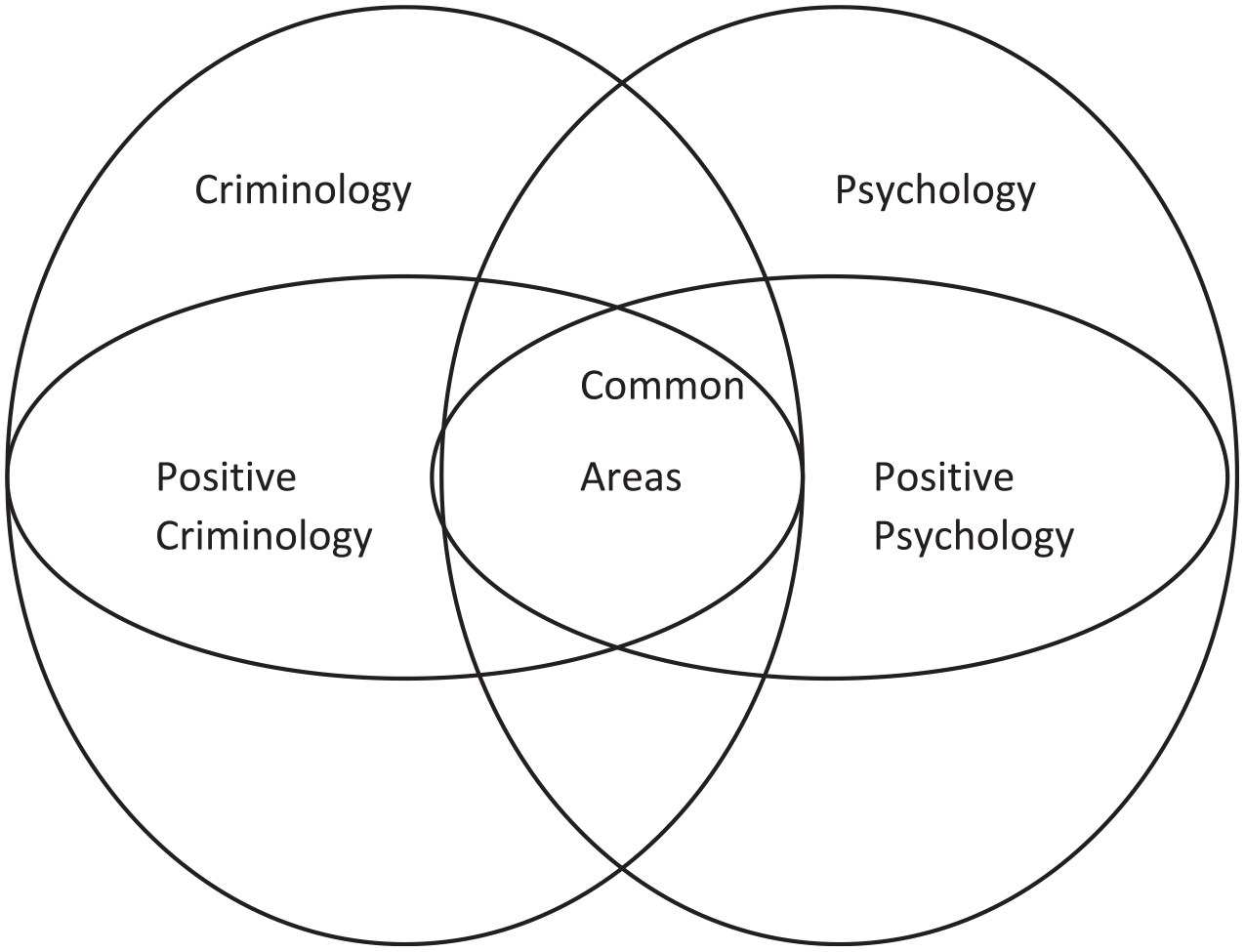
Common Areas of Positive Psycholody and Positive Criminology.
Target population
Although both approaches seek to improve quality of life and to enhance mental well-being by emphasizing strengths and positive aspects, positive criminology is inherently aimed at a specific and distinct population and thus at a comparatively limited range of experiences and behaviors. In other words, while the target population of positive psychology is potentially all human beings, positive criminology, by definition, only concerns at-risk individuals or offenders who wish to recover, rehabilitate, and reintegrate successfully into general society. For example, Kewley et al. (2020) has applied the positive criminology perspective extensively in the specific field of sexual harm and abuse—including prevention, treatment, law enforcement, rehabilitation, and victim assistance. Similarly, Elisha (2015) has used it to critically analyze the work of Israel’s Juvenile Probation Service. Yet another application is the interdisciplinary topic of the reentry of prisoners back into society (e.g., Maruna & LeBel, 2015). These studies have implications in terms of research design, objectives, and implications as they highlight the benefits of using positive human components in care settings of at-risk youth and offenders (such as love, compassion, social acceptance, and support) to increase their responsiveness to treatment and its effects. They also provide valid opportunities for rehabilitation and reintegration, such as education, solid employment, and housing, which are essential for rehabilitation and reintegration processes.
Areas of knowledge and interest
Positive criminology, by its virtue of interdisciplinary nature, incorporates aspects of a range of fields of knowledge, such as psychology, sociology, law, education, and politics. One notable example of this is restorative justice—a key aspect of positive criminology—that is related to law enforcement (Braswell et al., 2001; Wager, 2015; Walker, 2015). While some of the implications of restorative justice pertain to positive psychology, some of its aspects are purely nonpsychological. In a parallel example from a law enforcement standpoint, Gal and Wexler (2015) have described how the therapeutic jurisprudence approach and the positive criminology perspective can be mutually beneficial to each other. In addition, positive criminology highlights certain social processes where positive approaches are very pertinent regarding incarceration, negative labeling, reintegration, and social rehabilitation, which are unrelated to the psychology field.
Defined values and aims
Positive criminology is an ethical perspective: It seeks to promote integration at the three aforementioned levels, which it regards as strictly positive, and disintegration as wholly undesirable, and urges individuals to move toward the former. The means to this end, as previously noted, are to be perceived as positive by the target population, even when they involve the non-doing principle (Amitay et al., 2021), that is, not interfering with the nature of things, and enabling them to happen the right way, as expressed in the seemingly paradoxical notion of “Gaining control by giving up control” (Baugh, 1988). In addition, positive criminology calls for an absolute morality (one that is nevertheless very flexible in application), following the golden rule (see Reinikainen, 2005), whereby offending, violence, causing harm, and addiction are seen as undesirable in almost all circumstances, and their prevention, termination, and desistance are sought-after aims. Conversely, positive psychology usually does take not a moral position (beyond its definition as “positive”).
Conclusion
Positive psychology and positive criminology are both concepts that incorporate theories and models that underline the positive aspect of humanity and are comparatively new areas of knowledge that have become well established in standard discourse and research. Both have emerged to balance and complement existing knowledge in their respective fields, by emphasizing personal and environmental strengths that help people enhance their mental well-being, recover, and live better lives. They differ mainly in their respective target population (all human beings versus individuals at risk, offenders, and victims, respectively); their areas of knowledge and interest; and their declared value system. Recently, positive criminology has evolved into the avenues of positive victimology (Pugach et al., 2017) and spiritual criminology (Ronel & Ben Yair, 2017), indicating the potential for further development and the growing impact of the positive approach.
However, as with any budding paradigm, shifts in ideology and practice may take time and some effort. We hope that the positive approach will continue to develop and become well-established, by relying on human strengths and values to promote and preserve the mental well-being of all humankind.
Footnotes
Declaration of Conflicting Interests
The author(s) declared no potential conflicts of interest with respect to the research, authorship, and/or publication of this article.
Funding
The author(s) received no financial support for the research, authorship, and/or publication of this article.
