



Abstract
Past research has highlighted a number of case- and court-level characteristics that may be associated with differences in case processing time, yet other factors remain relatively unexplored. Drawing on an extensive case-level data set of misdemeanor and felony cases resolved in New York City’s court system, the current study contributes to our knowledge of case processing time by examining the association between the relative volume of arraignments (at the borough level) and case processing time. The analysis employs standard regression techniques to assess the relationship between case volume and case processing time while controlling for a number of individual- and case-level characteristics. Results suggest the relative volume of cases coming into the court system is positively associated with case processing time, net of several relevant case-level characteristics. These findings contribute to the small and inconsistent findings reported in prior work. Implications of these findings for future research and criminal justice policy are discussed.
Introduction
Case processing time refers to the time it takes to move a criminal case from arrest through the various stages of decision-making to final case disposition, whether it be dismissal, a plea, or trial (Zatz & Lizotte, 1985). Over the years, a number of court rulings have emphasized the importance of avoiding court delays, highlighting there must be a balance between meeting the needs of those facing criminal charges, those who have been victimized, and society as a whole. Individuals charged with criminal offenses have a constitutional right to a speedy trial as guaranteed by the Sixth Amendment that involves freedom from oppressive pretrial incarceration as well as basic procedural safeguards that assure fairness in the criminal justice process (Garcia, 1992). It is important to note, however, that not all cases should be disposed of quickly and without careful thought and attention. Clearly, more complicated, more difficult, and more serious cases should receive more time than those that are less complex and carry less severe consequences. The idea of proportionality is intended to not only maintain equality and due process in the treatment of cases but also acknowledge the reality that resources are limited and must be managed (Ostrom et al., 2018).
Importantly, the time required for a criminal case to be processed has both human and financial costs. First, individuals who are detained during the pretrial period, who make up approximately 65% of all individuals in U.S. jails (Zeng, 2019), represent a significant financial burden to the system. Furthermore, the individual and human costs of lengthy pretrial periods can be measured in terms of lost wages and employment separation, mortgage/rent default, time away from families, and the like (Center for Prison Reform, 2015). 1 In addition, if cases are unnecessarily delayed or even too brief, the costs (both to the system and the individuals involved) can potentially undermine the legitimacy of the justice system (Voigt, 2016). Thus, while efficient case processing represents only one goal of the criminal legal system, in many cases it is related to very real human outcomes.
Case processing time is also arguably related to possible case outcomes, such as a plea bargain versus jury trial, as individuals who have been held in custody for longer periods of time may be more willing to enter a plea than those who have not spent time in jail, whereas those hoping for a dismissal or understanding of inevitable guilt may wish to delay processing as long as possible (Petersen, 2020; Sacks & Ackerman, 2012; Zatz & Lizotte, 1985). Given this, examining extra-legal factors associated with processing time and efforts to reduce unnecessary delays become central to providing equitable treatment (Jacob, 1983). These concerns have contributed to court-driven interventions such as the “Excellence Initiative” put forward by New York’s Chief Judge Janet DiFiore, whose goal was to improve case processing performance across jurisdictions statewide.
The question remains, however, whether there are other upstream factors (such as the volume of cases coming before the court) that may affect case processing time. The purpose of the current work is to examine the impact of system inputs (the volume of arrests/arraignments by month/year) on case processing time in New York City, after controlling for case severity, crime type, and other individual- and borough-level factors. First, we review the limited prior work on case processing time, presenting arguments as to why the volume of cases may affect processing time net of all case-level characteristics considered. We go on to highlight how changes in criminal justice policy and enforcement seen in recent years may contribute to the relative volume of cases coming to the courts and suggest that this variation may contribute to case processing times at the case level. We then discuss the data and methods used to address our research aims, followed by a presentation of results and a discussion of the findings and policy implications stemming from the current work.
Previous Work on Case Processing Time
Existing research has highlighted that case processing time can be affected by a number of factors, including individual case characteristics, court resources, rules and procedures as well informal norms and expectations within the courtroom workgroup. More broadly, these correlates can be grouped into organization-related factors and individual- or case-level factors. Organizational explanations focus on the effects of the court structure and operations, the availability of resources, and other court-specific procedures on case processing time, whereas other research explores how case and individual characteristics of the accused such as charge severity, the use of pretrial detention and/or bail, and whether an individual pleads guilty are all likely to impact the time needed to resolve an individual case. Below, we provide a brief review of factors discussed in previous research.
Case Characteristics and Case Processing Time
Quantitative exploration of the drivers of case processing time was a major focus in the 1970s and early 1980s (e.g., Church, Carlson, Lee, Tan, Chantry et al., 1978; Luskin, 1981; Mahoney et al., 1981). Notably, early work found that case- and individual-level characteristics were not salient predictors of case processing time, evidenced little consistency across studies, and left substantial variation unexplained (e.g., Flemming et al., 1992; Klemm, 1986; Luskin & Luskin, 1987; Neubauer & Ryan, 1982). For instance, examining state courts in Providence, RI; Dayton, OH; and Las Vegas, NV in the late 1970s, Neubauer and Ryan (1982) analyzed characteristics of the offense, characteristics of court processing, individual resources, and background characteristics finding that few individual-level characteristics were consistently associated with case processing time across the three jurisdictions examined. More recently, Ostrom and Hanson (1999) conducted a larger study of 3,500 felony cases finding the seriousness of the charge and manner of resolution (trial, deferral, or dismissal) to be the most consistent predictors of processing time. Few other case characteristics were associated with case processing across the nine courts examined. The authors’ results suggest the existence of few common individual and case characteristics, although they account for about one third of the variation in the time it takes to resolve criminal cases in the nine courts, with seriousness of charge playing a dominant role.
Zatz and Lizotte (1985) examined the effects of individual and case characteristics on the timing of court processing from arrest to disposition by guilty plea or trial in California, including whether timing differed across earlier and later processing of the same person (subsequent arrests of a given individual). Findings indicated that individuals arrested for the first time or those not seen as “hardened criminals,” such as youth and women, moved quickly through the system, while homicide and narcotics cases, and individuals arrested repeatedly who appear to specialize in a crime type were processed more slowly. Narcotics cases may be complex as prosecutors’ desire for more information (i.e., a given individual cooperating with the state by admitting guilt and testifying against others in exchange for leniency) may lead to more attempts at bargaining, whereas homicide cases have the most severe implications for consequences and protection of rights and personal freedom and thus may also take longer to resolve (Cohen & Reaves, 2006; Zatz & Lizotte, 1985). In addition, less serious cases are processed faster, as are those that involve hard physical evidence, such as firearm possession, where pleading is usually swift. Finally, the rate of case resolution increases with each successive time the same individual reentered the system (Zatz & Lizotte, 1985). Unfortunately, as noted by the authors, limitations included lack of information on bail status and time spent in custody following each arrest, as well being unable to examine jurisdictional differences (rural vs. urban, size, etc.).
Bielen and colleagues (2015), examining cases in Belgium, found that cases involving experts such as psychologists as well as the number of pleadings led to considerably longer time to disposition. This notion of case complexity echoes findings from Zatz and Lizotte (1985). Similar findings were evident among adult criminal cases across Canada in 2015–2016, where offense severity, number of court appearances in a given case, longer time between appearances, multiple individuals charged in one case, multiple charges, charges with a preliminary inquiry or trial, and cases resulting in a guilty decision increased time to disposition (Maxwell, 2018).
Faster processing time for those in custody have been attributed to pressures on incarcerated individuals to plead guilty, as well as incentive for guilty individuals to prolong their cases when out on bond (see also Casper, 1972; Neubauer & Ryan, 1982; Wildhorn et al., 1977). Cohen and Reaves (2006) found the median time from arrest to disposition was almost 3 months shorter for individuals detained in jail compared with those who returned to the community (see also Redlich et al., 2012, where those detained the entire time has their case disposed 2.5–7.5 times faster). More recently, Petersen (2020) found that individuals detained pretrial plead guilty 2.86 times faster than those who were released for felony charges in large U.S. urban jurisdictions. This suggests that the findings from prior work regarding faster case processing times for detained individuals compared with those released is related to the speed at which those who are facing charges plead guilty.
Finally, Redlich and colleagues (2012) examined the swiftness of diversion to mental health courts (i.e., the time from arrest to mental health court enrollment vs. initial arrest and disposition for individuals with and without mental health problems). Findings demonstrated that diversion to the mental health court took twice as long, with a mean of 70 days versus 37 days for traditional processing of individuals with a mental illness from the same jurisdictions, highlighting the importance of procedural differences based on case-level characteristics.
Prior work has examined felony case processing in New York City specifically (Rempel et al., 2016) and was designed to assess policies and practices that contributed to lengthier case processing times. Their work demonstrated that cases initially arraigned on felony charges took 199 days from arraignment to disposition (with a median time of 144 days), while felony arraignments that were indicted by grand jury averaged 325 days. Several factors were related to decreasing processing time, including the proportion of felony plea agreements without indictment or pleading cases down to misdemeanors early in the process, reducing adjournment lengths, and examining the length of time to resolve cases (Rempel et al., 2016). In addition, DNA-related backlogs, changes in defense provider (more common among serious cases), limited alternatives to incarceration, and fitness proceedings were associated with longer case duration within New York City (Rempel et al., 2016).
Organizational Factors, Local Legal Culture, and Case Processing Time
Given the relative inconsistency of findings related to case-level factors and case processing time many researchers began to explore the role of larger organizational factors in case processing time. Included in this area of research is the examination of courtroom structure and resource availability, the relative severity of cases before the court, and rules governing the trial process. Findings in this area suggest that case processing time is not significantly correlated with courtroom size, filings per judge, specifics of criminal charging process, or speedy trial rules (Church, Carlson, Lee & Tan, 1978; Eisenstein et al., 1988; Goerdt et al., 1989; Ostrom & Hanson, 1999), which lead researchers to examine how “local legal culture” may be related to the speed of case processing.
Packer (1964) was among the first to look at the importance of organizational and cultural variables. Although originally conceptualized to explain the role of individual values in the practice of criminal law, Packer’s notions of crime control and due process are relevant to case processing time. Crime control values emphasize speed and finality, where actors work similar to an assembly line and quantity of convictions is valued. This is much like the managerial orientation that places the importance of court operations and actors in the role of supervision and regulation of the population that flows through misdemeanor courts rather than determining guilt and determining appropriate punishment (Jacoby, 1980; Kohler-Hausmann, 2014). On the contrary, due process values emphasize quality and legitimacy without as much concern from time spent. Court actors operate within these “narratives” to justify case processing behaviors and define working goals (Narag, 2018). These ideas may be combined to develop an organizational-cultural understanding of variation in court processing time across jurisdictions.
For example, Eisenstein et al. (1988) explored courtroom workgroup dynamics and suggested that judges, prosecutors, lawyers, and other court actors develop informal exchange agreements to facilitate the disposition of cases. Similarly, Ostrom and Hanson (1999) suggest that courtroom actors have distinct expectations and attitudes toward the court and its leadership. If prosecutors perceive firm leadership and clear case management policies the court is often more expeditious, while the opposite is true when communications are less clear.
This body of existing research suggests that there may be both individual and structural/system characteristics, as well as specific policies, that have the potential influence to case processing time. Less studied is the potential for the demand side of the equation to impact case processing times. Trends in criminal behavior, such as the influx of crack cocaine in the 1980s, the dramatic increase in homicide cases in the early 1990s, the current opioid epidemic, and the resulting shifts in enforcement (i.e., zero tolerance or broken windows policing) are likely to lead to substantial differences in the volume of cases that come before the court across time and/or place. As such, it may be anticipated that a change in the volume of cases in each jurisdiction may be associated with changes in case processing time, net of commonly considered factors. Below, we expand on this hypothesized relationship, reviewing relevant research.
Why Case Volume May Be Associated With Case Processing Time
Prior work has examined the implications of “supply and demand” aspects on case processing time, both in Europe and the United States. One study of U.S. court size (e.g., number of judges) found increasing returns for court productivity with increasing court size, yet results have been confirmatory, contradictory, and even inconclusive across other counties (Voigt, 2016). An examination of civil case dispositions in Slovenian courts found that the mode of case disposition (those resolved through the full legal process, dismissals, etc.) was significantly related to supply (number of judges) and demand (number of cases) in medium-sized and large courts, although the effect sizes were rather small (Dimitrova-Grajzl et al., 2014). Other work has examined court size among the countries of the Council of Europe, finding that court size was not correlated with case resolution rates (Voigt & El Bialy, 2016). In contrast, the authors found that the degree of specialization of judges (only dealing with one area of the law) is negatively correlated with resolution rate, meaning significantly less efficiency (Voigt & El Bialy, 2016). Several other international studies, employing different methodologies, have found that increasing the number of judges does not necessarily reduce court processing times (Beenstock & Haitovsky, 2004; Buscaglia & Ulen, 1997; Dimitrova-Grajzl et al., 2014).
Voigt (2016) has identified potential factors that may determine the supply side of court output, including the number of judges per capita (and the characteristics of those judges in terms of experience, age, etc.), incentives judges are subject to, number and quality of staff, available technology, complexity of the judicial system itself (number of court layers), overall budget of the judiciary, number of nonjudicial tasks allocated to the judiciary (with the examples of land or firm registries given), percentage of judicial vacancies, and the complexity of cases filed. There is prior work from the United States finding that case processing time to resolution was not related to the size of the court, volume of filings or filings per judge, nor the courts’ criminal charging process (see also Church, Carlson, Lee & Tan, 1978; Eisenstein et al., 1988; Goerdt et al., 1989; Ostrom & Hanson, 1999; Ostrom et al., 2018). Rather, the extent of case flow management and control exhibited by a court over the pretrial stages, and its clear communication of such expectations, more strongly accounts for case processing time (Ostrom et al., 2018).
Of note, the studies reviewed above were related to the supply side (number of judges, characteristics of those judges, size of the court, etc.). Work related to the demand side, or volume of cases, is most relevant to the research questions explored by the current study. Early work regarding the volume of cases explored factors that would increase or decrease the volume of cases in civil courts, such as court fees, propensity to litigate, and court delays/waiting time (Voigt, 2016). But this is not the question we are examining herein (what creates volume?); rather, we are asking whether increases or decreases in case volume are associated with court processing time. Early work by Luskin and Luskin (1987) found that court caseload had no effect on processing time in Detroit but had a positive relationship in Providence. Inconsistent findings related to judges’ caseloads have also been found, where the judge’s caseload had no effect in Dayton, but had a negative effect in Detroit, such that a 50-case increase for a judge in Detroit equated to a 4-day faster average case processing time (see also Luskin & Luskin, 1986; Luskin & Luskin, 1987).
Importantly, previous measures of caseload or case volume were limited in a number of ways. Using a sample of 2,026 cases drawn from court records between April 1976 and March 1978, Luskin and Luskin (1986) examined two measures of relative case volume in their analysis of case processing time. The first measure represented a more global measure of case volume and was generated by taking the total number of individuals before the court at the beginning of the month in which a case was arraigned, divided by the number of judges available. The second measure was judge-specific and consisted of the number of individuals on a particular judge’s docket during the month the case was initiated. Although novel at the time, this approach fails to account for the potentially dramatic swings in the volume of cases present in front of the court over time as their analysis only included 2 years of data. Furthermore, although their sample was chosen at random, the authors failed to explore the potential for monthly caseload to play a role in case processing time among the population of felony cases disposed of by the court during this period. The current study expands upon existing research by assessing the association between case volume and case processing time during a period in which case volume fluctuated substantially. Furthermore, we assess this relationship among the full population of cases disposed of by courts in five counties (i.e., boroughs) in New York City during the period understudy.
One may speculate that the volume of cases coming into the system could also have a significant impact on processing time independent of the other system inputs. Nardulli (1979) discusses the importance of examining caseload size relative to court resources when constructing a measure of “caseload pressure” (see also Wooldredge, 1989). Given variation in the nature (i.e., type) and volume of court cases both within and between boroughs, it seems reasonable to expect that these differences would have an impact on case processing time in the aggregate. Furthermore, due to the positive correlation observed between the quantity and the seriousness of crime across areas, it can be expected that those areas with a larger proportion of more serious crimes are likely to experience longer delays in case processing. Below, we highlight a number of shifts that occurred in New York City during our study period which are likely to have affected the volume and nature of cases coming into the system and thus have the potential to impact case processing times.
First and foremost, police policies and enforcement tactics are likely to be directly related to the total number of cases that come before the court during a given period. Changes in public policy, political appointments, and social forces are all likely to influence overall enforcement from one year to the next. Older research from New York highlights the potential role of case composition and volume. During the late 1980s and early 1990s, the city witnessed dramatic and unprecedented changes in case volume and composition associated with the policing of drug offenses (Goerdt & Martin, 1989). These increases led to significant management and policy problems for court systems across the country, including New York (Belenko, 1990). A study by the National Center for State Courts concluded that increased narcotics caseloads were straining resources in some courts to the breaking point: “Even in well managed courts . . . a rapid and substantial increase in filings per judge will probably lead to a caseload ‘saturation point’ and longer case processing times” (Goerdt et al., 1989, p. 36). Church and Heumann (1989) provide a detailed account of attempts by the City of New York to reduce time for individuals awaiting trial for long period of time (their oldest felony cases) to relieve pretrial detention overcrowding through monetary incentives to district attorney’s offices (the “Speedy Disposition Program”).
More recently, reappointed New York Police Department (NYPD) Commissioner Bill Bratton called for drastic decreases in the total number of contacts between police and citizens (Baker, 2015). This announcement, in tandem with legislation that required that marijuana possession be resolved using a criminal summons (rather than resulting in arrest), led to greater reductions in total arrests (Brooklyn District Attorney’s Office, 2018). A previous study conducted by the Data Collaborative for Justice found that felony and misdemeanor enforcement (as measured by arrests) decreased nearly every year between 2013 and 2018. In that time frame, total enforcement decreased by 35% in New York City (Scrivener et al., 2020). Finally, progressive legislation ratified in New York City, such as the Criminal Justice Reform Act, which decriminalized many minor quality of life offenses, as well as New York State legislation that raised the minimum age for most criminal charges to 18, further decreased the total number of individuals entering the criminal court system in recent years (Mulligan et al., 2018; New York City Mayor’s office, 2017).
Congruently, each borough elects their own district attorney, has their own set of judges, and is given a unique set of resources as well as the power to make policy decisions that can affect the number of cases that come before the judge in a given court. For example, Cyrus Vance, the Manhattan District Attorney, recently instituted a policy that his office would no longer prosecute subway fare evasion cases (Manhattan District Attorney’s Office, 2019). Vance’s “decline to prosecute” policy went into effect on February 1, 2018, resulting in the dismissal of more than 500 cases per month with the total number of arraignments falling over 95% within 1 year. Similar decisions regarding the prosecution of marijuana possession took place in Brooklyn in 2014 (Clifford & Goldstein, 2014), Manhattan in 2018 (Manhattan District Attorney’s Office, 2018), and in the Bronx in 2019 (Deutsch, 2019). The staggered nature of these changes, due to the timing of their intervention, is also likely to contribute to the variation present both over time and across boroughs.
It is these high-level policy shifts and resulting changes in enforcement that are likely to impact the volume of cases coming into the system during a specific point in time. Reductions of nearly 35% in misdemeanor arrests or the near total curtailment of prosecutions for fare evasion is likely to be consequential, and thus, we suggest that the resulting fluctuations in case volume are likely to be associated with case processing time during the period understudy. The current analysis explores this possibility using data from all five boroughs of New York City during a period that saw large shifts in the volume and nature of cases that came before the court.
Current Study
The current study utilizes data from the Office of Court Administration to explore the association between individual- and case-level characteristics and total case processing time across the five boroughs of New York City during the years of 2014–2019. The current study contributes to our knowledge of case processing time by assessing the anticipated association between the relative volume of arraignments (at the borough level) and case processing time, net of other relevant case-level characteristics using a series of multivariable models. Prior to the presentation of the results of our analysis and a discussion of potential policy implications, details unique to the New York City court system are provided, along with a description of the data and analytic methods used in the current study.
The New York City Context
Although New York City can be considered a single jurisdiction in many respects, each of the five boroughs has their own court system, along with dedicated stakeholders such as judges and prosecutors. Most judges are appointed by the mayor for a term of 10 years, whereas district attorneys are elected by community members. Furthermore, relevant to case processing time, the court system is separated into a two-tiered system. The first, Criminal Court, represents the lower court that handles all misdemeanors and lower-level offenses as well as holds arraignments for most felonies (excluding those that are initiated via a grand jury). The Supreme Court is a higher court and is responsible for the criminal prosecution of felony offenses following indictment or guilty plea (DiFiore & Marks, 2016).
In New York City, most criminal cases begin with an arraignment in criminal court, regardless of charge level. Misdemeanor cases are relatively straightforward, as all misdemeanor cases are heard, tried, and disposed in Criminal Court. The felony case process is more complicated. At arraignment, an individual accused of a felony enters a plea of guilty or not guilty. If the individual pleads guilty, the case must be disposed as a misdemeanor in the lower criminal court. If an individual pleads not guilty, the case moves onto Supreme Court. Once in Supreme Court, the case awaits the action of a grand jury. If the individual gives up a grand jury proceeding, the prosecutor will file a Superior Court Information (SCI), a written accusation of charges, which is subsequently processed by the Supreme Court for sentencing (New York State Unified Court System, n.d.). If the individual enters a not guilty plea, the case then proceeds to grand jury hearing. If the grand jury indicts, it then proceeds to the Supreme Court for a full trial. With this in mind, the current study examines the factors associated with misdemeanor and felony case processing time separately, examining those disposed in Criminal Court independently of those processed by New York City Supreme Courts.
Data and Methods
This study uses data provided by the New York State Office of Court Administration (OCA) on misdemeanor and felony case processing in New York City Criminal and Supreme Court. The data are organized at the docket level, meaning each observation in the data set represents a unique case. A single individual can have multiple, separate dockets over the course of the study period. Separate data sets for arraignment, disposition, and attorney information were merged together using borough of arraignment and a unique case ID. The data include individual-level (e.g., sex, age, and race/ethnicity) and case-level (e.g., borough, charge, disposition type) information for each case. Although a single case can involve multiple charges, only the top charge at arraignment is provided. The analysis includes cases disposed between January 1, 2014, and December 31, 2019. Among misdemeanor cases, we exclude those with a top charge of prostitution (PL § 230.00 and PL § 230.03) because in many cases, particularly if they are transferred to specialized human trafficking courts, guilty pleas are eventually vacated, and cases subsequently dismissed. We also exclude cases that were dismissed due to a not fit to stand trial decision because these cause significant delays due to mental health evaluations and restoration efforts. 2
Outcome Measure
The dependent variable assessed in the current study is the number of days between arraignment and disposition. For many cases, this is simply the total number of days from the date of the first court appearance (arraignment) until the final disposition. However, there are exceptions if an individual fails to appear in court at any point, a warrant is issued, and their case is delayed. In this situation, the number of days the warrant is active is subtracted from the total case processing time, as the court is not at fault for the delay.
Predictor and Covariates
The primary independent variable in the current study is a measure of case volume. As mentioned above, there is a high degree of variability in the number of cases across boroughs, and from year-to-year. To capture this variation, we created a standardized score to represent the relative volume of cases existing at the time a given case was arraigned. To compute this measure, we first estimated the average monthly volume of arraignments in a given borough over the entire period under study (2014–2019). Then, we computed the total number of arraignments for each borough-month, subtracted the mean over the entire period, and divided by the standard deviation in monthly totals (essentially creating a z-score). The resulting measure provides a standardized estimate of the volume of cases in a given month relative to the average number of cases in that borough over the entire study period, thus capturing seasonal and annual variation within each of the boroughs of New York City.
All models include a number of individual-, case-, and borough-level characteristics that have been shown in past research to be associated with case processing time. The individual-level covariates considered are inclusive of demographic characteristics, namely, sex, race/ethnicity, and age. Specifically, the regression models presented below control for sex (male = 1), age at arraignment (continuous, M = 17.2, SD = 1.31), and dichotomous indicators for Black (= 1; non-Hispanic), Hispanic (= 1), and Asian (= 1), with ethnicity preceding race and White representing the reference group in each of the models shown.
We capture the nature of the most serious offense an individual was arrested for using a series of dichotomous variables. For the misdemeanor analysis, this measure includes a total of nine categories: (a) court-related charges such as criminal contempt in the second degree (PL § 215.50[03]), (b) drug (e.g., criminal possession of a controlled substance in the seventh degree, PL § 220.03), (c) other such as criminal trespass in the second degree (PL § 140.15), (d) person (e.g., assault in the third degree, PL § 120.00), (e) property (e.g., petit larceny, PL § 155.25), (f) sex crime (e.g., forcible touching, PL § 130.52), (g) vehicle related (e.g., aggravated unlicensed operation of a motor vehicle in the third degree, VTL § 511[01]), (h) weapons charges (e.g., criminal possession of a weapon in the fourth degree, PL § 265.01), and (i) theft of services (turnstile jumping). Theft of service crimes are omitted from the charge type measure in the felony analysis (as they do not represent felony crimes), while an additional category for murder/manslaughter is introduced given the general complexity of these cases above and beyond other person-related crimes. The most common offense type among misdemeanor cases was against-person offending (19.9%), while among felony cases the most common category was drug offenses (25.7%), followed by against-person offenses (23.5%). For both analyses, we chose to use property crimes as the reference category.
In addition to charge type, we include a number of case-level variables that may be associated with variation in case processing time. First, we include a measure of pretrial detention, set to 1 if a person was detained at any time prior to the disposition of the case. Second, for felony cases only, we include a measure of change in counsel if the attorney on record changed between arraignment and disposition. Third, for felony cases only, we include an indicator of the presence of Superior Court Information (SCI), which in essence is a guilty plea filed by the district attorney’s office when the individual standing trial waives their right to a grand jury prior to indictment (0 = no, 1 = yes). Finally, for felonies resolved in Supreme Court, we control for the presence of multiple individuals charged in a single case (0 = no, 1 = yes).
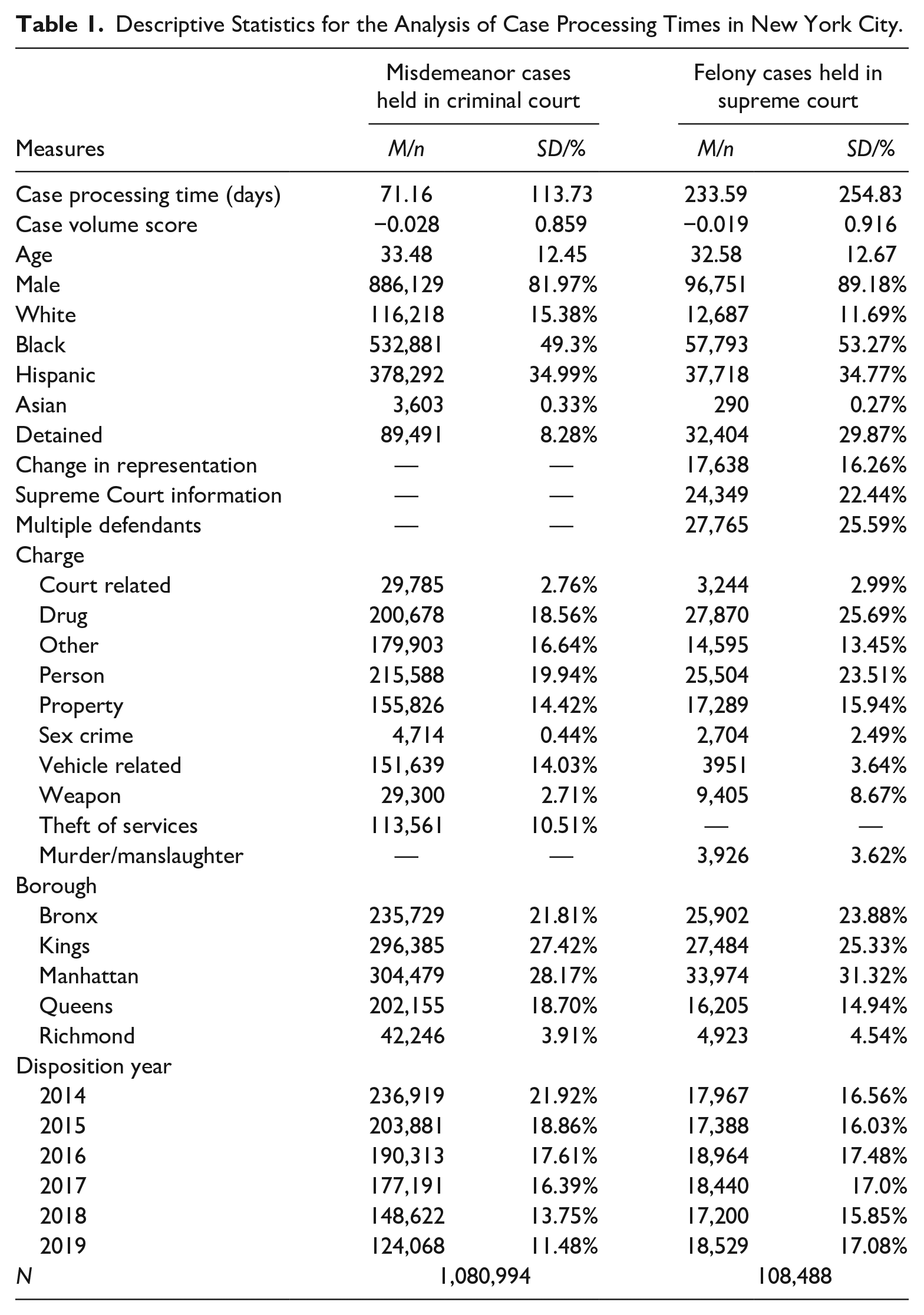
Importantly, to isolate the effect of changes in case volume we include a series of dichotomous variables designed to capture the between-borough variation present across the five boroughs of New York City as well as any time-specific shocks present across the city for each year and month of data included in the analysis. 3 Specifically, we include dummy variables for each of the boroughs in New York City: (a) the Bronx, (b) Brooklyn (Kings County), (c) Manhattan (New York County), (d) Queens, and (e) Staten Island (Richmond County) as well as each year 2015–2019 and each month. 4 In each of the analyses presented, Manhattan, 2014, and January represent the reference category. The inclusion of these measures allows us to account for many of the unmeasured factors present across boroughs (e.g., number of judges, district attorneys, or court staff) as well as changes in charging practices from year-to-year and other factors that may impact the operation of the courts during specific time periods (e.g., the holidays). Descriptive statistics for all measures employed in the current analysis are displayed in Table 1.
Descriptive Statistics for the Analysis of Case Processing Times in New York City.
Analysis
For the analysis of both misdemeanor and felony cases (separately), we estimate a series of negative binomial regression models. Although ordinary least squares (OLS) results are easily interpretable, and the method has often been used to assess the association between case characteristics and case processing time, case processing time (in days) represents a count variable and therefore OLS may be problematic for a number of reasons. While Poisson regression represents an alternative to OLS regression when count data are used, preliminary analyses indicated that overdispersion was present in our data, thus making negative binomial the most appropriate choice (Barron, 1992). Finally, due to the known issues surrounding nonindependence between observations (the nesting of cases within boroughs and within years), all results were estimated using clustered standard errors. Specifically, Huber-White clustered standard errors, using groups defined by borough-year, were estimated to reduce the chance of incorrect statistical inferences being made due to the hierarchical structure present in our data. 5
Results
Descriptive statistics for the two types of criminal court cases are presented in Table 1. Of the 1,189,482 cases included in the analyses, just over 9% were felony cases disposed in Supreme Court. The remaining 91% or just over 1 million cases were arraignments that were disposed as misdemeanor in Criminal Courts. The average processing time among misdemeanor cases was 71.2 (SD = 113.73) days, whereas the average indicted felony case was substantially longer (M = 233.59, SD = 254.83). 6 Individual characteristics across the two case types were fairly similar, with males and Black individuals representing the majority of the cases in question. Just over 8% of the individuals arraigned on misdemeanor charges were detained prior to trial, compared with nearly 30% of individuals charged with felonies. In addition, of the cases resolved in Supreme Court, 22.4% resulted in a guilty plea via Superior Court Information, and 25.6% of the cases involved multiple individuals.
Manhattan processed the greatest number of misdemeanor and felony cases, followed closely by Brooklyn and the Bronx. Substantially fewer cases were disposed in Queens and even fewer in Staten Island. Overall, the number of cases disposed in Criminal Courts, primarily misdemeanors, shrank between 2014 and 2019, with 2019 accounting for only 11.5% of all misdemeanor cases. On the contrary, the number of resolved felony cases remained relatively consistent over the study period.
Table 2 contains the results of our multivariable analyses designed to explore the factors associated with misdemeanor case processing time in New York City. The first model includes the individual- and case-level measures along with our measure of the relative monthly case volume. The second model also includes borough, year, and month indicators to explore whether results are robust to their inclusion and control for location- and period-specific effects that may affect case processing time.
Factors Associated With Misdemeanor Case Processing Time in New York City.
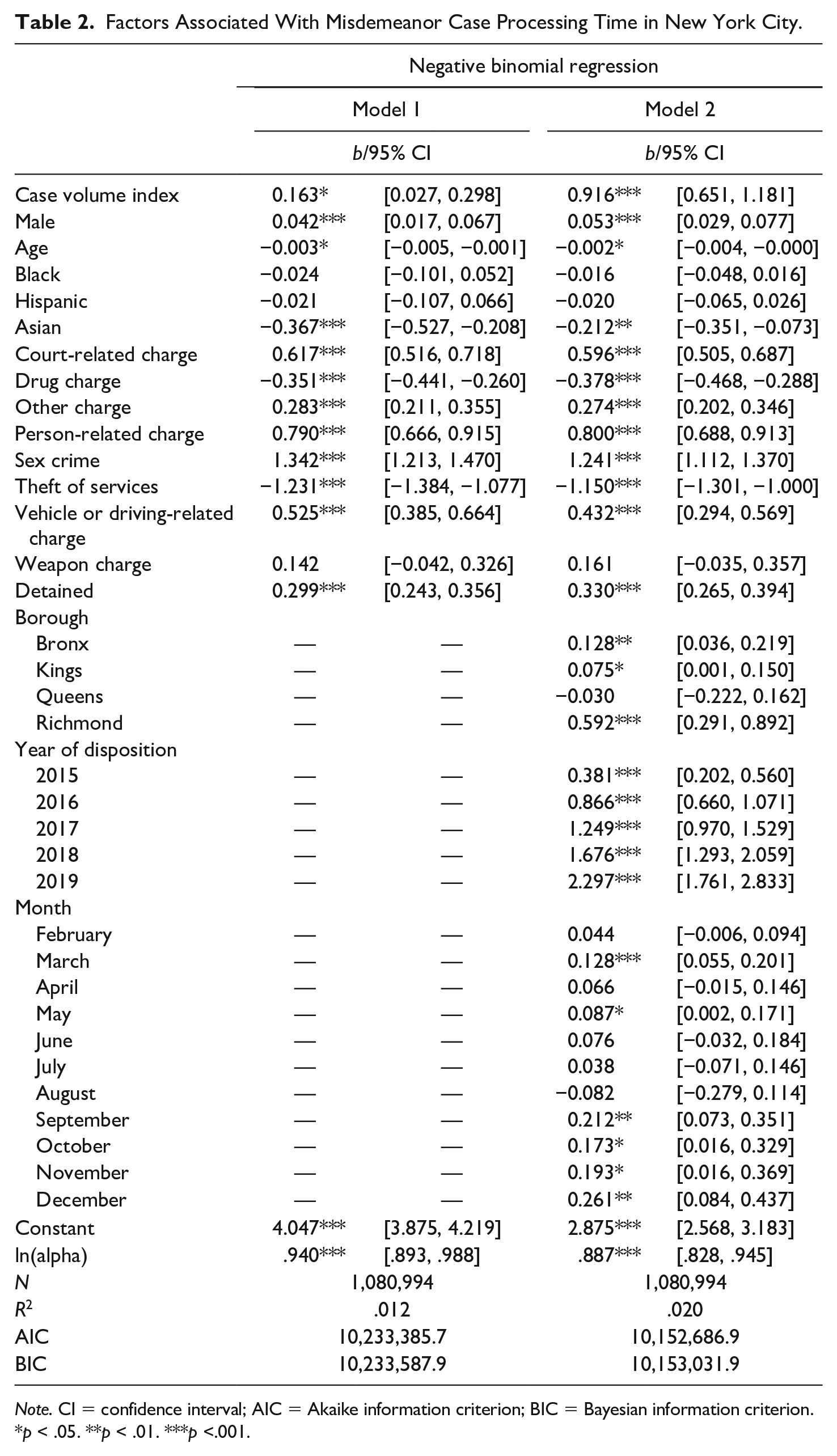
Note. CI = confidence interval; AIC = Akaike information criterion; BIC = Bayesian information criterion.
*p < .05. **p < .01. ***p <.001.
As shown in the first model of Table 2, being male was significantly associated with longer case processing time, while being Asian was significantly associated with shorter case processing time. While court-related, person-related, driving-related, other charges, and sex crimes were associated with longer case processing time, individuals who had been charged with drug-related crimes or theft of services had their cases disposed of more quickly. Finally, of the included control variables, misdemeanor cases in which the individual was detained pretrial took significantly longer to be disposed compared with cases in which the individual was released. 7 Related to the focus of the current study, the case volume index was significantly and positively associated with misdemeanor case processing time.
Turning to the second model of Table 2, which includes the borough and period indicators, the effects observed in the first model appear to hold, although many of them change substantially in terms of magnitude. Most relevant to the current study is the association between the case volume index and misdemeanor case processing time, which increased substantially once borough- and period-specific effects were accounted for by the introduction of borough, year, and month indicators. Specifically, a one-unit increase in monthly case volume was associated with a nearly 150% increase in time between arraignment and disposition, exp(.916) = 2.49; [2.49 − 1] × 100 = 149%, accounting for all other factors. This association is shown in Figure 1, where the predicted case processing time (in days) is displayed given different values on the case volume index with all other variables held at their means. For simplicity, values at +1/−1 standard deviation from the mean were used to represent “low” and “high” case volumes coming into the system.
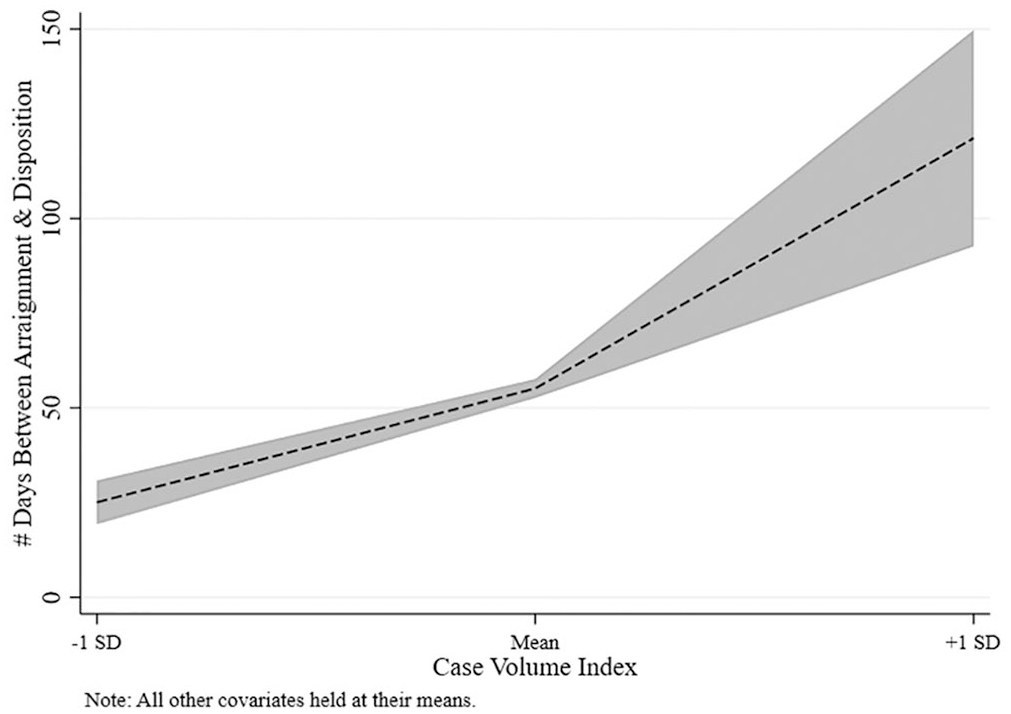
The association between case volume and case processing time among misdemeanor cases in New York City.
Results also suggest that case processing time varies across the New York City boroughs. Misdemeanor cases in Richmond County (Staten Island), the Bronx, and, to a lesser extent, Kings County (Brooklyn) were associated with significantly longer case processing time. There is also evidence that after accounting for all individual- and case-level characteristics, misdemeanor case processing time increased over the period understudy. Positive and increasingly large coefficients for each of the year dummy variables suggest that cases processed in more recent years have taken longer to be disposed. Finally, there are a number of months associated with significantly longer case processing time. Specifically, cases in March, May, September, October, November, and December had significantly longer case processing times than those disposed in January, net of all other factors. Although we did not hypothesize any specific monthly effects apriority, these results suggest that misdemeanor cases that are disposed of during the holiday season tend to take longer than those disposed during other months of the year.
Table 3 includes the results of a similar set of multivariable analyses designed to assess the same associations among all felony cases before the court across the five New York City boroughs. Most central to the aims of the current study, the results suggest that the volume of felony cases entering the system was again positively and significantly associated with case processing time. Once all case-level characteristics and individual-level demographics, borough, year, and month are accounted for, a one-unit increase in the case volume index was associated with a 10% increase in case processing time (Model 2). This provides further support for the inclusion of the borough and period-specific control variables that account for much of the unobserved heterogeneity present.
Factors Associated With Felony Case Processing Time in New York City.
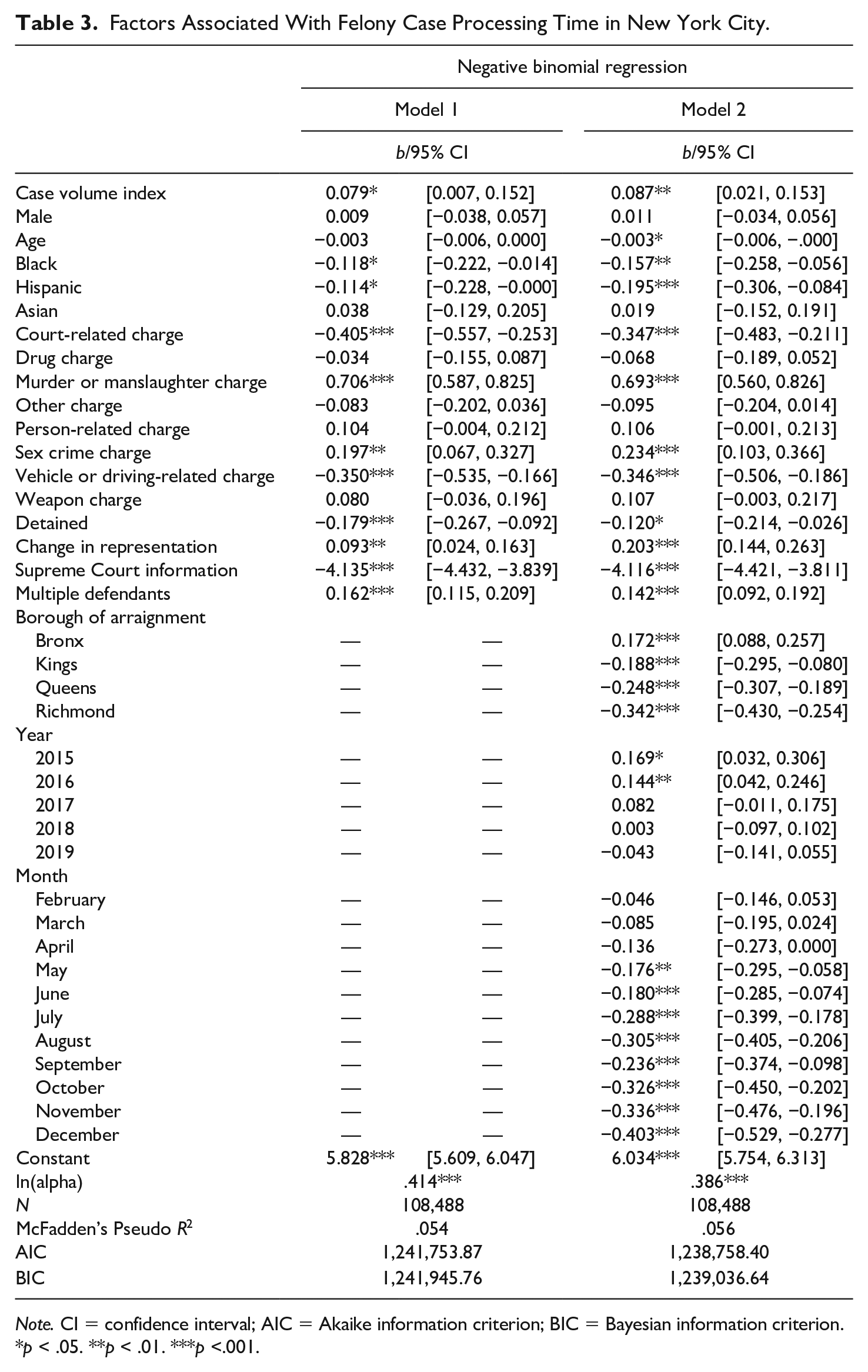
Note. CI = confidence interval; AIC = Akaike information criterion; BIC = Bayesian information criterion.
*p < .05. **p < .01. ***p <.001.
In terms of magnitude, the association between case processing time and case volume among felony cases is much smaller than observed among misdemeanor cases. Perhaps more importantly, the association between case processing time and case volume among felonies is relatively small in magnitude when compared with the other factors considered, especially charge type. For example, compared with property crimes, cases involving murder or manslaughter charges, as well as those involving sex crimes were associated with significantly and substantially longer case processing times. Interestingly, case processing times were shorter among felony cases in which the individual facing charges was detained prior to trial. This was opposite of the relationship observed among misdemeanor cases. As can be anticipated, felony cases with Superior Court Information (akin to a guilty plea) were disposed more quickly than those cases that went before a grand jury for indictment. Also as anticipated, cases that involved a change in counsel were associated with significantly longer case processing times. Finally, cases involving multiple individuals, which often tend to be more complex in their nature, took longer to be disposed.
Results presented in Table 3 suggest that there are also a number of differences observed across boroughs and over recent years. Except for the Bronx, results suggest that felony cases take longer to be resolved in Manhattan (the reference category) than in other boroughs. Relative to 2014, cases disposed in 2015 and 2016 were associated with longer case processing times (net of all other factors consider), while other years had similar case processing times to 2014. Finally, across the study period, cases disposed from May through December had relatively shorter case processing times compared with January.
Overall, the results shown in Table 3 are largely consistent with those estimated among misdemeanor cases. Most notably, the volume of cases coming into the system is associated with case processing time among both misdemeanor and felony cases in New York City. Although statistically significant, it is important to note that the magnitude of observed associations is substantially smaller among felony cases than it is for misdemeanors, with other factors appearing more salient to case processing time among felony cases. The association between case volume and case processing time among felony cases is shown in Figure 2. These results, as well as limitations of the current study and considerations for future research, are discussed in greater detail below.

The association between case volume and case processing time among felony cases in New York City.
Discussion
The current study examined individual-, case-, and borough-level factors associated with case processing time among all cases arraigned across New York City’s five borough between 2014 and 2019. Our findings add to our knowledge of case processing time by estimating the relationship between the relative volume of arraignments (at the borough level) and case processing time, net of other relevant case-level characteristics using a series of multivariable models. As was anticipated, the relative volume of cases coming into the New York City court system was significantly associated with case processing time, in that cases arraigned during months with larger monthly caseloads were associated with longer case processing time, net of other factors. We also found that the association between case volume and case processing time was greater for misdemeanors than for felonies, which may be because the volume and nature of felony cases did not change over the study period. Another possibility is that misdemeanor cases are receiving greater due process. For example, individuals charged with misdemeanors are less likely to plead guilty or no contest when they are more informed of their right to counsel, constitutional rights, and the conditions and consequences of entering a plea (Smith & Maddan, 2020).
These findings contribute to the small and inconsistent findings reported in prior work, which found little evidence that caseload was associated with case processing time (Luskin & Luskin, 1986, 1987). Furthermore, our study improves upon past research by assessing this association among the population of both misdemeanor and felony cases across each of the boroughs in New York City. Finally, we assessed this relationship during a period in which numerous policy changes were enacted, many of which had clear implications for the relative volume of cases put in front of the court, such as a dramatic decline in misdemeanor arrests for more discretionary arrests such as theft of services (i.e., turnstile jumping), decriminalization of marijuana possession, and decision by some district attorneys to no longer prosecute marijuana possession and/or turnstile jumping (Brooklyn District Attorney’s Office, 2018; Clifford & Goldstein, 2014; Deutsch, 2019; Manhattan District Attorney’s Office, 2018, 2019; Scrivener et al., 2020). Although we do not test the impact of any one policy change explicitly, we argue that case volume is the mechanism by which these policy changes may affect case processing time in the aggregate.
Other results stemming from our current analysis echo a number of the findings drawn from previous research. For example, cases in which individuals were charged with serious offenses, such as violent and sexual offenses, took longer to be disposed compared with less serious offenses (Rempel et al., 2016). Our findings also suggest that demographic characteristics are not strongly associated with case processing time, with sex being the only significant demographic predictor across the majority of models estimated. Thus, consistent with recent research, case-level factors seem to play a larger role in case processing time than the demographic characteristics of the individuals involved in those cases (Petersen, 2020).
Among the case-level factors included in the current analysis, a change in counsel and the presence of multiple individuals in a single case were associated with longer case processing times among felony cases resolved in Supreme Court. The latter is consistent with prior work that has found that the presence of multiple individuals in a case contributes to longer case processing times due to scheduling complications and protracted plea bargaining (Luskin & Luskin, 1986; Petersen & Lynch, 2013). Past research in New York City confirms that having a change in counsel over the course of a criminal case is strongly associated with longer case processing times (Rempel et al., 2016). In contrast, the filing of Superior Court Information, equivalent to a guilty plea in felony cases prior to being arraigned in Supreme Court, was unsurprisingly associated with a dramatic reduction in case processing time.
In regard to the association between pretrial detention and case processing time, we found opposite effects when examining misdemeanor cases independently from felony cases. More specifically, results suggest that when an individual facing a misdemeanor charge is detained at any point during the case process, the case was resolved more slowly than in cases where the individual was not detained. The negative association between being detained pretrial and case processing time among felony cases has also been observed among individuals charged with felonies in nine courts across eight states, and individuals who were detained pretrial had significantly shorter case processing times (Ostrom & Hanson, 1999). The authors of this study suggested that this association could be explained by the fact that courts gave priority to cases in which individuals were detained given these were also more likely to be more serious in nature (Ostrom & Hanson, 1999, p. 8).
Also consistent with past research on the New York City court system, we found evidence that case processing time varies significantly across boroughs, with felony cases taking the longest in the Bronx, while misdemeanors took a longer time to resolve in Staten Island (Rempel et al., 2016). Although it was beyond the scope of the current work to comprehensively explore why this may be the case, past research has suggested that in addition to the volume of cases and their characteristics, courts exist in their own social contexts and operate with their own “organizational arrangements” that give rise to unique court cultures and contribute to variability across courts (Johnson, 2006; Ulmer & Johnson, 2004). More specifically, in addition to the factors explored here, scholars have suggested that case processing time is determined in large part by established expectations and practices set by individual judges and attorneys as part of “local legal culture” (Ostrom et al., 2007). Stemming from this, it is also possible the relationship between case volume and case processing time varies across jurisdictions. That is, an increase in case volume may not result in similar increases in case processing time across different courts. This is something future research should explore with an eye toward identifying which types of courts may benefit the most from initiatives aimed at reducing case volume.
Research and Policy Implications
Our results suggest that reducing case volume may reduce case processing time, net of other factors. First, case volume could be reduced through pretrial diversion programs that are also promising with regard to reoffending (Dalve & Cadoff, 2019; Davis et al., 2021). For example, and as is happening in New York City, jurisdictions can implement pretrial diversion programs for misdemeanor cases, for younger individuals, and for those with mental health needs, thereby reducing court dockets (Center for Court Innovation, n.d.). Participants of Project Reset in Manhattan who were arrested for low-level nonviolent charges and had no prior criminal records were significantly more likely to have their cases dropped before arraignment as a result of the district attorney declining to prosecute and were less likely to be rearrested (Dalve & Cadoff, 2019). However, increased use of pretrial diversion could also increase the average case processing time given that lower-level cases that are less complicated are being funneled out of criminal court, but only if diversion is successful.
Also relevant to our findings, in 2016, the New York State Chief Judge launched the “Excellence Initiative” to improve court efficiency, reduce case backlogs, and increase trial capacity, partly in response to considerable case delays in New York City criminal courts (Gavin, 2016; New York State Unified Court System, 2017; Trowbridge et al., v. Cuomo et al., 2016). The initiative established a number of performance benchmarks to ensure the “timely resolution of different categories of cases” and created a unified case management tool to provide judges and court staff updated case information (New York State Unified Court System, 2017). In the first 3 years of implementation, all New York City criminal courts experienced reductions in overall misdemeanor caseload, ranging from 15% in Staten Island to 33% in Manhattan (New York State Unified Court System, 2019). Although the current study is not a direct evaluation of this initiative, our findings suggest that this reduction in caseload is likely to be partially responsible for the observed reductions in case processing time. The introduction of this initiative also aligns with the trend in felony case processing time observed in the current study. The average felony case processing time observed across the city fell significantly from 252 days for cases arraigned in 2014 to just below 185 days for those arraigned in 2018. Furthermore, the volume of misdemeanor cases not resolved within a year fell by 84% and 85% in the Bronx and Manhattan, by 72% in Staten Island, by 43% in Brooklyn, and by 27% in Queens (New York State Unified Court System, 2019). These statistics and other recent evaluations conducted at the borough level (see Weill et al., 2021) suggest that projects aligned with the goals of Chief Judge DiFiore’s Excellence Initiative may be successful in reducing court processing time.
A number of jurisdictions have recently enacted bail reform and alternatives to arrest programs. In New York State, of January 1, 2020, most misdemeanor and nonviolent felonies are no longer eligible for money bail. During this same time, most misdemeanor are mandated as desk appearance tickets (also known in other areas as citations) with arraignment (first appearance) occurring within 20 days rather than 24 hours of contact with the police. Future research should examine how these policies impact case processing time particularly in light of our results indicating that pretrial detention was associated with longer case processing time for misdemeanors but shorter case processing time for felonies.
Furthermore, given our results that change in counsel is associated with longer case processing times in felony cases, the implementation of vertical prosecution (which requires the same prosecutor to see a case from start to finish) may reduce case processing times. Future research should examine the variation in office policies on vertical prosecution to determine where court delays are most likely and how they can be reduced.
Limitations
Although we believe the current study adds to the literature on case processing time in a number of meaningful ways, it is not without its limitations. First and foremost, the data used are limited to a single court system in the largest urban area in the country. Although our results may be generalizable to more urbanized criminal justice systems (Schlesinger, 2005), it is unclear whether our findings may be generalized to suburban and rural settings.
Second, although the data analyzed capture a number of characteristics regarding each case analyzed, the items inclusive are not exhaustive. Most notably, as the data available only include information on the most serious charge being considered, we do not know whether the cases include multiple charges, which lends itself to case complexity and is likely to impact case processing time. In addition, we cannot account for any delays in case processing time that were due to individual decisions made by the court, the attorneys, or the individuals facing criminal charges themselves. Recent research has highlighted that not all individuals facing criminal charges find the pretrial period coercive and some are likely to attempt to delay the process in the hopes of receiving a more favorable plea deal (Euvrard & Leclerc, 2017). Research from New York City also finds that defense strategy, such as holding out for better plea deals, and attorney scheduling conflicts are often sources of delay (Rempel et al., 2016). Unfortunately, with the data available to us from the New York court system, we cannot assess whether some cases with longer processing times were associated with delays outside of the court’s control.
An additional substantial limitation to the present study is that the data used did not allow us to assess the role of working-group culture, which may emphasize courtroom efficiency and keeping case processing times to a minimum (Eisenstein et al., 1988). There is no doubt that judges themselves and the culture that they cultivate in their courtrooms may have an impact on case processing time in the aggregate. If judges are able to articulate their goals and coordinate with other members of the courtroom working group, actors are more likely to develop a shared culture that emphasizes efficiency, speed, and finality in the disposition of cases (Narag, 2018). One study found that courts in which judges establish case flow expectations and emphasize solidarity among courtroom actors resolved cases with greater efficiency compared with courts where prosecutors and defense attorneys have autonomy to determine the speed of case proceedings (Ostrom et al., 2007). Others have noted that for many prosecutors, “efficiency and speed of disposition provide daily evidence of the court professional’s work ethic,” and thus disposition speed serves as way to measure one’s performance (Van Cleve, 2016, p. 58). Although information on individual actors was not available, and we did not measure courtroom culture, our models do account for between-borough heterogeneity in factors such as staffing and organizational culture through the use of borough and period-specific indicators. Although we cannot say much about what explains the variation observed between the five New York City boroughs, we have confidence that our findings related to the association between case volume and case processing time are sensitive to their inclusion.
Finally, although we argued that major policy decisions are likely behind some of the sizable shifts in case volume over the analysis period, we do not attempt to evaluate the effect of these policy shifts explicitly. Instead, our analysis relied on the monthly case volume observed in each borough, which is likely to be driven by a number of factors outside of a district attorney’s control such as the underlying incidence of crime. Furthermore, other borough-specific policies and practices, such as the introduction of “vertical prosecutions,” and the hiring of 45 additional assistant district attorneys in the Bronx have been implemented in recent years (Hu, 2016). These policies and practices are inherently borough-specific and are likely to contribute to variation in case processing time across boroughs but were not the focus of the current study. Future research may do more to evaluate the implications of such policy decisions for case processing time, particularly in light of recent changes to legislation around evidence discovery and speedy trials in New York State (Senate Bill S1509C, 2019).
Conclusion
Despite these shortcomings, the current study adds to the relatively limited body of literature that examines the association between case volume and case processing time. Results suggest that larger relative case volumes are associated with an increase in case processing time among both misdemeanor and felony cases, controlling for other case characteristics. Results also highlight the salience of a number of case-level factors, including offense type, pretrial detention decisions, change in counsel, case complexity (as measured by the presence of multiple individuals being charged), and early felony guilty pleas (e.g., the filing of Supreme Court Information). As local stakeholders continue to consider additional options to keep individuals out of the court system, this study offers novel insights into the potential consequences of reducing case volume for case processing time.
Footnotes
Acknowledgements
We are grateful to Carolyn Cadoret and Karen Kane at the Office of Courts Administration, and Mike Rempel and Joanna Weill at the Center for Court innovation for their thoughtful guidance and feedback. We also thank Virginia Bersch, Director of Criminal Justice at Arnold Ventures for her ongoing support.
Declaration of Conflicting Interest
The author(s) declared the following potential conflicts of interest with respect to the research, authorship, and/or publication of this article: Any data provided herein does not constitute an official record of the New York State Unified Court System, which does not represent or warrant the accuracy thereof. The opinions, findings, and conclusions expressed in this publication are those of the authors and not of the New York State Unified Court System, which assumes no liability for its contents or use thereof.
Funding
The author(s) disclosed receipt of the following financial support for the research, authorship, and/or publication of this article: This work would not have been possible without funding from Arnold Ventures. The opinions, findings, and conclusions expressed in this publication are those of the authors and not those of Arnold Ventures.
