



Abstract
During postconviction innocence review, prosecutors and defense attorneys can set aside their adversarial roles and cooperate on case reinvestigation and resolution. This dynamic makes the postconviction setting especially worthy for a study of attorney workgroup relationships. Yet, criminological research of these relationships traditionally focuses on pretrial processes. Therefore, this study explores how attorneys cooperate and even collaborate to investigate potential wrongful convictions. It employs semistructured interviews with 19 defense attorneys and 20 prosecutors who have each helped exonerate a wrongfully convicted defendant. Results demonstrate that prosecutors valued open communication and transparency, ample time to review the case, and diplomacy and tact in protecting the reputation of the prosecutors’ office. For example, prosecutors and defense attorneys may engage in postconviction negotiations regarding media strategies and misconduct allegations. These results may help guide policy proposals that promote the independence and integrity of postconviction innocence review.
In the past 20 years, wrongful conviction case review has undergone a dramatic development. Prosecutors—who were once expected to oppose claims of innocence on the basis of “case finality” (Findley & Scott, 2006) or out of fear of being seen as “soft on crime” (Medwed, 2004)—have started formally adopting policies to facilitate exoneration in some jurisdictions (Webster, 2020). Defense attorneys who recognize this shift may now approach receptive prosecutors for assistance before initiating litigation in the courts. This new opportunity for cooperation has transformed the nature of some postconviction courtroom relationships. For example, cooperation between prosecutor-led conviction integrity units (CIUs) and innocence organizations have produced dozens of exonerations since 2018 (National Registry of Exonerations [NRE], 2019; Scheck, 2019).
Nevertheless, even cooperative postconviction relationships involve imbalanced power dynamics. Prosecutors hold all the discretion when approached with an innocence claim. They can choose among several options: oppose the defense argument and stand by the conviction, do nothing and leave the decision to the courts, or support the defense and ask the court to dismiss the case (Zacharias, 2005). This study explores the relationships and decision-making involved in this final option: when prosecutors support defense and overturn a wrongful conviction.
Since 1989, prosecutors have gradually become more willing to assist with exoneration (Webster, 2019). The pace of this assistance has grown exponentially since the mid-2000s with the creation of the first CIUs (NRE, 2016). In just 5 years, the number of CIUs—initiated by district attorneys from Los Angeles, to Chicago, to Dallas, to Brooklyn—has quadrupled (NRE, 2020 “Exonerations in 2019,” p. 2). CIUs have allowed for ongoing working relationships between prosecutors and innocence organizations. These “professional exonerators” work toward a common goal of providing relief to the wrongfully convicted (NRE, 2019, p. 2). Meanwhile, less formalized relationships between prosecutors and defense attorneys continue on a case-by-case basis, and these ad hoc collaborations also produce exonerations (Bowman & Gould, 2020; Webster, 2020).
Still, it is the CIUs that have dominated the narrative and captured the imagination of the public, and also of researchers (see, e.g., Fairfax, 2012; Hollway, 2015; Scheck, 2010, 2016; Thompson, 2017). The rapid development of the CIUs has also led to a larger conversation about how state and local criminal justice systems can review postconviction innocence claims and reproduce the success of the CIU. For example, states can introduce a task force to study wrongful convictions and postconviction remedies (Wolitz, 2010), establish a statewide CIU run through the Attorney General’s Office, (NRE, n.d. “Conviction Integrity Units”), or operate an independent statewide commission that investigates postconviction innocence claims (Hynson, 2016; Mosteller, 2016; Wolitz, 2010).
The success of these efforts depends upon cooperation between prosecutors and defense attorneys. Therefore, this study asks: What is the nature of these postconviction relationships—both within and outside the context of CIUs? How do these relationships differ from earlier stages? Given the power imbalance between the two parties, how do defense attorneys secure and sustain prosecutors’ interest in postconviction innocence review? Using interviews with 19 defense attorneys and 20 prosecutors who helped secure an exoneration, this study explores these questions and their significance for the postconviction workgroup and for postconviction policy and practice.
Literature Review
Cooperation Between Adversaries in Earlier Stages of Case Processing
Studies of prosecutors and defense attorneys’ working relationships focus on earlier stage decision-making, such as plea-bargaining negotiations (Blumberg, 1967; Cole, 1970; Metcalfe, 2016; Skolnick, 1967). In plea-bargaining, the parties work to avoid trial. In postconviction processes, they work to avoid protracted appeals. Either way, cooperation between the parties could serve to reduce time spent in court, and reduce uncertainty about the final outcome.
According to courtroom workgroup theory, attorneys cooperate to accomplish shared goals—do justice, efficiently dispose of cases, and maintain working relationships (Eisenstein & Jacob, 1977). Plea bargaining allows prosecutors and defense attorneys to develop routinized processes that can easily be replicated from one case to the next (Sudnow, 1965). For example, attorneys may negotiate plea bargains as part of a “package deal” in which reduced charges for some are exchanged for greater prosecutorial discretion in others (Cole, 1970, p. 340). Blumberg theorizes that defense attorney “regulars” more readily accept these compromises than do outsider defense attorneys because they are “bound into an organized system of complicity” (Blumberg, 1967, p. 22). Blumberg argues that the practice of “assembly-line justice” requires actors to juggle enormous caseloads and then leaves them vulnerable to the scrutiny of the appellate courts and to the public (Blumberg, 1967).
An established relationship with a counterpart can also serve as an “uncertainty reduction tool” that facilitates attorneys’ informal case processing based on local norms (Ulmer, 1995, p. 600). Strong courtroom workgroup relationships also provide “mutual protection and face-saving” strategies (Ulmer, 1995, p. 596) As Cole writes: “The general public is a potential threat to the prosecutor” (Cole, 1970, p. 341). Defense attorneys working on exoneration cases may identify this threat as a source of bargaining power. Through their handling of the exoneration case, defense attorneys can help protect prosecutors and allow them to save face.
The Postconviction Workgroup
Prosecutors confronted with innocence claims might anticipate how their handling of an exoneration would be reported by the press and received by voters. As publicly elected officials, they are often beholden to “low-information, high-salience” voters who respond only to the most shocking cases (Pfaff, 2017, p. 169). Wrongful convictions are often shocking, especially those involving police or prosecutor misconduct, and these attract extensive media coverage. Indeed, prosecutors have been shown to be less likely to cooperate on an exoneration when the wrongful conviction involved misconduct on the part of prosecutors, police, or forensic analysts (Bowman & Gould, 2020; Webster, 2019).
Another source of uncertainty for prosecutors could be a lack of familiarity with the defense attorneys introducing the innocence claim. Compared to plea-bargaining processes, prosecutors might not have much of a pre-existing workgroup relationship with the defense attorney on the case. For many prosecutors working outside the context of the CIU, both the actors and the processes involved may be unfamiliar. Exonerations, and even valid claims of innocence, are relatively rare, with estimates of the wrongful conviction error rate ranging from 2 to 5% of capital or serious criminal convictions (Loeffler et al., 2019). Prosecutors from small jurisdictions could work their entire careers without meeting an innocence organization attorney. These specialized attorneys, who take cases statewide or even by geographic region, 1 will be “outsider attorneys” compared to the local defense bar (Eisenstein et al., 1988). Therefore, prosecutors confronted with requests to reinvestigate valid postconviction innocence claims may find themselves in an unfamiliar role with unknown actors.
A skilled appellate defense attorney or experienced innocence organization could help prosecutors mitigate these uncertainties. In contrast to the rushed negotiation common to guilty pleas, which can consist of a series of text messages (Roberts & Wright, 2015), postconviction reviews can last months (Webster, 2020). District attorneys’ offices may communicate with defense about joint case reinvestigations, ordering forensic testing, sharing case files, and scheduling court appearances (Green & Yaroshefsky, 2008; Scheck, 2016). In these cases, attorneys must “cross the great adversarial divide” (Levenson, 2016, p. 372) to discuss a resolution, whether that be dismissal, retrial, or case rejection.
Defense attorneys may also help prosecutors navigate the unique challenges of wrongful convictions cases, including how to conduct a reinvestigation on a conviction that is many years old (Zacharias, 2005); how to identify a specialized expert in an unfamiliar forensic science discipline (Findley, 2017); how to handle the fallout after evidence of misconduct emerges (Levenson, 2013, 2016); and how to adapt to a more cooperative relationship with defense attorneys (Levenson, 2016). Strong relationships with defense attorneys may even help motivate prosecutors to assist with an exoneration.
Postconviction relationships between prosecutors and defense attorneys is an understudied area; criminological theories of courtroom workgroup relationships overlook postconviction dynamics (Eisenstein et al., 1988; Eisenstein & Jacob, 1977; Ulmer, 1995; Ulmer, 1997), and legal research leaves postconviction relationships unexplored. This study attempts to address this gap in the research through qualitative interviews that explore the postconviction attorney workgroup relationship in the context of innocence review.
Methodology
Sampling Procedure and Study Population
This study uses nonprobabilistic, purposive sampling to identify prosecutors and defense attorneys who have helped exonerate a wrongfully convicted person since 2005. Interviewees include 19 defense attorneys and 20 prosecutors drawn from the NRE. The NRE is an open source, online registry tracking exonerations beginning in the year 1989. 2 Narrative case profiles describe the crime, the trial, and the postconviction proceedings, and they often acknowledge the attorneys by name and/or by affiliation. Participants are prosecutors working both inside and outside of CIUs, elected district attorneys, public defenders, innocence organization attorneys, and private defense attorneys. This methodology allows for an examination of prosecutorial assistance in various settings and an analysis of how defense attorneys describe successful postconviction collaborations compared to how prosecutors envision them.
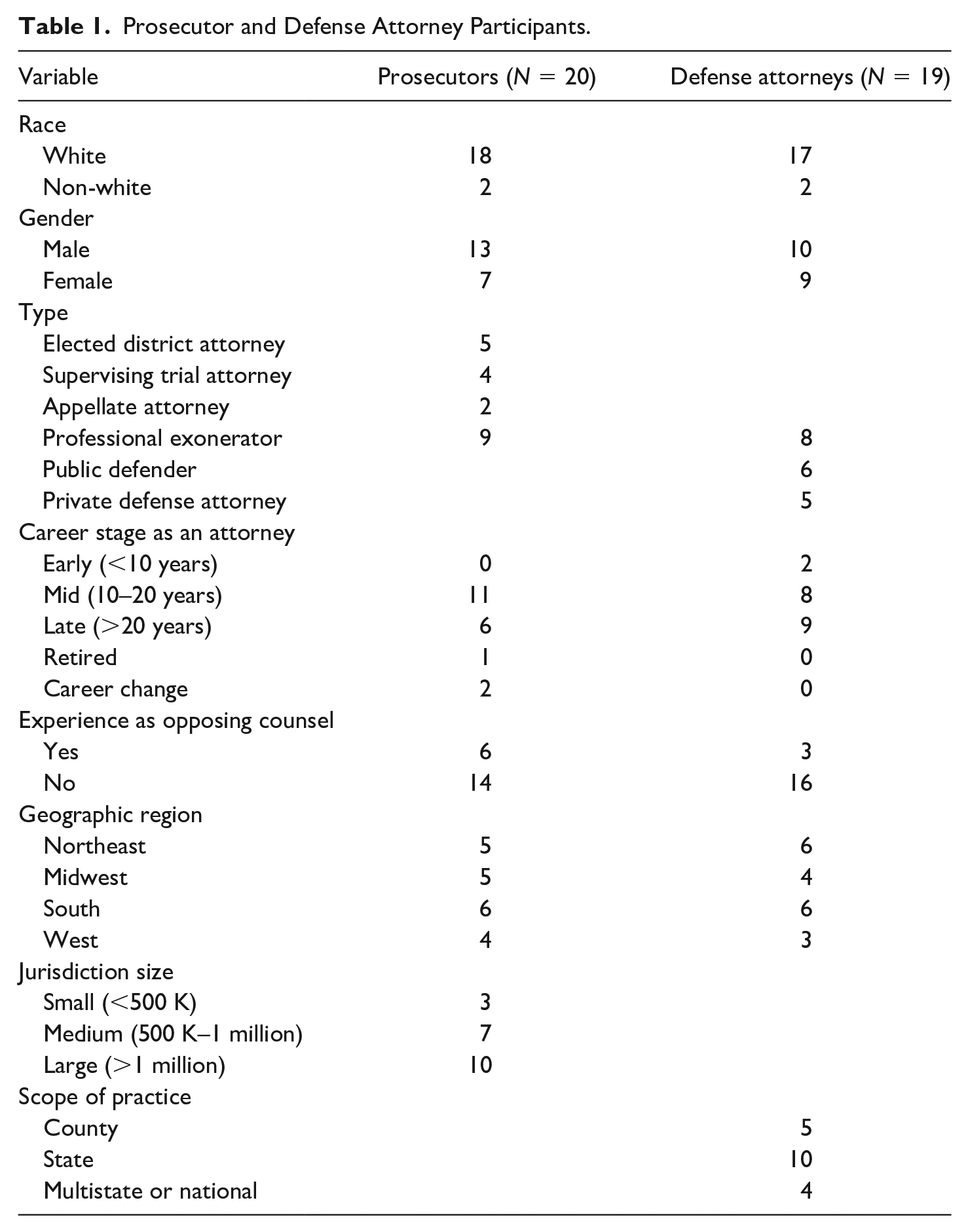
Attorney participants come from every region of the United States, 19 states, and 36 jurisdictions. Just under half of the prosecutor participants worked out of CIUs at the time of the interview (45%, or 9 of 20) and 42% of the defense attorneys (8 of 19) worked for innocence organizations. Overall, 23% of all participants (9 of 39) have experience as opposing counsel. Table 1 provides information on attorney characteristics.
Prosecutor and Defense Attorney Participants.
This study does not aim to recruit defense attorneys and prosecutors who have worked together on the same exoneration case, nor does it seek to compare defense attorney and prosecutors’ perceptions about the same case. While such an approach might have illuminated successful attorney workgroup relationships, three concerns prevented it: (a) threats to participants’ confidentiality 3 ; (b) potential data bias toward participants with positive collaborative experiences; and (c) restrictions on sampling that may have limited variation on other variables. Although attorneys did not work on the same cases, they were able to reference similar processes.
Data Collection and Analysis
Data collection began in April 2016 and ended in November 2018. Most participants were recruited by phone and/or email resulting in a response rate of 86% for defense attorneys (19 of 22 contacted) and 50% (20 of 40 contacted) for prosecutors. 4 The semistructured interviews were designed to last 60 to 90 minutes, with an average interview length of 84 minutes.
The two interview guides (one for prosecutors and one for defense attorneys) were divided into three sections in the following order:
Direct experiences with a specific NRE exoneration case (or cases), including working relationships with the counterpart before, during, and after the case disposition.
Direct experiences of postconviction processes outside of that case.
Perceptions of the postconviction innocence review process more broadly, including perceptions of prosecutor and defense attorney relationships.
Most of the defense attorney participants could reference a variety of experiences and postconviction interactions with different prosecutors in their area. Prosecutors and defense attorneys were asked how their counterpart became involved in the case, what their relationship with that office had been like previously, how they communicated during the case review, and whether their relationship with the counterpart’s office changed as a result. Defense attorneys were asked for their advice to prosecutors in approaching and maintaining relationships, while prosecutors were asked the same question of defense attorneys. In addition, all participants were asked: “When is the postconviction process most effective?” 5
Defense attorney and prosecutor interviews were conducted concurrently since grounded theory methods require an iterative process of sampling, interviewing, and analyzing (Charmaz, 2014). This approach led to a growing awareness of how prosecutors’ responses might be perceived by defense attorneys and vice versa, which then aided in the formulation of follow-up questions and prompts. The interview guide was revised accordingly. Thus, not every question was asked of every participant. Attorneys’ different circumstances, for example, those working through CIUs, necessitated a different set of questions as well. Seven attorneys preferred not to describe a specific case, but rather a series of cases (e.g., all those handled by the CIU). In addition, four prosecutors exonerated defendants independently, or with minimal involvement from the defense. Therefore, in referencing their postconviction relationships with defense attorneys, these prosecutors spoke of interactions surrounding wrongful conviction cases outside of the exoneration under discussion.
Qualitative coding and memo writing was performed throughout the data collection process. Analysis began with initial coding and memo writing and evolved into focused coding with the aid of qualitative software NVivo after the majority of the interviews had been completed. I determined that data saturation had been reached “at the point in data collection and analysis at which new information produces little to no change to the codebook” (Guest et al., 2006, p. 65), also known as “code saturation” (Hennink et al., 2017).
Results
Since prosecutors are not compelled to provide any type of assistance in postconviction cases, the burden of securing cooperation falls to the defense. Therefore, the findings focus on what prosecutors said that they valued from defense attorneys and what defense attorneys said about how they anticipated or adapted to these values. Three themes emerged from the interviews: open communication and transparency, patience as prosecutors review the case, and diplomacy and tact in preserving the reputation of the prosecutors’ office.
Defense Open Communication and Transparency
First, prosecutors wanted to believe that defense attorneys were “straight-shooters” 6 who were not “sandbagging” them. 7 As one CIU prosecutor explained, productive postconviction processes exist “when no one is trying to hide evidence that appears damaging to his or her cause.” 8 Prosecutor participants’ examples of defense dishonesty included presenting misleading information in their motions, sending prosecutors out to interview witnesses who kept changing their stories, and demanding information from prosecutors without any offer to collaborate.
Not surprisingly, prosecutors often voiced that developing trust with the defense attorney, or with the larger innocence organization, could help facilitate the case review. In the words of Prosecutor 34, “You need an attorney that you trust isn’t sending you down a rabbit hole . . . certain defense attorneys who we know, and we’ll be like, ‘Okay, your word’s good, we’ll take a look at it.’” As Prosecutor 34’s comment suggests, trust is easier to establish through familiarity.
Many of the prosecutor and defense attorney participants had some pre-existing knowledge of their counterpart on the case, either the office, or of the organization where they worked. However, only about a third of them (14 of 39) had worked directly with their counterpart before or had an established working relationship. The size of the courtroom community did not influence the strength of the relationships. Attorneys with established relationships worked in both large urban jurisdictions and in small ones. Professional exonerators were also no more likely to have pre-existing relationships than were prosecutors and defense attorneys operating independently and handling innocence claims on an ad hoc basis.
The prosecutors that expressed the strongest desire for transparency from defense counsel were CIU prosecutors. This is understandable since CIUs embark upon lengthy, resource-intensive reinvestigations. Pursuing a claim based on half-truths wastes time that might be spent on other, more meritorious innocence claims. For this reason, two CIU prosecutors expected defense attorneys to share their entire files with the prosecution, including privileged information. They explained: What I would want defense attorneys to know is, you can trust us. You can come to us, and you can purge, and we can purge. We’re going to show you the whole file, we're going to show you the work product, we’re going to do all of that. But that's got to go both ways in an innocence investigation because if you're holding something back, hoping that I don't find out? . . . I’m just going to be pissed. (CIU Prosecutor 6) Give me the ugly. Give me everything that hurts. Give it all to me. Let me figure it out. I respect that from the defense bar that is acculturated that’s doing that. Now some people aren’t because they’re like, ‘This is my law license man. I can’t tell you all that stuff. That’s not what I do.’ But it is when you’re talking to CIU. (CIU Prosecutor 27)
These CIU prosecutors expected an open file policy for both parties. They believed asking defense attorneys to share privileged information was fair since they also practiced open file discovery with defense (“we’re going to show you the work product.”) In addition, these two CIU prosecutors were more willing than their peers to engage in joint reinvestigations with defense: For example, inviting defense attorneys to accompany them for witness interviews and staying in close communication with them about every new development in the case. However, as CIU Prosecutor 27 acknowledged, the expectation created ethical issues for defense that do not exist in earlier stages of case processing. None of the defense attorneys volunteered that they would share privileged information with prosecutors.
Though not all prosecutors spoke directly to this issue, prosecutors with previous experience as defense attorneys were more likely to express an understanding of the defense’s ethical obligations. For example, CIU Prosecutor 37 explained why they thought that the innocence organization attorney had not offered to share the entire case file: I think that she probably would have been reticent to say, “Okay here’s everything in the defense attorney’s file,” and I can understand that because in some circumstances somebody might just try and use that against you.
This CIU prosecutor recognizes the power imbalance between prosecutors and defense and defense attorneys’ vulnerability. A defense attorney who shares privileged information with prosecutors could damage their clients’ last chance of appeal.
In addition, some of the defense attorney participants had good reason to distrust prosecutors. They provided several examples of prosecutor dishonesty, including prosecutors who attempted to interview their clients outside of their presence, who promised discovery materials that they never delivered, and who left them in the dark about evidence that could have been submitted for forensic testing. The prosecutors in these examples were all involved in wrongful conviction case review. In short, defense attorneys also take risks in cooperating with prosecutors on these cases.
Defense Patience
Prosecutors repeatedly referenced how much they valued defense counsels’ patience with their process. Specifically, five prosecutors said that they appreciated when defense attorneys allowed them the time that they needed to reinvestigate, and they complained when they felt rushed or harassed. For example: Defense attorneys submitting cases alleging actual innocence should understand that it takes time for prosecutors to review and absorb information on cases that the defense attorneys already know everything about. Patience is paramount. (CIU Prosecutor 24)
Prosecutors described needing ample time to locate forensic experts and conduct testing, locate and interview witnesses, follow up on allegations of misconduct, and more. Having the time to deliberate could help increase the likelihood of prosecutorial assistance in an exoneration case.
Defense attorney participants spoke of patience as well, but they varied in their willingness to practice it. In the words of one innocence organization attorney: “What’s the time limit in which you’re patient and your poor innocent client is sitting there for no reason?” (Innocence Organization Attorney 7). They felt the clock ticking for a still-imprisoned client who also suffered from serious health issues. With greater knowledge of the defendant’s circumstances, defense attorneys might struggle to grant prosecutors the time that they say they need. Innocence Organization Attorney 8, however, explained how a cooperative resolution could be worth the wait: Sometimes it takes [prosecutors] a lot to see the case . . . You don’t ever want to foreclose that because at the end of the day you could save your client years in prison if not the entire conviction by getting their agreement, because if they’re opposing you, even if you win on retrial they can appeal. They can appeal if they lose in the intermediate court and they can appeal to the state Supreme Court and they can drag it out for years and you can get your victory snatched away from you. Having them agree is priceless.
Thus, defense has much to gain by accepting the prosecution’s timetable. After this specific case was resolved, the district attorney helped the innocence organization by spreading a positive message to other prosecutors, which provided for the possibility of greater cooperation from regional prosecutors on subsequent cases. Therefore, patience was a virtue in this individual case, and it also served to enhance the innocence organizations’ reputation for the benefit of future clients.
Defense Diplomacy and Tact
Interviews with defense attorneys revealed that, in addition to trust and patience, prosecutors valued diplomacy and tact. Prosecutors might be discouraged from assisting if they felt that uncovering the wrongful conviction would damage their reputations or weaken the legitimacy of their offices. Defense attorneys’ decisions—for example, how they would handle a misconduct allegation or the media in a high-profile case—could influence how the exoneration would be perceived by the legal community and also by the broader public. This interest in diplomacy presented two interrelated avenues of postconviction negotiations as prosecutors sought to avoid the potential fallout around an exoneration case: communications surrounding media relations and the handling of misconduct allegations.
Media relations
A few defense attorney participants described using the media to exert pressure on prosecutors through the promise of good publicity or the threat of bad publicity.
Sometimes we can get the media involved, and that helps put pressure on the DA’s office to get involved and really look into stuff. We’ve been successful . . . We’re pretty selective about which cases we’ll do media stuff on beforehand, if it will help. (Innocence Organization Attorney 3)
However, the media strategy could backfire. While some defense attorneys suggested prosecutors would be more likely to dismiss a case when it had received significant press coverage, others suggested the very opposite.
From the prosecution perspective, defense attorneys who would use media pressure to bring attention to a case could not be trusted. Prosecutor 9 reported that some prosecutors feared that innocence organizations are “just trying to make a name for themselves” in the media. Prosecutor 23 criticized innocence organizations who rushed the investigation and preemptively sought out the press: “‘The clock’s ticking every day you don’t act on this.’ And then they run to the press.” CIU Prosecutor 6 stated succinctly: “Can the media be really beneficial in putting pressure to bear on people to take a case seriously? Sure. It’s a double-edged sword.”
Rather than using the media to pressure the prosecutor, other defense attorneys emphasized their restraint by communicating an intention to allow the prosecution to drive the public messaging or to avoid media exposure altogether.
We always tell the prosecutors this: “We’ll praise you up and down. You take all the credit for it. We’re not going to toot our own horn. We just want the result for our client.” (Innocence Organization Attorney 1)
This attorney anticipates that the prosecution perceives him as a media hound, reassuring prosecutors by saying “we’re not going to toot our own horn.” Indeed, in their press release about this exoneration case, the innocence organization stated repeatedly that the exoneration would not have been possible without the help of the prosecution.
Public Defender 14 takes this reassurance one step further by offering to help prosecutors avoid media exposure altogether.
I do everything I can to tell them: “We’ll keep this low profile, we won’t go to the press, we won’t do anything. Our job isn’t to make you look bad, our job is to do good for everybody and let you guys get on with all the other work you have to do.”
This participant assumes that the prosecutors do not want to “go to the press” and that any media exposure in this case might make them “look bad.” He reassures and reminds them of their shared goal to do justice by saying “our job is to do good for everybody.”
These communications strategies were described by all types of defense attorneys—public, private, and innocence organization—as well as defense attorneys with prosecution experience, such as Private Defense Attorney 31.
I didn’t go to the media right away and say, “my client’s innocent and prosecuting attorney needs to let him out and drop charges” and all the rest of that . . . I had told her that I would give her through Friday before I would say anything about it publicly. Give her the opportunity to be the one who took the action. I don’t have any desire to be a publicity hound.
These defense attorneys’ comments highlight that direct press outreach is not the only meaningful move; the interactions and communication surrounding media relations matters also. A defense attorney can communicate the intention to conduct press outreach, or not. An exoneration can be broadcast to welcome press coverage, or not. These backstage conversations between counterparts constitute a type of postconviction negotiation.
Misconduct allegations
In some of the cases that interviewees referenced, allegations of misconduct surfaced. Such misconduct, whether on the part of police or prosecutors, may have contributed to the underlying wrongful conviction. Such allegations are predictable in postconviction appeals, which deal with issues of newly discovered evidence, including evidence that had previously been concealed by police and prosecutors (Garrett, 2008; Hollway, 2015). In wrongful conviction case review, the Brady 9 violation is a regular subject of postconviction negotiations.
Three defense attorneys and one prosecutor spoke specifically about dropping Brady allegations. The prosecution may ask the defense attorney to do this, or the defense attorney may proactively offer it to secure their cooperation. For example, Public Defender 25’s office, anticipating that the prosecution would balk at the allegation of prosecutorial misconduct, voluntarily omits it from their legal motion.
We decided that we didn’t want to file something that was blaming them with the Brady violation because we thought that would kind of turn them off. And we thought that would anger them and make them not want to work with us.
In this example, the public defender relies on their existing knowledge of the prosecutor’s office, based on previous negotiations, and works to carefully maintain the relationship.
In other cases, the defense attorneys involved agreed to the terms set out by the prosecution. In the following quote, Public Defender 15 describes negotiating a joint motion to dismiss the conviction.
He said, “So we’re going to waive the requirement that you put a [#] motion in writing . . . And we’re going to agree, we’re going to join in your application to dismiss, not on the basis of the Brady.” They punted on Brady. “But because based on what we’ve learned, newly discovered evidence, we wouldn’t be able to meet our burden of proof.”
In this example, the prosecution sidestepped the allegation of prosecutorial misconduct (that prosecutors withholding exculpatory evidence contributed to the wrongful conviction) by agreeing to the finding of newly discovered evidence of innocence.
A private defense attorney explained how the prosecution asked him to keep a Brady violation off the record as well.
There was Brady violations all over the place, so I had to allege Brady. Even though they were cooperative, they said “Well, we’re never going to agree that there was a Brady violation.” I said, “You know, I’ve heard that before, and normally I would fight you saying that. I want a hearing and I want to be able to establish the Brady, but the way this is going if I’m going to get the result I want without going down this big Brady path,” so I agreed. (Private Defense Attorney 2)
The practice described here indicates that prosecutors may exchange their cooperation on a case for the right to frame the narrative about it. Without the evidentiary hearing establishing the Brady violation, the misconduct remains off the record and prosecutors can forego the trouble of disciplining the prosecutor or arguing the issue in court.
A trial prosecutor related a similar process: The course we proposed was . . . we will consent that [the defendant] is entitled to relief based upon newly discovered evidence, but we’re not admitting to any of the violations you’ve set out in your motion. We’re not admitting to Brady violations or anything like that, but we’re admitting there’s newly discovered evidence that would have changed the outcome of his case . . . And they said “Fine, we’ll go with that,” as opposed to having a long, drawn-out hearing on all those other issues, because we had one clear issue . . . so it seemed kind of wasteful to spend our time chasing these other things. (Prosecutor 19)
By negotiating with trusted defense attorneys, prosecutors may succeed in keeping Brady allegations out of the legal record, thereby protecting themselves from legal admonishment or disciplinary hearings. The defense attorney agrees to—or offers to—drop misconduct from the legal filings in exchange for relief for their client.
These types of exchange relationships occurred mostly between public or private defense attorneys and prosecutors working outside the context of the CIU. None of the CIU prosecutor participants described rejecting allegations of misconduct in defense motions, and none of the defense attorneys said that a CIU had asked them to drop such allegations. In fact, two CIU prosecutors spoke about actively investigating Brady violations, and one CIU prosecutor reported that the unit was conducting a large-scale case review of police misconduct.
Discussion
The present study employs semistructured interviews with 19 defense attorneys and 20 prosecutors who helped exonerate a wrongfully convicted defendant since 2005. Interviews explore how courtroom counterparts engage and interact with each other throughout their postconviction process. The analysis reveals that postconviction innocence review is fraught with uncertainty for prosecutors. Defense attorneys help mitigate prosecutors’ uncertainty in a variety of ways: by developing trust and demonstrating transparency, by agreeing to the prosecutors’ timetable as they conduct their reinvestigation, and by taking steps to help protect the reputation of the prosecutors’ office amid the potential fallout of an exoneration. Results contribute to courtroom workgroup theory while also providing practical insights for attorneys conducting postconviction innocence review.
The study samples only one attorney in each office, relying upon one attorney’s perceptions of how that office works. This design assumes accuracy of the data (that the individual attorney’s perceptions are valid), and it also allows for broad, generalizable findings in a greater variety of settings and contexts. Study limitations restrict the interpretation of these findings to postconviction innocence review processes culminating in exoneration. Findings represent that subset of prosecutors who not only have assisted but were also willing to talk about postconviction processes at length. This subset is likely to be more cooperative with defense attorneys, and more experienced, than the average prosecutor. As Table 1 shows, none of the participant prosecutors had fewer than 10 years of experience.
Prosecutor participants, answering questions about their own motivations, likely felt a greater impulse to provide socially desirable responses than did defense attorneys. Therefore, interviews with defense attorneys offer a fuller understanding of prosecutors’ postconviction behavior. Amid calls for qualitative research that studies “the interactions that jointly produce discretionary decisions” (Ulmer, 2019, p. 485), this study provides valuable context into the perspectives of two sets of actors.
The postconviction attorney workgroups described in this study can best be characterized as cooperative. Such was the nature of the study design to explore prosecutors’ cooperative assistance culminating in an exoneration. To truly extend courtroom workgroup theory to the postconviction stage, researchers will need to study more adversarial postconviction relationships as well. In what follows, the results are interpreted according to the three shared goals of the courtroom workgroup and then discussed according to their policy implications.
Efficient Case Disposal
Since meritorious innocence claims are relatively rare, many prosecutors and defense attorneys handling these cases are unlikely to establish routinized case practices. This necessarily changes the nature of the relationship. Negotiations become protracted. Strategies develop over time. In fact, prosecutor participants stressed the need for more time in the postconviction stage and urged defense attorney patience. Defense attorneys who respected the prosecutors need to deliberate may have helped facilitate their cooperation and possibly also the exoneration. Therefore, defense attorneys may need to manage expectations about what working with the prosecution can achieve, and how quickly.
At the same time, prosecutors’ efficiency interests could help motivate them to downplay negligence and misconduct allegations. As Prosecutor 19 said: “It seemed kind of wasteful to spend our time chasing these other things.” Allegations of prosecutorial misconduct can initiate a legal response that leads to additional work. Discovery of misconduct and negligence can also lead to calls for further case reviews as well as invite additional postconviction innocence claims. Therefore, when allegations of misconduct arise, they may portend an increase in the workload beyond the immediate case under consideration.
Maintaining Working Relationships
This study finds that, just like in preconviction stages, attorneys engage in bargaining postconviction as well. Early negotiations may involve discussions about transparency. Cooperative prosecutors, particularly those working out of CIUs, act outside of their traditional role in ways that may complicate the workgroup relationship. With prosecutors acting almost like defense attorneys by reviewing and reinvestigating wrongful conviction claims, they may expect to be granted greater access to the defense file, and even to the defendant. For this reason, defense attorneys may need to be prepared to respond to requests for greater access and transparency.
Prosecutors may also seek to bargain with defense attorneys about the terms of the exoneration. Four prosecuting and defense attorney participants specifically described a postconviction exchange relationship, involving an informal agreement to forego litigation around negligence or misconduct. This finding demonstrates that while some prosecutors may pressure defense attorneys to drop misconduct allegations, some defense attorneys will proactively offer to drop them anyway. Notably, CIU prosecutors did not describe negotiating about misconduct, and neither did the defense attorney participants who described collaborating with CIUs. One possible explanation for this finding could lie in the nature of the casework. Professional exonerators work only on wrongful conviction claims. Therefore, they are not complicit in any errors made by the courts or in any misconduct or ineffectiveness at the trial level. They are not bound by the same “organized system of complicity” (Blumberg, 1967, p. 22) as their counterparts working on traditional cases. Private defense attorneys and public defenders working with local prosecutors are more likely to be courtroom regulars, and less likely to enjoy the same independence and singular focus of the professional exonerators.
Negotiations may also center on the amount of media exposure. Savvy defense attorney participants carefully considered when to employ media pressure as a strategy and when to offer prosecutors the benefit of framing the narrative around the case themselves. Prosecutor participants cautioned that turning to the media could be “a double-edged sword,” 10 for defense. This suggests that defense attorneys should reserve a media strategy exclusively for cases where prosecutors cannot be expected to cooperate. Otherwise, prosecutors will appreciate when the defense demonstrates diplomacy and a desire to help the prosecutor engage in face-saving with the public. Defense attorneys working on wrongful conviction cases are already aware that if they can allow the prosecutor to “take all the credit” 11 as the agent who has helped correct an injustice, they may get a better result for their current client and future clients.
Doing Justice
The goal of doing justice is the one most expected to dominate in the context of postconviction innocence review. To be sure, prosecutors and defense attorney participants seek justice by overturning wrongful convictions in every one of these cases. However, some prosecutors and defense attorneys also undermined the goal by neglecting to pursue potential misconduct. In the short term, such arrangements benefit both parties. In the long term, these concessions mean less traction for defendants filing lawsuits and less accountability for bad actors. Succeeding in a wrongful conviction lawsuit often requires evidence of misdeeds on the part of criminal justice system actors (Norris, 2012). Admittedly, prosecutors’ absolute immunity protects them from all but the most severe intentional misconduct (Johns, 2005; Sullivan & Possley, 2015). Still, failing to investigate misconduct allegations in wrongful conviction cases effectively closes another avenue of accountability, engenders a climate where future misconduct will be tolerated, and forecloses the opportunity to investigate similarly flawed cases.
Policy Implications for CIUs and Other Innocence Review Entities
Reckoning with wrongful convictions has had a profound influence on criminal justice system policy, so much so that a distinct “wrongful conviction policy agenda” has emerged (Zalman, 2006, p. 474). Part of this larger agenda, which seeks to prevent and correct wrongful convictions, includes the creation of CIUs (for an early policy recommendation, see Scheck, 2010). The results of the current research lend support to this recommendation. Yet, they also highlight some potential risks arising from the increased prosecutorial role in postconviction innocence review on the county level. Below, I summarize the benefits and risks involved with this enhanced prosecutorial role and overview ways in which good-faith CIUs and state governments can mitigate these risks.
First, CIU prosecutors did not appear to engage in negotiations with defense attorneys that resulted in downplaying allegations of misconduct. Indeed, CIUs demonstrated their ability to perform case audits of widespread misconduct, such as in a forensic lab scandal or when a police officer is indicted for a crime. This underscores the benefit of CIU independence from the rest of the prosecutors’ office. Ideally, greater independence allows CIU prosecutors to make decisions with less regard for how those decisions might impact their colleagues.
As suggested by participants’ comments, some CIUs require defense counsel to waive their attorney–client privilege as a condition of working with the CIU. Because prosecutors with previous defense experience were less likely to insist on this condition, the finding lends support to the argument that CIU prosecutors should be hired externally, and preferably with defense experience (Hollway, 2015; Massachusetts Conviction Integrity Working Group [MCIWG] 2021; Scheck, 2016). Furthermore, if prosecutors require defense attorneys to waive this privilege, they should be prepared to offer the same level of transparency in return, including open file discovery and joint reinvestigations with defense.
As one potential solution, some CIUs have begun to establish “collaboration agreements,” which outline the rules for both prosecution and defense, including stipulations about privileged information, among other considerations (see Quattrone Center for the Fair Administration of Justice, University of Pennsylvania Carey Law School (2022) for specific guidelines for drafting cooperation agreements, p. 26). Such agreements could help defense attorneys make more informed decisions beforehand about the potential costs and benefits of working with the prosecution. They may also help prosecutors establish open communication and trusting relationships with unfamiliar defense attorneys. Prosecuting attorney participants valued defense attorney honesty and transparency. An agreement at the outset could help establish bureaucratic rules that both sets of attorneys and their sponsoring organizations can use to reduce the risk surrounding the interaction. Such agreements need not be limited to CIUs; prosecutors working in all types of settings could implement them.
Collaboration agreements might also include rules of engagement for media relations and discovery of misconduct. Defense attorney participants suggested that prosecutors could be concerned about negative publicity and, therefore, an early and open conversation about how to handle the press in any given case could help alleviate these concerns. Agreements could also outline how the discovery of potential misconduct or negligence will be handled. In general, a CIU should establish written policies and procedures outlining when and how it will report credible allegations of misconduct to outside authorities (Hollway, 2015; MCIWG, 2021). CIUs could simply share these policies with defense attorneys in advance of their collaboration. They might also maintain a list of “problematic actors” to help flag cases involving police, prosecutors, defense attorneys, expert and civilian witnesses and others whose credibility is in question (MCIWG, 2021, p. 45).
The present study finds support for CIUs’ greater independence and integrity as compared to prosecutors engaging in postconviction innocence review on an ad hoc basis. As noted earlier, CIUs have demonstrated marked success in producing exonerations. Nevertheless, state lawmakers should not mandate or pressure district attorneys to initiate CIUs. 12 This could result in the unintentional creation of “conviction preservation units” that undermine the legitimacy of good-faith efforts in other jurisdictions (Hollway, 2015, p. 19). At best, reluctant prosecutors might employ the unit as a mere “fashion accessory” adopted for its “public relations value” (Scheck, 2016, p. 706). At worst, they could sabotage innocence claims by compelling defense attorneys to waive their right to attorney–client privilege, interviewing witnesses and even defendants without their knowledge, and burying evidence of negligence and misconduct. Finally, many small to medium-sized jurisdictions will not have the resources or the caseload to justify staffing a standalone unit (Hollway, 2015). Approximately, 60% of prosecutors’ offices serve a population of fewer than 100,000 people (Bureau of Justice Statistics, 2007).
Instead, state lawmakers should consider creating statewide CIUs run by the Attorney General. Because CIUs are a largely urban phenomenon, postconviction innocence review throughout the rest of the state is left to the discretion of individual district attorneys who adopt a patchwork of practices, making do with limited resources. To compensate for this shortfall, Attorneys General could offer more systematic practices and greater transparency. The Attorney General could also be in a better position to address misconduct and conduct a separate investigation if necessary. As of this writing, six Attorneys General have created such units. 13 Other possible options include shared regional CIUs among small offices, or a smaller office partnering with a larger office’s CIU, or hiring part-time staff and investigators to run a small unit (MCIWG, 2021).
Other models of postconviction innocence review have received less attention, yet they rival the CIU model in their efficacy. The North Carolina Innocence Inquiry Commission (NCIIC), which was judicially created in 2006 after a high-profile case of prosecutorial misconduct, has been lauded as a model for other states to follow (Hynson, 2016; Mosteller, 2016; Wolitz, 2010). Commission members include judges, a prosecutor, a defense attorney, a public member, a victims’ rights advocate, a sheriff, and two discretionary committee members. Their principal task is to conduct reinvestigations, and they have been granted the subpoena power and the authority to do so. The commission refers defendants whom they believe are actually innocent to a special three-judge panel appointed by the Chief Judge to consider overturning the conviction. Full statistics are available and regularly updated on their website. 14 To date, they have received claims in over 3,000 cases, and have helped secure 15 exonerations.
Whether postconviction innocence review is conducted through a district attorney-led CIU, a state Attorney General’s Office, or through a standing statewide commission, actors reviewing the claims will develop expertise in this type of casework. They will become deeply familiar with the processes involved and may even be able to produce faster, fairer results. In addition, they may be able to build ongoing collaborations with innocence organizations. Finally, they may be more transparent with the public and with the defense bar, more capable of developing written guidelines and disseminating those guidelines, and more open about the results of their case reviews.
In conclusion, this study sheds light on an unexplored topic—attorneys’ postconviction workgroup relationships in wrongful conviction cases. It contributes to a discussion among scholars and policymakers about the growing popularity of district attorney-led CIUs. These findings are significant for criminal justice system policy because they underscore the benefits of CIUs as compared to more ad hoc postconviction innocence review efforts, and they support the adoption of postconviction innocence review entities at the state level. At the same time, the study highlights the damage that could be caused by prosecutors adopting postconviction innocence review without a sincere effort to uncover wrongful convictions.
Footnotes
Acknowledgements
The author expresses her heartfelt thanks to Elizabeth Griffiths, Jody Miller, Sarah Lageson, and Daniel Medwed who reviewed and commented on earlier drafts of this article.
Declaration of Conflicting Interests
The author(s) declared no potential conflicts of interest with respect to the research, authorship, and/or publication of this article.
Funding
The author(s) disclosed receipt of the following financial support for the research, authorship, and/or publication of this article: This project was supported by Grant Number (2017-IJ-CX-0012), awarded by the National Institute of Justice, Office of Justice Programs, U.S. Department of Justice. Any opinions, findings, conclusions, or recommendations expressed in this presentation are those of the author and do not necessarily reflect the views of the Department of Justice.
