



Abstract
This article analyzes the impact of party strategies on the issue structure, and consequently the dimensional structure, of party systems across Europe. Conceptualizing political competition in two dimensions (economic left-right and social traditionalism versus liberalism), the authors demonstrate that political parties in both Eastern and Western Europe contest the issue composition of political space. The authors argue that large, mainstream parties are invested in the dimensional status quo, preferring to compete on the primary dimension by emphasizing economic issues. Systematically disadvantaged niche parties, conversely, prefer to compete along a secondary dimension by stressing social issues. Adopting such a strategy enables niche parties to divert voter attention and challenge the structure of conflict between the major partisan competitors. The authors test these propositions using the 2006 iteration of the Chapel Hill Expert Surveys on Party Positions. Findings indicate that while the structure of political conflict in Eastern versus Western Europe could not be more different, the logic with which parties compete in their respective systems is the same. The authors conclude that political competition is primarily a struggle over dimensionality; it does not merely occur along issue dimensions but also over their content.
This article builds on Giovanni Sartori’s assertion that extreme parties “neither desire nor have much to gain in competing centripetally. Their goals are best furthered by tearing the system apart.” 1 We agree that, unlike mainstream parties, disadvantaged parties aim to “tear the system apart.” Contrary to Sartori, however, we do not see political competition as a struggle over polarization on the left-right continuum. To disrupt the system, disadvantaged parties rather seek to increase the salience of independent, unaligned political issues. We thus understand political competition as a struggle over the connections linking political issues—a struggle over political dimensionality.
Issue connections arise from continuous formulation of political ideologies, and as a result, they are both historically rooted and dynamically changing. This article analyzes the political issue composition of European party systems. We confirm that while political competition across the continent revolves around two dimensions (economic left-right and social traditionalism versus liberalism), the connection between these dimensions differs starkly across Eastern and Western Europe because of their unique histories. While Western parties connect the economic left with social liberalism and economic right with social conservatism, the opposite is true for parties in the East.
This blunt divergence in the structure of political competition across Europe begs the question whether the regions constitute two different political worlds or whether political competition functions analogously across the continent. To address this question, this article examines the impact of party strategies on the issue structure of party systems across the regions of Europe. We demonstrate that political parties in Europe contest the issue composition of political space. We argue that large, mainstream parties are invested in the dimensional status quo, preferring to compete over the primary, economic dimension. Systemically disadvantaged niche parties, conversely, compete chiefly along a secondary, social dimension. By increasing the salience of secondary social issues, niche parties across both regions of Europe challenge the structure of conflict between the major partisan competitors.
We firstly develop a basis for systemic comparison of political dimensionality by using a simple framework that captures variation within and across Eastern and Western Europe 2 and thereby places individual polities on the same rubric. Our approach highlights that while the structure of political conflict is diametrically different in the East and the West, the logic with which parties compete in their respective systems is the same. Finally, this study underscores the fact that political competition does not occur merely along issue dimensions but also over their content.
Generating Political Space
Politics is about issues. There exist a multiplicity of political concerns that are empirically separate. The plethora of issues that matter, however, easily becomes overwhelmingly complex and intellectually incomprehensible. For the sake of simplification, issues become connected into packages of values that serve as informational shortcuts. 3 For example, whether a highway should be built through a community is essentially separate from whether the same community should develop a recycling program. However, views on both of these issues are likely to be guided by concerns about the environment and economic costs.
The concept of political space is a generalized description of the landscape of political issues that are contested in a given society. It outlines the particular political issue-components that arise in various political systems and thus delimits the dimensions of the ideological arena in which political parties can position themselves and compete for support. Due to its capacity of outlining party positioning, it retains the ability to depict strategic competition among parties, while simultaneously providing a comparable ideological backdrop by summarizing the dimensional structure in a particular political system or a set of systems.
The dimensional structure of political space can be constructed either inductively—utilizing data on actual party or voter positions 4 —or deductively—addressing which sets of issues are theoretically likely to form primary dimensions. 5 Furthermore, with both induction and deduction, the specific dimensions can be derived at different aggregation levels—a specific party, a specific system, or a number of systems. The trade-off is one between specificity (inductive, low level of aggregation) and generality (deductive, high level of aggregation).
Authors working on these questions agree that dimensionality is an empirical issue and that dimensions are latent and contextual. 6 Each system is likely to have different primary dimensions that matter the most. Due to ideological links of positions on different dimensions, many authors identify a “master dimension,” which is generally labeled as the left-right and is taken to define party competition in a given system. 7 This allows spatial representation of political contest and enables spatial analysis of competition that occurs within each system.
What is lost, however, is comparability. Assessing party competition within system-specific dimensionality effectively atomizes the representation of competition. Analysts can identify competition in separate political spaces, commonly using the shorthand terminology of left-right, but it is clear that this left-right differs from system to system. The ultimate weakness of this representation is that it is impossible to tell what the differences between the various independent left-right scales are. Furthermore, the traditional left-right conception precludes the conceptualization, and subsequently measurement and analysis, of the potential change in issue composition of this master dimension. Understanding the dimensional variation of political competition and being able to represent it spatially is important for addressing the dynamics and nature of political competition more generally.
We therefore argue for the utility of deductive structuring of dimensions at a higher level of aggregation, with the aim of conceptually constructing a general political space. Using expert judgments as priors, it is useful to identify a small-n of dimensions, which are salient in a given set of political systems. 8 Such conceptualization of a broadly applicable and stable political space allows for the comparison of party positioning across systems, providing a baseline for measuring the structure of political competition.
Axis of Competition
Political parties do not position themselves randomly within political space. Instead, they situate themselves along the dimensions of political space based on their ideological outlooks and strategic calculations. Ideology constrains political space. Parties formulate ideologies that connect all of their positions across theoretically and empirically separable dimensions and that provide a common, simplified language for expressing political values and are also concretely connected to particular policy prescriptions, subsequently providing expectations of political actors and bases for evaluating their performance. This infuses the political system with stability, by constraining political actors, as well as with legitimacy of rule, by granting them a political mandate. “Politics without ideology is babel.” 9 Strategically, political parties interact with opposing parties, thus “carving out” areas of political space for themselves. Parties not only change their positioning on various dimensions, but they also change the salience invested into particular dimensions. 10
The axis of competition summarizes the main fault line in a society and highlights the structure of party positioning. In a two-dimensional political space, the axis of party competition can be expressed as the relationship between party positioning on dimension x and dimension y:

where α is the intercept, while β represents the slope of the competition axis in the two-dimensional political space. This slope outlines the proportion between competition occurring along dimension x (β → 0) or dimension y (β → ∞).
Figure 1 illustrates two possibilities. In the left panel, parties position themselves in all four quadrants of the two-dimensional political space. There is no correlation between dimensions x and y and therefore no discernable axis of party competition. In the right panel, parties align along a clear competition axis, which depicts the correlation between dimensions x and y.
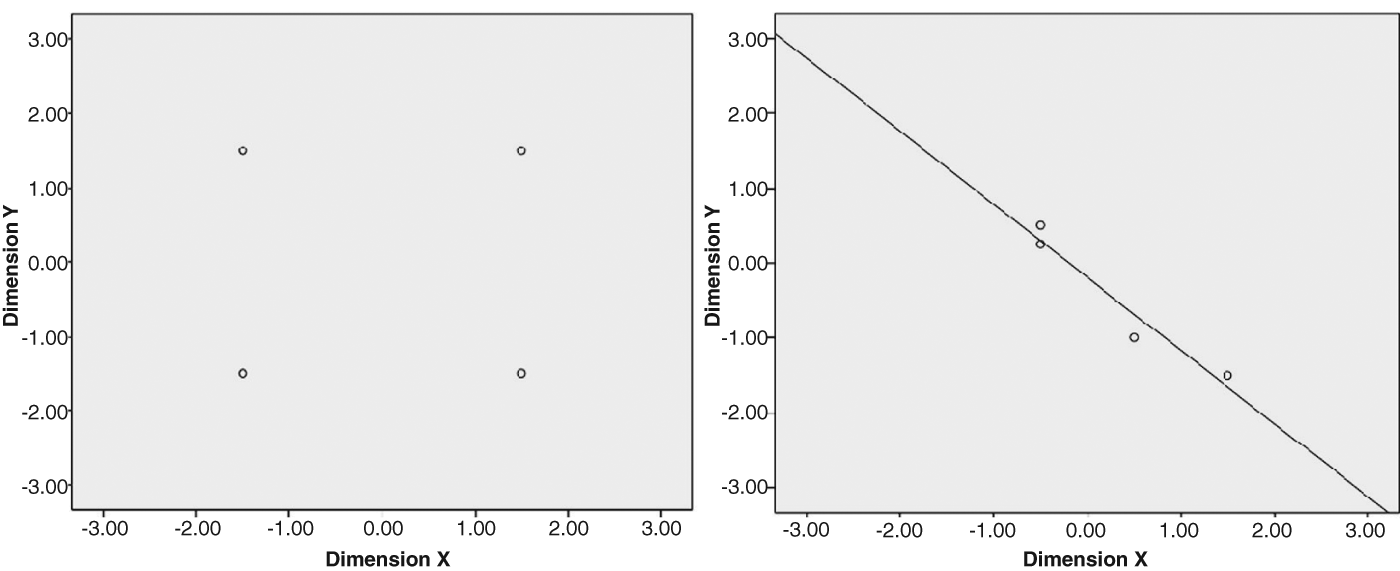
Axis of Competition in Two-Dimensional Political Space
Theory of Party Competition
Political competition reflects the interplay between popular political interests and partisan strategies. While citizen preferences underlie the issue composition of political space, it is political parties that—partially and strategically—translate these issues into political conflict. Political competition becomes a struggle over issue linkages, that is to say, over the dimensional configuration of political space. Parties decide whether to compete along the competition axis—that is, along the predominant dimension—or whether to highlight other, unaligned issues, thus increasing the dimensional complexity of political space. This determines the content of political debate, as well as the political crevices in which different parties may dwell. The costs and benefits of this issue competition, however, are not uniform across political actors.
Mainstream parties, likely to have long-standing roots in society as well as organizational apparatuses and linkages within political institutions, face much higher sunk costs of reputation and identity. A newly emergent, unaligned issue may reconfigure the bundling of political issues in such a way that a major incumbent party finds itself internally divided on certain issues. If these issues carry significant salience, the unity of the party is threatened. 11 Furthermore, increased dimensionality, which results from the introduction of an unaligned issue, inserts systemic instability. It provides additional planes of party competition, making equilibrium positions increasingly difficult—if not impossible—to reach. 12 Systems with high dimensionality can thus be expected to be systems of greater flux, which reduces a major party capacity of constructing coalitions and maintaining power.
An established mainstream party therefore benefits from the dimensional status quo and focuses on defining political conflict through the prisms of the standing dimensions—dimensions that provide it with stable electorates as well as a predictable set of coalition partners. 13 Indeed, it is such parties that strive for the Lipset-Rokkanian “freezing” of party systems along a stable competition axis. 14 Since they are likely to be the historical cocreators of the character of their domestic political space and since they are ideologically invested in the primary political fault lines (along which the competition axis runs), it is these established mainstream parties that compete along the predominant dimension of the political system.
Niche parties are younger political organizations that arise to pursue a specific issue or a narrow set of issues that have potential supporters in the electorate but that have been (often deliberately) neglected by other parties. 15 Unlike mainstream parties, these parties tend to be marginalized on the main political dimension. 16 While the competition axis frames political skirmishes between the major mainstream parties, these disadvantaged political parties seek to avoid being caught in the crossfire. To this end, two options exist. One is for niche parties to take extreme positions on the primary dimension. Recent work by Ezrow on niche party electoral success and failure indicates that this can be a beneficial strategy. 17 He finds that niche parties adopting extreme left-right positions garner more votes than those taking more moderate (or centrist) positions. This dimension, however, tends to be crowded with mainstream parties, making it difficult for other parties to enter the political system by emphasizing traditional left-right issues. Consequently, the preferred option of niche parties is often to exploit new issues on which their established mainstream opponents have no determined positions or—even better—on which they might be internally divided. 18 Indeed, the source of niche party political identity is frequently their differentiation from the major parties along these secondary inferior issues or along nonpolicy issues, such as valence or antisystemic orientation. Given the pervasiveness of the primary conflict, these parties continue to contest the dominant political issues; however, they favor emphasizing secondary issues. Niche parties aim to “tear the system apart” by trying to increase the salience of previously tangential issues, thus reorganizing the structure of political space, redirecting voter attention, and potentially capturing votes from mainstream parties.
Such strategies force mainstream parties to react by either ignoring the new issues or, in case they do garner significant support in the electorate, engaging them. Meguid highlights how in certain cases mainstream parties benefit from jumping on the bandwagon by emphasizing new niche issues that divide or embarrass their mainstream competitors. 19 In these scenarios, mainstream parties are rational to draw attention to these new issues. They will, however, do so only after the new issue has been introduced. Mainstream parties are unlikely to risk political capital, internal unity, and coalition potential by spearheading novel, unaligned issues, whose political leverage is inherently uncertain. Furthermore, when mainstream parties engage newly introduced issues, they do so with the ultimate aim of translating them into their ideological issue-bundle. 20 This strategic dynamic eventually leads to the absorption of the new issue and to the realignment of party positioning along an updated political continuum, effectively amounting to the “turning” of the competition axis. 21
Three hypotheses emerge from the preceding theoretical discussion of party strategies within political space:
Major/mainstream parties seek to preserve the dimensional status quo by investing salience in the primary issues of political competition.
Niche parties struggle to introduce and invest salience into new issues that do not easily fit into the standing issue structure in order to wrest attention.
When a new, potent political issue is introduced into the political system, it is most likely to be eventually adopted by mainstream parties and made to “fit” the long-standing issue composition.
Political Space in Europe
Scholars of European politics have deductively defined contemporary European party competition in two dimensions. 22 The first dimension relates to economics, generally spanning from state-directed redistribution on the one end to market allocation on the other end. The second dimension relates to social issues, concerning such factors as sexual lifestyles, national identity, or religious values, and spans from libertarian or alternative politics to authoritarian or traditional politics. 23 These authors further deduce a linkage between these dimensions—thus theorizing an axis of competition—whereby in Western Europe redistributive economic positioning corresponds with socially liberal politics. In Eastern Europe, where opposition to communist redistributive and authoritarian rule has structured post-communist politics, these same dimensions exist. Strikingly, however, the axis of competition has the opposite slope, linking traditionalism and authoritarianism with the economically redistributive left. 24
We evaluate the political space across Western and Eastern Europe in 2006 using data from the latest round of the Chapel Hill Expert Survey on party positioning. 25 The survey provides data on 227 political parties across the EU-27 (minus Luxembourg, Malta, and Cyprus). Similar to previous iterations of the project, 26 the 2006 survey includes questions about party positioning on the economic left-right dimension and the new politics dimension, as well as on European integration—both in general and in specific policy areas. Importantly for our purposes, the 2006 data set also includes systematic information on party positions and salience of fourteen policy issues (see the appendix for details). These new data allow us to more accurately assess the content of the dimensions of political contestation and to test our hypotheses concerning party strategies.
We begin our examination of the political space in Europe by considering the structure of the two dimensions in question. Do the positions political parties take on various issues cohere into distinct economic and social dimensions? What is the content of these dimensions (i.e., which issues stick together)? To what extent, if at all, does this content differ across regions? To address these questions, we employ the expert survey data mentioned above and conduct a principal component analysis on the positions parties hold on the fourteen policy issues. The results are reported in Table 1.
Factor Analysis of Policy Positions

Source: 2006 Chapel Hill Expert Survey on Party Positioning.
Note: Principal component analysis employing varimax rotation with Kaiser normalization.
Consistent with the literature on party competition in Europe, our analysis yields two clear factors (i.e., dimensions), the content of which are remarkably similar across regions. 27 On the one hand, policies related to the role of government and personal responsibility (as well as the position of the United States in world affairs) generate a clear “economic” factor. On the other hand, policies related to civil liberties, immigration, religion, cosmopolitism, and so forth form a discernable “social” factor.
Two policy areas—European integration and civil liberties versus law and order (in the case of the West)—are notable for their failure to load clearly on one factor over the other. Indeed, their relatively high scores on both factors suggest that these issues are related to both dimensions of political contestation. More provocatively, the results provide insight into contemporary party strategy, suggesting a possible shift of these two policy issues from one dimension to another (i.e., from the social to the economic dimension). 28 This finding is in line with our expectations regarding mainstream parties’ efforts to translate new issues into the predominant conflict dimension as a strategy for maintaining the status quo.
Thus far, our analyses have confirmed the existence of an economic and a social dimension in Europe and have spoken to the content of these two dimensions, but how do these dimensions interact to formulate an axis of competition? In other words, what is the dimensional structure of political space in Europe? Moreover, does this dimensional structure differ in the East and the West? We ascertain this by running a series of simple ordinary least squares (OLS) regressions for each of the twenty-four countries utilizing expert survey questions relating to the ideological positions of political parties—specifically their stances on economic issues (economic left/right) and on democratic freedoms and rights (tan/gal) (see the appendix for question wording). Modifying equation (1), we formalize the axis of party competition with the following equation:

The results reported in Figures 2 and 3 and Table 2 provide striking evidence of the dimensional structure described by party scholars as well as of the postulated relationship between the two major dimensions and the differences between this relationship in Western and Eastern Europe. Turning first to the graphs, it is clear that political parties do not place themselves haphazardly within the political space, but rather do so along discernable competition axes that link their positioning on the separate dimensions. Moreover, Figure 2 bolsters previous findings by Marks et al. as well as Vachudova and Hooghe that the axis of party competition is negative in Western Europe but runs in the opposite direction in the East. 29 Notably, however, our findings suggest that these regional discrepancies no longer hold across all Central and Eastern EU member states. As Figure 3 highlights, the Baltic countries of Estonia and Latvia as well as Slovakia and Slovenia follow the pattern typical in the West. For Latvia, Slovakia, and Slovenia—the countries for which we have comparable 2002 data—these results indicate a shift in the axis of party competition over time. The relationship between the dimensions in these three countries has reversed, as parties no longer appear to couple left economically redistributive ideologies with traditional and authoritarian values but seem to link them with socially liberal and alternative values.
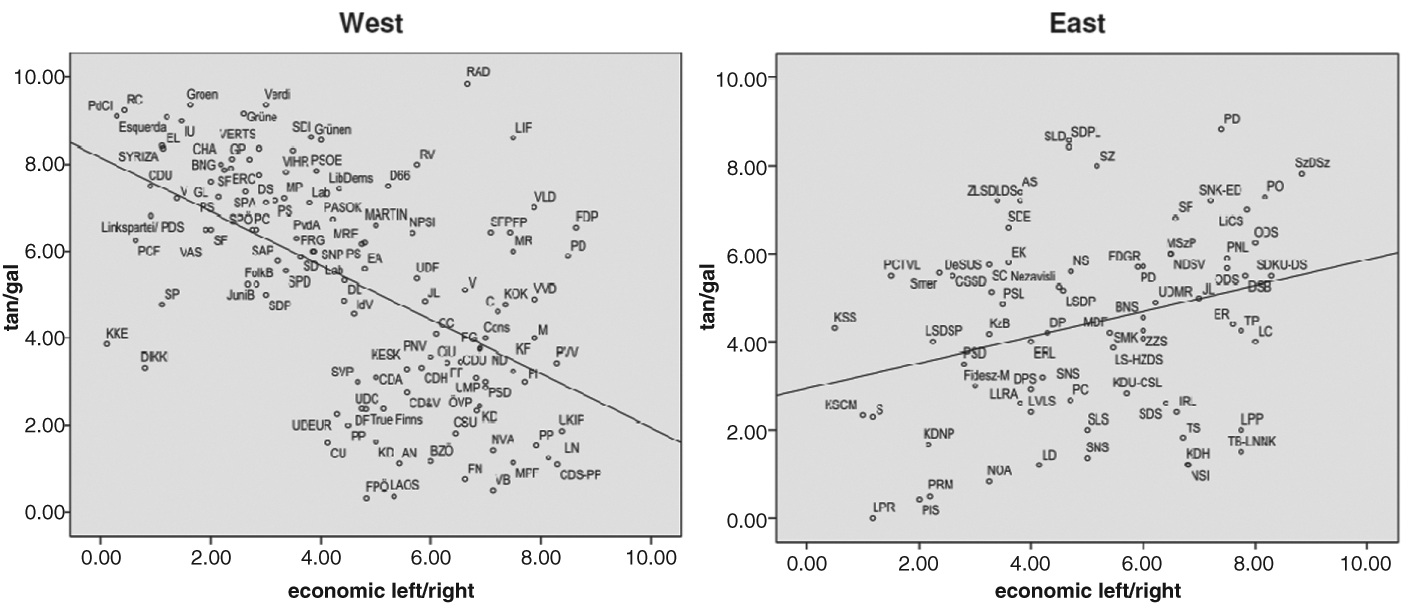
Political Space and Axes of Party Competition in Europe
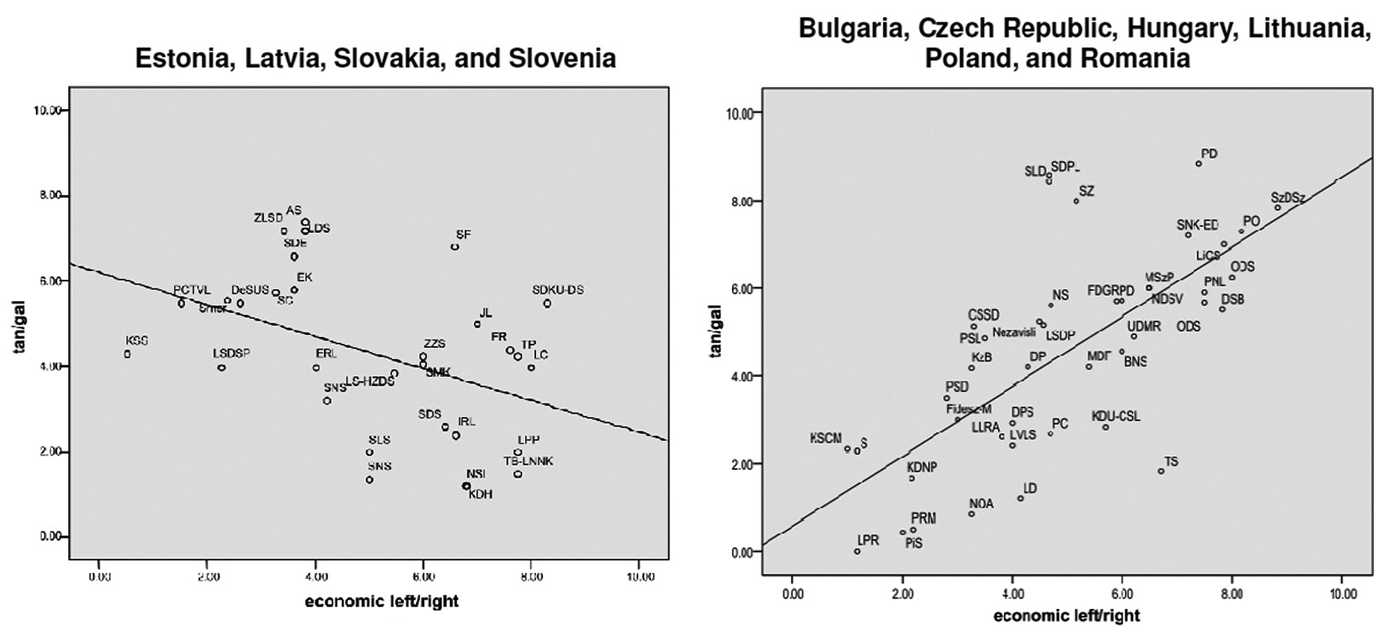
Political Space and Axes of Party Competition in Eastern Europe
Slopes and Fit Measures of Competition Axes in Europe
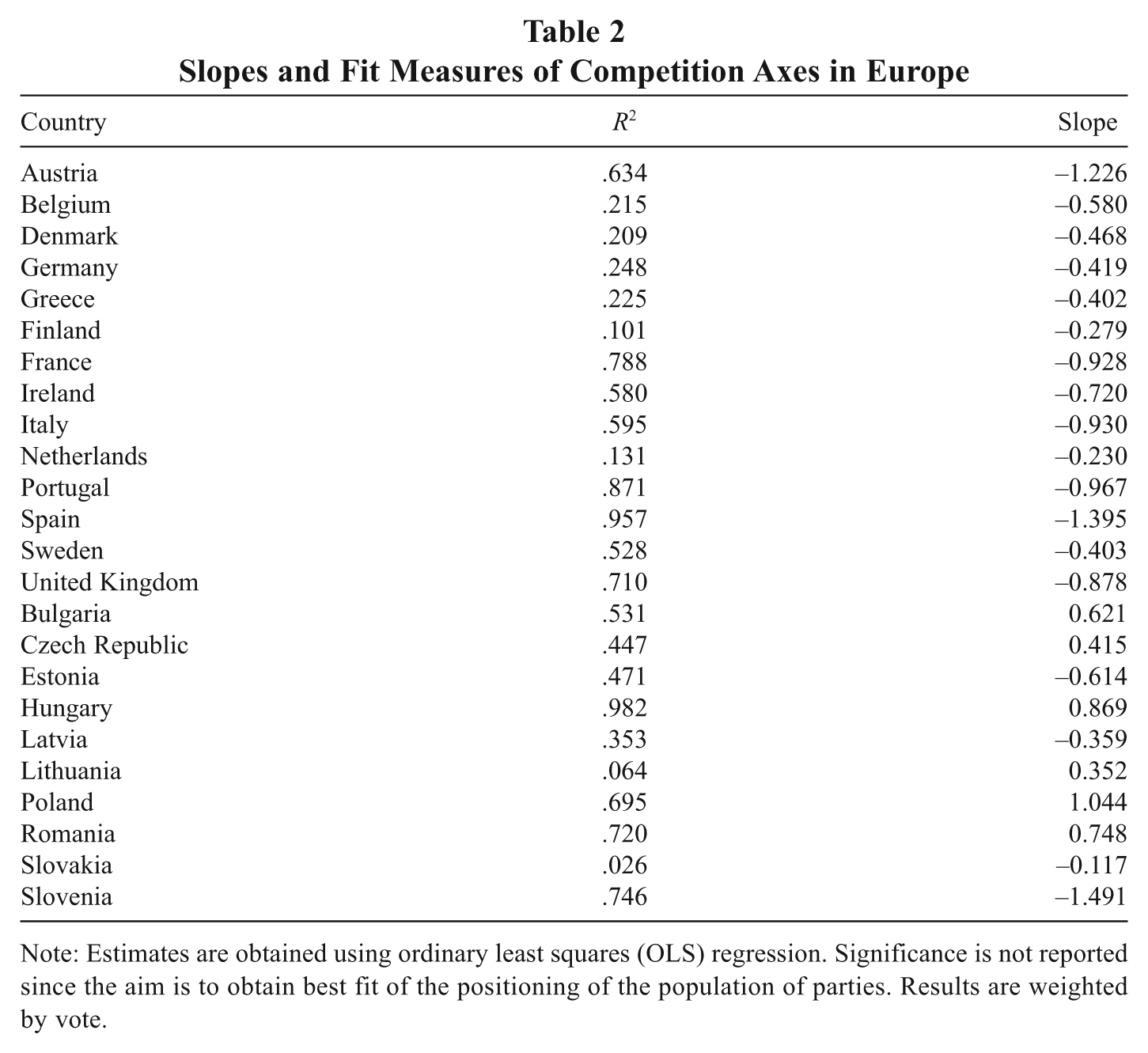
Note: Estimates are obtained using ordinary least squares (OLS) regression. Significance is not reported since the aim is to obtain best fit of the positioning of the population of parties. Results are weighted by vote.
While the empirical findings depicted in Figures 2 and 3 reveal distinguishable competition axes, the slopes of these axes differ significantly from country to country. We are mainly interested in the “steepness” of these slopes, as this provides insight into which dimension—economic or social—carries more weight in a given system. A “steep” axis of competition (|β| → ∞) suggests that political conflict in the given society runs predominantly along the social dimension, while a “flat” axis (|β| → 0) points to the centrality of conflict over the economic dimension. Referring to Table 2, for example, we find that the Netherlands, Finland, and Slovakia have relatively flat slopes, indicating that political conflict tends to revolve around economic issues; while Austria, Poland, Slovenia, and several of the Mediterranean countries have steeper slopes, indicating that social issues are significantly important.
Our examination of the structure of party positioning within the political systems of Europe suggests that while diversity in the issue content of political competition exists, the economic dimension is pervasive in all countries. This is most visible from the fact that although some axes of competition are steeper than others, only four countries—Austria, Spain, Poland, and Slovenia—have axes steeper than 45 degrees. 30 Only in these countries is the competition axis more aligned with the social dimension than with the economic dimension. Moreover, this alignment is still very slight, and parties continue to significantly differentiate their positions on the economic dimension. In all other countries, party positions differ more extensively on the economic than on the social dimension, suggesting the unremitting centrality of this dimension to their political competition. Indeed the economic divide, which has pitted the economic left against the right and structured European party competition throughout the twentieth century, remains crucial to political competition today.
Party Type and Dimensionality
The findings presented in the previous section emphasize the tenacity of redistributive conflict in Europe, underlining the forty-year-old insights of Lipset and Rokkan. 31 However, given the varying logics guiding the competition strategies of distinct types of political parties, we expect to see major parties investing increased salience into the main economic dimension and niche parties attempting to attract attention by investing salience in the secondary issues contained in the social dimension.
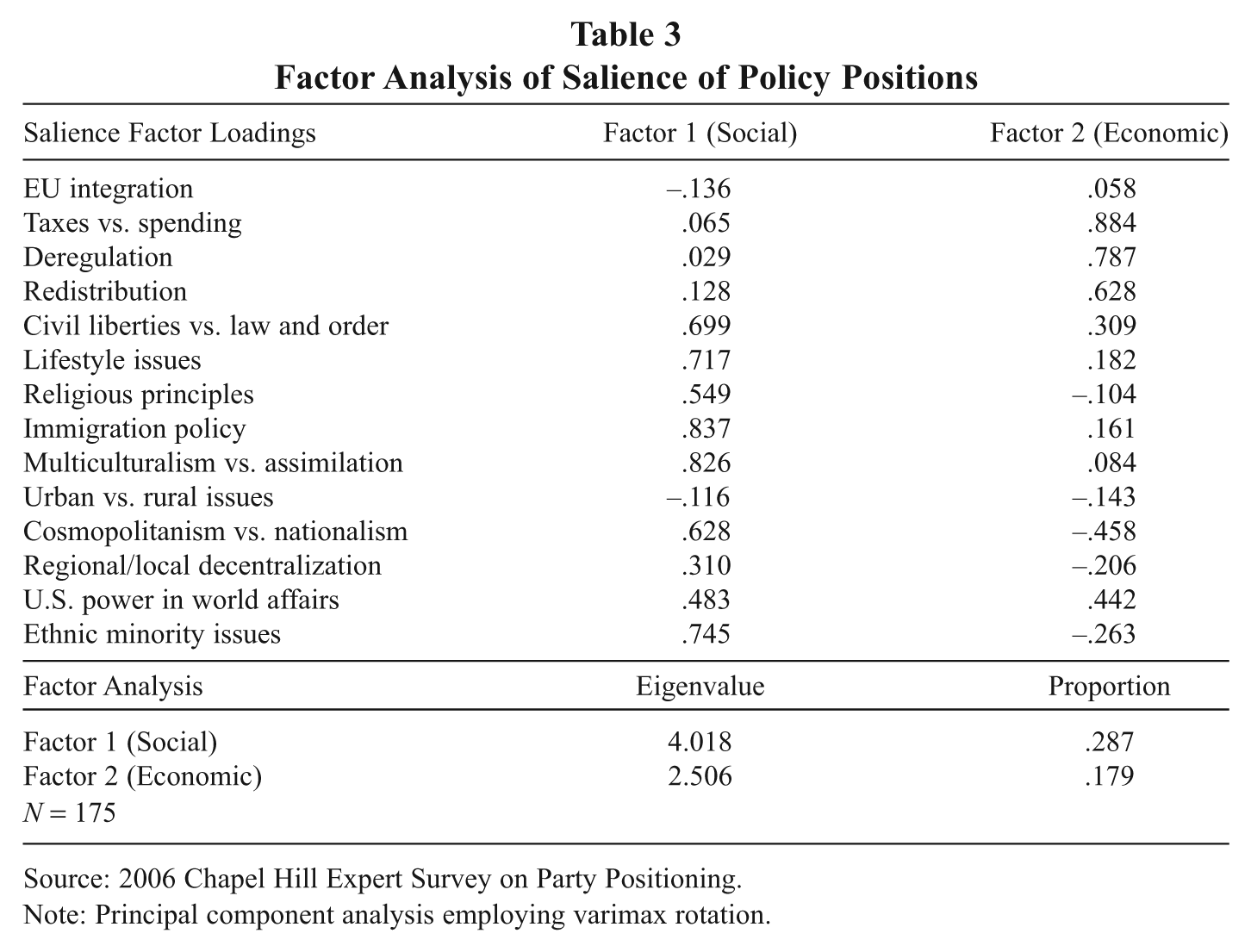
To test this hypothesis, we perform a principal component analysis on the level of the salience parties attribute to fourteen different policy issues (see Table 3). Similar to our analysis of the position of parties on these issues, this yields two clear factors—the first emphasizing social issues and the second economic issues. 32 Using these factor scores, we create two salience variables: salience of social issues and salience of economic issues. We evaluate the varying strategies of political parties by predicting the level of issue salience using party attributes, namely, party vote share and party type (niche party), while controlling for government membership and positioning on the two ideological dimensions tan/gal and economic left-right.
Factor Analysis of Salience of Policy Positions
Source: 2006 Chapel Hill Expert Survey on Party Positioning.
Note: Principal component analysis employing varimax rotation.
Table 4 summarizes the findings of the OLS regression analysis predicting the levels of salience of social and economic issues by party vote and party type. Following recent studies by Adams et al. and Meguid, 33 we operationalize party type by distinguishing niche parties (i.e., extreme left, extreme right, green, and regional/ethnic parties) from mainstream parties. 34 Our analysis suggests that social issues are important to niche parties. On average, niche parties place 18 percent more emphasis on social issues than their nonniche counterparts. 35 In contrast, economic issues are important to parties that receive a larger proportion of votes. On average, a party that receives 10 percent more votes will emphasize economic issues 3 percent more. 36
Predicting Salience of Policy Issues
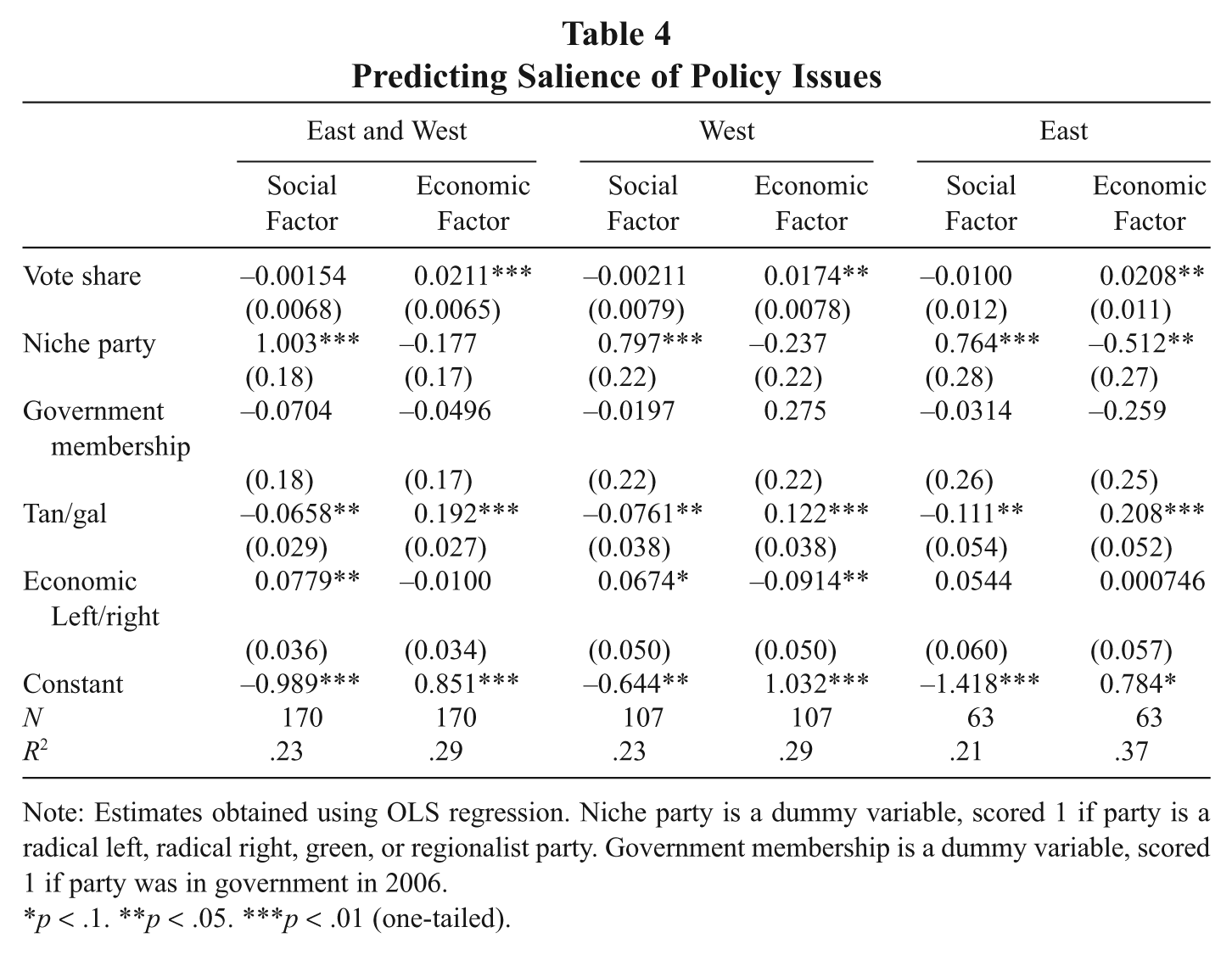
Note: Estimates obtained using OLS regression. Niche party is a dummy variable, scored 1 if party is a radical left, radical right, green, or regionalist party. Government membership is a dummy variable, scored 1 if party was in government in 2006.
p < .1. **p < .05. ***p < .01 (one-tailed).
Additional evidence is presented in Table 5, which includes a summary of the salience attributed to social and economic issues by party type and region. The figures shore up our OLS results, suggesting that niche parties invest salience into social issues, while major parties emphasize economic issues. Furthermore, Table 5 calls attention to the fact that small parties (parties with vote share ≤ 15 percent) not falling into the niche category behave differently from both niche and major parties. They seem to devote relatively little attention to either social or economic issues. Niche parties devote significantly more attention to the social issues, which form the secondary dimension of competition, while small nonniche parties choose to downplay policy issues altogether. Meanwhile, economic issues remain the prerogative of major parties.
Summary of Salience Factor Means by Party Type and Region
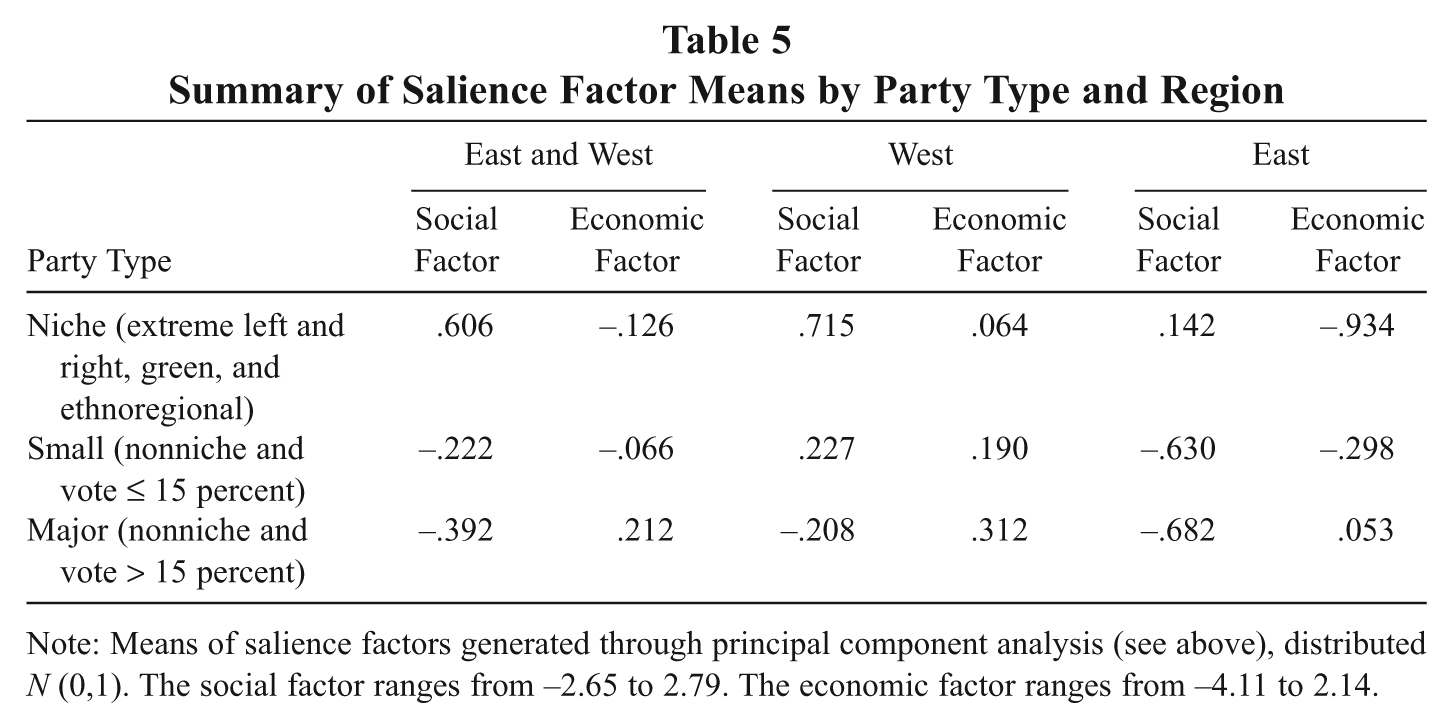
Note: Means of salience factors generated through principal component analysis (see above), distributed N (0,1). The social factor ranges from −2.65 to 2.79. The economic factor ranges from −4.11 to 2.14.
These findings underscore the endeavor of mainstream parties to contain political competition within the dimensional confines that are advantageous to them. The mainstream parties of Europe—those that have traditionally contested the structure of European economies and the construction of social systems—seek to preserve the pervasiveness of the economic dimension, which is their home turf. They thus invest increased salience into the issues that are contained in this dimension. Conversely, challengers in the political systems (i.e., niche parties) attempt to break this status quo by vesting increased salience in the secondary issues, contained in the social dimension.
Importantly, these logics of competition are virtually identical across the European continent. While Eastern European party systems have been molded by their communist heritage, leading to polar differences in party positioning, the current strategic forces shaping party competition are the same as those in the West. The major left-wing parties of Eastern Europe have decisively embraced the new political system of liberal democracy and market capitalism. Redefined as social democratic parties, they contest the contours of specific policies as established mainstream members of their party systems. The role of “tearing the system apart” is thus left to the disadvantaged niche parties, who—by emphasizing secondary, unaligned issues—act the same way as their Western counterparts.
Concluding Remarks
Politics is fundamentally a struggle over dimensional issue composition, with political parties strategically vying not only to position themselves along ideological dimensions but also—and perhaps more importantly—to influence the content of these dimensions. Describing political competition through the notorious left-right lens unfortunately hinders our investigation of such dynamics and prohibits systemic comparison by lumping disparate political concerns into one continuum. We therefore choose to conceptualize political competition in terms of political space—an approach that allows us to parsimoniously describe the structure of political competition, while capturing essential differences among political systems. This notion is paramount in understanding the strategic dynamics of political parties. Indeed, examining how parties jockey within this political space sheds light on parties’ varied strategies, revealing that while mainstream parties cling to the status quo by continually emphasizing conventional issues, niche parties consciously seek to skirt the confines of traditional political competition by stressing new or alternative issues.
Analyzing contemporary party politics in Europe through this theoretical lens yields important insights. To begin, when we deductively generate political space and plot political parties within this space, a picture of competitive diversity across Europe emerges—both in terms of the issue content of the political dimensions uncovered and in terms of the shape of the axes of competition. While parties in some systems clearly differentiate themselves along a particular dimension, parties in other systems are distinguished along alternate lines. Moreover, we find that this variation increasingly cuts across regions, spanning the East as well as the West.
Our evidence also indicates that despite the aforementioned diversity, the pervasiveness of the economic dimension remains. The continued dominance of this dimension in contemporary European politics—again this finding holds in both the East and the West—speaks to the consistent importance of redistributive issues to citizens and consequently to politics. However, it also highlights an important, and seemingly successful, strategy by mainstream political parties to preserve the status quo, namely, their conscious choice to compete on familiar and popular redistributive issues or, if need be, to force newer and often disruptive issues into the dominant economic dimension.
Perhaps most importantly, our article provides evidence that the dimensional structure of politics is the core subject of political contest. To be certain, political competition revolves around individual political issues. Political parties and party leaders do not think in terms of abstract issue dimensions. Their strategies, however, take dimensionality into account by addressing and seeking to alter linkages between political issues. While major parties are vested in the status quo, niche parties attempt to break their competitors’ advantage by highlighting unrelated political issues with the aim to divert political conflict to a different dimension. Thus, major parties battling for government control differentiate themselves along the primary dimension of conflict, while minor parties—constrained by the dominance of their major rivals—are strategically driven to exploit other political issues or to compete on nonpolicy issues altogether. Rather than “stretching” the political system, as suggested by Sartori, these parties seek to sidestep the main line of competition, “tearing the system apart” in new directions or abandoning its confines altogether.
Finally, though much has been made of the distinctiveness and incomparability of political competition in Western versus Eastern Europe, what stands out to us is the remarkable (and increasing) similarity. While the structure of competition remains distinct, the discrepancies appear to be waning as the axes of competition in Eastern and Central European countries begin to mimic the overall pattern found in the West. Furthermore, our observations concerning strategic dynamics—for example, niche parties stressing the social dimension over the economic dimension—hold in the East and the West. Our findings thus highlight that despite the different histories and recent trajectories, the logic of competition is the same across the European continent.