



Abstract
Lustration was not legislated in Romania to date, but it was discussed by deputies and senators of all ideological persuasions, especially from 2005 to 2007. Declarations delivered in front of the house, interventions during debates of lustration-related draft bills and contributions to a parliament-sponsored public discussion reveal that for Romanian legislators lustration can bring about moral cleansing and a break with the past, provide retributive justice for victims of communism, facilitate elite replacement, prevent future violence, and help countries enjoy the benefits of European Union accession, although it punishes valuable individuals, runs against European values, is impractical and unconstitutional.
Until late 1999, Romania persistently avoided the thorny issue of coming to terms with the communist past and doggedly refused to adopt transitional justice methods embraced by its neighbors. Scores of owners whose homes were abusively confiscated by the communist authorities had to petition the European Court of Human Rights when Romanian courts opposed just compensation and property restitution. Since 2000 the Council for the Study of Securitate Archive has allowed Romanian citizens to access the files compiled on them by the communist secret police, but few people have read their files. In 2006, secret files, including documents concerning prominent post-communist politicians, were no longer kept under lock for undefined reasons of “national security.” Its exit from communism was bloody, but Romania refused to hold accountable the military leaders responsible for the casualties of the 1989 Revolution. 1
None of these reckoning processes is as retarded as lustration. The issue was first brought up in 1990, when Article 8 of the Timisoara Declaration called for banning former communist officials and secret agents from post-communist politics for ten years. The initiative was rejected by President Ion Iliescu, a former communist official and collaborator of dictator Nicolae Ceausescu, and Premier Petre Roman, the son of communist officials. 2 Lustration was never mentioned in Parliament as long as the country was ruled by the Social Democrat Party, heir to the Communist Party. After the 1996 elections, hopes that the Democratic Convention government would support vetting vanished when President Emil Constantinescu declared lustration unnecessary because elections had replaced Social Democrat public officials with Democratic Convention supporters. All references to lustration were removed from Law 187/1999 on Access to Securitate Archives. 3 Once the Social Democrats and Iliescu made a comeback in 2000, the topic of lustration was set aside to allow the government to deal with urgent socioeconomic priorities.
After the opposition Justice and Truth Alliance (of the Democrats and the Liberals) formed the government in 2004, lustration received attention both because local observers did not want Romania to be the only country in the region not pursuing it and because they believed that this radical method could lead to elite renewal and curb the political influence of former communist officials and secret agents. The motors of the renewed commitment to evaluate the past were Democrat President Traian Basescu and the Liberal Prime Minister Calin Popescu-Tariceanu. Tariceanu created the Institute for the Investigation of Communist Crimes to investigate the communist past by exhuming the remains of communist-era victims and collecting evidence against victimizers. Resorting to the considerable formal and informal powers Romanian Presidents can draw on, Basescu ordered intelligence services to transfer the catalogue needed to locate specific secret files, together with an unprecedented number of Securitate documents, to the Council for the Study of Securitate Archives. A presidential truth commission documented communist abuses in a report Basescu used to officially condemn communist crimes just before Romania joined the European Union in 2007.
These transitional justice efforts were not the result of only top–down pressure from the Presidential Office. Basescu’s willingness to allow the tainted past of some luminaries to become public responded to bottom–up calls from civil society representatives, journalists, and politicians to shed light onto a sensitive topic. Inspired by Bulgarian efforts, in 2006 Romanian journalists launched a “Clean Voices” campaign to identify secret agents from among television reporters, press contributors, and talk-show hosts. Legislators representing the ruling Liberal Party presented a lustration proposal, while the opposition lodged its own anti-nomenclatura bill. Intellectuals, academics, and politicians repeatedly called on former and current spies to unveil their ties to communist and post-communist intelligence services, and many politicians admitted to past collaboration or were unmasked as former spies. 4
Romania was unable to adopt a lustration law, but the political class and the civil society have vigorously debated lustration as a method of renewing the political class. Much of the debate has taken place in the press or on television, with the most important positions already summarized in a handful of Romanian-language studies. 5 While it identifies how civil society representatives view lustration, the literature tells us little about how much of the debate reached Parliament, the body that can translate lustration into practice. How did legislators of various ideological persuasions view vetting? Which parties were for or against lustration? Which were the most vocal in the debate? Did the legislators’ positions accord with their party’s political stance on the subject? What arguments were used? Did they relate to the evil communist past or the fragile democratic future? Were they proactive or reactive? Were they political, social, economic, moral, or merely technical?
To answer these questions, a thorough analysis of Romanian parliamentary documents produced in the 1990-2007 period was conducted. Lustration was mentioned in (1) declarations delivered by legislators during the February 2005-December 2007 period, (2) summaries of the Senate and Chamber of Deputies meetings that debated the legislative proposals on lustration (PL 282/2006) and the vetting of former nomenclatura members (PL 545/2005), and (3) statements submitted by legislators as part of the public debate titled “Lustration in Romania: Principle or Instrument?” organized jointly by the Chamber of Deputies and the civil society on 25 May 2006. By analyzing these statements, we can establish when lustration was important and when it was overtaken by other subjects, which political parties and individual politicians took a stand for or against it and which ignored it, and what arguments each side presented. By linking statements to the larger debate carried outside parliament, the reasons why legislators felt the need to clarify their position, take a stand, or talk about lustration in the house become clear.
Post-communist Romania experienced elite reproduction, not elite replacement, although its brand of communism remained dictatorial until the end and its regime change was bloody. Indeed, 48 percent of all members of the first post-communist legislature had political positions before 1989, while “survey data from the fourth legislative term in the post-Ceausescu era show that five out of six MPs were registered as [Communist] party members before 1989,” demonstrating that Romania experienced less elite replacement than other Eastern European countries. 6 There are former Communist Party officials and secret officers in all political formations, especially in the Social Democrat Party and the nationalist Greater Romania Party. The Democrat Liberal Party (formerly the Democrat Party) inherited former Communist Youth League members and Securitate agents, but its supporters were younger and better educated than the more conservative and older Social Democrats. Constituted before 1945, the Liberal Party was banned under communism and reconstituted after 1989. Together with the out-of-Parliament Christian Democrat Peasant Party, the Liberal Party is one of the “historical parties” promoting an anticommunist agenda. Although some Liberals and Christian Democrats were unveiled as former Securitate agents, these parties accepted no Communist Party leaders as members.
The Parliamentary Declarations on Lustration
According to Parliament Statutes, Romanian legislators can read “declarations” (declaraţii) to the house during the parliamentary sessions of February–June and September–December. 7 Declarations are published in the official Monitorul Oficial, even when they are not read aloud to the house. They can deal with a topic of interest for the country as a whole or for the legislator’s electoral district, and they can present the legislator’s or the party’s position on the subject. Parties occasionally designate a legislator to speak on their behalf on matters of interest. Besides making their author known to the house, the party leadership, and the general public, declarations can keep a topic on the front burner, detail the representative’s position on issues of interest, or help to gather support for or condemnation of legislative proposals on the agenda of the parliament. Members of shadow cabinets have also used declarations as vehicles for criticizing governmental strategy or proposing alternate solutions in their areas of competence.
Prior to 2004, only one declaration mentioned lustration. Delivered on 16 June 1998, by Liberal deputy Octavian Bot, the statement regretfully noted that “after the 1989 revolution, one of our great hopes was the moral cleansing of the Romanian society that had just exited the absurd world of totalitarian communism. The process has been delayed by government and opposition members interested to hide their [tainted] past.” 8 Bot was trying to rekindle the debate on secret file access and lustration. Tellingly, no Christian Democrat legislator made lustration the topic of a declaration, although the party prided itself to represent the interests of the victims of communism and to champion de-communization.
The 2004 elections brought lustration and de-communization to the forefront of public debate. Not only that the ruling Liberal Party was committed to promote the interests of the former victims of the communist regime, but during the electoral campaign Democrat President Basescu referred to the unreformed political class as Romania’s “curse.” 9 Besides the Liberal lustration proposal, Parliament received an anti-nomenclatura bill initiated by the tiny National Initiative Party, formed of young Democrat dissenters. In this context of increased legislative activity, the number of declarations on lustration reached twelve in 2005, and thirty-four in the spring 2006 session, but then decreased to seven in the autumn 2006 session, six in spring 2007, and none in autumn 2007. 10 The trend mirrored the intensity of the lustration-centered debate carried outside the house, with interest peaking in early 2006, when lustration proposals were introduced in the house and the Chamber of Deputies organized public debates on the topic. Declarations on lustration represented a fraction of all declarations delivered to the house at the time (Table 1).
Declarations in the Chamber of Deputies, 2005-2007

Source: Chamber of Deputies’ website, www.cdep.ro.
Compared to senators, deputies were far more concerned with lustration. No senator delivered more than one declaration on lustration, but the Social Democrat Gheorghe Chiper and Dumitru Avram (Greater Romania Party) each spoke five times on the subject. Ilie Merce (Greater Romania Party) spoke three times, while six Liberals (Ovidiu Silaghi, Grigore Craciunescu, Claudiu Zaharia, George Scutaru, Mircea Pusca, and Viorel Oancea) and one Democrat (Stelian Dutu) each spoke twice (see Table 2). Parties differed in how they chose to make their position on the subject known to the house. Having introduced a lustration bill in 2006, the Liberals wanted to keep the pressure up and to benefit from the strength of numbers. While several Liberal legislators showed interest in the topic, the Social Democratic and Greater Romania Parties designated individual legislators to present their stand on lustration. It is not unusual for caucuses to divide responsibilities among members, thus allowing legislators with more interest in or more knowledge of a topic to speak on behalf of the party.
Declarations on Lustration by Party Affiliation
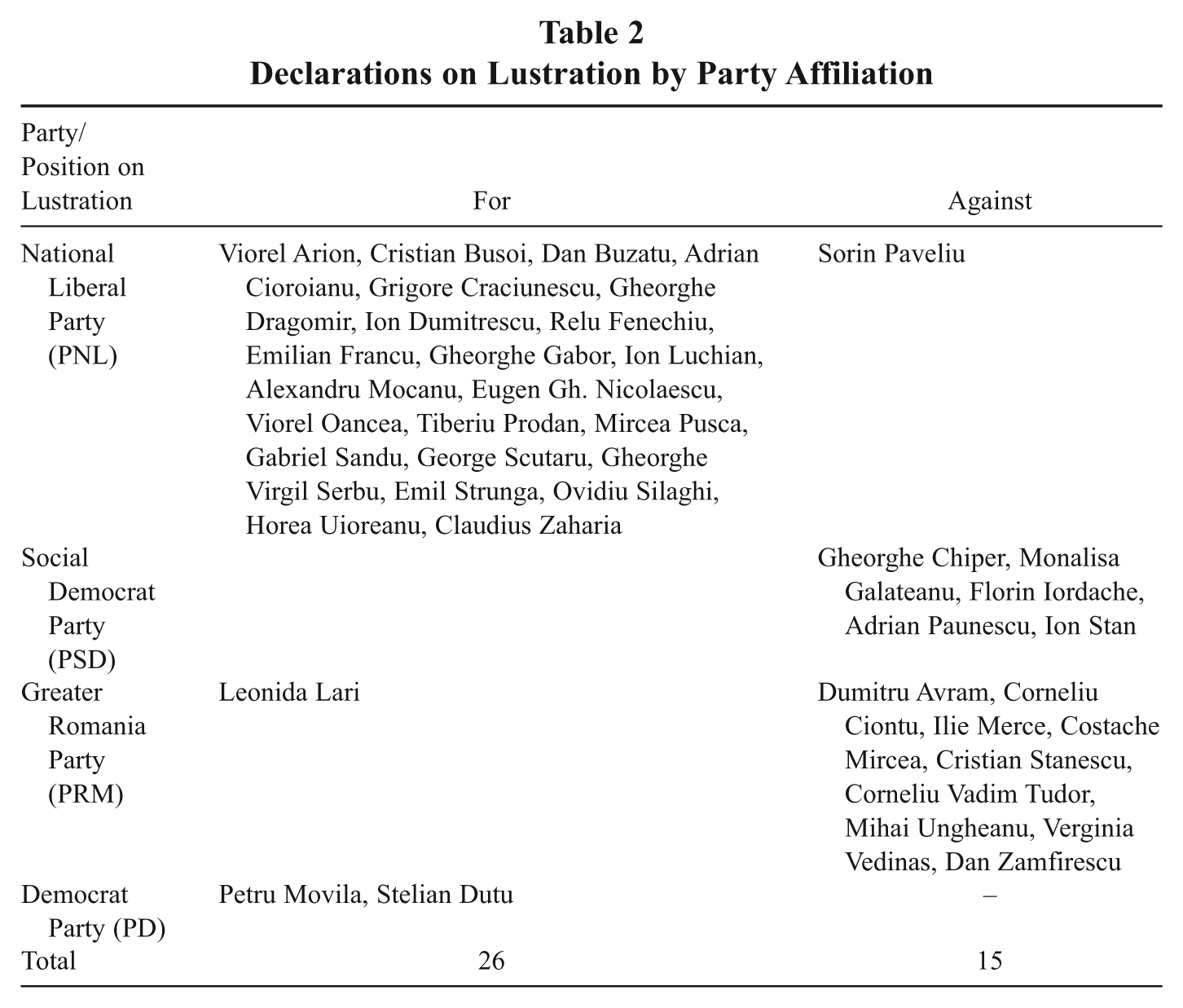
Few legislators considered lustration important enough to make it central to their declarations. Only 9.6 percent of deputies and 6.5 percent of senators spoke on the topic, proving that lustration had little echo in Parliament even when vigorously debated in the press. The house might have reflected the electorate’s apathy toward and ignorance of the topic, a trend the pro-lustration press campaigns of 2005 and 2006 were unable to break. 11 Legislators who spoke on lustration represented the Liberals (twenty deputies and four senators), the Greater Romania Party (five deputies 12 and three senators), the Social Democrats (six deputies), and the Democrats (two deputies). No Democratic Union of Magyars or Conservative Party representatives raised the issue in front of the house. Liberal deputies were the most active. As many as 37.7 percent of the Liberals, 17.2 percent of the Greater Romania Party deputies, 5.7 percent of the Social Democrats, but only 3.7 percent of the Democrats spoke on lustration. 13 Twenty-four legislators representing the government and eighteen opposition parliamentarians tackled this thorny issue.
Almost a third of all Liberal deputies delivered declarations in an effort to make lustration a priority for Parliament, present its advantages, preempt the opposition’s misconceptions, and support the bill introduced in Parliament in 2006. With one exception, all Liberals who spoke on the subject supported lustration (see Table 2). But the more they pressed the issue, the more vocal the lustration’s detractors became, drawn overwhelmingly from among the opposition Social Democrat and Greater Romania Parties. With one exception, legislators representing these parties criticized lustration, reconfirming these formations’ refusal to reopen discussions about the communist regime with which many of their members had collaborated. Last, the ruling Democrats did not fully embrace President Traian Basescu’s unconditional support for resolute transitional justice, as the party registered the lowest number of interventions on the topic.
Overall, the average age of lustration supporters was lower than the age of lustration objectors (forty-eight compared to fifty-six years, respectively), a divide reflecting the generational gap between younger, less tainted and older, more nostalgic politicians. 14 True, not all older legislators spoke against lustration, but all its critics were at least forty years of age. All but two of the eight senators who were older than sixty spoke against the vetting. Regardless of their political persuasion, all young deputies who participated in the debate supported lustration. While age seems a good predictor for the attitudes toward lustration of the very young and of the very old legislators, by itself it cannot explain the position of middle-aged deputies and senators, represented in both camps. The background of each legislator and his or her involvement in the Communist Party and state security probably informs personal positions on lustration. The partial data provided by the Romanian Parliament suggests that many of the legislators who were intimately linked to the party-state (deputies Ilie Merce, Gheorghe Paveliu and Corneliu Ciontu, and senators Adrian Paunescu and Corneliu Vadim Tudor) stood up against lustration.
Interventions during Legislative Debates
In 2005 the government and the opposition submitted to Parliament different lustration bills. The lustration bill (PL 282/2006) was registered with the Chamber of Deputies in 2005 by Liberal deputies Mona Musca, Viorel Oancea, Eugen Nicolaescu, and senator Adrian Cioroianu, and reached the standing committees a year later. The anti-nomenclatura bill (PL 545/2005) was introduced in 2005 by opposition deputies Cosmin Gusa, Aurelian Pavelescu, and Lavinia Sandru of the tiny National Initiative Party. Again, lack of support from parties in Parliament meant that the second bill reached the house and the standing committees only in November 2005. While the government’s proposal envisaged the vetting of “communist activists, people who belonged to the repression organs guilty of human rights infringements—the Securitate, the judiciary and the Procuracy” for ten years, the opposition proposed the vetting of only members of the top party-state structures, the nomenclatura. 15 In the end, the house rejected both proposals.
The government’s proposal, the lustration bill, was debated in the Chamber of Deputies on 6 April 2006, when five deputies presented their views (see Table 3). The bill was defended by representatives of the ruling Liberal Party and the Democratic Union of Magyars, and was criticized by the opposition Social Democrats and the Greater Romania Party, a fact suggesting a party discipline seldom enforced by Romanian formations. Although the Conservative Party leader Voiculescu was at the center of a public scandal alleging he acted as a Securitate secret agent under the code name Felix, a Conservative deputy voiced support for lustration. The Democratic Party was the only party to remain silent during the debate.
Interventions during Parliamentary Debates

Much more heated discussions surrounded the anti-nomenclatura bill, discussed in the lower chamber on 9 March and 22 June 2006. This time, the opposition split between the National Initiative Party initiators and the Social Democrat representatives, who favored the proposal, and the Greater Romania Party, which criticized it. Deputies Pavelescu and Sandru defended the bill they introduced. The Social Democrat Baesu spoke candidly without claiming to present his party’s position on the bill, while Musca embraced the anti-nomenclatura proposal, but asked the house to consider it together with the lustration bill, since they shared many commonalities. The younger brother of Vadim Tudor, Marcu Tudor, a former Securitate career officer, presented the Greater Romania Party’s constant position: no de-communization, in any form.
The May 2006 Public Debate
To allow civil society organizations to discuss the topic, to show the importance of lustration for the general public, and to lay the ground for the adoption of the lustration bill introduced by Liberal legislators in 2006, the Chamber of Deputies Liberal Speaker Bogdan Olteanu asked the Pro-Democracy Association, the Advocacy Academy, the Timisoara Society, and the Journalists Society to discuss lustration. Thirty-nine statements were submitted by civil society representatives, former communist-era victims, and eighteen legislators (eight Liberals, four Social Democrats, three Conservatives, and one each representing the Democrats, the Greater Romania Party, and the Democratic Union of Magyars) (see Table 4). Ten legislators represented the government and nine the opposition, demonstrating an effort on the part of the opposition to have equal voice in the matter. 16 The debate also involved the Conservatives and the Democratic Union of Magyars, two junior government partners whose legislators filed no lustration declarations.
Party Affiliation and Personal Position of Legislators Contributing to the “Lustration in Romania—Principle or Instrument” Public Debate
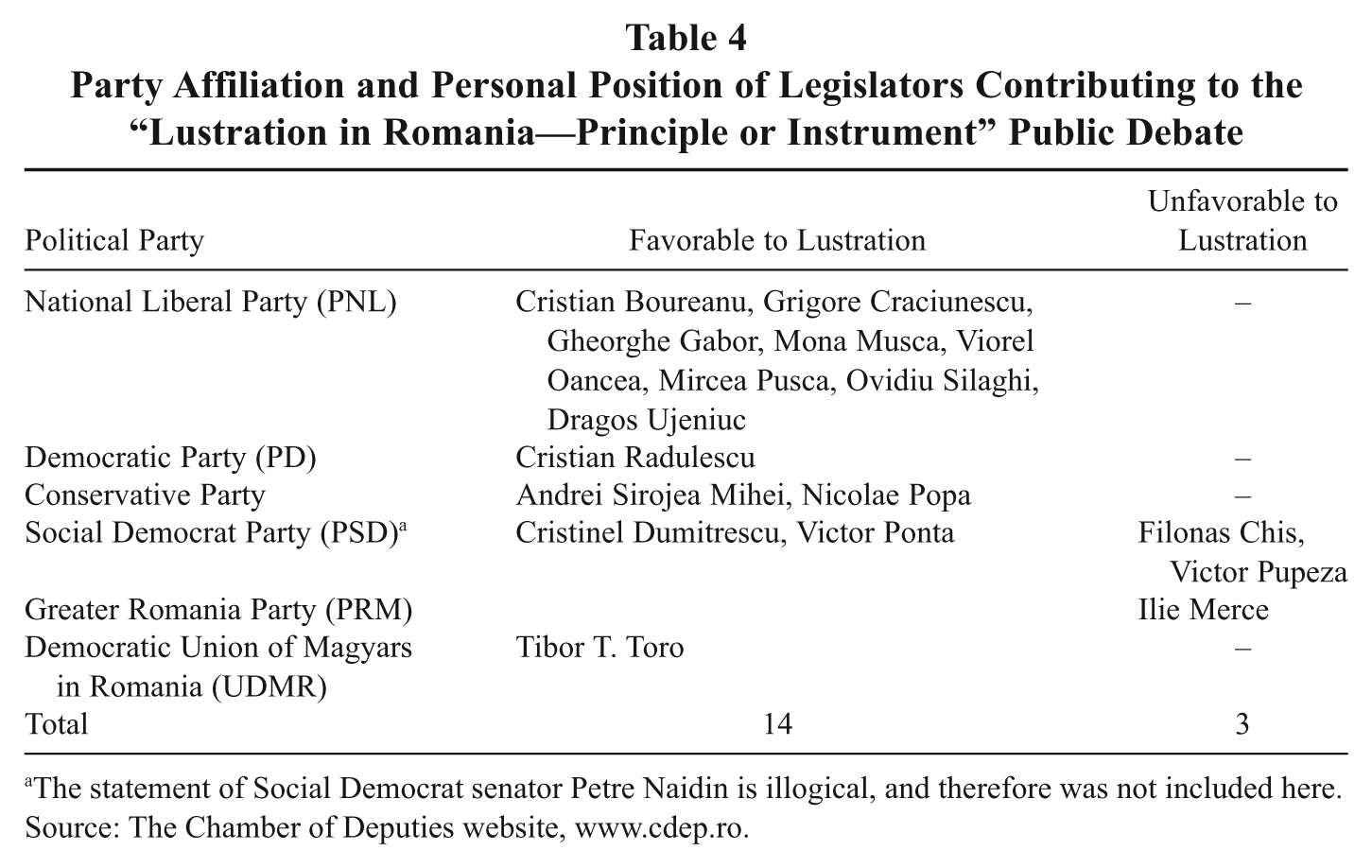
The statement of Social Democrat senator Petre Naidin is illogical, and therefore was not included here.
Source: The Chamber of Deputies website, www.cdep.ro.
The Liberals were again the most active, submitting almost half of all statements received as part of a public debate organized by the Chamber of Deputies Liberal Speaker. By contrast, the UDMR was the least involved, perhaps because the party privileged other policies (protecting the collective interests of the Transylvanian Hungarian community) and was worried that some of its leaders had collaborated with the Securitate and, as such, could be affected to lustration. Again, the Democrats’ relative silence demonstrated that the party closest to Basescu did not embrace the president’s de-communization ambitions. Despite efforts to vet its members, the Democratic Party continued to harbor former communist officials and Securitate agents. Reluctance to engage in the debate was shown by the Greater Romania Party, an outspoken critic of any measure to restrict the involvement of communist decision makers in post-communist politics. Perhaps the party considered the public debate illegitimate, superfluous or unimportant.
Most legislators favored lustration. Critics of lustration as a method of dealing with the communist past or of the lustration bill were drawn exclusively from opposition ranks. Liberal deputy Boureanu and his Social Democrat colleague Victor Ponta, two young politicians, supported lustration but proposed amendments restricting the bill’s scope by limiting the categories of public officials undergoing investigation. Among those who strongly defended lustration were deputies Viorel Oancea and Mona Musca, initiators of the lustration bill. Weeks later, Musca’s political career was cut short by public revelations about her collaboration with the Securitate in the 1970s in Timisoara.
All three deputies who spoke against lustration—Merce, Pupeza, and Chis—had belonged to communist political and administrative structures. 17 The two deputies who supported lustration in principle but objected to the lustration bill were the youngest legislators participating in the debate. Born in 1972, the Liberal Boureanu and the Social Democrat Ponta were only seventeen years old when the communist regime collapsed and were never faced with the dilemma of having to make moral compromises to promote their professional career. While not directly and personally affected by lustration, they voiced objections raised by their older colleagues who wished to limit the scope of the lustration bill. Perhaps the two afforded to criticize the bill because they could not be suspected of having a personal stake in blocking lustration. 18
Arguments for Lustration
As shown above, lustration had a limited echo in the Romanian Parliament. We know that some legislators and political parties were more interested in and supportive of lustration, but only a content analysis of declarations, interventions during debates on legislation, and public debate contributions can identify the arguments for or against lustration.
Lustration as Moral Cleansing and a Break with the Communist Past
This argument was the thrust of the Liberals’ justification for initiating the lustration bill. It was raised in 2005, when Buzatu claimed that lustration aimed “not to ban former communist leaders [from politics] but to rid economic structures of former Securitate agents who continued to exert political influence,” 19 and Nicolaescu said that the law “prevents some leaders to appeal to the mob to protect their dictatorship.” 20 Buzatu responded to press reports alleging that the country’s most successful entrepreneurs and businessmen were former Securitate agents, while Nicolaescu hinted to Iliescu, who opposed de-communization, and called the Valea Jiului miners to ransack Bucharest and intimidate opposition forces in 1990 and 1991. Cioroianu also believed that lustration would lead to a belated break with the communist past. In his words, “those who today [in 2005] oppose the lustration law contribute to perpetuating the mentality instituted in Romania through Sovietization and communization 60 years ago, in May 1945,” that is, they foster the communist culture of secrecy, unaccountability, patronage, and discretion. 21
The argument was reiterated by Fenechiu, for whom the law represented “Romania’s return to normalcy” leading to the “moral cleansing of the society,” 22 or to “moral reform,” in the words of Zaharia. 23 The lustration law represented a much-needed “moral filter,” Busoi said, 24 because “hygiene in politics is as useful as hygiene in our personal life,” as Dumitrescu put it. 25 Zaharia further argued that the law “opens the chance to correctly assess national resources available for socio-economic development. By permitting to rapidly deal with the legacy of the communist regime, [the law allows] the government and the public administration to fully focus their attention on improving the quality of services offered to taxpayers in order to bring it to European levels.” 26 For Scutaru and Dumitrescu, Romania needs laws “to guarantee untainted representation, free from association with the old regime,” 27 because “it is unjust for the country to continue to be ruled by eternal yes-men, communists or former communists converted to democratic values out of personal interest and love of public office. We do not exclude them from public life, we just identify them and let the voters and the history to judge them.” 28 For Gabor, the adoption of the lustration law would prove “willingness to shed off a past imposed on us through force, to show us and the others that we can critically examine our recent past . . . to give minimal moral satisfaction to the millions of victims who suffered because of communism and its servants.” “The law seeks to unmask the ‘servants of evil’ who stole decades of our history. Nobody will send them to prison, they will simply become known to us.” 29
Lustration as Retributive Justice for Victims of Communism
Other legislators saw vetting as an attempt to symbolically vindicate the victims of communism. By restricting their political rights, communist victimizers are subjected to the very treatment they offered to their victims, a measure leveling the playing field between victims and victimizers. The lustration law, Uioreanu said, was “an act of justice we, those untouched by communist experiences, had promised to all those who lost trust in the political class.” 30 For Busoi, lustration was an “absolute necessity” and Romania’s “last chance to rid itself of its horrendous communist legacy,” because “those who suffered at the hands of the communist regime must receive moral reparations,” and the country “must leave behind a past that always has worked against [the Romanian people].” 31 Francu encouraged legislators to support lustration because the society “is ready to do justice to all those who, for 45 years, suffered political persecution at the hands of the Securitate.” 32 For Craciunescu, everybody should “know that the long arm of the justice system will ultimately reach communist perpetrators who used public office for personal gain. Some wonder how the society benefits if former leaders are made accountable for their actions. It’s not a matter of gain or loss, it’s a matter of truth and justice. People died, some were maimed, others were psychologically damaged for life. People are eager to find out the truth and obtain justice.” 33
Lustration was warranted by the human rights abuses perpetrated by communist officials and secret agents. The trial of communism was needed, Arion said, for “a new genocide never to be possible again,” 34 hinting at the repression of early communist rule. Communism should be brought to trial, Zaharia insisted, also because Romania “is the only country that exited communism with the price of over 1,000 deaths and 4,000 people wounded.” 35 The youth benefited from an honest reconsideration of the past. For Paveliu, “We must allow those who in 1989 were too young to understand the national drama Romanians lived for 50 years. We have this obligation to the 1,000 young people who died [in the December 1989 revolution] for our transition from communism to capitalism controlled by former communists to gain credibility.” 36 “Democracy is but an empty word without lustration,” Sandu summed up. 37
Lustration as Elite Replacement Tool
Some legislators defended lustration as a way to renew the political and economic elite by allowing untainted candidates to fill the public offices from which their tainted colleagues were banned. The measure was not vindictive, because communist decision makers had gotten ahead in the society not because of superior personal skills or professional training but because they implemented repressive policies dictated by the party-state. For Serbu, post-communist legislators “who had influence and decision making power in communist times should withdraw from politics and make room for new leaders free from the communist ‘bug.’” 38 Lustration allowed Romania “to join Europe with a restructured political system made up of politicians and public officials who did not collaborate with the communist political police.” 39 Paveliu noted that “those who belonged to the repressive machinery contributed voluntarily to the deliberate starvation and the physical extermination of dissidents and their families, broke the spirit of the nation and transformed it into a mass of yes-men, and malformed successive generations indoctrinated to love the leader and the party. The party and its repressive organs relied on tens of thousands of party members who, red party cards in hand, found the way to personal welfare and happiness with the help of lies, terror and spying. . . . Obeying leaders, informing on others, a bossy attitude toward subordinates, and limitless hypocrisy represented the key to success in the struggle to climb the communist social ladder.” 40
Legislators called for elite renewal not only because they wanted to see a new generation of leaders emerge but also because they hoped to dismantle the networks of patronage and corruption linking former communist officials and secret agents who kept the state a prisoner to their group interests. There can be no elite renewal, Prodan argued, “without promoting untainted people, who support the national interest,” not their personal interests. 41 For Pusca, lustration is needed “if we truly want the dismantling of corrupt structures, and the ban from decision-making posts of those who can be blackmailed with their Securitate or party files. It is time to end the political game of those who—by blackmailing others or through fear of being themselves blackmailed—have controlled our destiny” after 1989. 42 Sandu noted that the Communist Party “the second echelon, has miraculously adapted to the new democracy. They are the last bastion of communist resistance. Only after their disappearance can we speak of a morally healthy society. They have no political color or conviction, they infiltrate all levels and exert a decisive influence over our society. Their ‘apparatus’ is among the few that have run smoothly in recent years. . . . [In] my county, former Communist Party secretaries were elected mayors, and all nomenclatura members have become successful businessmen, keeping investors away.” 43
Democrat deputy Dutu also viewed lustration as an elite replacement tool. “The absence of role models, the frequent rotation of cadres, the dominance of individuals engaged in politics to stuff their own pockets not to look for the interests of ordinary citizens characterize post-1989 politics. . . . Besides the unfulfilled promises that rightly discredited our political system, our unwillingness to assume our past has also had a negative impact.” 44 Dutu linked access to secret files to lustration: “Together with the lustration law, the publication of secret files can fulfill the electorate’s hope for [elite replacement]. . . . Many fear the files because they fear the truth. Just imagine how different our political class would be today if secret archives and the nomenclatura list were made public in 1990! We need to eliminate all our rotten politicians. Only afterwards can we hope for a competent, moral and publicly credible political elite.” 45
Lustration as Prevention against Post-Communist Violence
While previous pro-lustration arguments were raised in other countries as well, 46 in Romania lustration was also seen as a way to prevent violence, because pro-democratic political leaders are less inclined to pit social groups against each other, as former communists do. The deputies who supported this position made reference to the June 1990 events, when Valea Jiului miners were summoned to Bucharest by President Iliescu to “defend” the government against peaceful protesters. Chanting slogans like “We work, we don’t think!” miners savagely beat up protesters, harassed pedestrians, destroyed the headquarters of opposition parties, and ransacked the University of Bucharest. In 1991, the miners forced Petre Roman to renounce the premiership.
Nicolaescu voiced this argument when claiming that “the bloody incident of June 1990 could have been avoided if Romania had a lustration law.” 47 As antigovernment dissenters whose peaceful protest the miners quashed demanded lustration, the law’s adoption represented “moral reparation” for the miners’ descent on Bucharest. 48 Craciunescu also declared that a lustration law “could have barred the way to leadership positions to those who planned the mineriada [miner’s descent]. . . . Former nomenclatura members failed to understand that the people threw the communist regime to the history’s garbage bin. A lustration law is welcome [because] the planners and organizers of the 1990 mineriada must answer for their actions before the courts.” 49
Lustration as European Union Accession Requirement
Many legislators claimed that lustration is a requirement for EU accession, although the policy was never included among the political conditions Romania had to fulfill to become a member. Fenechiu insisted that the EU expected Romania to pass a lustration law. The reasons were explained by other legislators. First was the imperative to “enter Europe” under the leadership of a political elite committed to democracy, and untainted by communist ideals. For Buzatu, the EU “calls on [Romania] to cleanse its political class by eliminating from politics those who worked for the communist regime,” while for Serbu Romania “needs a reform of the political class, of our mores in order to be able to fulfill European requirements.” 50 Lari believed that “Romania cannot join [European] countries without condemning the communist regime and [adopting] lustration.” 51 Together with other legislative proposals, Scutaru argued, the lustration law could “introduce a morally healthy Romania, clean and unbroken, in the great European family.” 52 The law “condemn[ed] a regime that threw Romania out of Europe,” “isolated Romania, placed it under the control of the Soviet Union, and limited our most fundamental rights.” 53 For Strunga, “the EU has insisted for the moral cleansing the Romanian society needs in order to integrate in the Union. The past must be not forgotten, but exorcised; the memory of the victims of communism should not be honored just once a year on the anniversary of the Revolution but on a daily basis through the elimination from politics of those who consciously and willingly contributed to communist repression.” 54
Legislators believed that lustration had helped other post-communist countries to gain early acceptance into the EU. The Czech Republic, Hungary, and Poland already had lustration laws that “truly contributed to their joining the EU before us [the Romanians],” Silaghi argued, 55 while in 2006 Uioreanu reminded that similar laws were adopted in “countries that are already members of the EU.” 56 Romania remained one of the few Eastern European countries without a lustration law, and this “negatively impacted the way its transition unfolded,” Craciunescu claimed. 57 The experience of its neighbors, Movila contended, “suggests that a society emerging from a harsh communist dictatorship cannot be truly democratic without a moral revolution. . . . How can we build a modern European democracy with people convinced that the communist society is a superior form of social organization, with people who struggled to occupy a leadership position in that society?” A lustration law, he said, “is not revengeful, does not seek to eliminate them from public life, to hand down criminal punishment, but asks those who supported communism to take a step back. It’s a law necessary for our integration into the EU.” 58
Arguments against Lustration
Anti-lustration motivations responded to the pro-lustration positions detailed above, or brought forth completely new ideas. Critics of lustration dismissed it as “legally, politically and morally unacceptable,” “completely unconstitutional and even anti-constitutional,” a “discriminatory imbecility,” a “confused, ambiguous, legally imperfect” bill amounting to witch-hunt, and an “uninspired anachronism, a wasps’ nest empoisoning the country.” 59 The law was an “exercise in hypocrisy, intolerance and demagoguery” similar to Stalinist purges, “a non-sense transformed from a purification ritual into a wild chase,” a “political purge” and a “national hysteria,” an “aberrant, unconstitutional and late” law that “divides Romanian citizens in arbitrary categories, takes away the right of some citizens to elect and be elected, and leads to a generational gap.” 60 Denying its moral value, detractors viewed lustration as a blunt political device meant to help “self-avowed anticommunists, demagogues, populists, the frustrated,” “the mentally handicapped,” “the Bolshevik off-springs of early communist nomenclatura members,” and some political parties to gain political capital. 61
Lustration Is Unconstitutional
Legislators spelled out constitutional objections to lustration. For Vedinas, the proposal ran counter to the political right to elect and be elected to public office. 62 For Stan, the law “created a new category of politically persecuted persons who could rightly ask international courts for justice” and provided for punishment “based not on established facts, guilt or responsibility, but on adherence to a political system or a social or professional category at a time when Romania was not isolated internationally as South Africa.” 63 The proposal was unconstitutional, Galateanu insisted, because “it divides state dignitaries according to their ideological affiliation to communism and bans even those who took part in no condemnable acts.” 64 Collective punishment is undemocratic, as each individual must be held accountable for his or her deeds, according to the legislation. “The courts must condemn deeds, not opinions. It’s unacceptable to repair an injustice by committing another injustice.” 65 By promoting lustration “the government sought to turn the citizens’ attention away from the problems faced by ordinary citizens, replacing those with political vendetta.” 66
One Cannot Punish Valuable People or Condemn Romanian History
The Greater Romania Party legislators claimed that it is immoral and impractical to punish valuable people who happened to live under a repressive communist system, and that nobody has the right to condemn an important period of the Romanian history. Vedinas pointed out that many communist leaders were “valuable individuals, perceptive intellectuals and great patriots” and criticized lustration for “condemning an entire historical period of Romania” when in fact “history is our past, and we must assume it, with all its good and bad features.” 67 Ciontu insisted that “some communist leaders of the 1970s and the 1980s in the Soviet Union, Czechoslovakia and Hungary were more honest and responsible than many democrats of today,” 68 and Avram claimed that “to lump together tens of thousands of people, some of whom were, if not deserving, at least innocent, is an inexcusable abuse.” 69 For Vadim, those who benefited from the marginalization of former communist officials were “the rascals and the speculators, the only ones who, prior to 1989, had been denied Communist Party membership.” 70
Merce praised the communist regime. Glossing over the human rights infringements of the Securitate, he pleaded for an “objective” reconsideration of an intelligence service akin, for him, to services operating in democratic countries. The Securitate was “an institution of the Romanian state protecting its independence and sovereignty,” and “there was a time when Western democracies clamored Ceausescu, and saw him as an enfant terrible of the communist block, a serious adversary of the Soviet regime,” but that his many accomplishments had been long forgotten. He concluded that “since communist Romania was part of international organizations, all its state institutions, including the Securitate, were accepted” by the international community. “The activity of the Securitate, conducted according to legal norms and strict statutes and rules, was exaggerated to create the impression that we are all spies and to blame the entire nation. Romania seemed to have been a huge prison, where each inmate was an informer for Securitate. The only solution offered to wash away the guilt of widespread collaboration with Securitate is to open the files. This would benefit only Romania’s enemies and would amount to a catastrophe for our information services and to a pyre for those who served our country’s fundamental interests. . . . The rape of the Securitate archives had nothing to do with the national interest, and everything to do with political and group interests.” 71
There Are Other, More Important Problems
Objectors insisted that lustration should take a step back to the fight against corruption, criminality, and tax evasion or the improvement of living standards. 72 Commenting on the floods that devastated Romania in 2005, Avram said that “at a time when the Danube River floods tens of localities, some conflict-seeking individuals call for the aberrant laws on lustration, anti-nomenclatura and the condemnation of the Securitate as a political police. When the country is so hardly hit, the [ruling] Justice and Truth Alliance negates an entire historical period [the communist years].” 73 “Romanians need no trial of communism, but a real trial of the last 16 years of economic disaster and destruction of the very national fiber of the Romanian people,” Avram elaborated, suggesting that “now former communists and nomenclatura members would have been among ordinary people, not partying” as the current leaders were presumably doing. 74
Stanescu was surprised by the intensity of the public debate on lustration “at a time when Romanians’ real problems are the dramatic decrease in living standards, meager pensions for over one million people, price increases for utilities and basic products, the failure to stem high-level corruption, the enormous burden of the tax system, and even Romania’s poor preparation for accession into the EU.” 75 For Vadim Tudor, the country had other priorities, since “anticommunism is useless to hungry people,” as ordinary Romanians presumably were, and Galateanu argued that the law was “inappropriate” because it could lead to “administrative chaos at a time when the country faces floods and grave disfunctionality in the health care sector.” 76
Lustration Runs Counter to European Values
While supporters claimed lustration helped Romania to bridge the gap separating it from the EU, objectors used the EU as a reference against lustration. For Vedinas, the policy “runs against the European spirit of diversity, including ideological diversity,” while for Galateanu it “runs against the constitution and the fundamental rights” and “other Eastern European countries that adopted lustration were obliged by international organizations to abrogate them.” 77 Going even further, Stan criticized the law for ignoring the verdicts handed down by the European Court of Human Rights, assuming collective guilt, proposing retroactive justice, denying the right to appeal, and ignoring the experience of other Eastern European countries, which suggested that similar laws were either “irrelevant” or fostering social conflict. 78 After 2000, the European Court ruled in favor of lustrated Eastern European citizens. 79 Responding to those who claimed that EU promoted lustration, Avram observed that the EU “criticized [Romania] not for failing to assume its communist past, but for its corruption, poverty, injustice, and sterile political debates.” 80 Lustration was unnecessary because “this is the age of enlightened nationalism making Europe a region of unity in diversity,” where “few nomenclatura members and secret agents were brought to trial, [and] those linked to the former regime were judged not for their past activity, but for their current deeds.” 81
Lustration Is Impractical
Several legislators criticized lustration as an impractical policy that came too late, was immoral, socially divisive, vindictive, and unchristian. Lustration was immoral because “nobody has the moral standing to condemn the communist leaders and deny them the right to a future,” Vedinas said, because only history can decide whether communist officials and secret agents acted rightly or wrongly. 82 Mircea rhetorically asked, “On which moral grounds and in whose name can the [civil society] commit abuses against the Romanian national spirit and history, ask us to bring back to the forefront of politics the dungeons of history? Those who never understood or never lived under Stalinism can see it [resurrected] today in the form of the lustration law.” 83 For Mircea, Stalinist purges and post-communist lustration were similar, though they targeted different social categories. For Vedinas, lustration is unchristian, privileging the logic of vengeance over the Christian logic of forgiveness, and does not correspond to the “Romanian national spirit, which rejects vendetta.” 84 Paunescu warned that lustration would bring “hatred, incompatibility, conflict, class warfare,” not national reconciliation. 85
Lustration was impractical because it came too late, an argument raised most forcefully by Paveliu, before he became one of the initiators of the anti-nomenclatura law. Voicing the Democrats’ general ambivalence toward lustration, in 2005 Paveliu admitted that initially he supported lustration, but then he came to oppose it because by then there were not that many former communist officials to be lustrated. “Only those who were 40-45 years old in 1989 are still active [in politics]. Those who were younger did not reach leadership positions [under communism], those who were older are close to retirement. We must look forward toward the future. Those whom lustration can ban are too few, and the price the society would pay to marginalize them is too high.” 86 Instead of lustrating public officials, Paveliu urged Romanians “to show out contempt toward all those who, we know, supported an anti-national regime. Our proposal cannot and should not go beyond the democratic vote against these individuals and the parties that tolerate them.” 87 He favored “a trial of communism and allowing the people and the historians to get access to documents detailing the horrors of the communist regime.” 88
Conclusion: Deconstructing Lustration
This analysis of the occurrence of the term lustration in parliamentary documents ranging from declarations delivered by deputies and senators in front of the house, to interventions during debates of lustration-related draft bills and contributions to a parliament-sponsored public discussion on the topic reveals that Romanian legislators were rather insulated from the debates conducted in the local press. Indeed, legislators have allotted little time to discuss lustration, which was the topic of only a fraction of all materials submitted to the house.
The analysis confirms discrepancies between pro-democratic formations and successors to the Communist Party in terms of their position toward lustration: most legislators representing the former supported the ban, while most representatives of the latter rejected it. While both the Liberals and the Democrats have publicly stated their support for lustration, the Liberals were more proactive supporters, by also introducing a lustration draft bill, than the Democrats. The parties closer to the former Communist Party, the Social Democrat and the Greater Romania Party, adamantly opposed a vetting process that would affect first and foremost their members. The only dissenter of the group was Leonida Lari, a Greater Romania Party member who would not be affected by lustration and file opening because before the 1990s she was a citizen of neighboring Moldova, a former Soviet republic where the Securitate did not recruit informers.
The article further shows that Claus Offe’s typology of backward-looking and forward-looking justifications for lustration applies to Romania as well. Backward-looking lustration is concerned with general moral cleansing to wash away the legacies of the communist regime, and punish members of the old regime seen to have transgressed some moral law. By contrast, forward-looking lustration can establish a clean slate for the future by ensuring that the legacy of the recent past does not disrupt democracy in the future. It employs lustration as a means to stem corruption and prevent blackmail and other abuses in post-communist politics. 89 Both kinds of justifications were used in the Romanian parliament, together with more technical arguments. Backward-looking arguments claimed that lustration brings about moral cleansing and a break with the past, and provides retributive justice for victims of communism, but leads to the punishment of valuable individuals. Forward-looking arguments see the ban as an elite replacement tool useful to prevent future violence and to help countries to gain all benefits associated with EU accession, but also as a measure running counter to European values. Technical arguments tended to criticize lustration as impractical or unconstitutional.