



Abstract
This article constitutes a meta-analysis of sociological surveys conducted between 1967 and 2010 on the attitudes of Poles towards Jews. This analysis covers factual knowledge about Jews, like/dislike feelings, social distance, cognitive schema, and views regarding Polish–Jewish history. The results reflect a general nonacceptance of strangers as well as a specific type of anti-Semitism with strong roots in and encompassing a broad spectrum of Polish society. In this respect, Poland and some of the other Central Eastern European countries are much alike and distinguish themselves negatively in comparison to Western Europe. Nevertheless, in the last decade a positive shift in Polish attitudes towards Jews has been manifesting itself: feelings of closeness are increasing while disapproving cognitive schemes are decreasing. Further changes depend upon the reconstruction of Polish national identity as well as on the public debates delving into Polish–Jewish relations past and present.
Citizens of the Republic of Poland who consider themselves both Polish and Jewish constitute a very small fraction of the society: no more than 0.1 percent, that is, no more than one-thousandth. This is all that remains of the three and a half million strong Jewish population before the Second World War. Today these few “Jewish Poles,” “Polish Jews,” or “Poles of Jewish origin” are indistinguishable from and integrated with the society as a whole.
Paradoxically, “Jews” do occupy much space in the social consciousness and are the object of emotions—often negative. The Jews of whom Poles think today do not encompass solely those currently living in contemporary Poland. These Jews also include those who lived in Poland once upon a time—after the war, before the war, or even further into the past; the concept encompasses the entire Jewish nation. The “symbolic” Jews of today are simultaneously a collective entity and a construct of the collective imagination. Distinctions are of little significance for the prejudiced mind. This viewpoint assumes that people of some ethnic category are basically all alike always and everywhere, and that in each such person is found some common ethnic essence.
Sociologists know this from their research into “attitudes towards Jews”: studies thus labeled cover knowledge, emotional stances, prejudices, stereotypes, cognitive schemes, a sense of identity, and other subjective phenomena. Such investigations have been conducted in Poland for over four decades (begun in 1967 by Jerzy Szacki)—only a handful of other countries can boast so long a tradition in this field. 1 Yet the first twenty years were spent under a different political and economic system; halfway through the forty years Poland changed from communism to democracy, from a command economy to a market economy, and opened itself up to the world. Therefore, our inquiries not only reveal what Poles think of Jews today but we can also test if historical events in the country have influenced attitudes towards Jews, rendering them more, or less, friendly.
The basic methodology for checking attitudes among the mass populace is the survey. Yet this instrument is not infallible and has its limitations, all very well known to sociologists. It cannot reach and probe the deeper levels of consciousness, the social subconscious where the demons lie. Research subjects have a tendency to disguise socially undesirable opinions; they aim to appear politically correct. That said, more important than its faults are the virtues of the survey. Comprising a representative sample, it discloses the views of the whole society, particularly its mainstream, “ordinary people.” 2 It reaches farther than circles of friends and acquaintances, or other social circles whose engagement on one side or another of a social issue is so glaringly obvious. Moreover, since surveys are repeated, they reveal changes in society and safeguard us from unfounded impressions that things are getting increasingly better or increasingly worse.
This article will attempt to sketch out an image of the changes in attitudes towards Jews based precisely upon survey research. The two primary sources will be the standard public opinion surveys conducted by OBOP (Ośrodek Badania Opinii Publicznej [Center for Public Opinion Research], since 2003: TNS OBOP; est. 1958) and CBOS (Centrum Badania Opinii Społecznej [Public Opinion Research Center], est. 1982). Supplementary information will be drawn from more in-depth academic investigations, regularly done by scholars from the Institute of Sociology at the University of Warsaw, but also by scholars at the Jagiellonian University in Cracow and the Jewish Historical Institute in Warsaw. Noteworthy, of course, is the first Polish Prejudice Survey implemented at the end of the year 2008 by the Department of Psychology at the University of Warsaw. This particular study has opened a new stage in research into attitudes towards Jews, yet we should leave announcements of the results to its authors. I will, however, take advantage of some multinational surveys. In various countries, including Poland, these have been performed on behalf of the American Jewish Committee (AJC). 1 Comparative research will permit us to see how Polish society differs from or is similar to others. This is especially significant because of the popular thesis regarding Poland’s being negatively exceptional regarding the issue under discussion here.
I
A description of one group’s attitudes with regards to another should commence with what the former knows of the latter. Yet a significantly large fraction (sometimes even half) of the Poles surveyed cannot even vaguely approximate the number of Jews currently living in Poland, neither in thousandths nor in proportions. This should surprise no one. People have no source for such an accounting because no figure functions in the public realm that could be remembered like the broadly recognized number of six million Jews murdered during the Second World War. The fact that ordinary people do not know how numerous the Jewish community is in Poland today could also signify that it is not crucial for them. We neither seek nor accumulate in our memories information that is immaterial for us (this is the basis for so-called rational ignorance). Moreover, the majority of common folk are poor at numbers (“innumeracy”), especially large numbers regarding lesser known issues—and the ethnic composition of society in Poland is just such an inconsequential topic.
The problem is not, however, deficient but rather false knowledge. Those who have an opinion regarding “how many Jews are there in Poland” flagrantly inflate their estimates. In the course of one survey done in 1996, only one-third of the respondents selected the answers up to one hundred thousand in response to the question “How many Jews currently live in our country?” The remainder chose ever higher numbers, including the 14 percent that opted for the capricious “1 million or more.” 4
The glaringly inflated guesses could be associated with the perception of Jews as a threat: a conviction of the omnipresence of Jews belongs to an anti-Semitic worldview (“Jews are numerous, stick together, and secretly rule the world”). Nevertheless, there is a second explanation—one quite sympathetic and positive for a change. The more people hear of some minority in the media, the more of its members they “see” in society. 5 Some Poles might think that there are many Jews in their country because much is being said and written about Jews, about their history and culture, as well as about Polish–Jewish relations (e.g., suffice it to browse through the Sunday editions of the two most popular national dailies, Gazeta Wyborcza and Rzeczpospolita). Each of these factors sheds light on a piece of this puzzle.
Still, regardless of the reason why, exaggeration of the size of the contemporary Jewish community in Poland does indicate its mythologizing. For the sake of comparison, Poles accurately assess the magnitude of the prewar Jewish population; they are also well aware of what happened to this population. In 1995, an AJC survey revealed that 77 percent of those asked knew that Polish Jews were murdered; 13 percent stated that some part was murdered and the rest emigrated. 6 These are, in fact, very high indications considering a generally meager familiarity with historical facts in contemporary Polish society.
A patent inflation of the range of a country’s Jewish population is not reserved for the Poles alone. In Austria where the number of Jews is similarly small as in Poland, the colloquial visions regarding the ratios are similarly false. In 1991, only 14 percent of the Austrians surveyed by the AJC knew how few Jews there really are in their country: less than 1 percent. Yet some 22 percent of the respondents thought that this percentage was higher than 10. 7 Quite likely in other Central Eastern European states Jews constitute a “phantom pain,” like an amputated limb which continues to ache. Jews remain present in the social consciousness belying their almost complete disappearance in the region.
II
The simplest and easiest element to capture in attitudes towards others and aliens are feelings—especially sympathy and antipathy, hot and cold emotions. Individually experienced feelings are shaped to only a slight extent by direct contact—and still less via contact that is unbiased, unburdened by the influence of earlier judgments or even prejudgments. The assessments that underlie our emotions are created and passed down by our society. Individuals accept these (or not) in the course of their maturation within a group; hence, in this sense, one can say that human beings even learn what to feel.
These general truths are remarkably applicable in the case of sentiments Poles have for Jews. Very few of them have had a chance to personally meet a person who self-identifies as Jewish. Their impressions regarding Jews have been assumed via tradition, mass media, and other narratives circulating in the communicative space. Among peers and between generations, emotions felt towards Jews are passed on through language—its categories, proverbs, sayings, and nicknames.
Sociologists have at hand two series of measurements taken of such emotions (Figure 1). One is an OBOP survey from 1975 to 1991 (i.e., the last decade and a half of communist rule); the second encompasses the CBOS surveys done since 1993 (i.e., in the first decades of democratic rule). 8 The questions asked in these studies did not pertain solely to Jews in Poland—they pertained to Jews as one of many nations in general.

Sympathy and Antipathy Towards Jews, 1975-2009 (OBOP and CBOS)
Prior to the political and economic system transformation, the general public displayed neither sympathy, nor antipathy: indifference dominated. Jews were more “immaterial” than Poland’s neighboring nations (i.e., Russians, Germans, etc.) and other nations strongly associated with Poland (e.g., the French and Americans). Those Poles who did have any set attitude towards Jews tended for a long time to express antipathy more than sympathy. That said, a very slow but steady increase in sympathy manifested itself between 1975 and 1991—from 4 to 17 percent. Antipathy, in turn, clearly fell. The change evident across these years unveils a general trend of decreasing antipathy towards Others which, nevertheless, only partly explains things because antipathy towards Jews fell faster than towards other “un-liked” nations, and Jews ceased to be the nation least liked among the respondents.
Immediately after the 1989 systemic shift this trend of increasing sympathy accompanied by decreasing antipathy continued. Shortly thereafter, however, it halted and even took a clear step backwards for a good number of years. Then again, in recent years the previous tendency was revived and in 2008 declared sympathy (34 percent) slightly overtook antipathy (32 percent). To err on the side of caution since this difference falls within the statistical error range, it might be more precise to state that the two came up even. Be that as it may, this little wonder had occurred for the first time since survey research on attitudes towards Jews began in Poland in 1967. Now results from 2009 permit speaking of a statistically significant edge of sympathy (31%) over antipathy (27%), although, of course, we cannot be certain if it is permanent.
Because a warming trend in the feelings of Poles for Jews began even before the transformation and, moreover, did not pick up tempo after 1989, we can conclude that the change to democracy only sustained this tendency, just like the more general one towards decreased xenophobia. What is unique to the situation in postcommunist Poland is the previously mentioned rebounding of antipathy in the second half of the 1990s. This is probably connected to the sharp and strident arguments about the history of Poles and Jews during the last war—starting with the Carmelite convent controversy in the late 1980s and then peaking again with Jan Tomasz Gross’s book Neighbors at the beginning of the new century. 9 Worth emphasizing is that such uninhibited discourse was made possible precisely by democracy, which although facilitating free expression from one extreme to the other was, ultimately, able to handle the negative turn. It is apparent that the introduction of democracy has had a complex and complicated effect on opinions concerning Jews in Poland. Key here is that the end result is mostly positive.
As the eminent sociologist Seymour M. Lipset once stated, “Those who know only one country know no country.” 10 Vital therefore is comparison of Poland to other countries. The most current investigation was conducted by the American Jewish Committee in seven countries in 2005 (Table 1). 11
Sympathetic and Unsympathetic Feelings Towards Jews in Poland and Other Countries (in percentages)

Source: American Jewish Committee, Thinking about the Holocaust 60 Years Later, 2005.
Throughout this survey research, it is clear that the dominant attitude towards Jews is ambivalence—in Poland as in other countries of Europe (with the exception of Great Britain). Yet another similarity between Poland and all other countries is sympathy declared several times more often than antipathy. The latter is universally declared quite rarely, yet all is not as pretty as it seems. Today people the world over are becoming more reserved in open expression of a dislike towards others, and, in fact, know that one should be tolerant and friendly towards them. Therefore, one should interpret data from each country very carefully, paying close attention to the social context in which it was gathered. Antipathy with respect to Jews is certainly (and unfortunately) never so low (a maximum of 6 percent) anywhere. The differences in this measurement between various countries—when they are noticeably greater (and there are such)—do, nonetheless, retain their own particular meaning.
Sympathy in relation to Jews manifests itself clearly more often in Poland than in Austria and Germany, yet less often than in the remaining countries. It is the scale of this feeling that sets Polish society off from the societies most favorably oriented towards Jews, Poles declare the highest degree of sympathy less frequently, more exceptionally than others.
III
Shifts in feelings of sympathy and antipathy correlate with shifts in a sensed social distance with respect to Jews (Figure 2). This gap is still conspicuous but is slowly but surely decreasing in size. Naturally, I could accent this shift inversely—saying that the distance is diminishing yet still sizeable—but my perspective is hopeful. The reduction of social distance constitutes additional justification for a belief that feelings about Jews are warming.

Social Distance with Respect to Jews, 1988-2007
An acceptance of Jews as hypothetical neighbors (this being a basic indicator of ethnic distance in sociology) is rising. In 1999, a quarter of those queried in the Polish edition of the European Values Study stated that they would not want Jewish neighbors; by 2007 the number of such persons was clearly lower (16 percent). 12
Also intensifying is an acceptance for, also hypothetical, mixed marriages with Jews (yet another key gauge of distance). This is plainly seen in the results of Ewa Nowicka’s study of 1988, repeated longitudinally in 1998. 13 At the end of the 1980s, 40 percent of the people surveyed would advise a friend against marriage with a Jew; a decade later there were fewer such persons—33 percent. Jews comprise one of the least accepted minorities, but it should be noted that consent to mixed marriages—not only with Jews—is generally low in Poland. Poles do prefer “one of their own” in the family (especially persons of the same religion) and not some Other.
The fact that a sense of distance with regards to Jews involves a strong component of general distrust towards others comes well into view in the case of the public sphere. In 1994, about half of all Poles (according to CBOS) did not want to have a prime minister who would be of national minority origin. Whether this theoretical individual was to be Jewish or German or Ukrainian basically did not matter. 14 Similar was the outcome with reference to the president, as ascertained in Ireneusz Krzemiński’s pioneering study. In 2002, about one-third of those questioned were certain that they would not vote for a candidate of Jewish, German, Russian, or Ukrainian descent. Over the previous decade, however, the significance of ethnic origin weakened somewhat for Poles. In the case of a Jewish candidate, 38 percent would certainly not vote for him or her in 1992, while ten years later those people comprised 33 percent of the respondents. 15
The deep-seated emotion engaged in sympathy–antipathy and social distance involves a sense of closeness and intimacy versus remoteness and coldness. Intimacy bears various dimensions: blood ties, shared history, similar culture, and religious affiliation. Inventive sociological investigations disclose changes in some of these areas.
Blood ties (i.e., biological closeness) are the basis for a conviction that people of various nations belong to “the same race as Poles.” In 1988, 23 percent of the Poles studied by Ewa Nowicka replied that, in the case of a necessary transfusion, they would not accept “healthy and tested” blood from a Jew—just as they would not accept it from an Arab, or a Chinese or Black individual. In the case of European nations, this percentage was lower (approximately 8–14 percent); the category in which Poles situate Jews is clear. However, over the next few years, the sense of biological distance with regards to Jews but also the Arabs, Chinese, and Blacks changed somewhat. In 1998 about 15 percent of the Poles surveyed stated that they would reject blood from these groups. 16 These declarations do not have any predictive value with regards to a concrete set of circumstances, but they do possess a high diagnostic value with regards to the potency of ethnic prejudices.
Historical proximity with Jews on the same territory is assessed asymmetrically by Poles: they like to see themselves as good neighbors and the Jews as bad ones. In 2002 (as part of the Krzemiński team study), Poles asserted three times as often (27 vs. 9 percent) that they had historically experienced more harm than good with Jews. In contrast, seven times as often (42 vs. 6 percent) Poles avowed that Jews had experienced more good than harm with them. Such an asymmetry is nothing extraordinary: Krzemiński discovered the same in Polish appraisals of coexistence with Germans, Russians, and Ukrainians. All in all, we like to think of ourselves as good rather than bad neighbors. That said, the evaluation of coexistence with Jews is conspicuously better than those pertaining to other nations with whom Poles have lived or neighbored; this should not surprise anyone taking into account the actual course of historical events—the conflicts and wars with Germans, Russians, and Ukrainians. Nonetheless, over the previous decade, very likely swayed by the disputes and discussions regarding Polish–Jewish history, this asymmetry even intensified. In 1992, 18 percent felt that Poles had suffered more harm than good living with their Jewish neighbors, and ten years later 27 percent (half again more) felt this way. 17
In predominantly Roman Catholic Poland slowly waning in strength, however, is a feeling that the divide between Christianity and Judaism is fundamental. The difference in faith has always been a significant source of anti-Jewish prejudices. For centuries, the Catholic Church had underscored neither the Judaic roots of Christianity nor the fundamental kinship between the two religions. An official change in attitude was made manifest by the Second Vatican Council that was advanced and developed by Pope John Paul II. In 1996, 39 percent and then four years later 26 percent (one-third less) did not agree with the affirmation that “Jews are our elder brothers in the faith.” 18 Noteworthy is the detail that the latter survey was conducted shortly after John Paul II’s visit to the Holy Land and his prayers before the Western Wall in Jerusalem. The effect of that well-publicized event may have waned or waxed since then, but has not yet been examined.
Considering these five (of six) tested dimensions, a stronger feeling of closeness with Jews has been gaining among Poles. Perhaps these results are swayed by a growing political correctness, but taking the brief period of observation (4–10 years) into account, the changes are not insignificant. The question arises whether this will be a continuing propensity. Certainly, social distance will decrease as the intensity of intergroup contacts increases and Poles open up mentally and psychologically towards others.
This trend does, nevertheless, have its perceptible limits whose existence suggests an exception to the socially natural tendency to draw nearer and become closer. The troubling feature is the swelling negative assessment of Jews as historical neighbors. This increase is quite likely a reflex reaction to the recent disagreements and discord over Polish-Jewish history, meaning that an attitude towards Jews in Poland is not solely a matter of some general xenophobia. Other evidence that this involves more than xenophobia is indication of a divergent “structure of prejudice” with reference to Jews; the antipathy towards Jews is of a distinctive type. In contrast to antipathy expressed towards other nations or minorities, this aversion is rooted in a broader viewpoint—one that is known as anti-Semitism.
IV
Anti-Semitism is something qualitatively more than antipathy. It constitutes a way of looking at the world, in some respects a worldview itself. The crux of the political version of anti-Semitism is the conviction that Jews exert a great, inordinate, and undesirable influence on financial, political, and media institutions; it is a belief that Jews “rule the world” and that they do this secretly, in clandestine fashion, from behind the scenes. Therefore—in many countries, including Poland—a direct question regarding the purported influence and power of Jews is, in all probability, the most frequently applied test of anti-Semitism.
Immediately after changeover when, in 1990, Poles were first asked about the influence of “persons of Jewish descent,” 37 percent agreed while 28 percent disagreed with the statement that such persons play “too large a role in the life of our country.” 19 Similar results were gained in Ireneusz Krzemiński’s 1992 study: 35 to 36 percent agreed while 25 to 27 percent disagreed with the view that Jews have too much influence on politics and economics. 20 Since then, over the longer period of 1992 to 2010 (according to the credible comparisons performed by Marek Kucia) the fraction of those advocating anti-Semitic attitudes has not changed and is now 34 percent for both political and economic convictions. However—and this has appeared in the last decade—the number of people who reject such views has clearly grown—to the level of 45 percent with regards to political and 43 percent with regards to the economic aspect. As a consequence, in today’s Poland there are already more opponents than proponents of a belief in undue Jewish influence. 21 These changes have taken place alongside a significant reduction of those responding “Don’t know”: increasingly more people are capable of formulating their views with respect to these issues and anti-anti-Semitic attitudes are gaining per saldo.
In Poland, “Jews,” “persons of Jewish descent,” or “politicians of Jewish descent” not only bear no unique influence on politics, the economy, or the mass media, but they do not even exist as a separate entity in these fields. The idea expressed by some individuals about some collective and intentional pressure wielded by Jews cannot simply be treated as an erroneous personal description of reality. These convictions are the result of an individual’s assumption of a collective cognitive scheme which comprises an anti-Semitic belief about Jewish power.
Sociologists are neither specifically called upon to elucidate the historical sources of such a mind-set, nor of anti-Semitism in general. All too easily do social scientists succumb to a penchant for looking at the past from the perspective of the present; this should be left to the historians. Albeit Stanisław Ossowski did provide a brilliant explication of pre- and postwar anti-Semitism in Poland in his essay titled “In the Context of the Events in Kielce,” penned after the 1946 pogrom, but he was writing about his own times. 22 Sociologists find it simpler to explain why such an archetypal cognitive scheme is sustained and intermittently resurfaces in a society.
Psychology informs us that ethnic categorizations take on significance in times of disturbances in the social order that are perceived as a threat to the interests and identity of more sizeable social groups. We also know that the negative categorization of other groups strengthens the cohesion of one’s own group. For Poles, Jews seem to be “close at hand,” although it is hard to speak of a people no longer existing to the extent that it once did; hence it would be more accurate to say that the image of the Jew is “close at hand.”
In the initial postcommunist years, a fact contributing to the return of a belief in Jewish power was the revival of national and nationalistic emotions. Also playing a role in this phenomenon was the appearance of anti-Semitic allusions in political rhetoric, for example, during the first general presidential elections in 1990. 23 The toxins spilt then still affect society today. The radical market reform undertaken at the turn of 1989–1990 led to deteriorated socioeconomic status for several groups; frustration arose out of a lack of the ability to adapt to or change the new situation. “Jewish influence” alongside capitalist interests invading from outside and corruption scandals (i.e., cases of fiscal misappropriations, embezzlement, etc.) erupting inside—all these serve as straightforward explanations for hard luck and misfortune. 24 Nevertheless, neither anti-Semitic insinuations in political discourse nor a “Jewish influence” vindication for the pangs of reform could be adapted and accepted if a ready scheme regarding such was not already available.
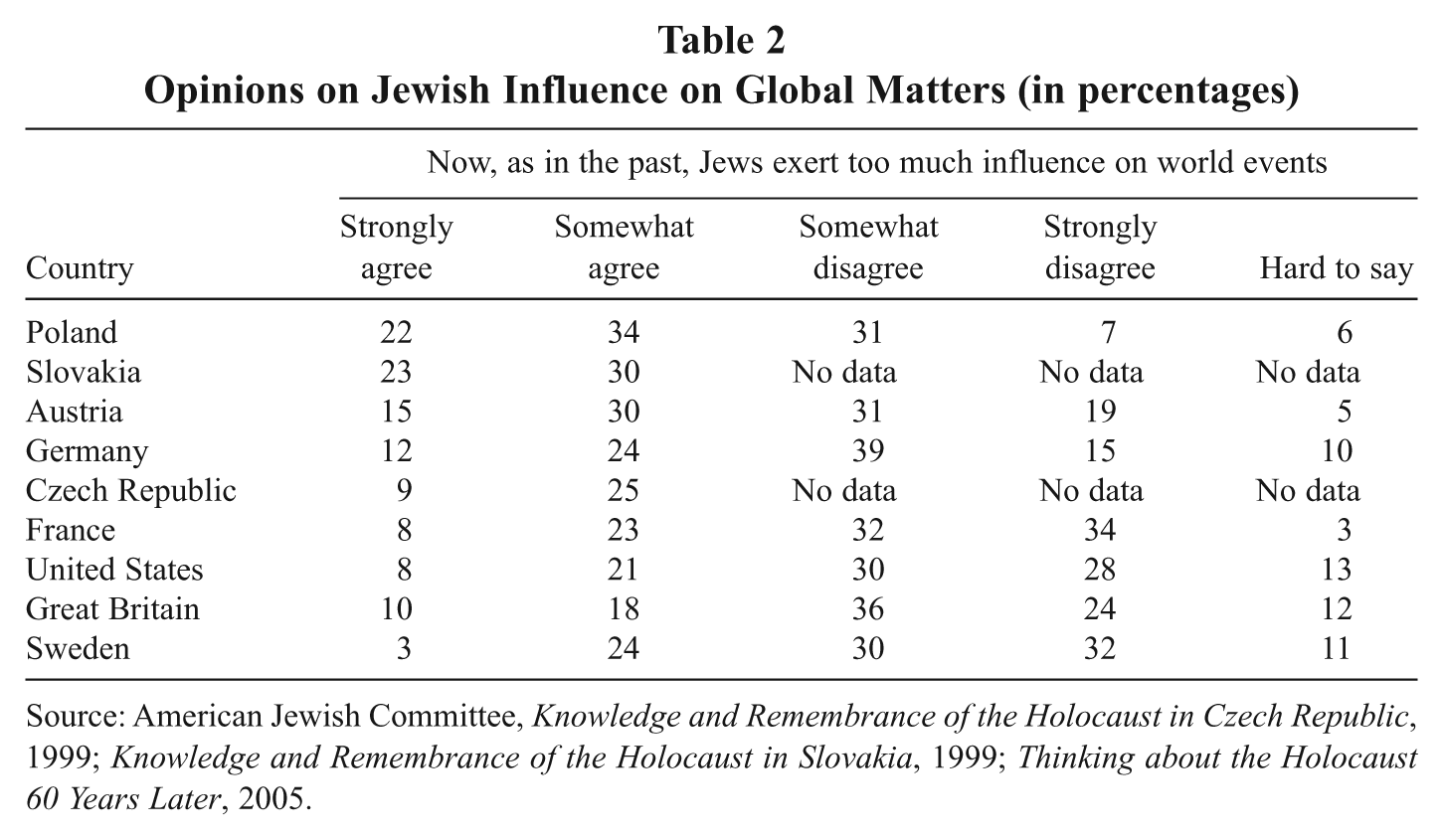
Imagined Jewish influence in Poland is accompanied by a more general mental picture of excessive Jewish influence on world affairs. A belief in the latter is an integral part of the canon and tradition of anti-Semitic thinking. Jewish power is purportedly international by nature and is hence expected to control global finances, manipulate governments, and direct mass media (Table 2). In a multinational survey done in 2005 by the American Jewish Committee, more than half (56 percent) of the Poles responding agreed—while a good third (38 percent) disagreed—with the statement “Now, as in the past, Jews exert too much influence on world events.” This comprises the highest level of agreement among the countries researched in this study. Noteworthy, too, is that nearly all of the surveyed individuals in Poland had an opinion on this subject though, by and large, there are few issues on which topic so many know what they think. 25 This is all the more puzzling since it would seem this matter has been maximally removed from everyday life; it would seem to belong to that described by Walter Lippmann as “out of reach, out of sight, out of mind.” 26
Opinions on Jewish Influence on Global Matters (in percentages)
Source: American Jewish Committee, Knowledge and Remembrance of the Holocaust in Czech Republic, 1999; Knowledge and Remembrance of the Holocaust in Slovakia, 1999; Thinking about the Holocaust 60 Years Later, 2005.
Nowhere, however—not even in stereotypically tolerant Sweden—is the level of agreement less than 25 percent. In Poland credence given to Jewish influence comprises the concentrated version of a more universal anti-Semitic mythology, but this brings little comfort.
This distillate variety is especially evident in Central Eastern Europe. Following Poland is Slovakia (53 percent) and Austria (45 percent). It is likely that Hungary would be not far behind; the Czech Republic is an exception. Advocates of anti-Semitic views are more numerous in the region in which Jews were more numerous in the past, before the Second World War. Elsewhere I have already spoken of exaggerated estimates of the Jewish population as a historical trace. A belief in Jewish power has likewise remained as a palimpsest of the centuries-old presence of Jews as well as anti-Semitic nationalisms in this region. The systematic, comparative, and historical analysis by Frederick Weil led him to the conclusion that the large concentration of anti-Semitism in the countries of Central Eastern Europe is the result of a conjunction of two factors. One is the great religious homogeneity and the domination of Catholicism. The second is the lack of a tradition of liberal democracy. Under such circumstances, a culture of tolerance cannot be shaped. 27
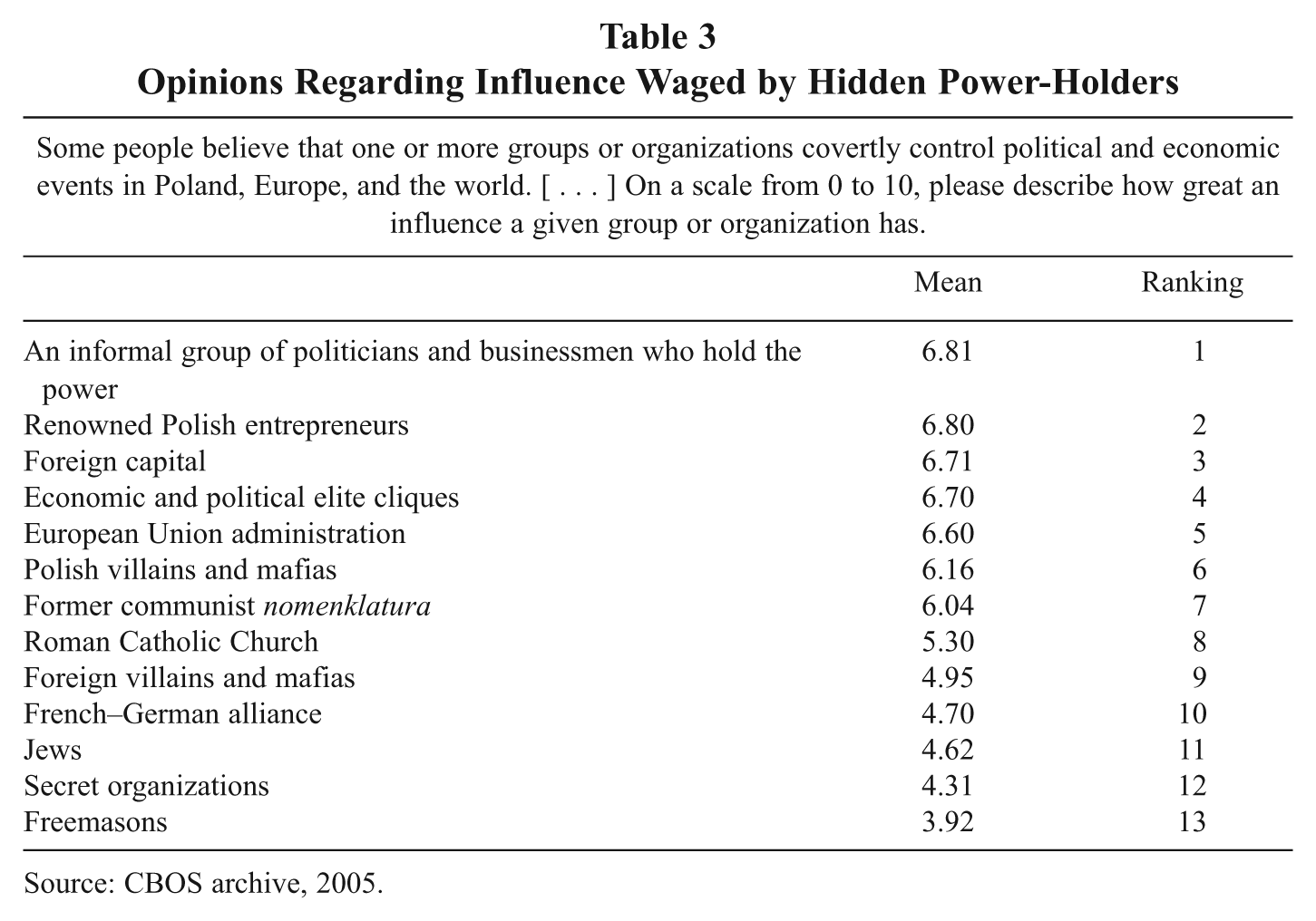
A social image of Jewish influence deserves more precise inspection. Such a mental picture encompasses a strong component of a general lack of trust in the world. Poles frequently assign excessive and clandestine control over their own personal fate to some Other; they consider their luck and destiny to be worse than deserved and hence blame certain evil forces for this state of affairs. When a questionnaire offers them only Jews to appraise, Poles take advantage of the ready and available scheme, assessing such influence as “too big.” If asked, however, to evaluate the influence of Jews vis-à-vis other ethnic groups in a broader context, Poles are forced to think, break free of the mold, and provide answers that seem a bit more in touch with reality. That this is the case indeed was illustrated by a CBOS survey a few years ago. Here individuals were requested to assess the “covert influences” of various groups and organizations (Table 3).
Opinions Regarding Influence Waged by Hidden Power-Holders
Source: CBOS archive, 2005.
It is evident that Poles are prepared to assign veiled power to all manner of identifiable and unidentifiable players on the political stage and in economic life. That notwithstanding, Jewish influence is seen as quite low in comparison to others; weaker than the Jewish influence are only secret societies and the Masons. With reference to Jews, as soon as Poles need to do more than simply reproduce or confirm a stereotype—as soon as they use some thinking power—Polish society does not stand out so negatively on the European scale. When this measurement is applied, opinions in Poland blend in more with the general backdrop, with those expressed in the other countries of this region of Europe.
In multinational surveys conducted in 1990s, respondents assessed Jewish influence in their countries. They were also asked to estimate the influence waged by other groups: politicians, businessmen, and media moguls. This factor alone—a comparison of Jews to other groups—accounted for the percentage of Poles seeing Jewish influence as “too great” falling by half (to 16 percent) compared to the results of the other surveys cited earlier. Undue Jewish control was envisioned at similar levels to the Polish in Russia, Byelorussia, Slovakia, Hungary, and Switzerland (14–17 percent). Somewhat higher levels were recorded in Austria (2001) and Germany (2002) (19–20 percent), with decidedly lower ones in Sweden, England, and the Czech Republic as well as in Lithuania, Latvia, and the Ukraine (2–11 percent). 28
Although a belief in Jewish influence is certainly a problem for Polish society, such covert power does not comprise a chronic and consistent theme in public affairs discourse. Ethnic categories turn up rarely in everyday conversations about politics, the government, and the reigning elite. There is no evidence that Poles think that “Jews run Poland” and “everything is the fault of the Jews,” rather than, for example, politicians, businessmen, the European Union, foreign capital, or homegrown schemers and connivers. Nonetheless, this pattern of thinking is deeply rooted in the collective mind and is easily activated.
In the course of a survey experiment that was performed in 2010, a sampling of Poles was first requested to answer an open question: to name “the groups that have too much influence on the affairs of our country” that came to mind (Table 4). The subjects of this study cited politicians, businessmen, and the Roman Catholic Church; less than 2 percent noted Jews. Next they were asked—without suggesting any particular groups—“Does any of the national minorities living in Poland have too much influence on the affairs of our country?” At this point Jews were named by 6 percent. Finally, the participants were asked directly: “How much influence on the affairs of our country do Jews who live in Poland have?” Now 22 percent, almost one-fifth of those studied, chose the multiple-choice answer “too much” even though only barely 2 percent spontaneously mentioned Jews earlier. 29
Opinions on Jewish Influence in Poland (Question Phrased in Three Different Ways), 2002–2010, in percentages

Source: author’s data.
The results of this research reveal that a prime impetus of some sort is needed to activate an anti-Semitic cognitive schema. Sometimes, a comparatively slight one suffices (reference to “minority groups”); sometimes a direct one is necessary (reference to Jews). People, among whom the idea that Jews bear undue influence on Poland arises rather rarely, surprisingly easily agree with that line of thinking once they come into contact with it.
Overall, as in the case of declared sympathy or closeness, a positive tendency is manifesting itself here, too. Eight years earlier—in 2002 when this experiment was first conducted—the question about “minority groups” awakened the anti-Semitic demon, raising the percentage from 1 percent in response to the first query to 19 percent in response to the second. The candid third question elevated the anti-Semitic reaction even more to a striking 43 percent. In more recent years, these priming stimuli have weakened in their power to evoke the concept of Jewish influence in Polish minds; stronger prompts are now required to induce expression of anti-Semitic prejudices and attitudes.
V
Political anti-Semitism—an obsession focused on “Jewish control”—has been branded “modern” to differentiate it from the “traditional,” mostly religious form. In today’s Europe, especially in that area closer to Poland, attitudes towards Jews are shifting over from the fields of power and politics into the sphere of memory—above all regarding the Holocaust. Jews (here used constantly and consistently as a label of social representation for a group) are seen less as a threat to the social order and more like a threat to national identity and a positive moral self-appraisal for various societies. Such is the viewpoint of Werner Bergmann, 30 and such is the case in Poland.
After Solidarity and the shift in the political and economic systems in 1989, matters between Poles and Jews evolved into a subject of public debate. Boisterous discussions regarding Polish–Jewish relations generate and etch into social memory new images referring to Polish Jews and non-Jews. In a country divested of its Jews principally because of the Shoah and postwar emigration waves, the disputes and deliberations concentrate on history and memory. Above all, they ponder the attitudes and behavior of the wartime as well as contemporary Polish society vis-à-vis the destruction of Polish Jewry. These are weighty and significant debates because memory is an exceptionally crucial component in the Polish collective ego, in what social scientists have named identity.
Collective memory fulfills the function of a historian of sorts: it observes, records, stores, revises, and recalls our group experience. All this takes place under the watchful eye of our self, our ego. The psychologist Anthony Greenwald who has supplied us with a vocabulary capable of capturing these processes has hailed the ego as totalitarian and the memory processes it controls as egocentricity, bene-effectance, and cognitive conservatism. 31
The first of these, egocentricity describes a phenomenon by which members of a group remember the past from their own personal perspective, presenting it to themselves as a dramatic play of sorts in which they themselves play the leading roles.
Until recently, writing and teaching Polish history in schools entailed solely the history of ethnic Poles. Lately the tales of other nations of the Republic have been included and Jews especially have shifted clearly into the center of the historical narrative. This pertains likewise to Second World War anguish and suffering. Their own torment is what Poles know and recall better than that of the Jews, despite the fact that the latter was—like no other—subject to total, systematic genocide. Probably no research study would show a majority of Poles admitting that Jews experienced greater suffering than the Polish non-Jews. It would suffice if Poles recognized the grief and agony of both groups equally.
The path which recognition of the incomparable scale and metaphysical dimension of the Shoah travels on its way into Polish minds is not easy or straightforward. It is blocked by an inveterate lack of closeness with Jews as well as an acute attentiveness to the martyrdom of the Poles—that of their own nation and often that of members of their own families. It is also hindered by the defensive conviction—particularly during the cross conflict at Auschwitz—that Jews do not see Polish suffering and do not respect Polish sensitivity. 32 One way or the other, it is with great difficulty that Jews are being encompassed by the community of memory. That said, something is nonetheless changing in this area. For the first time in 2010, as part of Marek Kucia’s longitudinal survey, the word “Oświęcim” (Auschwitz) was more often associated with the Holocaust (47 percent) than with the tribulations that befell the Poles (39 percent); fifteen years earlier, 47 percent chose the latter while only 8 percent accented the former. 33
The underestimation of the Jewish tragedy is not merely a matter of ignorance because Poles know well and good that nearly all Polish Jews were murdered. Per the thesis elaborated by Ireneusz Krzemiński, Poles are competing with the Jews over priority in victimhood—something that could lend them a sense of moral superiority. 34 Perhaps, however, Poles are not so much fighting for first place as avoiding second place. In any case, their own wartime catastrophe is part and parcel of their social identity.
Bene-effectance in collective memory work is based on attribution of causal instrumentality with reference to good, desirable, and positive events to oneself while responsibility for the bad and negative is attributed to others and/or to circumstances. Therefore, in considering themselves and Jews during the Second World War, Poles recall their praiseworthy acts, concurrently denying the disgraceful. This has manifested itself in the societal reaction to Jan Tomasz Gross’s Neighbors as well as in sociological research. According to a survey conducted in 2008, only 3 percent of those studied agreed with the view that “Only a few Poles rescued Jews while many persecuted them.” The more defensive view (more supportive of the national ego) that “Many Poles rescued Jews while a few persecuted them” was accepted by 43 percent. The remainder felt that there were just as many good or bad Poles. 35
Accusations about Polish passivity in the face of the dying Jewish population, as well as disclosure of Polish participation in German war crimes set in motion processes that go far beyond “competitive victimhood.” A segment of the Polish population accepts such facts and is moved to compassion for the Jews—as well as to remorse and humility, which contrast with the notion of national pride. Still, the majority generally rejects such accusations. Moreover, for part of the society it only reinforced or provoked antipathy or even hatred towards Jews. Depreciation of an accuser or the personalized reminder of an unfulfilled moral obligation is a phenomenon known well to moralists and psychologists. This is also one of the forms of secondary, derivative anti-Semitism.
The third characteristic of collective memory is its conservatism, that is, resistance to cognitive changes. A symptomatic consequence is the rejection of information incongruent with our self-image. With regards to our topic, beliefs regarding the history of Poles and Jews on Polish lands are highly resistant to change. In Poland, the reference points for images of Jews are not the real and empirical people themselves but some symbolic and virtual entities. Today a “Jew” is not a physical human being, but a figure of the collective imagination. More than just the passage of time, trips to Israel and school education will be required to deeply alter these mental pictures. The power of the imagination regarding the stance taken by Poles during the Shoah is not the simple outcome of insufficient mastery of the facts but the connections between these representations and the Polish national identity. The social imagination is underpinned by the ego and it, in turn, hampers any changes in the envisioned. If the Poles were to abandon the positive conceptions of their wartime behavior towards Jews, painful modifications to the entire image of their nation might ensue.
The way that Poles perceive Jews and their attitude towards Jews during the Holocaust constitute a mystification because Poles (like all peoples) mythologize their history. In their own eyes they are a nation of heroes and warriors for the freedom of others, wronged by history and their neighbors although their country was always welcoming to others. Looking at the research studies, the majority of Poles take on an apologetic stance towards the past: they know all the reasons to be proud, but not to be ashamed. 36 This “self-adoration” pertains principally to wartime, which has shaped the core auto-stereotype of the Polish martyr and the Polish hero. 37
Seen from this perspective, an attempt at shock therapy to the living history of Polish–Jewish relations would be rejected by public opinion as a strike against the national identity. Fear, the subsequent volume by Jan Tomasz Gross published in Poland in 2008, met this fate. Surveys conducted just prior to publication, and then after public discussions on the book had come to a close, revealed that the way average Poles envision their history had hardly changed. 38 Perhaps the influence of such debates is delayed, but for the time being the national ego has defended itself once more.
Change is nonetheless possible. “Both the individual and the group are constantly recreating the past, altering it in the interest of the present,” wrote Frederick C. Bartlett, a classic psychologist of memory. 39 This happens because new and breakthrough experiences of people and societies have an effect on identity. And a different identity requires a different history, permitting us to look at ourselves in a new light. New cognitive schemes are created and then societies recollect facts that had seemed to be long forgotten.
The reworking of such a memory in Poland might occur when the Poles who rewon their freedom and sovereignty find their good and rightful place among the nations of the world, modernize their country, and come to view all this as a great national success, grounds for pride, and the foundation for a new identity. When Poles no longer need to draw succor and sustenance from history, they will look at history and themselves with a more critical eye.
Perchance, however, reconstruction of the Polish collective memory will proceed earlier, without waiting for a historical shift in identity. Perchance such a narrative could be elaborated that would encompass the whole of the Second World War experience in occupied Poland leaving equal room for the Polish underground state, the organized battles, and the individual collaborators; the heroes, the silent majority, and the murderers; as well as the righteous saviors of Jews alongside the helpless bystanders and the pitiless perpetrators. Poles would be able to accept such a difficult yet just narration without fearing loss of their positive moral self-assessment. It is true that such an account has yet to be created; it remains to be undertaken by the historians.
Footnotes
This article was a public lecture delivered at the University of Warsaw as part of the Eight Lectures for the New Millennium series (15 December 2009), and then was slightly modified and enriched by the latest empirical data presented at Yad Vashem Institute in Jerusalem, at The Aftermath of the Holocaust: Poland 1944-2010 conference (3–6 October 2010). English-language translation by Annamaria Orla-Bukowska.