



Abstract
The European Union (EU) is one of the world’s most important policy promoters for gender equality. This article examines the benefits and limitations of EU gender equality policy making in two Western Balkan countries, Croatia and FYR Macedonia. Besides analyzing specific gender policy developments that can be attributed to the EU, particular focus is put on the women’s movement activists’ perceptions of the impact that accession may have on women and gender equality. The study demonstrates that while the Croatian and Macedonian EU accession processes have been beneficial to the introduction of new gender legislation and institutional mechanisms for the advancement of gender equality, the EU gender strategy has also shown serious limitations. Among these—and perhaps the most fundamental—is the strong contrast between stated goals and their actual implementation. I argue that unless profound institutional changes as well as changes in political culture take place in Croatia and Macedonia, the poor compliance with EU gender equality norms and policies will be hard to overcome.
The European Union (EU) has developed into an important actor in the field of gender equality. Beginning with the demand of equal pay for men and women, the principle of equality is now being integrated into all Community policies and activities through the framework of gender mainstreaming. Large bodies of European legislative texts are also dedicated to gender equality. This is mainly made up of various Treaty provisions and Directives concerning access to employment, equal pay, maternity protection, parental leave, social security and occupational social security, the burden of proof in discrimination cases, and self-employment. The case-law of the European Court of Justice is another key element. With good reason, the EU can be defined as a gender equality actor growing in importance as it deepens its powers through a wider range of gender policy domains, enlarges the number of member countries, and has an increasingly powerful presence in world politics. 1 With regard to this, it is nonetheless important to ask whether the EU is a powerful enough actor to tackle the broader structural and institutional aspects of gender inequalities in different countries and regions.
In this article, I provide empirical evidence drawn from two Western Balkan countries, Croatia and FYR Macedonia, in order to explore in more detail the effectiveness of the EU gender strategy: what are the benefits and limitations of EU gender equality policy making in the Western Balkans? Besides analyzing specific gender policy developments that can be attributed to the EU, the particular focus is put on women activists’ perceptions of the impact that accession may have on women and gender equality. A number of key observations emerge from this study. While the Croatian and Macedonian EU accession processes have been beneficial for the introduction of new gender legislation and institutional mechanisms for the advancement of gender equality, the EU gender strategy in Croatia and Macedonia has also shown serious limits. Among these—and perhaps the most fundamental—is the strong contrast between stated goals and their actual implementation. Poor implementation is directly related to a lack of awareness among legislators and bureaucrats of the gender equality laws and how to implement them. Beneath a surface of legal guarantees, there are also informal social mechanisms that prevent women from utilizing their rights effectively. Among the mechanisms that reduce the effectiveness of given rights in Croatia and Macedonia, political and administrative corruption as well as political bigotry are the most detrimental ones, since both work against core principles of gender equality rights and democracy. I argue that unless profound institutional changes as well as changes in political culture take place in Croatia and Macedonia, the poor compliance with EU gender equality norms and policies will be hard to overcome.
European Union: A Powerful Gender Equality Actor?
Despite the wealth of research on the EU and gender, it is still unclear where the EU is heading with its policies on gender, and whether the policies actually help in bringing about more equality between women and men or whether the opposite will be true. An optimistic view of the EU’s commitments and transformative potential in this policy area emphasizes the progressive deepening and widening of EU gender policy during the past few decades. 2 Today, the EU has the tools to be a polity that not only “affirms and shapes but also challenges gender power relations in several areas of its activities.” 3 According to Sevil Sümer, “a basic evolution took place in EU gender policies from a focus on women’s issues to an acknowledgment of gender relations and the need to transform the traditional gender contract.” 4 The deepening of EU powers over gender policy in the Treaty of Amsterdam, the relatively broad interpretation of EU employment policy, and the recognition of the interconnectedness of the economic with other domains within a gender regime are expected to lead to a situation where policies that affect employment will also affect many other gender relation areas. 5
A more skeptical perspective, on the other hand, argues that despite the actions taken at the European level to eliminate discrimination, much remains to be done. Gender inequality across Europe remains elusive. Figures from 2009 show that across Europe, women earn on average 17.4 percent less than men. 6 Although women’s participation in the paid labor force is increasing, labor markets continue to be highly segregated, with women clustering in lower-paid sectors. Moreover, the increased participation of women in the labor market is largely characterized by a high proportion of part-time work. 7 This reflects the fact that women remain primarily responsible for child care, care for the elderly, and the disabled. In addition, women are underrepresented in national parliaments and other decision-making bodies. Such inequalities persist despite a deep commitment at the EU level to the achievement of gender equality, as well as a sophisticated framework of anti-discrimination laws adopted across the EU member states. This situation is the result of several reasons, the principal one being that even though gender equality is protected by law, this remains premised on a traditional notion of the gender contract. Emanuela Lombardo, who has analyzed the impact of EU gender policy on Spain, argues that EU gender policy is still trapped in the “Wollstonecraft dilemma,” as it generates policies that always have some negative effect on women. 8 According to Lombardo, the main problem is that policy strategies still focus on tackling the symptoms instead of giving more attention to the causes of gender inequality, such as structural obstacles in the form of a patriarchal system. 9
Equally, Ilona Ostner describes the results of the various Directives as a double-edged sword, meaning that the legislation did not abolish discrimination but instead only required “good reasons for discriminatory practices and a minimum-means test.” 10 Social policies have flourished in the process of European integration only as far as they have fitted regulatory policies of negative integration in contrast to the redistributive ones of positive integration 11 Therefore, ultimately policies that do not focus on the centrality of the gendered division of care work and the need to share family responsibilities end up becoming market-oriented policies that encourage flexible forms of employment. 12 The opportunities and limits embedded in EU gender equality policies have also been evaluated at the member state level. Comparative Europeanization research offers explanations for differences in national adaptation to EU legislation and policies. 13 The effect and meaning of Europeanization differs from country to country as each one is different regarding its traditions, policies, and institutions. 14 When it comes to gender equality, a review of policy formation and policy outcomes over the past few decades indicates the disjuncture between commitments at the EU level and outcomes at the member state level regarding implementation of EU gender equality guidelines. 15 The enlargement process also brought to light the issue of the impact of the EU on gender policy development in Central and Eastern European (CEE) countries. According to several empirical studies, there is a tendency that the CEE countries do not formulate gender policies for the sake of improving gender equality but rather to gain access to different EU domains. As a consequence, the implementation of adopted EU gender legislation is slow and inconsistent. 16 In this article, I will give more in-depth consideration to both the benefits and limitations of EU gender equality policy making in two Western Balkan countries, Croatia and Macedonia. Croatia and Macedonia belong to a region where the implementation of democracy has faced long-term obstacles much greater than those encountered by those CEE countries that have already become EU members. By analyzing gender equality development in two Western Balkan countries, this study aims to broaden our knowledge about the EU’s possibilities and limitations in tackling gender inequality in potential member states.
European Union and Western Balkan “Facade Democracies”
Since the 1990s, the EU has been steadily involved in a complex process of the stabilization and progressive integration of the Western Balkans. Today, the term “Western Balkans” is used to refer to the countries of Albania, Bosnia and Herzegovina (BiH), Croatia, the Republic of Macedonia, Serbia, Montenegro, and Kosovo. All Western Balkan countries are striving for European Union membership, and in 2003 the EU declared that the future of the Balkans is within the European Union. 17 The EU’s Balkan policy has shifted from an agenda dominated by security issues to an agenda focused on the Western Balkans’ EU accession prospects. However, the countries of the Western Balkans are said to have a different political culture from the other East European countries. 18 The countries in this region have serious political and security problems, including the existence of intolerance, pathological nationalism and xenophobia, underdeveloped democratic political culture and lacking the art of compromise. 19 Arguably, the Western Balkans represent the most difficult set of prospective accession countries so far encountered by the EU. Most of the newly founded states are weak; the rule of law is not yet established; privatization has been done haphazardly, thus adding to the criminalization of the economy and the whole society; and corruption is still very high. 20 Economic failure had a devastating effect on standards of living and health across the region, forcing millions of people who had hitherto enjoyed a secure income into outright poverty by the late 1990s. These circumstances make the position of all citizens, especially the more vulnerable ones, very uncertain. Women from Western Balkan countries who are living with these major difficulties also experienced extremely turbulent times during and after the disintegration of Yugoslavia with conflicts and wars lasting an entire decade. With regard to gender equality policy, we can assume that the countries of the Western Balkans represent a highly unfavorable political context for the EU as a gender equality promoter. It is also essential to add the complex heritage of gender equality policy making during the communist era. It is often claimed that gender equality was one of the major achievements of the Eastern European communist regimes. Constitutional regulations provided women and men with equal rights in political, economic, and social life. 21 The Communist political party equality policies such as relatively high minimum wages, generous maternity leave and child care benefits supported women’s participation in gainful employment. 22 However, much of the progress in the area of gender equality under communism remained ambiguous and contradictory. Some scholars claim that the communist experiment was nothing more than an instance of “forced emancipation” and that women’s incorporation into public life was “insincere” because it was motivated by economic interests rather than by gender equality concerns. 23 In spite of the heavily propagandized gender equality in the sphere of paid employment, the reality of the labor market was far from gender-neutral since the state socialist system did not manage to challenge gendered job segregation and wage gaps. 24 In addition, under communism, gender-neutral stipulations in judicial sectors (e.g., family laws) were completely absent. Fathers, for example, were not encouraged to share responsibilities for raising children and there was no official notion of paternity leave. 25 The lack of gender-neutral legislation as well as the lack of public gender approach contributed to the strong legacy of traditionalism in attitudes toward the family and gender roles. Furthermore, some central gender equality and women’s rights issues, such as sexual harassment and domestic violence, were considered “private matters” exempted from state interventions and were completely absent from public debates.
In this article, the assessment of the effectiveness of EU policies in the Western Balkans will be analyzed through a two-country comparison between Croatia and Macedonia. Before the fall of the Berlin Wall, Croatia and Macedonia formed part of the then-Yugoslavia. Thus, until 1991, they partook in the same overarching political, economic, welfare, and ideological system. Nearly two decades later, however, the two countries found themselves at somewhat opposite ends of the economic, social, and political spectrum. Today, Croatia and Macedonia are both candidate countries for EU membership, but only Croatia has begun formal negotiations over membership (in October 2005). In summer 2011, Croatia won approval from the European Commission to join the EU in mid-2013. Macedonia was formally recognized as an EU candidate country in 2005. However, membership negotiations have been delayed because of political and economic instability and an ongoing dispute with Greece about its name. Croatia is also slightly more developed than Macedonia regarding several social, economic, and political indicators (see Table 1). In addition to their general political and economic contexts, the two countries also differ in the way women’s movements developed during the transition period. In contrast to Macedonia, the transition period in Croatia was marked by a rapid proliferation of feminist women’s NGOs. The Croatian women’s NGO scene could be described as remarkably vibrant and demonstrating relatively strong organizational capacities. 26 Under communism, feminism and women’s organizing in ex-Yugoslavia were exceptional and formed the most developed phenomenon among similar attempts in other Eastern European countries under communism. 27 However, the development of critical feminist ideas occurred in Slovenia, Croatia, and Serbia, while Macedonia was lacking similar initiatives. 28 In Macedonian society, gender relations during communism have been characterized by strong patriarchal values that have never been questioned.
Post-Communist Croatia and Macedonia: Socioeconomic and Political Differences
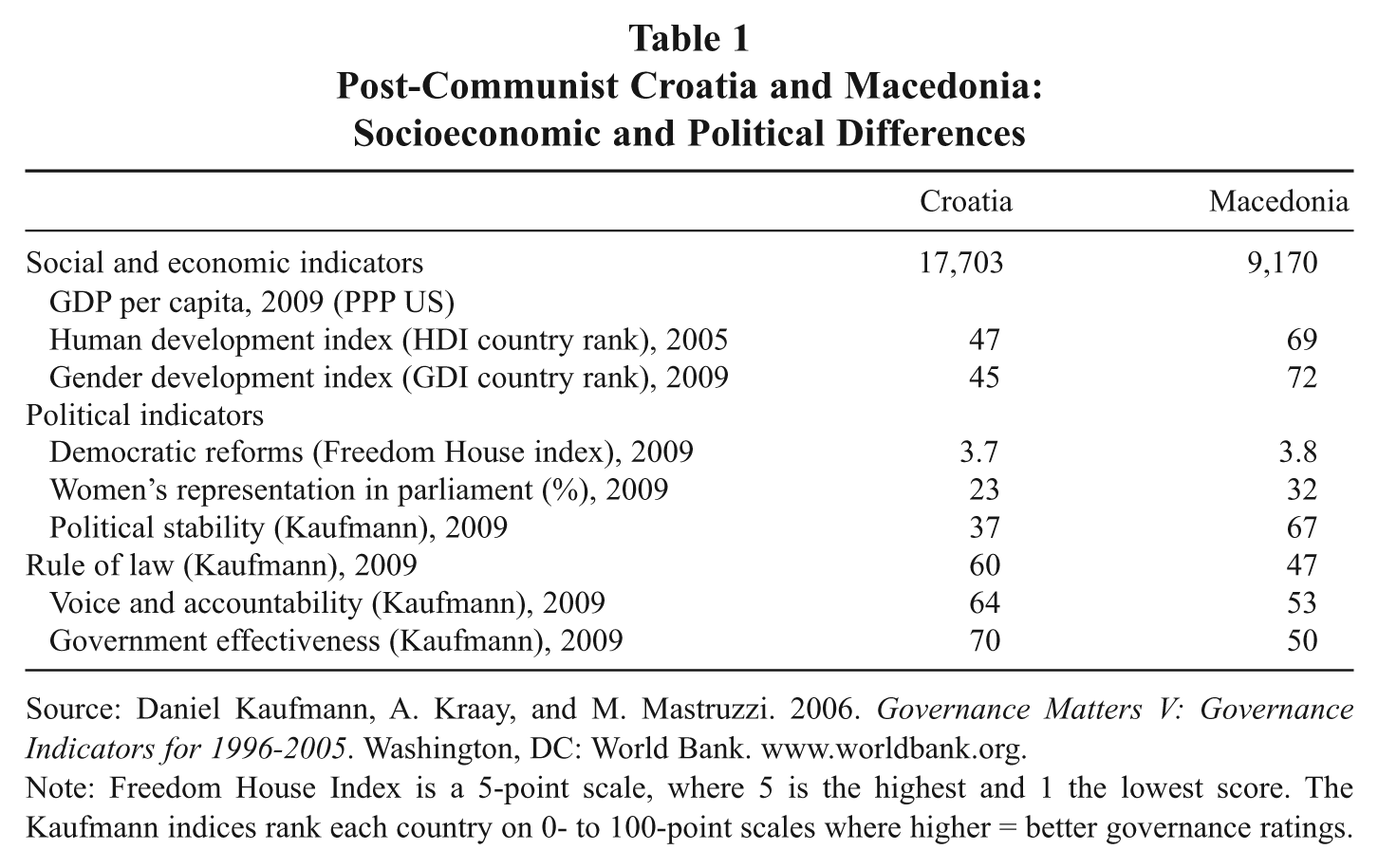
Source: Daniel Kaufmann, A. Kraay, and M. Mastruzzi. 2006. Governance Matters V: Governance Indicators for 1996-2005. Washington, DC: World Bank. www.worldbank.org.
Note: Freedom House Index is a 5-point scale, where 5 is the highest and 1 the lowest score. The Kaufmann indices rank each country on 0- to 100-point scales where higher = better governance ratings.
Such differences in the two countries notwithstanding, it is interesting to investigate what are the differences and similarities regarding the effectiveness of EU gender strategy in these countries and regarding the state of women’s movements’ perceptions about the benefits and limitations of EU gender equality policy making.
Methodology: How to Trace the Impact of EU Accession on National Gender Equality Contexts?
The empirical analysis of the impact of EU accession on national gender policy reform is not a straightforward enterprise. The problem of causality—how to establish a causal link between Europeanization processes and the member/candidate states’ policy change—is the main methodological difficulty encountered by Europeanization research. 29 In light of this study, the important methodological question is how to discern EU and non-EU effects on policy change within Croatian and Macedonian gender equality contexts. Are certain changes in, for example, the area of antidiscrimination policies the result of the EU influence alone, or because of other national processes? The efficiency and effectiveness of policies are particularly difficult to assess, since outcomes may be intended or unintended, wanted or unwanted, and direct or indirect. In this study, the previously mentioned methodological difficulties will be mitigated through a combination of research strategies. Regarding the indicators of Europeanization, the focus of this study will be directed toward (1) concrete legislative changes on national gender policy agendas, (2) women’s movement actors’ perceptions of the impact that the EU accession process may have on women and gender equality, and (3) basic indicators of gender (in)equality such as women’s labor force participation and women’s political representation.
The empirical data used in the analysis includes primary and secondary textual documents (legislative acts, policy programs, country statements, official country reports, and records of parliamentary debates). Besides relevant policy documents, the sources also include interviews with representatives of women’s movements regarding their perception of EU influence on the gender equality development in Croatia and Macedonia. The decision to interview women’s movement actors was made in the light of several empirical considerations. First, several scholars have shown empirically that gender equality issues would probably have been neglected during the post-communist transition if it had not been for the commitment of the women’s movements. 30 Second, there is also some empirical evidence that women’s movement actors in post-communist countries played a crucial role in the politicization of the EU norms and their implementation within the national legal framework. Thus, their opinion about the EU’s potential to improve gender equality in Croatia and Macedonia should be regarded as particularly important and valid in that context. It is important to state, though, that their perceptions may equally have been colored by their own hopes and disappointments as the actors in the gender policy processes. This methodological difficulty will be mitigated by also analyzing other empirical sources such as concrete gender policy development and basic gender (in)equality indicators.
A total of twenty interviews were conducted with women’s movement activists; of these, twelve took place in Croatia and eight in Macedonia. All of the interviewees held key positions in women’s NGOs, 31 women’s branches and committees of political parties, trade unions, and gender equality offices. Some of them were current or past presidents, national secretaries, or executive directors of such organizations, while others were current or past members of parliament or other governmental bodies. All interviews were conducted between January and September 2009 and addressed the following questions: How would you characterize the impact of the EU on gender equality development in your country? Do you think Croatia’s and Macedonia’s accession processes to the EU have been beneficial for gender equality? Would you say that any progress considering gender equality has occurred in your country during the past decade? In what areas? What are the major limitations of the EU gender equality strategy?
Benefits of the EU’s Gender Equality Strategy in the Western Balkans
The research conducted in this article identifies three levels of impact where Croatian and Macedonian EU accession processes have been beneficial for gender equality development in the two countries: (1) the introduction of new gender legislation, (2) the introduction of institutional mechanisms for the advancement of gender equality, and (3) strengthening women’s movements’ legitimacy and policy influence. The issue of gender equality, being a fundamental principle of the European Union, represented an important segment of EU conditionality that required several changes in the Croatian and Macedonian laws relating in particular to labor relations and domestic violence (see Table 2). In Macedonia, we can even notice a positive impact of the EU Gender Task Force of the Stability Pact 32 on the Macedonian Electoral Law from 2002 which determines that every third place on the electoral lists for Parliament should be reserved for the less represented sex. 33 Today, 32.5 percent of Macedonian parliamentarians are women, which is the highest percentage in the CEE region, 34 while the representation of women in the Croatian parliament is 23.5 percent. 35
Benefits of the EU Gender Equality Strategy in Croatia and Macedonia

As part of the EU membership process, the Croatian and Macedonian governments have also developed and set up national machineries for the advancement of gender equality. In Croatia, the Parliamentary Gender Equality Committee has been operating since 2000, the Gender Equality Ombudsperson since 2003, and the Government Office for Gender Equality since 2004. In Macedonia, the Unit for Gender Equality was set up by the government in 1997 within the frame of the Ministry of Labour and Social Policy (MLSP), with the purpose of influencing the advancement of women’s positions in conformity with international documents. Ten Commissions on Gender Equality within the ten Local Municipal Councils in Macedonia were established in 2000. In 2003 the Women’s MP Club was formed, which works for the promotion of gender equality in general and for the harmonization with EU gender equality standards, as well as representing a service for elected women in the Parliament.
The EU accession process has been perceived by women activists from Croatia and Macedonia as a big opportunity for advocating more efficiently the improvement of the situation of women, especially in the labor market. As one female activist from Macedonia put it in one of the interviews:
The EU gender equality legislation, policy and programs, and the mechanisms of their implementation, although they are not perfect, provide the tools for influencing the governmental policy towards ensuring gender equality. Macedonian EU membership is perceived as a significant opportunity to adopt various mechanisms of democracy.
The Croatian female activist stated the following:
The EU membership was a priority for the Croatian government, and this has positive consequences for women. The governments have begun to observe directives, standards, opinions and recommendations of the EU regarding equal status of women and men. An increasing number of politicians, even if they are not enthusiastic about the implementation of the gender-equal opportunities policies and laws, are influenced by the EU standards and at least try to behave in a politically correct manner. Furthermore, the government has begun to pay attention to demands from women’s organizations.
The EU accession process was also perceived as beneficial for women’s organizations themselves because women’s NGOs gained better access to EU bodies and the right to apply for EU funding. The development of the women’s movement during the 1990s throughout the Balkan countries was, in fact, one of the positive miracles of this dark period in recent history. 36 Women became a cornerstone of an emerging civil society through their activism: their active resistance against wars and nationalist political elites, and often against a large part of the nations’ intellectual elites; their courage in facing the dangers of crossing the fault lines between conflicting parties and/or the hostile majority in their own societies; and their empathy with victims as embodied in their relentless humanitarian work. In particular, the Croatian women’s NGO scene is rich, vibrant, and encompasses a wide range of activities.
There are several signs of a positive impact of the EU on the development of the women’s organizations in both countries. Funding support for women’s organizations and for NGOs working to achieve gender equality is an important element in the EU strategy to achieve greater gender equality. Women’s organizations from Croatia and Macedonia actively participate in the debate addressing the impact on women of EU accession and, to a certain extent, the future of Europe. For example, Croatian Women’s Network and Macedonian Women’s Lobby are members of the European women’s lobby. Women’s transnational advocacy networks in Europe are a source of both exchanges of knowledge and “good practice” as well as moral support that arises from being part of a network.
Limitations of the EU’s Gender Equality Strategy in the Western Balkans
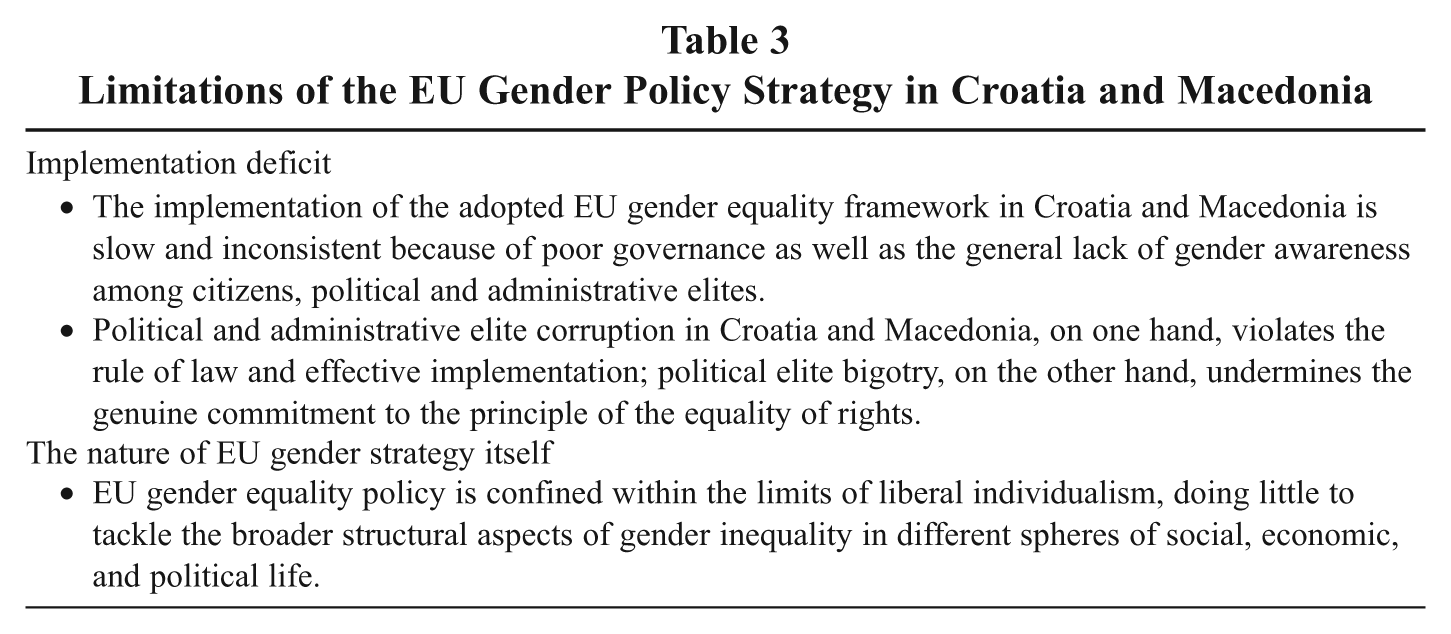
However, the EU gender policy strategy in Croatia and Macedonia has also encountered serious limits, as Table 3 illustrates. In spite of the previously mentioned achievements, de facto gender equality is far from being realized. In both countries, the governments give priority to the managing of the economic and political situation, with gender issues being a much lower priority. As an interviewee from Macedonia pointed out,
Limitations of the EU Gender Policy Strategy in Croatia and Macedonia
As a general remark, it can be stated that the policy developments in the Republic of Macedonia are very controversial and contradictory. On the one hand, there is formal acceptance of very advanced policies, legal changes and projects which should have an impact on the laws and institutions. Yet, these activities usually end in action plans, reports and/or conclusions which are not implemented. They do not produce any actual change. On the other hand, the patriarchal system of values is becoming even more powerful due to the conservative Government being very strongly connected both with the Orthodox Church and with the Islamic community, which has an increasing impact on everyday life. The majority of women in Macedonia do not have the same rights, opportunities, and responsibilities as men. Women in Macedonia face issues that are deeply rooted in the traditional, patriarchal values and gender roles in the family and in the society. Value systems are changing for the worse, and the bad economy compounds gender discrimination.
Laws guaranteeing equal opportunities for women, in line with European standards and norms, have been adopted in both countries. However, the level of implementation of legislative measures is perceived as very low and women in both countries continue to face disparities in terms of jobs, wages and political representation. 37 The legal framework regarding gender equality is in place, but on the other hand, gender equality laws and policy frameworks do not have any substantial effect on the daily lives of citizens. As an interviewee from Croatia pointed out,
There is considerable focus on gender equality issues in Croatia; however, accomplishing equal opportunities between women and men in the socio-political sphere as well as the legislative level is undoubtedly a challenge. It will probably be quite some time before the effects of the new legislation acts on gender equality are confirmed in social practice due to cultural patterns which are rooted in society.
In Croatia and Macedonia, as in most European countries, women constitute the majority of the unemployed. Among the employed, they dominate in lower-income professions such as care work, the textile industry, trade services, education, etc. Women are generally paid less than men for the same type of work and are faced with the “glass ceiling” syndrome. 38 For example, a recent labor market assessment conducted in Macedonia by the World Bank indicates that about 83 percent of the gender gap in remuneration in the country is unexplained, thus pointing to discrimination against female workers. 39 Nearly 90 percent of employees in the textile industry, which belongs to the less-paid industries, are women. According to data from 2006, there was not a single activity where the average pay of women was higher than that of men. 40
Besides persisting gender inequalities in Croatian and Macedonian societies, there is also other proof of poor implementation related to the EU gender directives and recommendations. Although both countries have adopted special gender equality legislation, there are still very few legal cases regarding any aspects of gender discrimination. For example, in 2009 the Macedonian Ombudsman office received only one claim based on discrimination on the grounds of sex . 41 This indicates, among other things, the lack of any citizen awareness about the possibilities of demanding protection and achieving their rights in the sphere of gender equality, work, and employment as well as protection from domestic violence. Women NGOs in Croatia claim that many women who are subjected to rape or other forms of sexual violence abandon the idea of pressing charges for fear of social stigma or because they feel that the police, health, and judicial authorities lack experience in dealing with such cases. These NGOs also criticize some courts for passing sentences that are too lenient. 42 The problem of insufficient institutional capacity of institutions and organizations responsible for the protection and promotion of gender equality should be regarded as one of the key barriers to any serious implementation of the goal of equal pay between men and women. According to Croatian and Macedonian women’s movement representatives and various national gender equality reports, there is a lack of clear understanding and knowledge of the equal opportunity concept as well as strategies for achieving gender equality as a national goal. There are no systematic, comprehensive training programs to ensure appropriate practical implementation of the theoretical concepts by the relevant public administration. An interviewee from Macedonia says that
the EU is encouraging the Macedonian government to invest in gender mainstreaming, but without following up and sufficiently supporting the process of real implementation. This gives people the perception that gender equality is being achieved. In theory, strategies, national plans, and programs for gender mainstreaming are well formulated but they are insufficiently implemented because there is not adequate public awareness, political will or professional capacity to do so.
For example, an analysis of the 120 collective agreements on the Croatian labor market has shown that less than 10 percent of the analyzed agreements include any reference to the principle of equal pay between men and women. 43 What is more, almost all of those agreements merely copied the equal-pay provisions from the Labor Act. Less than 2 percent of the analyzed agreements included certain special gender equality measures, but none was related to the issue of unequal pay. In an interview conducted for the purposes of this country report, officials of the Union of Autonomous Trade Unions of Croatia (UATUC) confirmed that the problem of gender inequality is rarely an issue of negotiations in the collective bargaining involving their association’s members. The interviewees are also somewhat concerned about the motives of their respective countries in relation to gender equality. All interviewees discussed “a lack of consciousness of discrimination.” This seems to be a problem that affects policy outcomes, policy input, and the behavior of women and men in the labor market. The interviewees emphasize that people in general are not aware when and if they are being discriminated against and, if so, where they are supposed to go with their complaint. An interviewee from Croatia is concerned that the lack of gender awareness affects the implementation of EU gender equality directives. The interviewee says,
If you had the political will to use that legislation, you could get good results without changing anything in the legislation itself. Mostly lack of political will and understanding of what it means are the biggest obstacles to achieving a more gender-equal society.
Several women’s movement representatives from Croatia and Macedonia argued that the EU has to work on ways to better share their knowledge on gender equality in general and gender mainstreaming in particular in order to make efficient implementation of the directives possible. Several interviewees mention the need for pressure for penalties from the EU if the legalization is not implemented correctly.
As a general remark, it can be stated that the policy developments in both countries are very contradictory. On the one hand, there is formal acceptance of very advanced policies, legal changes, and projects which should have an impact on the laws and institutions. Yet these activities usually end up in action plans, reports, and/or conclusions that are not implemented; hence, they do not produce any actual change.
Bridging the Poor Compliance with EU Gender Equality Norms and Policies?
This study has shown that over the past fifteen years, Croatia and Macedonia have made substantial progress in adopting new legislation and policies aimed at ensuring greater gender equality in different spheres of social life. Many of the women who took part in this research argued that Croatia and Macedonia have made significant progress in terms of reform of gender equality legislation, but they also insisted that implementation of the legislation and policy needed close scrutiny, increased resources, and real commitment, not just tokenism. As found in this study, the differences between the transitional political, economic, and gender contexts in Croatia and Macedonia seem to have had no major impact on the direction of the respective women activists’ perceptions of the limitations of EU gender equality policy making in the Western Balkans. According to them, Croatian and Macedonian political leadership still need to demonstrate that they respect demands of the EU and women’s organizations for gender equality and democratic institutions. There was an especially large number of complaints in both countries that the gender equality laws were enacted incompetently, with too much haste, and that they remained nothing but empty words. The implementation of the adopted legislation in Croatia and Macedonia is slow and inconsistent. That is one of the main problems raised in examining the coherence of the EU’s gender equality approaches to the Western Balkans. This is also where “gender policy fatigue” within the EU meets “accession fatigue” in the Balkans. Parallels can be drawn to similar developments in other CEE countries 44 and some of the older member states. 45
The political elites in the region very often use verbal commitments to EU accession as a smokescreen for business as usual. Poor implementation is directly related to lack of awareness of the laws and how to implement them by both duty bearers and rights holders. Poor implementation is also symptomatic of deeply ingrained negative attitudes and gender stereotypes, which cannot be uprooted through legislation alone. The lack of litigation from below, a lack of support by governments, weak equal treatment bodies, and shortcomings in the judiciary—these shortcomings lead to the fact that a lot of the transposed legislation has remained “dead letters.” The public neglect of gender issues during the transition period in Croatia and Macedonia may be considered as one of the elements that has represented an aspect of continuity with the previous, communist system. Even back then, gender equality was important in declarative terms, but in practice it was neglected or subordinated to other policy areas considered to be of more imminent political importance.
While poor implementation can primarily be attributed to the lack of good governance in the Western Balkans, the nature of the EU strategy itself is misleading because it does not recognize the distinction between “equality of rights” and “equality of results.” The fact that women and men are equal in their rights does not mean that they will achieve the same results. EU gender equality policy is confined within the limits of liberal individualism, doing little to tackle the broader structural aspects of gender inequality in different spheres of social, economic, and political life. Specifically, the social dimension of ongoing changes in candidate countries needs to receive greater attention by the EU and the national political actors including the women’s movement. Many women in Western Balkan countries may be better served by an emphasis on adequate housing, decent working conditions, health care, and child and elderly care. To women whose lives are shaped by differences in class or race, gender-neutral policies may be low priorities if not meaningless symbols. While the EU and other international actors offer general norms and policies in the area of gender equality and provide basic frameworks, gender politics and policies should more frequently be adapted to specific local problems.
What more can we learn from having analyzed the benefits and limitations of EU gender equality policy making in Croatia and Macedonia? This study’s main argument is that the rule of law and openness of elites to potentially underprivileged groups, such as women, are essential to the effectiveness of given gender equality rights. However, the presence of legal guarantees for gender equality does not automatically mean that these rights work in practice. Formal democracies, such as Croatia and Macedonia, are not necessarily equal to effective democracies in which people face no social or legal barriers that prevent them from exerting their rights. Beneath a surface of legal guarantees, there are informal social mechanisms that hinder women in practicing their gender equality rights effectively. Among the mechanisms that reduce the effectiveness of given rights in Croatia and Macedonia, political and administrative corruption as well as political bigotry are the most detrimental features, since both work against core principles of human rights and democracy. Elite corruption, on the one hand, violates the rule of law and effective implementation; political bigotry, on the other hand, undermines the genuine commitment to the principle of equality of rights. Whether democracy is effective or not does not automatically follow from the institutionalization of rights. It depends on the features of a society’s political elites and bureaucrats: their sensitivity to people’s rights and their openness to underprivileged groups, among which women form the potentially largest one, accounting for at least half of the population in any society. Further institutional changes with regard to both legislation and political culture must take place in Croatia and Macedonia before overcoming the poor compliance with EU gender equality norms and policies will be possible. To achieve de facto equality, it is necessary to invest in additional efforts in order to attain equal economic independence and prosperity between men and women, to reach a balance between work and private life, to promote equal representation in the decision-making process, to abolish gender-based violence and trafficking in human beings, and to eliminate gender stereotypes in various social areas.