



Abstract
In this article, we test the effect of communist-era legacies on the large and temporally resilient deficit in civic participation in post-communist countries. To do so, we analyze data from 157 surveys conducted between 1990 and 2009 in twenty-four post-communist countries and forty-two non-post-communist countries. The specific hypotheses we test are drawn from a comprehensive theoretical framework of the effects of communist legacies on political behavior in post-communist countries that we have previously developed. Our analysis suggests that three mechanisms were particularly salient in explaining this deficit: first, the demographic profile (including lower religiosity levels) of post-communist countries is less conducive to civic participation than elsewhere. Second, the magnitude of the deficit increases with the number of years an individual spent under communism but the effects were particularly strong for people socialized in the post-totalitarian years and for those who experienced communism in their early formative years (between ages six and seventeen). Finally, we also find that civic participation suffered in countries that experienced weaker economic performance in the post-communist period, though differences in post-communist democratic trajectories had a negligible impact on participation. Taken together, we leave behind a potentially optimistic picture about civic society in post-communist countries, as the evidence we present suggests eventual convergence toward norms in other non post-communist countries.
Introduction
Twenty years after the collapse of communism, a rough consensus in the literature on post-communist politics is that the past matters. Many questions remain, however, about exactly how, when, and why the past matters. One facet of the post-communist experience that has often been held up as direct evidence of the influence of the communist past—and more specifically to the effect of a compromised public sphere and an idealized private sphere—is the post-communist deficit in civic participation, which has been confirmed by cross-national survey evidence. 1 While communist regimes promoted a variety of civic organizations (ranging from youth organizations to labor unions), participation in these organizations was often mandatory and highly regulated by the state, while independent alternatives were either marginalized or outlawed. 2 As a result, the transition countries initially suffered from a dearth of credible civic organizations, as much of the communist “civic infrastructure” was abandoned, while the emerging alternatives were significantly constrained in terms of both economic and human resources (and in some cases by restrictive legislation even in the post-communist period). Since civil society restrictions were more severe in communist countries than in the generally shorter and shallower authoritarian episodes in other regions, 3 this organizational perspective would predict a large initial civic participation deficit, which should gradually diminish over time as domestic and international efforts to promote civil society development produce a new generation of civic leaders and organizations.
However, a more pessimistic interpretation of this deficit focuses on the demand-side aspect of civil society participation. From this perspective, the pervasive distrust of the public sphere under Communism has left an attitudinal legacy that severely undermines the sort of interpersonal and institutional trust necessary for civic participation. To make matters worse, the logic of communist shortage economies promoted the proliferation of informal friendship networks, 4 which continued to thrive during the uncertainty of the post-communist transition. These friendship networks are much smaller and have a very different organizational logic than Western voluntary organizations, and may have arguably “crowded out” the fledgling civil society in terms of both resources and personal allegiances of post-communist citizens.
The goal of this study is to provide not just a systematic analysis of the extent to which there has in fact been a civic participation deficit in the post-communist world 5 but also to assess the extent to which this deficit is a function of the communist past. 6 Thus, we revisit the question of the appropriateness of comparing civic participation in post-communist countries in a much more thorough empirical framework, namely, a pooled data set of the second, third, fourth, and fifth waves of the World Values Survey (hereafter WVS). This allows us to compare fifty-seven surveys from twenty-four post-communist countries with hundred surveys from forty-two non-post-communist countries from 1990 to 2009. We are thus able to bring much more data to bear on this question than previous work.
To assess the extent to which this deficit is a function of the communist era past, we apply a framework that we have developed elsewhere 7 that identifies specific causal pathways through which the communist-era past could impact the behavior of citizens (hereafter “civic behavior”) in the post-communist present. The framework lays out three theoretical propositions for how the past could shape political behavior in the present. One of these propositions flows from the idea that post-communist citizens approach civic participation in a distinctive manner because of the fact that they were socialized under communism; that is, it is the actual process of living through communism that matters. The other two of these propositions spring from another that individual citizens in post-communist countries do not necessarily approach civic life differently from the way that citizens elsewhere do so, but that aggregate-level outcomes are still different from those found in the rest of the world because of the legacy of communism. This framework is designed to provide specific testable and falsifiable hypotheses concerning the effects of communist-era legacies on civic participation by drawing attention to the actual mechanisms by which these legacies can act on civic behavior in the present. We lay out this framework and use it to develop a set of hypotheses about the drivers of civic participation in post-communist countries in the second and third sections, respectively. In the fourth section, we briefly discuss the data sources and statistical methods, which we then apply in the fifth section to test our different explanations for how the communist-era past may have impacted civic participation in post-communist countries. The sixth section discusses the implications of these results specifically for our understanding of civic participation in post-communist countries, but also more broadly for how historical legacies help to shape subsequent political behavior. We find that while a significant part of the post-communist civic participation deficit was due to communism’s impact on the region’s demography and religious life, the role of political institutional legacies was surprisingly modest. We also show that both the cumulative exposure to communist regimes and the nature of early political socialization experiences had lasting effects on the civic participation patterns of post-communist individuals.
Communist Legacies and Post-communist Political Attitudes: A Theoretical Framework
Our theoretical framework for exploring the effects of the past upon civic participation in the present consists of three separate, though not necessarily mutually exclusive, sets of causal pathways. The first of these assumes that post-communist citizens approach civic participation differently than citizens elsewhere because of the manner in which they were socialized under communism. Drawing on the socialization approach to the study of partisanship, we begin from the premise that children pick up many of their values and attitudes toward civic and political life at a relatively young age as they are entering adulthood. 8 The reason why post-communist citizens might approach civic participation differently, then, is because they were socialized under communism during their formative years.
We can think of two ways in which this might play out. First, an early socialization approach would lead us to believe that once these behaviors are fixed, they tend to stay that way over the course of one’s life. So if we can properly identify the types of behaviors that communist regimes inculcated into their youngest subjects, we can then examine if these behaviors permeate into citizens’ civic participation in the post-communist era. Alternatively, one could postulate that socialization occurs in a cumulative fashion over the lifetime of an individual. From this cumulative socialization perspective, behavioral patterns are not fixed by early experiences, but instead should strengthen the more time one spends living under communism. Moreover, while such patterns of behavior could begin to change on the basis of post-communist experiences, we would expect this change to occur gradually, which means that communist-era socialization should produce distinctive attitudes and behavior well into the post-communist period. One common feature of both versions of the socialization perspective is that they highlight differences between post-communist citizens because of the nature of communism in the country in which they were living at the time they were being socialized. We present our specific hypotheses in the following section, but the basic idea is that citizens who were socialized under Stalinist totalitarian regimes will display different pattern of civic participation than those who were socialized under post-totalitarian or reformist communist regimes. We refer to this approach as the Socialization Legacy Proposition.
An alternative approach is to assume that citizens in post-communist countries behave similarly to individuals elsewhere, but that the aggregate-level patterns of civic participation in post-communist countries will still be different because of other communist legacies. One could consider two different causal mechanisms underlying this type of argument. First, the grand developmental project of Communism arguably left behind individuals with a very distinctive set of demographic characteristics; we highlight three such possible socioeconomic legacies, although there may be more. First, communism left behind societies that were significantly poorer than their West European neighbors and in some cases further behind than during the pre-communist period. 9 Second, communism produced highly literate societies with lower levels of income inequality, and very distinctive patterns of social mobility. 10 Finally, communism resulted in a rapid but distorted industrialization, which created pockets of industrial concentration. So it may be the case that low income earners who are highly educated the world over tend to eschew civic participation, but that there turn out to be disproportionately more poor highly educated people in post-communist countries. In this case, individuals would behave similarly, but we will still end up with societal-wide patterns that look very different in post-communist countries than elsewhere (in this example, a participation bias). We refer to this theoretical approach as the Demographic Legacy Proposition.
Second, it may be the case that citizens in post-communist countries respond to economic and political stimuli in much the same manner as citizens elsewhere, but that in the first two decades after the collapse of communism they were simply confronted with different stimuli, which in turn resulted in different aggregate-level patterns of political behavior. To put it perhaps more intuitively, the argument here would be that citizens in Greece would likely have exhibited the same patterns of civic participation in the 1990s as citizens of Moldova had they faced the same set of political and economic circumstances in the 1990s as citizens in Moldova. We will refer to this approach as the Differential Stimuli Proposition.
While there are numerous stimuli we could consider, we are particularly interested in the performance of the economy and the performance of political institutions. 11 From an economic performance perspective, it is conceivable that the lower activism of post-communist citizens is simply the result of the paralyzing economic crisis of the post-communist period. 12 In formal institutional terms, the shorter and often shallower democracies of the former Soviet bloc may provide citizens with fewer opportunities for meaningful civic participation, and thereby contribute to lower citizen activism. 13 Finally, building on Howard’s argument, 14 it is possible that lower levels of civic participation in post-communist countries are simply due to the widespread informal friendship networks, which reduces citizens’ demands for formal civic participation. 15
Of course, it is legitimate to ask whether or not we can think of such a differential stimuli proposition as positing a “legacy effect” of communism. On one hand, the stimuli themselves to which people are reacting may in many cases be legacies of communism. So one can reasonably argue that the economic crisis faced by post-communist countries in the early 1990s was a direct result of communist-era distortions. 16 On the other hand, one could argue that empirical confirmation of this proposition would essentially be a rejection of a legacy-based approach at the individual level: if we find that citizens in post-communist countries approach civic participation no differently than anywhere else, then what does that actually have to say about the long-term effects of communism on civic behavior? In some ways, this is largely a question of semantics and should not interfere with our empirical inquiries. One alternative is to consider the differential stimuli proposition as one type of null hypothesis: support for this proposition would in a sense downgrade the role of the past in conditioning behavior in the post-communist present, although it would do so in a very specific manner. Another way of interpreting this, though, would be to say that to the extent we find support only for the differential stimuli proposition, it should lead us to conclude that individuals were not affected by communism in a lasting psychological manner but nevertheless that the approach can explain why we observe different patterns of civic behavior in post-communist countries. 17
Hypotheses
Building on the theoretical framework developed above, in this section we formulate hypotheses about the nature of post-communist exceptionalism in civic participation, and about how we can establish which, if any, of the historical legacy explanations provides a more persuasive account of the peculiarly post-communist participation patterns. Judging by the findings of previous studies, 18 the most straightforward communist legacy prediction is that post-communist citizens should exhibit a participatory deficit compared to their counterparts from non-communist countries. This hypothesis, of course, does nothing to get at any of the underlying mechanisms laid out in the previous section. Instead, we can think of it primarily as setting the stage for the mechanism-based analyses to follow; put another way, if there is no post-communist participation deficit then there is nothing for us to explain (unless we can show that two separate legacy mechanisms have opposite effects and cancel each other out). That being said, there are still open questions whether this participatory deficit also applies in comparison with other ex-authoritarian and ex-totalitarian countries—in other words, whether there is something specific about the nature of communism or whether it is part of a broader societal post-traumatic shock syndrome experienced by most former non-democracies. Another open question, which has not yet been answered conclusively, is about the temporal evolution of this deficit and the half-life of communist behavioral legacies.
Sociodemographic Landscapes Hypotheses
From the perspective of the demographic legacies proposition, post-communist civic participation may be depressed compared to the rest of the world simply because of the peculiar social and demographic legacies left behind by decades of communist developmental strategies. Perhaps the most important sociodemographic legacy of communism that could undermine civic participation is the weaker religiosity and church attendance after decades of communist efforts to weaken organized religion. 19 The impact of other sociodemographic factors is somewhat harder to asses: thus, ex-communist countries were comparatively poor, which should undermine civic participation, but on the other hand they were relatively equal in terms of income and human capital, which may provide for larger pools of potential civic participants. Similarly, the remarkable expansion of secondary and to a lesser extent tertiary education should in theory promote participation by post-communist citizens. On the other hand, such advantages may be undercut by the particular nature of communist education, which emphasized technical subjects and ideological indoctrination. Overall, however, to the extent that the “different sociodemographic landscapes” proposition is correct we should expect that on aggregate the post-communist civic participation deficit will be reduced or even eliminated once we account for differences in sociodemographic conditions between ex-communist and non-communist countries.
Differential Stimuli Hypotheses
The post-communist transition abounded in both economic and political stimuli, which may account for the different civic participation patterns of ex-communist citizens. In economic terms, East European countries experienced one of the most traumatic economic crises in recent memory, with deep and prolonged recessions that were often accompanied by high and persistent inflation, and significant rises in unemployment. However, it is not entirely clear what the net participation effects of such economic upheavals would be: On one hand, citizens worried about their short-term livelihood may find less time and energy to participate in public life. On the other hand, crises may also trigger efforts to overcome collective action problems to pursue common economic or political interests. The predictions are more straightforward with respect to political institutions: thus, the survival of authoritarian institutions should undermine civic participation by raising the individual costs of joining the public sphere. Moreover, the decline of the communist-era civic infrastructure and the slow development of alternative civic organizations may provide even eager citizens with fewer participation opportunities. Overall, to the extent that the differential stimuli proposition is correct, we expect that controlling for economic performance and political institutional differences should greatly reduce the extent of the post-communist participatory deficit.
Socialization Hypotheses
There are two ways to check for the effects of the socialization legacy proposition. First, we could treat civic participation as the cumulative result of life experiences. If this is the case, we should expect citizens who lived for longer periods under communism to be less likely to participate in post-communist civil society than those who experienced shorter communist spells. Meanwhile, longer periods of either pre-communist or post-communist life experience should have the opposite effect.
To the extent that socialization is purely a function of the environment in which one spends one’s early adult years, then individuals who spent more of these crucial early years under communism should have a greater participation deficit than their co-nationals who grew up during either pre- or post-communism.
The predictions are somewhat less straightforward with respect to the impact of different subtypes of communist regimes. While all communist regimes relied to some extent on the practice of enrolling their citizens in a variety of state-control “civic” organizations, there was a fair amount of variation in the extent to which regimes actively promoted such “civic participation” campaigns and the extent to which such campaigns relied on coercion. 20 Nor is it clear whether greater exposure to communist “civic participation” campaigns during either the early formative years or over the course of an individual’s life would result in the internalization or the rejection of the civic duty to participate in civic organizations. To the extent that individuals internalized communist regime pressures, we would expect individuals whose early socialization took place under more mobilizational communist regimes (esp. Stalinist and neo-Stalinist regimes) to have a smaller participation bias than those who grew up in more reformist communist periods. On the other hand, if the main mechanism is that of rejection of the public sphere in response to communist coercive participation campaigns, then we should expect individuals with a greater exposure to more coercive communist regimes (esp. Stalinist and neo-Stalinist regimes) to have a greater participation bias than those who grew up in more reformist communist periods. To assist us in testing this hypothesis, we have broken down the communist era in each country into five categories: the transition to communism, Stalinist, post-Stalinist hardline; post-totalitarian (in the Linz and Stepan sense 21 ); and reformist (note that not all countries experienced all five periods). We lay out the coding scheme below in Table 1.
Communist Experience by Year and Country

The Baltic republics and Western Ukraine were coded as starting communism in 1945, and exposure to regime subtypes was adjusted accordingly.
Data and Methods
In the empirical sections of this article, we draw on cross-national survey data from four successive waves of the World Values Survey, which cover fifty-seven surveys from twenty-four post-communist countries and hundred surveys from forty-two non-post-communist countries from 1990 to 2009. Unfortunately, the survey questions on which our dependent variable is based were asked in two different formats in different WVS survey waves. In the second and fourth waves (1990–1992 and 1999–2002), respondents were asked whether or not they belonged to each of a list of different types of civic and political organizations. In the third and fifth waves, respondents were given a modified and only partially overlapping list of organizations, and were asked to state whether they were an active member, an inactive member, or not a member of each type of organization. In addition, once when we focused on the overlapping organizations in the two types of questions, the survey wording made it difficult to compare the two indicators, since cross-temporal analysis within country comparisons revealed that on average combining active and inactive membership from the third- and fifth-wave questionnaires resulted in much higher participation rates than the dichotomous question in the second and fourth waves. 22 Therefore, we decided to restrict our analysis in the main part of this article to the questions from the second and fourth waves, which allow us to analyze participation immediately after the collapse of communism and then after slightly more than a decade of transition. 23
Dependent Variables
In analyzing the participation data, we start by looking at each of the six organization types separately in order to identify the extent to which post-communist participation varies across issue area. However, for the main statistical tests we follow previous studies 24 in creating an aggregate measure, which counts the number of different types of organizations in which the respondent reports to be a member. Since the dependent variable is a count variable and the variance of the distribution is greater than the mean, we use negative binomial regressions in our statistical models. 25
For all regressions, we report robust standard errors clustered at the country-year level. This approach adjusts standard errors in order to account for the multilevel nature of our data, that is, that the macro-variables, such as economic performance and institutions, differ across country-years but are constant for all respondents in a given survey. 26 Moreover, all the regressions use equilibrated survey weights, which combine any within-country survey weights with a cross-country component that adjusts for sample size differences across countries.
Independent Variables
To establish the extent of post-communist exceptionalism, the regressions in Tables 2 and 3 include an indicator denoting whether the respondent lived in an ex-communist country of Eastern Europe 27 or the former Soviet Union. 28
Post-communist Exceptionalism and Demographic Legacies

Note: Values in parentheses are robust standard errors.
p < .05, **p < .01, †p < .1.
Differential Stimuli Hypotheses
Note: Values in parentheses are robust standard errors.
p < .05, **p < .01 (one-tailed where appropriate).
To test the importance of sociodemographic differences, our regressions include several relevant individual-level characteristics, including dummies for tertiary and secondary education, age, sex, religious denomination, religiosity/church attendance, and size of locality. Since personal income questions present problems for cross-national analysis, 29 we focus instead on country-level GDP/capita to capture cross-country income differences. Moreover, to test the impact of the egalitarian legacy of communism, we included a GINI coefficient of income inequality from the most recently available pre-survey year. 30
As potential indicators of different economic stimuli facing post-communist citizens, we include data on inflation, GDP change, and unemployment in the year (or two years) preceding the survey. To capture institutional constraints on civil society participation, we use Freedom House democracy scores (reversed, so that higher scores indicate greater civil liberties and political rights). 31 Furthermore, since one may argue that the institutional framework for a functioning civil society takes some time to establish, and because even once such institutions come into being it may take time for citizens to become fully involved in them, we also include a measure of the length of a country’s democratic track record, calculated as the logged number of years for which the country had been continuously democratic. 32
Finally, testing Howard’s hypothesis about the importance of informal friendship networks as substitutes of civil society participation was a more difficult challenge, because the World Values Survey does not include questions about respondent’s social networks. Therefore, we tried to find questions that would allow us to capture the basic logic underlying such networks, and in the end we settled on two questions: the first asked respondents to rate the importance of friends in their lives, while the second asked them whether most people can be trusted or whether one “cannot be too careful.” We then used the two questions to create a dummy variable for respondents who displayed a narrow trust circle, that is, individuals who rated friends as very important in their lives but professed low trust toward people in general. We should expect such people to be more likely to rely on the types of informal friendship networks than people who either do not put as much emphasis on friends or who are more trusting toward all people. In addition to coding such narrow-trust individuals, we also created an indicator of the proportion of such narrow-trust individuals in the overall population of a country and in the respondent’s more immediate subnational region 33 in a given country-year. The idea is that whereas the individual measure captures the potential “demand” for such informal networks (and is therefore endogenous to that person’s life experience), the country-year aggregate is more likely to reflect the “supply” of such informal networks and therefore is largely exogenous to the preferences of any given individual.
To test the socialization hypotheses, we used a person’s age and the year of the survey to determine their birth year and then combined this information with the communist periodization data from Table 1 to calculate the number of years a given respondent had lived under communism and particular communist regime subtypes. 34 Moreover, for each respondent we calculated the number of years spent under communism and during each type of communist regime subtype for two periods: ages 6–17 and 18 and older. These periods were chosen to capture early socialization during primary and secondary school ages, and adult socialization. 35
Empirical Results
As a first step, we take a brief look at the broad patterns of civic membership across different types of organizations and different time periods. Such an approach is important for both substantive reasons, since it illustrates the nature and temporal evolution of the post-communist civic participation deficit, and for methodological reasons, since it allows us to identify whether the post-communist exceptionalism is sufficiently consistent across categories to justify using a single participation index.
A few clear trends are worth noting. Most importantly, there was a sizeable and statistically significant post-communist deficit for membership in five of the six types of organizations: religious, cultural/arts, ecological, professional, and sports and recreation, Moreover, there is very little evidence suggesting that over the first decade of the transition, ex-communist citizens were closing the participation gap vis-à-vis their non-communist counterparts. The only outlier is membership in labor unions, where ex-communist countries started with a large and significant surplus in the early 1990s. However, we would argue that, with the notable exception of Poland, this surplus does not really reflect greater labor activism in the former Soviet bloc but rather the communist legacy of mandatory membership in state-controlled unions for the employees of most state-owned enterprises (especially in the industrial and service sectors). This argument is reinforced by the fact that this large initial union membership surplus completely disappeared during the first decade of the transition. 36 As a result, in our regression analysis we exclude labor union membership from our civic participation index because it clearly captures different dynamics than membership in other organizations.
Regression Analysis
As a first step in the process of testing our legacy hypotheses in a regression framework, in the first five models in Table 2 we present a series of simple models that help establish the nature of the post-communist deficit in civic participation. Thus, model 1, which simply includes a post-communist dummy and a control for the survey year, confirms the summary statistics from Figure 1 and reveals a fairly large and highly statistically significant post-communist deficit in civic organization membership. Given that the coefficient in model 2, which restricts the analysis to the fourth WVS wave (1999–2002), is actually slightly more negative than in model 1, it appears that this participatory deficit is not simply driven by the scarcity of civic participation opportunities in the immediate aftermath of the collapse of communism. Model 3 confirms the existence of a post-communist participation deficit even if we shift from the cross-national sample used in the first two models to a within-country analysis of East and West Germans, who share a wide range of cultural and institutional commonalities but are separated by their differential exposure to communism. However, it should be noted that the size of the coefficient in model 3 is only about a third of that in model 1, which suggests that part of the overall deficit in model 1 may be explained by cultural and institutional differences, which are not necessarily related to communism. On the other hand, it is important to keep in mind two important external validity limitations of within-Germany comparisons: first, the specific nature of the East German communist regime may have produced different participatory dynamics than elsewhere in the communist bloc, and second, civic participation in West Germany itself may not be representative of other non-communist countries, given Bernhard and Karakoc’s argument about the demobilizing legacy of totalitarianism. 37

Civic organization membership by type
To account for Bernhard and Karakoc’s argument about the participation legacies of authoritarian and totalitarian regimes, 38 in model 4 we add two additional dummy variables: one, labeled “non-communist post-totalitarian,” which identifies the three countries (Italy, Austria, and Germany) who experienced totalitarian rule under their Fascist regimes according to Bernhard and Karakoc, 39 and one which identifies all countries that experienced authoritarian rule since 1970. 40 The results in model 4 confirm that citizens of non-communist ex-authoritarian and ex-totalitarian countries also exhibit a participatory deficit compared to their counterparts in older democracies, which may help explain why the difference between East and West Germans in model 3 was smaller than between all post-communist and non-communist in model 1. However, the magnitude of the deficit for non-communist ex-authoritarian and ex-totalitarian countries is significantly smaller than for ex-communist countries. This finding confirms the greater demobilizing effect of communism and the importance of distinguishing post-communist countries from other post-authoritarian/totalitarian regimes. 41
In model 5, we turn our attention to the question of regional differences between East European countries (including the Baltics and Moldova), which experienced roughly forty-five years of communism and the interwar Soviet republics, which were exposed to communist participation campaigns for over seventy years (i.e., an additional generation). While the coefficients for both indicators are negative and statistically significant, model 5 nevertheless confirms that interwar Soviet republics had a significant participation deficit even compared to their East European counterparts, 42 which suggests that at least at the country level greater exposure to communism is associated with weaker civic participation. 43 Of course, this contrast does not exhaust the possible variation between countries of the former Soviet bloc, which differed in terms of both pre-communist sociopolitical legacies and in the nature of their communist regimes. While pre-communist differences are beyond the scope of the current discussion, 44 we analyze the effects of differential communist experiences below in the section on socialization. 45
In the next two models we test the predictions of the demographic legacy proposition. Thus, in model 6 we add a battery of demographic and developmental controls, which may help explain why aggregate participation outcomes may vary in ex-communist countries even if individual behavior is very similar across different types of societies. The results confirm the importance of education, age, Protestantism, and to a lesser extent of economic development in driving civic participation, 46 but for our purposes the more important finding is the fact that controlling for demographics reduces the size of the post-communism coefficient by about 22 percent. However, even with these controls the post-communist deficit continues to be rather large and highly statistically significant.
Since religiosity and church attendance has been shown to drive civic participation in other settings, 47 and since communist regimes had pursued determined and at least partially successful campaigns against organized religion, in model 7 we test whether accounting for differences in religious attendance helps explain the post-communist participation deficit. The results confirm this expectation: not only were individuals reporting higher religious attendance more likely to participate in civic organizations but adding the religiosity controls explained roughly a quarter of the post-communist participation deficit from model 6. If we exclude participation in religious organizations from the participation index that we use as our dependent variable, the overall patterns are quite similar but the impact of religious attendance is somewhat weaker and it accounts for only 10 percent of the remaining participation deficit (results not shown; available from authors on request).
Finally, in model 8 we test an extension of the demographic legacy proposition by looking at whether greater education had similar participatory effects in post-communist and non-communist countries. To do so, we include interaction terms between the post-communism dummy and the indicators for secondary and tertiary education, which capture the different effects of education across regime types. The results in model 8 confirm earlier findings about the peculiar effects of communist modernization efforts: 48 thus, judging by the negative interaction effects between post-communism and education, the post-communist citizens received a much weaker participatory boost from education, and the effects are particularly strong in the case of secondary education. As a corollary, the post-communist participation deficit was almost twice as large for individuals with secondary education than for those with no/primary education, and for the latter the deficit was no longer statistically significant. In other words, it appears that the coercive participation drives promoted by communist education systems had a negative long-term effect on civic participation.
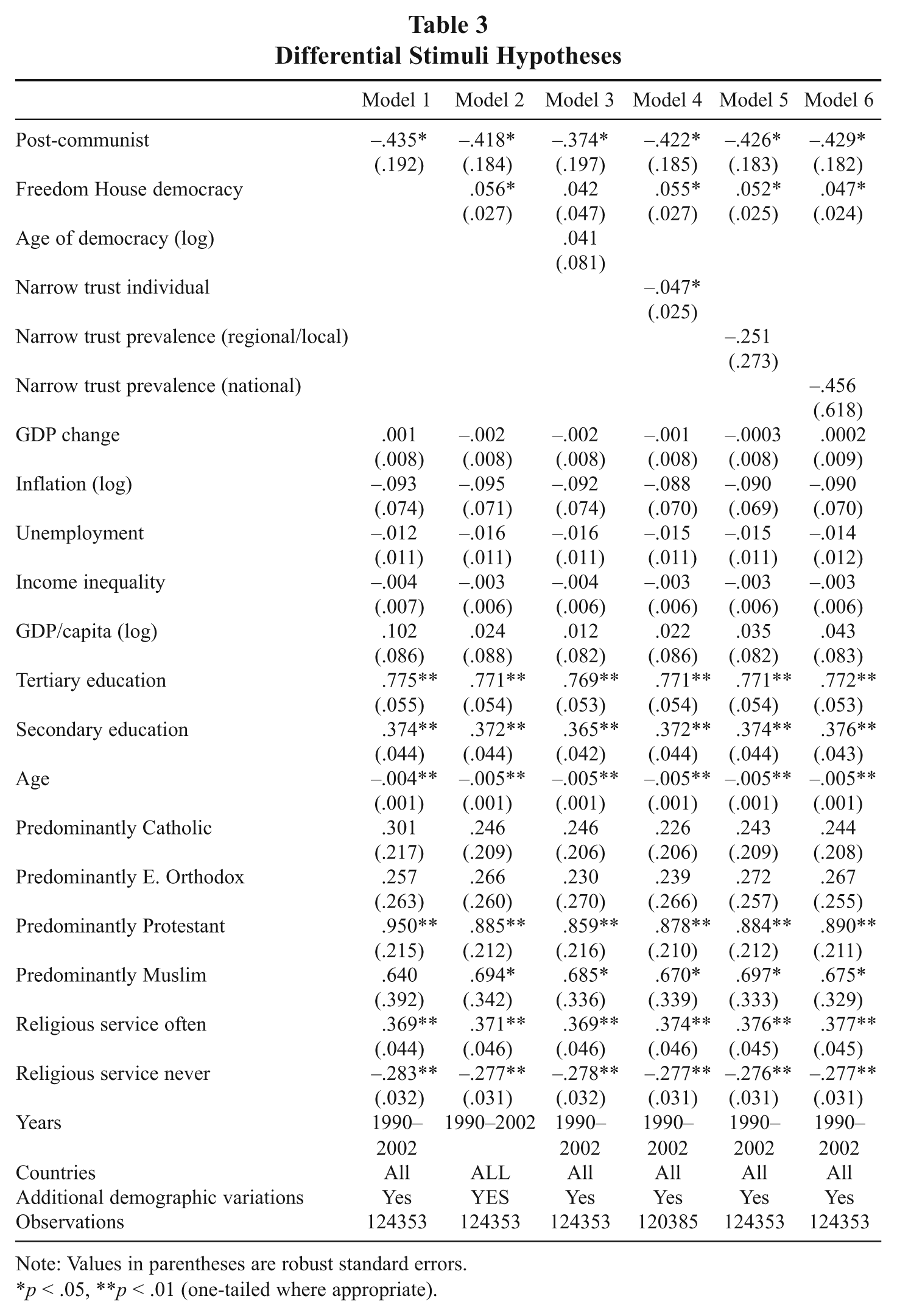
We now turn to the differential stimuli hypothesis, which tries to establish whether aggregate differences in post-communist civic participation can be explained by differences in the economic and institutional context in which individuals decide whether to join civic organizations. As a first step, in model 1 we added three indicators of economic performance—GDP change, inflation, and unemployment. The results indicate that even though both high inflation and high unemployment were associated with moderate reductions in civic participation, thereby adding some credence to the crisis-driven demobilization hypothesis, the effects were at best marginally significant. On the other hand, the inclusion of economic performance controls reduces the size of the post-communist deficit by approximately 15 percent, compared to model 7 of Table 2. This suggests that the trauma of the transitional economic crisis also explains a part—although certainly not all—of the post-communist civic participation deficit.
As a first step toward testing the role of institutional differences in driving individual behavioral differences, in model 2 we control for the lagged Freedom House democracy score in a given country. While the results in model 2 confirm that the more permissive institutional environment of democratic regimes seems to be associated with greater civic participation, the very small reduction in the size of the post-communism regression coefficient suggests that the post-communist civic participation deficit cannot be blamed on supply-side constraints driven by more restrictive political institutions. To test whether institutional differences are more important in the long run, in model 3 we also control for the age of democracy in a country at the time of the survey. However, doing so reduces the post-communist deficit by less than 10 percent, which suggests that the more recent democratization of Eastern Europe does not really account for its weak civic culture either.
Finally, in models 4 and 5 we test the impact of informal institutions. Judging by the results in model 4, individuals with a narrow circle of trust are indeed less likely to join civil society organizations (significant at .05 one-tailed). On the other hand, models 5 and 6 reveal statistically weaker results for the local/regional and country-level indicators of the relative prevalence of such narrow-trust individuals. This difference suggests that any negative correlation between informal networks and formal civic institutions is less driven by supply-side mechanisms (whereby preexisting informal networks crowd out the fledgling formal institutions) than by demand-side considerations, whereby the trust patterns of certain people predispose them to joining either narrow, informal friendship networks or broader, formal civic organizations. While this question deserves greater attention in future research, for the purpose of the current discussion, the more important finding is that the coefficient for the post-communist country dummy is virtually identical in models 2, 4, 5, and 6, which suggests that the post-communist participatory deficit cannot be explained on the basis of the greater prevalence and attractiveness of informal friendship networks in transition countries. 49
Furthermore, in Table 4 we turn to the question of how communist socialization has affected the participatory choices of post-communist citizens. Unlike the analysis in the previous two tables, the emphasis here is on the question of whether by virtue of their life experiences, post-communist citizens have different individual approaches to public life even once we control for differences in the societal contexts. As a first step in model 1, we simply tested how civic participation is affected by the overall length of time that an individual has lived under communism. The results are quite striking: longer exposure to communism is associated with significantly weaker civic participation even once we control for the whole battery of demographic, economic, and institutional factors. Thus, the individual-level results reinforce the aggregate-level comparison in model 5 of Table 2, which found that East Europeans had a smaller civic participation deficit than their counterparts in interwar Soviet territories. In line with the earlier findings that this deficit does not simply vanish as the communist experience recedes into the past, the coefficient for the survey year, which captures the length of the post-communist experience is also negative (albeit much smaller and falling short of statistical significance). 50
Socialization Hypotheses

Note: Values in parentheses are robust standard errors. Also included but not reported are the individual- and country-level controls used in Tables 2 and 3 (except for religious service attendance).
p < .05, **p < .01.
In model 2, we differentiate between different subtypes of communist regimes and find that by far the strongest demobilizing effect occurred among individuals who lived substantial periods of time under post-totalitarian regimes, whereas the effects were substantively smaller in reform-communist regimes and negligible (and no longer statistically significant) for Stalinist and neo-Stalinist regimes. While these findings need to be subjected to greater scrutiny, they suggest that the combination of relatively low repression and weak ideological commitment in post-totalitarian regimes represented the greatest antidote to subsequent civic engagement by post-communist citizens. By comparison, the demobilizing effects were weaker in situations of greater repression intensity (as in Stalinist and neo-Stalinist regimes).
In the last two models we distinguish between early and adult socialization. Model 3 focuses on the repercussions of overall early versus adult socialization and we find that early communist exposure has a much stronger and statistically significant demobilizing effect, while adult socialization had small and statistically inconclusive effects. Finally, the results in model 4, which distinguishes both the timing and the type of communist exposure, further reinforce that post-totalitarianism seems to have had a greater demobilizing effect than other communist regime subtypes and most of this effect seems to happen during early socialization (though the effects are still fairly large and statistically significant for adult post-totalitarian exposure). Remarkably, the only communist subregime type whose demobilizing effects were consistently weak in both substantive and statistical terms was Stalinism.
Conclusion
Overall, our analysis reveals a large and temporally resilient post-communist deficit in civic participation and suggests that three legacies seem to be particularly salient in explaining this deficit. First, it appears that the demographic profile of post-communist countries is less conducive to civic participation than elsewhere: simply controlling for the sociodemographic profile of post-communist citizens reduces the size of the civic participation deficit by more than 20 percent. Furthermore, once we account for the lower religiosity of post-communist citizens, the deficit declines by almost another 20 percent. Second, the magnitude of the deficit appears to be a function of the number of years spent under communism. Convincingly, we see this effect at both the aggregate level—the deficit is larger for people living in republics of the prewar Soviet Union—and at the individual level, where additional years lived under communism translate into lower levels of civic participation. Although the effect is cumulative over time, once we control for years lived under communism we see a stronger deficit for people socialized in the post-totalitarian years of communist regimes than for those socialized under high Stalinism. This suggests that perhaps the mobilizing effects of Stalinism left a lasting impression on those socialized in this era, which canceled out some of the generally demobilizing effects of living under communism more generally. However, for people socialized in the post-totalitarian eras, communism left behind only a demobilizing effect that has persisted into the post-communist era. Finally, economic conditions under post-communism also appear to explain part of the deficit, suggesting that the post-communist participation deficit is not simply a result of living through communism: living through the collapse of communism has also had an impact.
It is also worth noting the factors we found that do not help explain the post-communist participation deficit. First, while we do find the predicted effect for “low general trust–high network trust” individuals across our sample, accounting for the proportion of such individuals at the national or even subnational level does little to explain the participation deficit. Nor, for that matter, does controlling for such attitudes at the individual level. Additionally, and perhaps somewhat surprisingly, the current degree of political liberalization in a country seems to have little effect on the post-communist participation deficit (see Table 3, model 2), at least insofar as Freedom House scores are a good proxy for political liberalization.
To date, the defining study on civic participation in post-communist countries has been Marc Howard’s book. 51 Nothing we have presented in this article should be construed as challenging Howard’s basic insight that the experience of living through communism could produce individuals with less of a proclivity for participating in civic organizations. By casting a wider empirical net and embedding our analysis in a more general theory of legacy effects, however, we have been able to add quite a bit more to the story. Most importantly, we have fleshed out our understanding of what it means to “live through communism” in terms of the civic participation deficit: the sociodemographic landscape left behind by communism, living more years under communism, and socialization in the posttotalitarian phases of communist regimes seem to be important drivers of the civic participation deficit. Furthermore, we show that the post-communist economic—although not political—environment also seems to play a nonnegligible role.
Taken together, we leave behind a potentially optimistic picture about civic society in post-communist countries. To the extent that the civic participation deficit is driven by the experience of having lived through communism, we have no reason to expect it to persist beyond current generations. The evidence we have presented here points to eventual convergence toward norms in other non post-communist countries. Especially insofar as economic conditions in the first decade of post-communism may have driven part of the deficit, recent economic developments such as Poland being the only country in Europe not to go into recession in 2009 suggests that the days of distinctive post-communist economic experiences may be drawing to a close. The one crucial caveat here is that this may be a slow process indeed. The reversal of demographic changes wrought by communism is not likely to happen quickly, and even as older generations fade from the scene, it remains possible—and perhaps even likely based on the experiences of Germany, Austria, and Italy—that these older, more skeptical generations will leave their mark on their descendants. Thus, the question about when we should move beyond the post-communism paradigm is ultimately an empirical one, which will have to be answered by future research about the half-life of the behavioral consequences of communism.