




Abstract
Considerable scholarly attention has been given to Charter ’77 as a site of dissent in the former Czechoslovakia. Yet there was a socially embedded site of resistance that was active long before the dissidents. We call this site the Czech woodcraft culture. With its mass popularity and its potent references to Native American anti-colonialism, the woodcraft culture has still barely registered among researchers. In this paper, we offer the first scholarly account of the origins of Czech woodcraft culture, starting in the early twentieth century. We argue that subsequent transformations of the woodcraft culture in the Czech landscape should be understood as popular, complex, and often ambiguous practices of resistance, from the internationalist inversions of a national bourgeois order in the inter-war period, to nostalgic and paradoxically nationalist subterfuges of the Soviet-imposed regime after 1968. We trace how, as a response to the state socialist regime’s cultural and political pressures, the activities of Czech woodcraft culture were “layered with memories and experiences rooted in the pre-communist period” (Bren, 2002: 124). The Czech woodcraft culture as a whole provided its adherents with an autonomous space that enabled new forms of sociality, immersions in the natural world, and a host of long-standing voluntary associative activities that preceded the emergence of localized environmental movements and other sites of dissent around the Czech lands.
Introduction
To an uninitiated observer, the summertime Czech countryside abounds with an array of perplexing scenes. It is not uncommon to come across what appears to be the campsite of a North American Prairie Indian tribe with a serpent of teepees. Hidden in ravines and valleys, one finds log cabins modelled on American pioneer huts, with names such as Walden, Alaska, or Minnesota displayed on the gable. Elsewhere, perfectly ordinary and inconspicuous village dwellings are adorned with skilfully carved Indian totem poles. The more scenic rivers teem with canoes. The urban setting can provide more native references, such as a match in the Indian game lacrosse or a glimpse of a TV show where the contestants compete in starting fires by rubbing a piece of wood against a bow.
In this article, we trace the origins of these bewildering phenomena in the Czech landscape. Some readers will be familiar with something similar in Germany: namely, large numbers of Indian hobbyists who, as in the Czech Republic, can also often be seen wearing Indian attire while camping in teepees in the German countryside. There is already a substantial literature on such German “Indianthusiasm” and the longstanding fascination with all things Indian in Germany over the last two centuries. 1 However, our purpose is not a comparative endeavor because, unlike Germany, the Indian imagery has long been just one element in a broader range of references in Czechia, which we call the Czech “woodcraft culture.” Our aim, rather, is to map the contexts, evolution, and significance of such phenomena in the Czech landscape. The context is empirically different from that in Germany, much like the range of references themselves (for instance, the Czech woodcraft culture reproduces the backwoods activities of American pioneers in addition to those of North American Indians). As we will show, the Czech woodcraft culture is a multifaceted phenomenon combining subculture, political resistance, and a sense of community. Its intellectual origins go back to late nineteenth- and early twentieth-century North American outdoor movements. Since their import and adaptation in the Czech lands in the 1910s, these ideas have exerted a strong influence on the Czech society during the whole of twentieth century. Therefore, methodologically, one need not be surprised if the subject were to require a different framework for analysis than German “Indianthusiasm.” We suggest that a productive framework with which to understand such aspects of the Czech summer landscape is resistance. In brief, we suggest that the phenomena described above are manifestations of a popular legacy of resistance in Czechia.
Barbara Falk’s article, from an earlier issue of this journal, is a useful starting point for conceptualizing the Czech woodcraft culture as resistance. 2 Falk offers a historiography of English-language scholarship about resistance and dissent in Central and Eastern Europe. Drawing from Scott’s influential work, she suggests that some everyday activities can be important forms of resistance, even while they remain largely private or hidden. 3 Examples include absenteeism, reading samizdat material, or discussing alternative interpretations of history with family members. Such practices occupy one side of the continuum between the poles of hidden resistance and public dissent. At the other end are the more openly political activities, such as writing in samizdat publications, distributing a petition, or public protest. Where Charter ’77 has become emblematic of public dissent, the woodcraft culture often took more private forms of resistance to the existing regime in Czechia.
Falk’s article also serves as an effective counter-point with which to clarify our objectives. She uses the concept of dissent deductively to survey the empirical shape of historiography on the topic, whereas our purpose is to use empirical material about the Czech woodcraft culture in order to explore, inductively, the concept of resistance. Where Falk articulates a genealogy of the research on Soviet-era dissent across Central and Eastern Europe, our contribution charts the history of woodcraft over the course of the twentieth century as a changing form of resistance across time. We draw from interviews, samizdat material, classic texts, and recent historiographic research in the Czech language in order to offer the first scholarly account of the origins of Czech woodcraft culture in the early twentieth century, highlighting the contribution of one person in particular as influential: Miloš Seifert.
Our argument has three components. The first is historical. We contend that these sorts of activities in the Czech landscape can be traced back to an early twentieth-century child-centered educational program, inspired by the figure of the North American Indian. Moreover, we believe the woodcraft culture, which grew out of this initially narrower movement during the inter-war years, has been an important but largely neglected component in past accounts of twentieth-century Czech history and culture. The second component is cultural. We argue that Indian hobbyism and other nature-based outdoor practices in the lands around Prague were diverse. Material references to North American Indian cultures have been complemented with references to the American pioneer and backwoodsman. The Czech woodcraft culture as a whole provided its adherents with an autonomous space that enabled new forms of sociality, immersions in the natural world, and a host of long-standing voluntary associative activities that preceded the emergence of localized environmental movements. 4 The third element in our argument is conceptual. We suggest that subsequent transformations of the Czech woodcraft culture are best understood as popular, complex, and often ambiguous practices of resistance. From internationalist inversions of a national bourgeois order in the inter-war period, to nostalgic and paradoxically often nationalist subterfuges of the Soviet-imposed regime after 1968, we propose that the woodcraft culture constituted engagements in resistance within the Czech landscape, resistance whose significance was transformed as its various “layers of legacies” were built up and covered over one another. 5
Origins of Czech Woodcraft Culture
To trace the origins of the Czech woodcraft culture, one needs to start more than a century earlier, and on the other side of the Atlantic Ocean. There, the woodcraft movement was first developed by Ernest Thompson Seton. It was one of a number of outdoor, children-oriented educational movements popular at the turn of the twentieth century, both in North America and Europe. 6 Seton’s woodcraft movement blended an educational program, informed by the Enlightenment-related theory of recapitulation, 7 with the set of wilderness survival skills as defined by the late nineteenth-century U.S. woodcraft arts. 8 Seton combined the two strands, relating them to what he deemed to be the rituals and character of the North American Indian. He had witnessed a few of the injustices suffered by inhabitants of the Indian reserves during the last decade of the nineteenth century. This made him an outspoken advocate for the indigenous people of North America, whose figure in the abstract served as his role model. 9
In Seton’s eyes, the profound modernisation of the American society at the end of the nineteenth century embodied the erosion of American virtues such as physical courage, personal honour, independence of spirit, and personal self-reliance. He was critical of urban life and industrial technology and the associated loss of handicraft skills and practical knowledge. 10 For Seton, the depravity of the American urban life contrasted with the noble life of Indians before the arrival of the whites. He saw the latter as the “Indian’s burden and believed that the true American should do away with the pioneer model, adopt the best things of the best Indians and come to the realization that those live longest who live nearest to the ground . . . who live the simple life of primitive times.” 11 Seton’s diagnosis of America’s social ills led him to prescribe the return of adolescents and children to the outdoors and to restore, through nature, what he deemed as the traditional qualities of personal self-reliance and independence. 12
Unlike other outdoor educational programs at the time, Seton sought to instil the participants in his educational programs with a strong environmental ethos. He objected to wasteful use of natural resources. When his New York friends from the Camp Fire Club—many of them scientists—were invited to teach the boys participating in the 1904 camp, the rules prohibited killing any animal except for scientific purpose. Similar ideas were later, in 1906, formulated as guiding principles of the woodcraft movement in The Birch Bark Roll: “the promotion of interest in out-of-door life and woodcraft, the preservation of wildlife and landscape and the promotion of good fellowship among its members.” 13
Around Prague, two grammar school teachers—biology teacher Miloš Seifert and physical education teacher Antonín Benjamin Svojsík—shared an objective to establish an outdoor scout-like movement in Czech society. The two knew each other and exchanged ideas and experience. In the second decade of the twentieth century, their ideas and activities set in motion a surprisingly durable and pervasive cultural movement, whose development spanned nearly a century and five political regimes—from the Austrian monarchy, through the inter-war Czechoslovak democratic republic, German occupation during World War Two and the four decades of state socialism, to the contemporary postsocialist period.
In these efforts, Seifert and Svojsík not only drew on the ideas of Robert Baden-Powell, the founder of British scouting. Both were also acquainted with, and strongly influenced by, Seton’s woodcraft philosophy. Svojsík had already introduced Seton’s ideas to Czech scouting in his 1912 book Základy junáctví (Foundations of Scouting). 14 There he laid the ground for a thesis (which has since been widely accepted in the Czech scouting literature) about the role of Seton. He argued that Seton was at least as important as Baden-Powell in founding the scout movement. Moreover, Svojsík articulated the historical division of labor between the two: “romance, poeticity and love for nature [in scouting] are to be credited to Seton while order, discipline and organization are Baden-Powell’s achievements.” 15
Many early Czech scout leaders, including Svojsík himself, preferred the American version of scouting, at that point still strongly influenced by Seton, to the British scouting, which they perceived (rightly or wrongly) as excessively militaristic, regimented, and patriotic. The extent to which the experience of World War One, which broke out shortly after the arrival of woodcraft and scouting ideas in the Czech Lands, exacerbated these resentments against the British scouting can only be surmised today. It would appear likely that in Czech society, with its recently achieved national emancipation, yet still a part of the Austro-Hungarian empire taking part in a war for which the Czechs felt little enthusiasm, 16 the imperialist and militaristic overtones of the British scouting found little popularity. Nonetheless, the fact remains that since its origin, Czech scouting to date has been influenced by Seton’s woodcraft and writings, more so than other national scout organisations. More importantly, the point can be extended to Czech society as a whole. The influence of Seton’s ideas has never been limited only to Czech scout and woodcraft circles. During the inter-war period, they were popular and widely accessible. More of Seton’s works were translated into Czech than into any other language. 17 Between World War Two and the mid-1990s, more than a million copies of Seton’s books were sold in Czechoslovakia and the Czech Republic. 18
While we can only speculate today about the social conditions that made Czech society so receptive to Seton’s woodcraft, the central role played in this process by Miloš Seifert is beyond doubt. For Svojsík, Seton’s ideas were an important influence in the formation and development of his (Czechoslovak) variant of scouting. But for Seifert, Seton’s work became a main source of inspiration for the rest of his life. He had obtained Seton’s books Birch Bark Roll and Two Little Savages by 1913. That summer, he had already organized a camp for his students, inspired by Seton’s educational program. From 1921 until the late 1930s, Seifert maintained regular correspondence with Seton. In 1936, Seifert met Seton in person during the author’s week-long visit to Prague. 19 After several years of unsuccessful attempts by Seifert to found an organization modelled on Seton’s Woodcraft League of America, an organization called Zálesácká liga Československa (Woodcraft League of Czechoslovakia) was eventually established in 1922. 20
The key components of Seton’s woodcraft educational program included hands-on education through work in the natural landscape, knowledge and protection of nature, modest lifestyles, friendship, and the rituals, non-Christian spirituality, and stereotypical character of the North American Indian. These components corresponded with Seifert’s unconventional views on pedagogy and nature protection. Seifert was an educator, thinker, magazine editor, writer, visionary, pacifist, social reformer, and nature conservationist. 21 Between 1909 and the year of his death in 1941, Seifert authored 16 original books in pedagogy and nature conservation, translated another 28 books (apart from Seton, his favourite authors were John Ruskin, Henry David Thoreau, and the Dutch social reformer Frederik van Eeden), published 277 articles in 24 periodicals, and edited two magazines. 22 Further eight articles were published posthumously after the war between 1946 and 1948. 23
Seifert was an inspiring and passionate writer. His 1920 book Přírodou a životem k čistému lidství (Through Nature and Life towards Virtuous Humanity), which drew on Seton’s Book of Woodcraft, remains to date the most important text in the history of the Czech woodcraft culture.
24
While the majority of the book consists of practical instructions about conducting outdoor activities and studying nature,
25
the introductory chapter amounts to an original programmatic document that marks a radical departure from Baden-Powell’s variant of scouting. Here, Seifert was fiercely critical of English scouting, which he characterized as hopelessly hierarchical, clerical,
26
militaristic, imperialistic, and unacceptably conservative. He also rejected Baden-Powell’s emphasis on law-obeying citizenship, arguing that it amounted to condoning an unjust capitalist social order.
27
Furthermore, in this book Seifert took liberty in mixing Seton’s pacifism and cosmopolitanism with a far more radical political critique, which was clearly related to the radicalization of European societies in the aftermath of the Russian revolution.
28
The following quotation captures Seifert’s resistance spirit:
Carlyle and Masaryk taught me to seek the truth without compromises and pretentions. Subsequently, there was no other way for me, the path was clear: to part ways with today’s social order, to break the shackles of traditions, home and school and to find liberty and free thinking.
29
The popularity of woodcraft in the Czech landscape in the 1920s, with its romanticized character of a North American Indian in its centre, built on the earlier success of James Fenimore Cooper’s books in Czechia. Last of the Mohicans had first been translated and published in the Czech language in 1852. 30 Widely regarded as a classic in American literature, Cooper’s novel extolled the ideal of the noble savage, and by the time woodcraft arrived in the Czech Lands, a popular sense of solidarity and identification with the North American Indians had already taken root. According to Kožíšek, this was articulated in both arts and literature. 31 For instance, the Czech “national” painter Mikoláš Aleš completed a series of paintings of the North American Indians before the turn of the century, and Josef Václav Sládek’s poem from 1875, “On the Indian Graves,” circulated widely. In addition to such earlier influences, the arrival of woodcraft coincided with the growing popularity of the German writer Karl May, whose romantic adventure books featured a fictional Apache chief named Vinnetou. 32 The Vinnetou series fell firmly in the literary tradition of noble savage. Enmeshed with May’s depiction, the effect of Seton’s Indianism was that North American Indians came to epitomize the pinnacle of human virtues to twentieth-century Czech society. Accordingly, Ivan “Hiawatha” Makásek recently recalled his childhood disappointment with the realist account of life of North American Indians in John Tanner’s book In Indian Captivity (published in Czech in 1956). Tanner’s depiction stood in sharp contrast to May’s portrayal of Indians as role models of human virtues. Makásek noted that “in this book, there was nothing romantic and inspiring about the life of Indians that would invite us to follow them as role models.” 33
For Seifert, a biology teacher by profession and nature conservation enthusiast, the most attractive element of Seton’s woodcraft was not necessarily its Indianism but its emphasis on knowledge of nature and nature conservation. Seifert took great care in adapting Seton’s educational texts concerning nature to Czechoslovak conditions. More than that, he placed active nature protection, not only passive knowledge of nature, at the centre of his variant of woodcraft. “While woodcraft is, among other things, a pacifist, temperance, and spiritual movement,” he wrote, “it is first and foremost a movement for nature protection.” 34 Seifert tirelessly promoted woodcraft in expert nature conservation circles. For instance, by 1932 he had published 24 articles in Krása našeho domova, a magazine edited by the founder of Czech scientific nature conservation, Jan Svatopluk Procházka. Many of Seifert’s articles championed woodcraft as a nature conservation movement. In that way, he established a legacy of combining the woodcraft educational program with nature conservation, a tradition that continued to be a feature of Czech society for the rest of the twentieth century. 35
Inter-war Woodcraft: From Counterculture to Resistance
With its British and U.S. references, Czech woodcraft culture marked a clear departure from what the Hapsburg authorities (including the Ministry of Education and the Catholic Church) and various Czech national institutions regarded as an appropriate program for the youth in the late nineteenth and early twentieth century. The latter was demonstrated by the refusal of the largest Czech nationalist youth organization—Sokol, which was part of the national establishment—to adopt its program as part of the range of its activities. Indeed, by the time that Seton’s woodcraft arrived in the Czech Lands, national emancipation had been achieved and the need for movements in support of Czech nationalism had diminished. Following the establishment of Czechoslovakia in 1918, the woodcraft culture was the prime example of the shift of some sections of Czech society, away from bitter nationalist rivalries with the German minority in the Czech Lands, and towards the adoption of a wider international outlook. As Pecha has observed, in the post–World War One Europe, woodcraft’s Indianism was an articulation of a non-nationalist, cosmopolitan orientation. 36
Although teenagers and young adults were welcome in all of its outdoor educational groups, these woodcraft organizations offered programs that were less attractive to older teenage boys (membership was initially restricted to boys). Consequently, they generally left these organizations in pursuit of a less regimented version of outdoor activity as they grew older, and a loosely integrated movement—initially called “wild scouts” and later “tramping”—emerged during the first half of the 1920s as the first generation of members of the various outdoor organizations reached adulthood. Referring to the example of a particular group called Seton’s Scouts, Makásek has described how the interests and activities of this boys’ organization transformed as its members grew older. 37 The change was illustrative of the broader process in which children’s organizations transformed into a loosely integrated mass movement that we call the Czech woodcraft culture. The children’s educational program was gradually sidelined and eventually abandoned. Instead, their attention shifted increasingly to building huts and log cabins and, subsequently, to spending free time in nature—in log cabin “settlements” in river valleys and wooded areas of the Czech countryside. The expansion of the woodcraft idea from its original remit of children’s educational organizations to the mass tramping movement, ultimately with cross-generational appeal and with growing popularity among young women, was the main development responsible for the widespread popularity of outdoor activities and for the creation of a specific social formation associated with this phenomenon—the Czech woodcraft culture. With the growing number of the woodcraft culture adherents, it was becoming ever more common for young people to get involved without any earlier experience in the children’s organizations.
The expansion of the woodcraft culture and its growing popularity was facilitated by a number of factors. In addition to Seifert’s translations of Seton’s writings and May’s romantic books about American West translated from German, some aspects of contemporary American culture also nurtured the movement. They were communicated through Czech translations of literature on the North American wilderness and through early American westerns at the movies. Influential U.S. writers included James Oliver Curwood, Zane Grey, Bret Harte, and, above all, Jack London. 38 The leitmotif of this literature was the strong and indomitable individual set within a harsh and dangerous but pristine nature. Around 1925, in reference to characters in hugely popular books by Jack London, the most popular strand of the woodcraft culture began to refer to itself as tramping. Accordingly its adherents were called trampové (tramps). 39
Within the Czech woodcraft culture, the Indian and pioneering strands were not necessarily seen as competing or even contradicting inspirations. Instead, they were part of a complex continuum, with many people professing being adherents of both. 40 Whether taking inspiration from the Indian or backwoodsman and trapper, young urban workers and students sought the weekend refuge and escape in the romantic corners of the Czech countryside, away from what they had come to see as the drudgery and social restrictions of urban life. The free and romantic spirit of tramping, as well as its cultural references to the Wild West through films and literature, made it easier for the trampové to associate themselves with some elements of Seton’s woodcraft, as adapted to Czechoslovak conditions by Seifert. According to Rudan, Seton’s and Seifert’s woodcraft exerted a strong conceptual influence on tramping well into the post–World War Two period. The diversity of everyday activities of outdoor informal groups maintained several goals promoted by the original woodcraft organization—spending free time in the outdoors, acquiring working knowledge of the wild, being able to get by with very little, preserving an independent spirit through nature, and creating autonomous spaces of friendship and solidarity beyond the reach of authorities. 41 Such practices thus constructed and activated low-level sites of resistance to the dominant institutions.
While activities of many groups within the broad woodcraft culture did not initially extend beyond the realm of providing an autonomous space for their members, some of the early groups had a more radical political orientation. For instance, in 1926 Rudolf Noha led a group of activists to separate from the Woodcraft League, in protest of its insufficiently left-wing orientation, to form the International Socialist Association of Woodcrafters. The majority of the new organization’s members joined the Communist Party. 42 Initially, tramping was also a mildly rebellious and counter-cultural (yet non-political) movement of urban working-class youth. Its slightly anarchic overtones were reflected in the name of the first permanent campsite—Ztracená naděje (Lost Hope). With the arrival of economic crisis and the more divisive politics that ensued in the late 1920s and early 1930s, some sections of the tramping movement began to radicalize, and the movement gradually transformed itself from a largely cultural alternative to a politically progressive force. Tramping became a form of resistance against the dominant political ideology of capitalist, conservative, bourgeois values. During weekends and possibly one or two summer weeks, many young people adopted a different identity and formed an alternative community that not only challenged the state authority but also mainstream morality. 43
The transformative moment came in 1931 when Hugo Kubát, the regional administrator in Bohemia, issued a decree banning persons of the opposite sex from sharing a tent or hut unless they possessed marriage certificates. To resist this encroachment on their freedom, tramps began to organize protest gatherings and marches. On 19 May 1931, fifteen thousand tramps gathered at a protest demonstration in a brewery garden in Prague-Vinohrady. Some tramps joined the Communist Party. The politicization of the movement was reflected in changes of names of some tramp groups and their campsites: Red Partisans, Red Butterfly, and Red Breakthrough. In September 1931, the tramp movement sent a delegation of fourteen tramps on a study trip to the Soviet Union. Upon their return, several were fired from their jobs. 44 By 1933, several groups of left-wing adherents of the woodcraft culture in Prague had founded the Jack London Club as a progressive cultural and sporting organization for young people. Similar clubs around the country followed the Jack London Club’s example under different names, including Sandino, Bert Brecht, E.T. Seton, and John Reed. In 1936, the original club sent a delegation to the First World Congress of Youth Against War held in Paris. 45
The inter-war Czech woodcraft culture had become an inclusive church. Some woodcraft and tramp organizations were members of a loose umbrella body called Federation of the Czechoslovak Scout (a left-leaning alternative to Baden-Powellian Union of Czechoslovak Scouts), which had among its member organizations the Prague Jewish and German scout groups. In addition, some Prague Germans were well-known tramps. While Czech woodcraft culture shared many features and inspirations with the contemporary similar movements in the United Kingdom, Germany, and the United States (such as the emphasis on self-reliance, simplicity, outdoor life, and the Indian as role model), in many other respects it differed from them. Probably because of its urban and working-class social base, the Czech woodcraft culture’s love for nature and for staying outdoors did not extend to calls for conservative back-to-land ideas. Indeed, it was generally left-leaning in its politics and progressively internationalist in its outlook. This stood in contrast to the right-wing nationalism of various back-to-land groups in western Europe, many of which had also been inspired by Seton’s ideas (like the British Kibbo Kift Kin, which later evolved to Green Shirts). 46 Rudan claims that out of the three thousand Czechoslovak interbrigadists who fought in the Spanish civil war in the 1930s on the republican side, two thousand were tramps. 47
Woodcraft as Resistance to the Communist Regime
Since, by the mid-1930s, many adherents of the woodcraft culture had joined the antifascist movement, it may not be surprising that many of them took part in resistance during the German occupation of the Czech Lands between 1939 and 1945. Many were active in the 1944 Slovak National Uprising as well. 48 Despite its war credentials, two or three years after the 1948 Soviet-backed Communist coup, tramping and other outdoor woodcraft-related activities became the target of the new regime. The children’s outdoor organizations were banned in 1951, along with a majority of civic associations.
Yet the loosely integrated movement of tramps, woodcrafters, and backwoodsmen could not be dealt with in the same way because they lacked an organizational structure. Still, the new government did not let them go without impunity. Conspicuous in their dress styles, tramps were often arrested, interrogated by the police, and remanded in custody. Caught tramps were often forced to take part in a “voluntary” brigade (unloading railway carriages, for instance). 49 U.S. camouflage uniforms and other military equipment were particularly popular with the tramps heading outdoors. On Friday afternoons, police routinely stopped the tramps who congregated at the railway stations, ready to set off for their campsites, and then cut the letters “US” out of their gear, confiscating knives and machetes as well.
However, selected prominent figures of the movement faced far harsher forms of persecution after the 1948 coup. For example, just after Christmas 1949, Rudolf “Rudan” Noha, who was a leading figure of the inter-war left-wing woodcraft and tramping movements and the deputy chair of Jack London Club (founded in Prague in 1933), was arrested along with four fellow members of the club. Noha was also a member of the Prague-based avant-garde socialist group the International Socialist Association of Woodcraft, established in 1927. He was charged with treason and sentenced to thirteen years in prison based on the allegation that the Jack London Club was “the school of Trotskyism.” Ironically, while the post-war communist regime considered it “Trotskyism,” inter-war police reports had branded the same club, whose members had social democratic orientation, as a “communist” organization. 50
Kučerová contends that until the late 1950s, tramping was only for people who were willing to be in permanent conflict with officials. As the most visible and provocative part of the woodcraft culture, tramps continued to be harassed by the regime’s forces of law and order. Even in the 1960s, when more tolerance was exercised by the regime and the Czech woodcraft culture was revitalized, gatherings of its adherents in the countryside (such as tramp potlachs) were subject to round-ups by armed police or People’s Militia with dogs. The participants were searched, beaten up, and hurled on lorries to be dumped some twenty kilometres from their campsite. 51
In 1958, Otakar Leiský, a zoologist by profession employed at the State Institute of Heritage Monument and Nature Protection and a former scout influenced by Seton’s ideas, and several other activists started an association that would become an important hub of the woodcraft culture in the next two decades. The association arose as a result of a chance encounter in March 1957. While on a Sunday family walk to Prokopské valley in Prague, Leiský was approached by a group of boys who were eager to learn about the area. 52 From then on, the group held regular weekly meetings. In the summer of that year, Leiský organized a summer camp for this group of children, with a program modeled on the woodcraft educational system (outdoor games, hikes to the countryside, basics of ecology). As Leiský wanted his group to stay away from regime-supporting organizations, and since he needed to avoid persecution by the authorities for unofficial activities at the same time, it was essential to quickly find an officially recognized shelter. It was not possible to establish a new organization, so the only option was to join a suitable regime-sanctioned entity. For this reason, in 1958, Leiský’s group joined the National Museum Society, so as to become its section for nature protection.
Renamed Tis (meaning “yew tree” in Czech) in 1969 when it gained official registration by the Ministry of Interior and thus formal independence, the association focused on nature protection and outdoor education for youth, drawing on the legacy of Seton and Seifert from the early twentieth century. While Tis had legal standing as an independent organization (unlike other “social organizations” at the time), it received no funding and no other form of support from the state. Because of friendly contacts with several journalists, the association also enjoyed favorable media coverage. However, it soon found itself on a collision course with the authorities. This was mainly due to its criticism of the environmental impact of several government-promoted projects. But another issue was that Tis had a children’s section (which was modeled on Seton’s woodcraft). That program seems to have been resented by the leaders of the Pioneer Organization, a regime-sponsored group that also provided outdoor education for youth. Except for the Pioneers (in which all children were expected to join), Tis was the only children’s organization in late 1960s and 1970s socialist Czechoslovakia. By the end of that decade, about ten thousand children and teenagers were following the outdoor educational program that was run by Tis and based on woodcraft and scouting, thus breaking the Pioneer Organization’s monopoly on the extramural education of youth. 53
Eva Olšanská, one of the organizers for Tis, also ran a column in a monthly magazine Tramp. Appearing only for a short period after 1969, the column disseminated information on Tis within the tramping movement, thereby recruiting new members into Tis and further strengthening the linkages between the woodcraft culture and nature protection. 54 Thus, as an organization, Tis provided shelter for several groups along the lines of woodcraft and cooperated with the tramp movement.
The Woodcraft Movement’s Cultural Production during Socialism
At the beginning of the 1960s many political prisoners, including Rudolf Noha and his friends, were released and rehabilitated. A limited amount of information about injustices such as Noha’s case was publicized in the first half of the 1960, resulting in public disillusionment with the Stalinist variant of the communist regime. To many people who began to view the regime more critically (the youth in particular), the inter-war woodcraft culture offered an attractive alternative with its ideals of true friendship, trust, romance, and equality. 55 Although in the first half of the 1960s, woodcraft culture was still perceived by the authorities with hostility and though the movement continued to receive negative media coverage, the scale and severity of harassment reduced significantly and ceased entirely in the end of the decade.
Toward the end of the 1960s, the censorship was briefly lifted. The woodcraft culture quickly took advantage of these favorable conditions, drawing on the association of personal freedom (which it always promoted) with the greater freedoms offered by the reformist communist regime. New magazines were launched, previously banned books were published, and cultural events were organized. The sudden expansion of the movement is captured in the following quote by Rudolf “Rudan” Noha:
During World War Two and the first several post-war years it seemed that tramping vanished without a trace. . . . And then, all of a sudden, thirty years later, the movement of young Czechoslovak citizens—tramping—took the country by storm. It’s grown in entirely different political, economic and cultural conditions than in the post-World War One period.
56
The renewed energy of the woodcraft culture in the mid- and late 1960s is documented, for example, by the number of legally published tramp periodicals (about twenty) and, from 1965 to 1972, the impressive circulation of the most popular monthly Tramp (forty-three thousand). 57 In these periodicals, the lasting influence of Seton’s and Seifert’s woodcraft ideas on tramping was in evidence with regular sections on woodcraft (“history of woodcraft,” “chapters on woodcraft,” etc.).
In the 1960s, parallel efforts were aimed at the revival of the more directly Indian-oriented strand of woodcraft culture. The new tribe Neskenon was founded in Prague in 1965. It became an inspiration for similar woodcraft tribes in other Czech cities. 58 Also in the mid-1960s, campers’ schools representing a parallel line of activities drawing on this strand were organized, first by the official Czechoslovak Union of Youth, and then from 1968 until it was banned in 1970, by the newly founded organization Czech Campers Union. 59 In 1969, following the rejection of the Ministry of Interior to register the Woodcraft League (which had been banned since 1951), some Indian-oriented woodcrafters remained active in the Czech Campers Union, but it was also subsequently banned in 1970 as the pro-Soviet wing in the Communist Party reasserted its power.
In the second half of the 1960s, the Prague sports publishing house Olympia set out to publish Seton’s wildlife books. 60 At the last minute, before the political opportunity closed, their translator Miloš Zapletal persuaded the company to include an anthology of The Book of Woodcraft and The Birch Bark Roll as part of the series. 61 Published in a large number of copies, the anthology was instrumental in the spread of woodcraft-inspired activities during the next two decades. 62 That book became the only woodcraft manual officially published in the Czech language during the four decades of Communist rule from the late 1940s to 1989.
Normalization
In 1970, at the beginning of normalization, Tis served as a legal organization that was nevertheless independent of the state as much as this was conceivable at the time. At the legal and symbolic level, unlike the majority of officially recognized organizations, Tis did not have the leading role of the Communist Party in its bylaws. 63 At a more practical level, in contrast to most “social organizations,” it received no direct state funding. Financially, Tis was dependent on membership fees, sponsorship from “friendly” state companies and the income from occasional consultancy for public bodies. The relative distance and financial independence from state authorities enabled Tis to shelter a range of woodcraft culture–related activities during the first difficult decade of normalization. 64
According to Leiský, a leading figure in the association throughout the two decades of its existence, Tis drew on ideas of Seton, Albert Schweitzer, Tomáš Garrigue Masaryk, and A.B. Svojsík, thus combining domestic and international philosophical influences and blending current and past international influences with those referring to the “golden age” of the inter-war Czechoslovak democracy.
65
Tis provided an alternative and autonomous space during the decade of normalization. Aleš Máchal, a member of the Brno branch of Tis since 1975, recollected his first encounter with the organization during a chance meeting with several members of the Tis leadership:
I met Helena Lewitová and Eva Olšanská at a campsite in Malá Morávka. . . . Normalization was already under way. It must have been 1971 or 1972, I do not remember exactly. . . . It was a very confidential conversation. . . . It turned out that Tis was an association for the protection of nature, landscape and people [our emphasis]. . . . This illustrates what the organization was about: it was a community that stuck together and which had, to great extent, a certain dissent flavor. To use the jargon of the time, it was not really a counter-revolutionary or anti-socialist [organization], but it was definitely not a conformist activity either. . . . It had its own ways of conspiracy behavior.
66
Following the defeat of efforts to reform the communist regime in the late 1960s (known as Prague Spring), in the early 1970s the newly installed pro-Soviet orthodox regime initiated mass-scale purges. These actions were aimed not only at the defeated reformist communists but also at quashing any activity that did not conform to the official doctrine of normalization—“a program for political consolidation, social conformity, and return to normal, socialist life.” 67 Given the extent of its independent activity in the second half of the 1960s, the woodcraft culture was among prime casualties of normalization. All tramp magazines that started in the mid-1960s were banned by the early 1970s. They were quickly replaced with hundreds of samizdat publications (underground periodicals). Following the establishment of the dissident group Charter ’77 in January 1978, the police blew up about a hundred tramps’ and woodcrafters’ campsites in the Brdy Hills near Prague as a preemptive strike at another nonconformist group. 68 History had repeated itself. As in the darkest days of the 1950s, the woodcraft culture again was surrounded by silence. 69
One of the leading protagonists of the Czech woodcraft culture in post-1968 Czechoslovakia was Ivan Makásek. He was a proponent of a movement called “ecumenical scouting,” which was a unique and eclectic blend of Seton’s and Seifert’s woodcraft and scouting with hands-on environmental protection. The extent to which the construction of many Czechs’ identity in the aftermath of the 1968 Soviet invasion drew on distancing themselves from the Soviet colonizers while at the same time identifying with the North American Indians is evidenced in Ivan Makásek’s reflection on the situation in 1970s and 1980s Czechoslovakia: “The Indians lived on a reserve, as we did in the Soviet one.” 70
In the 1970s and 1980s, the authorities adopted a strategy of repression combined with attempts at incorporation and containment of the movement in official structures—particularly the movement’s cultural production. While two dozens tramp magazines from the 1960s were banned, and the publishers of many samizdat magazines that replaced them in the 1970s were persecuted, Mladý svět (the weekly of the normalized Socialist Union of Youth, with mass circulation of several hundred thousands copies) ran a regular column for tramps under the title “Campfire.” The column did not promote woodcraft culture as a movement. Rather, it served as an exchange of information about various events (concerts, competitions, exhibitions) and as a site of commentary and interpretation for some of these cultural events. Thus, the column was part of the regime’s strategy to steer the movement’s activity to regime-sanctioned forms of cultural production and thus to keep the movement under control. 71 The regime’s support for the annual music festival of tramp and folk music, called Porta, was a manifestation of the same strategy. The state authorities provided generous support for the festival, for its publicity, and for music recordings arising from the festival. However, by doing so, they also maintained the ultimate veto on who could perform with which songs in the festival, thus determining what kind of music was permitted in that space.
The distance of half a century enabled adherents of the woodcraft culture in the 1970s and 1980s to construct the inter-war period of the movement as a mythical golden era, with its romantic and adventurous overtones, its cultural heritage, and its temporal association with democratic Czechoslovakia. Thus during normalization, the woodcraft culture not only enabled people of all age groups to find a refuge from oppressive every-day reality with a group of like-minded friends in their campsites. Its recuperated legacy also enabled the reconstruction of Czech national identity outside the strictures of the state. 72 The decades that had passed since the inter-war golden age, the fact that the majority of new adherents could not remember its anti-establishment and internationalist struggles of the 1930s, and the silence of the regime’s media about that past, all served to erase the left-wing orientation of much of the inter-war woodcraft culture from memory. In fact, as a result of the revelations of injustices and crimes committed by the communist regime in the 1950s combined with the fresh experience of the Soviet invasion and the ensuing harassment, persecution, and monitoring in the period of normalization, woodcraft seemed to develop anti-left-wing political attitudes. However, we need to distinguish between the political-philosophical underpinnings of left-wing politics (in particular its Marxist-Leninist variant, which many in the woodcraft culture had explored in the inter-war period) and the everyday, lived experience of the adherents of the woodcraft culture in the 1980s, which was marked by communitarian values such as mutual help, cooperation, trust, and equality. While the former was irreparably compromised and rejected, the latter was prized as an alternative to brutal and hostile regime. A document from the Secret Police (see Figure 1) illustrates not only such monitoring, depicting what the police considered to be the organizational structure of what they called the “tramp movement” but also the association of tramps, scouts, and Tis with those the regime considered right-wing elements.
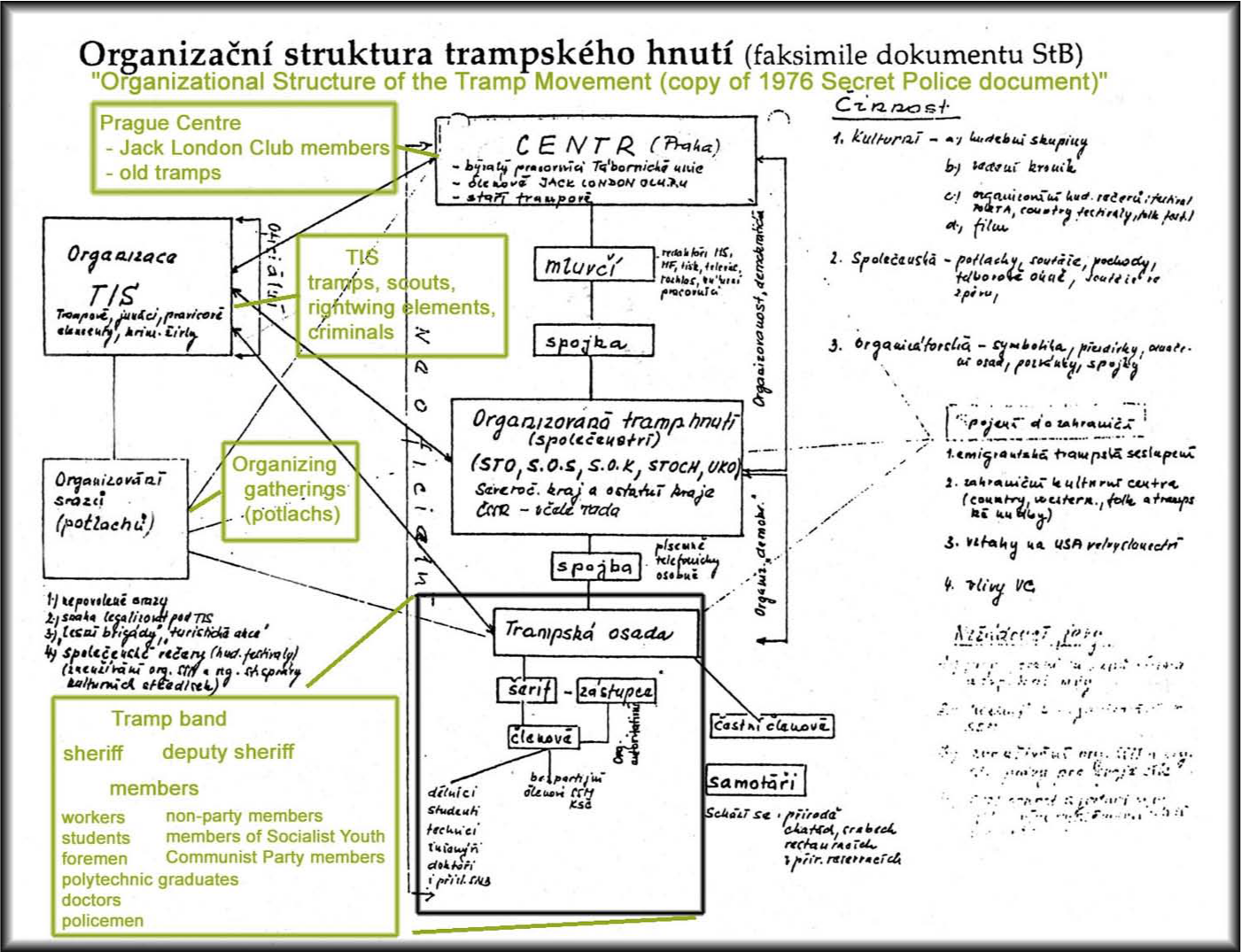
Secret Police Document from 1976, with English Translation Added by Authors.
The silence that surrounded the left-leaning inter-war woodcraft culture during the post-1970 normalization period provides evidence that, to the pro-Soviet Czechoslovak regime, this was an uncomfortable piece of history. Bren suggests that there are three reasons for this policy of censure. The first was the inter-war movement’s fascination with American Wild West lore. In a strangely distorted manner, vast tracts of North American geography were mapped onto the Czech countryside, and places of significance to the woodcraft culture (rivers, campsites, hills) were unofficially renamed using North American toponyms. Second, the harassment of dissidents by authorities in the 1970s and 1980s may have been embarrassingly similar to the harassment that the tramps experienced in the 1930s. Third, tramping and the whole Czech woodcraft culture represented an antithesis of citizenship and its relationship to space to that promoted by the policy of normalization. 73 While the regime effectively promoted a passive, consumerist, and atomized citizenry in its quest for the quiet socialist life, the woodcrafters and tramps extolled the values of friendship, community, and play—qualities that they carried over from the pre-war period to the communist times of the 1970s and 1980s.
For instance, Miloslav Nevrlý’s collection of short essays extolling the spiritual and aesthetic experience of outdoor activities with the minimal equipment and provisions (published in limited numbers in 1986 as a semi-official publication of a climbing club in Ústí nad Labem), met with an enthusiastic response from members of outdoor and environmental groups in 1980s Czechoslovakia, and it was further circulated in unofficial copies. 74 A number of later leaders in the Czech environmental movement referred to various strands of the woodcraft culture, including Nevrlý’s collection of essays, as important pre-1989 formative experience that led to their environmental activism. Several mentioned Seton’s books, books with Indian themes (including Karl May’s books), and also the childhood involvement in the woodcraft tribe Neskenon, as strong formative influences. 75 In that way, woodcraft—with its emphasis on simple life amidst nature with minimal equipment—nurtured not only a working knowledge of nature, self-reliance, and modest lifestyle among its adherents but also communitarian virtues like cooperation, camaraderie, and mutual aid. These were at odds with the regime’s promotion of individualistic consumerism, which was likely perceived by the regime as a safe way to divert its citizens from political challenges to its rule. At the same time, few adherents of the woodcraft culture seemed to see a contradiction in extolling communitarian virtues and rejecting the idea that Soviet-style Marxist politics should extend to all variants of left-wing political discourses.
Conclusion
We wish to conclude by revisiting the three points of the argument that we introduced at the beginning of the article. One piece of our argument was cultural. We suggested that, while diverse, the activities of Czech woodcraft as a whole constituted a cultural formation, whose diversity distinguishes the phenomenon from the “Indianthusiasm” in Germany. The Native American hobbyism and other nature-based outdoor practices in today’s Czechia comprise, altogether, a collective identity. Indeed, both in the inter-war period and in last three decades of state socialism, we showed the presence of what Sandlin and Walther consider the three necessary components in the formation of collective identity. 76 First, from the 1920s to the 1980s, the woodcraft culture was always a subculture (consisting of names, symbols, rituals, clothing, practices) in direct opposition to the hegemonic culture, whether the bourgeois culture of the inter-war period or post-1968 normalization. Second, adherents of the woodcraft culture shared a set of interpretive frameworks, which circulated through foundational texts (by Seton, Seifert, and others), figures, and practices that could be offered up for discussion and debate among its adherents. Third, in both periods, one of the strongest features (and to its sympathisers one of the most attractive) of the Czech woodcraft culture was a sense of solidarity and friendship, giving it a strong sense of group consciousness. Thus all three components—(a) opposition to hegemonic norms, (b) a shared if contentious set of interpretive frameworks, and (c) a sense of solidarity—were active in the formation of the diverse woodcraft culture as the basis of collective identity in Czechia.
The second part of our argument was that the woodcraft movement has been a necessary yet missing component from prior accounts of twentieth-century Czech history. Indeed, many features of the twentieth-century Czech society are inexplicable unless they are related to an evolving woodcraft culture, one that has always been responsive to the constraints and opportunities created by the political context. These features include the lasting popularity of sports such as lacrosse and canoeing, whose popularity is derived from the admiration of the figure of North American Indians. In some respects, the Czech woodcraft culture historically resembled what Ascherson calls a “breathing space, a survival chamber hollowed out within the foundations of an oppressive system . . . in which the man or woman who enters may be irretrievably changed.” 77 However, its distinctive and lasting feature was its extension into Czech popular culture: media, literature, sports, and music. This extended its influence far beyond the ranks of its active participants, and extended it well into the present day. 78
This historical extension into Czech popular culture can stand elaboration. Hands-on nature conservation, combined with the experience of being outdoors and the ability to get by with very little, has been a defining feature of the Czech environmental movement since the late 1950s. 79 So too has been the use of the North American Indian as a figure for inspiration. 80 Moreover, totem poles and other Indian crafts (bags, axes, calumets, headdresses, teepees, jewellery) are widespread and commercially exploited. Popular culture, including TV shows and magazines, has always been saturated with images and references to the skills, art, and history of North America Indians. There is literature, films, and popular music related to this culture. One of the latest addition is Indián & sestřička (The Indian and the Nurse), a feature film in 2006 about the relationship between a Roma woman and a white Czech man who is an Indian hobbyist. The historical legacy of the woodcraft culture also helps to explain the mass popularity of a specific genre of popular music called “tramp music” as well as the Czech variant of bluegrass and country music.
However, apart from the broad and pervasive manifestations of woodcraft in popular culture with which most Czechs would be familiar, the woodcraft culture in the narrower sense—as a participatory associative activity and collective identity—played a long-standing, significant, yet varying political role. In some ways this resembles what Li Bennich-Björkman has called “layers of legacies,” where a number of different traditions provide the foundations for recent formations in a post-socialist society. 81 But whereas Bennich-Björkman shows how resistance to the socialist state in Estonia drew on the norms of the inter-war establishment, our case is distinct. Much of the Czech woodcraft culture in the inter-war years constituted, instead, an anti-establishment counter-culture, such that it served to fold its legacies of resistance to the dominant regime over, in layers, from one period to the next.
Hence the third part of our argument is that, on a theoretical level, the Czech woodcraft culture has been an active and unrecognized form of resistance. From its emergence in the early 1920s, through to the late 1980s, the woodcraft culture constituted specific yet changing forms of opposition to the political establishment of the day. It was a complex and often paradoxical set of resistance practices that were not always hidden. In the 1930s, the woodcraft culture was a left-leaning, anti-bourgeois, and egalitarian movement. In the years after World War Two, it developed an anti-socialist and anti-left political orientation, while retaining its social inclusiveness and egalitarianism. We contend that in the post-1968 era, this widespread and everyday social phenomenon was a grassroots form of cultural and political resistance. With its foundations in friendship, camaraderie, trust, and cooperation, the woodcraft culture stood in contrast to better-known individualized and elite political dissent. Because of its everyday presence and universal familiarity, it played an often-overlooked yet pivotal role in maintaining the distinctive character of Czech society during the decades of the communist regime. Particularly in the post-1968 period, many Czechs—oppressed and powerless, yet feeling morally superior to their oppressors—could easily identify with North American Indians. At the same time, their participation in activities associated with the woodcraft culture, with its heyday in the Czechoslovak inter-war period, enabled them to invoke and draw with nostalgia on the memories, experiences, and myths of the pre-communist period.
In many ways, therefore, it was a profoundly hybrid form of resistance. It comprised activities that the regime regarded as outright subversion, such as large potlachs attended by hundreds of tramps, publication of samizdat magazines, and networking among different groups and strands of the woodcraft culture. But it also involved activities, such as festivals of tramp music, in which the boundary between the autonomous space and the incorporation into the regime’s structures were blurred and required careful navigation if the adherents of the woodcraft culture were to maintain their distance from the regime.
This history of the Czech woodcraft culture contributes to recent revisions that many scholars have made to conventional understandings of resistance in Central and Eastern Europe. In the traditional western scholarship, extensive attention has been paid to public forms of dissent to the communist regimes, such as Solidarity in Poland, or the Czechoslovak dissident group Charter ’77, with widely renowned figures like Lech Walęsa, Adam Michnik, and Václav Havel. In the Czech case, the dissent associated with Charter ’77 has attained emblematic status (both within and beyond the country) as major and transformative sites of resistance to Czechoslovak state socialism. However, that dissent involved a relatively small number of loosely linked and prominent individuals. Furthermore, it was somewhat detached from the rest of society, and active only from the late 1970s onwards. 82 Indeed, Suchland suggests that this tradition of dissent has now been largely assimilated into western liberalism to such an extent that it may now be time to advance a conceptualisation of postsocialist critique that moves away from liberalism’s normative assumptions about the dissident subject. 83
In this regard, we suggest that there was a more socially embedded site of resistance that was active throughout the whole period of Czechoslovak socialism: the Czech woodcraft culture. We have shown how the resistance of the woodcraft culture to the state socialist regime—especially from 1968 to 1989—were “layered with memories and experiences rooted in the pre-communist period” that were both hybrid and paradoxical to the internationalist and socialist “traditions” of woodcraft that such resistance invoked. 84 While the limited human rights opposition to Soviet-backed regime has achieved paradigmatic status in academia, the woodcraft culture, with its mass popularity and strong U.S. references, has barely registered among researchers. This culture not only had a significant impact on the ability of the Czech society to create and maintain its identity during the communist times. It also continues to have important cultural and social manifestations in the post-1989 Czech landscape.