




Abstract
Reforming a totalitarian state requires the changing of old institutions to new democratic ones, establishing new democratic procedures, changing people’s mindsets and introducing new democratic values. Many observers claim that Ukraine, the second-most populous country of the former Soviet Union, has fallen short of making meaningful democratic reforms. While much work in this regard remains to be done, it would be unfair to claim that Ukraine has not made any advancement with regard to democratic reforms. In this article, we describe and analyze broadly the correlation between the establishment of the new administrative court system in Ukraine and the ability of asylum-seekers to gain asylum status as evidence of intentional democratic reforms. The findings, which derive from data gathered from the Ukraine Register of Court cases from May 2009 through May 2010, suggest that Ukraine has implemented such reforms slowly and awkwardly. However, we suggest that Ukraine’s recent establishment of an administrative court reveals that deliberate, albeit cautious, steps have been taken to limit the power of the current government and hold it responsive and responsible towards the people.
In January 2008, a citizen of the Republic of Belarus was deported from Poland to Ukraine for exceeding the terms of his visa. Fearing reprisal for his past affiliation with an opposition social movement in Belarus, the individual applied to the State Committee for Nationalities and Religions for asylum in Ukraine. The State Committee subsequently denied the asylum-seeker’s petition as based on “groundless fears” of becoming a victim of persecution in his country, despite the following facts: the applicant was in charge of two units of the Youth Opposition Movement “Zubr,” had been detained for 15 days by the Committee of National Security (successor of the KGB), beaten, and expelled from a Belarus university. The asylum-seeker appealed to the Regional Administrative Court of Kyiv requesting the Court to cancel the State’s denial and to reconsider the case because his freedom, life, and health would be threatened if returned to Belarus. On July 6, 2009, the Administrative Court upheld the challenge to the State’s decision and obliged them to reconsider the case. In their decision, the Court referred not only to the Constitution of Ukraine, the Law on Refugees, and the Administrative Court Procedure Code but also to the European Union Directives which are used by the European Human Rights Court, the UN 1951 Refugee Convention and Amnesty International’s 2009 Report on Belarus. The Court noted that “it is groundless to deny asylum to an asylum-seeker based on the lack of documents which prove that an asylum-seeker is being persecuted due to his/her nationality, political or religious beliefs because often persons seeking asylum are deprived of the possibility to provide such proof.”
1
Many scholars have posited a link between human rights and democracy. Where democracies exist, the state apparatus is less willing and less able to violate human rights. 2 By implication, therefore, one can surmise that evidence of improvements in the area of human rights within a state is also evidence of democratization within that state. In our research, we focus on the area of human rights for immigrants and refugees; these individuals are extremely vulnerable—they may not know the language of the state to which they have moved and are often without financial resources. If their rights are protected, it bodes well for the protection of rights for all citizens within a state and for the process of democratization.
A separate system of administrative justice was established in Ukraine after the adoption of the Administrative Court Procedure Code on 6 July 2005. This system of administrative justice is an interesting phenomenon in a post-Soviet state that could be characterized as totalitarian prior to independence. According to the Administrative Court Procedure Code (Chapter 1, Article 2), “The goal of administrative justice is to protect rights, freedoms, and interests of individuals . . . against violations by the state authorities, municipal governments or their state officials and employees.” This was unheard of during the totalitarian era prior to 1991. Ukraine has been granting asylum almost since its independence. In 1996 the old Law on Refugees, which had been adopted on 24 December 1993, entered into force. A few years later, in 2001, a new Law on Refugees was adopted and implemented. At that time, asylum cases were filed to civilian courts of general jurisdiction. Because administrative justice in Ukraine is a new phenomenon and because the court cases were not accessible until after the Register of Court Cases (http://www.reyestr.court.gov.ua) was created in 2006, this area has been under-researched. Fair and independent administrative justice is certainly an important democratic development in a post-totalitarian state and, therefore, research in this area is needed.
Administrative justice deals with numerous types of cases. We have chosen asylum cases for our study 3 because they are the most vivid example of whether the new administrative court system made any difference; asylum-seekers are one of the most vulnerable groups filing cases to administrative courts. If the study shows that asylum-seekers succeed in questioning decisions of state authorities (the State Committee of Ukraine for Nationalities and Religions, which currently acts as a migration service), then Ukrainian citizens have better chances in doing so by questioning decisions made by other state authorities (Ministries, Tax Administrations, law enforcement agencies, etc.). The better the rights of aliens and citizens are protected against the state, the more democratic Ukraine becomes. Moreover, as a system of administrative justice becomes stronger and more independent, democracy becomes more stable in Ukraine. It makes the possibility of a reversal to authoritarianism more difficult and time consuming for any political elite. In this case, the administrative justice serves as a guardian of unstable democratic development before it becomes part of the population’s and state institutions’ culture. 4
Asylum Cases: Transitioning from Civilian to Administrative Courts
The Law on Legal Procedures of Ukraine, adopted on 7 February 2002, determined the system of administrative courts that were to be established within three years. The Order of the President of Ukraine, issued on 1 October 2002, established the Higher Administrative Court while another Order, issued on 16 November 2004, established Regional (original jurisdiction) and Appeal Administrative Courts. Regional Administrative Courts were created in each oblast city as well as in Kyiv and Sevastopol (twenty-seven courts). Appeal Administrative Courts were established in the largest regions of Ukraine such as Donetsk, Dnipropetrovsk, Lviv, Odesa, and Kharkiv oblasts as well as Kyiv and Sevastopol (seven courts). The Higher Administrative Court was set up in Kyiv, the capital of Ukraine. Adoption of the Administrative Court Procedure Code on 6 July 2005 defined the authority of each level of administrative court, as well as the procedures of applying to administrative courts and how administrative justice in Ukraine was to be exercised. The Higher Administrative Court started considering its first administrative cases on 1 September 2005. 5
Despite the fact that administrative courts were officially established in 2002 (Higher Administrative Court) and 2004 (Regional and Appeal Administrative Courts), and the Administrative Court Procedure Code was adopted in 2005, it took some time to create all the courts, fill them with judges, and for the courts to start considering asylum cases. Therefore, in 2006, asylum cases were still considered exclusively by civilian courts of general jurisdiction. In 2007, more than 35 percent of cases were considered by the newly established administrative courts, including the Higher Administrative Court, but the remaining majority of asylum cases were still being considered by civilian courts. Some cases in Odesa and Kharkiv oblasts were passed from the first-tier civilian courts to second-tier administrative courts. In 2008, 85 percent of asylum cases were considered by administrative courts and only 15 percent of cases were still considered by civilian courts. Finally, all asylum cases were considered exclusively by administrative courts beginning in 2009.
In Ukraine, asylum-seekers normally submit two types of cases. They ask a court to oblige the State Committee for Nationalities and Religions to either accept their applications for asylum or to grant them asylum. Currently, however, Ukrainian courts neither grant an asylum status nor oblige the State Committee for Nationalities and Religions to grant an asylum status to an asylum-seeker. To do so would contradict the Law of Ukraine on Refugees, according to which only “the bodies of the migration service” (currently this is the State Committee for Nationalities and Religions) decides whether to grant or withdraw an asylum status. 6 If the Higher Administrative Court or an Appeal Administrative Court makes a favorable decision for an asylum-seeker, they return the case to the first-tier court or the State Committee for reconsideration. However, in 2007 and 2008, some administrative courts did make rulings to “cancel the decision of the State Committee for Nationalities and Religions on denial to grant an asylum status and oblige the Committee to make a decision to grant an asylum status.” This practice changed in 2009 when such rulings became very rare. Similarly, when the claimant was the General Prosecutor’s Office (until 2009), some courts canceled decisions of the State Committee to grant an asylum status. In such cases, again since 2009, they have also started returning cases to lower-tier courts or the State Committee for reconsideration.
The most numerous and decisive courts’ decisions, available in the Court Case Register, were to approve a claim, to deny a claim, or not to consider a claim (referred to as “not-considered cases”). Because they are neither numerous nor informative for our current study, we do not take into account other technical (procedural) decisions on asylum such as opening a new case, to renew the time for appeal, to provide an interpreter, to finish preparation for considering a case, to return a case because of improper submission of documents, or to request documents from other courts.
Asylum Applications, the State Committee for Nationalities and Religions, and Decisions by Administrative Courts
As you can see in Table 1, in 2007, there was an increase in applications for asylum and a decrease of the asylum recognition rate. By contrast, in 2008 and 2009, the number of submitted applications decreased while the number of granted asylum statuses increased, causing a corresponding increase in the recognition rate as well.
Asylum applications submitted to Ukrainian State authorities.
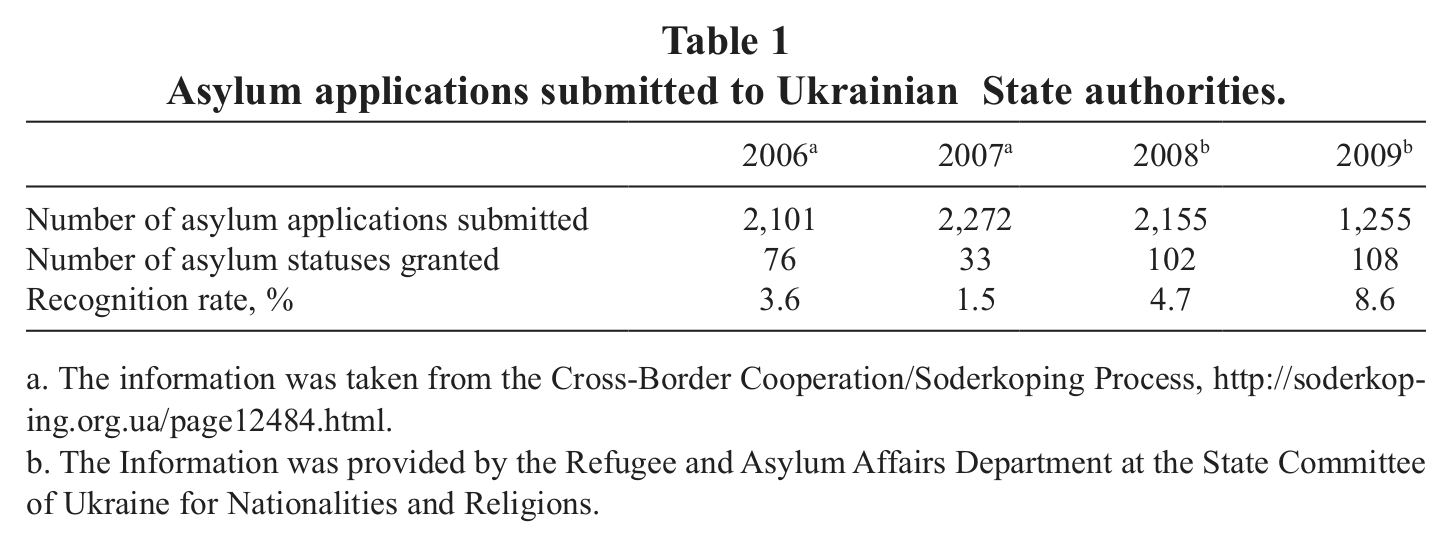
The information was taken from the Cross-Border Cooperation/Soderkoping Process, http://soderkoping.org.ua/page12484.html.
The Information was provided by the Refugee and Asylum Affairs Department at the State Committee of Ukraine for Nationalities and Religions.
Starting with 2007, we can surmise three trends vis-a-via asylum seekers from the data in Table 1. 7 First, the number of asylum applications submitted to Ukrainian authorities is decreasing. 8 Second, the number of asylum statuses granted to asylum-seekers is increasing. Third, consequently, the recognition rate is also increasing.
For the four most recent years for which we have data, the average recognition rate for granting asylum is only 4.6 percent of submitted applications. What happens to the remaining 95 percent of asylum-seekers who receive denials? Nataliia Naumenko, the Director of the Refugee and Asylum Affairs Department in Ukraine, explained (Interview, 2 March 2010), “a recognition rate of 5–7 percent is considered normal by the United Nations. The remaining 95 percent, who are denied asylum, either then try to illegally cross the border to get to EU countries or contest denials in courts, which may take two, three, four, or even five years. Obviously, asylum-seekers contesting denials from the State Committee for Nationalities and Religions, cannot be expelled from Ukraine.” 9
Figure 1 shows the constant growth of the number of asylum court cases in Ukraine for the period of 2006–2009. When looking at Table 1 and Figure 1 for the period of 2008 and 2009, it is obvious that the number of both court cases and asylum statuses granted increased, though not at the same rate. The number of court cases increased 123 and 235 percent respectively, while the number of asylum statuses granted increased by 309 and 106 percent, respectively. This indicates a correlation between the development of the administrative court system and the increase of asylum court cases. If the system of administrative justice functions properly, an increase in the number of asylum statuses granted can be expected in the near future.
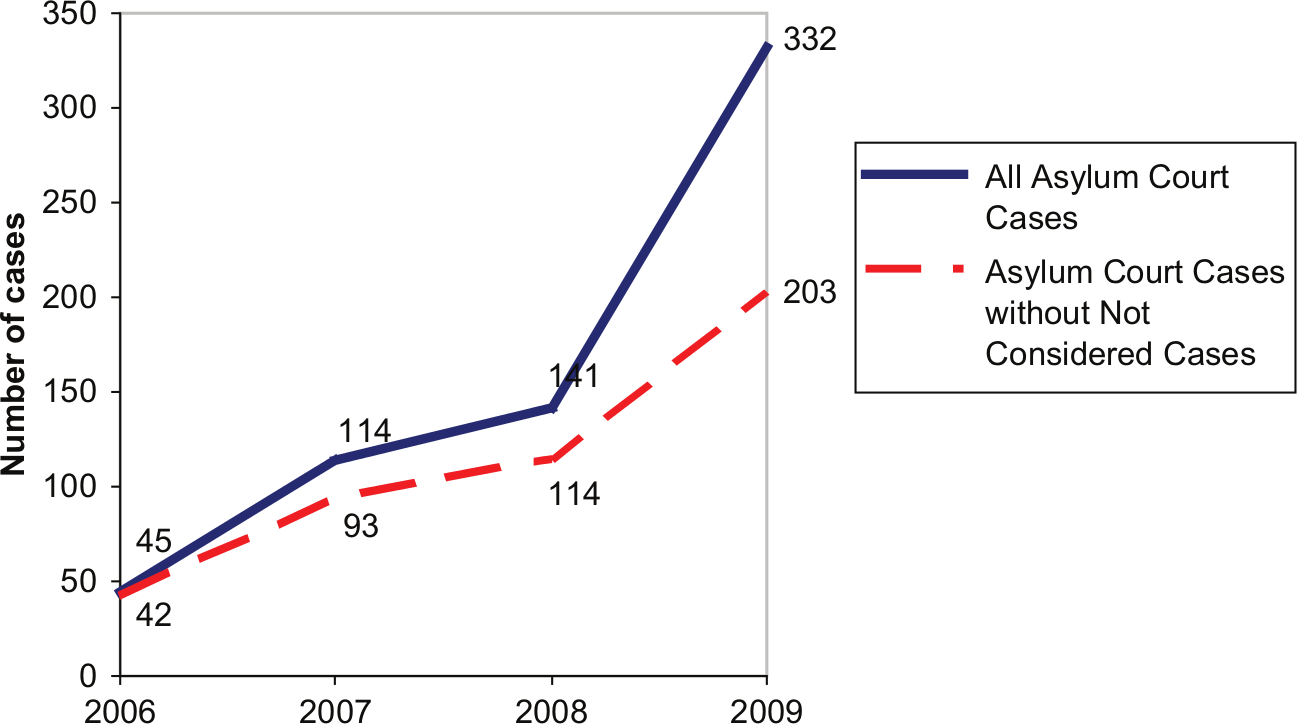
Asylum court cases with and without not-considered cases.
In 2008, we note a 235 percent increase of filed asylum court cases in comparison to the124 percent increase in 2007. Figure 4 shows that, in 2008, the number of cases in the first-tier administrative courts increased by 267 percent, in the second-tier appeal courts it increased by 289 percent, and in the third-tier, the Higher Administrative Court, the number actually dropped by 7 percent.
The increase of court cases in 2009 may have happened because of the high number of denials in 2008. However, in 2008, the situation with denials and approvals was the opposite. The number of denials reduced by 10 percent and the number of approvals increased by 182 percent. This is the only time in the period 2006–2009 when the number of approvals (sixty cases) exceeded the number of denials (fifty-four cases) (see Figure 3). Therefore, the increase of the number of court cases was not caused by the increase of refusals by the State Committee for Nationalities and Religions to either accept documents or grant asylum status; the recognition rate actually increased from 4.7 percent in 2008 to 8.6 percent in 2009, while the number of applications submitted reduced by 58 percent from 2,155 in 2008 to 1,255 in 2009 (see Figure 1).
Looking at Figure 3, it is apparent that the number of cases increased heavily because of the increase in not-considered cases. These cases are considered in more detail below. However, even if we subtract not-considered cases from the total number, there still was a 23 percent increase from 93 cases in 2007 to 114 cases in 2008, as well as 78 percent increase from 114 cases in 2008 to 203 cases in 2009. This increase from 23 to 78 percent is quite rapid and requires further explanation. One possible explanation could be the increased number of approved asylum cases by administrative courts in 2008. Therefore, more asylum-seekers decided to use this chance and file a case in order to change their denial by the State Committee for Nationalities and Religions. A second reason could be the increasing number of denials by the State Committee for Nationalities and Religions to accept asylum applications. There is definitely some correlation between the 30 and 50 percent increases of the number of cases contesting the denials of the State Committee to accept asylum applications and 23 and 78 percent increases of the overall number of denials to both accept asylum applications and grant an asylum status in 2008 and 2009, respectively. A third reason could be the change in asylum-seekers’ intentions to use Ukraine—not as a “transit” country—but as a country of their final destination because of enhanced security on the border between Ukraine and the European Union. A fourth and final reason is suggested by the comments of Naumenko. She notes that the adoption of the Administrative Court Procedure Code has not necessarily or substantially affected the protection of rights of refugees and asylum-seekers because, before the Code was adopted, refugees and asylum-seekers had been using civil law and civil courts of general jurisdiction. Thus, one (civil) law was replaced by another (administrative) law and civilian courts were replaced by administrative courts. However, it is worth pointing out that the Administrative Court Procedure Code is specially developed to deal with cases against state authorities and, therefore, adoption of this Code made the procedure of contesting their decisions easier.
10
This may help explain why the number of cases increased so rapidly in 2009; 100 percent of asylum cases were now being considered by administrative courts.
Even on ignoring not-considered cases, the data in Figure 2 show a new trend; every year more and more asylum-seekers contest their denials from the State Committee for Nationalities and Religions or first-tier courts, in order to receive an asylum status and stay in Ukraine. To repeat, we suggest this is because of (1) the creation of the separate administrative court system, in comparison to the overloaded and complicated civilian courts of general jurisdiction, which considered asylum cases until 2007, and (2) with enhanced security at the joint border with new EU countries, which joined the European Union in 2004 (Poland, Slovakia, and Hungary) and in 2007 (Romania), Ukraine starts appearing for asylum-seekers not only as a transit country but also as a country of final destination. This trend is likely to increase as Ukraine pursues better protection of asylum-seekers’ rights, in line with the UN Convention on Refugees and 1967 Protocol, and as it further strengthens its border security with the EU countries.
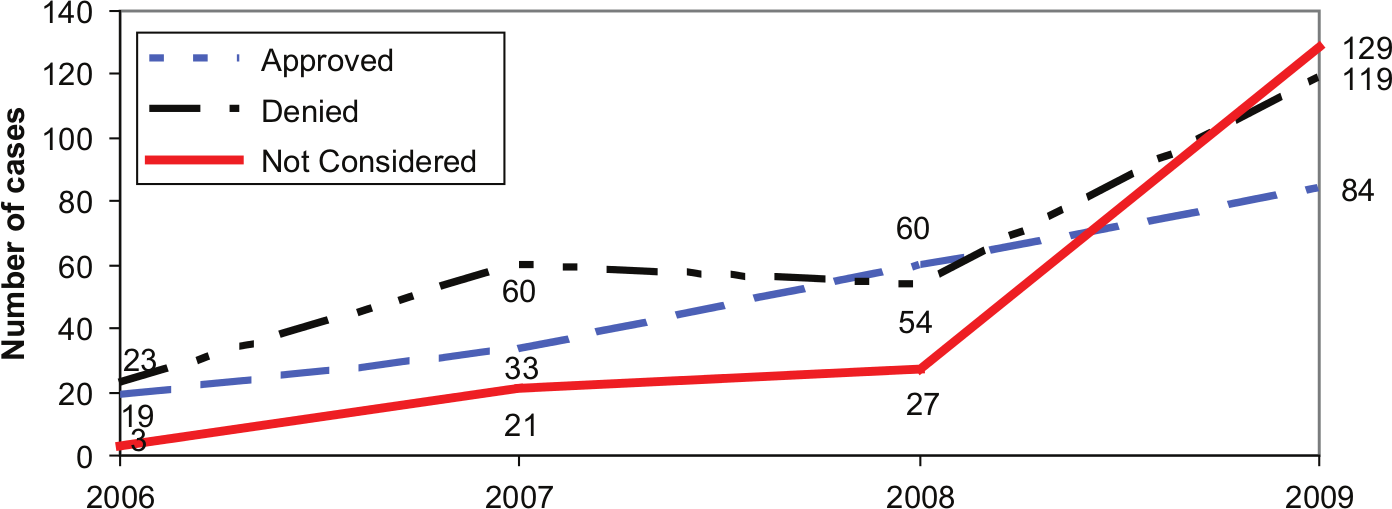
Dynamics of asylum court decisions.
It isn’t simply the court system in Ukraine that has been in transition in recent years; we also see a change in the reasons cited for court rulings. The State Committee for Nationalities and Religions still bases many asylum denials on asylum-seekers not having provided enough evidence of their life being threatened or on the ground that their fears of being persecuted in their country of origin are not well documented. Many administrative courts (especially the Regional Administrative Court of Kyiv) do not accept that argumentation, ruling instead that the fear of being persecuted is an assumption that has objective grounds, and that actual verification of it could put the person’s life in danger. Therefore, according to the principle of humanism on which the 1951 Refugee Convention is based, 11 the cases have to be reconsidered in favor of asylum-seekers. Moreover, the Courts point out that in administrative cases, the proof of evidence rests with the defendant, in this case, the State Authorities. Despite this positive trend, there are still some controversial cases.
In some instances, after the denials of the first and second-tier courts to the request of the General Prosecutors’ Office regarding asylum-statuses, the Higher Administrative Court, referring only to Ukrainian national legislation, cancelled the lower-tier courts’ decisions and made rulings that may violate the 1951 Refugee Convention. While the provisions of this Convention do not apply to any person who “has committed a serious non-political crime outside the country of refuge prior to his admission to that country as a refugee,” Article 33 states, “No Contracting State shall expel or return (“refouler”) a refugee in any manner whatsoever to the frontiers of territories where his life or freedom would be threatened on account of his race, religion, nationality, membership of a particular social group or political opinion.” Moreover, the United Nations Convention Against Torture (Article 3) states, “No State Party shall expel, return (‘refouler’) or extradite a person to another State where there are substantial grounds for believing that he would be in danger of being subjected to torture.” Amnesty International also expressed concern about the risk for refugees and asylum-seekers in Ukraine being forced to return to their countries, “The Ukrainian authorities continued to forcibly return asylum-seekers where they would be at risk of serious human rights violations and to disregard asylum procedures.” 12
In the wake of Ukraine’s adoption of the old Law on Refugees in 1993 (which entered into force in 1996), the adoption of the new Law on Refugees in 2001 (which includes many provisions of the UN Refugee Convention), ratification of the UN 1951 Refugee Convention in 2002, and the establishment of a system of administrative courts between 2002 and 2008, it still took time and effort for Ukraine to start changing the grounds for courts’ rulings vis-a-vis asylum cases in accordance with the principles and practice of international human rights law.
Asylum Court Decisions and Not-Considered Cases
According to the Administrative Court Procedure Code (Chapter 3, Article 122), “an administrative case should be considered and decided within a reasonable period of time, but not longer than two months since the filing of a case.” Furthermore, Article 128 of the Code states, “In the case of repeat non-arrival of a claimant at court, after he/she has been properly informed . . ., the court leaves his/her request without consideration.” Therefore, if a claimant has not appeared in court for the second time within this period, the case is left without consideration, what we have referred to as not-considered cases.
During the period under study, we see a new trend of not-considered cases appearing in the data and rapidly increasing. 13 Figure 2 shows that the number of cases decided in favor of the asylum-seeker remain fairly consistent: 42 percent in 2006, 29 percent in 2007, 42 percent in 2008, and 25 percent in 2009. For those cases where the asylum-seeker was denied, we actually see a decreasing trend: 51 percent in 2006, 43 percent in 2007, 38 percent in 2008, and 36 percent in 2009. This means that new administrative courts tend to make fewer negative decisions for asylum-seekers and almost the same percentage of positive decisions for them since 2006. The number of not-considered cases, however, grows substantially during the same period. The number of such cased increased steadily from 7 percent in 2006 to 18 percent in 2007 and 19 percent in 2008. In 2009, the number of not-considered cases increased rapidly to 39 percent.
Figure 3 looks at not-considered cases from a geographical perspective, showing the regions that stand out by having the largest number of such cases. Since 2007, Lviv oblast had 8 out of 21 not-considered cases. In 2008, Volyn oblast had 19 out of 27 not-considered cases. In 2009, the trend became much stronger and resulted in 32 cases in Zakarpattia, 42 cases in Odesa, 14 cases in Kharkiv, and 36 cases in Kyiv, out of 129 such cases in total.

Geographical scope of not-considered asylum court cases.
Why has this trend appeared and even increased recently? Asylum-seekers who have submitted their documents for asylum in Ukraine or filed a case in court to question the denial of the State Committee for Nationalities and Religions, cannot be expelled from Ukraine. According to Naumenko, Ukraine is not a country of final destination for refugees but, rather, a country of transit. 14 It is valid to assume that these asylum-seekers submit applications in order to not be expelled from Ukraine, but they also keep trying to get to the countries of their final destination, mostly EU countries. We may also assume that for some asylum-seekers Ukraine may be preliminarily a country of their final destination, but it becomes a transit country after they receive denial of asylum from the State Committee. In that case, asylum-seekers file their cases to court to have some more time for their legal stay in Ukraine. This gives them time to prepare to leave for a new country, most likely an EU country. It is very doubtful that these asylum-seekers, after they file a case to court, suddenly decided to return to the country of their origin from which they had escaped. It is also very unlikely that these asylum-seekers applied for asylum status in other countries (European and North American), received it there, and left Ukraine for those countries. The most likely explanation is that they filed a court case to protect themselves from expulsion and then entered neighboring EU countries through the Western border of Ukraine with Poland, Hungary, Slovakia, and Romania. Keeping in mind the direction of the flow of migrants through Ukraine from East to West, we may conclude that these asylum-seekers come to Kharkiv oblast, Kyiv, Odesa oblast, and even all the way to Zakarpattia oblast, apply for asylum, get a denial, file a court case, and then leave for EU countries.
We believe that the decline in the percentage of overall court decisions being taken against asylum-seekers, while the percentage of rulings made in favor of asylum-seeker has remained steady, is a fairly good sign of cases being considered impartially by courts trying to protect the rights of asylum-seekers. Not-considered asylum cases are a new and possibly problematic trend for both Ukraine and the European Union; these are the cases of potential illegal migration to the EU. In 2009, the number of not-considered asylum cases increased by 478 percent.
Asylum Court Cases by Tiers
As is evidenced by Figure 4, it is no surprise that the largest numbers of cases are handled by first-tier courts. Figures 4 and 5 demonstrate that nearly all denials of first-tier cases are appealed at some point. In 2007, thirty cases were denied and there were thirty-eight appeals. 15 In 2008, out of twenty-three denials, nineteen were appealed. In 2009, out of fifty-five denials, fifty-five were appealed in the second-tier courts. We can also see from Figure 5 that first-tier courts denied 58, 34, and 44 percent of submitted cases in 2007, 2008, and 2009 respectively.

Asylum court cases by tiers.
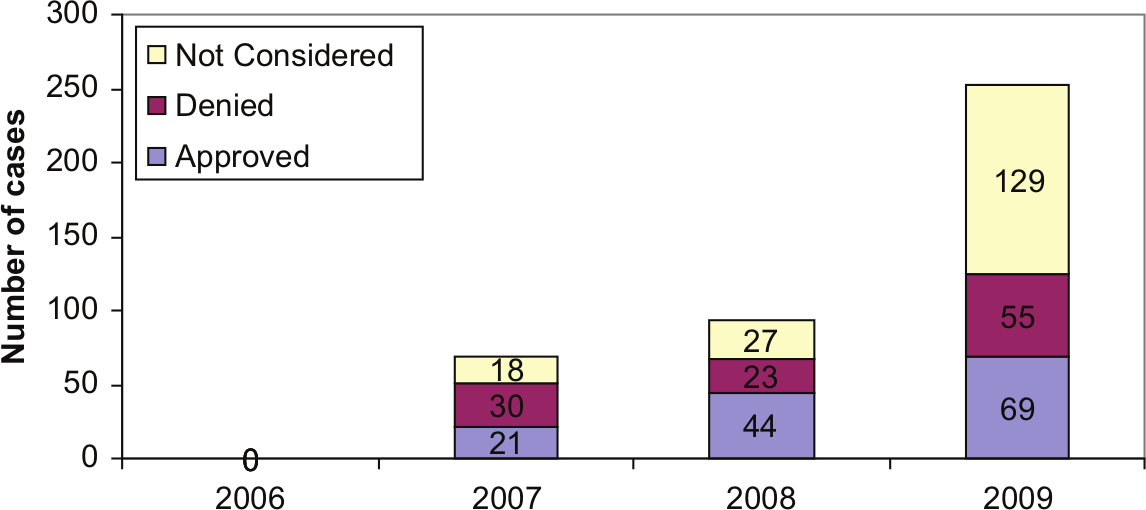
Asylum court decisions by first-tier (regional) courts.
How does the appeal process work out for asylum-seekers? Unfortunately for those seeking asylum, the higher the tier of a court an asylum case is submitted to, the fewer are the chances for the case to be approved in favor of the asylum-seeker. The first-tier Regional Administrative Courts make more than 50 percent of their decisions in favor of asylum-seekers whereas the second-tier Appeal Administrative Courts make only 25–35 percent decisions in favor of asylum-seekers, and the third-tier Higher Administrative Court makes barely 20–30 percent decisions in favor of asylum-seekers.
When considering the implications of Figures 4, 6, and 7, we can see that in 2007, out of twenty-five cases denied by Appeal Courts, only seven were submitted to the Higher Administrative Court, which denied five and approved two of these cases. In 2008, out of fourteen cases denied by Appeal Courts, twenty-eight were submitted to the Higher Administrative Court, which denied seventeen and approved eleven cases. 16 If we combine the results of both years, we will get the following numbers: out of thirty-nine denied cases of the second-tier courts in 2007 and 2008, thirty-five were filed to the Higher Administrative Court, which denied twenty-two of them and approved thirteen. As we can see, almost all cases denied by Appeal Administrative Courts were filed to the Higher Administrative Court. It is evident from Figure 6 that the second-tier courts denied 51, 66, 74, and 76 percent of submitted cases in 2006, 2007, 2008, and 2009, respectively. When looking at Figure 7, we can see that the Higher Administrative Court denied more than 70, 63, and 85 percent of submitted cases in 2007, 2008, and 2009, respectively.
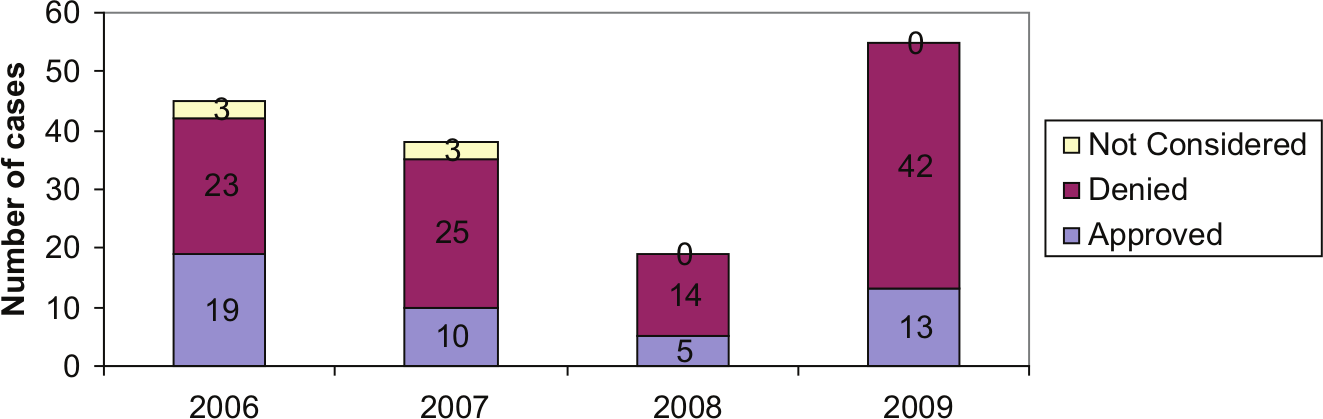
Asylum court decisions by second-tier (appeal) courts.

Asylum court decisions by third-tier (higher) court.
The dynamics of numerous and, in general, increasing asylum court cases at all three tiers suggests that the system of administrative justice is working for asylum-seekers in Ukraine.
Deportation cases are another type of related case considered by administrative courts. In order to deport an individual from Ukraine, a court has to make such a decision. A deportation case can be filed by Ukrainian law enforcement agencies such as the Ministry of Interior, the State Border Guard Service of Ukraine, or the Security Service of Ukraine. Such cases are submitted locally to the first-tier courts and are overwhelmingly approved by these courts.
Based on the statistics gathered from the Court Cases Register and depicted in Figure 8, we can see that the number of deportation cases, which is the number of illegal migrants detained and then expelled from Ukraine, was rapidly increasing during 2006–2009. We surmise that this increase is due to the increase in the number of illegal migrants coming to Ukraine. 17 The number of not-considered asylum cases, filed by individuals who are potential illegal migrants and who decided to move on to one of the EU countries, has also been rapidly increasing. By contrast, the number of submitted asylum applications has decreased rapidly in 2009; this seems inconsistent.
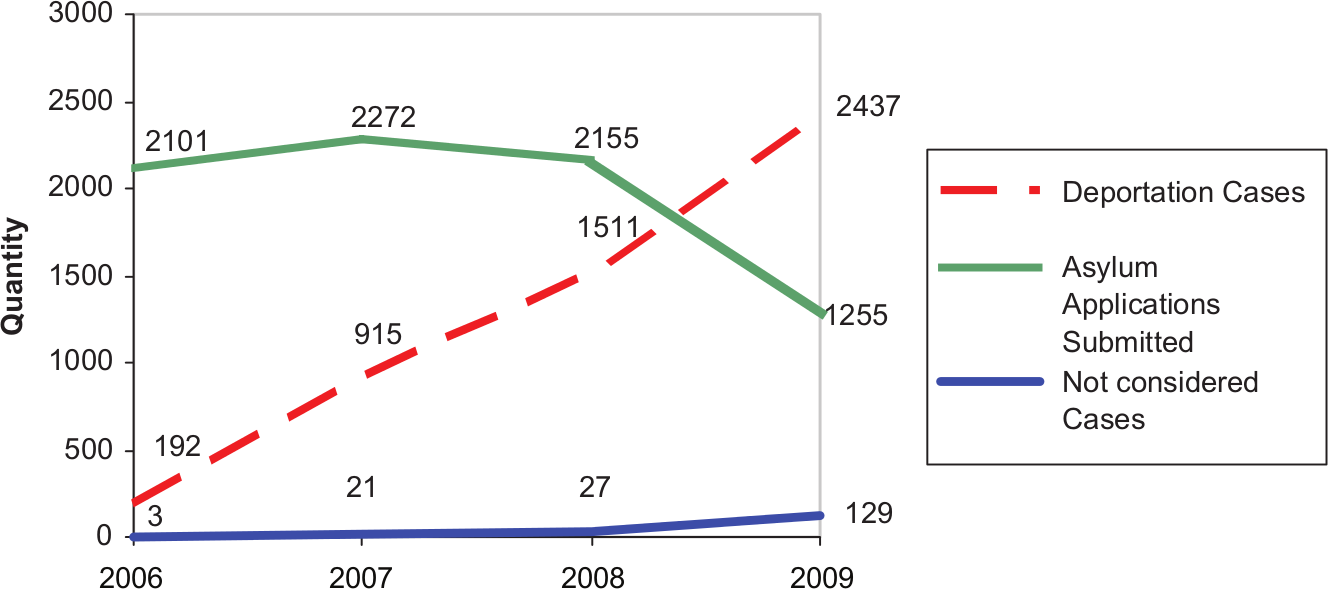
Dynamics of deportation and not-considered asylum court cases.
This inconsistency was addressed by Naumenko, pointing out that “the State Committee has been accepting asylum applications in 2009, but it has not been making decisions on granting asylum statuses since August 2009, due to uncertainty regarding the creation of the Migration Service in Ukraine.” 18 We think that it is reasonable to assume that if asylum statuses were not being granted de jure, then some asylum applications were also not being accepted de facto. The evidence that supports this assumption, based on the description of asylum cases reviewed by the authors in the Court Case Register, is the growth of court cases requesting the State Committee not to grant asylum status but to accept applications from 30 percent in 2008 to 50 percent in 2009. Therefore, we conclude that the number of accepted asylum applications has decreased for the aforementioned reasons.
Who Benefits from the New Administrative Court System?
Not surprisingly, in asylum court cases the vast majority of claimants are asylum-seekers. However, there are also some state authorities that use these courts to contest and change a decision of either the State Committee for Nationalities and Religions or an administrative court. 19 Statistics of asylum court cases show that administrative justice is a two-way street. Not only asylum-seekers usually question the validity of decisions of state authorities in courts, but also other state institutions question the validity of such decisions of state authorities and/or courts. However, the vast majority of asylum cases (85 percent in 2006, 92 percent in 2007, 95 percent in 2008, and 97 percent in 2009) are submitted by asylum-seekers. Therefore, the system of administrative justice is mainly used by asylum-seekers who want to protect their right to obtain asylum.
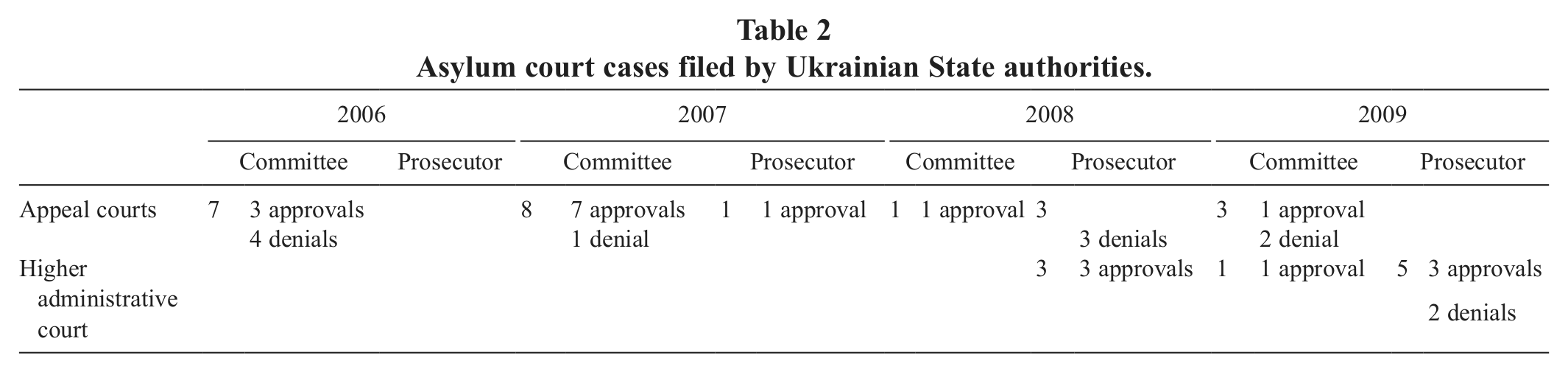
Yet the state does use the court system. 20 For example, in 2006, out of forty-five court cases on granting asylum status, there were seven cases (15 percent) in which the State Committee of Ukraine for Nationalities and Religions appealed the decision of the first-tier courts to cancel the denial of the State Committee and oblige it to grant an asylum status or reconsider its decision. Out of seven decisions, three appeal court rulings were in favor of the State Committee for Nationalities and Religions and four were in favor of asylum-seekers (see Table 2). In 2007, there were nine cases (eight percent), out of all 114 asylum cases, filed either by the State Committee for Nationalities and Religions (eight cases) or the General Prosecutor’s Office (one case) to the second-tier courts. However, by contrast to 2006, the vast majority of court decisions (eight rulings) were in favor of the State Committee for Nationalities and Religions, and only one decision was in favor of an asylum-seeker. In 2008, seven cases (5 percent), out of 141 asylum cases were filed in order to deny asylum-seekers granting an asylum status. The claimants were the General Prosecutor’s Office (six cases), as well as the Committee for Nationalities and Religions (one case). This time, in addition to four cases filed to Appeal Courts, there were three cases filed to the Higher Administrative Court by the General Prosecutor’s Office. 21 In 2009, out of 334 asylum cases only nine cases (three percent) were filed by Ukrainian authorities. Four cases were submitted by the State Committee for Nationalities and Religions (three to Appeal Courts and one to the Higher Administrative Court) and five cases were filed by the General Prosecutor’s Office (all five to the Higher Administrative Court). The third-tier court approved three cases filed by the General Prosecutor’s Office and one case submitted by the State Committee for Nationalities and Religions to cancel granting asylum status to four asylum-seekers. At the same time, the Higher Administrative Court denied two other requests of the General Prosecutor’s Office to cancel asylum statuses.
Asylum court cases filed by Ukrainian State authorities.
Conclusion: Problems and Achievements in Ukraine
On the one hand, a new administrative justice system, a feature of modern democracies, has been established in Ukraine. On the other hand, there are still some cases in administrative courts, mainly the Higher Administrative Court, which are quite controversial and are bordering on a violation of international human rights law.
So far, we have focused on the newly created administrative justice system in Ukraine and asylum court cases. We would be remiss, however, if we did not say something about Ukraine’s asylum system in general. Naumenko noted two current and future problems with Ukraine’s asylum system: (1) an expected increase of asylum applications due to the Readmission Agreement with the European Union, which entered into force in 2010 and (2) insufficient state funding, which makes it impossible to conduct all the needed naturalization measures for refugees in order to integrate them into Ukrainian society. She also noted several achievements: (1) the new Law on Refugees and Persons Who Need Assistance or Temporary Forms of Protection is being developed, (2) two Refugee Shelter Points have been established in Odesa and Zakarpattia, (3) The Refugee Integration Program has been adopted, and (4) many international projects to assist Ukraine and its refugees are being implemented. 22
While much has been done to protect the rights of refugees in Ukraine, more remains to be accomplished in order to finish the creation of a fast and fair asylum system. Ukraine is on the right track but is moving slowly, and sometimes uncertainly, in the direction of becoming a modern democracy, one that respects not only the rights of its citizens but also those of aliens seeking asylum.
It does not take much time or effort for a state to keep functioning in the way it has been operating for over seventy years. It does, however, take a tremendous amount of time and effort for a state to change how it functions. In the case of Ukraine, it took such time and effort, after it regained its independence in 1991, to start improving the protection of rights of asylum-seekers by adopting a new Law on Refugees in 2001, ratifying the UN 1951 Refugee Convention in 2002, adopting the Law on Legal Procedures in 2002 and the Administrative Court Procedure Code in 2005. To make these changes work is challenging and took even more time, effort, and persistence. It took four years, from 2005 (when the Code was adopted) to 2009, for the system of administrative justice to start working to the point where it considered all 100 percent of filed asylum cases. Furthermore, only in 2009 did some newly created administrative courts begin making rulings in asylum cases based on and in accordance with the principles of international human rights law and practice.
It is apparent that such procedural and institutional changes do not happen overnight in a post-Soviet state. Ukraine is on the right track of what will certainly be a long journey towards a modern democracy. If changes continue, such as those discussed above with administrative courts, Ukraine will finish its transition to a modern democratic state. There are still problems, however, in Ukraine; the Higher Administrative Court continues to make some controversial rulings, the number of asylum applications declined by the Committee of Ukraine for Nationalities and Religions remains near 50 percent, and the position of the General Prosecutor’s Office and law enforcement agencies on extradition of asylum-seekers is still undefined. Therefore, we should keep in mind that a country in transition can go either way, the way back or the way forward. The way back may be easier because it requires lesser effort and less time and because everything in the past is so familiar. Countries undergoing a democratic transition will reach a point when a reversal becomes more difficult than the way forward. So far, Ukraine has not yet reached this point, but it is on the way to it. The more time passes and the more efforts Ukraine makes, the sooner this country in transition will reach its “point of no return.”