



Abstract
The article presents the analysis of the Croatian post-socialist media system within the comparative framework of Hallin and Mancini’s approach. The media system and the political system are analyzed with the cluster of variables, interpreting the development of the media market, political parallelism, journalistic professionalism, and the role of the state in relation to the existing theoretical framework. The paper demonstrates a perfect fit with the Mediterranean polarized pluralist model of media system, and argues that the Croatian case disproves the proposition that Hallin and Mancini’s model cannot be applied to new democracies in post-communist Europe. The communist period in Croatia provided nuance to an already existing framework of media system, while the post-communist transition after 1990 and ensuing democracy continue to exhibit the historically determined relationships between politics and the media. The article argues in conclusion that ignorance of the true nature of media systems and social and political frameworks that shape them are the reason for the failed internationally assisted democratization processes and successful implementation of foreign media regulation models.
Croatia became a member of the European Union in 2013. During the past two decades, the country experienced independence (from the Socialist Federal Republic of Yugoslavia [SFRJ]), war, and transformation of its one party political system and socialist economy to a market economy and a multiparty political system. Both international and domestic actors helped the transition of the media system, yet the true nature of the Croatian media system continues to elude most analysts.
Past analyses predominantly employed a normative approach 1 in determining the degree of development of a democratic media system in Croatia 2 in relation to the values of democratic media development like freedom, equality, diversity, access 3 or the watchdog, agenda-setting, and gate-keeping role of media in a democracy. 4 While these analyses provide much needed insight into the gradual democratization of the post-communist Croatian media system and are able to show a difference between a democratic and a non-democratic media system, they do not explain, for example, the failure of all public service governing models so far, or the inability of the independent media regulatory bodies to attain true independence. They also do not explain their inability to enforce programming standards on commercial broadcasters, or the disenchantment of journalists in a free media market environment. 5
The dominant proposal about the European post-communist media systems in democratic transition includes the imitation thesis which presumes that these media systems developed in imitation to their Western role models, copying their regulatory solutions and adopting their media system values. 6 While it is certainly a fact that the introduction of new media regulation was supervised for the new EU members and candidates by the Council of Europe and the European Commission, the media as a social system (made up of structure and agency) is shaped by multiple influencing factors and not just media regulation.
I argue in this text that the contemporary characteristics of the Croatian media system are consistent with its historical roots, and that developments during the communist and post-communist periods have only added nuances to an already established pattern of relations between the media system and politics. To this end, I use the conceptualization of media systems developed by Hallin and Mancini. 7
While most well-known comparative frameworks for media system analysis as well as new applied media development tools include the same four structural dimensions—the market, the degree of state influence through the normative framework or media policy, the relationship of the political system to the media, and the journalistic culture 8 —and even some of the same variables to describe them, the usefulness of the Hallin and Mancini framework is in the detailed operationalization of each dimension (including the political system as an extra media variable) and its comparative testing in western Europe and North America. The empirical variability, which they found between different countries, forms enough of a pattern so that the authors could create three distinct models of media systems—the liberal North Atlantic model, the democratic corporatist model of Northern and Central Europe, and the polarized pluralist Mediterranean model of the European south. 9 The usefulness of the empirically created Hallin and Mancini model is thus in enabling a theoretical explanation of the Croatian media system development trajectories. In addition to this interpretive aim, this case study has an additional theoretical goal. This micro replication of a “single case within the framework of established generalizations” 10 in a cross-national comparative context serves as a test of a single variable—the consequence of the socialist political and economic regime for the media system development.
Many lump all post-communist European democracies in the same model without defining the common model’s characteristics, 11 or identify the model as “mixed.” 12 Even without a thorough analysis, it is simplistic to assume that 16-plus countries of Central, Eastern, and Southeastern Europe, with different political histories before the communist period, transition experiences, and varying responses to European integration processes, could be part of one model just because they have one common characteristic, that is, a common communist experience based on the Soviet model. Even though earlier comparative analyses have included Croatia in this group, 13 the Croatian pattern is specific, as SFRJ was a non-aligned country, not a signatory member of the Warsaw pact, with market-oriented socialism. 14
Sitter 15 highlights two approaches to the comparison of the media systems of Eastern and Western Europe: looking for similarities with earlier periods of Western European development, or stressing the difference of the socialist experience. 16 My approach to examining the Croatian media system does not attempt to dress it in one of these models but rather applies the indicators and variables from the Hallin and Mancini matrix looking for patterns of correspondence. 17
In addition to identifying the main characteristics of the Croatian media system and demonstrating a fit with other European models, I aim to demonstrate that the Hallin and Mancini model is relevant and applicable to the analysis of the European post-socialist media systems. Thus, the study will attempt to refute the proposition that the European post-socialist media systems cannot be included in the Hallin and Mancini 18 models because of the crucial difference introduced by their socialist experience. I will argue, based on the Croatian case, that the media system development after democratic transition returns to its pre-democratic trajectory having absorbed influences from the undemocratic period. In the analysis, I rely on own original research of the Croatian media system, including the application of UNESCO media development indicators as well as published research.
The Political System
The importance of the political framework for media system development is strongly highlighted by Hallin and Mancini, 19 as in the first normative theories. An authoritarian model of the media system was the original model in Croatia as elsewhere in Europe. 20 In the Croatian case it continued, with brief periods of democratic openings or fascist constrictions (pre- and during World War II), until 1990. During most of the modern period, Croatia was part of the Habsburg Monarchy (1527–1918), followed by periods of Yugoslav monarchism, Axis occupation, and Yugoslav communism. The national movement in Croatia developed according to the East–Central European model, 21 though the “spring of nations” from 1848–1849 22 brought neither independence nor a bourgeois revolution to Croatia, but the strengthening of absolutism and the development of neo-absolutism. 23 After the demise of the Habsburg Monarchy after World War I, Croatia entered its first South Slavic state alliance, where it remained under different regimes until 1990. In the early twentieth century, a multi-party system developed briefly in Croatia and lasted until World War II. In spite of the fact that radical left and right options gained only marginal support by the voters, 24 the occupiers established the Independent State of Croatia in 1941 and after its collapse in 1945 the Communists came to power and formed the second, Communist Yugoslav state.
Some 30 percent of Croatian citizens today identify with the left, 34 percent with the centre, and 16 percent with the right. 25 Zakošek identifies primary divisions in the first decade of transition in the 1990s between the nationalist “centre” characterized by traditional and religious values and the “periphery,” which is politically tolerant and secular. 26 Society today is at the same time re-traditionalizing and modernizing, which is manifested in the increased acceptance of the religious and national exclusivism, while the modernization trend shows as the acceptance of gender equality and economic and political liberalism. 27
The political regime in the 1990s was characterized as hybrid, “election democracy with elements of authoritarian regression,” 28 authoritarian democracy, 29 and defective democracy. 30 The political system development from a two-party system (1990–1992), to a system with one dominant party during which time the polarization of political space was highest (1992–2000, seen by Ravlić as a period of reduction of ideological pluralism 31 ) and the current period characterized by moderate pluralism with one main party on the left and on the right. 32 Democratic consolidation began after 2000, with ideological modernization of main parties, spread of ideological pluralism and de-ideologization of the state apparatus. 33 Croatia is today a consolidated post-communist democracy, 34 ethnically homogeneous, with a consensus between the elites and citizens about the concept of statehood, restoration of traditional values, 35 and acceptance of constitutional values. This signals an end to the transitional anomie of the 1990s 36 and a value homogenization of Croatian society with “no trace of any polarization.” 37
Democracy in Croatia is majoritarian: the winning party (or coalition, as has been the case with all governments since 2000) concentrates political power; the executive government dominates the parliament (in the past twenty-two years the parliamentary majority has never challenged its government). The proportional election system would seem to indicate a consensual type of governance, but with the D’Hondt system of proportional representation and a 5 percent threshold, it leans to the majoritarian side, as does the clear division between the government and opposition.
The Croatian political system and society at large is rife with clientelism. It is partly a relic of the Communist (and earlier, pre-modern) periods, and the past twenty years of independence did little to address it. The implementation of new values is still not evident, despite the recent 2011 shift of the conservative governing coalition to the social democrats. The rule of law is still not prevalent 38 and a sore point is also the perception of a lack of accountability for political elites. 39
Clientelism was particularly evident in the regulation of the media system in the 1990s, in two respects: privatization (e.g., the privatization of the press distribution company Tisak 40 ) and the distribution of frequencies for radio and television broadcasting. 41 The most recent distribution of digital television frequencies can also be viewed in this context, as the new “specialized entertainment” channels were given to two international players (who already have a channel each) over domestic projects that were geared to the public interest.
The Media Market
These political features also played an important part in the development of the media market. Gross demonstrates that weak social conditions in the second part of the nineteenth century contributed to delayed modernization in Croatia. 42 The peasants, who were the majority of the population, were largely illiterate, and only in the early twentieth century did the literacy rate improve as a precondition for the development of the mass press (“everyday literature” to Rački 43 ) and mass culture. In 1921, according to census data, there were 67.8 percent literate citizens in Croatia, 44 and press runs did not exceed 850 copies.
The first newspapers in Croatia appeared (in Latin, then German) in the second part of the eighteenth century, but it took almost another century before they appeared in Croatian. The Croatian intelligentsia, educated in Prague, Vienna, and Budapest, started the first newspapers. 45 Without the middle classes, no economic base or potential audience existed at that time for a mass press. In the early nineteenth century, the press in Croatia developed as a political platform for the national revival movement that included strong cultural overtones contributing to the acceptance of the national language in public and cultural affairs. The earliest original Croatian press content was published in 1826, while full editions of newspapers in Croatian appeared only in 1834. In addition to their political importance, the paper Narodne novine (People’s Newspaper) was the first to standardize modern Croatian orthography, which became the Croatian language literary standard. 46 The journalists of the time were poets and writers who invariably became politicians, though their readership was small and was composed mainly of the elite. Novi list (established in 1902) and Obzor were the first mass audience general information dailies, 47 but the print runs were never large: in the early 1940s they were still mainly between 2000 and 5000, with the largest print run of 20,000. 48
The impact of the Communist period (1945–1989) on the media system is contradictory in several respects. While the information and current affairs content/programming was subject to political control and regulation of its production (mainly by personnel decisions and self-censorship regarding certain topics, and not by prior censorship, which was abolished soon after the World War II), Vjesnik, a daily newspaper established in that period, is still claimed to have been the only quality daily in Croatia. 49
The rapid rise of the mass press in the 1960s was based on its dependence on market principles, enabled by the self-management political economy. 50 The press was expected to make a profit, and employed marketing principles in their work, including advertising and audience research. 51 The newspaper company Vjesnik was the “largest media power in southern Europe, a model capitalist company in the time of . . . communism.” 52 The daily Vjesnik had regular print runs of 90,000 copies in 1968; the weeklies Arena and Vjesnik u srijedu sold more than 300,000 copies. Vjesnik established its marketing agency in 1964 and soon after attracted major advertisers. 53
The tabloid format was not prevalent in the Croatian press. The only daily published today with similar characteristics to a tabloid is 24 sata, which sells for half the price of the other dailies and predominantly publishes short, visually attractive, news stories (79 percent), while the main national dailies (Jutarnji list, Večernji list, Vjesnik) are composed of more than 50 percent short stories. 54
After 1990, the economic aspects of media transition were characterized by nationalization, privatization, and marketization. However, the market for the press contracted and the print runs were reduced. A good example of the consequences of this period of transition after 1990 is reflected in the fate of the media company Vjesnik. The largest media company in the southeastern European region, during the socialist period, owned a printing press, a distribution network, was the publisher of two dailies and one sport daily (which was, as in the countries of the Mediterranean model, the first true mass market newspaper), entertainment and political weeklies, women’s and teen press, cartoons, love and crime novels, and erotica. The bulk of the company was divided up, privatized, or otherwise disposed of, and only the daily Vjesnik was left, financed from the state budget and influenced by the government. Its debts mounted, circulation fell to 2000 copies, the proposed privatization failed, and it was forced to stop its paper edition. It is unclear whether the journalists, who have not been paid in months, will be able to continue its Internet edition. In the electronic media the public service broadcaster HRT is in a downward trend following the increase in government’s neoliberal policies, but still retains a strong place. The Catholic Church owns one religious paper and a national radio station, and through its ownership of the Austrian Styria is also the owner of one of the three largest circulation dailies, Večernji list. Print runs are today smaller than in previous decades. In 2010, about 1,567,000 citizens (out of some 4.2 million inhabitants) read newspapers, 47 percent of them women. 55 The average print run in the same year was 492,747,000 copies for 17 dailies (a drop from 550 million in 2009), or 136 copies per adult citizen, which is comparable to the countries of the Mediterranean model. 56 In 2010, 70 percent of the print market was composed of national paid dailies. The market is highly concentrated in the television sector (C3 is 62), print has increased from 59 to 72, and while radio displays low concentration at the national level (C3 is 25, it is higher in local and regional communities 57 ), Internet portals are diverse (C3 is 37).
Media audiences are changing their preferences and the reach of all the media is dropping, except for the Internet, which grew from 34 percent in 2005 to 59 percent in 2011. 58 Television is still in the first place, with 76 percent of daily reach, while the largest drop is in the reach of print newspapers (72 percent in 2008 to 49 percent in 2010), with changing relationships of trust. 59
With new digital television channels (RTL 2, Doma TV, Kapital Network, Croatian Music Channel, Sportska TV), audience segmentation increased and the audience for the public service broadcaster decreased. In 2011, the public service HTV was for the first time not a leader in audience share; however the reasons have more to do with changes in programming and lowered public service value than with the attractiveness of the new channels that broadcast repeats of the old and not so popular series and films (Table 1). These developments also fit with the Mediterranean model in which weak media regulatory bodies and policy implementation (of the otherwise legally well defined expectations of public interest programming in television, including information and original audiovisual production 60 ) lead to the weakening of the public interest in radio and television broadcasting.
Audiences for Television Channels with National Coverage (%) (Share).
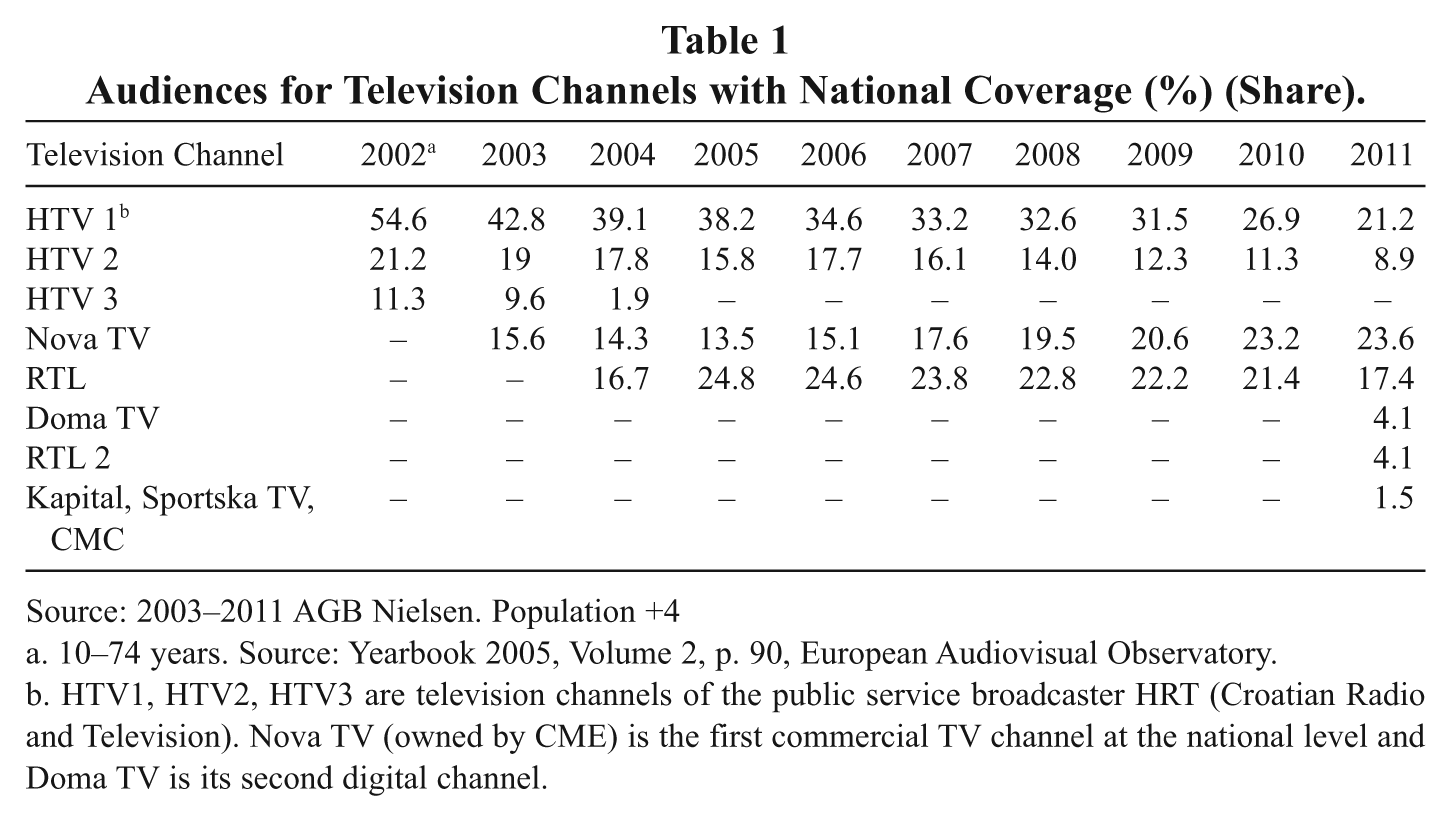
Source: 2003–2011 AGB Nielsen. Population +4
10–74 years. Source: Yearbook 2005, Volume 2, p. 90, European Audiovisual Observatory.
HTV1, HTV2, HTV3 are television channels of the public service broadcaster HRT (Croatian Radio and Television). Nova TV (owned by CME) is the first commercial TV channel at the national level and Doma TV is its second digital channel.
Political Parallelism
The analysis of the political system and media market places Croatia within the Mediterranean polarized pluralist media system. Relations within the media market are not separated from politics but only vary by degree or nature in different media systems. Higher media concentration expectedly produces higher parallelism of media owners and the state, 61 reduced diversity of media content, and thus a negative influence on the democratic role of the media. 62 A high degree of exchange between journalism and political professions, seen in the first Croatian newspapers in the nineteenth century, is present also today. Many diplomats, members of parliament, and even one recent Croatian prime minister were also journalists. In the last change of government in 2012, at least four active journalists took advisory or spokespersons’ roles in the new government. 63
The party press developed historically along well-known European lines in Croatia, while after 1990 political parties were not interested in starting openly partisan media. The editors in public service television are legally barred from holding party office. While all newspapers claim political neutrality, research shows a left–right divide between the readers of two main dailies: the readers of Jutarnji list thus lean more toward social democrats and those of Večernji list toward the conservatives. 64
Political advertising is allowed only during elections, and while political parties do not in general have a stake in media companies, the largest corruption trial in 2011–2012 has revealed that the accused HDZ party (in power for the greater part of the past twenty years) was involved in the secret purchase of local newspaper, radio, and television companies. The state still has some ownership shares in local media, a remnant from the 1980s when the cities and municipalities could establish their media. The Catholic Church also has an ownership stake in the media, and remains the only corporate element in the Croatian media system; 65 however, in a religiously homogeneous society its segmentation partner is the secular segment. 66
Political parallelism showed in media content during communism and during the transition decade. The similarity of the discursive style in politics and journalism was prevalent in the 1990s and a high degree of polarization was evident between “state building” journalists and “traitors,” which mirrored polarization in the political field. The promotion of the government and the ruling party was obviously the strategy of the state television at that time. 67 After 2000 the ideological frame diminished and the government position no longer prevailed, 68 although members of the ruling parties once again acquired more media time after the 2003 election. 69 The neutral norm in journalism increased (with the decrease in “good” news), 70 and increased live broadcasts displayed a trend toward the celebritification of journalists. 71 Research of media openness in the framework of the Index of Media Openness displayed a negative tendency from 2005 to 2006 in all key dimensions of professionalism and rationality—objectivity and professionalism, equal treatment of all sides, critical perspective based on facts, and development of engaged investigative journalism. 72
The regulatory system for the mass media aims at promoting internal as well as external pluralism. In the regulation and governance of the public service broadcaster HRT (another indicator for the dimension of political parallelism), Croatia has in the past twenty years tried everything except the professional model. The present model is a combination of the (multiparty) parliamentary and corporative models 73 incorporating representatives of civil society organizations (appointed by parliament) in the HRT Council. As Croatia has no history of corporate organization, there are no social groups to be truly represented. Thus, members of the councils and other media regulatory bodies only truly represent the political parties that nominated them. A recent example that supports this point is the refusal of the remaining members of the HRT Council, Supervisory Board, and the Director General to resign even after repeated requests from the civil society organizations working in the media field. As the regulatory framework for public service television is again under review, it is hoped that the professional model will be implemented as proposed, as the only governance model that could possibly have a positive effect given a majoritarian democracy, homogeneous society, and no strong political polarizations.
In the comparative study of media systems, the importance of the influence of social and political structure on media regulation is still not well understood. For example, Jakubowicz argues that the change in public service television regulation (Law on the HRT, 2002) in which the direct appointment of civil society representatives to the HRT Council was abolished (in favor of their parliamentary appointment), was a regression into political parallelism, without understanding that the corporatist model is inappropriate for the Croatian situation, which has no social tradition of stable interest-based collective organizations, and that as soon as the “representatives” were in office they proceeded to further their own private or particular political interests instead of the common public interest. 74
Another indicator of high political parallelism was the establishment of journalism studies at the Faculty of Political Science at the University of Zagreb in the 1980s, with first programs introduced in 1970. This late introduction of journalism in academic education prevails in other southern European countries of the Mediterranean model.
Professionalization of Journalists
The relationship of the journalists to the political sphere builds on the dynamics of political parallelism, but professionalization is also a more complex dimension. Three main dimensions of professionalization are autonomy, clear common professional norms, and consciousness about the public role of journalists. 75 Journalism in the Communist period was, as expected, not characterized by autonomy in political reporting, as the political realm was controlled by Tito’s one-party regime. After the 1960s, with an increase in the creativity and enhanced quality of the media, exceptions to the pattern of control and suppression of the media increased, resulting in the mid-1980s in Stipe Šuvar’s “White book” where he named and criticized (from his position of ruling Communist party executive) those journalists and artists with critical and creative writing and expression in culture and the media. 76 He was too late, though, to stop the rising wave of autonomous reporting that preceded the change. Instrumentalization continued in the 1990s when “journalists hurried into the embrace of the government” (former president Stjepan Mesić 77 ) and attempts of media to foster journalistic autonomy were denounced as disloyal to the national interest. Autonomy from the political power nevertheless increased in the 1990s and into the new millennium. Increase in the pressure exerted by government and the media’s dependence on party politics was noticed again in 2005–2006, while the autonomy from the economic and business interests remained low throughout. 78
The regulatory system for the media in Croatia protects freedom of expression, independence and autonomy of the media, and access to information. 79 Furthermore, there is a wide range of different types of media, but journalists in Croatia are unsatisfied with their autonomy. They continue to point to the persistent influence of the recently ousted HDZ government, not only on the public but also on the privately owned media. 80 This perceived lack of autonomy is linked to economic insecurity of the journalists, as only a minority of the media are unionized. Journalists also point to the unhelpful role of big business in the media sector, for example, the role of Agrokor (a Croatian food conglomerate) that is the largest single advertiser in the media, not to mention the owner of the main printed press kiosk distribution chain. Economic insecurity thus influences the journalists’ willingness to disown the journalistic code and author texts to order from their editors. The results of research are contradictory; while Kanižaj and Skoko have found a high degree of professional autonomy among journalists, Švob-Đokić et al. have found that journalists were censored by their editors, admit to self-censorship, insecurity in the profession, and lack of common professional standards. 81
Even though there is no systematic research on the self-perception of the role of the journalists, 82 the traditional understanding of journalists in Croatia is that they serve to advocate for the public good. 83 This gained currency during socialism as journalists were seen as “public workers” (but the public was equated with the state). Currently, the liberal norm of neutrality is competing with the traditional.
Although journalistic professional norms are enshrined in the Croatian Journalists Association Code of Ethics, which regularly pronounces its judgment on the professionalism of news or other media content, there were no consequences for those who break journalistic codes of conduct. Both editors and journalists created a self-regulating Croatian Media Council at the end of 2011, but the results of this initiative remain to be seen. In the meantime, also consistent with the Mediterranean model, a legal framework takes the place of self-regulation, and the media and other laws include protections against the most blatant unprofessionalism such as libel and the invasion of privacy. New social media and the Internet introduce new challenges to the issue of professionalism. On the one hand, they allow for greater autonomy and creative space outside the influence of corporate or government interests, but media using these platforms are often seen as disorganized, 84 and discussion on these fora often are filled with hate speech and intolerance 85 instead of contributing to balanced and democratic deliberations. The issue of the application of professional journalistic norms to blogs and other personal or social media is still a matter of debate in Croatia.
The State and the Media
We have so far analyzed the characteristics of three media system dimensions as well as those of the political system, which in Croatia is still often conflated with the state. Croatia regulates all aspects of the media. Thus, it protects freedom of expression, forbids hate speech, promotes media diversity and pluralism, and regulates against monopoly. 86 As a member of the Council of Europe, Croatia is a signatory to the European Convention of Human Rights as well as its media and cultural conventions, and as a future European Union member it has transposed the Audiovisual Media Services Directive (AVMSD) that regulates networked audiovisual media. 87
The relationship of the media to the state in the 1990s conforms to the model of unconsolidated presidential democracy described by Chalaby. 88 State pressures on the media were mainly through economic means (e.g., a special pornographic tax was levied on the opposition political weekly Feral Tribune) or arbitrary decision making (especially in local radio and television frequency distribution). With the constitutional changes in 2000, which introduced a full parliamentary system, and the demise of Franjo Tuđman, whose autocratic style also supported the model, the media systems could no longer be understood in terms of presidentialism.
Freed from the restrictions on economic enterprise, the new private printed press flourished with independent editorial policies (Jutarnji list, Novi list, Slobodna Dalmacija, and weeklies Feral Tribune, Globus, Nacional), while part of the press remained under state influence (Večernji list, Vjesnik). The legal framework for private radio and television stations allowed development at the local and regional level since 1996, while it was only after 2000 that the monopoly of the public service broadcaster was broken at the national level, after ownership regulation was relaxed to enable the establishment of two (foreign owned) commercial television channels. 89
The state in Croatia continues to have a strong regulatory role—it assumes the role of a patron, as well as distributive and redistribute roles 90 in the media market, through direct subventions to minority media, 91 by co-financing audiovisual production, the redistribution of HRT license fees, and through promotion of pluralism and diversity by special support for programs of local and regional electronic media from a levy on commercial broadcasters. Pluralism and diversity are part of the public interest goals and commercial and public service electronic media are expected to fulfil them in their programs. This is also cited as the reason for antimonopoly regulation and ownership restrictions. 92
The state also regulates the entry in the audiovisual market through frequency distribution procedures that need to be administered in the public interest. Advertising is also limited by regulation in line with the AVMS. Political advertising is also regulated, and forbidden except during elections.
The existence of a coherent media policy in Croatia is questionable as the legal and regulatory activity of the sector developed without “officially announced intention supported by sanction, including rewards or punishment,” 93 that is, the definition of goals that the regulation was supposed to achieve. In spite of this, the tendency toward deregulation and marketization is noticeable. It is increasingly a feature of Croatian media policy, which reflects the impact of neoliberal economic policies. 94 Croatia continues to maintain a statist media policy: despite the prevalence of public debates on legislative changes in the media sector, decisions are made technocratically. 95 Also, every new government changes Croatian media regulations. If we count only the changes to the laws governing the Croatian public service broadcaster HRT, there were more than ten in the past twenty years. A statist media policy is also a feature that places Croatia in the Mediterranean model.
Conclusions
The analysis presented here lays out the relationship of media and politics in Croatia that fit elegantly into the Mediterranean model of the media system. 96 The development of the Croatian media system can be described as characteristic of the periphery—although the country was part of the Habsburg Monarchy for several hundred years, it did not enjoy the developmental benefits of the empire, but rather the drawbacks of being at its edges.
The characteristics of social and political development in the nineteenth century—belated modernization, long-lasting authoritarian regime and late and brief experience of multiparty system with a late development of liberal institutions, weak industrial and technological development, low literacy rate, slow urbanization, small number of inhabitants, political instability or quick changes of the states and regimes, the political role of the national language—together had a significant impact on Croatian media system similar to that of other south European countries of the Mediterranean model. From 1960s, Communist regime enabled the development of media industries, media markets, mass culture and mass audiences. Single party domination and the authoritarian model of the media system of the time consequently produced a high degree of political parallelism. In the past twenty years of multiparty democracy, quick and dramatic changes have been taking place (transition, state building, war), 97 which have had an impact on the media system that was for the first time institutionalized in accordance with democratic norms and a free market but in constant conflict with the remnants of the authoritarian elements.
The Croatian media system exhibits the characteristics of the polarized pluralist model with regard to all of the dimensions of the Hallin and Mancini typology: weak and late development of the mass press, weak professionalization of journalism, strong political parallelism, and the strong role of the state. The political system also displays characteristics that describe the Mediterranean model 98 —strong political clientelism and low implementation of rational legal authority, that is, the rule of law; a political culture that does not value adherence to abstract norms and does not easily differentiate between public and private interest; and elites who communicate more to each other than to citizens. The political body in Croatia today is moderately plural, although historically it was polarized as recently as the 1990s. The media system today is characterized by the dominance of television as the only true mass media, a weak journalistic profession that has difficulty in attaining a satisfactory level of autonomy, a strong relationship between politics and the media (increasingly more on a personal then institutional level), and a strong role for the state in the media system, which through its regulatory, protective, distributive, and redistribute roles compensates for the weakness of the journalistic profession and media self-regulation.
With this in mind, it is clear why some of the regulatory models that were instilled in an attempt to imitate successful Western European examples (often proposed were those coming from the countries characterized by a democratic corporatist model) did not work. 99 Unrealistic expectations about the relationship of the media and the state and politics were caused by a lack of understanding of the true nature of the Croatian media system and the social and political processes that shape it. The false expectation that the system of civil society representation in media governing bodies would work in a society without a historical civil society, or that the neutral journalistic norm should be taught to the post-communist journalists in order to teach them how to do media in conditions of democracy in a country that had since its first newspapers seen the journalist as an elite and expected him to speak for the public, in hindsight, seems not just a little naïve.
The resilience of the historically shaped characteristics of the media system shown in the analysis of Croatia as a theory affirming/infirming comparative case 100 provides support for the thesis about the historical rootedness of media systems 101 challenging the imitation thesis 102 in regard to post-socialist media systems and disproving the proposition that the socialist experience disqualifies media systems in European new democracies from being included in the Hallin and Mancini framework. While this does not show which model some of the other Central and Eastern European countries would fit best, it does show that the application of the theoretical framework is possible within the described variations.
The experiences of other southern European states, which lived through the experience of long-term Fascism, reveal an increase in the rule of law as a consequence of their membership in the European Union, and also that the development of the professional model of governance of public service broadcasting is always a result of evolution. 103 In spite of the initial hostility of local circumstances, development of the rational authority (as perhaps the key to the differences between the media and politics relations in different models of media systems) seems to be possible with perseverance and optimism. Premised, of course, on the already existing democratic politics. As Hallin and Mancini show, 104 the largest variations among non-European media systems are in terms of the political arrangements for power sharing, pluralism, and governance in non-democratic or hybrid political regimes. As the three models are—though defined by four media system variables—named for the characteristics of their political systems, this might also be the key for the extension of the model.
All of this can be a lesson for developing media policies and regulatory models in future democratic transitions: implementation of foreign models will only work if they are adapted to the indigenous characteristics that shape the social and political development and the development of the media system.
Footnotes
Author’s Note:
Research for this article was undertaken within the scientific research project “Media Culture in Contemporary Croatia: Media Pluralism in Policy and Media System,” 2007–2012, led by Z. Peruško at the Centre for Media and Communication Research, Faculty of Political Science, University of Zagreb, and funded by the Ministry of Science, Education and Sport of the Republic of Croatia, including the project of application of UNESCO media development indicators funded by the UNESCO Participation Program (2008–2009).