



Abstract
Although not the most prolific of courts, the Bulgarian Constitutional Court (BCC) has now made enough decisions for us to begin characterising its decision making. Generally, decision making on the BCC is characterised by a low caseload dominated by referrals from parliament, by a high level of dissent, and by dissent that in turn is characterised by a disagreement between left- and right-wing judges. I make these claims on the basis of an analysis of BCC decisions over the period 1991 to 2010, and in particular on the basis of an analysis of judges’ dissenting votes as the expression of an underlying latent trait. I argue that this latent trait should be interpreted as a left–right dimension, both because the positions on this latent dimension match descriptions of judges’ politics and the politics of those who appointed, and because court majorities from the right end of the recovered dimension are often found when ruling in favour of right-wing opposition groups. On the basis of these findings, I argue for an interpretation of the BCC as an additional legislative chamber, comparable in this respect to the French Conseil Constitutionnel.
In twenty of the twenty-eight member states of the European Union, the power to declare legal norms unconstitutional is held exclusively by a specialised constitutional court. 1 Of the thirteen member states who joined in or after 2004, only two countries, Estonia and Cyprus, lack a constitutional court. The decision to concentrate the power of constitutional review in a dedicated court separate from the rest of the judiciary—sometimes described as a Kelsenian model of constitutional review, after the jurist Hans Kelsen, who proposed such a system for Austria—is clearly a very popular one in Central and Eastern Europe. This is because, at least according to Kelsen, the establishment of a separate constitutional court acts as a firewall, separating the judiciary proper from the potentially contaminating influence of “political questions.”
Given the decision to concentrate constitutional review in a specialised court, four key questions present themselves: 2 How shall the judges of the court be appointed? By whom shall cases be brought to the court? By what mode (abstract or concrete, ex ante or ex post) do judges review norms? And how final is the court’s decision? In many countries, the answers to these questions came about the processes of imitation, where particular patterns cut from whole cloth were grafted on. The answers to these questions were not, therefore, questions of how much but rather what type. Thus, a number of authors argue that appointment procedures for judicial bodies in Bulgaria (including the Constitutional Court) were largely inspired by a neo-Latin model, and that the appointments procedure for the Bulgarian Constitutional Court in particular was inspired by the Italian model. 3 For these kinds of choices, countries are only outliers if they develop or opt for sui generis or otherwise unpopular models.
For some key questions concerning constitutional courts, however, we may talk of an underlying scale or spectrum on which we may locate different countries. 4 This is true for the second of the above questions, namely, the question of who may refer an issue to the court. Here, we may ask, for a variety of actors—political actors, judicial actors, and ordinary citizens—whether the power to refer issues to the constitutional court is widely held or is instead tightly circumscribed. We may refer to courts where such power is tightly circumscribed as more closed courts, and other courts as more open.
Table 1 thus arrays selected countries and their constitutional courts from more open to more closed, where more open courts are courts where parliamentary minorities, courts at all levels of the judicial hierarchy, and ordinary citizens (through a constitutional complaint) may bring issues to the constitutional court.
Openness of Selected Constitutional Courts
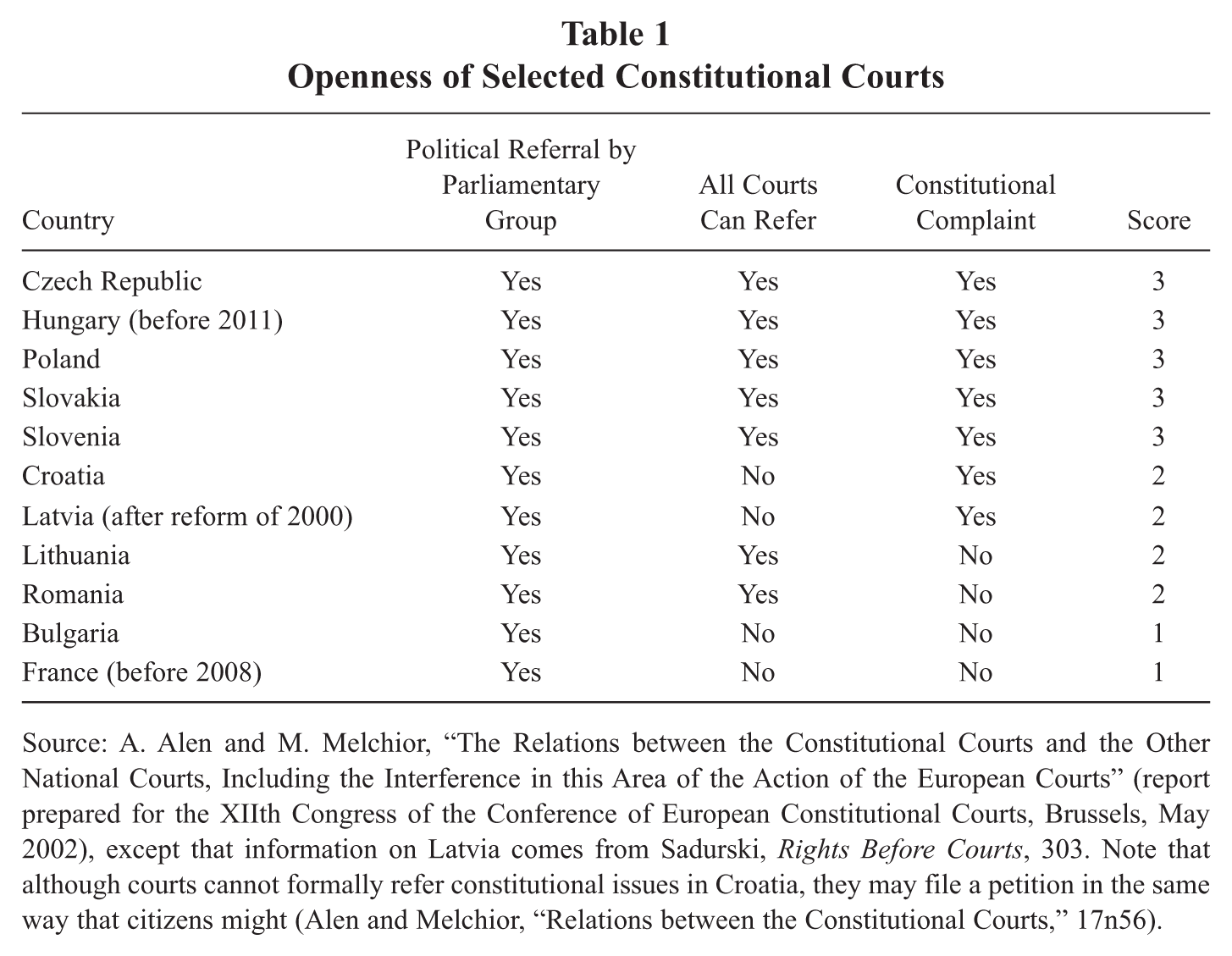
Source: A. Alen and M. Melchior, “The Relations between the Constitutional Courts and the Other National Courts, Including the Interference in this Area of the Action of the European Courts” (report prepared for the XIIth Congress of the Conference of European Constitutional Courts, Brussels, May 2002), except that information on Latvia comes from Sadurski, Rights Before Courts, 303. Note that although courts cannot formally refer constitutional issues in Croatia, they may file a petition in the same way that citizens might (Alen and Melchior, “Relations between the Constitutional Courts,” 17n56).
As the table shows, the right to refer issues to the Bulgarian Constitutional Court is tightly circumscribed. The court lacks any form of constitutional complaint on behalf of citizens whose constitutional rights have been infringed. Additionally, not every court within the judicial system may refer issues to the court, but only the Supreme Court of Cassation or the Supreme Administrative Court. What is not restricted is the right of minority parliamentary groups to refer issues to the court: one-fifth of members of the National Assembly may do so.
In this respect, the Bulgarian Constitutional Court resembles another Kelsenian court, the French Conseil Constitutionnel which, until a constitutional reform of 2008, 5 could only adjudicate constitutional disputes on the basis of a referral from political, not judicial, actors. This resemblance helps us explain the operation of the Bulgarian Constitutional Court, since the politics of the Conseil Constitutionnel have been studied in depth. Specifically, the argument is often made that the French Conseil Constitutionnel operates as an additional legislative chamber, disagreeing often, and disagreeing in a manner that reflects judges’ political leanings. 6
My aim in this article is two-fold. First, I argue that the Bulgarian constitutional court, qua Kelsenian court with restricted power of referral, acts and behaves very much as if it were an additional legislative chamber, in that there is frequent disagreement on the court which is primarily political rather than legal in its nature, and that in this respect it resembles the Conseil Constitutionnel, the locus classicus of this type of court. This comparison is even more apt given that other characteristics of the Bulgarian judicial system also have strong French influences: but the validity of the comparison does not hinge on this influence, but rather on the fact that both courts belong to a particular type. 7
Second, I argue that we can do for the Bulgarian Constitutional something which is not possible for the Conseil Constitutionnel, and can quantify the political leanings of particular judges on the basis of their pattern of published dissents. These measures can thus serve to confirm and render more exact impressions that many already hold about judges on the Constitutional Court.
My argument proceeds in five stages. I begin by first outlining Alec Stone Sweet’s theory of constitutional councils as additional legislative chambers, and how this relates to the publication of dissenting opinions. Secondly, I go on to discuss the structure of the Bulgarian Constitutional Court, its caseload, and the issue of referrals. Thirdly, I discuss data on judges’ dissenting opinions, and how these data can be analysed to reveal the dimension which underpins judges’ decisions. I subsequently argue that this dimension is best interpreted as a left–right dimension. I conclude by reflecting on the compatibilities between “political” decision making and relationships with other parts of the judicial system proper.
Previous Literature
In his 1992 book on the French Conseil Constitutionnel, Alec Stone Sweet advanced what he called the “third-chamber thesis.” This thesis—which obviously must be renamed for a unicameral system like Bulgaria’s—argues that the Conseil Constitutionnel can be fruitfully conceptualized as a kind of third legislative chamber insofar as it makes policy, operates entirely within parliamentary space, decides at least partly on the basis of political criteria, and has an impact on the first and second legislative chambers, which in turn decide at least partly on the basis of juridical criteria.
It is important to distinguish the third-chamber thesis from other theses about courts. First, the third-chamber thesis is more than the simple argument that courts are political. Courts are, as a matter of definition, political actors, in that they authoritatively allocate values, and have effects on the political system as a whole. 8
The third-chamber thesis is also more than the argument that the decisions of judges on courts are influenced or determined by their political preferences, even though one common phrase used to describe this view describes judges as merely “legislators in robes.” 9 The idea that judges are just legislators in robes applies to Kelsenian courts, but also applies—and perhaps even primarily applies—to supreme courts which do not have a monopoly on the power to declare legal norms unconstitutional, and where political actors do not enjoy particular standing to bring issues before the court. Although courts of this type sometimes engage in dialogue with the legislature, this dialogue is punctuated, as issues decided in the legislature may only reach the court years later when a concrete case presents itself.
Clearly, these claims are related, in that constitutional courts which function as third chambers are at least in part political, and the judges who sit on them decide cases at least partly on the basis of political preferences. At the same time, however, there is a tension between constitutional courts which function as third chambers, and political decision making. In Alec Stone Sweet’s framework, constitutional courts serve as triadic dispute resolvers, or arbiters, capable of resolving disputes between governing majorities and oppositions concerning the constitutional status of proposed legislation, and capable of doing so in a way that avoids the simple imposition of a numerical majority in the parliament. In order to fulfil this role, constitutional courts’ decisions cannot be entirely predictable, nor entirely political, for then they would cease to have their arbitral character. 10
In the French context, the elements of predictability and politicisation are partly muted, because “the Council’s jurisprudence is often cryptic and syllogistic, reinforcing the illusion of impersonality and unanimity,” further bolstered by a ban on dissenting opinions. 11 Constitutional courts which do permit the publication of dissenting opinions must take account of the potential negative consequences of “politicised” judging, if this politicised character is evident from the pattern or tone of published dissents.
One such potential negative consequence is the respect in which the constitutional court is held by the rest of the judicial system proper. Garoupa and Ginsburg have argued that constitutional courts must moderate their tendency towards politicised decision making if they are to avoid conflicts with the rest of the judicial system, and an eventual cessation of dialogue. 12
The third chamber thesis is separate from the issue of the independence of the judiciary and constitutional courts. It is this issue which has tended to dominate the study of constitutional courts both in Central and Eastern Europe generally 13 and in Bulgaria in particular. 14 Some have argued that high levels of judicial independence permit “political” judging, in that judges can express their own political preferences without fear of later sanction. 15 However, political judging is equally compatible with the idea that judges are beholden to their sponsors. Thus, whilst we might know something about the independence of constitutional courts in Central and Eastern Europe, this does not necessarily tell us anything about their degree of politicisation.
The Bulgarian Context
Part 8 of the Bulgarian Constitution sets out the structure and functioning of the BCC. Specifically, it details the method of appointment (Art. 147) and removal (Art. 148) of judges, the functions (Art. 149) and modes in which cases may arrive at the BCC (Art. 150), the method by which decisions are to be taken (Art. 151) and notes that the detailed organisation of the court is to be established by law (Art. 152). The law referred to in Art. 152, the Constitutional Court Act, was passed on 16 August 1991, only one month after the adoption of the Constitution itself. These two documents, when read together with the Court’s Regulations (as promulgated in State Gazette on 20 December 1991, and as subsequently amended), provide the normative framework for the BCC’s operations. This normative framework has remained largely unchanged, with the exception of a 2006 amendment to permit the Ombudsman (first appointed in 2005) to petition the court for a review of constitutionality.
As far as the appointment of the BCC is concerned, the appointment method is inspired by that used to appoint the Italian Constitutional Court, in that it is tripartite, and divided between President, parliament, and judiciary. 16 Article 147 states that the BCC “shall consist of 12 justices, one-third of whom shall be elected by the National Assembly, one-third shall be appointed by the President, and one-third shall be elected by a joint meeting of the justices of the Supreme Court of Cassation and the Supreme Administrative Court.” These decisions are taken by simple majority. Judges are appointed for nine-year non-renewable terms, and may not be dismissed except for non-performance by a decision of the Court. The Law on the Constitutional Court does not specify how the National Assembly is to decide on nominees, but judges must be “lawyers of high professional and moral integrity,” with fifteen or more years of professional experience.
Cases may arrive at the court directly upon request of “not fewer than one-fifth of all Members of the National Assembly, the President, the Council of Ministers, the Supreme Court of Cassation, the Supreme Administrative Court or the Prosecutor General,” and from municipal councils in issues regarding their competences, or indirectly (which is to say, in the context of a particular case) from the Supreme Court of Cassation or the Supreme Administrative Court (Art. 150(2)), or upon petition from the Ombudsman in cases regarding human rights. Thus, on paper the BCC exercises both abstract and concrete review upon referral from both political and judicial actors. 17
As far as the publication of dissent is concerned, Article 32 of the court’s regulations provides that the Court shall normally render its decisions by “open vote,” and that judges who disagree with the adopted decision or resolution may issue a reasoned dissenting opinion, except that no dissenting opinions are permitted where the court decides by secret ballot (immunity of judges, presidential impeachment). Decisions or resolutions are normally submitted to members for voting by rapporteurs designated by the Chief Justice (Art. 20). The role of dissent is made more complicated by Art. 151 of the Constitution, which requires that decisions of unconstitutionality must be made by a majority of judges. Because the court has an even number of judges, this means that seven judges must vote in favour of unconstitutionality. Tied votes are treated as equivalent to findings of constitutionality. Occasionally, where a judge is absent, a “minority” ruling authored by 5 judges may be the definitive one, even though it is opposed by an opposing “majority” of six judges. 18
Caseload
The number of cases which resulted in a “decision” of the court (reshenie), as opposed to rulings or orders, is shown in Figure 1, according to the identity of the referring party. On average, two-thirds of cases are referred by “political” actors (the President, the government, and the legislature) rather than other actors, and (once again on average) only 10 percent of cases in any given year are referred by the judiciary. Years in which the judiciary does refer a large proportion of the cases resulting in decisions are typically only years in which the parliament referred cases at a lower rate, such as during the Stanishev-led grand coalition (2005–2009). Some of this can be explained by the tumult at the highest levels of the judiciary, involving the abolition of the old Supreme Court and the 1996 creation of two new Supreme Courts of Cassation of administrative law. 19 Still, the proportion of cases originating with the judiciary is generally low throughout.

Cases by referring actor and year
The proportion of the BCC’s workload which derives from referrals from the judiciary is lower even than the originator of the “third-chamber model,” the Conseil Constitutionnel. In the three full years since the introduction of concrete review, the Conseil has had approximately three-fifths, three-fourths, and three-eighths respectively of its caseload referred to it by other courts under the procedure for the question prioritaire de constitutionnalité. 20 Thus, if there is any court which has its workload dictated by political actors, it is the BCC; and this is good evidence for considering it as an additional chamber in the legislative process.
Dissent
Although the large proportion of cases referred by political actors suggests that there are grounds for considering the BCC as an additional chamber, these grounds might be undermined were we to show that most cases, including those referred by political actors, were resolved unanimously. Given the method of appointment used to staff the court, and the consequent possibility for actors with different positions on the left–right spectrum to nominate judges to the court, unanimity in decision making might demonstrate either that nominating actors do not seek to appoint policy seekers to the court, or that policy seeking is dominated by narrowly legal concerns.
Unfortunately for this interpretation, most of the cases heard by the BCC involve dissent (see Figure 2). In total, 155 cases featured at least one dissenting opinion between 1991 and the end of 2010. The average number of cases involving dissent per year was around 8, which means that given the Court’s average annual caseload of about fifteen cases, 53.5 percent of cases featured a dissent. There is no clear trend regarding the rate at which judges dissent, nor any pattern. Whilst 1997 and 1998 were relatively harmonious and productive years for the court, some years have been much less so.
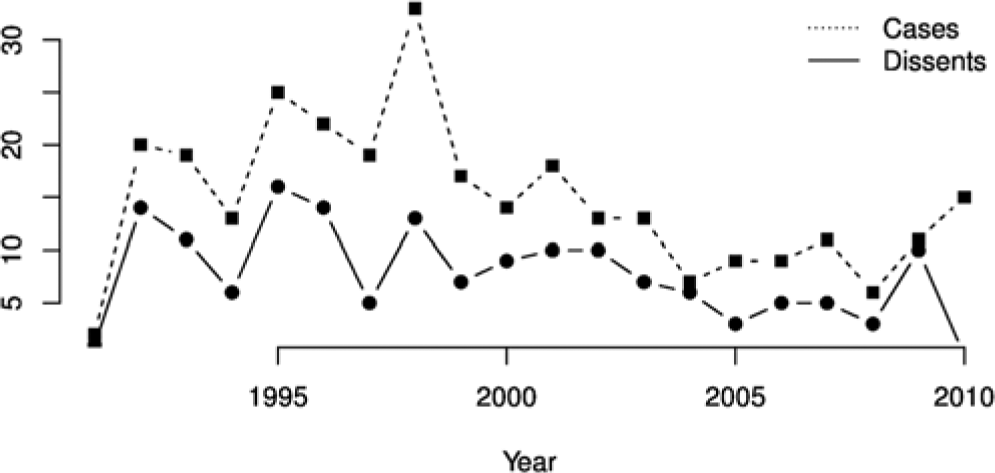
Dissents and caseload per year
With two exceptions (recently appointed judges Stefka Stoeva and Vanyushka Angusheva), all judges who have served on the Court have dissented at some point in time. The most dissentient judges (Todor Todorov and Aleksandar Arabadzhiev) have authored upwards of thirty dissenting opinions. Interestingly, former President of the Court Asen Manov is a relatively prolific dissenter, having written twenty-two dissents in total, a figure which is in contrast with the typical picture of court presidents as conciliators.
The rate of dissent is much higher than rates in other European constitutional courts. Over the period 1971–2011, only 7 percent of constitutional judgements in the Bundesverfassungsgericht included a dissenting opinion, or Sondervotum. 21 The equivalent figure for the Spanish Constitutional Tribunal between 1980 and 2009 was 12.7 percent. 22 Only in the Supreme Court of the United States are similar levels of dissent reached. Over the period 1946–2009, 70 percent of cases orally argued before SCOTUS featured dissent; nevertheless, this trend has been decreasing over time. 23
These data suggest that, in comparative terms, decision making on the BCC is very conflictual indeed. Although it would be a mistake to equate conflict with political, as opposed to legal, models of decision making, it does suggest that there are strong prima facie grounds for considering decision making on the court as potentially political. I take up the challenge of demonstrating this in the next section.
Ideal Point Analysis
The levels of dissent noted in the previous section need not indicate political disagreement between judges. It is possible that dissent, in each case, is motivated by entirely idiosyncratic factors, by personal characteristics which are related to dissent but not to politics (clubbability, willingness to speak out), or by differences of opinion which are legal in character (disagreements over constitutional interpretation, proportionality, or standing).
In order to demonstrate that dissent is in fact characterised by political concerns, I proceed in two stages. First, I estimate an ideal point model of dissent on the court, where judges’ dissents are modelled as a function of their location along some dimension, and an analogous case location. The further the judge is from that point, and the more the case discriminates with respect to that dimension, the more the judge is likely to dissent. It is important to note that this kind of analysis does not predetermine the content of the recovered dimension—it simply identifies that set of judge ideal points and case locations which best explains the observed pattern of dissent across judges and across cases.
Second, I interpret the recovered dimension by (1) investigating the association between judges’ ideal points and descriptions of their politics and the politics of those who appointed them; and (2) investigating, for each case, the association between the identity of the referring actor, and the “wing” of the court which formed the majority.
Ideal point models work to move backwards from a pattern of votes on specific cases to positions in a latent dimension. Here, the most important positions are the positions of each of the judges. The technical details of the model, and the method used to estimate the judge positions, are reported in the appendix. What is important is that the recovered judge positions are the judge positions that “best fit” the observed pattern of votes, given certain constraints. The model generates a probability that each judge in each case will vote in a particular way using judge (and case) positions, and adjusts those positions to improve the fit between the predicted probabilities and the actual outcome.
Because of this way of proceeding, it is entirely proper to ask how well a model which is based on judges having lined up along some dimension (which may be left to right, but which might equally well separate activist from passive judges: the model does not attribute or require any substantive content to the dimension) actually fits the data.
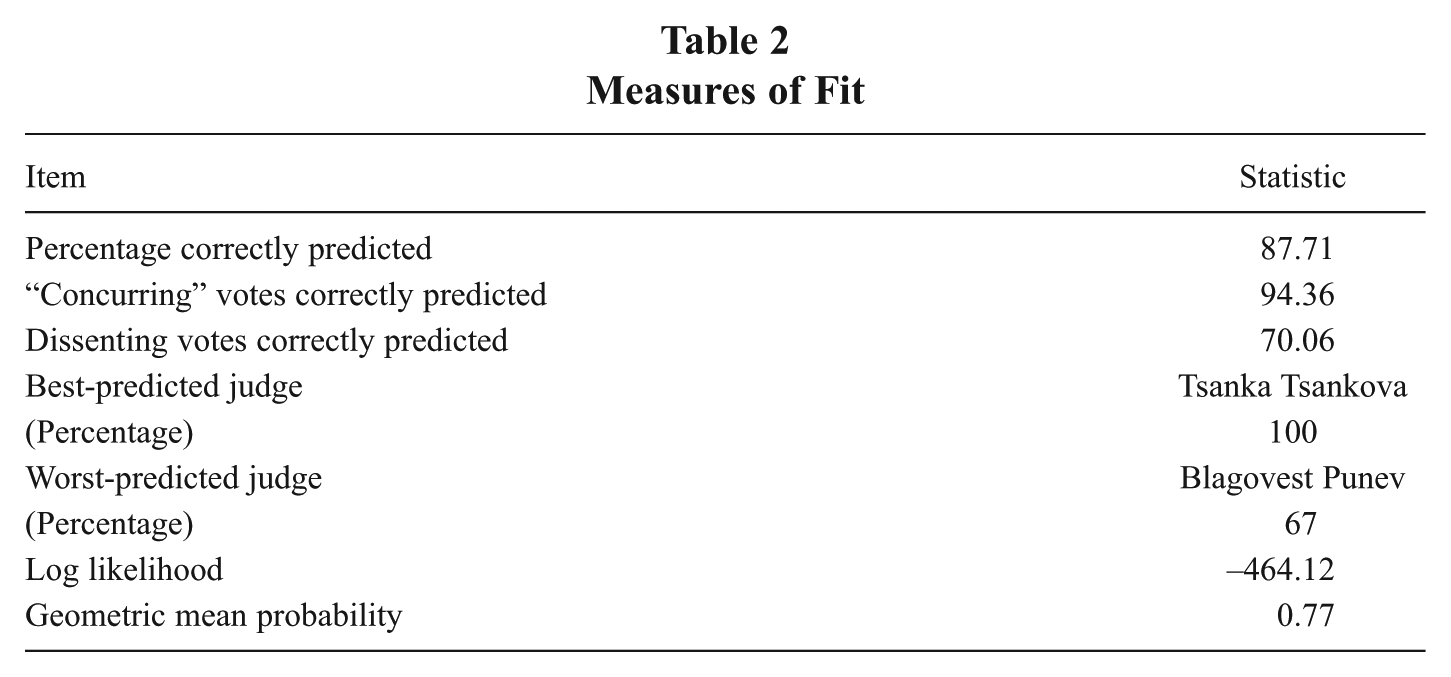
The fit of this model is relatively good. The percentage of decisions correctly predicted (PCP), is high, at 87.71, but this figure is, in a sense, misleadingly high, since it aggregates a large percentage of concurrences predicted correctly, with a smaller percentage of correctly predicted dissents. An overall assessment of the fit of the model is given by the geometric mean probability, or GMP. The GMP ranges between zero and one; values of 0.5 indicate that the predictive ability of the model is comparable to a coin toss. 24 Here, the value of 0.77 indicates that the model fits the data reasonably well (Table 2).
Measures of Fit
In ideal point analysis, it is not only possible to discuss findings about judges, but also findings about cases. One case parameter involves the degree to which each case “maps on to” the recovered dimension or, phrased more precisely, the degree to which each case discriminates between judges at similar points on this recovered dimension. We can calculate how many of the discrimination parameters are significantly different from zero (here, at a 10 percent level of significance). In fact, more than three-fifths (98/155) of the cases discriminate with respect to the recovered dimension. The proportion of cases which discriminate shows no clear pattern over time, but was high in the early 1990s and mid-2000s, dipping in the late 1990s and in the period towards the end of the study.
Although the fit of a model accounting for judges’ dissents along one dimension is good, this does not tell us anything about the substantive meaning of this dimension. Here, I argue that there are good reasons for interpreting this dimension as running from left to right. These reasons come in two types—reasons pertaining to judge characteristics, and reasons pertaining to case characteristics.
How to Interpret the Recovered Dimension
I begin by discussing the relationship of judges’ ideal points, as estimated by the model, with descriptions of the judges’ politics, and the politics of those who nominated them. Judge ideal points are plotted in Figure 3; each point is surrounded by a 95 percent credible interval; as is often the case, more extreme ideal points are surrounded by greater uncertainty.
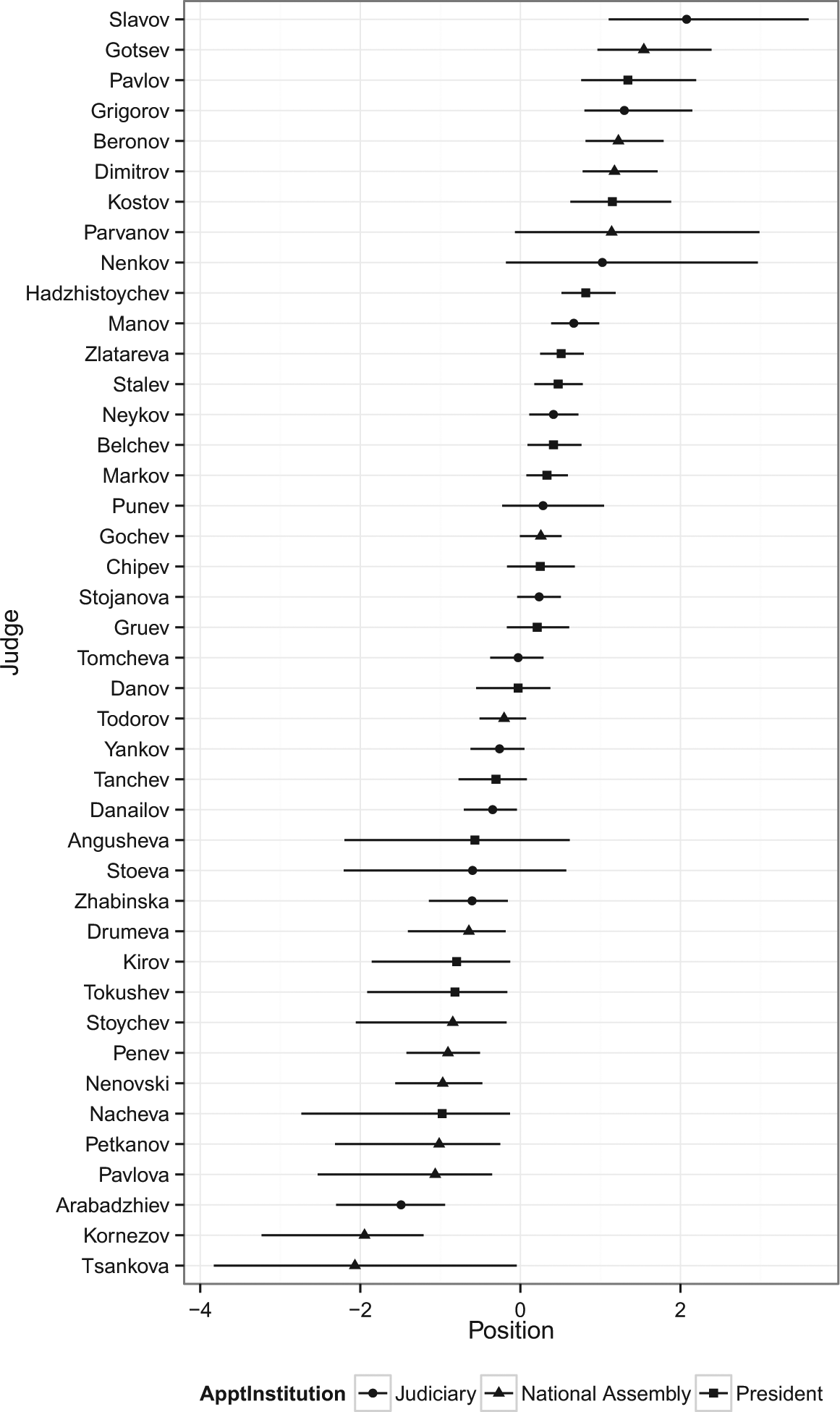
Judge ideal points
First, to what extent do these ideal points match descriptions of the judges’ politics? Venelin Ganev groups judges in the early part of the court’s history into “red,” or left-wing; “blue,” or right-wing; and non-aligned judges, as follows: 25
Kornezhov, Nenovsky, Panev, Arabadjiev, and Parvanov
Blue: Pavlov, Hadzhistoihev, and Dimitrov
Non-aligned: Manov, Danailov, Zhabinska, Chipev, and Kostov
This assessment matches well with the positions plotted in Figure 3. The mean position of the “red” judges is −0.67, compared to a mean position for the “non-aligned” judges of 0.22 and 1.11 for the “blue” judges. There is very little overlap between the three groups, with the exception of two judges, Kostov and Parvanov, who are both further to the right of the recovered dimension than we would expect on the basis of this grouping. It is worth noting, however, that judge Parvanov only appears four times in this data set, and that therefore the credible interval surrounding his ideal point is rather large. There is, therefore, good reason for believing that the positions of judges on this recovered dimension match subjective assessments of the judges’ positions along a left–right dimension, rather than reflecting judges’ positions along other non-political dimensions.
Second, to what extent do these ideal points match the left–right positions of those actors who appointed each judge? In order to test this, I have assigned each judge a notional left–right score, based on the position of the median legislator at the time of their appointment (for those appointed by the legislature), or the position of the President’s party (for those appointed by the President). 26 For judges appointed by the judiciary, I have imputed the position of the median legislator at the time. These scores are drawn from Döring and Manow, which in turn are based on expert surveys. 27 Although these scores may be imprecise, that imprecision makes it harder to find a significant correlation.
These scores might not reflect the mechanics of the appointment process. It may be that appointments made by the legislature do not reflect the position of the median legislator, but rather represented a package of nominations centred around the median legislator, but with no individual appointee at this point. If this were the case, it would represent a worst-case scenario for our test, since it would bias downwards our estimates of an association between these scores, and judges’ ideal points.
Perhaps for this reason, the correlation between the left–right position of the appointing actor and the position on the judge on the recovered dimension, imputing to the judiciary the position of the median legislature in the National Assembly, is 0.29 for all judges, which is a weak and positive correlation. If we exclude judges appointed by the judiciary, then the correlation changes to 0.51, which is a strong and positive correlation. This gives us good cause to describe the recovered dimension as running from left to right.
The relationship between these characterisations of judges’ politics, and the politics of those who appointed them, and the ideal points plotted in Figure 3, gives us good reasons to describe the recovered dimension as running from left to right, and thus to consider the decision making of the BCC as characterised by the same divisions present in the parliament (if indeed one accepts that left–right divisions structure party competition). 28 Additional support for this claim, and support that bears more directly on the question of the BCC as an additional legislative chamber, comes from inspecting the “majorities” on the court, and cross-tabulating these with the identity of the referring actor.
First, call a decision of the BCC “right-handed” if judges in the majority had, on average, ideal points which were to the right of judges in the minority. Call a decision “left-handed” if the opposite is the case. Second, consider the implied policy shift of referrals from the parliament, or from the President, under the assumption that minority parliamentarians and Presidents faced with hostile legislative majorities refer bills with which they disagree, and that complaints which are upheld result in a shift of policy towards their position. Let the implied policy shift of a successful referral be equal to
the mean left–right position of cabinet parties, minus
the mean left–right position of
non-cabinet parties (in the case of referrals by the legislature), or the President’s party (in the case of referrals by the President).
Conversely, let the implied policy shift of an unsuccessful referral be equal to the reverse of this, or the difference between (2) and (1).
Simplifying, if we take the sign of the implied policy shift (positive numbers equalling shifts to the right, negative numbers equalling shifts to the left), then we should expect that implied policy shifts with positive sign should be taken when the decision is “right-handed”—that is to say, when judges from the right of the recovered dimension are in the majority.
Indeed, this is what Table 3 shows. Cross-tabulated are the implied policy shifts for all those cases that were referred by the legislature, and where it was possible to calculate an implied policy shift based on the positions of the governing majority and minority, excluding the technocrat-led governments of Berov and Indzhova. 29 Where the decision was left-handed, most policy shifts were negative, and vice versa. This association is statistically significant (χ2 = 25.237 on 2 d.f., p ≈ 0).
Court Majority (Row) versus Implied Policy Shift (Column)
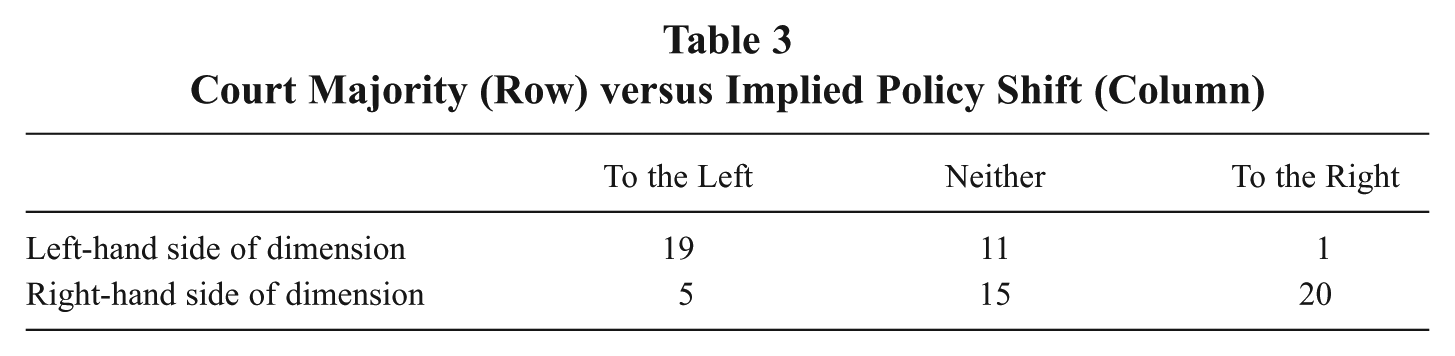
The exceptions to this general rule tend to be instances where the referral did not concern a matter of policy per se. Decision number 1/2000 is listed as a “right-handed” outcome, with an implied left-ward policy shift: but here the decision did not concern a matter of government policy, but rather a decision on the registration of the “United Macedonian Organization Ilinden Pirin” party. It seems difficult to classify this as a leftward policy shift. 30 Similarly, decision numbers 18/1995 and 5/2001 were technical decisions on matters relating to the term of the parliament and the rules on the voting quorum, rather than policy measures. This, then, is strong evidence for the interpretation of the BCC as an additional chamber of the legislature. Referrals from the left against the right can only succeed to the extent that they convince judges from the left of the court, and vice versa.
A final source of support for interpreting the recovered dimension comes from interpreting particular cases which were either well or poorly predicted by the model. Altogether, forty-two cases were perfectly predicted, or retrodicted. Recent (post-2009) cases perfectly predicted dealt with such issues as the Electronic Communications Act and Radio and Television Act (decision no. 3/2009), changes to the judiciary act (decision no. 5/2009), features of the National Assembly’s Standing Orders (decision no. 11/2009), and savings deposits (10/2009). All save the last of these were referred by the parliamentary opposition.
In decision no. 3/2009, at stake was a provision in the act which prevented multiplex operators from also being broadcasters. The ban, together with other provisions in the Act, 31 was referred to the court primarily on the grounds that banning multiplex operators from being broadcasters represented an infringement of that workhorse article of the constitution, Article 19, and in particular the guarantee found in Article 19(1) that the economy should be based on “free economic initiative,” though reference was also made to the guarantee found in Article 41 of the freedom to impart and receive information. The court argued that the ban did not represent a disproportionate infringement on Article 19(1) rights, as these rights were in any case tempered by Article 19(2)’s commitment to preventing unfair competition or abuse of a dominant position. A right-wing minority on the court disagreed. In their dissent, Judges Rumen Yankov and Ivan Punev argued that Article 19(1) had to be read as part of a commitment to a broader notion of economic liberalism (carefully distinguished from the presumably pernicious doctrine of social liberalism), which considered the market as a self-regulating mechanism, which, once subjected to general competition laws, brooked no further infringement of the right to private economic initiative.
Turning now to cases poorly predicted by the model: in five cases, the model predicted fewer than three-fifths of the vote on the court correctly. These cases concerned provisions on freedom of expression in the Radio and Television Act (decision no. 21/1996), amendments to the judiciary law (decision no. 1/1999), municipal budgeting (2/2001), pharmaceuticals legislation (decision no. 5/2008), and the Cultural Heritage Act (decision no. 7/2009). In the last of these cases, at stake was the registration and sale of works of recognized cultural value. The court found that the provision requiring prospective sellers to permit the state to buy the cultural work under the same terms as the prospective buyer did not constitute an infringement of the right to private property found in Article 17, but that the requirement to produce an official document to certify (already existing) ownership of a work of recognized cultural value did infringe the sanctity of private property. The case had been referred by the Ombudsman, rather than any political actor, and the pattern of dissents cannot clearly be interpreted in the light of the ideal points plotted in the figure, not least because the dissenters themselves formed two “wings”—two judges (Yankov and Punev) would not have struck down the registration requirement, making them the strongest supporters of the state’s right to protect its cultural heritage, whilst three further judges (Tanchev, Kirov, and Slavov) would have invalidated the first-sale requirement, making them the strongest supporters of the individual’s right to property. Because of these diverging dissents in the middle, the eventual judges in the majority spanned the range from Petkanov (fifth left-most) to Gotsev (second right-most judge). Thus, on issues where culturally right-wing and economically right-wing issues diverge, and where the different outcomes cannot be uniquely mapped onto a left-/right-wing dimension, the model performs less well, as is to be expected.
Conclusion
Thus far, I have argued that the Bulgarian Constitutional Court can be interpreted as an additional legislative chamber, in the same way that the French Conseil Constitutionnel has been characterised. I have based this argument on the source of referrals to the court, upon the high levels of disagreement on the court, and on the fact that these disagreements, when analysed as the expression of an underlying dimension, can be interpreted as divisions between left and right, as corroborated by the correlation between judges’ political positions and the positions of those who appoint them, and by the association between the identity of the referring actor(s) and the majority on the court.
To what extent does this match other characterisations of the court? As far as the judges on the court are concerned, there is mixed evidence. Schwartz cites one of the first judges on the BCC, Lyuben Kornezhov, as claiming that the BCC was from the beginning intended to “be a substitute for a second legislative chamber and to play a role similar to a Senate.” 32 Yet this revising role is conceived of in a purely technical way, for another judge cited by Schwartz seemed to vaunt the fact that the court had only split along party lines three times in more than seventy rulings, 33 and thus presumably operated in a non-political fashion. Quite precisely what “splitting along party lines” might mean in this context is unclear, but the left–right basis of judging (which does not require formal party affiliation) should be clear from Figure 3. This runs contrary to the generally professed commitment to legal positivism. 34 Thus, judges—who often are notoriously bad at recalling the frequency with which they dissent—may not agree with my characterisation. 35
This characterisation might be greeted more readily by some former politicians, at least in the period in the mid-nineties when the court’s activism was at its peak. Magalhaes reports a statement attributed to the Bulgarian Socialist Party’s headquarters that “once the top judges act by political means, the party will do the same.” 36 Whilst this statement was closely bound up with a hugely controversial decision on the eligibility of the Socialist Party’s candidate for president, we can say that on at least some occasions politicians have recognised the political character of BCC decision making.
This characterisation is orthogonal to some other descriptions of the independence of the BCC. Ganev, on the basis of the Court’s operation between 1991 and 1997, describes the BCC as a success story. 37 “Success,” in this context, seems to involve demonstrating necessary levels of independence, or at least sufficiently impressive levels of independence given the Communist legacy inherited by the court. A summary of a roughly similar period by Melone is also (implicitly) optimistic about the BCC’s independence. 38 Yet neither of these judgements is incompatible with the conclusions offered here; indeed, the continued willingness of opposition parliamentarians to refer issues to the court requires some modicum of independence of the BCC from government.
My characterisation is most compatible with, and indeed helps make sense of, Smilov’s characterisation of the court as an institution in which “political convictions do play a significant role in adjudication.” 39 The direction of our empirical work is different, however: Smilov assumes, or imputes, judges’ political orientations, and works forward to particular rulings, whereas I work backwards from all rulings in order to map political orientations. My approach allows for testing of some of the links in Smilov’s account, for example, the link between appointing actor and judge ideology (what Smilov refers to as “identity by appointment”).
This characterisation helps us make sense of the limited dialogue between the Constitutional Court and the two Supreme Courts, the Supreme Court of Cassation and the Supreme Administrative Court. All Kelsenian courts face potential problems in dealing with other courts, since they are not part of the judicial system proper, but rather occupy an indeterminate position between the political and the judicial. Where the political nature of decision making in Kelsenian courts is masked by a ban on dissent, or gnomic judgements, then the political nature of decision making is hidden, and ordinary courts can treat the constitutional court as another, faithful, judicial interlocutor. Where the political nature of decision making is overt, or at least latent in the structure of dissents, ordinary courts may decide, not necessarily to ignore the court’s decisions, but certainly to involve the court less where issues of constitutionality are at stake. Thus, the court fails to be fully integrated into the normal judicial system, and it fails to acquire the patina of legitimacy that derives from regular dialogue with other courts in legal or jurisprudential terms.
If judging on the Bulgarian Constitutional Court is characterised by political decision making, and if this were held to be undesirable, how might the court be reformed? One solution would be to increase the openness of the court, that is, to either permit the referral of constitutional issues by courts other than the Supreme Administrative Court or Court of Cassation, or to create the institution of an individual constitutional complaint. The latter has historically been resisted on the grounds of cost and workload, but the former might begin to enmesh the Constitutional Court more firmly in the normal fabric of judicial decision making and thereby weaken the hold of the parliamentary space.
Footnotes
Appendix: Technical Details of the Ideal Point Model
Formally, let
In this case, F is the cumulative distribution function for the normal distribution.
Because this model attempts to estimate values for three sets of unknowns, certain restrictions must be placed on some of the parameters. I therefore normalize the ideal points to have zero mean and unit standard deviation. This deals with the problem of scale invariance but leaves the problem of rotational invariance. It is for this reason that careful inspection of the recovered dimension is important.
I estimate this model using Monte Carlo Markov-chain (MCMC) models. 41 These models require additional checks to ensure that our estimates of the different parameters have converged. Here, I base my estimates on 1,750,000 iterations preceded by 250,000 burn-in iterations, and thinned every 250 iterations. The model run came close to convergence, since the value of Geweke’s diagnostic for the parameters on judges’ ideal points had a mean of 0.52 with 95 percent quantiles in the range [−1, 2.06 ], with most values within the critical range of ±1.96.
Acknowledgements
This research was funded by the Nuffield Foundation, grant SGS/39153. I thank Michael Hein, Stefan Ewert, and Venelin Ganev for comments on earlier versions of this article, and Maria Yordanova and Dimitar Markov of the Center for the Study of Democracy for very helpful discussions in Sofia.