



Abstract
The literature on party competition structure in eastern Europe varies between aggregated large-N studies that propose uniform patterns of party competition across the region on the one hand, and disaggregated, case-focused studies identifying a plurality of country-specific patterns on the other. This article finds that both suffer from theoretical weaknesses. The aggregated works, arguing for common unidimensionality of party competition in the region, overlook significant cross-national differences, while the case-focused works, suggesting country-specific multidimensionality, do not identify commonalities. In effect, both sets of research fall short in explaining the variance of party competition in eastern Europe. This article consequently argues for the importance of bridging these findings of aggregate uniformity and idiosyncratic diversity through the use of refined theoretical explanations of party competition patterns in the region. To demonstrate the plausibility and utility of such an approach, the article builds a theoretical model of party competition in eastern Europe, and tests it by estimating the vote for left-wing parties across ten eastern European countries using the 2009 European Election Study.
Introduction
How parties compete for representation and power in eastern Europe has generated substantial academic interest over the past quarter century since the region commenced its transition to democracy. Generating increasingly sophisticated research, the literature on party competition in the region can be divided into two broad groups. A first set of works has concentrated on structural aspects of party competition, studying the social bases of political parties, their organization, and the formal characteristics of party systems. This literature provides rather somber conclusions, suggesting that “stable organizational structures, institutional certainties, and relatively closed structures of competition . . . tend to be marked by their absence” 1 in eastern Europe. A second, alternative line of research has focused on individual voter and party characteristics, exploring their relative positions and preferences. This literature, on the contrary, finds that despite “these fluid party systems,” political competition is structured and “policy-based to a significant degree.” 2
The review of the field suggests that these studies leave us with a number of unanswered questions. The literature varies between aggregated large-N works that propose uniform structures of party competition across the region on the one hand, and disaggregated, case-focused studies identifying a plurality of country-specific patterns on the other. Both suffer from theoretical weaknesses. The aggregated works, arguing for common unidimensionality of party competition in the region, overlook significant cross-national differences in party competition, while the case-focused works, suggesting country-specific multidimensionality, do not identify commonalities. In effect, both sets of research fall short in explaining the variance of party competition in eastern Europe.
This article argues for the importance of bridging these findings of aggregate uniformity and idiosyncratic diversity through the use of refined theoretical explanations of party competition patterns in the region. It suggests that the discipline is in a position to generate and test expectations of party competition patterns that capture country specifics, not through idiosyncratic indicators but rather though more sensitive theory building. The article argues for the centrality of not only economic predictors, which have been extensively considered by research to date, but also predictors concerning ethnicity, state-building, and religiosity. While none of these are new to students of eastern European party competition, their combined usage in explaining party competition is strikingly rare.
The article first reviews the literature on party competition in eastern Europe, highlighting a number of questions raised by this research. In suggesting how these questions might be answered, the article proposes a set of predictors and relationships determining party competition in the region. To demonstrate the plausibility and utility of such an approach, the article proposes a vote choice model that it tests on data from ten eastern European countries using the 2009 European Election Study. The article concludes that with appropriate theorization, we may do rather well in explaining party competition and voting behavior in eastern Europe.
Studying Party Competition Patterns in Eastern Europe
The traditional view of party competition in eastern Europe focuses on the comparison between eastern party systems and their western counterparts from the perspective of classical cleavage theory as formulated by Lipset and Rokkan. 3 It is a structural approach, taking societies, parties, or party systems as units of analysis and concentrating on three research components: First, these works seek to identify the social structures and divisions central to the Lipset-Rokkan cleavage argument. Second, they study party organization as the political expression of these social divides. Finally, they address the systemic interplay between parties and society, using traditional party system indicators, such as the effective number of parties, and measures of electoral volatility. On the whole, they provide a pessimistic view of eastern European party competition, which they see as uprooted, ideologically underspecified, organizationally weak, personalistic, and unstable. Moreover, they suggest that these traits are not simply a symptom of the temporary tumult of democratic transition. In the words of Peter Mair, “the electorate and the parties are different.” 4
According to this view, the electorate lacks stable social structure and political identity. The turmoil of the twentieth century wiped clean many historical cleavages, “nor is it easy to identify new and contemporary cleavages.” 5 The experience of communism is seen as a social leveling, meaning that “social groups in post-communist society . . . do not have a clear sense of what is in their interest and what is not.” 6 As for party organization, the rapid democratization of a number of eastern European countries led to instantaneous power gains of political parties, precluding incremental, bottom–up organizational development. 7 Instead, party construction is an elite-dominated, top–down process, often directed from within parliaments after initial elections. 8 Consequently, party organization is weak, inducing party mergers and splits that convolute the political landscape. 9 To ensure a certain level of stability, eastern European parties rely on the penetration of the state to secure universal public funding, 10 on increased use of preelectoral coalitions, 11 and on the adoption of broad catch-all strategies vis-à-vis the voters. 12 This ideologically opaque character of parties is further deepened by the necessity of economic liberalization, and later by the exigencies of European Union accession, which set the political agenda, circumscribing competition and ideological differentiation. 13 Finally, the party systems are fluid and open. The effective number of parties in eastern European party systems is significantly higher than in older democracies, 14 while the level of party system institutionalization is significantly lower. 15 In sum, “the political scene in the post-communist region is still characterized by considerable ‘political noise’ with numerous contending parties, weak political actors and floating constituencies.” 16
The theoretical frame of this literature is largely structural, seeking to identify the social frames of partisan support, the organizational foundations of parties, or the institutional features of the party system. This leads it to employ either qualitative, historical approaches, or—as in the case of the electoral and party systems literature—quantitative macroindicators measuring party vote shares and party numbers. Studies using quantitative data on individual political parties or voters are almost absent from these analyses. 17
The conclusions of this literature contrast the experience of eastern European party competition with that of the west. However, the western European standards of rooted social cleavages underpinning party organization, party–voter linkage, and party system stability are concepts borrowed not from contemporary western societies, but rather from a stylized conception of the historical heyday of mass partisan democracy of the early twentieth century. As Lewis suggests, “the weak links of many new parties with well-defined social groups and the increasingly professional approach taken to the critical task of winning elections suggest the growing association of east European parties with variants of the catch-all and electoral professional party” 18 defined by scholars of western democracies. The eastern experience is unique in that local parties often skipped the historical trajectory starting with cleavage-based mass parties, rather arriving directly at strategic, issue-oriented organizations comparable to their western contemporaries.
This literature with its findings suggesting the leveling of social structure, as well as the inorganic origin, and social aloofness of political parties, leads most authors to ignore ideology or political preferences. However, in the words of Bornschier, “One of the reasons why it is sometimes difficult to identify social roots of political conflicts is methodological, or perhaps conceptual: our categories for describing social structure often lag behind our understanding of the conflicts themselves.” 19 Consequently, the assessment of issue preferences and ideologies espoused by parties, and held by voters, may help us understand the nature of political conflict and its structure.
An alternative strand of the literature pursues this goal. It focuses on how individual party positions and voter preferences structure party competition and voting behavior in eastern Europe. While initially largely theoretical, this literature has proceeded to generate hypotheses frequently tested through larger-N studies, often relying on various quantitative data sources assessing party positions, issue salience, and individual-level preferences and voting behavior.
These works generally proceed from the path-breaking study of Herbert Kitschelt which outlines a number of theoretical propositions concerning the politics of the region. 20 First, Kitschelt suggests that east European politics are (or will become) structured in predictable patterns. Second, these patterns are less a function of traditionally and crudely understood social class, but rather of individuals’ skill endowments and how they convert into resources and capacities in the new post-communist regime. Third, these endowments guide individual political preferences over key issue dimensions—social liberalism versus particularism / social conservatism / authoritarianism, and market versus state allocation of resources—consequently structuring the space of party competition. Kitschelt thus expects that “individuals and groups who are confident that they will succeed in converting their assets into valuable resources in a capitalist market society will support parties with libertarian-promarket outlooks. In contrast, those groups and individuals whose resources prove inconvertible will resist the marketization of economic relations and resort to authoritarian-nonmarket politics.” 21 This means that the competition space in eastern Europe should be unidimensional, combining the economic left (state allocation of resources) with social conservatism, and the economic right (market allocation of resources) with social liberalism. Responding to Kitschelt, Evans and Whitefield propose a more case sensitive approach, arguing that the structure of party competition varies across the region as a function of economic development, levels of ethnic heterogeneity, and the historic status of the state. 22 Their study consequently suggests a country-specific multidimensionality of party competition in the region.
These initial theoretical pieces herald a multiplicity of sophisticated, empirically oriented work on the structure of party competition in eastern Europe. This literature is dominated by studies concentrating on a smaller set of cases, almost invariably including the Czech Republic, Hungary, and Poland. These works tend to agree with Evans and Whitefield 23 on the country-specific multidimensionality of party competition. 24 The Czech Republic is thus dominated by competition over the economy, while Hungary and Poland compete over cross-cutting cleavages defined by economics, as well as religious and urban–rural divides, etc.
The primary explanation of these divergent forms of competition is found in the varying impact of the communist regime and its historical antecedents. The authors tend to distinguish between three communist regime types that have divergent effects: (1) bureaucratic-authoritarian regimes (Czech Republic), where competition is expected to revolve around economic issues; (2) national-communist regimes (Croatia, Estonia, Hungary, Latvia, Lithuania, Poland, Slovenia, Slovakia), where liberalizing communist parties lead others to highlight historical, non-economic divides; and (3) patrimonial communist regimes (Bulgaria, Romania, Serbia), where law and order issues and decommunization are expected to be significant noneconomic sources of competition. 25 Other authors additionally stress the importance of left party capacities and strategies, 26 strength of the opposition, and transition speed. 27
Simultaneously, a growing body of research assesses party competition structure across a wider range of counties in the region. Some of these studies share the country-specific multidimensional argumentation of the case-oriented works; 28 however, a number of large-N studies tend to argue for unidimensionality across eastern Europe. In line with Kitschelt, 29 these works see party competition in eastern Europe as divided between economically left-wing social conservatism and economically right-wing social liberalism—a pattern that is distinct from that of western Europe. 30 The main explanatory factor for this eastern European exception is the central role of the communist experience, causing a uniform political association between state-centered economics and political authoritarianism. 31
The view that eastern European party competition shares a common unidimensional structure that is a mirror image of the west is, however, challenged by recent empirical evidence. Using similar, large-N quantitative approaches, Bakker et al. and Rovny and Edwards find that when disaggregated, eastern party systems manifest a number of distinctive competition patterns. 32 Figure 1 demonstrates that some of these copy the west, with the economic left taking social liberal positions while the economic right adopts social conservatism. Strikingly, the variance in these competition patterns does not reflect the explanatory factors highlighted by the literature. These competition patterns do not coincide with different communist regime types, communist successor party strategies, or transition paths.

Aggregated and disaggregated political space
Avenues for Future Study of Party Competition in Eastern Europe
This literature leaves us with three unanswered questions. First, what is the dimensionality of eastern European party competition? Second, how should we bridge the aggregate uniformity postulated by some, and idiosyncratic diversity of eastern European party competition proposed by others? Finally, given that the dominant accounts of party competition patterns in the region do not explain much of its variance, what does? The persistence of these questions reflects the literature’s unease in striking a balance between sensitivity to case specifics on the one hand, and the search for general causal explanations on the other. While a typical analytical trade-off in social science research, more can be done to narrow this gap. The rest of this article suggests avenues in this regard.
Dimensionality
In terms of dimensionality, the divergent results are not only a function of methodology—pitting qualitative smaller-N studies that tend to propose country-specific multidimensionality, against quantitative large-N works that generally find regionwide unidimensionality. They are also a function of substantive focus. As Benoit and Laver emphatically argue, “the appropriate ‘dimensionality’ of some political space depends on the political problem at hand. There is no general ‘dimensionality’ that is applicable to any conceivable question regardless of context, but rather a range of possibilities that depend on which question we seek to answer.” 33 Consequently, depending on the research problem at hand, it is appropriate for some studies to select multiple dimensions or political issue items, while others focus on a unique dimension.
The question of “what number of dimensions” is thus the wrong one to ask. If proceeding quantitatively—that is, by analyzing the dimensional structure of multiple issue items using dimensional scaling techniques, such as multidimensional scaling, exploratory or confirmatory factor analyses—the answer to this question will be highly contingent on the nature and number of the items included in the calculation. A more fruitful approach is one that considers the salience of the political issues, ideally weighting party positional information by its importance, 34 as it is key to consider not simply the bundling of issues but the bundling of relevant issues.
The conceptual space of party competition should be conceived as a generic political map—a tool for plotting positions, distances, and movements of parties or voters. The number and nature of the dimensions of this map should be theoretically derived, and general enough to capture the variance of substantive interest. The association of the selected dimensions should be assumed as orthogonal. 35 This is obviously a stylized space, however, one that allows us to assess the layout, dimensional simplicity, and dimensional association, once we plot parties or voters in it. 36
This approach may bring us back to the straightforward two-dimensional plane, spanning economic and sociocultural issues, proposed by Kitschelt two decades ago. 37 However, depending on how actors fall in this space, we can assess whether the space is unidimensional (actors align) or not, whether economic issues positionally dominate sociocultural issues (greater dispersion over the economic than the sociocultural dimension) and vice versa, or whether these dimensions do not matter (erratic placement, defying known differences between actors). This approach, allowing the assessment of diverse party systems using a single dimensional space, is a modest step toward reconciling case specificity with the need for general analytical frames, a topic I now turn to.
Aggregate Uniformity versus Idiosyncratic Diversity
No student of eastern European party politics would be surprised to hear that parties in the Czech Republic vie significantly over socioeconomic outlooks, while Polish parties diverge in their views of the role of the church in public life, and Estonian parties differ in their approach to ethnolinguistic minorities. Indeed, many of the studies mentioned above go to great lengths to provide fascinating historical detail on these matters. Simultaneously, I am not aware of a comparative, empirically oriented analysis of party competition in the region that would consider the sources of divergence across cases as something other than historical peculiarities. Consequently, this engrossing variance in party competition patterns is relegated to the status of idiosyncratic diversity.
The large-N studies, on the contrary, tend to focus on such levels of aggregation that they miss this variance all together. While theoretically clean and empirically simple, the unidimensional conception of all eastern European party competition washes away much of interest. This conceptualization, for example, suggests comparability of left parties across the region, combining left-wing economic preferences with socially conservative outlooks—a proposition that would not hold up if we compared, say, Bulgaria or Romania with Croatia or Estonia. In short, this aggregate uniformity is not just simplifying, it may lead to invalid conclusions.
We can do better. We are in a position to develop and test broadly applicable theories of party competition structure and voting behavior in eastern Europe; theories that can account for cross-national variance, while using general, theoretically derived predictors that do not reduce to country dummies. A good place to start is back at the beginning. The pioneering theoretical work of Evans and Whitefield provides us with a set of key determinants of party competition in the region that subsequent literature juggles, but does not convincingly pin down in a coherent theory. 38 Besides the widely studied variable of economic development, Evans and Whitefield point us to consider ethnic heterogeneity and statehood. I take up their suggestion in the following section that considers what may account for the variance of party competition in eastern Europe, and proposes a first step in building a general vote choice model.
Explaining the Variance in Party Competition Patterns
As partly demonstrated in Figure 1, the patterns of party competition in eastern Europe are more complex than those suggested by the quantitative, large-N works reviewed. Simultaneously, this variance does not seem to coincide with dominant explanations considering communist regime types, communist successor party strategies, or transition paths. 39 The extensive focus of the literature on communist legacies has provided much clarity to our understanding of post-communist politics, while simultaneously distracting our attention from other significant sources of political conflict that may have played a role in shaping party competition in the region. While frequently mentioned by various studies, 40 the effect of ethnicity, statehood, and state building as well as religious divides on party competition structuring have received limited comparative attention.
The insufficient focus on these noneconomic, historical factors of party competition has four likely sources. The first is the initial preponderance of the traditional view that the destruction caused by the Second World War and by communism simply erased or at least reshaped these characteristics in eastern Europe. The second is that “historical legacies seem to matter more . . . as the post-communist transformation takes its course,” 41 and thus it is only lately that we become aware of these factors. Third, political science literature generally assumes that ethnic and state-building divides do not produce ideological competition, but rather lead to non-ideological, particularistic conflict. 42 Consequently, their impact on the space of party competition, as well as on party and voter placements, has been overlooked. Finally, the underappreciation of the role of ethnicity has been further deepened by the empirical focus on the Czech Republic, Hungary, and Poland, which are among the most ethnically homogeneous countries in the region. Nonetheless, the case-oriented literature provides ample evidence of the significance of religious, ethnic, and state-building divides that—together with economic conflict—frame the structure of party competition across eastern Europe. We are thus faced with the challenge of formulating general theoretical propositions concerning these variables that would capture the variance of party competition patterns and voting choices in the region. The rest of this article aims to serve as an introductory step in this direction.
A Model of Party Competition in Eastern Europe
In order to demonstrate the possibility to capture the variance in party competition in eastern Europe with a parsimonious theoretical model, this section formulates a simple model of vote choice, predicting the probability to vote for left parties in eastern Europe. The model centers around four major sources of political divides emphasized by the literature: the economy, ethnicity, statehood, and religion. I start out by discussing the basic theoretical expectations before specifying the model, and then test it on recent survey data from ten eastern European countries.
Key Divisions in Eastern Europe
The first source of division, the economy, is not only well discussed by the literature on the region, it also closely reflects the economic oppositions of established democracies. As in the West, economic divides in the East pit actors supportive of market mechanisms against those favoring state-led forms of economic regulation and distribution. I thus expect that greater support for redistribution and state intervention in the economy will increase the likelihood of left vote.
The impact of ethnicity and statehood on party competition patterns in eastern Europe is less obvious. My recent research suggests that state-building and ethnic minority issues are closely intertwined. 43 An interaction between the experiences of communist federalism and partisan responses to ethnic minorities importantly shapes party competition structure in eastern Europe. Specifically, I argue that various historical institutional mechanisms create an association between left parties and ethnic minorities from former federal centers. Consequently, “where a politically salient minority originates from the center of a dissolved communist federation [the Czech lands, Russia or Serbia], parties that lean to the left economically adopt implicitly tolerant or explicitly supportive stances on ethnic issues, while the economic right espouses ethnic nationalism. On the contrary, where a politically salient ethnic minority originates from somewhere other than a federal center, the economic left is induced to scapegoat ethnic minorities while the economic right adopts tolerant ethnic views.” 44
I thus expect that in countries where the main ethnic minority originates from the federal center (Estonia, Latvia, Slovenia), ethnic minorities will be significantly more likely to vote for left parties than ethnic majorities. In countries with significant ethnic minorities from other backgrounds (Bulgaria, Lithuania, Romania, Slovakia), ethnic minorities will be significantly less likely to support left parties than ethnic majorities. Finally, in countries without politically significant ethnic minorities (Czech Republic, Hungary, Poland), ethnicity will not have a significant effect on vote.
Religion has been a significant social and political force in eastern Europe. 45 Even under communist rule, churches “not only provided social and spiritual services for the masses, they also played an important part in the prodemocracy movement which culminated in the democratic transformations of 1989.” 46 Consequently, Borowik notes that “the atheization of Eastern Europe, if anyone believed in it, was a myth, popularized above all by [communist] ideologists, party activists and the propagandists.” 47 The arrival of democratic rule ushered in not only religious freedoms but also a role reversal for religious organization. From being constrained and repressed, religious organizations were restored as important components of society. 48 The church forms political preferences through its values and teachings that are promoted both by the political influence and participation of religious elites (clergy), as well as through popular dissemination via believers. 49 This way, as in other regions of the world, the church exerts conservative influence over political questions related to religious teaching, such as moral and reproductive issues. 50
Simultaneously, Whitefield suggests the dominant denomination of a country moderates the effect of religiosity in politics. 51 While “Catholicism affects social and ideological divisions in historically Catholic countries, Orthodoxy has very little effect on attitudes or cleavages where it is the dominant religion.” 52 The region can in fact be meaningfully divided into three religious areas. First, the countries with historically significant Protestant populations where a majority today claims to have no religion (Czech Republic, Estonia, Latvia), second, the countries with a predominantly Catholic population (Hungary, Poland, Lithuania, Slovakia, Slovenia), and finally the countries with a predominantly Orthodox population (Bulgaria, Romania). Consequently, while I expect that religiosity will reduce the likelihood of supporting left parties, this effect will likely differ according to the dominant denomination of the given system.
Model Specification and Analysis
This theoretical discussion leads to a specification of the following model of left vote, which, besides the variables of theoretical interest, controls for the usual social characteristics: gender, age, education, and wealth. The model also controls for communist legacies by including a variable that addresses the speed of democratic transition. 53 The utilized variables are summarized in Table A1 in the appendix.

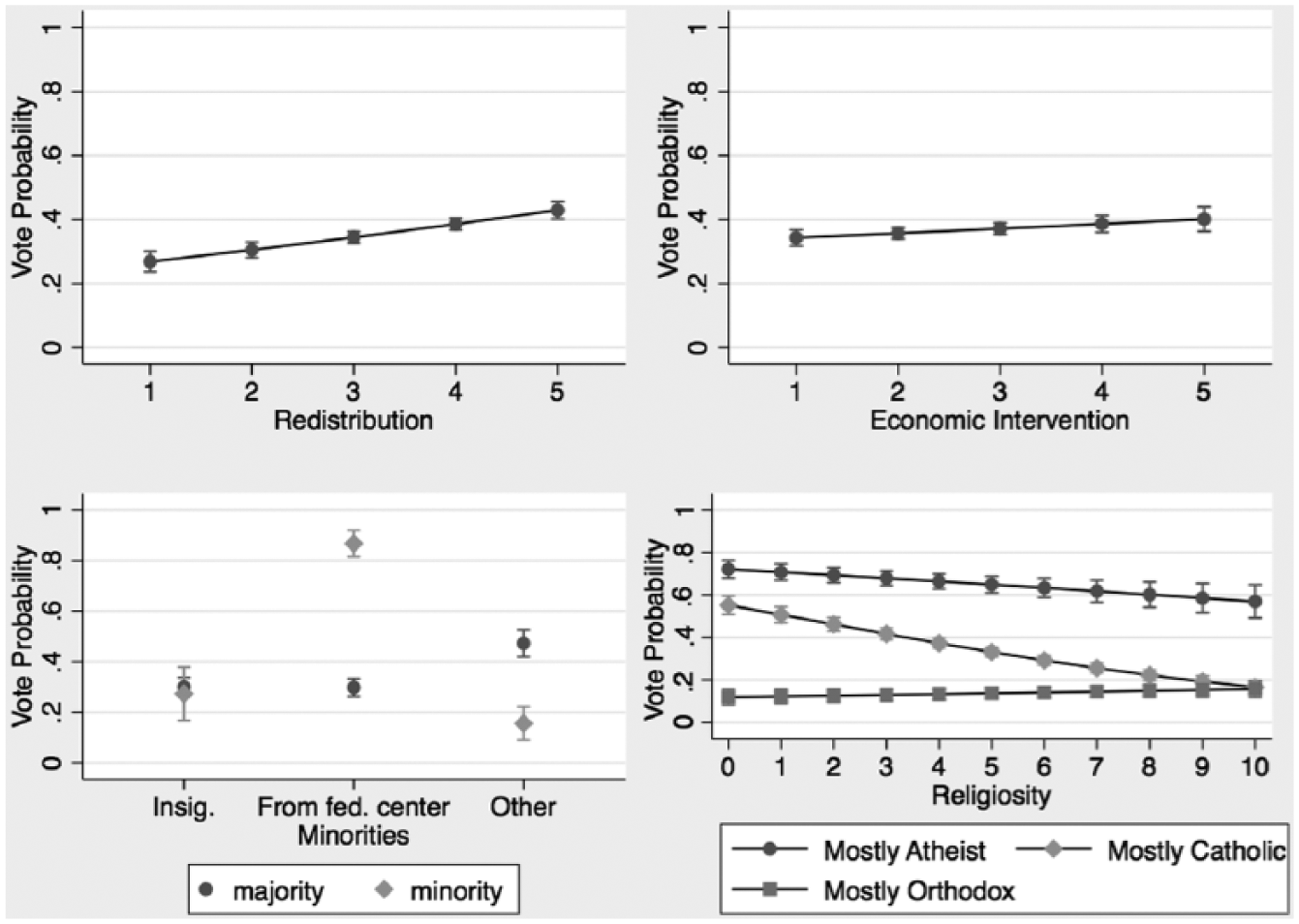
The model is estimated with a logistic regression explaining the vote for left-wing versus right-wing parties (see Table A3 in the appendix for details concerning party classification) in eastern Europe, using the 2009 European Election Study, which covers the ten eastern European countries that were members of the European Union at the time (Bulgaria, Czech Republic, Estonia, Hungary, Latvia, Lithuania, Poland, Romania, Slovakia, and Slovenia). Figure 2 summarizes the key results (based on model 2), while Table A2 in the appendix provides the estimation details. The subsequent discussion focuses on the full model (model 2).
Predicting Left Vote
The model correctly classifies more than 71 percent of the observations and produces a pseudo-R2 of 0.175, which is comparable to vote choice models for western Europe. 54 The results support the theoretical expectations outlined above. In terms of economic preferences, the top panels in Figure 2 show that voters in favor of greater redistribution of resources and greater state intervention in the economy are significantly more likely to vote for left-wing parties. The effect of economic preferences on vote choice is, however, relatively modest in comparison with the effect of ethnicity and religiosity.
As expected, the effect of ethnicity is significantly moderated by the origin of the politically salient ethnic minority. The bottom left panel of Figure 2 shows that where the presence of ethnic minorities is insignificant (the Czech Republic, Hungary and Poland), there ethnic minority status has no effect on vote choice. However, where a significant ethnic minority comes from the center of a dissolved communist federation (Estonia, Latvia, Slovenia), there ethnic minorities are more than 85 percent likely to vote for left-wing parties, while the majority population is only about 30 percent likely to do so, ceteris paribus. On the contrary, in countries where a significant ethnic minority comes from elsewhere than a defunct federal center (Bulgaria, Lithuania, Romania, Slovakia), ethnic minorities are significantly less likely to support left-wing parties than ethnic majorities.
Religiosity also manifests an effect on vote choice, which is moderated by the dominant religious denomination, as expected. The bottom right panel of Figure 2 demonstrates that in countries where most of the population report not having a religion (the Czech Republic, Estonia, and Latvia), religiosity has a weak negative effect on left vote. As religiosity increases, the likelihood of left vote decreases. In predominantly Orthodox countries, religiosity has no significant impact on vote. Finally, in predominantly Catholic countries, religiosity has a strong significant effect. As religiosity increases from its minimum to its maximum, the probability to vote for left-wing parties declines from about 55 to 16 percent, ceteris paribus. As a note of caution, it should be added that these precise results are particular to the data and model specification. Nonetheless, they highlight the key relationships between voter preferences or characteristics and their vote choice.
Conclusion
This article has reviewed the lively academic field studying party competition patterns in eastern Europe. It has highlighted a divide between works that focus on structural aspects of party systems and party organization on the one hand, and studies that concentrate on the patterning of individual party positions and voter preferences on the other. While generating a number of conclusions about the nature of party competition in the region, as well as a wealth of specific knowledge, this article suggests that the literature raises three important, unanswered questions. First, the literature disagrees on the number of separate political dimensions that structure party competition in eastern Europe. Second, the literature is divided between country-focused accounts that find idiosyncratic diversity across the region, producing limited predictions or explanations of competition patterns, and aggregated studies that overlook the diversity of these patterns. Consequently, and finally, the literature does not sufficiently account for what may explain the variation in competition patterns in the region.
Building on previous and ongoing research, this article proposed ways to address these three questions. It argued for the importance of generally applicable theoretical accounts that are, nonetheless, capable of capturing seemingly country-specific variation. Indeed, the main message of this article is that it is possible to build theoretically rooted accounts of party competition patterning that explain reasonable portions of observed variance, even in eastern Europe.
The article thus suggested that rather than seeking to “discover” the dimensionality of eastern European party competition, we should deductively derive dimensional spaces as generic maps for capturing the key political conflicts of interest. While obvious simplifications, such dimensional conceptualizations allow the assessment of the layout, dimensional simplicity, and dimensional association, demonstrating any specificities of particular political systems within a common frame. Similarly, to reconcile country-specific accounts with aggregated large-N studies in order to identify the predictors of party competition patterns in eastern Europe, the article proposed sensitive theorization of some of the key indicators implicated in both large- and small-N research. It namely argued for the inclusion of economic divides, ethnicity, state-building experiences, and religiosity in the explanations of party competition patterns in the east.
To demonstrate the utility of this approach, the article finally built a theoretical model of party competition in eastern Europe and tested it by estimating the vote for left-wing parties across ten eastern European countries. While a rather simple model, its characteristics and results, nonetheless, emphasize that, despite its natural complexities, political competition in eastern Europe can be meaningfully captured without resorting to country-specific idiosyncrasies. The model reminds us of the possibility of formulating general theoretical propositions, sensitive enough to address greater diversity of outcomes.
It is needless to say that the trade-off between parsimony and validity is present in all attempts at scientific generalization. While no exception, this article has emphasized the generalizability of the political experiences that underpin a good portion of the diversity of party competition in eastern Europe. With careful theoretical consideration, it may turn out that various, seemingly country-specific, idiosyncrasies form more general patterns. I believe that such careful consideration should be on the agenda of scholars studying eastern European party competition in the future.
Footnotes
Appendix
Party classification used in logit model
| Left Parties | |
|---|---|
| Bulgaria | KzB |
| Czech Republic | CSSD |
| Czech Republic | KSCM |
| Estonia | SDE |
| Estonia | EK |
| Hungary | MSZP |
| Latvia | SC |
| Lithuania | LSDP |
| Poland | SLD |
| Romania | PSD |
| Slovenia | SD |
| Slovakia | Smer |
| Slovakia | KSS |
| Right Parties | |
| Bulgaria | DSB |
| Bulgaria | RZS |
| Bulgaria | GERB |
| Bulgaria | NDST |
| Bulgaria | DPS |
| Czech Republic | ODS |
| Czech Republic | KDU-CSL |
| Estonia | IRL |
| Estonia | ER |
| Hungary | Fidesz-M |
| Hungary | MDF |
| Hungary | SZDSZ |
| Hungary | KDNP |
| Latvia | V |
| Lithuania | TS |
| Lithuania | LCS |
| Lithuania | LRLS |
| Lithuania | NS |
| Lithuania | LLRA |
| Poland | PO |
| Poland | PiS |
| Romania | PNL |
| Romania | PD-L |
| Romania | PC |
| Romania | UDMR |
| Slovenia | SDS |
| Slovenia | SNS |
| Slovenia | Zares |
| Slovenia | LDS |
| Slovenia | SLS-SMS |
| Slovenia | NSI |
| Slovakia | KDH |
| Slovakia | SF |
| Slovakia | SMK |
| Slovakia | SDKU-DS |

Note: Left parties are defined as communist, socialist, or social democratic. Right parties are defined as conservative, Christian democratic, liberal, or regionalist.
Acknowledgements
I would like to thank Kevin Deegan-Krause, Milada Anna Vachudova, the editors of EEPS, an anonymous reviewer, and the participants of the workshop “Whither Eastern Europe?” for comments and suggestions. A special thanks goes to Allison Rovny. All outstanding errors are mine.
Notes
Supplementary Material
Please find the following supplemental material available below.
For Open Access articles published under a Creative Commons License, all supplemental material carries the same license as the article it is associated with.
For non-Open Access articles published, all supplemental material carries a non-exclusive license, and permission requests for re-use of supplemental material or any part of supplemental material shall be sent directly to the copyright owner as specified in the copyright notice associated with the article.
