



Abstract
Kosovo is one of several Western Balkan countries that are part of the next round of accession to the EU. Like Bosnia, Serbia, and Croatia, it is also a country in which the history of conflict is recent and the benefits of EU membership ought to be a strong economic and political enticement to meet the standards necessary for membership. Yet, instead of major transformation of the post-conflict society towards democratization, economic development, and a robust human rights regime, the prospect of European Union membership appears to be leading to superficial legal changes without enforcement. This article investigates the tensions between internal challenges to legal change and external pressures for reform, adding to the literature on the decoupling of Europeanization and domestic change in candidate countries. A short analysis of one policy area, women’s property rights, illuminates the gaps between legal change and enforcement processes. The article also considers how and when a change in law can lead to social change. It is argued here that legal change in response to EU conditionalities may begin superficially, but creates an opportunity for collective action that can eventually lead to democratic change and a more robust enforcement of law.
On the 18th of July 2013, Štefan Füle, the European Commissioner for Enlargement and Neighbourhood Policy addressed the assembly of Kosovo. He said, “We share a vision of Kosovo being part of Europe. It is an inclusive vision. A vision of Kosovo being a place where . . . all citizens feel motivated to contribute constructively to building a country that has its eyes firmly set on the future and feels at ease with its neighbours.” 1 Füle’s speech marked a critical agreement that allowed for the beginning of negotiations on a Stabilization and Association Agreement (SAA) for Kosovo—the path to EU membership. It was a triumph for the elites who had fought for the independence of Kosovo, first with guns and then through politics. The expectation of future EU membership has been a source of hope for the troubled country since it established independence.
With an SAA set to begin in 2016, Kosovo is one of several Western Balkan countries that are part of the next round of accession to the EU. Like Bosnia, Serbia, and Croatia, it is also a country in which the history of conflict is recent and the benefits of EU membership ought to be a strong economic and political enticement to meet the standards necessary for membership. Yet, this is not how things are working out. Instead of major transformation of the post-conflict society towards democratization, economic development, and a robust human rights regime, the prospect of European Union membership appears to be leading to superficial legal changes without enforcement. In Kosovo, as in other countries, EU conditionalities have not had the hoped for transformative effect. 2 Yet, EU engagement has led to important political changes in Kosovo, key among them being the engagement of Serbia in high-level dialogue. This article argues that EU conditionalities, though not leading to societal change in and of themselves, create an opportunity for interest group engagement and the development of a “watchful constituency,” which may eventually lead to the enforcement of laws that now exist on the books but are otherwise invisible.
While the focus on a single case, and an unusual one at that, has limitations in terms of generalizability, it allows for a detailed examination of implementation and enforcement of policy changes. Here, the issues faced in Kosovo are compared across Western Balkan countries also engaged in accession processes with the EU. In many ways Kosovo is the least-likely case for political transformation as internal factors suggest that it would face serious challenges. It is not only post-communist, it is also post-conflict and struggling with economic difficulties resulting from the fact that many countries, even some within the EU, do not formally recognize it. At the same time, Kosovo’s history and the significant involvement of both the UN and the EU through the period of supervised independence would appear to make it a most-likely case for reform insofar as its political processes were actually under the control of external actors for a considerable part of its existence as a state.
This article seeks to investigate the tensions between internal challenges to legal change and external pressures for reform, adding to the literature on the decoupling of Europeanization and domestic change in candidate countries. A short analysis of one policy area, women’s property rights, illuminates the gaps between legal change and enforcement processes. Women’s property rights are a pertinent policy area to examine because they are both a human rights issue and critical to economic development. They are also a specific example of a set of gender-related policy concerns promoted by the EU across the Western Balkan countries. The second major contribution of the article is a consideration of how and when a change in law can lead to a change in social and political practices. It is argued here that legal changes in response to EU conditionalities may begin as just window-dressing but create an opportunity for collective action that can eventually lead to democratic change and a more robust enforcement of law.
Research for this article was conducted over four months in 2012 and 2013 when the author was living in Kosovo and conducting research on property rights. This was followed by further field research in 2014. Though secondary sources are used as noted, much of the data come from 48 interviews conducted in Kosovo. Interviews on the issues of property rights and legal processes were conducted in Pristina and four different municipalities in Kosovo: Ferizaj/Uroševac, Klinë/Klina, Gračanica/Graçanicë, and Rahovec/Orahovac. The semi-structured interviews were with legal professionals, government officials at the state and municipal levels, academics, and people working with nongovernmental and intergovernmental organizations.
The article proceeds as follows: the first section situates the analysis geographically in the context of the Western Balkan countries as they have emerged from authoritarian rule and conflict. The second section addresses external forces pushing for legal change in Kosovo, and the subsequent section details the internal impediments to reform. The fourth part discusses the gap between law and enforcement in Kosovo by examining women’s inheritance rights. This is followed by a discussion of legal development in Kosovo and the impact of EU engagement. The article concludes with an analysis of what we might reasonably expect as an outcome of external conditionalities and what factors might lead to institutional change in Kosovo.
Kosovo and the Western Balkans
Kosovo is one of the newest countries in the world. It achieved independence in 2008 and emerged from international supervision in 2012. 3 As a new country, it has faced the challenge of establishing the appropriate foundations for a flourishing economy and democratic governance. Indeed, Kosovo is currently the poorest country in Europe with unemployment at 35 percent, a GDP per capita around $3,500, and 35 percent of the population in poverty. 4 Kosovo has had to manage major economic challenges from three main sources: a post-war economy; problems of non-recognition; and the incomplete privatization of socially owned enterprises in the post-socialist era when Kosovo was still part of Serbia and Montenegro. With the incentive of possible European Union membership in the future, Kosovo has shown significant progress in developing laws that are EU compliant. However, the enforcement of these laws is in some areas half-hearted or non-existent. 5
Kosovo’s independence was the last severing of territory from what used to be the state of Yugoslavia. However, unlike some of the countries that left the former Yugoslavia early (Slovenia) or peacefully (Montenegro), Kosovo’s independence was the result of war and has been contested. Kosovo established de facto independence after a NATO bombing campaign against Serbia led to the withdrawal of all Serbian forces and administration from the territory in 1999. While the institutions of the state were being established, Kosovo was administered by the United Nations via the United Nations Interim Administration Mission in Kosovo (UNMIK). In 2008, Kosovo declared independence, which was not recognized by the Serbian state and is at this writing only recognized by 110 countries. Kosovo’s population is 92 percent ethnic Albanian, with the remainder of the population composed of Serbs, Roma, Ashkali, Egyptians, and Bosniaks.
Lack of international recognition of Kosovo’s independence has a number of consequences for Kosovo and some for Serbia as well. Kosovo has been unable to become a member of the United Nations, cannot compete in some international sports leagues such as FIFA, and does not have its own telephone country code. Moreover, allies of Serbia also refuse to recognize Kosovo, generating both economic and political difficulties for the nascent state. Within the EU, while twenty-three countries have recognized Kosovo, five (Spain, Slovakia, Cyprus, Romania, and Greece) have not, largely because of concerns regarding secession as a solution to territorial disputes.
Kosovo shares a political history with its neighbors Serbia, Montenegro, and the Former Yugoslav Republic of Macedonia (hereafter Macedonia FYR), all of which were under the control of the Ottoman Empire and subsequently Yugoslavia. Kosovo also shares an anticipated political future with its neighbors. All of the Western Balkan states, including Albania, can apply for EU membership. Croatia was the first to complete the accession process on 1 July 2013. Montenegro, Macedonia FYR, and Serbia are all candidate countries for EU accession. EU membership is desirable for all of these countries because of the increased opportunities for economic engagement through trade, access to structural and social cohesion funds, and freedom of movement for their populations. In an ideal world, the candidate process creates incentives for countries to reform their political systems and economies in ways that will make them more democratic and create an environment conducive to economic growth. What this would look like in practice is, among other things, clear and egalitarian laws enforced across region, gender, ethnicity, and status.
External Pressure for Reform
The decision to allow membership to the Western Balkan countries was made at a European Council meeting in Santa Maria de Feria in 2000 at which the Western Balkan area was identified as part of Europe and having legitimate expectations of EU membership. At that time, Kosovo had just fought a war with Serbia, the Bosnian War (1992–1995) was in recent memory, and there was a concern to promote political stability and security in the Western Balkans through the influence of the EU. The decision to extend EU membership to the Western Balkans was reaffirmed in 2003 at a meeting of the European Council in Thessaloniki, Greece. The Council “reiterated its determination to fully and effectively support the European perspective of the Western Balkan countries, which will become an integral part of the EU, once they meet the established criteria.” 6
Conditionality criteria for countries aspiring to EU membership were first outlined in the Copenhagen Council documents of 1993. The Copenhagen Criteria were influential in the accession process of the Central and Eastern European (CEE) countries. Some view the conditionality arrangements for these countries as effective because many have continued to progress in areas of democratic reform even after the accession process was completed and they joined the EU. 7 However, treating the CEE countries as a bloc in the accession process was controversial, given the variation in levels of democratic development in the CEE states, particularly Romania and Bulgaria. 8 Thus, a lesson learned from the EU expansion into Central and Eastern Europe was the necessity of treating countries individually and not as a bloc. The Stabilization and Association Processes (SAP) of Western Balkan countries will involve country by country negotiations on the specifics of reform. Moreover, the conditionality requirements relating to economic and political progress are very high compared to those countries that became part of the EU in the CEE bloc accession process. 9
Kosovo’s engagement with the EU is not new. From the beginning of UNMIK in 1999, future EU membership has influenced political development in both direct and indirect ways. Directly, different European Countries have provided advisors and consultants in a variety of areas. During UNMIK administration from 1999 to 2008, there were EU experts present in the assembly committees of the Provisional Institutions of Self-Government. There was also considerable EU involvement with “Pillar 4” issues of reconstruction and development, such as privatization, banking, and economic development. 10 After independence in 2008, the European Union launched EULEX, the European Rule of Law Initiative, which focuses efforts on assisting Kosovo in its integration into Europe.
In addition to this direct influence, there has been a more subtle role played by the aspiration to membership in the EU. “On a practical level, all the experience of the last 15 years indicates that it is more efficient to move in the European direction from the beginning, than to have to revise laws and restructure institutions later.” 11 Even if it is not specifically on the agenda, EU membership is the backdrop to the writing of legislation in Kosovo.
Kosovo’s path towards EU membership has recently taken a quantum jump forward as a result of a 2013 agreement with Serbia that resulted in the negotiation of a Stabilization and Association Agreement. Yet, Kosovo will face significant challenges on the path to the European Union. There are multiple reasons why this is the case, but two dominate. First, the experience of the EU with regard to the accession of the CEE countries means that the criteria established will be high. 12 Second, many of the Western Balkan countries have had difficult transitions from authoritarian rule, punctuated in some cases by political violence, ethnic cleansing, and war. The very security concerns that led the EU to extend potential future membership to the Western Balkan countries have also led to a democratic deficit and significant human rights concerns. Arolda Elbasani notes that as they face negotiations with the EU on membership, “most Western Balkans countries consist of borderline cases of transformation or ‘deficient democratizers’ that face unfavorable domestic conditions and share poor records of reforms.” 13
In Western Balkan countries, the engagement of the European Union and the carrot of membership has been instrumental in changing law and policy. The period of time in which countries have a Stabilization Agreement and before they become part of the EU is a crucial period of adaptation to European norms. “It is . . . ahead of the decision to open accession negotiations in particular, that the European Commission’s reporting focuses on the political conditions and the member states enter into a general debate on the merits of a country as a future member of the Union.” 14 Indeed, Judith Kelley has argued that only membership conditionality has the capacity to overcome domestic opposition. 15 Kosovo is currently in this critical time period in which we should be able to observe substantial institutional change.
The broad conditionality requirements for Western Balkan countries fall into both political and economic areas. Several critical areas of human rights that are important to the EU and challenging to the Western Balkan countries pertain to gender equality and the treatment of minority populations. While issues of minority protection are ongoing and difficult, it appears that gender equality standards have been achieved, at least legally. Yet, there is an identifiable gap between law and practice on some basic issues of gender equality such as women’s economic engagement and property rights.
Addressing equality of opportunity for women is high on the EU human rights agenda across the Western Balkans. Clauses regarding equal opportunities for women and minority groups are typically embedded in the Social Cooperation section of the Stabilization Agreements. Yearly progress reports regularly assess women’s rights and gender equality issues from the percentage of women present on party lists to availability of women’s health care. For example, in Macedonia FYR, the creation of gender equal laws pertaining to “working conditions and equal opportunities” was part of the Stabilization Agreement that was negotiated in 2001. 16 Recent Macedonian progress reports have specifically identified problems with women’s participation in the labor market and their political rights. 17
Andrea Spehar has studied the role of the EU in creating legislation regarding gender equality in both Croatia and Macedonia. She observes that “the EU gender strategy in Croatia and Macedonia has also shown serious limits. Among these—and perhaps the most fundamental—is the strong contrast between stated goals and their actual implementation.” 18 Indeed, there appears to be a trend in the Western Balkans of countries adopting gender equal laws to be in compliance with the EU and then struggling greatly with their implementation. 19 Poor compliance with gender equality standards in the Western Balkans has been recognized by the EU. 20
Internal Resistance to Change
While sharing the difficulties faced by other Western Balkan states, Kosovo also faces idiosyncratic challenges with regard to its relationship with the EU. Specifically, international involvement, both through the EU and UNMIK, has not been met with enthusiastic support across the board. Particularly after 2008, political opinion in some circles has opposed any sort of role for supranational organizations. One political party, Vetëvendosje, argues that the UNMIK period was undemocratic and they reject further infringement of Kosovo’s sovereignty by external actors, no matter what their intention. 21 Vetëvendosje does not oppose EU integration or domestic political reform; however, it does oppose the EU-mediated talks with Serbia. 22 Vetëvendosje is currently the third largest party in the Assembly, with 16 of 120 seats after the 2014 election.
Anti-interventionist sentiment is a troublesome obstacle to the success of conditionality. Some scholars have argued that EU conditionalities that oppose nationalist sentiments will never be fully implemented.
If conditionality demands do not correspond to the nation’s self-definition, the material incentives for compliance will not affect the government’s (re-)action to the EU’s criteria. The government will stick to what it considers appropriate and will not consider performing actions that are contradictory to the national identity—regardless of any cost-benefit calculation. In line with the “logic of appropriateness,” we therefore generally expect political conditionality to be ineffective where it clashes with national identity (no compliance). However, compliance may be the result of profound identity change.
23
There is not overwhelming societal support in Kosovo for the reforms that are happening on the way to an EU accession agreement. There is a “high degree of hostility” towards the EU and its involvement in politics despite the fact that many in government are working hard towards the goal of compliance and accession. 24 The end of UNMIK sovereignty led to a desire among some elites for complete independence from outside intervention, even that which is intended to help them towards European integration.
Institutional Change
States that would like to become part of the EU must undergo a process of changing their political and economic institutions to align themselves with EU values and practices. Through the accession and pre-accession processes states change laws and policies to become more democratic, egalitarian, and “European.” The direct and indirect influence of the European Union has had a positive impact on legal development in Kosovo. However, writing law does not automatically lead to the cooperation of local level courts and municipal officials that is necessary to enforce law. 25 Indeed, legal change can be implemented by a narrow political elite. Peter Hall has noted a particular concern about institutional change that is legal in nature, when a new piece of legislation is passed, there is a collective action problem that develops in mobilizing the actors who enact or enforce the reforms. 26 We can think of institutions as being “born weak” when the impetus behind them is not a response to demands from a domestic constituency, but rather, to an external constituency interested in the demonstration of support for human rights norms, democracy, or promotion of external investment. 27 Sociological literature refers to this type of change as institutional isomorphism, when institutions are adopted to provide legitimacy rather than improvement or efficiency. 28
Moreover, institutional change that occurs rapidly through law may not have the full assent of either elites or the general population. This is a salient issue in this context as Kosovo’s laws were written very rapidly in the effort to establish the legal foundation for a new state. Figure 1 shows that legislative action in Kosovo has been concentrated with peaks in three specific years: 2004, as the institutions of the state were established; 2008 with independence; and 2011 after new parliamentary elections.
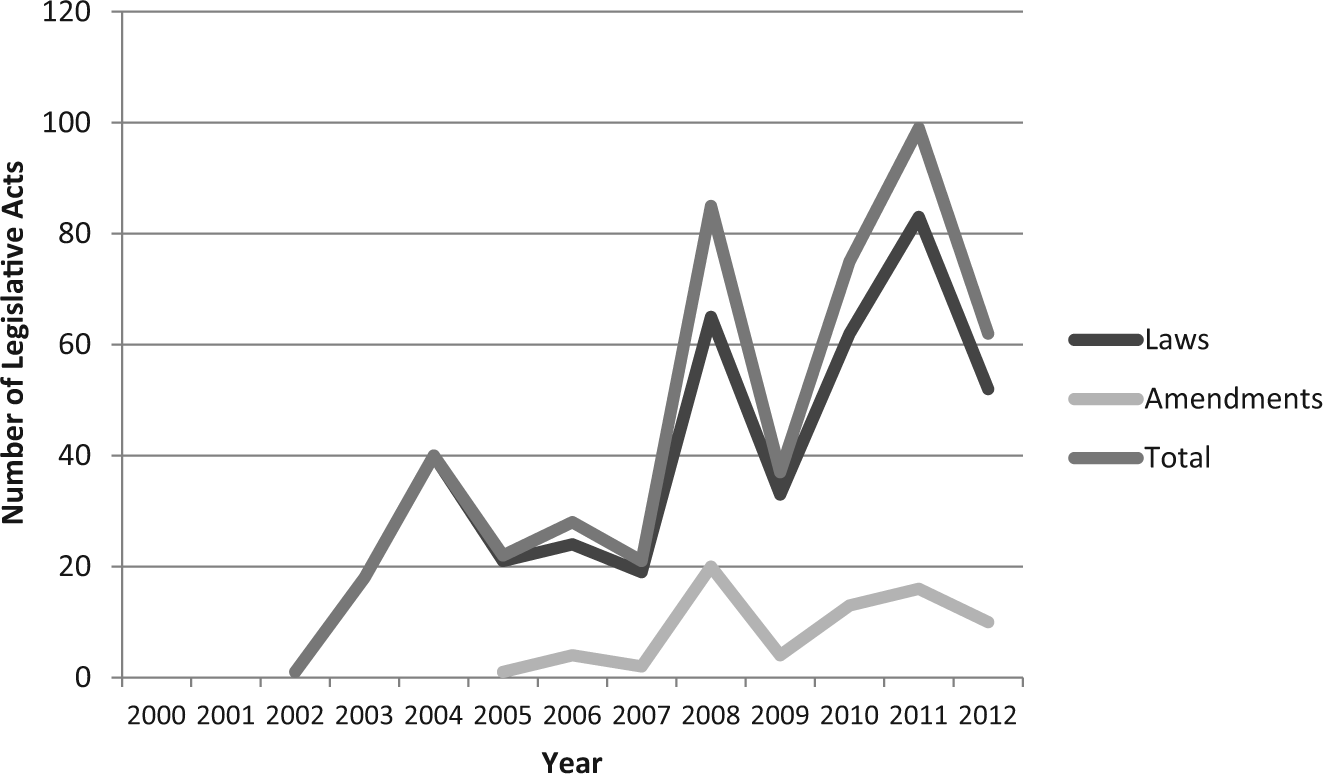
Legislation in Kosovo
We have reason to be wary of time periods with rapid lawmaking as there is unlikely to be a great deal of effort given to coalition building and deliberation. 29 Levitsky and Murillo argue that laws written during times of rapid change create institutions that are “born weak” as governing elites import institutions that are not aligned with domestic norms. 30 In Kosovo, laws were passed that served the purpose of asserting the identity of the state and preparing for eventual EU accession arrangements. These laws were not necessarily a response to demands from the populace, but the state-building activities of an ambitious and forward-looking group of elites.
EU engagement with post-communist states during a time of rapid change is likely to result in the development of laws and policies by elite cohorts without the building of broad constituencies to support these changes. “Evidence from postcommunist transitions suggests that rapid transformation tends to privilege not only the use of extant templates and connections but also a particular set of actors: the few elites institutionally capable of decision making.” 31 Without an intentional effort to build a constituency for the enforcement of these new laws, little change is likely to result and, indeed, we see across the Western Balkan countries laws created to be in compliance with EU accession processes that have little to do with facts on the ground. Yet, while we should be concerned about laws created rapidly during times of social upheaval, it is important to have a longer-term view of the possibilities they create. Robert Dahl has argued that the socialization of elite groups into the norms of competitive politics can have a long-term positive impact on democratization. 32 Similarly, elite socialization into international norms of human rights creates a new discourse within the country on norms of behavior.
Property Rights for Women in Kosovo
In Kosovo, political violence occurred in the midst of a transition from communist rule, leaving a legacy of uncertain property rights. Key among these highly charged political issues are the restoration of property to the Serbian minority population who lived in Kosovo prior to the war, the allocation of formerly socially owned properties, including residences, legalizing the many illegally constructed building in Pristina, and the privatization of large government properties over which Serbia and Kosovo contest ownership, such as the Trepça mine. These are politically charged, legally complex issues, some involving human rights, for which the solutions are not always obvious nor the enforcement mechanisms straightforward. Women’s economic and property rights in Kosovo are a simple concern in comparison; they are not as legally complex, and the policy process towards achieving them is unambiguous. Yet, there is little compliance with law regarding women’s property rights and there are significant barriers to women’s economic activity. The full engagement of women in the economy is a key component of growth and legal recognition of their property rights is a path to this goal. 33
In spite of a shared history of egalitarian property law with its former Yugoslavian neighbors, and a robust rule of law improvement program under the United Nations transitional administration, Kosovo has lower rates of economic engagement for women than other Yugoslav successor states. 5 Outside of the business sector, rates of property ownership for women in Kosovo are also lower. In Serbia, women own 37 percent of total property, with up to 50 percent in some areas; 34 the percentage of property owned by women in Kosovo is only 8 percent. 35 It is interesting to note that in the Albanian majority area of Serbia, the Preševo Valley, property ownership for women is also low, at 13 percent. 36
None of these inequalities can be explained by law. The law under the current regime in Kosovo is egalitarian. There are three important laws supporting women’s property rights in Kosovo: the Law on Gender Equality; the Inheritance Law; and the Family Law. These three laws were passed by the Assembly in 2004 while Kosovo was under the supervision of UNMIK. At that time, although UNMIK was in a supervisory role, the Provisional Institutions of Self-Government (PISG) was in the lead in terms of drafting legislation. In 2004, many new laws were promulgated as the ministries both wanted to demonstrate that they were active and competent. 37 Laws created during the UNMIK administration are egalitarian and intentionally consistent with European Union requirements. 38 External involvement had a tangible, observable output in the development of a robust legal framework for women’s rights.
Though women have legal protections, they frequently renounce their right to inherit family property. 39 While the specifics of how the law is subverted are discussed elsewhere, 40 here it is sufficient to note that it is common for female heirs to “refuse” inherited property rights. 41 Explanations for refusal of inheritance are entwined cultural factors such as strongly differentiated gender norms, the salience of Albanian nationalism, and the impact of Albanian customary law (the Kanun), which is deeply patrilineal and a totem of Albanian identity. 42
If culture is the reason why women have such low levels of property ownership, then public opinion surveys of women should also demonstrate a resounding refusal to inherit property. In the best of all worlds, public opinion survey data would be widely available for this issue, but it is not. There has been one large survey of 1,050 women dispersed across the country. In this survey, women were asked about their preferences for property inheritance for their children and for themselves. Overall, 75 percent of the surveyed women stated that both male and female children should inherit equally. 43 If it is indeed the case that women believe inheritance should be for both male and female children, then the explanation as to why women do not own property cannot be simply an issue of choice influenced by cultural norms.
There are a number of issues pertaining to knowledge, process, and implementation that create problems for women claiming their property rights. With regards to knowledge, it is clear that women do not always know that they are legally entitled to inherit from their parents or their spouses. When the above-mentioned survey asked women if the law supported equal inheritance rights for male and female children (which it does), 41 percent believed that law did not apply to inheritance issues. Instead, they believed inheritance issues to be governed by tradition and customary law. 44 The rare practice of female inheritance makes it unlikely that women or their families would know the content of the law.
The second category of legal impediment to women’s inheritance of property has to do with the process that the courts follow. Few people make wills in Kosovo; therefore, most inheritance cases follow laws on intestacy. 45 After the issuance of a death certificate, any heir of the deceased may renounce their inheritance at any time and some women choose to forego inheritance at this time. Agreements made among family members as to the disposition of property are recognized by the court or public notaries as they facilitate the rapid distribution of the estate. However, these agreements are often used to exclude of female heirs without their permission, by simply only listing male heirs. 46
Clearly, ascertaining who the correct legal heirs are would go a long way towards rectifying issues of women’s inheritance and property rights. The mechanism for a judge or notary to determine if all heirs were named would be to check the civil registry of the municipality. However, there is an absence of capacity in the civil registry system in Kosovo to identify all the legal heirs. When the war in Kosovo occurred in 1999, Serbian authorities removed the civil and property registers from Kosovo and took them to Serbia. The original registers remain there. In 2012, as a result of talks between Kosovo and Serbia, some steps towards the normalization of relations began. One of these was a project to bring the copies of the civil registry documents to Kosovo. Beginning in 2012 a process of the verification of the copies of the civil registry records began and is now complete. However, these records are paper and not digitized and not easily searchable. Therefore, even a court well disposed to recognize women’s inheritance rights would not necessarily know that sisters or daughters had been excluded in a prior agreement.
The use of family agreements, coupled with the lack of checks for legal heirs, allows the exclusion of women from inheritance. What is particularly interesting is that the same process is also being used to exclude male heirs from a share of the family property. 47 The poor economy in Kosovo has led to an outmigration of young workers for better jobs in nearby countries. As a result of economic migration, it is not uncommon for the heirs of a person who has died intestate to be out of the country. This has led to a number of incidents in which agreements written by families have excluded male heirs, as well as female. There are an increasing number of complaints being brought to the human rights office at the European Rule of Law Mission in Kosovo (EULEX) regarding male heirs excluded in the inheritance process. 48
Egalitarian laws on women’s property rights and inheritance have faced serious obstacles to implementation in Kosovo because of their dissonance with Albanian cultural norms coupled with a weak bureaucracy and legal system. 49 This is problematic from two perspectives. First, economic equality it is a human rights issue that is of concern to the EU. Second, women’s engagement in the economy, facilitated by their clear property rights, is critical to the economic development of the country. The law in Kosovo complies with EU policies but the practice does not. In this regard, the inheritance law is not unusual; many laws are being made in Kosovo that are not being fully implemented or enforced. Another, less important, example was the widely flouted Tobacco Law, which ineffectively restricted smoking in public areas. 50 In April 2013, the Assembly of Kosovo adopted another law on Tobacco Control that entirely prohibits smoking in public areas; 51 while more effective than the previous law, the enforcement is uneven.
Revisiting Institutional Change in Kosovo
External involvement in Kosovo and the goal of EU membership have led to modern, egalitarian laws. This is an important first step in any effective legal regime. However, the law alone does not effect change, and there is a large gap between the law and its enforcement. This gap is explained by resistance to laws that contradict cultural norms as well as by the poor functioning of the courts. However, internal impediments need not justify pessimism about the future. In the following paragraphs, I will discuss how the creation of law can promote institutional change that is more than window-dressing and follow this with examples of when this has occurred in other contexts.
There are three specific ways in which the presence of appropriate law is helpful in facilitating institutional change. First, the presence of law creates an opportunity for contestation in the courts. Groups or individuals can pursue legal action when laws are violated. Even if lawsuits are not successful, the presence of law allows for the attempt to assert rights that would not otherwise exist. There are examples of this in Kosovo. One that has caught public attention is that of Shyhrete Berisha, who is engaged in a legal battle to recover the family home of her late husband. During the Kosovo War, her village was attacked and her four children and husband were all killed. She was seriously injured and left the country to get medical treatment. When she returned, she was locked out of the family home by her in-laws. Ms. Berisha is the legal heir and began a twelve-year court battle to reclaim the home but so far there has been no decision. 52 Ms. Berisha’s case is famous within Kosovo and evokes much public sympathy. Progress has been covered in the media, and recently a civil society organization, Levisja FOL, gave her an award for “Civic Courage” because of her ongoing battle to use the courts to enforce her property rights. 53
Second, laws, even when aspirational or unevenly enforced, can create a narrative for the way society ought to be. This can be used by civil society groups and the government as an educational tool. Returning to the issue of women’s inheritance rights, in Kosovo, the Kosovo Women’s Network and the Lawyer’s Association NORMA use the law on inheritance to teach women about their inheritance rights. Civil society organizations have also participated in court monitoring activities to assess whether law is being followed.
Lastly, as the judiciary becomes more professional, having laws already in place provides a fast track towards change in practice. Judicial improvement could solve the enforcement problem quickly, but it is not easy to achieve. In Kosovo, the slow and sometimes corrupt functioning of the courts has been a problem since before independence. Most citizens avoid the courts because of the perception that they are “slow, difficult, and expensive.” 54 In other contexts, civil society has been critical in holding governments accountable for the enforcement of law and has compensated for this sort of democratic deficit. 55
Local mobilization around a desired change is a critical means of ensuring state enforcement when the courts are weak or difficult to access. Without citizens organized around an issue addressed by law, a state has no incentive to invest in its enforcement. This is true whether the law is a human rights issue, an economic concern, or just an ordinance regulating social behavior, such as the Tobacco Law. In other contexts, the development of a watchful constituency of citizens has led to the enforcement of laws and policies that would otherwise have had little effect. An example that pertains to women’s property rights is what happened in Uganda around the “consent clause” of the 1998 Land Act. Women in Uganda did not have property rights to their land and homes under customary law. The Land Act gave women the right to obstruct the sale of homes in which they were living and property which provided them with subsistence. While many aspects of the Land Act were not implemented or enforced, the spousal consent clause was. The reason for the enforcement of this particular clause lay in the array of women’s organizations which were carefully watching the implementation of the law. 56 Moreover, in other Balkan states, there is evidence of EU concerns creating a political opportunity for domestic constituencies to organize and seek change around issues that had previously been ignored or obstructed. Dimitrova and Buzogány examine the role played by environmental activists in Bulgaria and Romania in using EU rules to push forward their policy interests. 57
Legal changes do not immediately lead to changes in practice, particularly in countries where there are weak judicial institutions and poor linkages between the center, where laws are made, and localities, where laws are enforced. Yet, legal change creates an opportunity for a watchful constituency to develop and to use laws and policies to push for enforcement. What should we look for in Kosovo to ascertain whether reform is actually likely? The critical indicator would be the development of a domestic constituency for reform that can begin to tackle some of the impediments to change. In Kosovo, there are hopeful signs that this is happening. We are seeing new women’s groups developing that are engaged in equipping women business owners (The G7, Women’s Business Association and Kosovo Women’s Chamber of Commerce) and farmers (Women Farmers Association) as well as those that are specifically addressing women’s inheritance rights and political engagement (NORMA, Kosovo Women’s Network). In addition there are civil society organizations that are focused on democracy, anti-corruption efforts, and human rights such as the previously mentioned Levisja FOL and the Kosovo branch of the Youth Initiative on Human Rights. One might imagine that on an issue of gender equality, we might also see transnational networks forming to link national and international activists, but women’s property and inheritance rights are not highly visible. There are some linkages between external actors and local civil society organizations, but they largely occur through programmatic funding, for example through the Soros Foundation, Kvinna till Kvinna, and the National Endowment for Democracy or through government-based foreign assistance. The more civil society groups form and engage around women’s economic engagement and political equality, the more likely we are to see the egalitarian laws enforced as these groups create a constituency for reform.
Conclusion
Absent a watchful domestic constituency for enforcement, laws are likely to remain window dressing, particularly if their formation was designed to address an external constituency rather than domestic interests. If EU conditionality is to lead to real institutional change, it must be supported by local actors who can speed the implementation and enforcement through their advocacy.
Examining institutional change in Kosovo from a theoretical perspective, it should not be a surprise that the institutions developed are weak and laws unenforced. Legal change in Kosovo is the result of an exogenous shock that created institutions “born weak.” Laws were written and passed in a short period of time with the support of a narrow elite and little mass engagement in the specifics of legislative change.
There are two potential futures for these institutions: One involves the development of a coalition around their enforcement, in which case the institutional change will be robust. The current weak enforcement of laws on women’s property rights in both Kosovo and across the Western Balkans allows these laws to persist and give a necessary time gap in which to create a domestic constituency and the mechanisms for enforcement. If the limited public opinion surveys from Kosovo are correct, then there is a latent constituency for reform that can be mobilized. Just because institutions are “born weak,” it does not mean that they will grow up weak. Alternatively, the law that has been developed in these years of nascent state formation could continue to float above the society, not providing effective enforcement of the rules of the game, which is critical to economic development and growth. One path would set Kosovo firmly on its way towards European integration and economic development; the other will ensure continued economic stagnation.
Footnotes
Acknowledgements
I am grateful to Leah Anderson, Christine Folch, Winnie Fung, Larycia Hawkins, Steve Levitsky, Amy Reynolds, and Rachel Vanderhill for their input on earlier versions of the paper and to Grace Pyo for research assistance. All flaws remain my own.
Funding
My thanks go to the Fulbright Foundation for supporting fieldwork in Kosovo. The Earhart Foundation provided funding for work on the larger project.