




Abstract
An influential contingent of Catholic clergy in Poland reacted to Poland’s entry into the European Union by developing a narrative positing the Catholic foundation and ownership of Europe and all its constituent “nations.” This narrative, which I call national-European theology, identifies the Catholic Church as the progenitor of both European and Polish existence and guarantor of their continuity of identity. In this way, it remedies some Catholics’ anxieties about both the integrity of Poland’s national sovereignty and the allegedly secularizing and liberalizing cultural influence of other EU member countries. I argue that national-European theology can be fruitfully conceived as a hereditary ownership narrative, framed by moments of spiritual foundation and subsequent inheritance from spiritual founders, and that this narrative structure characterizes both nationalism writ large and Europeanization as an analogous modern identitarian project. I suggest that taking heredity as a lens through which to understand nationalism and its attendant notions of legitimation allows us to move past debates about the “content” of nationalist claims (ethnic, religious, linguistic, etc.) and toward the mechanism by which group reproduction is culturally defined and sanctioned. To do this, I first sketch a theory of nationalism as a hereditary ownership narrative, drawing upon the Polish case, and liken it to the “Europe-building” project of the EU. Second, I present a brief historical outline of Poland’s accession to the EU and the anxieties generated thereby. Finally, I turn to the rhetoric of the Polish clergy who best represent the national-European current in contemporary Catholic political theology.
Christianity is the lasting element not only of European historical memory and culture, but is also the vital element of European identity. Without this factor, Europe ceases to be Europe.
Introduction
Since the end of the nineteenth century, Catholic clergy in Europe have been engaged in a redefinition of their political role in countries which have progressively limited direct ecclesiastical influence on legislation and state institutions. 1 Despite centralized allegiance to the Holy See, which exerts some policy influence on subordinate clergy, in practice the politics of Catholic clergy have differed markedly by country, locality, and ideological persuasion. In Poland, prominent Catholic clergymen have since the fall of communism increasingly emphasized a narrative recounting the foundation of Europe and its constituent nations through baptism, which allegedly bestowed the Holy Spirit upon entire “nations” and thereby also Europeanized them. This narrative, which I call national-European theology, proceeds along two related axes—national and European—setting up a historical analogy between the birth of nations and the birth of Europe which renders EU expansion (sometimes called “Europeanization”) not only nonthreatening to national sovereignty but a continuation of the Church’s evangelical mission. The narrative structure of this political theology positions the Catholic Church as a mediator of the qualities of Europeanness and nationness, capable of bestowing these qualities with the sacrament of baptism.
The Polish inflection of national-European theology has historical roots in the communist period, most explicitly in the nationalist theology of Primate Cardinal Stefan Wyszyński, close friend and mentor of Pope John Paul II. Thus, what I am documenting here is very much an elite discourse, not shared even by all Catholic clergy, who call upon alternative political theologies defined in different (albeit frequently overlapping) terms, such as “Christendom,” “the West,” “separation of Church and State,” “liberation theology,” etc. However, I consider national-European theology of interest because it helps to collapse a frequently employed binary: that of nationalist versus internationalist or supranational identitarian projects. What I outline here is one attempt by prominent institutional spokesmen to define that institution as national, regional, and universal simultaneously, and thereby preserve its otherwise declining social and political influence. They do so by employing language which refers to a fundamental structure of human relationality: that of inheritance and kinship (in this case, “spiritualized” kinship), by making itself the arbiter of the “spiritual paternity” of Poles and Europeans. The obverse of this is that certain “descendants of Europe” have been disinherited in this discourse—particularly proponents of Enlightenment rationalities which take on anti-clerical or anti-religious casts.
In what follows, I first sketch a brief historical overview of the relationship between nationalism and the Catholic Church in Poland during the second half of the twentieth century. Then, I outline a theory of nationalism as a hereditary ownership narrative, drawing in particular upon the Polish case. Third, I present a brief historical outline of Poland’s accession to the EU. Finally, I turn to the rhetoric of the Polish clergy itself to illustrate how this Catholic ownership of Europe is being articulated by Church hierarchs in pre- and post-accession periods in Poland. I focus primarily on the pronouncements of three of Poland’s most outspoken clerical proponents of European integration: Henryk Muszyński, Archbishop of Gniezno (1992–2010) and Primate of Poland (2009–2010); Father Piotr Mazurkiewicz, professor at Cardinal Stefan Wyszyński University in Warsaw and Secretary General of the Commission of the Bishops’ Conferences of the European Community (COMECE) (March 2008–November 2012); and, of course, Pope John Paul II (r. 1978–2005), whose pontifical weight lent considerable impetus to his vision of a contemporary “Christian Europe.” John Paul II’s seamless blend of national and European Christian foundationalism has become orthodox for many Polish clergymen, and makes it no exaggeration to call him both the most nationalist and most European pope in the history of the Catholic Church. 2
I have chosen Poland as my site of study because of the heavy influence Polish Catholic clergy exert in the broader context of European Catholicism. A number of factors have contributed to this prominence, above all the papacy of John Paul II and sharp decline in the number of Catholic clergy across EU member countries during the first decade of the twenty-first century, leading many of these countries to “import” Polish priests, who accounted for about one-quarter of European seminary applicants in the first decade of the twenty-first century. 3
Custodians of the national-European narrative are continually in the process of determining whether Europeanization is in fact accomplishing its telos by scrutinizing whether or not it is occurring in a “sufficiently Christian” idiom. Alarmed by what they perceive to be the “secularizing” direction in which the Europeanization project is heading, these Catholic clergy have been assiduously emphasizing the Christian “roots of Europe.” 4 Thus, although Europeanization and Christianization are teleologically conflated by national-European theologians, the danger of their failure looms over any political and cultural change. Indeed, the specter of a father without children—evident in Polish clergy’s anxious invocations to laymen to have more children, displayed inside and in front of countless churches throughout the country and proclaimed in numerous sermons and publications—haunts the clergy’s visions of both present and future. The inability of many Catholic clergymen to account for the countless actual children the Roman Church has sired—literally and culturally—places it squarely in the midst of an existential crisis which, like the iconoclasm controversy which consolidated imperial Christianities during the collapse of the Western Roman Empire, is a crisis of theological interpretation: What is the relationship between God and image—and humanity as image of God? And if a father’s children do not resemble His image, are they His children at all?
Historical Overview
The Holy See’s historical animosity toward nationalist aspirations softened during the end of the nineteenth and early twentieth centuries; however, popes were quick to declare that devotion to a universal Christianity embodied in the institutions of the Church should supersede national loyalties. For instance, in the 1890 Encyclical Sapientiae Christianae, Leo XIII reminded Catholics that if the natural law enjoins us to love devotedly and to defend the country in which we had birth, and in which we were brought up, so that every good citizen hesitates not to face death for his native land, very much more is it the urgent duty of Christians to be ever quickened by like feelings toward the Church.
5
In the midst of the First World War, a mass-scale bloodletting framed explicitly as a conflict between European nations, Pope Benedict XV wrote an open letter to the leaders of participating European countries, appealing for peace. In that letter, he accepted the existence of historically transcendent (i.e., “timeless”) nations, but used that as the basis for which to argue for a universal peace founded in his interpretation of the Sermon on the Mount: Lay aside your mutual purpose of destruction; remember that nations do not die; humbled and oppressed, they chafe under the yoke imposed upon them, preparing a renewal of the combat, and passing down from generation to generation a mournful heritage of hatred and revenge. . . . Blessed be he who will first raise the olive-branch, and hold out his right hand to the enemy with an offer of reasonable terms of peace. The equilibrium of the world, and the prosperity and assured tranquillity of nations rest upon mutual benevolence and respect for the rights and the dignity of others, much more than upon hosts of armed men and the ring of formidable fortresses.
6
An understanding of nations as enduring, bounded communities of descent (some even possessing a theologico-historical destiny) certainly has Biblical precedents and was also characteristic of the Hellenistic ethnographic literature which influenced both early Christian writers and the European Renaissance. 7 During the nineteenth century, however, European philosophies of history moved decisively toward what Eric Wolf has called a “billiard ball” understanding of history: the idea that all people belong (at least primarily) to one nation, each of which is a collective historical actor with a shared past and future, if not destiny. 8 In Poland, such an understanding of nations became particularly pronounced during the postwar period (which I periodize expansively as 1945–1969), during which the Primate of Poland, Stefan Wyszyński, along with a sizeable number of Catholic clergy, engaged in a decades-long project to position the Catholic Church as the protector and custodian of “true” Polish nationhood. 9 They promulgated a narrative in which Poland was a discrete historical actor tasked with a Christ-like redemptive mission. This project was not entirely new—it had historical precedents tracing back to the partition period (1772–1918), during which time a mystically nationalist current began to permeate Polish lay Catholicism over the protestations of many (particularly higher) clergy. 10 However, during the postwar period the story of the Polish nation as historical redeemer became central to a symbolic battle between strong factions within the Church and the Soviet-backed state (the Polska Rzeczpospolita Ludowa, or PRL) over whether Polish nationhood was an essentially “religious” or “ethnolinguistic” phenomenon. 11
This battle both polarized and united the country. The public polarized (very broadly) in the direction of sympathy toward the Church versus allegiance to the State, marginalizing political positions which attempted to reconcile both loyalties (for instance, the PAX society of clergy committed to support of the regime). 12 On the other hand, the battle united the Polish public discursively, in that groups contending for power felt increasingly compelled to assert their claims in an ever-more strident language of apotheosized nationhood. 13 The appeal of Wyszyński’s Polish national mysticism, albeit heterodox from a traditional catechetical standpoint, was drawn from its strong language of political legitimacy: it positioned the communist government as a “foreign” entity, usurping the power which rightfully belonged to Poles—defined implicitly as a people who, at the very least, did not actively oppose the claim that the Catholic Church is the moral and existential guardian of Polish society. 14 In this, Wyszyński conflated the principle of nationality (a common organizing commitment of nationalist politics), which holds that, in order to be legitimate, a state must be of and for a particular nation, 15 with a definition of the Polish nation as privileging the pastoral and pedagogical role of Catholic clergy. Wyszyński’s postwar nation-building project thus sought to materially instantiate, through nationwide collective demonstrations like the Great Novena, a moral vision of the Polish nation as both brought into existence and continually enlivened by the Catholic Church. 16
In the postcommunist period, anxieties about national sovereignty re-emerged in a new political context. This time the expanding geopolitical entity vis-à-vis which Poland had to position itself was not the Soviet Union to the East, but the European Community (later Union) to the West. 17 In the pronouncements of many builders of this European unity, very different definitions of Europeanness could be heard: among them narratives which posited the essentially “secular” nature of Europe. 18 Not only did the specter of a “secular Europe” appear profoundly disconcerting to Polish national-European theologians, but the EC/EU’s structure of governance was far less centralized than the Soviet Union’s had been. It wasn’t long before “liberal” became a form of invective just as or even more deleterious than “communist” among conservative Polish Catholics—the many-headed hydra of European social and economic liberalism presented a diffuse enemy who could not be targeted, let alone brought down, as readily as a corrupt empire with a capital and a standing army. 19
At the same time, as Geneviève Zubrzycki notes, “With the creation of a legitimate national state . . . the fusion between nation and religion . . . is called into question.” 20 In other words, the widespread domestic perception, after the fall of communism, that the State is no longer fundamentally at odds with Polish identity rendered the existential guardianship of the Catholic Church politically superfluous for a growing contingent of Poles. Since 1989, the Polish center and left have been working to assert a vision of the Polish nation less dependent on purported ethnicity and religion than on citizenship. Despite a strong backlash by the Catholic right, the center/left vision of Polishness appears to be on strong ground, as evidenced by subscription rates to center/left periodicals and voting patterns in both domestic and European Parliamentary elections. 21
Legitimacy Tied to Heredity
Nevertheless, older notions of legitimacy and legitimation persist. As Patrick Geary has written, contemporary European nationalisms are framed by narratives which refer, explicitly or implicitly, to a “moment of primary acquisition,” usually in the early medieval period, which establishes the “true owners” of a given territory ad aeternam. 22 In order to make these claims to ownership endure over a period of centuries or longer, communal continuity must also be assumed via some mechanism(s) of historical inheritance. 23 It is this narrative combination of a foundational moment and subsequent inheritance of what has been founded that underpins the national-European understanding of legitimacy in the discourse of the Polish Catholic hierarchs treated here. This discourse points to a more widely shared understanding of nationalist political community. Because “nationness” (to borrow Rogers Brubaker’s term) is, like kinship, defined variously as constituted by both “biological” and “spiritual” qualities, I prefer “hereditary” to “ethnic” as a descriptor of nationalism and its attendant notions of legitimation. Moreover, hereditary discourses characterize not only nationalisms, but also the multifaceted ideology of Europeanness that developed during the twentieth century and to which Catholic clergy have given their own inflection. By focusing less on the content of identitarian claims (language, religion, phenotype, “spirit,” etc.) and more on their social structure (the self-concept, responsibilities, and privileges that accrue to those in the hereditary line and to those who have been disinherited or are not eligible to inherit), we can make more meaningful claims about how human communities are transforming during the late twentieth and early twenty-first centuries.
The rhetoric of inheritance, now expressed in the context of EU expansion, is a continuation of Catholic theologians’ (both clerical and lay) interwar attempts to articulate a political theology which would preserve Catholic social and political influence in a democratizing Europe. 24 This theoretical effort was, in turn, an evolution in a long historical process of contesting the relationship between Church and state in Europe. The Holy See had ceased to exercise the power of liturgically legitimating monarchs during the high medieval period. 25 This was the result of two main trends: on the one hand, of papal attempts to elevate the consecration of clergy over that of “secular” princes by insisting on the sacramental nature of the former and the non-sacramental nature of the latter, and on the other, by the drive of canonists to articulate a non-sacramental, legal doctrine of royal legitimation. 26 However, the institutions of the Catholic Church nevertheless exercised considerable social influence by pronouncing on the boundaries of legitimate political action and supporting certain lineages over others, and its canon law was invoked in royal hereditary disputes (such as, famously, that between the Bourbon and Orléanist lineages in nineteenth-century France). Thus the Holy See, as a major architect of the doctrine of hereditary legitimation of monarchs, also came to understand political legitimacy—in the secular realm beyond the See itself—in hereditary terms. 27
Until Leo XIII’s 1885 encyclical Immortale Dei, the Holy See’s official position was that monarchy constituted the only legitimate form of government. 28 With the advent of democratic theory and practice, however, the power of legitimation began to pass from royal bloodlines to “the general will,” which during the nineteenth century increasingly took the shape of the general will of “the nation.” This served as the occasion for the translation of hereditary legitimacy from royal and aristocratic “species” or “races” to national collectives: these new kinship groups were formed out of an eclectic combination of late medieval and Renaissance understandings of patria (themselves based on Classical models) with theologically inflected understandings of “chosen peoples” (what Philip Gorski has called Hebraic nationalism) and genealogical definitions of aristocracy which had frequently been articulated in racial terms. 29 These ideational components were fused in various ways through the “state-building histories of the old territorial states of Europe between the thirteenth and eighteenth centuries, which eliminated competing sovereignties inside a given territory, established permanent bureaucracies and standing armies, claimed radical powers of central taxation, and abolished rival jurisdictions, such as those of the church or locally based aristocracies.” 30 Nineteenth- and twentieth-century nations, tied together by such “common descent” (however defined), could then become the legitimate heirs of the territories and states to which they laid claim. The birth of the historical profession in the nineteenth century, in turn, resulted in large part from the task of producing “biographies” for these nations, beginning from the moments of their “birth.” 31 For the Polish Catholic hierarchs whose discourse is treated here, the practice of history continues to be inextricably linked with this narrative structure of foundation and legitimate inheritance.
Spiritual Property
Normative Polish historiography is no exception to this narrative structure. The birth of “Poland” as a historical entity is usually traced to the baptism of King Mieszko I of the Polanians in 996.
32
Yet the baptism of a king is additionally interpreted by the Church hierarchs treated here as the moment in which the Holy Spirit entered into Mieszko and his subjects, rendering them a people (Poles) and simultaneously Christianizing and Europeanizing them.
33
Pope John Paul II gave clear expression to this historiosophical trend during his 1979 papal visit to Poland, his first after becoming pope. In a resounding sermon given on Pentecost at the shrine of Saint Adalbert, who had died on a mission, financed by Mieszko I’s son, to convert pagan Prussians north of Poland, the new Pope declared, I greet Poland, baptized here over a thousand years ago! I greet Poland, guided into the mystery of the life of God by the sacraments of baptism and confirmation. I greet the Church upon the land of my forefathers in its collectivity and hierarchical unity with the success of St. Peter. I greet the Church in Poland, which has been led from the beginning by the holy bishops and martyrs, Adalbert and Stanisław, united at the side of the Queen of Poland, the Lady of Jasna Góra!
34
In his “European Act,” delivered at Santiago de Compostela in 1982, John Paul II expanded the scope of this political theology to include the rest of Europe: “The history of the formation of the nations of Europe developed at the same pace as its evangelization, to such a degree that the boundaries of Europe coincide with the boundaries of the Gospel.”
35
Then, combining both Polish national and European narratives into a masterful arc, John Paul declared in the same speech: That is why I, John Paul, son of the Polish nation, which always considered itself a European nation by virtue of its beginnings, traditions, culture, and living ties, son of a Slavic nation among Latins and a Latin nation among Slavs, I, successor of Peter in the Roman See, the See which Christ wished to locate in Europe, which he loves for its efforts to spread Christianity throughout the world, I, Bishop of Rome and pastor of the Universal Church, from Santiago direct to you, Old Europe, a call full of love: Discover your own self! Be yourself! Discover your beginnings. Breathe life into your roots.
36
What is founding both Poland and Europe, in this discourse, is the Holy Spirit itself, sent down both during Pentecost and at moments of baptism. The pope’s appeal to Europe to “be itself” is thus an appeal to Europeans to discover their “true” inheritance, the Holy Spirit, always present in, and mediated by, the sacraments of the Church. In contemporary Europe, therefore, the activism of national-European theologians aims to establish on firmer cultural footing and distribute more widely this inheritance of the Heavenly Father.
This narrative did not begin with John Paul II. By the 1918 Treaty of Versailles, which granted Poland national sovereignty and independence after over a century of partitions, Polish Catholic hierarchs could speak the language of national ownership comfortably while at the same time tying the Church’s message of a Catholic universalism inextricably to Europe. In a 1921 sermon to a gathering of the bishops of Poland, the Armenian-Rite Catholic Archbishop of Lwów, Józef Teodorowicz, declared, Our epoch has withdrawn from Christ. Like the prodigal son, it has cast away the warm home of Christian culture in which it was born and raised. Like the prodigal son it has lived off the remains of its paternal fortune; it has lived off the slogans of justice, love, brotherhood and freedom, which it took from the maternal home of Christianity and the Gospels. But it has squandered all that . . . wasting its parental fortune on all kinds of debauchery. Today it has lost everything.
37
The controversy about “legitimate” power or authority as articulated in national, religious, or other terms can therefore be understood as a permutation of a wider debate about the moral structure of inheritance of material and spiritual “property.” Property, as I use it, has a double, yet mutually complementary, sense: as a characteristic of the subject, on the one hand (a property of his), and as an acquired object (his property). “Property,” therefore, is what is inherited in a wide sense: not only what one carries on one’s back, but what one carries within oneself; the objects one owns, including one’s own (objectified) subjectivity. 38 Here the distinction between interiority and exteriority breaks down: to what extent are the spiritual property of “Europeanness” and the geopolitical property of “Europe” inherited through descent from ancestors, and to what extent (and how) are they acquired by a non-descendant? The answers to these questions may have far less to do with feelings of group solidarity—especially over a continent still riven by mutual suspicions and enmities—than with a shared but contested moral language of inheritance and its derivative notion of legitimate ownership.
In his postwar meditation on the Holocaust, Anti-Semite and Jew, Jean-Paul Sartre recognized this proprietary understanding of inheritance underlying Christian identity in France. He writes, “It is in opposing themselves to the Jew that they suddenly become conscious of being proprietors: in representing the Jew as a robber, they put themselves in the enviable position of people who could be robbed. Since the Jew wishes to take France from them, it follows that France must belong to them. Thus they have chosen anti-Semitism as a means of establishing their status as possessors.” 39 And, in a description resonant of Benedict Anderson’s definition of nationalism as a “deep, horizontal comradeship” with imagined members, he continues, “True Frenchmen, good Frenchmen are all equal, for each of them possesses for himself alone France whole and indivisible.” 40 “France whole and indivisible,” in turn, carries the unmistakable ring of territory and its unshakeable integrity. Sartre perceives, though not explicitly, a connection between this territorial nationalism and the aristocratic prerogative of land ownership: “By treating the Jew as an inferior and pernicious being, I affirm at the same time that I belong to the elite. This elite, in contrast to those of modern times which are based on merit or labor, closely resembles an aristocracy of birth. There is nothing I have to do to merit my superiority, and neither can I lose it. It is given once and for all. It is a thing.” 41
It is precisely property as reified substance that is defined, with legitimizing political effects, in narratives of inheritance. In the debate about the “spiritual identity” of Europe, national-European theologians claim that the Catholic Church is the custodian and mediator of the very substance—the Holy Spirit, or God—to which Europe traces both its ancestry and its telos. The Church, as the only legitimate mediator of this property, assures through its symbolic practices the unbroken connection of Europe and its constituent nations to their originary ancestral Pentecost.
Europeanization: Analogous to Nationalism
Scholars have defined nationalism in various ways, but what many of these definitions have in common is their attention to nationalism as a (usually modern) practice of politicized indigeneity, often understood in hereditary terms, which privileges “nations” as historical actors and frequently seeks to establish institutionalized political representation of “national will,” sometimes referred to as nation-building. 42 In what follows, I cite two Polish articulations of nationalism and then compare them to articulations of Europeanness under the auspices of EU expansion, a process sometimes referred to as “Europeanization.” Like nation-building, Europeanization has both cultural and institutional dimensions, which manifest in ways that are both mutually reinforcing and conflicting.
Raymond Williams has emphasized the etymological connection between “nation” and “native,” which brings to light both the genealogical and territorial connotations of claims to a particular nationality.
43
A striking expression of this genealogical-territorial understanding of indigeneity in Poland was articulated by Władysław Gomułka, First Secretary of the Central Committee of the Polish Workers’ Party, when describing the territory Poland acquired from Germany during the Potsdam conference after the Second World War: In these lands, we still find over a million autochthon-Poles, a million witnesses, who by their presence testify before the world and history that their ancestors were the sole proprietors of these lands, that the Germans found themselves here only as newcomers for whom the conquests and aggression of their forefathers paved the way to the conquered terrain of Piast Poland.
44
Gomułka’s strongly territorial articulation of a nationalist genealogy was, of course, only one deployment of the trope of a nation’s historical continuity. Recognizing the capacity for national histories to be weaponized, John Paul II attempted a more careful definition of nation in his address to the United Nations in 1995, both likening its rights as a collective to individual human rights and recognizing the limitations of the analogy: As a result of the concrete historical conditioning of this same nature, [people] are necessarily bound in a more intense way to particular human groups, beginning with the family and going on to the various groups to which they belong and up to the whole of their ethnic and cultural group, which is called, not by accident, a “nation,” from the Latin word “nasci”: “to be born.” This term, enriched with another one, “patria” (fatherland/motherland), evokes the reality of the family. . . . Upon this anthropological foundation there also rest the “rights of nations,” which are nothing but “human rights” fostered at the specific level of community life. A study of these rights is certainly not easy, if we consider the difficulty of defining the very concept of “nation,” which cannot be identified a priori and necessarily with the State. Such a study must nonetheless be made, if we wish to avoid the errors of the past [genocide and oppression of minorities] and ensure a just world order.
A presupposition of a nation’s rights is certainly its right to exist. 45
Yet the existential right—the right of a nation to exist qua nation—opens up a vast array of political difficulties, which the late pope acknowledged (as in the above citation), but never addressed. Instead, John Paul preferred to remain within the ambit of a theological and mystical discourse about national identity—which he easily transposed onto Europe. As he wrote in an essay tellingly titled “The European Nation,” Why, when we speak of Europe, do we begin with evangelization? The reason, perhaps, lies simply in the fact that evangelization created Europe, conferred the beginning of civilization upon nations and their culture. The spread of faith on the continent was conducive to the creation of particular European nations, sowing within them the seeds of multifaceted cultures, but connected through a shared inheritance of values rooted in the Gospels. In this way, a pluralism of national cultures developed on the foundation of values recognized on the entire continent. That is how it was during the first thousand years, and that is how, to a certain extent, despite divisions, it was during the second thousand years also: Europe lived a unity of fundamental values in a multiplicity of national cultures.
46
John Paul reflects a strongly theological understanding of Europe—its borders are coterminous with the “Gospel,” a concept which John Paul doesn’t limit specifically to the Roman Church. This reflected the spirit of ecumenicism which he hoped would both coax communist countries with strong Orthodox majorities “back” into the European fold and remind Western Europe that it doesn’t constitute the entirety of Europe’s philosophical geography. 47 Indeed, his proclamation of Cyril and Methodius (two prominent saints in many Orthodox Christian traditions) as patron saints and founders of Europe in 1980 was intended to help overcome interconfessional suspicions and ease the welcoming of the Eastern Bloc into Europe. 48
Yet Europeanization, as a historical process that has recently become the object of study, has a variety of interpretations, including less religious ones. It has been defined expansively as “a gradual political, economic, cultural and social process of convergence, leading towards an increasingly similar development of European societies.”
49
Since the formation of the European Coal and Steel Community (the precursor to the European Union) in 1951, the institutional weight of the EU in its various incarnations has given it an increasingly privileged position in defining “Europeanness” and, by proxy, the trajectory of Europeanization.
50
In Poland, the term “European integration” (which refers to the expansion of the EU) has become practically synonymous with Europeanization. One Polish sociologist defined European integration as the “complex, directed, multilevel, multi-sphere, and multi-stage process of creating one society of Europeans currently belonging to various, distant societies.”
51
Similarly, journalist Adam Szostkiewicz wrote, “By Europe, we understand here the idea of European integration, which requires ever-closer cooperation and the free resignation from a part of sovereignty by particular European nations within the framework of the European Union.”
52
John Paul II had explicitly equated European integration with Europeanization in his address to the European Study Congress in 2002: The expansion of the European Union or rather, for the process of “Europeanization” of the whole continental area, that I have fostered, is a priority to be pursued courageously and quickly in order to respond effectively to the expectations of millions of men and women who know that they are bound together by a common history and who hope for a destiny of unity and solidarity.
53
Within EU institutions, national-European theology is a minority position, although EU politicians from highly influential Christian Democratic parties often make reference to the “Christian roots” of Europe, and a rhetoric of “foundational values” rooted in Christianity is well within the mainstream.
54
Much has also been written about the Catholic theological underpinnings of EU guiding commitments like solidarity, subsidiarity, and unity in diversity.
55
However, this religious “foundation” is interpreted by many European political actors as diffuse and indirect, without obligating contemporary nations to make explicit confessional declarations. Indeed, the politics of some EU member countries, particularly France, are decidedly more insistent on secular language, with others concerned about not appearing partial to any religious faith.
56
In 2012, for instance, the European Commission ordered Slovakia to cease minting commemorative coins with images of Saints Cyril and Methodius—the patrons of Europe designated by John Paul II—in order to preserve religious neutrality.
57
These conflicting understandings of European identity made for an extended process of political wrangling over whether or not to insert clauses naming Christianity and God as the basis for European identity or law into the 2004 European Constitution: In the debates during the elaboration of the European Constitution, the Vatican was in favour of the explicit recognition of “Europe’s Christian roots” and the mention of God in the Preamble to the Treaty . . . John Paul II made this cause his own. Despite open support from several EU member states, particularly Italy and Poland, and a myriad of lobby associations, the Preamble retained a different wording about “the inspiration of the cultural, religious and humanist heritage of Europe, from which the universal values of the inviolable and inalienable rights of human beings developed, as well as freedom, democracy, equality and the rule of law.”
58
Blandine Chelini-Pont notes that this decision was made not only on cultural grounds but to prevent such a preamble opening the way for a Christianization of European law and the laws of EU member states. 59 Like nation-building, therefore, the process of Europe-building has proceeded along both cultural and institutional lines. Along with identitarian soul-searching, the accession process for would-be member countries is marked by protracted regulatory overhaul.
Prior to its entry into the European Union on May 1, 2004, Poland had to undergo a legislative screening of Polish laws and policies. The process was designed to ensure Polish compliance with the EU’s acquis communautaire, a monumental body of regulations devised by EU member countries over decades and set as the standard to which applicants must comply as a condition of entry. 60 Compliance with the acquis is strictly monitored by the European Commission, the executive body of the EU, before and after admission into the Union. The entry screening takes place bilaterally between the EU and individual candidates; that is, there is no room for collective bargaining on behalf of all aspiring members. 61 This has resulted, as Serena Giusti indicates, in member countries sometimes using the prospect of EU membership as a large bargaining chip in an effort to resolve longstanding international conflicts in their own favor. 62
But the acquis serves not only both to exacerbate and mediate nationalist conflicts; it also is the product of a long debate about what it means to be self-consciously European in the late twentieth and early twenty-first centuries. Among other normative commitments, it reflects a vision of capitalism that differs from the deregulation-oriented “Washington consensus” that proved so influential in Poland immediately after the fall of communism; it enshrines what László Bruszt and David Stark have called “organized capitalism” or the “Brussels consensus,” in which extensive regulation and compliance with collective standards is a mark of, rather than an impediment to, a “true” market economy. 63 This “European” capitalism does not hold the “free market” to be a self-correcting absolute; rather, it absolutely seeks economic growth. 64 Acceptance of this particularly European market ideology and apparatus has thus become a central part of what contemporary Europeanness means to an increasing number of inhabitants of the continent.
The importance of the acquis for defining Europeanness came into especial relief during the EU’s 2004 eastward enlargement, which raised strongly felt anxieties on the part of Western member countries about the “Europeanness” of applicant countries, most of which had recently emerged from decades of communist rule. Giusti gives voice to these anxieties when she writes that the 2004 expansion was fundamentally different from previous expansions because “accession preparation [was] running simultaneously with transformation and modernization” for the new member countries, 65 which exhibited “varying levels of Europeanness.” 66 Indeed, Western EU member countries worried deeply about linking themselves economically and politically with a region that borders countries “totally different” from them, a move with enormous “strategic and ontological consequences.” 67 Giusti thus writes that “The main and most powerful instrument for Europeanizing the aspirant members is the extensive application of the principle of conditionality.” 68 Bruszt and Stark agree: “Europeanization is, thus, a kind of normalization—a process of meeting norms and standards numbering in the tens of thousands.” 69
The acquis can thus be seen as an important “objective” frame for defining, spreading, and enforcing a particular vision of Europeanness. But it not only establishes normative boundaries between Europeans and others; it also mandates the policing of a physical boundary. External EU border security is a matter of grave collective urgency for member states. A pamphlet published in 2003 by the European Commission, just before Poland’s entry into the EU, states, Efforts are in hand to reinforce border controls by new entrants along the Union’s new eastern frontier. It is in their own interests to apply them strictly as they themselves become end-destinations for illegal immigration, or criminals, from outside-not just transit points to other EU countries. In addition, internal frontiers between the newcomers and other Union members will only be removed once external frontier protection is deemed to be adequate, based on a unanimous decision of the member states.
70
In light of this policy, the pamphlet’s later claim that “the EU should avoid drawing new dividing lines” sounds contradictory. 71 As Judy Batt has shown, the EU’s strict external border policies and loose internal border policies have in some ways recapitulated the Cold War iron curtain: the countries in the EU are brought much closer together in politico-economic and identitarian terms, while those outside the EU are isolated more forcefully (they now require expensive, time-consuming visas to enter the EU). 72 EU expansion has thus disrupted longstanding informal, international trade networks in the east, and because of the EU’s formidable economic and political power, its geography overrides alternative transnational politico-economic projects like Euroregions. This creates a narrative dissonance for many of those living in excluded geographic zones: many see themselves as European (indeed, often as Central European) but feel “betrayed” by Europe. 73 With the expansion of the EU, however, some of these populations have since found themselves responsible for enforcing an eastern boundary against “infiltration” by non-European outsiders. (And as more “central” European countries have joined the EU, the sense of betrayal by Europe has simply shifted eastward.)
In light of its emphases on normalization, historical continuity, economic-political solidarity, and boundary-making, Europeanization can be understood as a project analogous to, but not essentially in competition with, nationalism. In the Polish case, European identity was both sought as an aspiration and claimed as a pre-existing state of affairs prior to accession, which for national-European theologians was part of affirming a heritage they wish to see have a greater influence on the project of Europeanization.
Poland Enters the EU: a Brief Overview
The 1990s and early 2000s represented for Poland a time of great institutional flux, both as a result of domestic political wrangling over the definition of the nation and its state institutions as well as outside pressure from the European Union to shape that nation-state in its own image.
74
The postcommunist period was thus characterized, among other things, by a legal flux: Not only was a constitution not adopted until 1997, but, as Lena Kolarska-Bobińska notes, In 2001, out of some 150 acts approved by the parliament, more than 80 were amendments. The same acts are usually amended several times and in the same year. In 2000, the civil procedure was changed thirteen times. Every year, some 2,000 new items are published in the Journal of Laws. In result, the law, which should provide stable framework for social, political, and economic activities, is full of ambiguities and inconsistencies.
75
Public confidence in the three branches of government on both federal and local levels, as well as in public servants like doctors and teachers, steadily eroded throughout the 1990s. 76 This led to low voter turnout in local and parliamentary elections as well as a general disengagement from public life by the middle class. 77 However, the strongly felt impetus to join the European Union on the part of a large majority of the Polish public led to ongoing efforts to bring Polish government institutions in line with EU requirements. Indeed, the country’s first non-communist Prime Minister, Tadeusz Mazowiecki, declared Poland’s “return to Europe” to be a top priority for both the Polish people and his government in a speech to the Council of Europe at the beginning of 1990. 78
In 1991, Poland, along with Hungary and Czechoslovakia, signed Europe Accession Agreements, which established bilateral relations between each country and the EU and set a goal of establishing free trade between them over the coming decade. 79 In 1994, Poland submitted its formal application for EU membership, and formal accession negotiations opened up in 1998. They ended in December of 2002. Public opinion surveys during the late 1990s and early 2000s showed a broad awareness of the need to reform and stabilize Polish institutions and a mixed opinion about the implications of this reality for EU accession. 80 While a majority of Poles consistently favored EU accession, their level of support for it varied greatly based on how the question was asked. When people were asked whether they favored fast or slow EU accession, a large majority held that Poland should first largely resolve its institutional difficulties on its own prior to entering the EU or under direct EU pressure; when combined with those who favored EU accession as soon as possible and a reform of Polish institutions under the direction of the EU, an overwhelming majority of the Polish public could be seen to support EU accession even during the periods when such support was lowest. When asked how they would vote in a referendum held that day, however, people’s answers reflected much more ambiguity. The latter answers are reflected in Figure 1.
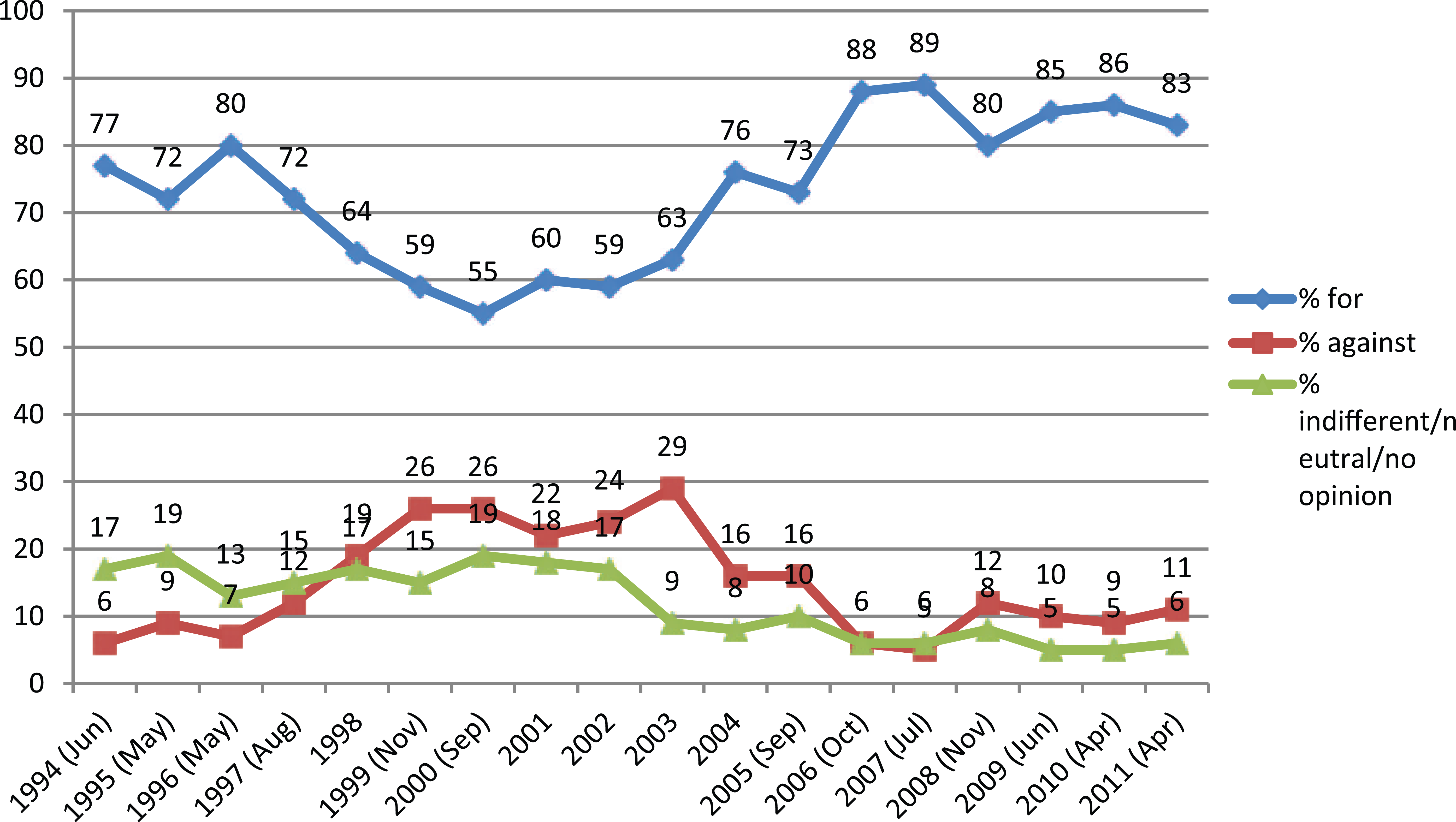
Support for EU membership in Poland, 1993–2011 81
As the data above show, Euro-enthusiasm began to decline in 1996. The most vocally Euro-skeptical period in Poland began after the 1998 Russian economic crisis, when unemployment in Poland itself began to skyrocket. The 2001 global recession worsened the situation, and in 2002 the Polish unemployment rate reached its apex at nearly 20 percent (see Figure 2). While unemployment alone is not sufficient to determine the overall condition of a national economy, in Poland at the time it was considered the country’s most important problem by both clergy and laypeople and was one of the most influential factors determining support for joining the European Union. 82 In addition to fears that unemployment would rise after joining the EU, Poles’ other fears included “bankruptcy of small and medium enterprises, collapse of large farms, and difficulties with sales of farm produce.” 83
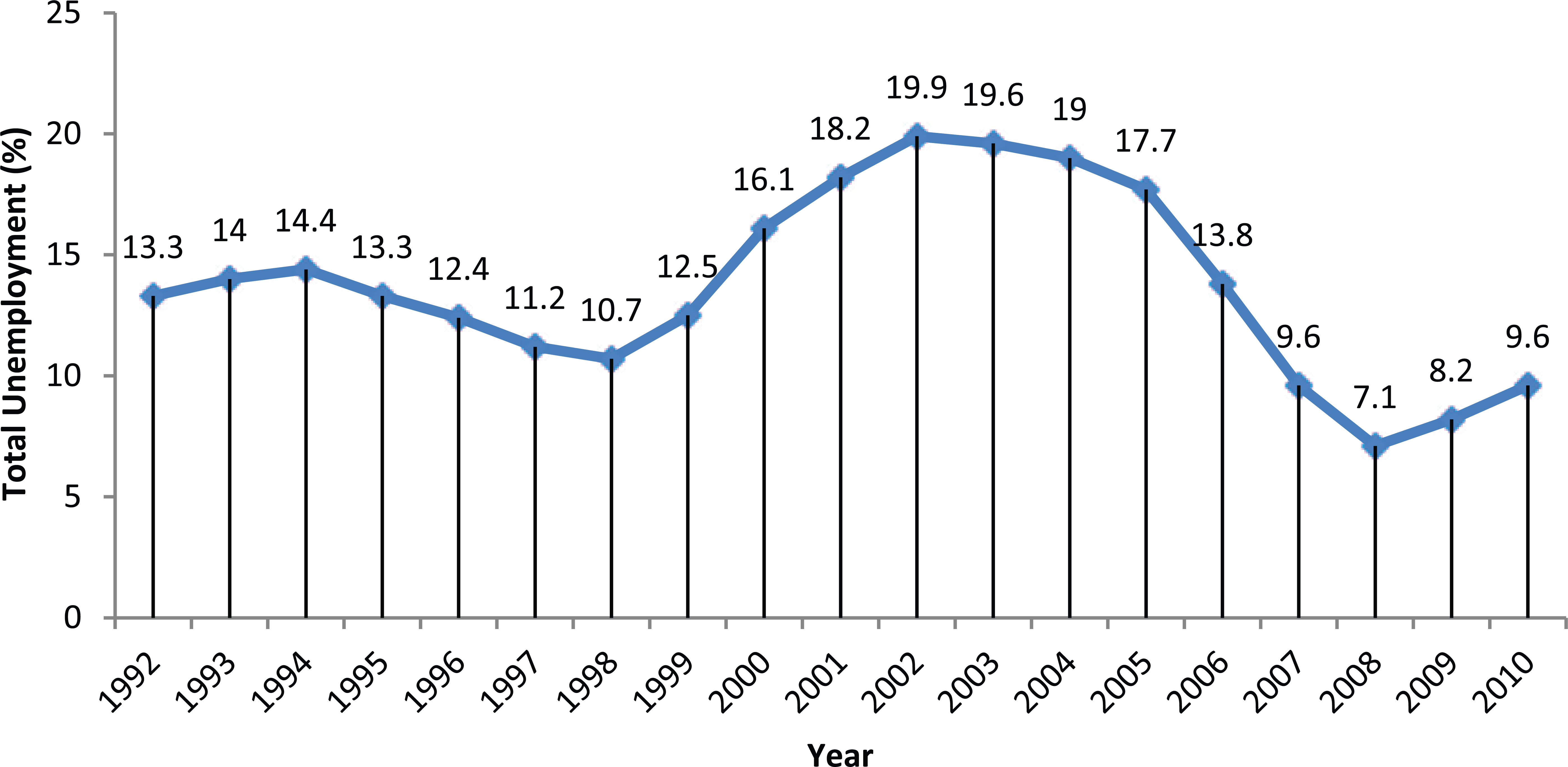
Poland unemployment rates, 1992–2010
However, even at the height of the Polish recession, EU membership enjoyed widespread support in Poland due to its strong perceived benefits. Poles hoped that “the integration [would] enhance the international security of Poland, secure protection of human rights, and provide the opportunity to work and live abroad,” that Poland would “adopt new technologies and knowledge and make greater use of international contacts and co-operation,” and that “as a result, Poland’s position in the modern world [would] largely improve.” 84 As Aleks Szczerbiak has shown, every government in the first two decades after the fall of communism, whatever its political orientation, held Poland’s accession to the EU to be its top priority—even despite “tough negotiating rhetoric” on the part of the Polish Right. 85 Even the postcommunist and leftist Social Democratic Alliance, which began governing during a period of low public support for EU accession (September 2001), reneged on its campaign promise to liberalize Poland’s abortion law and cultivated friendly relations with the Polish Catholic hierarchy. Some speculate that this was part of an agreement to assure the Church’s vocal support for accession, which would reflect a continuation of the quid-pro-quo church-state dynamics characteristic of the communist period. 86 Whether or not there was an agreement, “The Church urged its followers to go out to the polling stations, while indirectly stirring them to vote for Poland’s EU membership. One week prior to the referendum, the priests across the country read the Episcopate’s appeal to Poles to embrace the words of John Paul II that the ‘quest for Poland’s proper place in the political and economic structures of a united Europe is a rightful one.’” 87
Fathers of Europe
Drawing on the work of Jarosław Gowin, Geneviève Zubrzycki has devised a rough classification of four broad ideological orientations among Polish Catholic clergy, including “open,” or liberal; “purist”; traditional-conservative; and “closed,” or integrist clergy.
88
The narrative of a baptismal foundation of Europe and Europe as a hereditary community of Christian spirit is espoused primarily by clerics falling into the purist and traditional-conservative camps, which together make up the large majority of clergy in Poland, although specific estimates of their numerical prevalence are difficult to come by. Zubrzycki describes the traditional-conservative clergy as follows: Traditional-conservatives did not oppose Poland’s so-called “return to Europe,” but they argue that Europe would be stronger if it renewed its bonds with Catholicism. Accordingly, they see it as their mission to re-evangelize the Continent, with Poland as the Antemurale Christianitatis, the rampart of Christianity. No longer must Christians halt the advance of the (external) infidel; rather, Europe must be brought back to its forgotten values. A corollary to this is that Poland’s integration into a “de-Christianized Europe” brings with it a threat to Polish and Christian values: in the wake of Communism’s collapse, it is the West and its corrupted values that endanger this last European bastion of Christianity. Poland, then, must also remain Catholic in order to protect Europe from itself.
89
While traditional-conservatives see a strong link between Catholicism and nationally inflected cultural mores, purists “warn against the conflation of nation and religion: instead of emphasizing Polish Catholic exceptionalism . . . the purists stress the universality of Catholicism. They also consistently promote the principles of Vatican II: namely, ecumenism and attempts to modernize the Polish Church.” 90 John Paul II was a unique figure in that he straddled both of these popular camps, which underpinned his broad appeal both within Poland and abroad.
The main Catholic clerical counter-discourse comes from prominent Europhobic clergy whom Zubrzycki labels “closed,” like Fr. Tadeusz Rydzyk and Fr. Czesław Bartnik, who speak openly about the European Union as an evil empire riding on a tide of Jewish, capitalist, and masonic conspiracies. Although their pronouncements garner considerable media attention and have won them a devoted following, their voices have become a decisive minority since the end of the 1990s. “Open” clergy, like the late Józef Tischner and Adam Boniecki, certainly address themselves to Christian culture and Europe, though they have been less vocal about the project of Europeanization itself.
As in the wider population, the Polish Catholic hierarchy (here very generically speaking) went through several phases with regards to its attitudes toward EU membership, albeit in its own distinctive way. Fr. Mazurkiewicz periodizes three phases as follows: (1) Enchantment with Europe, from 1989 until the spring of 1990; (2) Dread, from the spring of 1990 until late 1995; and (3) Prudence, from late 1995 until the present day. 91 During the first phase, communist-era enchantment with “the West” still predominated. Rather quickly, however, enchantment turned to dread as “the transition period revealed a cultural terrain in the form of a collapsing civilization. Many negative phenomena, such as the acceptance of abortion, euthanasia, homosexuality, pornography, moral pessimism, and a relaxation of Church membership received their moral support from Western culture. Also indicated [by the clergy during this time] was the common aim, in both East and West, to privatize religion and lock up God in the ghetto of the Church.” 92 The clergy feared that the EU would leverage its position to force a liberalization of Polish law regarding these “negative phenomena.”
John Paul II, however, continued his staunch support of European integration during the early 1990s, stressing both its inevitability and the responsibility of Polish clergy for shaping the direction of European Christianity. 93 Within a few years, many Polish clergy also had become convinced that isolationism would only weaken Poland’s position in Europe, and by the end of 1995 an increasing number of pro-EU pronouncements by the clergy were appearing in the Polish media. 94 In 1997, the first delegation of Polish bishops visited Brussels in order to meet with EU representatives who they hoped would assuage their concerns about the loss of Polish national sovereignty with EU membership. The results were positive, with Bishop Tadeusz Pieronek, then Secretary General of the Polish Episcopal Conference, stating upon the bishops’ return: “The Church will be encouraging Poles to support [European] integration. . . . We are doing it already and we will be doing it even better.” 95 The end of the 1990s and early 2000s saw a consolidation of this stance. In an interview given to the newspaper Rzeczpospolita in 2000, Archbishop of Gniezno Henryk Muszyński argued that he was “convinced that there is no alternative [to joining the EU]—politically or culturally. It’s difficult to imagine Poland between an integrated Europe and Russia. In the cultural sense we belong to Europe, and that in large part to Western Europe.” 96 In these pronouncements, nationalist concerns for Poland’s welfare and sovereignty mixed with a narrative about Poland’s European belonging. The official 2002 statement of the Polish Episcopate regarding European integration defined Europe as an entity to which Poland certainly belonged: “Europe is . . . a community of deeds, culture, ideas, and tradition based on enduring Judeo-Christian spiritual values, Roman Law, and Greek philosophy.” 97
But the pragmatic concerns of geopolitics weren’t the only calculus for the Polish clergy; there was also a deep conviction that the Polish Church had a mission to re-evangelize those parts of Europe which had fallen away from their “true” heritage. Cardinal Józef Glemp (then Primate of Poland) articulated the Church’s dominant “Euro-realist” perspective in these terms in 2001: “[Europe’s Godlessness] is all the more a reason to enter [the EU]; just as the Church went on missions to the pagan world, today we enter endangered environments.” 98 He continued, “We do not enter the Union blindly; rather, we know that with our entry our values, everything that is close to our heart, also enters.” 99 Indeed, the notion that “it is better to influence the course of Europeanization than to fight it” well expresses the new consensus formed among Polish bishops and clergy during the mid-1990s. John Paul II, Muszyński, and Mazurkiewicz all understood Poland to be a privileged custodian of Christian values and its mission to be to spread those values throughout a laicized Europe.
What is distinctive in the case of the Catholic clergymen treated here is their emphasis on a particular theology of transcendence which is believed to underlie all “true” religions and cultures. As Mazurkiewicz writes, “The true unification of states on this continent can only occur on the level of culture, meaning with the support of common spiritual values, which—though universal—in Europe appeared historically in the context of Christianity. . . . If Europe is, above all, a certain kind of cultural collectivity, it cannot be forgotten that the foundation of culture is the vertical relation—its relation with God.”
100
This emphasis on God as the foundation of human sociality is a direct echo of the “Christian anthropology” of John Paul II, which he, in turn, derived from the philosophical school of Christian personalism in the mid-twentieth century.
101
By Christian anthropology, John Paul II and the Polish clergy understand a notion of personhood in which the human being is the image of God. It is the transcendence of this understanding of personhood which, in the view of the clergy, is the only insurance both against the failure of community-building projects and against the totalitarian tendencies of the twentieth century. That is why, in his speech regarding the drawing up of a European Constitution in 2002, John Paul II could say, A challenging task lies ahead of European political persons! To be fully equal to it they will need to know how to give to such values the deeply rooted transcendence that is expressed in openness to the religious dimension. This will also allow them to reaffirm the non-absolute nature of political institutions and public authorities due to the fact that primarily and quintessentially the human being “belongs” to God, whose image is indelibly stamped on the nature of every man and woman. If this were not to take place, there would be a risk of legitimizing the orientations of agnostic and atheist laicism and secularism that lead to the exclusion of God and of the natural moral law from the sectors of human life.
102
Mazurkiewicz, like many other Catholic hierarchs both in Poland and beyond, strongly echoes John Paul’s conviction that it was a deficit of Christianity (specifically, a “transcendental foundation of personhood”) which enabled the rise of Hitler and Stalin and which has the potential to enable such political terrors again. 103 He view is a common one. In a paper given at a 2004 international symposium devoted to John Paul II’s European thought, the late Archbishop of Lublin Józef Życiński asked, “What kind of culture is possible after Auschwitz? We must exclude from cultural-axiological propositions false prophets predicting alternatives to a classically understood Europe. These false harbingers of a new cultural order draw from a Marxist vision of Prometheus and liberatory rhetoric whose crowning glory was the gulags.” 104 Instead, Życiński argues that the preamble to the European Constitution must include an invocation to God. “Never again can we give voice to experimenters in the realm of anthropology,” he declares. 105 By conveying “European/Christian values” to future generations, therefore, the Church hopes to stave off another totalitarian system.
Narratives beginning with national/European Pentecosts are one way to embed notions about the transcendent nature of personhood within history. However, because Catholic philosophers of history on the whole also acknowledge the indispensable role of Greco-Roman antiquity, the Renaissance, and even the Reformation in crafting “European” culture, these baptismal narratives often attempt to tie many disparate historical traditions to moments of Christian foundation.
106
In an oft-cited passage from his sermon at Gniezno on the 1,000th anniversary of the death of St. Adalbert, John Paul tied together the threads of Christianity, transcendental personhood, transcendental collectives, human rights, the Enlightenment, European culture, nationalism, inheritance, and saints: In the name of a respect for human rights, in the name of freedom, equality, fraternity, in the name of human solidarity and love I call: Don’t be afraid! Open the doors to Christ! The human being cannot be understood without Christ. That is why the wall which is being erected today in hearts, the wall dividing Europe, will not crumble without a turning toward the Gospels. Without Christ, a lasting unity cannot be built. It cannot be done while cutting oneself off from those roots from which the nations and cultures of Europe grew, and from the great riches of bygone ages. How can we count on building a “common home” for all of Europe if we lack the bricks of human conscience fired in the flame of the Gospels, bonded together with the cement of social love, being the fruit of God’s love? It was precisely this kind of reality which St. Adalbert sought; for that future he gave his life. He also reminds us today that we cannot build a new order without a renewed human being, that strongest foundation of every society.
107
The new wall of which John Paul II speaks here refers to the enmities, prejudices, and divisions he argued had emerged in the postcommunist period and which could potentially stall the process of European integration and re-Christianization, not to mention result in a resurgence of violence the likes of which early European organizations had been formed to avoid. To counter this, he uttered his famous statement: “There will be no unity of Europe so long as it is not a unity of spirit.” 108 And later in the same homily he added, “The foundations of the spiritual unity of Europe have been laid upon the Gospels.” 109 For John Paul II and many of the clergy influenced by his thought, then, a national-European theology is the antidote to another century of hatred and bloodshed.
Conclusion
A few years into the European Union’s sovereign debt crisis, The Guardian editorialized in 2011, “If Europe finds it hard to tell its own story at the moment, it does not mean there is not one. . . . Even in distress, Europe has simply become too integrated, too big and too close to us to ignore.” 110 As the crisis continued to spread in subsequent years, the question of whether there can be a “story of Europe” and what that story should be has become a preoccupation of policymakers and public intellectuals across Europe as well as countless ordinary citizens. The conclusion reached by the Polish Catholic clergy in the mid-1990s, that despite its many problems and shortcomings, the European Union is a privileged vehicle for establishing a narrative of European identity, appears to be on more tenuous footing as the European Monetary Union and the EU’s structures of governance falter. However, the decision by a sizeable and vocal contingent of the Polish Catholic clergy to participate in the European project by envisioning itself as the party conferring Europeanness onto a uniting continent is not beholden to the success of the European Union’s nation- and civilization-building project, and so can find expression in myriad other institutional and non-institutional forms. 111
This Europeanization of Europe, whether in its “secular” or “religious” expressions, structurally mirrors nationalist projects in that it relies on a narrative of foundation and subsequent legitimate inheritance of subjective and territorial/state property through a genealogical chain. An influential Catholic inflection of this project, national-European theology, has had a profound effect on Catholic political theology in Europe. Though articulated most sensationally by John Paul II, it was carried on, in his own particular inflection, by Pope Benedict XVI, formerly Prefect of the Congregation for the Doctrine of the Faith under John Paul II and one of the late pope’s closest advisers. 112
However, Benedict’s successor Francis has moved away from this identitarian vision toward an emphasis on the social Gospel, introducing the most strident critiques of capitalism yet to be heard from the Holy See. 113 Tellingly, in a 2013 conversation with Angela Merkel, who was preparing for upcoming elections, the two appeared to be talking at cross-purposes: Angela Merkel focused on emphasizing Europe’s “Christian roots,” while Francis stressed the need for a “strong and just” Europe. 114 Francis was, of course, born in, and served as Archbishop of, Buenos Aires, Argentina—there have been no other popes from beyond Europe in Rome since the High Medieval period. 115 Thus, Francis may herald a tilting of political influence within global Catholicism away from Europe and toward the churches of the global south, with an attendant shift in focus away from institutional consolidations of identity and toward a new, worldwide civilizational project found in theologically-articulated principles of economic justice. It is still too early to tell, but the reign of Francis suggests that although it remains influential, the heyday of national-European theology as a mainstream position within the global Church may have irrevocably passed. Which Polish clergy follow Francis’s lead; remain committed to the trajectory articulated by John Paul II; or choose entirely different alternatives remains to be seen.