



Abstract
This article deals with ballot order effect in preferential voting in general elections in Slovakia. Previous research in this field has primarily focused on countries whose elections are based either on single-member districts or on lists with fewer candidates. This article aims to analyze a case of a different nature. Slovakia uses a proportional representation list system with a single nationwide constituency where all 150 members of parliament are elected. Hence, most of the political parties create lists with a high number of candidates, which according to theory should enhance the influence of ballot ranking. Using data from Slovak general elections between 2006 and 2012 with a sample of 7,587 candidates, this study provides strong evidence of the impact of ballot order on the results of preferential voting. The analysis in this article shows the existence of both the primacy and recency effects, that is, a positive bias of voters towards candidates listed at both top and bottom positions on a list. What is more, the multilevel models used in this article demonstrate that support for top-ranked candidates significantly increases as the size of the list increases. For the bottom-listed candidates, this trend is rather the opposite. These findings represent a valuable contribution to the debate in this area as they provide insight into the role of ballot order in electoral systems that use lists composed of numerous candidates.
Introduction
Recent research continues to focus on the potential influence of ballot form on election results. In this area, the order of candidates is of primary concern. Although studies have produced mixed results, prevailing findings indicate that positions of candidates on lists may play a relevant role. 1 If this is true then some candidates get an unearned advantage.
The literature explains these effects by pointing out the nature of voters. According to the theory, voters make their decisions with imperfect information and they do not necessarily seek optimal but only satisfactory solutions. Under these circumstances, the outcome may be the primacy effect when voters bias their support towards candidates listed in primary positions, or the recency effect when a higher amount of votes are cast in favor of candidates listed at the bottom. Larger numbers of candidates on the lists should theoretically enhance these effects, as every additional alternative decreases the concentration and interest of voters. As such, the highest and the lowest positioned candidates are rewarded because of their ranking.
Scholars have shown great interest in this topic and have provided substantial support for the existence and relevance of the ballot order effect. However, these authors have mainly focused on elections with lists of small numbers of candidates. 2 This itself is not a fallacy, though it limits the possibility of a more general view of the ballot order effect. As different electoral systems and their features lead to various opportunities for candidates to seek personal votes, 3 a similar logic can be expected with respect to voters. Naturally, it is more demanding to read through a list of a large number of candidates than a list consisting of only a few. Assuming that ballot order effect is stronger when higher demands are placed on voters, further research should pay closer attention to elections with lists composed of a larger number of candidates.
This article deals with one such case, analyzing the national elections in Slovakia. The country uses a PR system with a single nationwide constituency where all 150 members of parliament are elected. This aspect is of key importance as each Slovak party creates only one list where it places all its candidates. The ranking of candidates is purely a party matter. Although the electoral system allows for a list with just one or only a few candidates, most parties fill their lists with the maximum of 150 candidates or just below this limit. Slovak voters typically face highly numerous lists, which should thus enhance the ballot order effect.
Our findings are in accordance with this expectation. As the multilevel models will show, the primacy effect is clearly visible in Slovak elections. The candidates listed in the top positions strongly benefit from their rankings and receive the highest portions of preferential votes. Among these candidates, the greatest advantage is held by those in the first position and the effect diminishes with decreasing order. Bias towards the candidates at the bottom of the list was also found, though its effect is significantly weaker. An important result is that the ballot order effect was more substantial for bigger lists. Although present even in smaller lists, the results show that the benefit for the top candidates increases as the list contains more candidates. On the other hand, the recency effect biasing voter support towards the bottom candidates does not follow this trend. These findings represent a valuable contribution to the debate about ballot order effect as they provide an insight into its role in electoral systems that use lists composed of a large number of candidates.
Our research also examined other candidate features. The analysis showed a positive effect of incumbency on the number of votes cast for candidates. Those who had previously occupied an office received a higher share of votes, though this increase was not as significant as that of the top-listed candidates. Gender and education of candidates have been shown to have only very limited impact.
The structure of the article is as follows: The first section outlines the theoretical insights into ballot order effect. The next part introduces the Slovak electoral system as the institutional arena for analysis. The third section defines the methods and presents the data. The fourth section describes the results, and the article concludes with a summary and comments on limits to these findings.
Theoretical Assumptions about Ballot Order Effect
It is widely accepted that ballot content plays a role in voters’ decisions about whom to support in elections. The existing research provides enough evidence to show that citizens often rely on heuristic cues or information shortcuts, that is, the personal features of candidates typically presented on the ballot. Hence, individual characteristics such as gender, race, or education may substantially influence the final results of candidates and their access to mandates. 4
Aside from this, a growing literature focuses on ballot order effect, that is, a concept which assumes that the order of candidates on the list has an influence on voters’ decisions. Voters typically make their decisions with imperfect information, although nowadays information is provided through an increasing number of channels. Under these circumstances, this may result in the primacy effect, when voters bias their support towards candidates listed in the top positions, or the recency effect, when a higher number of votes are cast in favor of candidates listed at the bottom. 5
One of the main approaches explaining these effects is the satisficing theory. 6 It states that voters do not necessarily make optimal decisions but will accept solutions that are satisfactory enough. Voters thus set requirements that they find important, and when they procede through the list they check whether candidates fulfill these conditions. With every subsequent alternative, their attention decreases and their interest fades. As more candidates pass the voters’ test, voters are more open to supporting those listed in the front positions. This bias is labeled the primacy effect.
The so-called recency effect works on the opposite principle. This may occur when voters do not evaluate the candidates based on reasons to vote for them but instead on reasons to vote against them. When proceding through the list, increasing fatigue and lower concentration lead voters to find fewer reasons not to vote for the lower-ranked candidates. In the end, voters operating under such logic are biased to express their support for the candidates at the bottom of the list.
The ballot order effect may also appear under different circumstances. Miller and Krosnick state this phenomenon may occur when uninformed voters want to act as “good citizens” by participating in an election. 7 For these voters, it is irrelevant whom they choose; they select the first option in the list. The so-called donkey voting documented in Australia is based on a similar principle 8 — voters who cast more than just one vote give them to candidates in accordance with their order on the list. Here the ballot order effect is reinforced by the higher demands put on voters.
The research on ballot order effect is not only theoretical but provides solid empirical findings. John Regan analyzed the results of the Irish general elections from 1977 to 2011, where candidates were ordered alphabetically on the ballot. His sample covered 457 competitions at the district level for a total of 4,807 candidates. Regan’s research proved the presence of ballot order effect as he showed that candidates in the top positions scored better, with a plus of 1.27 percentage points. 9
Bagues and Esteve-Volart concentrated on Senate elections in Spain from 1996 to 2008. In their work, they found a substantial ballot order effect. Their outcomes show that candidates listed in top positions gained more votes while this advantage was more significant for the minor parties. For two major Spanish parties, the candidates got a surplus of about one-tenth of their support and for nominees of minor parties, this advantage added nearly one-fifth to their results. 10 These findings about the heterogeneous influence of ballot order effect are not rare. Ho and Imai studied statewide elections in California from 1978 to 2002 and found that the advantage for candidates of being listed first on the list is linked with small parties and non-partisan competitions. Conversely, their analysis of primaries detected no difference among candidates of various parties. 11
Koppell and Steen, who focused on Democratic Party primaries in New York City, provided interesting findings. Their results show that in 71 of 79 individual competitions, a bias toward the candidates in the first position occurred. What is more, in 7 of these 71 races the ballot order effect exceeded the winner`s margin of victory. In these cases, the order of candidates might thus have determined the electoral outcomes for the winner. 12
Findings on the influence of ballot order effect varies among studies. Miller and Krosnick conducted an analysis of an Ohio election and concluded that being first on the list added an average of 2.5 per cent of votes. 13 A slightly stronger effect was found by Meredith and Salant in their study of California city council and school board elections. They showed that candidates ranked first got a surplus of 4–5 per cent of votes. 14 Finally, a different impact was found by King and Leigh in their article about federal elections in Australia. According to them, support for candidates in the top list position was increased by approximately 1 percentage point. 15
The existing research shows the relevance of ballot order effect and generally links it to an advantage for top-listed candidates. The topic itself exceeded the theoretical environment and entered the legal arena when it became the subject of several court decisions. 16 In respect to geography, the research primarily focuses on the USA while other countries and regions are underrepresented. What seems more important is that authors have mainly focused on elections where lists with fairly small numbers of candidates are used. Regan`s article about Irish elections worked with competitions of 4 to 24 candidates (average of 11.53). In the districts of Australian federal elections analyzed by King and Leigh, approximately 2 to 14 candidates competed (with an average of 6 persons per district). Similarly, the number of candidates contesting in the California city council and school boards elections studied by Meredith and Salant ranged between 2 and 9. 17 Assuming that ballot order effect will be stronger when higher demands are put on voters, further research should pay more attention to elections with lists composed of larger numbers of candidates. The ballot lists in the general elections in Slovakia are an example.
Preferential Voting in Slovakia
After the fall of the communist regime, Slovakia 18 introduced a PR system for its general elections. The country’s territory was divided into four constituencies matching the borders of regions. The threshold was set at 3 per cent, thus allowing the smaller parties to obtain seats. This original framework contained flexible lists that gave voters the option of also participating in intraparty-level competition. Several modifications were subsequently made to the electoral system, but its basic proportional logic was kept unchanged. One example was the raising of the threshold from 3 to 5 per cent before the election of 1992. 19
The most important reform to date was introduced in 1998. The government, led by Prime Minister Mečiar and characterized by its problematic way of executing power, enforced a change of electoral rules shortly before the election with the aim of increasing its chance of success. The key intervention was the abandonment of the existing four districts and the adoption of a single nationwide constituency. Some other measures were taken to weaken the opposition as well, but these were all removed after Mečiar’s defeat in the 1998 election. As such, the nationwide constituency remained as the only relic of this electoral reform. 20
This framework is still valid. The Slovak parliament is composed of 150 members who, since the 1998 election, have been elected from a single district. Each political party thus creates only one candidate list. Although Slovak electoral law does not set any minimal number for candidates, the relevant parties generally fill the list with a maximum of 150 names. The order of candidates is fully at the disposal of the parties and it is consistent for the whole territory of the country. The ballots are thus subject to no rotation and they remain completely identical for all voters.
As mentioned above, the Slovak electoral system has used flexible lists since 1990 and voters are allowed to cast preferential votes. The original framework of the system operated with conditions that strongly limited the opportunity of voters to modify the order of candidates set by political parties. Before the 1994 election, these conditions were weakened, but the shift to one nationwide constituency in 1998 had exactly the opposite effect. To move to the top of the list, candidates had to obtain a number of preferential votes equal to at least 10 per cent of the votes of their party. This condition proved to be devastating, and so before the election in 2006 this threshold was reduced from 10 to 3 per cent. This last modification of the electoral system returned to the voters some potential to affect intraparty competition.
The current preferential voting in Slovak general elections works as follows: Voters have four preferential votes which they cast for candidates of the party they voted for. 21 Preferential voting is fully optional and if a voter does not use this option, only her or his vote for the party counts. After the polling stations are closed, the votes are calculated and, based on the Hagenbach-Bischoff quota, seats are allocated to the parties. It is only at this stage that the preferential votes come into play. First, candidates who have crossed the threshold of 3 per cent of their party`s votes are identified, and these are ranked at the top of their lists based on their results. The remaining candidates are placed below them but according to their original ranking. 22 This newly created order determines which candidates will obtain seats and represent their party in the parliament. 23
This implies that the Slovak electoral system works only with those preferential votes that are actually cast. If voters decide to support only the political party without giving any preferential votes to its candidates, they do not implicitly approve the order of candidates set by the party and voters’ unused preferences cannot be calculated by any means. The Slovak system thus differs from models used in other countries like Belgium where voters may support a candidate using a preferential vote or cast a vote for the party list as a whole. In Belgium, both types of votes are used for seat allocation, as list votes help the candidates placed in the top positions. 24 In Slovakia, no such mechanism is applied, and only the actually cast preferential votes are calculated. 25
Finally, the impact of preferential voting needs some attention. As mentioned above, the adoption of the single nationwide constituency in 1998 paralyzed the system. In the 1998 and 2002 elections, only one candidate was able to obtain a seat based on preference. Preferential voting at that time was thus nugatory, with virtually no effect on the election results. The decrease of threshold from 10 to 3 per cent of the parties’ votes enabled voters to participate at the intraparty level. In 2006, seven candidates became MPs thanks to preferential votes, and in the elections in 2010 and 2012, this amount rose to 10 and 15, respectively. Note that most of these candidates were originally positioned in the upper half of their lists; however, exemptions from this rule occurred (see further below). To conclude, the composition of the Slovak parliament since 2006 is at least partly influenced by preferential voting, thus making it a relevant topic for more detailed research.
Data and Methods
This study analyzes the results of preferential voting in Slovak general elections. The sample covers the three most recent elections in 2006, 2010, and 2012. This choice was made based on several factors. First, the respective elections were run under identical electoral rules. This fact excludes any potential influence of electoral law modifications made during the period under analysis. The last reform of the Slovak electoral system was implemented before the 2006 election. In later years, further possible changes of the system were discussed, but before the 2012 election none were applied. Second, in the 2006–2012 elections, the turnout of voters on preferential voting was quite stable. Since the implementation of preferential voting in 1990, the turnout for this part of the elections has been continuously growing, and the most recent elections indicate its stabilization. Throughout the 2006–2012 elections, this turnout hovered around three-quarters, with a high in the 2012 election when it passed 80 per cent. Note that in the second half of the 1990s, only slightly more than half of the voters used preferential votes.
A total of sixty-five party lists competed in the three respective elections. Of these lists, one party has been excluded from the analysis. The reason for its exclusion is quite straightforward. In 2010, one of the parties entered the election with a list containing just a single candidate. The party served as a commercial project and its participation in the election was a recessive gesture. Its only nominee naturally got all the preferential votes from the party’s voters. This case is excluded from further analysis, as having a list with only one candidate allows voters no interference at the intraparty level. The data set thus includes 64 party lists with a total of 7,587 candidates.
The dependent variable represents the candidate’s preferential votes. It is defined as the percentage share of gained preferences out of the number of votes cast for the political party on whose list the candidate was nominated. For each candidate this value may range between zero and one hundred. The former case appears if none of the party voters gives a preferential vote to the candidate. The latter case is the opposite and may occur if a candidate receives a preferential vote from all voters of his or her party. As the values of the dependent variable are not set as absolute gains of preferential votes, they are fully comparable among candidates from different parties. It is thus fully irrelevant how many votes the parties receive as the values of the dependent variable for all candidates may vary between zero and one hundred. As such, each candidate has the same basis for the analysis, which the application of an absolute number of preferential votes would not be able to secure.
In accordance with the theoretical assumptions, the independent variable is defined as the logged ranking of the candidates on the list. The log modification is applied because of the profile of the distribution. Aside from this, a set of dummy variables is used to map the potential primacy and recency effect. Literature indicates that candidates listed first score better than the ones listed second. 26 In general, this finding indicates that mapping only the gains of the very first and last candidates may show the real image only to a limited extent. As such, the analysis in this article operates with a set of eight dummies which cover the top four and bottom four candidates in the lists. This amount is the same as the number of preference votes given to each voter, and it allows a better insight into the ballot order effect.
Thorough research has been done in the field of incumbency advantage. According to many scholars, persons holding an office do better in elections for various reasons. Incumbents are better known to the voters, they have proven their ability to survive in the political arena and they typically have better access to resources. 27 Incumbency may be of higher importance in single-member districts, as such a framework draws attention to the candidates instead of to the parties standing behind them. Systems with party lists work differently. If they allow the voters to participate in the intraparty level of competition, however, it is relevant to expect some impact of incumbency as well. For this purpose, a dummy variable is constructed with a value of one for incumbents and zero for non-incumbents. Incumbents are defined as those who are or have previously been members of parliament or the national government.
Aside from list ranking and incumbency, a few control variables are used in the analysis. These cover some characteristics of candidates which, according to the literature, may have an influence on the election results. 28 Following these findings, gender and education of candidates are included in this study, both coded as dummies. In the case of gender, women are given a value of one while men are coded as zero. The dummy variable standing for education gives a value of one to highly educated candidates, that is, those with at least a PhD degree, and a value of zero to the remaining candidates. University degrees are added to the candidates’ names on the ballots, and thus voters in Slovak elections are easily able to identify those candidates’ education levels. The information about the control variables used for the analysis is presented in Table 1.
Descriptive statistics of the control variables
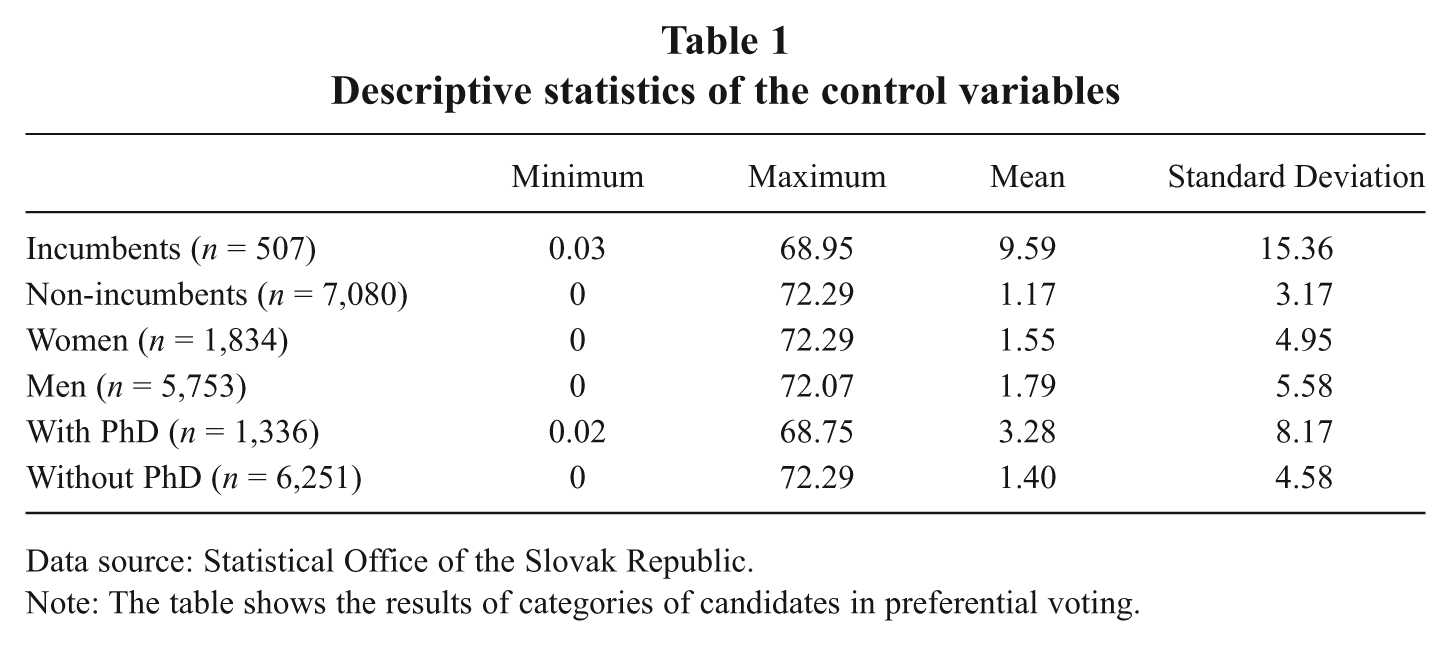
Data source: Statistical Office of the Slovak Republic.
Note: The table shows the results of categories of candidates in preferential voting.
As mentioned above, Slovak parties submit lists with up to 150 candidates. Although most of the parties fill their lists with the maximum possible number of their nominees, some parties do use shorter lists. At first sight, this variance might be explained by different ambitions of parties. In other words one may presume that parties fill their lists with the number of candidates that correspond to the number of offices they expect to win. This, however, is only partly true as most Slovak parties never gain more than 20 or 25 MPs. Submitting a list with 150 candidates thus serves as a way for political parties in Slovakia to prove their competence to their voters. 29 Hence, even parties who expect to attain only a small or marginal amount of votes often submit a list with the maximum number of candidates. On the other hand, these minor parties are the only ones who create small or medium-sized lists. Thus, while the length of the lists does not fully correspond to the size of the parties, these two functions cannot be completely separated.
Based on existing theory, the ballot order effect should be more substantial with the increasing size of the lists. The various numbers of candidates on the lists provided by the Slovak political parties thus allow controlling for this aspect. In order to cover this feature, a multilevel regression model with fixed effects is used instead of a classical ordinary least squares model. For this purpose, the lists are divided into three categories—small (less than 50 candidates), medium (50 to 99 candidates), and large (100 and more candidates). The data about list size are located at the higher level within which the individual data about the candidates are nested. Note that even the lists labeled as small still far outreach the size of lists in most other countries’ elections. The multilevel model allows interactions between the independent variables and the size of the lists, and thereby it provides a more precise insight into the topic than separate analyses of the three selected categories could achieve. Descriptive information about the three categories is summarized in Table 2.
Descriptive Statistics of the Data Set
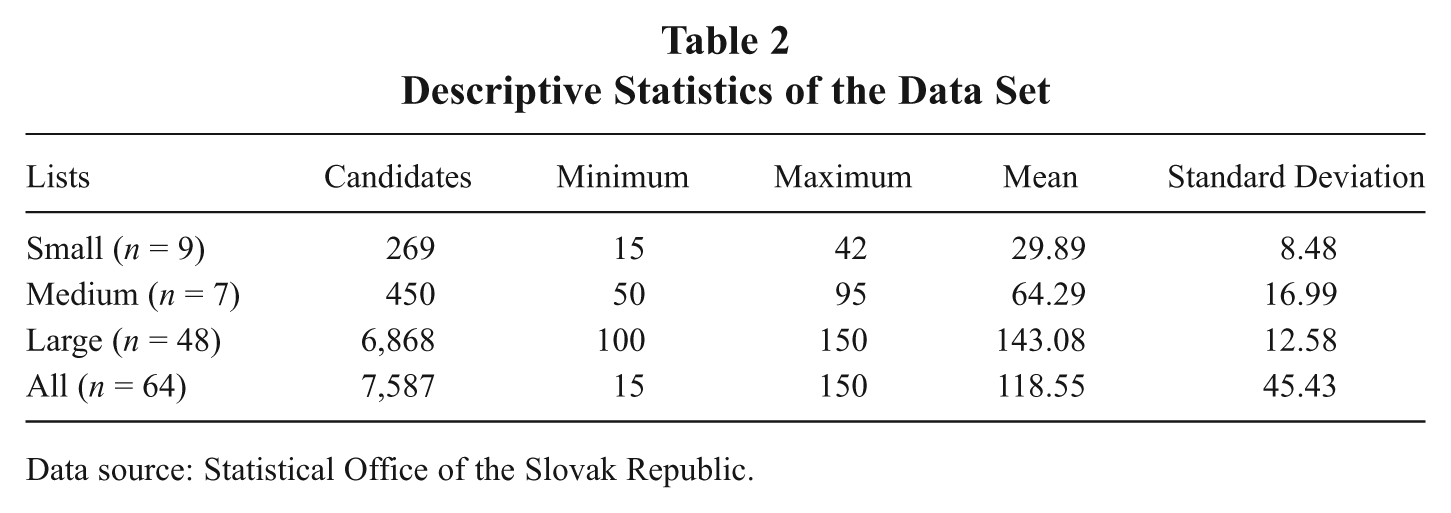
Data source: Statistical Office of the Slovak Republic.
As for the results, I expect the following: First, the ranking of candidates will be a strong predictor affecting their gains of preferential votes. Second, in the case that both primacy and recency effects are identified, the former will have a more significant influence. The logic of both hypotheses is built on the presumption that the long lists used in Slovakia should create a sizeable burden for the voters. The high number of candidates should demotivate the voters and thus impede them from moving through the whole ballot. It is presumed that such conditions will lead to a bias that is especially advantageous for the candidates in the top positions. In respect to the size of the lists, the respective effects should be more substantial in the lists containing the highest number of candidates.
Results
This article adopts multilevel modeling to estimate the results. Table 3 shows the outcomes for the whole data set of 7,587 candidates. A total of five models were calculated, the first being the null model serving as a baseline. Every subsequent model added more variables. Model 2 includes the group variables representing the categories of list size. In model 3, all variables regarding the ranking of candidates are added, both the logged ranking and the dummies for the four top and bottom list positions. Model 4 enriches the estimations with data about incumbency, and finally model 5 completes the analysis with variables of gender and education.
Estimation of Preferential Voting (Multilevel Regression Models)
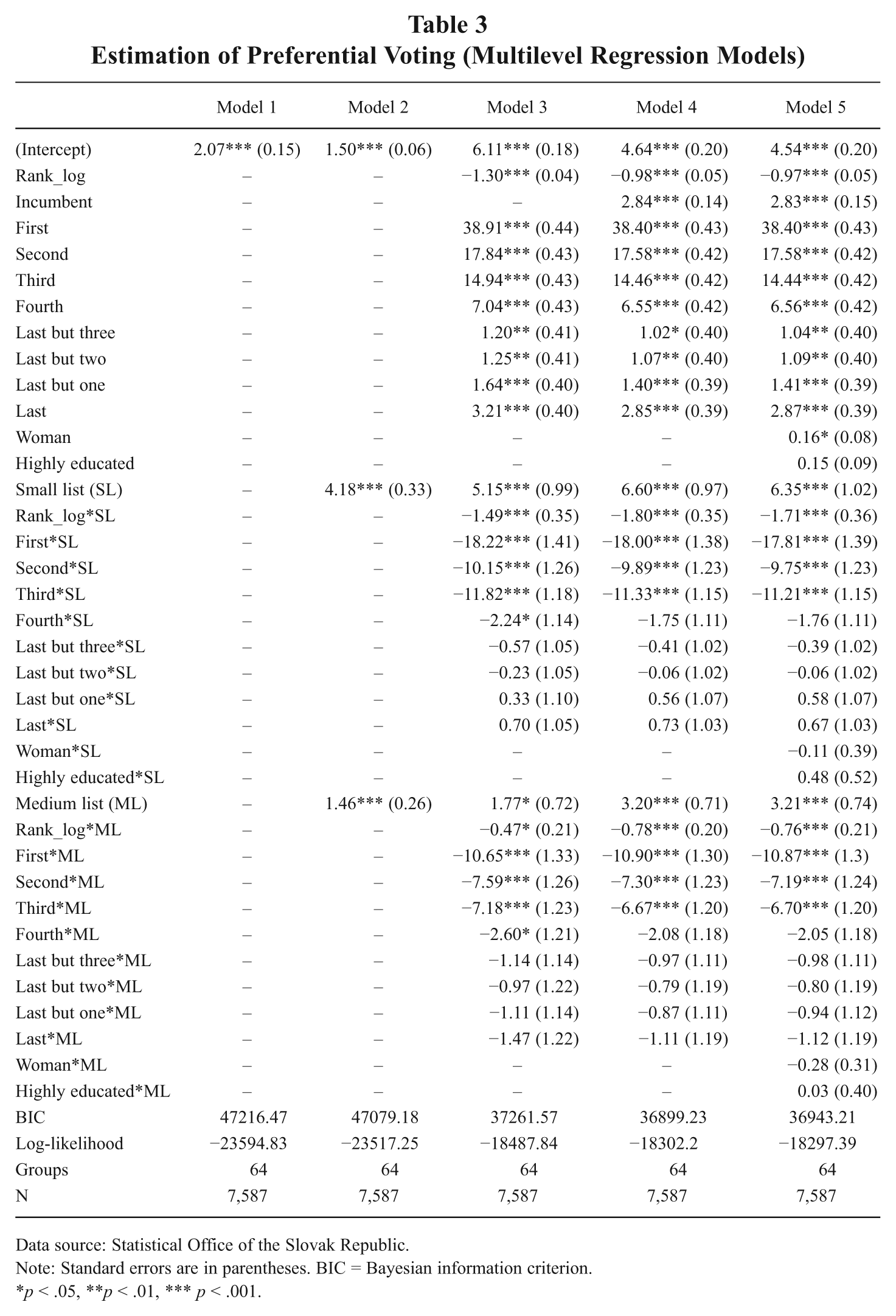
Data source: Statistical Office of the Slovak Republic.
Note: Standard errors are in parentheses. BIC = Bayesian information criterion.
p < .05, **p < .01, *** p < .001.
According to the outputs in Table 3, the more complex models represent a better fit for the data used. Of all the variables, candidate ranking contributed most to the quality of the models. The changing values of Bayesian information criterion (BIC) and the log likelihood reflect these findings in a clear manner. Note their change after inclusion of candidate`s ranking (model 3). The incumbency added to model 4 also showed a relevant contribution. On the contrary, the inclusion of gender and education that appeared in the final model seems to have virtually no effect on this field.
Before interpreting the parameters, a few technical comments are necessary. The higher-level variables representing the categories of list size are coded as dummies. Out of these, the variables small list and medium list are included in the models, thus making the large lists serve as the reference category. Hence, the parameters for the intercept and all individual variables refer to the gains of candidates listed on the large lists. To track the potential differences between the list size categories, the interactions between the variables of both hierarchical levels are applied. The only exemption here is incumbency, where no interactions are used. The reason is quite straightforward as virtually no incumbent appeared on small or medium lists in any of the elections. Out of the 507 incumbents, 502 were placed on large lists, while only 2 belonged to small and 3 to medium lists. Given this fact, the estimation for incumbency refers only to large-list candidates.
In the first place, the results show that size of the list affects the share of preferences the candidates can expect. The intercept of model 5, which is the best fit for the data, shows that when all variables are without effect, nominees on large lists get around 4.5 per cent on average. This value is significant at p < 0.001. For medium lists, the average portion of votes for candidates is slightly higher, and for small lists, it grows fairly rapidly to nearly 11 percent. This outcome is quite natural. Slovak voters are allowed to cast up to four preferential votes. Thus, in the case of smaller lists, the given amount of preferences is distributed among fewer candidates, effectively increasing the average share for each nominee.
The results provide strong support for the ballot order effect. As expected, the lower ranked candidates obtain a significantly smaller share of preferential votes. This effect is stronger for small lists, while the medium and especially the large lists lag behind. The explanation may lie in the amount of burden put on voters. Longer lists are more demanding and may deter voters from reading through them, leaving many lower listed candidates out of scope. For larger lists, the ranking from some points may lose its relevance as lower ranked nominees receive a similarly low number of votes simply because the voters did not reach their position.
The analysis of Slovak elections shows very strong and statistically significant evidence of primacy effect, that is, a positive bias toward candidates listed in top positions. The highest surplus of preferential votes is granted for nominees ranked first on their lists. The gains for the three subsequent positions are substantially lower, however still giving a powerful benefit to those who occupy them. In respect to list size, the findings fully support the theoretical assumptions. The primacy effect is the strongest in large lists, giving a surplus of more than 38 per cent of votes to the number one candidates. In the case of medium lists, this effect shrinks by more than 10 per cent and for small lists, by nearly 18 per cent. The share of votes received by the highest-ranked candidates in large lists is thus nearly twice that for leaders of small lists.
In all three categories of lists, the second, third, and fourth positions lead to a lower gain when compared to list leaders. Here again the effects for the group of large lists are higher in comparison to medium and small lists. While holding second position on a large list improves the candidate’s result by nearly 18 per cent of votes, the same ranking in small lists helps the position holder by less than 8 per cent. Note that while the estimates for positions two and three significantly differ among the groups of lists this does not count for position four. Hence, the effect of being fourth is not significantly different with respect to the size of the lists.
The results also provide some support to the recency effect, that is, the positive bias towards candidates ranked at the bottom of the list, however without any significant difference between the groups of the lists. Hence, the lowest rankings have some positive effect on the share of votes gained, though incomparably weaker than that for the top candidates. Of the four bottom positions, the last gives the nominees the biggest surplus estimated below 3 per cent of votes. The effect for the second to last candidate is about half that of the last candidate. Candidates placed in the third and fourth positions from last get an improvement of around 1 per cent of votes. Thus, in respect to their impact, in Slovak national elections the recency effect is overshadowed by the primacy effect.
Owing to the construction of multilevel models which include both log ranks and position dummies, it may seem harder to interpret the effect of changes in ballot position. To make this more explicit, I calculated the expected shares of votes for candidates at different positions on the list. The shares are counted with variables for gender, incumbency, and education having a value of zero, for example, displaying outcomes for men, non-incumbents, and without PhD. According to these calculations, the leaders on large lists may expect a share of votes greater than 43 per cent. This value falls sharply as nominees in the second and third positions receive about a half of the share of the list leader. A candidate in the tenth position may expect around 2.5 per cent of votes, and for subsequent ranks this value continuously and slowly fades. In the half of the list represented by position 75, the expected value reaches only 0.5 percent. The general decline ends only just before the very end, where the bottom candidates can expect a higher portion of votes. For the last nominee, the expected share is 2.7 per cent of votes.
For medium and small lists, the expected values work in a similar way. They have the same shape starting with the highest values for leaders and other top candidates, although their expected values are lower than those of large lists. Leaders on small and medium lists may expect to receive 31 and 35 per cent of votes, respectively. When moving down the lists, the continuous decline of vote shares occurs; however, on average the expected values are higher when compared to large lists. Candidates who fall in the middle of the lists have an expected vote share of 2.3 per cent for small lists and 0.9 per cent for medium lists. The gradual drop of vote shares stops shortly before the end of the lists as the values for the bottom candidates increase. For medium lists, this change is fairly low as the last candidate may expect a vote share below 1.5 per cent. In case of small lists, the boost for nominees in the bottom positions is more substantial. The expected value for the penultimate candidate is more than 2.5 per cent of votes and for the last candidate it reaches 4.1 per cent.
In addition to ranking, incumbency also proved to be a relevant predictor although, as mentioned, only in the category of large lists. The analysis shows that candidates with experience either as members of parliament or the national government score better, with a margin of nearly 3 per cent of votes. Given that the threshold which candidates need to cross is 3 per cent of the party’s votes, incumbency may prove to be a substantial help in ensuring a seat. On the other hand, the effect of gender and education proved to be marginal. Despite some evidence that women candidates received a slight increase in their votes, this effect is very low. In the case of education, the PhD degree does not help the candidates at all and shows no significant effect.
To sum up, the multilevel models have identified ballot order effect in Slovak national elections. Both primacy and recency effects were detected, with a stronger effect for the former. What is more, the positive bias of voters towards top-ranked candidates substantially increases for bigger candidate lists. The models do not support such a claim for the recency effect; however, this might be somewhat influenced by an anomaly which occurred in both the 2010 and 2012 elections.
In 2010, the libertarian party Freedom and Solidarity (SaS) made an agreement with the non-political association Ordinary People whose members were given the last four positions on the party’s list. As a result of a costly campaign, these four independents obtained enough preferential votes to become MPs. The next year, they formed their own party: Ordinary People and Independent Personalities (OLaNO). The new party adopted a very specific profile. Except for its four founders, the party lacks any membership and has no structure. Officially it serves as a platform for independent candidates who otherwise are not allowed to compete in national elections. In the 2012 election, the leaders of OLaNO repeated their tactics from the previous election and they occupied the final positions on the party’s list (147 to 150), in sharp contrast to all other Slovak parties, who place their elites in top positions. Just as in 2010, the campaign strongly stressed the nontraditional position of OLaNO leaders on the list. The four founders of OLaNO got enough preferential votes and were elected as MPs again. The leader of the party listed as last obtained by far the biggest portion of preferences while his three companions scored well behind him.
While this situation describes a successful tactical maneuver, it might interfere in the findings of this article. Slovak political parties do not reserve the bottom positions for their elites but occupy those positions with grassroots members. The cases of SaS in 2010 and especially OLaNO in 2012 thus represent an anomaly which could have led to an overestimation of the recency effect, more precisely that identified for large lists, as both of the parties belong to this category. A multilevel analysis without these two outliers estimates the recency effect more characteristic of Slovak parties,.
Table 4 presents the results. With identical variables used, these models represent a slightly better fit to the data, as the values of BIC and log-likelihood indicate. Note that the detected parameters are fairly similar, with only few differences. The effect of incumbency is slightly lower but office holders are still granted a bump of more than two per cent of votes. Also, the effect of position four on the list has become significantly different among the groups of lists based on their size. Apart from this, the other estimates remained more or less without change when compared to analysis conducted on the data set of all parties.
Estimation of Preferential Voting (Multilevel Regression Models)
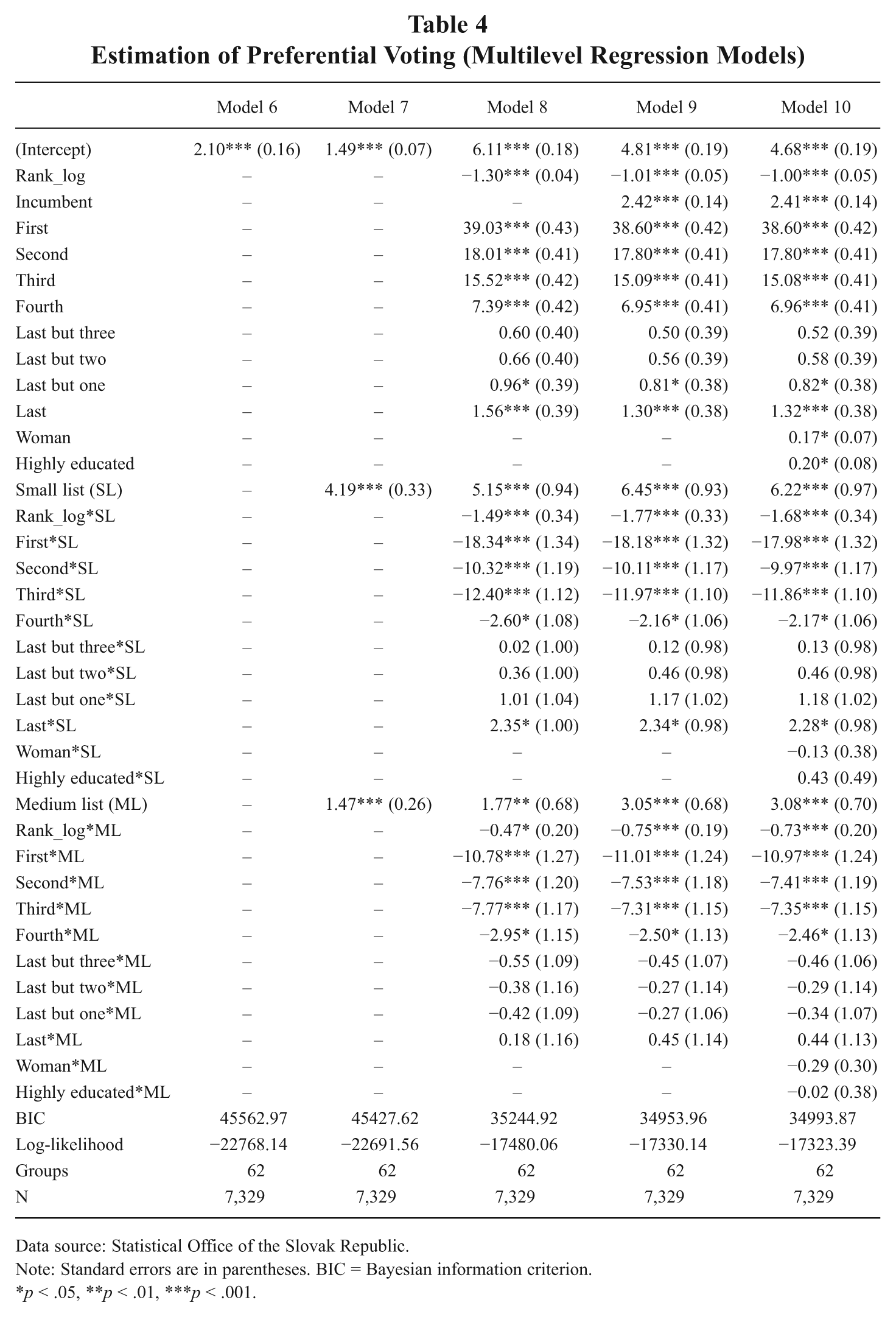
Data source: Statistical Office of the Slovak Republic.
Note: Standard errors are in parentheses. BIC = Bayesian information criterion.
p < .05, **p < .01, ***p < .001.
As expected, the only clear difference is found for the recency effect. As model 5 shows, with all parties included in the data set all four bottom positions showed a positive significant effect which did not differ among groups of lists. After exclusion of the two outliers, the results changed. In model 10, only the two final positions maintained a significant impact on the candidates` results. What is more, the parameters are substantially lower. Being listed as penultimate adds the candidate less than 1 per cent of votes at p < .05 regardless of list size. The last position grants an increase of more than 1.3 per cent of votes; however, this is not true for small lists where this effect exceeds 3.5 per cent. Exclusion of the two outlier cases thus severely lowered the impact of recency effect in large lists. Not only are the third and fourth positions before the end left without significant effect but the gains from two final positions are nearly halved. Based on these results, the recency effect tends to diminish when moving from small to larger lists, the exact opposite of what was found regarding support for the top-listed candidates, that is, the primacy effect. This finding adds an interesting contribution to the discussion in the final part of this article.
Discussion and Concluding Remarks
The analysis of ballot order effect in Slovak general elections shows that a candidate’s ranking in the list influences the share of preferential votes obtained. In accordance with theory, both primacy and recency effects were detected, though different in manner. Finally, this study contributes to the debate about ballot order effect as it points to the role of the size of candidate lists. To control for this aspect, multilevel regression models were calculated, with individual characteristics of candidates being nested in the variables representing categories of lists based on their size. Here, it should again be noted that the function of the length of the list cannot be fully separated from the size of the parties.
In accordance with the satisficing theory, this article shows an impressive bias among Slovak voters towards the top-listed candidates, that is, the primacy effect. As the results show, the highest-ranked nominees get a substantial surplus to the amount of their preferences. Among these rankings, the first position grants the biggest advantage while the three subsequent positions lag considerably behind. The primacy effect works differently depending on the size of the lists, however. When moving from larger to smaller lists, its effects become weaker, although still significant. Put simply, while position one on a large list represents a surplus of more than 38 per cent of votes, this amount shrinks by around 10 per cent in the case of medium lists, and for small lists it is nearly halved.
This finding is compliant with the satisficing theory. Based on this approach, the voters’ attention and concentration fades with every subsequent candidate on the list. Hence, the highly numerous lists used by a majority of the parties in Slovakia provide an obstacle that may discourage voters from a thorough reading of their whole list. With shorter lists, this behavior may be present only to a lesser extent. As a result, voters tend to bias their support towards the top-listed candidates, and for larger lists this outcome tends to be more notable. The results of this article fully support such an assumption, as the primacy effect was found to be strongest in large lists, with significantly weaker impact in medium lists and especially the small lists.
This study also provides some support to the recency effect, that is, the bias of voters towards the candidates ranked in the bottom of the lists. With all parties included in the analysis, the results show that nominees in the final positions receive some additional votes regardless of the size of the list. However, for the category of large lists, this effect is overestimated because of two outlier cases. To overcome this, models without these outliers were calculated and their outcomes were different. Based on these outcomes, the recency effect is shown to work at its maximum in small lists while it becomes weaker when lists grow in size. This again is in accordance with the satisficing theory. Smaller lists discourage voters from reading through their content less than larger lists do, and thus increase the possibility that candidates listed at the bottom will not fall out of scope of voters. Given that the four founders of the OLaNO party were the only ones who managed to win office from the bottom positions, this suggests that for parties creating large lists there is little concern over who will occupy the final ranks. For these parties, strategic ordering thus seems to be primarily a matter of the higher ranks on the lists.
The findings about the role of list size have some practical consequences. Based on the results, it seems optimal for political parties to fill their lists with the maximum possible number of candidates. The ability to stand enough candidates is of some importance as it points to the strength and capacities of parties. 30 However, in light of this study, it also enhances the parties` control over the composition of their parliamentary groups. As larger lists support the impact of the primacy effect, fewer votes are left for the lower-ranked candidates. Thus, the ability of voters to disrupt such a list with preferential votes decreases and the ranking selected by the party becomes more secure.
Some of potential limitations to this analysis must be pointed out. The Slovak electoral system does not use any randomization or rotation of candidates. Therefore it might be argued that top candidates receive their high levels of support not based on primacy effect but because they have obtained the status of high party official. It is true that party elites tend to get high positions on the list; however, this is not a rule. What is more, the primacy effect was found stronger for larger lists. The point is that if the support of the top-listed candidates was not caused by this effect, it would be reasonable to expect those candidates’ share of votes to be fairly constant for lists of different sizes. However, reality proves otherwise, and rising support for top candidates when moving from smaller to larger lists indicates a clear impact of the primacy effect based on the satisficing theory.
In order to check whether being a member of a party elite enhances the amount of received preferential votes, research should optimally control for a candidate`s popularity or name recognition using media content analysis. However, for various reasons, including the dissolution of several media outlets that existed in the earlier stages of the analyzed period, such data are not available for Slovakia.
Party leaders are a further issue. In all but one case, parties in Slovakia have placed their leader in position one on their lists. This means that even with a control for incumbency, the analysis in this study is unable to determine the possible effect of being a party leader as this affiliation is firmly bound with the highest position on the list. The success of the OLaNO party leader who got the most preferences while holding the last position suggests that the label “party leader” may be important; however, this sole case cannot serve as solid evidence for a more precise evaluation. This problem could be overcome if Slovakia adopted some randomization or a rotation of candidates on the lists; however, the country does not apply any such measure. This means that the candidate ranking is identical on all ballots throughout the country, and a separate party leader effect cannot be identified.
On the other hand, a similar problem does not arise for incumbency, as candidates defending offices are spread through many ranks on the list (Table 5). In a more detailed view, only 21.6 per cent of incumbents were placed in the first four top positions. These figures apply to large lists, as incumbents were nearly absent in small and medium lists. Similarly, the four top positions on large lists were not exclusively reserved for incumbents. Hence, the analysis in this article allows some control for incumbency.
Incumbents on Candidate Lists

Note: Percentage shares of incumbents of all candidates at the respective positions are in parentheses.
To sum up, these limitations show that some caution is necessary. While this article presents strong evidence of the impact of ballot order, potential confounders are present. Slovak parties use strategic ordering when creating their lists, giving higher ranks more often to their elite representatives. With incumbents being disproportionately listed in the top positions and the lack of data monitoring nominees’ individual popularity and name recognition, it is probable that the primacy effect might be overestimated here. Incumbency itself may work differently for candidates in top ranks than for those in the remaining positions, but this might well be the effect of the individual popularity of such candidates. Many such top-listed incumbents are high state officials such as prime ministers, members of the government, or chief executives of state agencies—all of whom enjoy substantially higher media attention. Including data about the popularity of candidates based on media content analysis would thus be beneficial for this article; however, as previously noted, such data are lacking. As such, the primacy effect identified in the Slovak case might be overestimated.
Finally, the problem with the absence of list randomization and rotation in Slovakia could be overcome in an experimental study. Such an experiment would, however, lack external validity. 31 To simulate conditions close to real Slovak elections in an experiment would be a challenge based on the enormous size of the majority of candidate lists. Because of the number of candidates on the lists, a proper rotation would significantly raise the organizational demands on the required number of participants in the experiment. A possible reduction could be made in the size of lists in order to rationalize the costs of the experiment, but this would subsequently jeopardize the possibility of applying the results to the real Slovak case, where the lists vary from small to huge. Experimental tests of the Slovak case thus might be helpful for its further research, but the high cost must be taken into consideration.
Footnotes
Funding
This article was supported by Czech Science Foundation grant GA15-22754S.