



Abstract
Business-firm parties founded on the initiative of a political entrepreneur are a phenomenon of growing importance in contemporary party politics. In practice, these are either commercial companies, whose structure is used for a political project, or new and separate organisations constructed on business principles. This article examines the case of Czech party ANO (“YES”), established by the owner of the Agrofert holding company Andrej Babiš. The party achieved remarkable success in the 2013 Czech general election. The opportunity for ANO’s success was provided by strong voter dissatisfaction, reinforced by the scandalous circumstances of the centre-right government’s fall. This context created a fertile ground for the introduction of a new entity espousing anti-party, anti-corruption, and anti-political sentiments. In ANO’s organisation and functioning, a strengthening of certain traits characteristic of this type of parties is apparent. A robust system for screening party members and representatives has been gradually put into place, and human resources–style techniques of psychological testing were employed at the party’s inception. Furthermore, the power in the party has been wholly centralised around the leader, and the party’s territorial structures assigned merely service tasks. ANO has also maximised its electoral-professional orientation. The strengthening of the typical traits of a business-firm party can be explained by reference to the party’s origin in the business environment and the notions entertained by its leader. In many respects, Babiš’s party has brought the organisational model of a business-firm party to its limits.
I am not a politician and never will be. . . . I am a manager. There should be politicians in parliament and managers in government. . . . The Czech Republic is a company with ten million shareholders. It is an indebted business with stupid management. On top of that, the management steals.
1
What is good for Agrofert is also good for Czech farmers. . . . And what is good for our employees is also good for all the citizens of this country.
2
Introduction
In recent years, some Central and Eastern European countries have witnessed seismic electoral shifts, resulting in profound changes to the shape of their party systems. One of these is the Czech Republic, where the 2010 election brought significant change, and was followed by another and even more important set of changes in the early election of 2013. This ended a period of relative stability in the party system dating to the 1990s; the support for the majority of the old political parties fell drastically, and new political formations successfully entered the electoral arena. 3
ANO (meaning “YES” in Czech) was founded by the owner of the Agrofert holding company Andrej Babiš, and has been the most important new Czech party. In the early 2013 election, ANO polled almost 20 per cent of the vote, putting it only narrowly behind the victorious Social Democrats; thus, it was considered the actual winner of the election, both at home and abroad. Thus far, scholarly reflections about ANO have been rare; the entity is usually considered a populist party, which succeeded in a climate marked by economic recession, a decline in trust in established party elites, and an atmosphere of deep concerns about corruption. 4 This is accompanied by discussions of the interconnectedness of ANO with the business interests of its leader. In the Czech public sphere, fears have been voiced that it might represent a threat to democracy, and, following its success, it has been referred to as “an oligarch’s party” and “a political division of Agrofert.” 5
This article does not analyse ANO from the perspective proffered by concepts of populism; rather it focuses primarily on the party’s organisational model. The main reason for this is that while the party’s populist appeals were prominent at its emergence, they were significantly transformed soon after its transition from opposition to government, as illustrated below. Despite this, the ANO organisation shows a remarkable continuity and, most importantly, an obvious tendency toward improvement. Furthermore, the party organisation provides an excellent opportunity to observe the thought processes of its founding father Andrej Babiš and his learning processes. In other words, the best way to understand the key characteristics of ANO seem to be through an analysis of its origins, its process of emergence, the stabilisation of its structures, decision-making mechanisms, and the importance of the party’s various organisational elements.
The framework for this study is provided by the concept of business-firm party, which was defined by Jonathan Hopkin and Caterina Paolucci, and later added to by André Krouwel (the details are introduced in the first theoretical section of the article). The individual components associated with this concept were then applied to ANO, and the text that follows is structured accordingly. One section is dedicated to Public Affairs, a predecessor of sorts to ANO. The main research question in this article is, Does ANO fulfil the characteristics of a business-firm party, and if so, whether these characteristics are deepened in a certain way? The analysis of these specific characteristics is significant, not just for this particular case; it might also contribute to theoretical improvements to the concept of a business-firm party, which has hitherto been applied mainly to the situation in Western Europe.
Political Entrepreneurs and Business-Firm Parties
Political parties in Western Europe have undergone a substantial transformation in recent decades, which can be interpreted as a consequence of the unfreezing of historical cleavages, itself influenced by substantial social change and shifts in values. 6 This results in an erosion of links between parties and society, accompanied by trends such as decreasing party membership. Parties have to adapt to changing conditions, which has led to growing application of an electoral-professional strategy, de-ideologisation, employment of PR consultants and media experts, etc. 7 A crucially important trend in this context has been the strengthening of party dependence on the state, whether in terms of funding or the recruitment of representatives, which can even result in party colonisation of the state. 8 The cartel party concept, as developed by Richard Katz and Peter Mair, is the best-known scholarly response to these phenomena. 9
One aspect of the transformation outlined has been the growing number of new political parties established without links to particular social groups. 10 Scholarly discussion focussing on new entrepreneurial parties has a longer tradition on the American continent, where—thanks to historical developments—conditions have been better for market-oriented political organisations. 11 When examining the growing number of papers dealing with this issue, it is important to mention the now classic article by Robert Harmel and Lars Svåsand. After studying extreme right parties in Scandinavia, they presented their conceptualisation of the entrepreneurial issue party. A single individual with no previous position in government founds this type of party, and the party is then closely associated with an issue prioritised by the founder of the “party enterprise.” 12 Nonetheless, the definitions and descriptions of these new parties provided by individual academics differ. This is because authors highlight their various aspects, and sometimes also environmental differences. Thus, designations have appeared, such as “media-mediated personality-party” (Jörg Seisselberg), “personal vehicle party” (Paul Lucardie) and “corporation-based parties” (William T. Barndt). 13
One of the most theoretically precise of the conceptualisations of entrepreneurial parties is that of the business-firm party, developed by Jonathan Hopkin and Caterina Paolucci. This was later incorporated by André Krouwel into the evolutionary framework of classical organisational models, that is, cadre, mass, catch-all and cartel party. 14 Hopkin and Paolucci’s conceptualisation, which views the entrepreneurial party chiefly from the perspective of its founder-entrepreneur, is aligned with the aims of this paper. The overview of the main characteristics of business-firm parties that follows is summarised in Table 1, and is complemented by an outline of the environments conducive to their success.
Overview of the Key Characteristics of the Business-Firm Party Model
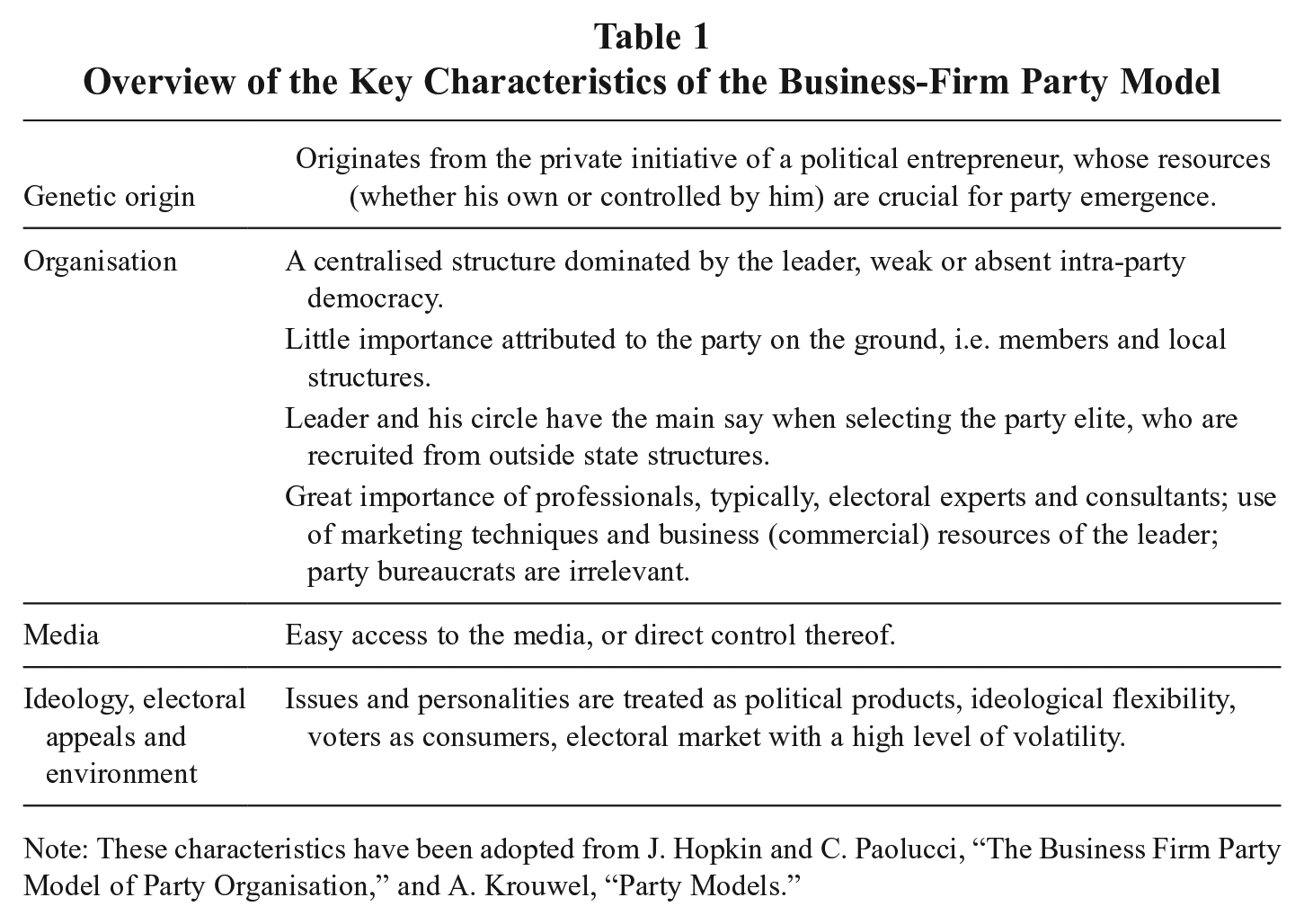
Note: These characteristics have been adopted from J. Hopkin and C. Paolucci, “The Business Firm Party Model of Party Organisation,” and A. Krouwel, “Party Models.”
Business-firm parties originate from private initiatives and their founders are entrepreneurs in politics. Krouwel, who develops Hopkin’s and Paolucci’s work, proposes two sub-types, linked either directly to a commercial company whose structure is used for a political project, or to a new and separate organisation constructed on the basis of business principles. As an example of the first sub-type, they cite Forza Italia (FI), founded by the businessman Silvio Berlusconi; the Spanish Union of the Democratic Centre (UCD), established by Prime Minister Adolfo Suárez, is an instance of the second sub-type. The expansion of both new parties occurred during a period of radical political transformation. In the early 1990s, Italians were deeply dissatisfied with the established party elites, chiefly because they were compromised by corruption scandals and links between politicians and the Mafia (Tangentopoli investigations). The UCD rose in a context of the Spanish democratic transition in the late 1970s. The situation of new or rapidly changing democracies, where voters’ attachments are uncertain or in strong decline, produces a high level of volatility, which is therefore propitious for such parties.
For Berlusconi’s party project, his personal motivations were key. His business expansion was largely based on his contacts with top politicians, in particular with Bettino Craxi, who had been prime minister for many years. The collapse of the existing arrangement was a consequence of the fall of Berlusconi’s political friends, alongside the threat of a left-wing government coming into office; these factors risked jeopardising Berlusconi’s position, especially his near-monopoly on commercial TV broadcasting. 15 Whereas Suárez needed to find a way to preserve his position as prime minister after an early election. For Berlusconi and Suárez alike, the creation of a suitable political vehicle was key. The business-firm parties they created are far from the traditional notion of political parties, which are intended as “voluntary organisation[s] with essentially social objectives.” 16
Characteristically, these parties limit the importance of the party on the ground, that is, members and local structures. Although in contrast they tend to seek to establish a broader base of support from sympathisers, who do not, however, enjoy full membership rights. Similarly minimised is the role of party bureaucrats, who are essential to mass parties. Indeed, in regard to the operations of a business-firm party, the party on the ground, and party bureaucrats, do not play a substantial role, as they do not align with the notion of a professionalised party with a vote-seeking orientation. Key party activities and tasks are brought “under formal (commercial) contract in terms of labour, services and goods to be delivered to the party.” 17 These tasks are sometimes “contracted out” to external experts, but Berlusconi’s party was able to naturally avail itself of the options provided by the companies within his economic empire, Fininvest.
As in business companies, policy positions and manifestos are constructed on the basis of market research, focus groups, and surveys. The party strategy is guided by the aim of presenting the most attractive “political product,” which is optimised to succeed in an electoral market, where voters are perceived as consumers. In Forza Italia, belief in the superiority of private business-firm principles was particularly evident, and the leader with his narrow circle rejected any intra-party discussion on its strategy. A consequence of this approach is ideological vagueness and flexibility, even though Forza Italia, UCD, and other business-firm parties have usually situated themselves to the right of centre. 18 It is difficult to classify them into party families, although, over time, they usually sought a grounding in transnational party structures.
The pivot of the party is the political entrepreneur who centralises power and possesses key resources. Hopkin and Paolucci emphasise that this model of leadership is linked to “personal popularity, organisational advantages, and crucially, access to unlimited professional expertise in mass communication.” 19 André Krouwel pertinently notes that the leader tends to be “the best wrapping for popular policies.” 20 Key characteristics of business-firm parties are their attempts to secure easy access to the media, or even to directly control it. Particularly notorious in this respect is Berlusconi’s mass media group Mediaset, which owns multiple TV channels, which had been used to promote the leader and his party. It is true that in terms of ties and funding, business-firm parties may receive some support from external interest groups, but these are not their main sources of income, electoral support, or channels of communication. 21
The Public Affairs Party: ANO’s Precursor and Its Influence
The concept of a business-firm party had been previously used in the Czech context in connection with the Public Affairs party, a political project which succeeded in the 2010 election, although not as spectacularly as ANO did in 2013. 22 This formation, which deployed anti-corruption and anti-establishment appeals in particular, was a political branch of a security agency, co-owned by the leader Vít Bárta. Bárta’s original aim for the Public Affairs division was to improve his security agency’s access to the public tenders being awarded and to win a dominant share of the market in his field. The political activities of the party were, however, episodic in character. Having become, following the 2010 election, part of the centre-right government, led by the Civic Democrat Petr Nečas, it was weakened by numerous internal conflicts and found itself in quasi-permanent disputes with its government partners. This resulted in spring 2012 in the secession of its ministers and some of its MPs, and the party disintegrated.
Babiš responded to the experience of Public Affairs and its electoral gains in 2010 with visible interest: “It appears that a successful party can be built up fairly rapidly in Czechia.” 23 At the point when ANO was founded in 2011, Babiš distanced himself from Public Affairs, as this party had already been politically compromised. Nevertheless, it is beneficial to highlight some remarkable similarities between the organisational strategies of the two parties. Especially noteworthy are the extreme demands placed on membership candidates in Bárta’s party (e.g., to attach a curriculum vitae to their application, as well as a statutory declaration that they were free from debt and had no criminal record) and its emphasis on registered supporters, as is its extreme centralism with the privileged position of the leader and his narrow circle. This centralism was grounded not on official, but informal, decision-making procedures, and it relied in particular on the existence of a so-called Conceptual council composed of a small group of people from Bárta’s company and close friends. 24
Paradoxically, the official chair of the party, a popular journalist, who served as leader for the 2010 election, was not a member of this key body of the Public Affairs party himself. Bárta, the de facto leader, had frequently appeared in public merely as one of the party’s rank-and-file. When it was uncovered that the official leader was a figurehead with little actual power, the credibility of Public Affairs was substantially damaged. Therefore, in this respect, the influence of Public Affairs on ANO has been very specific. In his founding appeal in November 2011, and subsequently, Babiš claimed that he only wished to be manager of the new formation, stating that he would cede the leadership to other figures. In his public utterances, he justified his limited role in the new entity with references to his “compromised background.” 25 Indeed, as soon as Babiš entered politics, the media began to discuss his controversial business reputation and the suspicion that he had secretly collaborated with State Security, the secret police under the Communist regime. His mistake-prone Czech also made Babiš the subject of jokes (he hails from Slovakia). Yet Babiš’s extended and genuine efforts to convince certain public figures to become directly involved in ANO proved unsuccessful. Thus, he had himself elected chair of the party at the founding congress of ANO in early August 2012, arguing that there was “no point in searching for some sort of trained puppet.” 26 This distancing from the duality of the leaders in Public Affairs reflected Babiš’s obvious concern that ANO might be seen as a “clone” of Bárta’s party; indeed, both were habitually compared in public debates.
Subsequently, Babiš refused to stand for parliamentary election. His belief that someone else should be the electoral leader lasted until June 2013, when he changed his stance. His long-term refusal was probably not public posturing; rather, it seems to have been based on a rational consideration of the handicap of his own past, which might have jeopardised the success of the entire project. 27 What prevailed in the end were not merely concerns about being compared with Public Affairs but also Babiš’s desire to keep the control of the party firmly in his hands, an attitude informed by the experience of building up the organisation.
The Genetic Origin: Making the Initial Public Offering
Babiš’s “pre-political” career, and his motivations for entering politics are similar in many respects to Berlusconi’s. He is one of the richest Czech entrepreneurs. The value of his property—the Agrofert holding company—was at the time of ANO’s founding estimated at one to two billion dollars. Agrofert encompassed more than two hundred firms with almost thirty thousand employees, mainly in chemical industries, agriculture, and related sectors. 28 As Babiš built up his business empire, during the 1990s and the first decade of the twenty-first century, he put his adroit lobbying skills to good use, maintaining close links with some Social Democrats and some Civic Democrats, that is, politicians belonging to the two largest parties, who alternated in government. These ties were important in Babiš’s privatisation of state enterprises. Similarly, it was important for his business conglomerate to influence political decisions on a number of public policies, for example, the state support for biofuels. However, Babiš’s political cover began to wane toward the close of the first decade of the twenty-first century. His loss of the ability to compete in the struggle for political influence is suggested by his own words: “With the rise of Topolánek [the Civic Democratic prime minister after 2006] came the mafia state”; a new “clique” (parta) had appeared; and “corruption increased by an order of magnitude.” 29
Aside from his fears that his economic interests were at risk, Babiš was also strongly motivated by feelings of humiliation, which he had allegedly experienced during his negotiations with politicians, and about which he complained bitterly. He characterised himself as a successful self-made man who had built up his business empire from nothing, and who was superior to politicians. 30
Babiš made his public entrance into politics in the second half of 2011. At that time, public trust in the centre-right government was low, because of government scandals, constant bickering within the coalition, and a number of controversial government decisions. Babiš often appeared in the media, who enjoyed the story of a billionaire outraged by what he described as the “Czech Palermo.” Arguably, ANO was born on Jan Kraus’s popular late night show broadcast on the public service Czech TV in late September 2011. Assisted by the obliging anchor (who later became a supporter), Babiš presented his initiative, a “Civic forum against corruption and political incompetence and for the enforceability of law,” together with an e-mail address where sympathisers could reach him. The expression “Civic forum” is, of course, linked with the political movement from the early days of transition to democracy in 1989; however, following a debate within the organisational nucleus of the embryonic association, Babiš let himself be convinced not to use the term. 31 In some respects, however, the name presented on the late night shows accurately reflects the main points of Babiš’s political campaign.
The emerging association adopted the name “Action of Dissatisfied Citizens” (Akce nespokojených občanů), and the acronym ANO 2011. Already in mid-October 2011, before he officially unveiled the new formation, Babiš had these registered as trademarks (!) at the Industrial Property Office, which is a good illustration of a manner of thinking firmly embedded in the business sphere. Babiš launched ANO by taking large advertisements in several national daily newspapers in early November 2011; in terms of content, ANO was characterised as a personal appeal by Babiš to the public. In legal terms, Babiš had not founded a party, but a civic association, that is, something that could not stand for parliamentary election. According to his appeal, the association was only to be transformed into a party when its supporters “filled Wenceslas Square” (the main square in Prague). 32 This reflected the endeavour to present ANO as a broad “movement of the discontented” and thus avoid the perception that ANO was “merely” one among many new parties. In order to reinforce the notion of a movement, a list of “registered sympathisers” was maintained and regularly updated on ANO’s website; it had reached twenty thousand names by mid-2012. Babiš also obtained the support of various public figures, such as the businessman and anti-corruption activist Karel Janeček and the best-selling novelist Michal Viewegh. This was all strongly redolent of Berlusconi’s initial presentation of Forza Italia as a broad movimento. However, mistakes were made during the construction of the milieu supporting ANO: several well-known figures were included among the supporters without their knowledge, and later they distanced themselves from Babiš.
The legal transformation of ANO into an entity that could stand for election took place in May 2012; however, the term movement continued to be used in the presentation of Babiš’s formation, and ANO became fixed as such in the public consciousness. The fact that, in terms of electoral candidacy, the Czech legal system places the same conditions on political parties and political movements also played a role in this decision. Remarkably, the original acronym ANO 2011 was used as the name of the new entity (see below for details on how “2011” was subsequently dropped from the name).
Neither the sympathisers nor the supporters were mentioned in the new statutes of ANO, and their actual influence over the new entity was nil. The recruitment of sympathisers (and donors) was among the chief tasks assigned to ANO’s regional officials, and one that was much more important than recruiting new members. 33
The Organisation and Its Boss: Building Another Division of Agrofert?
The organisational nucleus of ANO in autumn 2011 consisted of a small group of people around Babiš in the Prague headquarters of his holding company. They included Agrofert’s human resources director, a PR specialist, and the spokeswoman of a former Czech cabinet. A top–down approach was chosen to build the territorial structure of the new entity: regional and local structures were constructed by so-called coordinators chosen at the centre in Prague. They were chosen by corporate human resources methods and had to pass a psychological test. The birth of this idea is well illustrated by a statement made by the chief manager of the new party, who had formerly worked for one of the firms within the Agrofert conglomerate. “We must carefully vet those people,” he argued, “as some are attracted by Mr. Babiš’ money and others see this as a fast route to power.” 34 Party candidates standing for election to parliament’s upper chamber in autumn 2012 were also subjected to psychological testing. It is hard to imagine that a Western European business firm party would ever make use of human resources techniques in this way.
However, this vetting did not prevent “deviant behaviour” on the part of some coordinators. The social composition of these coordinators, who also formed the nucleus of ANO’s founding members, varied. Usually they were impressed with Babiš’s appeal, and often had no previous links with Agrofert. A consequence of this was that when the regional and district-level party organisations were established in late 2012 and early 2013, some of them were headed by people who understood ANO not only as Babiš’s personal project, but also as an opportunity to put their sometimes somewhat idealistic notions into practice. At the founding congress in August 2012 there had been some dissension; for example, one candidate for senator pushed by Babiš was not nominated. The election of the leadership was not a completely smooth process either. Babiš, naturally, was voted the party chair, and his two preferred deputy chairs were also elected. One of them, Jaroslav Faltýnek, was a member of Agrofert’s board; the other was a quality assurance manager in one of Babiš’s meat processing plants. However, not all the proposed candidates for the wider leadership of the party were elected. This indicated that although the establishment of the party’s territorial structures was managed by Agrofert, it was not entirely under the company’s control.
The next party congress, in March 2013, further confirmed this perception. Babiš was surprised by the results of the leadership election. Although he himself was re-elected chair by an overwhelming majority, regional party chairs and representatives not connected with Agrofert won four of the five deputy chairs in the election. The fact that his loyal supporter Faltýnek was not elected deputy chair immediately elicited an irritated response from Babiš at the congress. 35 This was followed by a conflict between Babiš and his deputy chairs, as they sought to negotiate influence over the running of ANO. Babiš, however, proceeded to ignore them; even in such sensitive matters as the choice of faces that would appear on the party’s billboards in the massive campaign planned. According to dissenters, Babiš justified himself by saying: “I’m paying, so I decide.” 36
These words reflect the realities behind the party’s funding. When founding ANO, Babiš publicly declared that he was resolved to invest “as much as will be necessary” in the project. 37 Originally, he and his companies were the only significant donors to the new entity, which for the year 2012 meant about $3 million in total. Only shortly before the 2013 election to the Chamber of Deputies, when ANO rose in the opinion polls, did the first important donors from outside Agrofert appear. Babiš repeated his determination to invest as much as necessary before the election, and ANO had the largest expenses among the parties contesting the election: around $4.5 million, according to official data. 38 To compare, the second most expensive electoral campaign at $3.5 million was waged by the Social Democrats, and other parties invested significantly less; for example, the heavily indebted Civic Democrats spent just $1.5 million. The “old” parties were unprepared for the early election in terms of funding, and proved no match for a businessman endowed with almost limitless resources.
Returning now to Babiš’s dispute with the deputy chairs in spring 2013, the leader had another significant advantage thanks to the statutes of ANO, which concentrated most of the power in his hands, allowing him to act independently in all matters. 39 The possibility that ANO might become independent of Agrofert, to at least some degree, was ruled out a mere few weeks after the party congress, when most deputy chairs resigned their positions in the leadership as well as their regional party chairs, and left the party. Their successors as regional heads, having learned from the experience of their predecessors, opted for loyalty. According to the statutes of ANO, the power to confirm them in office laid with the party presidium, which was staffed with people loyal to Babiš. The successor to Babiš’s most radical opponent, a deputy chair from the Karlovy Vary regional organisation, for instance, characterised his stance in the following words: “The dispute [with the deputy chairs] scared me. . . . Mr. Babiš is the boss, he has charisma and knows how to make people dance to his tune. . . . There’s no way I’d not fulfil a given task, and that’s how it should be.” 40 These words reveal much about the specific managerial culture and hierarchy of superordination and subordination, which was established in ANO.
The vacant deputy chairs of ANO remained unoccupied for the next two years, as an extraordinary congress of the party would have been necessary to elect successors, which the leader deemed a waste of time and energy. The inner leadership of the party, the presidium, in which several offices had been left vacant after the departure of Babiš’s opponents, co-opted those loyal to Babiš to its ranks. However, the key decisions ahead of the 2013 election were often not discussed in the presidium, but rather in a semi-informal narrow circle around the leader. The make-up of this circle varied, depending on the issue under discussion, but generally it was composed of hired electoral experts and members of the presidium.
The staging of the ANO congress in 2015 reflected the experience with the “uncontrolled” course of the previous congress. Now, Babiš, the only candidate for party chair, obtained all (!) the valid votes in a secret ballot, and thus a hundred per cent support from the delegates. At the previous two congresses, there had still been some votes against him. The chair also publicly announced that he wished Faltýnek to be the first deputy chair, and the counter-candidates duly withdrew. The leader’s opinion proved similarly influential in assigning other deputy chairs. Characteris-tically, and in a telling contrast with the previous two ANO congresses and their lively debates, there was almost no discussion at this one. The atmosphere in the hall was redolent, not so much of a party congress as of an annual general meeting of a company dominated by a single shareholder. There were not even discussions about changes to statutes, which further strengthened the already very powerful position of the party chair. Added to his unlimited power to act in the name of the party was a clause making his presence obligatory at political meetings unless one of his deputies had written authorisation from the presidium to act in his stead. Therefore, the 2015 congress can be considered to have achieved extra almost absolute centralisation of ANO around the figure of its leader. An organisation conceived along these lines is essentially merely an instrument of the political entrepreneur.
Gradual Improvements in the Party Centre’s System of Control over Its Members and Representatives
Some regional organisations witnessed a temporary decline in membership following the conflict between Babiš and his deputy chairs in spring 2013. However, as electoral support for ANO grew, membership became an attractive proposal for many, and by the time of the 2013 parliamentary election, almost seven thousand people wished to become members. 41 Nevertheless, ANO screened potential members carefully. According to party statutes, prospective members had to attach a curriculum vitae to their application, as well as a statutory declaration that they were free from debt, have no criminal record, and agree with the party’s moral code. The candidates then had to wait for a period of six months. 42 The admission of every member had to be approved by the presidium of the party, which could also shorten the waiting period or result in it being waived entirely. The presidium therefore acted as a gatekeeper. ANO argued that its highly selective and demanding admissions process was necessary to protect itself from careerists and that it did not wish to be a mass party. In this manner, the membership of Babiš’s party rose from eight hundred in June 2013 to a mere two and half thousand by early 2015. To compare, in 2014, the Social Democratic Party had twenty-three thousand members and the Civic Democrats twenty-one thousand. 43
The party presidium has the main say not only in accepting new members, but also in expelling them. The significance of this authority is increased by the fact that the statutes are vague about reasons for which members may be expelled—it is enough, for instance, for them to act against the “interests of the party,” but what this might involve is unspecified. Members are expelled with immediate effect. Originally, there was no appeal against decisions by the presidium; changes in party statutes adopted by the 2015 congress introduced the possibility of appeal to the arbitration and the conciliation commission. However, other changes of statutes adopted by this congress further tightened the control exercised by the leadership over the membership. Prospective members now have to produce a statement from the state-maintained criminal record repository. Furthermore, a new requirement has appeared in the statutes according to which members must notify the central party office if they are subject to “any proceedings, especially criminal or offence proceedings.” 44 This means that members should report to the party even minor offence proceedings, such as those concerned with illegal parking. It may be added that ANO habitually expels members, including senior local representatives. In summer 2015, for instance, the presidium instantly expelled several representatives and councillors in two cities, České Budějovice and Ústí nad Labem, because of their positions on local issues.
Also worthy of attention is the influence of central leadership over the selection of candidates to elected public offices. This was already evident in the founding period, when candidate lists were being compiled for the 2013 parliamentary election. The Czech Chamber of Deputies (the lower chamber of the parliament) is elected by a proportional electoral system, and constituency boundaries are identical to regional boundaries. ANO’s candidate lists in the individual regions were drawn up by regional organisations; however, it was the previously mentioned semi-informal circle around Babiš himself that had the final word in allocating the most attractive places at the top of candidate lists. These places were filled by public figures who affiliated themselves with ANO before the election, and were assigned to regions where it was thought they would make the greatest contribution to the party’s electoral success. These figures included a popular actor, a well-known political commentator, a former university rector, and a successful businessman and manager. The degree to which the party centre interfered with the placement of candidates at the top of candidate lists, was, nonetheless, limited by the number of celebrities ANO had at its disposal, the fact that the number of seats allocated per region varied, as well as lack of time, as the candidate lists had to be drawn up fairly quickly in time for the early election. Thus, in reality, the dominance of the ANO leader was not limitless, and the regional organisations retained some influence, even over the top places on the candidate lists. 45
Shortly before the parliamentary election, there was also a screening of prospective MPs, and similar criteria were employed to those used for membership candidates (some of the candidates were not party members). However, even this vetting did not prevent problems from arising, either in the final days before the election or shortly thereafter. For instance, in one case, an ANO MP, who was also the chair of one of its regional organisations, had concealed some of his controversial pre-1989 “sins,” as well as the fact that he owed a substantial amount of money in taxes. The party therefore prevailed upon him to resign his seat in late 2013, but this produced an undesirable response in the media.
Ahead of the 2014 local elections, screenings were tightened. Several thousand people standing for election on ANO’s candidate lists (of which only a small minority were party members) were subjected to screenings. The vetting was supervised by the new general manager of the party, whose team first established, from publicly available sources, all that it could about the candidates’ past (such as previous membership in other parties, debts, etc.). They then interviewed the candidates individually. In terms of their scope and aim, these screenings had no parallel among post-1989 Czech parties; however, analogies to them can be found in the former Communist era. Having vetted its candidates, ANO reordered some of its candidate lists substantially, struck off a number of candidates entirely, and even completely scrapped some lists. 46
The 2015 party congress strengthened the official mechanisms by which the party centre can control not only its members but also its regional and local structures. The presidium newly obtained the power to nominate candidates for elections of all types (parliamentary, local etc.), thereby eliminating the autonomy of the party’s territorial organisations in this respect.
To summarise, over the period of a few years, the ANO leadership has created and continued to improve a system of prevention and subsequent control of its members and territorial structures, which has allowed it to remove “undesirable elements” easily. The loyalty of regional and local functionaries was secured by successes in the 2013 parliamentary election, thanks to which some of them obtained parliamentary seats. The results of the local elections in 2014, which secured a direct share of power for the representatives of ANO in many towns and cities, helped to satisfy the party on the ground even further.
Fully Professional Campaigns: “Yes, Things Will Get Better”
In order to understand Babiš’s opinion regarding how ANO should operate, it is worth quoting his response to the objections voiced by the deputy chairs who opposed him in spring 2013, which he published on the party’s website:
If we were to argue over who would appear on billboards and what we would write on them like politicians do, we would never achieve anything. Politics is work for politicians, but professional work should be carried out by professionals. Our role is only to aid the campaign, hence I asked all regional chairs to suggest places where the billboards might be placed.
47
By professionals, Babiš meant paid experts responsible for marketing and PR. This quotation is a good illustration of the importance the boss of the party attached to these professionals, as well as his understanding of voters as consumers, to whom the party needs to sell the ANO brand optimally. This strategy is described in detail in relation to the party’s preparation for the general election. It is worth mentioning that prior to spring 2013, support for ANO in opinion polls was nil. In autumn 2012, its candidates failed entirely in elections to the Czech Senate, which is elected in single-member constituencies. 48 Fearing embarrassment, ANO chose not to stand for the concurrently held regional elections. Babiš then hired several campaign experts to prepare the party for the general election, which had been originally scheduled for spring 2014. Shortly before, most of the experts were involved in another campaign, that of Karel Schwarzenberg, the Foreign Minister in Nečas’s unpopular government, who stood for election as President and, surprisingly, advanced to the second round of voting. On the recommendation of these experts, ANO also hired the (very) expensive US agency PSB, which focused on electoral strategies and research and had previously worked for such figures as Michael Bloomberg, the Mayor of New York City, Tony Blair, and Hillary Clinton. PSB’s research provided a foundation, upon which target groups of voters and messages to be communicated could be defined.
The importance of experts and electoral surveys, and the fact that ANO’s focus on marketing was extreme, are evident in two areas that are crucial to any party: its name and programme. In April 2013, the name of the party was amended from “ANO 2011” to “ANO”; the dropping of the year 2011 from the name was later explained by the hired idea-maker and communications expert, who argued that ANO 2011 was “too long” and “made an odd impression” when repeatedly used in a text. 49 The modified name which, to remind the reader, means “yes” in Czech, was more forceful and easier to use in slogans, and in the party’s logo. The idea-maker also overhauled the logo to make it more serviceable for visual communication, adding the words “political movement,” to reinforce the perception of the distance of ANO from other parties, and the words “we are here” into a speech bubble serving as the letter “O.” This was to assist in the introductory campaign of the party planned for summer 2013, which was to force the ANO brand into public consciousness. 50
However, in early summer, Nečas’s government fell unexpectedly and shortly thereafter an early election was called for in October. Thus, ANO’s introductory campaign became an electoral one. The logo, with the slogan “YES, we are here” was replaced by the slogan “YES, things will get better,” which conveyed a strong message of hope for the future and began to be used as an alternative name for the party. Babiš gave the experts freedom to change the name and logo of the party.
As with the name, the party’s election manifesto also betrayed an overwhelming reliance on marketing and ANO’s great policy flexibility. At the time the early election was called, ANO lacked a substantive programme, and only had at its disposal a brief set of propositions drawn from Babiš’s utterances and announcements. Hence, the main points of the election manifesto were unveiled in haste, and the hired experts only completed the manifesto a few weeks before the election. However, PSB research showed that some of the elements in the initial version of the programme alienated or confused voters, and thus, the election manifesto was subject to change until the day of the election (see below for details on one of the more interesting changes, which concerned the idea of the state as a business firm). Babiš’s response when asked about the oddity of this process stated: “Why shouldn’t we be able to change the programme?” 51 Apparently, in his estimation, the point of the programme was to offer voters what they wanted. The centralisation of ANO and its dependence on the leader’s resources decreased the risk that dissent would emerge within the party in response to the changes in its policies. Still, dissent was not eliminated entirely. For example, one regional electoral leader resigned just before the election, claiming that for him ANO was insufficiently right-wing.
Use of hired experts also affected the evolution of Babiš’s own image. In summer 2013, when he decided to lead the party into the election, the general public did not know him very well (according to opinion polls). In addition, there was also a need to address the problem of his controversial business past. Therefore, Babiš undertook intensive media training and preparation for televised debates; which was accompanied by a massive presentation of his person in the media (see below). Within just a few months, his image had started to improve, and by the time of the 2013 election, Babiš had been transformed into one of the most popular Czech politicians, and since early 2014, has also been the most trusted. 52 In the public imagination, ANO and the political entrepreneur who founded it were both elements of a single entity.
Electoral experts and the PSB agency remained involved after the 2013 election because three second-order elections were held in 2014 (European, local, and Senate), and also because the party leader had decided to wage a permanent campaign to support ANO’s image as a governing party. Concurrently, the party finished the construction of its professional support structures where some of the expert staff, originally hired temporarily, were given permanent appointments.
The above shows both the procedures for the adoption of an electoral-professional strategy and Babiš’s understanding of ANO as a seller of political goods. Evidently, politics was for the owner of Agrofert a new market to penetrate, and nothing was to stand in the way of him acquiring new customers.
The Media and Its Deployment
Babiš’s entrance into politics demanded the creation of his own media machine, because, unlike Berlusconi, he did not own one from the outset. His first significant media investment was the news website Česká pozice (Czech Position), launched in late 2010, that is, just before the founding of ANO. Česká pozice devoted significant attention to Babiš’s activities, but interestingly, it was only after the 2013 election that he was acknowledged as the website’s source of funding. Babiš’s next project was the free weekly 5+2; this was a much more expensive endeavour, and his ownership was apparent from the outset. It was launched on a lavish scale during spring and summer 2012 by AGF Media, a new division of Agrofert, with dozens of regional editions and the involvement of more than 150 journalists. To compare, ANO had just 82 members during its nearly simultaneous founding congress, a fact that illustrates the importance attached to the two ventures. 53 The weekly was originally distributed directly to households, and soon reached a print run of a million copies, covering a substantial proportion of the Czech population. 54 Babiš claimed that 5+2 had nothing to do with ANO, and indeed PR pieces about local Agrofert branches and regional news, with an emphasis on sport, dominated the contents of the weekly at the outset, supplemented with a few news items of national and international importance. However, if ANO propaganda in the weekly was relatively rare initially, it became intense in the months preceding the 2013 election. For instance, the last issue before the election featured a large photograph of Babiš on the front page accompanied by his appeal to citizens to vote and a two-page interview with him inside. 55
It is nevertheless worth highlighting that the experts hired to conduct the 2013 campaign and the ANO regional activists stated that the weekly did not function in an entirely satisfactory way as a party paper, with journalists and editors not always accommodating the political brief. 56 This was most likely due to the tradition of Czech party journalism, which had virtually ceased to exist in the early 1990s; thus, the journalists hired by Agrofert were unaccustomed to toeing a party line. Nor was 5+2 a success in economic terms, as it was running at a huge loss. For that reason, its management was replaced and the number of employees cut back in 2013.
Babiš also spoke publicly about acquiring or building his own TV station, but in the end he made a different sort of investment. In a surprise move in early June 2013, he bought the media group Mafra from its German owner, becoming one of the most important players in the Czech media market. Mafra publishes the most frequently read broadsheet Mladá fronta Dnes; Lidové noviny, which is influential in intellectual circles; as well as the news websites associated with these dailies. This media acquisition caused significant public concern about press independence; this concern increased further following Babiš’s clumsy pressure on the editors of Lidové noviny to afford greater prominence to ANO events. The editors immediately brought this pressure to the attention of the public. 57 As with the launch of 5+2, the acquisition of Mafra was guided by political and economic concerns, but personal motivation also played a role. Babiš had been talking about the need to protect himself from the lies and disinformation spread by journalists. Although his purchase of Mafra took place during the pre-election period, Babiš had not discussed this step with the experts involved in ANO’s election campaign. In their view, his timing was unfortunate, as it triggered public debate. 58 In retrospect, Babiš himself characterised his acquisition of Mafra as a mistake, saying that he “should have bought Blesk instead” (the most read tabloid), as there would have been less risk of negative responses. 59 Again, this is a good illustration of Babiš’s thinking. For him the acquisition of an instrument, which would efficiently support his economic and political activities, was of crucial importance.
Even more remarkable, in terms of the exploitation of the media to further Agrofert’s commercial opportunities and Babiš’s political image, was the circumvention of the ban on political advertising in private TV broadcasting. Shortly before the 2013 election, arguing that it wanted to strengthen the image of its products, one of Agrofert’s poultry firms launched on a massive scale a spot on all private TV stations featuring Babiš as a cheerful seller of chicken to the most popular Czech ice hockey player Jaromír Jágr. The Czech Advertising Council, a non-governmental organisation overseeing ethical conduct in this field, dismissed complaints that this was illicit advertising, upholding Babiš’s (constantly repeated) claim that he was not a politician, as he had not yet held public office (!?). This case represents a unique instance of a business-firm party acquiring media attention in a sphere to which other parties had no access. This advantage substantially violated the equality of competition that was supposed to prevail in the political arena.
“We Are Not Like Politicians!” Or Are We?
Weak voter attachments to existing party elites created conditions for high volatility, which are conducive to the success of business-firm party appeals. The results of the 2010 parliamentary election, in which mainstream parties suffered a significant downturn, had already shown a substantial weakening of voter attachments; these subsequently deteriorated further during Nečas’s unpopular government term. However, the strongest impulse, which almost pushed the party system to collapse, came in summer 2013 when a scandal brought about the fall of the government. The police raided the Office of the Government, arresting Nečas’s Chief of Staff (and lover), as well as several former MPs of the Civic Democratic Party and the heads of military intelligence. These events shocked the voters of the right-centre parties then in government, but paradoxically, the Social Democrats, then in opposition, also found themselves in difficulties. With the fall of Nečas’s government, they lost a clear target and became divided over their stance towards the technocratic cabinet proposed by the country’s President Miloš Zeman and led by a former member of Social Democracy Jiří Rusnok (the prime minister was without official party affiliation). Ultimately, Social Democracy did support the cabinet, an electorally risky move, yet disputes within party endured until the election.
This represented an excellent opportunity for ANO. In the election, it won the support of many former voters of the Civic Democrats (and of Public Affairs), but it was also aided by the Social Democrats’ loss of credibility. 60 As is typical of business-firm parties, the general tenor of ANO’s programme tended to the right, yet the core of their appeals consisted of en bloc rejections of party politics as currently practiced, whether represented by the Civic Democrats or the Social Democrats. In this respect, ANO resonated with the majority of the population, which perceived the very word politician very negatively. One contemporary survey has shown, for instance, that the prestige attached to an MP or a minister had decreased to that of a cleaning lady. 61 The controversy over Babiš’s previous activities was at least partially overshadowed by the seriously compromised position of the established political class.
The kernel of ANO’s rhetoric, which married anti-party, anti-political, and anti-corruption sentiments, was not the result of decisions made by electoral experts, but rather stemmed from Babiš’s statements since the founding of ANO. To illustrate, his original appeal at the foundation of ANO in November 2011 contained the following words: “I employ thousands of people in my firms in Czechia, pay hundreds of millions in taxes and am every bit as annoyed as you are. I am annoyed because since the revolution [of 1989] not only have our politicians proved unable to manage our country, but they watch as theft continues. I am infuriated that we live in a dysfunctional state.” This appeal also attacked by name the leading government and opposition politicians as well as the President. By contrast, it praised “the Czech nation, [which] still has an enormous potential. . . . Our children could might live in a society which would be at a similar level to Sweden or Switzerland,” arguing that “common sense needs to be exercised in managing the state.” 62 These quotations reflect the classic populist dichotomy between a pure people (or nation) and the corrupt, arrogant, and incompetent political elite. 63 In the 2013 election, this understanding was projected in ANO’s most frequently used slogan: “We are not like politicians, we knuckle down!” 64
Contained in Babiš’s founding appeal was the contrast between “incompetent politicians” and “the able and trustworthy figures representing ANO,” which became another strong element in ANO’s election campaigning. It found its way into the already cited slogan “YES, things will get better,” as well as another the party used frequently, “We will put things right.” The idea that competence was needed to steer the ship of the state pervaded ANO’s election manifesto. 65 However, one of Babiš’s best known statements to the effect that it was necessary to “manage the state as a business firm,” which also originally appeared in ANO’s election manifesto, had to be corrected. Research undertaken by PSB established that voters perceived this slogan as a threat to democracy. Thus, it was removed from the election manifesto and replaced by words about an “inexpensive and lean state.” In the final weeks before the election, Babiš shifted the party’s rhetoric, saying that the state must be “managed well” and “to the benefit of the people.” 66
In sum: ANO’s appeal to voters lacked any ideological grounding whatsoever and was driven by the demand for the removal of politicians, parties, and in a certain sense, also the elimination of politics as such. ANO’s electoral appeal came from its leader, who put his finger on the sources of popular frustration.
However, the appeals by ANO quickly began to change following the 2013 election, a consequence of the surprisingly great success of the party (unexpected even by Babiš) and the political configuration that arose. The right-centre parties were decimated in the election and the left failed to win a majority. ANO thus received an opportunity to govern, although its only possible coalition partner was the Social Democrats, and it had to accept the Christian Democrats as a junior partner. The shift from opposition into government, and Babiš’s rise to the post of the Minister of Finance, necessitated a rethink of ANO’s protest character. As early as autumn 2014, when local and Senate elections were held, the leader redefined ANO as “a right-wing party with a social conscience.” 67 The need for at least superficial acceptance internationally led ANO to establish contacts with European liberal party structures, and the party became a member of the Alliance of Liberals and Democrats for Europe (ALDE).
The new situation was furthermore characterised by ANO’s attempt to differentiate itself from its Social Democratic partner in government. This was accompanied by a remarkable reinterpretation of the 2013 election and ANO’s success, which began to be explained as something that prevented the rule of the left. The abandonment of the party’s anti-political appeal was quite obvious in the small yet fundamental addition to ANO’s election slogan at the time of the party’s congress in February 2015 (here marked in italics): “We are not just politicians, we knuckle down!” ANO entered a new “post-anti-political” and probably also a “post-populist” era.
Conclusion
The genetic code of ANO and its organisational development as described here allow us to formulate the conclusion that with ANO, the model of a business-firm party has attained an extreme; with certain characteristic traits being developed far above what is typical for this type of party. Key to the origin of ANO was an entrepreneur who decided to enter politics. Without his initiative and great financial as well as other resources, the party could not have been formed, and neither would it have been able to achieve success. ANO’s origin in the business environment and its reliance on a political entrepreneur were not only reflected in the centralised organisational model of ANO and the leader’s dominance; it also led to the employment of techniques that are alien to democratic party politics, such as the human resources–style techniques of psychological testing of cadres at the party’s foundation. The territorial structures of the party were conceived as supporting props and not as entities that should be given autonomy, let alone allowed to influence the party’s operations. Grassroots members and lower and middle party representatives were viewed through the same lens.
In the early phases of ANO, alternative ideas appeared at the lower levels of the party machinery, relating to what the party’s character should be. A nucleus of opposition to the leader also emerged. In response to these episodes, a process of full centralisation of the party was begun, and the role of the leader and his narrow circle strengthened further to prevent the rise of the damaging opposition. The gradually perfected strict controls on membership candidates, members and party candidates for public office had the same aim: the party had created a robust system for protecting itself against “undesired elements.” Although not a monolith, its internal mechanisms were set up to effectively eliminate potential disloyalty from the lower ranks. Thus, the leader’s notion of a political organisation run on strictly managerial guidelines has been instituted; it is something for which one would be hard pressed to find parallels in “classic” Western European business-firm parties. In organisational terms, ANO is purely an instrument of the political entrepreneur, which has been adapted to compete as effectively as possible in the political marketplace.
The core people around the political entrepreneur were employees of his holding company and experts in various fields. The influence and importance of expertise rose substantially in the period leading up to the key parliamentary elections in 2013, when Babiš hired election campaign specialists. These experts were crucial not only to the campaign itself but even for amending the name of the party and some points of its official election manifesto, in line with public opinion. In this way, the electoral-professional strategy and the understanding of voters as consumers were brought to their limits.
By contrast, at its inception ANO lacked another characteristic trait of a business-firm party: access to media. The leader quickly compensated for this handicap by buying up media outlets, hoping to achieve synergy between his economic and political activities. However, some of these steps, notably the purchase of the Mafra media group shortly before the 2013 election, were not handled well in terms of realising the (short-term) objective of optimal electoral performance, as these moves elicited a significant negative response. Babiš’s use of banned political advertising on commercial TV stations (the ad was formally for his holding company, but actually promoted Babiš himself) also signalised transgression of a boundary, calling equality in political competition into question.
The party’s founding father was crucial, not only in his provision of financial, economic and media resources; but because he also created the core of ANO’s political programme, based on anti-party and anti-corruption appeals, and promises of political competence and improvements to the functioning of the state. Here the hired expert’s services focused on adjusting the appeal so that it could be marketed and delivered to voters, with several interesting consequences. The leader’s appeal aimed at the removal of politicians and in fact the elimination of politics as such. The effect of this appeal was to significantly strengthen the repercussions of the centre-right government’s scandalous fall in the summer of 2013, pushing the established party system towards collapse. Still, the entrance of ANO into government after the 2013 election led to a shift in its programme and its anti-political appeals were promptly transformed into a notionally centre-right orientation, with links established to European liberal structures. Paradoxically, ANO’s affiliation with these free-thinking structures occurred at a time when the centralisation of the party was achieved, thereby eliminating intra-party democracy almost entirely.
By their nature, business-firm parties are “light organisations,” lacking the institutional solidity of traditional mass parties; hence, they are vulnerable if a crisis arises, or if they simply transition to opposition. The swift collapse of Suárez’s UCD in the early 1980s is the best illustration of this. Even Berlusconi’s Forza Italia, which proved much more durable, had to adapt its organisation to some degree in the second half of the 1990s when it went into opposition and lost elections. As a consequence, some of its characteristic traits were modified and the party became somewhat more similar to the traditional Italian parties. 68 ANO has not yet experienced such a political shock, but given the substantial capacity of its organisation and the resources of its leader, it is more likely to follow the fate of Forza Italia than that of UCD. As with Berlusconi’s party, one might expect that the issue of organisational changes will be brought up in ANO at any subsequent crisis point.
The case of ANO highlights certain specific traits that this type of party can assume in “new” East-Central European democracies. That is, some strategic characteristics of the business-firm party became much more strongly pronounced, in a manner that is so far unimaginable in Western Europe. For the future, this might signify an important trend in the organisational development of parties.
Footnotes
Acknowledgements
I would like to thank Andrew Roberts, Vít Hloušek, Vlastimil Havlík, and both anonymous reviewers for their useful comments on the text. I am also grateful to Štěpán Káňa for the translation of the paper. This text was written as part of the research project “Contemporary Challenges of Democracy in East Central Europe” of the Czech Science Foundation (code GAP 408/11/0709).