



Abstract
Focusing on European Union (EU) Twinning projects in Azerbaijan and Ukraine, this article explores whether EU member states from Central and Eastern Europe (CEECs) offer specific added value for the implementation of EU Twinning projects in the Eastern neighbourhood compared to the older member states. An added value refers to the combined comparative advantages of a group of member states for the implementation of a Twinning project, as perceived by project stakeholders. The findings largely confirm our hypothesis that CEECs mostly offer country-specific comparative advantages, rooted in their recent transition and accession experience, socio-linguistic proximity, and shared historical legacies with the Eastern neighbourhood. In turn, the older member states are perceived to offer mainly sector-specific comparative advantages owing to their institutional experience, sectoral fit, existing sectoral networks in the Eastern neighbourhood, and prior Twinning experience in other countries.
Keywords
Introduction
European Union (EU) transgovernmental cooperation in the context of the European Neighbourhood Policy (ENP) is widely seen as a channel through which the EU can diffuse its regulatory standards and norms to neighbouring countries via sectoral transfer of the acquis and the subtle processes of socialization. 1 EU member states (MSs) play a crucial role in EU transgovernmental cooperation, as they usually serve as immediate suppliers of expert knowledge and policy advice during the implementation of EU transgovernmental projects. However, the MS involvement in EU transgovernmental cooperation remains largely neglected in existing studies. Those few works that have touched on this issue are mainly policy-oriented or lack a solid theoretical lens. 2 At the same time, there is a growing body of literature on the new MSs, or Central and Eastern European countries (CEECs), as emerging agents of change in the EU’s neighbourhood. 3 Their recent transition experience to democracy and market economy, as well as close historical, geopolitical, and cultural ties with their Eastern neighbours have, according to some authors, endowed CEECs with a specific added value for EU foreign policy in the Eastern neighbourhood. 4
However, so far, this added value has not been examined systematically, and there is only patchy evidence about the particular relevance of the CEECs’ experience for the countries in the Eastern neighbourhood. Moreover, existing studies focus mostly on the area of democracy promotion. Hardly any research has delved into the area of EU transgovernmental cooperation, especially institution-building instruments like Twinning, which explicitly encourage MSs to share their institutional experience and best practices in implementing EU directives and regulations. This article seeks to narrow this gap by examining whether EU MSs from Central and Eastern Europe offer specific added value compared to the older EU MSs for the Twinning instrument in the Eastern neighbourhood, which is used as a case of EU transgovernmental cooperation. To do so, it draws on the notion of “comparative advantage,” as used by the EU to refer to the specific strengths of MSs in international development cooperation. 5 Added value then refers to the perceived comparative advantages of an MS for the implementation of a Twinning project, as perceived by project stakeholders. Because of the nature and focus of our data, we do not seek to examine to which extent the involvement of CEECs increases the chances of successful implementation of Twinning projects or whether it positively affects—what is referred to in the external governance literature as—“rule adoption” in domestic legislation and “rule implementation” in domestic political and administrative practice. 6
In line with scholars viewing CEECs as emerging agents of change in the Eastern neighbourhood and based on insights from studies of Twinning in accession countries, we hypothesize that in the Eastern neighbourhood, CEECs will be mostly perceived to offer country-specific comparative advantages, while the older MSs will be perceived to have mainly sector-specific comparative advantages. In particular, we hypothesize that the involvement of CEECs in EU transgovernmental projects in the Eastern neighbourhood will be valued because of their recent transition experience, socio-linguistic proximity, and shared communist past with the beneficiary countries. In turn, the older MSs—and to some extent the CEECs also—will be valued for their institutional experience, sectoral fit, existing sectoral networks with the beneficiary, and prior Twinning experience in other countries.
To assess the hypotheses, we focus on Twinning projects in Azerbaijan and Ukraine, which have so far been the major beneficiaries of Twinning cooperation in the Eastern neighbourhood. 7 Our empirical analysis is based on data gathered through 40 semi-structured interviews with Twinning participants from Azerbaijan, Ukraine, CEECs, the older MSs, and the EU Delegations in Ukraine and Azerbaijan between September 2013 and July 2016. The data were gathered and processed using the EAR technique (Ego/Alter perception, Researcher’s analysis), a qualitative method of analysis and triangulation, developed by Arts and Verschuuren to determine the perceived influence of agents in decision-making processes. 8
The article is structured as follows. First, we briefly present the EU’s Twinning instrument as used in the ENP and explain ways in which Twinning engages inputs by MSs. Second, we outline the country-specific and sector-specific comparative advantages that different MSs are hypothesized to have for the implementation of Twinning projects in the Eastern neighbourhood. Third, we explain the methods for analysis and provide some background information on Twinning projects implemented in Azerbaijan and Ukraine to date and MS participation therein. The fourth part presents the empirical findings. The concluding section recaps the main points of the study, summarizes the findings, and suggests areas for further research.
Twinning in the ENP and the Role of EU Member States
Originally designed to help the EU candidate countries acquire the necessary know-how and expertise to adopt, implement, and enforce norms of acquis communautaire, Twinning has also been used since 2005 to modernize the public administrations of the ENP partner countries in line with EU law and best administrative practices of MSs. 9 The Twinning instrument fosters a socialization forum between MS bureaucrats and their counterparts from the beneficiary country, who work side-by-side on a daily basis for up to 36 months on a jointly agreed upon set of policy priorities, or mandatory results. 10 Those priorities usually entail sectoral reforms in line with Partnership and Cooperation Agreements (PCAs), Country Strategy Papers (CSPs), Action Plan (APs), or Association Agreements (AAs) in force between the EU and the ENP countries. An MS institution, after being selected by the beneficiary country, delegates an experienced civil servant, called Resident Twinning Adviser (RTA), to the beneficiary institution for the entire duration of the project. In turn, the RTA invites and coordinates other civil servants and experts from EU MSs, who contribute on a short-term basis to training sessions, workshops, and awareness-raising events over the course of the project. Additionally, the civil servants from the ENP country go on study visits to the counterpart MS institution. 11 In such a way, MSs play a crucial role in EU transgovernmental cooperation, as they serve as immediate suppliers of expert knowledge and policy advice during such cooperation.
While discussing at some length the direct and indirect impacts of EU transgovernmental cooperation on the neighbouring countries, 12 the existing literature has overlooked the crucial role of MSs in this process. Those few works that have touched on the involvement of MSs in Twinning are mainly policy-oriented and lack a theoretical lens. 13 Some of these studies have passingly touched on the possible sources of added value of different MSs for Twinning projects, and in particular on the reasons why specific MSs get selected over the others. For example, in their work on Twinning in the Czech Republic, Königová et al. found that some MSs had better chances to participate in Twinning owing to the larger financial and administrative resources, knowledge of local contexts, language, or lobbying activities in potential partner countries. 14 In her case study of Twinning in Hungary and Estonia, Tulmets also found that the public expertise and personal qualities of MS experts, as well as previously existing bilateral cooperation and personal links were pre-conditions for the selection of specific MSs for Twinning. 15 While these bits and pieces of data provide valuable insights into the possible reasons behind the selection of MSs by the beneficiary, they tell us little about the actual comparative advantages or added value that these MSs can offer for the implementation of Twinning projects. This is even more so given that the selection process is not always based on objective criteria and may be driven by personal preferences or interests of the evaluation committee members from the beneficiary institution. 16 In the Eastern neighbourhood countries, where the EU Delegations jointly decide with the beneficiary administrations, 17 the outcome of the selection process can even be the result of bargaining between EU officials and the beneficiary administration. 18
The question of the nature and quality of the comparative advantages of different MSs has become even more relevant after CEECs joined the EU and began to participate in EU transgovernmental cooperation programmes. Because of their recent democratization and market reform experience, as well as their close geopolitical and cultural ties with the Eastern neighbours, CEECs have arguably gained an upper hand in the region, as compared to the older MSs, the United States, or other international actors. 19 However, most of the scholarly literature on CEECs focuses on democracy promotion in the Eastern neighbourhood, while very few works have touched on CEECs’ role for EU transgovernmental programmes in the region. 20
In further advancing these debates, this article examines whether CEECs offer specific added value for EU transgovernmental cooperation in the Eastern neighbourhood compared to the older MSs. Added value in our analysis refers to the comparative advantages of an EU MS for the implementation of an EU Twinning project, as perceived by the stakeholders involved in the project implementation. A comparative advantage in this regard can be defined as a sphere of specialization in which an MS is perceived—by both itself and the beneficiary countries, as well as by other MSs—to be capable of cooperating more effectively and in a manner that is more useful to the beneficiary country than other MSs. 21 According to the nature of the comparative advantages, we distinguish between country- and sector-specific ones. Country-specific comparative advantages derive from general properties inherent to the country or public administration as a whole. Sector-specific comparative advantages are characteristics pertaining to specific sectors of policy making or public administration.
Hypotheses
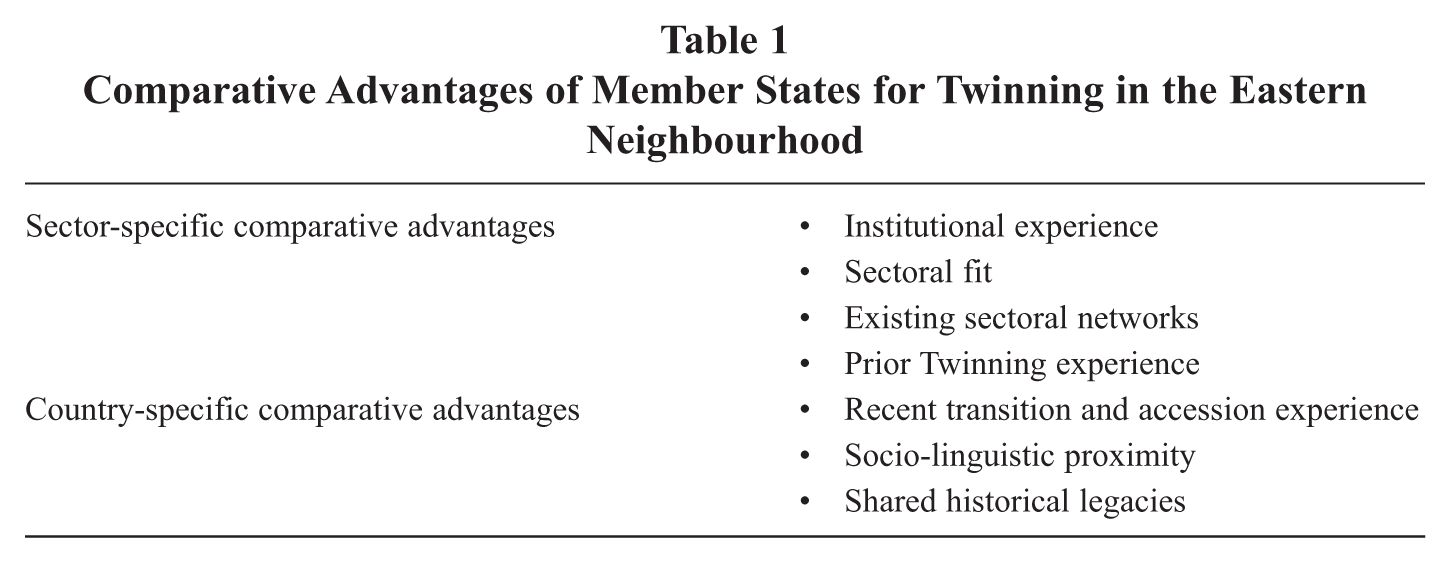
Drawing on existing studies on Twinning cooperation in EU candidate countries 22 and the works viewing CEECs as emergent agents of change in the Eastern neighbourhood, 23 we hypothesize that CEECs will have mostly country-specific comparative advantages for Twinning in the Eastern neighbourhood, while the older MSs will mainly display sector-specific comparative advantages (Table 1). In particular, it is hypothesized that CEECs will offer country-specific added value for EU Twinning in the Eastern neighbourhood because of their recent transition experience, cultural-linguistic proximity, and shared communist and/or Soviet past with the beneficiary countries. In turn, the older MSs will normally offer sector-specific comparative advantages, such as institutional experience in specific policy sectors, similarity of sectoral governance, prior Twinning experience, and density of sectoral networks with the beneficiary institutions in the Eastern neighbourhood. However, given their longer membership in the EU and long-standing (and well-resourced) public administration, the older MSs will have more sector-specific comparative advantages than CEECs.
Comparative Advantages of Member States for Twinning in the Eastern Neighbourhood
Country-Specific Comparative Advantages
One of the most obvious comparative advantages that CEECs may offer for EU transgovernmental cooperation in the Eastern neighbourhood is their transition experience, or rather, recent transition experience. 24 The process of transition typically involves a two-folded path from autocracy and centrally planned economy to democratic and market-based institutions. 25 The transition experience within the EU context refers to the institutional memory of democratic change and economic transformation of post-communist states of Eastern and Central Europe, most of which became members of the EU in the 2004 and 2007 enlargement rounds. 26 After having been themselves the beneficiaries of EU democracy promotion and transgovernmental programmes in the recent past, these new MSs have acquired a baggage of experience related to their political and institutional reforms, as well as the related history of cooperation with the older EU MSs and the United States. 27 Unlike the CEECs, most of the older MSs cannot boast of their transition experience, because they underwent their transitions a very long time ago and their institutional memory carries no implementation blueprints anymore.
The fact that the CEECs were themselves beneficiaries of the EU Twinning instrument, and thus have an intimate knowledge of the strengths and weaknesses of this instrument as a channel to help induce reforms, adds further weight to the expectation that civil servants from CEECs will be perceived to be particularly well placed to implement such projects in the Eastern neighbourhood. In this regard, the experience of civil servants from CEECs who were themselves involved in the implementation of Twinning projects in the pre-accession period and now operate in Twinning projects on behalf of the “sending partner” might appear especially valuable. As Königová et al. point out based on their assessment of the participation of EU MSs in pre-accession Twinning projects in the Czech Republic, it is critical to “explain the philosophy of any aid programme to the beneficiaries in a comprehensive and clear way, being fully aware of cultural sensitivities and seeking the acceptance and commitment from the recipient country and its institutions first.” 28 This brings us to the comparative advantages of socio-linguistic proximity and common historical legacies.
As highlighted above, Twinning establishes a socialization forum through the long-term secondment of bureaucrats and continuous direct contact between the respective bureaucracies and fosters interpersonal linkages across peer institutions. Under such circumstances, interpersonal communication plays an important role. Therefore, the socio-linguistic proximity and common historical legacies between civil servants from CEECs and their counterparts in the Eastern neighbourhood may help to build a relationship based on trust and mutual understanding and, as a result, familiarize counterpart state officials with EU regulations and practices. Also the fact that civil servants in some of CEECs, and in particular the Baltic countries, are fluent in Russian is expected to offer an added value to their participation in the Twinning exercise in the Eastern neighbourhood. 29
As indicated by Papadimitriou and Phinnemore, in the case of Twinning, “the ability of the dispatched civil servants to develop good working relationships with local staff has a significant bearing on the full realization of objectives.” 30 Existing studies on Twinning projects in the former EU candidate countries from Central and Eastern Europe have shown that the implementation process, at a day-to-day level of cooperation, has often been hampered by communication problems due to the language barrier, as well as by difficulties experienced by MS civil servants in adjusting to the local administrative culture. 31 Tulmets, for instance, indicates that “CEEC officials had difficulties to trust their future EU colleagues, who—they considered—had little knowledge of the candidate countries and were not always open to learning on the CEECs’ culture and past.” 32 Therefore, it seems plausible to expect that the socio-linguistic proximity and common historical legacies between the CEECs and the Eastern neighbouring countries should make it easier for civil servants from CEECs to find common ground with their counterparts in the Eastern neighbourhood countries and build a relationship based on trust and mutual understanding.
Indeed, decades of communist rule in the Eastern neighbourhood countries created a “Soviet identity” in those countries alongside their own national identities. It consists of certain habits, practices, social institutions, and socio-linguistic formulas, which linger on in the collective memory of all those who lived in the Soviet Union and, by extension, the Soviet bloc. 33 Such commonalities may contribute to better mutual understanding and trust between CEECs and post-Soviet countries east of the EU. Related to this, and even more importantly perhaps, a specific public service culture and administrative tradition emerged throughout the former Soviet Union and the former Soviet bloc, which to varying degrees still persists across the region. 34 Indeed, even in the new public administration practices of CEECs, influences from the communist heritage can still be seen. 35 This is not to suggest that all CEECs had the same communist regimes and administrative systems and all followed identical patterns in reforming their public administration. The point is rather that compared to civil servants from other EU MSs, civil servants from CEECs will find it easier to understand the local administrative culture of the post-communist countries in the Eastern neighbourhood. Given the specific goals and context of the Twinning instrument, understanding the local administrative culture may play an important role in facilitating the implementation process at the level of day-to-day cooperation.
Sector-Specific Comparative Advantages
Unlike the country-specific, sector-specific comparative advantages reflect strengths of MS institutions and civil servants in particular sectors of public policy making that are of relevance to the beneficiary. We look at four kinds of sector-specific comparative advantages—institutional experience, sectoral policy fit, prior sectoral cooperation, and Twinning experience, which are hypothesized to be mostly, but not exclusively, a prerogative of the older MSs.
To begin with, institutional experience is understood here as a notable record of administrative or institutional accomplishment gained by an MS in a specific area of public policy or administration. In other words, this concerns a reputational feature, held by MSs that are considered to demonstrate a “good example at home” in terms of their governance of a particular sector. 36 Given that the older MSs have been EU members for a longer time and, in many cases, have a more established administrative system, it is obvious to expect that this comparative advantage will apply more to the older MSs than to CEECs. Indeed, the latter are in some cases still struggling themselves to overcome their communist legacies and consolidate their transition.
Secondly, MSs may be considered as valuable partners when their administrative system at the sectoral level displays a certain degree of sectoral fit or compatibility with the administrative structures of the beneficiary side. 37 As indicated by the Europeanization literature, whereas some amount of misfit is important for policy diffusion to occur in the first place, 38 it is important that the nature or magnitude of such incompatibilities do not clash with the organizational specifics of the beneficiary institution. In the context of Twinning, this comparative advantage implies that for projects in specific sectors (e.g., statistics, land ownership, or education), MSs with a similar size or ministerial capacity as the counterpart organization in the BC may be preferred.
A third comparative advantage is the prior existence of sectoral networks between the MSs and beneficiary administration in a given policy area. Such sectoral networks may be part of established bilateral cooperation between the MSs and the ENP country. In her study of Twinning in Estonia and Hungary, Tulmets notes that these two countries preferred working with the MSs that had been their cooperation partners for several years. 39 In such a way, the financial, administrative, and personal connections emerging from the previous cooperation programmes in specific policy sectors are expected to create a conducive environment for Twinning. 40
A final sector-specific comparative advantage is prior Twinning experience. Certain MSs have gained extensive Twinning experience in a particular policy sector by participating in multiple Twinning projects in several countries. This may provide them with a “competitive edge” in EU transgovernmental cooperation in that particular sector, as compared to other MSs with no such experience. Through prior Twinning experience, they may be better equipped to avoid common pitfalls and setbacks in the management and organization of these projects in a given policy sector than the less experienced MSs would. 41
Data Collection and Methods
Owing to the strong emphasis of Twinning projects on policy contributions by MSs, we selected Twinning as the most likely case for studying the added value of CEECs compared to the older MSs for EU transgovernmental cooperation. In contrast to Twinning, other EU transgovernmental instruments, like TAIEX and SIGMA, provide less room for individual MSs to promulgate their comparative advantages, as these instruments mostly draw on EU-level expertise or private consultancies. 42
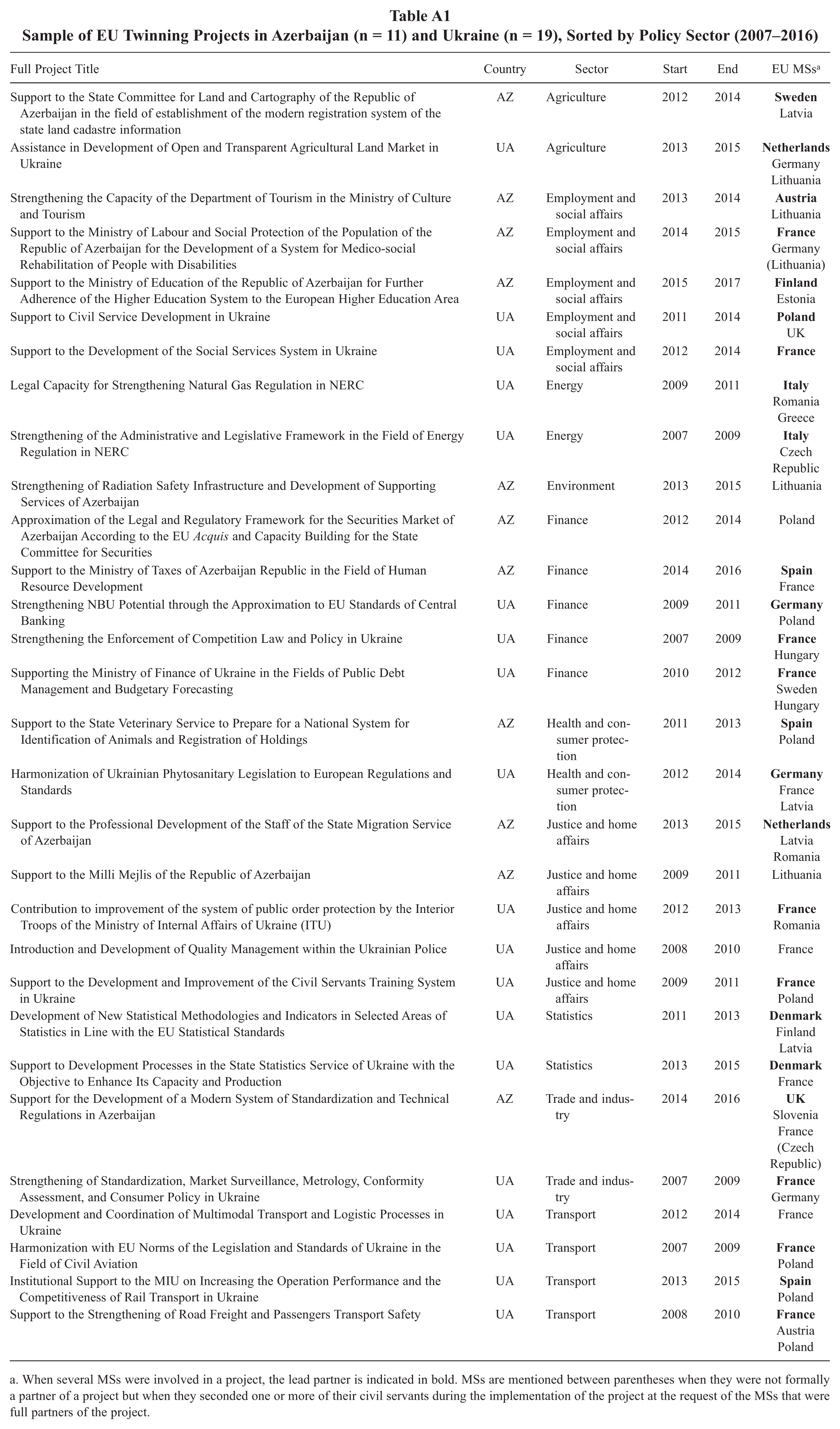
The empirical focus is on EU Twinning projects in Azerbaijan and Ukraine, which are the two front-runners in the Eastern neighbourhood in terms of the number of EU Twinning projects that have been implemented to date. Because of time constraints and difficulties locating all relevant stakeholders, we did not examine all Twinning projects in Azerbaijan and Ukraine, but selected a sample for analysis (see Table A1 in the appendix) that would allow us to sufficiently assess the added value of civil servants from CEECs in Twinning projects in Ukraine and Azerbaijan based on the characteristics that distinguish them from other EU MSs: recent transition experience, socio-linguistic proximity, and shared historical legacies with Ukraine and Azerbaijan.
Empirical data were gathered through forty semi-structured interviews, conducted with civil servants from CEECs, other MSs, Azerbaijan, and Ukraine, who have been closely involved in the implementation of the selected Twinning projects. Interview questions gauged the interviewees’ perceptions of the particular strengths and comparative advantages of the MSs involved in the respective projects as manifested during the implementation of the projects. The process of data collection was driven by a snowball sampling procedure, 43 which enabled us to get in touch with most Twinning officials through a network of relationships that we developed during our fieldtrips to Azerbaijan and Ukraine. While the majority of the respondents could comment on only one project, around one third of our interviewees could comment on two or more projects, which allowed us to cross-check evidence on each project from the sample. The overall number of interviews and, by extension, the size of the project sample were mainly driven by the considerations of data accessibility and sufficiency. From the outset, we intended to maximize the variation of our data by policy sector, MS partner involved (CEECs vs. older MSs), and respondent’s origin (the EU vs. the Eastern neighbourhood country). Once we were approaching the mark of forty interviews, we arrived at a point of “saturation,” whereby we were not getting additional useful data to test our hypotheses. Because the total number of Twinning projects implemented in Ukraine (forty-two) was slightly higher than that in Azerbaijan (thirty-three) in the period concerned, we kept this proportion in mind while selecting a sample of projects from each country (Table 2; Table A1 in Appendix).
Member State Participation in Twinning Projects in Azerbaijan and Ukraine, by Policy Sector (2007–2016)
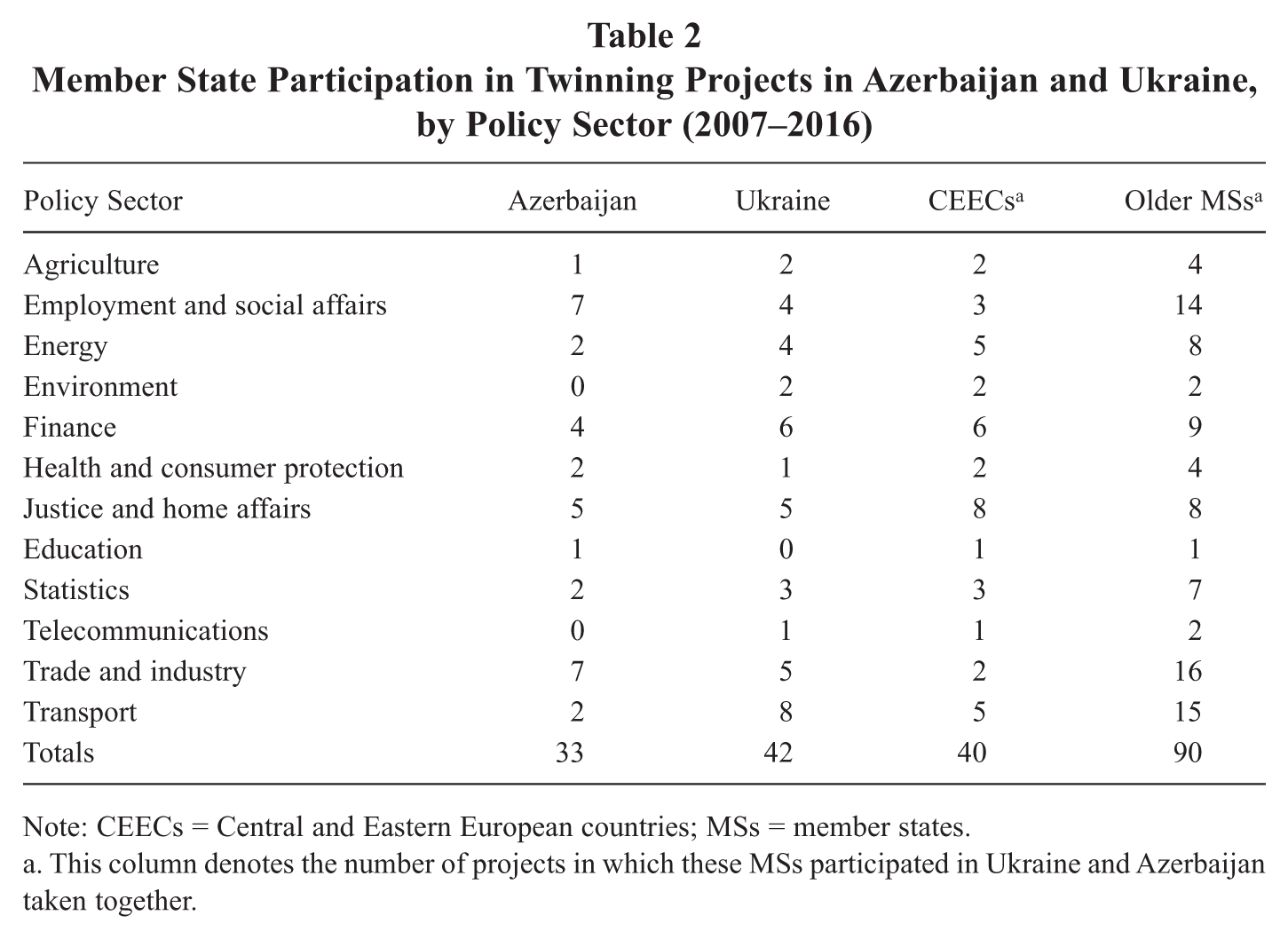
Note: CEECs = Central and Eastern European countries; MSs = member states.
This column denotes the number of projects in which these MSs participated in Ukraine and Azerbaijan taken together.
In order to control for preference bias in the interviewees’ assessments, we have triangulated our data using the EAR method (Ego/Alter perception, Researcher’s analysis). 44 This qualitative tool combines the perceptions of agents in decision making with an analysis of an external observer (researcher). Information on Ego and Alter perceptions, typically gathered during elite interviews, refers to an assessment by key agents of their own (Ego) or the other’s (Alter) influence in decision making. The Researcher’s analysis is then a validity check of those perceptions. Using this method to assess whether civil servants from CEECs and the older MSs are considered to offer specific added value during the implementation of EU Twinning projects in the Eastern neighbourhood, information on Ego perceptions refers here to an assessment by the civil servants from MSs of their added value in the project. Information on Alter perceptions regards an assessment of the added value of the MS involvement in the project by their counterparts from Ukraine or Azerbaijan and by their project partners from other EU MSs (in case the MS was not the only one involved in the Twinning project), as well as by officials from the EU Delegations in Ukraine and Azerbaijan who oversee the projects.
MS Participation in Twinning Projects in Azerbaijan and Ukraine
Between 2004 and 2016, about thirty-three Twinning projects were launched in Azerbaijan and 42 in Ukraine, which makes these countries frontrunners in the Eastern neighbourhood by the number of ongoing and concluded Twinning projects. 45 An overview of the participation of EU MSs in these projects is illustrated numerically in Table 2 and Figure 1. The Twinning instrument in Azerbaijan is based upon the priority areas stipulated in the Country Strategy Paper, which include democratic development and good governance, socio-economic reform with an emphasis on regulatory approximation with the EU acquis, and legislative and economic reforms in the energy sector, the transport sector, and the environment sector. 46 The sectoral spectrum of the Twinning Instrument in Ukraine covers a similarly diverse range of policy fields (Table 2) in line with the Partnership and Cooperation Agreement of 1998, the Action Plan of 2005, and most recently, the Association Agreement between the EU and Ukraine. 47

Member state participation as lead and junior partners in Twinning projects in Azerbaijan and Ukraine (2007–2016, n = 75)
Country-Specific Comparative Advantages of MSs for Twinning Projects in Azerbaijan and Ukraine
Recent Transition and Accession Experience
Most interviewees to this study concur that the recent transition and accession experience of MS partners from Central and Eastern Europe contributes to their added value during the implementation of Twinning projects. 48 For instance, in discussing the benefits of Poland’s transition experience for Twinning programme in Ukraine, a Polish official noted that “it is their understanding [by Ukrainians] that we [Poland] have gone through a certain period and achieved stability and now we are moving forward.” 49
Evidence from several interviews shows that civil servants from CEECs are valued for Twinning in Azerbaijan and Ukraine because they have a recent memory of how their country has undergone certain reforms.
50
As illustrated by a Swedish civil servant who operated as RTA in a project in Azerbaijan in which Latvia was the junior partner, the Latvian team members were indispensable as they could “share their experiences, the steps of transformation, mistakes and recommendations on how to avoid them.”
51
The fact that most CEECs can boast of a recent transition experience has two important implications for their added value in Twinning. First, Twinning officials from CEECs still carry their own professional experience and blueprints of recent reforms that they witnessed or spearheaded in their home administrations about a decade ago.
52
As a Danish civil servant who was involved in a statistics project in Ukraine suggested,
Officials from the new member states [CEECs] can relate well to how that decade has passed for them in statistics. The Danes do not remember that situation because there are already different generations. They do not know how it was 50-60 years ago when a certain [statistical] register was being created. It was just too long ago. . . . Initially, we wanted to only cooperate with Germany and France; however, the experience of the new member states is simply invaluable. Their experts are around 50 years old. 10-15 years ago they were implementing new technologies [in their country systems] and they perfectly remember what they did.
53
And second, because a majority of CEECs are still in the process of reforming their administrations and have not yet reached the level of the older MSs, the gap in the institutional development between these CEECs, on the one hand, and Azerbaijan and Ukraine, on the other, is still within reach. As a Ukrainian respondent explained, “something that gets reformed in Germany or France is in fact not reformed, but adjusted. In our Ukrainian case, we need to build from scratch and therefore their experience is generally interesting, but not realistic.” 54 For that reason, Azerbaijani and Ukrainian officials simply find it easier to relate with the MSs that have not gone too far off from their common starting point of institutional reform. In this respect, a Polish official noted that CEECs have a better understanding of “what is happening in the civil service system of Ukraine.” 55 For example, he added, “the English have a better experience; however, it is so remote [from the Ukrainian conditions] that without a ‘translator’ it is very difficult to implement something.” 56
For that reason, while often themselves being role models for CEECs, the older MSs often struggle to get their message across because their administrative systems or best practices in a given policy sector are too advanced and hard to stomach from the point of view of their partners from the Eastern neighbourhood. 57 A Dutch civil servant highlighted that this is exactly why the Netherlands always tries to partner with CEECs in EU Twinning projects, because “they sense the counterpart better since they were beneficiaries of Twinning themselves only recently.” 58 Similarly, a British civil servant explained that his department wanted to team up specifically with a CEEC for the Twinning project in Azerbaijan on technical barriers to trade, because, like Azerbaijan, they moved from a planned economy system. 59
Thereby, the transition experience of the Baltic countries is perceived as offering an even greater added value than the other CEECs from the former Eastern bloc, because the Baltics were a part of the Soviet Union and thus changed from the Soviet system to the EU’s system. 60 According to one Ukrainian official, “they [Baltic states] come from the same political system and have similar issues, and the approaches they used are more suited for us as well.” 61 In this respect, it is also interesting to note that, particularly in Azerbaijan, the Baltic countries tend to be seen as a best practice of de-Sovietization and modernization, at least in the perception of civil servants and technocrats—as opposed to senior government officials. 62 However, beyond attesting to the value of transition experience, this appreciation also speaks to the relevance of socio-linguistic proximity and common historical legacies.
Socio-linguistic Proximity and Common Historical Legacies
Historical, cultural, and linguistic affinity of (some of) the CEECs with Azerbaijan and Ukraine are seen as an important factor facilitating the implementation of Twinning projects in those countries. 63 After the collapse of the USSR, former communist societies found themselves in a state of institutional, social, and cultural homogeneity, 64 which allowed those societies, despite the different evolutionary paths adopted in the post-Soviet period, to have a more intimate understanding of political and administrative predicaments facing each other and thus enjoy more legitimacy in dealing with each other’s issues, as compared to outsiders, that is, the older MSs. Respondents from both Ukraine and Azerbaijan expressed the view that civil servants from CEECs have a much better understanding of typical political problems and cultural context in the Eastern neighbourhood after having shared part of history together, both under the Soviet Union and before. As a Ukrainian civil servant notes, “countries of the former Soviet bloc are particularly effective, because we have in common some issues, shared history, and understanding of the current processes.” 65
Just like with transition experience, this is especially the case for the Baltic states that were formerly part of the USSR and have a unique understanding of the post-Soviet realities. 66 The Swedish RTA of a Twinning project in Azerbaijan, which involved Latvia as junior partner, said that she “noticed that dialogues and discussions between the Latvian and Azerbaijani team members sometimes were more constructive [than between the Swedish and Azerbaijani team members]. For instance, when they discussed a new law based on a law from Soviet time, the Latvian and Azerbaijani team members easily understood each other.” 67 This also indicates that recent transition experience and shared history are often seen as two sides of the same coin. 68
In terms of cultural proximity, respondents implied that affinity with the administrative culture rather than with the national culture of the beneficiary country contributed to the added value of CEECs. 69 For example, Dutch civil servants mentioned that the Netherlands prefers to work in a consortium with CEECs like Poland, Lithuania, and Latvia for Twinning projects in the Eastern neighbourhood not only because of their recent transition experience but also because of their closer affinity with the local administrative culture. 70
Besides historical and socio-cultural legacies, command of local languages, in casu Russian (and/or Ukrainian in the case of Ukraine), was very often cited as a factor facilitating the Twinning implementation process. 71 This relates to the importance in Twinning of interpersonal communication between the beneficiary country and the MS officials, whereby direct interaction without interpreters contributes to a better rapport between the sides. The high importance of demonstrating hard, measurable results in the aftermath of each project makes the quality of communication (both in terms of language familiarity and interpersonal relations) between different members of project team a crucial component of Twinning success. For example, the French RTA of the Twinning project on competition policy in Ukraine was recalled and replaced because of the mounting communication difficulties with the beneficiary country’s officials. 72 Interestingly, in the case of Twinning in Azerbaijan, a command of Russian only appears to be an asset with older civil servants. Since many of the younger civil servants in the country were educated in the EU or the United States, communication in projects involving younger civil servants tends to be in English.
Sector-Specific Comparative Advantages of MSs for Twinning Projects in Azerbaijan and Ukraine
Institutional Experience
The interview data generally confirm our hypothesis that institutional and administrative experience constitutes mostly—but not exclusively—a comparative advantage for the older MSs owing to their generally well-established governance of particular policy sectors. Several interviews have indicated that the division of objectives and tasks within Twinning consortia during project implementation occurs on the basis of institutional experience of each MS partner in the given policy sector. 73 And that experience is often judged against the quality of reforms undertaken and general reputation of the MSs in that policy sector. 74
For example, in the Twinning project in Azerbaijan on standardization and technical regulations, the long established experience of the United Kingdom and France in this area, in combination with the transition experience of Slovenia, was seen as the main strength of the consortium. 75 In a project on metrology and consumer policy in Ukraine, the French and German systems were considered the most competitive in Europe, partly because of their strong role in such EU-wide standardization institutes as AENOR. 76 Also, our interviewee added, “they [France and Germany] are powerful and reputable players in the sphere of standardization and lead many technical committees in Europe, in addition to a well-functioning system at home.” 77 Similarly, France and Germany’s long and relevant experience in the field of disability care and social services was considered an important asset in Twining projects in these areas in both Azerbaijan and Ukraine. 78
In a project on land sales and land cadastre in Ukraine, the Netherlands was valued for its long-time expertise in this field. 79 Germany, a junior partner to that project, brought a more recent reform experience in that policy area, because Germans “experienced unification between Eastern and Western Germany and they are still in the process of selling state-owned land. And after thirty-five years the land market of Eastern Germany is still not complete. So they bring this tremendous value of how it is to sell public land and how you set up the cadastre of that area and what difficulties you encounter.” 80 In a related Twinning project in Azerbaijan, both Sweden and Latvia were considered to have great experience in the field of land evaluation and cadastre. 81
In projects in Ukraine’s transport sector, France, Spain, Germany, and Poland were viewed to have strong administrative and institutional experience in multimodal, rail, road, and aviation transport, respectively. 82 Estonia and Finland were perceived to have a good reputation in the field of higher education, and therefore the Azerbaijanis wanted to learn from their administrative and institutional experience in this field. 83 During Twinning cooperation on police forces in Ukraine, the French gendarmes were viewed to carry a valuable home-based experience in that policy area. 84 In the sector of budgetary forecasting in Ukraine, Sweden was perceived by Ukrainians to have a sophisticated, well-staffed debt management system. 85 The German Federal Bank (Deutsche Bundesbank), a senior project partner to a Twinning project with the Central Bank of Ukraine, was viewed as “one of the most respectable central banks all over the earth.” 86 The Netherlands, in turn, presents a role model in civil service reform and public personnel management, 87 while Poland’s financial and banking sector serves as a model thanks to Poland’s successes in building a stable currency and liberalizing capital flows. 88
Sectoral Fit
Besides institutional experience, it is also important that the MS administrative system and practices fit with those of the beneficiary’s during Twinning implementation. In the abovementioned project on standardization in Azerbaijan, an additional advantage of the consortium was that Slovenia (unlike France or the United Kingdom) was a small country with a limited administrative capacity, like Azerbaijan. In the field of technical barriers to trade, the size of the country and especially the administrative capacity of the ministerial organization matters. The Azeri side saw strong parallels with Slovenia in this regard. 89 The participation of Austria in a project on tourism in Azerbaijan was also considered beneficial not only because Austria has a very good reputation in terms of managing and promoting tourism (cf. administrative and institutional experience) but also because it is comparable in terms of size and, like Azerbaijan, it has mountains with a significant touristic potential. 90
In a project on phytosanitary issues in Ukraine, Germany’s involvement was considered very relevant because of the similar size of the countries and their comparable regional division (Germany has Länder and Ukraine, Oblasts).
91
A Danish official involved in a project in the field of statistics confirmed this point by suggesting that France enjoyed a comparative advantage working with Ukraine because of the comparable regional structure of the statistical systems in both countries, whereby data are collected from below, processed locally, and then passed on to the centre.
92
In a follow-up interview, our respondent emphasized a great importance of general sectoral fit between MSs and beneficiaries’ system from the Danish point of view:
Ukrainian statisticians think that the French system is very similar. For us, Northern member states, Denmark and Finland, we find this strange because we think that the French system is very old-fashioned and 20 years behind from ours. However, it turns out to be closer to the Ukrainian system.
93
In that respect, our interviewee also mentioned Poland as having the similar comparative advantage to France’s, as “it is a large country with regions,” which works very well for Ukraine in this and other policy fields. 94
Existing Sectoral Networks with the Beneficiary
Only in a couple of projects, sectoral networks involving the MSs and their counterparts from the beneficiary institution in Azerbaijan and Ukraine existed prior to the Twinning project. For example, the Estonian and Azerbaijani team leaders of the Twinning project on higher education in Azerbaijan already knew each other because they were the respective leaders of the Quality Assurance Agency of their countries. 95 Ukraine hosted France with two Twinning projects in the field of law enforcement owing to an existing bilateral collaboration between the Ukrainian Ministry of Interior and French gendarmerie. 96 There was a considerable density of such bilateral networks with the French in the early stages of Twinning in Ukraine (between 2007 and 2010), which was likely the reason why the French were selected for every second project during that period. 97 While the existence of such sectoral networks contributes to building thrust and creates a conducive environment for Twinning, 98 overall, we did not find enough evidence based on our sample to make robust claims about sectoral networks as a comparative advantage.
Prior Twinning Experience
We found more evidence in support of prior Twinning experience as a sector-specific comparative advantage. Given that CEECs generally participate less in EU Twinning projects than the older MSs, it is not surprising that it is mostly the older MSs that were mentioned to have this comparative advantage. For example, in the Twinning project in the Ministry of Taxes of Azerbaijan, Spanish and French participant organizations were valued for their extensive experience with previous Twining projects dealing with human resources. 99 It was also considered an asset that most of the French and German experts involved in the implementation of a project on disability care in Azerbaijan had international experience in post-communist countries, including in EU Twinning projects. 100 Similarly, for a project on standardization, the Azeri Twinning partners found it valuable that the French experts had previous experience with Twinning in the Balkans in the area of standardization and technical regulations. 101
In the case of projects in Ukrainian statistics, Denmark had a comparative advantage because of its multiple involvement in similar Twinning projects in places as diverse as Turkey, Israel, and Armenia. 102 Ahead of the EU’s Eastern enlargement, Denmark was also a great advocate of the CEECs and organized many PHARE projects in the region. As a result, this MS participates in almost every EU Twinning project in statistics, with 80 percent of cases as a leading partner. 103 Our Danish interviewee also noted that “even if another country wins a project (like Germany did in Macedonia), it still invites Statistics Denmark as a junior partner.” 104 An EU official involved with several projects at the National Electricity Regulatory Commission of Ukraine suggested that Italy, the lead partner in the project, has always been at the forefront of EU Twinning cooperation in this field in Turkey, Lithuania, and other counties. 105
Consortiums of CEECs and Older MSs as “Perfect Match”
Although not hypothesized, it appears that the greatest added value for Twinning projects in Ukraine and Azerbaijan is offered when CEECs and the older MSs operate together in a consortium, as suggested by a large number of our interviewees. 106 As a result, the older MSs are increasingly found to team up with CEECs and form consortiums because of the complementarity of their comparative advantages. Indeed, given that the older MSs generally lack country-specific comparative advantages for Twinning projects in the Eastern neighbourhood and CEECs tend to have fewer sector-specific comparative advantages, the older MSs and CEECs collaborate in order to maximize the added value that the consortium can offer to implement the project. Therefore, this finding could be seen as an additional confirmation of our initial hypothesis concerning the specific nature of the added value that CEECs may offer for Twinning in the Eastern neighbourhood.
For the project at the State Migration Service in Azerbaijan, for instance, the three consortium partners—the Netherlands, Latvia, and Romania—agreed on a division of labour that neatly reflects each partner’s excellence and competence not only in terms of skills and experience but also in terms of familiarity with the local language and context. 107 As such, the Dutch were responsible for providing training sessions, whereas the Latvians had a leading role in the practical implementation, helping the Azerbaijani civil servants to amend existing legislation and draft new legislation. Both the Latvian and Romanian civil servants shared their experience of harmonization of national migration legislation with EU legislation and explained how their organizations were reformed on the basis of European standards. Another example is the Twinning project in Ukraine’s civil service, implemented by a consortium of the United Kingdom and Poland. A Polish official associated with that project explained that the United Kingdom undertook all matters related to public service competencies and public relations, because the British had significant expertise in those areas, whereas Poland mainly handled the problems of implementation because of the proximity of political systems. 108
Conclusions
While EU MSs play an essential role in EU transgovernmental cooperation, and in Twinning in particular, their involvement remains largely understudied in the literature. Being aware of the added value that different EU MSs can offer for the implementation of Twinning will allow for a more nuanced understanding of the strengths of different MSs and make room for better programming of Twinning.
Focusing on Twinning projects in Azerbaijan and Ukraine, the article explored whether CEECs offer specific added value for the implementation of EU Twinning projects in the Eastern neighbourhood compared to the older MSs. Added value in our analysis referred to the perceived comparative advantages of an MS for the implementation of an EU Twinning project, as perceived by the project stakeholders. The article hypothesized that CEECs would mostly boast of country-specific comparative advantages, rooted in their recent transition experience, socio-linguistic proximity, and shared historical legacies with the Eastern neighbourhood. In turn, the older MSs were mainly expected to have sector-specific comparative advantages owing to their institutional experience, sectoral fit and existing networks with the beneficiary, and prior Twinning experience.
The findings largely confirm the hypothesis that the participation of CEECs in Twinning projects in the Eastern neighbourhood does offer a specific added value to the implementation of the projects, as compared to the participation by the older MSs. And this added value is manifested predominantly in the country-specific comparative advantages, which CEECs bring for Twinning projects in Azerbaijan and Ukraine. According to most respondents, recent transition and accession experience and personal participation in democratic and market transformations in their home countries make civil servants from CEECs better equipped to induce similar changes in other post-Soviet systems. In addition, they have a better understanding of the local situation and can relate more to the cultural and administrative parameters of the Eastern neighbourhood countries. The Baltic countries are perceived to be best placed in this respect since they were once part of the Soviet Union. Because of the centrality of interpersonal communication in the context of Twinning, the command of Slavic languages, especially Russian, is also seen as a strong comparative advantage of CEECs.
In contrast to CEECs, the older MSs mostly bring sector-specific comparative advantages on the board. Many of the older MSs, including the Netherlands, Germany, or the UK could demonstrate exemplary administrative systems, as well as excellent international reputation in their areas of sectoral expertise. Compatibility with the administrative structures of the beneficiary side also appears to be an important asset of the older MSs, in particular having a similar size, geography, or regional system. In addition, the prior Twinning experience of the older MSs in the respective sectors was seen as valuable. For example, Denmark and Italy have been known for a substantial experience across Europe and beyond through participating in EU Twinning projects in specific sectors, such as statistics and electricity market. Some MSs, like France or Finland, are tightly linked with beneficiary organizations in bilateral sectoral cooperation outside of Twinning, but we found too little evidence in our sample to fully support this comparative advantage. Although in several Twinning projects CEECs also boasted of sector-specific comparative advantages, in particular, institutional experience in relevant sectors and sectoral fit, these advantages were far more common for the older MSs.
Interestingly, although not hypothesized, our analysis also finds that the older MSs increasingly tend to team up with CEECs and form consortiums because of the complementarity of their comparative advantages, which only further corroborates our results. Indeed, given that the older MSs generally lack country-specific comparative advantages and CEECs tend to have fewer sector-specific comparative advantages, the older MSs and CEECs often join hands in order to maximize the added value that the consortium can offer for EU Twinning in the Eastern neighbourhood.
Despite the variation that Azerbaijan and Ukraine display on a number of factors that may determine perceptions of MS comparative advantages, including attitude toward European integration, sectoral variation, and ethno-cultural differences between those two countries, we did not find any evidence of these factors playing a significant role. This suggests that our findings on the added value of CEECs and the older MSs may possibly hold in other countries in the Eastern neighbourhood, such as Georgia, Moldova, and Armenia.
By raising the awareness of MSs’ strengths, our research may contribute to better coordination and complementarity in EU Twinning and other programmes under the ENP. The understanding of MS comparative advantages also holds new avenues for research on the effectiveness of EU Twinning in the neighbourhood. Further research will have to determine whether the participation of MSs based on their comparative advantages effectively increases the likelihood of successful implementation.
Footnotes
Appendix
Sample of EU Twinning Projects in Azerbaijan (n = 11) and Ukraine (n = 19), Sorted by Policy Sector (2007–2016)
| Full Project Title | Country | Sector | Start | End | EU MSs a |
|---|---|---|---|---|---|
| Support to the State Committee for Land and Cartography of the Republic of Azerbaijan in the field of establishment of the modern registration system of the state land cadastre information | AZ | Agriculture | 2012 | 2014 | Latvia |
| Assistance in Development of Open and Transparent Agricultural Land Market in Ukraine | UA | Agriculture | 2013 | 2015 | Germany Lithuania |
| Strengthening the Capacity of the Department of Tourism in the Ministry of Culture and Tourism | AZ | Employment and social affairs | 2013 | 2014 | Lithuania |
| Support to the Ministry of Labour and Social Protection of the Population of the Republic of Azerbaijan for the Development of a System for Medico-social Rehabilitation of People with Disabilities | AZ | Employment and social affairs | 2014 | 2015 | Germany (Lithuania) |
| Support to the Ministry of Education of the Republic of Azerbaijan for Further Adherence of the Higher Education System to the European Higher Education Area | AZ | Employment and social affairs | 2015 | 2017 | Estonia |
| Support to Civil Service Development in Ukraine | UA | Employment and social affairs | 2011 | 2014 | UK |
| Support to the Development of the Social Services System in Ukraine | UA | Employment and social affairs | 2012 | 2014 |
|
| Legal Capacity for Strengthening Natural Gas Regulation in NERC | UA | Energy | 2009 | 2011 | Romania Greece |
| Strengthening of the Administrative and Legislative Framework in the Field of Energy Regulation in NERC | UA | Energy | 2007 | 2009 | Czech Republic |
| Strengthening of Radiation Safety Infrastructure and Development of Supporting Services of Azerbaijan | AZ | Environment | 2013 | 2015 | Lithuania |
| Approximation of the Legal and Regulatory Framework for the Securities Market of Azerbaijan According to the EU Acquis and Capacity Building for the State Committee for Securities | AZ | Finance | 2012 | 2014 | Poland |
| Support to the Ministry of Taxes of Azerbaijan Republic in the Field of Human Resource Development | AZ | Finance | 2014 | 2016 | France |
| Strengthening NBU Potential through the Approximation to EU Standards of Central Banking | UA | Finance | 2009 | 2011 | Poland |
| Strengthening the Enforcement of Competition Law and Policy in Ukraine | UA | Finance | 2007 | 2009 | Hungary |
| Supporting the Ministry of Finance of Ukraine in the Fields of Public Debt Management and Budgetary Forecasting | UA | Finance | 2010 | 2012 | Sweden Hungary |
| Support to the State Veterinary Service to Prepare for a National System for Identification of Animals and Registration of Holdings | AZ | Health and consumer protection | 2011 | 2013 | Poland |
| Harmonization of Ukrainian Phytosanitary Legislation to European Regulations and Standards | UA | Health and consumer protection | 2012 | 2014 | France Latvia |
| Support to the Professional Development of the Staff of the State Migration Service of Azerbaijan | AZ | Justice and home affairs | 2013 | 2015 | Latvia Romania |
| Support to the Milli Mejlis of the Republic of Azerbaijan | AZ | Justice and home affairs | 2009 | 2011 | Lithuania |
| Contribution to improvement of the system of public order protection by the Interior Troops of the Ministry of Internal Affairs of Ukraine (ITU) | UA | Justice and home affairs | 2012 | 2013 | Romania |
| Introduction and Development of Quality Management within the Ukrainian Police | UA | Justice and home affairs | 2008 | 2010 | France |
| Support to the Development and Improvement of the Civil Servants Training System in Ukraine | UA | Justice and home affairs | 2009 | 2011 | Poland |
| Development of New Statistical Methodologies and Indicators in Selected Areas of Statistics in Line with the EU Statistical Standards | UA | Statistics | 2011 | 2013 | Finland Latvia |
| Support to Development Processes in the State Statistics Service of Ukraine with the Objective to Enhance Its Capacity and Production | UA | Statistics | 2013 | 2015 | France |
| Support for the Development of a Modern System of Standardization and Technical Regulations in Azerbaijan | AZ | Trade and industry | 2014 | 2016 | Slovenia France (Czech Republic) |
| Strengthening of Standardization, Market Surveillance, Metrology, Conformity Assessment, and Consumer Policy in Ukraine | UA | Trade and industry | 2007 | 2009 | Germany |
| Development and Coordination of Multimodal Transport and Logistic Processes in Ukraine | UA | Transport | 2012 | 2014 | France |
| Harmonization with EU Norms of the Legislation and Standards of Ukraine in the Field of Civil Aviation | UA | Transport | 2007 | 2009 | Poland |
| Institutional Support to the MIU on Increasing the Operation Performance and the Competitiveness of Rail Transport in Ukraine | UA | Transport | 2013 | 2015 | Poland |
| Support to the Strengthening of Road Freight and Passengers Transport Safety | UA | Transport | 2008 | 2010 | Austria Poland |
When several MSs were involved in a project, the lead partner is indicated in bold. MSs are mentioned between parentheses when they were not formally a partner of a project but when they seconded one or more of their civil servants during the implementation of the project at the request of the MSs that were full partners of the project.