



Abstract
The article presents the perceptions of global and internal developmental hierarchies in Romania. According to our empirical results, the Western-centred developmental paradigm has deeply penetrated the worldviews of ordinary people in Romania. As a consequence, national self-perceptions, respectively, constructions of internal regional and ethnic differences in Romania, are powerfully shaped by the idea of East–West developmental hierarchies. Melegh introduced the concept of an “East–West slope” to denote a discursive construction used since the eighteenth century. This construction suggests that there is a gradual decline of development (or “civilization”) as one moves from the West (North West) toward the East (South East). The author argues that this framework not only defines how Romanians position themselves in the global developmental hierarchy but also how they define their internal (regional and ethnic) hierarchies. The article also discusses Todorova’s concept of Balkanism. This interpretive framework not only defines the perceptions of external observers but (following a process of cultural penetration) may also shape the self-perceptions of those involved. This article argues that Romanians have succeeded in avoiding—at least partially—the most severe consequence of the “Balkanizing gaze,” which is a constant sense of inferiority. It is also important, however, that this Balkanizing gaze can be reproduced at a national/local level and (in interrelation with other types of developmental discourses) can organize internal hierarchies.
Keywords
A country does not belong to the space where it stands, but to the target it looks at.
1
Many Romanian intellectuals have explored the metaphor of escaping the Balkans. Adrian Cioroianu used the phrase “impossible escape,” 2 while Sorin Antohi has elaborated an ingenious typology of the strategies used by the Romanian elites to dissociate themselves from the Balkans. 3 The first among Antohi’s strategies is “sublimation,” meaning a creative process by which seemingly Balkanic characteristics are transformed through artistic means into products that can be sold on the global/Western market. The second strategy, “ethnic ontology,” takes the form of discourses that focus on the unique spaceless and timeless characteristics of a “unitary Romanianness.” The third strategy Antohi calls “geopolitical bovarism.” Its essence is defined in the opening quote by Nicolae Iorga, that Romania belongs not “where it stands but to the target it looks at.” 4 Consequently, Romania could be the “Belgium of the Orient” and Bucharest the “little Paris.” 5 More generally, the country could (symbolically) belong to the West, if its elites were insistent enough in adopting Western models.
One should emphasize that it is not the Balkans per se that Romanian elites have tried to escape, but the Balkans as a geo-historical and cultural metaphor constructed by the Balkanist interpretative framework, as defined by Todorova. 6 This framework was used initially by Western observers, who constructed the Balkans in opposition to the West. However, following a process of cultural penetration, it has profoundly shaped the self-perceptions of those involved, leading to a pronounced, persistent sense of inferiority among those living in this region.
In this article, I draw on representative survey results to investigate the perception of developmental hierarchies in Romania. One of my main questions is whether the national self-perception of ordinary Romanians is organized according to a Balkanizing interpretative framework. 7 Surveys conducted within the Developmental Idealism Studies research program reveal considerable differences as regards the self-perception of Central and Eastern European nations: while Bulgarians and Albanians position their country next to the Central African Republic and Nigeria, Hungarians place Hungary in a middle position. 8 My empirical question is whether Romanians’ perceptions are similar to the Bulgarian and Albanian or to the Hungarian ones. My second, more general question refers to the acceptance of East–West-type developmental discourses. I argue that these discourses not only define the ways Romanians position themselves in the global hierarchy but also how they construct internal (regional and ethnic) differences. A related research question is whether ethnic and regional stereotyping is connected to the idea of developmental hierarchies and whether historically constructed hierarchies could change over time. This is of particular interest in the case of Transylvanian Hungarians, given the contradiction between their historically dominant and present-day disadvantaged position.
Conceptual Tools
Our investigation could be anchored in a multi-level conceptual framework. On a first level, world-system and dependency theories should be mentioned. As for Eastern Europe, this framework was particularly influential during the 1970s and 1980s. Historians convincingly describe how different parts of Eastern Europe were included into the emerging Northwest Europe–centred system of global capitalism as peripheral or semi-peripheral societies during the eighteenth and nineteenth centuries. 9 They also emphasize the enduring character of structural inequalities and power asymmetries, and consequently have been highly sceptical concerning the developmental prospects of East European semi-peripheries. Recently, many analysts have argued that world system theories could be insightful when analyzing the former Soviet Bloc countries. 10 Thus József Böröcz interprets state socialism as an attempt to isolate East European societies from the structural constraints of the global economy and to soften the social consequences of the core–periphery logic. Consequently, with the collapse of state socialism, these societies returned “to that part of global productive assets of humankind that is valorised by global capital without the interference of the socialist state.” 11 This resulted in fact in restating the semi-peripheral positions specific to these states before the Second World War.
On a second level, one should emphasize that an emerging discursive order was also a constitutive part of the asymmetric relationship between Eastern and Western Europe. Maria Todorova argues that Balkanism is a phenomenon similar to Orientalism. 12 Larry Wolff uses the expression “demi-Orientalism” and highlights that the current conventional division of Europe into East and West can be traced back to the eighteenth century. 13 This was related to the Enlightenment and the spread of the evolutionary paradigm that the Eastern part of the continent has often been identified with backwardness, and as lacking the sophisticated social relations and institutions characterizing Western societies. Ezequiel Adamovsky disagrees with Wolff, arguing that the beginnings of “Euro-Orientalism” can be found much later—in the second half of the nineteenth century. As an institutionalized and hegemonic discourse, it took shape in the period following the First World War and consolidated itself only during the Cold War era. 14 Attila Melegh 15 uses the expression East–West slope in a very similar manner: it is a historically constructed global-hierarchical evolutionary scheme, with the Western core-countries on the top of the hierarchy, and all the others evaluated according to their distance from the core.
On a third level, the concept of developmental idealism, elaborated by Arland Thornton, is also of particular importance here. 16 Developmental idealism is a cultural model, or a set of values and beliefs strongly connected to the evolutionist perspective and the developmental paradigm. It is based on the idea that all societies across the globe (should) follow essentially the same developmental pathway. As a consequence, countries or societies could be ranked and hierarchized according to their level of development (civilization, advancement, etc.). Thornton highlights that the developmental paradigm enjoys huge prestige even today, in spite of the fact that it has been heavily criticized by many social scientists because of both its evolutionist and Western-centred character. 17 Developmental scales ranking different countries are propagated (among others) by highly prestigious transnational organizations like the United Nations Development Programme (UNDP) or the World Bank. 18 These scales can be considered discursive tools through which the global elites express and reinforce their own ideas concerning social development and developmental hierarchies. Furthermore, a large number of investigations (surveys) conducted in the frame of the Developmental Idealism Studies research program have shown that ordinary people around the globe are well “aware” of developmental hierarchies, 19 and that the Western-centred developmental paradigm has a powerful effect in shaping both individual life strategies and political decisions conducive to societal-level change. 20
Developmental idealism has many common characteristics with functionalist-evolutionary theories of social modernization. 21 One of its key components is the conviction that development (or the condition of advanced modernity) is universally attainable. In other words, adepts of developmental idealism – as opposed to world system theorists 22 – are optimistic concerning the developmental prospects of (semi-)peripheral societies. A further component is the belief in causal mechanisms between the different dimensions of “development” (e.g., modern patterns of family formation, democracy, and market economy are interconnected and are conductive to well-being). Thornton emphasized repeatedly his “agnosticism” concerning developmental idealism and different theories of social change. 23 His question is not whether the presumptions of developmental idealism are valid but whether (or to what extent) the different elements of developmental idealism are accepted or rejected by various groups of people.
On a fourth level, the habitualized 24 strategies of “colonized subjects” (i.e., people belonging to categories associated with lower positions on the slope) are also important. Melegh noticed that if “colonized subjects” internalize the idea of the slope, “the most important feeling down the slope is that the position of the country cannot be maintained and should be changed.” 25 Analysts offer various typologies of (habitualized) strategies meant to deal with developmental hierarches. They also emphasize that differences in the strategies to “ascend the slope” organize competition and define cleavages in many nationally or locally bounded social fields. 26 For our purposes, three strategies/habits are important, namely (1) elaborating competing models of development, (2) internalizing the Orientalizing/Balkanizing gaze and underrating one’s own society, respectively, or (3) taking a middle position and competing with “neighbours” or “internal others.”
The Romanian Context
Socio-historical Background: Changing Perceptions of Development
According to Chirot, Romania was integrated into the global system of capitalist economy during the nineteenth century as a peripheral society. 27 Since then, one of the major concerns of Romanian elites has been to improve the relative developmental position of their country. The economic performance and the developmental success of interwar Greater Romania is a much debated issue. 28 However, it seems evident that various groups of the interwar intelligentsia, especially young intellectuals, were quite dissatisfied in this respect. 29 In this context (as elsewhere in Eastern Europe), a wide range of alternative developmental models were circulated. Chirot typified them along four axes, namely, democracy versus elitism, secular Western versus anti-secular “nativist,” statist versus anti-statist, and open versus closed economies. 30
Developmental thinking was an important component of the Marxist ideology too. 31 State socialism could be perceived as an alternative model of development, characterized by a closed economy, a statist approach, secular and anti-nativist values, and anti-democratic leadership. As mentioned already, it could also be perceived as an attempt to escape the core–periphery logic of Western-centred global capitalism. First, Eastern-Bloc countries led by the Soviet Union tried to establish an alternative transnational economic system. Second, national-level economic and social planning could also be perceived as a means of escaping centre–periphery-type dependency. This latter aspect was particularly important in the Romanian case, since in 1962 the Romanian party leaders vehemently rejected Khrushchev’s plan for an alternative state-socialist system of “world economy,” and in a kind of “declaration of independence” called for (intra-Bloc) national sovereignty and economic autarky. 32
Unfortunately, there are no survey results regarding the perception of developmental hierarchies during the former regime in Romania. However, citing the results of surveys conducted in Hungary in the 1980s, Szabó stated that at the beginning of the 1980s Hungarians found their own society in many areas more developed than the “West.” Such areas were, for example, the level of health care, or the fulfilment of equal opportunities. Moreover, 46 percent of Hungarians thought in 1981 that in their country the living standards were higher than in the “West.” Nevertheless, these perceptions were reversed during the 1980s. 33 One should note that in Hungary the change in the perception of developmental hierarchies occurred parallel to a shift from developmental discourses emphasizing the universal and quantitatively measurable aspects of “modernization” (industrial production, economic performance, life expectancy, etc.) to a discourse relying on qualitative, civilizational differences. 34 Not only did Hungarians lose their faith in the developmental prospects of state socialism during the 1980s, they also tried to elaborate a new consensus concerning the country’s desirable developmental pathway. However, the discursive construction underpinning this new consensus was inherently ambivalent. On the one hand, it urged the acceptance of the Western developmental paradigm, perceived as a coherent model that could be adopted. On the other hand, geo-cultural arguments and geo-historical metaphors, emphasizing the inherently and historically rooted Western character of Hungary, also played a key role in solidifying the country’s new orientation. In this respect, the medievalist Jenő Szűcs and his thesis concerning the three historical regions of Europe was of central importance, as it constructed “Central Europe” as a region historically connected to Western civilization. 35 “Mitteleuropa” was certainly not an exclusively Hungarian project, and—as a geo-historical and cultural metaphor—it played a key role in solidifying pro-Western orientations in countries like Poland, Czechoslovakia, or the Croatian and Slovenian republics of Yugoslavia. However, it also created and excluded “Orientalized” others (e.g., the “non-Western,” “non-European” parts of Eastern Europe), most importantly Russia and the Balkans. 36
As for Romania, both similarities and differences could be hypothesized. The acceptance of the state socialist project of social modernization was most probably at its peak during the late 1960s and early 1970s. Romania had attained remarkable results in social modernization up to this period. 37 It is also important that Romania opted for autarky and a sort of national Communism following the 1950s. This led to a remarkable closure, even if only in comparison with other societies of the Eastern Bloc. In this context, external hierarchies most probably played a less important role in popular concepts concerning development. In other words, development (modernization) was most probably self-referent for many people, especially for the socially mobile lower strata.
In Romania, a new consensus about the country’s developmental pathways took shape at the level of the cultural and political elites in the 1990s. Its basic idea was very simple: Romania should “return” to its Western references and should follow “Western” patterns of social development (perceived as a coherent model). 38 In practice, this meant a radical turn in geopolitics and the acceptance of the neoliberal policies propagated by Western-led transnational actors. This outcome was very similar to those in Hungary, Poland, or the Czech Republic. However, an important difference should be noted concerning the discursive construction of the new consensus. Romanian elites (or most precisely the majority of them) vehemently rejected geo-historical and geo-cultural metaphors and adopted a “pure” version of developmental idealism (or the “liberal utopia,” as Melegh calls it 39 ). The rejection of the geo-cultural metaphor and civilizational discourse was connected to two factors. First, in this framework Romania played the role of the Orientalized other (vis-à-vis the “inherently Western” Central European parts of the former Soviet Bloc) and risked being excluded from the enlarging Euro-Atlantic structure. Second, Romanian elites perceived the Central European project as challenging the process of building a unitary Romanian nation-state. For instance, Huntington’s cleavage 40 dividing Western and so-called Eastern Orthodox civilizations cut across Romania, while the only territories in Romania that had a record of Central European identity were perceived by the Romanian elites as being exposed to Hungarian irredentism. 41 Moreover (partially connected to the fear of Hungarian irredentism), political elites tried to maintain the centralized structure of the state and to dominate the discourse of regionalization. 42 Under such conditions, the use and acceptance of civilizational discourses has remained marginal in Romania. Nonetheless, attempts to create a civilizational discourse to highlight Romania’s “Western” characteristics existed. Geography textbooks used in Romanian schools, for instance, discuss Romania as one of the Central European countries (along Poland, Czech Republic, Slovakia, Hungary, and Slovenia). 43 Cristian Cercel has convincingly argued that hierarchizing minorities and especially the phenomenon of “philo-Germanism without Germans” is also connected to the production of symbolic geographies whose aim is to insert Romania into the “civilized” Western world. 44
Regional and Ethnic Differences
As for internal developmental hierarchies, it is of key importance that, historically, the country was made up of several areas with distinct traditions (Figure 1). Transylvania (in Romanian Transilvania or Ardeal), Banat, Crișana, and Maramureș had belonged to the medieval Hungarian Kingdom, and in the late seventeenth century, after the Ottomans were chased out of Hungary, became part of the Habsburg Empire. The region came under Romanian authority in 1918.
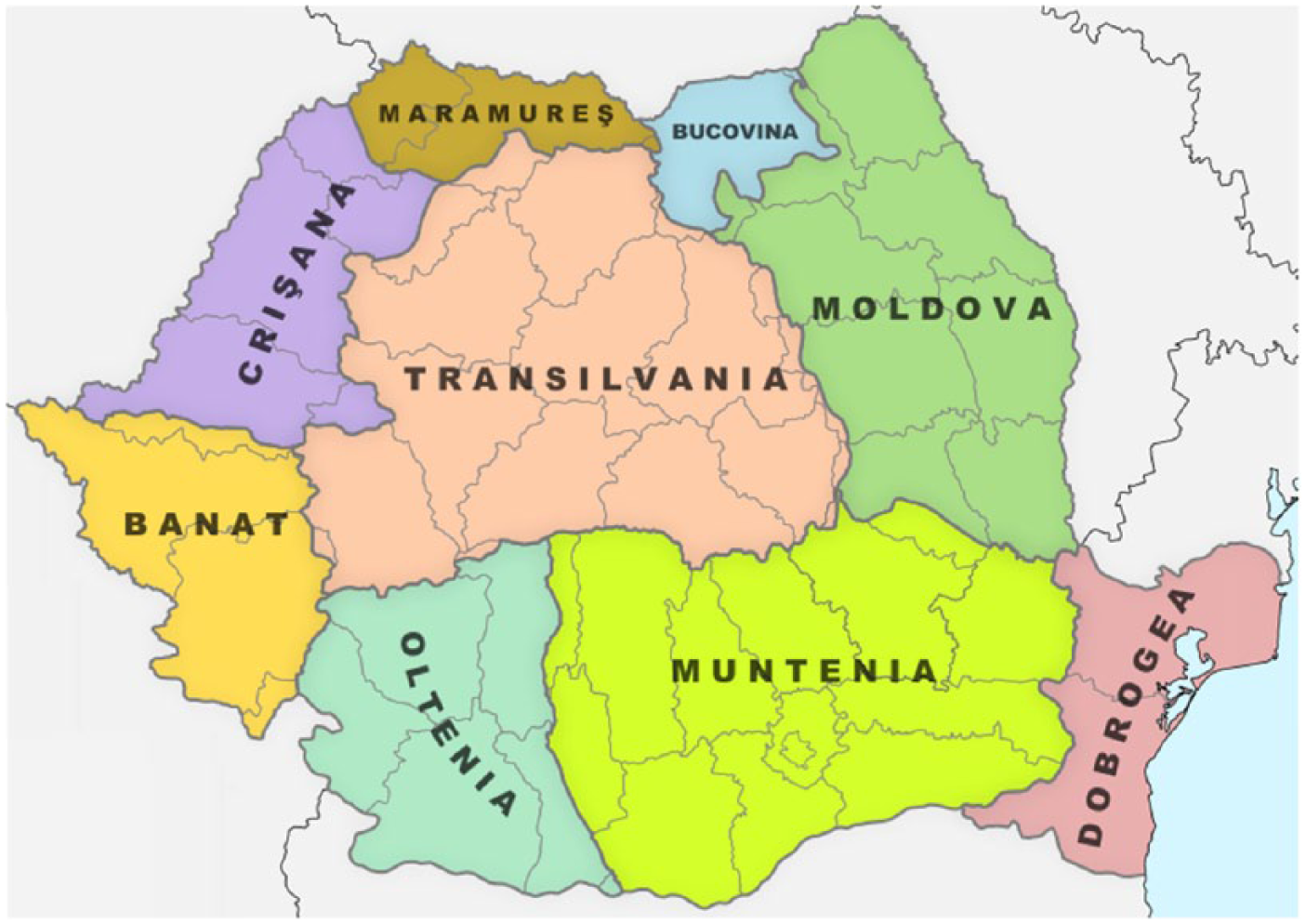
The historical regions of Romania
Moldavia and Wallachia were separate principalities until the creation of the Romanian State in 1859. The two principalities (and the newly created Romanian State) were under indirect Ottoman rule until 1877. Both Wallachia and Moldavia have several sub-regions. Wallachia is composed of Muntenia (also called Greater Wallachia) and Oltenia (also called Lesser Wallachia). The medieval principality of Moldavia comprised territories that now belong to Romania, the Republic of Moldova and Ukraine. The present-day Romanian region of Moldavia refers to the western parts of the former principality. However, in the symbolic geography of Romania, Moldavia is distinguishable from Bukovina, which earlier also used to be part of the principality of Moldavia, but from 1774 to 1918 belonged to the Austrian Empire. Dobruja (or in Romanian Dobrogea) was under direct Ottoman rule earlier and became part of the newly independent Romanian Kingdom in 1878. The regions that used to be under Habsburg rule were among the less industrialized parts of the Austro-Hungarian Empire. Nevertheless, they still had a relatively favourable position within the newly established Greater Romania.
Greater Romania was established in 1918 and included many national minorities, most of them being concentrated in Transylvania, Banat, and Crișana. According to the results of the 1930 Romanian census led by Sabin Mănuilă, the proportion of Hungarian- and German-speakers (taken together) was 36.5 percent of the total population of the newly gained provinces and 58.3 percent among urban dwellers. 45 In the interwar period, they had a favourable socio-economic position and continued to dominate the urban centres of Transylvania in spite of the nationalizing efforts of the Romanian nation-state. 46 The German community experienced a mass exodus and ceased to exist in a substantive (ethno-demographic) sense during and immediately after state-socialism. While in 1977 Germans still numbered 360,000, today their number hardly exceeds 30,000. Nevertheless, symbolically the German community/heritage remains very visible in Romania today. 47 The proportion of Hungarians has also dropped. Presently, 20 percent of Transylvania and 6.5 percent of Romania is part of the Hungarian community (numbering 1.3 million people). While earlier this ethnic group was dominant in the urban centres, today the proportion of urban dwellers among Hungarians is well below the national average. Hungarians earn less than Romanians, are less educated than Romanians, and are severely underrepresented among the upper and middle classes. 48 The next ethnic category of major importance in Romania is the Roma/Gypsy. According to the 2011 census, 620,000 considered themselves as Roma; however, according to the estimates of experts, the number of people perceived as Roma by others is between 1.3 and 1.8 million. The Roma always had a quite low position within Romanian society; however, their marginality evidently increased following 1989. 49
As already mentioned, the majority of Romanian elites tried to avoid using geo-cultural metaphors. However, this does not mean that these metaphors do not play an important role in the symbolic geography of Romania. Antohi highlights that “after the unification many prominent Romanians expressed their dissatisfaction with the ‘Romanianisation’ of Transylvania (considered by many as ‘Balkanisation’), moreover, many hoped that they would be successful in Transylvanianising Romania.” 50 The Transylvanist idea, however, had a much stronger grasp on the Transylvanian Hungarian and Saxon elites. They stressed the “Western” (Austrian-Hungarian) legal and administrative traditions of the province and portrayed the “Balkanization” of Transylvania as a major threat. Transylvanist discourses were revitalized after the regime change of 1989, first of all by a group of intellectuals formed around the bilingual (Romanian–Hungarian) journal Provincia. In Banat, a group of social scientists started the project “A treia Europa” (The third Europe) stressing the “Central European” character of the region. There is some evidence that this kind of civilizational discourse influences the regional stereotyping of ordinary people too. Brubaker and his colleagues found that in Transylvania regional categories may function as quasi-ethnic categories. In their example, ethnic Romanians in Cluj distinguished themselves from “Southerners” (in Romanian “sudiștii” meaning people from Muntenia, Oltenia, and Bucharest) not only in civilizational but also in racial terms. 51
Neither is ethnic identity formation independent of developmental/civilizational discourses. Sasha Davis emphasized that in the interwar period the sense of civilizational supremacy of Germans and Hungarians helped them to resist the assimilatory efforts of the newly created Romanian nation-state. 52 The position of the Roma in Romanian society is also deeply affected by developmental/civilizational discourses. 53
My research question is whether stereotypical representation of different regional and ethnic groups is connected to the idea of developmental hierarchies. As mentioned already, one of the general questions was whether Romanians could be characterized by an internalized sense of inferiority similar to Bulgarians and Albanians, or by taking a middling position similar to those revealed by research in Hungary. As for Transylvanian Hungarians, the empirical question is the following: how do they perceive their position and how do others see their position in the developmental hierarchy (on the East–West slope), considering the conflict between their historical sense of supremacy and their present-day disadvantaged position.
Data and Methods
In my analysis, I use quantitative data provided by the Romanian Institute for Research on National Minorities. The Institute, in cooperation with the Developmental Idealism Studies research program, conducted a nationally representative random survey of 1,200 respondents in Romania in September 2014. The various historical regions and ethnic groups were proportionally represented. Transylvanians (including Banat and Crișana-Maramureș) constitute 33.8 percent (406 respondents 54 ), Muntenians (including Dobruja) 38.2 percent (459 respondents), Moldavians (including Bukovina) 17.6 percent (211 respondents), and Oltenians 10.4 percent (125 respondents). These are large enough regional subsamples to analyze them separately. As for minority ethnic groups, the statewide representative random sample did not include enough cases for a meaningful assessment. However, 729 randomly selected Transylvanian ethnic Hungarians were surveyed additionally. Thus, their responses also could be analyzed separately. 55
As for the perception of global developmental hierarchies, the Core Questionnaire proposed by the Developmental Idealism Studies research program was used. 56 We asked the respondents to locate 17 different countries on a developmental scale ranging from 0 to 10. Additionally, respondents were asked whether they agree that countries can be ranked in a hierarchical order according to their level of development. (“Do you agree that countries can be ranked in a hierarchical order according to their level of development?”)
As for the perception of internal hierarchies, both closed- and open-ended questions were used. The developmental position of the various Romanian regions was measured on the same scale ranging from 0 to 10. Seven regions were listed, namely. Banat, Bukovina, Dobruja, Moldova, Muntenia, Oltenia, and Transylvania. Respondents were not asked to rank Maramureș and Crișana, as these are more blurred regional categories and identities. 57
Similarly, a closed-ended question was asked regarding the impact of the cultural traditions of different ethnic groups on the developmental level of the region where they live. Germans, Hungarians, Roma/Gypsy, and Romanians were the listed categories.
Next to the closed-ended questions a set of open-ended questions was asked, regarding the typical characteristics of the regional groups (Oltenians, Muntenians, Moldavians, and Transylvanians), respectively, of the ethnic communities living in Romania (Germans, Roma/Țigani, Hungarians, and Romanians). For each regional and ethnic group, three characteristics could be mentioned by the respondents.
Perceptions of Global Developmental Hierarchies
Acceptance of Developmental Hierarchies
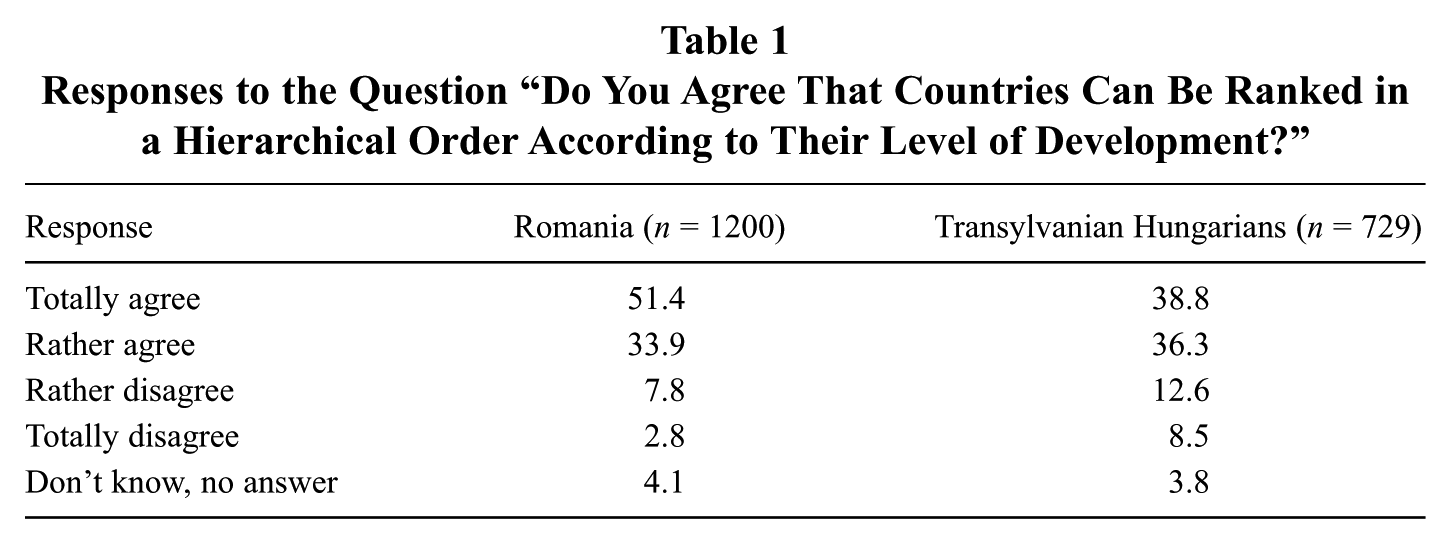
Investigations carried out in the framework of the Developmental Idealism Studies research program 58 revealed that the developmental paradigm has permeated the worldviews of ordinary people and the developmental hierarchies as they appear in different indexes produced by global elites, such as GDP/capita or HDI, are largely accepted. Our results also underscore the wide acceptance of developmental thinking and of the idea of an East–West slope. The results show that the vast majority of Romanians, 85.3 percent, agrees with the use of developmental hierarchies (Table 1). The proportion of those who disagree with the use of developmental hierarchies is only 10.6 percent. In the case of Transylvanian Hungarians, the acceptance of developmental hierarchies is lower; however, the great majority (75.1 percent) also accepts the idea of a developmental hierarchy.
Responses to the Question “Do You Agree That Countries Can Be Ranked in a Hierarchical Order According to Their Level of Development?”
Most Romanians were able to place the listed countries on the developmental scale: the response rates were between 76 and 98 percent for individual countries (Table 2).
Respondent’s Ratings Compared to World Bank’s GDP/Capita
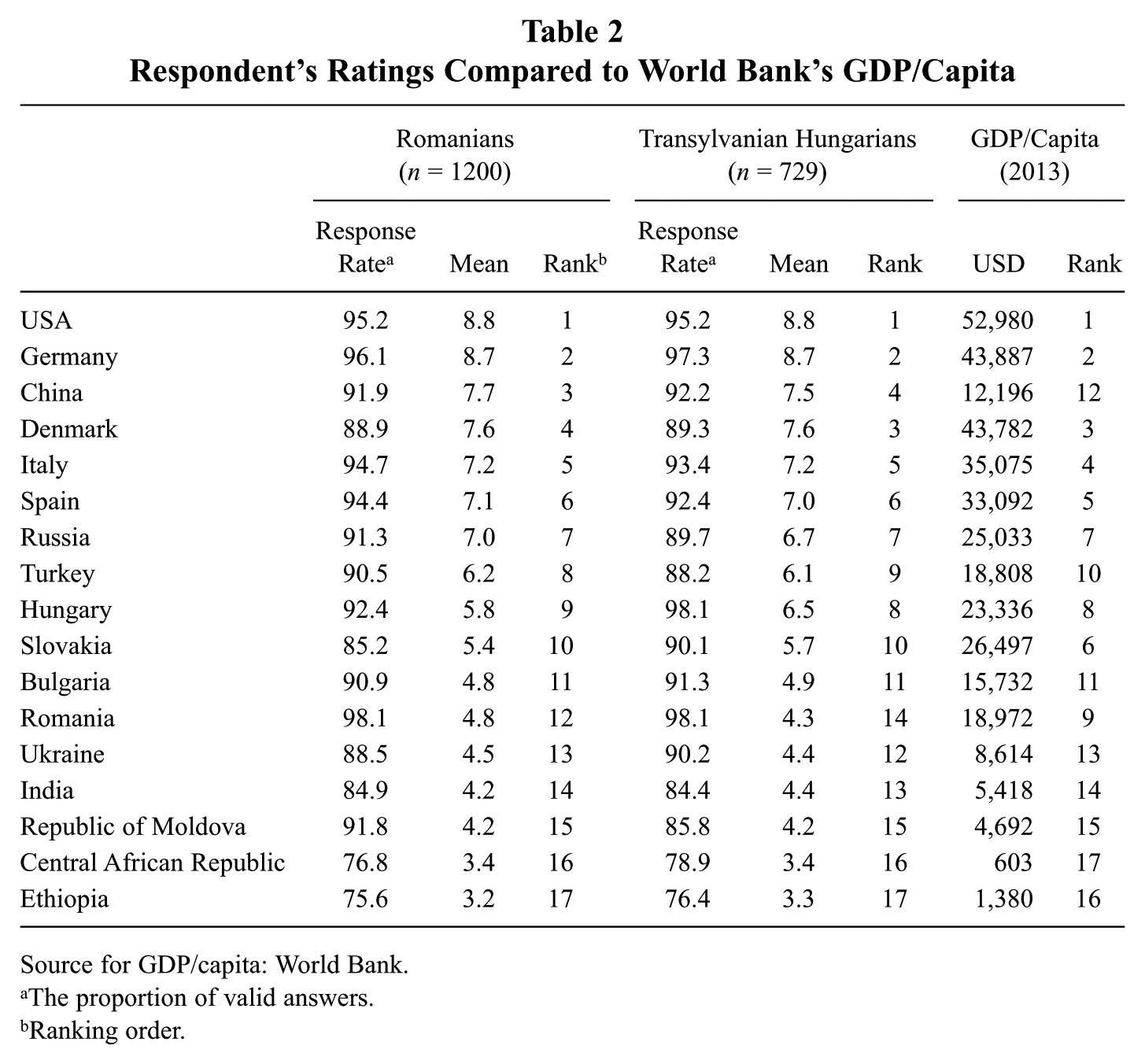
Source for GDP/capita: World Bank.
The proportion of valid answers.
Ranking order.
Transylvanian Hungarians and Romanians perceive quite similarly developmental hierarchies. The correlation between average individual countries ranking of Transylvanian Hungarians and Romanians is extremely high (P = 0.997). It is noteworthy that both ethnic Romanians and Hungarians clearly “over-position” the developmental level of China, and to a lesser extent also that of Russia and Turkey. The only significant difference is in positioning Hungary, as Transylvanian Hungarians ranked their “ethnic homeland” somewhat higher compared to the Romanian average. One can also conclude that there is a significant overlap between the perceptions of ordinary people and the developmental hierarchies propagated by global elites. This is indicated by the very high correlation values between average individual countries rankings and GDP/capita (P = 0.868).
Underrating or Taking a Middling Position?
As already mentioned, one can distinguish various habitualized strategies meant to deal with one’s lower position in the developmental hierarchy. Previous surveys found that Albanians and Bulgarians severely under-evaluated themselves, ranking their own country next to some sub-Saharan states (Table 3). Researchers who analyzed the Bulgarian case interpreted this fact on the basis of Todorova’s notion of Balkanism. 59 Kiossev’s notion of “self-colonizing cultures” also adequately describes this habit. 60 According to Kiossev, in self-colonizing cultures, people characterize their own society through the lack of all kinds of valorized traits and institutions supposed to exist in a “normal” society (the idealized Occident).
Developmental Positions According to Romanian, Albanian, Bulgarian, and Hungarian Perceptions
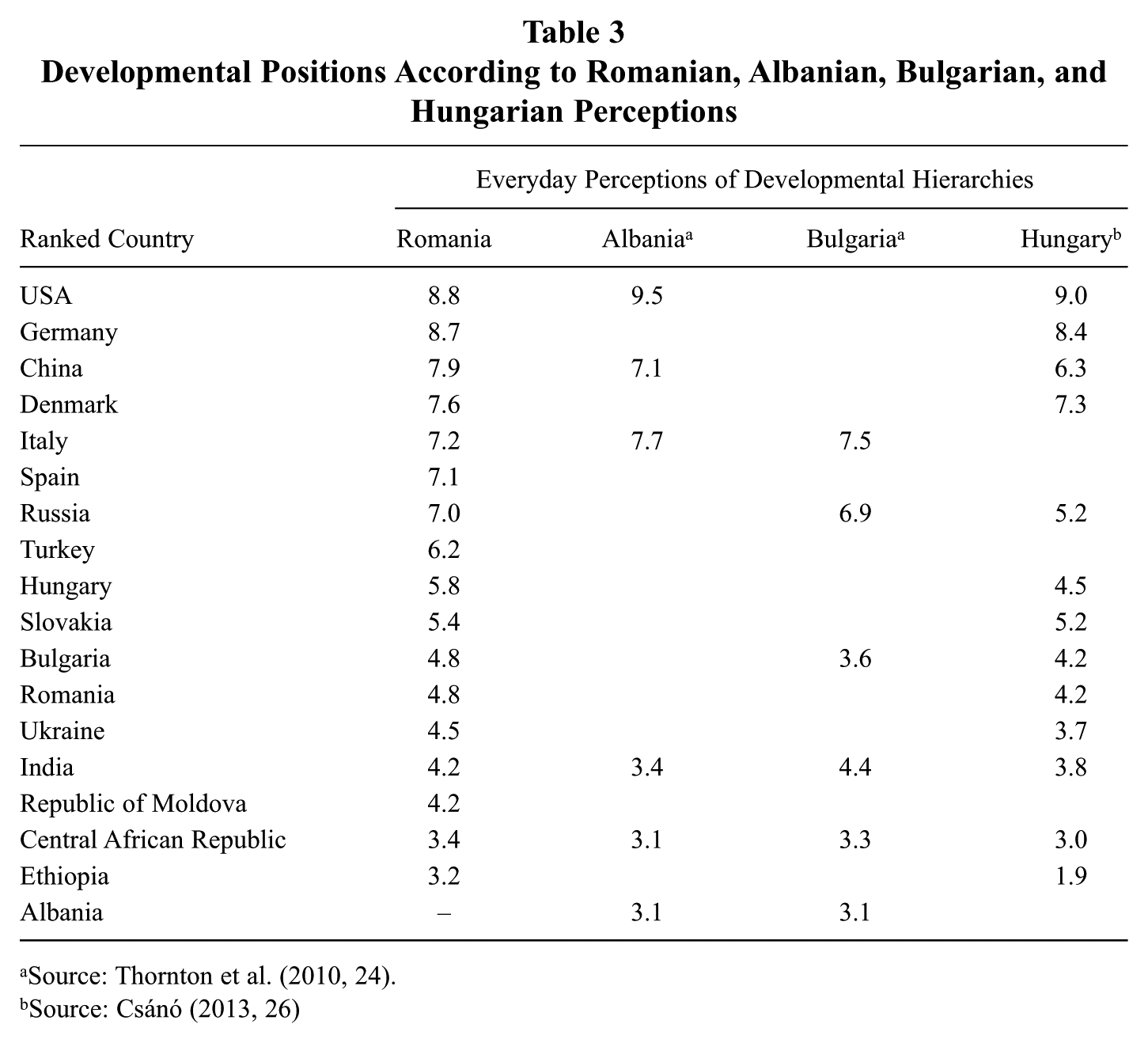
Source: Thornton et al. (2010, 24).
Source: Csánó (2013, 26)
Taking a middling position is a distinct strategy/habit. In this habit, the sense of inferiority vis-à-vis the West coexists with the sense of superiority vis-à-vis neighbours. Milica Hayden-Bakić’s term of “nesting Orientalism” emphasized that discursive positions can vary according to the situation. Thus, “Orientalized others” can also use the strategy of “Orientalizing” to dominate weaker actors or to improve their own position. 61 Alexander Maxwell highlighted that the (geographical and geo-historical) boundaries between the “West” and “East” have been intensively disputed and the prevalence of the (East–West) bridge metaphor indicates that a wide range of collective actors (from Vienna to Almaty) are prone to adopt an intermediate position and thus play the game of nesting Orientalism. 62 The already mentioned concept of Mitteleuropa is also connected to this strategy/habit. It is not accidental that Csánó, using a similar developmental scale as ours in Hungary, found that Hungarians placed their own country in a middle position on the developmental slope. 63 Western countries were considered as being more developed than Hungary; however, the majority of East European countries (among them Romania) was evaluated as less developed. This highlighted one of the major characteristics of the Hungarian national identity, which is—next to the sentiment of lagging behind the West—the sense of superiority over neighbouring nations. In other words, the Hungarian strategy/habit of coping with the developmental hierarchy rested on vindicating an in-between position on the developmental ladder and competing with neighbours to “climb the ladder,” or, in a less metaphorical phrasing, to obtain a relatively advantageous position in the centre–periphery-type structures of dominance.
Our results showed that the Romanians’ self-perceptions were more similar to the Hungarians’ and less like the Bulgarians’ and Albanians’. Romanians placed their own country in a middle position on the developmental ladder. This means that in Romania’s case Balkanism is not a primal framework of (self-)interpretation, and in that sense efforts to escape the “Balkanizing gaze” could be considered successful. The fact that Romanians did not under-evaluate Bulgaria also shows that they do not interpret developmental hierarchies in a Balkanist framework. 64
Constructing Internal Hierarchies
Regional Hierarchies and Stereotyping
Next to global developmental hierarchies, we also tried to map internal hierarchies. We used the same 0–10 scale and asked our respondents to rank seven Romanian regions according to their level of development. One of our main questions was whether people living in different regions perceive internal developmental differences similarly. Table 4 shows that the correlation between the mean rankings of the various regions made by people living in different regions are rather high, meaning that ideas referring to internal regional hierarchies are broadly similar in the different regions of the country. However, differences also exist. These differences are the most accentuated in the case of Transylvanian Hungarians. Average rankings made by Transylvanian Hungarians on the one hand and Muntenians, Moldavians, and Oltenians on the other do not correlate significantly, meaning that Transylvanian Hungarians perceive internal developmental hierarchies rather differently as compared to people from the Old Romanian Kingdom. However, as the correlation values show, there is a similarity between the rankings of Transylvanian Hungarians and Transylvanians Romanians.
Pearson Correlation (P) Values between Average Rankings of Romanian Regions by Respondents Living in Different Regions

Correlation is significant at a 0.05 level.
Correlation is significant at a 0.01 level.
It seems that there is a consensus among people living in different regions that Transylvania is at the top of the internal developmental hierarchy, closely followed by Banat (a related geo-historical unit) (Table 5). There is a quasi-consensus that Muntenia, where the capital city is located, is below Transylvania and Banat. Only rankings made by Oltenians were slightly different: they ranked Banat higher than Transylvania and Muntenia at the same level as Transylvania. People living in the Old Romanian Kingdom (e.g., Muntenians, Moldovans and Oltenians) consider that Bukovina (part of the Austrian Empire between 1774 and 1918) is more developed than Moldavia. However, Transylvanian Romanians perceived Bukovina as closer to Moldavia, while Transylvanian Hungarians ranked Bukovina even lower than Moldavia.
Respondents’ Perceptions of Internal Developmental Hierarchy (Means)
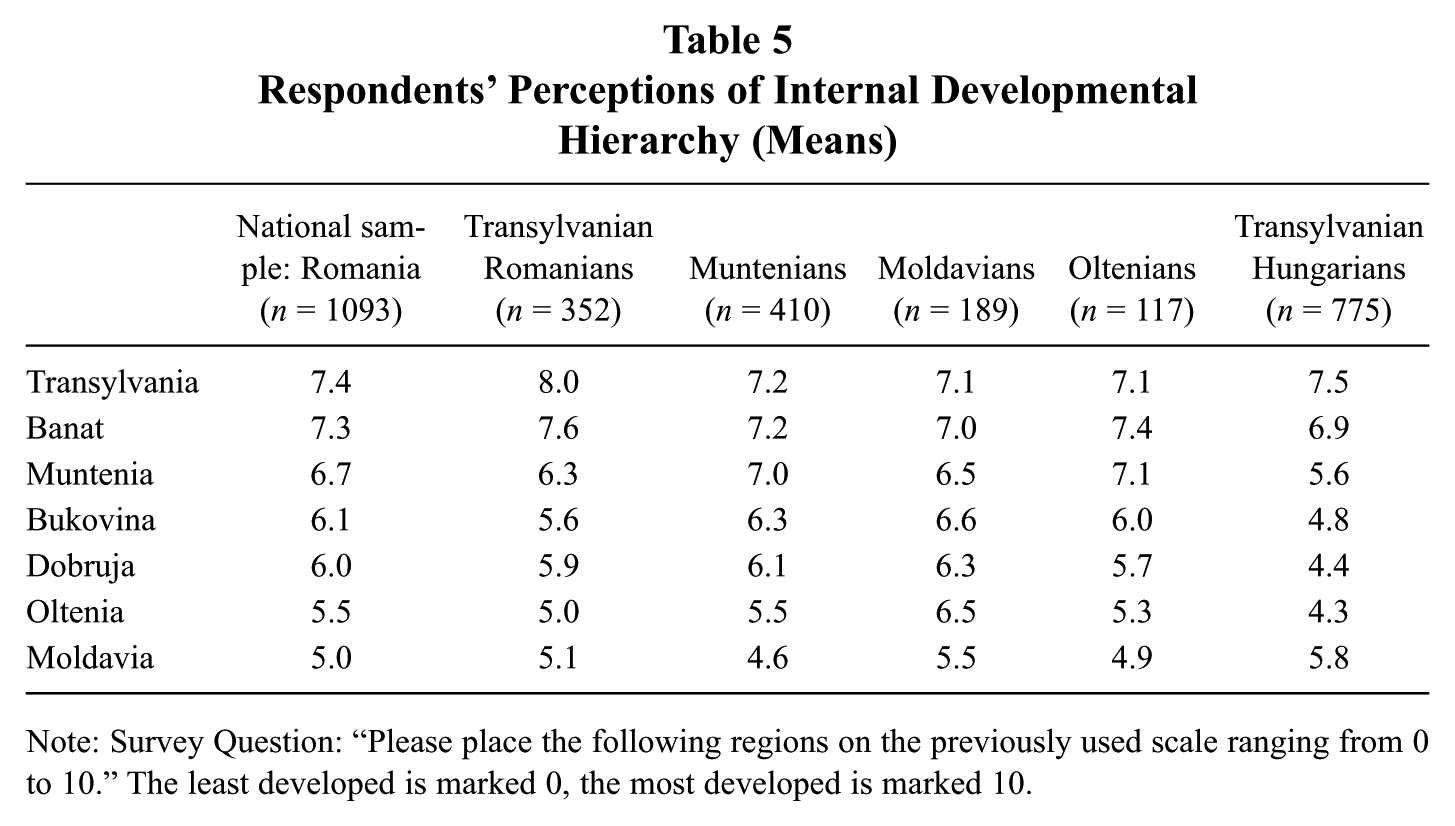
Note: Survey Question: “Please place the following regions on the previously used scale ranging from 0 to 10.” The least developed is marked 0, the most developed is marked 10.
Differences concerning the bottom of the internal developmental hierarchy are more accentuated. Oltenians, Muntenians, and Moldavians themselves see Moldavia as being the least developed region of the country. One could add that the Romanian-speaking Republic of Moldova, which historically was also part of the Moldavian Principality, was ranked by the Romanians next to India (see Table 2). Both Moldavia and the Republic of Moldova are perceived by the Romanians as an underdeveloped Eastern periphery. Between Romania and the Republic of Moldova there exists a relatively high degree of ethnic kinship. Romania offers extra-territorial citizenship for Moldovans. However, Moldovans studying or working in Romania are often considered as low-status “Eastern” migrants rather than co-nationals. 65 Transylvanian perceptions of the bottom of internal hierarchies are rather different, and this difference is even more accentuated in case of Transylvanian Hungarians. They place Oltenia (and not Moldavia) at the bottom of the internal developmental ladder. Transylvanian Hungarians even perceive Moldavia as more developed than Muntenia. According to our hypothesis, these differences are due to the tendency for Transylvanians (and especially Transylvanian Hungarians) to use the “Balkanizing” framework more frequently in constructing internal hierarchies. Thus, they place Oltenia (the most “Balkanic” province of the country) at the bottom, while they tend to evaluate Moldavia (the less “Balkanic” region of the Old Romanian Kingdom) more positively.
In a further step, we present stereotypes concerning regional groups, as they appear in open-ended questions (Table 6). We asked for characteristics of Oltenians, Muntenians, Moldavians, and Transylvanians. Our main questions were whether regions considered more developed are also positively stereotyped and whether stereotyping can be linked to the idea of developmental hierarchies.
The Stereotypes Referring to Oltenians (Percentage)
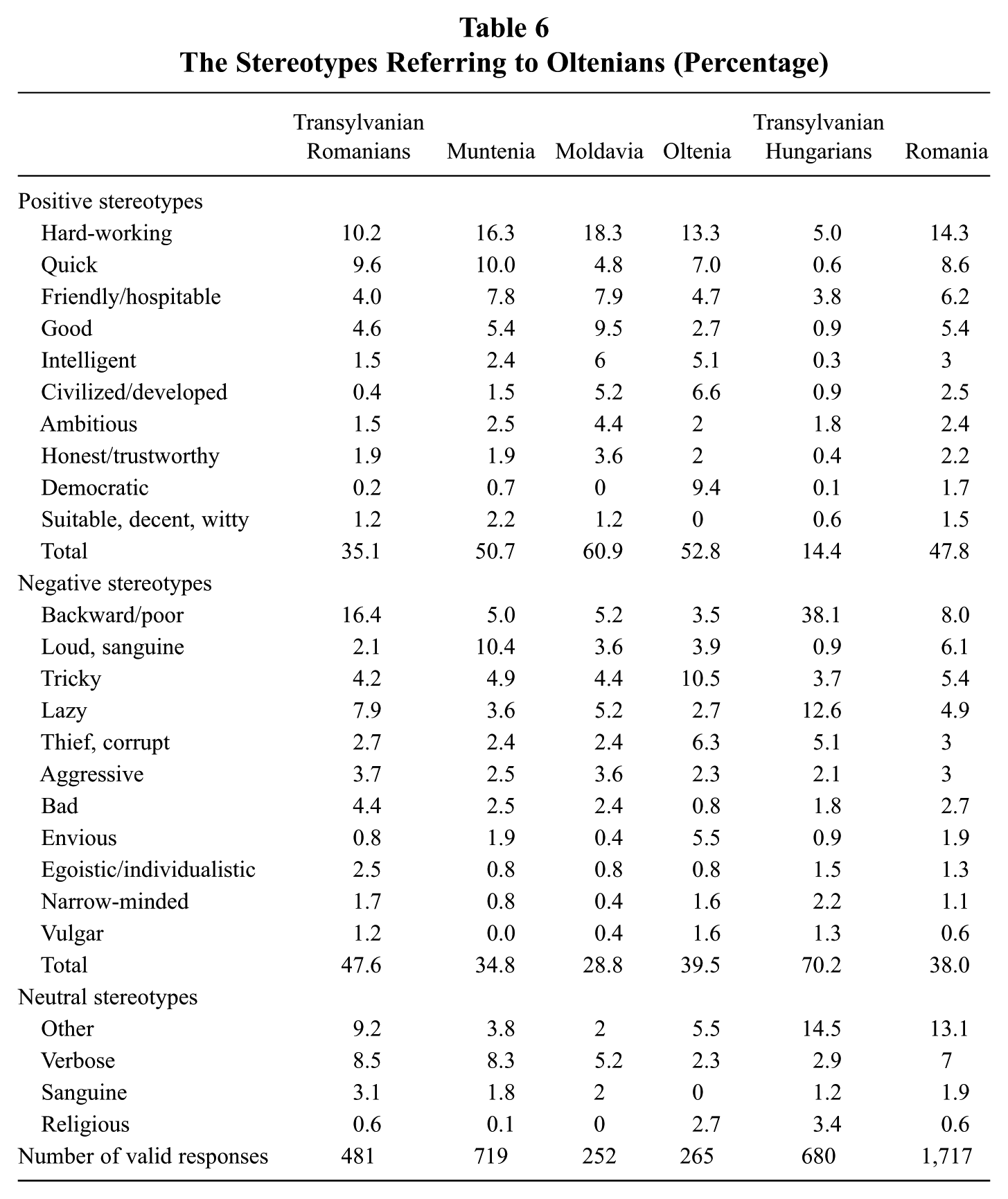
In the symbolic geography of Romania, Oltenia is certainly considered the most Balkanic region of the country; 66 however, as we saw, it is not unequivocally regarded as the least developed. It seems that stereotypes concerning Oltenians also differ significantly along regional and ethnic lines. Transylvanian Hungarians (but also Transylvanian Romanians) see Oltenians as backward and lazy people. These characteristics are linked to the “Balkanic temperament” (loud, sanguine), and respectively to “Balkanic amorality” (tricky, thief, corrupt). These further characteristics were mentioned in a high proportion by Muntenians too and by the Oltenians themselves, but in their case these attributes were less frequently supplemented with characteristics invoking backwardness.
Muntenia in Romania’s symbolic geography has a double signification. On the one hand, it is the political-administrative core of the Romanian nation-state and comprises some of its most industrialized territories. On the other hand, it is also considered a Balkanic region, most importantly by Transylvanians (Table 7). 67 In the stereotyping of Muntenians there are also significant ethnic and regional differences. Oltenians, Muntenians, and Moldavians mentioned in a high proportion positive attributes, a significant part of them invoking high-level development. However, Transylvanians, and particularly Transylvanian Hungarians, are less inclined to characterize Muntenians through positive stereotypes. For many Transylvanians, this part of the country seems to be quite similar to Oltenia.
The Stereotypes Referring to Muntenians (Percentage)

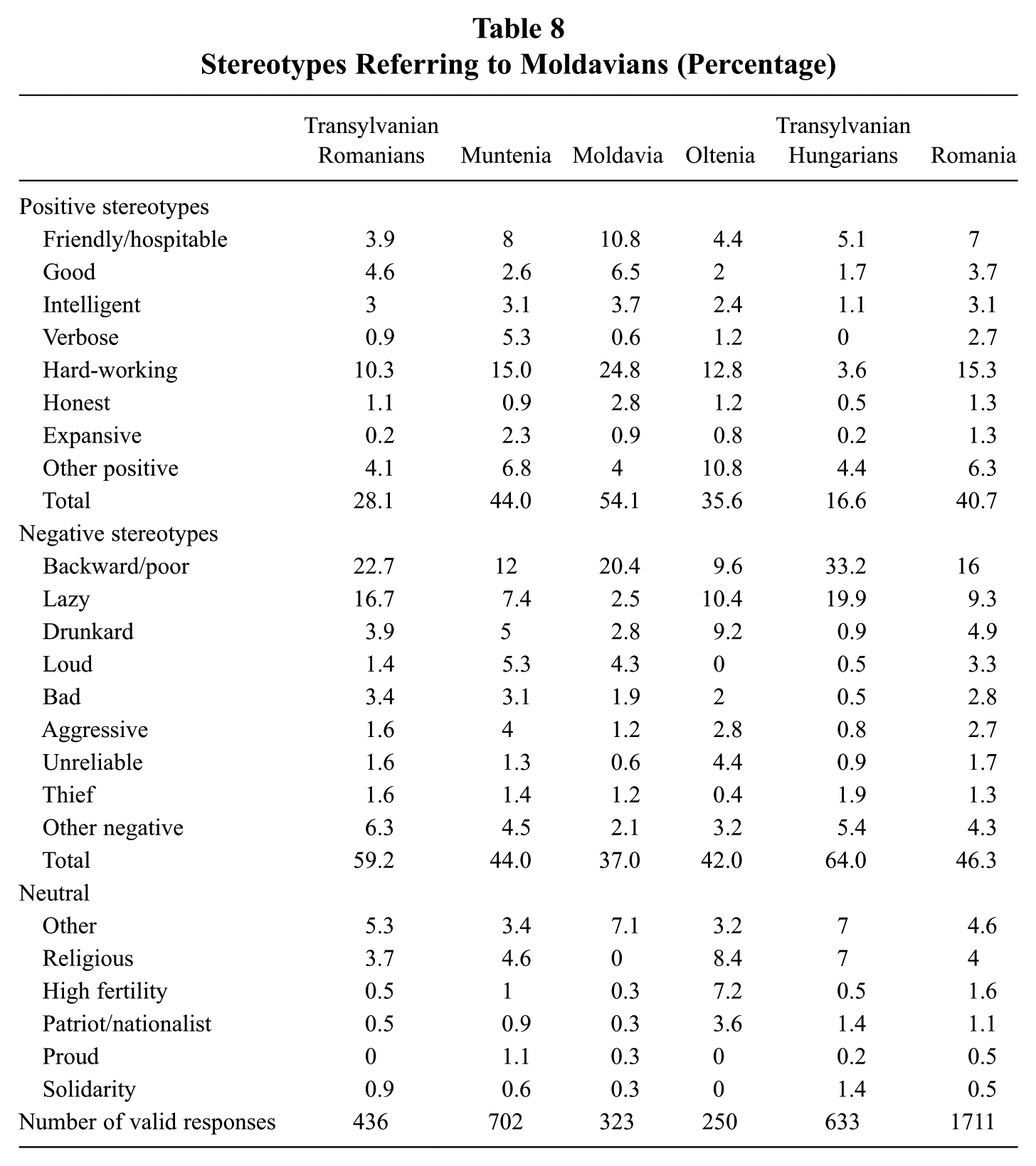
Open-ended questions also show that Moldavia is considered by many Romanians as a backward internal periphery (Table 8). Moreover, backwardness and poverty is an important element of the Moldavians’ self-perception. However, they consider themselves hard-working too. One may say that they consider themselves diligent people who are capable of development.
Stereotypes Referring to Moldavians (Percentage)
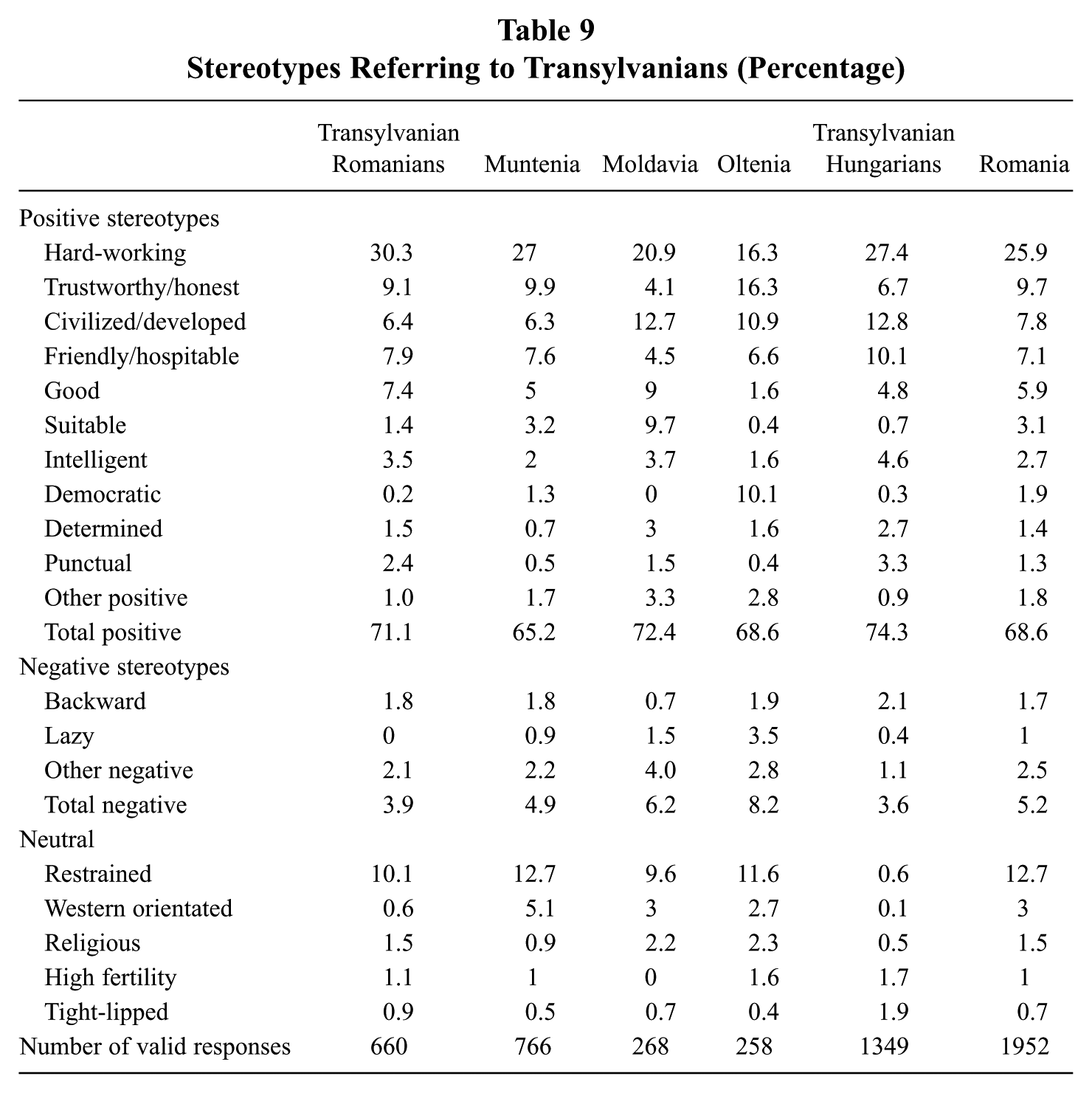
Transylvanians are positively stereotyped in a similar manner by people living in all the regions of Romania (Table 9). The open-ended question also highlighted that they are unambiguously at the top of the internal developmental hierarchy. They are considered diligent, restrained/measured, civilized, and intelligent. At the same time, the evaluation of Transylvanians is the dimension in which there are no notable differences between Hungarian and Romanian ethnics.
Stereotypes Referring to Transylvanians (Percentage)
Ethnic Stereotyping
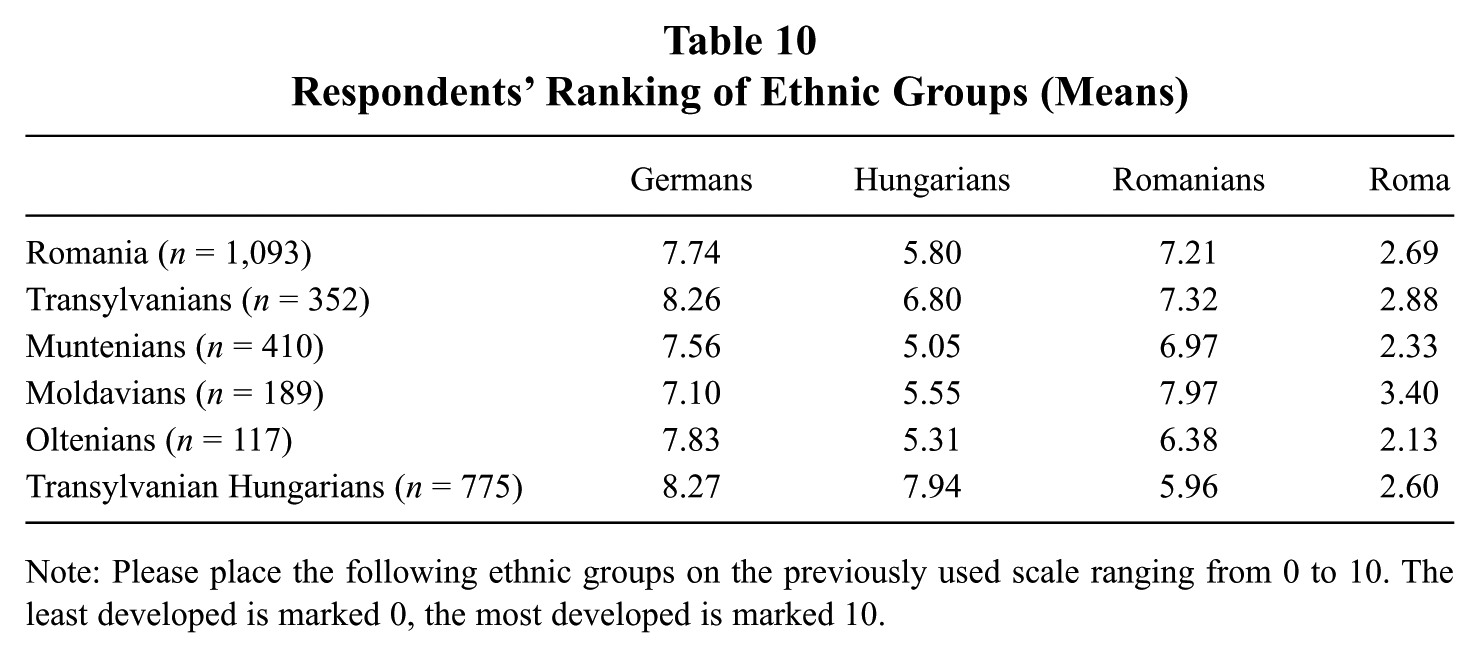
Closed-ended questions revealed that there is a quasi-consensus among respondents that the German influence has a positive impact on regional development, while the Roma presence has a negative one. Germans were ranked higher by both Romanian and Hungarian ethnics than their own ethnic group. Hungarians and Romanians occupy an intermediary position according to the closed-ended question. Regional differences also exist. Transylvanians in general (including Transylvanians of Romanian ethnic background) evaluated the German and the Hungarian influence more positively than their fellow citizens living in other historical regions (Table 10).
Respondents’ Ranking of Ethnic Groups (Means)
Note: Please place the following ethnic groups on the previously used scale ranging from 0 to 10. The least developed is marked 0, the most developed is marked 10.
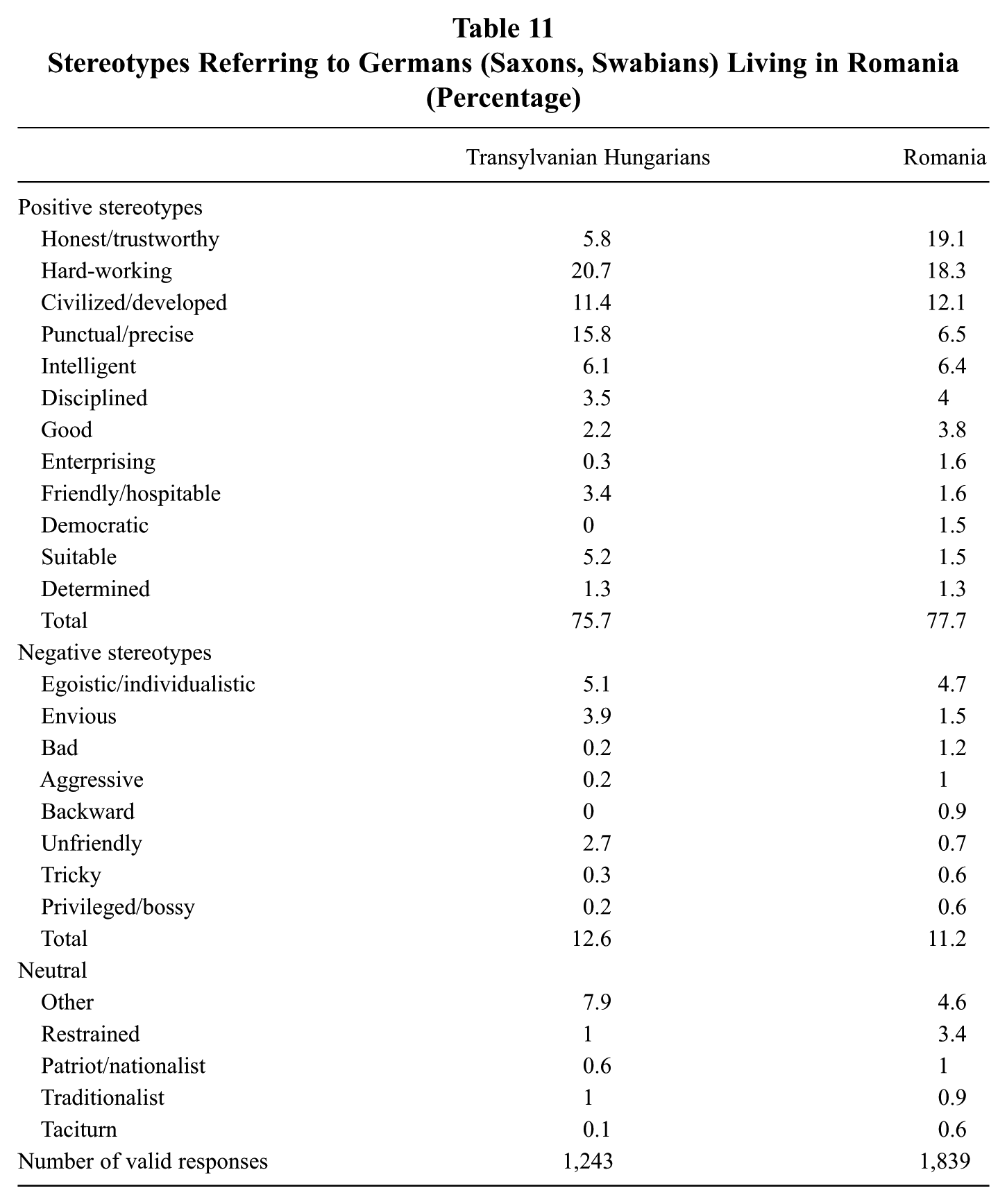
Open-ended questions also revealed that in case of the Germans, positive stereotypes are obviously dominant (Table 11). It is also evident that their positive stereotyping is connected to the idea of a developmental hierarchy. The most frequently mentioned attributes were honest, hard-working, civilized, punctual, and disciplined. Negative stereotyping of Germans is less frequent.
Stereotypes Referring to Germans (Saxons, Swabians) Living in Romania (Percentage)
Nowadays, the discourse stressing German/Saxon supremacy has a special function. As already mentioned, the German community no longer exists in a substantive ethno-demographic sense. However, the German (meaning in this context Western) heritage was discovered and included into the Romanian national canon following 1989. The climax of this process was offered by the programmes of the period when Sibiu was the European Capital of Culture. Klaus Iohannis, the present president of Romania successfully capitalized on this process. This process of the valorization and canonization of the German heritage is closely connected to the Romanian strategies of positioning on the developmental ladder. Through emphasizing the German heritage, Romanians try to construct the “Central European” character of their country. Following Antohi, one could call this process a form of “geo-political bovarism.” 68 In a similar manner, Cercel argued that “Philo-Germanism without Germans” is a self-colonizing attempt to improve the country’s “civilizational” position. 69
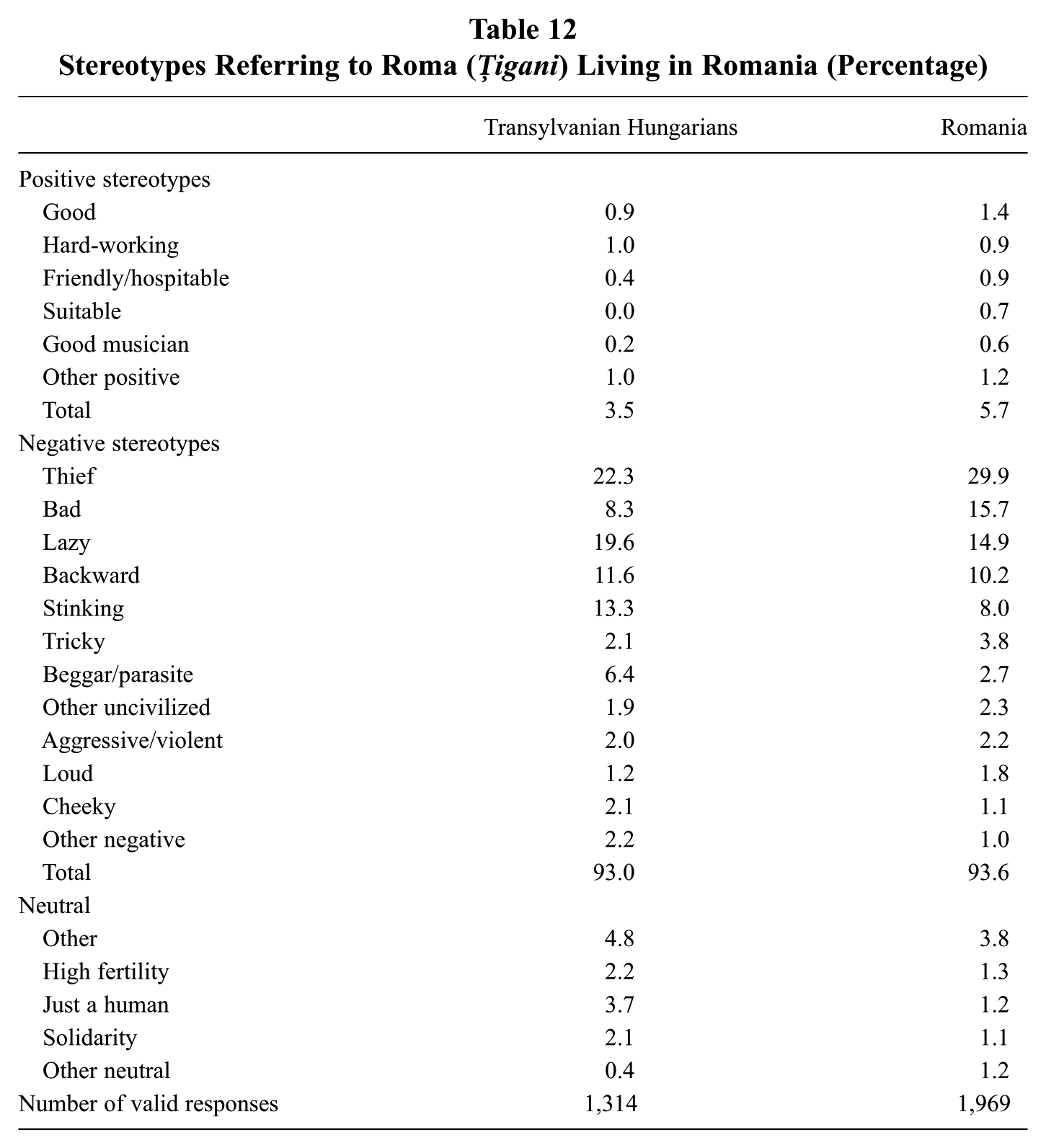
Roma certainly represent the opposite extreme (Table 12). In their case, attributes such as lazy, backward, stinking, and filthy were mentioned quite frequently. The attributes of slyness, sanguine temperament, verbosity, and loudness associate the Roma also with the Balkan mentality. Another important set of attributes refers to the marginal social position of the Roma. These attributes invoke their predisposition to criminality (thief, liar, scoundrel, or in rare cases even murderer) or their incapacity for social integration.
Stereotypes Referring to Roma (Țigani) Living in Romania (Percentage)
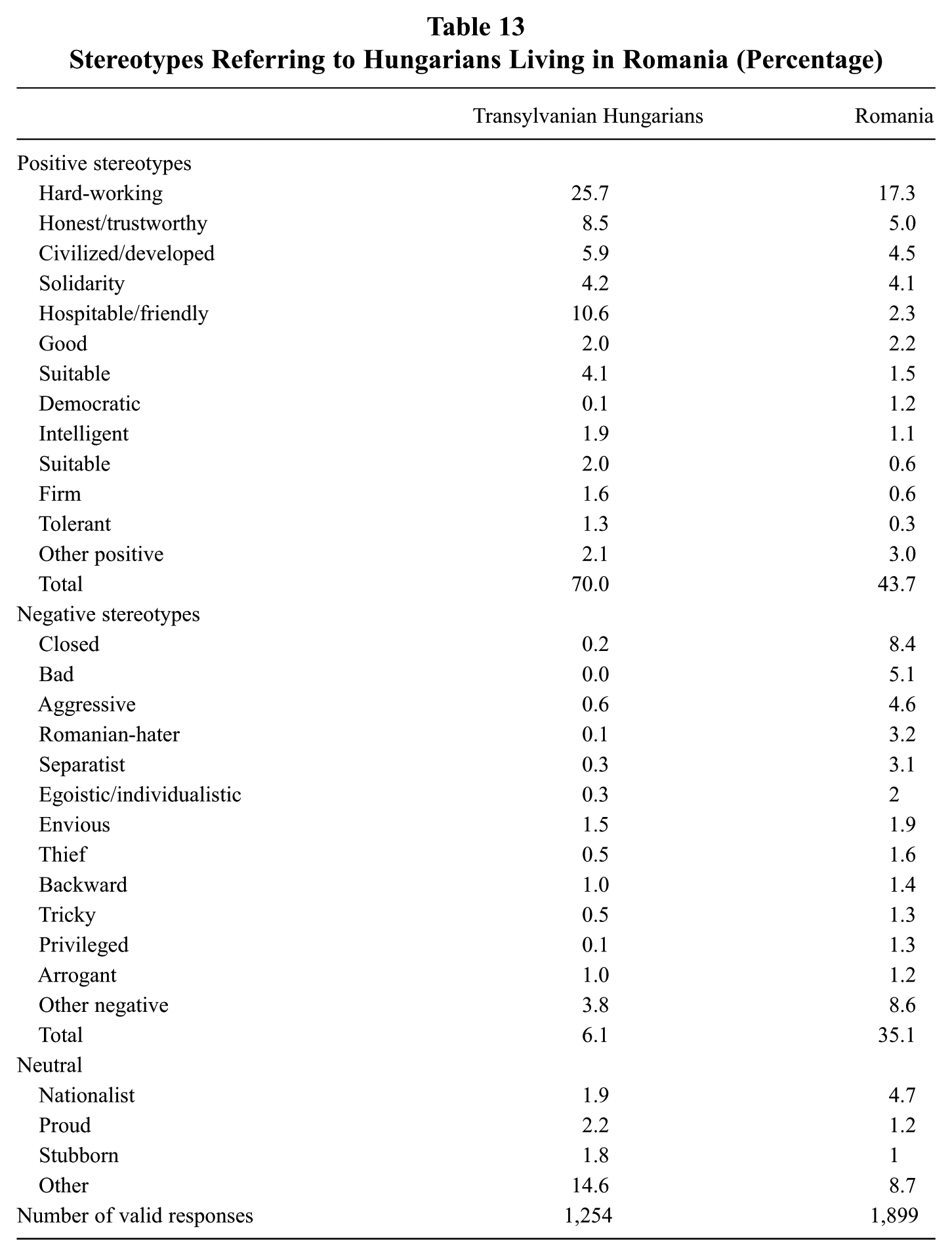
Hungarians obviously occupy an in-between position in the ethnic hierarchy (Table 13). Their stereotyping is not as evidently connected to the idea of the developmental slope as that of the Roma and Germans. An important part of the attributes cannot be related at all to civilizational discourses. In Romanians’ stereotypical image of Hungarians, a key element is that of an internal enemy that seeks separation from the majority (nationalist, separatist, Romanian-hater, closed, inimical, etc.). This shows that many Romanians resent the ethnically based political activism of Hungarians. However, another significant segment of the stereotypes can be connected to the civilizational discourses, and in this respect Hungarians are in general positively stereotyped by Romanians (hard-working, trustworthy, civilized, cultured, etc.). Consequently, in the Hungarian–Romanian relationship, the higher position occupied by the Hungarians on the East–West slope is still an element that defines both auto- and hetero-stereotypes.
Stereotypes Referring to Hungarians Living in Romania (Percentage)
As for stereotypes referring to Hungarians, comparative data from 2000 and 2008 are also available. The surveys conducted by the Research Centre on Interethnic Relations (CCRIT) in 2000, respectively by the Romanian Institute for Research on National Minorities in 2008 used a methodology similar to ours. Both surveys employed open-ended questions concerning the typical characteristics of Hungarians and Romanians and both were carried out on a randomly selected national sample and, additionally, on a sample representative for Transylvanian Hungarians (Table 14).
The Proportion of Positive and Negative Stereotypes Referring to Hungarians and Romanians
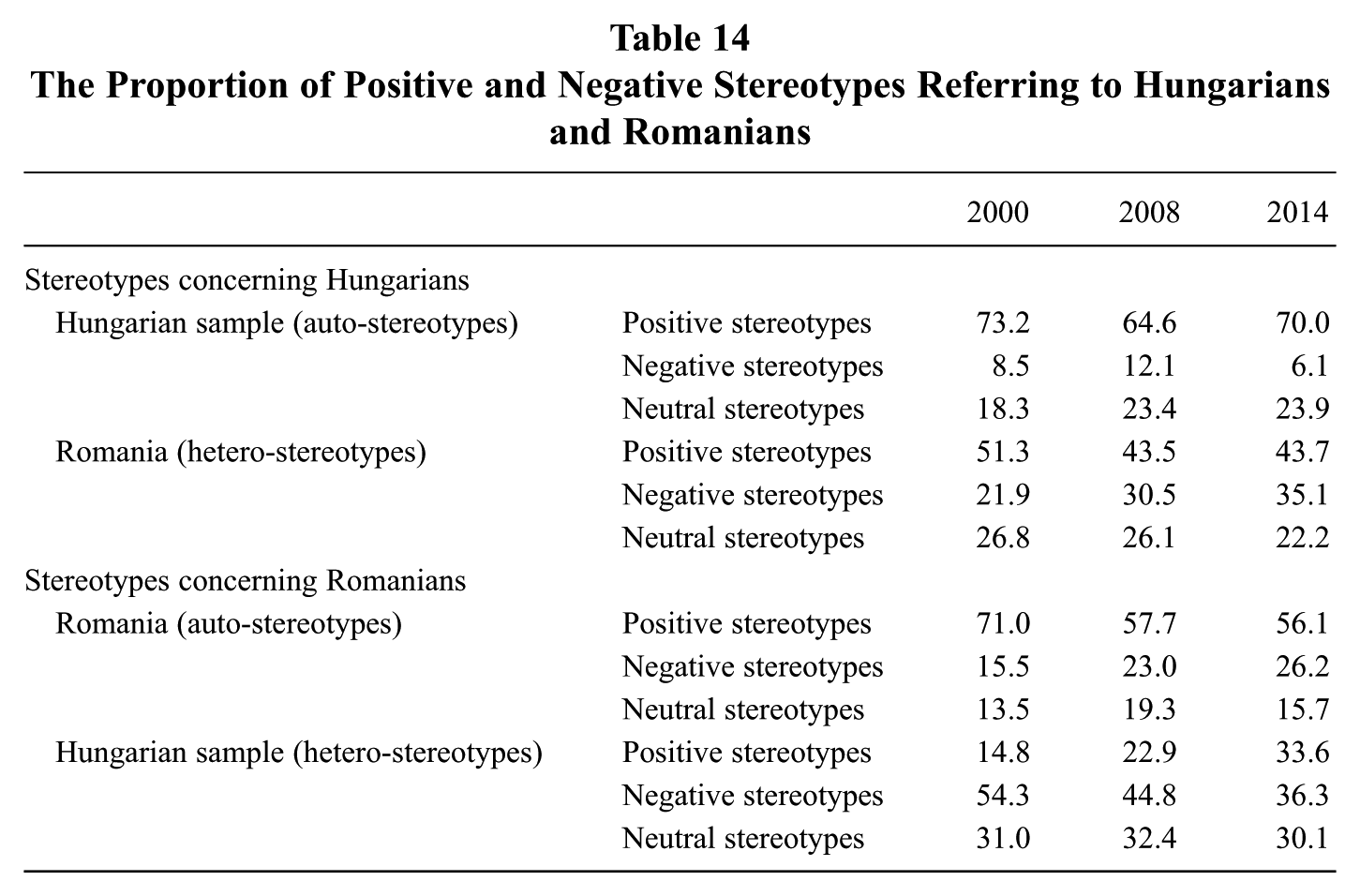
One could observe that Romanian stereotypes concerning Hungarians have changed over time. In 2000, positive stereotypes (the majority of them emphasizing the “developed”/“civilized” character of the Hungarians) predominated. In 2008 and 2014, positive stereotypes were less frequently mentioned, while the proportion of negative attributes has clearly increased over time. This could be considered a phenomenon parallel to the changes taking place in the system of ethnic stratification in Transylvania, where an obvious process of social marginalization of the Hungarian community is taking place. 70
Romanian’s auto-stereotypes have also changed, however, in an opposite direction (Table 15). In 2000, 71 percent of the auto-stereotypes of Romanians were positive, while only 15 percent were negative. The proportion of positive stereotypes has decreased over time. In 2000, hospitability was the most frequently mentioned auto-stereotype, but goodness and honesty were also more frequently enumerated than in 2014. It seems that the importance of these positive elements (having no direct relation with developmental discourses) has diminished, while the importance of stereotypes placing Romanians on the slope has increased. These further stereotypes are, however, predominantly negative, and through them Romanians emphasize the “backwardness” of their own group, indicating a spread of the “self-colonizing” attitude.
Stereotypes referring to Romanians (Percentage)

The Transylvanian Hungarians’ stereotypical image of Romanians has also changed. However, attributes invoking the backwardness of Romanians have become less frequent and attributes invoking positive characteristics (especially work ethic) have become more common. It is worth mentioning the deep cultural and historical embeddedness of these stereotypical images. Melinda Mitu and Sorin Mitu showed that Hungarians’ image regarding Romanians crystallized in the early nineteenth century and was transmitted through literary texts that became part of the Hungarian national literary canon. 71 The authors showed that the key element of this image is civilizational backwardness. Romanians appear as a local adaptation of the archetype of the “noble savage,” as peasants and shepherds who eat hominy, live in huts, in villages secluded from the civilized world, and listen only to their Orthodox priests, who are as uncivilized and backward as they are. 72 The authors also present descriptions of the principalities that used to be part of the Ottoman Empire (Wallachia and Moldavia), perceived by the Hungarian observers as “Oriental societies.” 73 The survey carried out in 2000 found the remnants of these stereotypical images among Transylvanian Hungarians. Backward, religious, superstitious, and lazy were attributes mentioned quite frequently by Transylvanian Hungarians to characterize Romanians. However, it seems evident that under the conditions of their increasing social marginalization, Transylvanian Hungarians cannot maintain their historically constructed sense of superiority vis-à-vis Romanians. They not only lose position in the system of ethnic stratification, but they adjust their perceptions regarding their position relative to the Romanians—metaphorically speaking, they have taken a downward step on the civilizational slope.
Conclusions and Possible Political Consequences
As a first concluding remark, one can emphasize that the idea of developmental hierarchies, in particular, that of the “East–West slope,” is widely accepted in Romania. Ordinary Romanians perceive developmental differences very similarly to representations distributed currently by global elites, that is, to discursive patterns constructed historically. It is also important that there is a quasi-consensus concerning global developmental hierarchies in the Romanian society. We mentioned that Romanians and Transylvanian Hungarians perceive the developmental level of different countries quite similarly. Melegh and his colleagues also emphasized the homogeneity of these perceptions in Bulgaria, Romania, and Hungary. They found that there is no significant difference in the perception of global hierarchies along regional or generational lines and differences in social position. 74
A second important conclusion is that internal (regional and ethnic) hierarchies cannot be interpreted without taking into consideration the wide acceptance of the developmental paradigm and the existing consensus about external hierarchies. In this sense, Melegh’s remarks are of key importance. First, he emphasized that if “colonized subjects” (i.e. people belonging to categories associated with lower positions in the hierarchy) internalized the idea of the slope, they would try to improve their position on it. Second, he argued that strategies (or in our understanding, habits) of (re)positioning on the slope could differ widely. One could argue that differences in the perceptions of internal hierarchies could be caused by differences in strategies/habits of (re)positioning. An important difference is that Transylvanians in general and Transylvanian Hungarians in particular construct regional hierarchies differently compared to people living in other regions of Romania. They tend to use the “Balkanizing” interpretative framework to emphasize the “Central European” character of their regions. People living in other Romanian regions try to avoid these geo-cultural metaphors.
This leads to our third conclusion. Many authors emphasize that in Hungary and in other so-called Central European countries, a discursive shift took place in the 1980s and 1990s. This means that developmental discourses emphasizing quantitatively measurable aspects of “modernization” were replaced by discourses stressing the role of historically constructed “civilizational” or “cultural” differences. The prevalent use of the geo-cultural metaphors of “Central Europe” and its opposites (“Balkans,” “Russian or Eastern despotism,” etc.) was connected to this turn. It is important that in Romania, the use of geo-cultural metaphors had more opponents than adepts. The (habitualized) strategies aiming to avoid the “Balkanizing gaze” most probably played a central role in the fact that the new developmental consensus in Romania has crystallized along a pure form of developmental idealism (according to Thortnon), or “liberal utopia” (according to Melegh).
As a last remark, one can stress that the idea of global developmental hierarchies strongly affects national stereotyping and, in a larger sense, also strategies of nation building. Until recently, empirical research concerning national stereotyping in Transylvania focused first of all on the relationships between Hungarians and Romanians, taking the thesis of parallel nation-building as a starting point and interpreting the problem within a social-psychological framework. 75 From this perspective, the national/ethnic stereotypes seemed symmetrical, presenting themselves as each other’s mirror image. Our approach does not deny the importance of parallel nation-building, but stresses that in itself it does not clarify the relationships among East European ethnic groups. This is due to the fact that national/ethnic stereotyping (and generally speaking, the process of nation building) is deeply embedded in global developmental discourses (of an East–West type), respectively in power relations of a centre–periphery type. Thus, the (self) image of each group is to a large extent defined by their position in a developmental hierarchy.