



Abstract
The paper focuses on the phenomenon of borderland shuttle trade across Russia’s borders with Estonia, Latvia, Lithuania, and Poland. I argue that borderland shuttle trade is more sustainable in comparison with long-haul shuttle trade, as the former gives entrepreneurs more flexibility, involves fewer transaction costs, and can rely on the extensive support of borderland communities. At the same time, it has some specific vulnerabilities, and its susceptibility to customs control and reliance on overloaded border crossing infrastructure are among the most important. Contrary to beliefs about contemporary states’ inability to exercise efficient control over informal cross-border flows in the age of globalization, this research demonstrates that over the course of time, states may be at least partially successful in suppressing informal cross-border trade. Ultimately, cross-border shuttle trade has proven to be vulnerable to more and more targeted restrictions and control practices. Still, it has also proven to be highly resistant to governmental crackdown in various ways, such as buying fuel from long-haul truck drivers or switching to trade in non-excisable goods or to low-penalty cigarette smuggling. The latter practice illustrates that shuttle trade is only part of the flexible informal cross-border economy and that it can be transformed into low-penalty smuggling when needed.
Contemporary nation-states’ capability to control accelerating cross-border flows in the age of globalization is one of the key issues for Border Studies. Some scholars adhere to the post-modernist view that states are less and less capable to manage cross-border flows efficiently and thus are gradually losing control over their borders. 1 Others, however, argue that contemporary states still have a wide range of opportunities to control cross-border flows. They argue that in some respects border controls are now stronger than ever 2 or that states implement advanced methods of control (e.g., risk analysis and proactive surveillance 3 ) to compensate for their weaker, “traditional” control over national borders.
To contribute to the dispute about contemporary nation-states’ capability to deal with the challenge of intensified cross-border flows, it may be useful to consider long-term governmental policies toward informal cross-border trade in areas where this phenomenon is particularly persistent.
What are the key long-term trends in governmental policies toward borderland shuttle traders and in the latter’s adaptation to these policies? What factors prompt governments to choose between tolerant and suppressive policies toward cross-border shuttle trade? In what ways do borderland shuttle traders react to tough and protracted governmental crackdown campaigns? What range of important practices do they use to safeguard their cross-border operations and bypass customs control?
To deal with these questions, the article is organized in the following way. First, I focus on theoretical conceptualizations of the key features of shuttle trade (with a special emphasis on post-Soviet shuttle trade) and relations between shuttle traders and authorities. Second, I consider key developments in borderland shuttle trade in selected areas. Third, I analyze governmental perspectives on borderland shuttle trade and consider protracted suppression campaigns on excise goods trade that have been conducted since the late 2000s. Finally, I categorize the typical ways in which borderland shuttle traders reacted to these restrictions.
Background
Key Features of Shuttle Trade
Shuttle trade is a kind of informal entrepreneurship referring to activities fully or partially taking place outside governmental regulation and taxation (increasing profits and reducing costs) but largely tolerated by society. Several explanations are proposed to explain the pervasiveness of informal entrepreneurship in some countries. Williams distinguishes between structuralist (exclusion from the modern economy and state benefits), neoliberal (voluntary “exit” from the legal economy to avoid the costs of formal registration), and poststructuralist (work conducted for friends, neighbors, and kin) explanations, concluding that no single explanation is sufficient and that any of them can prevail in different circumstances. 4
Shuttle trade (also referred to as informal cross-border petty trade 5 ) is a kind of informal activity that most typically involves the purchase of goods by small-scale informal entrepreneurs in one country for resale in another country. Shuttle trade is an intrinsically gray activity, balancing on the border between legal (bringing goods in allowed amounts via checkpoints) and illegal but just lightly penalized (or at least hard-to-trace) practices, such as falsely declaring that goods are brought for private use or the illicit sale of such goods in a destination country. 6 Still, it can be argued that there is a continuum between shuttle trade and petty smuggling and that one of these activities can easily turn into the other, depending on the rigidity of states’ regulation policies. 7
While shuttle trade exists in many regions worldwide, it has been argued that such trade was particularly persistent in some post-Soviet and post-Socialist Eastern European countries in the 1990s. 8 In this case, a sharp rise in shuttle trade’s popularity was caused by both “structural” and “neoliberal” factors, such as increased consumer demand coupled with inadequate supply, liberalization of the movement of people, severe economic crisis, and rising unemployment. 9 However, some researchers argue that both incentives and gender structure could change with time and could vary depending on particular regions. Stammler-Gossman 10 and Sasunkevich 11 argued that in the 2000s and 2010s, unlike in the first post-socialist years, taking advantage of existing opportunities (price conjuncture, relaxation of visa regime, etc.) has become a more important strategy for people living in some borderland areas.
Eventually social and economic conditions, as well as governmental regulations, changed to the detriment of shuttle trade. Economic growth in post-Socialist countries created new jobs and raised salaries, making such employment more attractive in comparison to cross-border entrepreneurship with its hardships (travel inconveniences, heavy lifting, the need to work under bad weather conditions and during illness, frequent psychological stresses) and risks (problems with selling goods, risking borrowed funds, extortion by officials and organized crime, change in governmental regulations). 12 Large-scale export of consumer goods, together with rising domestic production, contributed to decreasing prices for such goods, hence making small-scale export less profitable. Customs and trade regulations have become more transparent and friendly to large exporters and, at the same time, stricter and less friendly for small-scale shadow exporters. For instance, in 2004 the Russian government restricted the amount of tax-free goods that could be brought to Russia for personal use from 50 to 35 kg and the goods’ value from $10,000 to approximately $2,000. As a result, the typical profit from shuttle trade trips dropped several times. 13
Cross-Border Shuttle Traders versus Authorities
Border regimes are crucial for shuttle traders’ activity. By moving goods across a border, shuttle traders maneuver between different territorially bounded law enforcement regimes and fiscal, employment, regional, and other sovereign orders (that could be conceptualized as “sovereignty regimes” in line with John Agnew’s argument). 14
It is important that the national border is not the only control line and the central government is not the only actor that tries to protect the above-mentioned orders. Borders of control are numerous and flexible; they can manifest themselves not only as physical barriers and checkpoints but also as norms, meanings, values, and practices, some of which can be immaterial and deterritorialized. 15 In accordance with Agnew’s argument cited above, a sovereignty regime that ensures control over cross-border shuttle trade is not necessarily strictly territory-bound and not entirely national. It is rather graduated, being an aggregate of dominating interests of central and regional governments, powerful business actors, and supra-national actors. 16 More specifically, EU–Russian cross-border shuttle trade is typically shaped not only by customs control but also by fiscal and police control inside a destination country, and by periodically modified penalty legislation. The latter is influenced by local authorities, legal businesses and other kinds of lobbyists, EU and Eurasian Customs Union supranational norms and regulations, and by official discourses emphasizing the need to protect the legal economy and denigrating “unprincipled profit-seekers” or even “semi-criminals.” 17
The influence of a border regime on shuttle trade is ambiguous. On the one hand, cross-border entrepreneurship is profitable largely because border barriers fix price differences and hinder goods redistribution and price equalizing. 18 On the other hand, too-strict border control in many cases makes shuttle trade either unprofitable or obviously illegal and hence much riskier.
As it is usually very difficult for a state to control the sale of goods within its territory, a border checkpoint is the point where relatively efficient control over shuttle trade can be exercised. This control can be enhanced both by means of adjusted legal regulations (aiming to penalize shuttle trade practices) and by giving extensive discretionary power to customs officers, border guards, and immigration officers, who can qualify trips’ purposes as commercial or noncommercial, accelerate or slow down the speed of border control or customs clearance, grant or deny a visa for an alleged shuttle trader, etc. Contemporary Border Studies tend to conceptualize border crossers’ position at the point of border control as a kind of “legal vacuum” when officials have a wide range of possibilities to make arbitrary decisions on border crossers’ admission or non-admission. 19
The most typical ways to evade restrictions employed by shuttle traders could be characterized as a kind of de Certeauvian tactics, 20 utilized to exploit the vulnerabilities of official strategic spatial control. 21 In line with Katz’s conceptualization, these tactics are aimed not at subverting the existing order but rather “reworking” it, that is, recalibrating existing power relations without changing their essence. 22 These tactics are usually based on shared knowledge (of goods and markets and ways of bypassing restrictions), network ties (kinship ties, personal acquaintances, and business links), and in some cases group solidarity, protecting those who suffer from governmental restrictions and penalties. 23
Importance of the Current Research
The existing scholarship provides a range of explanations of shuttle trade’s social incentives and of a range of factors that influence governmental policies toward informal traders. The current research is not designed as a full examination of the social incentives of shuttle trade and the geographical differences in those incentives. Instead, it focuses on the evolution of borderland shuttle traders’ practices and on responsive governmental practices since the early 1990s. This design could help both to evaluate shuttle trade’s persistence in the unfavorable conditions of governmental crackdown and to highlight the specific features of borderland shuttle trade that have contributed to its better sustainability in comparison with long-haul shuttle trade.
The EU–Russian border has been chosen for a case study for the following reasons. It is the lengthiest EU border and it fits the geographical area covered by the journal. Additionally, it represents a valuable case for conceptualizing the shuttle trade phenomenon due to the complexity of barriers associated with this border. Cross-border movement is greatly shaped by visa regimes, which provide destination countries with a powerful tool to disqualify undesirable entrants on arbitrary grounds. Even more important, there is a serious customs barrier that contributes to preserving marked price differences for many kinds of goods. A large part (if not the evident majority) of those shuttle traders who cross the EU–Russian border regularly deal with excisable goods, while excise policies are heavily influenced by EU regulations. Hence, it can be argued that in the case under consideration shuttle traders face complex borders and orders imposed both by nation-states and by the EU as a transnational institution. The rigidity of this border both makes shuttle traders deal with the tough immigration and customs barriers and provides the traders with additional opportunities to find profitable niches thanks to artificially enhanced price differences. Taking the last point into account, it is no wonder that shuttle trade is one of the most significant kinds of cross-border activity in the current EU–Russian borderland, being responsible for a major share of border crossings. According to official and expert estimations, shuttle traders are responsible for up to some 80 to 90 percent of border crossings in particular periods and areas. 24
Methodology
Research on informal entrepreneurship can be rather challenging, as entrepreneurs can be reluctant to share information about unauthorized or forbidden activities. 25 This can complicate collecting information by interviewing or conducting surveys. While this obstacle is not unsurmountable, it can partially explain why the bulk of anthropological research cited in the previous section focuses on local rather than countrywide or cross-border cases. Also, anthropological research typically prioritizes shuttle traders’ perspectives while devoting far less attention to the governmental perspective. Finally, sociological surveys and observations usually provide just a “snapshot” perspective and cannot trace the long-term evolution of the phenomenon.
Taking these vulnerabilities into account, a comparative historical approach focusing on written sources appears to be one of the best alternative options for research on cross-border shuttle trade. The comparative historical analysis employed in this research is aimed mainly at identifying key causal trends of the relevant governmental policies and of practices employed by informal entrepreneurs. More specifically, it focuses on building a causal narrative about the post-Soviet development of these policies and practices based on comparison of key trends across the selected cases. 26
The comparative historical analysis on which this research is based conceives shuttle trade across the Estonian–Russian, Latvian–Russian, Lithuanian–Russian, and Polish–Russian borders as four individual cases. This approach allows consideration of the same phenomena in partly similar (location at the EU–Russian border and largely similar socioeconomic conditions) and partly different (nation-specific) conditions. No systematic research was conducted on the Finnish–Russian border but focused on key features of Finnish policies to be compared with the respective Baltic states’ and Polish policies. While the limited number of cases considered restricts the representativeness of the findings, the research can still contribute to a better overall understanding of shuttle trade across the EU’s external borders.
This historical research is based on several kinds of sources, namely, statistical data, legal acts, customs services’ official guidelines for travelers, and various kinds of mass media publications (interviews with officials, governmental agencies’ press releases, op-eds, news, etc.). Using statistical information helps to trace some important contextual factors (such as unemployment rates), while legal acts and official guidelines contain information about governmental policies. Mass media publications provide the core sources used to trace systematically both law enforcement trends and informal entrepreneurs’ practices since the early 1990s. To ensure consistency, I identified these publications via the Integrum World Wide database (the largest database of Russian-language media sources), 27 Yandex News subscription service, and catalogs of the national libraries of the three Baltic states and of all Russian provinces bordering these states and Poland. Polish media sources (with a special emphasis on articles from central Rzeczpospolita and regional Gazeta Olsztyńska) were partially identified via Google search. In all cases, combination of the keywords shuttle trade, border, and states’ names (or national adjectives) in the respective languages were used to identify relevant media publications.
A high reliance on media publications of various kinds seemed necessary for a historical approach to research on cross-border shuttle trade. This reliance leads to the danger of distorted findings because of media bias, namely, of selective and tendentious coverage of issues. While it is probably hardly possible to eliminate the impact of this bias completely, efforts were made to diminish its potential impact.
First, I tried to formulate the key research issue (evolution of informal cross-border practices and governmental responsive measures) in such a way that it was as little dependent on politically biased representations as possible. Media coverage of cross-border shuttle trade is more likely to be highly biased when treating social reasons for the phenomenon, the justifiability of informal entrepreneurs’ practices and of governmental policies targeting the issue, and the success or failure of governmental measures. Shuttle traders’ practices themselves are a relatively neutral issue, the coverage of which is less likely to be biased. At the same time, while processing collected sources, I found that media representing shuttle traders’ states in some cases tended to blame neighbor states’ customs officers for various abuses and excessive rigidity, while the media of the states implementing suppression policies were not so sensitive to these kinds of problems. Thus, conflicting media representations of this kind are treated with particular caution.
Second, to manage media bias, the range of media used was diversified to include sources representing political viewpoints and geographical scales (e.g., nationwide and provincial). 28 I tried to meet these conditions by focusing on media representing various viewpoints (Russian and neighboring states’ pro-governmental and oppositional media) and providing diverse geographic coverage (nationwide and provincial media). Reports of those journalists who systematically communicated with shuttle traders or with officials were paid special attention. Media attention to shuttle traders’ activities can be uneven and fragmentary, but at the same time media (especially local) are typically highly sensitive to some events, such as cases of severe traffic congestion caused by shuttle traders, governmental crackdown measures, and informal entrepreneurs’ protest actions.
Geography and Social Conditions
Russia currently borders the following five EU member states: Finland, Estonia, Latvia, Lithuania, and Poland. While the first three countries border mainland Russia, the remaining two border the Kaliningrad exclave. According to Russian official data, the length of Russia’s land border with Estonia is 325 km, with Latvia 271 km, with Lithuania 266 km, and with Poland 236 km. 29 There are three pairs of automobile checkpoints at the Estonian–Russian border and four pairs at each of the three remaining borders.
The Estonian and Latvian borderland areas are the most ethnically heterogeneous and have the most numerous Russian communities living on the EU side of the EU–Russian border. As of the beginning of 2016, in the Estonian Ida-Viru county Russians account for 72.8 percent of the local population, while in the Latvian Latgale region they accounted for 37.1 percent of the local population. 30
Most borderland areas of all the states considered (except Finland) are distinguished by relatively low salaries (that from 2000 until 2016 varied from 120 euros to 700 euros, with a trend toward steady growth, depending on the borderland area and the year 31 ) and typically higher unemployment rates than the national average. As Figure 1 demonstrates, most typically it fluctuated between 10 and 20 percent.
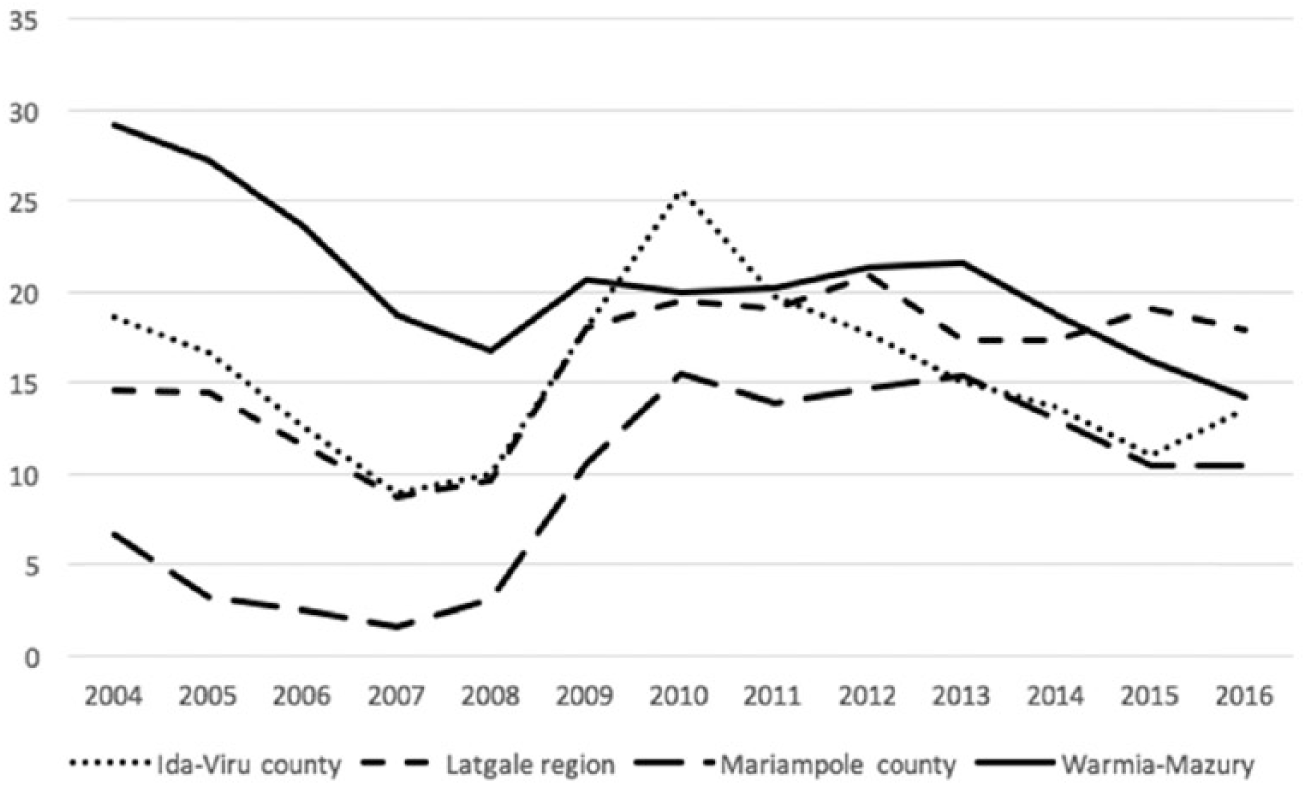
Unemployment rates in selected borderland regions of the Baltic states and Poland
Evolution of Borderland Shuttle Trade in 1990s and 2000s
At the beginning, the dominant incentives for shuttle trade looked as though they were opportunistic and neoliberal rather than deriving from marginalization and exclusion: informal cross-border trade was driven primarily by opportunities to earn additional income in favorable conditions (deficit and cross-border price differences) rather than by unfavorable social conditions. Large-scale shuttle trade across the future EU–Russian border had already started in the early 1990s. Polish consumers became more and more frequent visitors to the neighboring Kaliningrad province after prices in both Poland and Polish–Russian border regimes were liberalized. Also, liberalization of prices (especially after July 1991) and sporadic attempts at economic blockade by the USSR (before it recognized the independence of Estonia, Latvia, and Lithuania in August 1991) caused many Baltic consumers and shuttle traders to buy up much cheaper foodstuffs, petrol, and other goods from neighboring Russian regions. In turn, Russian shuttle traders started visiting neighboring countries with goods that did not have much demand in Russia but were very cheap (such as watches and cookware), being overproduced by plants working under the planned economy. 32 For example, in 1991, about twenty thousand Kaliningraders visited Poland. 33
The influx of foreign buyers posed very serious problems for Russia’s late Soviet and early post-Soviet supply system, with the result that Russia was unable to satisfy the increasing demand. Some regional authorities in 1991 publicly requested the central authorities to close the Russian borders with the Baltic republics to prevent a goods deficit. 34 The regional authorities themselves took protective measures in response, introducing coupons, starting to sell goods only for holders of passports registered in those provinces, and establishing temporary road police checkpoints. These measures proved not very efficient, as foreign buyers found ways to bypass them. Only in early 1992, after prices in Russia itself were liberalized, did the problem gradually recede into the background.
Apart from reselling consumer goods, many informal entrepreneurs from both Russia and the neighboring Baltic states started a transit trade in scrap metal from Russia to richer European countries. Large volumes of scrap metal were bought for next to nothing or were stolen from factories or military facilities. According to Russian legislation, Russia’s borders with the Baltic states had the same official status as internal borders until July 1992. Only the most important cross-border roads were controlled by the police who, however, had no power to confiscate scrap metal. Even later, customs controls at the Russian–Baltic borders actually began to operate only in the autumn of 1992, and Russian border guards managed to take full control over the “green” border only in 1995. 35 Thus, at least until autumn 1992, shadow metal scrap export across from Russia to the Baltic states was a gold mine for many informal entrepreneurs. Though large-scale entrepreneurs prevailed, some small-scale entrepreneurs also made a fortune in this business. 36
In the early 1990s, severe economic crises and rising unemployment temporarily made economic marginalization and exclusion crucial incentives for shuttle trade. Unfortunately for long-haul shuttle traders, relatively favorable economic conjunctures and the authorities’ high tolerance of such trade did not last long. After 1993, the variety as well as the amount of consumer goods brought across Russia’s north-western borders started to reduce as a result of both changing economic conjunctures and neighbor countries’ restrictive fiscal and immigration policies. The Baltic countries’ authorities started to tighten regulations for petty traders and Estonia and Latvia introduced a visa regime for Russian citizens in 1992 and 1993 correspondingly (Russia responded symmetrically). Polish garments had already become expensive for Russian buyers 37 in the first half of the 1990s and were even less affordable after the 1998 Russian economic crisis. The Russian government, in its turn, started to reduce gradually the amount of goods that could be imported for non-commercial consumption without duty. 38
While these restrictions, coupled with the above-mentioned consequences of the 1998 Russian economic crisis, proved to be a severe blow for long-haul shuttle trade, borderland shuttle traders managed to stay afloat. They utilized their competitive advantage of short distances and managed to find several niches, allowing them to compensate for the narrowness of borderland consumer markets.
Short distances between destinations allow traders to travel frequently and in some cases (e.g., in the case of “twin cities” Ivangorod and Narva, as well as Sovetsk and Panemune) even to cross the border several times a day on foot or by bike, thus minimizing travel expenses. However, borderland shuttle traders’ dependence on particular modes and routes of transportation could become the reverse side of a coin. Entrepreneurs could have to wait in huge bottlenecks near checkpoints, often occurring because of the shuttle traders’ increased activity itself. Queues damage shuttle traders’ business very seriously by slowing down cross-border operations and exhausting entrepreneurs physically. 39
Borderland shuttle traders managed to find several specific niches, allowing them to rely on stable demand. In Russia, inhabitants of Kaliningrad province started to bring for resale Polish foodstuffs, many of which, from the second half of the 1990s, 40 were both cheaper (typically, 1.5–2 times 41 ) and of better quality than similar goods from Kaliningrad province. This trend was interrupted for a short time by the Russian economic crisis of 1998 and, after returning, lasted until the new Russian economic crisis that began in 2014. The rapidly developing trade in Polish foodstuffs and some kinds of consumer goods eventually gave a dramatic push to hypermarkets in Polish borderland towns such as Bartoszyce, Braniewo, and Goldap. Petty trade in some Russian foodstuffs and medicaments also remained widespread in some cross-border twin cities, such as the Estonian city of Narva adjacent to the Russian town of Ivangorod. 42
A more important niche was represented by excisable goods (viz., strong alcoholic beverages, tobacco, and fuel) that after the late 1990s finally became the dominant kind of goods brought by petty informal cross-border entrepreneurs from the Baltic states and Poland. 43 These goods were sold on the Russian side of the border both by supermarkets and legal gas stations and by unauthorized corner shops 44 and illicit gas stations. 45
Such popularity of shuttle trade in excisable goods was caused both by high price differences and by the continuously high demand in the destination countries. Russian gasoline was the most consistently popular kind of informal trade across each of the considered borders from the early 1990s, while the trade in cigarettes and alcohol was less stable. Tobacco prices fluctuated until the Baltic states and Poland joined the EU and adopted the EU’s excise policies. 46 It was also important that a bottle of alcohol was much bulkier and more easily discoverable than a pack of cigarettes; thus, shuttle trade and petty smuggling in alcohol was much more vulnerable before the more restrictive customs policies that started to be implemented in countries neighboring Russia from the first half of 1990s. 47 Though informal cross-border traffic in alcohol from Russia to neighboring countries was popular in the 1990s, 48 its importance partially declined later on. Still, for more profit, many shuttle traders brought several kinds of excisable goods at once in tax-free amounts. 49
The introduction of a visa regime between Poland and Russia and between Lithuania and Russia in 2003 (caused by Polish and Lithuanian accession to the EU) inflicted a serious blow to informal cross-border trade. 50 However, this blow proved short-term, as networks of consulates and visa centers in the borderland regions made visa applications relatively easy for borderlanders. Thus, cross-border trade recovered over time as the following figures demonstrate.
In any case, even when cross-border movement was temporarily unfavorable, shuttle traders in excisable goods continued to bypass customs restrictions with practices of splitting (e.g., distributing permissible amounts of cigarettes) or mimicking (e.g., bringing fuel in enlarged tanks). Traders in gasoline particularly benefited from the availability of Volkswagen Passat B4 cars, whose fuel tanks’ capacity was 70 liters according to manufacturer specifications but could easily be enlarged up to 100 liters and even more using some minor technical tricks. No wonder then that older Volkswagen Passats, whose massive use by borderland shuttle traders has been regularly discussed by the popular media since the second half of the 2000s, eventually became the most popular make of car among individual cross-border entrepreneurs involved in the gray importing of gasoline. Furthermore, the Volkswagen Passat was also found to be very convenient by tobacco smugglers as it had many large spaces for hiding cigarettes. 51
Liberalization of the visa regime for some categories of border crossers also contributed to the increase in shuttle trade by the end of the 2000s. In June 2008, the Russian government decided to abolish visas for Estonian and Latvian non-citizens, which facilitated border crossings for many informal entrepreneurs in Ida-Virumaa and Latgalia. 52 Later, in June 2012 Russia and Poland introduced a local border traffic (LBT) visa-free regime for Kaliningraders and Polish borderlanders traveling within a determined borderland zone. According to some estimates, up to 90 percent of the 2.1 million visa-free trips of Polish citizens to Kaliningrad province in 2013 lasted less than three hours, 53 while fifteen to twenty thousand gasoline shuttle traders made the most of the overall four million Polish border crossings. 54 The LBT regime was suspended in July 2016 by Poland (Russia responded symmetrically) because of political considerations.
Most importantly, the Baltic states’ and Polish accession to the EU eventually opened new opportunities for shuttle traders in excisable goods. As the Baltic states and Poland became a part of the broader fiscal sovereignty regime, they had to adopt the European Union’s regulations and increase their excise duties sharply by the end of 2000s. 55 This resulted in a dramatic growth in retail prices, which, in turn, boosted the demand for cheaper Russian cigarettes and petrol that in early 2010 typically was 1.5 to 2 times cheaper than in the neighboring EU countries. 56 Eventually, the pressing challenges posed by the shuttle trade in excisable goods prompted the Baltic states and Poland to start the systematic suppression of shuttle trade.
Governmental Responses: Between Tolerance and Suppression
Authorities on both sides of the border for a long time were relatively tolerant and had ambivalent attitudes toward shuttle trade.
For Russia (and to some extent for Poland), borderland shuttle trade was beneficial, despite such side effects as traffic congestion and some problems with maintaining law and order in sales points. Russia largely tolerated shuttle trade because it usually involved cheaper Russian excisable goods, bringing profits and additional jobs to Russian borderland regions. For some localities, shuttle trade became one of the main drivers of economic growth: For instance, mostly due to customers from Narva, its twin city Ivangorod, which was in deep decline in the 1990s, ceased being dependent on federal subsidy in 2005. 57 Massive demand for cheaper tobacco and fuel supported the economies of Russian localities bordering the EU, while the massive demand for cheaper or better consumer goods and foodstuffs supported the economies of Polish localities near the border with Russia.
For the Baltic states and Poland, shuttle trade provided informal employment for many inhabitants of depressed borderland regions with high unemployment levels. Depriving many borderlanders of this opportunity could potentially provoke social unrest that, in turn, could lead to ethnic conflicts in areas with large Russian minorities.
For some officials on both sides of the EU–Russian border, corrupt deals with petty entrepreneurs served as an attractive source of additional income. Some media reported cases of customs officers extorting fixed, small amounts of money from the bulk of petty entrepreneurs crossing the Polish–Russian border 58 and the Latvian–Russian border. 59
Yet, in EU countries bordering Russia, shuttle trade undermined legal businesses; 60 as these businesses paid taxes and excise duties, they effectively had to sell their goods at more expensive prices. Apart from this, shuttle traders, being the most active border crossers, in many cases made a substantial contribution to traffic congestion near checkpoints. These checkpoints could not manage increasing flows of border crossers, despite EU and Russia investing a significant money and effort in enlarging the checkpoints’ capacity. 61 The dramatic growth in the numbers of Polish–Russian border crossings between 2010 and 2015 (see Figure 2) illustrates this point.

Polish–Russian border crossings (2007–2016, millions of crossings)
In some cases, adjacent countries had divergent interests toward various shuttle trade flows that prompted them to pursue divergent customs policies. For instance, while Polish customs service was tolerant of the large-scale export of consumer goods and foodstuffs to Russia despite trying to prevent the import of Russian tobacco and fuel, Russian customs service usually turned a blind eye to the large-scale export of cigarettes and gasoline while trying to restrict the import of Polish consumer goods and foodstuffs. 62
Despite being reluctant for a long time to take hard and consistent measures to suppress the borderland shuttle trade, both Russian and EU authorities waged restriction campaigns periodically.
In the 1990s–2000s, Russian authorities gradually tightened the weight and value limits for goods brought for personal consumption specifically to target shuttle trade. 63 In 2010, though, these limits were relaxed (they increased from 35 to 50 kg and from 1,000 to 1,500 euros) as Russia joined the Eurasian Customs Union. This made the Russian customs regime more graduated (according to Agnew’s concept mentioned above) and sensitive to the interests of small traders from other member countries.
Until the late 2000s Russia’s north-western neighbors were more focused on suppressing smuggling and illicit sales of goods brought by shuttle traders. Some observers believed that authorities sometimes slowed down customs control to decelerate the flow of undesirable goods. 64 According to some Russian sources, Poland waged a major campaign against Russian informal cigarettes traders for several years after 2005. This campaign allegedly involved massive nitpicking customs inspections of suspicious Russian visitors but resulted only in partially replacing Kaliningraders by Polish shuttle traders. 65 The consistent and intentional character of those nitpicking inspections could hardly be confirmed by Polish sources. Russian complaints were not very visible in the Polish media, which mostly focused on abuses of Polish visitors on the Russian side of the border. 66
After the Baltic countries and Poland joined the EU and had to raise their excise duties, the illegal shuttle trade, supplemented by extensive sales networks, became an extremely serious threat to authorized petrol and tobacco producers and sellers. As of 2010, the share of illegal cigarettes in the Latvian market was estimated at 41 percent, in the Estonian market at 29 percent, and in the Polish market at 10.6 percent. 67 As of 2013, some 40 percent of Lithuanian drivers preferred to buy illegal fuel, according to one survey. 68 Finally, the Baltic states and Poland chose to suppress borderland shuttle trade in a quite traditional way, by tightening customs regulations.
A wave of massive campaigns against the cross-border petty tobacco trade was launched in 2008–2009: the daily import norm allowed via land borders was reduced from 200 to 40 cigarettes. Concurrently, law enforcement policies were also tightened: For example, Polish customs service started systematic confiscation of vehicles modified for tobacco smuggling. 69 This made trafficking a duty-free amount of cigarettes across a border less lucrative. The crackdown prompted some shuttle traders to switch to gasoline while others chose the illegal domain and turned into small-scale smugglers.
The next wave of restrictions against importing cigarettes via land borders followed in the 2010s, when the Latvian authorities allowed the import of cigarettes and other excisable goods only once a week at the most (2012), and when the Estonian authorities permitted travelers to bring in two packs of cigarettes only up to twice a month and a liter of strong alcohol only once a month. The restrictive measures caused some reduction in illegal sales: For example, in August 2013, according to AC Nielsen’s marketing research, the share of cigarettes smuggled to Latvia in January–June 2013 was 30 percent while it was 35 percent during the same period in 2012. 70
The subsequent wave of customs restrictions targeted gray trade in fuel that had become the most popular kind of goods for many borderland shuttle traders after the suppression of the cross-border trade in tobacco. Those officials who planned and implemented the restrictions took advantage of the lower flexibility in petrol shuttle trade in comparison with the informal trade in tobacco: Vehicles’ and gas tanks’ contents could be tracked more easily than small lots of cigarettes.
In 2011, Lithuania started to collect excise duties for fuel in tanks from motorists crossing EU borders more frequently than five times a month. In 2015, the allowance was reduced to three times a month. 71 In 2012, Latvia introduced a similar excise duty for those who crossed a border more frequently than once a week. 72 In 2012–2013, Estonia limited the excise-free amounts of fuel in gas tanks in accordance with the distance to a destination point. In 2013, it started to charge automobilists entering Estonia more than once a month for any amount of fuel exceeding the amount that was in the car’s tank immediately before leaving the country. 73 In 2013, Poland started to charge those motorists who crossed a border more than ten times a month. In all cases, a motorist who managed to justify the non-commercial character of his or her extra trip could be exempted from paying excise duties, which laid the ground for arbitrary law enforcement. These restrictive measures dealt a very serious blow to cross-border shuttle traders whose most popular activities now came to be penalized.
Table 1 illustrates EU member states’ current approaches toward petty imports of tobacco and gasoline from Russia. It is interesting that Finland did not follow Polish and Baltic examples until the mid-2010s, even though an illicit trade in cigarettes from Russia (both by Russians and Finns) and fuel (mainly by Finns) also flourished across the Finnish–Russian border. Several factors could contribute to the more relaxed Finnish policies. As regards tobacco, Finland traditionally had rather tough consumption restriction policies and one of the lowest tobacco consumption rates in the EU, far behind the Baltic states and Poland. 74 The size of the Finnish illegal tobacco market was far behind those of the three Baltic countries (it was comparable with the size of the Polish one). 75 The problem of cross-border trade in petrol by Finns caused debates in the Finnish media. Though one study demonstrated that between 2005 and 2013, the sales figures of gas stations in Eastern Finland dropped by 13.2 percent, 76 the problem of traffic congestion near the border was paid more attention. Still, customs officials did not perceive these problems as urgent, at least in the early 2010s. 77 It is difficult to identify any evidence in Russian or Finnish media about the pervasiveness of informal cross-border networks specializing in illicit sales of Russian tobacco and fuel in Finland. Some Finnish consumers argued that they did not like the quality of Russian gasoline, 78 and this preference might have limited the informal cross-border trade in fuel. Also, Finnish officials periodically highlighted serious technical problems with implementing full-fledged control over the very intensive cross-border flows. 79 This is quite explicable, taking into account that the Finnish–Russian border was the most frequently crossed land border between the EU and Russia: In 2014, it was crossed 11.4 million times, 80 while the Polish–Russian border was crossed 6.6 million times. 81
Restrictions for Bringing Excise Goods via Land Border Checkpoints Introduced by EU Member States Bordering Russia (Effective as of 31 December 2016)

No wonder that Finland was reluctant to introduce serious restrictions before 2016. Nevertheless, in May 2016 Finland introduced restrictive measures against tobacco traders: Now only those Finnish citizens who spent more than 24 hours abroad or those foreigners (except transit travelers) who were going to spend more than 72 hours in Finland have been allowed to bring in the permitted amount of tobacco. This decision probably was provoked by the noticeable growth in shadow tobacco flea markets near the border that, in turn, have been nourished by a cheapened Russian ruble and the increased stimuli for involvement in cross-border shuttle trade triggered by the Russian economic crisis and economic depression in Finnish borderland areas. 82 Though the restriction seriously damaged the cross-border trade in tobacco, borderland gray markets tried to adjust to the new circumstances by introducing cheap overnight accommodations for those Finnish visitors who were ready to wait 24 hours before returning with cigarettes. 83
Shuttle Traders’ Counterresponses to Suppression Policies
Informal entrepreneurs reacted to official policies of suppression in various ways, such as abandoning the shuttle trade business altogether, trying to bypass restrictions, switching to smuggling, and protesting against restrictions. In most cases, it proved to be difficult for traders to find workable solutions that allowed them to continue in the business while staying legal at the customs control.
Some informal entrepreneurs chose to abandon cross-border trade 84 in favor of changing their occupation or moving to some other region or a EU member state that offered better employment opportunities. 85 As Figure 1 shows, governments that chose suppressive policies proved to be lucky, as employment trends in the respective borderland counties were generally favorable at the time when restrictions were introduced.
Those shuttle traders who chose to continue their cross-border business found ways to accommodate themselves to new restrictions. Many just put up with governmental restrictions and continued their business, 86 given that in most cases considered here (except Estonia) governments still left room to bring in fuel several times a month, thus getting some income in addition to a salary.
Some started to return via neighboring countries’ checkpoints, 87 and some to travel less frequently but to use buses with very large tanks. 88 Returning via neighboring countries’ checkpoints proved to be just a temporary solution, as subsequent restrictions in those countries largely made this practice inefficient. However, the practice of buying petrol from long-distance truck drivers crossing the EU–Russian border 89 proved to be more pervasive: Though the Baltic states started considering restrictive measures against such trucks in 2014, 90 no efficient solution had been implemented at least in Latvia and Lithuania as of the end of 2016.
Some shuttle traders chose to switch to non-excisable goods (e.g., foodstuffs or pharmaceuticals). Though this option was less profitable than the trade in excisable goods, it was still workable at least for those who lived at a very short distance from a border, especially for inhabitants of twin cities situated near each other across a border.
The Russian “sanctions war” with the EU and subsequent devaluation of the Russian ruble provided an unexpected new window of opportunity, initially for Russian shuttle traders and soon after for shuttle traders from adjacent states. Even before the conflict, Russia introduced a series of restrictions against foodstuffs from the EU. Since January 2014 it has prohibited the import of EU-made pork products, allegedly because of African swine fever. In August 2014, responding to EU sanctions, Russia introduced a ban on a wide range of EU-made products (meat, dairy products, fruits, and vegetables). At the same time, the ban did not affect individuals bringing in small amounts of goods (up to 5 kg). This created a favorable ground for shuttle trade in foodstuffs (especially delivering goods to Russian cities adjacent to the border) and for small-scale low-penalty smuggling in these goods. The dramatic devaluation of the Russian ruble at the end of 2014 made this trade less profitable but, in turn, created a favorable ground for buying and reselling cheapening Russian non-excisable consumer goods. In 2015 the ruble’s rate stabilized, Russian prices rose, and the profitability of these operations decreased.
After the crackdown on the gasoline shuttle trade, some borderland entrepreneurs switched to low-penalty smuggling in cigarettes. According to some observers, it has become the most popular kind of informal cross-border activity in the Latgale region 91 and has also become increasingly popular in Lithuania after restrictive governmental measures were implemented there as well. 92 Some Polish customs officials also reported that some “gasoline shuttle traders” switched to cigarette smuggling. 93 Though punishments for smuggling cigarettes have been more severe (fine or confiscation of a car), this did not stop many cross-border informal entrepreneurs. Profits from reselling Russian cigarettes in the EU could easily outweigh fines and even the confiscation of cheap old cars, many of which were sold in borderland areas with ready-made caches for cigarettes. 94 It was also important that the checkpoints could barely cope with the large flows of cars and that customs officers risked causing huge traffic jams if they started thoroughly checking each car for smuggled cigarettes. 95
Finally, there were several cases when shuttle traders overtly challenged restrictions by engaging in protest actions. So far, protesters have only managed to achieve partial success at best. Among those informal borderland entrepreneurs who ventured to challenge the authorities openly, Polish shuttle traders were the most efficient. In May 2013, after the government announced its decision to tax fuel in the tanks of frequent travelers’ vehicles, Polish protesters blocked a road near the Goldap checkpoint for two days. They also sent an appeal to the Constitutional Court and did their best to gain wide support among influential opposition parties and politicians. 96 Notably, authorities in some borderland municipalities, including a mayor of the city of Goldap, supported the protesters. 97 Finally, the central government relaxed the regulations and allowed car drivers to cross a border ten times a month without being taxed instead of the previous limit of once a week announced in June. 98 On the other hand, Latgalian protesters who tried contesting governmental restrictions that took effect after 2012 (taxing fuel in cars that crossed a border more frequently than once a week) were less successful. Although they managed to organize several protest actions and send petitions to top Latvian officials, 99 they ultimately failed to gain visible concessions from authorities.
Still, the ground for further protest action remains. Being largely concentrated in borderland towns, shuttle traders can communicate with each other routinely and find support among local politicians. Despite official attempts to label shuttle trade as smuggling or unprincipled bargain seeking, 100 public attitudes toward shuttle trade and petty smuggling in the respective countries remain largely tolerant. In 2013, according to the findings of a survey by the Lithuanian Free Market Institute, 62 percent of Lithuanian respondents, 51 percent of Latvian respondents, and 31 percent of Estonian respondents declared positive attitudes toward illegal trade in cigarettes, alcohol, and fuel. 101 In the Estonian and Latvian borderlands, social problems are intertwined with ethnic identity issues that are currently exacerbated by the EU–Russian conflict and worries about Moscow’s potential ability to exploit these problems to fuel separatist sentiments in Ida-Viru and Latgale.
Conclusion
Since the second half of the 2000s, EU–Russian cross-border trade has been greatly shaped by the EU’s transnational economic border order. This order has enhanced price differences for excisable goods, making them a particularly attractive niche for cross-border shuttle trade. While this cross-border price gap was enlarged by supranational regulations, it was the nation-states that remained responsible for dealing with the complex and controversial consequences, including heavy damage to legal businesses and the growing social (and sometimes even political) importance of informal entrepreneurship for some borderland communities. After hesitating between tolerance and suppression for some time, the nation-states considered here chose suppression.
Contrary to the argument about contemporary states’ diminishing capability to exercise efficient control over cross-border flows, this research demonstrates that in the course of time states may be at least partially successful in suppressing “undesirable” cross-border trade. Moreover, they can achieve this by applying “old-fashioned” customs restrictions. Ultimately, some of the most pervasive kinds of cross-border shuttle trade proved to be vulnerable to targeted restrictions and controls, which concentrated on particular “Achilles’ heels” (such as targeted control over gas tanks and limiting the numbers of nonexcisable border crossings per period).
It is important that governmental success was not achieved quickly but after prolonged competition between governmental measures and informal traders’ “splitting” or “mimicking” tactics, aimed at adjusting to the restrictive regulations and at hiding small violations. Also, governments had to be cautious of provoking social unrest in borderland areas with high unemployment rates, and of provoking neighbor states’ symmetrical measures. Their counterparts in adjacent states typically were not interested in suppressing cross-border shuttle trade to an equal extent: The state in which goods are purchased is usually more favorable toward shuttle traders than the state in which goods are sold. Still, in all cases considered, the governments finally chose suppression, as shuttle traders’ competition became too serious for tax-paying legal businesses and as traffic congestion started to paralyze cross-border movement more frequently. At least in some cases, governments could take into account statistical trends such as reduced unemployment rates in borderland areas.
Still, borderland shuttle trade has proven to be highly resistant to governmental crackdowns. Initially, it developed along a largely similar trajectory as that of long-haul shuttle trade: informal cross-border entrepreneurs took advantage of goods deficits and of retarded price liberalization in post-Soviet Russia. However, after governments tightened restrictions and prices started to equalize in the 1990s, borderland shuttle trade took a divergent path by utilizing specific advantages. Short distances contributed to lower transaction costs and much easier logistical calculations. Borderland shuttle traders could make their trips more regularly and could get more stable profits by transferring smaller amounts of goods. The high concentration of shuttle traders in a limited space (e.g., in small borderland towns) facilitated the proliferation of best practices such as the widespread exploitation of used Volkswagen Passat cars together with specific tank volume enlarging technologies after the second half of the 2000s. At the same time, the efficiency of borderland shuttle trade proved limited because of the small capacity of borderland sales markets and huge bottlenecks at border control, which appeared mainly because of the shuttle traders’ increased activity itself. Several kinds of high-demand excisable goods, usually cigarettes and petrol, in most cases proved to be critically important for the sustainability of borderland shuttle trade.
Even following harsh and smart governmental crackdown campaigns, many borderland informal traders managed to find a way to stay in the game, for example, by buying fuel from long-haul truck drivers or switching to petty smuggling in cigarettes and foodstuffs. Smugglers in cigarettes were less vulnerable than gasoline shuttle traders, as hidden tobacco is less easily identifiable than gasoline in tanks. Theoretically, governments can react by criminalizing petty tobacco smuggling and toughening customs inspections. This can bring serious side effects though, such as traffic congestion, penal system overload, and social unrest in borderland areas.
Overall, cross-border shuttle trade is a relatively vulnerable phenomenon that over time could be suppressed through governmental restrictions. Yet, shuttle trade is only a small part of the informal cross-border economy, which can be very flexible and transformable: New actors can be involved and shuttle trade can be transformed to low-penalty smuggling in line with Bruns’s and Miggelbrink’s arguments cited earlier about the existence of a continuum between shuttle trade and petty smuggling. It is not clear if governments can cope with such a complex phenomenon without completely closing their borders.