



Abstract
In this study, we examine the relationship between objective and subjective dimensions of social integration and the size and heterogeneity of an egocentric network using nationally representative databases from Hungary. We measure social integration with the level of trust and the level of public participation (objective dimension) and with individuals’ self-evaluation of whether they are integrated (subjective dimension).
Our results show that while the size and heterogeneity of the egocentric network are positively associated, the proportion of relatives among strong ties correlates negatively with objective indicators of social integration. The heterogeneity of weak ties is related positively to public participation. The correlation between the size and composition of egocentric networks and subjective integration is less clear: The proportion of relatives among strong ties seems to be unrelated to the external side of perceived social integration, while it is associated positively with the internal side of subjective integration. The number of strong ties seems to be positively correlated with both sides of subjective integration.
These results suggest that higher levels of social integration cannot be achieved without concentrating on more than one of the network’s dimensions. They also underline the need to pay more attention to network characteristics and social support not only regarding perceived social integration but also regarding objective indicators of social integration.
Introduction
Social ties and social networks are usually regarded as terms equivalent to social integration. 1 Studies handle the lack of ties as an obvious sign of disintegration or segregation; 2 however, it is also obvious that for a better understanding of integration, examination of having or lacking relations is not sufficient. As part of a more sophisticated approach, we state that the structure and size of egocentric networks matter as well. 3 First, individuals with ties to different social groups can access more information, and thus they treat uncertainty and crisis in their lives (e.g., unemployment) better. 4 Also they are more likely to have contact with members of higher strata, which might increase the chances of their mobility. 5 Second, it seems to be an advantage if someone has both weak and strong ties. 6 Strong ties have an important role in social support and provide economic and mental stability, 7 whereas weak ties are more important in the effective mobilization of resources. 8 In sum, a person is regarded as well integrated if she has ties that are heterogeneous and consist of both weak and strong ties. 9
Although the terms connected to social ties and social networks are used interchangeably with social integration, it may be argued that “social integration” is more than having social ties: Solidarity, commitment, belonging, trust, and public participation are also important dimensions to take into account. From a systemic point of view this is often referred as “social cohesion,” which is seen as a multidimensional characteristic of communities. Schiefer and van der Noll 10 suggest a core list of essential elements of social cohesion: (1) social relations, referring to social networks, trust, participation, and tolerance; (2) self-perceptions of attachment and belonging; and (3) orientation towards the common good, that is, “feelings of responsibility for the common good and the compliance to social rules and order.” 11
While social cohesion denotes a collective quality, social integration captures the quality and strength of the individual’s ties to society. For example, O’Reilly, Caldwell, and Barnett 12 propose a definition of social integration as “attraction to the group, satisfaction with other members of the group, and social interaction among the group members.” Speer, Jackson, and Peterson 13 argue that lack of social integration means that “people fall out of relationship with one another, leading to greater social isolation, declining civic trust, lower levels of participation, and less investment in social infrastructure.” To sum up, in this article—inspired by Shiefer and van der Noll, 14 and Chan et al. 15 —we define social integration with three dimensions: social ties (strong ties and weak ties), trust (generalised trust or trust in other people and confidence in institutions), and public (civil and political) participation.
These factors can be called the “objective” dimensions of social integration, since social scientists and policy makers decide which aspects are most important regardless of the individual’s own feelings or own evaluation of being integrated. Thus, as another dimension of integration, “subjective” or perceived social integration must also be taken into account. 16
The subjective evaluation of social integration is captured through the individual’s perception of her own safety and the extent to which she perceives herself as an important member of society. This approach is beneficial because it is able to take into account a diversity of opinions about important aspects of social integration. 17 Subjective integration means, on the one hand, that someone feels that she is part of society, she has a particular role in it, she is not marginalized in society. In other words, she feels that she fits into the structure of the society. This could be called the structural or “external” side of perceived social integration. On the other hand, being integrated also means that someone feels safe and supported by her kin and her close friends, she feels that she or what she does is accepted by others, and that she is recognised for being the person she is. This could be called the individual or “internal” side of perceived social integration.
This multi-dimensional nature of social integration allows relations between its components to be examined. This approach is closely related to Banfield’s 18 work. Examining a small town in Southern Italy, characterized by low public participation, low economic growth, and networks centred on the family, Banfield describes the phenomenon of amoral familism. He shows that “in a society of amoral familists, no one will further the interest of the group or community except as it is to his private advantage to do so.” 19 Amoral familism may be seen as a special social condition 20 in which general trust is low, political and social participation is weak, and individuals follow their self-interest instead of the community’s and they assume that others act the same way. In such societies, kin relationships are extremely strong and trust in relatives is high, whereas trust in any other member of society is very low.
When trust—either trust in fellow citizens or confidence in institutions—is low, people assume that others do not share their values and beliefs, people do not expect cooperation from others, and consequently, they follow their own self-interests. 21 Trust and confidence are extremely important to engage in any type of participation: When generalised trust is high, people might think that others would participate as well, and thus the costs and risks of participation would decrease. In a society characterised by low trust, perceived costs and risks are high; therefore, people tend to stay passive. Furthermore, without the belief that institutions will respond to our efforts to express opinions or to find solutions to common problems, political participation seems superfluous. 22
Based on Banfield, 23 in this paper we examine how social ties (the size and the heterogeneity of the egocentric network) are associated with the other two objective dimensions (trust and public participation) and the subjective dimension of social integration, using nationally representative Hungarian survey data.
The association between the characteristics of egocentric networks and “objective” dimensions of integration is supposed to be mostly positive: The larger and the more heterogeneous the individuals’ networks, the more trusting, confident, and active they will be. Since strong ties are expressive, and multi-functional relations connect us to our family and close friends, they are supposed to increase the level of perceived social integration as well. On the other hand, these strong ties might have some less favourable characteristics: they are highly influenced by the “like me” principle, 24 meaning that someone makes close friends with similar others. Thus, someone might feel well integrated when her close egocentric network is homogenous, but as demonstrated by Banfield’s Southern Italian town, this homogeneous network might be negatively related to public participation and trust, that is, to the objective dimensions of social integration.
Our article contributes to the literature by pointing out that association between dimensions of social integration might vary, and individuals might be characterised by a high level of social integration in one dimension, but by a lower level of integration in another dimension. Using data from Hungary provides novel answers to the research question since countries in this Central-East-European region have below-average levels of trust in people and in institutions, below-average public participation and have weak scores on social networks indicators. 25 Although people are not well integrated “objectively,” they might feel that they are relatively well-integrated “subjectively” because in their close circles they are respected, feel safe, and are supported by their kin and close friends. This might be the process that maintains the relatively low level of social integration in Hungary (and in Eastern Europe in general).
Literature and Hypotheses
In the following section, we briefly discuss the main research results and literature about the relationship between the structure of egocentric networks and other objective and subjective dimensions of social integration. Based on this literature, we formulate our hypotheses.
Egocentric Networks and Trust
Dense networks play a crucial role in creating social cohesion and a high level of trust. 26 According to Coleman, 27 dense networks are important to make decisions about the trustworthiness of others: when direct information is not available about a person’s trustworthiness, the only possible source of information is the opinion provided by this person’s acquaintances. Furthermore, when everybody knows each other in a group, interpersonal ties and mutual commitments can increase trust and decrease non-cooperative behaviour. On the other hand, excessively dense networks can lead to distrust and suspicion among members of the network by over-controlling individuals’ lives. Obligations of reciprocity and sharing resources close these networks further and cause the formation of non-transparent networks, where—as in Banfield’s theory—people outside these networks can become a threat to members. 28 Besides density, the heterogeneity of ties can be important as well: in a heterogeneous environment, intergroup conflicts are less likely to emerge. 29 According to experimental research, direct interactions among individuals are reliable predictors of mutual trust. 30
Egocentric Networks and Participation
The size of egocentric networks correlates positively with various forms of public participation. 31 Angelusz and Tardos 32 identify this phenomenon in national and local election participation. Moreover, many argue that the correlation between network size and public participation is even stronger in the case of participation in civil organizations and other, extra-parliamentary forms, as in signing a petition or participation in a demonstration. 33 However, it is important to emphasise that the direction of the causality is not clear. On the one hand, it is possible that participation contributes to the maintenance of a larger network. On the other hand, it is also possible that it is easier to involve people with more acquaintances in the work of associations and other forms of participation.
The relationship between heterogeneity of the egocentric network and participation is less clear. From a democratic participation point of view, building heterogeneous networks is desirable, since it implies that people from different strata and social groups are able to discuss public issues. However, the “like me” principle 34 and other factors work against this desirable state. Some research suggests that heterogeneous egocentric networks decrease the probability of electoral participation. 35 Mutz 36 argues that various opinions lead to uncertainty, whereas according to Noelle-Neuman 37 in an environment with many opinions differing from the individual’s, she might feel that she differs from the dominant norms of her social circles. Finally, Coleman 38 argues that closed groups are able to provide the social support necessary to increase electoral participation.
The classic assumption about civil associations is that they create cross-cutting ties among social groups. 39 However, other studies find that membership in civil associations is a way of creating social capital; thus, people from higher strata form associations with people from a similar social background rather than with others of lower social status. 40 This does not rule out the possibility that members of civil associations are able to create ties with people of a different social status, but efforts to create connections within these associations can decrease the chance of making and maintaining other connections outside these associations.
Research on Hungarian associations has shown that people participating in associations are fairly homogenous groups. They tend to be similar to each other and differ from others who do not participate, a finding that supports the claim that associations strengthen homogenous ties. 41 Other studies examining primarily weak ties have found positive correlations between civil participation and the heterogeneity of weak ties. 42
Egocentric Networks and Subjective Integration
People having closed networks might feel safer since strong ties not only provide material goods and instrumental help but strengthen opinions and provide psychic and emotional support. 43 Strong ties often originate from the “like me” principle: people choose friends from people similar to them. 44 Moreover, strong ties are often transitive, which means that the ego’s two close contacts are more likely to get to know each other than two other acquaintances only connected by weak ties to the ego. 45 If the “like me” principle is working, the ego’s two close friends will be similar not only to the ego but to each other as well. Thus, the tie between them is also more likely to be strong, which results in closed, homogenous networks. Members of these networks will have continuous support from each other, strengthening the network even more, and making new ties to people outside these networks less likely to form. 46
Although the literature mostly stresses mechanisms based on similarity and affection, in creating networks, mechanisms based on repulsion are also important. Skvoretz 47 argues that homogenous groups might be formed not only by the selection of similar people but also by keeping a distance from certain groups. This might be especially important in the evolution of territorial segregation.
We assume that whether homogenous networks are formed by affection or repulsion, they certainly strengthen the feeling of safety. If the network is based on affection, the main cause is strong social support, whereas if it is based on repulsion, the main cause might be having negative images, negative expectations, and fear of others. On the other hand, the external side of perceived social integration might depend more on the higher heterogeneity of an egocentric network since feeling an important part of society might require positive feedback from people with various status and various social backgrounds.
Based on the literature reviewed, it seems that the size of the egocentric network and its composition (its heterogeneity or homogeneity) affect social integration. Thus, we formulate the following hypotheses:
Hypothesis 1: The size of an egocentric network is positively correlated with other dimensions of social integration.
Hypothesis 2: If egocentric networks are composed mostly of kin-relations, the level of trust and public participation should be lower. In other words, the heterogeneity of the network is positively correlated with trust and public participation.
Hypothesis 3: If egocentric networks are composed mostly of kin-relations (i.e., the heterogeneity of an egocentric network is small), the level of perceived internal social integration should be higher, whereas the level of perceived external social integration should be lower.
Data and Methods
We used data from the Hungarian Election Study for 2008 48 and the European Quality of Life Survey second wave (2007). 49
The Hungarian Election Study contains data for 3,100 individuals and is representative for the adult population of Hungary. Since only two-thirds of the sample were asked egocentric network questions, our initial sample size was 2,120. The questionnaire asked respondents about their membership in voluntary organisations, political participation, voting behaviour, and confidence in institutions. Using these questions, we had three indicators for the first component of social integration (trust) and two indicators for the second component of social integration (public participation).
Our first indicator of social integration was membership in voluntary organisations. Respondents were asked if they were members of each of ten types of voluntary organizations (e.g., sports club, professional association, charity organization, and trade union). This indicator measures if the respondent is a member in at least one voluntary organisation.
Our second indicator was participation in political activities. Respondents were asked if they participated in any of thirteen political activities in the previous few years. The scope of these activities was broad: The list included activities from working in a political party or action group over taking part in a lawful public demonstration to voting via SMS in a television show. 50 The variable of participation in political activities indicates whether the respondents participated in any of the thirteen political activities. Regarding these two variables, we decided to code them as binary variables since the main difference in the characteristics of the egocentric network is between those who participated in more than one voluntary organization and those who did not, and between those who participated in political activities and those who did not. 51 Nevertheless, we also estimated regressions using the original, continuous variables, and these results were similar to the main results.
The third indicator is also related to political activity: It measures if respondents voted in the last general election preceding the survey.
The fourth and fifth indicators of social integration were confidence in governmental and non-governmental institutions, respectively. Respondents were asked to indicate how much they trust eight governmental (government, courts, parliament, constitutional court, army, president, police, and local governments) and four non-governmental (churches, political parties, trade unions, and NGOs) institutions on a 4-point scale. Variables of confidence in governmental and non-governmental institutions are calculated as the mean of these eight and four answers, respectively. 52
The number of strong ties was measured with the name-generator approach. Respondents were asked to name people they share three particular types of social relations with (discussing intimate and personal matters; going out together; getting help with everyday tasks). They could list up to five people in each of the three situations (altogether maximum fifteen people), and they were asked to indicate the type of relationship these people had to them (e.g., husband/wife/partner, son/daughter, parent, other relative, friend, and colleague). The number of strong ties is calculated as the number of people listed in these three questions. We have also been able to calculate the proportion of relatives among strong ties as an indicator of the heterogeneity of strong ties.
The number of weak ties was measured with the position-generator technique. It measured a respondent’s relationships to particular types of alters. Respondents were asked to indicate whether or not they have contact with anyone in particular occupations (e.g., high school teacher, engineer, skilled worker, waiter/waitress—altogether twenty-two occupations). The number of weak ties is calculated as the number of occupations the respondents had contact with. The heterogeneity of weak ties is measured as the variance of the prestige scores (from Treiman’s Standard International Occupational Prestige Scale) of the occupations the respondents had contact with.
The Hungarian data of the second wave (2007) of the European Quality of Life Survey (EQLS) contains data for one thousand individuals, and it is representative for adult persons living in private households. This questionnaire included questions about subjective social integration. Respondents were asked to what extent they agreed or disagreed on a 5-point scale with three statements regarding perceived social exclusion.
I feel left out of society.
Some people look down on me because of my job situation or income.
I don’t feel the value of what I do is recognised by others.
High values of the variables reflect disagreement with the statements; that is, they reflect perceived social integration (or lack of social exclusion or low social exclusion). It has to be noted that these variables do not measure the structural or external and individual or internal sides of perceived social integration to the same degree. Specifically, the first variable reflects mostly the external side of integration, since the statement refers to the whole society. Thus, this variable measures perceived marginalization, 53 or in other words, the lack of a socially relevant role in the society. We can refer to this variable as a measure of being integrated into the macrostructure of the society. The second statement also refers to society, but in a functional or stratification-related way, as it connects integration to occupation and income. In other words, it connects being integrated to occupational status, which is an individual characteristic. On the other hand, the third variable is assumed to measure the support and recognition of others. In other words, it concentrates more on the individual side of integration, since it reflects that the respondent is accepted by others, and that she is recognised for being the person she is—without reference to her occupational status or other role in the society. To sum up, moving from statement 1 to statement 3, the three questions measure the internal side of perceived integration increasingly, whereas from moving statement 1 to statement 3, they measure the external side decreasingly. 54
The EQLS questionnaire lacked the standard measures of egocentric networks (i.e., the position generator or name generator). The number of strong ties is captured using a question asking respondents who they would get support from in five situations. 55 They had to choose the most important person in each situation, indicating if this person was their partner/spouse, other family member, colleague, friend, neighbour, or someone else. The number of strong ties is calculated as the number of situations respondents could get support in. The proportion of relatives among strong ties is calculated as the share of naming partner/spouse, or other family members in these situations. It has to be noted that this measure is far from ideal, since respondents were able to name only one person in each situation; thus, in most situations they named a relative. Moreover, the questions about strong ties measure the availability of strong ties in different areas rather than their absolute number. Thus, as we noted above, the variables can be regarded only as proxy measures of the number and heterogeneity of strong ties. Questions for weak ties were lacking in the questionnaire.
We estimated a linear relationship between the size and the heterogeneity of egocentric networks and the indicators of social integration using ordinary least squares regressions. 56 The estimated model regarding data from the Hungarian Election Study is the following:

where
The estimated model regarding data from the European Quality of Life Survey is the following:

where
Results
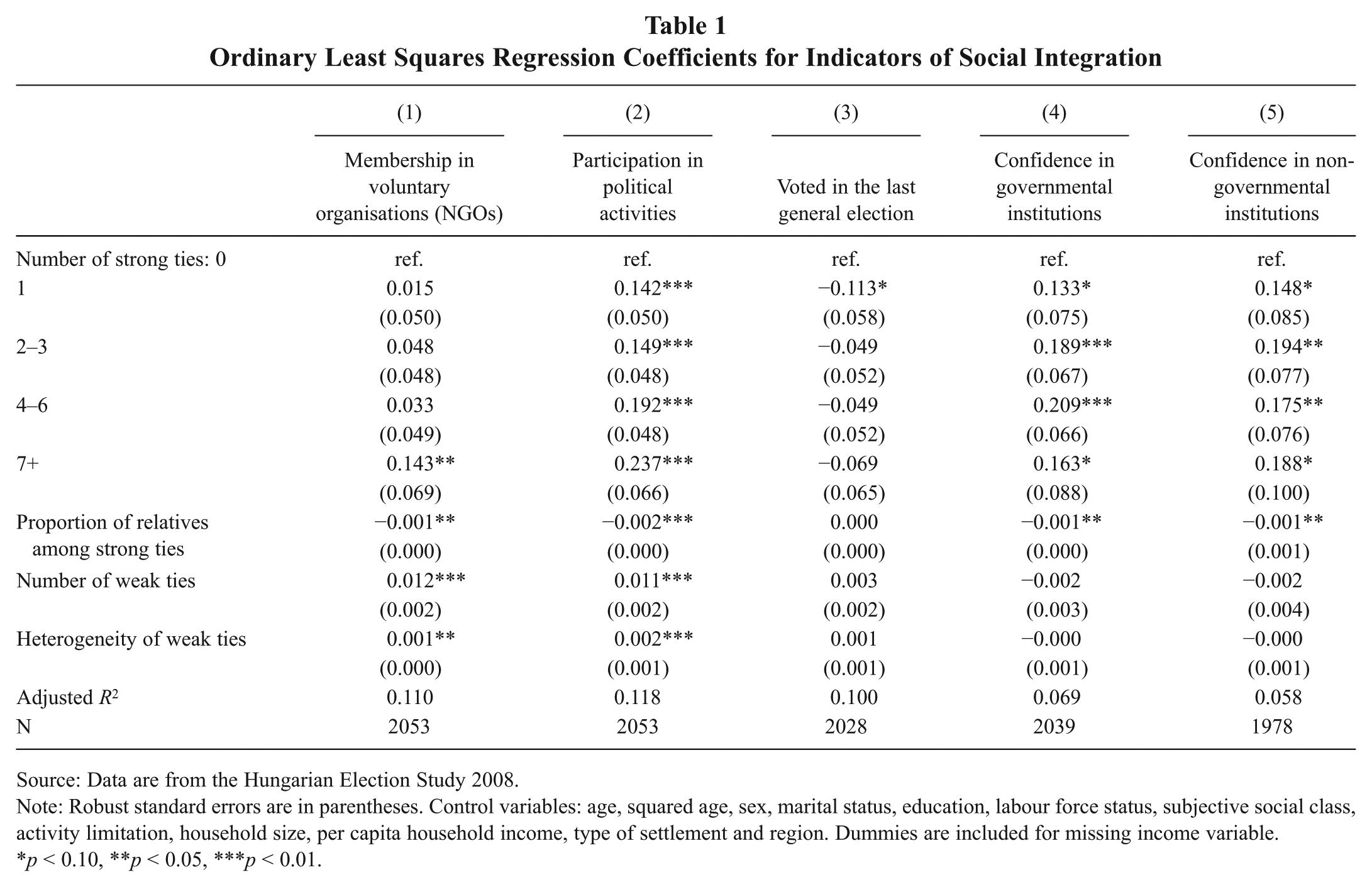
Table 1 and Table 2 show the results for objective and subjective indicators of social integration, respectively. Dependent variables of columns 1 to 3 in Table 1 are variables of public participation (membership in voluntary organizations, participation in political activities and voting in the last general election, respectively). The numbers of strong and weak ties are mostly positively related to variables of public participation—the one exception is voting in the last general election, which is determined more by socio-demographic variables. Compared to having no strong ties, having 7 or more strong ties correlates with a higher likelihood of membership in voluntary organisations, whereas having 1–6 strong ties makes no difference statistically in the likelihood of membership. On the other hand, having one strong tie is associated with a 14.2 percentage point higher likelihood of participation in political activities compared to having no strong tie; having more than one strong tie is associated with a linearly increasing likelihood of political activities. Regarding the number of weak ties, a practically meaningful, one standard deviation increase is associated with a 6.0 percentage point increase in the probability that an individual is a member of (at least) one voluntary organization, and with a 5.5 percentage point increase in the probability of participation in political activities. This means that individuals with larger egocentric networks are more likely to participate in public life than people with smaller egocentric networks. Regarding voting, the estimated coefficient on the number of weak ties is not statistically significant, whereas the effect of the number of strong ties is non-linear. Those with no strong ties voted with the highest likelihood in the last general election. Compared to them, those with one strong tie were 11.3 percentage point less likely to have voted. Those with more strong ties voted with statistically no different likelihood; that is, the relationship between the number of strong ties and voting seems to show a U-shape.
Ordinary Least Squares Regression Coefficients for Indicators of Social Integration
Source: Data are from the Hungarian Election Study 2008.
Note: Robust standard errors are in parentheses. Control variables: age, squared age, sex, marital status, education, labour force status, subjective social class, activity limitation, household size, per capita household income, type of settlement and region. Dummies are included for missing income variable.
p < 0.10, **p < 0.05, ***p < 0.01.
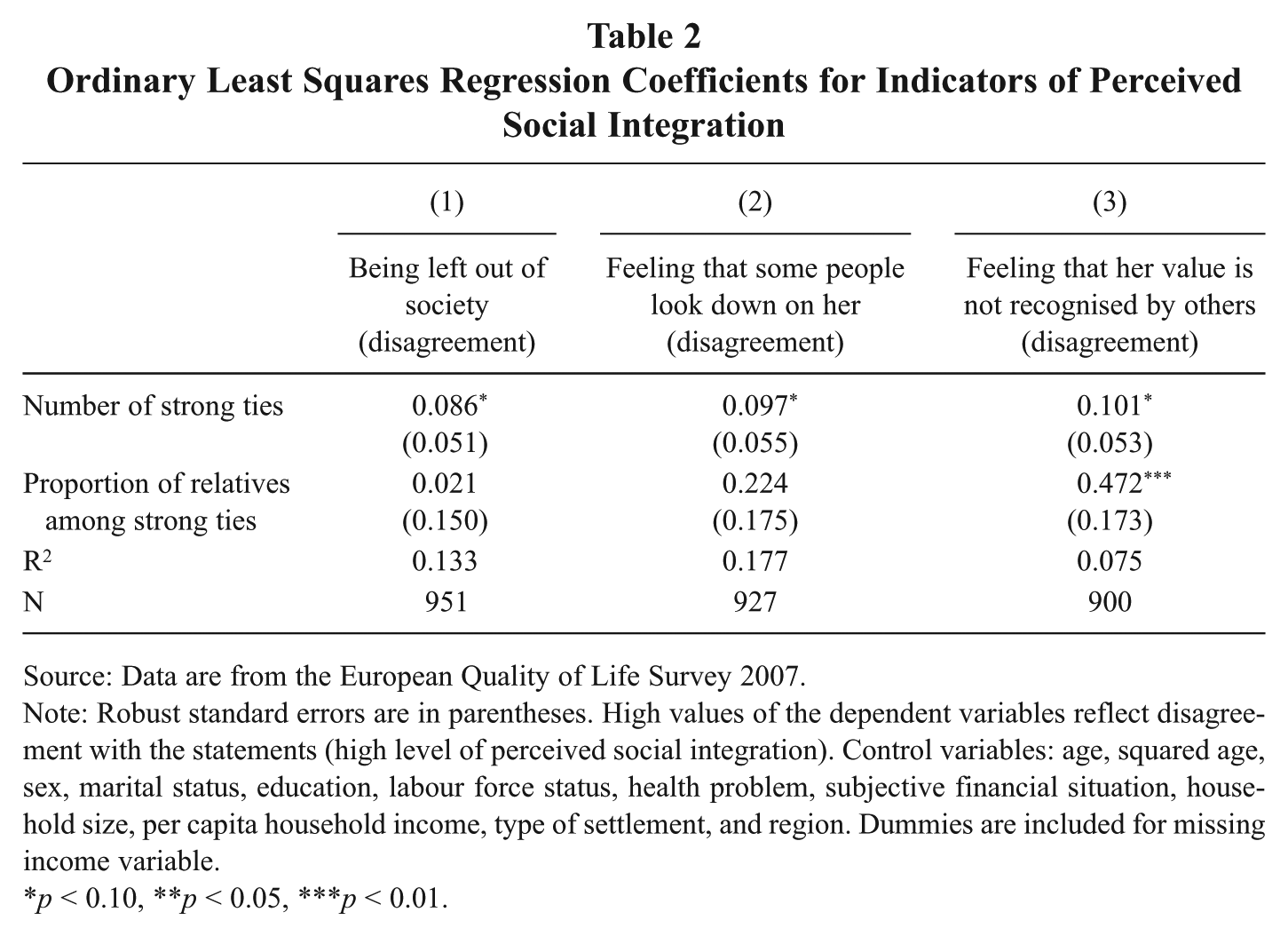
Ordinary Least Squares Regression Coefficients for Indicators of Perceived Social Integration
Source: Data are from the European Quality of Life Survey 2007.
Note: Robust standard errors are in parentheses. High values of the dependent variables reflect disagreement with the statements (high level of perceived social integration). Control variables: age, squared age, sex, marital status, education, labour force status, health problem, subjective financial situation, household size, per capita household income, type of settlement, and region. Dummies are included for missing income variable.
p < 0.10, **p < 0.05, ***p < 0.01.
Heterogeneity of weak ties correlates positively with two of the three variables of participation. A meaningful, 1 standard deviation increase in the heterogeneity of weak ties is associated with a 2.2 percentage point increase in the probability of being a member in voluntary organizations, and with a 3.6 percentage point increase in the probability of participation in political activities. The results corroborate the findings using American 64 and Japanese data. 65 As noted above, these results do not indicate any direction of causality. It is possible that public participation strengthens the connections between different groups of society, while it is also possible that a heterogeneous network provides the basis of acquiring communication skills necessary in public participation.
According to our hypothesis, the higher the proportion of relatives among strong ties, the less likely the membership in voluntary organisations, and the less likely the participation in political activities. A 1 standard deviation increase in the proportion of relatives is associated with a 2.5 percentage point decrease in the probability of voluntary organisation membership and with a 5.4 percentage point decrease in the probability of participation in political activities. On the other hand, its association with voting in the last general election is insignificant.
These results might be explained by the different nature of the three types of public participation. Participation in voluntary organisations and participation in political activities require persistent cooperation with others, whereas voting in an election is a single event, where an individual acts alone. According to Banfield, 66 those who have strong ties mostly in their family trust other people less and are less likely to cooperate with others, which might explain the negative coefficients for the first two indicators and the insignificant coefficient for voting. 67 On the other hand, the elderly are more likely to vote in general elections than the young, whereas they have smaller networks as well; thus, the correlation between network size, the heterogeneity of the egocentric network, and voting is rather weak. It is also possible that voting is a more or less ritual or routine event; thus, it depends less on social contacts and network characteristics. Other studies also suggest that voting and voting intention are influenced by the size of the political discussion network rather than the size of the core discussion network or the number of strong ties. 68
In the case of confidence in governmental and confidence in non-governmental institutions (columns 4 and 5 in Table 1), regarding strong ties, the results are similar: the number of strong ties correlates positively with the type of confidence in institutions. The real difference appears to be firstly between those who have no strong ties and who have some strong ties (at least 0.13- to 0.15-point higher trust compared to the former group), and secondly between those who have one strong tie and those who have two or more strong ties (0.04- to 0.08-point higher trust compared to the former group).
The proportion of relatives among strong ties correlates negatively with both trust variables. A 1 standard deviation increase in proportion of relatives among strong ties is associated with a 1.4 percentage decrease in confidence in governmental organisations, and with a 2.0 percentage decrease in confidence in non-governmental organisations. The number and heterogeneity of weak ties seems to be unrelated to confidence in institutions.
Table 2 shows the results for models where the dependent variable is perceived (subjective) social integration. The dependent variable of model 1 is that the respondent feels left out of society, the dependent variable of model 2 is that the respondent feels that some people look down on her because of her job situation or income, and the dependent variable of model 3 is that the respondent does not feel that what she does is recognised by others. As we noted above, these statements reflect increasingly the internal side of perceived integration (and decreasingly its external side).
The coefficient on the number of strong ties is positive and significant in all the three models, which means that the higher the egocentric network, the more integrated individuals see themselves—regardless of the degree of the internal and the external side of integration. The estimated coefficient on the proportion of relatives among strong ties is insignificant in model 1 and model 2, whereas it is positive and significant in model 3. It is worth noting that the size of the coefficient increases as the dependent variable reflects increasingly the internal side of subjective integration (0.021, 0.224, and 0.472 in model 1, model 2, and model 3, respectively). These results could be interpreted as suggesting that the proportion of relatives in the egocentric network is positively related to the internal side of perceived social integration, but it does not seem to be correlated with its external side. However, we have to note again that the measure of egocentric networks in the EQLS questionnaire is far from ideal, and as the questionnaire lacked questions on weak ties, we were unable to include these variables in our models. Hence, the results are only indicative and we must be careful when drawing strong conclusions from them.
Hypothesis 1 seems to be supported by our results. A higher number of strong ties is associated with better social integration according to both objective and subjective indicators. The number of weak ties, however, correlates positively only with membership in NGOs and participation in political activities, with those two types of activities that require more or less persistent cooperation with others.
Hypothesis 2 is also mostly supported by our results. The proportion of relatives among strong ties correlates negatively with four of the five objective indicators of social integration, whereas the heterogeneity of weak ties correlates positively with indicators of public participation, but it is not related to voting and confidence in institutions. Overall, it seems that the heterogeneity of the egocentric network is positively related to being well integrated.
The results do not falsify hypothesis 3 either. The proportion of relatives among strong ties seems to be positively related to the internal side of perceived social integration, whereas it is not correlated with the indicators of subjective integration measuring mostly the external side of social integration. Thus, we may conclude that egocentric networks composed mostly of relatives are beneficial regarding feeling safe and being supported by others (internal side of perceived social integration), whereas it has no negative impact on the external side of subjective integration. However, the lack of correlation might be caused by the question design in EQLS, in which the availability of kin in different situations is measured more than their proportion in the egocentric networks.
Summary
In this study, our aim has been exploratory: We have analysed the association between the size and heterogeneity of egocentric networks and objective and subjective indicators of social integration, using nationally representative databases from Hungary. Many studies use the notion of social integration as a synonym for social networks. Based on studies of social cohesion, 69 we define social integration as a multidimensional characteristic of individuals in a society. In our approach, social networks are only one dimension of social integration, and political participation, generalized and institutional trust and self-perception of being integrated are equally important dimensions of it.
Our results show that the size and heterogeneity of the egocentric network associate positively with objective indicators of social integration (public participation and confidence in institutions). The number of strong and weak ties correlates positively with objective indicators of social integration, whereas the higher the proportion of relatives among strong ties, the less likely it is that an individual participates in public activities, and the less likely she is to trust institutions. Heterogeneity of weak ties is related positively to public participation. On the other hand, owing to lack of good-quality secondary data regarding the subjective indicator of social integration, our results are less clear. The proportion of relatives among strong ties seems to correlate positively with the internal side of perceived social integration, but it seems to be unrelated to its external side. The number of strong ties is associated positively with both the internal and external sides of subjective integration.
Owing to data limitation, we were unable to test whether the effects of the number and heterogeneity of strong ties on perceived social integration remain unchanged if the number and heterogeneity of weak ties are also included in the models. It is possible that the effect of the heterogeneity of weak ties is the inverse of those of heterogeneity of strong ties; that is, the heterogeneity of weak ties might be positively related to the external side of subjective integration. Further research is needed to answer this question.
Since our analysis has been necessarily exploratory—because of data limitations—we think it is a first step, but it has been able to give some evidence that the mechanism we have described is worth studying in more detail. One direction of future research could be comparative: repeating our analysis using data from other countries or regions. Another interesting direction could be using longitudinal (panel) data to allow us to analyse causal relationships.
Nevertheless, these results show that association between dimensions of social integration might vary, and individuals can be characterised by a high level of social integration in one dimension and by a lower level of integration in another dimension. The results also suggest that the multi-dimensional nature of social integration cannot be neglected, drawing attention to the fact that a higher level of social integration cannot be achieved by concentrating only on one of its dimensions. Our results also underline that homogeneous egocentric networks are not beneficial regarding trust and participation; however, they might have a positive effect on feeling safe, supported, and recognized by others for being the person an individual is. This might contribute to the explanation of the relatively low level of social integration (i.e., below-average levels of trust, below-average public participation, and weak scores on social networks indicators 70 ) in Hungary and in Eastern Europe.
Footnotes
Appendix
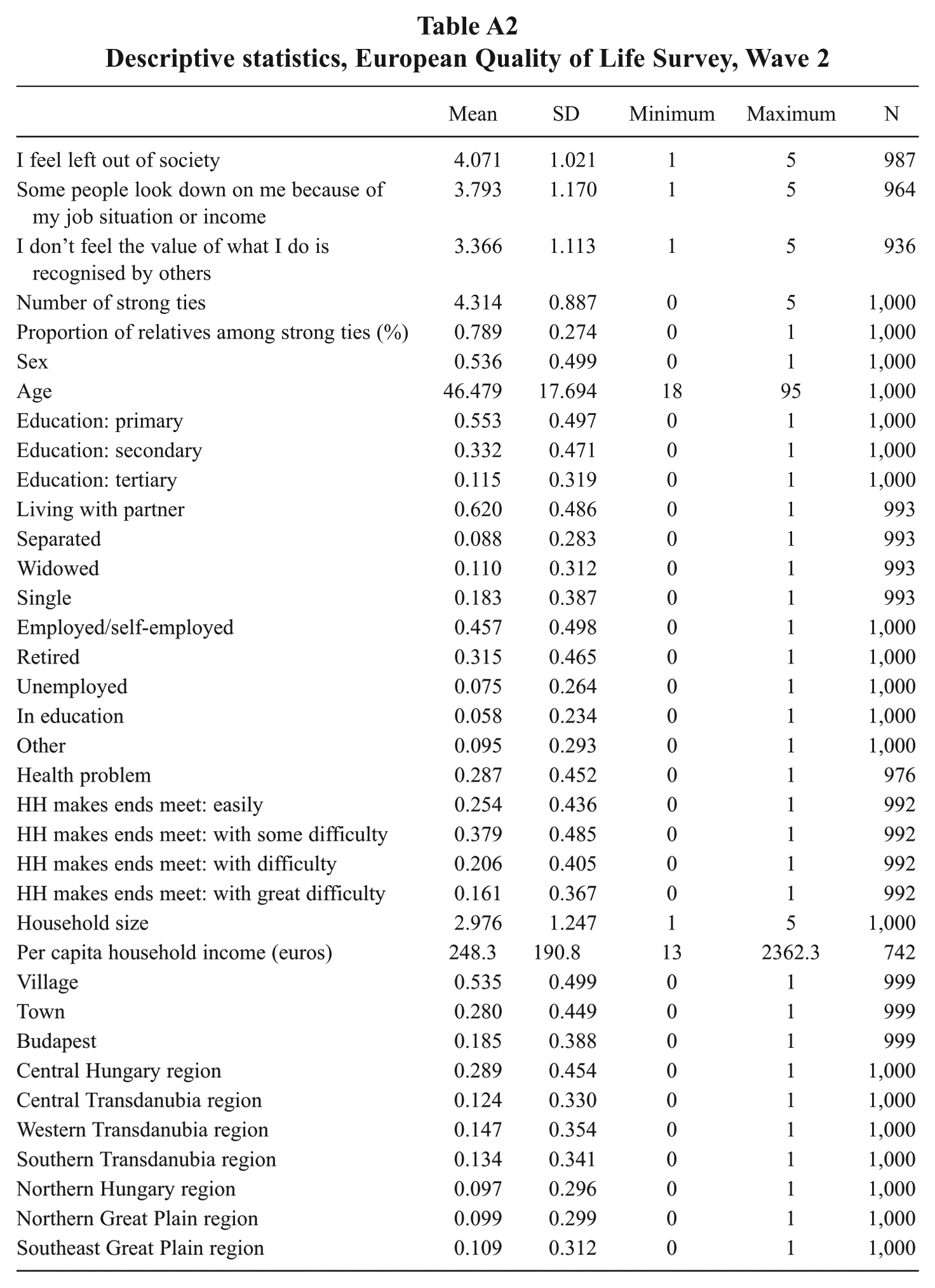
Descriptive statistics, European Quality of Life Survey, Wave 2
| Mean | SD | Minimum | Maximum | N | |
|---|---|---|---|---|---|
| I feel left out of society | 4.071 | 1.021 | 1 | 5 | 987 |
| Some people look down on me because of my job situation or income | 3.793 | 1.170 | 1 | 5 | 964 |
| I don’t feel the value of what I do is recognised by others | 3.366 | 1.113 | 1 | 5 | 936 |
| Number of strong ties | 4.314 | 0.887 | 0 | 5 | 1,000 |
| Proportion of relatives among strong ties (%) | 0.789 | 0.274 | 0 | 1 | 1,000 |
| Sex | 0.536 | 0.499 | 0 | 1 | 1,000 |
| Age | 46.479 | 17.694 | 18 | 95 | 1,000 |
| Education: primary | 0.553 | 0.497 | 0 | 1 | 1,000 |
| Education: secondary | 0.332 | 0.471 | 0 | 1 | 1,000 |
| Education: tertiary | 0.115 | 0.319 | 0 | 1 | 1,000 |
| Living with partner | 0.620 | 0.486 | 0 | 1 | 993 |
| Separated | 0.088 | 0.283 | 0 | 1 | 993 |
| Widowed | 0.110 | 0.312 | 0 | 1 | 993 |
| Single | 0.183 | 0.387 | 0 | 1 | 993 |
| Employed/self-employed | 0.457 | 0.498 | 0 | 1 | 1,000 |
| Retired | 0.315 | 0.465 | 0 | 1 | 1,000 |
| Unemployed | 0.075 | 0.264 | 0 | 1 | 1,000 |
| In education | 0.058 | 0.234 | 0 | 1 | 1,000 |
| Other | 0.095 | 0.293 | 0 | 1 | 1,000 |
| Health problem | 0.287 | 0.452 | 0 | 1 | 976 |
| HH makes ends meet: easily | 0.254 | 0.436 | 0 | 1 | 992 |
| HH makes ends meet: with some difficulty | 0.379 | 0.485 | 0 | 1 | 992 |
| HH makes ends meet: with difficulty | 0.206 | 0.405 | 0 | 1 | 992 |
| HH makes ends meet: with great difficulty | 0.161 | 0.367 | 0 | 1 | 992 |
| Household size | 2.976 | 1.247 | 1 | 5 | 1,000 |
| Per capita household income (euros) | 248.3 | 190.8 | 13 | 2362.3 | 742 |
| Village | 0.535 | 0.499 | 0 | 1 | 999 |
| Town | 0.280 | 0.449 | 0 | 1 | 999 |
| Budapest | 0.185 | 0.388 | 0 | 1 | 999 |
| Central Hungary region | 0.289 | 0.454 | 0 | 1 | 1,000 |
| Central Transdanubia region | 0.124 | 0.330 | 0 | 1 | 1,000 |
| Western Transdanubia region | 0.147 | 0.354 | 0 | 1 | 1,000 |
| Southern Transdanubia region | 0.134 | 0.341 | 0 | 1 | 1,000 |
| Northern Hungary region | 0.097 | 0.296 | 0 | 1 | 1,000 |
| Northern Great Plain region | 0.099 | 0.299 | 0 | 1 | 1,000 |
| Southeast Great Plain region | 0.109 | 0.312 | 0 | 1 | 1,000 |
Funding
Funding Sources: National Research, Development and Innovation Office (Grant / Award Number: NKFIH, 108836). Project title: Integrative and Disintegrative Processes in the Hungarian Society
