



Abstract
The process of migration has been the subject of extensive debates throughout Europe. Migration patterns are constantly changing in our current globalized economy; therefore, it is insufficient to assume that countries sharing cultural, geographical, and linguistic similarities experience synchronised migration flows. This article attempts to contribute to the understanding of one of the most dominant migration streams from Eastern Europe, specifically the movement from Ukraine to the Czech Republic and Poland. The period of interest follows the accession of the destination countries into the EU between 2004 and 2014. The results show that Ukraine suffers from much worse economic and social conditions than Poland and the Czech Republic. GDP growth, unemployment, and the poverty rate are three important indicators that explain why there has been such a large influx of Ukrainians into the host countries. While educational attainment was also massively deficient in Ukraine, it appears this is a reflection of the institutional failure of the Ukrainian education system, thus leading to the education–occupation mismatch of Ukrainian migrant workers. Despite the fact that Poland and the Czech Republic are linguistically, culturally, and geographically close, the immigration flow from Ukraine has behaved very differently in each case; for instance, the most notable contrast reveals that migration to the Czech Republic, but not to Poland, was substantially affected by economic crises.
Introduction
The economic gap between developed and developing countries has increased so drastically that it has created an infinite number of potential migrants. 1 Portes and Dewind emphasize that this gap has become wider under the process of globalisation. 2 Thus, the most concentrated migration flows and the related issues of migrant integration are currently among the most sensitive (and potentially the most explosive) issues facing mankind. 3 Migration works as a catalyst for globalisation; however, it is also supported and accelerated by different globalisation processes simultaneously. 4 Numerous factors serve as the motivation; however, movements most frequently occur from developing to developed countries driven by the desire to improve living standards. 5 For this reason, Hollified and Castles come to the prescriptive conclusion that all modern states should strive to monitor and to regulate migration thoroughly in order to achieve a balance between openness and security. 6
The thirst for new workers in developed countries started to increase with globalisation, especially for jobs within the field of manual labor, which residents view as “inferior” and underpaid and are reluctant to perform. 7 This supports the belief that foreign labor will enhance the economy through filling gaps in the labor market. 8 Moreover, demographic issues also feed a growing demand for labor forces from abroad, and to a certain extent, this type of migration can help to improve some demographical parameters (for instance, counteracting an ageing population and low fertility rates). Despite restrictions on mobility, in today’s globalised world there are varied motivations for migration, more migration routes, and different patterns of flow. Consequently, previously unexposed regions are increasingly experiencing the effects of significant migration for the first time, and the intensity of international migration is not predicted to decrease in the foreseeable future, 9 thus creating a tremendous demand for research on the topic.
The difficulties with international migration research stem from the complexity and the connectedness of the factors associated with migration. One example of this complexity is the pattern of multi-level mediation within various governmental agencies and foreign authorities. 10 In addition, other researchers regard migration as an integral aspect of extensive social and developing processes. 11
This article concentrates on the migration flow from Ukraine into the Czech Republic and Poland as a result of the potential for successful migration permitted by their geographical, cultural, and historical similarities. Ukrainian migrants comprise one of the largest group of foreigners within both respective countries; 12 however, the ease of and incentives for their movement has fluctuated as a result of several policy, economic, and demographic changes. This article examines a period of particular interest between 2004, after the accession of the Czech Republic and Poland to the EU, and 2014. Before this period, migration policies in both destination countries had already begun a gradual process of standardisation to fit EU requirements, replacing and structuring earlier, largely underdeveloped policies. Ironically, it was the infancy of these policies that previously incentivised migration, as fewer regulations eased the entry of migrants. 13 With a more developed migration policy, what were the main draws for migration to the Czech Republic and Poland for Ukrainian migrants between 2004 and 2014? How did migration policies and Ukrainian migration flows develop following accession to the EU? This paper aims to contribute to the understanding of labor migration through seeking answers to these questions, using existing migration policy research and an investigation into the non–policy-related motivations and deterrents for Ukrainian migration. To make sense of the bigger picture, an evaluation of the impact of migration will be conducted to explore policy implications.
Methodological Notes and Data Sources
The methodological approach of this study is based on comparative research into the migration policies and flows of Ukrainians to the Czech Republic and Poland, which is sourced through the existing academic literature and statistics on the topic. This will be followed by a comparative analysis of four economic indicators using data taken from official databases. These data relate to the workforce of Ukrainians (evidence of valid residence permits, etc.) and flows (the number of registered and unregistered foreigners from Ukraine staying permanently for 2004–2014). The sources used include the Czech Statistical Office, OECD State, the Minister of Labor and Social Affairs of the Czech Republic, and the Ministry of Labor and Social Affairs of Poland.
Migration Policy
Alongside growing international labor flows, there are rising numbers of networks created between migrants and their countries of origin, which facilitate further migration flows for noneconomic reasons such as family networks and higher education. 14 The rapid exchange of information and the overall flexibility of these networks can easily bypass official efforts to route or suppress migration flows.
Thereby the efforts to regulate streams of migration are complicated. International governments’ cooperation is uncertain because the authorities of origin countries understand this process as a safety measure in mitigating local problems and issues. These authorities also consider emmigration as an important source of future income through remittances. 15 This underpins the opinion that there is no logical incentive for foreign governments to strive to suppress migration; 16 consequently they attempt to maintain relations with large communities of compatriots as a significant economic resource.
However, there is still a constant endeavour to monitor migration in order to reduce outside threats to host countries. 17 Nevertheless, Borjas asserts that labor migration helps “grease the wheels” of the economy because labor migrants move in reaction to miscellaneous economic opportunities and reflect the specific skill needs of employers within the host countries. 18
Labor recruitment is conducted by a number of actors including placement firms, staffing agencies, and private and public employers who often take advantage of vulnerable individuals seeking work abroad. While some states have implemented recruitment regulations to help mitigate this problem, a combination of jurisdictional constraints and economic interests have limited states’ capacity and political will to take action. 19
In the process of migration, a host country’s migration policy plays a significant role. Migration policy has been defined as a policy leading to direct or indirect regulation of the movement of migrants across international borders and their residence within states. 20 The policies tend to regulate, attempt to influence the direction of legal migration, and manage the punishment and prevention of illegal migration. 21 Policy outcomes include granting visas and passports, security and regulation of crossing borders, and the conditions for granting asylum. In addition to these matters, migration policies contain both immigration and integration policy. 22 Immigration policy defines the target number of foreigners who may reside in the country. Chaloupková and Šalamounová describe the different attitudes to immigration among European countries as being conditioned by social, economic, political, and cultural factors. 23 The majority of the European member states have progressively accepted that “temporary” economic migration has an obvious tendency to transform into permanent immigration, 24 and such a development is even supported by EU law.
Governments of host countries can also play a significant role in encouraging migration by decreasing administrative barriers, especially for circular migrants and those less educated and poorer. A reduction in administrative barriers results in a greater likelihood of achieving permanent residence as well as pursuing education and making employment opportunities more straightforward. Overregulation can lead to illegal migration in the form of migrants overstaying their residence permits. This policy approach, including restrictions on a migrant’s ability to return home, can damage the development potential of migration. 25
The Migration Policy of the Czech Republic
Czech migration policy is firmly anchored within the common policies of the EU, and its implementation follows, to a certain extent, the common legislative instruments of the Union. 26 Specific areas of migration that are most regulated by the EU are international protection (asylum), protection of the EU external borders, and matters of return (including the deportation of illegal immigrants). With regard to legal migration and integration of foreigners, the EU member states maintain a relatively high degree of independence. This distribution of protections and competencies creates an interconnected framework for migration, regardless of the degree of harmonisation at the EU level. Czech policy needs to take into account not only the specific needs and possibilities of the state but also the situation at EU level. It must actively participate in common approaches to problem-solving. The Ministry of the Interior of the Czech Republic (MI) states in “the Strategy of Migration Policy” that the Czech Republic has adopted several parts of the migration policy, such as the integration of foreigners both in society and in the labor market. 27
Within the Czech migration strategy, there is an emphasis on integration of foreigners as the basic goal of a successful migration policy. This must be a two-way process whereby both foreigners and the domestic population must participate in an integration process.
The Czech Ministry of the Interior asserts that the Czech Republic has a balanced long-term integration policy whose development and implementation in the long term is supported by contributions from EU funds. This policy proposes strict monitoring and comprises projects at both the national and international levels, including a network of regional integration centres for foreigners.
According to the legislation on conditions for residency of migrants in the Czech Republic,
28
On the labor market, a foreigner has the same status as a citizen of the Czech Republic if he or she is granted permanent residence or is a citizen of the EU or he/she is granted asylum. Other foreigners in the Czech Republic must have a work permit and have been granted permanent residence. If the applicant meets all the conditions, then he or she can start looking for employment using the gateways of the Employment Office or through the websites of the Ministry of Labor and Social Affairs. The applicant may choose from job vacancies there. If none are suitable for him or her, there is a possibility of registering as a candidate for a certain job.
However, priority is given to a suitable candidate of Czech nationality or an EU citizen for a job.
Foreigners in the Czech Republic may obtain either a Blue Card or an Occupational Card. The Blue Card is for skilled and qualified foreigners: university graduates or those with a vocational qualification that has taken more than three years to obtain and who want to work in the Czech Republic for more than three months. The Blue Card grants both a residence permit and a work permit in the Czech Republic.
Occupational Cards replaced the Green Card in 2014. 29 It is a new kind of a permit for long-term stay for the purpose of employment. After foreigners have obtained an Occupational Card from MI (Division for Asylum and Immigration Policy), they are allowed to stay and to work in the Czech Republic. The Occupational Card replaces the Residence Visa for more than 90 days due to employment, which is a permit for a long-term stay for the purpose of employment, and the Green Card.
The Migration Policy of Poland
The migration policy of Poland has also been required to adhere to EU legislation since accession, particularly as the implementation of EU standards were considered important to protect core member states from being adversely affected by the enlargement of the Union. 30 Because of a lack of domestic political interest in migration issues, migration policy in Poland has been viewed as reactive, meaning that laws are revised or formed mostly in response to newly identified administrative problems, or the introduction of new EU legislative acts. 31
The Polish approach to integration policy is no exception to the trend in Eastern Europe. A juridical and institutional framework has been created to tackle Poland’s lack of a comprehensive, lasting, and systematic state strategy towards the integration of foreigners; however, its advancement has mostly been in response to the requirements of the Union and guided by strategic decisions made at the EU level. Therefore, the development of an integration policy in Poland has been considered to be a vigorous, centralised, and “top–down” process, where decisions directed at the EU level to some degree compensate for the absence of political decisions executed by the state. 32
Despite this guidance, there has been no logical integration doctrine and all juridical regulation and integration programmes up to now have been solely focused on two groups: migrants holding refugee status who have been granted international protection, and repatriates with their families. While this can be explained by the limited experience of Poland regarding long-term immigrants, 33 it can also be attributed to the negative stance policy makers hold towards settlement immigration that active integration programmes are viewed to encourage. 34 The integration of third country nationals has therefore been left under the responsibility of Polish NGOs, whose activities are often limited by insufficient EU and privately sourced funds. 35
Beyond EU legislation, several important developments in Polish migration policy with regards to non-EU immigration have been evident in recent years. Firstly, migration policy has shifted from a position of protectionism against any inflow of new migrants to helping desirable groups of immigrants, with a focus on short-term migrants and those entering from its eastern neighbours. The incentives provided are administrative and economic—not socio-cultural or political. 36 Specifically, access to the Polish labor market has been liberalised by the simplification of two legislative routes through which foreigners coming from outside the EU can gain employment in Poland: work permits and the employer declaration system.
Work permits are granted based on information about the situation in the local labor market and, as in the Czech Republic, preference is given to eligible Polish citizens for a job. This means that a non-EU migrant can be granted a work permit for a certain employer in Poland on the condition that nobody among the applicants registered at the Employment Office meets the requirements. A suitable person for that job, registered at the Employment Office, must be found within fourteen days. After this period, it is possible to hire a foreigner.
Meanwhile, the employer’s declaration 37 allows the citizens of six states (Ukraine, Belarus, Russia, Moldova, Georgia, and Armenia) to be employed for up to six months during a twelve-month period, without the necessity for a work permit, on the basis of the potential employer’s declaration. These direct incentives intended for Eastern, neighbouring countries help to maintain favourable relations. The implementation of the declaration, which liberalises the entrance of seasonal workers into the Polish labor market, arises from a structural labor shortage. The system has made labor migration into Poland accessible and inexpensive for Ukrainian migrants. While the Polish economy is able to fill its labor shortages, Ukrainian migrants are able to begin working without much of the bureaucratic difficulty associated with obtaining a full work permit. This system has driven much of the labor migration from the Ukraine, and the number of declarations issued has been increasing tremendously; 762,700 declarations were issued to Ukrainian workers in 2015, 1.2 million in 2016, and 904,854 in the first half of 2017 alone. 38 Among foreigners in Poland, the largest industries in which employers use declarations are agriculture (50.3%), construction (12.6%), and manufacturing (7.5%). Of all the declarations received, Ukrainians make up the vast majority. Interestingly, declarations from other sectors besides these have been rising (18% in 2013), suggesting that this procedure is now increasingly being used as a method for entry into the workforce for both low-skilled workers and highly skilled ones. 39 The popularity of this relatively unique solution to an otherwise typically restrictive process towards hiring third country nationals also illustrates the impact and importance of state regulation and migration policies on the dynamics of Ukrainian immigration.
Further developments include the adoption of the new Polish Citizenship Bill in 2012, which reduced the required years of residence to qualify for citizenship from 5 to 3 years. 40 In 2011, the National Assembly also passed a law to legalise the residence of certain illegal foreigners, the most liberal law regarding the legalisation process of foreigners in Poland. 41 All of these developments follow a natural progression of a slow, controlled opening towards the inflow of foreigners; however, they primarily promote circular migration rather than long-term migration. 42 It seems therefore that while Poland has demonstrated signs of openness towards short-term migrants, policy developments regarding the integration of foreigners have consistently been neglected.
The Effects of Czech and Polish Migration Policies on Ukrainian Migration Inflows
The migration policies of the Czech Republic and Poland are perceived as being favourably orientated towards Ukrainians and they include a process for obtaining visas and residence permits. Within the Czech Republic, a number of migration policies collectively encourage migration from countries within the EU (see above), whereas in Poland, Ukrainians are included within the set of Eastern countries who benefit from preferential migration policies. There have been a number of migration policies that have had significant impact on migration flows and patterns from the Ukraine to Poland. Specifically, a number of regulatory relaxations have eased the movement of Ukrainians into Poland; a policy set in September 2012 completely exempted Ukrainians from the requirement of a visa, on the basis that they planned to reside in Poland only between 3 months and a year. This encouraged “circular” migration, which is also the primary type of migration in the Czech Republic. 43 The employer’s declaration system has also reinforced circular, or seasonal, migration, as declarations are only valid for a up to six months within a twelve-month period. Following this, workers must either apply for a work permit or return to Ukraine and begin the process again.
However, Ukrainians cannot benefit from their educational qualifications because it is difficult to validate their diplomas in the Czech Republic and Poland. Despite the fact that Ukrainians cannot use their education and skills, their wages are higher than in Ukraine (but lower than the wages of Czechs or Poles). Thus, several research papers claim that many Ukrainians who choose to come to Poland and the Czech Republic to work in low-skilled job positions are university educated. 44 Less than 7% of Ukrainian migrants in Poland had jobs that corresponded with their educational qualifications. 45 This causes a brain drain from Ukraine; however, it doesn’t create a brain gain in either the Czech Republic or in Poland, because the migrants are not employed in highly skilled positions. Other research, however, claim that the educational mismatch has been overestimated (see later section).
The Pattern of Migration into the Czech Republic and Poland
Since the Czech Republic and Poland joined the EU, 46 opportunities for migration have increased and this has resulted in an increased number of migrants in both countries, most significantly in the Czech Republic. 47
Within the examined period, it is possible to notice the distinct progress of immigration into these compared countries. The neoliberal period of 2005–2008 was characterised by economic expansion and a local shortage of labor in the Czech Republic. 48 In the Czech Republic during the period 2004–2007, the number of foreigners increased, reaching a peak in 2007 at 102,511. 49 Thereafter, there was a noticeable decline in the number of migrants, even though the Czech Republic had a positive net international migration until 2011. Czech migration policy in the period 2005–2007 was influenced primarily by a high demand for labor as a consequence of economic expansion and low unemployment, while the inflow of less qualified workers to the Czech Republic increased sharply during that period. 50 After joining the EU, the Czech Republic implemented legislation facilitating entrance to the Schengen Area (2007). 51
As a result of the economic crisis in 2008, unemployment rose and the number of jobs for both Czech citizens and foreigners fell. This caused the total number of foreigners to gradually decrease because work was one of the main motives for immigration. The increase in unemployment and economic stagnation led to a misconception of migration policy within the Czech Republic. 52 The repeated changes in regulations brought confusion to the whole process and, above all, significant cost increases for employers. 53 The government implemented a number of regulations leading to a reduction in the number of migrants and this led to employers refusing to hire foreigners, even those who did not need a work permit. 54 Because of those measures, the number of foreigners in the Czech Republic almost halved in 2008 and that trend remained until 2011 (see Figure 1).

The inflow of foreigners into the Czech Republic and Poland
The trends of the Ukrainian migration to Poland from 2004 to 2013 (see Figure 1) differed in comparison to the Czech Republic. Within this period, it is possible to observe a slight increase in immigration (with a slight dip in 2006). On the basis of the available data, the economic crisis did not have such an extensive impact on the labor market in Poland; the Czech Republic was heavily impacted by the crisis, and membership of the Schengen Area resulted in changing conditions for migrants in the Czech labor market. Conversely, migration to Poland was not significantly affected and remained stable (see Figure 1), primarily because of the “Permission of Temporary Residence,” enabling employment in Poland for six months. 55 The number of permanent and "fixed-term" residence permits issued in Poland remained at approximately forty thousand people per year when the recession was deepest (2007–2010), and the considerable increase that followed suggests an increase in short-term, circulatory migration (see Figure 1). Therefore, Poland’s heightened, but selective, openness towards short-term migration maintained migration levels during the crisis. However, towards the final years, the inflow dipped drastically, to approximately thirty-two thousand, providing the first signs that migration had transitioned into settled migration.
When comparing Poland with the Czech Republic, it becomes apparent that each country has experienced a completely different development in migration policy; one outcome of this is the contrasting numbers of work permits granted that allow integration into labor markets. In the Czech Republic in the period 2004–2014 the number of work permits issued changed considerably. A big shift took place between 2008 and 2009 because of the change in legislation regarding work permits, and this caused a significant decrease in immigration. Disregarding the EU countries, the majority of applicants for Czech work permits come from Ukraine, Vietnam, and Russia. 56 Every year the number of immigrants applying for work in the Czech Republic is growing, and this particularly refers to Ukrainians who are employed for seasonal work. 57
In Poland since 2007, the number of work permits granted has also increased—multiplying fourfold within the ten-year period—and Poland has facilitated a process of authorising work visas for citizens of its Eastern neighbours—Belarus, Georgia, Moldova, Russia, and Ukraine. According to Eurostat, citizens of foreign countries account for less than 2 percent of the Polish population, the lowest in Europe. 58
However, it is difficult to accurately estimate net labor migration in both the Czech Republic and Poland, as a significant proportion of irregular migration, specifically migrants who have outstayed their permitted residence, exists in both countries. Without a documented employment contract or work permit, these workers are invisible to labor inspectors, police, and trade unions, making it difficult—if not impossible—to ascertain the true scale of this phenomenon.
According to the Polish Ministry of Family, Labor and Social Policy (2015), 59 more than ninety thousand foreigners have obtained residence permits in Poland, and approximately fifty to seventy thousand foreigners remain in the country illegally; however the Multicultural Centre in Prague 60 estimates the real figure may be closer to five hundred thousand. 61 In Poland, the majority of “circular” migrants are from its Eastern neighbours, and among them, Ukrainians comprise the largest group entering, residing, and working in Poland. According to the Polish Ministry of Family, Labor and Social Policy, Ukrainian nationals accounted for the greatest migrant population (26,315) in 2014, exceeding the Vietnamese (2,369) and Chinese (2,133) by more than tenfold. 62 They represent the group of migrants perceived to be most familiar with Polish society because of geographical, cultural, and linguistic familiarity; the historical and the current relationship between the two nations; and lastly, well-developed migration networks.
Non-policy-Related Incentives for Ukrainian Migration
In contrast to migration policy, there are certain factors influencing migration that authorities within the destination countries cannot directly tackle, or systematically predict, as motivating factors. As the main incentives for migration are economic or demographic, this article explores four different indicators of development to track and compare the living conditions between Ukraine, the Czech Republic, and Poland between 2004 and 2014. The main indicators considered in this article concern the development of labor markets of the Czech Republic, Poland, and Ukraine (unemployment rate, education level of the population) and the economic situation of these countries within the examined period (gross domestic product [GDP] growth rate, poverty rate). The results and accompanying analysis of research aim to provide insight into how these elements may have influenced the requirements for foreign workers in the Czech Republic and Poland and impacted migration, regardless of the policies applied in these countries.
Chosen Economic Indicators of Examined Countries
The four indicators have been chosen on the basis of what the existing academic literature regarding Ukrainian migration has labelled as influential within the examined period. The chosen economic indicators are the unemployment rate, education level of the population, GDP growth, and the poverty rate. As mentioned above, the majority of Ukrainian migrants are “circular” and thus move to the Czech Republic and Poland in search of employment. Naturally, an examination of the unemployment rate could shed light on whether prospects for employment differ between the regions. Similarly, the prospect of improved living standards may also motivate movement, usually leading to long-term migration. The poverty rate is an important indicator related to inequality in the country and reflects the economic situation in the country.
Ordinarily, economic incentives for migration are stifled during the times of recession; thus, an evaluation of the synchronisation of migration flows and the GDP growth rate could impart insight into how robust these economic motivations are.
The incentives for education, however, can be split into two categories. Higher education prospects can either directly serve as an opportunity for migrants to better their own or their family’s educational qualifications, or it can be an indicator that there is a greater opportunity to obtain a more productive job. 63 For Ukrainians, having an interesting job ranks highly in their personal values; 64 thus, the prospects of higher productivity could produce a powerful incentive for Ukrainian inflow. Distinguishing between the two incentives using the chosen method is difficult; however, available research will be used to help understand the trends.
Unemployment rate
Of the three countries examined, the lowest unemployment rate is in the Czech Republic. Figure 2 displays an insignificant difference between Ukraine and the Czech Republic within the period 2004–2014. More marked differences can be seen in Poland, where the unemployment rate began to fall significantly after EU accession. It slowly followed the same path as the two other countries.
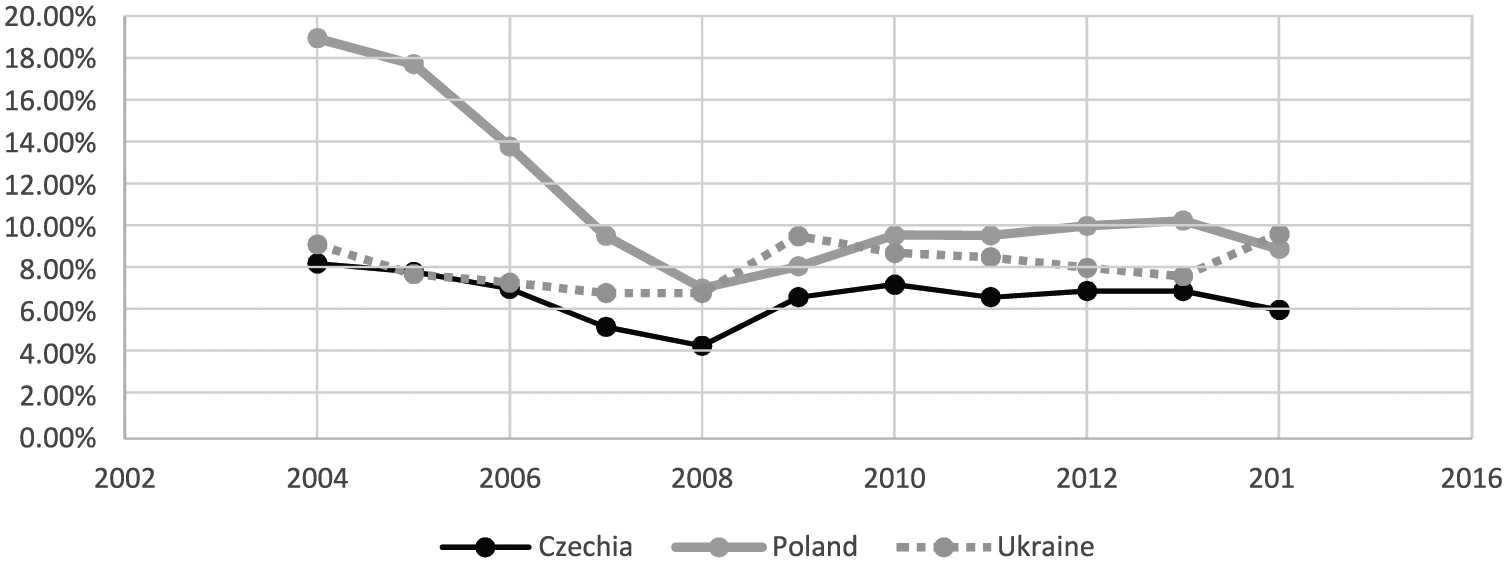
Unemployment rate by percentages
Between the examined period of 2004 and 2014, there was a distinctively inverse and lagged relationship between the unemployment rate in Poland and the Ukrainian immigration inflow, as shown in Figure 3, suggesting that the largest part of Ukrainian migration into Poland was in response to changes in the unemployment rate. For instance, in 2004, the employment rate in Poland was exceptionally high at 19 percent of the GDP, and this was also the lowest immigration level of Ukrainians during this period. Within the following four years up to 2008, the unemployment rate recovered greatly, and this corresponded with a surge in Ukrainian immigration for permanent residency by more than two-fold by 2009. The data suggest that the majority of Ukrainian migrants migrate in search of employment when labor market conditions appear favourable. However, their success on the Polish labor market appears rather limited; Figure 4 shows that the number of registered Ukrainian migrants at the Employment Office grew much more than the number of work permits issued between 2008 and 2014, implying that massive employment barriers were faced. For those who did find work, however, employment was almost equally split between full- and part-time positions; according to the Ministry of Family, Labor and Social Policy, 45.6 percent of Ukrainian migrants were in constant employment, while 47.9 percent were working part-time in 2014. 65 This supports the existing evidence suggesting that most Ukrainian migrants migrate in search of employment.

Comparison of the unemployment rate in Poland with the Ukrainian migration inflow between 2004 and 2014

Number of registered statements and work permits of Ukrainian citizens issued in the years 2008–2014 (data in thousands)
Education level
When observing the data, there are noticeable differences especially in the sub-upper secondary and upper secondary educational categories (see Table 1). Within Ukraine, almost 50 percent of people did not reach upper secondary education, with the proportion gradually increasing throughout the period. In contrast, the percentage of citizens within this category in the Czech Republic (10.9 percent) and Poland (16.1 percent) since 2004 has consistently declined over time. Moreover, the tertiary educated population proportion is the highest in Poland and the lowest again in Ukraine. Thus, the Ukrainian educational structure is the worst by far in comparison to the Czech and Polish ones. The growth of tertiary educational attainment in Ukraine is very far from compensating for the decline in the level of upper secondary education, implying the institutional failure of Ukrainian education policy.
Education Level of the Population (by percentage)

Source: Own compilation based on data from the OECD.
On the surface, therefore, it would seem that education could be a potential pull factor for Ukrainian migrants. Surprisingly and contradictory to these findings, other research papers have disregarded education as an important factor within migration decisions. 66 This may partly be a result of the complicated process for migrants to validate their diplomas, although Leontiyeva suggests that most migrants do not have diplomas to validate, contrary to the stereotype. 67 Higher education levels could also attract families who want to better their children’s educational prospects. The evaluation of the importance of education for second-generation Ukrainian migrants in the Czech Republic, however, is a much more difficult issue to address as a result of the lack of participation of the “invisible” children of migrants in migration research. 68 On the other hand, Poland’s leading rate of tertiary educational attainment could explain why Ukrainian students account for a significant proportion of the university students in Polish universities, as well as the increase in the number of temporary residence permits granted for educational purposes between 2012 and 2015. 69 Thus, the attraction of education is higher in Poland than in the Czech Republic.
GDP growth rate
The economic health of all three countries can be represented by GDP development (Figure 5). The annual GDP of Poland has not experienced constant progression or regression, and it varies almost annually. However, the most vivid declines in Ukraine and the Czech Republic are seen in 2009 (this might be explained as the result of the bank bailout in the United States). Meanwhile, the GDP of Poland improved for a short period (2009–2010). At present, the GDP of the Czech Republic and Poland is slowly increasing but the development of the Ukrainian GDP is not so positive. Therefore, the decision of the destination country appears to be influenced by its economic situation to an extent.

Annual GDP growth rate (by percentage)
Poverty rate
According to the OECD, 70 the poverty rate is the ratio of the number of people (in a given age group) whose income falls below the poverty line—taken as half of the median household income of the total population. However, two countries with the same poverty rates may differ in terms of the relative income level of the poor.
Figure 6 shows the annual development of the poverty rate in the three examined countries. The differences between the three countries are remarkable as there are no patterns of convergence, despite the concentrated migration flows. In Ukraine, the poverty level in rural areas is almost twice as high as in urban areas. 71 According to the United Nations, more than 80 percent of Ukrainians live below the poverty line. At present, the average wage in Ukraine is 1,176 UAH, or about $50 a month, which is a dollar and a half a day. 72

Annual poverty rate
Therefore, the poverty rates can shed light on the reasoning for both circular and long-term migration, as Ukrainians choose to migrate even though they may experience an education-occupation mismatch.
The Key Factors of Migration
The current migration relationship between the Czech Republic and Ukraine is the result of the long-term development of the relatively different political, economic, social, and demographic conditions in both countries. 73 Joining the EU (2004), and subsequently the Schengen Area (2007), has fundamentally changed the nature of international migration to the Czech Republic and Poland in the last twenty years. In the first half of 1990s the Czech Republic and Poland primarily became transit countries, with the dominant streams from the East heading towards the West. Later they became target countries. The Czech Republic can be characterised as an immigration country, where migrants represent approximately 4 percent of the population (in Poland less than 2 percent). 74
The role of high demand for Ukrainian workers in both the Czech and Polish labor markets is arguably the most influential reason in sustaining Ukrainian migration to these countries. This demand is primarily seen in the construction, service, and agriculture sectors. The growth of the Polish economy has created a major need for inexpensive labor, which Ukrainian immigrants are able to provide. In Poland, the GDP has increased since the 2008 crisis, unemployment is the lowest it has been since 1991, 75 many citizens have moved to other EU countries since Poland joined the Union, and with a rapidly aging labor force the need for labor migration is at a high. The Czech Republic has similar migratory pull factors; the biggest migration increase occurred in the Czech Republic between 2003 and 2008, when economic growth was positive and labor demand was aimed at a cheap labor force.
Ukrainians leave their country predominantly because of economic and political reasons. Despite Ukraine’s formal independence in 1991 following the disintegration of the Soviet Union, Russia’s influence is still noticeable and very significant. Ukraine is located in Eastern Europe, and at 603,700 km2; it is the second largest state in Europe. Ukraine is among the less developed countries, which can be demonstrated, for example, by the Human Development Index (HDI). Ukraine is placed in the 81st position in terms of its HDI (the Czech Republic is 28th and Poland 36th). 76 Ukraine is neither an EU nor a NATO member, but it is a UN member. The Ukrainian military conflict, which started in 2014, encouraged labor migration from Ukraine. Because of its unstable political and economic situation, Ukrainians have been forced to look for jobs abroad as domestic prospects become increasingly unstable. However, while the crisis sparked fears of another wave of refugees, the partial stabilization of the area has removed some of these more serious concerns. Jaroszewicz argues that rather than looking to obtain a refugee status, the vast majority of Ukrainian migrants spurred by the ongoing crisis will continue to pursue circular, seasonal work, while young migrants look for ways to settle more permanently. 77 A portion of this youth migration is suspected to be young men fleeing army conscription. As the conflict with Russia escalated, the Ukrainian government reinstated the draft with the power to conscript men between the ages of 20 and 27. This was compulsory for all men until 2015, when male undergraduate and postgraduate students were exempted.
However, between 2012–2013 and 2014–2015, the number of Ukrainian students studying in Poland increased from nine thousand to more than twenty thousand. Currently, this number exceeds thirty thousand Ukrainian students. This increase can be seen as not only a result of evasion of military conscription but of the youth population’s desire to find a more economically, politically, and socially secure position through the “utilization of cross border contacts.”
According to Jozwiak and Piechowska, Ukrainian students currently comprise more than 50 percent of foreign students in Poland, which they state is “not only a result of the universities marketing campaigns, but also the difficult situation in Ukraine.” 78 The possibility of finding postgraduate work in Poland is also an extremely important factor in this facet of Ukrainian migration, particularly given the eased policies towards Ukrainians in work declarations and subsequent permits.
These changes in migration strategy are due to both the ineffectiveness of pursuing the status of refugee (with only 46 of more than 2000 applicants being accepted in Poland in 2014) 79 and the relaxation of several migration policies in target countries, making immigration a more effective means of ensuring economic and political safety.
But why do they choose the Czech Republic and Poland? Ukrainians consider the Czech Republic and Poland to be rich western countries, which offer the possibility of enhancing their quality of life. 80 Specific pull factors include economic stability, political stability and, crucially, higher remuneration in the Czech Republic and Poland. According to Drbohlav, Lesinska, and Duszczyk et al., the most attractive factors of the Czech Republic and Poland for Ukrainians are language similarities, cheap transport to these countries, liberal migration, and visa policies. 81
In addition, family connections, social environment, and family policy play a very important role for Ukrainians and these factors greatly influence their decisions to leave their country. 82
The current inflows of Ukrainians into the Czech Republic and Poland are heavily influenced by the existing background of the immigrant community that created a necessary mechanism for the success of newcomers. Information flows, support (both financial and moral) in finding or sustaining work, and securing accommodation are all notably affected by the addition of a support community. Although this pull factor is not as economically based as others, the connection to social networks remains a dominant incentive for migration, particularly when viewed in context of “migrant network theory,” which claims that “the existence of a diaspora or networks is likely to influence the decisions of migrants when they choose their destinations.” 83 However, the existence of family and social networks in places of immigration do not only affect where migrants choose to locate, but in what ways they do so. As discussed by Fedyk and Kindler, the social networks of circular migrants enable them to continue that same pattern of migrating. 84 He states that Ukrainian circular migrants are only able to become long-term immigrants when they develop new social relationships outside of their original group of other circular migrants. These new relationships provide them with the resources and connections to pursue a more permanent method of mobility within the host country. However, because of the importance and influence of circular work relationships, Fedyk suggests that “temporary stays rarely lead to Ukrainian migrants developing local ties that could result in a higher propensity towards settlement.”
A low efficacy of law enforcement can be another factor of migration to the Czech Republic because, in the view of some migrants, it makes their life easier. 85
Ukrainian, Czech, and Polish are all Slavic languages that facilitate easy integration. Poland is currently the most sought-after destination for Ukrainian migrants. 86 In Poland, Ukrainians are considered as short-term work migrants. The majority of them “circulate” between those two countries without any intention of settling in Poland. However, considering the recent conflict between Ukraine and Russia, that trend might change in the near future. According to Lesinska, the main reasons for migration from Ukraine to Poland are higher wage rates (63.7 percent) and the reunion of families (13 percent). 87
The Status of Ukrainians in the Labor Markets of the Czech Republic and Poland
The migration flow from Ukraine to Poland developed and increased gradually during the examined period 2004–2014 (Figure 7), with an enormous increase in the number of Ukrainians in the Czech Republic between 2004–2007; the annual average increased by no fewer than five thousand annually. This fact can be explained by political instability in Ukraine, falsification of the presidential election, the four-year “Orange Revolution” (based on Ukrainians’ negative attitude towards their new parliament) and low government benefits that led to a sharp outflow of the population from Ukraine to other countries, the Czech Republic being one of them. This country provided many jobs for immigrants and high subsidies, pensions, and scholarships. The highest intake of Ukrainian immigrants occurred in 2007 (almost forty thousand people arrived). However, a sharp decline occurred in 2008 and it reached its lowest number in 2011. This could be explained by the consequences of an American bank bailout that influenced the world economy. The worldwide rate of migrations was low. Thus, the annual average of immigrants from Ukraine decreased from forty thousand to two thousand. At present, the annual inflow average varies insignificantly.

Inflow of Ukrainians people Poland and the Czech Republic (2004–2014)
Poland experienced a different development within the examined period. There was a constant inflow of around ten thousand migrants each year. This was explained by Svetlosakova, 88 who mentioned that Poland is the only European country that was not sharply influenced by the worldwide financial crisis.
According to research conducted by Charles University, the Ukrainians’ principal target is short-term work migration; in the Czech Republic, this is mostly in the construction industry, in Poland in agriculture. 89 In the Czech Republic and Poland, the majority of Ukrainian immigrants are employed. In 2010, the number of unemployed applicants from outside the EU in the Czech Republic was slightly more than nine thousand 90 —that is, approximately 2 percent of all the unemployed persons in the Czech Republic. Ukrainians make up fewer than four thousand job applicants in the Czech Republic, and approximately 0.4 percent of all applicants. Taking this into account, in 2010, approximately 3.33 percent of the 120,000 Ukrainian immigrants were unemployed. 91 Lesinska described that in Poland there is a similar situation; that is, the predominant majority of the Ukrainian migrants are employed. 92
The low unemployment rate of Ukrainian migrants during a time of rising overall unemployment leads to negative misperceptions of Ukrainians within both host societies. One of the causes of a negative perception among Czech and Polish citizens is a fear of reduced job opportunities and an increased burden on the social and health systems. Individuals with the right of permanent residence also have the right to unemployment benefits. In the Czech Republic, a foreigner may obtain permanent residence after five years of living in the country and he or she must be granted a long-term visa or a long-term residence permit. For some individuals, the period may be shorter (e.g., members of Czech families). Obtaining permanent residence is subject to various requirements. For instance, a foreigner is obliged to provide evidence of his or her regular income, information regarding his or her family, his or her accommodation, and finally, he or she must pass a Czech language exam (level A1 93 ). In 2011, approximately fifty thousand Ukrainians had permanent residence in the Czech Republic. 94 In Poland, there is a similar situation. Permission for permanent residence is not granted if the potential applicant would be considered a burden on the Polish welfare system; this means that the applicant would not get a job or any other source of income. The permission is granted for five years and it can be prolonged again for five years. Permission is required for temporary residence if the applicant works or has the intention of working for up to twelve months or wants to study or look for a job (up to six months). 95
Between 2005 and 2008, brain waste was caused as highly educated Ukrainians, regardless of their destination, were prepared to migrate to wealthier countries despite having to work in lower skilled jobs. 96 Meanwhile between 2010 and 2012, it was more likely that middle-skilled Ukrainians migrated, although education was not considered an incentive for their movement in either period. A gradual decline in the skill level of Ukrainian migrants has been observed throughout the examined period. Conversely, a study concluded that this brain waste is not as massive as popular belief holds; a sample survey found that only 10 to 13 percent of the Ukrainian migrant population are university educated in the Czech Republic, even when their responses did not need formal validation of their education. 97 Nevertheless, the same study still concludes that one in five Ukrainians holds positions in which their colleagues have significantly lower qualifications, implying that Ukrainians are not successful on the labor market. Thus, regardless of whether there is truly a brain waste, it appears that Ukrainian education level is not an effective indicator of their ability to perform a job. A significant number of Ukrainians “downgrade” from their educational qualifications prior to migrating; therefore, it is the inadequacy of the Ukrainian education system in transferring education into skill that leads to brain waste. 98
In the last five years, Ukrainians have put an emphasis on gaining residential permits. In the broader context, this change is related to a growing proportion of families or couples among the migrants. Another change is that of the percentage growth of women migrating, which is around 50 percent. 99 Ukrainian women mostly occupy positions in retail, health care, or household assistance. 100
The Impact of Ukrainian Immigration and Policy Implications
Migration is considered to be one of the key issues in society primarily because of the complex impact on its components. 101 The assessment of this impact is a very demanding process, not only because of its intricacies but also because of its varied time horizon. Undertaking such an analysis is very difficult if not impossible, especially when making an unambiguous decision about whether the final impact on society will be positive or negative. 102 Numerous approaches have been taken in order to explain the process of the migration (economical, demographical, sociological, psychological). However, there is no general all-encompassing theory to explain the variation nor the complexity of human migration. 103
According to OECD statistics, purchasing power in the Czech Republic and Poland is at least three times higher than in Ukraine. It means that Ukrainians are willing to work for lower remuneration than the local citizens. They mostly perform manual work, that is, in the construction industry, but they are better remunerated than in Ukraine. On the other hand, Czech and Polish people despise these jobs because of insufficient financial inducement and social attractiveness. 104 Numerous Czech and Polish citizens do not perceive, nor want to perceive, the positive effects on the local labor markets, but people still have the impression that migrants take job opportunities from “local citizens.” That statement can be easily disproven because, despite increasing unemployment, there is still a demand for labor that can be satisfied by employing migrants. Hence, this is why some employers hire foreigners.
The economic activities of Ukrainians as employees in Czech and Polish companies are included in the GDP of both the Czech Republic and Poland respectively. However, the majority of them send their earnings back to their families in Ukraine. In the Czech Republic and Poland, they usually live in shared accommodation to minimise expenses and to maximise their earnings. Their pensions are not spent within the host countries; therefore, their earnings are included in Ukraine’s GDP. To encourage long-term migration and thus consumer spending within the host country, the regulations for obtaining permanent residence permits or extending existing permits must be relaxed.
When working in the Czech Republic and Poland illegally, migrants do not pay taxes or social and health insurance. In this way, the state loses out financially and this undermines the social systems of the host countries. From an economic standpoint, the migrant also loses by working illegally, because he or she experiences discrimination: for instance, he or she gets lower remuneration. The loss can also be felt by the economically active in the domestic population and those who act in accordance with the law. They may be deprived of job opportunities by cheaper illegal migrants. The ones who profit from illegal migration are local entrepreneurs who employ illegal migrants, and the “job mediators,” who manage these activities. For the mutual benefit of the host economy, the tax-paying population, and the migrants, stricter regulations on tax payment should be introduced to prevent these economic losses.
The difficulty of diploma validation prevails within both destination countries, which has potentially recomposed the migration population from higher skilled into lower skilled. However, as mentioned above, it appears as though the occupation–education mismatch amongst Ukrainian migrants may reflect the failure of the Ukrainian education system to transfer education into skill, as education–occupation mismatch appears to be a general trend for Ukrainian migrants. Thus, the elimination of brain waste potentially requires an educational reform within Ukraine. This should not cause greater competition for native workers, as priority is given to native citizens in both Poland and the Czech Republic.
Conclusion
The pattern of migration primarily flows from developing countries to developed countries, thus increasing the need for the investigation and regulation of these movement patterns. 105 Membership in the EU provided a structured framework for migration policy in Poland and the Czech Republic; however, the policies have not completely converged, nor have Ukrainian migration patterns become synchronised within the period of interest.
Instead, there have been notable differences between the flows and varying incentives for migration. Varying policy procedures, demographic shifts, employment opportunities, and economic stability have all created different developments in migratory flow from the Ukraine between Poland and the Czech Republic.
Poland’s implementation of the unique declaration system has led to a massive influx of Ukrainian immigrants that the country might not have otherwise seen. This policy-driven procedure has simplified the process of finding work, and in some cases allowed migrants who maintain consecutive employment to obtain a work permit without as much difficulty. However, this policy, among others, has also reinforced the pattern of circular migration to Poland, rather than a more stable long-term settlement. While Polish legislation has allowed for a different migration system for six chosen countries (Ukraine, Belarus, Russia, Moldova, Georgia, and Armenia), the Czech Republic continues to maintain the same migration policy for all non-EU countries and countries not included in the EEA (European Economic Area).
A standard migration policy for all third-country nationals may act as a barrier to entry for many Ukrainian workers and discourages the same type of circular migration seen in Poland. Obtaining a work permit, along with other required documents, is difficult for many migrants. Often, foreign workers rely on intermediary services who better understand the bureaucratic procedures and can overcome language barriers ; however, these services are often quite expensive, and thus are not always an option. While the Czech Republic has maintained a stricter overall approach to Ukrainian migrants, the government has established the use of occupational cards, which ultimately led to an increase in employees from abroad. While Poland has exercised a more lenient approach to migration policy, and thereby turned itself into a prime destination for Ukrainian workers, it continues to lag behind the Czech Republic in terms of policy development—particularly as a result of the current underdeveloped integration policy.
Despite the lenient migration policy in Poland, the migration flow has remained constant during the period examined. On the other hand, migration to the Czech Republic is highly influenced by its economic development, rather than policy incentives. This is clearly demonstrated through the dramatic drop in immigrants following the economic crisis.
In 2007, the number of migrants in the Czech Republic reached its peak, with the number of newcomers reaching more than a hundred thousand. In two years, by 2009, this number dropped to forty thousand. According to OECD statistics, this is the lowest number of any OECD country. In Poland, the peak occurred in 2012; however, there has not been much fluctuation overall during this period. Nevertheless, in recent years, both countries have experienced the same change in the gender composition of Ukrainian migration. The percentage of women has been growing, causing a rise in certain professions such as housekeeping and beauty stylists.
The selected economic indicators revealed different levels of economic development in the examined countries. Ukraine displayed worse results in poverty rate, education level, and GDP growth when compared with the Czech Republic and Poland. The chosen indicators implied that Ukraine is a poor country, with the further problem of the political instability in Ukraine acting as a motivation for migration. Despite the negative perceptions held by a number of native citizens, Ukrainians often work in positions that residents are not willing to accept. For Ukrainians, the remuneration of such work in the Czech Republic and Poland is incomparably higher than in Ukraine. Therefore, the main push factors for Ukrainians are the unstable political situation, low remuneration, and high poverty rate in their country.
Employment in low-skilled positions in either the Czech Republic or Poland however is not necessarily due to a lack of educational training or an invalid diploma. Instead, there seems to be a systemic failure in providing education that can be used to an equivalent standard in labor markets; thus even highly educated Ukrainians with validated diplomas may not be successful. Nevertheless, because of the shortage of labor in some sectors, this approach might change in the near future. Meanwhile, education does not seem to influence migration decisions into the Czech Republic; however, it is a common incentive for Ukrainian youth in Poland.
In summary, Ukrainian migration has filled the gaps within the labor market and therefore contributes to the economic growth of both countries. With an increase in tax regulation, the economic benefit can be furthered. The integration of Ukrainian migrants is not met with any major difficulties in Czech society; however, the integration policy in Poland remains insufficient as only circular migrants are primarily encouraged to enter. Therefore, it is necessary to monitor migration and integration between the countries, not only in relation to the suitability and ease of employment, but also the economic, political, and demographic factors in Ukraine that may instigate migration.