




Abstract
What determines the incentives of governments and businesses to invest in skills needed for higher value-added activities? While many factors matter, this article focuses on the motivations and the role of political parties in government. A policy analysis in Poland and Romania between 1989 and 2015, shows how governments can determine a change in the supply of skills even in relatively new democracies. We tackle the variation in the supply of sophisticated skills in the two countries and find that, unlike governments dominated by national-conservative parties, governments dominated by liberal parties have strategically steered the supply of skills in the economy. They have simultaneously identified and incentivized three key actors to invest in higher added value activities: (1) They have steered their higher education institutions towards offering degrees conducive to research and development; (2) they have incentivized students through scholarships or through secure employment by fostering links with enterprises; and (3) they have bargained with multinational companies to attract sophisticated activities. The article suggests that political parties should figure more prominently in political economy scholarship focusing on CEE. Moreover, this work speaks to a broader debate about the role of political parties in skill formation and in institutional change more generally.
Introduction
Political economists have long argued that political parties have more than a marginal role in economic policy making, 1 but this is far from agreed upon in the context of postcommunist Central and Eastern Europe (CEE). 2 Whether political parties in government have influenced these new political economies other than by liberalizing the market is still unsettled in the literature. 3
In this article, we focus on government policies in the field of higher education in which political parties have been shown to have an impact in advanced industrial economies. 4 Other scholars have similarly argued that government strategies directly influence the skills supply in the economy. 5 Formally, the skills supply is measured through formal qualifications in the market, such as the number or the percentage of people who graduate from a specific degree each year. 6 This measure allows us to engage with the puzzling developments that have taken place in Central and Eastern Europe between 1989 and 2015. While all countries have democratized and opened up their economies to international trade and investment, only some have moved from low- to high-skills equilibria in the production of goods and services. Equally, the skills supply through universities has also differed rather starkly both within and across countries.
Poland and Romania have simultaneously embarked on their paths towards democracy and a market economy. Notwithstanding, the research intensity of their economies has diverged, which is captured by the different trends in private and public research and development (R&D) spending in both countries. 7 Other indicators regarding research intensity of these economies show a similar pattern. The number of researchers working in R&D 8 was 1,300 per million people in both countries in 1996. These numbers gradually diverged: they decreased in Romania while increasing in Poland. As such, in 2014 the number of researchers being active in R&D was 2,000 per million people in Poland and 900 in Romania. While these diverging trends capture the R&D intensity of entire economies, similarly diverging trends can be observed regarding general higher education spending by the government. In 2012, Romania spent 0.8 percent of GDP per capita on higher education, the same as in 2001. Poland spent 1.1 percent of GDP in 2012, up from 0.8 percent in 2001 (See Figure 1). 9
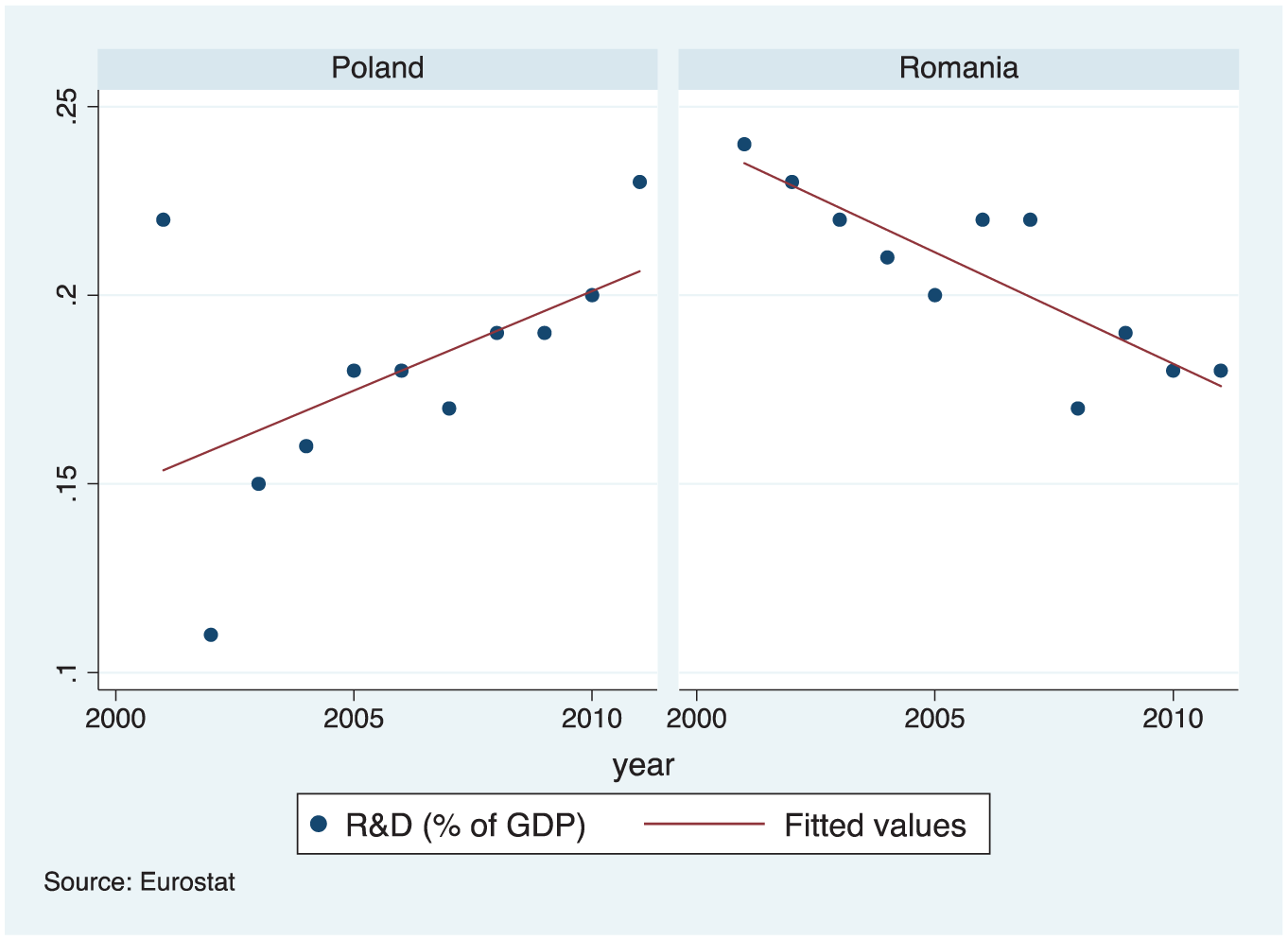
Research and Development (R&D) as Percentage of GDP in Romania and Poland
One intriguing question emerges: What processes led to this divergence in economic sophistication? We trace the process that links the supply of skills to the economic sophistication of an economy and enquire what role governments and political parties therein have played in the process. Education and training are a sine qua non condition in order for people to be able to engage in R&D-intensive activities. Moreover, expenditure for R&D activities are in part financed by governments. Increasing the supply of sophisticated skills is one way through which the government can contribute towards more R&D-intensive activities taking place domestically, which is unquestionably a concern for policy makers around the world. 10
But the sophistication level of economic activities results from the interaction of a series of factors. For exploring this, we first consider the stakeholders that can influence the upgrading of skills supply and of the sophistication of domestic economic activities. We show why firms active domestically are less likely to be the leading actors in the upgrading process. 11 We move on to explain how other actors, such as chambers of commerce and higher education institutions, can pursue higher value-added activities, but they tend not to get involved in such activities in the dependent market economies (DME) of CEE. 12 Their role in shaping the supply of skills in both countries has been limited as well. We proceed and suggest that political parties in government have played a facilitator role in economic upgrading by strategically influencing the supply of sophisticated skills. Moreover, parties that have been active in steering the skill supply have tended to be catering to the advanced sectors of the economy, placed to the economic right of the political spectrum in the post-communist context. 13 This finding is surprising particularly because political parties have been almost absent from political economy scholarship focusing on the region. The next section presents the methodology followed by the theoretical contribution in the third part. The fourth part presents the empirics contrasting the cases of Poland and Romania, before concluding.
Research Puzzle and Methodological Approach
We are interested in the process through which political parties steered the supply of skills in these economies. The official supply of skills is closely linked to government regulation in the field of higher education, but we highlight that skills are influenced from two directions: through the government investing in these skills, that is, regulating the skills supply, but also through the influence of other institutions, such as firms and associations of firms, that invest in the skills needed by their employees.
Methodologically, we engage in a most-similar-cases design 14 to the extent possible in an observational study. From a formal perspective, the political systems of Poland and Romania are largely similar: their bicameral parliaments are elected simultaneously, the president is directly elected. The behavioral role assumed by parties should determine policy differences, while the formal set-up of the political system should not mediate outcomes any different. Despite important institutional similarities in the two political economies, governments have played different roles in incentivizing the R&D intensity of economic activities. We trace how political parties in government regulate the production of skills while acknowledging that it would be incomplete to consider the supply of skills irrespective of demand stemming from employers.
Poland and Romania started the transition to a market economy with a large industrial sector and a strong reliance on heavy industry. 15 Foreign Direct Investment (FDI) flows have increased spectacularly and multinational companies have come to dominate investments and to be essential employers in the private sector. 16 This has led researchers to characterize them as DMEs. 17 In such economies dominated by FDI, the incentives of individuals and businesses to invest in skills tend to be complementary. This equilibrium is established and maintained by the interaction of key institutions in this political economy, including universities.
Many factors need to be corroborated in order for economic sophistication to increase. As a matter of fact, Rodrik identifies three key determinants of economic growth: geography, integration, and institutions. 18 Geography and integration are largely similar in the two countries. Integration refers to market size and to the possibility to participate in international trade. We acknowledge some inherent differences between these political economies. Historically, Poland has had a stronger legacy of industrialization than Romania even though both countries had a large agricultural sector at the beginning of transition. At the same time, the geographic proximity to the high-skills economies of Germany or the Czech Republic could have facilitated the process of economic sophistication and upgrading in Poland. Nonetheless, this rather small difference in geographical position becomes negligible for the services sector, where higher-value-added activities tend to concentrate. In the services sector, the duration and frequency of flights should be considered the geographical difference rather than the absolute distance between two cities. We therefore contend that for the purposes of our comparison, the geographical position of Romania and Poland versus advanced industrialized countries is almost identical. We thus expect differences in institutions to explain the diverging outcomes in economic sophistication because they have been shown to be truly causal for economic growth. 19
Our analysis starts with the institutions hypothesized to have the most influence on the sophistication level of economic activities. We show step by step why several of them have not mattered in improving the economic sophistication of the dependent market economies of Poland and Romania. We find that governments can change incentives of essential institutions to invest in high skills even though the process is not straightforward. We note that preferences and incentives of political parties and multinational companies (MNCs) tend to be implicit. When political parties respond to their constituency in pursuing a policy, they are likely to present the policy as universally beneficial for the entire electorate. Therefore, liberal political parties on the economic right are not expected to argue that some voters need to pay higher taxes that will be used for investments in education that will attract foreign companies to the country. Similarly, national-conservative political parties will not publicly acknowledge that they will not endorse investments in higher education because they prefer direct cash transfers to the less well-off voters. Voters paying higher taxes will most likely not be the same as those benefitting from employment in these companies; hence, parties will present targeted reforms as strategic investments. Similarly, companies taking relocation decisions are expected to publicly present this as an investment for both the company and the destination country. MNCs are not expected to show public interest in lower-skill or low-research-intensive economies.
A good way to approximate the calculations of firms is to rely on data from sources that can reasonably be assumed to be available to these companies. This includes publicly available studies carried out by risk consulting or management consulting companies (such as PriceWaterhouseCoopers 20 or Roland Berger). Also, international organizations and international financial institutions produce publicly available studies. 21 Parties’ strategies are analyzed by looking at their enacted policies.
Theoretical Contribution and Existing Literature
Political economists have duly been interested to explain “how institutions evolve.” 22 Change taking place in established political economies in which institutions reinforce existing equilibria is surprising. In contrast, in Central and Eastern Europe, after 1989 institutions have been redesigned with unprecedented force and scope, which makes the explanation of change appear superfluous. The fall of the communist regimes in the region meant that a multitude of paths became available. 23 This critical juncture meant that, almost ironically, political parties in government continued to play a similarly decisive role as they did during the planned economy. 24 The major difference was now determined by how parties decided to use this role. Differences between Romania and Poland have begun during these early years despite similar starting points in 1989. Broad trajectories of economic coordination were established at the beginning of the 1990s at the same time as MNCs started to enter these economies. The skills supply needs to be understood in this context.
However, the changes taking place in CEE cannot all be drawn back to the general liberalization of these markets combined with the inherited communist legacy. The variation in the sophistication level of economic activities reached by 2015 cannot be fully explained by the liberalization processes—largely similar—nor by the different starting points in the transition, as the trends in sophistication have diverged quite remarkably starting with the 1990s. Firms have been shown to be the drivers of institutional change in advanced political economies, such as France. 25 However, this argument has less explanatory power if large firms do not have strong ties to the domestic economy, as has been shown to be the case in CEE. 26 These economies have increasingly become entrenched in the global economy and they have come to be dominated by MNCs as employers in productive services and as sources of capital. 27
It is in this context that scholarly engagement with R&D in the post-communist market economies has been rather limited (but for the valuable output of Radosevic). 28 We depart in our analysis from literature that argues that the demand for low skills of firms active domestically determine a low quality of instruction and research in higher education. 29 The demand for sophisticated labour tends to be relatively low in both private and public firms that are domestically and foreign-owned. However, the large, more productive, firms tend to be MNCs. 30 Given that MNCs active in CEE tend to demand unsophisticated skills, students enrolled in university do not have incentives to invest in acquiring difficult-to-get skills. By having these two sets of actors - MNCs and students - following their interests, the outcome is a low-skills equilibrium where relatively low-value-added activities are carried out by a relatively low-skilled labour force. 31 These equilibria are self-perpetuating because “once established, patterns of political mobilizations, the institutional rules of the game, and even citizens’ basic ways of thinking about the political world will often generate self-reinforcing dynamics.” 32
Strong complementarities have emerged between institutions involved in the production of goods and services that are unlikely to be disrupted by private companies. We therefore turn to the role of political parties. Limited research so far has disentangled the influence of political parties in fostering the change of these institutions. Against the generally accepted perception of a laissez-faire ideology and a general liberalization of these markets, the role of political parties in government responding or targeting a specific constituency when deciding on policies, has been documented sporadically. 33 Frye focuses on the importance of polarization of the political systems in the entire post-communist space in Europe and Asia, arguing that the more polarized a political system is, the less likely market-oriented reforms leading to economic growth are expected to be. 34 Paul Lewis analyses the important link of the institutionalization of the party system to democratization. 35 Grzymala-Busse explains that in contexts in which one party dominates the political competition, this allows the party to extract resources from state firms or privatization deals. 36 This leads to a larger and weaker state in which political parties use the state as a source of private rents. This has not been the case in Poland, Grzymala-Busse argues, because several parties contested (and won) elections after 1989. 37 This has been different in Romania, where the political system has been dominated by the former communist party, the Social Democratic Party (PDSR). We further trace whether political parties representing different interests on different ends of the economic left-right spectrum 38 can be linked to an increase in the sophistication of economic activities.
Moving from Low- to High-Skills Equilibria
The process by which economic actors—firms and workers—move from low- to relatively high-value added activities in global value chains is referred to as economic upgrading. 39 Poland and Romania have adopted an export-oriented model of development and became part of existing global value chains in the process of transformation into market economies. Rather than building supply chains from scratch, these countries joined existing ones. Within-industry differences are increasingly relevant in this process given that firms active in the same industry can require different levels of skills, depending on which part of the supply chain they become active in. 40 Hence, the supply of skills in the economy becomes crucial in such circumstances, determining how high up the supply chain can be joined. The more sophisticated the skills made available by the government, the higher up the supply chain can be joined. Also, the strongest link in the supply chain tends to determine the level of sophistication of the entire economy. The strongest link has tended to be represented by MNCs in both Poland and Romania, which points towards the high level of interconnection of these economies with the global economy. Moreover, these countries have been characterized as DMEs, used largely as assembly platforms by MNCs. Hence, the demand of skill sophistication for such activities has been relatively low. Ultimately, when these countries joined these global value chains, MNCs have usually intermediated the process.
Furthermore, international organizations have also played a role. The processes through which they have influenced domestic developments, also pertaining to the sophistication level of activities, have been complex. This was attempted by international organizations attaching conditions to funding or by imposing membership conditions; the World Bank or the International Monetary Fund have played such roles. 41 More pro-actively, the European Union (EU) has been an instrumental actor in upgrading processes in CEE. The EU has provided a plausible institutional model and this has been critical for the success of some Eastern European countries, such as Hungary, the Czech Republic, and Poland. 42 Bruszt and McDermott explain how the European Union has been essential in the reform of specific industries, especially the agricultural sector and the related food industry. 43 In the same vein, Dobbins focuses on the positive effects of Europeanization in higher education. 44 These international institutions, particularly the EU, can directly influence the supply of skills by imposing conditions on how many university degrees should be offered. Nevertheless, it is not clear why the European Union should have a stronger influence on the sophistication level of some member countries but less on others. We contend that this international influence has been mediated by domestic factors, which has made European policies more effective in some countries than in others. Supportive of this argument, Vachudova acknowledges that political parties only respond to EU requirements as long as this does not affect the domestic sources of their power. 45
Another compelling explanation for why some countries have moved up in the global value chain focuses on distinct historical legacies that should have played out differently in the two countries. The structure of the communist economy was shown to be essential for outcomes. 46 McDermott provides a fine explanation of how the networks between firms continued to exist after the fall of communism and how these have co-determined change. 47 It should therefore not be surprising that outcomes in Poland and Romania have diverged during post-communism if these political economies have historically been different from one another. Nevertheless, these legacies need to be absorbed and translated into policies by political parties. Historical legacies on their own do not produce policy changes, actors with agency do. Political parties in government can be the actors transforming these historical legacies and they have done so particularly regarding the supply of higher education degrees. The empirics analysed further below reveal that Polish governments have used the historical advantage in aviation due to some targeted government policies and this has been the case in Romania as well, but to a very limited extent.
In this picture of overall low equilibrium in the region, the sophistication level of the Polish economy has increased. We analyze through process-tracing how political parties have designed policies aimed at allowing firms to upgrade the level of sophistication of economic activities conducted locally and what role the supply of skills has played in the process. Some Polish governments have helped smooth the transition from education to the labour market, thus incentivizing the different actors to invest in higher skills and activities. We find that these governments have actively contributed to shaping policies conducive to more sophisticated activities, which was largely not the case in Romania. Understanding the processes through which some economies move from vicious to virtuous cycles, that is, increase their level of sophistication defined as percentage of R&D in economic activities, provides scholars with the opportunity to explain institutional change.
Empirical Analysis. The Supply of Skills in Romania and Poland
Romania
Historical start of marketization
The role of the Romanian government in facilitating cooperation between HE institutions and MNCs has been limited after 1990. In the beginning of the transition, the first government in power, the successor of the communist party (PDSR), was a promoter of a more autarkic developmental strategy. Indeed, Romania’s transition to a market economy was more troubled than Poland’s despite having started the transition with no foreign debt and with budget surpluses. 48 However, while radical reforms were pursued in Poland at the beginning of the transition, 49 this path was not taken in Romania. This meant privatization of state-owned companies or their modernization started later, only once the liberal centre–right alliance, Cheia, succeeded to power in 1996. This had a strong influence on the institutionalization of the market economy and on the supply of skills in the country.
Once having opened up to FDI, the government has done so unselectively. Generous direct transfers were made to citizens and to state-owned enterprises in the first years of transition to generate electoral support by the national-conservative party, the Social-Democratic Party (PDSR). 50 This allowed governments to eschew longer-term oriented policies, such as higher spending on education along with an increased supply of university-level skills. This lack of support for the creation of human capital is captured by the level of spending on higher education. This has sustained the decreasing level of sophistication of economic activities taking place domestically.
These early policies marked differences between Romania and Poland going further. Microeconomic restructuring measures, such as the reforms of state-owned enterprises, only started after 1997. Such restructuring measures were not popular with large shares of the electorate, mostly dependent on state employment. The benefits of these reforms were not felt immediately, which also led to the defeat of the party conducting these reforms, the centre–right alliance, CDR, after the 2000 elections. The centre–right alliance left office after four years. The result was that the social-democratic party, PDSR, was in power for eleven of the first fifteen years of transition. Another aspect that made reforms more difficult than in Poland was that stakeholders in the reform process learnt how to fight their interests once having understood the rules of the game. 51 Thus, an opportunity for radical reform immediately after the fall of communism was lost. We further consider the institutions involved in the skill formation process able to change the incentives of actors to invest in higher value-added activities.
Multinational Companies and Foreign Chambers of Commerce
Chambers of commerce are important stakeholders in the process. These have lobbied successive laissez-faire governments in Romania in order to keep the existing framework or to ameliorate it marginally. The American and the German chambers of commerce have been active in lobbying the government for various facilities. However, their aim has not been to invest in human capital or in skills that would allow people to engage in more sophisticated activities. The American Chamber of Commerce expected “a stable, predictable, legislative and fiscal framework, coherent public policies, transparency in the decision-making process, clear country and sector strategies.” 52 These expectations are unsurprising, but do not imply an upskilling of the population. If governments solely satisfy these criteria, this is unlikely to lead to an increase in the sophistication level of economic activities carried out domestically. Indeed, a survey conducted in 2013 in Romania shows that less than half of the CEOs see innovation in services and products as an opportunity to grow. 53 This speaks to the different strategies of growth MNCs have in Romania compared to Poland, as shown further below. Cost reduction, rather than a move up the value chain, has been considered the main method of restructuring here. Businesses do not expect the government to invest in providing a highly skilled workforce. This is not surprising given the high self-selection of businesses with an interest in activities other than R&D: Only 35 percent of CEOs in Romania believe that creating a highly skilled workforce should be one of the top three priorities of the government. This is lower than in other countries of the region. “Only 12% of CEOs in Romania believe that developing an ecosystem of innovation fostering growth should be a Government priority.” 54 This shows that MNCs are unlikely to incentivize governments to supply sophisticated skills, such as those needed for research and development.
But MNCs are the lead firms in most economic sectors, and they tend to be the most productive private employers in the region. 55 However, few MNCs have developed strong ties locally. The ability of these companies to easily move in and out of the destination economy provides an indication of this rather weak tie of MNCs to the Romanian economy. A service centre of the ING bank located in Cluj has moved to Hungary in 2012. Closing the service sector took place “amid economic and legislative changes in recent years, that have considerably reduced its medium-term planned efficiency.” 56 In manufacturing, Coca-Cola, Nestle and Kraft have relocated to Bulgaria. 57 The decision to relocate is therefore not unlikely for MNCs, and therefore their incentives to invest in skills are rather limited. Despite moving abroad, some companies stay close to the border in order to be able to place products there. If a government in a DME restricts its activity to responding to the existing skills demand of companies, this demand is unlikely to emerge. Therefore, the incentives for upgrading the skills supply are unlikely to stem from these institutions.
Governments facilitating cooperation
The Romanian political scene has been dominated by one main party since the fall of communism, the Social Democratic Party, which has essentially remained in power after the communist regime collapsed. 58 The state was more freely politicized, 59 which has made some authors talk about state capture. 60 An alternation in power took place in 1996 and again in 2004, when centre–right governments came to power.
Equally, governments headed by the social-democratic party have not interfered in order to change incentives of key institutions to invest in sophisticated activities. Governments headed by the liberal parties took some specific steps aimed at mediating skill formation, but the policies were not consistent throughout, as shown further below. Some options were available, such as attracting FDI selectively. Governments usually delegate this role to an agency for foreign investment. However, the formal institutional framework put in place by the social democratic government for promoting foreign investment after 2000 was fragile. A Romanian agency for the promotion of foreign investment (Agentia Romana pentru Investitii Straine ARIS) stopped working in 2009 after having been put in place in 2002. This agency was headed by several managers unknown to the business environment. 61 This happened under the centre–right government headed by prime minister Emil Boc. Political parties on the left and on the right had an ambivalent relationship with the business environment and their effect on promoting higher value-added activities was severely limited. Thus, the marginal role that could have been played by political parties was rather negligible.
Nevertheless, there has been scope for cooperation between MNCs and HE institutions initiated by center-right parties at the local level. Local authorities incentivized universities to cooperate with multinational companies. In Sibiu, the engineering department of the university Lucian Blaga cooperates with the tire company Continental in order to train engineers that would work at Continental. 62 Such an example emphasizes how investments in higher value-added activities in a MNC require at least some cooperation of the government with the university to train the needed employees. Hence, the supply of skills has to be assured locally. Nonetheless, such cooperation has been only sporadically mediated in Romania. Such cooperation has taken place in here too, which has led to an increase in economic sophistication at a rather small scale. This gives us the opportunity to observe the counterfactual to non-cooperation of the government with universities and MNCs. Similar small-scale cooperation has taken place elsewhere in the country, in Cluj-Napoca or in Bucharest, where the government has facilitated cooperation. 63 But these instances have not been generalized over time and space in order to lead to an increase in research and development at country level.
We notice in the Romanian case that once all institutions follow their self-interest, this leads to a perpetuation of a low-skills equilibrium. If non-governmental institutions, lead firms (i.e., MNCs), citizens themselves, as well as the government, fulfil their short-term goals, this keeps a low equilibrium afloat, including the supply and demand for skills. This has led to a decrease in the sophistication level of the Romanian economy, measured as R&D, while the Polish economy has registered increases, supported by targeted government policies.
The Supply of Skills in Poland
Historical start of marketization
The low-skills equilibrium in Romania has been documented in the literature and it does not seem particularly surprising once the links between actors that keep this equilibrium afloat are understood. 64 But one question remained unsettled: Can such an equilibrium be broken? How has Poland, which inherited a relatively similar political-economic system, managed to escape this low-skills equilibrium? Poland has been the only EU country not to have fallen into recession during the global economic crisis that started in 2008. Moreover, foreign capital continued to flow into Poland despite the recession and the decreasing trend of inward FDI in the region. 65 Notwithstanding, the level of sophistication of goods and services produced in the two countries has diverged, which is captured by the R&D spending levels as a percentage of GDP by private and by public entities. Looking at Poland twenty-five years into the transition shows that historical path dependencies are not entirely deterministic.
Unlike in Romania, there has been political consensus regarding economic reform in the country immediately following the fall of communism. Polish political parties all supported the economic reform plan suggested by the IMF and the World Bank already at the beginning of transition. 66 The outcome of the critical juncture produced by the regime change was therefore different from that of Romania. Poland opened its economy early and it imposed harder budget constraints, which determined productivity gains. 67 The first post-communist governments had a more important role to play than subsequent ones. 68 The beginning of transition has been unquestionably relevant for the general path of this political economy because early draws in each trial have a powerful effect on the possible equilibria that will emerge. 69
Multinational companies and foreign chambers of commerce
We use the same design in our analysis as in the case of Romania and focus on the views of companies regarding Poland’s business environment. The perspective of businesses on the economy is important for their likelihood to incentivize employees to invest in skills, thus increasing the supply of skills in the economy. Equally, firms can also expect government support and investment in sophisticated activities.
Poland is equally strongly dependent on foreign capital. Eighty-three percent of the 212,000 people in services in Poland work in a foreign company according to a survey conducted by the Association of Business Service Leaders. 70 In 2016, companies considered the availability of highly skilled employees in Poland to be relatively satisfactory. Similarly, collaboration with local universities was also satisfactory, similar to the collaboration with local authorities. 71 This suggests that, similar to Romania, companies are also unlikely to have higher demands from Polish governments in terms of skills needed in research and development. Therefore, incentives for high skills do not stem from business associations or from MNCs here either. Foreign employers originating from the United States, the Nordic countries, France, the United Kingdom, and Germany dominate most Polish regions, including Krakow, Wroclaw, and Warsaw. Polish employers are more numerous in Lublin and Rzeszow, being prevalent particularly among IT companies.72,73
Governments facilitating cooperation
In Poland, political parties have been more closely monitored and regulated because no party has been able to monopolize the state. 74 One strategy adopted by the Polish government, the Democratic Left Alliance in 2003, was to incentivize the diversification of industrial production. Special economic zones were developed in 2003 aimed to attract foreign investment through tax incentives. Governments have fostered collaborations between businesses and universities. One such priority industry was the business services sector. The special economic zones provide tax incentives of between 25 and 50 percent. As a result, Poland has become the largest producer of LCD sets and household appliances in the EU. 75
Between 2007 and 2015, the Civic Platform—generally supported by former voters of the center-left Democratic Left Alliance and representative of the middle and upper middle classes—was in power. They also aimed to incentivize relevant actors to invest in more difficult-to-get skills. However, the mechanisms surrounding these developments have not always worked smoothly. Poland’s Civic Platform government, via its education ministry, decided to offer scholarships to students studying certain subjects, namely, hard sciences. The outcome was that some students enrolled in the first year for the purpose of receiving the scholarship and quit the programme after one year. Various mechanisms can be effective when governments mediate between HE institutions and MNCs, but intentions do not always yield the expected results. Our analysis reveals that if the government ensures the simultaneity of measures by at the same time incentivizing students, HE institutions, and firms, the chances of higher-value-added activities to emerge in the private sector are higher.
Indeed, the rise of the level of R&D in Poland has not been guaranteed during the transition years. Levels of R&D spending in 2000 were lower than in Romania. Moreover, a 2014 OECD report emphasizes the large disparities between the skilled and unskilled workers in the country, which provides a less black and white picture of the Polish political economy. Nonetheless, Polish governments have used two main paths for promoting R&D intensive activities: First, they have sought innovative companies by setting up special economic zones in the proximity of Warsaw and Krakow but also further east close to the Ukrainian border. Second, they have used foreign promotion agencies in order to attract companies working in sectors with higher levels of R&D.
As a consequence, some European banks have moved their back-office activities to Poland. 76 Firms active in the financial industry in Wroclaw and Krakow developed business solution centres, including areas in IT and HR. 77 Wroclaw Agglomeration Development Agency has been supporting both investments and tailored education programs in the Wroclaw area. 78 Similarly, the aviation industry is advertised by the Polish investment agency to be strongly connected to the global industry and as one of the most innovative industries in the economy. 79 Polish companies seem to be active higher up in the value chain of this industry. The aviation valley, close to the Ukrainian and Romanian border, has attracted several companies, among which are Hamilton Sundstrand and Hispano-Suiza. 80 Successive governments have supported the aviation industry. The National Centre for Research and Development (NCBIR) invested €75 million between 2013 and 2017 in scientific research and in knowledge transfer to the aviation industry. The centre provides funding from both Polish sources as well as European Union funding. 81 The European Union can thus provide institutional and financial support for such measures. However, EU funding needs to be obtained by the national government and managed through government agencies. EU funding thus work similarly to historical legacies that need the agency of a government to work.
The Polish aviation industry builds on pre-existing advantages; the military has been the major historical driver of the industry. However, once the shift to a market economy was made, existing skills and existing production facilities became obsolete for the new requirements. Civic Platform right-oriented government simultaneously attracted capital and supplied relevant skills. The university in Rzeszow offers degrees producing skills needed by the companies settling in the aviation valley. 82 In order for such a centre to be effective, several institutions need to cooperate. The government intervened by setting up the special economic zone and by providing university degrees in demand in the area. It is in this context that increasing expenditures on R&D need to be understood. They participate in international projects aimed at developing their human potential in research clusters. 83 The Kraków Technology Park was also designated as a special economic zone with a lower tax regime. Many companies are active here, including Amway, Google, IBM, Lufthansa, and Tesco. 84
Nevertheless, the special economic zones are not uncontroversial in Poland’s politics. The Razem (together) Party, established in 2015 by young radical left-oriented members, is indicative of this. They critique the special economic zones for benefitting from state-funded subsidies and tax reliefs. 85 This hints towards the legitimate and complex electoral question that governments supportive of such upgrading support need to respond to. It shows that governments tend to get involved in such activities in order to respond to their constituencies, though at the same time, they lose other potential voters. Such intervention of the government in the economy will partially influence its likeliness to be re-elected. The Civic Platform was replaced in power by the Law and Justice Party (PiS) in 2015. Some legislative changes following this shift have been controversial, 86 but the special economic zones have not been affected.
This analysis shows how governments can facilitate cooperation in order to steer the supply of university-level skills. Governments responding to voters potentially benefitting from employment in the advanced sectors of the economy have made the first move by providing human capital and tax incentives. MNCs decided to engage in sophisticated activities only once a well-trained labour force existed in the economy that would sustain production activities. But governments needed to provide human capital in the first place because firms were less likely to invest otherwise given their short- and medium-term goal orientation. Similarly to Romania, institutional change in skill formation is unlikely to be shaped by firms alone.
Conclusion
Political parties in government after the fall of communism have designed the new political-economic institutions of the region. They continue to regulate policies and to influence the skill supply through higher education institutions. However, scholarly engagement aimed at explaining the variation in governments’ role in such public policies in the post-communist democracies has been surprisingly narrow. This article aims to fill this gap by explaining the link of political parties to the skills supply and to economic governance in the post-communist context.
We explain institutional change in skill formation by showing how governments have mediated relationships between employers and employees. While doing so, we zoomed in on three strategies of governments that have been associated with an increase in the level of economic sophistication: bargaining with MNCs, incentivizing students to invest in skills relevant for upgrading and creating HE degrees relevant for the specific needs of companies. We highlighted how these policies have allowed firms active in the two countries to become part of value chains at different levels of economic sophistication.
Moreover, political parties in government that have acted as mediators between institutions of skill formation leading to the pursuit of higher-value-added activities have tended to respond to different constituencies than parties that have not been active in this role. Political parties catering to voters employable in the advanced sectors of the economy, such as the Civic Platform in Poland, have been designing policies that increased the supply of sophisticated skills. Parties catering to voters that have not capitalized on the new economic conditions in the market economy, such as the Social Democratic Party in Romania, have been less active in this role. Thus, the space for manoeuvre of the government in the area of skill formation has been exploited differently by parties, and this can be linked back to the constituencies of these parties.
The article acknowledged the interdependencies between firms and institutions of skill formation. Strong institutional complementarities are conducive to low equilibria—low skills and low sophistication. Therefore, many factors need to be corroborated in order for economic activities to move from low- to higher-skills equilibria, and governments can be instrumental in this process. They can provide incentives toward coordination at higher levels of instruction and production.
As these countries become more engaged in developing higher-value-added services, competition for FDI between the governments of CEE will become even more acute. This may pose even more challenges to the countries that are now trapped in low-skills equilibria.
Footnotes
Acknowledgements
The author would like to thank David Soskice, Gwen Sasse and Bob Hancke for comments on previous versions of this paper as well as two anonymous reviewers. All errors remain mine.
