



Abstract
This article discusses metaphor and irony as discursive strategies employed by the Lithuanian media while construing the imagery of crime, criminal, and criminality. The method applied to analyse metaphor and irony in Lithuanian criminological discourse combines the framework offered by conceptual metaphor theory with corpus linguistics. First of all, metaphorical and ironical expressions were inventoried, and then conceptual paradigms were reconstructed from them. The conceptual-level analysis revealed that the relations between the conceptual domains of metaphor and irony are processed by different types of mapping (similarity [metaphor] vs. dissimilarity [irony]). Despite differences in the processing of cross-domain mapping, metaphor and irony realised in public criminological discourse carry out the same or very similar rhetorical and social functions. The main function of these discursive strategies is the vivid expression of emotional attitudes and values directed at the criminal—the text adresser evaluates the criminal and crime negatively, dissociates from the offender, and isolates him symbolically from our community. In this way, the contemporary Lithuanian media constructs and shapes the community’s approach to particular social phenomena—crime, criminal, and criminality.
Introduction
Cognitive linguistics studies and their results of the past few decades have proved that certain rhetorical figures of speech, first of all metaphor, are not only decorative textual elements but also discursive strategies, the expression and function of which are closely related to a particular ideology of discourse. Therefore, one of the linguistic discourse analysis techniques is a thorough study of rhetorical tools used in discourse. The article analyses two of the most common rhetorical tools, metaphor and irony, in contemporary Lithuanian public criminological discourse.
Before turning to the specific analysis and its results, it is necessary to discuss briefly the nature of public criminological discourse, to what extent its rhetoric has been analysed, how the research material was selected, and what are the objectives and objects of this research.
According to criminologist Aleksandras Dobryninas, a certain criminological discourse appears when crimes, criminals and problems related to criminality are the subject of discussion, texts or reports. 1 Linguist Rūta Marcinkevičienė notes that any discourse is embodied in texts. 2 Based on the statements of these two scholars, public criminological discourse is defined in this article as written, oral, or visual texts about criminals and their crimes, as well as the problems caused by criminality, addressed to Lithuanian residents. It should be noted that these texts, the vast majority of which are criminal news reports, are not static; they are a part of the active communicative process of the community (the texts are extensively commented online, they are discussed, etc.), 3 and the media is ranked as one of the main institutions creating or diffusing public criminological discourse.
Every country’s legal system has a clear definition of crime as a legal concept, and legislation sets out the types of crime and the penalties for criminals. However, at the same time each speech community has a specific concept of crime and the criminal, which can be seen as public opinion about this specific social phenomenon. Although there is no doubt that our perception, imagination, and evaluation of crime and the criminal are primarily determined by the specific moral and emotional atttitudes and the set of values in a certain community and by our individual experiences, our understanding of offences today is very much influenced by their representation in the media. The professor of penal politics Mick Ryan created an almost undeniable axiom when he stated that most of us are fortunately not routinely the victims of crime, especially serious crimes, and so much of what we know about such crimes comes from the media. 4 This statement can be expanded as follows: most of us are not victims of serious crimes, and we are not criminals or other participants in the criminal justice process; therefore our perception, imagination, and even experience of such a social issue as crime are mainly determined by the representation of this phenomenon in the media. 5 Moreover, the psycholinguistic experiments of Paul Thibodeau, James L. McClelland, and Lera Boroditsky prove that the description of a criminogenic situation, its presentation, and the choice of rhetorical tools in the media influence not only the attitude of the addressee of the message but also how he sees the solution to the situation. 6
It follows that after determining what concepts of crime and criminal the media generates, it would be possible to ascertain the nature of public opinion about crime in a certain speech community.
It is also relevant to determine what outlook on crime the media broadcasts by analysing this discourse from an interdisciplinary perspective with certain pragmatic objectives, because the rhetoric of the discourse influences certain social processes. At first, for example, successful realisation of programmes for the probation and reintegration of offenders and effectiveness of alternative responses to crime such as Restorative Justice depend partly on existing public opinion; secondly, this opinion helps to foresee if the society will approve the ideas of penal populism; 7 and thirdly, public opinion tendencies definitely affect the attitude of the penal-policy politicians and professionals, and influence their decisions, for example, in shaping penal politics trends. In this case, it is possible to say that public opinion, punitivism, and the media may mesh together. 8
The research material for this article is limited to written texts from the archives of three Lithuanian online media portals: delfi.lt, lrytas.lt, and kauno.diena.lt. A total of 877 articles were gathered from the Internet, and a corpus of 441 581 words was built for discourse analysis purposes. In order to reflect the specifics of contemporary Lithuanian public criminological discourse, the research corpus was created according to four main selection criteria for the articles: chronological, origin of texts, genre, and theme. Original Lithuanian crime-related information texts by journalists published in the years 2001–2015 were chosen for the research, the main theme of which was serious offences implemented by criminals in Lithuania or by criminals from Lithuania, or crime victims from Lithuania. These articles are most often published in the criminal newsroom of the media.
The year 2014 saw the publication of a dictionary of conceptual metaphors in Lithuanian public discourse, 9 in which conceptual metaphors were codified and the inventory of metaphor expressions that actualise them from four areas of public discourse was completed (in other words, from four metaphor target domains)—politics, economics, health, and sports. Since the aforementioned vocabulary does not include metaphors appearing in public criminological discourse, in this field the present article seeks to fill this gap in Lithuanian public discourse research.
The purpose of this article is to collect metaphorical and ironic expressions from the texts of contemporary Lithuanian public criminological discourse, to indicate their source domains and reconstruct the prevailing conceptual models, and determine their main functions in discourse. The focus of this linguistic discourse analysis is thus metaphorical and ironic expressions in the target domain of criminal, crime, and criminality concepts.
The theoretical framework of this research is offered by conceptual metaphor theory as structured in cognitive linguistics. The origins of conceptual metaphor research, which has been employed for several decades, was the publication of George Lakoff and Mark Johnson’s Metaphors We Live By (1980). One of its fundamental theses was that metaphor is not just a matter of language, that is, of mere words. On the contrary, human thought processes are largely metaphorical. 10 The metaphor can be understood as mapping from a source domain to a target domain; 11 thus metaphors allow us to understand one thing in terms of another. Since its inception, metaphor research has become a fast-growing research field, expanding at the same time in many directions, and the variety of proposed research methods, perspectives, research material, and tested concepts is growing. In the context of this article, it is important that in recent decades of metaphor research, attention has been paid to the role of conceptual metaphor in social life and social politics. Nowadays, in order to analyse the metaphoric structurisation of social categories, the language of the media is often used, for two major reasons: one, its relative availability, and two, its significant influence on public discourse. In addition, according to Malgorzata Fabiszak, social consensus on the conceptualisation of social institutions is negotiated and achieved through the media. 12
Significantly, it was not only linguists but also by lawyers, criminologists, and sociologists who first noticed and investigated the functioning of metaphor and its role in criminological discourse, making it possible to investigate the rhetoric not only of public discourse but also the discourse of penal policy professionals. Sarah Armstrong, for example, a researcher of penal policy working with the metaphor specialist Alice Deignan, investigated the metaphors used in the corpus of criminal justice policy documents and Scottish penal policy documents. 13 George L. Kelling, a professor of criminal justice who examined unsuccessful investigations of a series of rapes in an area of Buffalo, New York, in 1991, has argued that the police work in this particular case ended in failure because the criminal justice system in the USA is metaphorically understood as a thin blue line. According to Kelling, the power of metaphor to shape public policy reaches its peak when a metaphor becomes a linguistic habit. When metaphors lose their capacity to attract attention, they become an intellectual trap. The example examined and described by him clearly showed that conventional, dead metaphors, through which we are aware of our social reality and experience, may influence our actions and behaviour even if we do not realise it, and the influence of these metaphors may not be limited to the positive. 14
Though researchers do not pay as much attention to irony as to metaphor, especially as regards irony in criminological discourse, in recent decades a number of significant studies have nevertheless been carried out, the results of which are also relevant to this research. By the end of the twentieth century, it was concluded that the definitions of irony proposed by classical rhetoricians—that the meaning of ironic expression is opposite to its literal meaning, and that irony is antiphrasis or semantic inversion—show that some types of verbal irony can be defined in this way but that these definitions fail to explain the multifaceted phenomenon of irony. 15 Both irony and metaphor were investigated using new approaches. According to Linda Hutcheon, irony is not a limited rhetorical trope or an extended attitude to life; it is a discursive strategy operating at the level of language (verbal) or form (musical, visual, or textual). 16 Certain modern approaches to verbal irony have been developed. The supporters of the echoing theory (Deirdre Wilson, Dan Sperber, et al.) argue that verbal irony is a variety of echoic interpretation, when the speakers echo thoughts they attribute to someone else, while dissociating themselves from them with anything from mild ridicule to savage scorn. 17 Other researchers (Herbert H. Clark, Richard J. Gerrig, et al.) placed great significance on the psychological aspect of irony as a communicative act and assert that speaker and audience pretend to support the direct level of this act; this is the so-called pretense theory of irony. 18 Looking at irony from a pragmatic and semantic perspective, researchers (Rachel Giora and Ofer Fein) proposed the graded salience hypothesis. In this hypothesis, the factor relevant to comprehension is not literality (or nonliterality) but the degree of salience of the utterance processed. Salience admits degrees. Factors affecting a degree of salience are, for example, conventionality, frequency, familiarity, or prototypicality. 19 Other researchers (Laura Alba-Juez, Salvatore Attardo, et al.) 20 highlight axiological aspects of irony and argue that evaluation is one of the intended meanings of speakers when using verbal irony. 21
In this article, conceptual metaphor is treated at the same time as an object of discourse analysis and in a sense as a tool of this analysis, because the same framework offered by conceptual metaphor theory in this article is applied to identify and describe not only conceptual metaphor models, but also irony models. Although conceptual metaphor theory is most usually applied for the investigation of metaphor, the author of this article argues that this theory could be adapted to describe the mechanism of irony, especially since there are already examples of such research—Dovilė Vengalienė in her thesis and articles has analysed the irony of Lithuanian and American online news headlines, relying on the conceptual blending theory, one of the branches of conceptual metaphor theory. 22
One of the fundamental theses of conceptual metaphor theory, on which this article is also based, is that conceptual metaphors are realised by linguistic metaphors (or metaphorical expressions). Alice Deignan, in her contemporary studies of metaphor, identified a clear distinction between two approaches depending on where and how the metaphor researchers receive the linguistic data and on the methodology they apply: (1) the discourse approach and (2) cognitive and psycholinguistic approaches. 23 A number of metaphor researchers in the cognitive tradition have used intuitively generated data: unsourced data elicited from informants or invented texts. In this way, the researchers’ aims are to gather information about thought rather than about language. 24 Researchers in the discourse-approach tradition use corpus methodology and natural discourses. This article is based on the latter methodological perspective, and in terms of direction this analysis may be called a bottom–up approach. While investigating metaphorical and ironic expressions, quantitative and qualitative analysis were used equally.
Metaphorical Conceptualisation of Criminal, Crime, and Criminality
The conceptual metaphors reconstructed from the metaphorical expressions gathered from the research material differ by level of generality; therefore, in this article the most generalised conceptual metaphors, that is, certain broad, umbrella metaphors subsuming several other related conceptual metaphors, are called metaphorical conceptual models. It was found that during the research period a large part of the conceptual metaphors characterising a criminal and a crime belonged to four additional predominant umbrella conceptual models: A CRIMINAL IS NOT A HUMAN BEING, CRIME IS AN INHUMAN ACT and CRIME IS A SPECIFIC PROFESSION RELATED TO TAKING LIFE, CRIME IS A DUTY.
A Criminal Is Not a Human Being and Crime Is an Inhuman Act
a) A CRIMINAL IS AN ANIMAL, CRIME IS THE SATISFACTION OF PHYSIOLOGICAL NEEDS. Violent and sexual offenders are most often described in the research material as predatory, sometimes even rabid
(1) Iš mokyklos grįžtančios mergaitės užpuolikas tąkart
“The assailant
(2) Trys jaunuoliai taksistą darkė
“Three youngsters tortured a taxi driver
Persons belonging to organised crime groups engaged in smuggling, drug trafficking, theft, etc. are most often referred to as
(3) Tačiau šie atvykėliai iš Lietuvos buvo tik
“However, these newcomers from Lithuania were just
(4) Teisininkų teigimu, Lietuvoje įkliūva
“According to lawyers, only
b) A CRIMINAL IS A SUPERNATURAL BEING, CRIME IS AN ABNORMAL ACT. In Lithuanian media, serious offenders are metaphorically called monstrosity (Lith. išsigimėlis), spectre (Lith. pabaisa), and monster (Lith. monstras), and often (but not in all cases) the crime or one of the crimes they have committed is a sexual offense, for example,
(4) R. Zamolskio istorija: simpatiškas paauglys virto
“R. Zamolski’s story: A lovely teenager turned into a
(5) Žmogus ėjo pasivaikščioti prie upės, sutiko tris
“A man went for a walk by the river where he met three
It is an old routine to call a criminal a monstrosity (išsigimėlis) and spectre (pabaisa); in the Lithuanian speech community these metaphors were used in Soviet public criminological discourse as well, although the metaphor of monster (monstras) has become common only in the last decade, probably because of the influence of English and French texts. It should be noted, however, that this is only a change in expression, an additional linguistic form with a meaning identical to išsigimėlis and pabaisa, for example,
(6) Dembavos
“The
Because it is difficult to find the appropriate translational metaphorical equivalents for išsigimėlis and pabaisa, the proof that these words in Lithuanian also name supernational or sub-human beings could lie in their meanings as indicated in the “Vocabulary of the Lithuanian language” [lkz.lt online].
2. spectre. For example: Ežere man pasirodžiusi 3. scarecrow. For example: Kad paukščiai rugių nelestų, stato pabaisas. So that birds do not peck the rye,
The metaphorical mapping between monstrosity, monster, etc. and a criminal who has committed a certain crime is motivated by the fact that for an ordinary person the act is uncharacteristic (therefore inhuman), abnormal, for example, perverted sexual desires, or the desire to kill an intimate person, which is hardly understandable, or inexplicable by logic, or committed for no reason at all.
In summary it can be said that in Lithuanian public criminological discourse, the conceptual metaphorical model A CRIMINAL IS NOT A HUMAN BEING reveals a deliberate action aimed at dehumanising the offender, because metaphorically his criminal intentions are treated as certain physiological needs characteristic of animals or as abnormal, perverted acts characteristic of monsters, but not inherent to man.
Criminality Is a Specific Profession Related to Taking Life and Crime Is a Duty
In Lithuanian public discourse, murderers or other criminals who commit serious crimes are metaphorically referred to as representatives of four professions—executioners (Lith. budeliai), butchers (Lith. skerdikai), hunters (Lith. medžiotojai), or fishermen (Lith. žvejai), 28 and their crime is seen as the performance of jobs and duties usual in these professions – execution (Lith. egzekucija), slaughter (Lith. skerdynės), hunting (Lith. medžioklė), and fishing (Lith. žvejyba).
a) A CRIMINAL IS AN EXECUTIONER and CRIME IS AN EXECUTION. This is one of the most productive conceptual metaphors found in the research material and belonging to the models discussed above. A criminal is most often called an executioner if his violent actions caused the victim much pain and suffering, and if these actions end in murder, which is not always the case, the crime committed is called an execution. Historically, the executioner held an office in medieval Western Europe, still found in those countries where the death penalty exists. Interestingly, the executioner’s direct task was to carry out the death penalty or punish the criminal physically, and in public criminological discourse the criminal performs this “job” of the executioner on an innocent victim; probably the motivation for this metaphorical mapping is the intention to emphasise the indifference of the criminal to the victim, to the pain of the other person, as if it were a routine job similar to an executioner’s duty, for example,
(7)
“
(8) Teisme pradėta nagrinėti
“The Court has started to examine the criminal case of Mantas Šerpenskas, who was called
b) A CRIMINAL IS A BUTCHER and CRIME IS SLAUGHTER. In Lithuania, the term “butcher” (Lith. skerdikai) designated the men who were called upon in a village if it was necessary to slaughter an animal, because it was psychologically difficult for a farmer who had grown up with the animal to do this himself. Later, in the Soviet period, people who worked in industrial slaughterhouses were also called butchers. In the research discourse, a criminal is metaphorically referred to as a butcher in two cases: (1) when the tool used for the crime (or one of tools) is a knife or an axe (probably because of the associative connection with “real” slaughter) and (2) when the criminal (or the criminals) commits more than one murder. The crime committed by such “butchers” is usually imagined as slaughter, for example,
(9) Taksistui galvą nupjovusį
“
(10) Panevėžyje po išgertuvių –
“
c) A CRIMINAL IS A HUNTER and CRIME IS HUNTING; A CRIMINAL IS A FISHERMAN and CRIME IS FISHING. Sometimes it is not absolutely clear from the metaphorical expressions whether they refer to the hunting of a criminal-beast, or a criminal-hunter. Still some hints (e.g., the use of traps, loops, arms) suggest that the metaphorical paradigm of criminal-hunter is quite rare in contemporary public criminological discourse. Since the paradigm of the criminal-fisherman is also quite rare, these two pairs of conceptual metaphors can be seen as being peripheral to the discourse metaphors studied here, for example,
(11) Klaipėdą gąsdina išgalvoti
“Klaipėda is frightened by fictional
(12) Būkite atidūs – tai gali būti
“Be careful—it may be
It should be added that the metaphoric paradigm A CRIMINAL IS A HUNTER reveals the abnormality, or unusualness of these hunters—they hunt humans, not animals (as in the above-mentioned example—they are human hunters, or hunters of human beings), there is no example in which the victim of such a hunter has any animalistic features.
To summarise, it can be said that the metaphor models CRIMINAL IS A SPECIFIC PROFESSION RELATED TO TAKING LIFE and CRIME IS A DUTY create a parallel between a criminal and a callous executioner, butcher, etc. who is simply carrying out his duty. They highlight criminal equanimity, indifference to the victim’s pain, inability to empathise, and in short an absolute lack of empathy on the part of the person committing the crime.
Metaphorical Concepts of CRIME and CRIMINALITY
Almost all conceptual criminal metaphors and part of the metaphors describing crime in the research material are already listed in this article—those understood as a regular part of the criminal metaphor logical chain; for example, a criminal is an executioner and his crime is an execution, etc. It is necessary to add, however, that not all crime metaphors indicated in this discourse are conceptually dependent, because some of them function as separate cognitive units.
After reviewing the collection of expressions describing crime metaphorically, at least three different perspectives on crime were identified: (1) when a criminal process is metaphorised, the execution of the crime is viewed from the point of view of a witness (as already mentioned: metaphors of hunting [when a criminal-beast hunts], execution, slaughter, hunting [when a criminal-hunter hunts], and fishing); (2) when the spreading effect of knowledge about a serious crime is metaphorised, the crime is imagined as an earthquake; (3) when a crime is metaphorised as being a fact, a recollection in the human past, in other words, as a mental compound in the human mind, then the crime is imagined as a heavy object. The two latter crime metaphors, which have not yet been discussed, are presented further in this article.
a) CRIME IS AN EARTHQUAKE. Although crime is nowhere bluntly identified as an earthquake, some predicative attributes assigned to crime in the texts reveal that such a conceptual metaphor functions in discourse: the ability to shock or shake a country, town, village, people, etc., for example,
(13) Nedidelę Mastaičių gyvenvietę <…>
“Small settlement of Mastaičiai <…> was
b) CRIME IS A HEAVY OBJECT. This conceptual metaphor structurises a crime as a heavy object which weighs heavily on the conscience, for example,
(14) Vienintelis likęs nusikaltimas, kuris slegia mano sąžinę ir sieja mane su praeitimi, yra nužudymas Maskvoje (LR 2008)
“The only crime left which
Having discussed the metaphors about criminals, it is still necessary to review briefly the closely related notion of criminality and its metaphorisation. Criminality is a compound of all crimes committed within a certain defined area in a certain period. Criminality, or the existence of crimes of some kind and their proliferation, is seen metaphorically in the research material as a contagious or very serious disease, and the conceptual metaphor CRIMINALITY IS A DISEASE is realised in this way, for example,
(15) Per paskutinį dešimtmetį prekyba žmonėmis pasiekė epidemijos mastą, o svarbiausia – nė viena valstybė neturi
“Over the past decade trafficking in human beings has reached epidemic proportions, and most importantly there are no countries
The statistics for metaphorical expressions describing criminal, crime and criminality in the research material show which conceptual metaphors are productive, and which can be seen as peripheral (Table 1).
Conceptual Metaphors and the Number of Expressions Realising Them

Ironic Conceptualisation of the Criminal and Crime
As mentioned previously, the methodology based on conceptual metaphor theory is applied in this article to describe ironic conceptual models. Therefore, according to this theory, one conceptual structure (target domain) is realised in discourse by starting from the vocabulary of another conceptual structure (source domain). This dyad of concepts, or conceptual model, reconstructed from specific expressions, is described by the equation “A is B.”
The comparison of conceptual metaphorical and ironic models in public criminological discourse reveals certain differences between the mechanisms of these rhetorical strategies. As regards metaphor, a ratio of similarity and analogy is highlighted between the target and the source domains, while in the case of irony the similarity expressed between the two domains is assumed or pretended, and is therefore ironic, because, according to the axiological aspect, the selected source and target domains do not have any similarity, and moreover the chosen concepts very often belong to opposite ends of the rating scale entrenched in our society. It can be said that the cross-domain mappings of irony are based on dissimilarity. Interpreting from the perspective of the pretense theory of irony, the ironist who asserts that criminals are heroes, nobles or eagles and the like pretends to believe that criminals are similar to heroes, but at the same time hopes the readers will recognise this pretense and decode the ironic meaning.
Irony in these texts is considered to exist when a word is used, but another or even opposite meaning of the word is understood and another non-literal meaning of the statement is created. The article is guided by the Hutcheon approach, namely, that ironic meaning is not simply the unsaid meaning, and the unsaid is not always a simple inversion or opposite of the said: it is always different—other than and more than the said. 29 Each ironic expression contains one or several clues giving signals or prompts to the addressee of the irony that the expression should be understood outside the direct meaning. Such tools for creating ironic meaning and its perceptual measures are usually designated as textual and contextual markers, 30 and in most cases for the author of this article they were factors differentiating ironical and metaphoric expression.
The following paragraphs present seven conceptual ironies identified in the research material and describing ironically either a criminal or his activity, that is, crime/crimes.
Crimes Are an Activity Dedicated to Public Benefit
This conceptual irony is apparent from the following expressions in which the criminals are named as heroes, their friends are brothers in arms, and their crimes are heroic deeds, acts of bravery, meritorious acts, etc., for example,
(16) Išžaginęs bendramokslę Visvaldas, tarsi norėdamas pasigirti šiuo savo
“Visvaldas raped the classmate and called to the room a friend who came together with him as if in order to boast of his ‘
The Commission of Crimes Is Honest Work
This ironic paradigm includes referring to a crime as honest work, and to the criminals as eager workers specialising in a particular field, being rewarded for their job or even making a career, for example,
(17) Varėnoje jaunų plėšikų
“The surprise ruined the young robbers’
Criminals Are Warriors
In the research material, criminals are sometimes ironically named as warriors, heroes, or veterans, belonging to a specific regiment with headquarters, and for example stolen goods are treated as war trophies. At first glance, it may seem that this conceptual paradigm should be considered as metaphor rather than irony, because it is based on external similarity (the structure of a criminal organisation is similar to that of an army, weapons are often used to achieve goals, etc.). However, the author of this article treats this paradigm as irony not on the basis of external or structural similarity, but on the basis of clear axiological dissimilarity seen in the wider context. The concept of the criminal has a constant negative connotation, whereas the army, its heroes, and veterans, are opposed to criminals in the sense of values, they are custodians and defenders of the country and its citizens; to serve in the army is honorable and is worthy of respect and admiration from the people.
(18) Kauno sporto halėje vykusio ringo <…> kovas stebėjo Kauno „daktarų” gaujos
“The fights in the ring <…> of Kaunas Sports Hall were watched by
Crimes Are Harmless Entertainment
These concepts include ironic expressions maintaining that a crime was only an adventure, harmless entertainment, for example,
(19) Netrukus trys vagišiai apie savo nakties
“Soon the three thieves were already explaining their night
Criminals Are Birds
This ironic conceptual model can best be investigated by dividing it into several subconcepts.
a) THE CRIMINAL IS AN EAGLE. In the mythology of many European nations, the eagle is considered to be the king of birds, the symbol of the sky (sun), fire and immortality, and royalty. It embodies power, strength, victory, and pride. The image of the eagle in the old Lithuanian coins and heraldry is the symbol of the ruler, so in this case when using this symbolism and naming unmeritorious persons as eagles, a strong contrast is made (when the name of the symbol denoting the persons at the highest level of society is transfered to a person who is in general at the lowest level of society), and thus an effect of irony is achieved, for example,
(20) Du
“Two
Though it is not possible to identify the above-mentioned ironic concepts as specific to any particular category of criminals or crimes, the following two concepts describe ironically only traffic offenders.
b) TRAFFIC OFFENDERS ARE A SPECIES OF EAGLE. In this case, in order to create the ironic meaning not only the symbolic meaning of the eagle is used but also the meaning of the eagle as a bird, a specific biological class with its species. Therefore as an analogy for such species as golden eagle, sea grey eagle, or eastern imperial eagle, a new species of road eagle (Lith. kelių erelis) appears in these texts referring to the roadhogs who caused an accident or with their driving (driving under the influence, exceeding the speed limit) potentially posing a danger to other road users, for example
(21) Nuo narkotikų apsvaigęs
“A
c) TRAFFIC OFFENDERS ARE A SPECIES OF COCK. This conceptual paradigm has developed from ironic expressions, for example, referring to a traffic offender as little road cock (Lith. kelių gaidelis). At first, this picturesque ironic expression was used in a social Lithuanian advertisement, later becoming popular and moving to other public discourse texts including the criminological texts analysed here.
31
If we call a person we do not like a cock because of certain characteristics, this would not be irony but metaphor, because the cultural connotation of cock in the Lithuanian speech community is more negative than positive, usually designating a feuding, aggressive man who quickly becomes enraged, while in the last decade this connotation has been expanded to include the defensive meaning of a person with a non-traditional sexual orientation. In addition, the lowest caste of prisoners are called cocks in the jargon of Lithuanian prisoners. But little road cock (kelių gaidelis) seems ironical, primarily because the expression contains certain markers of irony: the attribute road (which in this case would be more logically assessed not as a syntax marker but as a lexical marker, in Lithuanian
(22) Mamą su dukra užmušęs
(23)
Criminals Are Nobles
Ironically, criminals are sometimes described as representatives of the highest social background or as nobles—kings, princes, elite, celebrities, etc., for example,
(23) Tarp teisėsaugininkams pažįstamų veidų buvo matyti visas vadinamasis „Vilijampolės
“All the so-called ‘
Criminals Are Guests
Criminals who trespass on the premises or invade a specific new area are ironically referred to as guests, for example,
(24) Įėjusi į kabinetą ne iš karto suprato, kad jame – suįžūlėjęs
“She entered the room but did not immediately realize there was an impudent
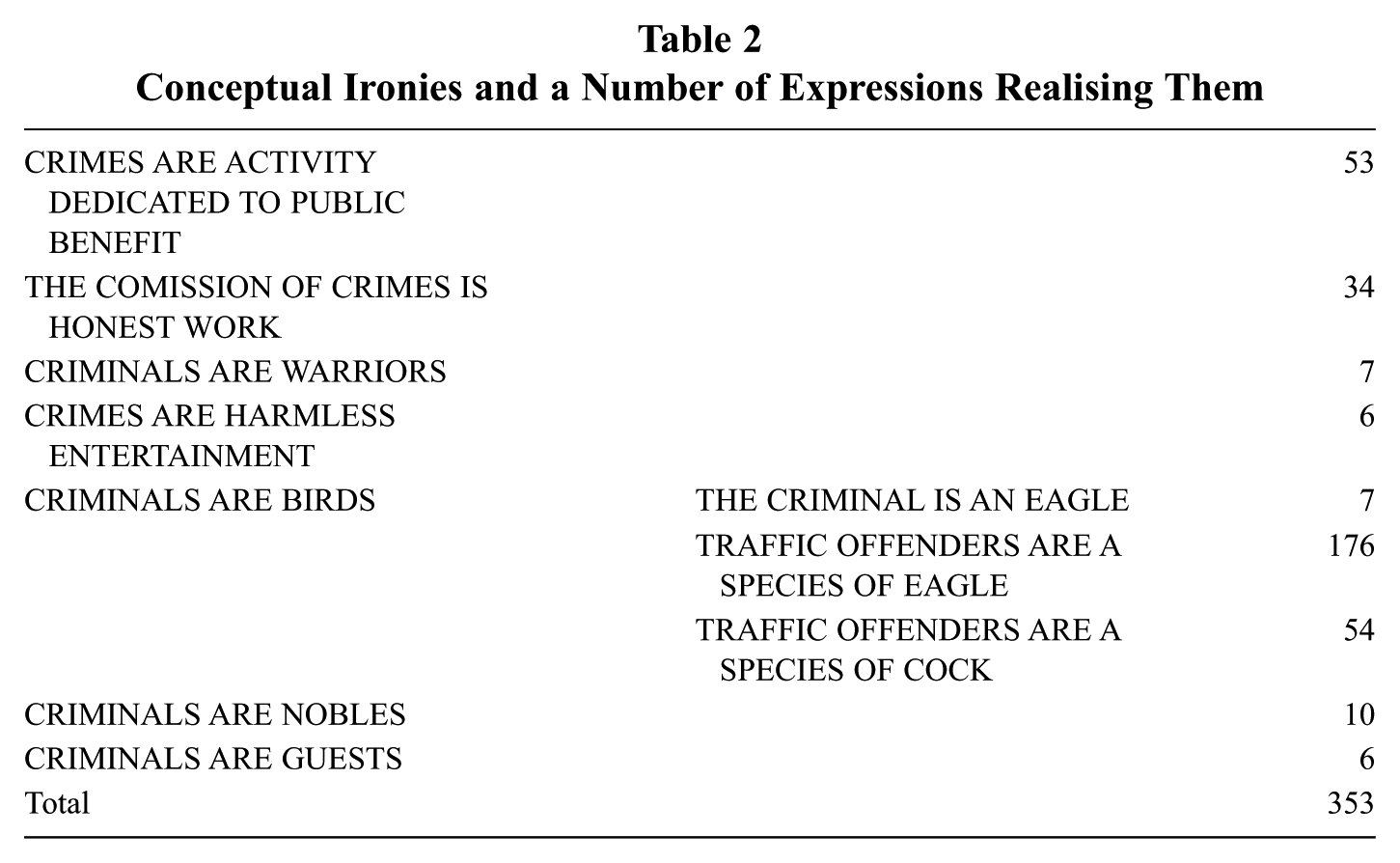
Conceptual Ironies and a Number of Expressions Realising Them
The Functions of Metaphor and Irony in Public Criminological Discourse
The analysis of the metaphorical and ironic expressions and concepts contained in the research material suggests that two main groups of functions can be identified for them: rhetorical and social. The rhetorical functions are more closely related with the level of expression (to give figurativeness, expression, and wittiness to the text), 32 whereas the social functions are best revealed at the level of concepts. To indicate the social dimension of irony and metaphor, that is, the social functions of these discursive strategies, the idea developed that communicative exchange (or discursive activity) is a form of social activity, and therefore involves relations not only of real but also symbolic power. 33
Among social functions, probably the most evident is the expression of emotions having an evaluative tone in relation to subjects in the target domain: surprise that a human being could commit such a crime, terror, fear, upset, or condemnation. This function is most prominent in the case of metaphors. The second function, closely related with the first, is negative evaluation. The axiological aspect of metaphor is very significant in the research material, because the texts related with the concepts of criminal, crime, and criminality in the metaphorical target domain partially reflect the value orientation of a conformistic, conventional society. This parallel of source domain objects—of predator (the prototype of which in the Lithuanian speech community is a wolf), monster, butcher, or executioner—is chosen because there is a very prominent seme of overall negative valuation between the criminal and the source domain lexemes referred to. In addition, all these lexemes have a negative connotation in the Lithuanian language.
In the case of irony, it should be emphasised that negative evaluation is one of the most universal functions of irony. Some researchers consider verbal irony as a mechanism to express different degrees and types of evaluation. 34 As already mentioned, the concepts of the target of irony (thus of irony’s “victim”) and the source domains are at opposite ends of the rating evaluation scale entrenched in the society. But certain irony markers signal that this identification of the “victim” of irony, that is, the offender and the offender’s actions, with the subjects and objects that are “higher” in terms of the values approach is a pretence, and the expression of irony based on the principle of contrast makes the function of negative evaluation even more prominent. It should also be emphasised that these ironic expressions in the articles create an atmosphere not of light humor or benevolent criticism, but of bullying and purposeful humiliation.
In these texts, the function of exclusion of the criminal from the community realised by the metaphors should be related primarily to the selected source domain concepts. There are rudiments of metaphorical scenarios 35 in the research material here, stereotypical situations from daily experience that function in the conscience of discourse participants as cognitive schemes structuring thinking and behaviour. As an example, the criminal is frequently seen as a predator who invades the human community to hunt down victims—human beings. 36 Everyday experience, replaced in the specific case of modern man by instructions from secondary sources (mass media are very important here), prompts the final necessary part of this scenario: Such a beast is dangerous to the human community, and therefore the relevant services must catch and isolate it. The metaphors of monster, monstrosities, spectre which are named in this article as supernatural beings, presuppose a similar scenario. According to John Douard and Pamela D. Schultz, when a criminal is called a monster or a beast, a label is immediately attached that later gives a certain direction to the relationship with the criminal. Such emblematic metaphors as monster, monstrosity, beast, that is, not fully human creatures, propose a conception of other, different, so dangerous to us; therefore such persons must be banished, segregated from society, supposedly for our safety. 37 In general, this function of separation of other and different realised in discourse by metaphor and irony and directed at the criminal can be derived historically from the ancient ritual of scapegoating. 38
Linda Hutcheon, the scholar of irony, discusses whether irony creates communities, or whether already existing discursive communities make irony possible. 39 According to Wayne C. Booth, in the case of irony the building of amiable communities is often far more important than the exclusion of victims. 40 Booth speaks in the main about “amiable communities” between ironist and interpreter, whereas Hutcheon disagrees with this approach and accentuates the other moment of irony, maintaining that irony happens because so-called discursive communities, to a variety of which we all belong simultaneously, already exist and provide the context for both the deployment and attribution of irony. 41 According to the author of this article, this process is bidirectional in public criminological discourse: first, the act of using irony creates a discursive community between the author of irony and the audience. The authors of texts use ironic expressions directed at the criminal (the “victim” of irony) when they believe the readers of the texts will certainly back or support the irony, thus creating between the author and the readers a community condemning the criminals from the standpoint of conventional attitudes. Second, the premise for creating irony and this amiable, elitist, and exclusionary community between the ironist and the intended audience comes from an existing hostile community with a different system of values, a community designated in the texts by such direct expressions as world of criminals (Lith. nusikaltėlių pasaulis) or criminal world (Lith. kriminalinis pasaulis). Each time the boundary between these two communities (the conventional, represented by the ironist and interpreter, and the so-called criminal world) is made deeper and more prominent by the ironic expressions analysed here, because, as a result of unacceptable actions, the former representative of the conventional community is marked with a label of ironic expression and thus banished from our ranks and attached to the criminal, or the others’ community.
It may be generally concluded that the rhetorical and social functions of metaphor and irony are closely related in these texts. Generally speaking, the main functions of conceptual metaphor and irony in public criminological discourse are the expression of an emotional attitude and value judgment directed at the main subject of the discourse (criminal and crime): the aim of the text addresser is to evaluate the offender negatively, dissociate from him, and exclude him symbolically from the community. The exceptional linguistic forms of irony and metaphor help to realise these social functions more effectively and more suggestively than would be possible by choosing a direct (nonfigurative) method of expression.
How the metaphorical and ironical concepts of public Lithuanian discourse analysed in the article affect the social perception of crime and the criminal is an important question yet no sociological or psychological studies have dealt with this. Certain assumptions about a link between the reporting rhetoric and public reactions have been made only by investigators from other countries. The previously mentioned psycholinguistic experiments of Paul Thibodeau, James L. McClelland, and Lera Boroditsky prove how certain metaphors shape people’s thinking about such important issues as crime and criminals. These scientists have examined the effects of two different metaphorical frameworks in American public discourse—crime as a predator and crime as a virus, both of which incidentally are used in the Lithuanian public criminological discourse analysed above. In an experiment, participants’ suggestions for solving a crime problem were systematically influenced by the metaphoric frame. When crime was compared to a virus, participants were more likely to suggest reforming the social environment of the infected community. When crime was compared to a predator, participants were more likely to suggest attacking the problem head-on by hiring more police officers and building jails. The experiment confirms recent speculation by policy makers, academics, and journalists suggesting that the metaphors we use to discuss important issues shape our way of thinking about the issues, and even how we approach solving them. 42 Which approach to solving crime prevails in the Lithuanian public can only be deduced from statistics—in the research material there are 184 expressions realising the metaphor “criminal is a beast,” and only 10 realising “criminality is a disease.”
Conclusions
After an analysis of metaphor and irony in Lithuanian public criminological discourse (2001–2015) with the target domain being the concepts of criminal, crime, and criminality, the main concepts of the source domain were revealed. It was found that during this period the criminal is metaphorised by means of two metaphorical models, which subsume several smaller metaphors: (1) A CRIMINAL IS NOT A HUMAN BEING (A CRIMINAL IS AN ANIMAL (beast, fish); A CRIMINAL IS A SUPERNATURAL BEING (monster, monstrosity, spectre); and (2) CRIMINALITY IS A SPECIFIC PROFESSION RELATED TO TAKING LIFE (A CRIMINAL IS AN EXECUTIONER, A CRIMINAL IS A BUTCHER, A CRIMINAL IS A HUNTER, A CRIMINAL IS A FISHERMAN). Looking at the number of metaphorical expressions through which the conceptual metaphors are realised in the discourse, it can be seen that the most productive and dominant conceptual metaphors describing the criminal who committed a serious crime, are A CRIMINAL IS A BEAST and A CRIMINAL IS AN EXECUTIONER.
Metaphorisation of crime in discourse depends on the perspective from which the crime that is in the process of being committed or has been committed is seen: (1) when the crime is described as an active action which is being committed (or was committed), as if observing it from the outside, it is realised as an INHUMAN ACT (SATISFACTION OF PHYSIOLOGICAL NEEDS, AN ABNORMAL ACT) or as DUTY (EXECUTION, SLAUGHTER, FISHING, HUNTING); (2) when the crime is described as a fact or memory in a human’s past, it is seen as a HEAVY OBJECT weighing heavily on the conscience; (3) in order to emphasise the spreading effect of news regarding serious crime, it is metaphorised as a natural disaster, an EARTHQUAKE, and when it is an attempt to summarise some trends or reasons for criminality, the crime or criminality is seen as a very serious or infectious DISEASE. The most productive reconstructed metaphors are CRIME IS HUNTING (when a criminal-beast is hunting) and CRIME IS EXECUTION; the metaphor CRIME IS SLAUGHTER is also quite productive.
The following seven paradigms of conceptual irony were reconstructed from ironic expressions: (1) CRIMES ARE AN ACTIVITY DEDICATED TO PUBLIC BENEFIT; (2) COMISSION OF CRIMES IS HONEST WORK; (3) CRIMINALS ARE WARRIORS; (4) CRIMES ARE HARMLESS ENTERTAINMENT; (5) CRIMINALS ARE BIRDS; (6) CRIMINALS ARE NOBLES; (7) CRIMINALS ARE GUESTS. The fifth conceptual model is divided into three smaller concepts: A CRIMINAL IS AN EAGLE; TRAFFIC OFFENDERS ARE A SPECIES OF EAGLE; TRAFFIC OFFENDERS ARE A SPECIES OF COCK. According to the number of expressions in the discourse, three ironic paradigms are treated as the most productive and dominating: CRIMINALS ARE BIRDS, CRIMES ARE AN ACTIVITY DEDICATED TO PUBLIC BENEFIT and COMISSION OF CRIMES IS HONEST WORK, all other models are treated as peripheral, because no more than ten expressions were identified in the research material. It should be emphasised that in the case of irony, unlike the case of metaphor, the relation between the source and the target domains is pretended, because from the axiological and semantic perspectives there is no similarity or analogy between the two domains; moreover, the concepts that are very often chosen belong to the opposite end of the evaluation rating established in our society and have different connotations.
Despite differences of processing cross-domain mapping and of creating figurative meaning, metaphor and irony realised in public criminological discourse perform the same or very similar rhetorical and social functions in this discourse. The authors of texts use metaphorical and ironic expressions in order to elicite a rhetorical effect – to draw the reader’s attention, or to show themselves as witty. The conceptual models of metaphor and irony in these texts fulfill at least three social functions: (1) expressions of negative emotions directed to the target domain concept; (2) negative valuation of the criminal and his crime and (3) identifying the criminal as belonging to an other, different category than us and exclusion from our human and humane community.
This study of two discursive strategies (metaphor and irony) in public criminological discourse reveals some aspects of the present Lithuanian media attitude towards the criminal and crime. Through the dominant conceptual models of metaphor and irony, Lithuanian media represent criminals as inhuman, impersonal, deviant, and dangerous beings whose value system is directly opposed to ours. The metaphorical scenarios realised in these texts most often propose the only solution: the isolation of such not (fully) human beings by segregating them from our human community.
Footnotes
Appendix: Sources and abbreviations
D = delfi.lt; KD = kauno.diena.lt; lkz.lt = online; LR = lrytas.lt.