



Abstract
Throughout the European Parliament’s nearly forty years of existence, electoral turnout in European parliamentary elections has consistently been lower than electoral turnout in the national elections of the member states. This is particularly the case for the majority of states in Eastern Europe where turnout in European elections has resulted in low electoral participation of eligible voters. Focusing on the 2014 election to the European Parliament, we highlight that low election-specific knowledge contributes to these low participation rates. In more detail, we rely on name recognition of the main candidates of the three main party groups, and show that knowledge of these candidates is more than twice as high in Western Europe as in Eastern Europe. Second, we illustrate that these low knowledge levels in the East also help explain the larger turnout gap between national and European elections in the East.
Introduction
The 1979 direct elections to the European Parliament (EP) were heralded as an innovative mechanism of democratic political participation that resulted in 61.9 percent turnout. However, that fairly high level of citizens’ participation in elections to the EP has not withstood the test of time. Instead, voter turnout has been steadily declining since then, reaching its record low of 42.6 percent in 2014. 1 The sheer enthusiasm about active participation in the European project seemed to have dissipated by 2014, leaving scholars with only mounting doubts that the 1979 level of voters’ political engagement can ever be repeated. Yet, turnout for the 2014 EP elections has not been uniform and ranged from 90 percent recorded voter participation in Belgium to a mere 13 percent participation in Slovakia. An additional attention-grabbing characteristic of the 2014 EP electoral results is the gap in electoral participation between Western and Eastern Europe. In fact, since the first Eastern European EU enlargement in 2004, on average, turnout has been more than 20 percentage points lower in Eastern Europe as compared to Western Europe (see Figure 1). For example, in 2014, electoral participation averaged 52.7 percent in the countries of the West, and only 28 percent in the countries of the East. Even more striking, the turnout gap between national and European elections has been more pronounced in the East as illustrated by EP electoral turnout levels reaching 70 percent of national turnout levels in the West and merely 50 percent in the East.
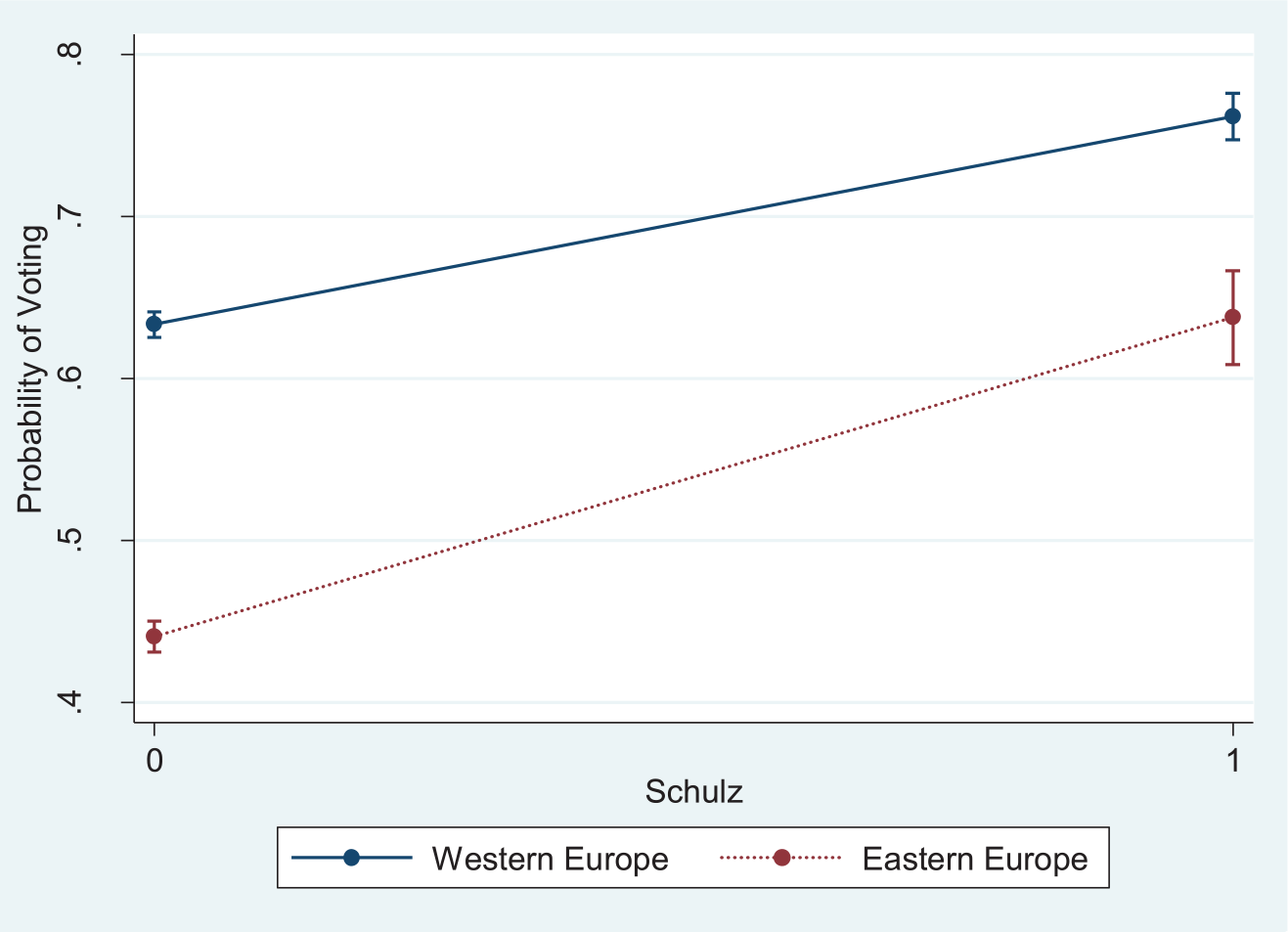
Margins’ plot measuring the influence of knowledge of Schulz on voting in Eastern and Western Europe
What explains these differences in participation and especially the larger turnout gap in the East? We demonstrate that part of this larger turnout gap between the first-order national elections and the second-order European elections should be triggered by less salience attributed to these elections by individual voters. Using name recognition of the Spitzenkandidaten as a proxy for the salience of these elections and relying on data from the European Election Study (2014), we find that the knowledge levels of these candidates of the three main parties (Junker for the Conservatives, Schulz for the Socialists, and Verhofstadt for the Liberals) are more than twice as high in Western Europe as compared to Eastern Europe. We further highlight that this knowledge gap explains, to a great degree, why the turnout gap between national and European elections is higher in the East compared with the West.
Turnout in Western and Eastern Europe
Three features distinguish voter turnout in Western Europe from voter turnout in Eastern Europe. First, turnout in national elections is more than 20 percentage points higher in Western Europe compared with Eastern Europe. Second, in both regions, turnout is higher in national elections than in European elections. Third, the turnout gap between national and European elections is considerably higher in the East compared with the West (see Tables 1–4). In European election cycles (i.e., 2004, 2009, and 2014), the turnout gap between national and European elections was approximately 5 percentage points higher in the Eastern European countries of the EU as compared to the Western European countries (see Table 3). Even more pronounced, in 2014, the gap between national and European elections reached 8 percentage points (it was 22.13 percentage points in Western Europe and 30.57 percentage points in Eastern Europe) (see Table 3). In other words, if we measure the percentage of voters who turned out for the European elections in 2014 against the percentage of voters who turned out for the national elections within the same year, we find that turnout reached 70.43 percent of national level turnout in the West and only 48.47 percent of national turnout in the East.
Turnout in Western Europe (percentage)

Source: “Results of the 2014 European Elections,” European Parliament, http://www.europarl.europa.eu/elections2014-results/en/turnout.html; “Voter Turnout Database,” International Institute for Democracy and Electoral Assistance 2018, https://www.idea.int/data-tools/data/voter-turnout.
Turnout in Eastern Europe

Turnout Gap in Percentage Points between National and European Elections

Percentage of Citizens Who Turn Out in European Elections Compared with National Elections

Given these differences, the following question comes to the fore: Why is abstention in the European elections higher in Eastern Europe compared with Western Europe, not only in absolute terms but also in relative terms? This puzzle becomes even more relevant if we consider that this increased turnout gap is specific to the European elections and is not replicated in other second-order elections. For example, in a very recent study, Schakel and Dandoy show that turnout gaps between national and regional elections have similar magnitudes in both East and West Europe. 2 Generally speaking, the higher turnout in Western Europe could be explained by several factors, some of which include the less institutionalized party system and the lack of party identification of many citizens in Eastern Europe, 3 institutional differences between the two regions (e.g., there is no compulsory voting in the East), 4 a lack of habit to vote in former Warsaw Pact countries, 5 higher dissatisfaction with the way democracy works in Eastern countries compared with Western European countries, 6 as well as greater economic hardship faced by many in former communist states. 7 While these factors provide plausible explanations when examining overall differences in voter turnout between the Western and the Eastern European countries, these same factors fall short of providing explanations for the larger turnout gap between national and European elections in Eastern Europe compared with Western Europe.
Possible Explanations for the Larger Turnout Gap between National Elections and European Elections in Eastern Europe
Since the larger turnout gap between national and European elections is specific and not generalizable to other type of elections, it is likely that European factors are responsible as to why East European citizens are particularly reluctant to vote in the Europe-wide electoral context. We focus on three such factors here: general knowledge of the EU, election-specific knowledge of the EU, and voters’ assessments of the EU. We hypothesize that at least one of these factors differs in the East from the West and explains the particularly low turnout in European elections among the Eastern European electorate.
Political knowledge
There is an overall strong consensus in the literature that political sophistication is a propeller, if not a prerequisite, for political engagement. 8 According to de Vries, van der Brug, van Egmond, and van der Eijk, political sophistication can be understood “as the store of political information available to an individual to be called upon when making judgments or decisions” 9 or as “the quantity and organization of a person’s political cognitions.” 10 Voters are only likely to vote if they are informed enough to evaluate the choices of candidates presented to them. Therefore, voters who are not politically immersed enough or possess “too little information to determine which candidate to vote for are more likely to abstain.” 11 Feddersen and Pesendorfer concur with these findings and argue that it should not be surprising to find that uninformed voters have a tendency to “delegate their vote via abstention to more informed voters.” 12 According to Tilley and Wlezien, the more representative opinions individuals possess the more their behavior should change for the better. 13 Some positive observable changes “for the better” include citizens’ willingness to embrace active political engagement. 14 More focused on turnout, Grönlund notes that knowledgeable voters are more likely to participate in elections than less knowledgeable voters who are more inclined to remain passive. 15
When discussing the influence political knowledge might have on the particularly low turnout in Eastern Europe, or on differences in electoral participation between Eastern and Western Europe, we must distinguish two types of political knowledge: general knowledge and domain-specific knowledge. 16 Scholars who advocate that citizens are “generalists” infer that those who are knowledgeable about certain domains of politics are also more likely to be familiar with other domains of politics. 17 On the other hand, scholars focusing on domain-specific knowledge argue that citizens tend to seek out information according to their interests and self-select into specific knowledge domains. 18 Knowledge acquisition in the latter form is consistent with their attitudes. According to Holbrook, Berent, Krosnick, Visser, and Boninger, “attaching personal importance to an attitude leads to the acquisition of attitude-relevant information in long-term memory.” 19 From that perspective, general knowledge should not be treated as a substitute for domain-specific expertise as these types of knowledge can have distinct effects on individuals’ cognitions. 20 Gilens shows that citizens’ ignorance on domain-specific issues is greatest among those who possess high levels of general political knowledge. 21 At the same time, the context in which voters are embedded plays a role. Acquisition of different dimensions of domain-specific knowledge varies according to the “properties of the information environment and the motivations of the individual consumer.” 22 Thus, the context dictates the boundaries of political information provisions as well as the extent to which such is utilized effectively. 23 When analyzing knowledge of the EU, we follow the second school of thought and argue that there are potentially two different types of political knowledge, unrelated and independent of each other. One type of knowledge is general knowledge about the EU and its functioning. The second type is the election-specific knowledge about the EP elections.
Hypothesis 1: The turnout gap is larger in Eastern Europe than in Western Europe because general knowledge of the EU is higher in the West compared with the East.
In support of this hypothesis, there is evidence that individuals are less informed about political issues taking place at the European level than national levels. According to Hobolt and Wittrock, this explains at least part of the turnout gap between national and European elections. 24 We assume that this knowledge gap might be asymmetrical. In other words, relative to their counterparts in the East, individuals in the West might know more about the EU and the functioning of the European institutions. European integration has been an integral part of citizens’ life in Western countries. For decades, voters in Western Europe have been steadily exposed to EU’s formal and informal information campaigns. In contrast, most of the Eastern European countries have only joined in 2004 and have not had an opportunity to fully reap the informational benefits. As a result, general knowledge of the EU might be less entrenched in the East as compared to the West. We measure general knowledge by two proxies: the first proxy asks respondents whether Switzerland is a member of the EU, and the second proxy asks survey participants whether EU member countries elect the same number of representatives to the European Parliament. Respondents have the choice to answer yes or no, or indicate that they do not know the answer.
Hypothesis 2: The turnout gap is larger in Eastern Europe than in Western Europe because election-specific knowledge of the EU is higher in the West compared with the East.
Aside from general knowledge being taken into consideration as a plausible explanation, election-specific knowledge might bear great responsibility for explaining electoral discrepancies between the West and the East. We think that a good proxy for measuring election-specific knowledge is the name recognition of the Spitzenkandidaten for the EP elections. Against the backdrop of declining turnout, the 2014 EP elections introduced the so-called Spitzenkandidaten procedure, which is a (relatively) novel approach geared toward voter mobilization in EP elections. The process entailed that prior to the EP elections, competing European political parties nominate candidates for the President of the European Commission, thus linking, more overtly, European parliamentary elections with the elections of the head of the EU executive. 25
The leading candidates’ visibility has been at the forefront of campaign strategies, making the elections to the EP almost synonymous with the names of leading candidates for the head of the EU executive. As leaders could be viewed to exude “potential as mobilizing political agents,” 26 assessing the level of knowledge of the leading candidates is a viable measure for election-specific knowledge, especially since one of the goals in the European parliamentary election process is that “those candidates . . . play a leading role in the parliamentary electoral campaign.” 27 If citizens do not possess or possess low levels of knowledge of political actors, they are either less “to make a reasonable choice” 28 or are more likely to stay home on Election Day. Thus, we deem the recognition of potential candidates necessary for increasing the likelihood of citizens of the different EU countries to vote on Election Day. 29
In particular, we maintain that name recognition of the top candidates in the 2014 EP elections could be a particularly good proxy for the low salience of European elections in Eastern Europe. For example, lower knowledge of these main candidates could signify that EP elections in the East are even less important for political parties, the media and voters than in the West. This assumption is grounded in the observations that, on average, political parties are less institutionalized in the former communist countries, they are less entrenched in society, and they lack the membership of some Western European parties. 30 Hence, it might be more difficult for them to make their “top” European candidate known to their respective voters given that they are not in the immediate vicinity of the EU epicenter, which, inadvertently, might already generate less media coverage of electoral campaigns and debates with the Spitzenkandidaten. Moreover, the lack of general news coverage of the EU, particularly in the East, renders the top candidates too distant for voters to even know of their existence as well as importance within the electoral context. 31 It would then only be logical to assume that voters do not possess specific knowledge about the Spitzenkandidaten. Furthermore, the lack of knowledge about the top candidates in EP elections might then explain why Eastern European voters are reluctant to participate in these elections, resulting in the particularly low turnout rates in EP elections in Eastern European countries.
Hypothesis 3: The turnout gap is larger in Eastern Europe than in Western Europe because assessments of the EU are more negative in the East compared with the West.
The lack of cognitive mobilization may also contribute to the lack of European identity, which might have a greater demobilizing effect on fairly new members of the European Union compared to the original EU-15. As noted by Inglehart, cognitive mobilization “increases the individual’s capacity to receive and interpret messages relating to a remote political community,” yet “one must become aware of it before one can develop a sense of commitment.” 32 Thus, voters’ assessment of the European Union, and their orientation toward or away from the European project and the processes it entails become important investigative steps. In other words, their approval or disapproval of the European Union becomes a plausible explanation for the turnout gap between national and European elections in Eastern Europe compared with the West.
An array of studies finds that the propensity of a European citizen to vote increases with her support for the European project 33 and voters who hold ambivalent attitudes toward the European Union were still more likely to cast a vote during the 2004 and 2009 European elections than those who held negative attitudes toward the European Union or remained indifferent. 34 In addition, public opinion research illustrates that for many abstainers abstention is a deliberate choice, which is an indication that they either to do not exhibit trust in the European project or they do not support it. 35 Following this logic, we presume that dissatisfaction with the EU is higher in the East as compared to the West. This assumption is exemplified in the cases where the right-wing populist governments (e.g., in Poland and Hungary) have strengthened their anti-EU rhetoric based on blame that they attribute to the EU and its failures including, but not limited to, the Euro crisis and the protracted European refugee crisis. 36 As a result, the Eastern European voters might be less likely to vote in EP elections not only in absolute terms but also relatively to their participation in national elections. In order to measure EU support, we use two variables. The first variable assesses whether respondents think that in the EU things are going in the right direction and the second variable measures whether they think that their country’s membership in the EU is a good thing.
Data and Methods
Focusing on general knowledge of the EU, EP election-specific knowledge, and voters’ assessments of European integration, we aim at explaining why the turnout gap between national and European elections is larger in Eastern Europe compared with Western Europe. In order to do so, we use the 2014 European Election Studies’ Voter Study (2014). 37 First, we juxtapose the general knowledge of the EU of Eastern Europeans and Western Europeans by comparing correctly answered questions pertaining to whether Switzerland is a member of the EU and whether each member state elects the same number of representatives to the EP. Second, we present the level of election-specific knowledge in the East and the West by comparing knowledge levels of three Spitzenkandidaten between the two regions. In the final univariate tests, we do the same for our two proxies measuring citizens’ positive or negative assessment about the EU.
In the second part of our empirical analysis, we present bivariate and multivariate statistics. In the bivariate realm, we measure the aggregate differences in the answers to the independent variables and the dependent variable. As such, the aggregate analysis provides a first crucial step in determining whether the influence of any of our main variables is different in the East when compared to the West. To illustrate this reasoning, let us assume the following two scenarios: (1) the likelihood that a citizen votes is 90 percent for both Eastern Europeans and Western Europeans who know that Switzerland is not part of the EU and (2) Western Europeans know the correct answer 20 percentage points more than Eastern Europeans. In this case, the gap of 20 percentage points in knowledge of Switzerland’s membership status could explain why the turnout gap is higher in the East as compared to the West.
As a final modelling strategy, we run a multivariate regression model. The model includes the binary variable—whether somebody voted in the European election—as the dependent variable. Because of high collinearity, we only use one election-specific proxy. The proxy assesses whether respondents know who the top candidate of the European Social Democrats and Socialists is (i.e., Martin Schulz). We also include the general knowledge variable measuring the number of representatives elected to the EP from each member state, as well as the assessment variable asking the surveyed whether they think that their country’s membership in the EU is a good or a bad thing. In the model, we control for relevant confounders (i.e., education, church attendance, class, age, gender, and urbanisation (see Table 5). 38
Operational Definitions of Control Variables

Because the bivariate analysis illustrates that there are differences in election-specific knowledge between Eastern and Western Europe, we also add an interaction term between Eastern Europe and our knowledge proxy for Martin Schulz. To confirm that a greater lack of election-specific knowledge in the East triggers the larger turnout gap between national and European elections in Eastern Europe, we ideally want the coefficient of the interaction term to either have a small or no impact. Such a small impact or lack thereof would imply that the effect of knowing any of the candidates, in our case, Martin Schulz, is similar in the two regions. In this case, higher knowledge levels of Schulz in the West would essentially translate into higher turnout. We run the regression model as a binary logistic regression analysis. 39 We also display the marginal effects’ plot of the interaction term.
Univariate Results
Table 6 compares general knowledge levels between Eastern and Western Europe, EU election-specific knowledge in both regions, as well as citizens’ assessment of the EU in the East and the West. First, we find that there is very little difference between the East and the West in terms of general knowledge about the EU. In both regions, roughly 70 percent of the surveyed correctly identify that Switzerland is not part of the EU. In fact, there is a slight difference in that the percentage of correct responses is approximately 5 percentage points higher in the West. Yet, this difference might be due to geographic proximity. If we look at the second general knowledge question, which explores whether EU member countries elect the same number of EP representatives, the percentage of correct answers is nearly identical (i.e., 61 percent), albeit with a slightly higher correct percentage in the East.
Knowledge and Assessment of the EU in Eastern and Western Europe

In contrast, if we take a look at election-specific knowledge there is no convergence between Eastern and Western Europe (see Table 6). Rather, citizens’ survey responses reveal that knowledge of the three main candidates is more than twice as high in Western Europe as compared to Eastern Europe. For example, while slightly more than one-fourth of the respondents can correctly identify that Claude Junker is the top candidate of the European Peoples’ Party less than 9 percent can do the same in the East. The differences in knowledge between the two regions for Martin Schulz and Guy Verhofstadt, the candidates for the Socialists/Social Democrats and Liberals, respectively, are in the same percentage bracket. Hence, there is a net difference in election-specific knowledge between Eastern and Western Europe.
Similar to general knowledge about the EU, the descriptive analysis of voters’ trust in the EU yields a convergence in the responses provided by citizens in the two regions. Looking at our first opinion proxy, there is no difference in the responses to the question whether things in the EU are going in the right direction. On a scale from 0 (things are not going in the right direction) to 2 (things are going in the right direction), the mean answer is 1.04 in Western Europe and 1.03 in Eastern Europe. For our second proxy, which asks whether the EP cares about EU citizens’ concerns, the answers range from a 0 (does not care at all) to a 4 (cares a lot) scale. On this scale, the average is 1.36 for Western Europe and 1.44 for Eastern Europe, illustrating that citizens in the East have slightly more trust in this institution than citizens in the West.
Bivariate and Multivariate Results
Given the significant gap between EP election-specific knowledge between the West and the East, it is likely that these differences in election-specific knowledge between the East and the West explain the larger turnout gap between national and European elections between these two regions. We test this hypothesis in the multivariate realm. Before doing so, we confirm two points: (1) that the self-reported turnout gap between national and EP elections reflects the actual turnout gap and (2) that the bivariate relationship between knowing any of the three candidates and voting in the EP elections is roughly the same for the three contenders. First, Table 7 highlights that the self-reported turnout gap between these first-order and second-order elections is 8.88 percentage points higher in Eastern Europe as compared to Western Europe in 2014. This mirrors the actual 8.44 points difference (see also Table 3). 40
Self-Assessed Turnout between the East and the West

Second, Table 8 illustrates that knowing any of the three main candidates to the elections of the EP nearly guarantees that a survey respondent votes. 41 In fact, throughout Europe, knowledge of these candidates gives any citizen, approximately, 90 percent likelihood to vote. Since the probability of voting for an individual with election-specific knowledge is only slightly higher in Western Europe, as compared to Eastern Europe, these descriptive statistics already confirm hypothesis 2. With similar likelihood, twice as many people know the top candidates in the West. Hence, this difference in knowledge explains, at least, part of the larger turnout gap in the East.
Knowledge of EU Politicians and Self-Reported Voting

Table 9 and Figure 1 support the assumption that election-specific knowledge matters for individuals’ likelihood to vote. The coefficient for knowing Schulz is statistically significant and positive. The interaction term (see Table 9), which is significant and positive, showcases that individuals’ knowledge of Schulz as a candidate increases the likelihood of voting in Eastern Europe when compared to the West. Yet, the margins plot in Figure 1 (which holds all other variables constant at their median) illustrates that this difference is very small. In other words, the two lines are nearly parallel further highlighting that the substantive influence of knowing the Socialist top candidate for the EP election is a strong predictor for casting a vote both in the East and the West. Voters’ knowledge of Schulz is nearly 2.5 times (or 13 percentage points) higher in Western Europe than in Eastern Europe (see Table 6). This difference in knowledge can explain, at least partially, why the turnout difference between the national and the European elections is larger in the East than in the West. In fact, if the knowledge level of Schulz were to be as high in the East as in the West (i.e., 22 percent instead of 9 percent) and if the probability to vote were still at .9, then turnout would increase by approximately 11.7 percentage points in the East. This approximation would even render the turnout gap between national and European elections smaller in the East as compared to the West. 42
Multiple Regression Model Measuring the Effect of Election-Specific Knowledge on Turnout in Western and Eastern Europe

Discussion
A relatively well-established literature has built on the seminal work by Reif and Schmitt 43 and has provided evidence for the second-order national election framework. Within this framework, national elections are elevated to a much higher political standard to which none of the other types of elections, especially European elections, can live up in electoral significance to voters. Since media coverage, campaign activity, and voter interest are lower, 44 turnout is expected to be lower in EP elections as well. Unsurprisingly, this finding applies to all countries except for the two compulsory voting countries (Belgium and Luxembourg). Yet, not only is turnout lower in European elections as compared to national elections, we also find that the turnout gap between national and European elections is wider in Eastern Europe compared with Western Europe.
We explain this larger turnout gap in the East by the proxy variable of election-specific knowledge (i.e., knowledge of the three top candidates in the EP elections) and we demonstrate that, compared to the West, European elections seem to be of less interest to voters in the East. This observation is further confirmed by additional descriptive statistics. Table 10 highlights that more than two times as many citizens in the West regularly read about the EP elections as compared to the East (21 percent of the surveyed vs. 10 percent of the surveyed). When we look at campaign activity, we get similar results. In Eastern Europe, a mere 8.5 percent of those surveyed were contacted by one or more of the national political parties regarding the EP elections in 2014. In Western Europe, this number stood at 17.4 percent.
Salience of EP Elections in the West and the East

These additional descriptive statistics nicely corroborate our findings. EP elections are less embraced within the informational environments of the Eastern European EU member states, leading prospective voters to possess little election-related knowledge. Campaigns either do not take place or do not cover European issues. Newspapers and television broadcasting is minimal at best. Relatedly, the key politicians at the European level, such as the President of the European Commission and the President of the European Parliament, may find less motivation to participate in political meetings in Eastern European countries than in Western European countries. 45 In fact, their meetings and outreach might be concentrated in Western Europe. A study by Schmitt, Hobolt, and Popa. confirms these observations with election-specific data. The authors report that there were nine debates among the main candidates for the President of the European Commission in the months leading up to the 2014 EP elections. Yet, they were largely conducted in the three key languages of the European Union (English, French, and German) and, while broadcast also on the Internet and Euronews, they mostly received attention in the Western-based home countries of the candidates. 46
In addition, many case studies on campaign coverage confirm that the European Union does not appear to be a great mobilizing factor or “an independent dividing line in the political competition.” 47 These campaigns remained unobtrusive in nature and were mainly “domesticised and not Europeanised.” 48 For example, Stępińska finds that Polish voters had been subjected to a lack of information as domestic issues and vague political messages dominated the contents of those political advertisements. 49 In Romania, the voters were equally subjected to a lack of reporting about the 2014 EP election. According to Ştefănel “no television news channel from the ‘must-carry package’ changed its schedule during the EP electoral campaign; there were no broadcasts dedicated to this election or TV debates involving only Romanian EP candidates.” 50 Similarly, in the Czech Republic, the EP election campaign appeared as “the least visible and interesting campaign in modern nation-wide elections” in the country. 51 These same observations were also applicable to the 2009 EP elections in Bulgaria where Raycheva and Róka argue that the “average citizens had no opportunity to learn what an MEP’s responsibilities were, what topics and priorities the European Parliament would need to consider, or how Bulgaria’s interests would be affected.” 52
The arguments presented thus far indicate that the average citizen in the East is less exposed to these elections in public media outlets than the average citizen in the West. It is more difficult for individuals in the East to be fully immersed in the EU informational networks pertaining to the elections compared to the average citizen in the West, especially since EU’s information-specific outreach in the East has not been as elaborate as the one found and promoted among the Western European countries. The majority of the Eastern European countries have also not felt motivated to fully embrace an entity that they deem as distant from their daily lives and create a dynamic election-specific information environment that can capture the political interest of their citizens. In contrast, European integration has been part of individuals’ socialisation for decades in Western Europe. In the majority of Western European countries, Europe is part of the daily political debates that citizens hold privately and publicly; this should bring the EU closer to the average citizen. As a result, European elections might be perceived differently and, arguably, attributed a higher standing in Western Europe—a standing that might trigger higher voter turnout.
This leads us to the conclusion that while voters in the East possess similar levels of general knowledge about the inner workings of the European Union as citizens in the West, they maintain minimum levels of specific knowledge about EP elections and exude little interest in them. Yet, if citizens are ill-informed and not familiar with the election-specific context of EP elections, they have little incentive to cast a vote. In fact, these low levels of election-specific knowledge (only one in ten individuals knows the main candidates of the European socialists or conservatives) translate into record low turnout numbers.
Conclusion
The vast literature on European elections postulates that voters anywhere in Europe are less informed about political issues taking place at the European level as compared to national levels. These low levels of knowledge about European issues and elections stem, at least in part, from parties’, the media’s, and election campaigns’ inability or unwillingness to pay close attention to these second-order elections. 53 This lack of an information environment in which voters can immerse themselves triggers low levels of voter turnout. In the West, approximately 50 percent of the electorate turns out on European Election Day. In the East, these numbers drop to below 30 percent. Even more telling is the fact that the turnout gap between national and European elections is 8 percentage points wider in the East than the West.
By focusing on three alternative explanations—general knowledge of the EU, EP election-specific knowledge, and assessments of the EU—we have shown that these low turnout numbers in the East are linked to the lower salience of these elections. Using name recognition of the top candidates as a proxy for the significance of these elections among the electorate, we highlight that in Eastern Europe these elections are less important than in Western Europe. While in Western Europe around one-fourth of the electorate knows the names of the top candidates of the two main parties, the numbers drastically decrease below 10 percent in the East. These low knowledge levels then directly translate into record low turnout.
Theoretically, our work brings us to the following question: Can an election, where top candidates are unknown to 90 percent of the population and where less than one in three citizens votes, still be considered second order? Instead, such an election could possibly be considered third order, as voters ascribe to it the least amount of significance when compared to other elections. More practically, this finding prompts the following question: What should countries do to increase the visibility of these elections among their respective electorates? To partially address this second question and offer some answers, we suggest that national governments and EU politicians should engage in renewed outreach efforts. They should invest more resources geared toward creation of an effective information environment, especially in Eastern Europe where such resources appear to be scarce and if present are, largely, hijacked by national political parties. EU politicians should also be innovative in how EP election information reaches their respective electorates in countries where national media outlets are crowded by national political platforms. As fragmentation is one of the characteristics of Eastern European political systems, future research should place more attention on election-specific knowledge gaps and take a closer look at the relationship between name recognition of national leading candidates and voter turnout in EP elections. That approach will allow for a more extended and country-specific discussion of the importance of electoral knowledge within national contexts. More practically, we believe that closing the gap between general and election-specific knowledge should not be considered an onerous task since general knowledge levels about the EU are relatively high in both Eastern and Western Europe. 54
