




Abstract
This article belongs to the special cluster, “Politics and Current Demographic Challenges in Central and Eastern Europe,” guest-edited by Tsveta Petrova and Tomasz Inglot.
During the past two decades, many European countries, including Germany, Italy, and Spain in the west, and Poland and Hungary in the east, encountered prolonged demographic crises. These challenges first became evident in the late 1990s as fertility rates declined rapidly, much below the level necessary to ensure a simple replacement of generations. Moreover, since the EU accession, mass labor migration from the new Member States to the more developed western European countries added yet another dimension to the growing population problems. This article attempts to explain variation in governmental policy responses to these developments between two countries, Poland and Hungary. Hungary, owing to its long-term tradition of relatively generous and extensive social programs directed to families, youth, and children, should be expected to handle its population emergency much better than Poland. Yet, the opposite has happened. In the last few years, Poland has proposed and implemented several innovative measures to address fertility and migration pressures while Hungary has remained committed to its traditional social policies in this domain. I will analyze and compare the two cases by examining a combination of historical factors related to the legacies of demographic emergencies defined in terms of national strength and survival, and by examining the politics of family policy, with a special focus on the creation of coalitions of governmental and/or nongovernmental actors that either facilitate or obstruct effective policy innovation.
Keywords
Introduction
Demographic challenges, exemplified by low fertility and out-migration of young people, are hardly new topics in comparative European studies. As Pedersen, Gauthier, Hantrais, and many other historians and social scientists have observed, western European states such as France, Belgium, Austria, Sweden, and more recently also Italy and Spain, provide good examples of prolonged population crises caused by declining births. 1 Out-migration, in turn, occurred mostly among less developed countries, first in Southern Europe, and more recently in Central and Eastern Europe. 2 These two types of demographic challenges periodically stimulated government policy reforms targeting young people and families with children and thus deserve our scrutiny as instances of state-directed efforts to deal with rapid social changes taking place across the continent.
In political science, however, comparative studies of population and family policies are relatively rare and it is even more so when we shift our geographical focus from the west to the east, or to the new Member States of the former communist bloc. Within this region, Hungary and Poland deserve special attention, since during the past several years they have experienced, arguably, the most severe and consequential demographic crises in the postwar period. Historically, these former communist states have stood in stark contrast to each other in terms of their demographic trajectories. Since the end of World War I, Hungary has experienced many periods of severe population decline. Initially, the country’s territory shrank dramatically in the wake of the Treaty of Trianon (1920) and since then successive governments wrestled with frequent cycles of low fertility and a rapidly aging society, for example, in the 1930s, 1960s, and 1980s. 3 Poland, in contrast, usually confronted the opposite challenge of overpopulation, especially before World War II. After 1945, following dramatic wartime losses, the number of inhabitants again grew steadily, with the latest baby boom lasting through the mid-1980s, almost until the very end of communist rule. This more recent wave of new births, in fact, compensated for traditionally high out-migration patterns and low life expectancy (high death rates, especially among the male population) during the same decade and even later. Nonetheless, since approximately 2000, Poland began to catch up with Hungary at an accelerated pace, then rapidly falling to the very bottom of the fertility ranking in Europe. 4
The EU data for 2013 marked the Polish fertility rate at 1.29, slightly higher than the lowest point of 1.22 in 2003, as compared to Hungary at 1.35, somewhat higher than its lowest indicator of 1.23 in 2011. Yet, in 2013 both countries remained far below the EU-28 average of 1.55. Furthermore, between 1994 and 2004, the median age of the population in Hungary increased from 37.4 to 41.3 years, but in Poland, during the same period, it rose even faster from just 33.4 to 39.2. 5 Thus, both countries have been aging rapidly but the Polish case stands out as an especially surprising example of the astonishing speed of demographic change in recent years, further exacerbated by mass migration, predominantly of younger people, to the west.
As concerns out-migration, however, Poland and Hungary have not converged to a common pattern. Hundreds of thousands of Poles began to leave the country in search for better opportunities in the old Member States almost immediately after the EU accession, in 2004. The number of people temporarily residing abroad doubled during the first two years, 2004–2005, and later stabilized above approximately 2 million persons, reaching a high of 2.5 million (including more than 2 million in Europe) in 2016 (Table 1). In contrast, only the most recent sources have begun to show a similar rising tide of migrants leaving Hungary for better opportunities in the west, especially to Germany, Austria, and Great Britain. 6 The latest data available to the author show that 70 percent of all Hungarian citizens living abroad reside in these three countries. In 2012, official statistics registered 239,000 Hungarians remaining overseas for over a year or more, that is, 2.4 percent of the entire population and twice as many as in 2001. 7
Estimate of Emigration From Poland for Temporary Stays During 2004–2016 (Number of Polish Citizens Residing Abroad at the End of the Year).

Note: Number of emigrants listed in thousands according to place of residence. EU data for 2004–2005 includes twenty-five countries and for 2010–2012, twenty-seven countries. Data for 2004–2005 include persons residing abroad more than two months and for 2010–2016, more than three months.
Source (based on): http://forsal.pl/galerie/1078482,duze-zdjecie,2,emigracja-wciaz-rosnie-najwiecej-polakow-wyjezdza-do-wielkiej-brytanii.html (accessed June 11, 2018; data obtained from GUS–Main Statistical Office, Warsaw).
This article draws on empirical research conducted in the region since the early 2000s to describe and explain the ways in which Polish and Hungarian governments have attempted to address current demographic problems, with a special focus on family policy measures, that is, the means, in cash and in kind, used by the state to assist young people and families with children. As we will see below, Hungarian governments, controlled since the 2008 elections by the right-wing nationalist party, FIDESZ (Young Democrats), of Prime Minister Viktor Orbán, have consistently applied a traditional mix of policies, developed decades ago, to achieve rather modest results. The country saw only a slight increase and stabilization of fertility rates, and until recently increasing but still moderate growth in permanent out-migration, especially if compared to Poland. We must also keep in mind that historically, including the period since 1989 and even through the early 2000s, Hungarians have been much less likely to leave the country for good than the Poles, who in large measure, could take advantage of greater and more effective opportunities to connect with well-established and resourceful emigrant diasporas and quickly find acceptable employment in the west. Furthermore, as Figures 1 and 2 demonstrate, Hungarian migration patterns have been highly volatile, much more so than in the Polish case, and contingent on a mix of domestic economic and political factors, including the effects of the Great Recession during 2008–2010 and the two electoral cycles of 2010 and 2014 that enhanced the power of the ruling FIDESZ party and thus caused growing resentment among urban, higher educated youth. 8
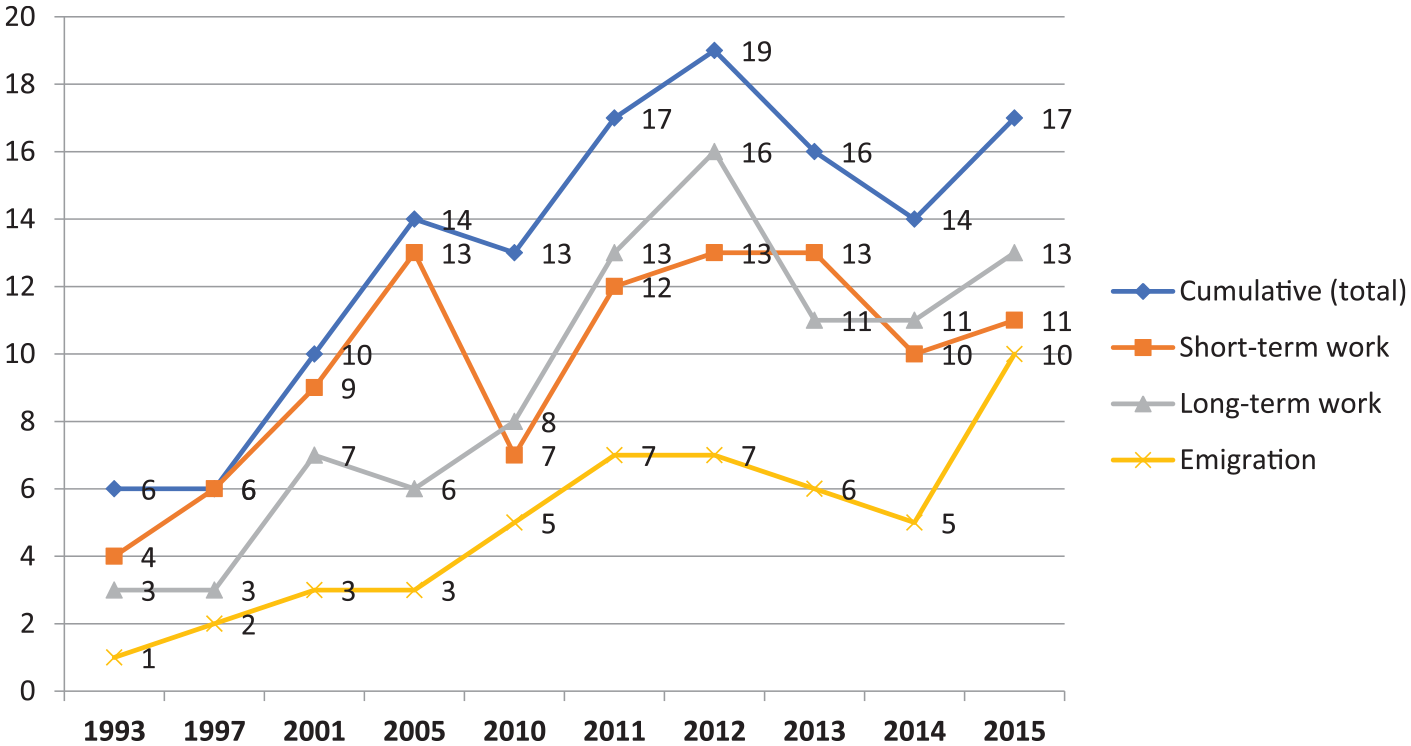
The Evolution of the Migration Intention from Hungary According to Planned Length of Stay Abroad, 1993–2005 (%)
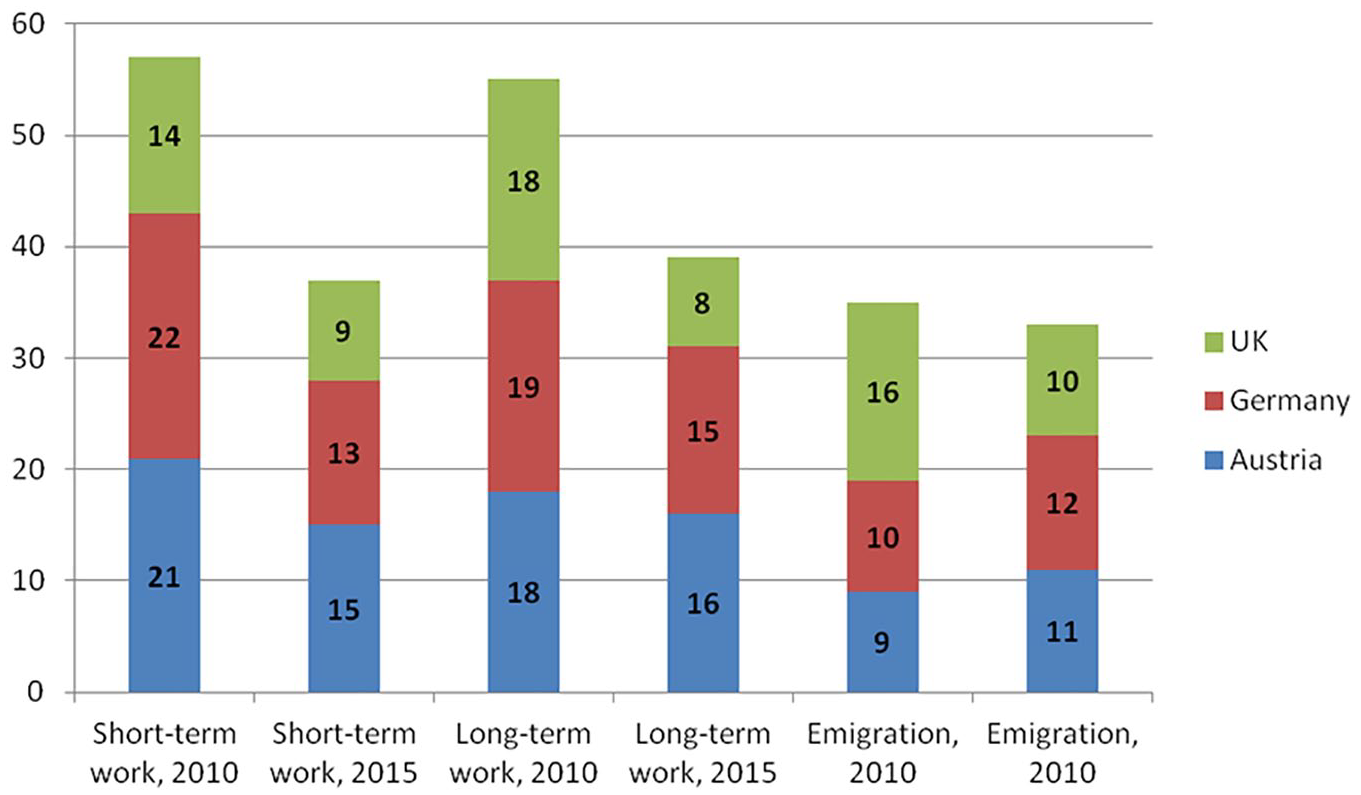
Preferred destinations for young people in Hungary willing to leave the country in a given period of time. Green: UK; red: Germany; blue: Austria.
At the same time, the two successive Polish governments, led by the center-right Civic Platform (PO) and since 2015 by the right-wing, nationalist Law and Justice Party (Prawo i Sprawiedliwość [PiS]), launched a series of aggressive and generous policy reforms designed to counter the negative demographic trends in this country. The latest initiative, started by PiS in 2016, the introduction of a new family benefit—the so-called 500+ program, until 2019 universally available only for the second and consecutive children under 18 years and means-tested for the first child, almost doubled national spending in this category of the welfare state to historically highest levels since World War II. We must also note that so far, this policy shift has coincided with measurable demographic changes. In July 2017, the number of births, including many second and third children in families, grew by 11.5% in comparison with 2016. 9 Out-migration flows have stabilized, with a small but noticeable reverse trend of some temporary migrants returning home. 10 In addition, Poland, like Hungary in this regard, is rapidly becoming a country of immigration, with hundreds of thousands of Ukrainian and Belarusian citizens moving west to the neighboring country in search of better-paying jobs and more comfortable living conditions. 11 Nonetheless, as concerns the most recent, and quite costly (higher than 3 percent of GDP in 2017 12 ), family policy measures, the fertility outcomes and long-term economic and political viability of the expanded social safety net for the young people in Poland remain in serious doubt.
This article’s goals are modest in scope since the problem under discussion is very recent, and the population dynamics in both countries has been extremely fluid and heavily politicized. I aim to explain the variation in policy responses to the immediate demographic crises (including low fertility and migration) between the two countries from 2004 until 2017. I argue that despite a certain ideological affinity between the contemporary conservative-nationalist governments in Hungary and Poland, their approaches to these problems and the decision-making processes have been dominated to a large extent by contrasting historical legacies, that is, the long history of maintaining a stable and quite generous family policy infrastructure in the former country and the traditional neglect of this segment of the welfare state in the latter. This explanation holds true at least until the 2010s. More recently, the current politics of social policy have contributed to the divergence in governmental responses by forcing the ruling parties to differentiate themselves from their predecessors in different ways, most visibly in Poland. The current governments of both countries framed the issue of demography or, as they define it, a “demographic emergency,” as the top priority of national survival, tied closely to the politics and ideology professed by the ruling parties, FIDESZ in Hungary and PiS in Poland. 13 As the political divide with their rivals, the moderate centrist Civic Platform and its newer offshoot, the Modern party (Nowoczesna), intensified in 2015–2016, the nationalist government of Prime Minister Beata Szydło in Poland (November 2015–December 2017) had a much higher incentive to introduce novel policy solutions and accelerate family support spending in a more dramatic fashion than its counterpart under Viktor Orbán. In Hungary, a stable societal consensus on a generous family protection system has solidified over many decades, leaving much less room for similar, more innovative reforms by any political party, left or right. In addition, the basic institutional continuity of the social policy–making process, involving a stable and well-entrenched coalition of actors, with only a token presence of insiders from nongovernmental organizations (NGOs), reinforced the status quo in this country whereas in Poland, since the early 2000s and following the first official recognition of the demographic emergency, a major change in this area has been under way.
The number of participants in the rapidly growing coalition calling for family policy improvements began to expand and encompass new actors from, for example, the office of the president, various activists of the Law and Justice party, individual experts, a handful of influential NGOs, and especially the effective, Catholic-affiliated lobby of the Large Families Association 3+. In consequence, when the new government took office after the 2015 elections, the ground had been prepared for more action on family policy, now perceived by all major political forces as an urgently needed response to the demographic problems. Indeed, examples of Poland and Hungary further amplify the conclusion reached by the Canadian sociologist Anne Gauthier 14 that among all factors, demographic considerations have been the only constant, and the most common, driver of family policy reform and innovation across Europe. Nonetheless, in the former country, political competition and polarization accelerated the reform process that had commenced under the previous governments. In Hungary, many crucial reforms had already been implemented before 1989, making it harder to produce much innovation beyond already generous tax credits supported by FIDESZ eager to please its core middle-class constituency. Now, in the absence of a significant political challenge to its rule, the Orbán cabinet proceeded to solidify its conservative family policy stance without major changes in spending or the composition of the existing range of benefits.
Theoretical Framework and Methodology
In this article, I draw on the long-standing tradition of small-n, comparative study of social policy making and comparative political analysis. 15 I use qualitative methodology based on content analysis of secondary sources, backed by primary materials such as interviews and local academic and nonacademic publications obtained during field research and online. I traveled repeatedly to both countries during 2009–2017 and collected relevant data from the European Commission and the national ministries responsible for family policy in Warsaw and Budapest.
The most current scholarship in this area has focused for the most part on the cross-national similarities rather than differences in policy such as the phenomenon of the unexpected expansion and growth of the welfare state during and since the Great Recession across the EU, with special attention to the benefits and services targeting working women, young families, and children. Much of the work on family policies in the region remains grounded in historical institutionalism, 16 but the newest comparative studies in the field at large highlight the significance of political factors, for example, the influence of party competition, party ideologies, elections, and women as political actors on behalf of gender equality. 17 Other scholars also point to the impact of additional, key political players, for instance, business groups and workers who form coalitions in support of more generous social policy measures on behalf of families and youth. 18
In recent years, Germany has led the way as the most surprising family policy innovator, surpassing many of its traditionally more generous neighbors, for instance Austria and France, in terms of the overall dynamics of welfare spending for cash transfers (parental leaves) and services (nurseries and kindergarten). Much of this progress, including unexpected policy innovation, has been attributed to political factors and, to some extent, also to a major ideological shift within the ruling conservative party (CDU-CSU) toward a more progressive vision of the family and women’s participation in the labor market. 19 Another, competing explanation, however, reminds us of the impact of historical legacies, and more precisely the complex history of German unification that resulted in creative blending of the social policy solutions to demographic decline inherited from both the former West Germany and the GDR, producing a more effective, and relatively generous combination of child-care services and cash benefits, that is, parental leave. The latter scheme, typical of the European, Bismarckian conservative welfare states, now coexists with expanded nurseries and kindergartens, in the past severely underdeveloped in West Germany but favored by the former communist rulers in the GDR. 20
The analysis of the German case illustrates the benefits of using mixed historical and political theoretical frameworks. A similar approach may also help us better understand the origins of Polish and Hungarian social policies, drafted and adopted in relation to the post-accession demographic crises described above. The two countries share with Germany their social policy roots in the Bismarckian tradition of the conservative welfare state. 21 Moreover, all three states are currently ruled by right-wing parties or coalitions of parties that espouse an ideological blend of market economics and state paternalism, with a heavy emphasis on the stable and generous social safety net. Finally, throughout the Great Recession, during 2008–2010, many European countries managed not only to preserve but also expand their family policy spending, partly in response to urgent demographic concerns. 22 Certainly, we must keep in mind that in contrast to its eastern neighbors, since 1945 the Federal Republic of Germany, as the largest and most prosperous EU member state, has been a country of immigrants rather than migrants. Nonetheless, its low fertility levels (1.39 in 2013) and a rapidly aging population (with the median age increasing fast, from 36.0 in 1994 to 46.5 in 2014) 23 create similar or even greater pressures on the government than we have seen in Poland and Hungary, where out-migration counts as another big contributor to the current population crises.
Hungary: The Limits of Experience
Hungary confronted its most recent, compounded demographic crisis of low fertility, aging society, and a sudden out-migration wave in a relatively privileged position, at least from the social welfare perspective. Since at least the 1930s, and again the mid-1960s under communist rule, this country has built a remarkable welfare state infrastructure in support of working women, families, and children. In addition to the paid, twenty-six-week-long maternity leave for young mothers, this set of provisions also includes two types of child care (parental) leave (GYES and GYED), also paid, lasting from two to three years, universal family allowances for households supporting children, almost universal kindergartens for preschoolers 3-6, nurseries for infants (now 16% enrollment in the group 0-3), and more recently also generous tax breaks for large families. All these programs combined have consistently placed Hungary in the forefront of family policy spending in Europe (ca. 3–4 percent of GDP), not far behind much wealthier western countries as France, Belgium, and Sweden, well-known as leaders in this segment of the welfare state. 24 Regardless, it appears that since 2010 the successive governments led by FIDESZ have failed to alleviate the deepening crisis with effective policy measures, while fertility rates remain stubbornly low and public opinion polls consistently show growing discontent and increased desire of young people to emigrate to the west (see Figures 1 and 2).
In Hungary, in the last decade, we can identify three major phases of policy reform that can be related to the ongoing demographic crisis. The first one, from 2008 to 2009, was initiated by the caretaker cabinet of Prime Minister György Gordon Bajnai. The second reform stage took place under the FIDESZ government, following the 2010 elections. The third, and the last, period of policy change commenced since 2014, under the second Orbán cabinet. Because the initial reform proposals were undertaken during the Great Recession, which hit Hungary particularly hard in 2008–2009, the Socialist-backed regime struggled to maintain a generous safety net that would privilege low-income families, individuals, and especially children. For example, a major reform proposal, titled “The New Baby Boom. Revolution of Middle Class Fertility” (Az Új Baby Boom. A középosztály gyermekvállalási forradalma) tried to combine different forms of assistance to the needy in one comprehensive, flexible policy proposal that would promote part-time employment, parental leave, child care, and affordable housing for young couples. These ideas, however, could not be fully implemented, largely owing to severe budgetary constraints, especially since Hungary had to again renegotiate its economic assistance package with the International Monetary Fund. In 2009, the Bajnai government, like the earlier attempt by another caretaker cabinet of Lajos Bokros in 1995, moved to reduce child care leaves, GYED and GYES, from three to two years. Women’s groups and middle-class families mobilized effectively against it and forced policy reversal on GYED, the program that had served most working Hungarian women from better-earning groups since the mid-1980s. 25 Nonetheless, the Socialist-backed government made concerted efforts to address the EU recommendations regarding social inclusion, gender equality, and especially child welfare protections—all now included in the Open Method of Coordination (OMC) process representing voluntary social policy agendas adopted by the new Member States since 2004. Prominent Hungarian welfare experts, many still active in policy circles with solid pedigrees dating back to the communist period, for instance Prof. Zsuza Ferge, hoped that this renewed attention to the poor and especially children, in cooperation with the progressive EU welfare agendas, would move the country closer to a social-democratic welfare regime, reminiscent of Sweden or Denmark. 26 These hopes however did not come to pass, mainly because of economic pressures but also largely due to the brevity of the tenure of this caretaker government and the historical legacies of the social insurance–based, conservative welfare state that never privileged low-income groups. 27
The March 2010 parliamentary elections returned FIDESZ to power with an overwhelming majority of seats, enabling the government to push through major constitutional changes. The Orbán government, taking advantage of the improved economic situation and emboldened by his newly acquired political standing, moved quickly to reaffirm state commitment to the conservative welfare state. This time the main goal was not only to continue to spend heavily on family support and thus address the perceived neglect of demographic issues by the previous regime but also to enshrine the ideological principles behind all this in the Hungarian constitution.
The first reform period under FIDESZ ushered in a major reorganization of the policy-making structure toward greater centralization of power in the national government and especially in the executive branch. In the next two years, the Family Policy Department of the newly created Ministry of Human Resources (Emberi Erőforrások Minisztériuma [EMMI]), 28 became responsible for the population policy measures. Yet in practice all power over budgetary allocations and even agenda setting for social spending moved to the Ministry of National Economy. Then, a year later, total control over this segment of the welfare state shifted directly to the Council of Ministers and the Prime Minister’s Office. 29 In terms of policy priorities, the new government upgraded and solidified the key elements of the traditional Hungarian family support, primarily the GYED childcare leave, now paid also to women in employment after the first year, the universal family allowance, maternity benefits, and tax relief for families. The two successive FIDESZ-led cabinets, however, differed substantially in terms of their emphasis on the type of support that was prioritized and the constituency that was supposed to benefit from it. As the new elections neared in 2014, tax breaks for higher- and middle-income families increasingly received more attention in the media and in actual policy-making. 30
Overall, we can conclude that the seven-year period of FIDESZ rule, 2010–2017, basically reaffirmed the traditional family safety net for the families in the shape and form in which it had existed historically since at least the 1960s (following the substantial upgrade in the 1980s). Because until the period of 2012–2013 at least, out-migration was not a major factor, the government remained convinced that conventional measures, now with more secure funding and the new emphasis on more generous tax relief, of most value to working middle-class families, would produce desired results, or at a minimum lead to some sort of stabilization of the fertility rate. In fact, the latter increased measurably from 1.23 in 2011 to 1.35 in 2013, approximately the level of 2000. 31 Still, in terms of the overall demographic picture, the situation continued to worsen, now also because of the most recent, unexpected out-migration wave that the authorities were refusing to acknowledge. In 2013, for example, the FIDESZ government scrambled to propose a few token emergency incentives to help young families during crisis but these initiatives were mostly shrugged off by young people who got hit especially hard by long-term unemployment, meager job prospects with only temporary work contracts, and often also by the fallout from risky housing loan defaults denominated in Swiss francs. 32
As concerns the politics of family policy as a response to demographic emergencies in the past, the Hungarian ruling elite, left and right, largely maintained the same course but with different emphases, depending on current politics and ideology. As we will see below, another crucial difference with Poland, aside from the contrasting attitudes regarding social support for the families, children, and the youth, has been the power and involvement of nongovernmental actors. In Hungary, only a handful of insider groups have been allowed to provide significant input into the decision-making process. Kimberly Morgan 33 and other feminist scholars, for example, have stressed the growing role of women’s groups and individual female politicians and activists in recent family policy reforms across Europe. Indeed, quite a few prominent Hungarian women have been involved in the policy-making process but mainly in subservient roles, and only occasionally as leaders of opposition movements, as we have seen above in the case of failed GYED cuts under Prime Minister Banjai. Under Orbán, for instance, Zsuza Kormosné, head of the Unit for Women’ Policies (Nőpolitikai Osztály), since 2014 withinthe Department of Family Policies of EMMI, and a mother of five children, has served as a lead expert of the Large Families Association (Nagycsaládosok Országos Szövetsége [NOE]), the leading nongovernmental group with considerable clout under all cabinets, and especially FIDESZ. In addition, Tünde Fűrész, Vice Secretary of State of Family and Population Policy, a mother of three children, just like the Secretary of State of Family and Youth, Katalin Novák, both have been at the forefront of the Hungarian campaign for the support of traditional families, not only within the country but in various European and international fora as well. Moreover, as the leader of the feminist umbrella organization the Hungarian Women’s Lobby, Borbála Juhász, told the author during an interview in Budapest, many proposed reforms received widespread media coverage that eventually helped organize joint protests of a wide range of organizations from the left and right to oppose the most controversial measures. These groups include, for example, the conservative Association of Hungarian Wives (Magyar Asszonyszövetség), the ex-communist Association of Hungarian Women (Magyar Nők Szövetsége), and left-liberal feminist organizations like Women Against Violence (Nők a Nőkért az Erőszak Ellen [NANE]). 34
Regardless, under FIDESZ, electoral politics, boiling down to the maintenance and defense of the well-entrenched policy consensus against real or imagined attacks from the left, largely held sway. In the meantime, the centralization of decision-making power over social policy in the executive and the Prime Minister’s office allowed little room for outside input, except from well-entrenched insiders such as the Large Families Association (NOE). As several scholars have noted, this situation has been quite common in many former communist states of Central and Eastern Europe where only a few civil society organizations can exert meaningful influence on crucial policy decisions, outside regular political party channels. 35 In this regard, however, Poland provides a striking counterexample of both bold policy innovation, with real short-term gains, but also more complicated politics of social policy where nongovernmental actors had exerted much considerable influence, at least during the first, and the longest, period of family policy reforms initiated before 2016.
Poland: The Opportunities and Risks of Novelty
Poland offers a rather remarkable and contrasting case of a country with virtually no previous history, prior to 2000–2007, of significant demographic problems in the postwar period. This is arguably one of the major reasons why past or present regimes never felt much need or sufficient domestic political pressure to commit substantial resources to the creation of a satisfactory and reliable social safety net for families, youth, and children. Before 2011, for example, Poland seldom spent more than 1 percent of its GDP on all family-related benefits and services combined. The rare exceptions occurred only during severe political and economic crises that forced the authorities to quickly adjust wages and quell public unrest by using family allowances as a direct and effective transfer of money to the population. This happened during the workers’ unrest in early 1971, under martial law in 1982–1983, and again during the regime transition in 1990–1992. 36 Nonetheless, the sudden drop in fertility rates in the early 2000s, in combination with the unexpectedly high out-migration of primarily young people to the west in 2004–2007, created substantial pressure for policy change. Indeed, the year 2007 is now widely regarded as the turning point when the Polish minority government, controlled by the Law and Justice party, issued the first official, national family policy agenda, 37 motivated by the perceived “demographic emergency.” 38 This situation was first acknowledged seven years prior, in 2000, but no major changes in policy took place until after the fall of the liberal-left coalition and the resurgence of the post-Solidarity political parties.
In contrast to Hungary, however, the Polish example demonstrates a clear attempt to break with the past and offers young people a much better social safety net than anything available to previous generations, in terms of both the quality and the quantity of programs and services available. In fact, the contemporary competing political forces, the center-right led by the Civic Platform party (PO) and the nationalist right led by Law and Justice (PiS), have shared, and continue to share today, a firm commitment to this course of policy change, proposed initially by the 2007 agenda. However, as the crisis got progressively worse, the economy slowed down during the 2008–2010 Great Recession, 39 and the competition between the two major post-Solidarity parties intensified, the two political rivals started to diverge in their approaches. The 2007 Family Policy Program (Rządowy Program Polityki Rodzinnej), adopted by the first Law and Justice cabinet, envisioned a steady but gradual expansion of cash benefits (maternity and parental leaves) and a stable but slow injection of new money, partially supported by EU grants, for childcare. This approach predominated approximately until 2015, under two successive governments led by Civic Platform. Meanwhile, as Law and Justice prepared for the next round of parliamentary elections, their family policy agenda became more aggressive, proposing large spending increases. 40
Thus, when the Polish government initially decided to prepare and implement a long-awaited, decisive policy response to the widely recognized population emergency that had been building up for a decade, it did so in a manner reminiscent of many previous crises. Timing made a big difference in this decision that occurred in quite different but equally, if not more, challenging political and socioeconomic circumstances and shaped the government policy response. In other words, historical legacies of cyclical policy adjustments in family policy have been the norm in Polish decision-making, meaning the temporary allocation of limited resources to this sphere of the welfare state and rarely involving any comprehensive reforms beyond traditional social insurance (maternity support, birth grants, and child care leaves). 41 In a similar fashion, now, at the time of demographic, rather than economic or political, pressure, in 2007–2011 maternity insurance also became the focus of reform, with a major extension of paid leave for new mothers to 22 weeks (2010) and eventually to 26 weeks (2013), with full pay.
After the fall 2007 elections, as the migration crisis intensified, the new government run by Civic Platform under the two prime ministers Donald Tusk and Ewa Kopacz picked up on the key elements of the 2007 Family Policy Program drafted by its predecessor and the main competitor, Law and Justice (PiS). During their eight-year tenure, 2007–2015, they took several additional steps toward a more substantial improvement in the social safety net for families and young people. For example, they moved to introduce a new benefit for mothers based on the extension of the available maternity leave to a full-year, an extra 26 weeks, of parental leave that could be shared in different increments by both the mother and the father. This payment, and the leave period granted by an employer under the same provision, can now, beginning in 2014, also be collected by previously excluded groups, such as students and noninsured parents, for instance farmers.
At the same time, however, the Civic Platform government worked closely with the European Union to ensure Poland’s compliance with EU recommendations concerning gender equality, meaning special attention to so-called life–work balance circumstances to promote female employment. This meant that Member States committed themselves, voluntarily under the OMC (Open Method of Coordination) meetings of the relevant ministries of labor and welfare, to develop better childcare options and promote fathers’ greater involvement in child rearing. 42 Hence, beginning in 2008, relatively modest, but still significant, resources were directed toward the construction of new nurseries, the implementation of novel regulations granting government support (social security subsidies) for private nannies, and most importantly to the expansion of kindergarten services. The latter showed the most progress, with almost 75 percent of Polish children over three years old attending kindergartens in urban areas; this number is much closer to Hungary, which always surpassed Poland in this category of family policy. 43
Up to this point, we could argue that Hungary and Poland had each followed a separate trajectory of historically determined family policy development that remained firmly path-dependent, according to specific national traditions. The former country relied on its generous social safety net to maintain and upgrade benefits targeting young people and their children while the latter refrained from radical steps and kept its spending within the same segment of the welfare state at a relatively modest level. Yet this situation changed drastically after 2015, the year of consecutive presidential and parliamentary elections in Poland, both eventually won by the Law and Justice party (PiS). Therefore, given the latest developments, it is no longer sufficient to rely on a historical explanation 44 alone to explain the variation in policy-making between the two countries.
In contrast to Hungary, in Poland the politics of family policy making, now framed by the party leaders and the media as de facto politics of demography or population policy, has been shaped by two powerful competitors represented by a handful of key officials at the highest levels of the government. First, in 2013, as he prepared to launch his campaign for the second presidential term, President Bronisław Komorowski introduced his own Family Policy Program (Prezydencki Program Polityki Rodzinnej). Long serving as a “bridge” between liberal and conservative factions within the PO, Komorowski, sensing shifting political sentiments, moved decisively to the right with his policy proposals. Second, he reached out to the expert community and civil society, in response to growing societal pressures to adopt more decisive policy measures to counter the mounting demographic crisis. The President set up an advisory group, with broad-ranging representation of liberal but also conservative economists and social policy advisors. Moreover, by 2010, he had already developed close contacts with the Large Families Association 3+ (Związek Dużych Rodzin 3+), the Polish equivalent of the Hungarian NOE (established in 2003 in close association with the Catholic Church), 45 and in 2014 he signed a parliamentary law that increased income tax deductions for children by 20 percent. 46
From today’s perspective, following the unexpected victory of PiS in both the presidential and parliamentary elections, we might say that this situation paved the way for future, much more far-reaching, family policy reforms. Nonetheless, when the Law and Justice party ran its aggressive campaign accusing its opponents, including President Komorowski, of failing to do enough for families, few observers anticipated that they would succeed. In early 2015, beginning from the presidential campaign of Andrzej Duda, and following the parliamentary race of other Law and Justice (PiS) candidates in the fall, this party, under the leadership of Jaroslaw Kaczynski, unveiled its signature proposal called “500+.” 47
This new benefit, modeled in part on similar payments granted to families with children in western Europe, including the favored migration destinations for Poland—the United Kingdom and Germany (Table 1), was eventually adopted in April 2016. It granted each family with two or more children a monthly benefit, tax free, at the amount of 500 zloty (ca. 120 Euros). In government parlance, it was referred to as a “child-rearing benefit” (świadczenie wychowawcze) to distinguish it from the social insurance and workplace-related, preexisting benefits such as the conventional, means-tested family allowance (zasiłek rodzinny) and an addition to the allowance, also means-tested, for mothers taking time off work to take care of young children for up to four years (zasiłek wychowawczy). All previous payments, usually based on social insurance and often income-related, remained in place but now many families, 3.2 million in total, received a fresh injection of cash that in fact represented the equivalent of a sudden pay raise. Families with one child under eighteen and single mothers with a lone offspring also qualified for this payment but only if their income fell below 800 zloty (200 Euros) per person within the household. In spring 2019, in anticipation of the upcoming parliamentary elections scheduled for September, the legislature (Sejm) overwhelmingly supported a major extension of this scheme to cover first children, regardless of the financial situation of the parents. The payment of the benefit was scheduled, prorated for three prior months, to begin later in the summer. This law will now cover 6.8 million children at the cost of 43 billion zloty (ca. 10 billion Euros), up from the 23 billion annual expenditures allocated so far. 48
Just a few months after its initial implementation, the government released the first data and called the 500+ scheme a resounding success. Indeed, from a welfare perspective, arguably Poland has never seen any similar upgrade in family support implemented so quickly with such wide-ranging consequences. By July 2016, for example, 3.2. million Polish families applied (mostly online) to receive this payment and 2.7 million children were receiving the benefit every month at their local municipality (financed by the central budget, and in addition to other, means-tested assistance). This number represented approximately 47 percent of all children in Poland below the age of eighteen. 49 According to various estimates, relative poverty in the country (before 2016 the EU data indicated an average poverty rate in Poland at 7.4 percent) dropped by as much as 20 percent in 2016 50 and, among children—clearly the most vulnerable group—by as much as 50–70 percent. 51 In sum, large families, with three or more children, and those with lower incomes seem to have benefited the most from this reform. We must mention however that these types of families have been the most vulnerable and arguably suffered the greatest deprivation during Poland’s rocky transition to capitalism. 52 Yet at the same time, these are not necessarily the same people who tend to migrate overseas or the ones who postpone having children or choose to remain childless. We must note that during the same period new births increased only slightly, by just 15,000. 53
As mentioned above, in her analysis of the equivalent, and often much less generous, family policy reforms in western Europe, Kimberly Morgan, American political scientist and leading expert on family policy, emphasizes the growing role of women, as politicians and activists, in shaping important changes in the welfare state that preserved essential benefits during the Great Recession. 54 However, as we have already seen in the Hungarian case, we can only partially validate these claims. Indeed, in Poland many women experts and executives at the highest political office—the main moving force behind the 2007 Family Policy Program, Joanna Kluzik-Rostkowska (of PiS and later PO), the current president of the Social Insurance Institution, Gertruda Uścińska, and the leader of the Large Families Association 3+, Joanna Krupska, for instance—have all made substantial contributions to the gradual buildup of a better social safety net for Polish families since the EU accession. In fact, they often paid more attention, unquestionably under European influence and with substantial financial assistance from Brussels, to gender equality and women’s employment, and to some extent also to social inclusion (poverty). Nonetheless, we would be hard-pressed to give them credit for any radical breakthrough in terms of the perceived demographic crisis, and especially when we analyze the dynamics behind the most recent acceleration of family policy reforms, that is, the move toward generous, middle-class tax credits in Hungary and the 500+ program in Poland.
In this area, very much politicized since the heated Polish election campaign of 2015 and influenced by a growing ideological divide within the country, the leading male conservative politicians have monopolized policy-making, not only to the detriment of women but also civil society more generally. In fact, beginning with the first presidential family policy plan launched in 2013 by Bronisław Komorowski, we can already notice not only a definitive political and ideological shift to the right in this regard but also a much greater concentration of decision-making power in just a handful of persons at the highest political level. Today, in fact, in Poland, just as we saw previously in Hungary at a much earlier date, the population agenda and related policy responses, including the signature program 500+, are shaped in much detail at the very top. In Warsaw, however, unlike in Budapest, this involves the leadership of the ruling party, Law and Justice chairman Jarosław Kaczynski and his entourage, and not the other key executive leaders, the former Prime Minister Szydło or President Andrzej Duda. The current president in fact used the demographic crisis only briefly during his campaign for office and since then has yielded the initiative totally to the leading parliamentarians from PiS and their governmental allies in the executive branch. 55
Conclusion: The Triumph of Novelty over Experience?
Since the early 2000s, Poland and Hungary have been experiencing similar demographic challenges, caused mainly by declining fertility and, more recently, increasingly by out-migration of their, mostly young, citizens to the better developed Member States of the “old” European Union, mainly Germany and the United Kingdom. The two countries have drafted and implemented several measures in family policy that were at least in part intended to stabilize and even reverse population decline. At the same time, Hungary and Poland pursued unmistakably divergent courses of action in this domain. As a generous welfare state and a European leader in family policy, Hungary chose to augment existing benefits and services, with more emphasis on tax relief and only token attention to EU recommendations such as gender equality, for instance. In contrast, Poland increasingly introduced more innovative family policies, first in a gradual and fiscally conservative fashion, but since 2016 much more aggressively, doubling or even tripling its spending on young mothers, families, and children.
In my initial argument I assumed, based on previous research into the history of the two welfare states and relevant policy-making trajectories, that this variation in policy responses could be explained by examining the impact of the legacies of the past or, in other words, by analyzing the path-dependent expansion of a welfare state that continued to exhibit constant, basic characteristics. Hungary would remain a generous spender on family policy and Poland would follow a much more gradual approach, increasing expenditure in this category on a limited scale, solely to address immediate challenges with minimal impact on the national budget. Nonetheless, the acceleration of the Polish reforms, exemplified by the introduction of the 500+ benefit for families with children, has made it more difficult to explain such a dramatic policy change in a narrow fashion, within the traditional framework of historical institutionalism. In addition, on close examination, we can notice an unprecedented increase in political and ideological polarization in both countries that spills over into social policy decision making in ways unseen before.
Hence the explanatory framework that best captures the total dynamics of population policies in the two countries appears to be a combination of a historical-institutionalist and a political approach. The latter helps us to better account for the paradox of policy variation, on one hand, and explain the simultaneous divergence in politics of the two countries, on the other. In practice, this has meant the progressing concentration of decision-making power in the hands of just a handful executive officials and the exclusion of experts such as many women with feminist convictions on the left and the right, and of civil society, broadly conceived. Admittedly, the latter has been much stronger and more involved in welfare state affairs in Poland than in Hungary but this influence had already peaked under the previous government by Civic Platform (PO) and has significantly declined ever since.
Timing and sequencing of family policy reforms in both countries also deserves our attention. Undoubtedly, in Poland the emergence and official recognition of the phenomenon of population decline in 2000, coupled with the onset of mass out-migration since EU accession in 2004, served as an important “trigger” for action, regardless of ideology or politics. Hungary, in contrast, lacked the same incentive for policy innovation during this period. In this country, demographic problems became the “norm” a long time ago, rather than a new crisis, as perceived in Poland. Furthermore, sequencing of the Polish reforms, a gradual reform phase followed by a second, more aggressive stage of changes also made a difference, fitting into the general pattern of the “emergency” cycles of social policy development in postcommunist countries. 56 In the case of Hungary, we witnessed instead a more stable continuation of reforms within the established conservative framework. In other words, the demographic challenges became institutionalized to a much greater extent than ever before FIDESZ took power. The fact that Orbán cabinets followed a series of unsuccessful liberal and socialist reforms that targeted family policy made further experiments in this area less likely. Nevertheless, in 2019 the Hungarian government announced a new series of measures to subsidize large families with children, including a car purchase subsidy, housing assistance, tax exemption for mothers of four and more children, and special provisions for grandparents as caregivers to children. 57 These provisions increase family policy spending (by ca. 500 million Euros) but not as much as we witnessed in Poland. They also signal continuity with the past in terms of the gradual expansion of the conservative welfare state, unlike Poland where PiS skillfully built up the new extremely generous scheme on top of the previous agenda developed during 2007–2015.
Finally, we can raise the question about the future trajectory of policy responses to the demographic problems that refuse to go away. The fiscal burden of social expenditures has been equally troublesome in both countries for some time, but Hungary has been more used to the maintenance of its heavy commitment to the families and is unlikely to change its attitude soon. Poland however has pursued family policy innovation with great success so far, since approximately 2011–2015, largely also thanks to its continuing better revenue situation, and healthy economic growth backed up by a huge influx of European funding for infrastructure and regional development, including many areas related to social policy such as childcare facilities and training of personnel. The question remains whether the country will be able to uphold this generous social safety net simultaneously for the elderly (pensions) and the families. If and when the tide turns the other way, as many economists predict may happen quite soon, 58 Poland may yet return to its traditional cyclical fashion of temporary policy expansion, followed by an equally sudden reversal of improvements in the well-being of families from all social strata.
