



Abstract
This article answers the question how the situation of incorporation of Central Pomerania, formerly a German region, into Poland in 1945 affected the formation of its commemorative landscape. The author discusses how this affected the erection of new monuments after 1945, and if the example of German Great War memorials, erected here after 1918, had an influence on new Polish commemorative practices. A “competition of memories” is used here as the analytical tool. It is understood as a phenomenon that occurs in areas where two cultures are superimposed on one another, so primary commemorations are copied, employing the structures of the existing memorials, to produce secondary commemorations. Through an analysis of archival and fieldwork materials, the author examines the social practices of memory. The case studies are memorials recycled for commemorations connected to the Pomeranian Line and mythology of “recovery,” legitimising the incorporation of Central Pomerania into Poland.
Keywords
Monuments commemorating World War I were erected in all the countries of Western Europe, which had suffered particularly heavy losses. British war memorials, 1 French monuments aux morts, 2 and German Kriegerdenkmäler 3 were all part of the “orgy of monumentalization” 4 that swept across Europe and the United States 5 after the hecatomb of the years 1914–1918. These monuments after 1945 were frequently submitted to recycling practices, and new plaques and titles commemorating the victims of the next war were added to them. The situation of the monuments in the Polish “Recovered Territories,” however, is quite exceptional. After 1945, these regions, formerly part of Germany, were incorporated into the new Polish state. The newly acquired areas included regions such as Pomerania, Masuria and Warmia, Lower and Upper Silesia, as well as the Lubusz Region. All these regions had little in common, since their local (German) culture, geographic specificity, and status within the German Reich differed. 6 They were unified in a symbolic way as the “Recovered Territories” by People’s Poland’s propaganda and politics. As a result of incorporation, the German war memorials that had been erected on a mass scale during the interwar period were now a part of a landscape belonging to a different country and a society of a different sensibility and historical memory.
My article aims to answer the question how this situation affected the formation of the commemorative landscape of one particular region in the “Recovered Territories,” Central Pomerania; whether, and if so, in what way it affected the erection of new commemorative monuments after 1945; and to what extent the example of German war memorials had an influence on the shape of new Polish monuments and commemorative practices. I use the term “Central Pomerania” to mark the territory of former Koszalin voivodeship that was first established in 1950, since the “recovered” part of Pomerania was in the beginning within one sizeable voivodeship of Szczecin, and later on divided between Szczecin and Koszalin. Local forms of commemoration, as well as policy toward the monuments, differ in the regions of Szczecin and Koszalin. The term “Central Pomerania” can be found until this day in names of local institutions, such as the Museum of Central Pomerania in Słupsk, or even in political discussions on the administrative division of Poland. 7 In most cases, the term “Pomerania” refers to areas under the influence of Szczecin, leaving those parts nearer Koszalin a blank page. In this article, whenever the term “Pomerania” is used, it refers to the region of Szczecin and Koszalin, not Gdańsk, as is sometimes the case in Polish.
The detailed analysis offered in this article concerns the period after 1945. It discusses the transformation of German war memorials erected during the inter-war period and their connections with the construction of new monuments commemorating the battles fought to break through the Pomeranian Line (Pommernstellung) after 1945. I proceed from the assumption that it is not only historical events as such but also the ways of commemorating them that merit scholarly examination; in this way my article makes a contribution to current research in the history of commemoration. 8 I focus on the fate of war memorials erected after 1918 in those parts of the German Reich that, according to the decisions made at the Potsdam conference, were incorporated into the newly created People’s Poland after World War II. Until 1945, the majority of the population inhabiting the so-called “Recovered Territories” identified themselves with German culture. Communist Poland developed a range of arguments aiming to explain why these areas, which in fact had been a kind of compensation for the loss of extensive Polish territories in the east, incorporated into the USSR, were now within its borders. The myth of the “Recovered Territories” created for such purposes presented the formerly German areas as “returning” to Poland after nearly a thousand years. 9 Legitimising the incorporation of the “Recovered Territories” was one of the major factors behind the commemorative activities undertaken in Poland after 1945, as discussed here.
The situation of Western and Central Pomerania was quite exceptional. It was the region where the settlement was least successful and the rhetoric of “recovery” had to be created either by connecting with the distant past or by mythologizing the recent war events. Therefore, on the one hand, some historical events that were brought back to life and blown out of proportion for the sake of creating a Polish historical narrative for the “Recovered Territories” and for the new inhabitants to identify with, considered mostly the distant “Slavic” past of the regions, including the battle of Cedynia in 972; 10 the tradition of the early eleventh- and twelfth-century Polish states of the Piast Princes Bolesław Chrobry and Bolesław Krzywousty, which included Western and Central Pomerania; or the presentation of the Pomeranian dynasty of the Griffins as a Polish dynasty. 11 On the other hand, it relied on consecrating the battles fought to break through the Pomeranian Line in 1945 as the recent founding myth of Central Pomerania. The Pomeranian Line was a line of fortifications guarding the eastern border of the Third Reich, extending from the Baltic Sea in the north to Festungsfront Oder-Warthe-Bogen in the south. Completed after Hitler’s rise to power, it had a significant symbolic potential apart from its actual strategic role, and was important in German propaganda. It was presented as the eastern equivalent of the Maginot Line, designed to put up long and effective resistance to attack. 12 Ironically, this rhetoric also served the interests of the opposing side: the breach of the Pomeranian Line was to be the last obstacle on the Soviet and Polish way to Berlin. Consequently, after 1945, the Polish authorities decided to use the battles of the Pomeranian Line as the main element of the strategy of commemorating the Polish fight for Central Pomerania. In this way, it became one of the founding myths of the newest history of the “Recovered Territories,” being an example of mythologizing recent historical events especially important for the region under discussion.
Poland was a country where the memory of World War I was a marginal phenomenon, and the war itself was treated as a war of independence, a view quite different from the way it was perceived in the West. 13 Such a country, which practically did not have any commemorative monuments connected with this historical catastrophe, 14 suddenly acquired a great number of Great War memorials. These constituted a challenge for the new settlers of different ethnicities and cultures arriving in the region after 1945: the so-called repatriates, population resettled from the Polish territories that became part of the Soviet Union after 1945, people from the neighbouring regions of Greater Poland and Cuiavia, and Ukrainians resettled from south-eastern Poland in the course of Operation Vistula (1947). The monuments did not belong to the familiar elements of a cultural landscape. The settlers faced the challenge in their own way, not only destroying the monuments but also “recycling” them; thus, the situation cannot be seen as a simple case of damnatio memoriae. 15
After the takeover of the “Recovered Territories,” works on the displacement process as well as re-settlement were published, but the German material legacy and its treatment by Polish authorities and society has attracted significant research, especially during the last twenty years. The overview of the process in different parts of the “Recovered Territories” as well as in other regions with a strong presence of German culture 16 stresses on the one hand the rupture of cultural continuity and on the other adaptation of different parts of the German heritage by the new settlers. 17 It has also been studied in specific regions, such as East Prussia 18 or in particular cities like Gdańsk/Danzig, 19 Szczecin/Stettin, 20 or Wrocław/Breslau. 21 Although the processes described there, such as the “de-Germanisation” policy 22 —which was connected with seeing the German culture of the “Recovered Territories” as “imposed by German occupation” 23 and resulting in efforts to eradicate it—as well as adaptation of elements of the cultural landscape and erection of new memory sites are to be found in Central Pomerania, it is also apparent that the region has attracted less research attention. Therefore, we should also bear in mind that what is visible at the macrohistorical level, can not necessarily be shown in the example of Central Pomeranian policy toward German monuments.
The Competition of Memories
The phenomena described here concern different forms of shaping historical memory. I understand it as a type of cultural memory relating to the past of a given group, reconstructed in accordance with its current needs by the historiography that the group endorses. Such memory invokes figures and sites of memory crucial for the creation of the identity of the group as a historical community. 24 In the case under discussion, soldiers, especially the fallen, and their cult will be seen as the primary figures of memory. 25 The centenary of the Great War and the interpretations concerning its longue durée and its impact on ways of remembering is conducive to undertaking this subject, adopting new perspectives and new analytical tools. 26
My interpretation is based on the study of archival materials and on the results of field studies. During archival queries, I have examined documents from the National Archives in Koszalin and Szczecin produced by local groups (correspondence of settlers, private materials, and reports from the local gatherings of self-government), as well as by officials (official documents issued by the Ministry of Recovered Territories and other official bureaus, documents issued by counties and voivodeship, documents of the Union of Fighters for Freedom and Democracy [ZBOWiD] and Socialist Youth Association [ZMS], scouts, and others). My field studies consisted of finding “recycled” monuments, documenting them and—wherever possible—interviewing local inhabitants about their fate. The research was undertaken in 2017–2018 in Central Pomerania in seven counties. 27 I proceed from the assumption that the “field” constitutes the source and primary object of research. I use the material to show the bottom–up and top–down strategies of shaping the newly emerging collective memory of the Polish settlers after 1945. 28 This took place within the frames of memory imposed by the higher authorities of an authoritarian state, whose sovereignty was severely curtailed. The frames of memory, as Maurice Halbwachs observes, allow the individual to reconstruct the past, thus making it possible to form a sense of continuity and relationship with it. 29 For memory is constantly reinterpreted in order to shape and maintain the identity of the group. 30 In this case, the frames of memory under discussion operated in Poland in the years 1944–1989, and the groups, which created the archival materials I analyse, functioned within the realities of the communist system, even if some cracks in the official version had already begun to show. In addition, the shifts affecting Central Pomerania illustrate the phenomenon of the competition of memories, which I would like to propose as an interpretative category.
I define it as a phenomenon that occurs in areas where two cultures are superimposed on one another. As a result, not necessarily consciously, 31 a coherent code of primary commemorations, 32 which derive from a different culture, is copied or imitated, often in a creative way, employing the material and spatial structures of the existing memorials, to produce secondary commemorations. The competition of memories has a temporal and processual dimension, comprising the following two processes. The first involves the use of the existing memorials and adds another layer of meanings to those already accumulated; in the second, a layer of memory is cleansed in order to produce a “clean” memory of the new community that has replaced the one that used to inhabit a given territory. In the case of a radical demographic change, there is a need among the new group re-settling a given territory to create its own “monumental landscape” as a background for its myths and commemorations, resulting in the eradication of previous commemorative spaces or their recycling. 33
The actors taking part in the process of commemoration can be divided into those operating at a higher level (the state) and the grassroots level (the settler communities). Sometimes, they may share the same interests, as was the case especially in the second half of the 1940s. Likewise, the competition of memories can have a spontaneous (bottom–up) or planned (top–down) dimension. The reasons why such a practice was done, differed: it could be purposeful destruction as a part of the “de-Germanisation” policy, but also the need to use existing materials because of a lack of funds for a new commemorative object, or misinterpretation of the meanings inscribed in these elements of cultural landscape that could be seen as “hostile,” “unknown,” or just “different.”
The term “competition of memories” itself is not new. It appears in the context of the comparison between the suffering caused by Nazi and communist rule in Central-Eastern Europe, 34 the competing memories of the suffering of the Holocaust, 35 or in the context of the relations between an ethnic or religious minority and the majority. 36 However, it has not been used in the meaning and context that I propose here. The approaches adopted so far only consider the competition that concerns the situations of direct confrontation of the commemorating groups. Thus they do not take into account situations where the competition of memories takes place when one group is no longer present in the space and is represented only by the objects that used to commemorate one set of events, and under new circumstances comes to commemorate another. The existing conceptualisations do not show how in such situations the new forms of commemoration may be inspired by the old ones; neither do they consider the influence of the phenomenon of competing memories on the shaping of the commemorative landscape of a given area. The tool I propose makes it possible to interpret this type of relations, especially in areas with a complex past, which have undergone a shift of borders and radical demographic changes, as well as to see memory as a material shaped by the state for its political and ideological purposes.
The Chronology of Alternations
It is important to note the chronology of alternations done to the German Great War memorials, as the development of Polish memory culture in the “Recovered Territories” underwent distinctive political phases and turning points: the “integration” phase between the years 1945 and 1949, the “legitimization” phase of 1950–1970, and the “relaxation” phase from 1970 onwards, 37 connected with the attitude of People’s Poland toward “Germans” that also underwent significant changes. 38 The chronology is also a valid tool when it comes to the cult of the fallen soldiers in People’s Poland. 39 I would want, however, to emphasize that the actions suggested on the level of state policy do not have to be visible on the level of the region under discussion and it is important to “understand the local perspective” without seeing the region from any central perspective, 40 as well as that the specificity of different parts of the “Recovered Territories” should be borne in mind. 41
Although during my field studies in Central Pomerania I found German war memorials that had undergone alterations in the second half of the 1940s, there are no records documenting such activities in the region in the local archives. At the time, the new settlers were mainly concerned with questions of the economy and organisation of local politics and administration, rather than with the remnants of German culture. Since the treaty of Zgorzelec in 1950 between People’s Poland and the GDR, which recognized the Western border of Poland, and the de-Stalinization process after 1956 that led to a public discussion about the problems in the “Recovered Territories,” the official state policy shifted from attempts to internally assimilate and legitimize the Polish presence in the region to external legitimization by East Germany and even the Roman Catholic Church, and a recognition that government and society needed to invest in the Polish identification with the “Recovered Territories.” 42 However, these attempts were more visible in the region only during the 1960s, with greater interest in introducing symbolic changes to the environment in Central Pomerania. From the grassroots perspective, the 1960s were a time of relative stability, and fears that “Germans will return” abated, even if official propaganda still kept fuelling such anxieties. 43 Such interest was also grounded in propaganda campaigns, that is, the top–down perspective. The year 1965 was officially proclaimed the “Year of Western Pomerania,” including the two then-existing provinces of Szczecin and Koszalin. The year 1966, in turn, marked the climax of the six-year-long celebrations of the Millennium of the Polish state—counted from the first historical mention concerning the state of Prince Mieszko I in 966—which also was one of the political struggles between the state and the Roman Catholic Church that wanted to celebrate the Millennium above all as the date of the baptism of Mieszko. 44 The settler communities felt a growing need to make sense of their presence and confirm their faith in the Polish future of these areas. This function could have been served both by the initial “quick alterations” of German war memorials made as part of the “de-Germanisation” policy, which sometimes constituted the basis for the construction of the local identity of the region before 1950, and the later carefully planned forms of commemoration, such as the commemoration of the Pomeranian Line, designed to connect tourism and martyrdom. It was meant to link the natural resources of the region, such as postglacial landscape features, and their role in the battles to break the Line.
After Willy Brandt’s visit to Warsaw in 1970 and the recognition of Poland’s postwar western border by Western Germany, the government’s anti-German propaganda was challenged. The “relaxation” phase meant that commemorations mainly planned as anti-German no longer played that role. In the region under discussion, it resulted in ceasing to use the spaces created a decade before. From the beginning of the 1970s it became clear that there were no longer financial resources available for wide-ranging commemorative projects in Central Pomerania. As a result, despite the existence of designs and mock-up models, the continued demolition of old monuments (motivated by their bad state, lack of aesthetic value or inappropriate character of the memorialisation) did not lead to the intended outcome, that is, the construction of new monuments. Lack of funds meant that some places were left without any memorials at all. This happened, for example, in Sypniewo (Ger. Zippnow), where the old monument (Figure 1), built in the place of and from the materials of the German war memorial, was dismantled after 1968, before it turned out that there were no resources for the construction of a new one.
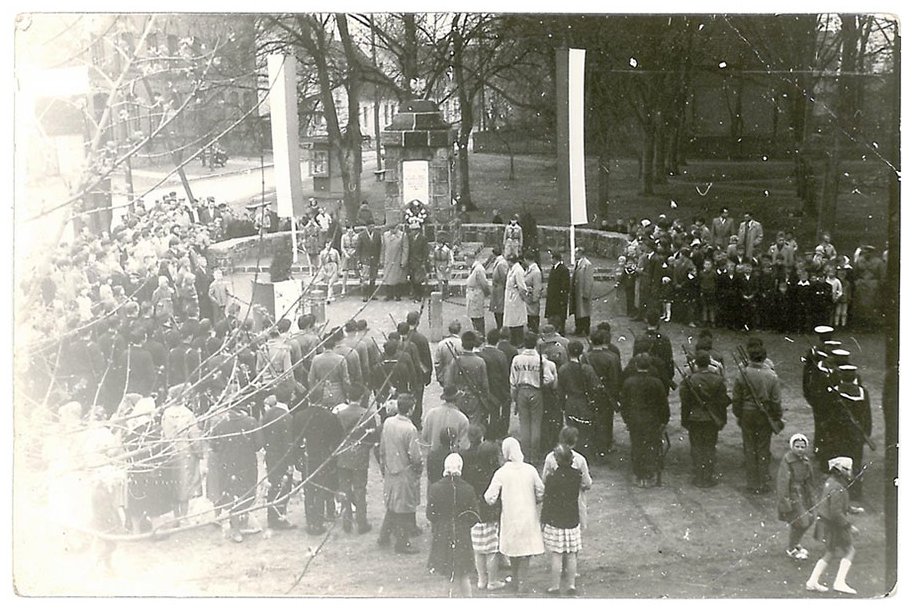
The “recycled” German Great War memorial in Sypniewo. It served as a local monument commemorating the “liberation” of the village until it was dismantled after 1968. Photograph courtesy of A. Samsel (one of the interviewees during the fieldwork), from her private archive.
Memorials as Recyclable Objects
From the start, war memorials in Central Pomerania: monuments, commemorative plaques, stones, or the heroes’ groves (Heldenhaine), 45 were a peculiar material moulded to reflect the accumulating layers of memory. As early as 1919, the central authorities of the Weimar Republic suggested that instead of building new monuments, the existing ones should be used as models, or better still, they should be adapted to serve a new function as World War I memorials. In this way, a new layer was superimposed on the commemorative monuments of the previous wars of independence and unification (1813–1871). Consequently, their function was first to consolidate the newly unified state, 46 and then to bring people together in the commemoration of shared trauma, consoling the mourning families and mollifying those frustrated by the defeat. 47 What was new in the case of “recycling” the monuments in Poland after 1945 was that they were taken over by the new groups, not always conscious of the history and meaning behind them.
As a result of their “compound” nature, such memorials are sensitive to historical developments and flexible when it comes to constructing, in a literal and metaphorical sense, new layers of memory superimposed on the original basis. In this case, the memorials are both sepulchral and military; hence, their religious and political context is equally important. 48 Although the transformation of meanings conveyed by monuments usually preserves at least one of such contexts, 49 it also makes it possible to trace the operations performed on the collective memory of the new communities of Polish settlers after 1945. The makeover of a memorial, as well as the alteration of the place name from a German to a Polish one (usually evoking some distant Slavic roots), is a manifestation of significant changes introduced in the symbolic space of particular towns and villages.
It should be observed that the memorials analysed here are objects of memory that function in the sphere of everyday life, communicating certain messages to members of a given community. 50 Passed by every day, they are a material representation of what features, or is supposed to feature, in the memory of a community. 51 As Reinhart Koselleck points out, war memorials were not built for the dead, but to a great extent for the living: communities, for which they functioned as a material frame of memory. 52 Consequently, both in their original and transformed form, the memorials under discussion should be analysed not only as tools of a political fight, but also as cultural objects, evincing different concepts of nation, 53 and as sites of mourning, making it possible to come to terms with loss. 54 Given the number of victims and the scale of sacrifice between 1914 and 1918, such mourning should be seen not only as an individual feeling but a political duty. 55 This attitude to mourning also became an important element of commemoration in People’s Poland after 1945, linking the “recycled” Great War memorials with the monuments devoted to the Pomeranian Line. Moreover, the fact that the biggest changes were developed in places important to the myth of breaking through the Line, as I show in the text, is another vital factor. The planned commemorations of the battles of the Line were connected with the removal or recycling of German war memorials. For example, during the preparations for the “Year of Western Pomerania” and the Millennium of the Polish state, mentions such as the following appear in documents: “Two formerly German monuments were dismantled in Zdbice and Mirosławiec.” 56 The changes introduced two interrelated processes: cleansing and commemoration. The words “monuments were dismantled” are important, as they include both processes: “dismantling” refers to forgetting, while “monuments” refer to commemorating. Set side by side, they show the processes of selection, performed on the memory of a place, in this case two small localities of Zdbice (Stabitz) and Mirosławiec (Märkisch Friedland). Both of them played a particularly important role in the legend of the fight for the Pomeranian Line. The so-called Death Pass, where the Line was finally broken, is located near Zdbice, and Mirosławiec saw some of the most intense fighting. Thus, the activities described are hardly accidental.
As I have pointed out, the preservation of the form of a memorial, coupled with additions or changes to its meaning, characteristic of German war memorials of the interwar period, begs the question how the Polish settlers interpreted this form and meaning after 1945. The attitudes of the settlers were not always straightforward. They could, but did not have to, destroy or transform the monument according to how they read it. One should also bear in mind the shadow that World War II, whose impact on Polish territories was particularly tragic, cast on the much less vivid Polish collective memory of World War I. As a result, it was usually only the structure of the monument that was preserved; particular elements were eliminated or accumulated, gaining new meanings. Thus, even though the primary dominant was retained (a monument still commemorates), the subject of the memorialisation became different.
The process of “recycling” has a double intentionality, either negative or positive, regardless of the effect. Firstly, a negative recycling, where the primary purpose is that there is something commemorated that the group do not want to commemorate, should be distinguished. It means a war against the “Germanness” of a memorial is declared: elements decoded as “German” are destroyed or reused for different purposes. Such recycling can be successful, whenever a monument is totally rebuilt and a group does not perceive any of its “Germanness,” or can end with a failure, when a monument is rebuilt only partially, regardless of the efforts of the new community. The first case can be observed in the example of Siemczyno (Heinrichsdorf). The monument, in a characteristic shape of a war memorial, was stripped of any plaques, reoriented, and instead of an eagle on the top, a figure of Virgin Mary was placed (Figure 2). Being in the close vicinity of the local church, it was recycled to serve as a chapel. Only the cross in an oak wreath was left, but in a very obliterated form, not clear enough to be recognized without further knowledge as a sign commonly seen in German war memorials. Without looking at the information in front of the church, where an archival picture of the monument is shown (Figure 3), or any knowledge about the look of a war monument as such, its primary role as a former German war memorial is almost impossible to be seen. The second case can be illustrated with the monuments in Łabędzie (Labenz) and in Sieciemin (Zitzmin). Both monuments were, as in the case of Siemczyno, recycled to serve religious purposes, but the approach of the local community was different. In both villages, the monuments were partially stripped of the most “German” and meaning-bearing elements. In Łabędzie, the monument was reoriented and the top was replaced with the figure of Virgin Mary (Figure 4). However, all the plaques with names of the fallen soldiers, inscriptions, and dedications were not destroyed; even the gilding of the letters was preserved. In Sieciemin, not only was the monument reoriented and stripped of the original top, where currently the figure of Jesus Christ is standing, but also plaques were partially destroyed (Figure 5). It is evident that some of them were hacked off and where this strategy did not bear fruit, they were painted white.
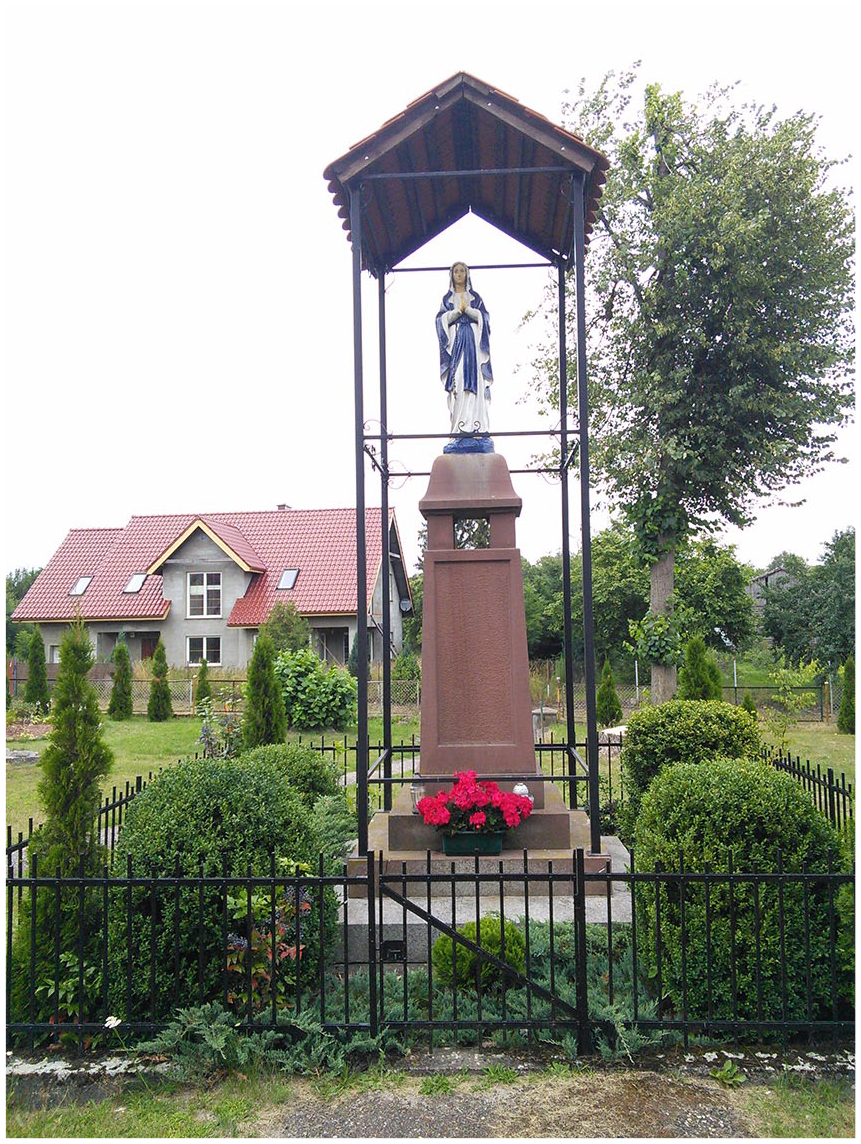
The “recycled” German Great War memorial in Siemczyno that now serves as a chapel. Photograph by the author

The information on the previous form of the memorial, put on a tablet in front of the church in Siemczyno. Photograph by the author

The partially “recycled” German Great War memorial in Łabędzie, nowadays a chapel of the Virgin Mary. Photograph by the author

The partially “recycled” German Great War memorial in Sieciemin, with the rest of the names of the fallen German soldiers painted white. Photograph by the author
We can, however, also distinguish the cases of a positive recycling. The primary purpose of rebuilding a monument is different here. Instead of just getting rid of what is commemorated on it, and associated with “Germanness,” a group wants to commemorate something else using the structures of the primary commemoration. What is being commemorated differs: we can find memorials changed to commemorate fallen Red Army soldiers or new communities of settlers. A case in point can be seen in Iwięcino (Eventin), where the monument still stands in the same place in the centre of the village; only the plaques are different (Figure 6). Instead of commemorating fallen German soldiers from the neighbourhood, they commemorate the community of new settlers who came here after 1945. Therefore, as shown, during the recycling process both intentions, to destroy and strip the monument of its marks of “Germanness” and to preserve its primary function of commemorating, are intertwined.
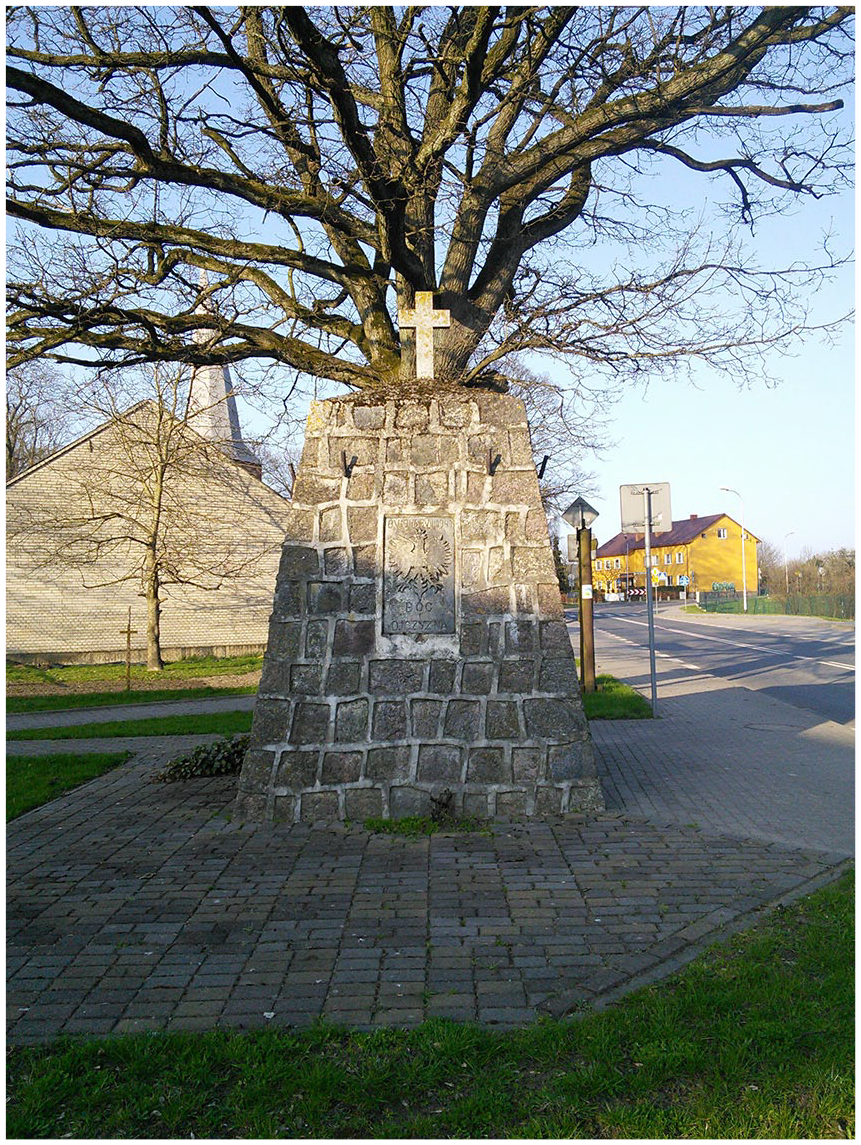
The “recycled” German Great War memorial in Iwięcino, commemorating the groups of local settlers. Photograph by the author
The Pomeranian Line Memorials as an Example of the Competition of Memories
Let us now examine the phenomenon of the competition of memories through the example of the recycling of German war memorials and constructing new monuments commemorating the fight to break through the Pomeranian Line. As it turns out, the scale of such monuments, connected with their location, was an important factor. The design for the memorialisations of the fight for the Pomeranian Line stressed their size and extent: “the work undertaken as part of this project is unprecedented in Poland when it comes to the size of the area . . . and the range of historical issues involved.” 57 At the same time, emphasising the exceptional nature of the project in terms of the number and scale of the memorials served to justify all the problematic (in a technical and semantic sense) aspects of commemoration. In this way, the commemorative warscape was created. 58
Despite the involvement of many groups of interested actors at the grassroots level—the veterans’ association, families of the fallen, and communities of the new settlers—it was the central authorities that had a decisive voice concerning what should be remembered and who were the organisers of “memory work” involved in the construction of memorials of the Pomeranian Line. 59 The memorials of the Pomeranian Line became a direct memory competition for the German war memorials, which—ignored or recycled—constituted the closest, tangible model of “how” to remember, especially fallen soldiers, irrespective of official instructions.
How are the Line memorials comparable with German war memorials? Firstly, because the former in several cases use the forms and materials of the latter. Secondly, which is more important, because the strategy behind the design of the former is related to the ‘Germanness’ of Central Pomerania. It was to be seen as overcome, and the new structure of memory of the region was designed to do this. The network of memorials dedicated to the Line was so dense that it could serve as a reverse side of the network of German war memorials. Therefore, it can be interpreted as a competitive structure of memory, characterised for Central Pomerania. Like the German war memorials, Polish memorialisations were military-sepulchral; and in both cases, rather than one central monument, the commemorative landscape included a number of scattered memorials, such as boulders with inscriptions, war cemeteries, or free-standing monuments, all sharing the same character.
What connects all the types of the cult of the fallen soldier is the respect paid to the bodies of the fallen. German war memorials, with their precisely prepared lists of names of the fallen, were meant to serve as a substitute for the bodies that were in most cases not exhumed. When it comes to that point, the memorials of the Line differed: the bodies were still in the region, and identified as the primary carriers of memory. At first glance, it was the veterans as eye witnesses who could say something about the event itself, who were the most valuable carriers of memory; hence, through collecting testimonies and erecting “provisional” memorials, the Department of Museums and Polish Martyrdom in the Ministry of Culture and Art, from 26 September 1945 onwards, urged society to engage in commemorative activities. However, this kind of autobiographical memory had to be quickly transformed into historical memory, stripped of its variant versions, fixed and ready to be—literally—cut in stone. 60 In other words, in the case of military-sepulchral memorials, commemorating both the fallen and the veteran-witnesses, things get more complicated. The actors at the central level wanted to take control of both those memories: of the veterans and the fallen. In the former case, this involved the unification of all veteran associations into one central organisation: ZBOWiD, a state-controlled organisation of war veterans. 61 In the latter, what is controlled is the dead body as the primary carrier of memory.
The transfer of the bodies of soldiers who died in different places to central cemeteries was one of the stages in the process of taking such control by the 1940s. In this way, the war cemetery becomes the central place of the cult of the fallen. 62 Even though a soldier died at a given place, his body is exhumed and moved to a new location. The connection between the body (as a testimony of the events) and the original place is thus broken; instead, the body is assigned imposed meanings. For instance, it is no longer the body of a soldier “who died during the liberation of X town” (or, as in the case of the German war memorials, a soldier “who was born / used to live in the town of X”), but of “a hero of the fight for the Pomeranian Line.” Memory is to be focused in one place, specially designed for the purpose. Endowing such memory with official status makes it easier to manage. Consequently, individual soldier burials no longer make sense, and every effort is made to make sure the tombs are uniform in shape. The dead body as a carrier of memory is to become part of a mass. This contradicted the intentions behind the construction of German war memorials, whose purpose was to honour the particular dead listed by their names and surnames, rather than to be a symbolic representation of the whole nation. 63 The plaques on the memorials of the Line were therefore only symbolic and showed the number of soldiers and their army unit, not their names (Figure 7).
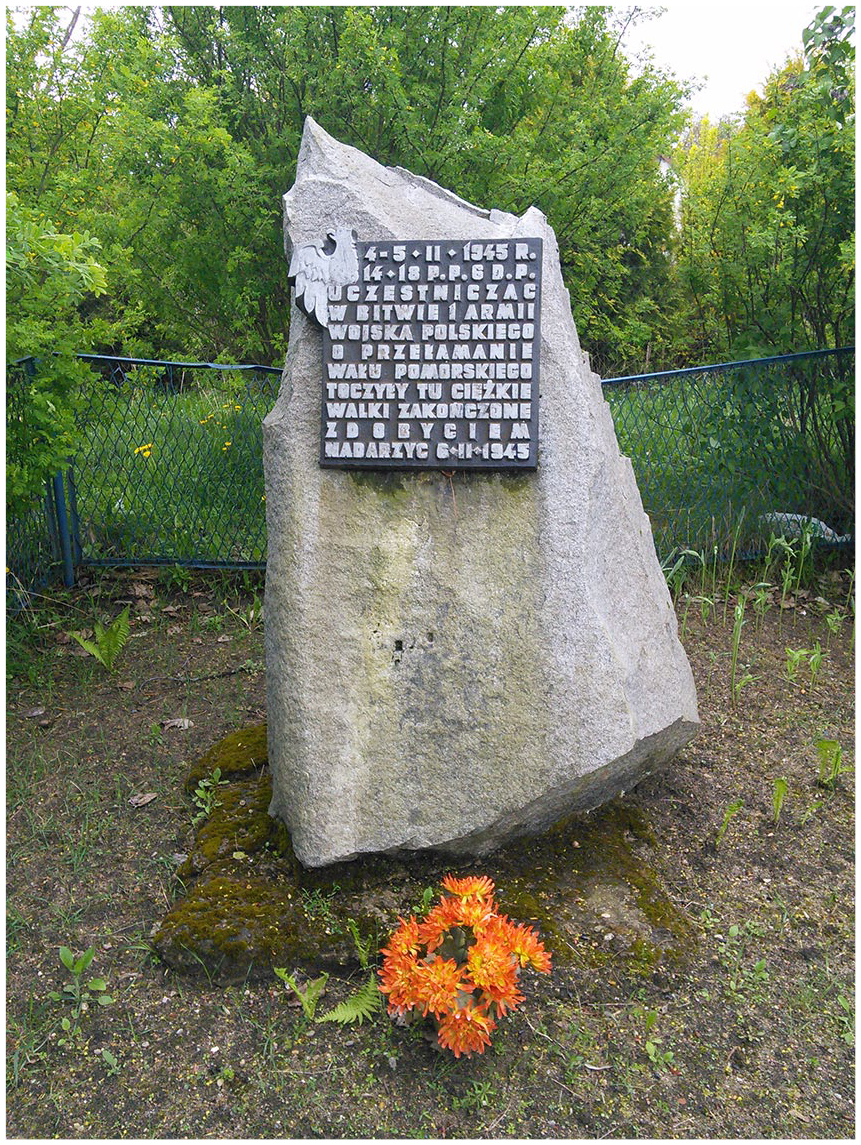
The plaque on the memorial of the Pomeranian Line in Nadarzyce. There are no names of the fallen; the only information is on the army units that took part in the “liberation” of the village. Photograph by the author
Sites of memory of the fallen were also to be regularly “revived,” which was a common strategy in People’s Poland. 64 This was also the case with the monuments to the Line. This purpose was served by celebrations of the very activity of looking after the monuments: “Ceremonies awarding diplomas and honorary badges of ‘The Guardian of the Sites of National Memory’ should be celebrated in places that feature permanent forms of memorialisation.” 65 Walking trips along the trail of the “Heroes of the Pomeranian Line” organised by the Socialist Youth Association, which stopped at the monuments to participate in ceremonies such as the ones described above, served a similar function. Likewise, the periods when the created sites of memory were to be “used” were also imposed from above. The whole year was divided into quarters so that the memorials could be used regularly. Starting with the Days of Liberation (from January to March), the End of World War II (9 May), the National Holiday of Poland’s Renascence (22 July), the Outbreak of World War II (1 September), the Day of the Polish Army (12 October), and the Day of the Dead (1 November). Every year a special anniversary was celebrated to raise interest in the memorials; for example, 1964 saw the celebrations of the 20th Anniversary of People’s Poland, in 1966 the Millennium of the Polish state, and in 1968 the 25th Anniversary of the Establishment of the Tadeusz Kościuszko First Division of the Polish Army, whose first, disastrous, battle took place in Lenino on 12 October 1943 (hence the date later became the Day of the Polish Army). Consequently, the meanings of the memorials and the events celebrated became intertwined.
Eventually it was the cult of the fallen soldiers that had a decisive influence on the choice of Podgaje (Flederborn) as the location to be identified as the centre of the Pomeranian Line memorials. It was there that on 3 February 1945 the Nazis murdered thirty-two prisoners of war from the Polish First Army by burning them alive in a barn. 66 The soldiers were commemorated immediately after the war, but it was not until the 1960s that state authorities commenced the construction of a monument conforming to the centrally imposed aesthetic. Not just the monument itself but the whole village was ordered to be tidied up to ensure the appropriate look. As it was reported, “Only such solutions guarantee the full achievement of the intended effect.” 67
The history of the Podgaje memorials is a perfect illustration of the issues raised in the present article, especially because the Polish memorial of the Line here is different from the other monuments commemorating the Line: it has a plaque with the names of the soldiers who died there. There are three monuments in Podgaje, dedicated to the fallen soldiers, to be analysed here: the original German Great War memorial; the Polish memorial to the soldiers murdered during the battles on the Pomeranian Line, erected after the war; and the Polish memorial to the fallen unveiled in 1969. The structure of the first Polish monument was very similar to the German war memorial that stood in the village in front of the church, which was destroyed during the war. A plaque with the names of the murdered soldiers was placed on the plinth, and the monument was crowned by an eagle sitting on a white and red sphere, while the German memorial in the same shape, with plaques listing the names of the fallen, was crowned by an eagle sitting right at the top of the monument. The fate of the commemorative plaques affixed to the monument is quite telling. The first Polish monument featured a plaque with a mistaken number of soldiers: thirty-seven instead of thirty-two. The same plaque, with the number corrected, was then placed on the new monument. The new Podgaje monument was unveiled on 6 July 1969. It was composed of two parts: each visitor could go inside to see the monumental figures of burning soldiers, while an additional inscription detailed their fate (Figure 8).

The newest memorial to the fallen in Podgaje. It evokes the shape of the barn where the soldiers were burned. Photograph by the author
The difference between the monument spontaneously erected after the war, which had been modelled on, or had even directly recycled, the local German memorial, and the memorialisation from the 1960s is significant. What links both monuments, however, is the same plaque, even if renovated and corrected. The official memorial from 1969 emphasises not so much the glory as the horror of what happened. Visitors can go inside the monument, where they are overwhelmed by the enormous figures of soldiers dying in the flames. These are not heroes, but primarily victims. 68 It is important to see it not only as the first Polish monument that could have been directly modelled on the German memorial but as a sign of the competition of memories. The primary commemoration to the fallen German soldiers was an inspiration for the first version of Polish memorial to the dead. In this case, not the spatial, but material, structures were employed: the Polish memorial was built not in place of the German one, since its vicinity (the church) was destroyed. The religious meanings were therefore not expressed; instead, military associations and meanings propelled by People’s Poland’s propaganda took first place. The Polish memorial stood in the place of the barn where the soldiers were murdered. Material structures of the German monument were used to produce the first Polish memorial, and the plaque from the first one was transferred to the second one, linking it indirectly to the original German monument. Both Polish monuments are therefore secondary commemorations. It is also visible how both intentionalities of the recycling are connected: On the one hand, it bears the marks of intent to destroy “German” traces, especially important in the case of mythologizing murder, and on the other, it imitates the form of the memorial. This tension is also visible on the central plaque of the first Polish Podgaje monument that bears the reading “1410 – 1945 Grunwald – Berlin.” Here the figure of the “German” and “Nazi” are identified as one and the same, while in the ideological sphere several layers of memory come to be combined. The impact of the symbol is further strengthened by the addition of the images of the “Teutonic knight” who was defeated in Grunwald / Tannenberg. 69 “The German” becomes a figure comprising all the images of a hostile power attacking the Slavic world. It is quite telling that the second Polish monument was unveiled in 1969, just one year before the “relaxation” phase in Polish–German relations had started. With the combination of different figures of “Germanness,” the first monument is an excellent example of the two first phases of memory in the “Recovered Territories.”
In substituting the first Polish monument with the second, the case of the actors involved also comes to the fore. The first one was built by a local group: soldiers who came later on, discovering that their predecessors were murdered. The second one was a top–down initiative that meant to make it a central part of the monumentalisation of the myth of the Pomeranian Line.
Further Implications
The “orgy of monumentalization” of World War I, present in Western Europe, came to be linked, in a way, with the rich Polish commemoration of World War II: The Pomeranian Line memorials are a reflection of the scattered German monuments of the Great War and are in fact a distant echo of the “orgy of monumentalization” mentioned above. The memorialisations of World War I were used in order to commemorate World War II. This top–down initiative developed in two phases. The first one, which after Connerton can be called “the great archivization,” 70 involved collecting as many witness statements and identifying as many places to be commemorated as possible. The new Polish state, also in the so-called Recovered Territories, was in a way founded upon this activity.
In the situation described here, it is the specific nature of “formerly German” memorialisations that comes to the fore. Their adaptation was paradoxically facilitated by their initial “compound” character. The “formerly German” memorialisations are not simply what was “left behind by the Germans”—their old World War I monuments. They are monuments that have been subjected to recycling, with their origin sometimes easy and sometimes difficult to recognise, uniting layers of the old “German” and the new “Polish” settler memory. This gives a new meaning to their “formerly German” character: It is no longer simply what was left behind, but what was creatively made over. The meanings of “former Germanness” are then created not by the Germans who had left but the settlers who arrived in their place. It is they who determine whether something is “formerly German,” not the Germans who left it behind.
Thus, depending on the epoch, German war memorials can be read in different ways. Up to 1945, they commemorated soldiers who died in different wars, with World War I elements as the most prominent. In the second half of the 1940s, they were used as a basis for the commemoration of new groups, such as the Polish settlers or the soldiers of the Polish First Army fighting to break through the Pomeranian Line. In the 1960s, efforts were made to include them in the network of centrally planned, rather than grassroots-initiated, memorialisations, especially the monuments commemorating the fight for the Pomeranian Line. They competed in terms of form and content with the local German war memorials, finally taking over the role of the local, “Polish” memorialisations connected to the cult of the fallen soldiers.
What are the sources of the phenomenon described here? Was it motivated by a culture that sees the veneration of the memory of soldiers as community-making or were German war memorials so amenable to makeovers? While World War I had deprived the soldiers of their individuality, and the monuments gave it back to them, 71 World War II endowed the commemorative process with reverse dynamics. We will not find the answer in the oblivion “that is constitutive in the formation of a new identity.” 72 What is involved is not a rejection of unneeded memory, but its transformation. More than that: Some problems are not so much passed over in silence (the expulsion of the Germans), as amplified, since they become the foundations of a new identity. In the first period immediately after the war, the previous German presence on these territories is used to emphasize the injustice of the war, to secure the new borders.
The fate of the monument to the Pomeranian Line is also an illustration of the changes in the memory of the “Recovered Territories.” Carefully planned in the middle “legitimization” phase, they were abandoned after the change of course in the 1970s. The notes made in ballpoint on the margins of the typescript of “Materials Concerning the Development of Tourism in the Pomeranian Line Region” bear witness to this. An anonymous clerk wrote “no need” or “who will give money for that?” against proposals on the list. The same person underlined the fragment saying that the number of tourists to the Pomeranian Line region is still limited. The connection between tourism and martyrdom clearly had not yet brought the expected results.
Why was that? In the specific situation of the “Recovered Territories,” the memorialisation involved two phases, characterised by a change in the approach of the central and local actors towards commemorative activities. For it is not only its primary features (such as appearance) that decide the success of a monument, but also its further fate, determined by such factors as the circumstances of its construction, the sources of funding, institutions, and people connected with it—the so-called second life of a memorial. 73
The second significant factor is the relationship between the original German memorials and the new or recycled monuments. It is possible to see how, owing to shared cultural roots, such as Christian ones or the cult of the fallen soldiers, the new memorialisations follow the patterns established by the old ones or employ those of their elements that are more universal. What kind of memory then do they preserve? Centrally planned and constructed, they are supposed to be the sites of “Polish,” “national” memory, thus eradicating any basis for identifying these territories as “German.” However, since they make use of the “formerly German” features, they paradoxically become sites of a “different” memory, rooting the new one in the old. This happens despite many strategies employed in a top-down effort to design collective memory.
Footnotes
Acknowledgements
I would like to thank Maria Fengler for her help with the first English version of the text, and three anonymous reviewers for their insightful comments and critiques.
Funding
The project was financed from National Science Centre funding granted on the basis of decision 2017/01/X/HS3/01063.
