




Abstract
Through the lens of modernization theories, the process of European integration can be perceived as Poland’s second modernization, following the systemic transformation in the nineties. In this article, we analyze the divergent perceptions of the European Union, and attitudes toward European integration, as they coexist within contemporary Polish society. We introduce the notion of European integration as a triple modernization, encompassing economic, institutional, and cultural changes. Using a mixed methods approach based on qualitative and quantitative data from the European Values Study 2017, we demonstrate that Poles generally accept the peripheral status of Poland in the economic context and expect financial support from the core of the EU. Simultaneously, within the cultural context, there exists a marginal but salient attitude that is based on opposition toward cultural pressures and on a claim to an active role in the shaping of the European axiological agenda. Distinguishing the three aspects of this general process of European integration allows for the identification of the source of tensions that are described in literature as cross-European populist tendencies to question the very idea of European integration in member societies of the EU.
Introduction
In the literature that has evaluated the state of democracy in European societies, it has been already widely acknowledged that the European Union is currently facing a demanding challenge in the form of the declining attachment of member states to the idea of the EU’s consolidation and expansion. Some authors have noted that a lowering in the belief in democratization that could come together with deeper integration within common European structures does not spare even the established European democracies; 1 however, in most cases the focus of analysis is on new member states, that is, the countries of Central and Eastern Europe, because of the burden of post-communist institutional and cultural legacy, and relatively late democratization. 2
In fact, although the European Union is most commonly understood as a political and institutional venture 3 that expects member states to adopt certain institutional solutions as a precondition of accession, growing attention is being given to informal and cultural aspects of its influence. 4 We argue that European integration entails not only institutional change according to the guiding principles determined by the established European democracies but also the absorption of a specific cultural agenda. This is not to say that this agenda remains hidden; on the contrary, it is openly proclaimed in the Treaty on European Union (TEU), according to which the united Europe is to be rooted in a specific set of values: “The Union is founded on the values of respect for human dignity, freedom, democracy, equality, the rule of law and respect for human rights, including the rights of persons belonging to minorities. These values are common to the Member States in a society in which pluralism, non-discrimination, tolerance, justice, solidarity and equality between women and men prevail.” 5 In this sense, the process of integration with the EU encompasses both institutional and economic modernization. Institutional modernization denotes here the belief that European solutions regarding democratic institutions and politics, especially political pluralism and the principle of checks and balances, should be perceived as a benchmark for countries aspiring to accession, and a taken-for-granted standard in EU member states. Economic modernization refers to the belief that “open markets and foreign investment provided the only viable model of economic development capable of generating long-term collective welfare benefits and socioeconomic convergence for CEE.” 6 However, the integration process also structures cultural relations within the Union: the new member states are expected to become absorbers of values advocated by the EU 7 and comply with the aforementioned institutional and political standards. In other words, European integration denotes also what we call cultural modernization, that is, the development of the attachment to a certain set of values in member societies.
The process of European integration, understood as triple modernization—economic, institutional, and cultural—assumes that the member societies, especially the so-called new member states, are to a large extent passive absorbers of cultural pressures and should be molded to fit into the European stencil. However, it is often overlooked that these societies are active subjects who also interpret cultural influence within the frames of their local cultural schemes and symbolic systems. Of prime importance are the meanings and values connected with the notion of “Europe” itself, of the European Union, of relations between a given member society and Europe as a point of reference, and values that are perceived as truly European values.
In this article, we aim to shed light on the divergent understandings of Europe, and the attitudes toward European integration that coexist within contemporary Polish society. Poland was once perceived as a pacesetter among those CEE countries aspiring to EU accession, later as a permanent outsider, 8 and now, to fit in with the continuum by Zubek, a troublesome brakesman of the EU. We therefore ask how the integration process is understood in Poland: What are the attitudes toward Europe, and in what aspects, if any, Polish society diverges from European values. In the analysis that follows, we first disentangle the ties among the three aspects of modernization, or the triple modernization. Next, based on empirical data, we identify the notions of Europe and the perceived relations between Poland and Europe expressed by our subjects. We argue that although the inclusive and modernizing vision of European integration is still dominant in Poland in a quantitative sense, special attention should be given to the other, which contests the modernizing aspect of the integration. We posit that this second notion is gaining qualitative importance in view of the cross-European shifts described as populist tendencies undermining the integration in member societies of the EU.
Modernization and Its Aspects
The term modernization in the broad sense adopted by social and political sciences refers to the passage from traditional to modern society. The dynamics, nature, and consequences of this process are investigated by the theories of modernization; however, it is beyond the scope of this article to examine and discuss the tenets of the numerous and manifold perspectives on modernization. 9 As Knöbl notes, 10 the literature on modernization is surprisingly unstructured in view of the notable impact of the notion of modernization on social research. However, various framings of modernization are underpinned by, if not the same, then at least convergent assumptions. 11 The key argument of these assumptions is that, first, modernization is a linear process of “development,” that is, it has inherently positive connotations. This aspect is especially stressed by Inglehart and Welzel, 12 who go so far as to equate modernization with “human development.” Second, that this process of development follows a series of stages with a specified “point of arrival,” which is a fully developed, or fully modern, social organization. This assumption, initially articulated by Karl Marx, 13 constitutes a core tenet of modernization theories. 14 As a result, some countries are seen as “underdeveloped,” and the process of modernization as “catching up” with those who are more “advanced” on their way to modernity. 15 Third, modernization is described as a multilayered process driven by a complex interplay between economic, institutional (political), and cultural factors, where the leading impetus is provided by economic growth. 16
Some theorists of modernization equate economic growth with rising standards (quality) of living and, thus, perceive it as a key driver of the modernization process. This is supposed to be reflected in the GDP’s dynamics over time and in the changing structure of the economy. The GDP has recently been criticized as a measurement of welfare, 17 but even the critics admit that it can still be an indicator of economic development beyond a certain threshold. 18 By structural change of the economy, we mean the transition from a centrally planned one that is based on state ownership, toward the market economy where private ownership prevails. The second dimension of modernization, that is, institutional, is most often understood as democratization. The link between modernization and democracy was articulated by Lipset in his classic writings 19 and has inspired various elaborations. 20 In the understanding adopted by these authors, democracy implies the existence of a party system, a competitive media market, and citizens’ participation in various forms of social and political activities. The third dimension of modernization, that is, cultural, refers to changes in values. Although Inglehart and Welzel claim that these changes are probabilistic and not linear, 21 they expect them to occur in two key dimensions: in a transition from traditional to secular-rational values, and from survival to self-expression values, which are supposed to dominate in postindustrial societies.
It is generally acknowledged that these three aspects of modernization are co-dependent; however, disagreements arise as to the direction of the influence. In Marx-like fashion, some approaches to modernization give precedence to the economic aspect of modernization. They view the process of social change as determined by economic factors, especially economic growth. 22 From this perspective, rising standards of living result in a variety of socio-cultural consequences, like “social mobilization,” 23 political participation, 24 or longing for self-expression, 25 which ultimately exert pressure on institutional change and democratization. Other perspectives stress the leading role of culture. They argue that “culture is the mother, institutions are the children,” 26 that is, localized cultural factors determine the specificity, if not the general direction, 27 of outcomes of modernization processes—an idea captured, for instance, by the notion of “multiple modernization.” 28
This leads to the problem of European integration, that is, in essence, a modernization project based on the catching-up principle and underpinned by the assumption that European societies differ in terms of socio-economic development. 29 However, European integration does not imply only economic development, but institutional (democratic) and cultural (adoption of European values) as well. As such it might be regarded as a top–down process of change in which financial resources, institutional solutions, and values are transmitted from the core of the EU to the new member societies. In this context, the Polish accession to the EU can also be perceived as a second modernization of Poland, following the first brought about by systemic transition in 1989. 30 This opens up the question: How is the process of integration with Europe perceived by Polish society; is the idea of “catching up” with Europe still accepted by Polish society?
Methodology and Data Sources
This study is based on a mixed methods approach. 31 We used both quantitative and qualitative data, as our aim was both to capture orientations toward Europe and the European Union in some breadth and to investigate the meanings attached to the notion of Europe and the emotions generated by perceived relations between Europe and Poland.
The quantitative analyses are based on the European Values Study (EVS)
The qualitative data was obtained from two sources. The first was a series of 12 focus group interviews (FGI) conducted in three Polish cities (a metropolis, a medium-sized city, and a small city) in April 2018, with four interviews in each. Each of these groups was composed of eight persons, with an equal proportion of men and women. Nine of these groups’ respondents were recruited based on their political views (FGI 1 to FGI 3: supporters of the current government [Law and Justice, LaJ]; FGI 4 to FGI 6: supporters of the main opposition party [Civic Platform, CP]; FGI 7: persons who voluntarily chose not to participate in recent elections; FGI 8 to FGI 9: supporters of other minority parties). The respondents of the remaining three groups were selected based on various characteristics, such as young age and having a mortgage (FGI 10), subordinate position in a workplace hierarchy (FGI 11), or elderly age—above 65 years (FGI 12). The semi-structured discussion that took place during the interviews pertained to the general opinions and feelings of respondents regarding the quality of their lives, expectations, current living conditions in Poland and abroad, and the values and aims that the country should pursue in the future. The second data source was Polish Facebook public profiles. Eleven profiles were selected purposefully based on their coverage (i.e., most popular according to social media monitoring agency, Wirtualne Media, at the time of the analysis, that is, December 2017), and themes of discussion (corresponding with the main thematic areas of the EVS questionnaire). In this study, we used data from only one of these profiles—Fronda.pl, the profile of an alt-right news agency presenting a nationalist-Catholic perspective on current issues. During the two-week period of profile observation and data harvesting, in total 632 posts were collected along with users’ comments and the responses to these comments. The data obtained from focus group interviews allowed us to map opinions and sentiments expressed by the general public, that is, people differing in their views on the current situation in Poland, and postulate the organization of social life, values, and general life attitudes. The data obtained from Fronda.pl offered a rich, in-depth insight into views that are not openly voiced in their most radical form; as such, we could not have expected them to surface during group interviews but they constitute a powerful source of discourse that resonates in the public debate in Poland.
Results
Analyzing the complicated relations between Poles and Europe (understood simply as the group of core EU countries), is certainly not an easy task. However, it should be clearly stated that according to regular opinion surveys the vast majority of Poles see Poland as part of this very Europe (see Figure 1).
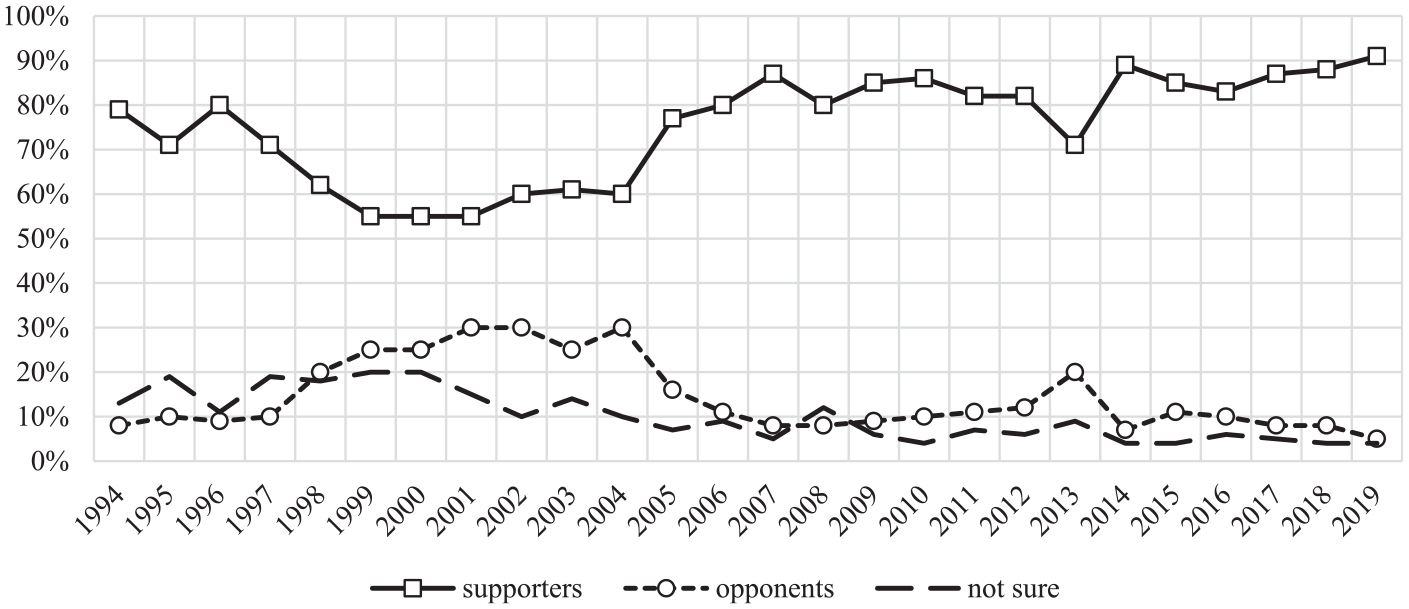
Support for Poland’s membership in the EU 1994–2019
The European Values Study (EVS) also shows that Poles see themselves as Europeans: in 2017, nearly three-quarters (73 percent) said they felt close to Europe (with 22 percent feeling very close). These data clearly show that Poles consider themselves to be a European society. However, if we look at the European integration process in terms of modernization, then Poles’ beliefs, ideas, and attitudes toward it turn out to be far more complex. This differentiation is based on a distinct treatment of the aspects previously described as the three dimensions of modernization: economic, institutional, and cultural change. Further on, we show the divergent attitudes toward each of these aspects.
The Economic Dimension
The economic dimension of modernization is the least controversial in Polish society. A considerable majority (76 percent) chose “a high level of economic growth” as one of the most important goals for our country for the next ten years, with 51 percent indicating this goal as their first choice and 25 percent as the second choice. The high percentage of people who recognize the importance of economic growth shows that there is widespread awareness of the shortcomings in this area among all social groups and strata. The belief that rapid economic growth is an important goal for Poland is not dependent on respondents’ political views; this aim is mentioned equally frequently by supporters across the political spectrum.
The qualitative data show that the countries of Western Europe (“the old EU”) are the benchmark against which the respondents compare living standards in Poland. In the respondents’ view, these countries are characterized by a “prosperity” that Poland has not yet achieved. The idea of “prosperity” in those societies that serve as a point of reference when analyzing the situation in Poland involves the belief that those societies are wealthy, which translates into a higher quality of life. A map of the key themes and their mutual relationships is shown in the Table 1.
Themes Connected With the Issue of Economic Development in Poland and in Europe

Source: Authors’ own analysis.
The core image of the countries of “old Europe” involves the belief that they are characterized by normality, a quality that the respondents believe is lacking in Poland, seen as deficient in various respects. “Normality” should be understood, mostly, as a specific standard of living—general wealth. In the respondents’ view, life in the West is better than life in Poland because the West is generally more affluent than Poland, the relation between income and work is more fair, and welfare benefits fulfil their key role, all of which enable people to live a normal life, which is not the case in Poland, described as a poor country.
However, Western European countries offer more than just a higher material standard of living to their citizens; economic growth is also seen as a factor that influences the quality of life in a more general sense. Quality of life encompasses also the respect demonstrated by individuals who represent government (or are employed by government) toward the “recipients of benefits;” this respect is dramatically lacking in Poland. This was discussed primarily in the context of asymmetrical interpersonal relations, that is, those characterized by a power imbalance or knowledge imbalance. In our respondents’ experience, the latter is characteristic of relations in the health care system, especially between doctors and patients: Physicians in the Polish health care system do not show the much-desired kindness, while this kind of attitude is thought to be a standard “in the West.” The same holds true for relations involving an asymmetry of power, for example, between citizens and the police.
The second aspect of the quality of life involves friendly interpersonal attitudes. In the respondents’ opinion, people in the West are less competitive and more polite toward one another, whereas in Poland a general incivility dominates. These differences between European societies and the Polish society are particularly pronounced in the world of labor. According to our respondents, any person who introduces a bad atmosphere into a German, Dutch, or British company is very likely to be Polish since Poles attempt to transplant the competitive strategies they have learnt in the Polish working environment.
The belief that Western European countries are at a higher developmental stage compared to Poland generates two types of negative emotions. Above all, it gives rise to a specific inferiority complex of “being Polish,” that is, a sense of being inferior to other European nationalities. This belief is expressed both in the statements made on the topics discussed above, and in all utterances where the respondents compared Poles to other European nations and highlighted features that unfavorably distinguish Poles from other Europeans. This “Polishness complex” also stems from the fact that, in the respondents’ opinion, Poles are treated badly outside Poland and occupy the lowest place in the hierarchy of European nations. The Polishness complex is mainly a component of the reflected self-image believed to be held by members of other European societies, based on the belief that Poles are perceived as being “inferior Europeans,” and that the wealthier societies of Western Europe treat them with disregard or even contempt.
In response to this feeling, our respondents tried to find different, nonmaterial aspects in which a comparison with the societies of “old Europe” would be favorable for Poles. The key aspect of the “compensation” process is to deny the differences in competencies between Poles and other European nations. From this perspective, Poland is represented not as a country that is failing in terms of the specialization and procedures that rationalize the world of labor but as a country that is strong in the “multiple competencies” demonstrated by Poles who must fix systemic deficiencies with their own personal efficiency. This helps the respondents compensate for the sense of inferiority arising from the low level of affluence in the Polish society by invoking a sense of superiority associated with the resourcefulness of Poles as individuals.
This specific Polishness complex stems from the assumption that Poland is less economically developed than Western Europe. Catching up with Europe in economic terms would, therefore, provide a remedy for the aforementioned problems of Polish society.
The second emotion identified in the qualitative data, alongside the sense of inferiority, is the sense of injustice experienced by Poles. This originates from the belief that Poland’s relatively unfavorable economic situation is due to an unfortunate historical coincidence, primarily the experience of Second World War, and communism. The comments on this topic are deeply pessimistic: because of troublesome history, Poland is doomed to suffer a bad fate and, as a result, it had, has, and always will have to catch up with the societies of the “old Europe,” and aspire to achieve a standard of living that has long been obviously accessible there.
However, it is also important to remember, as has been shown in other studies, that the EU is perceived by Poles as a modernizing institution that has a real impact on various aspects of the standard of living in Poland. 33 For this reason, the next section will take a more detailed look at the attitudes harbored by Poles toward the process of European integration in its institutional aspect.
The Institutional Dimension
In the institutional dimension, European integration primarily involved the adoption of the acquis (or acquis communautaire, a term used prior to the Lisbon Treaty), that is, the legislation of the European Community. In this sense, the EU, as an institution, exerts a significant influence on the organization of collective life within its member states. Thus, trust in the EU as a public life institution may serve as an indicator of the social perception of this institutional aspect of European integration.
Forster and Frieden, 34 who analyzed the determinants of confidence in the EU in the context of socioeconomic crises, found that trust in the national government and the EU are interrelated. They noted substantial effects of identity-related (exclusive national identity) and ideology-related (left-wing self-identification) factors on the level of trust in the EU, but concluded that there is little or no evidence that the member-states citizens have recently become more exclusive or extreme in their identities or ideological positions. 35 Since there is evidence that changes in ideological sphere are the effects of unfavorable economic conditions, this indicates that economic factors are the most important determinants of the confidence in the EU. 36 Key significance of economic factors in shaping the attitudes toward the EU as well as mediating role of trust in the national government were also documented in other analyses. 37
In 2017, Polish society was divided almost equally into those who trusted and distrusted the EU: 49 percent expressed their confidence in this institution, including nearly 9 percent of those who had “a great deal” of confidence. In the previous edition of the European Values Study (2008), which was also the first EVS round after Poland’s EU accession, the percentage of respondents trusting the EU was slightly higher: it stood at 54 percent, with 11 percent having “a great deal” of confidence. Thus, although the percentage of people who support Poland’s membership in the EU remains invariably high, 85 percent in 2008 and 87 percent in 2017, 38 confidence in the EU as an institution has declined slightly (a small yet statistically significant change).
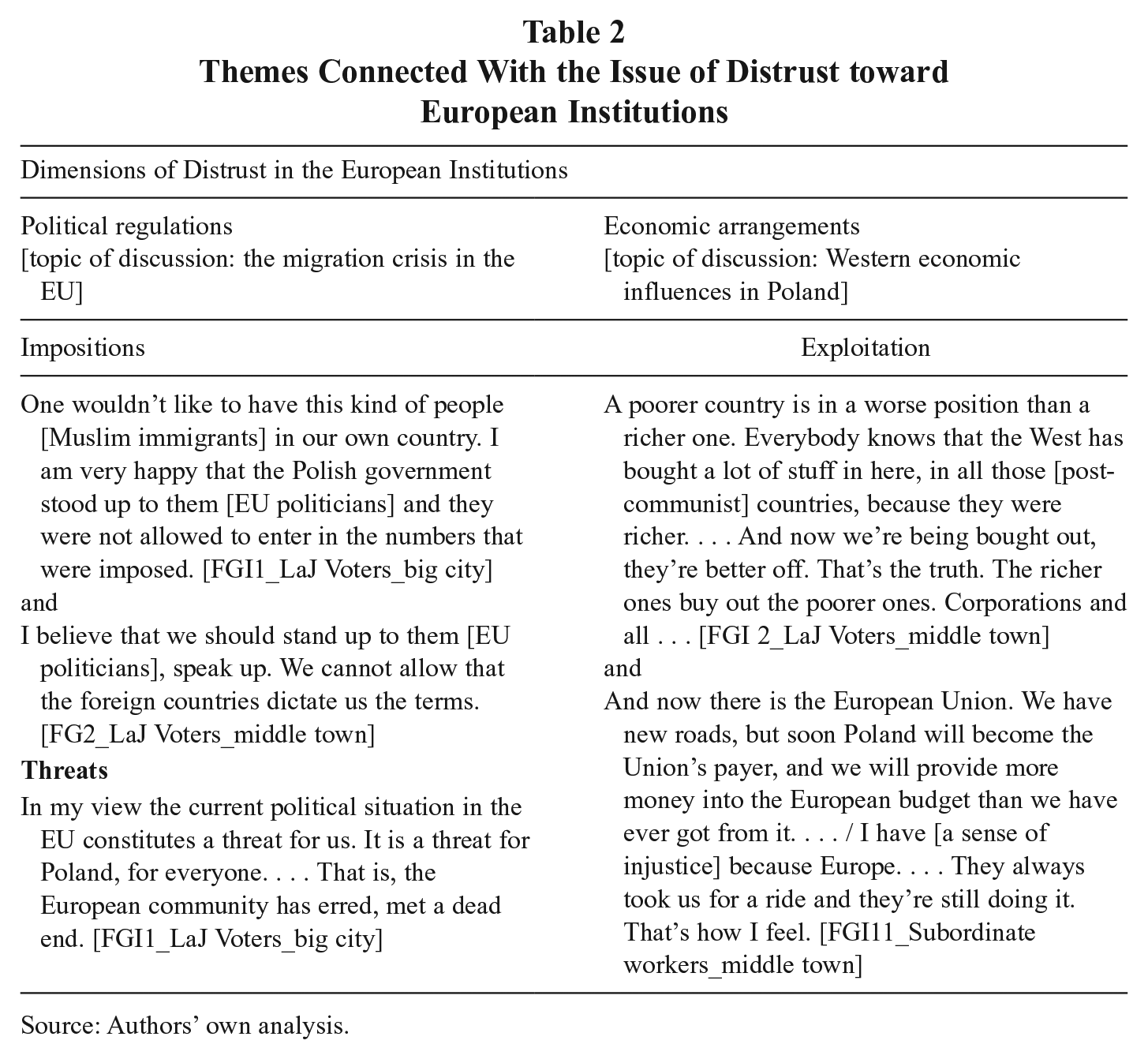
The qualitative evidence suggests that the distrust toward the EU has two main dimensions: the first is related to European political regulations, and the second, to the Western economic influences in Poland (see Table 2). In the political domain, the EU is thought to be “dictating” Poland the terms of foreign policy such as, for instance, the numbers of migrants to be admitted in the EU member states, including Poland. In our respondents’ view, this was the case during the migration crisis. The negative attitude revealed in the statements regarding this topic stems both from a feeling that the EU attempts to subordinate Poland and deprive it of its sovereignty, imposing some solutions without considering Polish society’s opinion, and from a belief that the political direction taken by EU politicians is simply wrong and risky, poses a political threat for Poland.
Themes Connected With the Issue of Distrust toward European Institutions
Source: Authors’ own analysis.
In addition, the West is also thought to be “exploiting” Poland, taking advantage of its relative vulnerability. In line with this opinion, the current policies pursued by European institutions by no means lead to levelling off the historical backlog and, thus, also the economic imbalance between Poland and the West. Although Poland has received financial support, some of our respondents believe the support is only temporary and, in the end, Poland will have to return more than it has received.
The findings from the European Values Study show that the level of confidence in the EU is scarcely diversified by demographics: It is equal among men and women, minimally differentiated by the size of domicile, age (generation), or level of education. As far as generations are concerned, two groups deviate from the overall trend, that is, those born before 1945, and the youngest respondents, born after 1990. Generally speaking, the oldest respondents do not trust the EU: as many as 61 percent declare a lack of confidence, including 23 percent who claim to have “none at all.” On the other hand, people born after the systemic transformation are more likely to trust the EU (53 vs. 47 percent).
The data presented above show that confidence in the EU is scarcely related to position in the social structure. However, it is significantly correlated with general attitudes and political choices. Variables that play a role here include, in particular, trust in other people and opinions on the desired system of governance in Poland.
Confidence in the EU as an institution translates into trust in people outside the immediate circle of family and friends, that is, people encountered for the first time, or people of different nationality or religion. This is illustrated by the correlation coefficients in Table 3. As shown here, Poles who have confidence in the EU tend to trust different categories of people, and vice versa: Lack of confidence in the EU co-occurs with a low level of trust in people.
Relation between Confidence in the EU and Trusting Various Groups of People (Spearman’s Correlations)
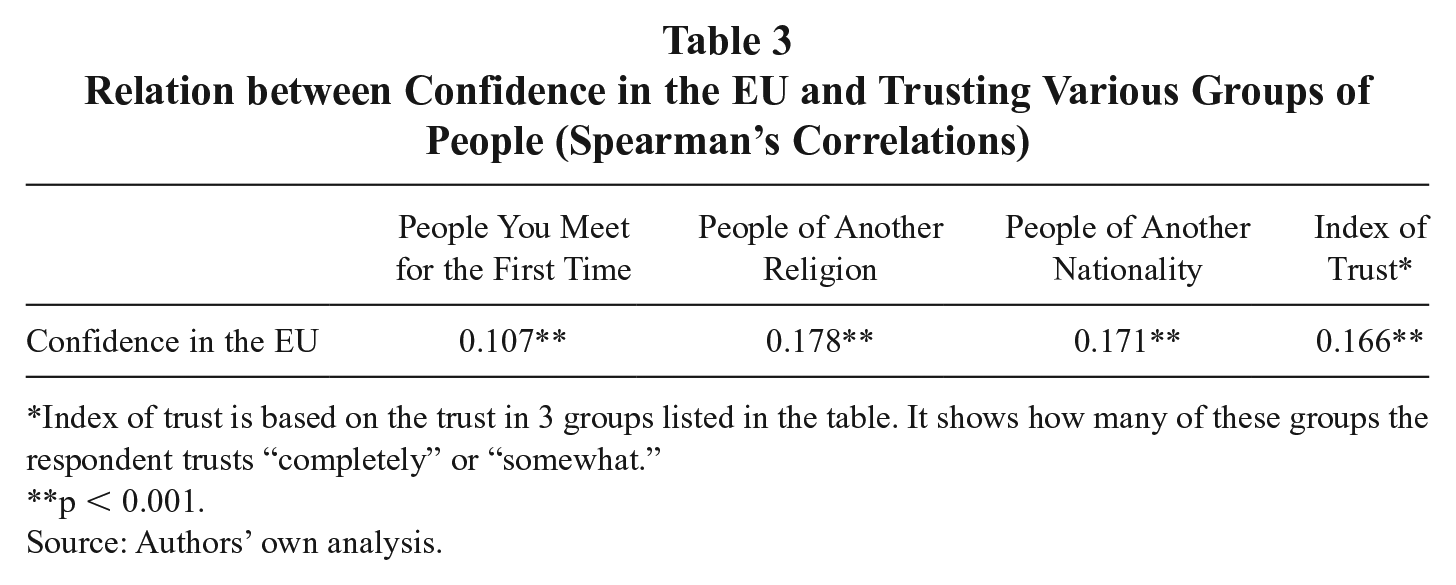
Index of trust is based on the trust in 3 groups listed in the table. It shows how many of these groups the respondent trusts “completely” or “somewhat.”
p < 0.001.
Source: Authors’ own analysis.
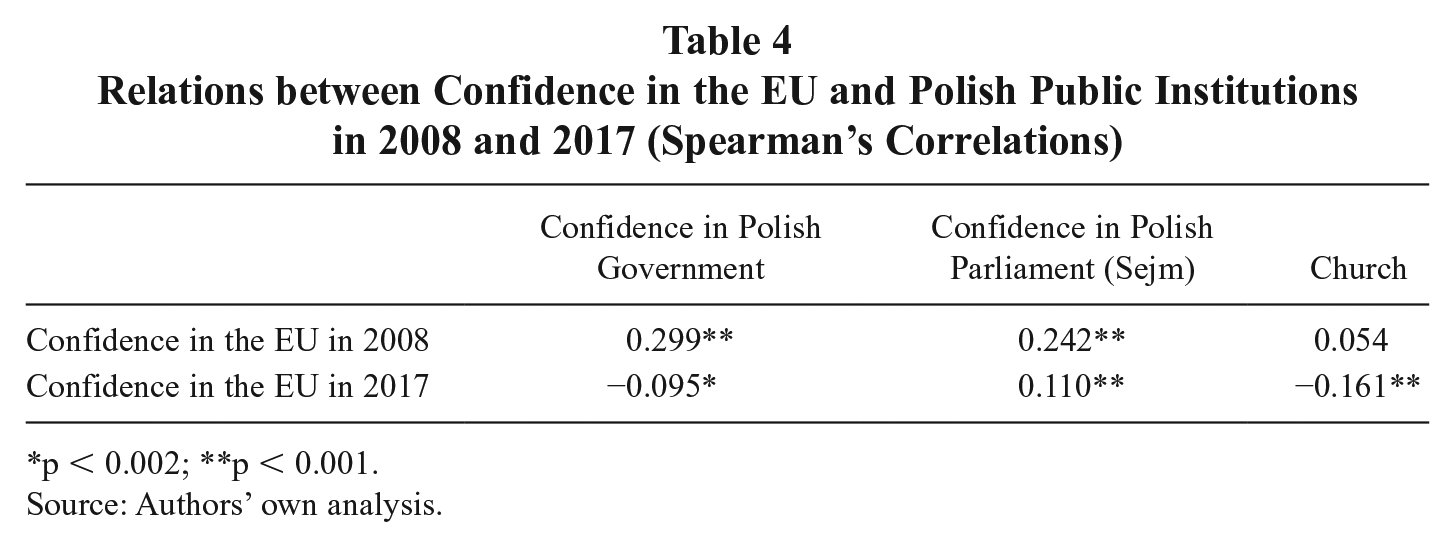
Relations between Confidence in the EU and Polish Public Institutions in 2008 and 2017 (Spearman’s Correlations)
p < 0.002; **p < 0.001.
Source: Authors’ own analysis.
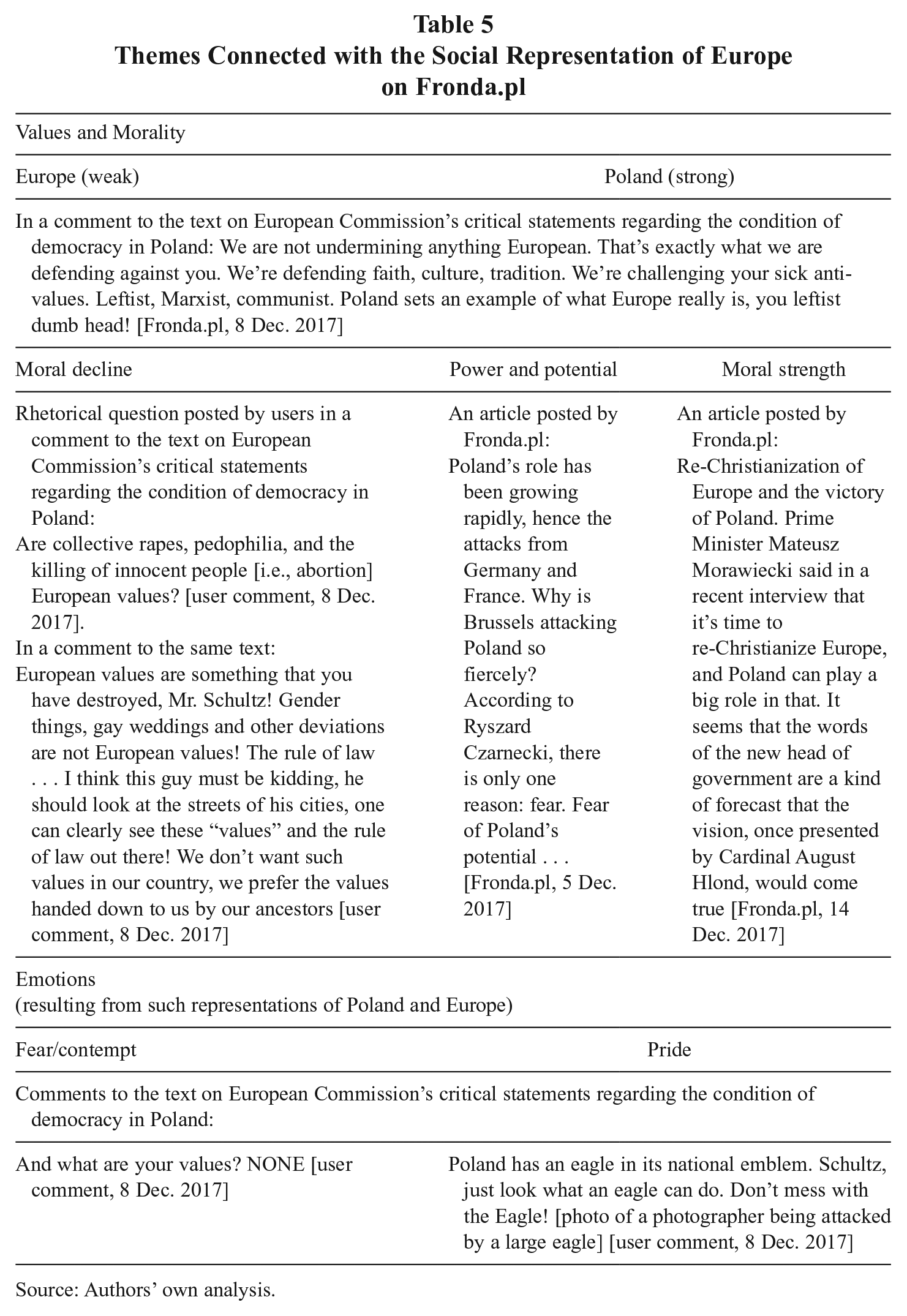
Themes Connected with the Social Representation of Europe on Fronda.pl
Source: Authors’ own analysis.
The political dimension of confidence in the EU is also noteworthy in terms of its connection with attitudes toward national political institutions, that is, government and parliament. Of particular interest are the changes that occurred in those relations during the nine years between the two rounds of the European Values Study. In short, one can say that Poles in 2008 were divided into those who had (moderate) trust in institutions, and sceptics who tended not to trust institutions. Correlations between the level of trust in the EU and trust in the government and the Sejm (parliament) were positive and quite significant at that time. In 2017, the correlation coefficients decreased in absolute terms and, at the same time, there was a change in the direction of the relationship between confidence in the EU and in the national government, while the direction of the EU–Sejm relation remained the same, although its strength declined (Table 4).
The table also presents correlations between the level of confidence in the EU and that in the Catholic Church. We decided to present these correlations because of the nature of the changes that have occurred in this relationship between the two EVS rounds. First of all, the strength of the correlation (i.e., the absolute value of the correlation coefficient) increased. Moreover, in 2008, the value of this coefficient bordered on significance (p = 0.05) and was positive. In the most recent EVS round, however, a statistically significant negative correlation was observed, which means that people who trust the EU tend to have no confidence in the Church. Conversely, those who trust the Church tend to be reluctant about the EU. This implies that the attitude toward the EU has assumed an axiological meaning, that is, it has started to be viewed in terms of values, which had not been observed before. Therefore, the cultural dimension of the European integration has acquired new significance.
The Cultural Dimension
Pursuant to its founding treaties, the EU is based on the recognition of certain values: freedom, democracy, pluralism, and equality between women and men. Those who trust the EU indirectly express their appreciation for the EU as a center of cultural modernization engaged in the dissemination of these values.
The results of the European Values Study confirm that this is indeed the case. Confidence in the EU is positively correlated both with the belief that democracy is the right system of governance for Poland (coefficient: 0.158), and with the importance attached to democratic governance in the country (0.102). A commitment to democracy also entails a willingness to take advantage of the opportunities it offers, its meaning, and participation in public governance. Confidence in the EU co-occurs with an interest in public affairs and in opportunities to influence government decisions, which is reflected in the positive correlation between confidence in the EU and the variable that Welzel called the “index of liberty aspirations.” 39 A positive correlation between this index and confidence in the EU is a new development: Ten years ago, in the previous edition of the EVS, no such correlation was found.
Moreover, people who have a high level of confidence in the EU are also equality-minded and willing to embrace “otherness.” They tend to believe that foreigners who come to settle in Poland have a positive impact on the country’s development. They are also more likely than others to admit that “homosexual couples are as good parents as other couples”: 22 percent of those who have a great deal of confidence in the EU, and only 8 percent who do not trust it. Those who trust the EU are also somewhat more likely to reject rather than accept fixed traditional gender roles: Only one in three (32 percent) of those who have strong confidence agree that “a man’s job is to earn money; a woman’s job is to look after the home and family,” while 68 percent disagree with this statement. The percentage of respondents who share this view seems quite high, but the opposite is true of those with low levels of confidence in the EU: they are more likely to agree (54 percent) than disagree (46 percent) with the above statement. Sharing household chores as a very important prerequisite for a successful marriage is mentioned by 54 percent of those who trust the EU and 46 percent who do not. Although gender equality is not a matter of course in Polish society, people who endorse it tend to demonstrate an open attitude toward the EU.
However, the data we have collected also clearly reveal an attitude that is distinctive in that it rejects the values previously described as “European.” In the EVS data, this attitude is manifested primarily through an exclusive understanding of European identity: Those attributes of a European that are considered to be very important include being born in Europe, having European parents, and being a Christian. This shows a very narrow perception of what being European means. The most pronounced element of this perception is the attitude toward the last attribute, that is, being a Christian. This attribute is “very important” for 15.9 percent of the respondents, and “quite important” for a further 31.1 percent. The importance of Christian faith as an element of European identity is negatively correlated with the level of confidence in the EU (Spearman’s rho −0.149, p < 0.001). This is manifested in the fact that 65 percent of those who have “a great deal” of confidence in the EU believe that being a Christian is unimportant (not important or not important at all) for the recognition of European identity, while nearly the same percentage (61 percent) of people who have no confidence in the EU consider the Christian faith to be an important attribute of Europeans (very important or quite important).
Such a narrow understanding of European identity is also connected with religiousness, which is, in turn, strongly linked with the institution of the Catholic Church. Religious people invoke the teachings of the Church when seeking answers to various questions, not only those related to the spiritual life but also those concerning morality, family life, or even important social and political issues. Conservative religiousness co-occurs with attachment to traditional gender roles and is conducive to the belief that there are clear and indisputable rules enabling people to distinguish between good and evil (Figure 2).

Percentages of respondents, who believe that “There are absolutely clear guidelines about what is good and evil. These always apply to everyone, whatever the circumstances” and those who strongly agree or agree that
The attitude presented here can therefore be characterized as a kind of longing for a world that is organized according to clear (conservative) rules. Another argument supporting this claim is that the narrow perception of European identity is linked to a tendency to perceive various social relations as a duty: this is reflected in respondents’ acceptance of statements such as, “work is a duty toward society,” “it is a duty toward society to have children,” and “adult children have the duty to provide long-term care for their parents.”
A further element of the traditional worldview is the attachment to the nation state and the tendency to see national identity from an ethnic rather than civic perspective—hence the high correlation between the indicator for the narrowly understood European identity, and the index of national identity and attachment to Poland (correlation coefficients: 0.402 and 0.233 respectively), as well as a reduced level of tolerance for otherness.
Tolerance (or rather its opposite, intolerance) was measured using a question about the various social groups that the respondents would not like to have as neighbors. At this point, it should be noted that in this measure Poles generally turned out to be fairly tolerant toward people of different race or nationality, while they were far less willing to accept people perceived as heavy drinkers (71 percent would not like to have them as neighbors) or drug addicts (74 percent would not accept such neighbors). The attitude toward these two latter groups is, however, not linked to a narrow understanding of European identity, whereas the attitude toward people of different race and nationality, Muslims, and homosexuals is indeed linked to this narrow understanding: The stronger this attitude (i.e. the more important it is for a respondent to include being a Christian as an element of European identity), the higher the likelihood of rejecting these groups. These findings are presented in Figure 3.
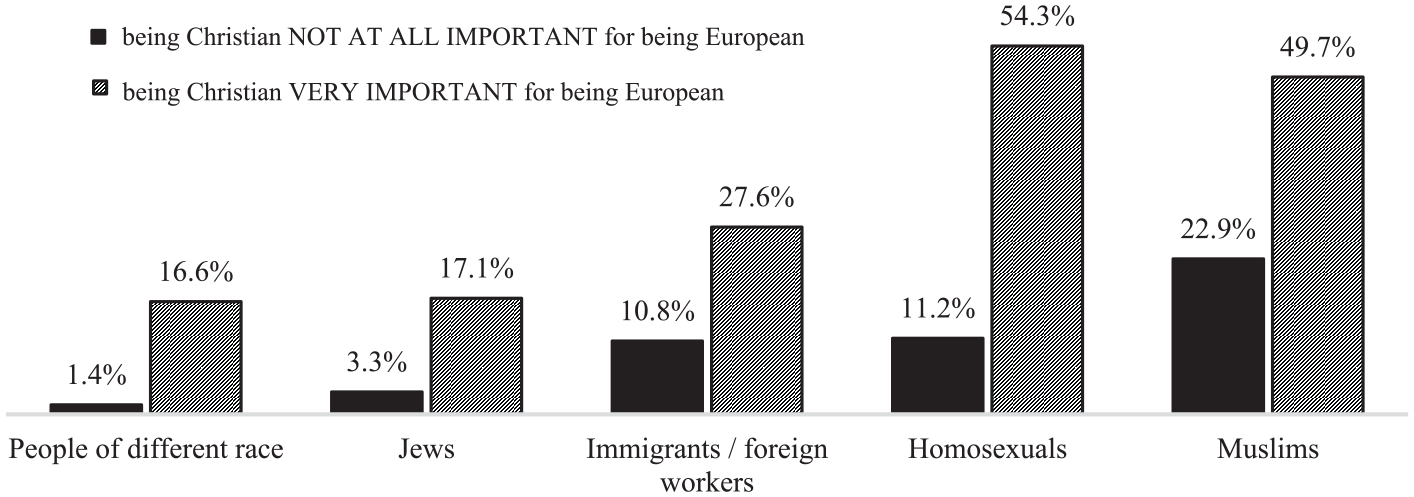
Percentages of respondents who would not have the following groups as neighbors—within the groups for whom being Christian is “not at all important” or “very important” for considering someone European
The groups listed in the chart “distort” the image of a well-ordered social reality where Poland is inhabited by Poles, China by the Chinese, and Europe by the Caucasian race. People who seem to be particularly fond of this image are those with a strong commitment to traditional Europeanism. Gay people are also thought to go against the “natural order” and, as such, are not accepted: worth noting is that homosexuals are more likely than Muslims to be rejected by “traditional Europeans.”
The analysis of qualitative data provides a more accurate insight into the meanings and emotions associated with Europe and the EU among people with radical Catholic-nationalist orientations and allows us to reconstruct their perception of the relationship between Poland and Europe. The methodology of the mixed methods approach, which is based on combining qualitative and quantitative data, does not allow us to claim firmly and explicitly that the aforementioned attitudes, analyzed in detail on the basis of quantitative data, can actually describe the users of Fronda.pl (the alt-right web portal that was used as a source of a part of qualitative data). However, we assume that the overall orientation of these people is similar: This website is intended for readers with clearly nationalist and radically Catholic views, and, as we have just pointed out, attachment to Poland and traditionally understood religiosity are the key correlates of the narrow understanding of European identity (see Table 5).
The communication that occurs on Fronda.pl reveals a representation of Europe where the main element is the belief that contemporary Europe has “gone astray,” and is betraying “fundamental European values.” A key feature of this mental representation of Europe is the emphasis on the “moral decline” of the societies of “old” Europe, allegedly manifesting itself in two spheres. The first one is the rejection of Europe’s founding values—above all, Christianity, understood in a very particular way as sticking to a rigid set of so called “traditional” values, based on strict division of family and gender roles, and positive attitude toward the Catholic Church. The second is submission to morally wrong—according to Fronda.pl authors and supporters—ideologies (for instance so-called gender ideology values advocated by feminist and pro-choice movements, liberal morality). When presented in this way, Europe is contrasted with Poland, the latter having all the attributes that modern Europe is believed to lack. In this vein, Poland is represented as powerful: a dynamically developing, successful, important country of brave people. Poland’s economy is described in a positive light only with an emphasis on its dynamism and potential. Sport is reported in the light of the successive victories of Polish athletes, while Poles are depicted as a courageous and strong people.
However, the most prominent characteristic of Poland in this perspective is the fact that it has remained faithful to “right” and “truly European” values. In this context, the “right” European values include tradition, culture, the values handed down by our forebears, and, above all, religious faith, perceived as tantamount to Christianity. Religious faith and traditional customs are seen as the source of Poland’s strength. In this narrative Poland faces a great and important challenge: it is the last bastion of Christianity in Europe, and, as such, must undertake the challenge of re-Christianizing Europe and making it “moral” again. Poland does this by guarding “real” European values and proclaiming them to the world. The arguments invoked in the discussions on Fronda.pl and the structure of participants’ emotional reactions indicate that the discussants speak in defense of Poland and its right to represent European values. European politicians and members of Western societies are required to do only one thing, namely, to recognize the moral superiority and “true Europeanism” of Poland.
The representation of Europe, as reconstructed here, has a significantly negative emotional charge and arouses dual (and contradictory) emotions: on the one hand, fear of the negative cultural impact of EU institutions on Poland (as a threat to the “traditional values” prevailing in Poland) and, on the other hand, contempt for the EU, presented as weak and deprived of any values. On the contrary, the representation of Poland invokes pride of the country’s axiological strength.
Discussion and Final Remarks
The analysis of both quantitative and qualitative data on Polish values generated through the EVS questionnaire and focus group interviews indicates that when Poles think about integration with Europe, they clearly distinguish between what we previously called the economic, institutional, and cultural modernizing impact of the EU. In the economic aspect, Polish society is strongly determined to “catch up” with west-European standards of living. In the institutional dimension, it is divided into those who trust European institutions, and those who reject them. Distrust derives from a conviction that the EU imposes on Poland political arrangements which can worsen the situation in the country and exploits it with its economic policy which favors Western companies. In the cultural field, in the broad sense, the vast majority of Polish society is at least moderately in support of the modernizing influence of the EU axiological system. As demonstrated by comparison between the quantitative data from 2008 and 2017, Polish society at large adapts to the European axiological discourse in terms of equality, tolerance toward diversity, and pluralism of lifestyles. In this sense, Poles accept the modernizing impact of the EU also in its cultural aspect, and the internalization of European values advances.
However, there exists a minority group who opposes such perceptions of cultural modernization by the EU. They should not be mistaken for those who occupy anti-European positions, as they generally agree that Poland “belongs” to Europe, also in a cultural sense, but their understanding of European values differs from this conveyed by the Treaty on European Union, and tacitly adopted in EU documents and discourse. From their perspective, each of the EU’s modernizing axiological “proposal[s]” poses a cultural threat to the Polish set of values. As the EU actively promotes its values, it regularly introduces symbolic issues connected with civil rights, gender equality etc., to public discourse. These topics, when detected, are picked up and framed as being a threat, and an axiological “counter-proposal” is offered. The Catholic Church in Poland is the key actor in this process, as it is both a proponent and exponent of the most conservative views opposing social change, understood as being the modernization of social relations. Although the Church in Poland was highly supportive of the westernization of Poland in the communist era, recent research suggests that, currently, the Polish Catholic clergy holds an ambivalent attitude toward the EU. 40 They propose a vision of integration with Europe not as modernization but as cultural traditionalization. Traditionalization denotes here a return to traditional models of social relations based on clearly defined social roles, identities, and differentiated rights and obligations.
This means that the cultural modernization, on the EU’s terms, is no longer perceived in Poland as having no real alternatives. On the contrary, our analysis demonstrates that Polish society no longer accepts the role of the passive absorber of cultural pressures exerted by the EU, although as we have shown, it still accepts and expects a top–down transfer of financial resources from the “core” of the EU to the “new” member societies. This suggests that at the core of tendencies which are often called “anti-European,” there is no rejection of Europe per se; rather there is an opposition to the status of “newcomer” in the cultural and axiological sense, and a claim to an active role in the setting of the EU axiological agenda.
