



Abstract
This article contributes to the scholarly discussions about the self-responsibilization, defined as a configuration of understandings and action strategies oriented to compensate the (perceived) dysfunctionality of the media system, of audience members in East European societies. The authors argue that audience members’ sceptical and self-reliant stance towards political news, which were planted in Soviet times, continue today in the context of mediated geopolitical conflicts. Based on a mixed methods study of Baltic Russian-speaking audiences’ behaviour in the context of the Russia–Ukraine conflict, the authors explore audience members’ media repertoires aimed to “fish out” reliable information from the political news by searching for unspoken clues or identifying ideologically biased messages. The authors introduce six political news repertoires based on the varied degrees of plurality of information channels and conditional trust. Then, they characterize audience groups exercising these repertoires and explain how audience members rationalize the chosen repertoires as a part of their agency in the context of geopolitical turbulence. They suggest that media audiences’ self-responsibilization is a worthwhile object for further study and call for a shift in East European media research away from a structuralist approach and towards an agency-centred one.
Introduction
Following political news for opinion formation about current national and international affairs is an important citizen practice and part of the public legitimation of power. 1 One of the important functions of the media system in democratic societies is to provide information for citizens’ deliberation about political issues; 2 this function, however, may be challenged by several obstacles, one of them being audiences’ scepticism about the trustworthiness of media news. Authors of earlier studies report that people in many Eastern European societies are characterized by high scepticism towards media institutions 3 and that they have a perception of journalists as failing to resist political-economic and commercial pressures. 4 One reason for this can be that distrust of the political elite transfers to public media. 5 Another reason can be lower press freedom in most East European countries compared to most Western and Northern European countries, 6 with the recent illiberal turn in the region defined by a mixture of illiberalism, nationalism, and populism further deteriorating the situation with media freedom there. 7 As part of “a conservative nationalist project,” illiberal populist politicians are reported to be “exerting partisan control over public institutions and the media.” 8 Researchers have found journalists’ self-censorship on the media markets have been affected by economic constraints, oligarchic influences, and new authoritarianism. 9 Authors who have investigated media coverage of contentious topics in politics or business report that journalists describe their practices of manoeuvring on the verge of what is allowed to be said publicly as adekvatnost. 10 For Surowiec and Štětka, it is not yet clear whether “this crisis of democratic media systems constitutes a uniquely idiosyncratic period, or whether this is simply the continuation of a long-term process that had been implicit in the transition process, but came to prominence in the past few years.” 11 Nevertheless, it is particularly in East European societies where a strong tradition of media freedom has been absent that such a political climate provides fertile ground for media scepticism. Authors earlier have explained the high scepticism towards media and journalists, characteristic of East European societies as derived from the Soviet past as part of the historical culture of resistance. 12 Researchers of audiences history regard news scepticism to be an aspect of the audience’s agency in Communist societies 13 rather than a passive reaction. In their historical audience research, Meyen and Nawratil refer to the strategies of television audience members to personally manage the dysfunctionality of the media by searching for the “in-between truth” from the television news coming from both Eastern and Western Germany. 14
This invites us to look at media-society relations in post-communist countries from the perspective of media news use, trust patterns, and related normative beliefs as a part of the (historically established) audience agency. The audience members actively relate to the media content by extracting the reliable information from the political news by searching for unspoken clues to fill in the “blank” spots in the news, 15 identifying ideological bias in media messages, 16 and juxtaposing information provided by various news sources. 17
The collectively learned scepticism towards media organizations and the self-responsibilization 18 of audience members is mutually reinforcing as subjects voluntarily take on the task themselves of information collection and selection from the media institutions because they do not trust them as an expert agency to fulfil this duty in a way that is beneficial for the audience. As Pjesivac et al. have argued, as audience members “swing the responsibility of producing trustworthy messages from news media to themselves . . . consumers are no longer required to have trust in journalistic selectivity, only in themselves, in their own ability to look for the truth between the lines of the delivered news media content.” 19
We argue that the behaviour of news audience members is aimed at compensating the (perceived) partial dysfunctionality of the media system. Whereas historical studies refer more to audiences’ skills of decoding one particular media text or “reading between the lines,” nowadays the skills ascribed to self-responsible media users concern more intertextual capabilities. Audience members seek multiple sources and validate their decisions via comparison and synthesis. 20 Our earlier studies demonstrate that the motivation to check other ideologically plural media channels is rationalized by emotional curiosity, an emotional understanding of the “other side” as a form of counter-source fact checking (if oppositional channels also present the fact, it should be true), channel discourse checking (is it still biased), and searching for new facts (admitting that the preferred channel may not publish the ideologically undesirable facts). 21 Thus, the intertextual repertoires form a base for exercising media citizenship. Also, while people do not fully deny the functions of the media system in the context of crisis communication, they rationalize the reasons (e.g., threats are softened to avoid panic; information is not context specific; institutions themselves are disinformed) for the partial dysfunctionality. In this way, audiences justify to themselves the need to seek additional sources of information (e.g., by calling the persons who are believed to be able to give some contextualizing cues). 22 Kiriya considers the additional use of the media in order to be more informed and to make their own decisions a pragmatic attitude towards media functions. 23 To sum up, we argue that audiences have developed self-reliant media-related behaviour strategies (juxtaposition of sources, interpreting clues) that allow them to manage the partial dysfunctionalities of the media system while not to fully abandon trust because this is a useful tool for managing complexity.
We consider that this self-defined audience responsibility in the context of (perceived) partial dysfunctionality of the media system, exercised through a plurality of information channels and conditional trust, is a worthwhile object for further study for three reasons. First, governments need to communicate with all sections of the population, not only with those who trust institutions and obey the instructions given (e.g., in crisis situations). In order to communicate more effectively with more demanding and critical audiences, there is a need to know more about the peculiarities of the sceptical audiences using (ideologically) plural information sources and the resistant or negotiating modes of reception. 24 Second, if different media repertoires and the mundane rationalities behind them remained unexplained, this may cause conflicts between groups in society (e.g., opposing groups are regarded as “paranoid” or “brainwashed”). Third, this line of research contributes to the shift in East European media research from a rigidly structuralist approach towards a more elaborate conceptualization of interaction of agents (audiences) and structures (media system) taking into account the Giddensian idea about aggregated agential impact in transforming the structures. 25 Several authors who have investigated the Eastern European media sphere have criticised researchers’ preoccupation with the study of structural power at the expense of considering people’s agency 26 and pointed to the need to study “audience behaviour as one possible locus of agency in the formation and development of media systems.” 27
Informed with the above-referred considerations of the self-responsibilization of audience members and their exercise of media citizenship via plural information channels and conditional trust, the authors of this study aim to (1) explore media repertoires, (2) characterize audience groups exercising these repertoires, and (3) explain how audience members rationalize the chosen repertoires as a part of their agency in the context of geopolitical conflict.
Based on the mixed methods study of Baltic Russian-speaking audiences’ behaviour in the context of the Russia–Ukraine conflict (the case is explained in the relevant subchapter below), the authors explore how audience members in the complicated contexts use reductionist and/or pluralist strategies to choose sources of political news and evaluate the trustworthiness of media bearing different geopolitical discourses. We ask:
How do people manage their news media repertoires in the context of perceived dysfunctionality of media during geopolitical crises?
What repertoire clusters emerge?
What is the sociodemographic character/profile of these clusters?
How do members of the repertoire cluster discursively rationalize their position as media citizen-consumers in the context of the media dysfunctionality in the midst of geopolitical crises?
Theoretical Framework: Media Repertoires and Trust
We investigate audiences’ strategies and configurations between diversity-seeking and reductionist responses based on the concepts of media partisanship, ideologically selective media exposure, avoidance of political news, media repertoires, and social trust.
The interplay between technological and political factors has increased the complexity of the political news media scene 28 and motivated various strategies of complexity reduction among media audiences. One strategy is news avoidance or incidental encounters with political news. 29 Other studies, however, suggest that following news is still important because it is intertwined with social communication and is a kind of daily ritual. 30
Another strategy of complexity reduction is a homogenization of information sources. Several authors claim that citizens tend to select only political news that confirms their political preferences. 31 From the other side, research on digital news encounters reveals that media users often make “extended” searches for counter-attitudinal information or encounter information that appears beyond intentional searches accidentally. 32 Garrett also argues that while people prefer like-minded sources of news, they do not necessarily screen out oppositional ones. 33 Indeed, research conducted in Russia on the media environment characterized by low diversity shows that people are still willing to access alternatives to state-aligned television broadcasts. 34 Likewise, in the case of the Ukrainian crisis, audiences are reported to hold the view that “an accurate picture of developments can only be constructed autonomously by reviewing diverse viewpoints with a sceptical eye.” 35
These findings suggest that while according to the hostile media perception paradigm, counter-attitudinal sources of news are treated as untrustworthy, 36 they can still be part of one’s media repertoire. So, the news media diet alone does not give a comprehensive picture of the possibilities for the deliberative media citizenship that brings us to the issue of trust. According to general sociological conceptualizations, trust occurs when there is a margin of uncertainty about the effectiveness of our control of actions of other social agents, including institutions. Sztompka defines trust as “a bet about future contingent actions of others.” 37 From that perspective, we can look at the decisions audiences make about whether certain media can be (conditionally) trusted or not as making bets for imagined future episodes when selecting media: either for an increase or decrease in diversity. So, the decisions about trust towards certain media can serve as either a reductionist strategy (only the fully trusted media outlets are taken to the repertoires) or a diversity-seeking strategy (where media outlets that cannot be trusted or only conditionally trusted are also searched for in order to confirm the facts of the oppositional channel and seek alternative explanations or fulfil an emotional curiosity).
In order to investigate the configurations of reductionist and diversity-seeking strategies, we have turned to media repertoire studies. 38 Repertoires are understood in this article as user-created subsets of channels, programmes/content, or other media production units selected from all available options for personal consumption. The meta-motivation for the creation of repertoires has been explained in the same way, as the creation of trust: namely, repertoires are designed to deal with fragmented and multifarious information offers. 39 Thereby, a crucial dimension in the research of repertoires is how audience members balance between allowing for and reducing diversity. 40
In addition to the earlier studies demonstrating the interconnection of media use and trust, 41 we suggest expanding the concept of media repertoires as embodiments of the interplay between trust and use that can both increase and reduce diversity. We propose the concept of news diversity management repertoires as a form of exercise of self-reliance in the context of (perceived) partial dysfunctionality of the media system. These repertoires are understood as principles that guide the ways in which flows of information are organized and the complexity of information offered is managed.
The Russian-Speaking Audiences in Estonia and Latvia
This article focuses on the political news media use of the Russian-speaking population living in the Baltic states of Estonia (33 per cent of the entire population) and Latvia (37 per cent of the entire population). Because of their complicated relationships with the media system and the social anxieties related to their Russia-oriented media repertoires among ethno-linguistic majority populations, they represent a specific case of interest. The bulk of these individuals are settlers from the Soviet era and their descendants, many of whom, for various reasons, maintain transnational ties with Russia. Their media repertoires have formed in the flux of the Soviet legacy of media-related habits 42 and the building of new national media systems that, in the beginning, were often unable to satisfy the needs of ethno-linguistic minorities. 43 Their exercise of transnational media practices involves following Russian (and to a lesser extent also Western) media and having digital cross-border contacts, both in Russia and elsewhere. This is combined with the extensive use of local origin sources of news (see Appendix 3).
It is assumed that transnational audiences are capable of comparing and using plural interpretative frameworks. 44 Indeed, Baltic Russian-speakers hold a normative ideal of self-reliant autonomous media use, especially in the context of the political conflict. 43 Based on earlier research we knew that these audiences are sceptical about the media and journalists 45 and this was also confirmed by the 2019 Baltic Russian Audiences Survey (BRAS) data. 46 About 90 per cent agreed that in the context of the Russia–Ukraine conflict, journalists reflect events in accordance with the interests of their owners. Also, the general understanding of the media does not support the personal 47 or transparent 48 mode of reception, according to which audience members relate the information provided in the media as reflections of reality. Rather, they acknowledge the constructed nature of the text: that is, its official 49 or mediated 50 mode. Among the Estonian/Latvian Russian-speaking population, 80 per cent disagreed with the statement that journalists reflect events as they really are. Such a view corresponds with the self-reliant norm of “putting the puzzle together” and “reading between the lines” that is argued to have been exercised in Soviet times and also today. 43
Based on what is said above, we consider the Baltic Russian-speaking audiences to be interesting subjects for research on the management of informational complexity and viewpoint diversity. As digitally active transnational audience members, they are likely to have extended encounters with ideologically oppositional information because of their cross-border social media networks. However, considering the ideologically polarized mediascape, they may well have been motivated to use reductionist strategies.
Research Strategy, Data, and Operationalization
The findings presented in this article are part of a research project organized into four phases. First, qualitative data were collected and later analyzed. This then informed the development of the survey questionnaire. Finally, the survey results inspired our return to the analysis of qualitative data (see the scheme of the study design below).
Scheme of the study design

We asked the participants in the study to make voluntary screen recordings of their PCs and/or mobile phones. Participants were instructed to record all their online activities except those that are work/education-related and contain confidential data such as online banking and emailing, while explicitly entertainment-oriented online activities (i.e., viewing films and series, playing online games) were instructed to be recorded only for the first five minutes of the particular activity. This allowed us to observe various digital practices on a (nearly) day-to-day basis over three separate periods (ten days in 2017, two weeks in 2018, and three weeks in 2018) that these informants were involved in. Follow-up interviews were carried out in which the participants were asked about the recorded episodes selected by the researchers. The qualitative study sample was composed of twenty-eight digitally active members from the Russian-speaking communities in Estonia and Latvia with different sociodemographic backgrounds (not all respondents participated in all waves of data collection) (see Appendix 1). Initially informants were recruited on the basis of connections obtained during our earlier qualitative audience research projects, and later supplemented by snowball and other sampling techniques. Written informed consent was obtained from each study participant. No screenshots of their recordings are made publicly available; all other personal data have also been anonymized.
The survey data collection was commissioned from the market research company Kantar. The nationally representative sample (n = 400 in Estonia and n = 402 in Latvia) was composed of respondents aged between eighteen and seventy-four years whose main language used with family was Russian (see Appendix 2). The interviews were conducted by telephone during May 2019.
Qualitative data—both screen recordings and follow-up interviews—were analyzed in two phases: first, we did thematic coding, and then performed close reading of the material with the help of analytical tools of discourse and narrative analysis. What we learned from this task is that “extended or sidetracked encounters with counter-attitudinal information,” to use the terminology offered by Li and Liu, 51 were relatively prominent in political news following. In the context of the Ukraine crisis, we observed searches for news channels that did not conform with the individual’s own political views. Thus, in the quantitative analysis of the survey data, we did not focus either on particular use frequencies or the particular combination of channels but rather on indicators of the general variety of channels.
For the quantitative survey measurement of the variety of personal media menus, we calculated the individual average scores that expressed generally the use of different types of media channels—Russian state-aligned, Russian alternative, Western, local media both in the Estonian/Latvian and Russian language: web, television, radio, and press, plus social networks (the full fifteen-item list is provided in the Notes section). 52 The respondents’ personal use variety scores were calculated on the basis of reports of “frequent” or “sometimes” use of particular channel types (in both cases, the use of a particular channel was counted as 1, and “very rare” or “no use” was counted as 0). The median of individual use scores was 7. For further analysis, we used two variables: the above-median variety of media channels used (50.2 per cent of the whole sample) and the below-median variety of media channels used (49.8 per cent of the whole sample).
The qualitative data revealed that the use of particular channels might be motivated by an interest in counter-attitudinal information, while these channels might actually be distrusted. So, it was clear that the use indicators had to be looked at in relation to trust indicators. The qualitative study revealed that the participants talked about Russian, Western, and local media in a generalized manner, according to the dominant ideological discourse represented in these channels. For example, when talking about Russian information sources, people meant state-controlled television and the Internet and not the Russian alternative, oppositional media. For this reason, we measured trust in information sources of different geopolitical origin reporting on the Ukraine–Russia conflict, where these media channels offered oppositional reality accounts both content-wise and discursively. We asked about different degrees of trust using the scale “trust fully,” “trust somewhat,” or “do not trust at all” Russian, local, Western, and Ukrainian information sources.
The trust repertoires were analyzed by using the clustering analysis K-means method because the particular combinations of ideologically diverging viewpoints were topical and the small number of variables allowed for relatively clear clusters. A four-cluster solution was selected as the most informative: (1) trusting mostly local and Western media channels (pro-Western), (2) trusting mostly Russian media channels (pro-Russian), (3) trusting somewhat all channels (trusting-prone), and (4) distrusting all channels (distrusting). The averages and sizes of the clusters are provided in Table 1.
The Averages of the Clusters Constituting Variables across Four Clusters of Trusting Strategies

Note: 3 = “full trust,” 2 = “some trust,” 1 = “no trust.”
In order to compose an integrated typology based on the media use variety and media trust strategies, the two variables were combined as a cross-tabulation matrix. That is, the members of the four clusters—pro-Western, pro-Russian, trusting-prone, and distrusting—were differentiated into two subgroups: (1) personal score of variety of media channels used above the whole sample’s median and (2) personal score of variety of media channels used below the whole sample’s median. As a result of this cross-tabulation, eight subgroups formed as shown in Table 2.
Composition of Integrated Typology: The Audience groups According Personal Score of of Variety of Media Channels and Clusters of Trusting Strategies.
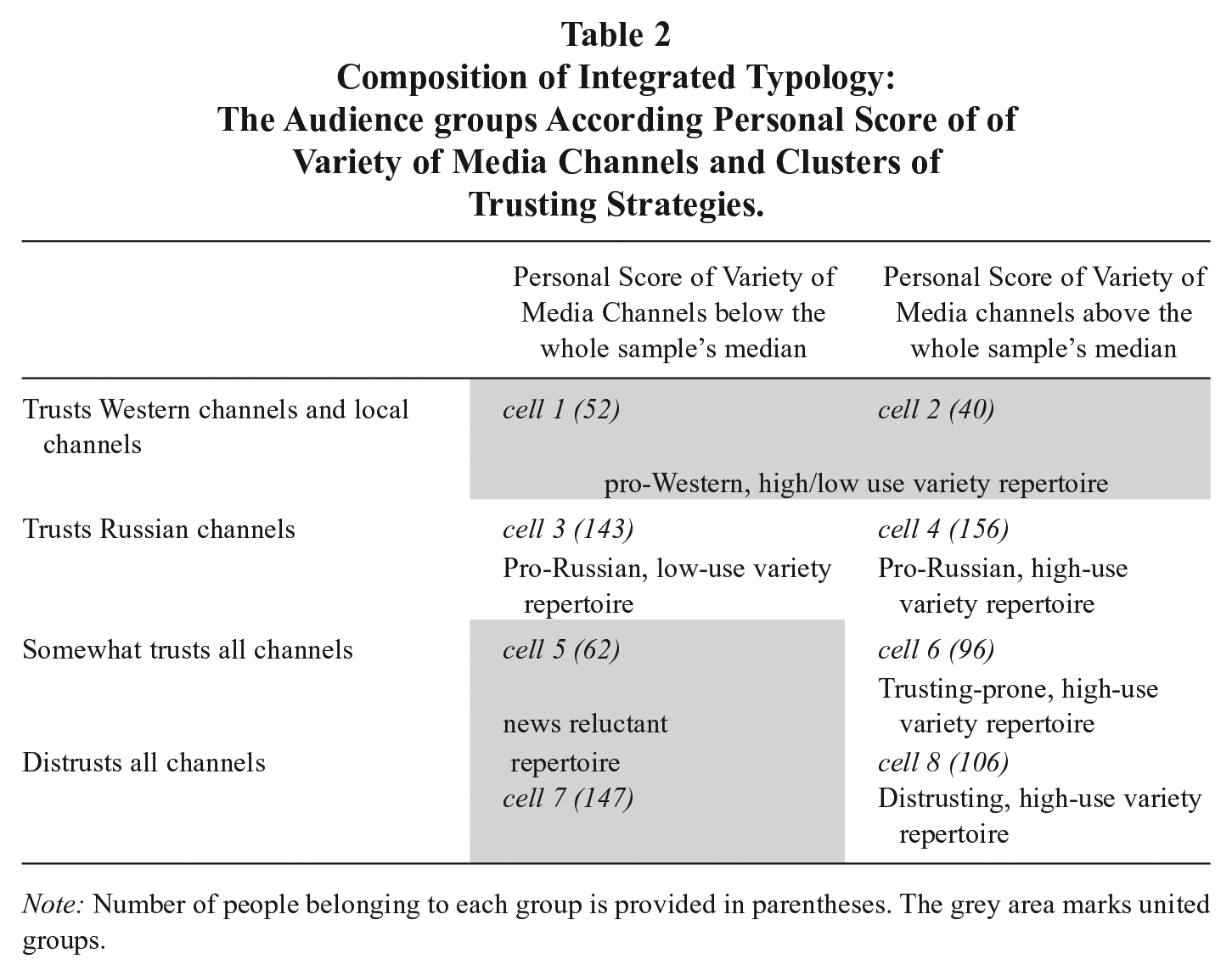
Note: Number of people belonging to each group is provided in parentheses. The grey area marks united groups.
As some groups that formed through this cross-tabulation operation were small in number, some re-grouping was done, based on the experience obtained from the qualitative study. Two pro-Western subgroups of high-use variety and low-use variety were combined into one repertoire group as shown in Table 2. The variety of use variable was not utilized in order to differentiate this cluster into subgroups because (a) the number of respondents would remain too small for further statistical analysis and (b) this group is characterized by high ideological variety of media channels even if one part of the group members do not exercise high variety across web, television, radio, and the press. Second, the subgroup characterized by low variety of media use and distrusting all media channels was united with a small group that was generally trusting towards all media channels but nevertheless did not follow the news frequently and regularly. As both subgroups reported to avoid political news above the average, this group was labelled as news reluctant repertoire.
Thus, six audience repertoire groups were considered for further analysis: (1) pro-Russian, low-use variety repertoire (cell 3 in Table 2; n = 143); (2) pro-Russian, high-use variety repertoire (cell 4 in Table 2; n = 156); (3) pro-Western, high/low-use variety repertoire (cells 1 and 2 in Table 2; n = 92); (4) trusting-prone, high-use variety repertoire (cell 6 in Table 3; n = 96); (5) distrusting, high-use variety repertoire (cell 8 in Table 3; n = 106); (6) news reluctant repertoire (cells 5 and 7 in Table 3; n = 209).
Informed with the survey-based knowledge about the repertoires, a secondary case-by-case analysis of qualitative material was conducted in order to check the potential real-life prototypes to the statistically constructed ideal types. A rather close match was found between the repertoires of the quantitative and qualitative data.
Results
As explained above, the integrated media use/trust groups were constructed based on the personal average scores of the variety of media channels used and the clusters of trust in sources of information about the Russia–Ukraine conflict. Below we will provide a description of each group (see Figure 1). The sociodemographic profiles of the repertoire groups are provided in Appendix 4. The survey-based characterization of each repertoire group is illustrated with examples from the qualitative mirror-typology we created by doing a case-by-case analysis of the qualitative data.
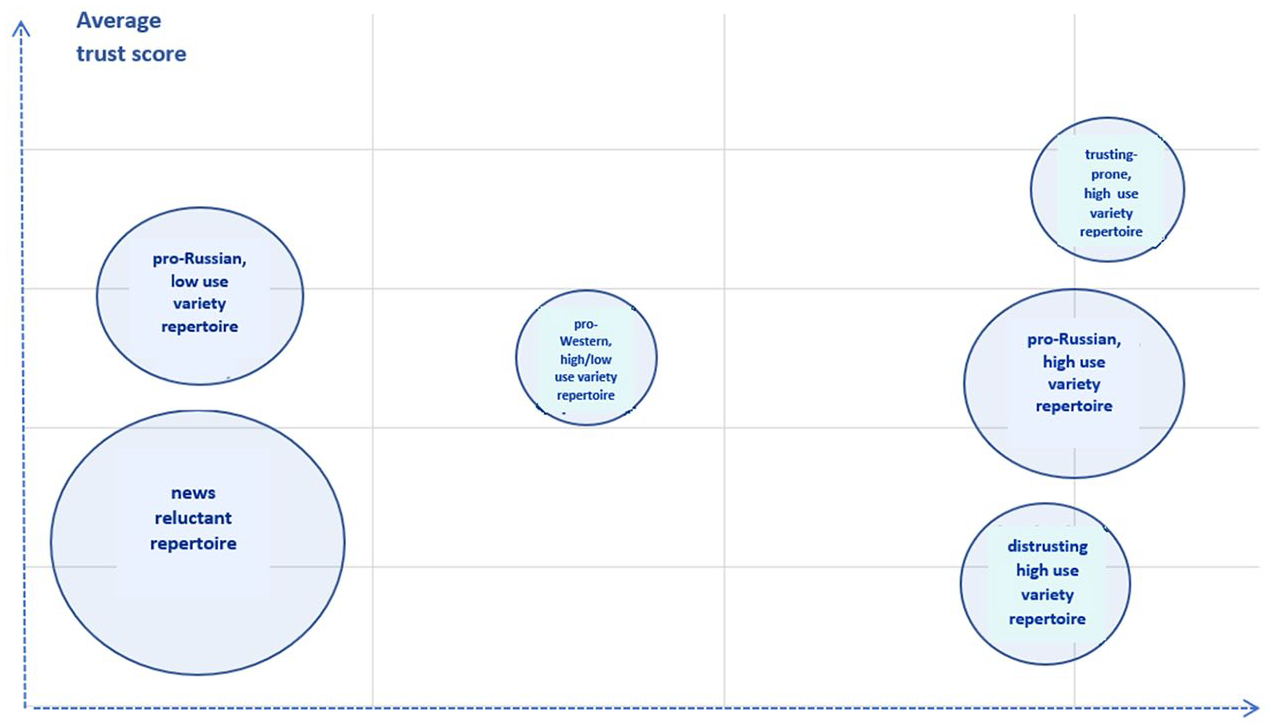
Hand-drawn scheme of repertoire groups. Horizontal axis: variety of use of different media outlets (average scores of each group calculated according to the list of 15 items). Vertical axis: average trust towards the Russian/Western/local/Ukrainian media (average means in each group are calculated on the basis of relevant means of particular channel type). The size of circles roughly corresponds to the numbers of the members belonging to the particular repertoire group
As can be seen in Figure 2, all the repertoire groups hold high media scepticism in regards to the objective and independent coverage of the Russia–Ukraine conflict by journalists and relatively high self-reliance in terms of personal ability to manage contradictory media information. However, their wish to discuss oppositional views with other people is more varied across the repertoire groups. In the following section, the motivations and methods of personal management of the media system’s (perceived) dysfunctionality are explored based on the integrated analysis of quantitative and qualitative evidence.

The media scepticism and self-reliance in encountering oppositional information and opinion across the repertoire groups. The 100 per cent level indicates Estonian and Latvian Russian-speakers belonging to the particular repertoire group
We start with the group labelled pro-Russian, low-use variety repertoire. It was characterized by a lower than average variety of channels used for obtaining news, high trust in Russian media, and distrust of Ukrainian media. Members of this group extensively followed Russian state television and local private media in Russian. About one-third of them also frequently followed local public broadcasters. The majority of them were older people; many also had undetermined citizenship status and were monolingual with no or poor skills in languages other than Russian (Appendix 4). This repertoire group was characterized by a tendency to disagree with statements of self-reliance; members of this group tended to dislike encounters with oppositional views (Figure 2).
A good example of this repertoire group was seventy-year-old Valentina from Valmiera. She had strong opinions about politics and was not interested in learning information that conflicted with her own ideological orientations. She mostly relied on Russian state television as her key source of news, with almost no interest in local media channels since “Latvia’s [pro-Western] position annoys me” and “I just don’t want to be hammered with so much information because sometimes you look and it’s quite difficult to see and hear all this.” The rare encounters with information on local media outlets turned out to be painful for her: I once watched a local show. There was an artist and some other ordinary people. They were asked whether they would be afraid for their children if the Russian army were at the doorstep and NATO supposed to protect us. Frankly, this is all ridiculous to me. I want to laugh at how our politicians and people could believe that Russia would do this. . . . So, why should I look for [alternative, oppositional information]. I already have my own point of view. That’s why I don’t even want to listen to them or watch local channels.
Her rejection of the national political leadership, and the local media by extension, was also fed by feelings of resentment at not being granted Latvian citizenship automatically after the collapse of the Soviet Union.
In general, this repertoire group represented the most classic example of selective exposure: a relatively low ideological variety of used media channels and a strong trust in those that supported their political loyalties. Their encounters with ideologically diverging media outlets were nonhabitual and relatively rare and were regulated by a hostile media perception that de-motivated them further from regular searches for information sources beyond their everyday ideologically close media repertoire.
The group labelled pro-Russian, high-use variety repertoire was characterized by a higher than average variety of news sources, high trust in Russian media, and distrust of Ukrainian media. Members of this group were active media users who frequently followed local and sometimes also Western and alternative, oppositional Russian media, but who reported mostly trusting Russian state-aligned media. They also actively used social media. This repertoire was characteristic across different sociodemographic groups (Appendix 4). This group was characterized by a higher readiness to discuss their views with oppositionally minded individuals (Figure 2).
Individuals who belonged to this repertoire alluded in the interviews to some special kind of dutiful citizenship discourse, where principles of political allegiance were mixed with the pleasure and curiosity of seeking out counter-ideological viewpoints, even if these turned out to be painful experiences. For example, sixty-nine-year-old Tatjana from Tallinn stated that “Well, it’s nicer, of course, to read information that matches my views” and then claimed “but I try to learn about other views on events as well.” Her screen recordings made on 26 March 2017, when anti-corruption protests took place in Russia, showed that she had first come across this news on Facebook, where a fellow Facebook user had shared live streaming of the protests by the pro-democracy movement Open Russia, which initiated her “journey” across various news sites—from local to Russian (both state-aligned and alternative, oppositional) to Western—to learn more about this event. Finally, via Skype she contacted her relative living in St. Petersburg to find out “how are things there” with protests in the city. It was the information vacuum on Russian state television that had stimulated her interest in alternative, oppositional news sources, including those that were beyond her habitual media repertoire. In the following interview excerpt, where she reflected on this experience, we can see her referring to tacit knowledge of the principles guiding the news selection of ideologically oppositional media sources that she, in turn, utilized rationally in order to obtain information about the protests. The awareness that the media channels trusted by her might be selective in representing events did not, however, shake her loyalty to them but, instead, led her to rationalize and maintain an ideologically heterogeneous media menu: I was surprised that there was no information on the central [Russian television] channels. Then saw—there was [information] on Euronews, which I sometimes watch . . . I also watched RTVi—these are sources which cover the events in Russia from an American point of view, but they are the only ones that had information. I figured that if there was nothing on [Russian state-controlled TV channels] PBK or RTR, then it would definitely be on these channels!
As further exemplified by the case of Tatjana, this repertoire represented a conscious choice of both ideologically close and ideologically distant media outlets in order to maintain an ideological position. To put it simply, audience members belonging to this repertoire seek to be ideologically consistent but self-reliant 53 in a polarized media scene.
The group with pro-Western, high/low-use variety repertoire was composed of media users who mainly trusted Western and local media and did not trust Russian and Ukrainian media. Their media menus were ideologically highly diverse: from local media to Russian media—both state-aligned and alternative, oppositional—to Western media. This group included more specialists and people with higher education, people who knew Estonian/Latvian and English well, and young people (Appendix 4). This group was characterized by slightly less scepticism and a greater readiness for encounters with oppositional views in both the media and in personal communications (Figure 2).
The participants in the qualitative study who represented this repertoire considered themselves to be skilled in validating information on the basis of plural sources and recognizing discursive manipulation. While the news media repertoire of forty-one-year-old Alexandr from Daugavpils is rather uniform and fixed (it consists mainly of Western and Russian alternative, oppositional media), he also follows Russian state-aligned media from time to time, despite the fact that he considers these sources to be propagandistic. He rationalized such an approach on the need to take part in conversations with non-like-minded members of his social network and his sense of dutiful citizenship. Conversations about political issues are considered to be citizen skills and part of the “good citizen”
54
model: It is important to know what is happening (in Russia), at least in general terms, so that at least you can talk about something with people who are discussing this topic.
In the interview, he depicted a self-responsible citizen who is used to operating in the context where institutional miscommunications prevails as some ideal. He told a story of how he learned about the situation in Ukraine at a work-related event from Ukrainians who had visited Latvia: [For own opinion formation it is necessary to] communicate with people who live there. With ordinary people. Previously, for example, I read one point of view and then another one. Somehow people from Ukraine came to visit us either for a seminar or some other kind of cultural exchange. I approached them, and we talked. I asked them how everything there [in Ukraine] was going. What I heard helped me put the pieces of the puzzle together and understand what is really happening.
Note the use of several elements that stress the strong agency with which he is able to operate despite institutional obstacles: ordinary people who are able to deliver what is conceived as authentic information, “putting the puzzle together” from pieces of information, forming a personal opinion after deliberation.
The (ideological) plurality of news sources might be motivated by a momentum of entertainment (close to the anti-fandom phenomenon
55
) mixed with moral evaluations. For example, thirty-three-year-old Anna from Riga, who holds anti-Kremlin views, followed the 2018 Russian presidential elections mainly via local and Russian alternative, oppositional media; out of curiosity, however, she also had some encounters with Russian state-aligned media. In one of her screen recordings we noticed her googling for “Putin’s endorsers 2018” (in Russian: “доверенные лица путина 2018”) and ending on the Ukrainian site Gordon listing Russian celebrities who had been appointed by Russian president Vladimir Putin as his “trusted persons” in the campaign for the presidency. Later, in the follow-up interview, she explained that this search was motivated by her experience of following the election night broadcast on one of the state-controlled Russian TV channels: The studio was filled with different singers, musicians and actors who all praised Putin. . . . When Kuchera (the show host) jokingly, and even mockingly, turned to the studio to ask if there was someone who didn’t vote for Putin today, everyone laughed, thus saying that “you understand yourself that everyone here voted for Putin.” . . . It was, as I said, both scary and comical. . . . And I went online to see which of the popular musicians and actors this year were among Putin’s endorsers. . . . I am not so old and I am waiting for the moment when they are all going to be ashamed.
This narrative also reflects the mediated mode of reception 56 where attention is put on the stylistic aspects rather than informational value.
Audience members with trusting-prone, high-use variety repertoire trusted somewhat all media channels, and their media menus were highly diverse. A majority of them used global and Russian social media, and more or less regularly followed Western and Russian alternative, oppositional media; they were also active users of Russian and local Russian-language public service television, and had high interest in Russian and local—both Russian- and titular-language—news portals. There were more people with higher education in this group and many of them were thirty-five to forty-five years old (Appendix 4). This group was characterized by intermediate-level English proficiency and the groups’ citizenship profile had proportionally more Estonian/Latvian and less Russian citizens (Appendix 4).
From the qualitative data, we learned that the motivation behind the exercise of this repertoire was the acknowledgement that one had to be careful with trusting media and that information needed to be verified. For example, for eighteen-year-old Denis from Tallinn, there was no news outlet offering “absolutely reliable information” and media tended to provide different, conflicting reality representations; for this reason, one had to combine “sources of information from different countries” in order to see “how this or that country will present this or that news” and to “draw a conclusion based on this for yourself.” It is on a news aggregator that he relies in this task: Basically, I currently have Windows10, and it has a “Main News” function. . . . It collects literally all sources, and provides news from all points of view. . . . Sometimes there is a whole list of different sources on the basis of which the article is built. Then you can choose and view them one after another if you wish.
So, in this case a self-reliant strategy is facilitated by the reliance on a technical mediator. This repertoire is resource demanding, both mentally and physically, and can be exercised only temporarily.
The group exercising distrusting, high-use variety repertoire followed different media channels but did not trust any of them. The group members were well educated and materially well off but had relatively poor English and other foreign language skills (Appendix 4). A significant number of this group were forty-five to fifty-five years old (Appendix 4). This group was characterized by a relatively high readiness for encounters with oppositional views both in the media and in personal communications (Figure 2).
From the qualitative data, we learned that this position was connected with low self-reliance as a media consumer. For example, forty-five-year-old Andrei from Riga said that lay audiences could not sort out conflicting reality representations offered by media/political elites, and the only strategy for coping with this situation was to take a critical, sceptical view of all sources of information. Consider, for instance, his commentary on the 2018 Skripal family poisoning case, where he refused to trust any news source: In my opinion, a man who is not a specialist has absolutely no means to understand the situation or know what really happened there. He is forced to believe the media and official statements. But since some people declare one thing and others another, it is not objectively clear why we should believe one but not another. Right? Why should I choose whom to believe?
It is his understanding of the modern information environment as a courtroom-like competitive field where ideologically varied sources of news are expected to provide some “evidence” to their claims that motivates his exercise of a plural news media diet. This was also evident from his reflection on the media coverage of the Skripal case: If even the English press hasn’t indicated the presence of any evidence, then it is strange. I agree that the Russian press might hide some things. That’s why I decided to take a look at the English version.
Our survey results also confirmed the phenomenon of (political) news avoidance. Characteristic to the news reluctant repertoire was infrequent use of a couple of channels—mainly global social media and Russian or local Russian-language news portals—and modest or a lack of trust in all media channels (Appendix 4). Although this group had intermediate-level English and Estonian/Latvian language skills (Appendix 4), they did not search for information on Western or local language news outlets. Only half of this group followed daily news. These respondents were the most sceptical of the objectivity of media: almost all thought that the media were controlled by powerful elites (Figure 2), which may also explain the high avoidance of political news among members of this group. This finding supports the observations of other researchers who explain news avoidance as the rejection of the medium of political news itself and the belief that the news was depressing. 57 With irregular following of daily news, these people rely on information that reaches them via word of mouth: parents and friends are influential gate-keepers of information for them. Likewise, these people may come across political content online accidentally.
This repertoire is popular among young people (Appendix 4). Consider, for example, the case of twenty-one-year-old Alisa from Tallinn who said, “If I pass by [while father is watching political TV broadcasts], then sometimes I listen.” While her screen recordings showed accidental encounters with political broadcasts shared by her social media contacts, she herself had little interest in politics on TV. In the interview, it appeared that for her, her father embodied a norm of a self-responsible media citizen-consumer who is able to practice information verification via the juxtaposition of ideologically different news sources: One piece of information can be presented from different angles. The information itself can be true, but the focus of attention can be placed on something else. I know that my dad prefers to watch about the same thing from several, different sources.
Although Alisa herself has not practiced it, she presented this in the interview as an ideal strategy of opinion formation on conflicting political issues. As this case exemplifies, the implicit norms of audience membership can be communicated from generation to generation. This finding supports the thesis about the maintenance of a self-responsibilization among post-Soviet audiences. This case also shows how avoidance of the political news does not necessarily mean that an individual disapproves of the norm of a self-responsible media user.
Conclusions and Discussion
This article contributes to the scholarly discussions concerning the behaviour of news audiences in Eastern European societies. From the results reported by scholars like Mickiewicz, 58 Meyen and Nawratil, 59 and Popescu and Tóka, 60 the authors proceed that in (post-)Soviet times (part of) audience members shared normative views that they themselves should be able to “fish out” reliable information from political news by searching for unspoken clues or identifying ideologically biased messages. We have elaborated on the thesis raised by Pjesivac et al. 61 and termed this pattern as self-responsibilization where media users adopt the normative ideal of being self-responsible for discovering the “truth” in-between complex and contradictory media texts and, thus, compensate for the (perceived) dysfunctionality of the media system. We argue that while this practice of self-responsibilization was established in Soviet times, it has developed further in the post-Soviet democratic and free market media regimes.
Our study confirmed the arguments raised by Bognár, 62 Pjesivac et al., 63 and Pjesivac 64 about the widely shared scepticism towards media organizations and journalists on the part of Eastern European audiences. Among the Estonian/Latvian Russian-speaking population, about 90 per cent agreed that journalists serve the interests of their owners. Further qualitative analysis revealed that this has shaped the exercise of news audience membership. Sorting out reliable information is not based on guessing the unspoken clues or ideologically biased message of one communicator (the state) but working with several texts enabled by the (cross-border) free market information available. In the case of Baltic Russian-speaking audiences, the self-responsibilization is not related to the (perceived) dysfunctionality of a single national media system; rather, it is related to several national or international media systems since the media diets of this group are, by nature, cross-border. Thus, self-responsibilization seems to be part of their identities as transnational citizens.
In this article, we have scrutinized the interaction of seeking out and/or reducing the diversity of political information during times of geopolitical turbulence. The six media repertoires presented illuminate the ways in which audience members combine diversity-seeking and/or reductionist practices across a spectrum of conflictual sources of news. Two of the six repertoire groups (comprising about 44 per cent of the whole Russian-speaking audiences in Estonia and Latvia) were characterized by relatively low diversity in their news media diet. This consists of individuals generally disinterested in political news and with irregular news following habits (described as avoidance repertoire group) and people whose news diet was dominated by Russian state-controlled media. Their media scepticism in regard to the coverage of the Russia–Ukraine crisis, however, did not differ from the audience groups with more diverse news menu. The audience members who trust and follow Russian state-controlled channels also infrequently check the facts from alternative, oppositional media sources because they consider it normal that the partisan media does not reflect all facts. The model of a self-responsible media citizen is also internalized among the audience members who usually avoid political news.
About 56 per cent of the Russian-speaking audiences exercises with varied regularity a plural news media repertoire. Two groups (forming together about one-third of the Russian-speaking audiences) with diverging ideological allegiances (either pro- or anti-Kremlin) have somewhat similar motives and methods in exercising self-responsible media citizenship. They check—at least on important occasions—counter-ideological news sources both for the verification of facts but also for checking discourses. The latter means that the audience members followed, more or less regularly, the media discourse they did not approve of—unpleasant voices, doubted moral, manipulative style of expression—and shared their experiences with researchers via colourful and juicy narratives. This was close to the anti-fandom phenomenon. It seemed that audience members need these experiences in order to rationalize their own ideological partisanship. The rationalization of news following as provided by these audiences stresses the strong agency individuals are able to wield despite institutional obstacles.
Among the nonpartisan audiences (forming about one-fourth of the Russian-speaking audiences), the plurality of news sources is deliberately supported with technological means such as news aggregators that enable them access to the (internationally) available ideologically multifarious news sources. They explained the exercise of diversity management repertoires with an aim to sort out and validate the integrity of information. They did not pay attention to the discursive varieties of the texts and did not exercise anti-fandom type encounters as we noticed in the case of politically sidelined audiences (either pro- or anti-Kremlin). The access to resources for juxtaposition—either technological like news aggregators or social like personal communication networks or intellectual—is considered an essential part of citizen dignity.
Even though our particular study only concerns Baltic Russian-speakers, it is worth further application. Researchers have observed that feelings of uncertainty and unhappiness about the polarized and fractionalized media scene on the part of audiences motivates their normative belief in the need to be self-reliant despite the lack of resources. 65 Thus the self-responsibilization and diversity management repertoires are likely exercised in varied contexts, especially among minority audiences who hold a sceptical stance towards communication from their governments. This audience behaviour can raise alarms among other population groups (such as the ethno-linguistic majority in our case) with higher trust towards media institutions and less diverse media diets and (re)produce social tensions or conflicts.
At first glance, media scepticism may be conceived as being in opposition to the ideals of media citizenship. As our observations show, however, media scepticism in combination with self-responsibilization, where the latter compensates the former, can actually be emancipating and empowering and prevent an alienation of audiences from citizen participation in the (perceived) hostile environment that nurtures the erosion of public reflection. From this perspective, we can consider self-responsibilization as a source of agency for individual audiences.
Supplemental Material
sj-pdf-1-eep-10.1177_0888325420964946 – Supplemental material for Navigating Conflicts through the Media: The Sceptical and Self-Responsible Repertoires of Baltic Russian-Speakers
Supplemental material, sj-pdf-1-eep-10.1177_0888325420964946 for Navigating Conflicts through the Media: The Sceptical and Self-Responsible Repertoires of Baltic Russian-Speakers by Triin Vihalemm and Jānis Juzefovičs in East European Politics & Societies and Cultures
Supplemental Material
sj-pdf-2-eep-10.1177_0888325420964946 – Supplemental material for Navigating Conflicts through the Media: The Sceptical and Self-Responsible Repertoires of Baltic Russian-Speakers
Supplemental material, sj-pdf-2-eep-10.1177_0888325420964946 for Navigating Conflicts through the Media: The Sceptical and Self-Responsible Repertoires of Baltic Russian-Speakers by Triin Vihalemm and Jānis Juzefovičs in East European Politics & Societies and Cultures
Supplemental Material
sj-pdf-3-eep-10.1177_0888325420964946 – Supplemental material for Navigating Conflicts through the Media: The Sceptical and Self-Responsible Repertoires of Baltic Russian-Speakers
Supplemental material, sj-pdf-3-eep-10.1177_0888325420964946 for Navigating Conflicts through the Media: The Sceptical and Self-Responsible Repertoires of Baltic Russian-Speakers by Triin Vihalemm and Jānis Juzefovičs in East European Politics & Societies and Cultures
Supplemental Material
sj-pdf-4-eep-10.1177_0888325420964946 – Supplemental material for Navigating Conflicts through the Media: The Sceptical and Self-Responsible Repertoires of Baltic Russian-Speakers
Supplemental material, sj-pdf-4-eep-10.1177_0888325420964946 for Navigating Conflicts through the Media: The Sceptical and Self-Responsible Repertoires of Baltic Russian-Speakers by Triin Vihalemm and Jānis Juzefovičs in East European Politics & Societies and Cultures
Footnotes
Acknowledgements
This work was supported by Estonian Research Council [PUT1624].

Notes
Supplementary Material
Please find the following supplemental material available below.
For Open Access articles published under a Creative Commons License, all supplemental material carries the same license as the article it is associated with.
For non-Open Access articles published, all supplemental material carries a non-exclusive license, and permission requests for re-use of supplemental material or any part of supplemental material shall be sent directly to the copyright owner as specified in the copyright notice associated with the article.
