




Abstract
The article is a critical analysis of data collected during anthropological fieldwork in the Albanian city of Berat, where one of the world’s largest political slogans is located. The inscription “ENVER” on Shpirag mountain was created in 1968 as a birthday present for the leader of the Albanian regime Enver Hoxha. For almost thirty years, this inscription dominated the city, being visible from a distance of many kilometers. After the political transformation in 1991, the new Albanian government planned to destroy the slogan as a remnant of the cult of personality. However, despite the help of the army and the use of explosives, the inscription could not be removed. The giant slogan from Berat is a phenomenon on a global scale: its history, as well as its meanings, created a unique narrative about Albanian politics and culture. For over three decades, the inscription has become an element of the local aesthetic and social landscape. In 2012 the Albanian artist made a subversive act of capturing the old propaganda slogan: as a consequence, the original inscription “ENVER” was replaced with a new one: “NEVER.” Anthropological fieldwork and art-based research focused on the slogan, encouraged participants to express ideas, insights, views, and experiences. The data collected during the research are very varied. Many of them consist of superficial judgments, gossips, presumptions, and stereotypical clichés. They are also accompanied by much deeper expressions, articulating the palimpsest memory of women and men living in the shadow of ENVER/NEVER.
The article is a critical analysis 1 of data collected during anthropological field research in the Albanian city of Berat in September 2016. A peculiar historical object is located near this city: an inscription on a mountain slope, visible from a distance of several kilometres, and one of the largest propaganda slogans in the world. This slogan would have probably naturally worn away and become forgotten had it not been for a 2012 artistic intervention which radically changed its meaning. On happening upon the press release about this unusual artistic project, I realised how little is known about the giant object itself, which is so characteristic of the “ideoscape” 2 of the People’s Republic of Albania, established after the Second World War.
In 2012, Albanian artist Armando Lulaj made the old slogan into an interesting act of subversion. His artistic intervention was to transform the historical inscription “ENVER” into a new slogan: “NEVER.” Although a video documenting the course and effect of artistic activity has been seen within the environment of an international art gallery, 3 very little was known about the Berat inhabitants’ reception of both the object itself and the artistic intervention that recontextualised it. This raised further questions: What does it mean to live in the shadow of a giant object embodying a strong ideological message? What do local residents say about it, what do they remember and what have they forgotten? Does this situation shape local identity? Does the proximity of the “memento” of a failed political system influence the assessment of this system? How can we understand nostalgia for the past and a simultaneous désintéressement towards it? Are there any attempts undertaken to transform this object from the past into a tourist attraction?
An attempt to find answers to the above questions became the impulse to establish an interdisciplinary research team. The project was to be based on standard anthropological field research methods—such as in-depth interviews and participant observation—that allow for obtaining qualitative data. 4 However, in order to go beyond discursive knowledge, the team included artists, whose task was to acquire nondiscursive, affective, and sensual knowledge. 5 According to Ben Anderson, the term affect is used to describe “a heterogeneous range of phenomena that are taken to be part of life: background moods such as depression, moments of intense and focused involvement such as euphoria, immediate visceral responses of shame or hate, shared atmospheres of hope or panic . . . societal moods such as anxiety of fear.” 6 The important thing is that no affect is autonomous, but each type of affect occurs as part of a socio-cultural-spatial formation. In this way, the field research project gained an experimental dimension, and the data obtained gave insight into both attitudes (rather easily communicable) and affects (the expression of which often goes beyond the sphere of language).
Below, I present the main assumptions of this type of research, which are part of an increasingly popular and valued art-based research method. 7 I then reconstruct the little-known history of the propaganda slogan, the complexity of which adequately reflects the complexity of the history of Albania: first authoritarian, then democratic (though not without interruptions). Finally, I critically analyse the data collected as a result of the research. These data are varied; much of it consists of superficial judgments, presumptions, and stereotypical clichés. Fortunately, however, they are also accompanied by much deeper expressions, articulating the palimpsest experience of women and men living in the shadows of ENVER/NEVER.
“Enver Is Not Just a Name”
Berat is a city in southern Albania, 120 km south of Tirana, on the Osum River. It is the centre of the agricultural region, dominated by olive crops. There are currently about one hundred thousand inhabitants. 8 It is called the “city of a thousand windows”—owing to Old Albanian cascading houses rising on the slopes of the mountains in the Mangalem district—in 2008 it was inscribed onto the UNESCO World Cultural Heritage List. It is one of the oldest cities in Albania, ruled successively by the Illyrians, Rome, Byzantium, Bulgarians, Serbs, Turks, Greeks, and Italians. In October 1944 the communist Provisional Democratic Government was formed, with Enver Hoxha as prime minister. This event is important because Hoxha, who ruled Albania between 1944–1985, had a special sympathy for Berat. In 1961, he proclaimed it a “museum city” and did not subject it to the architectural regime of socialist modernity.
In 1968, local representatives of the ruling Party of Labour of Albania (Partia e Punës e Shqipërisë [PPSH]) decided to prepare a special gift for the leader for his sixtieth birthday. Through the forces of youth organisations and the army, the largest social act in Albania’s post-war history was initiated—the hard work of hundreds of people was to last a whole month. On the slope of Mount Shpirag, near the city, one of the biggest political slogans in the world began to appear: it was the name ENVER. First, the steep slope was cleared of bushes, then 36,000 square metres of rock fragments were transported there with the help of horses and mules. The rocks were used to form the letters, which were then painted in white with paint and lime. The five-letter sign’s dimensions were impressive: each one was 150 meters high and 60 meters wide. Thanks to the location of the sign, on a well-exposed slope, it was visible from a distance of several kilometres, including from almost anywhere in Berat. 9
The People’s Republic of Albania (Figure 3), existing since 1946, began introducing radical changes to the system in the late 1960s. The fight for the “new Albania” included the postulate of the politicisation of everyday life, which was henceforth to be subordinated to the interests of the People, Homeland and Socialism. The slogan on Mount Shpirag is a unique form of political indoctrination. During the communist period, gestures of this kind, such as displaying the name of the Albanian leader—using stone, wood, or flowers—were very popular. Propaganda slogans were posted almost everywhere: from hills, to roadside billboards, to shops, schools, and public buildings. As a result, it was expected that “all citizens were expected to internalize” the messages. 10
The process of politicization of everyday life culminated in cooperation between Albania and the People’s Republic of China. In 1967, Albania proclaimed itself as the first atheist country in the world, and the collectivisation process was completed, which in practice entailed the state taking over private mountain lands. 11 The mass closure of mosques and churches was accompanied by intense propaganda drives, aided by the tool of political posters and the dominant message of the cult of work, socialism, and Hoxha.
Ylljet Aliçka 12 talks about propaganda slogans in his autobiographical works. 13 As a university graduate, he received employment as a schoolteacher in a village in northern Albania. There he learned that his duties would include arranging stone slogans with students and keeping them in good condition. The slogans, which the school head assigned to each teacher—such as “The most dangerous foe is a foe forgotten”; “The Party is the tip of the sword of the working class”; “We shall take to the hills and to the mountains and make them as fertile as the plains”; “The stronger the dictatorship of the proletariat, the stronger our socialist democracy”—had to be cleaned of leaves and mud once a week or repainted. “Their contents and lengths were interpreted in many ways. They were seen as a sign of sympathy or antipathy by the ruling Party organs.” 14 As the school head clearly stated: the slogans “are our political duty, and if anyone is opposed to that, well, that’s a different matter.” 15
The ubiquity of propaganda slogans is also confirmed by Adam Yamey, a doctor and writer who visited Albania in 1984: “There were many slogans plastered all over the country, but little variety in the messages that they conveyed. ‘Work, Discipline, Vigilance’ written in Albanian, was a common roadside exhortation. Many a mountainside was adorned with ‘Parti Enver,’ 16 (‘Party of Enver’) or ‘Lavdi PPSh,’ which means ‘Praise the PPSH’—the Albanian Workers Party, and the words ‘Rroftë shoku Enver!’ which translates as ‘Long Live Comrade Enver,’ praised the country’s only party’s leader and appeared everywhere.” 17
The number and symbolic meaning of the slogans created in Albania under Hoxha’s rule allow us to state that they became an element of the “national landscape ideology.” 18 This ideology creates an emotional basis for identifying an individual or group with a specific space, which is treated as “ours,” free from foreign influences and safe. So while Ireland is associated with the cliffs of its west coast, 19 the Netherlands with polders and the system of irrigation channels, and Russia with endless birch forests, socialist Albania was a country of slogans that changed into signs of the community and its values. The Albanian “national landscape ideology” can be viewed also in terms of “ideoscape.” In the five dimensions of global cultural flows described by Arjun Appadurai, an “ideoscape” is the movement of ideologies. It can be seen as often politically inflected images and notions like freedom, rights, welfare, and so on that are used by entities or individuals to build state ideologies (or countermovements to such ideologies). Although Appadurai placed his concept of “-scapes” within the framework of thinking about a rapidly globalizing world, it also has meaning outside this context. All “-scapes” are “the building blocks” of “imagined worlds . . . the multiple worlds that are constituted by the historically situated imaginations of persons and groups spread around the globe.” 20 What was the imagined world of Hoxha? According to the official interpretation, propaganda slogans were part of the “proper” educational process, which included education, work, and physical or military exercises or training. Their main task was, as Hoxha put it, to “instill new socialist principles” and encourage citizens “to fight against every foreign ideology and against foreign influence.” 21
None of the propaganda slogans, however, matched the scale of that on the top of Mount Shpirag. No other slogan aroused so many emotions and had a history as long and complicated as the one in the Berat area. The year 1968, symbolic for the cultural history of the twentieth century, including the political aspirations of Albanians from Kosovo, was only the beginning of the turbulent history of the slogan “ENVER.”
The story told by some residents of Berat says that the reason for choosing this very place for the giant inscription was because Hoxha could see it from the balcony of the local headquarters of PPSH. If this is true, then the leader of Albania could also see the acronym PPSH at the summit, above the historic Mangalem district, located in the same vista. Such a picture has been preserved on a decorative tapestry offered in a souvenir shop in the centre of Berat.
It is certain that from 1968 onwards (Figure 2) “volunteers” from youth socialist organisations revitalised the inscription by removing the vegetation and repainting the stones white. 22 This kind of work at the “monument” was treated as a duty to the leader and party. 23 These practices were stopped only after Hoxha’s death in 1985. The abandoned inscription therefore became increasingly less visible. However, it still existed after 1992, when the first non-communist government in Albania was established and it quickly became an embarrassing and controversial memorial. New, democratic authorities perceived the inscription above Berat as a shameful souvenir from dark times. As a result, Sali Berisha, Albania’s president and the head of the Democratic Party of Albania (Partia Demokratike e Shqipërisë), decided to destroy the inscription. 24 The sheer size of the inscription required the involvement of the army, which in August 1995 appeared at the foot of Mount Shpirag. The army dropped napalm on the unwanted inscription, 25 and explosives were also used. Even these radical measures, however, were not effective. What is worse, during the operation two soldiers burned to death and the exploding rock fragments also damaged several nearby farms. 26
Despite the actions taken, the propaganda slogan from 1968 remained. In 1997, with the change of power in Albania—when the Socialist Party of Albania (Partia Socialiste e Shqipërisë) won the parliamentary elections and Berisha resigned 27 —the issue of the propaganda inscription returned. At the request of the local post-communist authorities, rescue operations were undertaken, thanks to which “ENVER” became visible again on the mountainside. 28 However, at the turn of the twenty-first century, nature became an important actor in this story. The neglected inscription had become overgrown with thickets, and sun and rain had made the paint less and less visible. At the beginning of the 2010s, the inscription was difficult to see and read. Many tourists visiting Berat who climbed the walls of the castle towering over the city to admire the panorama encompassing Mount Shpirag were unaware of the inscription placed on it.
Another important event took place in 2012 when Armando Lulaj, an Albanian artist, attempted to subvert the old slogan. Whitening the letters with lime and removing the shrubs growing on them was thought out in such a way that the historical inscription “ENVER” was replaced by the new slogan: “NEVER.” Lulaj is a visual artist who lives and works in Tirana. His intervention on Mount Shpirag (Figure 1) was part of an artistic project “Albanian Trilogy: A Series of Devious Stratagems,” which was presented at the prestigious fifty-sixth Venice Biennale. 29 As the curator Marco Scotini wrote, for Lulaj this project was a summary of many years of work on the Cold War in Albania, “in particular, on the relative themes of collective memory and historic experience.” 30 A film entitled “NEVER” was the most famous part of the artist’s project. The twenty-two-minute film was shown both in many world galleries and during the sixty-third Berlinale International Film Festival in the “Forum Expanded” section.
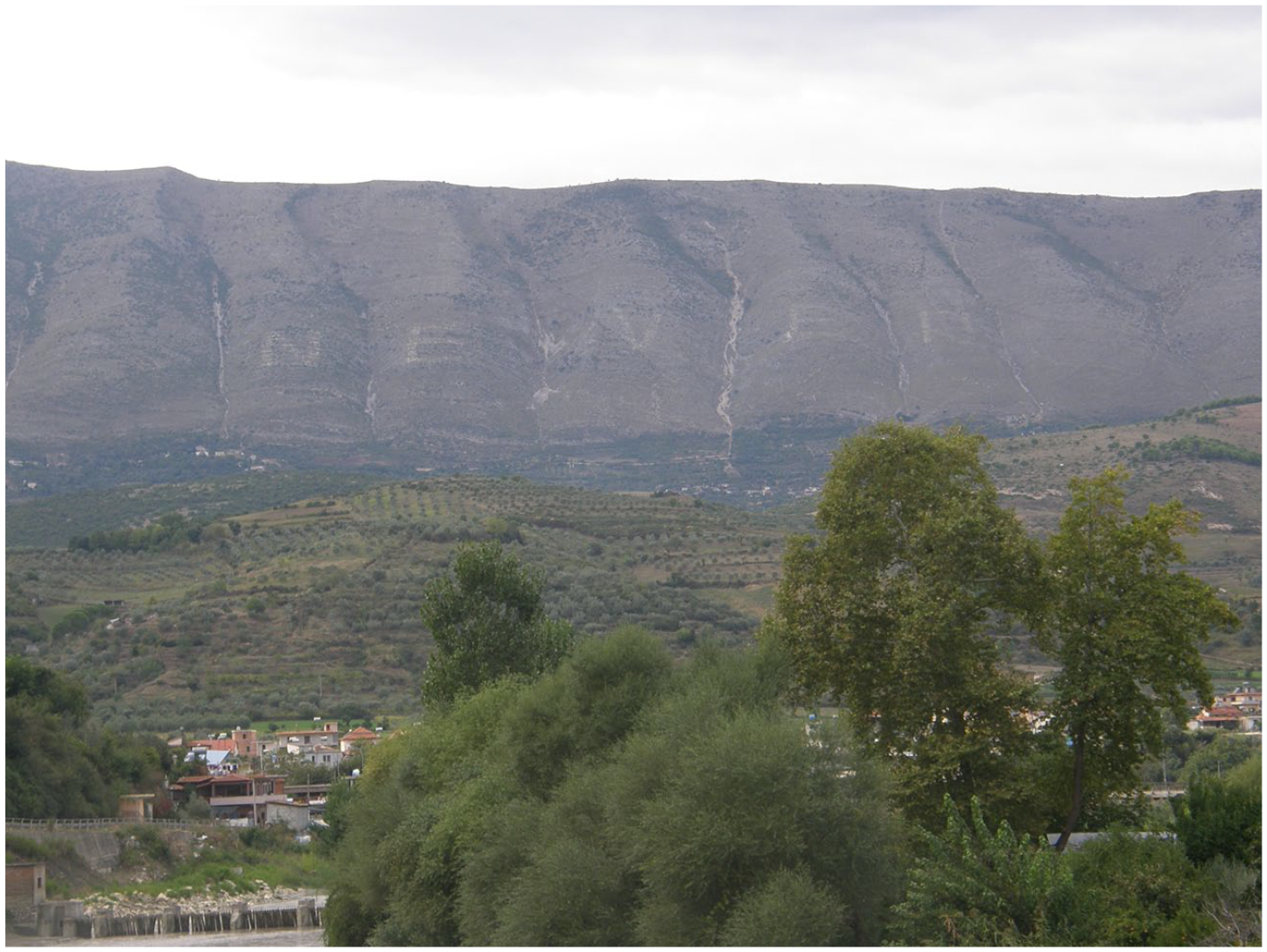
Mount Shpirag, September 2016

Decorative tapestry offered in the gift shop in the center of Berat
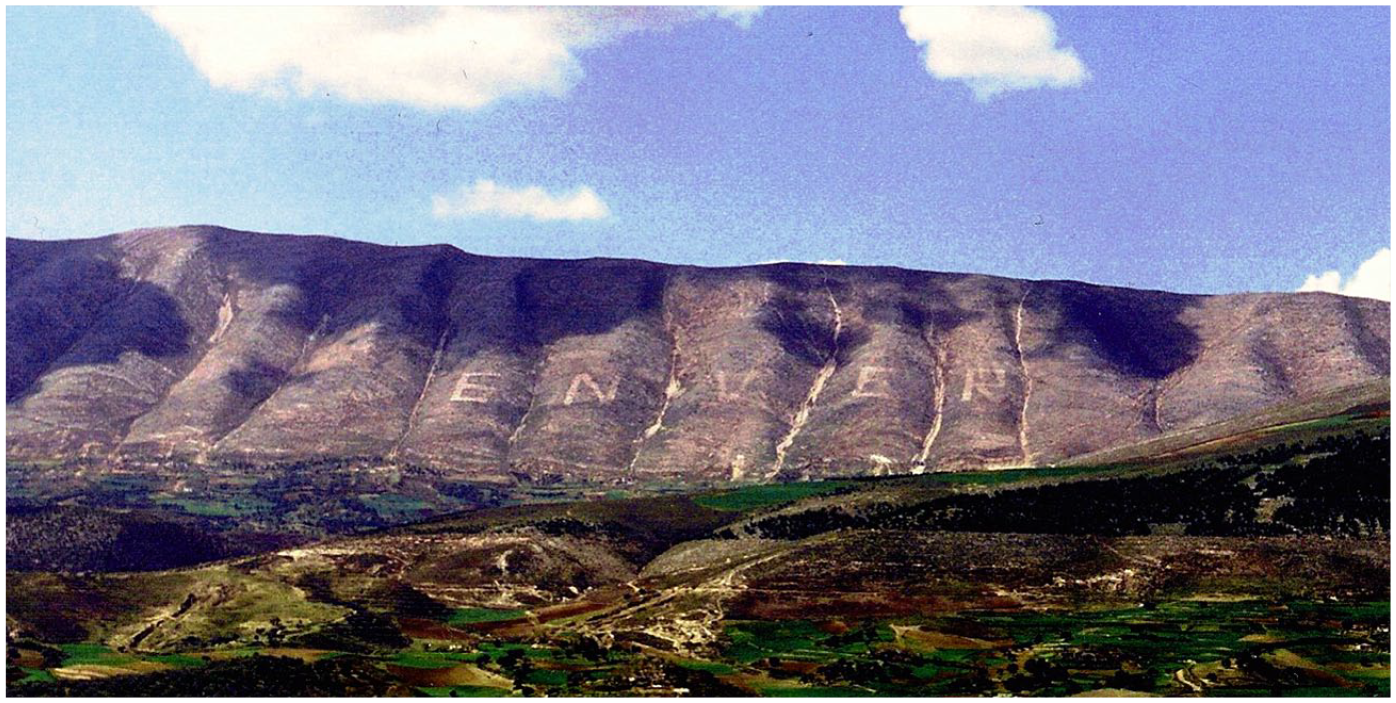
Mount Shpirag, 1974
“Enver is not just a name, it’s a concept and this concept has the negation in its inner structure. . . . Recently some other artists wanted to turn NEVER in FEVER. This is more problematic for me, and reflects a political party attitude. I think that with NEVER the history takes its real shape,” said Lulaj in an interview with an Albanian NGO. 31 My interest in the Berat slogan was not artistic, and I did not want to interfere in Lulaj’s project. Over almost five decades, the inscription on Mount Shpirag has become an element of the local aesthetic and cultural landscape. The inscription generated political decisions, evoked social emotions, and attracted public attention. Lulaj’s artistic project also met with various comments and evaluations. Collecting and describing the local meanings of this specific object, as well as registering the values and emotions associated with it, I considered the key task.
In 2016, an interdisciplinary research team was formed, which included cultural anthropologists and artists (students, PhD students, and professors). 32 The team’s task was to collect various data, which combined the techniques and tools of anthropology and art—it was particularly interesting to apply some of the methods used in art-based research. Since the 1980s, cultural anthropology has become more open to the presence of new ideas in fieldwork research, such as collaboration, polyphony, reflexive inquiry, and dialogue. Some anthropologists “blurred the boundary separating art from science” 33 and, as a consequence, a rhetorical and reflexive turn took place and more experimental ethnographies were developed. According to Sarah Pink, 34 a crisis of representation compelled the use of new media, such as film, photography, performance, hypermedia, and exhibition. In the next decade, anthropology began experiments using artistic practices as additional research tools and a “new path” of anthropology arose 35 known as art-based research. This umbrella term refers to the use of the various forms of arts as the basis for inquiry, intervention, or knowledge production. As a research method, it combines the conventions of “traditional” qualitative anthropology methodologies with methods used in art. 36 According to Patricia Leavy, art-based research is a “set of methodological tools used by researchers across the disciplines during any or all phases of research, including data generation, analysis, interpretation, and representation.” 37 In the ENVER/NEVER context, the most important affordance is the possibility to ask participants/collaborators to express ideas, perceptions, views, and experiences in ways and through channels that go beyond the privileged use of denotative language characteristic of most traditional methodologies of the discipline. 38 I will describe the art-based research methods and techniques used during the project in detail later in this article.
Standard anthropological research methods—primarily in-depth interviews and observations—were the first stage of our project. The collective evening discussions of the results were supposed to provide new information, but also inspiration to the artists who were primarily “witnesses” in this first stage. Once the map of key concepts and problems was successfully created, standard techniques were supplemented with artistic experiments.
Strange “Work of Human Hands”
The first, most surprising conclusion from in-depth interviews was that talking about the inscription from Mount Shpirag was a problem for the residents of Berat. It transpired that the knowledge related to the history of the slogan, both that of half a century ago and its most recent instance, is little known, vague, and full of mistakes. An ignorance of the facts regarding this subject also applies to people whose windows overlook the slopes of Mount Shpirag.
The creation of the ENVER slogan is usually associated with Hoxha’s rule; however, there were also references to the time after his death. The broad spectrum covers 1964 (“volunteers did it” or “forced volunteers”), 1972 (“they decided to make capital letters so that they were visible from as far away as possible from the sky”; “they wanted to please Enver and made the largest inscription that they were able to do”), and 1985 (“after Enver’s death volunteers made this inscription with small pebbles”) or 1986 (“in honour of the leader who had been dead for a year”). The correct date of the slogan was not even known to those who well remembered the hard work put into its creation and the subsequent obligation of periodic renewal of the letters. For teenagers and students, it was distant history and they said briefly that the slogan was “very old.” There is also no certainty as to who created the slogan. Sometimes the respondents mentioned “communists” and sometimes “people living in villages at the foot of the mountain who worked on government orders.” Only one interlocutor mentioned that after 1991 “people destroyed the inscription.”
The newest history of the inscription also remains in the realm of speculation. Most people had a vague idea that something had changed “at the top,” but they could not provide details or the exact date of this change and no one mentioned the name of the artist Armando Lulaj. The change from ENVER to NEVER was often dated to 1990 and 1991 or generally to the “nineties” (even an employee of the local Ethnographic Museum said this). The respondents probably linked the attempts to destroy the inscription in 1995 with the artistic intervention that took place almost 20 years later. An employee of one of the hotels, born in 1981, argued that the change occurred when he was a high school student—in the second half of the 1990s—and that he had discussed it with his friends. Some interviewees claimed that the slogan was transformed “two or three years ago.” Several people indicated the mysterious “director” who “hiked the mountains” as the inscription change agent. A young waiter said that NEVER was made for the purpose of making a film “for Hollywood.” In addition, there were mentions of “people acting on the orders of the government,” “mountaineers,” “students from Tirana,” or “people from other areas who hated the dictator and changed the inscription to NEVER.”
What is interesting is that many people, when talking about the inscription, began to tell local legends associated with Mount Shpirag. One person even said that the slogan was created on its slopes by no accident, because it is “a unique mountain that has its own legend.” The legendary tale has several versions. 39 We were usually told about two giant brothers, Tomorr and Shpirag, who were famous for their strength. They both fell in love with the same beautiful girl, Osum. She also loved them both, and met with them secretly, once with Tomorr and once with Shiprag. When the disastrous ménage à trois ceased to be a secret, the brothers began to fight with each other. Two peaks tower over Berat: Tomorr (2,417 meters), which bears traces of a mace in the form of deep cauldrons, and Shpirag (1,218 meters), the gullies of which are scars from blows inflicted by the sword, remind us of the fatal end of this story. 40 The Osum River, which separates both peaks and flows through Berat, was created from the tears of the girl.
I emphasise this story, because the legend, reprinted in Albanian and foreign tourist guides, is the best known “fact” associated with Mount Shpirag. Folklore has become common knowledge; it is readily invoked and considered attractive to outsiders. However, there is no urban legend regarding the inscriptions. The legend of the deadly fight of two brothers also became an inspiration for a specific kind of “theming landscape,” 41 which associates a specific space with certain values such as picturesqueness and exoticism, which are attractive to tourists. However, these values are not associated with the slogan. Most residents denied that the inscription could be a tourist attraction. There are no postcards, mugs, or T-shirts with this historical inscription in the local shops. An owner of the hostel located within the castle, from which the slogan is visible, stated, “They (tourists) never ask about NEVER.”
Conversations about emotions were also as difficult as conversations about “facts.” Opinions about the slogan—both old and new—are divided. For some residents of Berat, ENVER was an important memento of old times, part of the local history of the city and even the whole country. Others said it was a historic sign of the “truth” of the totalitarian system, when, as a young travel agent said, “everyone had Enver in the house.” In this context, NEVER is seen as “distorting history.” There are also opinions that indicate many people miss the rule of Enver Hoxha and they certainly “would like to change it to the original inscription.” Sentimentalisation and idealisation of the past are characteristic of people expressing a positive attitude to ENVER. 42 In this case, the “politics of nostalgia” manifests itself in emphasising that during Hoxha’s rule, “there was no prostitution” and “everyone had a job” and “an education.” The owner of the hostel claimed that the inscription ENVER encouraged conversations, during which foreign tourists could learn who the leader of Albania was. NEVER does not have that same potential. For many people, as was often emphasised, the “new,” “English” word was simply meaningless. This should be understood not only in symbolic terms; some residents are simply not sure what the new inscription means. A woman working in a hotel in the old quarter of the city was convinced that the inscription on Shpirag read “Welcome.”
For some Berat residents, though, NEVER symbolises political change and opposition to communism. One young boy simply says that the new slogan means “the transition from communism to democracy, liberation, the end of dictatorship.” While he associates ENVER with “suffering,” he links NEVER “with freedom and democracy.” The young waitress believes that the change was meant to make “Enver never come back” and “forget what he did.” A resident of the Mangalem district, from where the inscription is clearly visible, said that “it is good not to see this name every day.” The owner of a small hotel speaks favourably about the change in the inscription and criticises selling souvenirs with the image of Hoxha as they “remind us about the evil man.” Importantly, one woman observed that in her opinion, people who look at the inscription still see its old version, as it is so strongly present in their consciousness.
About thirty in-depth interviews convinced us that the topic of the slogan was provoked by our questions. The inscription from Mount Shpirag is not the subject of conversations of the inhabitants of Berat on a daily basis, which perhaps explains the frequent uncertainty in the formulation of thoughts and selection of appropriate words of the respondents. Teenage students, who dreamed of studying in Tirana or abroad, said that no one teaches about the history of the inscription at school. Our interlocutors often asked one another about dates and tried to determine the “right” version of events. In a few cases, people were “better informed” but they could not provide details. In offices and museums, both old and new guidebooks were investigated, but they did not contain any information about the inscription. There were even arguments, such as in the case of two young men, one of whom claimed that NEVER arose “naturally” over time, while his friend vehemently denied it, saying that it was “the work of human hands.”
“If Someone Asked Me for My Opinion”
In the second stage of the project, we decided to conduct several experiments, using art as a research tool, 43 assuming that it provides knowledge that “is not expressible in ordinary discourse.” 44 The artists prepared three experiments: “Stones from Berat,” “Portrait company” and “The roof of my city. What would be on it? (if someone asked me for my opinion).” As part of the first experiment, a shop was opened with information (in Albanian) “selling stones.” The offer included stones from Mount Shpirag, which were arranged according to size and assigned to specific letters of the NEVER inscription from which they were “taken” (during the conversations it was explained that they were “original replicas” or “perfect copies,” painted with white paint, like the ones on the slopes of Shpirag). Thanks to the central location and interesting offer, the store quickly gathered a boisterous group of people. The next day, in another place on the promenade, a poster with the image of Enver Hoxha and the inscription “NEVER” in the background was hung, encouraging clients to use the services of a “portrait company.” As a condition, those wanting to pose for a portrait were asked to choose which background slogan they wanted—ENVER or NEVER—which in turn became an opportunity for a conversation. “The roof of my city” involved the artist and one person at a time. It was about arranging one’s own version of the inscription from Mount Shpirag using stones, leaves, and sticks brought by the artist. New slogans were placed in workplaces, private apartments, on tables in bars, or on pavements.
All the experiments took place on Bulevardi Republika (or in its immediate vicinity), the city’s main pedestrian area, in the afternoon, which promoted going for a walk. Each experiment was organised in a place where Mount Shpirag mountain and the inscription were clearly visible—and very often during conversations, it became “present,” pointed to with a triumphant gesture (“this is the truth”) or a dismissive wave of the hand (“it does not matter”). The experiments took place day after day, and photographic documentation indicates that dozens of different people participated in them.
The “original replicas” stand was the experiment that was the most public and that involved interaction with many people. The artists’ calls of “Berat stones for sale!” quickly aroused interest and attracted first individual passers-by, and then groups of a dozen or so residents. At first, they were interested in where the stones for sale came from. Then there was a loud, collective discussion full of gesticulation, clearly spoken words, and significant moments of silence. Passers-by repeatedly changed the order of the cardboard letters: arranging either the old or the new slogan. Some people expressed satisfaction or anger by sometimes pointing to the mountain slope when they disagreed, reminding others about the 1968 slogan. Some people shouted with approval: “Enver, Enver!” Speakers of English engaged in conversations with two “saleswomen,” during which they tried to explain the meaning of the slogan.
The experiment called “The Portrait Company” advertised services with the slogan “Free Portraits.” It only attracted young people, mainly high school students; older people watched from a distance. The artist had previously prepared backgrounds with the slogans ENVER and NEVER, on which they then drew the portrait of a specific person. The situation allowed for a conversation not only with the person being portrayed but also with their friends accompanying them. Everyone using the artist’s services definitely preferred the NEVER slogan. They perceived the history of Albania in the times of Hoxha in a clearly negative way and described it using stereotypes and several clichés. Often, private profiles on social media (most often it was Instagram) were eagerly exchanged with the artist. These portraits were later photographed and posted on these profiles as a unique type of “selfie,” in line with the convention of travel photography, which depicts a person against the background of an object or place. 45
The last experiment was the most intimate. An artist approached individual people and tried to establish contact with them. When they expressed interest, she engaged them in an attempt to reflect on the question of their own private version of the inscription, which they would like to put on the “roof of their city,” as she symbolically called Mount Shpirag. In this case, the rock fragments collected at the foot of the mountain and brought by the artist were the tools of expression. The material was used by the participants of the experiment to compose names, both their own or their loved ones, a slogan “Lenin Enver Stalin,” a symbol of a star or a tree, the word “We” and “Peace.” This last slogan, which was placed with great care on the glass top of a bar table, not only expressed certain emotions but also interestingly referred to the English-language NEVER and even the number of letters. From my perspective, “Peace” is the most moving slogan created during this experiment.
Conclusions
Palimpsest seems to be an immanent feature of Albania’s history over the past seventy years. The palimpsest nature of history, according to Andreas Huyssen, is expressed in that “memories of the past and an evolving present have mixed in unforeseeable ways in the politics.” 46 Hoxha demolished the center of Tirana—the Old Bazaar, City Hall, street of barricades—to put signs of new power there in the form of the Palace of Culture, the National Museum, and modern apartment buildings. Similarly, in 1991 monuments of him were overthrown to inaugurate the introduction of the new system. In this context, the transformation of ENVER into NEVER is a creative and dialogical activity showing how one can effectively combine a painful past with a hopeful present. The tangled opinions and emotions of the inhabitants of Berat can, in my opinion, be treated as strategies for taming, understanding, and accepting the artistic palimpsest, which not so much annihilates what is old, but transforms it into the past.
Researchers of the social memory of communism indicate that in addition to examining its formal aspects, what also needs to be examined are the versions experienced locally or individually, which are often different or contradictory to the official ones. 47 Since 1989 there has been a conflict of memory and counter-memory about the old system, and distinctly negative images of the past coexist with other images, ones that are collectively referred to as “nostalgia for communism.” 48 Cristian Tileagă also aptly notes that “what we call ‘individual memory’ about one’s life appears only apparently as a ‘property’ of the self . . . and mediated by personal and social relationships, and the material environment. Our relationship to the past and others is an unfinished business.” 49 This means that each individual memory crystallizes in specific constellations and networks of relationships that arise within mental, material, and cultural spaces.
Interestingly, the concepts of communism and nostalgia are also disputable. Communism as a consistently implemented political and social system did not exist in Europe after the Second World War; thus, including all countries of Eastern Europe and the Balkans in the “communist bloc” is in this context the same abuse as the Orientalism described by Edward Said or Balkanism in the view of Maria Todorova. In each of these cases, the dominant discourse appropriates its subject—communist countries, the Orient, the Balkans—by homogenising and showing it from an ahistorical perspective. 50 One should rather talk consistently about state socialism and about post-socialist countries and about expressions of nostalgia for socialism.
The term nostalgia can also be misused. Ancient Greek etymology, which indicates the pursuit of “returning home,” does not need to be reinterpreted today only in terms of naïve faith in a better past. According to Svetlana Boym, nostalgia is not a “bad word” or “an affectionate insult,” nor should its sense be reduced to the aphorism of Charles Maier, who said that “Nostalgia is to memory as kitsch is to art.” 51 It is interesting that in recent years nostalgia has been increasingly seen as an “emotional complex” that evokes not only positive emotions, but rather contains a mixture of sadness and longing joy. 52 Nostalgia is also associated with a sense of uprooting, which in post-socialist countries often has its source in the “trauma of great change,” 53 which is a troublesome and still not fully recognised reversal of transformation and modernisation processes. 54 The great change—seen as a transition from dictatorship to democracy—was a sudden and violent process that came from outside and caused unpredictable and ambiguous consequences (abolition of censorship vs. high unemployment, the opening of borders vs. financial crisis). The nostalgic affect concerning the times before the “great change” is sometimes stigmatized as immature, but it has both cultural (reluctance to accept the new, often difficult order) and psychological reasons (remembering one’s own youth). Therefore, nostalgia should not always be linked to passivity, withdrawal, resignation, and the lack of willingness to adapt to new conditions. It is also a practice of suspicion and doubt about the new system and a bottom–up response to top–down processes of rapid social change.
The inscription on Mount Shpirag allowed us to capture the dynamics of memory. The slogan in honour of Hoxha is a type of “site of memory” 55 which not only evokes questions about how to define cultural heritage and how to assess the poetics and politics of artistic interventions, but also how to effectively examine attitudes and emotions towards such “sites.” The project described above was an attempt to fuse qualitative field research with certain techniques belonging to the art-based research method. Has the expected synergy and complementation of various methods occurred in this case?
An analysis of the research process and the collected data indicates that the anthropological part of the project has allowed for a mapping of dominant attitudes and local knowledge about ENVER/NEVER. The explanations, memories, dates, and other data we obtained during in-depth interviews were discursive. Conversations with the inhabitants were to involve activating and engaging their memory and intellect—but they also triggered affects, sometimes violent. Experiments using artistic tools, however, engaged the senses and evoked strong, affective reactions. Thanks to the emphasis on sensual, emotional, and perceptive reception, it was possible to activate a form of understanding that comes from “empathic experience” that gives insight into what other people experience. 56 Thanks to this, discursive data were supplemented with nondiscursive data that were inexpressible during a conversation.
The thicket of tangled opinions, judgments, and emotions does not allow for easy categorisation. The people of Berat want to forget but also to remember; the gigantic inscription was for them a stigma as well as a specific source of positive difference; they treat the Hoxha times as a “dark age” or a critical mirror for the contemporary condition of their country. An older man admits that he tries not to look at Mount Shpirag at all; a young girl, on the other hand, went on a trip and remembered that a local variety of sage, “sherebele,” densely covered the foot of the mountain. For teenagers, the NEVER slogan is well understood, raises positive associations, and is a symbolic break from the problematic past. Older people argue that the slogan of 1968 should be treated as a monument, an element of cultural heritage and even (least often) a work of art.
Conversations about the slogan on Mount Shpirag and the Albanian past have sometimes led to surprising situations: one of the forty-year-olds rolled up his shirt sleeve at the end of the meeting, revealing the image of Skanderbeg tattooed on his arm. “This is my hero,” he said emphatically. By juxtaposing the figure of the historical hero—a symbol of the courage and perseverance of the Albanians—with the slogan in honor of the communist leader, he made an interesting gesture: he put them both on the same level of reference. The difference is that the NEVER slogan was a non-spontaneous inscription placed in the public space of distant mountains, while the Scanderbeg tattoo is the result of a personal choice, an inscription located in the private space of the body. Thus, the palimpsest of Albanian memory gained another dimension, confirming the statement that “our relationship to the past and others is an unfinished business.”
