



Abstract
This article explores the role played by the 1940 Katyń massacre in structuring foreign relations between post-communist Poland and Russia. In so doing, it offers a theoretical model through which to understand the combative politics over history that have burgeoned in Eastern and Central Europe after the dissolution of the Soviet Union. Tracing how political discourse over the massacre has evolved from the late 1980s to the present, it examines the impact of exogenous influences and changing geopolitical realities on how this event is recalled within these two states, which exhibit markedly different relationships to their shared past. Questions of regime type, relative standing within the region, and how—as well as by whom—interstate discourse over contentious historical events is initiated are all central to the model of dispute origination developed herein, as is the presence of various institutional factors, chief among them membership in the supranational European Union (EU). A shadow study of Polish–Ukrainian relations concerning history, focusing on the mass killing of ethnic Poles that took place in Volhynia and eastern Galicia in the period 1943–1945, is also undertaken in order to illuminate the significant differences in how the past has been politically activated in relations between the respective post-Soviet dyads of Poland–Russia and Poland–Ukraine.
Lawina bieg od tego zmienia, Po jakich toczy się kamieniach.
1
The politics of history permeate post-communist Europe, a region where conversations within and among states are frequently framed in terms of the past and its contemporary, politically conditioned assessment. In this regard, no event has proven more divisive in post-communist Poland’s fraught relationship with Russia than the 1940 Katyń massacre, wherein the NKVD executed some twenty-two thousand Polish citizens on Stalin’s orders, an act that the Kremlin—citing the falsified findings of the 1944 Burdenko Commission report 2 —blamed on German forces for the next five decades and that Russia today still refuses to acknowledge as a war crime. Demonstrating the deep hold that Katyń has on Poland’s national consciousness, President Lech Kaczyński, in the text of the speech he was fated to never deliver at the commemoration of the massacre’s seventieth anniversary, referred to this monumental cover-up as “the founding lie of the PRL.” 3
Theorizing Polish–Russian Relations
From the late 1980s onward, the question of how to interpret Katyń has served as an effective barometer of Polish–Soviet, and later Polish–Russian, relations. The massacre, however, was chosen as a focal point for this analysis not only due to dissonant narratives surrounding its recall marking a major rupture between these countries, but also because attendant conversations were revitalized in the wake of the 10 April 2010 Polish Air Force Tu-154 crash in Smolensk that claimed the lives of President Kaczyński and ninety-five others en route to honor Katyń’s victims. Efforts made by both sides to shift the tone and tenor of political engagement after this tragedy therefore provide an opportunity to assess not only how historically contingent relationships are engendered between states but also how durable these are and what the prospects may be for modifying them. That the seventy-fifth anniversary of the massacre fell in 2015, when bilateral tensions were already heightened as a result of the crisis in Ukraine, provides further leverage for understanding how Katyń has defined relations across successive governments and evolving regional dynamics.
The primary puzzle framing this research is longitudinal: Why has recall of this event varied so dramatically over time among these two states, and how have the changing stresses evinced colored the interactions of their respective political elites? (The term “recall” is employed deliberately, to distinguish the functional and contextually discrete use of past events that occurs when they are politically activated, as opposed to “remembering,” a process that unfolds more organically at the societal level.) Posing these questions, however, highlights an ancillary, but theoretically broader, cross-sectional puzzle: Why are some historical episodes consistently invoked in interstate relations, while others, often equally or even more problematic, remain relatively quiescent?
Addressing the above adequately requires acknowledging that certain contentious interpretations of the past are primarily fodder for domestic politics, while others more readily structure interactions between states (although these are by no means impermeable categories). In the former instance, the politics of history are typically shaped by conflicting internal accounts of what actually occurred. In contrast, regional-level disagreements over the past tend to function as an extension of nationalized identity politics, emphasizing episodes around which an interpretational consensus prevails at home for at least one of the actors involved. Discourses emanating from adjacent states then either compete or align with the dominant thrust of this narrative. 4 Accordingly, it is critical to examine how regional interpretations of the past influence, as well as respond to, domestic conversations over history. As borders become ever more porous not just to flows of people but also information, what is recalled, as well as how and by whom it is recalled, increasingly affects the construction and revision of national-level understandings regarding the past, as well as the degree to which these are allowed to (re)intrude upon interstate relations.
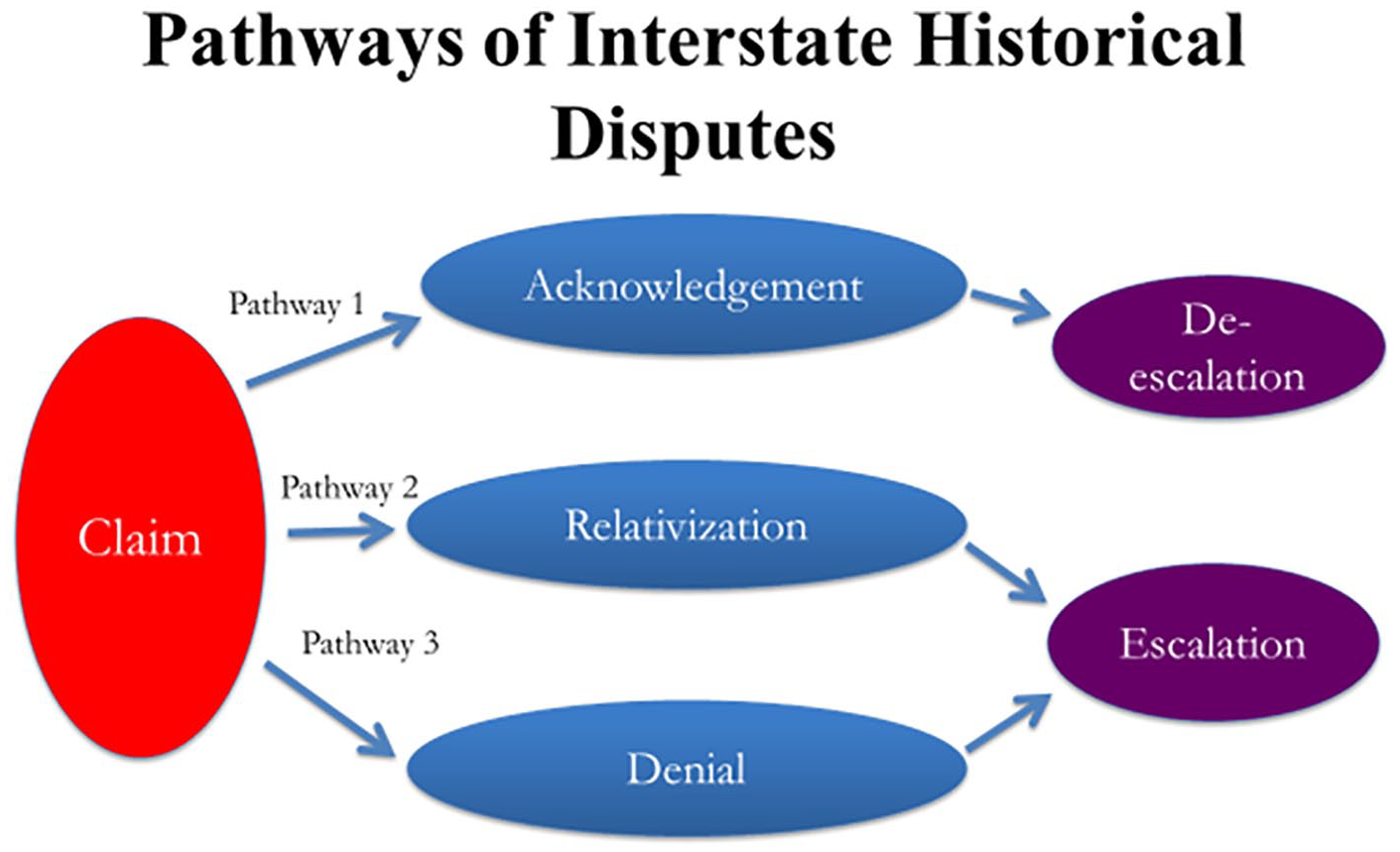
There are three main pathways contentious historical claims follow once introduced into cross-border politics (see figure 1). In the first, an accusation is levelled against one side and that side acknowledges the grievance and its accompanying stipulations (e.g., restitution or an official apology), leading to a de-escalation of tensions. This is the model that eventually came to be followed by West Germany relative to the Holocaust, though it required decades to fully take hold within government and throughout society. The second pathway is that of relativization, exemplifying a “yes, but. . .” approach characterized by seeking equivalencies to counteract the thrust of the other side’s grievance without, however, contradicting the basic facts of it. As will be discussed below, this approach has characterized official Russian responses to Polish claims concerning Katyń in recent years. The third pathway, meanwhile, is marked by outright denial, which entails one side either asserting that the event in question did not happen as depicted or that an altogether different party bears responsibility. An example would be the ongoing minimization by Turkish officials of the systematic persecution and killing of Armenian civilians in the Ottoman Empire during World War I and its immediate aftermath, which Ankara adamantly refuses to recognize as an instance of genocide. Predictably, the latter two approaches function to escalate interstate tensions.
In this regard, it is important to take account of how national leaders respond to a region’s major influence brokers, or anchoring hegemons. Anchoring hegemons are not necessarily those political entities possessed of the largest armies or most robust economies, though these factors can, and frequently do, coincide. Instead, the term first and foremost denotes states or supranational organizations preferentially capable of controlling the main “storylines” (exclusively or in competition with one another) undergirding the historical and/or civilizational interpretation of a defined geographic space.
This ability to create, frame, and legitimate perceptual realities in ways that transcend political boundaries, whether due to imperial legacies or current positioning in the world-system, is enormously relevant in the post-communist context, where countries routinely articulate or defend policies and preferences via recourse to claims concerning the past. These claims, in turn, reverberate against regionally dominant understandings, the latter utilized by states as heuristic devices in the fractious process of working out their own Janus-faced politics. Understood in this manner, at the interstate level the principal referential antipodes transecting the political imagination of the post-communist world are those of Western Europe (represented, however imperfectly, by the EU) and the Russian Federation, the legal successor to the USSR and de facto inheritor of its recondite legacies.
Critically, the ideational influences anchoring hegemons exert beyond their borders are not epiphenomenal to political processes, which speaks to the frequent temporal persistence of the interpretive divides they promulgate. (It could hardly be otherwise given the elite-led nature of this enterprise.) At the same time, the regional storylines anchoring hegemons promote, despite their typically normative and didactic connotations, do not necessarily countermand strategic impulses, there being no clear-cut causal directionality inherent in them relative to the formulation of foreign policy. Consequently, the historically bound discursive positions anchoring hegemons adopt and export are capable of fomenting discord between states as well as justifying conflictual positions ex post facto; functioning in the latter versus the former capacity in any given instance does not diminish the centrality of these narratives. For instance, regardless of whether the Kremlin primarily annexed Crimea in 2014 because doing so comported with an understanding that Russia had a more legitimate historical claim to the peninsula than Ukraine or whether Russian officials sought to justify what was in reality an opportunistic decision by presenting it in terms of righting a past injustice, 5 the end result—amplifying divergent ways of interpreting the past—was effectively the same. Likewise, how states that are not anchoring hegemons respond to such narratives may also result from instrumental or principled motives, but the outward manifestation is essentially equivalent. What matters is that mnemonic discourses routinely link to real foreign policy consequences.
Similarly, recognizing the theoretical value of the anchoring hegemons concept does not imply that other states lack political agency when it comes to utilizing the past (though its impact is likely to be far more limited regionally); for evidence of this, consider the ubiquity of the “perpetual victim” trope in Poland, which emphasizes the near-constant abuse that Poles have historically endured at the hands of adjacent powers. Instead, it merely suggests which metanarratives and geopolitical orientations a given subaltern is inclined towards. Likewise, while anchoring hegemons are, by definition, more influential in the regional scope of their appeals than other actors, this does not mean they are immune from reassessing or evolving their stances under changing circumstances. For instance, while the EU was able to promote more explicit recognition of Jewish suffering during the Holocaust among the post-communist states as a tacit condition of their joining this supranational body, on other matters where the “old” EU did not yet have a strong position, its new post-communist members were able to exercise considerable sway. An example would be the concerted campaign waged by political and cultural elites from certain former Warsaw Pact states to have the EU affirm the commensurability of Stalinism and Nazism, as reflected in the Prague Declaration of 3 June 2008. 6 Not all such appeals were successful, but their interjection into a wider political milieu did affect attitudes, as when the European Parliament declared in September 2008 that 23 August, the date on which the Molotov–Ribbentrop Pact was signed, would henceforth be commemorated as the European Day of Remembrance for Victims of Stalinism and Nazism (which many observers took as promoting an equivalence between the two totalitarianisms). Similarly, while EU member states did not pay a great deal of attention to the Katyń massacre prior to Poland joining its ranks, Polish elites were well aware that during the communist period it was only in the West that open discussion of this event was allowed, and correctly intuited that their interpretive stance would resonate with the EU’s understanding of twentieth-century history.
Consequently, while fully recognizing the intrinsic gravity of Katyń for the Polish nation, I nevertheless contend it is the Kremlin’s reinterpretation of Soviet legacies in ways that have progressively diverged from the perceptions predominant in East-Central Europe that best explains why this event features so prominently in relations between Poland and Russia, while other crimes of a similar vintage, notably the ethnic cleansing of Poles by the Ukrainian Insurgent Army (UPA) in Volhynia and eastern Galicia between 1943 and 1945, have, in comparison, minimal political relevance. 7 Admittedly, these tragedies are not directly analogous; among other distinctions, it was primarily peasants who were killed in the latter instance and Polish self-defense units and Home Army soldiers retaliated not just against the UPA, but also Ukrainian civilians (moreover, the UPA was not a formal state organ, but a paramilitary organization, unlike the Soviet NKVD). Nonetheless, the contrast in the attention paid to them remains striking. This is especially so given that the UPA’s terror campaign claimed two to three times the number of Katyń’s victims in Volhynia alone, including a great many women and children. 8 At the same time, bifurcations in contemporary political resonance are also apparent in the case of the Katyń massacre itself, which has come to be associated almost exclusively with Russia even though many of its victims were incarcerated and are known (or presumed) to have eventually been shot on the territories of what are today the sovereign states of Ukraine and Belarus. 9
However, theorizing that the contentious historical narratives of post-communist Europe are, at an interstate level, defined against the interpretive frames provided by a region’s anchoring hegemon(s) is, by itself, insufficient to explain why Poland’s political interactions with Russia concerning the past have become increasingly adversarial over the last two-plus decades, while relations with other neighbors (including not just Ukraine but also Germany, which within lived memory started a war that claimed the lives of nearly one out of every five Polish citizens), remain by and large cordial. Assessing how countries evaluate discordant external claims relative to internal conversations, and how these influence the attitudes adopted toward other states, also requires considering the effects of political affinity (see figure 2 below).

Political affinity posits that national leaders are more trusting of, and hence willing to interact positively with, states whose worldviews are congruent with those of their own. Because of the high degree of institutional isomorphism exhibited among them and the predictability this fosters, these regime-level effects are most evident among liberal democracies, whose normative commitments and universalistic claims predispose them towards acceptance of pluralistic recall. 10 Modern democracies are therefore better able to tolerate, or at least comprehend, dissenting views among those they consider their peers as compared to authoritarian regimes of the nationalist and populist variety, which are defined by the circumscribed specificity of their ideological appeals. This renders liberal democracies more likely to resolve tensions over history, the actors involved conditioned to regard one another as inherently more transparent and relatable. Alternately, on issues where no compromise can be reached, they are more willing to “agree to disagree” with relative amicability. The converse pertains as well: states with incompatible regime types are far more likely to politicize contentious legacies and to misinterpret important cues that could aid in resolving them. However, while this phenomenon is most apparent at the regime level, it is also discernible across governments, especially as even democratic states may experience shifts over time in the degree to which the latter tolerate expressions of liberalism, depending on the politicians and parties in power at any given moment. 11 Affinity effects, however, are not limited to reinforcing or juxtaposing views between “most similar” and “most different” cases; they may also manifest if one state views another as potentially capable of converging ideologically with it, particularly if a tutelary relationship, whether actual or perceived, exists between them. (Many Polish politicians styled themselves as promoters of democracy in Ukraine, especially after the 2004–2005 Orange Revolution.)
Nevertheless, even accepting that the degree of political affinity exhibited among states and the interpretive framing provided (or elided, in the case of the EU relative to Katyń) by a region’s anchoring hegemon(s) represent the processual drivers controlling the salience of the past in cross-border relations, this still leaves the method of their operationalization undefined. Shifting analytical granularity to focus specifically on contentious interstate dealings reveals the oftentimes synergistic effects of rhetorical cascades and audience escalation, two mechanisms that promote feedback loops that may culminate in discursive lock-in unless the process is disrupted by a critical reorientation of the relationship.
Rhetorical cascades postulate that once historical narratives are articulated in deontic language (e.g., by asserting that there exists an obligation to pursue justice), even politicians reluctant to deal with moral imperatives concerning the past find it difficult to avoid answering in kind, if only to refute the initial allegation (“we did not do what you say we did”). Given the centrality of didacticism to the politics of history, such a precipitation of claims and counterclaims is extremely difficult to resolve short of one side acquiescing to the other’s perspective. This is especially true when disputes involve anchoring hegemons, as disagreements featuring them are much more likely to receive widespread attention than if competing viewpoints were confined to subaltern states. Audience escalation, meanwhile, takes seriously that the scope of the venue into which historical narratives are introduced determines how far their influence extends. Firmly ensconced in the EU and the wider institutional architecture of Europe and the West, Poles now have an expansive stage from which to express their historical grievances, as well as the formal ability to invoke transnational scrutiny of these claims. 12
Finally, as rhetorical cascades and audience escalation polarize and amplify narratives, discursive lock-in may occur if a tipping-point threshold is breached, causing inflexible interpretations of the past to replicate across successive cohorts of national politicians. This is not an inevitably deterministic outcome, but once disagreements over how history is to be understood become politically entrenched, they are unlikely to change substantively absent a systemic shock of sufficient magnitude (e.g., a change of regime) to bring about a critical reorientation in how feuding states interact with one another.
Katyń in Polish and Russian Recall
Referential frames relative to the Katyń massacre differ dramatically between Polish and Russian elites. Among the former, there exists little substantive contestation concerning how these killings are to be viewed, Poles understanding them in terms of Stalin’s extrajudicial murder of the citizens of another country. Interpretative variations, when present, are thus fairly minor and typically involve debates over symbolic issues, such as whether Katyń should be referred to as an instance of genocide. Consequently, domestic political fault lines in Poland run along differences of degree rather than differences of kind, the former attributable to individual politicians’ ideological commitments and policy-making styles. 13
This virtual unanimity in understanding stems from the fact that not only did the NKVD eliminate Poland’s “best and brightest,” military leaders, government officials, and white-collar professionals having been executed in disproportionate numbers, but also because among Poles there exists a pervasive feeling that the killings irrevocably altered the outcome of World War II and the subsequent course of national development. Furthermore, because it was forbidden to talk about Katyń during the communist period, the delimited physical act came to transcend itself, accreting a host of mnemonic associations. 14 Perceived in this light, references to the Smolensk disaster as a “second Katyń” resonate all the more, the crash seen by many as but the latest narrative arc in a calamitous book of Polish memory. In the words of former Polish Foreign Minister Radosław Sikorski, what happened that day in April 2010 “re-awoke some of the deepest layers of Polish messianism and victimhood.” 15
Meanwhile, in Russia the recollection of Katyń exhibits considerably less uniformity and stability; as will be discussed below, three principal interpretive tropes have been evinced there:
Liberal—Katyń was a war crime, potentially qualifying as genocide. Linked to a highly negative perception of Stalinism and the need to distance Russia from its Soviet past.
Statist—the NKVD/Stalin were responsible for the killings, but Katyń was one event in a long list of totalitarian repressions. Proponents stress moral equivalencies and emphasize Russian/Soviet suffering.
Reactionary—the USSR was not responsible for Katyń. Outright denial or obfuscation is associated primarily with communist hardliners and far-right nationalists.
In terms of their respective prominence, the liberal interpretation gained traction among reform-minded elites and former dissidents immediately after the collapse of the Soviet Union, when it provided both a means by which to identify with the West and a moral cudgel to wield against remnants of the old order. It was soon eclipsed, however, by the ascendance of the statist model. Meanwhile, the reactionary perspective, though never a mainstream current, has proven to be a persistent distraction, its relevance varying according to the alignment of political forces in government or vying for power at any given time.
Another sharp disjuncture in how these countries relate to the legacy of Katyń arises from underlying differences in Polish and Russian perceptions concerning the meaning of the Soviet experiment and its aftereffects. Politicians in Poland, by and large, regard the massacre as a crime against an explicit ethnic identity, while their Russian counterparts stress its class aspects, rendering it a crime against an ideologically ascribed status. The existential implications of these viewpoints are significant, with the Polish perspective complementing ongoing efforts among many former Warsaw Pact members to deemphasize the role autochthonous elements played in communism’s imposition and cast the master narrative of the latter half of the twentieth century as one of Soviet neo-colonialism. 16 Russia, for its part, has no such credible appeal to make.
At issue as well is the vexing question of political guilt and its heritability. Much as they did during Soviet times, Polish commentators and politicians today routinely conflate Russia with the USSR, a proclivity abetted by the growing ambivalence Moscow has come to display toward the Soviet regime. Meanwhile, post-communist Russian leaders have consistently emphasized that their country is not culpable for the crimes of a state that no longer exists. 17 As a result, the two sides often find themselves discussing the same events in mutually unintelligible terms.
Glasnost, “Blank Spots,” and the Search for an Anti-Katyń
According to Mikhail Gorbachev’s senior advisor Anatolii Cherniaev, the “problem” of Katyń resurfaced on the Kremlin’s radar beginning in 1987 with the advent of an international letter-writing campaign urging the USSR to clarify the circumstances of the massacre. 18 Gorbachev was similarly confronted by discomfiting questions during his visit to Poland in 1988. Pressed on the matter by a group of intellectuals in Warsaw, the Soviet leader admitted that he was aware many considered the killings to be “the work of Stalin and Beria,” 19 but reminded Poles that this was not yet a foregone conclusion. Emphasizing the common tragedy of the massacre, he also noted that there were two monuments in the Katyń Forest, one dedicated to the executed Poles and the other “to the Soviet POWs who perished, shot there by the fascists.” 20
For the Polish side, the issue of the massacre never fully went away, remaining a sore spot even for PRL leaders like Wojciech Jaruzelski, who recounts raising questions about Katyń with his contacts in the Soviet military as far back as the 1960s and 1970s. 21 It was during Jaruzelski’s April 1987 visit to Moscow that Poland and the USSR concluded a resolution to tackle difficult issues concerning the past, leading to the formation of a joint commission tasked with looking into “blank spots” in Polish–Soviet history, foremost among them Katyń. Headed by the Soviet historian Georgii Smirnov and his Polish counterpart Jarema Maciszewski, the group met intermittently from 1987 until the fall of Poland’s communist regime. Despite facing an obvious political agenda and stalling on the part of Soviet authorities, the Polish side made headway, providing their colleagues with a report contesting the Burdenko Commission’s findings in May 1988. 22
But while the advent of glasnost loosened the fetters of censorship, it also reinforced the need for carefully managing Katyń in the minds of Soviet leaders, the massacre having come to be seen as a potent tool in the hands of the Poles. As Edward Shevardnadze, Valentin Falin, and Vladimir Kriuchkov wrote in a 22 March 1989 brief to the Central Committee of the Communist Party: The theme of Katyń is now artificially relegating to second place even questions connected to the start of the Second World War and the German attack on Poland. The subtext of this campaign is obvious—the Poles are intimating that the Soviet Union is in no way better, and perhaps even worse, than the Germany of the day, that it carries no less responsibility for the start of the war and even for the military defeat of the Polish government.
23
These remarks were not hyperbolic; in 1989, the Soviet side was confronted with a perfect political storm. Not only did the fiftieth anniversaries of the signing of the Molotov–Ribbentrop Pact and the Soviet occupation of eastern Poland fall during that year, but in June 1989 Solidarity activists routed the Polish United Workers Party (PZPR) in Poland’s first competitive legislative election in more than four decades. Consequently, although Shevardnadze and company counselled that it might “make more sense to admit what really happened and who is to blame for it,” 24 Gorbachev did not acknowledge Soviet responsibility until Jaruzelski’s visit to Moscow on 13 April 1990, when two files regarding the massacre were handed over to the Polish delegation, forty-seven years to the day after Berlin radio announced the discovery of the Katyń burials. 25 Concurrent with this transfer, the Soviet news agency TASS issued a statement countermanding the USSR’s previous position and expressing regret for what it termed “one of the weightiest crimes of Stalinism.” 26
Despite this admission of guilt, Soviet leaders were not willing to condemn the past unequivocally. Realizing something needed to be done to attenuate Poland’s claims, which were rapidly coming to be seen as a threat to the USSR’s reputation and international standing, Gorbachev issued a secret directive on 3 November 1990 instructing archivists to seek out material showcasing instances where Polish actions “brought harm to the Soviet side,” the intent being to have this information available as a palliative and counterweight to accusations directed against the USSR. 27
Soon thereafter, the rhetorical trope of an “anti-Katyń” emerged in Russia, the Polish-Bolshevik War of 1919–1921 recast to serve in this capacity. 28 This conflict proved an imperfect fit, but focusing on it allowed realpolitikers and aggressive nativist elements to argue that the deaths of Red Army POWs in Polish prison camps constituted a crime commensurate to Katyń, despite the fact that a large number of Polish POWs also perished while incarcerated by the Bolsheviks. 29 Soon the Russian side was circulating mortality figures that at their upper bounds strained reason (claims of eighty to one hundred thousand dead were routinely cited) and referring to what took place as a war crime. However, while there is no doubt that conditions in the camps were extremely harsh and thousands of POWs perished, most reputable historians believe that their deaths resulted from infectious diseases and poor sanitary conditions in the hastily improvised and overcrowded internment facilities rather than deliberate attempts at extermination. A comprehensive 2004 study of this conflict, produced by a Polish–Russian team of specialists, estimated the number of prisoner deaths at around sixteen to eighteen thousand. 30
Balancing Liberalism with Statism: The Yeltsin Years
After the 1991 August Putsch failed to remove Gorbachev from power, the reorganized Procuracy of the Russian Republic took over the investigation into Katyń. The matter was assigned to a young prosecutor named Anatolii Iablokov, whose review of the evidence persuaded him that the massacre should be treated as a war crime according to Nuremberg statutes. 31 On 13 June 1994, however, the Military Prosecutor’s Office nullified Iablokov’s decision and removed him from the case. 32 The investigation was to formally proceed for another decade.
But while the Soviet, and later Russian, military-security apparatus was loath to mollify Poland, the dissolution of the USSR brought with it a liberalization of attitudes among Russia’s new civilian leadership. President Boris Yeltsin unreservedly acknowledged Soviet culpability for Katyń and, at least during his first years in office, seemed intent on conveying a remorseful tone to the Polish side while conspicuously distancing his government from the preceding regime. 33 This represented a clear manifestation of the liberal interpretive position, which functioned to de-escalate political tensions between the two countries.
Exemplifying this, Yeltsin and Polish President Lech Wałęsa signed a declaration of friendship and mutual understanding during Wałęsa’s visit to Moscow in May 1992, precipitating a second transfer of documents on 14 October 1992. Included among these was the long-sought-after “smoking gun,” namely Beria’s memo advocating the execution of the Poles, prominently featuring Stalin’s bright-blue signature affirming the decision to liquidate them. The following day, Wałęsa sent an emotional letter of gratitude to the Russian leader in which he noted that Katyń “had become a symbol of truth, a test of sincerity between our two nations.” 34
This is not to imply that a consensus view prevailed among Russia’s post-Soviet elite in the early 1990s regarding the massacre. 35 Nonetheless, the overall tenor of the rhetoric emanating from the Kremlin during these years was decidedly liberal, critical of the Soviet legacy, and desirous of fostering good relations with neighboring states. Yeltsin’s August 1993 visit to Warsaw, when he assured Wałęsa that Russia would cooperate with Polish officials in investigating Katyń and release additional archival materials as they were uncovered, exemplified this dynamic. 36 It was during this trip that Yeltsin experienced a potential Willy Brandt moment, the Russian leader overheard whispering “forgive, if you can” as he fell to his knees while placing a wreath to honor Katyń’s victims in Warsaw’s Powązki Military Cemetery. But unlike in 1970, when the West German Chancellor was photographed kneeling before a monument to the 1943 Warsaw Ghetto uprising, Yeltsin’s gesture lacked follow through, and the possibility of reconciling Polish and Russian understandings of the massacre soon evaporated.
Beginning in 1995, which Wałęsa declared the Year of Katyń, Russian attitudes began turning in a more statist direction. Facing political headwinds at home from a burgeoning coterie of nationalists and the reconstituted Communist Party of the Russian Federation (KPRF), Yeltsin was not present in the Katyń Forest to mark the massacre’s fifty-fifth anniversary that year. Instead, he sent Sergei Filatov, the head of his presidential administration, to deliver remarks emphasizing the Russian victims of Soviet totalitarianism. Likewise reflecting this shift in orientation was Yeltsin’s 22 May 1995 letter to Wałęsa, wherein he underscored that prospects for resolving this complex issue were not aided by “the inflaming of emotions . . . in the mass media by certain political circles” or “the escalation of demands presented to the Russian side.” 37
Despite the rather antagonistic tone of Yeltsin’s letter, Polish leaders did not take public umbrage. In fact, Wałęsa echoed the idea of collective suffering during his 4 June 1995 speech at Katyń, observing that Stalin’s repressions led to the deaths of an estimated ten million Russians and that the two nations were “connected by the tragic brotherhood of martyrdom.” 38 To a large extent, this response resulted from Yeltsin’s ability to appear sincere when expressing contrition for the Soviet past, Poles wanting to believe him when he insisted Russia was turning over a new leaf. Moreover, for all that he was an imperfect democrat, Yeltsin was viewed as having genuinely liberal inclinations. As such, he often received the benefit of the doubt from Polish democrats in light of his difficult domestic situation, it being assumed that what backpedaling on promises he did engage in was done for reasons of political expediency in the face of muscular challenges emanating from anti-democratic ideologues.
Nor was the gradual turn towards statism during the latter half of Yeltsin’s term absolute. For example, on 19 October 1996 the Russian Duma resolved to create memorial complexes at Katyń and Mednoe, and in June 1998 Yeltsin and Kwaśniewski (who had succeeded Wałęsa as president in December 1995) agreed to jointly mark the opening of the two sites in April 2000. Nevertheless, from this point onward attempts to establish competing hierarchies of suffering and victimhood came to increasingly characterize Russia’s rhetoric concerning the massacre. Illustrating this, in September 1998 Yurii Chaika, who was then the First Deputy Prosecutor of the Russian Federation, demanded Warsaw launch a criminal investigation into the deaths of Red Army POWs in the Polish–Bolshevik War, 39 which Poles took to be a deliberate provocation intended to deflect responsibility for Katyń. Consequently, while the exhibition of lock-in effects over the massacre in Polish–Russian relations was not yet a foregone conclusion, the situation was ripe for the emergence of rhetorical cascades and audience escalation.
Statism Hardens: The Putin Years (and Medvedev Interregnum)
Relations at the top echelons of government worsened markedly after Vladimir Putin assumed the Russian presidency in 2000 and adopted an avowedly statist interpretation of Soviet history. Putin’s election intensified currents already present among Russia’s elite, but unlike with Yeltsin, his stance could not be excused as contingent on the demands of domestic politics. Even during the 2000 presidential contest—well before he consolidated power—Putin handily defeated his closest challenger, Gennadii Zyuganov (KPRF), in a first-round electoral victory with 53.4 percent of the vote (as compared to Zyuganov’s 29.5 percent). Thus, in contrast to the 1996 election when the so-called “red-brown” coalition posed a real threat to Yeltsin, Putin had little need to pander to far-right nationalists or what was by then the dependably uncompetitive KPRF and its aged base.
Meanwhile, for Putin’s first five years in office, his analogue in Warsaw was Kwaśniewski, a fluent Russian speaker affiliated with the communist-successor Democratic Left Alliance (SLD). Despite this, the relationship soured rapidly, its deterioration catalyzed by Putin’s heavy-handed policies in Chechnya and Kwaśniewski’s support for the “color revolutions” that swept the post-Soviet space beginning in the early 2000s. In addition, by this time Poland was already in NATO and well on its way to joining the EU (it acceded in May 2004), developments that not only reinforced the growing rift with Russia but also freed up political energy for backward-looking glances. Reflecting this, on the sixtieth anniversary of the Katyń massacre the Sejm promulgated a decree conflating and condemning the “Nazi and communist genocide.” 40
Relations were further tarnished by Putin’s refusal to attend the opening of the Katyń and Mednoe memorials in 2000. 41 Kwaśniewski, observing diplomatic protocol in his absence, was also not present. Instead, Prime Minister Jerzy Buzek represented the Polish government at Katyń, while the Russian delegation was headed by Deputy Prime Minister Viktor Khristenko.
Comparing their remarks reveals very different emphases. Buzek’s speech opened on a sardonic note: Katyń was not merely a terrible crime carried out under the majesty of Soviet law, it was also a lie. A lie repeated thousands of times, but one which still remained a lie. For entire generations in Poland and throughout the world the word “Katyń” will remain a signifier of genocide and a war crime.
It ended with no less a rhetorical flourish, the Polish PM emphasizing: “I pay homage to all the people murdered and tortured at Katyń, as well as throughout the Soviet Union. Our pain is equal to yours.” 42
In contrast, Khristenko noted that “we, Russians, well understand the feelings Poles connect to Katyń. . . . After all, it was the nations of the former Soviet Union who were the first and main victims of the inhuman machinery of Stalinism, which broke and injured millions of lives.” He then went on to emphasize a numerical comparison: “Here, in this ground, rest four thousand Polish officers and tens of thousands of our countrymen. In our national memory the Katyń Forest will forever be a symbol of a terrible tragedy experienced by our society, one which also touched the representatives of other countries.” 43
Kwaśniewski, in a letter penned for the opening of the Mednoe memorial two months later, echoed the sentiments Buzek had expressed. Noting that the truth behind the killings was never meant to be discovered, he termed the massacre a “symbol of Polish martyrology on the Golgotha of the East.” However, he also expressed “sympathy for the millions” of Stalin’s Soviet victims and concluded his missive by extending an olive branch to Russia: “After having exited the darkness of the totalitarian night, we would like to, together—though it is not easy—today seek the road of reconciliation.” 44
Putin therefore disappointed Poles during his first visit to Poland on 16 January 2002 when he did not offer an apology for Katyń, as many expected he would. 45 He also explicitly rejected comparisons between Nazism and Stalinism, which were by then becoming commonplace across East-Central Europe. Nonetheless, Putin did make an attempt to mend relations, announcing, for example, that he would find a way to offer reparations to Polish victims of Stalinism (this pledge was never realized). 46 His visit also heralded the formation of a bilateral working group tasked with examining the controversies over history that existed between the two sides, recalling a previous Soviet-era effort. 47
While Putin, like his predecessor, accepts that the NKVD was behind Katyń, he has proven himself far more willing to promote a selective version of Soviet history, one which emphasizes episodes Russians can justifiably vaunt—the Red Army’s fight against fascism in World War II having become “the central legitimating myth of the Russian state” 48 —while overlooking the worst excesses of Stalinism. This predilection quickly garnered him the suspicion of neighboring states, such an interpretive realignment not only complicating how Soviet crimes are perceived at home, but also how Russia’s leadership is viewed abroad.
Illustrating this, on 11 March 2005 Aleksandr Savenkov, the Russian Federation’s Chief Military Prosecutor, announced the closure of the investigation into Katyń on the grounds that all those accused of carrying out the killings were deceased (without, however, revealing the identities of the executioners). Of the 183 volumes of records that had been compiled pertaining to the massacre and subsequent Soviet response, 116 were to remain sealed, designated as state secrets. Savenkov also refused to rehabilitate the victims or recognize Katyń as either a war crime or genocide, categorizations not subject to statutes of limitations under international law. Further antagonizing Poland, the final verdict only confirmed 1,803 deaths among the almost fifteen thousand prisoners held in the three principal camps of Kozelsk, Ostashkov, and Starobilsk. The fate of the more than seven thousand Poles detained in various other facilities across western Ukraine and Belarus, who are customarily enumerated among the massacre’s victims, was ignored. 49
Savenkov’s actions did not come as a complete surprise to Warsaw; the decision had already been signaled by September 2004, leading Poland’s newly organized Institute of National Remembrance (IPN) to open its own investigation later that same year. 50 This did not, however, temper the political firestorm that ensued after it was officially revealed. Reaction in Poland was negative across the ideological spectrum, with European Parliament deputy Bronisław Geremek, an unabashedly center-left figure, retorting that as a result of this “shameful” act, “Russian authorities take upon themselves co-responsibility” for Katyń. 51 Similarly, the speaker of the Sejm Włodzimierz Cimoszewicz (SLD) stated that he could not fathom why it was “easier for Boris Yeltsin’s Russia to acknowledge its responsibility for the Katyń crime than for the Russia of Vladimir Putin to release the names of those who committed this crime.” 52
Nonetheless, the Polish side demonstrated itself consistently careful, even while the right-wing Law and Justice (PiS) was in power (it controlled the legislature from 2005 to 2007, and was the party of President Kaczyński), to emphasize that it did not blame the Russian people or minimize their suffering under Soviet rule. As a 2006 Senat decree noted, “this crime implicates not the Russian nation, but the communist system, which led to the deaths of tens of millions of people.” 53
Putin also struck a balance between acknowledging the Polish victims and reminding the world of their Soviet counterparts, but in distinctly statist terms. Indicative of this is the letter he published in Gazeta Wyborcza prior to his second visit to Poland in 2009 (this time as Prime Minister, Dmitrii Medvedev having become Russia’s president in 2008) to mark the seventieth anniversary of the outbreak of World War II. Averring therein that “half-truths are always problematic,” Putin counseled that “the memory of the cemeteries in Katyń and Mednoe, like the tragic fate of the Russian soldiers who were captured during the 1920 war, should become a symbol of shared grief and mutual forgiveness.” 54
The Soviet-centric tone of these remarks was echoed in his speech at Westerplatte the following day, in which Putin emphasized “there are 600 thousand Red Army soldiers buried in Polish ground, our citizens who died here. Of the 55 million victims of World War II, more than half—half!—were citizens of the Soviet Union. Please stop and think about this.” 55 These words contrasted starkly with Lech Kaczyński’s address, which alluded to the perils of neo-imperialism and the previous year’s conflict in South Ossetia before rebuking Russia for comparing Katyń to the unintentional deaths of POWs in the Polish–Bolshevik War. 56
Putin’s statist orientation was again on display in a speech he gave three days before the Smolensk disaster, when he and Polish Prime Minister Donald Tusk (of the center-left Citizen’s Platform [PO]), met at Katyń on the occasion of the massacre’s seventieth anniversary in an effort to mend relations:
57
Our people, who endured the horrors of the civil war, forced collectivization, and the mass repressions of the 1930s, understand very well—perhaps better than anybody else—what [execution sites] like Katyn, Mednaya, Pyatikhatka mean to many Polish families, because this sad list includes sites of mass executions of Soviet citizens too.
58
Moreover, at a press conference afterwards, Putin went on to share his “personal opinion” that the killings represented Stalin’s revenge for the “32 thousand Red Army soldiers” who died while incarcerated in Polish prison camps some two decades earlier. 59
After Smolensk: What Changed?
The period immediately following the crash of the presidential Tu-154—undoubtedly a critical juncture—offered genuine opportunities for the reorientation of Polish–Russian relations. Cutting a kinder, gentler figure than Putin, Medvedev in particular impressed Poles with his evident sincerity in sending condolences. He also ordered Russia’s Federal Archival Agency (Rosarkhiv) to make key massacre-related documents available on its website, where they appeared on 28 April 2010. In addition, right before Victory Day in May 2010, Medvedev released sixty-seven volumes of classified Katyń materials, leading Poland’s then-acting president Bronisław Komorowski to stress that revealing the truth about the massacre could form a “good basis” on which to build Polish–Russian relations going forward. 60
Medvedev likewise took pains to distance himself from those in Russia who continued to deny Katyń was the work of the NKVD, deriding reactionary forces in his October 2010 Munich Security Conference speech.
61
And during his official visit to Poland in December 2010 (the first by a Russian president in nine years), Medvedev pledged that Russia would “continue cleaning up its historical debris.”
62
Lending credence to these words, one week earlier the Duma passed a resolution (by a vote of 342 for, 57 against) denouncing Stalin and condemning Katyń as a political crime, albeit in unambiguously statist language:
63
Sharing our grief with the Polish people, the deputies of the State Duma remember that Katyn is a tragic place for our country as well. In the trenches of Katyn lie thousands of Soviet citizens destroyed by Stalin’s regime in the years 1936-1938. It was on them that the technology of mass murder was worked out, which was later in the same location used on Polish troops. Next to them are the graves of Soviet war prisoners shot to death by Nazi executioners during World War II.
However, despite these encouraging signs, tensions over the massacre did not disappear. A textbook example of audience escalation emerged in 2011, when the European Court of Human Rights (ECoHR) agreed to hear a case (Janowiec and Others v. Russia) brought by the relatives of 12 Katyń victims. While it was the family members that lodged the lawsuit alleging Russia had not carried out a proper inquiry into the killings, the litigation represented politics-by-proxy, with the Polish government participating as an interested party. During the proceedings the Russian Federation’s Deputy Minister of Justice, Georgii Matiushkin, argued that not only did the Court lack standing in the matter, as Moscow had only signed the European Convention on Human Rights in 1998, but that there was insufficient evidence to conclude the “missing” Poles had actually been murdered. 64 On 16 April 2012 the Court’s Fifth Section, labelling Katyń a war crime, found Russia guilty of treating the families in a degrading and inhuman manner and of not cooperating with the ECoHR (regarding the question of whether an effective investigation had been carried out, it cited a lack of jurisdiction). As if this was not enough to further aggravate tensions, the matter was subsequently referred to the Court’s Grand Chamber. The latter, in a controversial 21 October 2013 judgement, vacated much of the previous finding, ruling only that Russia failed to cooperate with the ECoHR probe. 65
In hindsight, although the numerous formal and informal examples of Russian solicitude evinced after Smolensk resonated with Poles, they did not augur a substantive transformation in relations. Matters were not aided by the fact that conspiracy theories concerning the crash soon began to circulate widely in Poland, rejuvenating mistrust of the Kremlin’s motives and raising doubts about whether the full truth regarding Katyń would ever be revealed. 66 Following Putin’s return to the Russian presidency in 2012, regional developments likewise reinvigorated tensions over history, with Warsaw’s support for the Maidan protests and Moscow’s interventionism in Ukraine emphasizing profoundly different understandings of Soviet (and Tsarist) legacies.
Accordingly, the divisive interpretive frames that existed previously remain active, modified but not relinquished. In light of this, President Komorowski marked the massacre’s seventy-fifth anniversary in 2015—which was also the fifth anniversary of the Smolensk tragedy—by paying homage to the victims in a 3 April ceremony at the Tomb of the Unknown Solider in Warsaw before traveling to Bykivnia, located outside Kyiv, to attend a memorial service with his Ukrainian counterpart, Petro Poroshenko. 67 Unlike in 2010, the Katyń Forest was only visited by low-level delegations from Poland and Russia. 68 More recently, Polish Prime Minister Mateusz Morawiecki (PiS) indicated that he intended to travel to Russia in April 2020 to observe both the eightieth anniversary of the massacre and the tenth anniversary of the Smolensk disaster. However, this trip, which would have occurred at a particularly difficult point in Polish–Russian relations given the inflammatory comments Putin made in late December 2019 ascribing partial blame for the outbreak of World War II to Poland, 69 ultimately did not take place. Although the ostensive reason for the cancellation was the threat posed by the COVID-19 pandemic, the Chief of the Chancellery of the Prime Minister of Poland, Michał Dworczyk, accused Russia of making inadequate preparations for the visit, which resulted in the Russian Foreign Ministry castigating Poland for what it termed a “provocative outburst” and “outrageous ingratitude.” 70
It is improbable, absent another black swan event, that Warsaw and Moscow will reconcile their political representations of the massacre anytime soon. Instead, Andrzej Duda’s election as Poland’s president in May 2015, coupled with PiS securing a strong plurality in the October 2015 parliamentary election, has assured that Warsaw will continue to pursue an active politics of history in its foreign affairs. Russia, meanwhile, hardened its statist position, with Minister of Culture Vladimir Miedinski declaring in January 2016 that future museum exhibits at Katyń and Mednoe will address the Polish–Bolshevik War as well, given that a “significantly larger” number of Red Army POWs died in Polish custody than there are Poles buried at these two sites. 71
The Ukrainian–Polish Counterexample: Why Anchoring Hegemons Matter
Comparing how contentious legacies have factored into Polish–Ukrainian, as opposed to Polish–Russian, relations across successive governments and political constellations provides a useful foil for understanding the enduring relevance of Katyń to the latter dyad. Given the complicated nature of their historical interactions, the lack of sustained friction between Warsaw and Kyiv over the past seems counterintuitive, particularly as iterative public opinion surveys conducted throughout the 1990s and 2000s reveal that Poles harbored generally unfavorable attitudes towards Ukrainians for most of this period, at times even viewing them more negatively than Russians. 72 This suggests political dynamics between Poland and Ukraine are primarily governed by elite dynamics rather than societal attitudes, which is in line with the theoretical predictions advanced herein. 73
For example, Ukrainian president Viktor Yushchenko, just days prior to leaving office in 2010, posthumously bestowed the title “Hero of Ukraine” on Stepan Bandera. 74 Yet despite Bandera having been the ideological leader of the OUN-B, an eponymous faction of the Organization of Ukrainian Nationalists whose military wing, the UPA, was responsible for the bulk of non-combatant deaths in Volhynia and eastern Galicia between 1943–1945, this provoked only cursory condemnation from the Polish side. As the Marshal of the Senat, Bogdan Borusewicz, explained to reporters, while the decision was regrettable from Poland’s perspective, honoring Bandera was ultimately an internal Ukrainian matter. 75 That a similar remark could have been uttered by a Polish politician regarding a Soviet figure such as Molotov or Kalinin is inconceivable.
What accounts for this differential treatment, particularly in light of the contentious history both sides share with one another, as well as with Russia? 76 It is tempting to explain away this discrepancy by contending that post-communist Polish leaders have paid preferential attention to Katyń because of the victims it claimed and the fact that the Soviet Union covered up its involvement in the massacre for decades. But this argument is not fully satisfactory, especially as it does not account for why Volhynia suddenly assumed a salient role in Polish–Ukrainian relations in the last few years. Instead, a fundamental distinction lies in the durable commitment to historical rapprochement Warsaw and Kyiv established after the USSR’s collapse. Exemplifying this, presidents Aleksander Kwaśniewski and Leonid Kuchma unequivocally condemned the crimes committed by both nations in 1997, including Operation Vistula, the forced resettlement of Ukrainians by Poland in 1947. 77 And Yushchenko, while still Prime Minister in 2003, apologized for the Volhynia massacres on the occasion of their sixtieth anniversary, with the Rada and Sejm passing resolutions recognizing all the victims that same year. 78 Concerning Katyń specifically, the Kharkiv memorial opened in June 2000 with Kwaśniewski and Kuchma both in attendance. Similarly, despite their differences, Komorowski and Ukrainian president Viktor Yanukovych jointly officiated at the 2012 dedication of the Polish war cemetery at Bykivnia.
More generally, Poland quickly became a liberal democracy after the fall of its communist regime, while Ukraine may be regarded as semi-democratic for much of its post-1991 existence. However, because successive governments in Kyiv either tried to balance between Russia and the EU (as was the case under Leonid Kuchma) or adopted an unambiguously pro-EU stance (as happened under Viktor Yushchenko), the two states enjoyed a considerable degree of political affinity among their respective elites. Indicative of this, the Volhynia massacres became a significant issue only in 2013, when relations between Poland and Ukraine were ebbing because of Yanukovych’s increasingly illiberal tilt and pro-Moscow stances. Contention centered about an abortive Polish attempt to legislatively affirm the killings as genocidal, despite a 2009 resolution having already labelled them “mass murder with characteristics of genocide.” 79 (Conditioned on domestic political realities, this proposal was championed by the unlikely alliance of PiS, SLD, and the Polish People’s Party [PSL] in what many observers interpreted as a bid to embarrass the ruling PO, which opposed the use of the term for pragmatic reasons connected to their desire to maintain good relations with Kyiv.) 80 But even though Yanukovych’s general interpretation of regional history comported much more closely to Russia’s than did that of his stridently pro-EU predecessor, his unease with the anti-Soviet credentials of the UPA ensured this proposal would not unduly impair relations between Warsaw and Kyiv. 81
As a result, the matter was only revisited in 2016, after recently installed governments in both Poland and Ukraine began to exhibit strongly nationalistic tendencies, prompting a rise in historical tensions between them. Indeed, Polish–Ukrainian relations worsened considerably after a controversial quartet of memory laws was adopted by Kyiv in April 2015. 82 Included was a statute that, alongside its other provisions, designated paramilitary groups and organizations that fought for Ukraine’s independence in the twentieth century, among them the UPA, as national freedom fighters and prohibited the public denigration of their veterans. 83 This did not, however, lead to a sustained rupture in relations, and even though the Sejm finally adopted a resolution on 22 July 2016 designating the Volhynia massacres genocide (the Senat had ratified a similar measure two weeks earlier), its language was quite measured. 84 Moreover, the leaders of both countries have also made conspicuous efforts to mitigate the impact of contentious domestic discourses on bilateral affairs. Poroshenko, for instance, visited Warsaw’s Volhynia memorial on 8 July 2016, while in the Polish capital for a NATO summit. In turn, Duda was the only foreign head of state present when Ukraine celebrated the twenty-fifth anniversary of its independence in August 2016. The Polish president also voiced concerns over the language of article 2a of the 2018 Amendment to the Act on the Institute of National Remembrance, which singled out crimes committed by Ukrainian nationalists between 1925-1950 (annulled by Poland’s Constitutional Tribunal in early 2019, the article had been championed by the right-wing Kukiz’15 movement–which initially proposed it in July 2016–despite opposition from politicians aligned with both PO and PiS). 85
Critically, they found common ground by emphasizing the mutual threat posed by Russia, an anchoring hegemon that increasingly associates its regional policies (including the annexation of Crimea and military incursions into Ukraine’s Donets Basin) with historical narratives that contravene the broader understandings of World War II and the Soviet period that Kyiv and Warsaw now share. Consider the 2 June 2016 letter to Polish legislators from a group of prominent Ukrainians, among them former presidents Kravchuk and Yushchenko. In it, the Ukrainian side apologizes for past “crimes and wrongdoings” but urges Warsaw to not equate Volhynia with genocide, as such an “ill-considered political declaration” will “only be exploited by our common enemy.” 86 Tellingly, although Polish responses were not uniformly positive, a number of leading intellectuals and politicians, including all three surviving former presidents, answered by thanking the Ukrainians for their apology and asking them to likewise forgive Polish misdeeds, noting that in the face of “nationalism and Russian imperialism,” it is “easier to survive these threats together.” 87
Despite the recent intensification of tensions between Warsaw and Kyiv over specific legacies, the main regional fault line in post-communist Europe’s politics of history continues to demarcate a neo-authoritarian Russia from those more democratic states that display a greater political affinity, whether as its members or partners, for post-communist Europe’s other anchoring hegemon, the EU. In this respect, the decisive move away from the Kremlin that Ukrainian politics exhibited after 2014 attenuates the possibility that disagreements with Poland will experience audience escalation to the European level. Similarly, it is probable that the vast majority of rhetorical cascades currently manifesting between Poland and Ukraine will prove self-limiting, as the contentious legacies in question encompass historical episodes that are, for the most part, also highly problematic in Ukrainian–Russian relations (where they are more likely to be activated, given Russia’s geopolitical standing). All this suggests that the present issues Poland is experiencing with Ukraine are, to a large extent, by-products of political salvos over history Kyiv and Moscow are primarily targeting at one another. Comments made by the then head of Ukraine’s Institute of National Memory, Volodymyr Viatrovych, bolster this perception; Viatrovych argued that in contemporary Ukraine, honoring the UPA carries no anti-Polish connotations, as the insurgents are today recognized not for the role they played in the “Polish–Ukrainian conflict” of the 1940s but because they fought against Soviet communism. 88 Further indicating that regional metanarratives concerning history have consolidated about two primary antipodes, in October 2016 the Sejm and Rada adopted a joint Declaration of Remembrance and Solidarity that condemns the USSR as a co-aggressor in World War II on par with Nazi Germany and denounces Russia’s current foreign policy as a threat to European security and international order. 89
Conclusion
More than a decade ago, Martin Šimečka observed that throughout East-Central Europe “the fight for history in the past twenty years was actually more of a fight for legitimacy on the part of those who are supposed to interpret history.” 90 This remains true today not only at the domestic level but among states as well, with post-communist polities increasingly vying to determine how the past is to be depicted beyond their borders. Illustrating this is the sheer volume of rhetorical cascades over interpretations of history that have been exhibited in recent years, as well as the audience escalation that has occurred via appeals to such supranational institutions as the European Parliament and the ECoHR.
At the same time, it is important to remember that not all problematic pasts become fodder for cross-border disagreements. Even horrendous crimes may be removed from the realm of interstate contestation provided there exists some basic accord regarding how they should be understood. In this respect, it is the perceived offenses committed against one side that are not sufficiently acknowledged by the other that tend to turn into enduring conflicts, with interpretive misalignments becoming all the more pronounced when they involve anchoring hegemons and differing regime types (or at least divergent political orientations among governments). Thus, while discursive lock-in has taken place in Polish–Russian relations over Katyń, it is unlikely to do so in Polish–Ukrainian relations over Volhynia. In significant measure, this is because Ukrainian narratives concerning history harbor no credible hegemonic pretensions beyond Ukraine’s borders; as a result, even when they run afoul of Polish interpretations, they do not challenge the latter’s legitimacy at home or within Europe in the same way that Russian narratives do. Furthermore, while both Poland and Ukraine have more nationalistic governments in place today than was the case for much of the post-communist period, neither side views the other as imperiling their respective nation’s physical or mnemonic survival. In contrast, the historical wrongs committed by the USSR remain salient in Polish–Russian affairs because the two sides have diverged both institutionally and ideologically, their politics of the past fueled by, and reflecting, events in the present. In this environment, Russia, as an anchoring hegemon within the post-communist region, poses exactly the sort of existential threat to Poland’s politics of history that Ukraine never could.
