



Abstract
Thirty years ago, many credited civil society for communism’s sudden and mostly peaceful demise in Central and Eastern Europe (CEE). In the decades since, scholars have debated the definition, structure, impact, and strength of civil societies in this region. This article introduces a special section that provides theoretical, methodological, and empirical considerations of civil society activism in CEE thirty years after the end of communist regimes in the region. Based on our new multi-country survey instrument and extensive field research, we contend that despite important differences in civil society and democracy’s trajectories within the region, there are commonalities emerging, with new forms of civic activism which are more informal, more dynamic, and ad hoc, often focused on “everyday issues” that average people identify as important and worthy of engagement. Unlike much previous research that focused on formal organizations and institutional conditions, we argue that civil society development in CEE needs to be analyzed from the perspective of actors—activists and citizens—and the concrete concerns that motivate the varied forms of their civic activism.
The Past and Present of Civil Society
The role of civil society in Central and Eastern Europe (CEE) has been both misunderstood and mythologized. Overly optimistic assumptions in the 1990s, combined with an excessive focus on nongovernmental organizations (NGOs) and international funding in the early 2000s, hindered our understanding of what civil society is, how it develops, and why different variations evolve. 1 We believe that three decades of social, political, and economic development in this region provide both the perspective and an appropriate timeframe for fresh analysis. This article introduces a special section on civil society activism that applies several methodological tools to re-examine some of the prevailing assumptions about “post-communist” civil societies and moves beyond the legacy of the past. We appreciate the importance of historical legacies and the way they can shape social processes and outcomes, but the articles in this section focus less on history and more on the current context, countries’ divergent post-communist paths, and the reasons for this diversity. In addition to revisiting the concept of civil society and making the case for other terms that better reflect the dynamism of this sector, the articles explain what motivates people to engage while providing rich empirical details on how activism looks thirty years after communism’s demise.
We argue that the region of CEE, by which we understand all post-communist countries in Europe including Russia and the former Soviet republics in Europe, as diverse as it is today, is still conceptually relevant and useful for comparative research 2 on civil society, political transformation, and democratic consolidation. Because of its unique past and shared transitions, developments in this region continue to provide a fertile ground for testing hypotheses on the effects of new political institutions, market reforms, and social and attitudinal changes. 3 These countries, despite their different trajectories both before and after 1989, belong to a certain geographical region in Europe whose development in the second half of the twentieth century was under the influence of the Soviet Union and its Communist Party. 4 Moreover, from 1989 to 1991, this region faced new but similar challenges as these states departed from their shared communist experience. For each CEE country, vital aspects of this challenge involved the choice of new political and economic structures as well as social changes, including the development of civil society. 5
Our research demonstrates that CEE remains, most of all, an important region for comparative research on civil society and civic activism. Measuring the strength of civil society and characterizing its content are perennial challenges that scholars have long recognized. 6 Over the last three decades, dominant measures, such as United States Agency for International Development’s (USAID) Civil Society Organization Sustainability Index, emphasized the role of formal organizations and legal and regulatory structures that shape the environment for social self-organization. Although on the rise in most regions of the world, informal types of civic participation and online activism are rarely incorporated into these measures and indices. The methodological challenges associated with identifying these initiatives and evaluating their impact on political processes and citizens’ awareness of public concerns make their absence unfortunately common.
Today, these new forms of activism and social participation in CEE and elsewhere in the world, which are growing in number and intensity, require a rethinking of how we map and understand civil society activism. While scholars have discussed the importance of “non-institutionalized” forms of community engagement, 7 our novel empirical evidence provides a more holistic understanding of these forms of civic participation and their impact. Our findings, grounded in cross-national survey data and in-depth fieldwork, shed new light on how and why civil society actors in the region, both activists and citizens, experiment with various organizational forms, both online and offline, and take on new roles as facilitators, conveners, and innovators, as well as service providers and advocates. As the authors in this special section demonstrate, old forms of activism remain in CEE countries they explore, but political circumstances, technology, and social needs are constantly pushing individuals to be creative about where, why, and how they engage in civic activism.
A unifying thread of this collection of papers is that they all draw on rich data from our cross-national survey “Perceptions of Civil Society and Activism” conducted in Bosnia and Herzegovina, Czech Republic, Poland, Russia, and Ukraine. Importantly, our case selection allows for comparison within three distinct parts of the post-communist region: Central Europe (Poland and Czech Republic), post-conflict (Bosnia and Herzegovina), and post-Soviet (Russia and Ukraine). The surveys were administered by professional polling agencies from November 2019 to February 2020, and data were collected using the same survey questionnaire on five independent nationally representative samples of the population aged fifteen years and above. 8 The goal of the surveys was to investigate the level and nature of civic activism, both institutionalized and informal, as well as the perceptions, opinions, and attitudes of citizens regarding civil society, political norms, and their motivations for participation (see Supplemental Appendix A). What our survey demonstrated is that although the post-communist region has distinct characteristics, there are important similarities in what motivates activism and how it looks across these countries. These similarities include activism driven by concrete concerns visible to citizens in their everyday lives and use of more informal modes of mobilization relying less on professional activists. Yet, understanding the conditions and issues spurring mass mobilizations requires a better grasp of specific contexts, ranging from opposition to planned construction of waste management dumps in Russia to opposition to further abortion restrictions in Poland.
Relying on a unified survey instrument, rather than on available but often quite divergent popular surveys, we are in a better position to test our hypotheses and to answer our research questions in comparative perspective, delivering fresh results regarding civic activism in contemporary CEE. We measured citizens’ declared membership in voluntary civil society organizations (CSOs) and their participation in various ad hoc social activities and actions that challenge political elites. As all the articles maintain, formal membership in associations does not always fully capture or translate into real engagement; asking two questions separately (about membership in formal organizations and ad hoc activism) thus gives us a better indication of the actual level of voluntary civic participation in the given national context while allowing for comparison across the region. The survey also measures the different motivations that citizens have when they engage in civic activism, as well as the issues that mobilize individuals for active participation (these are discussed in section “Motivations for Activism” of this article).
Overall, neither membership in groups and organizations nor participation in a public activity in the last twelve months is very high in the region, with the notable exception of the Czech Republic, as Table 1 illustrates. Yet, these figures also indicate that there is no obvious correlation between the level of declared civic activism and the level of democracy in these countries, as many scholars had predicted earlier. 9 We also learn from our empirical case studies that it is often “bursts” of civic activism, such as in Poland and Russia, that should be taken into consideration when examining the robustness of civil society. These spikes in activism occur when citizens come together and organize around imminent threats and important social issues, such as women’s reproductive rights in Poland, political corruption in the Czech Republic, or police corruption in Bosnia and Herzegovina. A burst of civic activism can also address charitable causes such as those that were highly visible at the start of the COVID-19 pandemic.
Individual Participation in Five CEE Countries

Source: D. Pietrzyk-Reeves, P. McMahon, P. Pickering, P. Pospieszna, L. McIntosh Sundstrom, “Perceptions of Civil Society and Activism,” Survey conducted in Czechia by CVVM in January 2020, in Poland by KANTAR S.A. in November 2019, in Bosnia and Herzegovina by IPSOS in November 2019, in Russia by Levada in December 2019, and in Ukraine by KIIS in November 2019.
Note: CEE = Central and Eastern Europe; CSO = civil society organization; CVVM = Public Opinion Research Center; KIIS = Kiev International Institute of Sociology; NGO = nongovernmental organization; BiH = Bosnia and Herzegovina.
Respondents who are a member of any group listed in Question 1 of the survey: a party, trade/labor union, business/professional organization, rights advocacy organization, church/religious organization; sports/leisure club, cultural association, another voluntary association, or an online group related to your interests.
Respondents who answered that they had participated in one of the activities listed in Question 2 of the survey (excluding the option: membership/actively engaging in a CSO): protest/demonstration/strike, volunteering, social movement; organizing others around a common interest, signing a petition, donating money to a CSO or NGO; sharing information about a public issue on social media; contacting a politician or civil servant, or other.
Our study allows for a comparative analysis that can address several arguments made about CEE by scholars of civil society. One is the argument that the “civic participation deficit” may be attributable to “living under communism,” and thus likely to diminish with normative shifts across generations. 10 Another is the counter-argument, based on empirical evidence, which suggests that the “problems with participation” in post-communist countries will not be solved by new generations because the level of participation can be partly explained by citizens’ interaction with less-than-well-functioning democratic systems. 11 A different proposition suggests that general civic participation in the region would rise as economic conditions improve. 12
We contend that although civil society activism thirty years after the fall of communist rule does not look the way scholars, donors, or activists from the region expected, individuals and groups are, indeed, organizing in various ways to raise awareness of different issues across the political and social spectrum to promote policy change. All the authors in this section join other scholars of the region in challenging what Marchenko argues is conventional wisdom on civic engagement for people in CEE, that the post-communist societies are inert and passive, 13 and explore new, as well as enduring, manifestations of civic activism in the region.
Our research contributes to several ongoing debates on the relationship between civil society and democratization, on the changing goals and patterns of civic activism, and, more generally, on the nature of civil society development in CEE today. Previous research on civil society in CEE has largely focused on formal organizations and institutional and legal conditions for their formation and functioning. 14 It was believed, as suggested by Putnam, 15 that the rise of independent civic associations would contribute to both the growth of social capital and democratization. In this article, we argue that civil society development in CEE needs to be analyzed from the perspective of actors—activists and citizens—as well as the actions they take, which are often driven by concrete or everyday concerns. In the next section, we explain why CEE continues to be a meaningful regional category for empirical comparative research on civil society and its dynamics, despite its constituent countries’ different trajectories, and also why we think the category of “post-communism” no longer has sufficient explanatory power in research on civic activism in the region. In sections “ Civic Activism at the Center of Civil Society” and “ Motivations for Activism,” we use empirical evidence to describe and analyze the motivations and dimensions of civic activism, which we believe better explain ongoing developments than existing approaches. We provide summaries and analysis of our findings in section “ The Return to Diversity?.”
CEE: A Useful Grouping?
In the last three decades, research on CEE has focused centrally on the nature, dynamics, and impact of civil society. This is the case because the region has been a laboratory for democracy and, more recently, for democratic backsliding, with different aspects of history, political culture, and experience shaping citizens’ understanding of their roles. Moreover, in recent years, more attention has been given to the phenomenon of “shrinking public space” for CSOs and NGOs that has been observed in several CEE countries, including Hungary and Poland, and also in many other countries around the world. 16
The first vital question to address concerns the CEE region itself and the reasons for treating it as having certain characteristics in common that make it appropriate for comparison with other regions, especially Western Europe. The unique post-communist context that involved the communist experience and the necessity of dealing with its legacy justified looking at the developments in the region from different theoretical perspectives that seemed applicable to all of these countries. 17 At the same time, a number of scholars recognized that the communist experience across these states was, in fact, quite varied, despite important commonalities. 18 In line with this thinking, our research goes beyond the “post-communist condition” as the major point of reference and looks at current developments in the region, shaped by a variety of factors, such as culture, religion, and political competition, that have greater explanatory potential than either the “post-communist legacy” or the thesis of “the weakness of civil society in post-communist Europe.” Arguably, communism is no longer a reference point for people living in CEE, and for many, post-communism as an object of research no longer seems relevant. 19 We, thus, agree with Jacques Rupnik, who noted in 1999 that “the word ‘postcommunism’ has lost its relevance,” as “the fact that Hungary and Albania, or the Czech Republic and Belarus, or Poland and Kazakhstan shared a communist past explains very little about the paths that they have taken since.” 20 As the post-communist legacy fades into the past, it becomes less relevant and other factors that are both shared across some of the countries and unique to particular countries increase in relative importance to balance the factor of the shared past. Yet communism’s similarities and differences across the region are still important influences, among others. Our survey results themselves show that the region exhibits some distinctiveness that the civil societies of countries we group in the CEE region share amid the differences among them.
What is common in CEE is the fact that all these countries faced similar institutional challenges after 1989, such as the creation of constitutions and new political parties, privatization, and market reforms, as well as finding their own developmental paths in the new reality. Building on Bernhard et al., 21 our research focuses on comparing civic activism in countries across and within subregions: those that belong to the former Eastern Bloc in Central Europe (Czech Republic and Poland), the Balkans (post-conflict Bosnia and Herzegovina), and the former Soviet Union (Russia and Ukraine). This case selection allows us to empirically investigate—rather than assume—the similarities and differences in civic activism, as well as countries with widely varying levels of political openness. We focus less on structural conditions and historical factors and more on the actual processes and dynamics of civic activism, as we explain in the next section.
Civic Activism at the Center of Civil Society
In recent scholarship, civic activism has been defined broadly as “forms of action carried out by civil society actors that are either formal or relatively informal in nature, and that can be organized or less institutionally structured.” 22 Similarly, we understand civic activism as various forms of civic engagement, both formal and institutionalized, as well as informal and non-institutionalized (including protests, social movements, use of social media, and ad hoc participation) that comply with the norms of civility and thus do not involve actions that are violent. Although the very terrain of “uncivil society” is subject to scholarly debate, 23 we argue that it is not the norms and values that civil society groups stand for that are vital when it comes to deciding what is civil or uncivil, but the forms of speech and action in which they engage and whether they are based on tolerance and respect for others. This broad understanding of civic activism is not without boundaries or degrees of importance. Signing an online petition or donating to a CSO may not show the same level of commitment as charity work or active participation in a social movement, or organizing others locally for a common purpose. However, even various forms of online activism indicate the potential for a voluntary conscious effort to support some type of civic action, whether organized or spontaneous. 24 Also, as shown in the cases of Poland and Russia, online activism often morphs or facilitates in-person activism.
Thirty years ago, civil society activism attracted both attention and acclaim for helping to bring down communist regimes in the region; previous research thus focused on several factors that seemed to impact the development and robustness of the civic sector. 25 Dominant approaches explored the conditions of civil society by measuring CSOs’ size, structure, financing, and role, and thus, in this way, suggesting its sustainability and importance. Less attention was given to how and under what conditions citizens participate, which might be influenced by political and economic developments. The various measures of the strength of civil society as presented in several indices focused on institutional aspects and formal actors—mainly the number of registered organizations and declared individual membership in CSOs. 26
We contend that although these measures and comparisons are useful, current research should acknowledge the gap between formal organizations registered on paper and their level of engagement in practice. Although CSOs are still important actors of civil society and play a vital role as mediators, facilitators, advocates, or service providers, their professionalization often diminishes the need to mobilize wide participation or support among citizens. 27 Furthermore, organizational approaches are primarily interested in the forms of collective citizen action rather than the content of their actions. We argue that civil society development in CEE needs to be analyzed not only from the perspective of the number of CSOs and NGOs that are engaged but also from the perspective of engaged individuals and groups outside of formal organizations. This shift has been noticed in research on citizen activism in advanced democracies, which acknowledges the importance of non-electoral forms of participation: “the forms of political action are changing. The old forms of political participation—voting, party work, and campaign activity—are in decline, while participation in citizen-initiated, contentious, and policy-oriented activities is increasing.” 28
The persistence of hybrid regimes and democratic backsliding in the region raises the question of the potential of civil society to initiate political change and policy reform, on the one hand, and of the role of citizens who can mobilize in large numbers for issues they care about, such as state capture, corruption, threats to civil rights, or conservative values, on the other. There are many recent examples in CEE of mass protests, demonstrations, and budding social movements, and we can no longer say that the non-institutionalized forms of civic involvement do not contribute to the strengthening of civil society and social capital. 29 Our empirical research also suggests that citizens in CEE have positive expectations of more informal civic engagement. Most of them treat active civic participation as an important norm of citizenship and they tend to trust civil society actors when they address important societal issues. Elite-challenging actions, which have recently erupted in Poland in the form of protests and women’s strikes, indicate that, as in the 1980s, people still mobilize when their rights are at stake and when political elites take decisions that openly antagonize certain groups and contribute to further polarization in society on controversial issues such as abortion.
Repressive states like Russia that enforces a statist model of civil society contribute to the problem of sustainability of CSOs and civic movements because they either do not recognize their input or diminish their voice. 30 Faced with clear and immediate adversity, the segments of citizens prove eminently capable of self-organization, solidarity, and trust, quickly recognizing the collective nature of the threat and putting together a response that can be successful in repelling specific challenges. The Russian state, however, refuses to perceive the diverse protest movements as reflecting a systemic problem—one that stems from corruption, weak property rights, and the lack of political accountability—and instead perceives protestors as being themselves a systemic problem that can be eliminated with various laws and crackdowns that will intimidate individuals and groups from acting. 31 But as the article on Russia indicates, we witness the dynamic adaptation of civic activism even in this restrictive political environment. For example, informal grass-roots protests focused on the everyday environmental concern of waste management that occurred in communities across more than thirty regions of Russia in 2017, compelling landfill projects to be put on hold and waste management reform.
Motivations for Activism
Explaining what animates individuals’ and groups’ engagement in civil society activism is among the hardest questions to answer with certitude. The articles in this section use a mix of quantitative and qualitative data to explore different macro- and micro-level factors that might explain who participates in civil society activism, who does not, and why. And while political culture, resources, opportunity structures, transnational ties, and the state’s behavior are all plausible macro-level factors influencing civic participation, we also know that a variety of other individual- and issue-level variables are important for explaining why some people are more likely than others to engage in civil society activism.
Our cross-national survey data allowed us to test several hypotheses related to issue-level variables that explain both attitudinal and behavioral motivations for participation. We were particularly interested in discovering whether there is a significant difference between “everyday social problems,” which are concrete (local concerns that affect citizens directly such as municipal garbage management, health and social care, or neighborhood green space), and abstract problems/issues (such as the rule of law, human rights, or the quality of democracy) when it comes to their mobilizing potential. We were interested in finding out whether citizens are most likely to support (attitudinally) and participate (behaviorally) in public mobilization efforts (such as demonstrations, protests, and writing and signing petitions) when they concern everyday social problems. 32 Our hypothesis, which states that citizens are most likely to participate in public mobilization efforts when they concern everyday social problems, was tested on the basis of responses to the survey question: “What are your main reasons for participating in a public activity?” As Table 2 illustrates, our data generally support the second hypothesis. On average, more respondents (45.6%) were likely to mention a concrete problem than an abstract problem as motivating their participation. As coding responses to survey questions is not a straightforward process, some of the authors in this special section use qualitative methods, such as semi-structured interviews and media analysis, to tease out individual motivations and to provide a richer analysis. These findings, analyzed in their country contexts by the papers in this special section, support the trend widely explored by others, which suggests that civil society activism in CEE can emerge from citizens’ concern over the everyday problems with which they identify, but also by some abstract problems, notably human rights, which was indicated by 26.2 percent of all respondents.
Reasons for Participation, Grouped by Type and Country
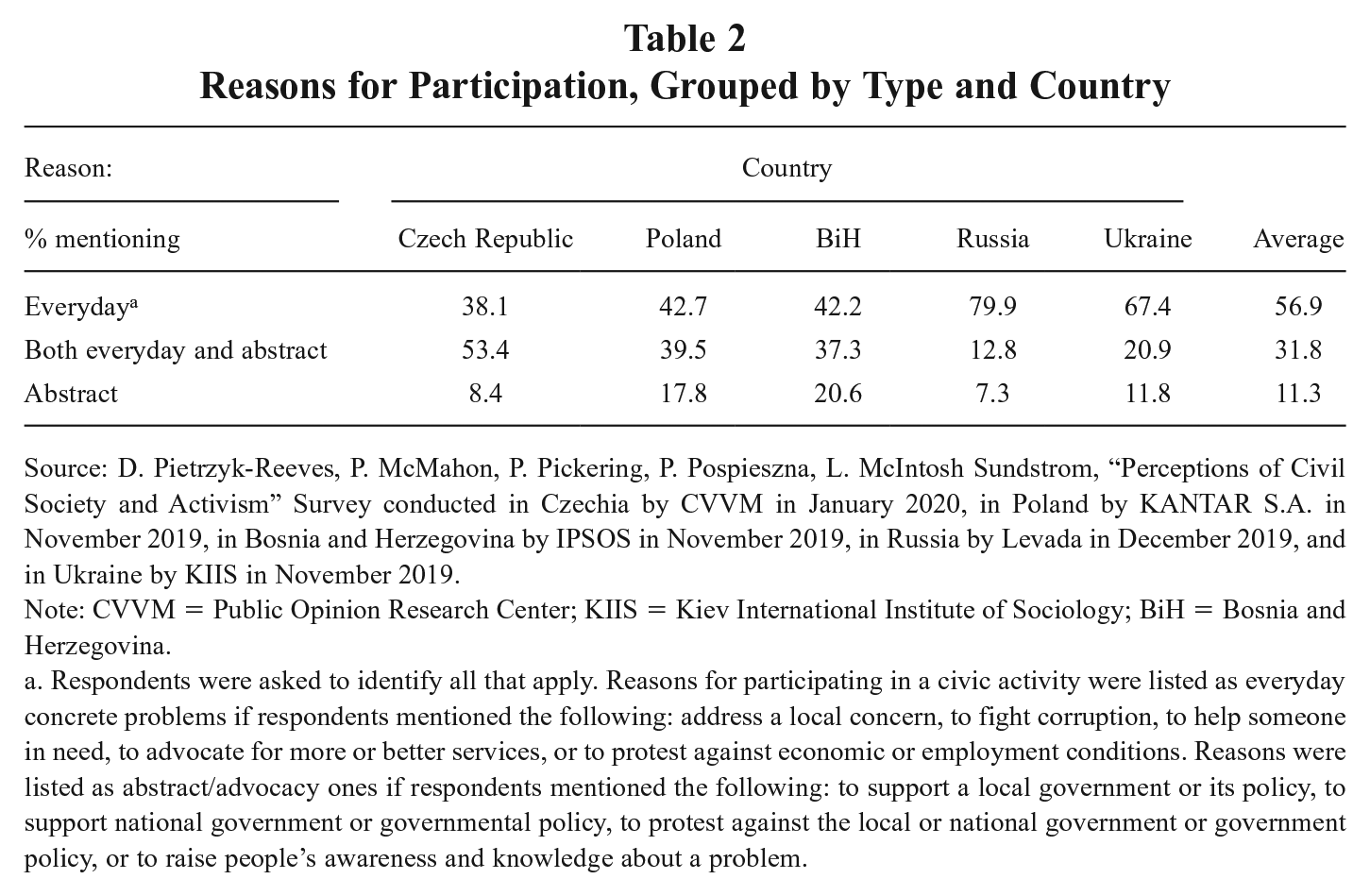
Source: D. Pietrzyk-Reeves, P. McMahon, P. Pickering, P. Pospieszna, L. McIntosh Sundstrom, “Perceptions of Civil Society and Activism” Survey conducted in Czechia by CVVM in January 2020, in Poland by KANTAR S.A. in November 2019, in Bosnia and Herzegovina by IPSOS in November 2019, in Russia by Levada in December 2019, and in Ukraine by KIIS in November 2019.
Note: CVVM = Public Opinion Research Center; KIIS = Kiev International Institute of Sociology; BiH = Bosnia and Herzegovina.
Respondents were asked to identify all that apply. Reasons for participating in a civic activity were listed as everyday concrete problems if respondents mentioned the following: address a local concern, to fight corruption, to help someone in need, to advocate for more or better services, or to protest against economic or employment conditions. Reasons were listed as abstract/advocacy ones if respondents mentioned the following: to support a local government or its policy, to support national government or governmental policy, to protest against the local or national government or government policy, or to raise people’s awareness and knowledge about a problem.
Coding answers to our survey question “What is the largest unmet problem in your country that could be addressed by the involvement of citizens?” provides support for the second hypothesis that citizens are most likely to attitudinally support public mobilization efforts when they concern everyday social problems (as opposed to abstract problems).
As Table 3 shows, 37.2 percent of respondents were likely to list everyday problems as the largest “unmet problems” that could be addressed by citizen engagement, while only 8.4 percent listed abstract problems. However, the highest number of respondents (54.4%) indicated both abstract and everyday issues as those that should be addressed by citizen’s active engagement, reflecting that most citizens are concerned about a variety of problems. As the article by McMahon and Niparko on Poland suggests, this may explain the mass support for mobilization efforts around women’s rights in Poland of late, which combines both abstract issues like human rights and concrete, everyday problems associated with a women’s choice and women’s reproductive rights.
The Largest Unmet Problems That Could Be Addressed by Involvement of Citizens, by Type of Problem and Country

Source: D. Pietrzyk-Reeves, P. McMahon, P. Pickering, P. Pospieszna, L. McIntosh Sundstrom, “Perceptions of Civil Society and Activism,” Survey conducted in Czechia by CVVM in January 2020, in Poland by KANTAR S.A. in November 2019, in Bosnia and Herzegovina by IPSOS in November 2019, in Russia by Levada in December 2019, and in Ukraine by KIIS in November 2019.
Note: CVVM = Public Opinion Research Center; KIIS = Kiev International Institute of Sociology; BiH = Bosnia and Herzegovina.
Respondents were asked to choose the three most important. Unmet problems were coded as everyday problems if respondents mentioned the following: environmental protection, rights of socially vulnerable groups, health and social care, unemployment, poverty and work-related issues, corruption, or education. Unmet problems were coded as abstract problems if respondents mentioned the following: human rights, rule of law/impartial judiciary, protections from Europeanization and Westernization, women’s rights, greater protection of national values, protection of religious values, or quality and sustainability of democracy. Coding responses into these categories is challenging and required contributors to this special section to take into account the particular contexts in which they are working. For example, most contributors viewed that “environmental protection” was framed as a concrete problem for communities and activists in their particular contexts. Each contributor might, however, code responses to this question slightly differently based on their country context.
We observe the potentially transformative power of civil society activism in the region, with recent examples not only from Poland and Russia which are analyzed here but also from Hungary, Romania, and Serbia where large numbers of people mobilized for issues they care about, such as a clean environment, state capture and corruption, and women’s rights. These examples show that both social movements and ordinary citizens remain important and powerful forces in the semi-consolidated democracies, hybrid regimes, or competitive authoritarianism, which potentially can deter further democratic backsliding or the consolidation of authoritarianism. 33 Importantly, the article on Bosnia and Herzegovina suggests that there is some popular skepticism about CSOs and their mission, especially in the context where the model of a foreign-funded civil society persisted for some time and makes citizens prefer engaging in less-institutionalized, horizontally organized activities.
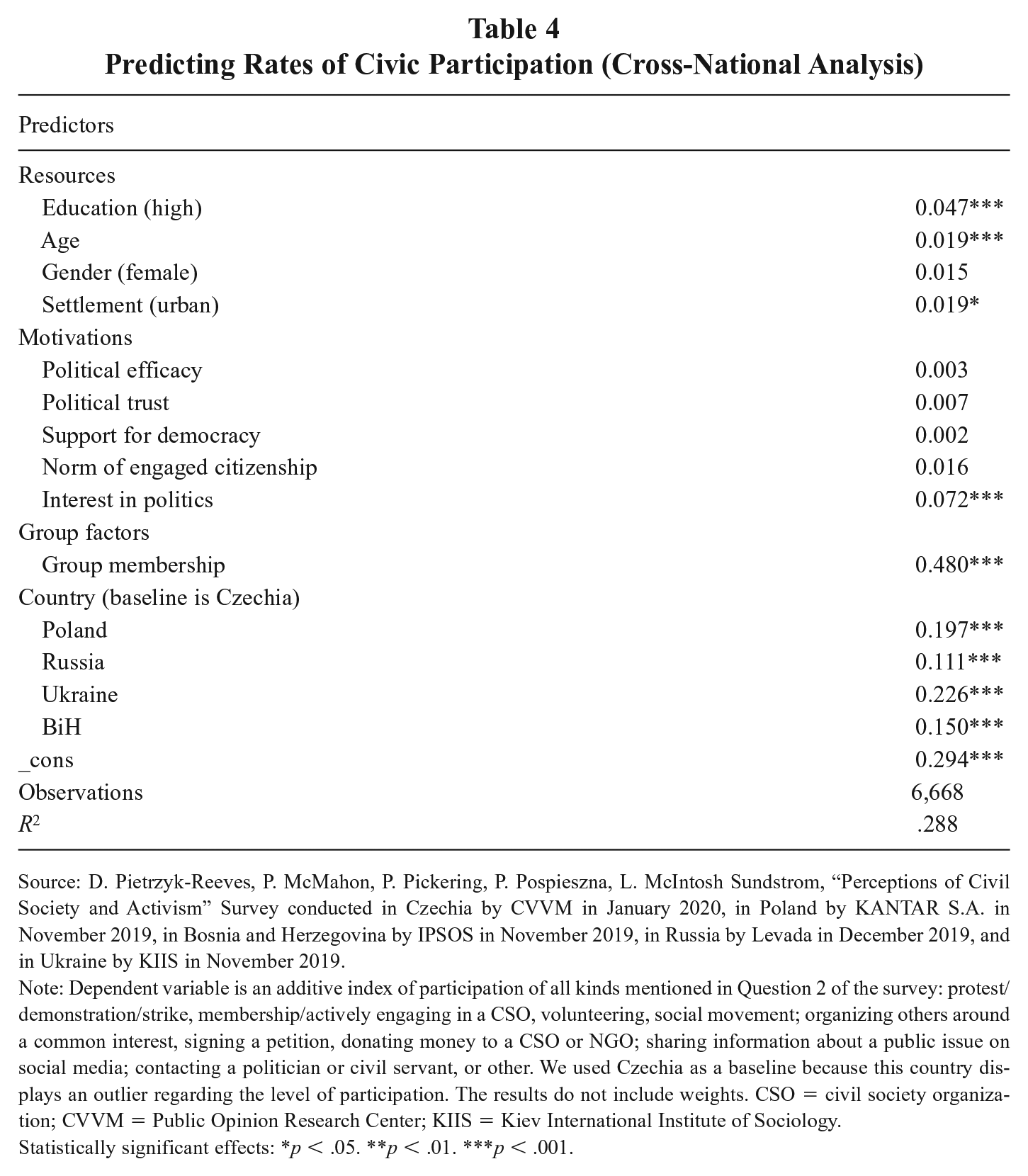
From the theoretical perspective that is offered here, it is more important to understand the motivations and resources that contribute to civic activism in its various forms than the correlations between civic participation and social capital or the performance of institutions. Dalton tested the “civic voluntarism model” according to which “people participate because they can, they want to, or someone asked them.” 34 Our survey also allowed for testing the explanatory power of this model. We conducted statistical analysis on a pooled sample (Table 4) rather than on each country to test a primary concern in this introduction: whether different country contexts affect participation. The other contributors to this special section are best situated to detail the particular country contexts and why some predictors may be different across cases. While other scholars of post-communist Europe have conducted analysis on pooled samples, 35 we recognize that this practice has received methodological criticism. 36
Predicting Rates of Civic Participation (Cross-National Analysis)
Source: D. Pietrzyk-Reeves, P. McMahon, P. Pickering, P. Pospieszna, L. McIntosh Sundstrom, “Perceptions of Civil Society and Activism” Survey conducted in Czechia by CVVM in January 2020, in Poland by KANTAR S.A. in November 2019, in Bosnia and Herzegovina by IPSOS in November 2019, in Russia by Levada in December 2019, and in Ukraine by KIIS in November 2019.
Note: Dependent variable is an additive index of participation of all kinds mentioned in Question 2 of the survey: protest/demonstration/strike, membership/actively engaging in a CSO, volunteering, social movement; organizing others around a common interest, signing a petition, donating money to a CSO or NGO; sharing information about a public issue on social media; contacting a politician or civil servant, or other. We used Czechia as a baseline because this country displays an outlier regarding the level of participation. The results do not include weights. CSO = civil society organization; CVVM = Public Opinion Research Center; KIIS = Kiev International Institute of Sociology.
Statistically significant effects: *p < .05. **p < .01. ***p < .001.
We investigated the capacity of a series of variables to predict rates of civic participation. These variables included (1) demographic characteristics of the person (age, socio-economic status, settlement, gender); (2) political attitudes that matter for participation (e.g., political efficacy, political interest, preference for democracy, norms, and trust); and (3) membership in groups. A regression analysis predicting civic action across our country cases shows that education, urban residence, interest in politics, and membership in organizations are strong and positive predictors of participation of all kinds. Age has a strong negative impact, meaning that the older the respondent, the less likely they are to participate. However, we observed important differences between our studied countries, which suggest the additional impact of country-specific political and/or socio-economic factors and variation within the post-communist region and even its subregions.
This table shows that in predicting civic participation, there are significant country differences between Czechia (our baseline country) and our other four country cases: Bosnia and Herzegovina, Poland, Russia, and Ukraine. This is indicated by the statistical significance of the country dummy variables. The survey asked about participation in the last twelve months, a time period that included June 2019, when Czechia experienced the largest demonstrations since 1989. 37 Also, as noted by Weiss, 38 there is a well-organized network of organized CSOs in Czechia, particularly in the environmental and social issue, and some organizations, especially unions and umbrella associations, enjoy privileged participation in some public policy areas. We refer to the particular country contexts and explain why some predictors may be different across cases in the other contributions of this special issue.
The Return to Diversity?
In his 1993 book, Joseph Rothschild predicted the return to diversity in CEE as these countries rejected communism and transitioned politically, economically, and socially. 39 Rothschild maintained that the CEE states remained diverse—historically, economically, politically, and socially—despite having been confined by communism for more than forty years. And as these countries transitioned to democracy, Rothschild expected that important differences would intensify. In important ways, this special section confirms his expectations by providing new empirical findings on civic participation and civil society development in CEE. What we also find is that individuals in these countries are motivated by different issues and engage in different forms of activism. Instructively, the issues, forms, and impacts of civic activism move beyond the expectations of scholars and donors supporting liberal democratic action.
Our survey results, however, contradict some of the differences in the region that have so far been assumed while revealing surprising similarities in the attitudes citizens have, including the prioritization of similar motivations for civic engagement that we call “everyday problems” (despite some differences presented in Table 4). In the countries we explore, we find that membership in formal organizations remains relatively low in comparison with membership levels in Western European countries, with the exception of Czech Republic. 40 We confirm through our survey data (Table 1) and interviews that in most cases citizens are more likely to engage in public activities than to be passive or to become active members of formal organizations.
The first article in the section re-examines the dominant approaches to civil society research in post-communist countries that developed in the 1990s, including the “weakness of post-communist civil society” thesis and the expectation that civil society is one of the key arenas that contribute to democratic consolidation. Calling for a more dynamic approach to both understanding and operationalizing civil society, Pietrzyk-Reeves identifies four criteria that must be considered for this reformulation to be helpful to our understanding of the role this sphere of activity plays today. The first criterion of the dynamic approach concerns broadening our understanding of civic activism as the key dimension of civil society. Instead of reducing civil society to associations and organizations, the concept should emphasize citizens’ ability to speak out and mobilize in different ways, through volunteering, establishing, and joining CSOs or social movements or linking online activism with offline action.
The second criterion concerns measurement and evaluation, taking into consideration changing patterns of civic participation and encouraging different methodologies that allow for a time-series analysis of civil society’s strength and weakness. The third criterion concerns the normative content of civil society which should be seen neither merely as a vehicle of democratic consolidation nor only as democracy’s guardian. Finally, a more dynamic understanding would better consider cultural and moral values as well as citizenship norms in evaluating the strength of civil society.
The articles on Poland and Russia seek to explain how civic activism looks in these countries and, thus, how and why civil society activism has evolved over time. McMahon and Niparko, for example, analyze Polish civil society using semi-structured interviews to complement survey research to better understand and bring to light informal types of activism, as well as the reasons that motivate it. Relying on interviews with civil society experts, activists, academics, and government officials, the authors argue that despite the government’s actions (and perhaps because of its policies and attitudes), Polish civil society has no shortage of organizations, in-person, and virtual activities.
Contemporary Polish activism, in fact, reflects a broad spectrum of orientations, and although certain areas and forms of activism are shrinking and disappearing, as in Russia, the country’s landscape is shifting in innovative ways, largely because of new technology and in response to the government’s anti-democratic behavior. At the same time, the Law and Justice government’s interest in “overseeing civil society” means that in some areas, activism is expanding, and relationships are strengthening. Given the government’s conservative-patriotic orientation, it is not surprising that “value guardians” or groups loyal to the government are growing in number and strength. The article demonstrates that precisely because of the government’s interests and behavior, it has created a backlash among individuals concerned about the future of democracy, rule of law, and human rights in Poland. All of this has, inadvertently, created networks of organizations and individuals that regularly call upon each other to protest proposed laws and government actions. Thus, activism around liberal, progressive causes, such as women’s rights and LGBTQ+ (Lesbian, Gay, Bisexual, Transgender and Queer plus) rights, is transforming, exploiting new technology and opportunity structures, and strengthening, with groups forming ad hoc coalitions and informal networks to resist democratic backsliding and the government’s conservative-patriotic agenda.
The article that examines Russian citizens’ support for and participation in civic activism is also interested in explaining how activism has evolved over time. Focusing on two key issue sectors—environmentalism and women’s rights –Sundstrom, Henry, and Sperling use survey research and interviews, challenging existing stereotypes of Russians as apathetic and/or fearful of participating in civic activism. This empirically rich article demonstrates both why and how Russians are engaging in public activities. As in countries in Central Europe, in Russia there has been a noticeable shift away from professional and formal NGOs to informal organizing, which is propelled in part by an increasingly repressive political context for activism and is assisted by new social media platforms.
The authors point to three drivers for the changes in Russian civic activism: the contraction of political freedoms, the decline in foreign funding, and the availability of web-based communication and fundraising technologies. As in Poland, these drivers have encouraged a shift from more formal ways of organizing to collective mobilization through informal groups and networks that often lack legal registration. Thus, despite governmental pressures and the disappearance of foreign donors, and because of the emergence of new technologies, some areas of civic activism are flourishing. Although there are important similarities in the two issue areas they focus on—environmental and feminist “everyday activism”—there are also revealing differences. Because of the place-based nature of environmental issues and their broader appeal, environmental activism has sparked more in-person and long-lasting protests around the country than has feminist activism. Again, as in Poland, the Russian government’s measures have unintentionally fostered a vibrant, if still fragile civil society.
In the fourth article in the section, Pickering investigates civic participation in Bosnia and Herzegovina, focusing on the specific factors that influence and motivate citizens’ engagement. Using data from our original survey, media coverage, and secondary sources, it examines the proposition that citizens in Bosnia and Herzegovina are most likely to support and participate in civic actions when they concern everyday social problems, especially local concerns that affect them directly rather than abstract political ideals. The article also aims to identify the macro- and micro-level variables that are most important in motivating civic engagement. The author finds that most Bosnians claim that they are motivated to take civic action because of their interest in tackling concrete everyday problems and the locally resonant norm of helping those who are socially vulnerable. Statistical analysis further indicates that while the segment of the population that views conservative values as unmet problem that could be addressed by civic engagement is small, this group is more likely than the larger portion supporting civic engagement on entrenched socio-economic problems to take action on their concerns. Testimony from a small group of civic activists suggests one reason why many citizens who prioritize social and socio-economic concerns are not engaged. In short, it is a problem of framing. While activists have adapted to changing political and social environments, they appear to struggle to frame their action in ways that resonate with citizens’ concerns, sometimes casting blame on citizens’ assumed passivity more often than on their own strategies for promoting engagement.
In the final contribution of this section, Pospieszna and Vráblíková look comparatively at five countries in the region, focusing on the issues around which civil society is mobilizing and why civil society actors in the region engage in various forms of participation, thus contributing to our understanding of the micro-level motivations for civic activism, as well as the impact they can have on the prospects of democracy. Using the survey data, the authors analyze responses to the question “What do you consider the largest unmet problem in your country that could be addressed by the involvement of citizens?” and compare what they refer to as the mobilizing potential of liberal and conservative issues in the five countries under discussion. In addition, the article examines the profile of citizens (i.e., socio-demographic characteristics, political attitudes, democratic norms, and membership in organizations) who see cultural liberal and cultural conservative issues as problems that are worth their civic engagement. The cultural liberal issues include “environmental protection,” “human rights,” and “women’s rights,” whereas the cultural conservative issues include “protection from Europeanization and Westernization,” “greater protection of national values,” and “protection of religious values.” The authors compare how the mobilizing potential of the two ideological camps translates into the actual type of citizens’ participation: voting, protesting, petition signing, and online activism.
The authors find that despite important differences between these countries, in Bosnia and Herzegovina, Poland, Russia, and Ukraine, there is a relatively high mobilizing potential for liberal issues. Moreover, the profile for the cultural liberals does not differ much across these countries. At the same time, conservative issues show the lowest mobilizing potential in the studied countries. Yet, as with the analysis of activism in Bosnia and Herzegovina, they find that although there is less mobilizing potential for conservative values, these values are more likely to translate into actual participation in these countries. The authors find many similarities between Bosnia and Herzegovina, Poland, Russia, and Ukraine, although they have experienced quite different historical trajectories.
Together, these articles demonstrate that the CEE region still constitutes fertile ground for research on civil society while also showing that a significant change in scholars’ analytical perspective on civic activism is required. Instead of treating civil society as a tool or instrument of democratization and democratic consolidation or as a barrier to backsliding and new authoritarianism, more attention should be given to the actual dynamic phenomenon of civic activism in its various forms and goals. Our major finding is that although, overall, individual participation in organized groups seems to be quite low in the countries of our sample (except for the Czech Republic), to better understand the real drivers of civic activism and how activism really looks, we need to use different methods of measurement, and we must explore the practices of activism in the contexts in which it really happens.
Supplemental Material
sj-docx-1-eep-10.1177_08883254221089261 – Supplemental material for Introduction: Civic Activism in Central and Eastern Europe Thirty Years After Communism’s Demise
Supplemental material, sj-docx-1-eep-10.1177_08883254221089261 for Introduction: Civic Activism in Central and Eastern Europe Thirty Years After Communism’s Demise by Dorota Pietrzyk-Reeves and Patrice C. McMahon in East European Politics & Societies and Cultures
Footnotes
Funding
This research was supported by a research grant of the National Science Center in Poland (Project No. 2018/30/M/HS5/00437).
Supplementary Material
Supplemental material for this article is available online.
Notes
 ) and Dean’s Professor of Teaching and Learning. She is the author of The NGO Game: Post-Conflict Peacebuilding in the Balkans and Beyond (Cornell University Press, 2017) and the co-author of American Exceptionalism Reconsidered: U.S. Foreign Policy, Human Rights and World Order (Routledge: 2017). McMahon is also the author of Taming Ethnic Hatreds: Ethnic Cooperation and Transnational Networks in Eastern Europe (2007) and has been involved in four other book projects. Her research has appeared in various publications, including Foreign Affairs, Political Science Quarterly, Human Rights Quarterly, Democratization, and Ethnopolitics and has been supported by the American Council for Learned Societies (ACLS), the U.S. Department of State, the National Research Council, the National Council for East European and Eurasian Research (NCEEER), the Soros Foundation, and the Carnegie Corporation.
Supplementary Material
Please find the following supplemental material available below.
For Open Access articles published under a Creative Commons License, all supplemental material carries the same license as the article it is associated with.
For non-Open Access articles published, all supplemental material carries a non-exclusive license, and permission requests for re-use of supplemental material or any part of supplemental material shall be sent directly to the copyright owner as specified in the copyright notice associated with the article.
