




Abstract
The secret police, along with the political apparatus of a ruling party or administration, created the backbone of communist regimes and constituted the main tool of State violence. The state of the art within studies on the Polish security apparatus—albeit extremely rich—is entirely focused on archival documents. What is missing from the research on the secret police in Poland is an oral history approach. This article is a pioneer attempt at revealing the operative methods of the Służba Bezpieczeństwa (SB) through interviews with former officers. It aims at reconstructing the mechanism that led the officers to victimize dissidents and how they created moral justifications for their deeds. Asking about their career track, successes and failures, relationships with other officers, private life, and details of daily duty, I tried to glean what made the interviewees become perpetrators.
The secret police, along with the political apparatus of a ruling party or administration, creates the backbone of authoritarian regimes. Its pivotal role in Central and Eastern European communist regimes is well recognized. 1 The secret police constituted the main tool of State violence, suppressing social protest and trying to eradicate every indication of defiance. Thus, the security apparatus became an intrinsic element of the communist political culture. It assured the stability of the single-party dictatorship in two ways: preventing the opposition from emerging as a competing political movement and guarding the propaganda world of appearances that legitimized the ruling elite. After 1956, the Polish Security Office rebranded itself as the Security Service [Służba Bezpieczeństwa—SB]. It—as well as its counterparts in Soviet Bloc states—practised multi-level violence that ranged from physical violence to more subtle forms of coercion that relied on permanent surveillance breaching its citizens’ privacy. The latter activity was typical for the post-Stalinist period of Polish history which commenced around 1956 and lasted until the collapse of the regime in 1989. 2
Post-1956 persecutions carried out by the SB intensified in the 1970s when opposition groups started to emerge and organize and soared in the 1980s with the imposition of martial law. 3
The range of measures used by the secret police varied over those two decades. It included legal methods described in laws and internal departmental instructions—such as arrests, surveillance, and searches. But there were also situations when the secret police would beat up people during interrogations, threaten their loved ones with death, or take them to the forest and pretend to execute them. One should stress that during the 1970s and 1980s there were at least a few dozen unsolved homicides of dissidents that historians blame on the SB. 4 The special squads that operated within the structure of the SB were tasked with kidnapping and torturing opposition activists or threatening the activists with late-night phone calls. As such units never revealed their identity to victims, they were popularly called “unknown culprits” [nieznani sprawcy] in prosecutors’ verdicts when dismissing victims’ claims. The most blatant example of such practices was the activity of the notorious “Group D” (“D” standing for “disintegration”) responsible for harassing the clergy. 5
The state of the art within studies on the security apparatus—albeit extremely rich 6 —is entirely focused on archival documents, far more descriptive than explanatory and, even worse, bound by the very language of the police documents. This tendency (and resulting shortcomings) has been denounced by sociologists and historians, who have appealed for “thorough studies on officers outlook on the world, of their intellectual abilities and private life” 7 or criticized a “narrow research perspective [. . .] neglecting sociographic approach.” 8
Moreover, one should bear in mind that albeit the vast Polish security apparatus archives provide scholars with an abundance of information, an important dimension is lacking in this picture. Documents represent the secret police’s point of view, so the reader is granted a wide perspective on the social and political landscape, but the very observer is predominantly invisible.
Certainly, the Personnel and Training Department (which operated under various names throughout the decades of the SB history) produced a lot of material, both of a quantitative and qualitative nature, yet almost all of it conveys a highly ideologized vision of reality, portraying police cadres as they should be not as they are. The deficit of knowledge is a wider phenomenon: a similar research gap has been observed regarding the historiography of the Stasi. As Gary Bruce put it,
For all of the sound scholarly treatment of the Stasi, one disappointment in the accounts has been the absence of a human portrait of a Stasi employee. [. . . ] Historians continue to debate vigorously whether the regime aimed to control all aspects of life in East Germany or whether there were indeed private “niches” to which one could retreat with more or less regime acquiescence; yet the most gaping hole in this discussion is what those involved in the repression apparatus thought about the nature of their work.
9
The language of official reports and files masks the real nature of political violence, examples of which will be given later in the article. The secret police write exhaustively about the circles and individuals subjected to surveillance but are much more restrained in revealing the backstage of its operational work. 10 From its documents, we will learn little about the techniques of repression and even less about the attitudes and mentality of the executors of this repression. Topics such as factional and intergenerational conflicts between functionaries or assembling clandestine hit-squads remained an undisputed taboo.
What is missing from the research on the secret police in Poland is an oral history approach. While fields such as history of opposition, gender history, or history of everyday life blossom with testimonies of activists and witnesses, perpetrator studies are mostly founded on written sources produced in the past by the SB itself. There are probably several reasons for that deficiency: difficulty in finding the right people and persuading them to give an interview, a tendency to perceive police officers’ testimonies as outright lies, and a fear of legitimizing perpetrators and dehumanizing their victims. 11
This article is a pioneer attempt at revealing the SB operative methods through interviews with former officers. 12 It aims at reconstructing the mechanism that led the officers to victimize dissidents and how they created moral justifications for their deeds. Asking about their career track, successes and failures, relationships with other officers, private life, and details of daily duty, I tried to glean what made the interviewees become perpetrators.
In the years 2018–2020, I have gathered twenty accounts by senior apparatus members which amounted to over fifty hours of recording (see Table 1). The research sample was composed mostly of the former heads of divisions both in the HQ of the Ministry of the Interior and the Voivodeship branches (three eventually were promoted to heads of the Voivodeship SB). They were born between 1940 and 1957, joined the ranks of the SB from 1968 to 1984, and their career tracks led through nine cities—the most prominent of which were Warsaw, Poznań, Gdańsk, and Wrocław. I deliberately focused on the senior officers (a sort of managerial elite), expecting them to be high enough in the chain of command to possess thorough and versatile knowledge. However, I didn’t try to approach the top command staff (deputy ministers, directors of departments) whose testimony could have been too geared towards defending the regime’s reputation. It is worth to note that all the interviewees were male, which reflects the overall gender composition in the SB: in 1985, women constituted only 8 percent of senior officer corps in the Ministry of the Interior, 13 usually related to auxiliary units like passports or logistics; higher positions in the SB hierarchy were reserved almost entirely for men.
A List of the Interviewees
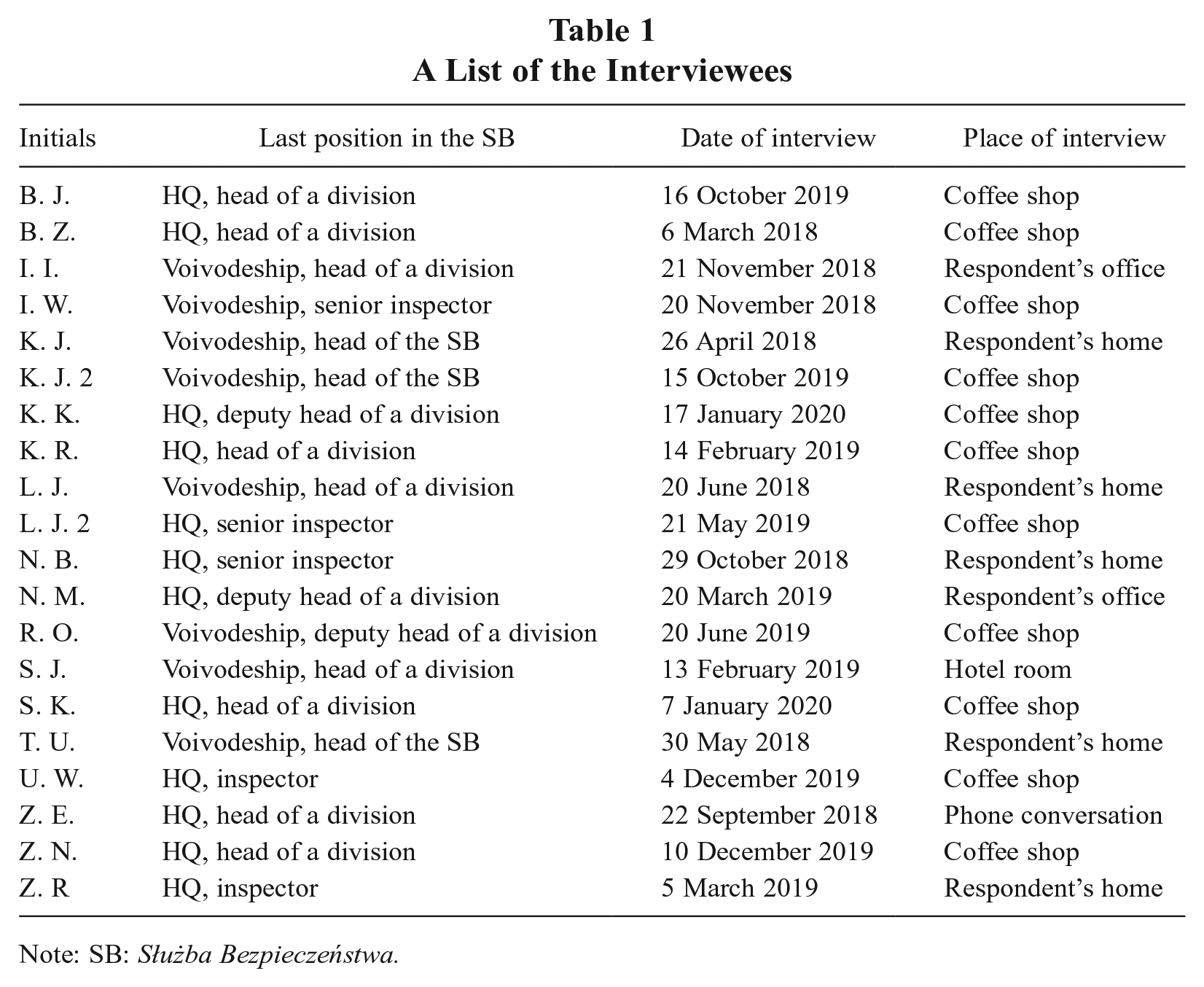
Note: SB: Służba Bezpieczeństwa.
When analysing agents’ testimonies, I’m going to refer to similar research done by Katherine Verdery, 14 Andreas Glaeser, 15 and Gary Bruce, 16 which was devoted, respectively, to Romanian Securitate and East German Stasi oral history. Verdery, an anthropologist, conducted a few in-depth interviews with agents whose names she found in her own surveillance file created by the Securitate in the 1970s—when she came to Romania for field research and was spied upon as a “suspicious foreigner” by the secret police. Glaeser and Bruce talked to, respectively, twenty-five and fourteen former Stasi officers.
According to the insightful concept proposed by Sheena Greitens in her book on dictatorships, the task set before the secret police by an autocratic ruler correlates with the police’s internal structure. The security apparatus’s primary role is reflected in the degree of its fragmentation. Dictators afraid mainly of a coup plotted by their political associates tend to create multiple security organizations, competing and controlling each other. Such highly fragmented secret police focus on surveilling elites and are more likely to employ indiscriminate terror. A coherent and unified apparatus, on the other hand, is meant to counter the threat of a popular rebellion. A lower level of fragmentation is usually accompanied by less violent behaviour—a well-synchronized and highly bureaucratic security organization provides its officers with a constant stream of information, thus making torture or other forms of physical coercion unnecessary. 17
While the Stalinist period in the history of the Polish secret police definitely meets the criterion of a fragmented organization bent on purges within the ruling class, 18 the systemic changes that came after 1956 made the Security Service an exemplary model of the second type of organization. 19 The officers’ main task (besides typical counterintelligence duties) was to monitor the social mood in search for any harbinger of potential upheaval and to prevent any public discontent from transforming into organized protest or a dissident movement. The Party and governmental elites may have enjoyed a relative sense of security (at least in comparison with the Stalinist period), as the secret police were geared to ensure system stability instead of inciting witch-hunts. The divisions between rulers and the ruled to a great extent overlapped with those between perpetrators and its victims.
Assuming an emic approach
20
towards perpetrators’ recollections, I made a deliberate decision not to ask the interviewees about their moral dilemmas or to signal to them in any way that I consider them to be perpetrators. While asking about the nature and details of their job, I chose my words carefully and steered clear of any phrasing that could sound as though I was accusing them of violating human rights. I believed, drawing on the experience of oral history researchers, that such an approach would be both futile and counterproductive. I didn’t want my respondents to feel cornered or in defensive positions, as it would irreversibly damage their trust in me and, in effect, limit access to their memories. In this respect, I chose to follow the reflections of Glaeser (which transpired to be absolutely accurate throughout my interviews) that
Posing the question [about pangs of conscience] thus would be ahistorical, because, perverse cases notwithstanding, people who inflict suffering on others, the Stasi officers included, rarely perceive themselves as “victimizers.” Instead, they typically feel that the suffering they have inflicted was fully justified either in the interest of preventing greater harm or as fair punishment.
21
Despite the initial premise of not bringing up the issue of moral judgement in the conversation, most of the interviewed officers at some stage of the conversation volunteered self-exonerations of different kinds. It was obvious that they were dismissing charges that had not been brought up, addressing questions that had not been asked, and yet apparently haunted them. In some instances, the contradiction between the statement itself and the reason for which it was made was visible at a semantic level: “I am definitely not ashamed of where I used to work. I have nothing to hide. Surely, I am not bragging about it either”—colonel K. J. told me (who, during our first phone conversation, displayed the utmost concern that I had not revealed his pre-1989 identity to his new business associates while trying to obtain his phone number from them). 22 There were other telling examples of such inconsistencies in life story narratives. Lieutenant U. W.—for almost two hours—tried to convince me that throughout his entire service, he did nothing except compiling reports for the Political Bureau and had never dealt with genuine political work. And then, all of a sudden, he sighed, “Don’t think I’m trying to evade some topics. I can’t get away from it. I live with it and will live with it until the end of my days.” 23
The defensive posture taken by the former police agents boiled down to two types of arguments, respectively, referring to the legal and geopolitical order. The first one was about claiming personal innocence and self-portraying as law-abiding officials. “I was acting in a legitimate institution and in accordance with governing law”
24
; “I performed my duties in good faith and in accordance with applicable law. I have always tried to do my best,”
25
insisted officers, highlighting that they had never been convicted in court and complaining about “smear campaigning” targeted at them despite being “innocent in the eye of the law.” “I never hurt anyone, so I don’t have pangs of conscience,”
26
one of the interviewees assured me. Some of them derived their proof of innocence from the verdict of transitional justice: “They branded us bandits, and yet I’ve never been to trial for any crimes [after 1989].”
27
Colonel S. K., whose official duties were to conduct “operational securing” (i.e., persecute) of the Catholic Church and who did not let me record our conversation, commenced our meeting with a statement:
I worked in a legitimate institution, I did not break any law. Please take me to court immediately and show me where I broke the law. I didn’t break it; I never even hit anyone. My conscience is as clear as that of some 70% of officers.
28
The second self-defence tactic was more intricate as it focused on the subjugated status of communist Poland and its dependency on the Soviet Union. It was the (immoral) Cold War order that determined individual choices, and no single agent in the political police could be held accountable for that. “We, born after the war, had no say. We can’t be deemed responsible for Yalta.”
29
Some pointed out they remained as righteous as circumstances allowed and fulfilled patriotic duties in spite of political limitations:
The group of officers I was in charge of had the same view that we are simply in the system we are in, and we have to function efficiently. And in this system, you have to take care of people and their interests. You have to look after the interest of the state as a whole, that is, of the society.
30
None of my interlocutors admitted that he himself had resorted to violence (at least as they defined it for their own use, which I will elaborate on later). “I never locked anyone up in my life. I’ve never victimized anyone in my life”—they assured me—“I never hit anyone.” It is noteworthy again that such declarations were not induced by any direct questions. I never tried to coax my respondents into self-incrimination of any kind, let alone asking if they engaged in torturing inmates; it was they who brought up the topic. However, while denying personal responsibility for abusing human rights, the officers didn’t seem particularly inclined to defend the organization’s good name. As many as twelve persons in the sample dismissed the assumption that they were perpetrators, yet allowed themselves to bear witness—in one form or another—to instances of perpetration within the rank of the secret police.
Apparently, my interviewees employed the strategy of “deflecting guilt” 31 and pursued it even at the expense of their narrative’s consistency. One could observe a blatant contradiction between the claim that working with the Security Service was by no means morally reprehensible and the descriptions of human rights violations committed by the very same institution. General K. J. (the one who refused to be held accountable for Yalta) referring to the 1980s and police action against the opposition commented somewhat enigmatically: “there were rewards for doing harm to people. But you can’t turn back time, can you? The service made its own mistakes, which it should admit to, because you can’t hurt people.” 32 In a similarly puzzling vein spoke lieutenant U. W.: “I knew I didn’t work in an entertainment company.” 33
The reason the interviewed officers decided simultaneously to defend and to tarnish the reputation of their own rank is not clear and may be subject to various interpretations. Thankfully, it benefits the researcher in providing him with a detailed insight into the intricacies of everyday police activities inaccessible through the analysis of archival documents. The oral accounts I gathered seem complementary: the author of each testimony skips over their own misdeeds, and yet gives some clues about transgressions of others. In effect, superimposing multiple testimonies provides us with a relatively coherent and reliable overall picture. The interviewees reveal most about the mechanism of violence when accusing their colleges and co-workers.
Three narrative strategies of deflecting guilt emerge from the material collected: spatial, generational, and organizational. Within the framework of the first one, police agents sought to attribute the instances of violence to the insubordination of the SB local branches. Beating, blackmailing, and kidnapping—all kinds of activity the political police are notorious for—had to happen “over there,” away from the HQ in Warsaw, and against its will—or at least without its acquiescence. The senior officer from the Ministry of the Interior recalled,
Fortunately, I did not have the pleasure of participating in some kind of a scuffle. It never happened to me in my life. But later, of course, I found out that in Poland, in many cities, there were beatings [of detainees], that it happened . . . There was no such thing in Warsaw, maybe because . . . because the management was a bit careful; there was no pressure to do something like that. There was no such thing that you know, “rough him up quietly there,” no. The local branches always were allowed more leeway because it was farther away from the candlestick, yeah.
34
Generational divisions played an important role in how my interviewees framed their career track memories. As all of them enlisted in the service no earlier than in the late 1960s, they represented a new quality compared to the background of the older officers, undereducated, and mostly belonging to the Stalinist formation of “people’s power entrenchers” whose esprit de corps was shaped during fight against anti-communist guerrillas after World War II (WWII). A new generation within the ranks of the SB tended to see itself as more professional, efficient, and advanced. The way those agents used to describe their older colleagues often seemed condescending and sometimes tinged with mockery or even outright contempt—“morons,” “blockhead,” and “diehards.” In the eyes of their successors, the “old guard” epitomized all the evils and flaws of the political police. 35
The Stalinists were associated with ideological rigidity (addressing co-workers with the obligatory “comrade” title, deemed ridiculous and obsolete by the younger generation), cronyism, and antisemitism, and deeply entrenched hatred towards the intelligentsia, which made them particularly wary and hostile towards dissident movements. Captain Z.N., born in 1953, reported,
We differed in education, so our outlook was completely different. They were still of those “no high school diploma but a sincere desire will make you an officer” [a post-war propaganda slogan encouraging candidates without a high school education to enlist in the ranks of the security apparatus]. They gained their experience in the times of the Security Offices and it left its stigma on them. They were instilled with principles that were completely foreign to us. [. . .] The principles of not compromising [with the opposition], not engaging in dialogue, but liquidating. I remember one of my colleagues would put a gun on the desk during the interrogation. As a scare tactic. It was unthinkable for us.
36
The third narrative strategy geared to allocating blame—implemented by the former officers—relied on pointing out other department, divisions, or units within the Security Service. Some of my interlocutors insisted that one dedicated part of the service was designed to suppress civil rights, while the rest only dealt with morally commendable tasks. The fall guys turned out to be peers from the other department. Particularly, the officers in intelligence and counterintelligence claimed to be of a different mould, entrusted with the honourable duty of defending the country and not tainted by persecution of their own people. Such a view was largely unfounded, yet functionaries of, respectively, Departments I and II seemed fond of emphasizing their autonomy and distinctiveness. A prominent officer within the counterintelligence department (his brilliant career in the secret service extended beyond 1989) distanced himself from the core of the institution he worked for:
A very important division for the authorities was the third division, the political police. This goes without saying because, as you know, the authorities were very suspicious until 1990. After all there was censorship and everything. They were extremely careful about ideological purity. So [the task of the political police] was to fight and expose everything that could pose a threat to the authorities. They fought all the seeds of independent thinking, and especially acting. This division was given priority. On a par with the fourth department, of course, which dealt with the Church. That is, the fight against the Church.
37
The recognition of some SB department’s wicked role might affect career paths. Three of the respondents claimed they declined transfer to another department due to ethical reasons. An officer with the counterintelligence unit refused to join “branch III,” which dealt directly with suppressing the opposition, even despite the fact that it would have entitled promotion (“I wasn’t after an ideology-related job”). 38 Other agents didn’t agree to join Studies’ Bureau, a special unit widely recognized as elite and established for the “disintegration” of the underground “Solidarity” leadership: “those people got lost there with their methods,” he explained somehow enigmatically.
Irrespective of the particular narrative strategy, the most valuable insight into the mechanisms of state violence stem from eyewitness testimony. It was not common for the officers to provide me with precise and exhaustive descriptions of victimization and persecution, so that several times I had a chance to get behind the scenes, learning grim details of secret police work. However, in every case, the respondents refused agency in the developments they reported. Their stories, which were framed as “colleagues’ experience,” gave what should be considered firsthand accounts. Despite all the semantic caveats made to detach the narrator from the event (“I was notified,” “one heard a story,” “allegedly it happened that . . . ”), it looked as though my interlocutors were telling about things they had taken part in or at least had seen with their own eyes. Therefore, such a moment of candour occurred, if ever, only after longer conversations when such officers gained trust in me. Their voice changed, they bragged, or they confessed—I couldn’t tell then, and I still can’t.
Colonel K. J., whose career led through successive promotions from Department III to being a Security Service chief in an important Voivodeship, interrupted his story, hesitated for a moment, and then kept on:
Barely after arriving in the Ministry in 1976, I was given a special assignment. I was sent to the army for three months for training. With the leading opposition figure, Jacek Kuroń. For three months we were together at the training ground in Białystok. A special platoon of reservists was created, consisting of Jacek, six [military counterintelligence] agents, and me. At first, I wasn’t told why this group was created, but later it turned out that it was about delaying the creation of KOR, because they [in the Ministry of Internal Affairs] already knew that there was to be such a thing. Apart from that, they had mischievous plans for Kuroń. [PO: Mischievous plans?]. Well, not in the sense of killing him or anything, but they wanted to put him in jail for many, many years for a criminal offense. I’m just saying this between us, by the way, these people [the officers responsible for carrying out the task] are already dead. They were supposed to go out on leave with Kuroń, get him drunk to the point of unconsciousness, break a window in a jewellery store and throw him inside [posing as a burglary]. The plan didn’t work out, ’cause Jacek grew wary and didn’t want to drink with them.
39
Apart from the direct physical violence, there were also other means of victimizing dissidents. Captain L. J., who for a year and a half was working with the infamous Studies Bureau, gave me an example of how a gaslighting technique was implemented by the political police.
The Department III tried to do all sorts of ridiculous things, like moving someone’s [being under surveillance] car quietly. They got in and drove 2–3 streets away and then made fun of him, when he reported to the militia that his car had been stolen [laughter] and that in the morning, when he was going out drunk from a hooker, he had to worry where he had left the car. [. . .] They rather preferred to resort to such intelligent tricks [laughter]. Because if you do that to someone a few times, eventually he won’t know if he’s all right [laughter]. My friends told me a bit about these things when we were drinking [laughter].
40
It is worth noting at this point that the former officers, while describing the persecution of opposition activists, presented them in the worst possible light, droning over alleged flaws and bad intentions. Thus, dissidents, portrayed by their former persecutors, turned out to be embezzlers, alcoholics, unfaithful partners, and last but not least—traitors, paid by the CIA (Central Intelligence Agency). S. K., from Department IV, in his account, obsessively returned to the theme of alleged exploitation by priests. In churches and monasteries, sexual orgies were supposedly taking place. Even the funeral ceremonies of the Primate were reportedly deemed an occasion for clandestine trysts between priests and nuns. A fraction of these stories might be true, but this does not change the fact that—apparently—the victimizers needed to tarnish the good name of their victims and thus make their own actions less morally reprehensible.
Stalking, harassing as well as infringing privacy definitely comprised forms of unlawful violation of human rights. A house search, especially when carried out on a regular basis, amounted to one of the most annoying sorts of repression, targeting not only the conspirator but also his family. For Z. E., being on the active side proved painful too:
At the beginning of my service, I was such an apprentice. I participated in operational activities, I listened to some interrogations, operational conversations of different nature. I also participated in searches. I can honestly say that it was a traumatic experience, digging through someone’s . . . dirt, underwear. And I’ll tell you that it was such a shock that later on in my life, if I could, I avoided such actions. [. . .] It was something I didn’t like very much.
41
On the other hand, for colonel Z. N., recollection of numerous house searches he supervised clearly transpired quite pleasantly. It was before I switched my recorder on, when he—getting into a sort of a chat—bragged about his past connections.
I would pay a visit to plenty of distinguished professors and intellectuals in their flats [he listed names]. I knew them well, however, not always at their best. Professor [. . .] for instance always had a terrible mess on his desk.
It took me a while before realizing what Z. N. was actually talking about.
Surprisingly enough, the procedure of a house search might serve not only to intimidate (or, obviously, to obtain proof of “illegal activity”) but also as a tool to select cadres. The detailed and appalling account given by Captain L. J. gives us a rare opportunity to trace the very mechanism of a perpetrator in the making. Therefore, I decided to quote it at length:
Do you know what this creation of Group D looked like? I know that at one point they even tried to drag me into it, but after my reactions they gave up. I didn’t hide that I wasn’t up to it, that I didn’t want to. Nevertheless, I was not demoted. [PO: But what did it look like, did they asked you to beat someone up?] No, no. That’s not how anyone was ever involved in these matters. The superiors approached us more psychologically. Long, frequent talks, having vodka together. Checking what was in a person and what he was capable of. Suggesting topics and observing how you would react. And so, piece by piece, deeper and deeper. You know, it was not such a stupid institution. And that was the principle on which people were chosen. There were also observations, such as show searches, to which rookies were taken. And someone always observed very carefully how these new people behaved. In every group there would be someone who was keen [laughter] and you could quickly sense who was keen, eagerly searching and rummaging in drawers, and who was more on the principle—“I do it because I have to.” And from this you selected people for field activities. In my department they took two people. I don’t know what they did there. But later this group was given new tasks, more and more, deeper and deeper. And that’s how Piotrowski’s group was created. When I saw that they were already mental deviants, I ran away from the department, got a transfer to the other unit.
42
Captain Grzegorz Piotrowski was a head of one of the divisions within Department IV. He commanded the team which in October 1984 kidnapped, tortured, and murdered priest Jerzy Popiełuszko, who was renowned for his anti-communist stance and enormously popular among the Warsaw faithful. 43 When Popiełuszko’s mutilated body was found a few days later, the authorities—facing the prospect of social unrest on an unprecedented scale—accused Piotrowski of lawlessness and insubordination and got him arrested along with his team and immediate superior. The full sequence of events and the motives of the perpetrators have never been fully explained. The historians’ presumptions varied from a bottom-up act of zealotry all the way to a Soviet plot, calculated to empower the party hardliners.
Popieluszko’s death occupied an important place in the former agents’ recollections. Fourteen out of twenty officers brought up this topic during the conversation. They didn’t claim to (or seem to) possess any firsthand knowledge regarding the homicide, yet their assumptions pointed to the same set of factors: there was a kind of a tacit consent in “the fourth” for a “harsh approach.” “General Płatek was temperamental, and he expected results” while “Piotrowski was rabidly ambitious and keen on promotions.” Basically, respondents condemned the murder yet considered it also “unprofessional,” meaning the culprits operated without orders and a proper plan and henceforth “screwed it up.”
44
What was striking, however, about their narrative was the peculiar choice of words used when referring to that crime. Only two people outright called it “murder”—instead, I heard a variety of euphemisms and bywords: “the Popieluszko issue,” “the Popiełuszko-related incident,” “Popiełuszko’s affair,” and “hideous craziness.”
It was the moment when that Popiełuszko activity emerged—said K. J. 2. [PO: What Popiełuszko activity, what do you mean?] Well, you know, the fourth [department] slip-up.
45
A shift in the narrative’s rhythm and clarity often heralded stories of violence and victimizing. There were many times when the officers’ stream of recollection encountered (or I directed ) instances of transgression, it became vague, blurred, convoluted: “I heard they [other officers] embarked on different games and sorts of play,” “they tried to use certain methods,” “kind of difficulties might happen during the investigation,” “there have been some not-so-glorious actions.” Even when pressed, agents didn’t want to (or couldn’t) flesh those riddles out with details—to call the dark side of their profession by its name. In such cases, I was left to guess from the historical context what my interlocutors might be alluding to.
It is beyond doubt that among the numerous instances of political repressions inflicted by the state on its citizens in communist Poland, the imposition of the martial law is by far the most lurid example. The crackdown on the “Solidarity” movement of 13 December 1981, carried out by the military and police, was the most massive violation of human rights in the country’s post-war history. Aside from a curfew, phone call censorship, extremely brutal dispersion of demonstrations by the infamous riot police ZOMO, and bloody attacks on striking factories and mines, martial law was also accompanied by the mass arrests of “Solidarity” activists. During just the first hours of the operations, thousands were taken into custody, interrogated, and then interned. The detentions were usually brutal. The police would come in the middle of the night, break down the doors, and drag opposition activists out of their beds. The lack of information was supposed to exacerbate the stress of the imprisoned. There were also beatings and staged execution scenes. 46
The night when the martial law was imposed affected activists’ memories; their life stories revolved around this trauma. 47 In the case of former agents, the opposite was true. I found it quite difficult to urge my interviewees to talk about what happened that night (and the following days), despite the fact that, given the scale of mobilization, they had surely had to take part in the crackdown. The officers tended to praise the operation, highlighting how swift and efficient it proved to be (“it was a masterpiece”). However, they showed reluctance to dwell on the details, especially regarding their own engagement. Some claimed they tried to alleviate the harshness of the martial law: limiting the number of detainees, removing people from the list of detainees, or letting them go home “after a short conversation.”
The interviewees were unanimous that martial law was inevitable to avoid a much worse disaster, namely, a Warsaw Pact intervention. 48 One may consider such a justification to be merely a convenient excuse, another attempt at deflecting guilt, yet during over fifty hours of interview, I realized that my respondents’ fear of Soviet influence was deep and genuine. The role of the KGB in Poland occupied an important place in the officers’ recollections, actually reaching far beyond the scope of this article, yet the common denominator of those stories was a conviction that Soviets are both mistrustful and omnipotent. Reportedly, the Ministry of the Interior was under close scrutiny from KGB liaisons, and even some functionaries of the Security Service had been recruited by Soviet intelligence. A senior officer with the Ministry, referring to the Soviet permanent garrison deployed in Poland (and the threat it posed), twice mentioned the number 300 thousand, seven times greater than the actual strength of this force. 49 Despite that given his rank, he had access to real data and should have known better, he multiplied the size of “the allies,” apparently driven by fear.
Three officers mentioned the Soviet invasion of Afghanistan in 1978 and the ensuing massacre of the local security forces—subscribing to the communist ideology yet seen as disloyal by Moscow. They also allude to “Spetsnaz” units deployed to Poland in 1981, whom they saw with their own eyes. Their disposition to victimize stemmed from the fear of becoming victims. Colonel I. I. put it this way:
There was a belief among the officers of the military and the secret service that if Russian troops intervened, the first thing they would do is what they had already done before in Afghanistan. They will shoot all of us in this building. We’ll be the first ones they shoot. Well, that’s what’s been talked about loudly, that we’ll be the first . . . So, some of these attitudes and views [towards “Solidarity”] originated from there, and that’s where martial law came from later.”
50
As mentioned before, the very notion of inflicting violence embraced in officers’ recollections was ambiguous. Analysing the phenomenon of violence carried out by the secret police, one should bear in mind that functionaries might have their own ethical rules, and deeds today conceived as despicable for them were just an example of professional efficacy. It was not uncommon for the police agents to vaunt an allegedly inoffensive approach to political opponents, despite having described instances of brazen infringement of human rights. What the culprits perceived as harmless and innocuous treatment, merely minor nuisances for the opposition activists, were not necessarily seen the same way by their victims. “Please don’t believe what they say about us. A well-trained officer didn’t have to resort to violence or any . . .”—an SB colonel, who headed a unit tasked with surveillance of academic circles in one of the largest Polish cities asserted to me. To prove his words, he told me the following story:
There’s a big convention at the university. From all over the country. And someone from a voivodeship headquarters asked us that a professor from their city, from whom they want something, come to this conference. And he somehow refuses, he doesn’t want to help, and the materials indicate that he knows something [i.e., he participates in an opposition activity]. “And if you came across any circumstances that might support us, we would be highly grateful.” Okay. Well, so the guy, to his misfortune, brought a student with him. Well, and all this was done in the hotel room, prepared in advance [cameras and wiretapping]. And then I go and talk to this professor. Such a shameful little story. He was broken, right? Devastated, because there is an audio there, and a video as well. Two men kissing and so on. And other things like that. I didn’t show the photos to him, I just made him understand. I said: “I have a request: you go back home, to your work and my colleagues have some questions there. Please, if it makes no difference to you, give them the information. Let’s help each other. I don’t remember anything, and if you can, please kindly help them there, if it doesn’t offend your dignity . . .” A week or two later I get a call. Colleagues from that voivodeship headquarters: “You, listen, listen, what did you do to him? He agreed to cooperate.”
51
Recruiting secret informers was by far the most common form of Security Service operational activity. 52 The dexterity in building and managing a network of so-called “personal sources of information” was counted among the key competences of an officer from the moment he joined the service. “Instruction 006,” the SB rulebook outlining principles of operative work, which newly admitted officers were expected to learn by heart, indicated that, “In combating hostile activity, it is of fundamental importance to ensure the flow of information from areas of interest to the Security Service. Secret collaborators play a special role in this respect.” 53 The handling of the secret informers’ network was subject to annual personal assessment—the officer who was considered to be underperforming with his recruiting might face loss of salary bonus or transfer down the ladder of command.
It was no different for the officers included in this study. Everyone highlighted the importance of “personal sources”—the interviewees reiterated that a well-performing officer should rely primarily on rapport with his informers instead of technical means of surveillance. A willing informer could provide intel not only about what has happened but also about what will happen. If an informer is converted into “an agent of influence,” he could be used to “disintegrate” the underground cell by disseminating rumours and sowing discord. 54
It’s safe to say that the same rule applied to the case of the Stasi and Securitate. Glaeser and Bruce independently highlighted that the ability to recruit informers was a crucial skill for their interviewees. East Germany officers had to coerce citizens into cooperation in spite of the official instructions which told them to persuade people. Stasi functionaries were obliged to meet specified quotas of recruited persons per year, and their annual assessment hinged on how they handled their informers’ network.
55
The Romanian policemen, whom Verdery talked to, conceded the same:
Informers were very important. That came with the job [. . .] It [recruitment] was done in two ways: using patriotism and compromising material. We could appeal to your desire to serve your country, or if you’d gotten caught doing something against the law, we’d say “Come work for us; if not, you’ll be prosecuted and go to jail for it.”
56
In the Polish case, attempts at forced recruitment were also used as a means of persecution. Breaking a subversive during interrogation and turning him into a police subordinate was an ideal outcome for every officer. A threat changed into an asset. I traced this strategy while conducting interviews with former activists of the 1968 student protest in Poland. From the point of view of the Ministry of the Interior, it was much more important to compel the detainee (or arrested person) into signing an obligation to cooperate than extracting confessions. According to the scenario prepared by the SB, only a few student leaders were to stand trial, while it was desirable for as many of them as possible to become informers. The recruitment strategy was based on intimidation and deception. The forced cooperation was presented as a continuation of the investigation procedures, so that the stunned and panicked victim did not notice when he had transformed from an arrestee into an informer. 57
Drawing an analogy with managerial studies, one may say that recruiting informers served as a sort of “Key Personal Indicator” in assessing officers’ efficiency. This is why a significant part of their testimonies revolved around procedures, rules, and guidelines regarding how to deal with secret informers. Thus, we can assume the dominant manifestation of violence relied to a lesser degree on physical force or outright torture rather than intimidation and psychological manipulation. Within the ranks of the secret police, the ability to recruit constituted an equivalent of marksmanship in the army—a core competency the officer is expected to master. No matter the obstacles, by choice or by force, the officer was expected to be able to talk his prey into cooperation.
Although official guidelines recommended recruiting informers solely on a voluntary basis and through appealing to their “patriotic feelings,” some officers admitted that such an approach rarely proved useful, especially when opposition circles were concerned. “I tell you what. Such an informant, who wanted it himself, had no greater value”—revealed S. K., the senior officer with Department IV.
58
To get an insight into the activity of a targeted group (be that an employee of a factory or a university) required laborious preparations that included finding a proper person capable of providing the needed information and convincing him or her to collaborate. Several times, respondents assured me that they “drew no consequences” if someone refused to cooperate. Yet it was quite obvious that the system kept producing all kinds of incentives for the officers not to accept such a refusal easily. A senior officer with Department III didn’t try to hide his cynicism:
One needs to know psychology. Recruitment is largely about blackmail after all. It’s about knowing how to blackmail a person. Because there were three basic models of recruitment. One—ideological commitment, because there were also some people like that. The second—material interest, we paid for each piece of information, well, actually there was no fixed salary, you just defined the value of the information and the payment was made. And the third—blackmail. If someone was caught stealing something or caused a car accident while drunk, you took out papers from the police, went to the guy, . . . We recruited homosexuals quite often in this way.
59
During the interviews, I was provided with an abundance of successful recruitment stories. Basically, every functionary had a handful of such tales to vaunt. Sometimes, I felt like I was talking to a hunter bragging about his trophies. Candidates for recruitment were threatened with “consequences” of their opposition activity or tempted with money or a passport. According to an intelligence agent, some informers tended to embrace a sense of power, their denunciations capable of destroying others lives. Nonetheless, driving under the influence along with sexual offences probably belonged to the most common forms of “leverage” that the interviewees alluded to. A head of one SB voivodeship told me about a local priest who used to sexually assault children. The officer was visibly proud of the way he handled “the situation”—he ordered the priest to be detained and brought him to the police station for “a talk.” Then he recited a formula, “father, you know that ‘someone who likes children is facing Article 203 of the Penal Code’” [“Księże, a ksiądz wie, że kto lubi dzieci temu grozi dwieście trzeci”], an untranslatable rhyme suggesting that this method of blackmail was often in use. 60
There were various kinds of training and courses—some of them conducted as a KGB school in Moscow—during which policemen had to improve their skills in acquiring “personal sources of information.” “We had classes in operative methods, where we learnt how to conduct ‘a recruitment talk’. We trained on each other. First, I tried to recruit my pal and then we switched roles.” 61 Respondents usually displayed scepticism towards bureaucratic procedures and the artificial methods they had been taught. “It’s sort of an art, you can’t truly learn it. Every recruitment is different, you need to improvise, to adjust to the circumstances.” 62 “Some succeed with that, other don’t. I learned on the fly, from my colleagues.” 63
Several times, I asked respondents, “Let’s assume you want to recruit me. How would you go about to the task?” In response, they smiled and eagerly (even with a glint in the eye) started to build a plot: they would need to run background checks on me, figure out what career stage I’m at, and find my sweet spots and work out possible scenarios for luring me into cooperation.
Among various narrative strategies employed by the former police officers to make sense of their biographies, “professional commitment” was by far the most predominant. Basically, all of the interviewees, to a lesser or greater extent, portrayed themselves as politically disengaged, well-trained, and unbiased policemen. They used to tout their “operative successes,” especially when this didn’t entail digging into details of morally reprehensible deeds, emphasizing how much skill and resourcefulness was needed to fulfil the task. 64 A former head of the counterintelligence division was proud that while making use of clues given by secret informers, he never compromised any of his sources.
One might argue that an allegedly apolitical stance is just a retrospective projection or self-defence tactic, nonetheless the confidential survey conducted by the Personnel Department seems to support the officers’ claim. According to those data from the late 1980s, nearly 66 percent of newly hired officers joined the SB ranks mainly in pursuit of an “interesting job,” “good salary,” and “tied accommodation” (a perk of extraordinary significance in a socialist economy of deficit). 65 There was also a substantial change regarding the content of motivation letters, which candidates were obliged to submit when applying for the job: while in the first decade of PRL, future officers often brought in their ideological commitment (“I want to defeat the class enemy and buttress socialism in Poland”), in the 1970s and 1980s, such creeds were all but absent. 66
The self-esteem based on a claim of professional proficiency was confronted—in officers’ life stories—with their miserable fate after 1990. All of them had their pension cut to the minimum level under the provisions of the retributive law, introduced in 2016 by the right-wing ruling coalition. Their testimonies conveyed the sense of humiliation and outrage at undeserved harm along with a genuine and utter feeling of surprise.
As far as I managed to figure out, the vast majority (at least fifteen persons) of my interviewees didn’t pass (or didn’t apply for) the vetting procedure to be part of the system transition. Their expulsion from the service came as a shock and was widely perceived as a sort of human resources waste. “We thought every authority would need professionals such as us.” 67
The mechanics of violence revealed in collected testimonies didn’t point to ideological motives of any kind. The perpetrators did not blackmail, apprehend, or harass their opponents due to emotional inclinations. Even those who admitted (albeit in a convoluted way) inflicting harm on people defined by the security apparatus as “political opponents” didn’t display any personal grudge towards the victims. It wasn’t the internalization of communist values or sadistic tendencies that prompted them to become victimizers or—as Bruce put it with reference to Stasi practices—“affectors of life.” Priests, opposition activists, and other persons of interest were not subject to hatred; the officers’ memories seemed void of personal sentiments and lacked an ideological agenda. The policemen saw their victims not as foes but rather as tasks set before them. What drove them to unjust and unlawful persecution amounted to pursuing an individual career strategy. It was their ambition to retain attractive jobs, and to follow an established career track leading to promotion and peer recognition, that made them perpetrators.
***
“Except for an extraordinary diligence in looking out for his personal advancement, he had no motives at all. And this diligence in itself was in no way criminal”—wrote Hannah Arendt in her famous study on Adolf Eichmann. 68 Certainly, the Security Service was not the SS, and whatever harm was inflicted on the anti-communist opposition was incomparable to the Holocaust. Yet Eichmann was working with the Gestapo—the Nazi secret police—hence one might seek a certain resemblance on the institutional level. Both organizations seemed founded on the same basic tenet: they relieved individuals of moral dilemmas, instead bestowing power upon them. 69
The former officers of the SB embraced the idea that every secret service operates on a similar principle, recruiting informers and seeking furtive control over social movements and political parties. “Let’s not fool ourselves. Solidarity was staged and the Orange Revolution was staged. Every revolution is steered and financed by some secret service. The only thing that counts, is it’s gotta be our service.” 70 This opinion, expressed by a former officer of the intelligence (Department I), resonated with several other accounts. As exaggerated as it was, such a claim reflected the general sentiment of the respondents, who consider themselves to be highly qualified mercenaries. According to this interpretation, the political police only was following the party’s instructions, not having its own political agenda. One of the officers, when asked if the SB contemplated the idea of halting the political transformation of 1989 by force, grimaced: “Not at all. You know, members of the police and security services are people accustomed to serve. They immediately fall in line with any new master that comes along.” 71
One might find such an attitude to be merely a cheap excuse and another attempt at “deflecting guilt.” That’s what is usually ascribed to the notion of the “security apparatus” in classic historiography—a unique phenomenon typical of the authoritarian political culture. However, perhaps we should consider a different approach if not a paradigm shift.
“All countries have intelligence services, and no one familiar with the actions of the FBI under J. Edgar Hoover can confidently point a finger without it shaking a bit,” wrote Verdery, explaining why in her book she didn’t go for condemning the Securitate adamantly enough, possibly disappointing some of her Romanian readers. Recent research seems to bear Verdery’s argument out: as far as operative methods are considered, undercover police operations carried out in liberal democracies show striking similarities with those taking place in communist regimes.
Authors who—thanks to the Freedom of Information Act—managed to gain access to Federal Bureau of Investigation (FBI) files, discovered that the American secret police in the 1960s and 1970s conducted surveillance on students and scholars suspected of communist inclinations or involvement in “un-American” activities. In the light of declassified documents, one can see clearly that the bureau resorted to the same techniques as their communist counterparts: its officers gathered intelligence through networks of secret informers (with at least some of them strong-armed into cooperation) in an obvious way pursuing political rather than legitimate law enforcement aims. At that time, FBI used to spy upon activists of the students’ movement and harass professors whom they saw as subversives. As M. F. Keen put it, “The FBI’s activities, including its widespread surveillance of American sociologists, served to silence dissent, inhibit democratic discourse, and push the mainstream of the discipline toward an uncritical support of the status quo.” 72 Policing practices implemented by the bureau under Hoover were a dead ringer for the crackdown on the student protests on 1968 carried out by the Polish Security Service. 73
Perhaps one should revise the classical taxonomy of secret services, where the notorious authoritarian and totalitarian political police belongs to an isolated category, detached, scorned, and deemed to share no common traits with widely respectable institutions such as MI5, Scotland Yard, 74 or the FBI. As Gary Marx pointed out, “surveillance is neither good nor bad, but context and comportment make it so.” 75 As it seems, the special services should be perceived and studied as an institution of the modern state, operating according to a similar pattern in every latitude. It is the political context, the dominant political culture, and the level of control exercised by the parliament that determine the extent to which the special services respect the boundary separating legitimate control from blanket surveillance and brutal violations of civil rights. Maybe a probe into the universal rules underpinning the institution of the secret service, its schooling procedures, and its operative practices should set a new direction for research.
Footnotes
Funding
This article was written as a part of Research Project 2015/19/B/HS3/00920 funded by the National Science Centre in Poland.
