



Abstract
In this article, we examine a decade of parliamentary debates related to the topic of family to understand the reasons and the rhetorical strategies that drive the support of Romanian MPs for the traditional family. Starting from four themes identified in the literature as relevant for the topic of family—national identity, religion, heteronormativity, and children—we identify the dominant definition of the “traditional family” as that of the Christian Romanian family founded and defended by ancestors—that is, union between a man and a woman for the purpose of reproduction—as the only place that can guarantee that children will grow up in a healthy and moral environment. This hegemonic narrative is enhanced by the anti-gender campaign repertoire and strengthened by populist logic, aiming to restore true Romanian values—Christian, ancestral, and national—in opposition to contemporary Western relativism and the alleged colonial cultural project of gender equality+ politics. The decadent present, threatening national identity, the continuity of the people, Christian values, the natural gender order, or the safety of children, can be saved only by returning to the traditional family, which functions as a hegemonic signifier re-imposing, in the logic of the narrative of return, a nationalist, conservative, and religious definition of the family, based on biological and natural foundations and necessarily heteronormative and chauvinist.
Introduction
In this article, we question the political construction of the “traditional family” in the last decade of Romanian parliamentary debates. Why is it necessary to (re)- define/return to the “traditional” family institution and what does it mean in terms of a political project and from an ontological perspective?
The traditional patriarchal and heterosexual model of the family still plays an important role in Romanian society. According to the 2018 World Values Survey (WVS) and European Values Study (EVS) 1 more than 40 percent of Romanians consider that family life suffers when the woman has a full-time job, and that a woman’s job is to look after the home and family, not earn money. About half of the respondents consider that abortion can never be justified, and two thirds consider that homosexuality cannot either. If one takes a temporal perspective, current gender attitudes, and beliefs are more open to the idea of gender equality than two decades ago. 2 Romania has developed a legislative and institutional gender equality framework that is slowly being implemented. Family lives and practices also reveal a diversification of the dominant normative model, with marriage remaining the most important institution. 3 Even if it still has a reduced social impact, a more diverse and dynamic associative space has been developed (feminist and LGBTQI+ non-governmental organizations [NGOs], associations, groups), diffusing competing micro-narratives 4 on gender equality, gender identities, and different family models (single mothers, mono-parental families, homosexual couples, transgender, and non-binary identities). 5
These alternative micro-narratives of the family seemed to be accepted as part of the democratization and Europeanisation process. Nevertheless, in 2018, the Referendum for the Family occasioned a significant public and political debate on the reinforcement of the traditional family as the principal (single) model of family. Many scholars interpreted the referendum as signalling momentum for a retrogressive mobilization of actors who share patriarchal and traditional family values
6
and as part of a populist and conservative rhetoric which already existed in the political, public, and intellectual space.
7
The referendum appears as a crucial moment for the (re)imposition of a hegemonic definition of the family at the political, social, and legislative level:
From the most ancestral times our people have inherited and cultivated a remarkable respect for the family, having an unflinching faith that the family is built and blessed by God [. . .] Undermining traditional family values by creating new alternatives is gravely and irreversibly jeopardizing the natural family as the foundation of human society, as a means to develop society, as a bridge from one generation to the next.
8
This quote, paradigmatic of a large number of parliamentary discourses, underlines at least two political stakes: the association of the traditional family with a mythical national golden age and the rejection of alternative forms of family.
Western, democratic societies today seem to reframe the discursive construction of the family in two opposing directions. During the twentieth and the twenty-first centuries, these societies experienced an important diversification of both the normative definition of family and of lived family lives. 9 Moreover, gender roles and gender identities were largely transformed toward a more fluid and non-binary view (in biological terms), a transformation that also influenced family lives and parental roles. 10 Over time, international and national legal and political frameworks and instruments have been developed to sustain gender equality and more diverse and inclusive norms and regulations for family and parental roles. More recently, diverse forms of “opposition to gender equality+” 11 have been observed all over the world. These anti-gender campaigns, 12 which can be interpreted as a “retrogressive mobilization,” 13 promote a conservative political agenda that sustains “family values” and “natural” gender roles. This agenda clearly opposes “progressive” politics, aiming to maintain and/or restore a dominant/hegemonic family definition and a biological, binary, and heterosexual definition of the human being. We consider that this opposition can be analyzed as a tension among postmodern narratives of the family—those micro-narratives allowing a diversity of family and gender configurations—and as a new attempt to reconstruct a major (“single”?) master narrative of the family, 14 underpinned by the narrative of return. 15 The reference to a mythical, idealized family life and a genuine—innocent—stage of the human being is used to legitimize the return to a master narrative and the promise of a better future in a logic of “nostalgia and hope.” 16
Thus, our main research question is: What is the role of the narrative of return in (re)imposing a unique and exclusive narrative of the family against the diversity of lived family lives? We claim that “the traditional family” became a hegemonic signifier 17 that, through the narrative of return, contributes to the (re)construction of an essentialized national identity that is necessarily Christian, nativist, patriarchal, and heteronormative. Moreover, by excluding/contesting newer forms of family organization and lived family life, it legitimizes the criticism of gender equality+ policies and favors the process of de-democratization.
We base our analysis on a thematic qualitative analysis of Romanian MPs’ speeches that addressed, directly or indirectly, the topic of family. The Romanian Parliament created in 2013 a committee to elaborate a legislative proposal for modifying Romania’s constitution. Since the seeds of the 2018 referendum were planted in 2013, when the Coalition for Family (CpF) sent the committee a set of proposals 18 for modifying the constitutional provisions relevant to protecting the family and the Christian heritage of the Romanian people, we began our analysis in 2012, so that we could capture the debates preceding the formation of the committee, and we followed these debates until the end of 2021.
The article’s contribution to the field is twofold. Empirically, it is the first study of the definition and the political stakes of the “traditional family” in Romania. The 2018 referendum has been analyzed from multiple perspectives: as cross-partisan and religious retrogressive mobilization, 19 its failure to mobilize voters, 20 the relationship between religion and politics, 21 or the dynamics between LGBT groups and the conservative opposition to them. 22 Furthermore, we extend the analysis beyond 2018 to identify both the discursive logics and ideological settings that established the traditional family as a hegemonic signifier and the circulation of the arguments mobilized by the anti-gender campaigns. From a regional perspective, the Romanian case will contribute to the documentation of eastern European political and cultural particularities regarding the anti-gender agenda and the process of de-democratization. Theoretically, by conceptualizing the traditional family as a hegemonic signifier imposing, through the narrative of return, an exclusivist and anti-democratic nationalistic project, we contribute to reflection on the link between anti-gender politics and the de-democratization/illiberal process. 23
This article is organized in five sections. In the first section, we develop the concept of the traditional family as a hegemonic signifier and identify the main topics that can operationalize this concept. In the second section, we offer a critical analysis of the Romanian context, arguing that the seemingly recent retrogressive mobilization for the traditional family is based on two major processes overlapping with the post 1989 period. The third section presents the methodology used in the study and describes the empirical corpus we used in the article. The fourth section includes a thematic analysis of the parliamentary speeches on family built around the four items identified in the second section. We conclude in the final section by discussing the main results of our study.
The Traditional Family: A Hegemonic Signifier Structured by the Narrative of Return
The family is one of the most powerful social institutions, as it structures our societies. It is often (re)presented as a universal, ahistorical, and natural organization of human beings. Two preliminary considerations are important here. First, the “family” is not only a very diverse social institution with a changing definition and content, 24 but also “a complex, politicized matrix of meaning and structure.” 25 As a result, from a scientific perspective, it is impossible to formulate “a” definition of the family, regardless of the socio-political and cultural context. Second, the family and the familial model of organization represent a central argument in the legitimation of new political power and hierarchies by modern political philosophers. 26 Moreover, starting from the nineteenth century, the family has been presented by liberal ideology as the “the basic cell of society” and interpreted by national ideology as the key element for the survival of the nation. Foucault’s analysis of the relationships between population, power, and biopolitics emphasizes that the population became a political object for governance, 27 while the family became a privileged instrument for governing populations. 28 These political, ideological, and symbolic dimensions of family, (re)constructed and (re)interpreted by different regimes and political parties since the nineteenth century, constitute an essential meta-discursive reference to the narrative of the traditional family.
The family (including “family values,” “natural family,” or “traditional family”) is a key narrative of the rhetoric and political strategies of anti-gender and anti-equality+ movements. The anti-gender discourse elaborated between the mid-1990s and the mid-2000s, mainly in the Vatican’s intellectual circles, “culminated with the publication of the Lexicon: Ambiguous and Debatable Terms Regarding Family Life and Ethical Questions in 2003.” 29 All case studies in the literature show that even if the targets of anti-gender mobilizations are diverse, the family issue is always present. The attacks on “gender mainstreaming” are connected to the family issue, because it seeks to “discriminate against men, eliminate biological sex, and destroy the institution of family.” 30 The family is not merely strategically used by anti-genderist leaders; it is also “genuinely cherished” as a central world view by many actors engaged in the movement. 31 The pro-family pose is strategically used by a transnational network of powerful religious and political actors, 32 such as the World Congress of Family, to legitimate a radical agenda. 33 We could continue with additional examples, as references and narratives related to the family are commonly used, in different flavors, in almost all anti-gender campaigns and populist rhetoric. 34
We argue that while gender (genderism, gender ideology) is used to construct a common enemy that brings together different actors, family (traditional family, family values) appears as a last bastion to defend an ideal promising collective rescue, love, and happiness. The traditional family can be interpreted in anti-gender campaigns as a hegemonic signifier aiming to (re)impose a nationalist, conservative, and religious definition of the family, with both ontic and ontological consequences. 35 The traditional family is not only an empty and/or a floating signifier, but a hegemonic signifier, used both to impose a hegemonic narrative of the family and to impose/transpose that narrative into all other signifiers from the chain of equivalence. Even more, this hegemonic signifier aims to impose a master narrative of the family against the multiple existing micro-narratives that are to be replaced.
As the literature on anti-gender campaigns and movements shows, there are many signifiers that contribute to imposing the traditional family as a hegemonic narrative. 36 We focus in our analyses on four main themes. The first one is the national identity theme, together with its anti-colonial, anti-European variants: the ethnic purity of the nation and traditional national values are all threatened by various contemporary phenomena (e.g., migration, the LGBT+ community, Western/European progressive colonial values). The traditional family is one of the few barriers against these threats, the nation itself being described as “a big family.” The national identity theme is often interplayed with welfare chauvinism, leading to the creation of generous family-supporting policies, such as in Hungary. 37 The second theme is religion as a repository of universal truth and a guarantor/keeper of the moral order (the discursive production of the Vatican is an explicit example). 38 The family, in this perspective, is a sacred institution, the bulwark of Christian civilization. 39 The third theme is maternity, heteronormativity, and a natural/biological male/female binarism. 40 Biology is used as a foundational fiction in order to maintain heteronormativity and this sexual binarism. 41 Finally, the defense of innocent children (against threats such as LGBT propaganda or sexual education) is a major theme that can generate moral panic 42 and that is a powerful trigger for mobilization by parents. Conservative parents’ associations defend family values, aim to re-establish paternal authority, and request family policies that protect the traditional family. 43
In analyzing these four themes, we have two objectives. First, we focus our analysis on the ways in which these four themes function as signifiers in a chain of signifiers that contribute to building a master narrative of the traditional family as a hegemonic signifier. Second, we analyze this master narrative through the lens of the narrative of return. Our paper is also guided by the following research questions: What are the themes related to the definition of the traditional family? What does “traditional family” mean? Is there a point in time to which the narrative of return directs itself, or is there a timeless, universal, “natural” meaning of the term? Who protects the family and against whom?
Post-socialist Romania: The Long Way to Democratization
The revival of a traditional and patriarchal world view and the (re)imposition of the traditional family as a hegemonic signifier in the logic of a narrative of return are linked to two main processes overlapping with the post-socialist period: the pre-eminence of a gender conservative, anti-feminist order coupled with a conservative and patriarchal political view of social and family issues.
Anti-feminism and Traditional Gender Order
The anti-feminism and anti-gender+ equality discourses are dominant in post-Communist Romania. They are linked primarily to the “Communist heritage,” the anti-Marxist mantra, and the re-construction of a traditional “gender order” 44 based on the “natural” (biological and/or theological) division by sex and complementarity underpinned by traditional family values. 45 At a symbolic level, anti-feminist discourses presented by intellectuals and public personalities 46 produce a “discursive delegitimization” of feminism and gender equality. 47
The conservative gender order, with hegemonic familialist and strongly orthodox connotations, strengthens heteronormativity and heterosexuality as “natural” and “normal.” The history of homophobia is very powerful and was accompanied by penal measures under the Communist regime and the prolongation of hostility and rejection after 1989, despite international regulations defending LGBTQI+ rights. 48 Currently, the most problematic and undeveloped legislative framework in the gender+ domain concerns LGBTQ rights. 49
The Romanian democratization process focused primarily on economic and liberal political and juridical issues. During the first decade of the transition, governmental plans and national strategies practically ignored topics such as family life, children, education, equal opportunities, or gender equality, with the government’s attention being devoted almost exclusively to dealing with political and economic crises. The year 1996 was the first year in which such themes were taken into consideration, only to reveal a conservative pro-natalist approach with the explicit goals of increasing natality and of protecting mothers and their children. 50 The demographic argument was also central in the 2015 legislative proposal concerning the necessity of a referendum for the redefinition of the family in the Constitution: the low birth rate and “fragile families” (interpreted primarily as babies being born outside marriage) were identified as major risks in contemporary society, and the protection of the traditional family was transformed into an issue of national interest.
Public policies and legislation related to gender equality were adopted mostly in a top-down dynamic, mainly imposed by European Union (EU) regulations with very limited national political support. Very often the laws do not have clear norms of application, rendering them nonfunctional, and thus national strategies in this domain remain simply policies on paper with a very low impact in the political domain. 51 Family policies, child-care, and work-life balance arrangements are dominated by a neo-familialist conservative perspective, combined with a neo-liberal economic approach. 52 In a nutshell, combining the interpretation of the lack of implementation of laws and policies as “façade democracy” 53 and the interpretation of democracy as being fundamentally linked to inclusion and equality, 54 including gender equality, we can characterize the current Romanian situation as a “façade gender-equality democracy.” 55
The Mainstream Political Conservative Social Project
The Romanian partisan space lacked for a rather long period of time (2004–2020) any strong far right and radical populist parliamentary parties, favoring a cross-party diffusion of multiple populist and conservative themes, which were imported into the mainstream media as well. 56 The concepts of “tradition” and “traditional family” metamorphosed into a populist mantra for most political parties and politicians, expressing a hegemonic national/nationalist political project with important Orthodox nuances.
Three branches—the nation, Orthodoxy, and the family—compose the central pillar of the nationalist identity edifice that originated in radical-right populist discourse and eventually spread among all political parties, especially after the Great Romania Party (Partidul România Mare, PRM) became irrelevant in the political arena. 57 In terms of gender construction, it implies a patriarchal order based on a naturalized, binary, and heteronormative norm, celebrating traditional femininities and masculinities, maternalism, and familialism. The strength of ethnic nationalism, religious-conservatism, and gender traditional roles originated in the historical construction of the Romanian nation (in the nineteenth century) and took on different forms in the post-1989 Romanian political space, influenced both by the national and the international contexts (especially European and migration issues and welfare chauvinism). 58
The privileged socio-political role of the Romanian Orthodox Church (Biserica Ortodoxă Română, BOR) during the post-Communist history of Romania led to an “inclusion of theocratic elements into the political life of the Romanian state,” to the spread of an “ethnocentric vision for the nation,” and to an increasing influence of the BOR in the area of bioethics. 59 Previous analyses of the political discourses surrounding the 2018 referendum have shown that support for a conservative definition of the family was characteristic for the majority of members of the Parliament (MPs), regardless of their political party. 60
Populism, in its national/nationalist-ethnic forms, has been present in the Romanian political space since the beginning of the 1990s; by the first decade of the twenty-first century the discursive repertoires of the radical-right had managed to spread into mainstream political discourse and media. 61 Moreover, after a significant period without a populist parliamentary party, a new populist, radical, far-right party managed to rise from the ashes of its predecessors, 62 as indicated by the rather unexpected electoral success of the Alliance for the Union of Romanians (Alianța pentru Unirea Românilor, AUR), which managed to enter the Romanian Parliament as the fourth political force (about 10% of the seats) in 2020.
Data and Methodology
Our analysis is based on the complete set of transcripts of the parliamentary debates that took place in the Romanian Chamber of Deputies between 2012 and 2021. This period covers the last year of the 2008 to 2012 legislature, two full legislatures (2012–2016 and 2016–2020), and the first year of the current (2020–2024) legislature. Overall, we cover a decade of debates in the Romanian Parliament, 923 official transcripts. 63
Starting from our literature review, we selected a set of four themes to analyze in our paper using a thematic analysis. 64 Thematic analysis is a hybrid technique, combining inductive and deductive code techniques and allowing the systematization and analysis of rich empirical material with respect to the key concepts of our theoretical framework and to previous studies. As a qualitative method, thematic analysis requires a critical reading of the texts and can lead to identifying the particularities and specificities of the Romanian case under study. We devised for each theme a set of keywords needed to identify possibly relevant speeches using NVivo version 11. For national identity, we used as keywords: nation, national identity, traditional family, natural family, mono-parental, same sex, and family values. For religiosity, we used the following keywords: religion, faith, Christian, Orthodoxy, and church. For heteronormativity, we used the following keywords: gender equality, gender identity, gender ideology, gender roles, gender stereotype, sexual orientation, sexual minority, homosexualism, lesbianism, gay, LGBT, and feminism. Finally, for the fourth theme, children, we used the following keywords: maternity, birth, children, adoption, and sexual education. Given the specificities of the Romanian language, in searching for the keywords we used word stems where possible or multiple variants to account for gender and case agreement.
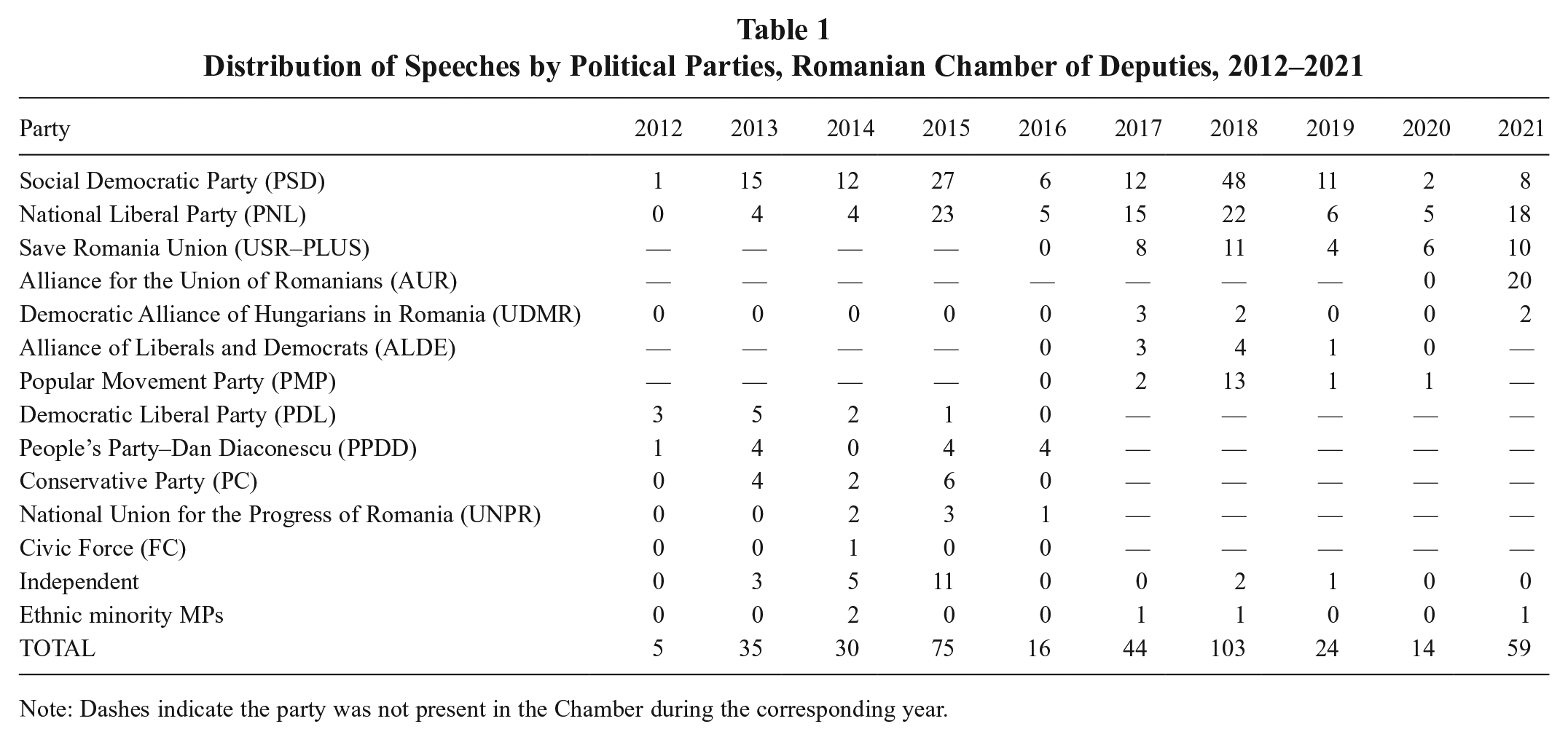
The results of the initial search varied by keyword, from one to 1,649 references grouped in one to 344 transcripts. Once the relevant transcripts were identified, we read through each of them and marked the speeches relevant to our analysis. Thus we created the corpus that we used for this research: 405 speeches grouped in 176 transcripts of debates that took place between February 14, 2012 and December 21, 2021. The distribution of the 405 speeches by year and by political party is presented in Table 1.
Distribution of Speeches by Political Parties, Romanian Chamber of Deputies, 2012–2021
Note: Dashes indicate the party was not present in the Chamber during the corresponding year.
The speeches were given by MPs from twelve political parties covering the whole political spectrum, by independent MPs, and by the representatives of ethnic minorities. Until 2020, most speeches on these issues came from the Social Democratic Party (Partidul Social Democrat, PSD) or from the National Liberal Party (Partidul Național Liberal, PNL). In 2021, the AUR gave the most speeches on these topics (34 percent, twenty out of fifty-nine), followed by PNL, with 31 percent of the speeches. This should not come as a surprise, since AUR claims the family is the first of the four pillars of its political program, alongside country, faith, and freedom. 65 Several studies show that family, religion, and nation are central themes in the illiberal and populist project of the AUR. 66
Overall, 35 percent of the speeches came from the PSD, 25 percent from the PNL, 10 percent from the Save Romania Union–Party of Liberty, Unity, and Solidarity (Uniunea Salvați România–Partidul Libertate, Unitate și Solidaritate, USR-PLUS), and 5 percent from the AUR. Most speeches—a quarter of the corpus—were made in 2018, the year of the referendum, followed by 2015, the year the citizen initiative was put into motion, accounting for 19 percent of the speeches, and then in 2021, with 15 percent of the speeches. Considering the number of years these parties were in the Parliament during the time period we analyze, these figures translate into twenty speeches per year for the AUR, sixteen speeches per year for the PSD, eleven speeches per year for the PNL, and eight speeches per year for the USR (see Table 1 for a more detailed temporal distribution).
The distribution by gender shows that 37 percent of the speeches were given by female MPs. Since the proportion of female MPs in the Chamber of Deputies has varied from 11 percent in 2012 to 21 percent in the 2016–2020 legislature, 67 this distribution suggests that women were more interested than men in discussing these issues in the Parliament. The speeches cover the whole territory of Romania, given by MPs from all counties in the country. Ilfov accounts for 13 percent of the speeches, followed by Bucharest (10 percent), Iași (7 percent), and Bihor (6 percent). It should be noted that Bucharest and Iași are the sites of the most important annual pilgrimages of Christian Orthodox believers: St. Parascheva in Iași and St. Dimitrie in Bucharest. The presence of Ilfov and Bihor at the top can be partially explained by the fact that the MPs with the highest number of speeches in the corpus represent these counties: A.D. Gheorghe, representing Ilfov, gave forty-eight speeches, while F. Cherecheș, representing Bihor, gave thirteen speeches. The 405 speeches were given by 184 MPs, for an average of 2.2 speeches per MP. One MP (A.D. Gheorghe, from the PNL) is an outlier, with forty-eight speeches in the corpus. Excluding his speeches, the average drops to 2.0 speeches per MP, with only three MPs giving ten speeches or more and only thirteen MPs giving five speeches or more. The remaining 170 MPs gave between one and four speeches.
The “Traditional Orthodox and Natural Family”: The Only Way to Conserve the Glorious National Identity
The reading of the 405 discourses in the corpus led us to a series of preliminary considerations, which we present before the thematic analysis. Whenever the discussion touched upon the meanings of family and family lives, the overwhelming majority of the Romanian MPs preached (we chose this word partly because the speeches often sounded like sermons one hears in a church rather than in a parliament) for maintaining and/or returning to the “traditional family,” understood as a “Christian family” and as the source and keeper of the Romanian national identity.
The triad of traditional family, Christian values, and national identity became a sort of political litany, overlapping with partisan affiliation, age, and sex. The referendum (starting from the moment the citizen-led petition initiated the process, but especially around the moment it was held in 2018) appears as an important catalyst both for existing discourses and narratives and for the introduction of new themes, inspired by international anti-gender networks (“gender ideology,” “genderism,” and “children’s innocence”).
The corpus also includes discourses that sustain gender equality (usually understood as equality between women and men and only marginally as gender equality+) and alternative forms of family and family lives: unmarried couples, divorced families, nonparental families, families without children, mono-parental families, and same-sex couples. There are also speeches recognizing individual choice regarding the decision to have children (emphasizing the importance of sexual education, contraception, and the right to abortion) and the need for public infrastructure for childcare. Together, these discourses account for about 25% of the speeches in our corpus. By comparison, the discourses referring to the triad mentioned above comprise almost 60% of the corpus. The remaining discourses (15%) include other topics or have a neutral stance on these issues. It should be noted that all discourses celebrating traditional family virtues reject these alternative familial forms and focus on the familial (parental and mostly maternal) role in childcare and child education.
One can also observe significant differences in terms of argumentation and rhetoric. Pro-gender equality speeches are logically constructed, are based on statistics and research, and use a professional vocabulary. By comparison, pro-traditional family speeches are elaborated in a populist logic, using affective and emotional arguments 68 and often employing religious references and vocabulary.
The Traditional Family—Source of the Continuity of the Romanian People
Most speeches defending the traditional family emphasize its crucial role for the continuity of the Romanian people and the defense of our national identity, with the “dissolution of the family” being presented as “the dissolution of the nation.”
69
References to ancestral traditions and origins and to the simultaneous founding of the Romanian people and the traditional family are commonly used, constructing a mythical, ahistorical (universal and eternal), unique, and exclusive narrative:
We have inherited from our ancestors the respect for family, the most important cell of a society, the place where destinies are being formed and ideals are being created, the fountain of continuity for this people.
70
In other discourses, the historical reference for the golden age of the family is the nineteenth century and the generation that built the Romanian nation (Kogălniceanu, Cuza, Brătianu).
A dichotomy is built between the traditional family as symbol of a long national history and as moral guarantee for the survival of the Romanian people, on one hand, and contemporary modern relativism, inspired by foreign “ideologies” such as “political correctness,” on the other:
This referendum is an indicator for the direction of Romanian society: towards political correctness and the destruction of its Christian values and national identity, or towards maintaining the same societal developmental model that we’ve known for millennia, one that respects freedom, human dignity, and normality—because we are talking about normality here, we are talking about things linked to the natural law. No one, regardless of any ideology or precepts, no one is fit to reinterpret the natural order.
71
The “pessimistic and anti-modernist narrative”
72
offers a strong argument for rejecting alternative models of family or family lives:
I could say, after an extensive analysis of demographical data, that Romania has borrowed many of the Occident’s diseases, making substantial changes to traditional values, especially with respect to the family. Today the family does not represent anymore that “cell” of society in which children were born and then grew up. We are talking more and more about consensual couples, about mono-parental families, and less and less about two-parent families.
73
Demographic concerns (declining natality is considered a threat to the perpetuity of the nation) are also instrumentalized, in order to preach the urgent need of returning to the traditional family, the only form that promises our collective salvation:
The chance to replenish, to reinvigorate the Romanian people sits with the family that is reproducing and that is educating its offspring in the spirit of traditional values and needs. This is part of my destiny as a Romanian, and I think it is also part of our survivability as a people.
74
The defense of traditional values and national identity also leads to a direct critique of the European Union’s involvement in Romanian politics on the issue of Muslim migrants, who are considered a threat to our national security and to our cultural identity:
Romania does not need economic immigrants, Romania does not need multi-culturalism, and Romania does not need a mass influx of people from Asia and Africa. We will not be able to deal with it from the perspective of citizens’ security, of national security. We will not be able to deal with it from a cultural perspective.
75
The Christian Family Is Founded on Marriage between a Man and a Woman
The traditional family is the Christian family, presented as the “natural,” “normal” family, as the pillar for the survival of the nation. From this perspective, the only acceptable definition for the family is a union between a man and a woman. 76 The laicity of the State—if acknowledged, something that not all MPs are willing to do—cannot ignore the Christian values of its citizens, values that create the foundation of the Romanian nation. Consequently, the Church is the only institution with the moral authority to define the family. 77
Biological arguments are also used, even if the scientific argumentation is not developed and the discourses focus on “human nature” and “normality.” The religious vocabulary, including quotes from the Bible and other religious books and authorities, is dominant, and it echoes multiple other speeches defending the BOR and the inclusion of religion in the school curriculum. The hegemonic definition of the traditional family as a Christian one is reinforced through all the signifiers that construct the Christian religion as a central element of Romanian political identity:
I perceive a constant pressure to denounce certain values that define and identify us as a people in the world. One of these [values] is the traditional family, based on love between a man and a woman, blessed by God and by the Church.
78
Once again, an opposition is established between the Christian characteristics of the traditional family and modern constructionism and relativism.
79
Western intellectual and cultural history is denounced, and the topic of linkages with Marxist ideology remains central in Romanian public discourse:
80
The family is, first and foremost, a theological, biological, and social institution of the Christian world. The Christian family is formed by a man and a woman, and it is centered on a set of common values upon which children are educated and raised in order to create a healthy society, a society that is able to truly develop and reproduce. Unfortunately, during the 20th century, after the Second World War, together with the expansion of the deconstructivist ideas of the Marxist Frankfurt School, they have started to impose, step by step, ideas that have more to do with value relativism and tearing down what we know as the Christian family. The attack on the normal family, formed by a man and a woman, is one of the priorities of gender ideology, an ideology that attempts to reconstruct, in a post-modern way, the class conflict that we all know from the Marxist ideology of the 19th century.
81
The attempt to relativize the universal authoritarian narrative of the family is strongly attacked in the name of Christian values and national origins and future, two hegemonic identity elements in Romanian society.
The Family Has to Be Heterosexual: Its Biological Function Is Reproduction
The reproductive function of the family, responsible for the survival of humanity and the nation, legitimizes the heterosexual definition of the family:
The natural function of the family is to promote as a fundamental goal procreation and the perpetuation of humankind.
82
Through marriage, the state has the obligation to offer and guarantee the highest level of protection since marriage, through reproduction, is the only type of relationship that contributes to the historic continuity of the nation and to the progress of human society. This is why marriage is an institution reserved to heterosexual couples.
83
Homophobia is dressed as national interest, the argument being that the heterosexual family is protecting the interests of future generations.
84
Narratives borrowed from international anti-gender campaigns are used to demonize European influence and the colonial project of the progressists: gender ideology, the destruction of traditional familial (parental) roles, genderism, the construction of a “new man”:
85
I think it is better to keep the birth certificate with only two options: male and female. We do not need a third one.
86
We do not want to live in a country in which men and women will be replaced by a “new man,” by a “neutral gender,” and which practices a “pretend marriage,” regardless of sex. Keep unaltered the national and spiritual identity of the country where you declared you want to live, so that we’ll have something to leave to our children and grandchildren.
87
With respect to gender theory, which pretends there are no differences between men and women, that traditional social roles are artificial constructs, stereotypes—this leads to the negation of the fundamental values of European civilization and morality, of the values and institutions of our civilization.
88
Defending the gender/sex biological binarism is mandatory for the protection of “our” civilization and for rescuing the nation. The proposal to legally recognize civil partnerships has triggered virulent condemnation of those countries that have legalized same-sex marriages, through discourses focused on the dangers of allowing homosexuals access to adoption and filiation and the building of an apocalyptical image of a future without a hegemonic, traditional definition of the family:
Watch the terrible example of countries such as France, Spain, or England, where the attack got to the point where governments not only have legislated marriage for all, including having children by adoption or artificial insemination for same-sex couples, but they have even replaced the words “mother” and “father” from the official registries with the supposedly neutral terms “parent A” or “parent B.”
89
“Take Your Hands off Romania’s Children!”
The defense of the traditional family is the only guarantee for a normal, healthy, and moral education for future generations, which ensure the continuity of the Romanian people:
90
For us, Romanians, family is not a lifestyle; it is fundamentally linked to parents’ roles. [. . .] Will we build a shield around our children and guarantee their future in a strong society, or will we abdicate from our principles and from our faith? I encourage you to meditate upon these questions and do what is good for Romanian families, for the current ones and for the future ones. I will do this, for the sake of my children and grandchildren.
91
Children are ultimately the biological reason for the traditional family. The importance of the birth rate for the continuity of the nation and the pivotal role of children’s education for the transmission of Romanian cultural and spiritual values, traditions, and unity are crucial elements of national identity, used to justify the necessity and the urgency of defending the traditional family. Thus, the rejection of alternative family models is justified by “the children’s interest”:
The legislative proposal regarding civil partnership forces the creation of legislation that is parallel to the institution of marriage, to the detriment of “children’s major interest,” which can be fully reached only within a family formed by marriage.
92
During the first part of the period we are analyzing, arguments were more or less related to traditional themes of national construction: religion, tradition, the “normal” family, and demographic concerns. The 2018 referendum clearly favored a connection with the international arsenal of arguments and strategies. Anti-gender themes were increasingly present: gender ideology, genderism, the cultural war, and children’s control. The vulnerability of children, exposed to aggressive pro-gender and pro-LGBT propaganda spread by Western political and cultural groups, became a focal point for many MPs. Once again, the anti-colonial theme was employed, serving to incriminate imported values. Some speeches associated these influences with the Communist, totalitarian, project for re-education, a very powerful reference in the post-Communist context:
Beyond all aspects of the LGBT phenomenon, its aggressive promotion represents a grave social and moral danger, one against which the young generation, the children, are very vulnerable. The fact that we accept that some people are born with such unnatural habits does not justify the aggressivity of dirty propaganda that attempts, through proselytism, to bank upon our children’s weakness. This is just one example of the dangers of importing Western values.”
93
The real problem is the increasingly aggressive return of totalitarian ideologies which, in fact, want nothing else but to control the child, to control the man, to break him out of his family and community and subject him to state re-education, indoctrination and ideologization. As such, all these cannot be in agreement with freedom of conscience, individual freedom, and human dignity, which were given to us by God.
94
These arguments aimed to create a “moral panic”
95
and obtain emotional collective support for the only way children could be protected: by (re)enforcing the traditional family and the (exclusive) parental role in the moral education of children. Especially after 2018, in the context of discussions related to the national school curriculum, the debate surrounding sexual education became a focal point for anti-gender mobilization:
Children are a gift from God, not a right received from some irresponsible, corrupt, and criminal authorities that, instead of supporting the traditional family and children, end up promoting, at the national and European levels, homosexuality, gender change, sexual education in schools from early ages, pedophilia, and committing extremely grave abuses, by kidnapping children from within Romanian families living beyond the national borders.
96
We point out that gender ideology is the foundation of sexual education, in the way that it is presented by the World Health Organization. This suggests that sexual education should start before the child is 4 years old because, the “experts” argue, the child is a sexual being. Gender ideology also legitimizes medical abuses with irreversible consequences on thousands of children. Transgenderism has become a fad because children are expertly manipulated to become unsure with respect to their own gender. During 2018, in a specialized clinic in England—the Gender Identity Development Service—2159 children were subjected to gender change surgery and hormonal treatments. The youngest was 3 years old.
97
The threat to the biological identity of children was exacerbated through scary scenarios: medical abuses in gender/sex change, homosexuality, pedophilia, and kidnapping of children. In 2021, the forced vaccination issue was added to this apocalyptic picture:
The children of Romanians have to be vaccinated by force, taken out of their parents’ care and authority and indoctrinated with LGBT ideology through so-called sexual education courses, whose content cannot be voted upon by the parents.
98
It is perhaps not a coincidence that the increased importance of this type of discourse overlapped with the AUR becoming a parliamentary party: Dragolea shows that the danger posed by “gender ideology” and “LGBTQ propaganda” in the area of education is a key element of AUR’s illiberal discourse. 99
Conclusions
In this article, we have examined a decade of parliamentary debates related to the topic of the family, aiming to understand the reasons and the rhetorical strategies that underpinned the significant support by Romanian MPs for the traditional family. Starting from the literature on family models, lived family lives, and gender equality+ policies, we showed that alternative forms of family have developed and exist, alongside the traditional model, in current-day Romanian society. In post-Communist Romania, however, the mix of anti-feminism and conservative neo-familialism, combined with the central role religion plays in social values and the political space, favored a conservative and patriarchal gender contract, with traditional gender roles and with salient homophobic, chauvinistic, and Christian-nationalist social attitudes.
The hegemonic narrative of the traditional family is strengthened by the populist logic that aims to restore true Romanian values—Christian, ancestral, and national—in opposition to contemporary Western relativism and the colonial cultural project of gender equality+ politics. Emotional arguments and a dichotomous frame are employed as central discursive strategies in the attempt to convince people of the necessity to return to a traditional, exclusive definition of the family. The decadent present, filled with numerous threats to national identity, to the continuity of the people, to Christian values, to the natural gender order or the safety of children, can be saved only by the return to the traditional family. 100
What does “traditional family” mean? As constructed through the four groups of themes analyzed in this paper, the traditional family is the Christian Romanian family founded and defended by the ancestors. It is the union between a man and a woman with the purpose of reproduction, the only place that can guarantee that children will grow up in a healthy and moral environment. Reference to a mythical golden age of the Romanian people, combined with reference to the glorious founders of the Romanian nation in the nineteenth century, inspires both a nostalgic sentiment for a lost paradise and the hope of restoring it through the reimposition of the traditional family as a master narrative. Alternative lived family lives and Western norms and practices are therefore rejected and condemned as being responsible for the current crisis of Romanian society. One should also observe that the Communist period is mostly rejected and associated with the new forms of cultural imperialism, and that in the Romanian case the narrative of return refers to the epoch of national construction, mythicized with ancestral colors.
Originating in older social values and in the political narrative of Romanian post-Communist society, the idealized traditional family narrative is enhanced by the anti-gender campaign repertoire. 101 The dichotomous scheme, specific to populist logic, draws a black and white picture of opposing values and categories: normal versus degenerate family lives; nativist and patriotic politics versus Western and colonial cultural politics; perpetuity of the Romanian people versus the extinction of Romanism; natural, sacred Christian values and tradition versus relativism and an abusive neo-Marxist cultural project. This chain of signifiers constructs a totalizing schema, imposing the traditional family as a mandatory narrative that should be restored. Therefore, the traditional family functions as a hegemonic signifier re-imposing, in the logic of the narrative of return, a nationalist conservative and religious definition of the family, based on biological and natural foundations and necessarily heteronormative and chauvinist. Under the flag of the national interest, the family appears as an instrument for governing the population in a quite Foucauldian biopolitical logic: natalist politics, conservative neo-familialism, and moral (Christian) children’s education are mandatory political options to save the future of the nation. Competing micronarratives of the family are banned, and there is room only for a master narrative: the return to the traditional family.
As a political project, the traditional family narrative legitimizes the return of patriarchal, nativist, heteronormative values as a reaction to gender equality+ politics: homophobia, chauvinism, and sexism can be seen as a counter-reaction to a cultural imperialism that aims to dismantle the Romanian people. From an ontological perspective, reimposing a master narrative on the family and rejecting alternative family models and lived family lives aims to restore a holistic totalitarian world view, in opposition to the relativism and multiculturalism of postmodern democratic societies. Thus, the traditional family can be used as a strategic argument favoring illiberal and anti-democratic politics. 102
