



Abstract
Efficient lesson planning with universal design for learning (UDL) enables teachers to more effectively meet students’ individual needs. In this study, a comparison of lesson plans by teacher candidates in a teacher preparation program before and after UDL training is presented. After training, teachers (n = 45) incorporated more differentiated options and varied teacher strategies based on UDL principles into their lesson plans, so that the content was more accessible to all students. A variety of changes and options was examined, and examples of commonly occurring choices selected by the teacher candidates were provided. The improved multiplicity of options in lesson planning demonstrates a better understanding of UDL principles; however, teachers need more experience in actually implementing the UDL principles in their classrooms.
Background/Relevance
As our education paradigm has shifted to include increased access to the general education curriculum and inclusion in the same standards-based assessments, one method that is increasingly used by both special and general education teachers is to differentiate instruction to enable all students to benefit from instruction in the general education classroom (Van Garderen, Scheuermann, Jackson, & Hampton, 2009). As our educational service delivery models change, our teacher preparation programs need to focus more on collaborative practices with an emphasis on differenti ated instruction and accessible options for students served in less-restrictive settings (Brownell, Sindelar, Kiely, & Danielson, 2010). To help meet these new challenges, the Higher Education Act requires instruction in the universal design for learning (UDL) that provides flexibility in instructional presentation, student response, and engagement (Smith, Robb, West, & Tyler, 2010). With the training focusing on differentiation, co-teaching/coplanning, and UDL, general and special education teachers can more effectively accommodate students who learn differently, engage with content from different perspectives, and speak English at varied levels of proficiency.
Many local school districts are focusing on more inclusive classroom practices and incorporating more collaborative co-teaching models. These collaborative efforts are based on the idea that each teacher has specific knowledge and expertise to address the instructional needs of the class (Van Garderen et al., 2009). In essence, credential candidates need more preparation in bringing special education services into the general education classroom to more fully provide access to the state standards and the class curriculum. Not only are the needs of students with Individualized Educational Programs (IEPs) addressed through UDL, the needs of at-risk, but yet to be identified, students are also addressed (Kloo & Zigmond, 2008). UDL is an appropriate framework for designing lesson plans for increasingly diverse general education classrooms and supports co-teaching through the use of the three principles of UDL, advocated by the Center for Applied Special Technology (CAST), which include multiple means of representation, engagement, and action and expression (D. H. Rose & Meyer, 2006; D. H. Rose, Meyer, & Hitchcock, 2005).
UDL Concepts and Definition
The principles of UDL (see Figures 1 and 2) originated from the guiding principles used by architects who design buildings, products, and environments for independent use by people with a wide range of unique physical and cognitive needs. Ron Mace conceived Universal Design to eliminate the obligation to retrofit buildings and products to meet the Americans With Disabilities Act (ADA) accessibility requirements. The Center for Universal Design at North Carolina State University and the CAST were instrumental in adapting these principles of Universal Design for the field of education to better support accessibility for all learners. CAST has developed a UDL framework (see Figure 2) to emphasize a flexible curriculum that could be presented in multiple formats so that the content would be accessible and appropriate for students with diverse backgrounds, learning styles, and abilities. The framework is based on the following three brain-based neural systems involved in learning: (a) recognition systems that identify patterns and objects, (b) strategic systems that tell us how to do things, and (c) affective systems that determine what is important and provide the motivation for learning (CAST, 2011). UDL advocates for flexible multiple media and tools targeted to these systems (The Access Center, n.d.). UDL supports effective pedagogy that may include curricular materials, technologies, and instructional strategies that provide numerous means of representation, expression, and engagement (Meyer & Rose, 2000).
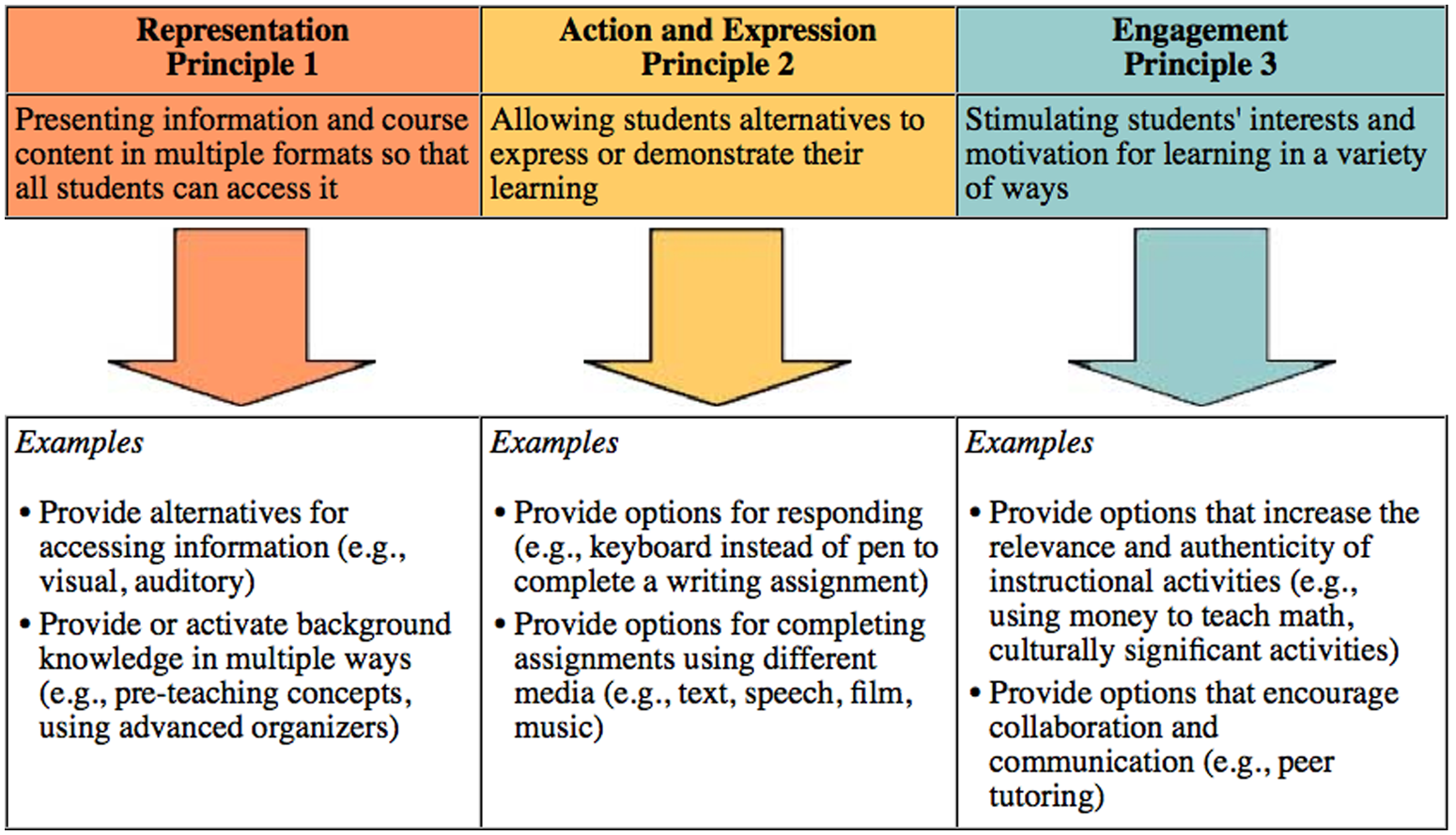
Universal design for learning (UDL) principles
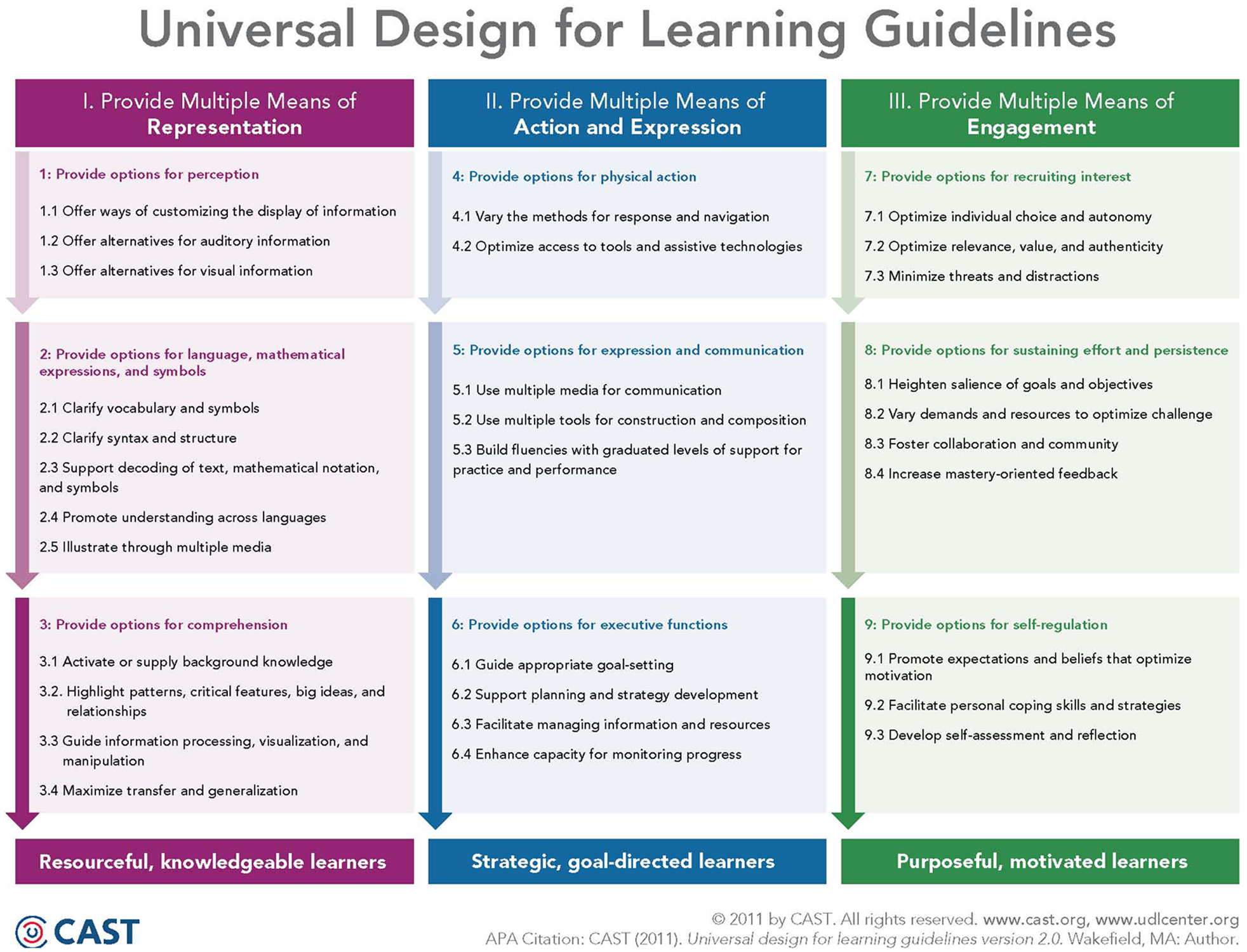
Universal design for learning (UDL) guidelines
Universal Design for Learning
In the context of the present study, UDL can be defined as a set of principles and techniques for use in the classroom along with the design of accessible instructional materials. These principles revolve around a variety of alternative ways for students to participate using different modes of representation, action and expression, and engagement. As we describe each mode, consider middle school students with varied levels of achievement and learning challenges who struggle to understand and work through ratio word problems. Although the teacher has worked through examples from the text and has demonstrated appropriate algorithms to solve the problems, some students cannot consistently solve the word problems. By considering the common difficulties that students with learning challenges encounter in mathematics, ratio in this case, before delivering more traditional whole class instruction, the teacher can utilize UDL principles to design a lesson that builds in strategies and scaffolds that benefit all students.
Representation refers to designing instructional materials that make content accessible to the greatest number of diverse learners. For example, UDL suggests that providing multiple representations of a concept not only enables deeper engagement with that concept but also enables access for a broader range of learners (McGuire, Scott, & Shaw, 2006). In planning lessons for diverse learners, aspects of UDL may be embedded through videos, audio text, and diagrams as a framework to interpret content. This enables teachers to support student access to and engagement with content across the curriculum. In the middle school ratio example mentioned earlier, the teacher might use diverse multiple representations of ratio including images, video, and animations. In addition, questions to activate students’ prior knowledge of proportional reasoning are embedded in the lesson to help students make connections with related and already-mastered concepts. The teacher could make the connections between math symbols, representations, and written text more apparent through carefully designed audio, visual, and interactive demonstrations.
Action and expression can be defined as alternative communication methods for students to communicate or demonstrate their learning. Rather than using traditional forms of assessment such as written pencil and paper tests, our middle school ratio teacher might allow students to demonstrate learning through interviews or by creating representations and novel story problems. When teachers increase the number and variety of participation options and forms of assessment for students, both teachers and students benefit (The Access Center, n.d.).
Engagement involves stimulating students’ interest and motivation to learn through creative, hands-on, and meaningful instruction. A teacher provides multiple means of engagement to recruit students’ interest and sustain their engagement with content. In our ratio example, the teacher may include peer-tutoring activities like revising cooking recipes for varied number of servings and creating a ratio table for each number of servings.
Universally designed lesson plans attempt to meet the needs of all learners at the onset of instruction rather than having to retrofit lesson plans that initially fail some learners (Casper & Leuichovius, 2005; CAST, 2009). UDL lesson planning makes it possible for students with wide differences in their abilities, such as seeing, hearing, speaking, moving, reading, writing, understanding English, paying attention, organizing, engaging, or remembering, to more fully participate in inclusive settings (Burgstahler & Cory, 2008; Casper & Leuichovius, 2005). The diversified lesson plans can serve as a framework to inform pedagogy and also to help teachers meet the challenges of serving a diverse student population by incorporating flexible instructional materials, techniques, and strategies (CAST, 2009; King-Sears, 2009; Samuels, 2007).
After gaining skills in UDL lesson planning, our special education teacher candidates should be ready to take on the roles of co-teachers rather than serving in the general classroom as assistants or underutilized classroom aides. Their specific skill set can help them provide resources and services above and beyond what the general education teacher is offering. For a co-teaching model to be successful, the special education teacher brings unique skills to each classroom, focusing on core academic skills and alternative modes of instruction, and helping students gain access to the general education content (Brownell, Adams, Sindelar, Waldron, & Vanhover, 2006; Kloo & Zigmond, 2008).
UDL can be a critically important means for reaching all students through the conveyance of the curriculum in multiple sensory modalities, flexible groupings, and adjusting the instructional pace. It can increase the efficacy of instruction. Without the knowledge and ability to increase students’ access to curricula, many general education teachers do not create a responsive environment designed to best meet the individual needs of their students. The UDL framework can serve as the vehicle to bring together special and general education teachers in delivering educational services to all learners in one general education classroom. Finally, as King-Sears (2009) aptly pointed out, UDL is not inextricably intertwined with technology and its use is reliant on effective pedagogy. For example, in the area of mathematics, a teacher can use UDL to mediate a poorly written math text to convey important concepts. Her instruction may incorporate technology, such as virtual manipulatives and interactive diagrams, or she might use real manipulatives or printed diagrams. Ultimately, the teacher designs effective instruction for a broad range of learners by combining sound pedagogy with UDL. Sound pedagogy is the key when teachers utilize a UDL framework for lesson planning because learning objectives must always drive the design of instruction. A teacher must know what he/she expects students to learn before planning for instructional materials, methods, and assessments (D. Rose, Meyer, & Edyburn, 2008). Research question: After participating in a 3-hour instructional module on UDL, will candidates increase the use of UDL principles in designing lesson plans that incorporate statewide content standards and make instruction more accessible to the diversity of students in the general education classroom?
Previous Research
We designed our study based on the research conducted by Spooner, Baker, Harris, Ahlgrim-Delzell, and Browder (2007). Spooner et al. examined the effects of UDL training on the lesson plan designs of special and general education teachers in undergraduate and graduate teacher preparation classroom settings. In two classes in the special education program and two classes in the general education program, participants were randomly assigned to experimental or control conditions. Participants in the experimental condition of each class were given the UDL training intervention during the first hour of class with control participants arriving to class 1 hour later. University instructors administered a 1-hour lecture on the principles of UDL and discussed various ways to include those principles in lesson planning. The intervention culminated with each participant assisting in the creation of a group lesson plan to meet the needs of one contrived case study student with special needs in a general education classroom or a student with more severe disabilities in a special education classroom. In all four classes, experimental participants used significantly more UDL principle variations in their lesson planning after they received the 1-hour intervention and outperformed their peers in the control condition in their posttest gains. They determined that before UDL can have a profound impact on teaching and learning, teachers must learn to use it in planning instruction for all types of students including students with disabilities.
Our case study differs from that of Spooner et al. (2007) in four ways. First, because we are preparing our special education teachers to work collaboratively with their general education colleagues, we had different objectives and outcomes for the credential candidates. Unlike Spooner et al., we wanted our candidates to design lesson plans for intact general education classes that included students with mild to moderate disabilities. Second, we recruited only teachers who are preparing to work with students with mild to moderate disabilities in an integrated general education setting. So rather than training our teachers to utilize UDL principles in their own special education classrooms or resource rooms, our focus is on bringing the principles into the general education classroom to benefit all students, not just those with disabilities. Third, instead of writing a lesson plan to address an individual student, our candidates write lesson plans that address the needs of all learners, including students with IEPs in a general education setting. Fourth, since these teachers need to be able to train general educators and advocate for the use of UDL principles, we trained the teachers with a more intensive, interactive module that they could access when preparing for their own future trainings. In this study, we examine how candidates utilize UDL principles to incorporate statewide content standards and make instruction more accessible to the diversity of students in the general education classroom.
Method
Participants
The participants were 45 graduate students in the Mild to Moderate Graduate Level I Credential Program at an urban university in northern California. This convenience sample was working toward special education certification and was enrolled in one of the two sections of an introductory special education teacher preparation class taught by two of the authors (Gall, Gall, & Borg, 2007). Participants ranged in age from 23 to 53 with a mean age of 32.9 and were 72% female. The ethnicities of these participants were as follows: 5% African American, 20% Asian American, 63% Caucasian, 9% Hispanic, and 2% other. The participants’ highest levels of education were as follows: 39% completed a bachelor’s degree, 27% had some graduate work, 32% completed a master’s degree or professional degree, and 2% had some advanced graduate work or a PhD. Teaching experience averaged 1.3 years, but most participants had no teaching experience. The participants were all comfortable using computers, with 25% somewhat comfortable and 75% very comfortable. All but one participant used the Internet once or more per day.
Setting
All participants gave their informed consent and agreed to allow the researchers to use their data (three lesson plans) and demographic survey for inclusion in this research project. Because the data collected were part of the normal requirements of this class, refusal to participate indicated disallowing individual lesson plans to be included in the aggregate data analysis. All candidates enrolled in both sections agreed to participate for 100% participation. The participants came from two sections of a course titled Introduction to Mild/Moderate Disability, each taught by one of the authors. This class was chosen because one of the objectives was to teach credential candidates how to differentiate instruction to meet a wide range of learners. We included UDL and collaboration in the content because many of the candidates enrolled will be, or are currently, teachers of record in a classroom and they needed this content to enhance their practice and assure achievement for all students.
Procedure
Participants in both sections were required to write a lesson plan at the beginning of the semester before the UDL training, directly after the training, and at the end of the semester. For the first two lesson plans, participants were given case study scenarios that described a general education classroom setting that included students with learning disabilities. Each of the lesson plan scenarios included IEP goals for the students with learning disabilities in the class and a content standard that must be addressed in the lesson plan template (see Appendix A). For the final lesson plan, participants were asked to create their own scenario in a general education setting. Credential candidates had received instruction on how to use our lesson plan template (see Appendix B), but there was no instruction in UDL at this point. The first lesson plan served as a pretest to determine what the credential candidates knew about differentiating instruction and incorporating principles of UDL without formal UDL instruction. The lesson plan template that the participants used prompted them to use multiple options for access in each of the three areas discussed earlier: representation, action and expression, and engagement. After the first lesson plans were turned in, we scheduled the 3-hour UDL training for each section. One of the researchers delivered the 3-hour training to each section at the scheduled time.
The UDL training was composed of a web-based training module, Universal Design for Learning: Creating a Learning Environment That Challenges and Engages All Students (The IRIS Center for Training Enhancements, 2009), and guided notes created by the researchers (see Appendix C). The IRIS training module not only presented the principles of UDL but also modeled the UDL principles in the delivery with embedded videos, closed captioning, and audio. Examples of how to overcome typical barriers in the traditional general education classroom content areas were also included in the training. As the researcher presented the content, she also modeled UDL by utilizing guided notes to accompany the IRIS module. Upon completion of the module, candidates were given the same lesson plan template to complete a second lesson plan based on a hypothetical middle school mathematics classroom scenario (see Appendix A). In addition to the lesson plan template, participants were also given a list of resources for utilizing UDL modifications (see Appendix D). For the third lesson plan, we allowed our candidates to design their own case study scenario with hypothetical special education students and authentic California content standards to address. In this way, they were able to use their own experiences from real classrooms to make the lesson plan more authentic.
Instrumentation
Candidates enrolled in this course typically write at least two lesson plans over the course of a semester. For this study, we required three lesson plans, one before training, one directly after training, and the third one due at the end of the semester. In this way, we examined acquisition of UDL principles and maintenance of those principles at the end of the semester. The lesson plan template created for this class was designed to help credential candidates think through all of the important steps in designing a lesson plan for students with a variety of special needs (see Appendix B). In addition to the three aspects of UDL, the template requires candidates to state a learning objective, connect the objective to a state content standard, and describe at least one student with a disability. The teacher candidates were also prompted to address the specific classroom needs of any individuals with a disability as determined by the IEPs. For the first two lesson plan assignments, we provided a state content standard and IEP goals for special education students included in the class. The template also prompted students to explain their approach to each of the following areas: Introduction (attending cue and anticipatory set), Body (procedures, input, modeling, guided practice, and independent practice), Closure, and Evaluation (rubric criteria for approaching, meeting, and exceeding expectations). The lesson plans were scored using the rubric designed by Spooner et al. (2007). The rubric consisted of a 3-point scale and evaluated the participants’ use of UDL principles in the design of the lesson plan. Points were distributed as follows: 0 for no clear description of instructional modifications, 1 point if one or two modifications were discussed, and 2 points if three or more modifications were discussed (see Table 1). The components of representation, action and expression, and engagement were scored separately and then summed up to yield a final score between 0 and 6. After scoring was complete, we examined the lesson plans to extract rich details that demonstrate how credential candidates utilize materials, instructional methods, and assessments within the UDL framework to address the learning objective.
Performance Data
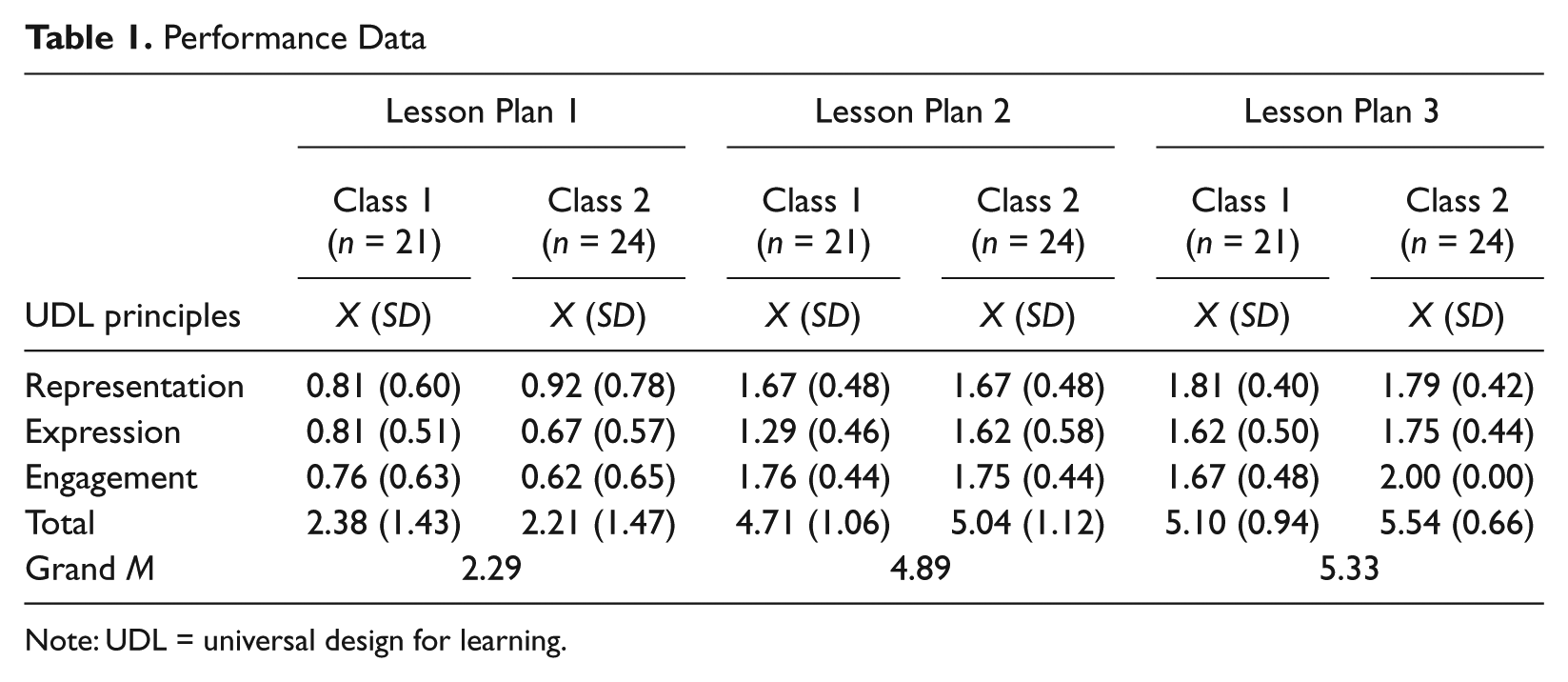
Note: UDL = universal design for learning.
Design and Data Analysis
While we had two sections of the same course, both sections received the UDL training before the second lesson plan was completed. A two-factor analysis of variance (ANOVA) with repeated measures comparing lesson plan mean score differences between the two sections of the class and mean score differences within groups over three points in time was completed for the dependent variable (scores for each component of UDL in lesson plans). T-tests were completed to further tease out differences between scores of Lesson Plans One and Two, and Lesson Plans Two and Three. Effect sizes were calculated using Cohen’s d for differences between Lesson Plans One and Two, and Lesson Plans Two and Three. The first two authors scored the lesson plans together; 20% of the lesson plans were scored a second time by a doctoral student to check for interrater reliability. We compared the number of agreements and divided them by the number of total possible points. Interrater agreement was 94% across all three sets of lesson plans. Finally, after scoring the lesson plans, researchers examined them to elucidate how participants applied the three principles of UDL (representation, action and expression, and engagement) to address learning goals and plan for instructional materials, instructional methods, and assessment. We looked for areas of strengths and weaknesses in applying UDL principals to address learning objectives to inform future training sessions.
Results
In this study, the question of whether credential candidates in a special education teacher-training program could increase their understanding of UDL and apply these principles to their lesson plan writing is addressed. Specifically, credential candidates were trained with a 3-hour UDL training module to see whether they could incorporate flexible materials, techniques, and strategies for delivering instruction, and could plan activities for students to demonstrate their knowledge in a variety of ways. Table 2 provides means and standard deviations by a group for pretest, posttest, and maintenance conditions (Lesson Plans One, Two, and Three). A two-factor ANOVA with repeated measures comparing class sections with scores across time revealed no significant differences between the two class sections’ performance on the three lesson plans, F(1, 43) = .75, p = .392. There was a significant difference, however, in scores of lesson plans across time, F(1, 43) = 205.73, p < .001. The interaction between class section and lesson plan score changes across time was not significant, F(1, 43) = 2.16, p = .15. Paired sample t-tests revealed significant differences on lesson plan scores between the first (M = 2.29, SD = 1.44) and second (M = 4.89, SD = 1.09), t(44) = 10.44, p < .001, ES = 2.06, and between the second (M = 4.89, SD = 1.09) and third lesson plans (M = 5.33, SD = 0.83), t(44) = 2.35, p < .05, ES = .46.
Scoring Rubric on the Three Components of Universal Design for Learning
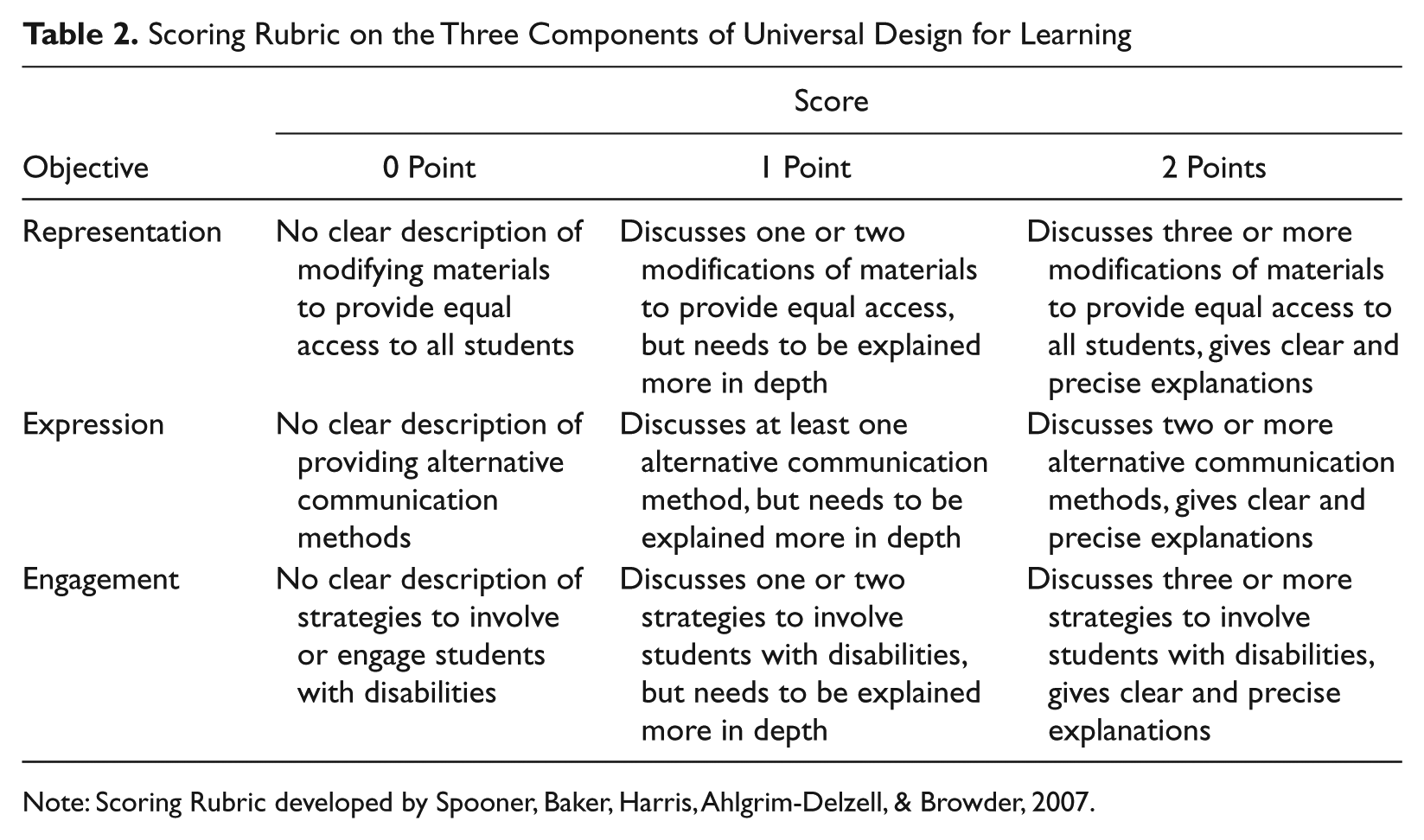
Note: Scoring Rubric developed by Spooner, Baker, Harris, Ahlgrim-Delzell, & Browder, 2007.
Post-UDL Training Analyses
Results indicate that there were no significant differences between mean scores of the two sections at any of the three points in time. We did not expect to find differences because the same researcher provided training to both sections of the class using identical materials. Improvement in credential candidates mean scores of the number of UDL principles used in the design of their second lesson plans demonstrates significant improvement in their ability to include UDL principles in lesson plans. The large effect size suggests that the 3-hour UDL training was effective at teaching about UDL principles and encouraging teacher candidates to incorporate them in their lesson plans.
Maintenance Condition Analyses
The results indicate that candidates’ mean scores on incorporation of UDL principles in their lesson plans significantly improved in the maintenance condition from both the pretest (first lesson plan) and the posttest conditions (second lesson plan). The medium effect size suggests that the 3-hour training administered several weeks prior to the third lesson plan continued to influence participants to utilize UDL principals in lesson planning and even showed some improvement as the students were becoming more comfortable with practicing use of the concepts.
Discussion
In this study, we examined the effectiveness of a 3-hour UDL training session to help special education credential candidates incorporate the principles of UDL in lesson plans. The 3-hour training was effective in teaching the participants about UDL principles and incorporating them into lesson planning. By incorporating principles, we mean they included at least one novel manner to deliver content, engage students, and assess student learning in ways that may overcome barriers inherent in more traditional forms of teaching (see Table 3 for examples of participants’ lesson plan modifications). Our training stressed the importance of the learning objective being at the center of materials, methods, and assessments chosen to accomplish that objective. We scored each lesson plan by how well participants described how they would implement materials, instruction, and assessments to address the learning objective. As mentioned, a high score of 2 in any of the three principle areas meant that participants discussed implementation of three or more modifications to overcome traditional barriers to effective instruction and assessment. An interesting observation was that in the “Materials” section of the lesson plan template, where participants list all the materials that they will be using in each area, many different modifications were listed. Later in the plan, however, when participants were required to explain how the materials would be used in each UDL area, some of the materials listed were not actually implemented or described.
Participants’ UDL Modifications
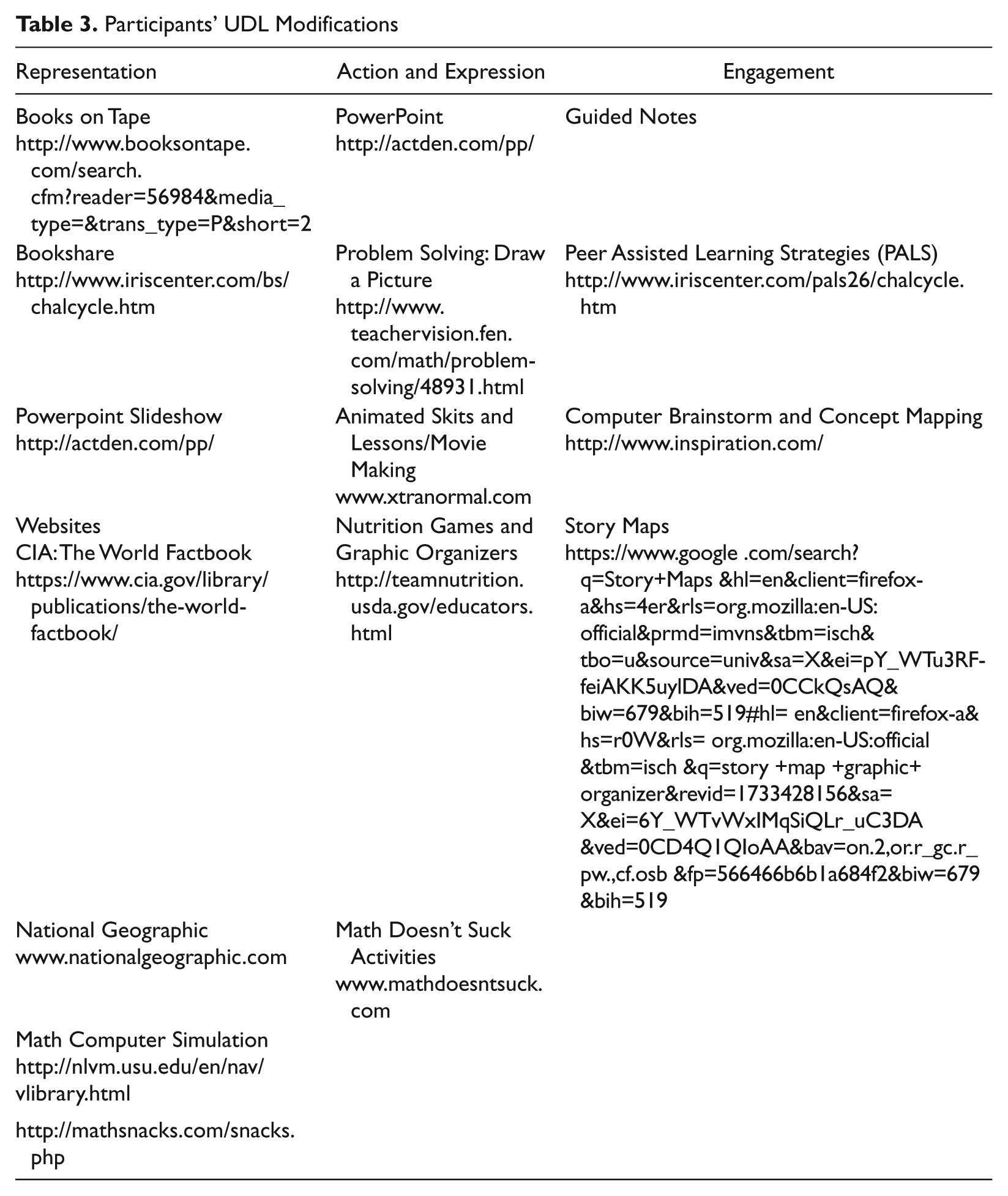
Modifications
Only modifications fully described for implementation were scored because it demonstrates that the participant has considered how they would use that modification to address the learning objective. The middle school ratio lesson plans provided many examples of a variety of materials listed but fewer actually implemented in the body of the lesson plan. For example, a participant might list power point, graphic organizers, audio equipment, three-dimensional (3-D) models, and manipulatives under representation materials but only describe using power point, graphic organizer, and 3-D models in the actual plan. In the area of engagement materials, a participant listed guided notes, games, 3-D models, peer tutoring, and various websites that could be consulted. In the actual plan, the participant only fully describes the use of 3-D models, guided notes, and peer tutoring as ways to engage students in the ratio lesson. In the area of action and expression materials, our participants were especially likely to list more modifications than they actually described as using in the plan. One participant listed manipulative materials, web-based test, web-based games, and created word problems. In the actual plan, however, the participant describes the teacher modeling the use of manipulatives and demonstrating web-based games, but the students in the class end up solving paper and pencil class-made worksheets. This was a common occurrence across all three sets of lesson plans. Participants list a variety of modifications in the materials section of each principle but fully describe fewer in the body of the plan. In addition, many of the participants had difficulty in modifying traditional forms of assessments and continued to rely on written tests and paper and pencil worksheets. Possibly because teacher-centered instruction is emphasized in more than 80% of textbooks used in schools (Van de Walle, 2007), our participants observed traditional teaching and assessment techniques during their own education, and they need more time and experience with UDL to change behaviors. The performance data (see Table 2) depict lower mean scores in the area of action and expression, suggesting that participants had more difficulty in designing modifications for this principle. As we continue to develop our UDL training, we will focus more time in the area of action and expression, especially in the design of novel forms of assessments to check for student learning.
Implementation
While our credential candidates improved in their ability to incorporate UDL principles in lesson planning (Courey, LePage, Siker, & Blackorby, 2012), we don’t know if they can actually implement these plans in real classrooms. In another study, we observed that credential candidates create lesson plans to address difficulties that students with learning challenges bring to the mathematics classroom. They struggled to implement activities that fully addressed the learning objective in a real middle school mathematics classroom. For example, the credential candidates used colorful manipulatives and candies to convey the meaning of a ratio, but they struggled to engage the students in connecting the meaning of a ratio to solving ratio word problems. In addition, little thought was given to novel forms of assessment and most candidates used dry erase boards and pencil and paper worksheets. There seems to be converging evidence that credential candidates need more practice in designing lesson plans with the UDL framework. More important, they need more supervised practical experiences while implementing these lesson plans in real classrooms.
Our teacher education programs need to be more attentive to the changes in reform policy and to address the changing landscape of our classrooms. As more instruction occurs in a general education classroom, more of our services will occur in an embedded manner. We need to educate future teachers, and special and general education teachers to function effectively in more inclusive environments. UDL is an appropriate framework for designing lesson plans for a diverse general education classroom and supporting co-teaching because UDL considers the needs of diverse learners by providing multiple means of representation, action and engagement, and expression (D. H. Rose et al., 2005; D. H. Rose & Meyer, 2006).
Limitations
The results of this study suggest that credential candidates can improve in their abilities to incorporate UDL principles in creating lesson plans. The lesson plans created for the assignments were written with contrived settings in mind. Thus, we cannot be sure that these results would generalize to the teachers’ lesson plans for their actual students. First, the sample size was small and limited to special education teacher candidates who learn about differentiated instruction in other classes. While the introductory class sections used in this study is usually the first credential class our candidates enroll in, some candidates may have taken a different class before, where they were exposed to differentiated instruction. Because there are common strategies used when differentiating instruction and using a UDL framework, some candidates may have come to our introductory class with prior instruction for modifying instruction and materials. Second, we also taught collaborative skills in a separate class session; however, the lesson plans that candidates generated gave no indication of their ability to combine these two skill sets for the benefit of real students in inclusive settings. Finally, there was also no control group of teachers with whom to compare the teachers who received UDL training. The teacher candidates could have improved between the pretest and posttest due to a confounding factor and not based on the UDL training. In addition, the teacher candidates were exclusively from the department of special education.
Practical Implications and Conclusions
We serve a variety of students in our current classrooms. The teachers in these classrooms need to be prepared in the best methods for reaching all of these students. The results of this study have several implications for teacher preparation programs. First, credential candidates can benefit from instruction in lesson planning that promotes the use of specific UDL techniques and principles to make the general curriculum more accessible to all students. Second, the effect size findings suggest that the UDL training maintained over time from the second to third lesson plans and students’ use of principles increased as demonstrated by the increase in scores. When implemented in a general education setting, the lesson plans can be written so as to provide increased curriculum access for struggling students and their more advanced peers. In this manner, all students in the class may benefit from the variety of instructional and assessment options used by the teachers. The richness of a lesson plan with multiple options for representation, action and expression, and engagement will probably appeal to students with less proficiency in English, students with cultural differences, or gifted students who can engage with more challenging material. Learning styles and preferences are present in all learners, not just in those with special needs; the multiplicity of methods and the variety of materials offered through UDL can provide universal academic access to all.
Future research includes a follow-up study to team special education teacher candidates with candidates from either the elementary or secondary credential programs to see if they could use the specific skills and principles in a collaborative manner to create and implement lesson plans for real classrooms. In addition, beyond extending this research to include special education teachers teamed with general education teachers, we will include a control group of similar teams that will receive UDL training after data collection.
Footnotes
Appendix A
Appendix B
Appendix C
Appendix D
UDL Resources
Declaration of Conflicting Interests
The authors declared no potential conflicts of interest with respect to the research, authorship, and/or publication of this article.
Funding
The authors received no financial support for the research, authorship, and/or publication of this article.