



Abstract
Content Acquisition Podcasts (CAPs), created using Mayer’s Cognitive Theory of Multimedia Learning, are a form of instructional technology that can deliver critical course content and be used by teacher educators to conserve limited face-to-face instructional time. In this study, the authors investigate whether the sequence of instruction for CAP exposure (preview or review) paired with textbook reading affected knowledge gains on topics related to students with disabilities. They randomly assign preservice teacher candidates from two large public universities to one of three conditions: (a) CAP exposure preceding reading, (b) CAP exposure following reading, and (c) reading with graphic organizer/outline alone. A 40-item multiple-choice pre- and posttest measured participant knowledge of two topics: “Learning Disabilities” and “High-Functioning Autism.” Students in both CAP groups significantly outperformed students from the Text-Only group on both experiments, but order of CAP exposure did not result in significant differences in learning. The authors describe implications for teacher preparation programs regarding how to create and implement theoretically sound technology-based instructional materials, such as CAPs.
A key outcome for the field of teacher preparation is production of professionals who possess and use evidence-based practices (EBP) necessary for success with all students within their grade level or content specialization (Brownell, Sindelar, Kiely, & Danielson, 2010). To accomplish this goal, teacher education faculty should (a) have knowledge and keep abreast of newly developed EBPs (Brownell et al., 2009; Reschly, Holdheide, Behrstock, & Weber, 2009) and (b) develop and/or use pedagogies and instructional materials that are grounded in theory and have demonstrated empirical results during face-to-face instruction and field experiences (Leko, Brownell, Sindelar, & Murphy, 2012; Sindelar, Brownell, & Billingsley, 2010; Wilson, Floden, & Ferrini-Mundy, 2002). Thus, the field of teacher education should take stock of practices that are grounded in empirical evidence and evaluate the extent to which those practices are present in our respective teaching repertoires (Clark, 2009; Clark & Estes, 2008). This exploration is particularly relevant given the ongoing discussion in the literature related to whether teaching is a profession with the same respected standing and standards as medicine, law, and engineering (Connelly & Rosenberg, 2009; Dray & Thomas, 2010).
Reviews in the field of special education teacher education (e.g., Leko et al., 2012; Sindelar et al., 2010) and general education teacher education (e.g., Grossman, 2005; Wilson et al., 2002) conclude that the empirical literature identifying effective methods that teacher educators can use to promote learning among teacher candidates is limited. Sindelar et al. (2010) went so far as to say, “In a word, the empirical foundation on which we have built special education teacher preparation is more like Swiss cheese than concrete” (p. 8). It is no exaggeration to suggest that significant room exists for new scholarship offering documentation of EBP to support improvements in this critical field (Oyler, 2011).
Current Limitations of Special Education Teacher Education Research
Sindelar et al. (2010) reviewed the literature and provided implications for future research in special education teacher education. They noted that special education teacher shortages (e.g., Boe, Cook, & Sunderland, 2008), alternate routes to certification (e.g., Rosenberg, Boyer, Sindelar, & Misra, 2007), and teacher induction (e.g., Oyler, 2011) are three areas of import for special education teacher education that have emerging evidence bases. Sindelar and colleagues, however, noted several limitations in the research base for initial teacher preparation, including (a) a lack of evidence-based pedagogical practices embedded within teacher preparation programs (Pugach, Blanton, & Correa, 2011), (b) limited knowledge regarding experiences that result in quality preparation for teaching exceptional children (Brownell, Griffin, Leko, & Stephens, 2011), and (c) the limited number of studies that utilized research designs that met accepted standards for rigorous research (e.g., experimental and quasiexperimental designs; Odom et al., 2005). The consequences of these limitations include the continued existence of numerous preparation programs with heterogeneous structures and practices (Goe & Coggshall, 2007). In addition, it remains difficult to isolate and experimentally evaluate the effectiveness of specific practices and overall preparatory programs on preservice teacher learning (Rosenberg & Sindelar, 2005).
Multimedia Interventions in Special Education Teacher Education
To build an evidence base for pedagogical practices in teacher preparation courses and experiences, Sindelar and his colleagues (2010) called for systemic programs of research that emerge from theoretical and conceptual frameworks and utilize high-quality research designs. Given the aforementioned critique of the field of teacher preparation, innovation is needed to apply thinking that addresses these systemic problems.
An influx of multimedia-supported pedagogies is currently supported in teacher preparation (Resta & Carroll, 2010). In some studies, researchers (a) simulate various scenarios that teacher candidates will face (i.e., Dieker et al., 2009; Dieker, Hynes, Hughes, & Smith, 2008; Mitchem et al., 2009), (b) provide core content and background knowledge (i.e., Gormley & Ruhl, 2007; Kennedy, Hart, & Kellems, 2011; Kennedy & Thomas, 2012), and (c) compare face-to-face learning with content presented entirely online (O’Neal, Jones, Miller, Campbell, & Pierce, 2007; Thompson, Klass, & Fulk, 2012). Although there are numerous examples of multimedia-based instructional approaches in special education teacher preparation programs, the limited number of ongoing and programmatic lines of research falls short of research agendas proposed by leaders in the field (e.g., Leko et al., 2012; Sindelar et al., 2010).
Criticisms of special education teacher preparation research include the need to boost methodological rigor. A number of research teams describe innovative uses of technology that address the call from Sindelar et al. (2010) to augment research quality. To illustrate, Fitzgerald and her colleagues (Fitzgerald et al., 2011; Mitchem et al., 2009; Miller et al., 2009) are engaged in a program of research that uses Senge’s (1990) theory of practice fields to ground their studies. The use of guiding theory is a foundational component in design, testing, and dissemination of new practices (Clark, 2009; Mayer, 2004). Experimental design is another element needed to augment generalizability of research (Shadish, Cook, & Campbell, 2002). Gormley and Ruhl (2007) randomly assigned participants to either a treatment or control condition, as did Kennedy and his colleagues in two studies (Kennedy et al., 2011; Kennedy & Thomas, 2012). Anderson and Lignugaris-Kraft (2006) used strong experimental design features by way of randomly assigning participants to conditions, and replicating positive and significant results of the experimental group with the control group following posttest. Experimental designs do not magically inoculate a study against flaws but can boost generalizability assuming that internal and external validity are adequately addressed.
In summary, to develop a sufficient literature base for EBP, the field of special education teacher education needs increased numbers of researchers to undertake programmatic lines of scholarship that utilize valid theoretical frameworks and test those theories using experimental designs (Leko et al., 2012; Sindelar et al., 2010). This statement does and should not preclude researchers from using qualitative and quasi-experimental methods, as these designs yield substantial scholarship and are the best methods to answer many research questions. Given the current climate of accountability and priority on measurable results, experimental designs should be used when possible and appropriate. The program of research extended by this research study utilizes an empirically valid theoretical framework (Mayer, 2009) and an experimental design.
Addressing specific problems of practice
To address the challenges of conducting high-quality teacher education research, researchers should first determine authentic and specific problems of practice for study (Clark, 2009). One such problem that is common across teacher education programs and settings is limited face-to-face instructional time (Riccomini & Stecker, 2005; Thomas et al., 2012). To meet licensure requirements, general education teacher candidates typically take a single course about students with exceptionalities (Turner, 2003). Furthermore, the content of this stand-alone course tends to focus on characteristics of students with exceptionalities, covering 14 categories of disability in one semester (Winn & Blanton, 2005). Although some universities require more than one course, these novice educators largely are underprepared to teach students with exceptionalities (Brownell et al., 2011; Oyler, 2011).
A thorough understanding of content (e.g., a working knowledge of the characteristics of disability) is a prerequisite for developing expertise (e.g., teaching skills and the ability to identify and implement recommended EBPs) for teaching students with exceptionalities (Brownell et al., 2009; Sternberg, 1999). Thus, a mismatch exists between the learning needs of teacher candidates and available time to deliver core content. To illustrate, a typical 15-week semester leaves little time to cover content on disability characteristics, special education history, and law, and develop a repertoire of evidence-based approaches to support the learning and development of students with exceptionalities.
Different instructors address this problem of practice by using multimedia-based instructional vignettes. For example, many instructors use the IRIS center modules (http://iris.peabody.vanderbilt.edu/) as a tool to introduce preservice teacher candidates to important content in an interactive multimedia environment. The IRIS modules provide rich content in numerous domains and reflect the principles of universal design for learning (Rose & Meyer, 2002). In this study, to augment class time and maintain instructional quality, Kennedy and his colleagues (2011) used asynchronous enhanced podcasts to deliver content about the characteristics of students with disabilities. Before discussing emerging research that supports the use of enhanced podcasts in special education teacher education research, an important question to answer is, “What are enhanced podcasts?” In their research, Kennedy (2011; Kennedy, Newton, Haines, Walther-Thomas, & Kellems, 2012) now refer to enhanced podcasts as Content Acquisition Podcasts, or CAPs, for short.
Theory and Empirical Support for CAPs
What Are CAPs?
CAPs are examples of enhanced podcasts in that they contain still pictures, on-screen text, and audio synced and uploaded to the web for broadcast. CAPs differ from generic podcasts because they are carefully developed to align with Mayer’s (2008, 2009) Cognitive Theory of Multimedia Learning (CTML) and principles of instructional design (see Figure 1) to optimize memory and retention of novel information (Kennedy, 2011; Kennedy & Thomas, 2012). CAPs focus on the big ideas of a single major topic and, although they vary in duration, generally range between 5 and 10 minutes (see https://vimeo.com/37764041 for an example). CAPs can and should be broken into clearly delineated subsections when there is a lot of material to be covered (see https://vimeo.com/40105175 for an example). Traditional podcasts used in higher education are frequently much longer (e.g., 60 minutes or more) and can be free flowing with respect to covered content (Heilson, 2010; Hew, 2009). There are many methods for producing audio-only, enhanced, or CAPs. To see the production steps used by Kennedy and his colleagues, a CAP on making CAPs is available at http://vimeo.com/24179998 (Part 1) and http://vimeo.com/24182724 (Part 2). Written steps used to produce CAPs are available at http://people.virginia.edu/~mjk3p/docs/CAP_Production_Steps_MK.pdf.
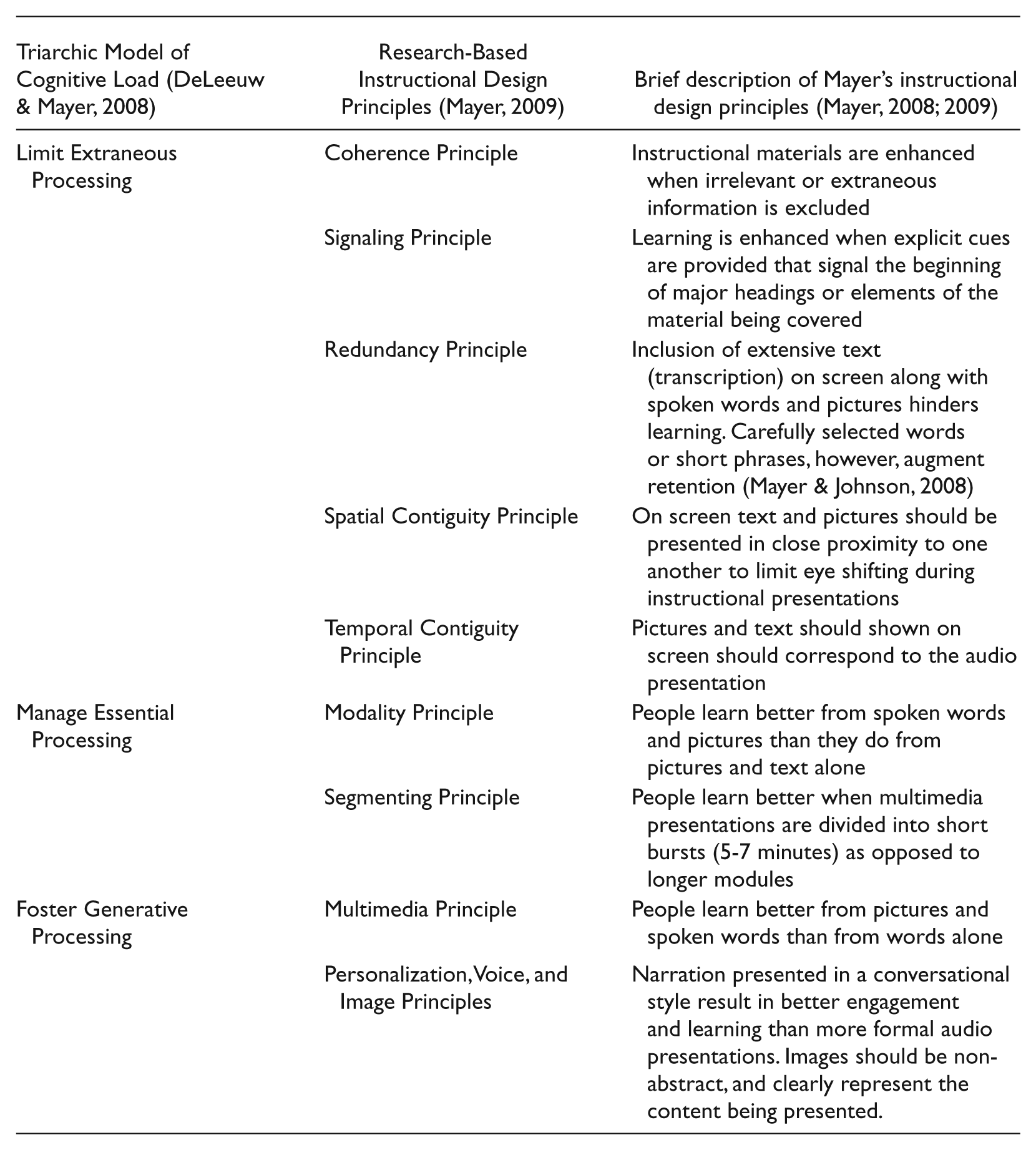
Mayer’s design principles as aligned with the triarchic model of cognitive load
How can CAPs be used in higher education?
CAPs are not a simple repurposing of recorded course lectures with or without attached slides. The purpose of a CAP is to provide brief, yet intense instruction that teaches or reviews only the most critical information presented on a topic. CAPs can be used to preview (Pre-CAP, for example, used prior to reading or class) or review content (Re-CAP, for example, following instruction, in preparation for an exam). CAPs can be accessed through course management websites (i.e., Blackboard) or through file-sharing websites such as www.youtube.com or www.vimeo.com. Once developed, CAPs can be reused as long as the content is current to support development of key content and vocabulary. CAPs can be employed in class (e.g., before lecture to prime new knowledge) and outside of class (e.g., to prepare to engage in activities or study for tests) with positive outcomes (Kennedy et al., 2012). CAPs support cognition by eliminating extraneous information that is not essential to understanding core concepts. In addition, CAPs promote active processing by combining focused visuals, narration, and succinct on-screen text (see Figure 1).
Emerging evidence for CAPs in higher education
Kennedy and colleagues conducted two studies to investigate the effects of CAPs on preservice teacher learning about exceptionalities. First, they conducted an empirical test with 79 undergraduates enrolled in an Introduction to Special Education course at a large midwestern university (Kennedy et al., 2011). Students were randomly assigned to CAPs or audio-only conditions to learn whether undergraduate participants exposed to CAPs would score higher on a measure of retention than peers in the audio-only condition. The topics of the instructional materials were “Traumatic Brain Injury” (TBI) and “No Child Left Behind” (NCLB). Results demonstrated that students who watched the CAPs aligned with Mayer’s theory and design features scored significantly higher than students exposed to audio-only podcasts, and effect sizes were in the medium to large range (NCLB, d = 0.64; TBI, d = 0.82). These results provided rationale to conduct further studies of CAPs’ utility as an instructional medium.
In a follow-up study, Kennedy and Thomas (2012) randomly assigned 164 undergraduates at two large midwestern universities to two groups. The research question addressed whether students who learned course content about positive behavioral interventions and supports (PBIS) by watching a CAP would perform differently than students who read a practitioner-friendly chapter (Lewis, Newcomer, Trussell, & Richter, 2006) and had access to a graphic organizer (GO) and outline of key PBIS content. A pretest–posttest-maintenance design was used to measure group differences at three time points. At posttest and maintenance, students who watched CAPs scored significantly higher on a measure of knowledge than students who used text-based materials. Furthermore, this experiment demonstrated large effects favoring CAPs (posttest, d = 0.98; maintenance, d = 0.97).
One limitation of these studies is that only three CAPs covering three content topics were tested (Kennedy et al., 2011, Kennedy & Thomas, 2012) and the effects of CAPs on learning were studied without access to supplemental instructional materials, as would be the case in a typical learning environment (e.g., teacher education coursework). Therefore, although the experiments yielded significant results, additional research regarding the utility and practicality of CAPs in authentic settings is needed.
Purpose
Domain/content knowledge regarding the etiology and manifestations of exceptionalities is crucial for teachers to determine how to meet academic needs of such students (see Brownell et al., 2009). Furthermore, if teacher educators can learn about characteristics in a time-efficient and effective way such as CAPs, more face-to-face class time could be spent learning how to actually instruct students with exceptionalities (e.g., developing expertise in applying EBPs through problem-based practice). Thus, this study explores the use of CAPs to promote acquisition of content knowledge about the characteristics of students with learning disabilities (LD) and high-functioning autism (HFA). In addition, the use of CAPs is coupled with textbook reading (a general expectation in most introductory college courses) to determine if CAPs have a value-added effect on student learning when compared with students who only read and have access to a GO and outline of key content.
Method
We used an experimental, quantitative, three-group pretest–posttest design to examine whether undergraduates from two universities gained more information across two experiments if they (a) read a selection from the course textbook (untimed), and had access to an outline and GO of key content; (b) viewed a CAP prior to reading the textbook selection; or (c) read the textbook selection and then watched the CAP. The intent of the two experiments was to determine whether exposure to CAPs at different times (as a preview or as a review) accompanied with textbook chapter reading affects how much information participants gain about the topic. Another intent of the experiments was to examine whether students who watch a CAP about characteristics of disabilities along with textbook chapter reading on the same topic gain more information than students who read the textbook chapter alone. In summary, we attempted to replicate existing research on CAPs and then extend the practicality/utility of this instructional tool.
Participants
A total of 168 students enrolled in introductory special education courses at two medium-sized universities participated in this study and were randomly assigned to conditions. In all, 37 participants were from a midwest university and 138 participants were from an eastern university. The total sample comprised 2 first-year students, 8 second-year students, 89 third-year students, 65 fourth-year students, and 2 fifth-year students, of which 39 were male and 136 were female. A total of 10 students were declared special education majors, 109 were other education majors, and 48 were noneducation majors.
Procedures
Researchers randomly assigned students to one of three groups, who remained in the same condition during both experiments. Students in the respective groups either (a) watched a CAP before reading a selection from the course textbook (Pre-CAP), (b) watched a CAP after reading (Re-CAP), or (c) only read the textbook selection and had access to a GO of key content along with an outline (Text Only). The Text-Only condition employed typical teacher education practice with a textbook chapter reading, accompanying outlines, and GOs. The researchers selected two textbook chapters for this experiment, written by Bryant, Smith, and Bryant (2005) on LD and Stichter, Conroy, and Kauffman (2008) for HFA. The researchers used Inspiration software to create the outline and GOs. The GOs and outlines present the main ideas of the readings using the same hierarchical organization as the CAPs.
Two experiments, each lasting approximately 45 minutes, occurred during two regularly scheduled meetings of the course. Participants completed a multiple-choice pretest near the beginning of the course to evaluate existing knowledge levels and rule out any existing differences between the three groups. The same multiple-choice instrument was used as the posttest following the LD and HFA experiments. The first experiment was on the topic of the characteristics of students with LD, and the second experiment was on characteristics of students with HFA. These topics were selected given their inclusion within any course on teaching individuals with exceptionalities.
To maintain experimental control, the experiment took place at both universities prior to the introduction of any LD or HFA content, and instructors were careful to ensure that the topic was not presented in face-to-face instructional time, or accessible as a required or optional reading prior to the completion of experiment activities. The possibility, however, existed that some students may have read ahead in the course textbook and learned about characteristics of students with LD or HFA following the pretest. To control for this, researchers asked students whether they read the respective chapters on LD or HFA prior to the day of the experiments; those students who did were excluded from the study (n = 4).
Drawing on methods detailed in previous experiments (Kennedy & Thomas, 2012; Kennedy et al., 2011), two CAPs were produced for this experiment. The CAP on LD is 5 minutes and 55 seconds, and the CAP on HFA is 7 minutes and 13 seconds. The CAP on LD can be viewed at http://vimeo.com/14444176, and the CAP on HFA can be viewed at http://vimeo.com/14569793. In this study, we tested Mayer’s theory by linking specific questions to content presented through spoken and printed words in the CAP to determine whether students who were taught using this method would outperform students who had unlimited access to a Text-Only version of the same content using a test of knowledge acquisition.
Instrumentation
The LD pretest consisted of 25 multiple-choice questions, and the HFA pretest included 20 multiple-choice questions. Researchers created the instruments used in these experiments. Two full professors with expertise in LD or HFA reviewed the LD and HFA instruments prior to use in research to check the questions for content and clarity. Items were revised based on reviewer feedback, and revisions were approved by experts prior to use. Cronbach’s Alpha was calculated for both instruments (LD, α = .74; HFA, α = .71).
Experimental Procedures
Pretesting was conducted at the beginning of the semester. Pretests were untimed, and results indicated no significant differences between groups (see Table 1). The LD and HFA experiments occurred approximately 3 and 4 weeks, respectively, after the pretest. On the day of the experiment, instructors told all students that they would be breaking into groups to learn about a topic in different ways. Instructors separated students into three classrooms based on group assignment. A researcher followed a script to conduct experimental procedures. Instructors gave students an untimed posttest immediately following each experiment. The following group procedures are the same for the LD and HFA experiments. For the purpose of brevity, only the LD experiment procedures will be presented.
Results of Independent t Tests for Measurement of Group Differences at Pretest
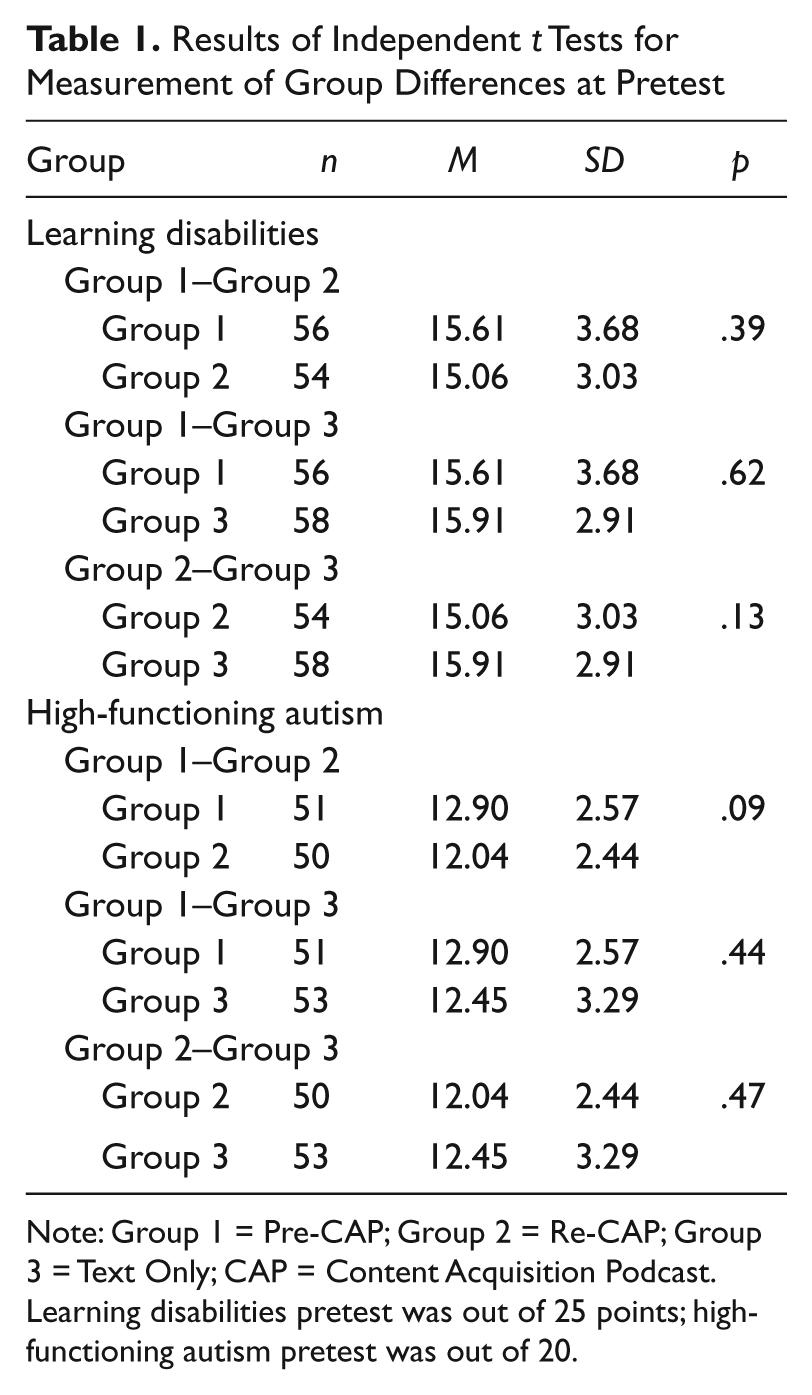
Note: Group 1 = Pre-CAP; Group 2 = Re-CAP; Group 3 = Text Only; CAP = Content Acquisition Podcast. Learning disabilities pretest was out of 25 points; high-functioning autism pretest was out of 20.
Pre-CAP group procedures
Participants assigned to the Pre-CAP group watched a CAP on characteristics of LD, and read a portion of a textbook chapter (Bryant et al., 2005), followed by posttest. Researchers instructed students that they would be watching a video on the projector screen about LD, and to pay careful attention to the images and on-screen text without taking notes. After viewing the CAP, researchers distributed the reading to all students. Students were permitted to take notes. When students finished the reading, researchers instructed them to complete the posttest.
Re-CAP group procedures
Participants assigned to the Re-CAP group first read the selection of the chapter, then watched a CAP on characteristics of LD, and then took the posttest. Researchers told students to read a specific section of the chapter on LD and to take notes if they wished. Because students read at variable rates, they were instructed to either continue reading or sit quietly until everyone finished. Then, the researcher collected the readings, and the students simultaneously watched the CAP via a projector screen. Prior to viewing the CAP, students were told to clear their desks and watch the CAP without taking notes. Students then completed the posttest.
Text-Only group procedures
Students in the Text-Only group read a section of a chapter on the characteristics of students with LD, and were provided with an outline and GO to use as a guide, and then took the posttest. Researchers told students to read the chapter, and use the accompanying GO and outline as a guideline for note taking as they read. When students finished reading, they completed the posttest.
Results
The independent variable in the study was the sequence of introduction for multimedia (CAPs) and text-based instructional materials (i.e., CAPs as preview to reading, CAPs as review of reading, or reading alone). The dependent variables were participant scores on the pretest and posttest for two multiple-choice tests, corresponding to the topics presented by the instructional materials (i.e., LD and HFA).
Researchers completed two repeated measures ANOVAs with two within-participants variables and one between-participants factor for both experiments (LD and HFA). The within factors (Time) were scores on the pretest and posttest for the LD and HFA assessments. The between-participants factor was group assignment (Group). There were no significant differences at pretest among the three groups (see Table 1). Levene’s test for equality of variances was not significant for either the pretest or posttest. Given these results and the random assignment of students to three experimental groups, there was no further need to statistically control for between-group variance and differences. The raw score means and standard deviations for the LD and HFA pretest and posttest are listed in Table 2.
Pretest and Posttest Mean Scores and Standard Deviations for Learning Disabilities and High-Functioning Autism Pretests and Posttests

Note: CAP = Content Acquisition Podcast. Learning disabilities pretest was out of 25 points; high-functioning autism pretest was out of 20.
LD experiment
The results for the ANOVA for the LD experiment indicated a significant effect between Time and Group, Wilks’s Lambda = .78, F(2, 152) = 22.11, p < .000, multivariate η2 = .23. Partial eta squared describes the “proportion of total variation attributable to the factor, partialling out (excluding) other factors from the total nonerror variation” (Pierce, Block, & Aguinis, 2004, p. 918). Therefore, 23% of the variance in this model can be attributed to the interaction between Time and Group. In addition, η2 can be used in ANOVA as an estimate of effect size (Cohen, 1988). A η2 measurement of .23 indicates a large effect size. Table 3 contains additional information relating to the ANOVA.
One-Way Within-Participants ANOVA for Pretest–Posttest Scores
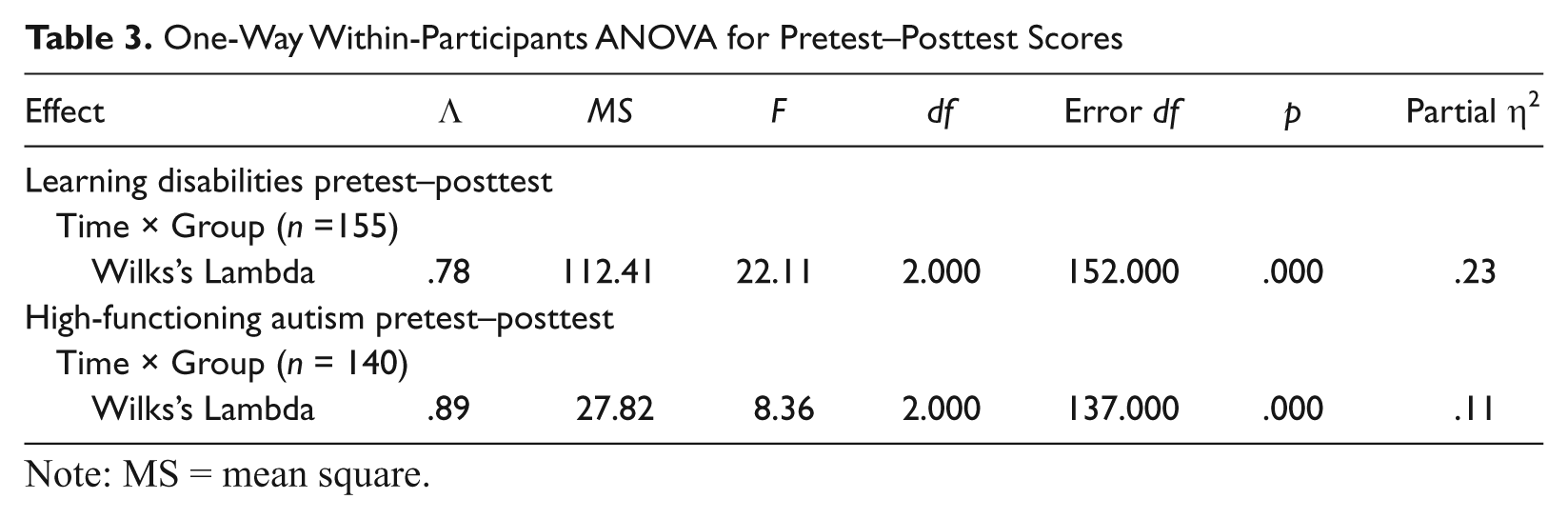
Note: MS = mean square.
To further investigate observed group differences and determine which groups (if any) significantly outperformed the others on the LD posttest, researchers used a Bonferroni correction to control for a Type I error during three pairwise group comparisons (e.g., Pre-CAP–Re-CAP, Pre-CAP–Text Only, Re-CAP–Text Only; α = .05/3 = .017). To conduct the pairwise comparisons, we completed a one-way ANOVA using Tukey post hoc comparisons. Tukey post hoc comparisons of the three groups’ mean scores indicate that students in the Pre-CAP group (M = 22.02, 95% confidence interval [CI] = [21.37, 22.67]) scored significantly higher on the LD posttest than students in the Text-Only group (M = 18.85, 95% CI = [18.09, 19.61], p ≤ .000, d = 1.24). In addition, students in the Re-CAP group (M = 21.48, 95% CI = [20.67, 22.29]) significantly outperformed students in the Text-Only group (M = 18.85, 95% CI = [18.09, 19.61], p ≤ .000, d = 0 .94). There were no other significant results. Given the nonsignificant differences on the LD pretest, the observed differences between Pre-CAP and Text-Only groups as well as Re-CAP and Text-Only groups, respectively, can be attributed to the CAP intervention. In addition, Cohen’s d indicates a large effect size favoring the effects of the intervention on the Pre- and Re-CAP groups when compared with the Text-Only group.
HFA experiment
The results for the ANOVA for the HFA experiment indicated a significant effect between Time and Group, Wilks’s Lambda = .89, F(2, 137) = 8.36, p < .000, multivariate η2 = .11. Therefore, 11% of the variance in this model can be attributed to the interaction between Time and Group. Table 3 contains additional information relating to the ANOVA.
To further investigate observed group differences and determine which groups (if any) significantly outperformed the others on the HFA posttest, we used a Bonferroni correction to control for a Type I error during the three pairwise group comparisons (α = .05/3 = .017). To conduct the pairwise comparisons, we completed a one-way ANOVA using Tukey post hoc comparisons. Results of the HFA experiment were similar to the LD experiment. Tukey post hoc comparisons of the three groups’ mean scores indicate that students in the Pre-CAP group (M = 18.06, 95% CI = [17.36, 18.77]) scored significantly higher on the HFA posttest than students in the Text-Only group (M = 16.66, 95% CI = [16.07, 17.25], p ≤ .000, d = 0.63). In addition, students in the Re-CAP group (M = 18.38, 95% CI = [17.90, 18.87]) significantly outperformed students in the Text-Only group (M = 16.66, 95% CI = [16.07, 17.25], p ≤ .000, d = 0.94). There were no other significant results. Given the nonsignificant differences on the HFA pretest, the observed differences between students in the Pre-CAP and Text-Only and Re-CAP and Text-Only groups, respectively, can be attributed to the CAP intervention. In addition, Cohen’s d indicates a medium and large effect size, respectively, favoring the effects of the intervention on the Pre- and Re-CAP groups when compared with the Text-Only group.
Discussion
In this study, we explored whether CAPs have a value-added effect on retention of content if students watch CAPs either as an advance organizer prior to reading or as a review following reading. We compared these results with a third group who read a chapter on the topic and had access to an advance organizer and outline of chapter content. For both content areas, mean scores for participants who watched CAPs (Pre-CAP group and Re-CAP group) scored significantly higher than those who did not view CAPs (Text-Only group) on the measures of knowledge retention. Significant differences for both experiments yielded either large (LD posttest) or medium to large (HFA posttest) effect sizes according to Cohen’s guidelines (1988). Therefore, for preservice teachers, CAPs can be considered an EBP to be used to enhance recall of information regarding characteristics of students with disabilities for preservice teachers.
The current study provides further evidence to support the use of instructional materials created using Mayer’s (2009) CTML in higher education coursework. Furthermore, this is the third study to use an experimental design to test the efficacy of CAPs in various instructional configurations with respect to their ability to deliver critical course content to undergraduate teacher education candidates (Kennedy & Thomas, 2012; Kennedy et al., 2011). As noted, Mayer’s CTML (2009) and instructional design principles (2008) are interwoven into the design of CAPs at every stage of production. The application of this learning theory allows the research team to control the looks and sounds of instruction in a manner that optimizes students’ cognitive functionality. The payoff for strict adherence to these design principles is the learning gains demonstrated by students who learned with CAPs as compared with students in the various comparison conditions.
Conducting empirical tests of validated theoretical models using experimental designs is the standard of research quality called for by Sindelar et al. (2010) to help improve the state of knowledge in our field. The findings of this study address these concerns and the need to (a) conduct research on technology that focuses on student outcomes rather than self-reported perceptions about technology use (Heilson, 2010) and (b) report results of experimental investigations of technology that are easily replicable and feasible for use in authentic teacher education settings (Grossman, 2005).
Implications
Multimedia learning materials based on sound learning theory and effective principles of instructional design provide a context for generalization that is often missing in the research on technology in teacher education (Clark, 2009). Podcasts, including enhanced podcasts such as CAPs, are increasingly used in teacher education for synchronous and asynchronous instruction (Heilson, 2010; Hew, 2009). Therefore, it is essential that instructors who design and/or use podcasting pay careful attention to the instructional design features that are intentionally or unintentionally included within learning materials. If unintentional design features are present (e.g., use of redundant text, or instruction is not constrained to only key information), it is incumbent on the instructor to revise the content or find other resources that employ principles of instructional design known to support cognition and learning.
Because of the communicable attributes of Mayer’s (2008; 2009) well-known theory and design framework, along with the description of CAP development procedures provided in this and other articles (see Kennedy et al., 2011; Kennedy & Thomas, 2012), we have provided teacher educators with processes and procedures they might use to create and test their own CAPs. The production steps utilized in this study help sidestep criticisms by Clark and Estes (2008), Mayer (2004), and Lawless and Pellegrino (2007) about the atheoretical nature of most research using technology and the lack of a common language and transportability of tech curricula (Grossman, 2005). In the field of special education teacher education, this line of research on CAPs addresses concerns raised by Leko et al. (2012) and Sindelar et al. (2010) by way of using a high-quality research design and undertaking a programmatic line of research. In addition, given the limited instructional time and the importance of preparing preservice teachers to work with students with disabilities, teacher educators can use CAPs to expand the amount of information delivered.
Future research could explore the use of CAPs to complement existing coursework as supplemental home learning across entire semesters. In addition, researchers could examine the extent to which in-service teachers can use this technology to augment student learning across various settings and courses. For example, students could create their own CAPs to extend understanding of a topic, and/or in-service teachers could use this tool to deliver various content-related tasks at different levels (e.g., basic to complicated) to meet a wide array of student learning needs (see Kennedy, 2011). Last, a critical next step is for other research teams to create and use this tool in practice and research, and report their results.
Limitations
There are several limitations of this study. First, the results of this study are based on nonstandardized instruments created by the researchers. Although questions and answers were directly tied to CAP content, which was based on the textbook chapters (Bryant et al., 2005; Stichter et al., 2008), there is a possibility that items may measure unintended constructs or that students may have interpreted some items differently than intended. Also, pertaining to the multiple-choice instruments, the number of items was limited, resulting in two relatively short measures. Given that the research activities took place during regularly scheduled class time, the use of a brief measurement instrument was necessary to limit the response cost from participants and not take up too much instructional time. Reliability of the instrument is adequate (α = .74 for LD and .71 for HFA) meeting minimum recommended levels for reliability (α ≥ .70) but should be strengthened for future research. Additional and multiple measures should be employed. In addition, content acquisition was compared at just two points in time, pretest and posttest immediately following instruction; future research should evaluate whether learning endures over time.
Researchers tested CAP usage with only two trials spanning two topics. Furthermore, although the results for the LD content demonstrate large effect sizes, the results for the HFA content are moderate. In previous studies, effect sizes for content were .98 for PBIS (Kennedy & Thomas, 2012), .64 for NCLB, and .82 for TBI (Kennedy et al., 2011). It is important to investigate the characteristics of individual content to create the strongest possible instruction for each topic. Potentially, a readability analysis comparing levels across content would help answer some of these questions, as would a comparison of reliability and item analysis to ensure that each dependent variable was equally valid and similar in sensitivity. To date, all research on CAPs has been conducted by Kennedy and colleagues, and research into CAPs or CAPs-like podcasts by other researchers and for other purposes will help to build the database on podcasting. A critical next step is for other research groups to create CAPs, use them in instruction, conduct high-quality studies, and publish the results. This research should include satisfaction measures from instructors creating and using CAPs, and the students who use them as learning tools.
Researchers introduced CAPs in each of the experiments as a structured, supervised, and required activity. One of the benefits of technology is the anytime, anywhere accessibility. Thus, research examining the efficacy and utility of CAPs for learning that is driven by preservice or in-service teacher choice is of interest. In addition, a logical next step is to evaluate the effects of CAPs as a learning tool embedded within lectures and across entire semesters of coursework.
Finally, although participants were randomly assigned to conditions, the participant sample was students enrolled in specific sections of an introductory special education course at two research-intensive universities. Teacher candidates at other stages of their programs and at various institutions, including those more focused on teacher preparation, may differ in ways that would yield different results in response to CAPs. In addition, although this study utilized an experimental design, there was no true control group. Use of a control condition would lend further credibility to the results of this and future studies.
Conclusion
Teacher preparation programs are faced with increasing accountability (e.g., NCLB) but shrinking resources (Pugach et al., 2011). This wicked problem is exasperated by limitations in instructional time, as most teacher preparation courses are provided in 15-week (semester) increments with approximately 3 hours of weekly instruction, yet the amount of content to be covered extends well beyond the artificial boundaries of university calendars. As general educators work with students with disabilities in inclusive settings, research into methods such as CAPs that conserve instructional time and augment learning are necessities. Research into theoretically grounded instructional technologies such as CAPs should be further studied to define optimal conditions for creating durable learning to support preservice general educators in their future work with students with disabilities.
Footnotes
Declaration of Conflicting Interests
The author(s) declared no potential conflicts of interest with respect to the research, authorship, and/or publication of this article.
Funding
The author(s) received no financial support for the research, authorship, and/or publication of this article.