



Abstract
Co-teaching is a widely implemented instructional strategy that poses unique challenges to teachers and may require targeted training. This study considers the role of pre-service and in-service professional development opportunities regarding co-teaching and teacher confidence, interests, and attitudes regarding co-teaching in a sample of general education and special education teachers. After controlling for key teacher demographics, professional development opportunities around co-teaching were positively associated with each teacher outcome. Teachers with more frequent in-service opportunities in co-teaching were more confident in their co-teaching practice and demonstrated higher levels of interest and more positive attitudes about co-teaching than did those teachers with less frequent in-service opportunities. Pre-service training on co-teaching was also positively associated with teacher confidence.
Co-teaching, commonly regarded as collaborative teaching between special education and general education teachers in a shared classroom space, has become highly recommended in the field of education for supporting inclusive practices and the full integration of children with disabilities in general education settings (Friend & Cook, 2009). Educational practices in collaborative processes such as co-teaching support the spirit and intentions of federal and state mandates that promote the education of all children in general education settings. Co-teaching joins a host of emerging collaborative educational practices that support the mandates laid out in the No Child Left Behind Act of 2001 (NCLB; PL 108-446) and the Individuals With Disabilities Improvement Act of 2004 that students with disabilities access the general curriculum and that they do so in the least restrictive environment. In addition, these mandates require that all students must be instructed by highly qualified teachers and that individual educational program teams for students with disabilities include general and special education teachers (Cook & Friend, 2010).
Approximately 6.5 million children aged 3 to 21, representing 13% of all public school enrollments, were receiving special education services in 2008-2009 (Aud et al., 2011). More than half of these children spend most of their day in general education classes, which is a marked increase from past decades (Aud et al., 2011). Co-teaching is provided within integrated general education settings as the instructional context for students with disabilities. For example, rather than pulling out students with disabilities for instruction in separate classrooms, in the co-teaching model, students remain in general education classroom settings, receiving collaborative instruction by general education and special education teachers for one or more content areas.
Co-teaching has become widely implemented as an instructional model (Howard & Potts, 2009; Muller, Friend, & Hurley-Chamberlain, 2009). It can be seen in classrooms across all grade levels and content areas, and increasingly, general and special education teachers are given the opportunity to co-teach (Fennick, 2001; Murawski, 2006; Murray, 2004; Zigmond, 2006). Although co-teaching has garnered considerable attention in the literature over the past few decades (for a review, see Friend, Cook, Hurley-Chamberlain, & Shamberger, 2010; Murawski & Swanson, 2001), most work in this area has been focused on describing this practice and providing recommendations for optimal implementation. A relatively small body of empirical work has addressed this area, and studies that exist have primarily focused on teachers’ roles and relationships and program logistics (Friend et al., 2010; Weiss & Lloyd, 2002).
The literature on teacher attitudes and experiences with co-teaching suggests that co-teaching has been well regarded by general education and special education teachers as beneficial to students outcomes and to the overall professional development of teachers (Hang & Rabren, 2009; Minke, Bear, Deemer, & Griffin, 1996; Scruggs, Mastropieri, & McDuffie, 2007; Walther-Thomas, 1997). However, most of this research has included teachers who are currently co-teaching, offering a somewhat limited view of teacher interests or confidence in co-teaching.
The co-teaching model does pose unique challenges to teachers. Research suggests that co-teaching is time-consuming and requires strong interpersonal and collaborative skills by teachers (Bouck, 2007; Fennick & Liddy, 2001; Luckner, 1999). Friend et al. (2010) stated that “because co-teaching departs so significantly from the traditional ‘one teacher per classroom’ model, it is not reasonable to expect educators to understand and implement it without specific instruction in the pertinent knowledge and skills” (p. 20). Although pre-service and in-service training are frequently highlighted as critical to the success of co-teaching (Minke et al., 1996; Scruggs et al., 2007), very limited empirical research has addressed the associations between teachers’ professional development opportunities regarding co-teaching and their confidence, interest, and attitudes about co-teaching. There is a particular need for research in this area that includes teachers with a range of experiences with co-teaching and with special education.
Pre-Service and In-Service Professional Development in Co-Teaching
While co-teaching represents a partnership between special educators and general educators, research has found that a greater percentage of special education co-teachers have taken pre-service courses in collaborative teaching during their teacher preparation programs, as compared with general education co-teachers (Austin, 2001). In a large study of 168 special education and general education teachers, Fennick and Liddy (2001) found that special education teachers were more likely to experience the pre-service preparations for co-teaching that were judged as most useful by teachers and rated themselves as more informed than general education co-teachers about the possibilities and benefits of co-teaching. However, other research has found that teachers in general and special education reported being underprepared for inclusive education practices, collaboration, and co-teaching (Cramer & Nevin, 2006). Although some empirical work has documented how postsecondary teacher education programs prepare teachers for co-teaching through their pre-service training efforts (e.g., Kamens, 2007; Nevin, Thousand, & Villa, 2009), very little research has addressed the ways in which this pre-service training may be associated with teacher outcomes regarding co-teaching. Further empirical work is needed that looks more closely at pre-service training opportunities that specifically address co-teaching strategies as they relate to teacher outcomes, such as perceived competence, interest, and attitudes regarding co-teaching for general and special education teachers.
For many teachers, in-service training opportunities through districts are the most commonly experienced preparations for co-teaching (Fennick & Liddy, 2001). Literature suggests that to support effective co-teaching practices, teachers need training in additional skills that may not have been provided in their initial teacher preparation programs (Friend, 2007; Walther-Thomas, Bryant, & Land, 1996). In-service training efforts should include topics such as co-teaching models, supervised practice, problem solving, and planning (Walther-Thomas et al., 1996). Although literature recommends that schools provide an extensive professional development program on co-teaching for existing teachers, the limited empirical research in this area suggests that in practice, most teachers need more frequent and in-depth training specifically on co-teaching. In a metasynthesis of qualitative research on co-teaching, Scruggs et al. (2007) found that teachers frequently identify an ongoing need for training that includes strategies and skill development specific to co-teaching and different co-teaching models, in addition to more general support on effective collaboration, consultation, and communication. Similarly, Fennick and Liddy (2001) found that in-service training was the most commonly experienced preparation for co-teaching; however, such training tended to be short term and limited in scope. These studies suggest that in-service training opportunities on co-teaching among general and special education teachers may be variable and, at times, insufficient.
Although it is widely acknowledged that teacher professional development through pre-service and in-service training opportunities are critically important in the implementation of co-teaching (Friend, 2007; Leko & Brownell, 2009; Walther-Thomas, 1997; Walther-Thomas et al., 1996), there is scant empirical research on how such training is associated with teacher outcomes. More focused empirical work is needed that looks directly at how teacher pre-service and in-service training in co-teaching relates to the way that teachers experience co-teaching in practice. This study directly addresses these gaps in the literature by considering the following research question:
Research Question 1: What are the associations between teacher pre-service and in-service training on co-teaching and teacher attitudes, interests, and confidence regarding co-teaching?
It is hypothesized that teachers with more pre-service and in-service training in co-teaching will demonstrate more positive attitudes and greater interest and confidence in co-teaching. These associations will be considered in a sample of teachers that represents a wide range of years of teaching, as well as varied experiences with special education and co-teaching.
Method
Participants
A total of 129 teachers from five districts in a Mid-Atlantic state participated in this study. Participating teachers completed an extensive online survey containing questions about teacher demographics and co-teaching experiences, interests, and attitudes. Information about the study was sent to teachers through district superintendents or directors of special services. The researchers identified these districts as representing a range of geographic and socioeconomic diversity, as well as participating in inclusion and co-teaching practices. Recruitment materials invited participation from all teachers, including general and special educators, teaching preschool through Grade 12 to participate. Teachers did not need to be currently co-teaching to participate in the study. District administrators reported sending recruitment materials to 327 teachers across the five districts, and the response rate for this study was 39%. Slightly less than half of the participating teachers were from a large, urban school district. The remaining teachers worked at one of the four other districts, which were smaller and from suburban, middle to upper-middle class communities.
The majority of teachers in this study had 10 or more years of professional teaching experience (n = 72) and had a master’s degree (n = 72). Twenty-seven percent of teachers were special educators (n = 34), and 58% of teachers were currently engaging in co-teaching (n = 74). Participating teachers held certification in P-3 (n = 15), elementary (n = 72), middle school endorsements (n = 19), content areas K-12 (n = 47), special education (n = 36), and special content areas such as art, music, or physical education (n = 7). Several teachers held additional certification in supervision, library/media specialist, speech therapist, English as a second language, or reading specialist (n = 21).
Measures
The Co-teaching Experiences and Attitudes Survey (CEAS) was developed for this study to measure multiple aspects of co-teaching as it is understood and experienced by practicing teachers. Teachers completed the CEAS online by following a secured link provided to them in their recruitment materials. This multipart survey was developed to be applicable for teachers of all age ranges and subject levels, as well as for those teachers who were and were not currently co-teaching. The CEAS went through a lengthy validation process, which was initiated by a review of literature that yielded the overall research inquiries. These parameters served as the basic guidelines for the development of the survey questions. Survey questions were developed to be clear and well organized to support the face validity of the instrument (Fink, 2002). The survey was then reviewed by several colleagues with experience in survey research. After these checks for content validity (Carmines & Zeller, 1991), the survey instrument was pilot tested by a small group of 15 co-teachers. We solicited feedback from participating co-teachers as to the relevance and clarity of individual items as well as the survey as a whole. This pilot testing also included extensive interviews with 11 general education and special education teachers, which contributed to the refinement of the survey to enhance its validity and relevance (Minervini, Pancsofar, & Petroff, 2011).
Teacher Demographic Variables.
In the online survey, teachers provided demographic information about their teaching experience, including their total years of professional teaching. Descriptive statistics revealed that most teachers in this study had 10 or more years of teaching experience. A median split was conducted on this data to yield a bivariate measure of teaching experience. This variable, veteran teacher, indicated teachers’ status in terms of years of professional teaching experience (1 = 10 or more years of professional teaching experience, 0 = fewer than 10 years of professional teaching experience). Other key demographic variables included co-teacher (1 = currently co-teaching, 0 = not currently co-teaching) and special educator (1 = special education teacher, 0 = general education teacher).
Professional Development
Teachers were asked to rate how often they had the opportunity to learn about different aspects of co-teaching and collaboration during their training. Teachers rated their responses on a 3-point Likert-type scale (1 = never, 2 = sometimes, 3 = frequently). Teachers rated their learning opportunities separately for pre-service and in-service training. This portion of the survey included 21 items, 5 of which specifically addressed co-teaching. A composite variable comprised as the average of these 5 items was created for pre-service and in-service professional development opportunities. It was required that least 4/5 of the items were nonmissing, and all cases met this requirement. Internal consistency on these scales was very strong for pre-service training (r = .93) and in-service training (r = .91). Table 1 presents the item-level data for pre-service and in-service co-teaching professional development subscales.
Item-Level Descriptive Statistics on Teacher Pre-Service and In-Service Training on Co-Teaching.

Teacher Outcomes.
For the purposes of this study, teacher outcomes were identified and limited to confidence, interest, and attitudes toward co-teaching. Teachers used a slider rating tool to rate the degree of confidence they felt in doing certain aspects of co-teaching (0 = cannot do at all, 50 = moderately can do, 100 = highly certain can do). Items addressed the same areas of co-teaching that were described in Table 1. It was required that least 4/5 of the items were nonmissing, and all cases met this requirement. Internal consistency on these items was strong (r = .85), and a composite score was computed for each teacher as the mean of the five items for co-teaching confidence.
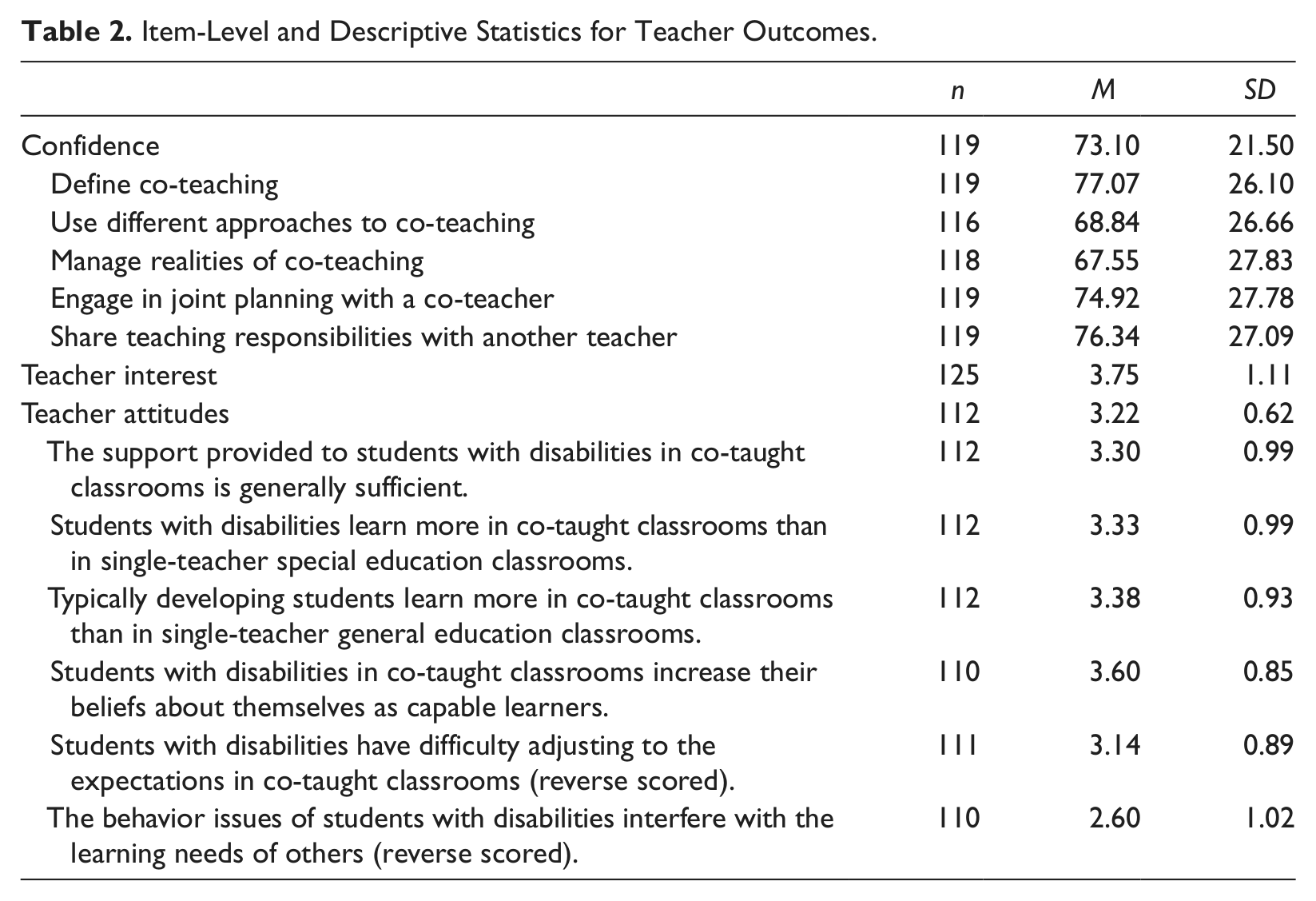
Teacher interest in co-teaching was assessed with a single item in which teachers were asked to rate their current level of interest in co-teaching, defined as providing in-class instruction for students with and without disabilities in general education settings, using a 5-point Likert-type scale (1 = very uninterested, 5 = very interested). Finally, teacher attitudes about co-teaching were assessed using a 6-item scale that focused on attitudes regarding the benefits and challenges of co-teaching on student success. Items measuring teacher attitudes about co-teaching were drawn from Hang and Rabren’s (2009) Teacher’s Perspective Survey. In some cases, minor modifications were made to the wording of Hang and Rabren’s original survey questions, based on feedback from teachers during the pilot research. Teachers were asked to indicate their level of agreement with a series of statements, using a 5-point Likert-type scale (1 = strongly disagree, 5 = strongly agree). Two items were reverse coded so that higher scores reflected more positive attitudes about co-teaching. It was required that least 5/6 of the items were nonmissing, and all cases met this requirement. Internal reliability on these items was strong (r = .74) and a composite score was computed for each teacher, comprised as the mean of the 6 items for co-teaching attitudes. Table 2 presents the item-level and descriptive information on the teacher outcomes.
Item-Level and Descriptive Statistics for Teacher Outcomes.
Results
Demographic Correlates of Pre-Service and In-Service Training
Before assessing the relationships between pre-service and in-service training and teacher outcomes, it was necessary to analyze the potential demographic correlates of professional development on co-teaching and teacher outcomes. t tests were conducted to determine whether there were meaningful differences across groups in pre-service and in-service training opportunities and teacher confidence, interest, and attitudes around co-teaching across teacher demographics (veteran teacher status, experience with co-teaching, special educator status). Table 3 presents the results of these analyses. Nonveteran teachers reported significantly more frequent opportunities to learn about co-teaching during pre-service training than did veteran teachers. Co-teachers reported significantly more frequent opportunities to learn about co-teaching during in-service training, greater confidence and interest in co-teaching, and more positive attitudes regarding co-teaching than did non-co-teachers. Special educators reported significantly more frequent opportunities to learn about co-teaching during pre-service and in-service training and greater confidence and interest in co-teaching than did general educators.
Mean Scores and t test Statistics for Differences in Across Teacher Demographics.

p < .05. **p < .01. ***p < .001. ****p < .0001.
Acknowledging that there may be important intercorrelations between teacher demographic variables, regression analyses were conducted with pre-service and in-service training as outcome variables and teacher demographics, including veteran teacher status, experience with co-teaching, and special educator status as independent variables. The results of these analyses are presented in Table 4. Significant relationships between teacher demographics and pre-service and in-service training remained largely consistent.
Summary of Multiple Regression Analyses for Models Predicting Pre-Service and In-Service Training.

p < .10. *p < .05. **p < .01. ***p < .001. ****p < .0001.
Associations Between Professional Development and Teacher Outcomes
To gain a better sense of the associations between pre-service and in-service training opportunities and teacher outcomes, we conducted a series of multiple regression analyses. Zero-order correlations and descriptive statistics, presented in Table 5, revealed that there were no issues with outliers or muticollinearity in the data. We used a hierarchical modeling approach that allowed us to enter pre-service and in-service variables as a separate block after initially entering teacher demographic variables (veteran, co-teacher, special education teacher) in Step 1 of the analysis. This approach not only allowed us to assess whether pre-service and in-service opportunities were significantly associated with teacher outcomes but also gain an understanding of the unique variance explained in the outcome variables by the professional development measures. Outcome variables included teacher confidence in co-teaching, interest in co-teaching, and attitudes regarding co-teaching. Table 6 depicts the results of the regression analyses.
Correlation Matrix for Analysis of Associations Between Professional Development and Teacher Outcomes.

p < .05. **p < .01. ***p < .001. ****p < .0001.
Summary of Hierarchical Linear Regression Analyses for Models Predicting Teacher Confidence, Teacher Interest, and Teacher Attitudes Regarding Co-Teaching.

p < .10. *p < .05. **p < .01. ***p < .001. ****p < .0001.
In the regression analysis predicting teacher confidence in co-teaching, teacher demographic variables were entered in Step 1. Teachers who were currently co-teaching reported significantly higher levels of confidence (β = .34, p = .0005). The addition of professional development variables significantly contributed to the model (ΔR2 F = 12.87, p < .0001), accounting for an additional 16% of the variance in teacher confidence. Pre-service training on co-teaching was significantly associated with teacher confidence (β = .19, p = .046), with those teachers with more frequent opportunities to learn about co-teaching in pre-service training reporting higher levels of confidence in co-teaching. Similarly, in-service training on co-teaching was significantly associated with teacher confidence (β = .35, p = .0003), with those teachers with more frequent opportunities to learn about co-teaching in in-service training reporting higher levels of confidence. The final regression model accounted for 30% of the variance in teacher confidence in co-teaching (F = 10.48, p < .0001).
In the regression analysis predicting teacher interest in co-teaching, teacher demographic variables were entered in Step 1. Teachers who were currently co-teaching reported significantly higher levels of interest in co-teaching (β = .25, p = .01). The addition of professional development variables significantly contributed to the model (ΔR2 F = 4.19, p = .02), accounting for an additional 5% of the variance in teacher interest. In-service training on co-teaching was significantly associated with teacher interest (β = .29, p = .006), with those teachers with more frequent opportunities to learn about co-teaching through in-service training reporting higher levels of interest. The final regression model accounted for 14% of the variance in teacher interest in co-teaching 1 (F = 4.48, p = .001).
Finally, in the regression analysis predicting teacher attitudes about co-teaching, teacher demographic variables were entered in Step 1. Teachers who were currently co-teaching reported significantly more positive attitudes (β = .36, p = .0005). The addition of professional development variables significantly contributed to the model (ΔR2 F = 6.43, p = .002), accounting for an additional 8% of the variance in teacher attitudes. In-service training on co-teaching was significantly associated with teacher interest (β = .34, p = .001), with those teachers with more frequent opportunities to learn about co-teaching in in-service training reporting higher levels of interest. The final regression model accounted for 19% of the variance in teacher interest in co-teaching (F = 6.00, p < .0001).
Discussion
A vast amount of professional practice literature has addressed elements, strategies, and conditions for collaboration between general and special education teachers in the co-taught classroom. These practices are supported by federal and state mandates that reflect the benefits of heterogeneous classrooms in which all students’ learning is supported (Cook & Friend, 2010). However, there has been a dearth of empirical evidence on co-teaching in practice. One important gap in the literature has been the role of professional development opportunities in pre-service and in-service regarding co-teaching on teacher outcomes. This study addressed this gap by examining professional development opportunities on co-teaching and their associations with teacher outcome variables of confidence, interest, and attitudes on co-teaching.
The results of this study suggest that professional development on co-teaching was significantly associated with each teacher outcome. Teachers who reported more frequent opportunities to learn about co-teaching from in-service training were more confident in their co-teaching practice and demonstrated higher levels of interest and more positive attitudes about co-teaching than did teachers who reported less frequent in-service training on co-teaching. Pre-service training was also associated with teacher confidence, with teachers who reported more pre-service learning opportunities in co-teaching demonstrating more confidence in co-teaching than teachers with less pre-service training on co-teaching. Professional development opportunities were significantly associated with teacher outcomes even after controlling for several key teacher demographic variables, such as veteran status and co-teaching and special education experience.
In-Service Training
The findings of this study suggest that teachers who had more frequent opportunities for in-service training in co-teaching practices were more confident in their ability to co-teach, more interested in co-teaching, and held more positive attitudes about co-teaching. The co-teaching literature is replete with recommendations for training in co-teaching and related skills, yet previous research indicates that teachers reported receiving very little training in co-teaching or related topics and would have liked to have been better prepared (Scruggs et al., 2007). The results of this study support the sustained provision of in-service training for teachers on co-teaching models and skills.
Associations between in-service training and teacher outcomes were found even after controlling for teacher demographics. However, preliminary analyses found that general educators and those not involved in co-teaching had fewer opportunities for in-service training in co-teaching practices than did current co-teachers and special educators. The results of this study suggest that in-service training on co-teaching may benefit general and special educators in their willingness and confidence in participating in a co-teaching model. Providing in-service training prior to co-teaching may ameliorate some of the challenges of co-teaching and support practices of collaborative teaming.
Pre-Service Training
This study found that teachers from pre-service programs with more learning opportunities in co-teaching were more confident in the skills of co-teaching. An additional finding was that special educators were more likely to be prepared during their initial training to engage in co-teaching than were general educators. This is consistent with previous research that found special education teachers had more pre-service training in co-teaching during their teacher preparation programs, as compared with general education teachers (Austin, 2001; Fennick & Liddy, 2001), suggesting that general educators need more pre-service training in collaborative skills such as a co-teaching. This finding should further inform teacher preparation programs that continue to separate general and special education courses of study. It may benefit teacher preparation programs to train general and special education teachers together around topics such as co-teaching.
A more collaborative approach to teacher preparation on co-teaching that includes opportunities for such cross-disciplinary conversations at the pre-service level is consistent with emerging national teacher education standards that include a set of knowledge, skills, and dispositions that address collaborative teaming and related skills (Council for Exceptional Children, 2005; National Board of Professional Teacher Standards, 2002; National Council of Accreditation for Teacher Education, 2008). General and special education teacher candidates need to be educated in skills of co-planning, effective interpersonal communication, problem solving, and other critical skills of collaboration (Villa, Thousand, & Nevin, 2008). It is expected that over time, all newly prepared teachers will need to demonstrate the expectation and skills to successfully implement a co-teaching model.
Although pre-service training in co-teaching was significantly associated with teacher confidence, it is somewhat surprising that there were no significant associations found between pre-service training and teacher interest and attitudes regarding co-teaching. When interpreting these findings, it is important to note that on average, teachers in this sample held many years of professional teaching experience, with the majority of participants teaching for 10 or more years. For many teachers in this sample, there may have been a wide distance between pre-service experiences and current teaching interests and attitudes. It is also likely that co-teaching was being addressed much less frequently in teacher preparation programs 10 years ago. We found that veteran teachers were less likely to be prepared for co-teaching during their initial training than were less experienced teachers.
Teacher Demographics and Teacher Outcomes
The results of this study also shed light on some interesting findings regarding teacher demographics and co-teaching outcomes. When all teacher demographic variables were simultaneously considered in regression analyses, only co-teaching experience was significantly associated with teacher outcomes. Teachers who were currently co-teaching reported significantly higher levels of confidence and interest in co-teaching, as well as more positive attitudes regarding co-teaching than those not involved in co-teaching at this time. These findings are consistent with some previous work in this area, which found that special and general educators who were engaging in co-teaching had more positive attitudes about co-teaching than did general educators in traditional settings (Minke et al., 1996). This may have implications for the manner and patterns in which school administration constructs co-taught classrooms and identifies co-teaching pairs. If participation in co-teaching can influence positive attitudes and interest, giving teachers this opportunity has the potential to transform a school faculty.
Limitations and Suggestions for Future Research
This study responded to gaps in the extant literature by considering a diverse sample of teachers with varying levels of experience with co-teaching and teaching students with disabilities. Professional development opportunities in pre-service and in-service training were assessed around multiple dimensions of co-teaching. However, the results of this study should be interpreted with an attention to certain constraints. This sample represented only a portion of teachers in the participating districts. Teachers who volunteered to participate in this study may have differed in meaningful ways from other teachers in these districts. However, the sample in this study was well distributed across five districts, representing a good range of teaching environments, particularly with regard to student socioeconomic status. This study was able to capture a range of teacher experiences and achieve a balance in terms of represented districts in the overall sample.
When interpreting these findings, it is also important to note that data in this study were self-reported and collected at a single point in time. As data were collected from a single respondent, there could be an unmeasured characteristic of teachers that might account for positive orientations toward professional development as well as positive outcomes regarding co-teaching. Therefore, the results of this study should be considered exploratory, highlighting important areas for future research.
Future work in this area should situate teacher interests, attitudes, and confidence in co-teaching within the broader context of teacher practice and competence in implementing co-teaching, as well as student performance. Such work should utilize observational measures of co-teaching practice and outcome indicators for professional development along with longitudinal designs, which can examine the impact of professional development on co-teaching relationships and performance over time. Such future research should explore the role of teacher interest, attitudes, and confidence in co-teaching on student outcomes across academic, behavioral, and interpersonal domains. Future work should also look more closely at the nuances of teacher professional development around co-teaching, considering factors such as frequency, length and duration of training opportunities in addition to depth of consideration of co-teaching. Finally, the results of this study show a discrepancy between training of special versus general educators, which may indicate that further work is needed to investigate the structures of professional development that address general and special educators simultaneously.
Conclusion
The practice of co-teaching continues to be used by schools to meet the needs of diverse learners within inclusive classrooms. As a result, teacher education and in-service trainings must directly respond to the variety of skills and practices necessary to promote effective co-teaching. However, the limited research literature indicates that continued investigation into effective practices and structures are critical. This study sets the foundation to further inquiry into co-teaching and related areas by suggesting that professional development in co-teaching may be associated with greater teacher confidence and interest in co-teaching and more positive teacher attitudes about this instructional practice.
Footnotes
Declaration of Conflicting Interests
The author(s) declared no potential conflicts of interest with respect to the research, authorship, and/or publication of this article.
Funding
The author(s) received no financial support for the research, authorship, and/or publication of this article.