



Abstract
Given the growing numbers of students identified with autism, educators need an understanding of evidence-based practices (EBPs) to meet these student’s individual educational goals. EBPs are defined often as instructional strategies, interventions, or teaching programs that result in consistent positive student outcomes. Educator’s use of EBPs has been shown to improve the learning outcomes of students with disabilities. It is imperative that educators understand how to select and implement such practices with students in their classrooms and continuously monitor the progress of their students. Recently, two major resources that classify EBPs for students with autism spectrum disorders (ASD) are available for review. This introduction to the special issue provides a review of EBPs specific to the education of students identified with autism as well as discusses the current resources available to educators who are in classrooms supporting students with autism. Recommendations for how best to prepare educators to use EBPs are provided.
Across all settings and placements, educators who serve students with disabilities are increasingly encouraged to use research evidence to inform their instructional practice (Yell, Shriner, & Katsiyannis, 2006). In addition, as school districts shift their emphasis to measuring student outcomes and using student outcome data to determine teacher effectiveness, the use of evidence-based practices (EBPs) becomes especially critical for special educators’ success (Brownell, Sindelar, Kiely, & Danielson, 2010; Greenwood & Maheady, 1997). Yet, how best instructional practices are defined or determined appropriate for students with disabilities depends on several factors. In this introduction to a special issue on preparing teachers to educate students with autism, we discuss the importance of EBPs in special education in general; and the factors used to determine the appropriateness of such practices specifically with children identified on the autism spectrum disorder (ASD). We briefly review EBPs specific to the education of students identified with autism and provide resources for educators who are in classrooms meeting the needs of students with autism, and conclude with recommendations for how best to prepare educators to use EBPs. The articles that follow the introduction will provide more details on preparing teachers to implement EBPs and the data collected supporting such strategies.
The Importance of EBPs
EBPs are defined as instructional strategies, interventions, or teaching programs that result in consistent positive student outcomes when tested experimentally (Mesibov & Shea, 2011). The application of high-quality research testing on the use of each practice is required for instructional strategies, interventions or teaching programs to be labeled as EBPs (Odom, Collet-Klingenberg, Rogers, & Hatton, 2010). High-quality research, as defined by Boutot and Myles (2011), includes studies that incorporate experimental, quasi-experimental, or single-subject research designs; includes multiple replications of results; and are published in peer-reviewed professional journals. Boutot and Myles (2011) stated that data from interventions that are supported only by anecdotal reports, case studies, and publications in non-refereed journals, popular magazines, Internet websites, and other social media outlets should not be considered as practices that are evidence-based.
A number of educational organizations identify EBPs, and in some cases, provide guidelines for identifying EBPs (see Torres, Farley, & Cook, 2012). The use of EBPs has been shown to improve student outcomes; however, they do not work with all students. It is critical that educators understand how to select and implement a best practice with the students they are currently teaching. Torres et al. (2012) provided a 10-step implementation framework for educators when planning to use EBPs. The first step suggested is for educators to identify the characteristics of the students in their class and match them with their personal teaching style. The second step is to search one of the recommended sources of EBP (e.g., Best Evidence Encyclopedia, National Autism Center [NAC], National Professional Development Center [NPDC] on ASD, and What Works Clearing House). The third step is to select an EBP that matches the educator’s instructional goals as well as the characteristics of the students in the class. The fourth step involves becoming familiar with the essential components of the selected practice, which will assist educators in understanding how to deliver the intervention correctly. The next step involves the implementation of the practice along with effective instructional techniques such as appropriate pacing, monitoring student progress, and maximizing appropriate behavior. This step may take time for new educators to perfect. The next two steps involve monitoring the implementation of the EBP with fidelity and to determine whether student outcomes are improving. The monitoring should be done by using appropriate progress monitoring tools, so that reliable data and feedback are obtained. If necessary, educators may need to adapt the implementation of the EBP and then evaluate the effects of the changes made. The final two steps include making instructional decisions based on the data collected and becoming an advocate for the use of EBPs with colleagues. When EBPs are implemented with fidelity student outcomes will improve. More information on how to implement the 10-step process can be found at Torres et al. (2012).
Brownell and colleagues (2013) found that educators increasingly know more about the content subject, in which they are teaching than the use of EBPs; and in some cases, they may also know about effective instruction and the use of EBPs. Over the past several decades, the expectations placed on educators of students with disabilities have become increasingly complex, encompassing more responsibilities with more diverse groups of students (Smith, Robb, West, & Tyler, 2010). In addition, it is often reported that educators do not feel they have sufficient training or enough time to use EBPs or train their para educators to use EBPs within their classrooms (Garland, Vince Garland, & Vasquez, 2013; Stahmer, Collings, & Palinkas, 2005). According to the National Research Council (NRC; 2001), training is an essential prerequisite to ensure that evidence-based teaching strategies are employed when working with students with ASD. It is critical that we train educators how to select and implement EBPs within their classrooms of students with a diverse set of needs. Simpson (2005) warned that professionals’ and caregivers’ reliance on untested methods and dependence on strategies that have limited evidence has resulted in unrealistic and unreasonable expectations for students and has hindered the potential progress of students with ASD. As Odom et al. (2010) suggested, Teachers and other practitioners working with children and youth with ASD and their families are required by agencies and insurance companies to implement evidence-based practices (EBPs), but there may be little guidance regarding where to locate those practices and what criteria to use to verify that a practice is evidence based. (p. 275)
“The increased prevalence of students identified with autism has intensified the demand for effective educational and therapeutic services, and intervention science is now providing evidence about which practices are effective” (Wong et al., 2014, p. 1).
We believe with the continued increase of students identified with autism and with many of these students served in inclusive settings, many educators are at a disadvantage as they do not know how to adapt empirically validated instructional strategies and programs to meet the needs of these students. Educators, however, understand that the student’s Individualized Education Programs (IEPs) require “a statement of the special education and related services and supplementary aids and services based on peer-reviewed research to the extent practicable” (Ryan, Hughes, Katsiyannis, McDaniel, & Sprinkle, 2014, p. 96). The following section illustrates the importance of using EBP in classrooms for students with autism. At the conclusion, we will provide resources and websites that may be helpful for special educators in the field working to improve the outcomes of students identified with autism.
EBPs Specific to Education of Students With Autism
According to Mayton, Menendez, Wheeler, and Zhang (2010), the rationale for identifying and implementing EBPs for students with ASD is threefold: (a) the increasing prevalence rate of students with ASD in schools, (b) the risks associated with unsuccessful outcomes for students with ASD and for their families, and (c) the history of unsubstantiated interventions that have been made available to the public. Improving the educational outcomes for students with ASD is dependent on the provision of programs and strategies that are based on proven methods (Hendricks, 2011). To address the significant and growing needs of students with ASD in inclusive classrooms, it is important that educators have firsthand knowledge of EBPs and the skills necessary to implement such practices that will help minimize their own gaps between research and practice. In 2001, The NRC outlined requirements for evaluating the evidence for effective educational practices for young students with ASD (up to the age of 8 years old). Six components were recognized as essential skill areas for instruction, including functional spontaneous communication, social skills, play skills, cognitive development, functional academic skills, and preemptive strategies to decrease challenging behaviors. With a greater emphasis on EBPs in the field of education in general, the resources available that outline these practices specific to students with ASD are more comprehensive and readily available than in previous years (see Table 1). Despite this access, educators face the challenge of being able to accurately identify and successfully match EBPs to students’ current needs in their classroom; they are not receiving adequate training to replicate the strategies in the classroom (Stansberry-Brusnahan & Collet-Klingenberg, 2010).
Resources.
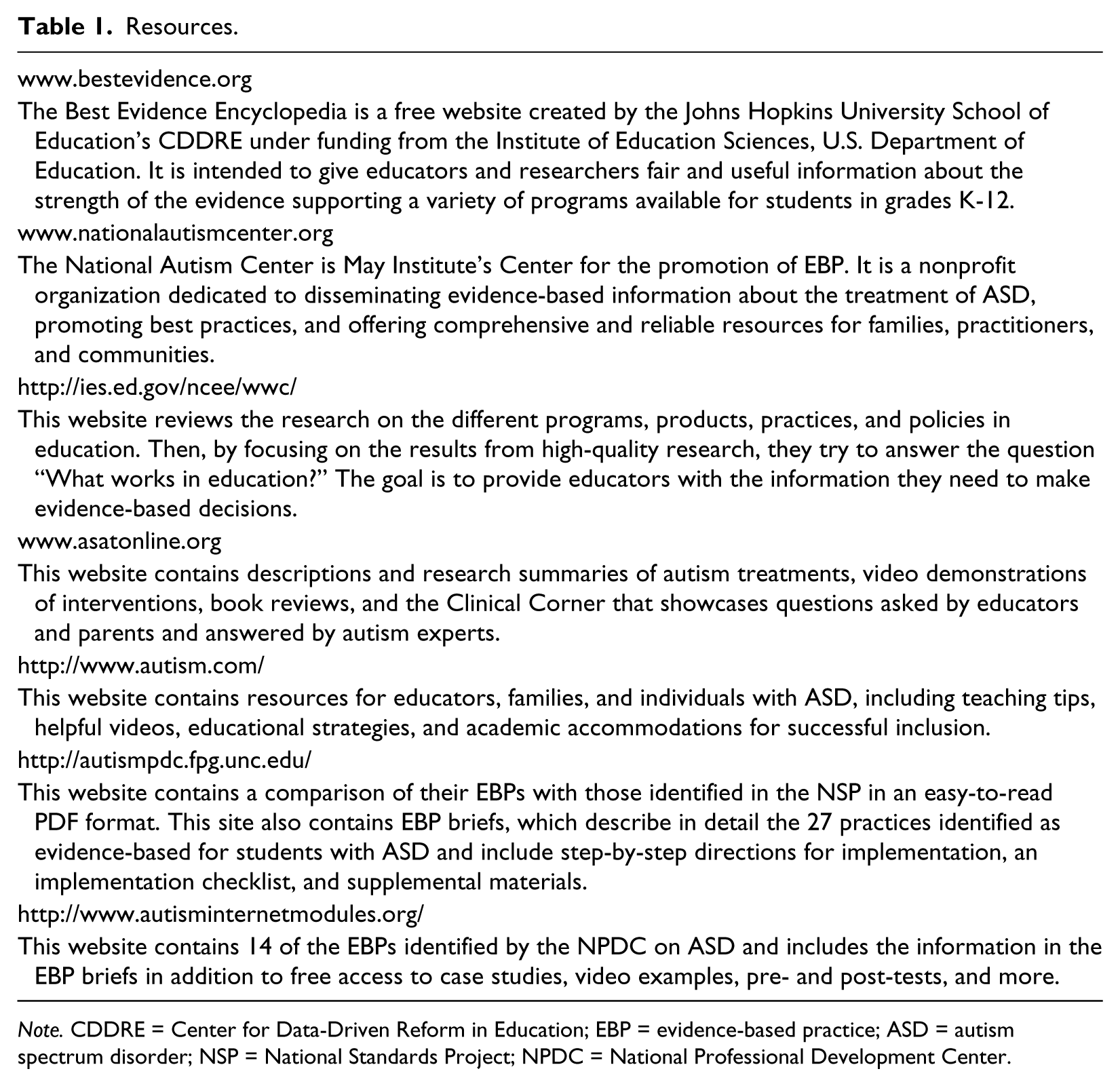
Note. CDDRE = Center for Data-Driven Reform in Education; EBP = evidence-based practice; ASD = autism spectrum disorder; NSP = National Standards Project; NPDC = National Professional Development Center.
Resources for EBPs
In the past 5 years, two major resources were developed to assist consumers and educators in understanding appropriate EBPs. These resources include both systematic reviews of quality research to support the practice as evidence-based for students with ASD as well as a comprehensive list of practices by category.
In 2009, The NAC completed the National Standards Project (NSP), in which 775 research studies were reviewed to identify effective treatment models for students with ASD. Wong et al. (2014) further clarified that the NSP focused on comprehensive treatment models (CTMs), defined as “a set of practices designed to achieve a broad learning or developmental impact on the core deficits of ASD” (p. 3). The NSP classified CTMs into three specific categories: established, emerging, and unestablished. Eleven strategies were classified as established (lead to beneficial outcomes for students with ASD); 22 were considered emerging treatments (have some evidence of efficacy); and 5 were identified as unestablished interventions (have a lack of evidence to support using the specific approach; NAC, 2009). Some examples of the of the established CTMs include Antecedent Package, Comprehensive Behavioral Treatment for Young Children, Naturalistic Teaching Strategies, Pivotal Response Treatment, and Self-Management (NAC, 2009).
For each established CTM identified, the report provided a table outlining the description of the treatment package; examples of specific strategies included for each CTM, number of studies reviewed, specific age groups, and identification of skills increased and/or challenging behaviors decreased. For example, in the review of the CTM, Comprehensive Behavioral Treatment for Young Children, 22 studies were reviewed to provide evidence for this treatment package being used with children below the age of 8 to increase communication skills, higher cognitive functioning, interpersonal skills, motor skills, and play skills while decreasing interfering behaviors and other general symptoms of ASD. Strategies included in comprehensive behavior treatment were also identified, such as discrete trial instruction, incidental teaching, applied behavior analysis, and early intensive behavioral intervention (NAC, 2009).
More recently, the NPDC on ASD completed a review of published research between 1990 and 2011 that evaluated the evidence supporting focused intervention practices (Wong et al., 2014). The NPDC on ASD (http://autismpdc.fpg.unc.edu/) is a center funded by the Department of Education and is supported by multiple Universities to promote the use of EBPs for children and adolescents with ASD. Odom et al. (2010) defined focused intervention practices as designed to address a single skill or goal of a student with ASD. According to Wong et al. (2014), focused interventions are differentiated from CTMs by the following criteria: require operational definition of procedures, specify learner outcomes, and have a tendency to be accomplished in shorter time period. It is important to clarify that many of the listed focused intervention practices are the strategies that are combined into those serving as part of the CTMs.
This NPDC on ASD review included single-subject designs, experimental group designs, and quasi-experimental design and resulted in a list of 27 focused intervention practices identified as EBPs (Wong et al., 2014). Some examples of the identified practices include differential reinforcement, extinction, functional communication training (FCT), modeling, functional behavior assessment, discrete trial instruction, video modeling, and visual supports. The review resulted in three resources as follows: (a) a report that disseminated the purpose, methodology, and result of the review; (b) evidence-based briefs; and (c) a fact sheet for each of the 27 practices. The evidence-based briefs (see http://autismpdc.fpg.unc.edu/content/briefs) provide the following information and resources for each identified EBP: overview of the practice, step-by step implementation instructions, checklists for implementation, and list of research studies that demonstrate the evidence to support the practice. The briefs provide invaluable resources that special educators can refer to when identifying, developing, and implementing an intervention plan for students with ASD.
Wong et al. (2014) included a fact sheet for each of the 27 identified EBPs (e.g., http://autismpdc.fpg.unc.edu/content/ebp-fact-sheets). Each fact sheet includes a brief description of the practice, the number of research articles that qualify as evidence, the age range for which the practice applies, the outcomes associated with the practice as well as a reference list of the research studies reviewed. For example, FCT is described as a procedure to replace challenging behaviors with a functionally equivalent alternative communicative behavior (Fettig, 2013). The strategies involved in the implementation of FCT include functional behavior assessment, differential reinforcement of alternative behavior, and extinction. The fact sheet lists 12 single case designs that qualify FCT as an EBP for ages 3 to 18 years old and results in a decrease in inappropriate behavior and an increase in social, communication, play, school readiness, and adaptive skills (Fettig, 2013).
Using EBPs to Improve Student Outcomes
The NAC and the NPDC on ASD have taken the initial steps for educators to learn how to improve outcomes for students with ASD by identifying which practices are evidence-based. Special educators can use these two vital resources to choose practices to match their individual student’s needs. The following section provides an outline of steps for using EBPs to improve specific student outcomes.
In addition to the 10-step implementation plan outlined earlier by Torres and colleagues (2012), it is important that prior to any implementation of an EBP, specifically a focused intervention practice, that special educators are prepared to assess a student’s current skills and develop observable and measureable goals (Odom et al., 2010). These goals should focus on the following components of instruction: functional spontaneous communication, social skills, play skills, cognitive development, functional academic skills, and interventions to address challenging behavior (NRC, 2001). It is recommended that educators collaborate with other professionals, as well as the student’s family to identify any additional goals and objectives as well as identify any individual preferences and motivators. Educators can use written goals and objectives to match current needs to identified EBPs using the identified resources. Following the identification of an EBP, it then becomes necessary to train all members of the educational team on the procedures outlined (Odom et al., 2010). In addition to ensuring the implementation of EBPs, educators are responsible for measuring the outcomes of the strategies that are implemented (Mesibov & Shea, 2011). Therefore, not only must EBPs be identified and implemented, there should also be measurement of daily instruction to make data-based decisions regarding students’ progress and future programming. As Wong et al. (2014) stated, The most important evidence supporting an EBP at the individual student level is the progress the student makes when the EBP is implemented. This places a great responsibility on the practitioner to implement the EBP with fidelity, collect data on child/youth performance, and use the data to evaluate the success of the EBP for meeting the child/youth’s goal. (p. 33)
Conclusion and Recommendations
Appropriate training on EBPs for all special educators, specifically in the field of autism, is warranted. Institutions of Higher Education need to evaluate current coursework specific to ASD and ensure that EBPs are discussed consistently across coursework and there should be an emphasis on reviewing, evaluating, and understanding current research on EBPs. In addition, training educators needs to go beyond didactic instruction on EBPs; there should be an emphasis on training educators to practice these strategies through data collection using fidelity checklists that includes direct feedback and repeated measures on implementation of strategies in classroom settings (during coursework and internships experiences). It is also recommended that graduate coursework requires students to have an understanding of research in special education, knowledge about access to research studies, and have the ability to evaluate and critique research studies on specific teaching strategies for students with autism. It is imperative that teacher preparation programs ensure that future teachers are provided with the tools and resources to accurately evaluate research to identify EBPs; provided training on the accurate implementation of EBPs with fidelity; and provided with the tools to stay current with growing field of research on EBPs for teaching students with autism.
Contents of This Special Issue
This special issue provides a range of examples of the current research in training educators of students with ASD. Topics include a review of the literature on the implementation of EBPs, maintaining EBP following graduate training, perceptions on needed skills for teaching in inclusive settings, and a model for effectively preparing members of intervention teams to meet the needs of students with ASD. In the first article, Alexander, Ayres, and Smith conducted a literature review of 23 studies, in which teacher training on specific EBPs for students with ASD was evaluated and the authors suggested recommendations for future research in this important area of study. In the next article, Hall evaluated the effect of a masters-level graduate training on special educators’ maintaining their use of EBPs 6 years after graduation. The third article, Able, Sreckovic, and Schultz navigated a translational study to evaluate the daily experiences of special and general educators to determine the knowledge and skills necessary to meet the needs of students with ASD in fully inclusive settings. In the final article, Donaldson focused on describing and evaluating an apprenticeship model of clinical supervision to provide training specific to speech language pathologists to be better prepared to serve students with ASD and contribute to intervention teams. We hope you enjoy the issue!
Footnotes
Declaration of Conflicting Interests
The author(s) declared no potential conflicts of interest with respect to the research, authorship, and/or publication of this article.
Funding
The author(s) received no financial support for the research, authorship, and/or publication of this article.