



Abstract
Global comparisons of teacher education programs should start with an understanding of the school systems that teachers are being prepared for in their local contexts. The purpose of this article is to describe Singapore’s dual education system as well as teacher preparation in a country that educates many students with disabilities in a separate environment. The focus will be on three of the factors critical to understanding comparative work: the goals and purposes of inclusive education and inclusive policy, the past and present state of Singapore with regard to policy and governance, and teacher training in the context of dual education. Suggestions for how teacher educators can learn from one another despite the vast differences in how students with special needs are educated are provided.
Inclusive Education Around the World
Creating an inclusive society, including one that prepares teachers to work in schools that welcome diverse learners, requires a comprehensive understanding of what inclusion means and how education plays a key role in creating and sustaining an environment that provides a quality education for all individuals (Opertti, Walker, & Zhang, 2014). In many regions of the world, inclusive education is not a novel concept for researchers or practitioners. However, there is a difference between having a deep understanding of the concept of inclusion and instituting the practice (Florian & Black-Hawkins, 2011).
The United Nations has long advocated for individuals with disabilities. Despite agreeing to and providing an extensive framework for inclusive policy during the Salamanca World Conference on Special Needs Education (United Nations Educational, Scientific and Cultural Organization [UNESCO], 1994), many member states face a wide variety of challenges when it comes to inclusion. These challenges include social policy, legislation, financing, and, in many cases, cultural beliefs. However, inclusive education is at the core of transforming societies. The “rhetoric of an inclusive society . . . provides a strong rationale for schools to be more inclusive of children with disabilities” (Lim, Thaver, & Slee, 2008, pp. ix-x). The need for understanding how we can better prepare all educators, including special educators, is paramount to transforming communities as education provides a foundation for our beliefs and for how individuals treat each other.
While many countries, including the United States, have had policies in place that mandate inclusion in public schools for decades, other countries and regions are still learning how to create systems that facilitate and encourage fair practices and learning opportunities for all learners (Opertti, Brady, & Duncombe, 2009). In Asia, inclusive education has been limited mainly to students identified as having special needs, generally referring to those with physical and/or mental disabilities, as well as refugees (UNESCO-IBE, 2008; Zagoumennov, 2011). Educating individuals with diverse needs does not always occur in mainstream schools and children with the most severe disabilities may not be educated at all.
As Bray and Thomas (1995) reported, many countries have national education systems and policies that are heavily influenced by central government politics and priorities. Despite regional differences, countries and government leaders are increasingly aware of the need to revamp educational systems in an attempt to make inclusion truly effective as a result of the human rights movement (Opertti et al., 2013/2014). As displayed in Figure 1, the human rights movement has become the driving force behind a powerful call to transform entire educational systems. For students with special needs, altering the educational system may mean an opportunity to study at mainstream schools where all children are provided accommodations relevant to their learning needs. These ideologies help guide policymakers in transforming learning environments (Wong-Ratcliff & Ho, 2011). Once inclusive policies are adopted, inclusive approaches to education are often left to ministries of education and these departments focus on mainstreaming students with disabilities into regular schools (Amadio, 2009; Amadio & Opertti, 2011; Cedillo, Fletcher, & Contreras, 2009; Garcia-Huidobro & Corvalán, 2009). As these policies are adopted, creating inclusive societies may also include revamping how special education teacher trainees are prepared before they enter the workforce as well as the types of professional development they receive throughout their career. This transformation has been taking place over the last two decades in Singapore.
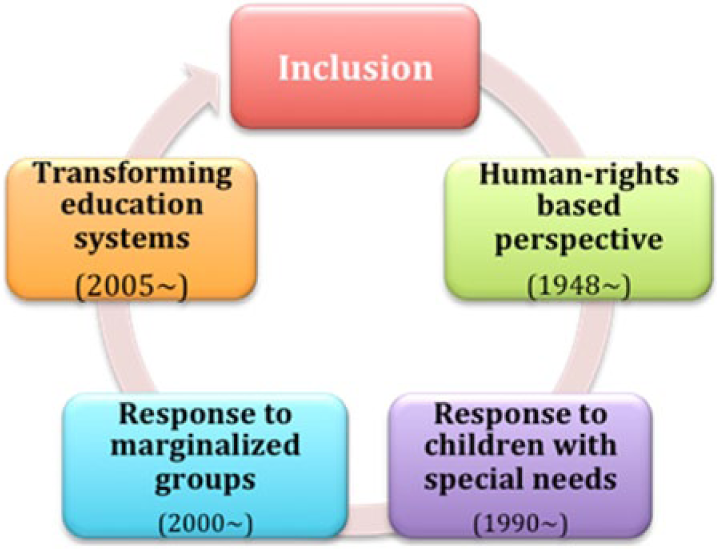
The continually evolving journey to inclusion: Four core ideas in the international arena.
Singapore’s method of training teachers for a career in special education is unique as the current system requires preparing pre-service teachers for careers in mainstream and special schools. There is a strong partnership between the Singapore Ministry of Education (MOE), which governs policy for education in Singapore, and the National Institute of Education (NIE), which is responsible for training all teachers. The focus of this comparative piece will be on examining three of the factors identified by Bray and Thomas (1995) as critical to understanding that relationship and comparative work in a country developing an inclusive system. The three areas of focus will be (a) ideologies, goals, and purposes of education in Singapore; (b) MOE governance and accountability; and (c) teacher education and professionalism as conducted at NIE. As these are three broadly defined factors, it is impossible to explain these elements without also taking into account Bray and Thomas’ educational and societal factors of educational achievement and the policy-making process within the context of Singapore. Through understanding these factors in the Singaporean setting, teacher educators may also consider how these three factors affect their own programs for pre-service and professional development of in-service special educators.
Singapore
Ideologies, Goals, and Purposes of Education
The Singaporean educational system has evolved significantly since its independence. The government has consistently emphasized education as people are Singapore’s only natural resource and the key to thriving in a rapidly changing, dynamic world (Lim & Nam, 2000). Song Weng, Walker, and Rosenblatt (2015) wrote, in the 1960’s and 1970’s, the country focused on the provision of basic literacy for the masses. By the early 1980s, Singapore had grown into a Newly-Industrialized Economy. The socio-economic revolution in Singapore led to a focus on an efficiency-driven education, in which students attended schools based on their perceived aptitudes and abilities. By the 1990s, the system evolved into an educational system that designed curriculum and instruction to support the creativity and capacity for innovation in students. (p. 64)
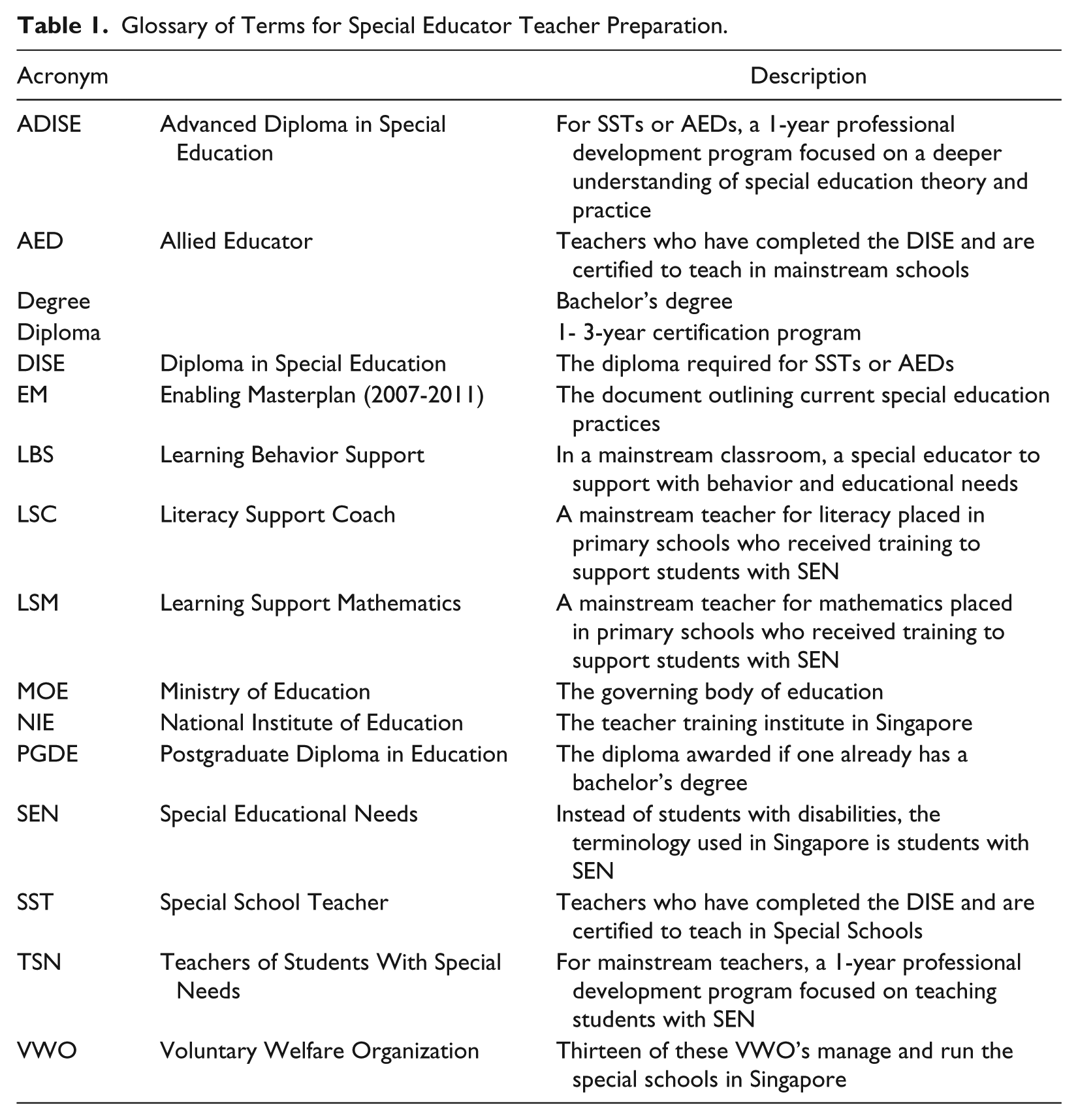
While the first schools in Singapore offered little support for students with disabilities, charity organizations developed special schools that could provide more intensive provisions for students with disabilities (Lim & Nam, 2000; Poon, Musti-Rao, & Wettasinghe, 2013). While the nation grew in the 1980s and 1990s and became known for its students’ academic achievement, a gradual separation of schools occurred that divided education into two categories: mainstream schools and special schools (Poon et al., 2013). This separated school system became known as dual education. Lim and Nam (2000) have described the dual education system in Singapore as comprising of mainstream schools for typically developing pupils and special schools for individuals with special educational needs (SEN; for other popular acronyms, please see Table 1). Special schools have traditionally been managed by voluntary welfare organizations (VWO) or the MOE with support from the National Council of Social Services (NCSS).
Glossary of Terms for Special Educator Teacher Preparation.
In February 1988, the Minister of Education, Dr. Tony Tan, led an investigation of the problems and needs of people with disabilities in Singapore and submitted his recommendations in the Report of the Advisory Council on the Disabled: Opportunities for the Disabled (Lim & Nam, 2000). Among the recommendations was that the management of special schools should fall under the MOE. This proposal was a significant shift from viewing special schools as a welfare provision to an educational one (Lim & Nam, 2000). While other recommendations included better teacher–pupil ratios for different exceptionalities, more certified educational psychologists, increases in per capita spending per child, and special land and financing to build more special schools, the report also maintained the dual system of educational delivery by stating that “integration should fit the disabled child to the most suitable educational environment” (p. 38).
Today, there are 20 special schools in Singapore educating more than 5,000 students ages 7 to 21 years old (MOE, personal communication, May 12, 2015). While mainstream schools are funded by the MOE, special schools are funded through a “tripartite relationship among Volunteer Welfare Organizations (VWOs), which are often charities, with joint administration and funding from the Ministry of Community Development, Youth, and Sports and the MOE” (Poon et al., 2013, p. 61). Mainstream schools, especially at the secondary level, are driven by assessments while special schools focus on teaching life skills to students with disabilities (Poon et al., 2013). Mainstream schools traditionally have 35 to 40 students in a class with one teacher (Musti-Rao, Hawkins, & Tan, 2011). While there are no data on class sizes in special schools, observations conclude that classes are much smaller and students often have multiple teachers and teacher assistants working with them.
In addition to Dr. Tan’s report, during the mid-1980s as The Childhood Developmental Screening Programme was started in the Maternal and Child Health Clinics in Singapore (Ho, 2007). This program was put in place to detect developmental delays and behavioral concerns. A focus on early childhood screening proved successful in identifying children with special educational needs. Currently, the number of children with disabilities identified in preschool continues to increase. In turn, the need for early childhood educators who are trained in special needs is increasing as well. For those students with disabilities not detected in early childhood settings, identification of disabilities once in school remains a challenge as there is currently a waiting list for the free diagnostic services offered by MOE due to a limited number of educational psychologists (Poon et al., 2013). The availability of professionals to identify and diagnose individuals with special needs in the public or private sector can be scarce and a challenge especially for families who cannot afford private practice. As in many places, families with financial means in Singapore can often afford specialized care delivered in a more timely fashion.
In 2007, the Enabling Masterplan (EM) 2007-2011 (Steering Committee on the Enabling Masterplan, 2007) was developed by the MOE. The EM included six key recommendations: (a) Restructure the leadership framework with the government taking over both early intervention and special education; (b) planned and purposeful integration of students with SEN through the exploration of educational models that bridge the gap between the special and mainstream education systems; (c) develop and maintain quality programs and staff; (d) adequate funding of enabling services such as sports groups, volunteer organizations, and other community services; (e) empowerment of family caregivers through education and training; and (f) proper transition planning and management within schools. These recommendations were essential as new focus was placed on the critical component of early intervention, not just early identification as had been done in the past. Human and financial resources have been dedicated to bridging the gap between mainstream and special schools, and more focus was placed on transition planning for post academic environments so that students with disabilities can have a productive and successful future.
Educational Organizations Governance and Accountability
The NIE is an institute of The Nanyang Technological University in Singapore. Based on MOE policies and initiatives, NIE is responsible for preparing all pre-service mainstream teachers through degree, diploma, and postgraduate programs. In addition, NIE provides ongoing and continuing professional development. The school offers a menu of teacher education programs for mainstream teacher trainees. It is important to understand the difference between a degree, a diploma and a postgraduate diploma in the teacher preparation context in Singapore. All three certifications are full-time programs that allow an individual to teach in a Singapore classroom. A diploma is normally a 1- or 2-year certificate verifying completion of a certain course of study. It is similar to an associate’s degree or certificate of teaching in the U.S. context. A degree is a 4-year program offering more depth and breadth of coverage and is equivalent to a bachelor’s degree in the United States. A postgraduate diploma program is typically a 1-year program for nonteaching degree holders.
An individual interested in becoming a mainstream teacher at NIE must first pass the Institute’s entry requirements for admission. Darling-Hammond (2010) documented the high standards and current strategies of becoming a mainstream teacher in Singapore which include scoring in the top half of the Cambridge Advanced Level examinations (“A” Levels), and being within the top third of their grade-level class in school. Candidates applying to become a teacher are assessed based on an interview, a review of their academic records and civic work, and an assessment of their commitment to teaching. After this comprehensive process, only about one in eight of the applicants is accepted (Darling-Hammond, 2010).
After securing admission to NIE, candidates must apply to a particular academic group (e.g., math academic group, science academic group) to become a content area teacher. For example, if a candidate wants to become a math teacher, the math academic group will look at the math courses the candidate has completed and the scores received to determine whether the candidate has a strong enough math background to become a math teacher. If not, the student will be offered admittance into another academic group based on content area (e.g., art or social studies) grades.
Once admitted to the academic group, there are three avenues to become a mainstream teacher in Singapore. One way is to receive a 2- or 3-year diploma in education based on the content area the teacher trainee is studying. This is the shortest route to becoming a teacher in schools. The second route is for individuals who already hold a bachelor’s degree in an unrelated field (i.e., business, engineering, philosophy). These degree holders must complete a 1-year postgraduate diploma in education (PGDE). The PGDE option is for career changers or individuals who decided to study education after receiving a degree in another field. The third option is to pursue a 4-year bachelor’s (BA or BS) degree in education. The degree option is strongly encouraged for all prospective teachers and for those who already hold a diploma. While the diploma offers the quickest route to the classroom, individuals are urged by the MOE to continue their education and earn a bachelor’s degree and support is provided for this endeavor.
One of the unique components of teacher preparation in Singapore is that individuals accepted into the mainstream teacher preparation program sign a bond with the Ministry of Education to fully fund their education and provide a stipend during study. Students receive a stipend equivalent to 60% of an in-service teacher’s salary during the entire duration of their programs (which ranges from 3½ to 6 years; Darling-Hammond, 2010). In return, mainstream teachers must work for the MOE for 3 to 5 years after completing their diploma or degree.
Teacher Education and Professionalism
Separate from mainstream teacher training, there are two distinct ways to work with students with disabilities in Singapore. One is to become a special school teacher (SST) in which one works full-time in special schools as a lead teacher in a class. The second is to become an allied educator (AED) and learning behavior support (LBS) specialist at a mainstream school. In either case, a diploma in special education (DISE) is required. While the DISE program is rigorous, it is limited to 1 year. Graduates of the DISE program should have the skills necessary for identifying disabilities, diagnosing and assessing strengths and weaknesses of students, planning interventions in either a mainstream or special school setting, and evaluating impact of the instruction provided. DISE coursework focuses on child development, pedagogy, and the major types of disabilities.
SSTs
To become a SST and have a class of his or her own takes approximately 2 years. Individuals who want to become a SST must work in a special school for at least 1 month as an aide or apprentice before they can enter the DISE program. A SST completing the DISE will take four requisite courses and two electives over the course of 1 year while also completing a practicum (student teaching) experience. Teachers completing the DISE program must also sign a bond with the VWO that manages their school. The VWO will support the teacher’s education and, in return, SST signs a 2- to 3-year agreement to work at the school after completion of the program.
AEDs
Individuals who wish to become an AED at a mainstream school may or may not have worked in a mainstream school before entering the DISE program. This entry requirement is based on school needs. For example, if a school is in desperate need of an AED, the leadership may send them directly into the DISE program without having served in the school. An AED completes the six requisite courses with no elective options. Part of the coursework includes focusing on the preparation of Individualized Education Plans for students in mainstream schools. The duties of an AED include identifying students who may have special needs, planning pull-out (withdrawal) lessons with them, and working with teachers to find evidenced-based practices to support students with SEN in mainstream settings.
Professional development
As part of PM Lee’s devotion to a more inclusive society, one specific legislative measure adopted provided additional training for mainstream teachers who have students with SEN in classes. Mainstream primary teachers are required to take one course on supporting students with SEN. This embedded component is usually one course entitled, Teaching and Managing Learners at the Primary Level. The thrust of this course is to both consolidate a trainee’s understanding of student diversity and provide examples of relevant strategies to support the pupils in their learning and development. Additional training can be completed through the Teacher Trained in Special Needs program (TSN; MOE, 2004). The TSN program provides training initiatives for 10% of the existing mainstream primary teachers and 20% of the existing mainstream secondary teachers. All primary schools have at least one support coordinator for literary (LSC) and math (LSM). These are mainstream teachers who are specially trained to support students at risk of literacy and numeracy failure in first and second grades. Teachers are nominated for this program by the leadership at their schools. In the TSN program, teachers are given the opportunity to develop a deeper understanding of both special needs and the ways to differentiate instruction to meet the needs of diverse learners. Teachers who attend the 1-year TSN program take one foundational course and three electives. These teachers receive 120 hr of training to provide support students with SEN in mainstream schools.
For AEDs and SSTs, professional development after multiple years in the field occurs through the advanced diploma in special education (ADISE) program. Launched in 2014, the ADISE program is a 1-year program offering five courses: Mobile Technology for Special Educators, Behavior Management, Evidence-Based Practices, Reflective Practice, and Research to Practice. Individual schools sponsor teachers for the program which requires attending courses 2 days a week at NIE and then implementing learned strategies in their school 3 days per week. While teachers attend the program, substitute teachers manage their classes and fulfill their classroom duties. Participants in this program are fully funded and receive their normal salary while attending the program.
In addition to undergraduate training and professional development, there are master’s degrees and doctoral degrees in special education offered at NIE. These degree programs promote and require in-depth study of current research on knowledge-based theory and practice. Many of the participants in these programs are professionals involved in the field of special education whether as teachers, school leaders, or workers in community agencies or VWOs.
Teacher Preparation in This Context
Opertti and his colleagues (2013/2014) noted that understanding and practicing inclusive schools and successful teacher preparation practices includes progressively moving education from diverse and often contradictory visions, approaches and practices structured around categories and groups, to a more holistic perspective based on the idea that understanding, respecting and responding to the expectations and needs of all learners within their contexts and circumstances is the pathway to truly attain inclusion (p. 158)
Five recommendations made by Opertti et al. (2013/2014) can provide a framework for the lessons we can learn from Singapore’s ongoing pursuit of an inclusive society and how education plays a part in that quest. The recommendations may also provide other special educator teacher preparation programs ideas when designing curriculum and programs. Opertti and colleagues recommend the following:
Create a Common Societal Understanding of Inclusive Education
Inclusion is increasingly understood as integrating children with special needs into mainstream schools, especially in Africa, the Arab States, and the Asia-Pacific regions (Opertti et al., 2013/2014). Efforts to attain inclusion in both schools and societies at large are often hampered by constraints within the education system (Florian & Black-Hawkins, 2010). Teacher educators may consider asking their teacher trainees to identify constraints within their own systems and around the globe as they begin discussions about the best ways to achieve inclusive societies.
At NIE, discussions in special education courses often focus on what an inclusive society looks like and what that means for students, teachers, and society within the context of Singapore. During these rich, deep conversations with students, issues about funding, personnel, and the curricular changes that would be necessary are grounded in the practical implications of a completely inclusive system. While focusing on strategy instruction and practical applications in the classroom is important, it is also vital to consider the theoretical underpinnings and assumptions we have regarding inclusive practice and the best ways to create inclusive societies. By fully examining what inclusion means and how it affects a society, not just a school system, valuable, critical discussions can challenge inherent ways of thinking.
Promote Fundamental Mind-Set Changes
The most troublesome barriers to inclusion come from entrenched values, attitudes and behaviors that disdain and/or disregard the idea of a just society; that do not recognize or accept diversity as key foundation of a more inclusive and cohesive society, and that do not consider the scope and implications of glaring social and educational gaps as a priority issue. (Opertti et al., 2013/2014, p. 160)
Gaad (2010) reported on the difference between approaching education for those with disabilities away from a “charity or social welfare” mind-set to a “rights-based approach” (as cited in Opertti et al., 2013/2014, p. 160). Singapore has made significant strides in this domain as mainstream teachers are, in most cases, sensitive to students with SEN. However, working with students with SEN in mainstream schools is often left to the AED. The TSN program is making strides in helping mainstream teachers understand students with SEN and how to differentiate instruction for all learners. After all, as Ainscow, Dyson, and Weiner (2012) wrote, “effective teaching is effective teaching for all students” (p. 7). Many teachers, however, still do not feel they are equipped with the special set of skills, knowledge, and pedagogical understanding needed to reach all learners (MOE, personal communication, November 6, 2015).
The path to become a special educator in Singapore might be most indicative of the mind-set barriers that special educators in schools and the MOE are working hard to overcome. Becoming a SST or AED teaching and supporting students with SEN in a Singapore school can take as little as one year. Conversely, unless an individual already possesses a bachelor’s degree, it takes two years at a minimum to become a mainstream teacher and continuation to a bachelor’s degree in education is highly encouraged. In short, less training and knowledge about specific educational pedagogy is expected from special educators than from mainstream teachers. While this may seem like simply a matter of credentials, this issue is also reflective of an inclusive system still in its nascent stages. There is currently less value placed on special educators and, in turn, on students with SEN.
Restructure Schools to Provide Comprehensive Support to All Learners
Around the world, inclusive education reforms are calling for radical changes to the traditional one-size-fits-all approach. In some of the most inclusive educational environments, such as the United States, standardized assessments drive curriculum and pedagogy. Standardized assessments may not be the best instruments to encourage the development and improvement of relevant pedagogical materials for individual learners (Kohn, 2000). Teacher educators may want to consider how special schools can provide a model for inclusive schools by supplying more comprehensive support systems including flexible curricula based on student needs. Inclusive schools can provide supports for students to participate in an individualized curriculum and pursue an alternative degree. According to Opertti and his colleagues (2013/2014), these comprehensive supports may include (a) services to ensure the physical, psychological, and social well-being of all students; (b) school infrastructures designed for barriers-free access to both the physical building and the academic content; (c) early support and intervention for students with special needs; and (d) native language instruction and teaching approaches that are adapted to the lingual needs of minority students.
Designing educational systems with proper supports may also include allowing “all children . . . opportunities to shape what, how, where, when and with whom they learn” (Florian & Black-Hawkins, 2010, p. 822). It is important to consider that certain students and families may choose to be educated in environments that are designed to accommodate for their special needs. While environments where individuals live, work, and play together is the ultimate goal, the amount of care and attention given to students in special schools may provide a model for developing more comprehensive, separate supports in inclusive schools.
Address the Expectations and Needs of All Learners Through an Inclusive Curriculum
Truly inclusive educational systems design curriculum as a tool to develop all student’s potential and provide individual supports and accommodations to help learners achieve that potential. A mainstream curriculum that is “dumbed-down” is not true inclusion; instead, it is important to hold high standards for all learners and provide curriculum that is “open and flexible, allowing for different learning styles and content which are relevant to learners and society” (p. 164).
Since 2012, there has there been a separate curriculum for special schools in Singapore. The curriculum is focused on living, working, and learning. In most cases, special schools are still free to create and follow self-developed curricula. This flexibility provides educators the opportunity to focus on individual needs and yet, conversely, does not provide a framework for teachers based on the needed skills for work, independent living, or transitioning into society. Four of the 20 special schools have adopted the mainstream curriculum while the remaining special schools utilize the Living, Learning, & Working in the 21st Century curriculum introduced in 2012 to varying degrees (MOE Special Education Branch, 2012). Research is currently being conducted to determine the effectiveness of this curriculum.
Empower Inclusive Teachers to Address Diversity of Learners
Teachers are policymakers as decisions in classrooms determine what students learn once the classroom door is closed (Fulcher, 1999). With this in mind, teacher educators need to consider how we empower teacher trainees and provide them with the competence and confidence to become effective decision makers. Teacher education curricula should enhance student competencies and support individualized learning within a multitude of contexts (European Agency for Development in Special Needs Education, 2011; Forlin, 2010; Forlin & Chambers, 2011; Rouse, 2010). Moreover, while teacher educators often discuss and promote differentiated instruction to their students, they must also emulate and model differentiation in their own college classrooms and the necessary supports that will allow each student to find their own voice and style as a beginning teacher.
In addition to the framework and examples above, Opertti et al. (2013/2014) advocated that teacher educators should encourage teachers to work in multicultural environments to strengthen their own understanding of differences. It is important that teacher educators make it a priority to actively recruit and develop trainees that come from different ethnic, social, and cultural backgrounds than their own. In Singapore, specifically, the diversity of the population is reflected in school leaders, teachers, and students. While predominantly Chinese, Singapore includes a rich mix of Chinese (73%), Malay (13%), Indian (9%), and “Other” residents (Singapore Department of Statistics, 2014). This diversity can encourage an understanding and appreciation of differences that goes much deeper than a curriculum or lesson plan. Teacher educators in many places may want to consider their own pre-service teacher recruitment policies and how to best meet the needs of diverse learners. It is important that teacher educators recruit, train, and develop teachers that reflect the diversity of their students.
Discussion
While Singapore is only 50 years old and is making progress in becoming an inclusive nation, challenges remain in terms of structure and support in both education and society. While discussing the progress in the early identification of students with special educational needs, Ho (2007) noted, there is little point in having a community-wide system for early detection of infants and children suspected of having developmental and behavioural problems unless there are concomitant resources available for the comprehensive assessment of these young children, followed by appropriate management and care. (p. 899)
Most recently, Poon and his co-authors (2013) reported that, while legislation that exempts students with disabilities from compulsory education was “crafted to reduce the pressure on parents to have their children perform in schools, it potentially deepens the divide between the mainstream education and special education system” (p. 64). In short, it is difficult to develop an inclusive society in a young country highly focused on educational achievement and the development of its workforce. As Lim and Nam (2000) wrote, the “dual system is a significant barrier to integration opportunities” for individuals with disabilities (p. 108).
The MOE, under the direction of PM Lee, is working to develop a more inclusive system. The Steering Committee on the Enabling Masterplan (2007) has recommended that the MOE take ownership of special schools and provide continued leadership and guidance to VWO’s and mainstream schools serving students with disabilities. In addition, more groups are taking the initiative to support and advocate for individuals with disabilities in the community. For example, the 2015 Purple Parade, a movement that supports inclusion and celebrates the abilities of persons with special needs, was the largest ever and was attended by the Prime Minister for the first time (Purple Parade, 2015). However, a truly inclusive society is hard to create when the youngest members of society are separated beginning in the earliest years of their education. In Singapore, “the rhetoric of a vision of an inclusive society . . . provides a strong rationale for schools to be more inclusive of children with disabilities” (Lim & Nam, 2000, pp. ix-x).
While advocacy and legislation are critical to lasting change, there are still practical obstacles in developing an inclusive system. One of the bigger challenges facing teachers of students with SEN occurs in mainstream schools. Together with TSN teachers, AEDs can support students with mild special needs (dyslexia, autism spectrum disorders, and attention deficit hyperactive disorder) studying in mainstream schools (MOE, 2014). Feedback from DISE graduates in the field indicates the quality of the education received at NIE provides very thorough foundational knowledge for their current role in schools. The graduates also indicate they would benefit from more comprehensive education programming to reach more severe students with disabilities and translate the theoretical foundations into practice (MOE, personal communication, November 6, 2015). While discussions are ongoing about creating a bachelor’s degree in special education, there are no definite plans in place. Current conversations between MOE and NIE are focused on how to best strike a balance between foundational knowledge and practical applications when only one year of preparation is provided. In addition, in most cases, there is only one AED for an entire secondary school. Due to isolation, high workload, and minimal preparation, the attrition rate for AED’s is high. This leads to a situation where there is little experience and continuity in schools as new AEDs are constantly being recruited.
Based on the author’s firsthand experience working with special educators here in Singapore, they are passionate, care deeply, and are very talented teachers in their own right. Holding SSTs and AEDs to the same entry and degree requirements as mainstream teachers would demonstrate that teaching special education and working with students with SEN is valued as much as working in mainstream settings. The continued training of new TSNs and AEDs through NIE and increased personnel and support once in schools will be of paramount importance to make sure that teachers of students with mild disabilities, and the students themselves, are supported in mainstream settings.
While there are certainly challenges to preparing special education teachers in Singapore, one of the bright spots is the requirement that prospective SST candidates work in special schools for at least 1 month before they can enter the diploma program for SSTs at NIE. In some cases, prospective special educators will work in the school for 1 year. This working time allows the school and the individual an opportunity to discover whether the “fit” is right between the individual and the special education profession. While conclusive research has yet to be completed, this practice would appear to improve teacher performance early in their career and lead to higher retention rates for teachers of students with disabilities.
On a planning level, it is important to discuss the impact of inclusive schools and curriculum on learners with special needs and the effect of following a mainstream curriculum if it is not relevant to a student’s ability level or interests. de Boer, Pijl, and Minnaert (2010) conducted an extensive review of the literature and found that some families prefer a noninclusive environment due to the fact children with disabilities often have fewer friendships, are less accepted, and are considered outcasts in inclusive schools. Understanding the specialized care and supports provided to students with special needs as well as the flexible curriculum these students are able to complete can help inclusive educators understand why some dual education programs may be desired by parents in an assessment-based society. Those with more moderate to severe disabilities may be best served in a dual education system.
Conclusion
Bray and Thomas (1995) wrote that “most people working in the field commonly labelled comparative education tend to have a good understanding of macro-level phenomena but are much less comfortable with the tools and perspectives of researchers who work at the micro-level” (p. 473). When comparing ideologies, goals and purposes of education, educational organizations governance and accountability, and teacher education and professionalism, it is important to consider the policy-making process and the emphasis a society places on educational achievement. Relying solely on macro-level analysis takes the humanity out of the comparisons and can devalue the work of the teacher in the field. In many cases, a teacher working with a child with severe autism faces the same challenges whether in a special school in Singapore or in a fully inclusive classroom in the United States. While the structures and supports put in place by governments, institutions of higher education, and societies are important in providing a teacher with both the practical strategies (how) and the theoretical ideology (why) supporting educational practice, it is important to avoid judging a system solely based on macro-level criteria.
While there are great differences between the legislative requirements of inclusive schools systems such as the United States’s, the United Kingdom’s, and Singapore’s dual education system, there are common questions that teacher educators may want to ask as they work with pre-service teachers. For example, is the support offered by special schools worth separating students with special needs into exclusive environments? Is there an opportunity for students with special needs to be better prepared through a curriculum focused on life skills as opposed to a more traditional academic curriculum? Are special educators viewed as equals to content area teachers or are they simply viewed as support personnel? How do we provide academic, life, and independent living skills in a curriculum and system focused on standardized assessments? Would special educators be better prepared if they were required to spend a year in schools as an aide as part of their teacher preparation program?
Special educators prepare, guide, and teach students with special needs. In addition, special educators often act as advocates for inclusive environments locally and globally. One of the responsibilities of the teacher educator is to encourage special education trainees to challenge their own assumptions and to understand what inclusion and special education entails in their own context and globally. In Singapore, the dual education system mandates a very different path for both teachers and students as compared with students and teachers in inclusive school settings. The challenges and opportunities that arise in both settings can provide valuable lessons for teacher educators and their trainees.
Footnotes
Declaration of Conflicting Interests
The author(s) declared no potential conflicts of interest with respect to the research, authorship, and/or publication of this article.
Funding
The author(s) received no financial support for the research, authorship, and/or publication of this article.