



Abstract

Keywords
The proliferation and availability of information detailing events both large and small in virtually every corner of the globe may actually work to distort our perception of the challenges associated with truly understanding our world. The spread of information may be characterized as globalization in name, although globalization in practice is a completely different matter. Globalization in practice is no small task, and in spite of our ability to view and virtually experience events around the world in real time, geographic distances, language, resources, and a host of other barriers make any real changes on a large scale a challenge at best. As a result, the world is now, metaphorically, a smaller place. Therefore, our experiences here in the United States should not serve as the center of our ideas about the world. Rather, an international, more accurately, global, perspective must be taken. Indeed, globalization, or the notion that particular ideas, events, and policies extend to all parts of the globe, now serves as the impetus for broad issues such as economic (Friedman, 2007), social (Roth & Briar-Lawson, 2011), and policy development (United Nations Educational, Scientific and Cultural Organization [UNESCO], 2007). Likewise, it is no surprise that globalization affects perceivably narrower issues such as special education teacher education.
Hence, the intersectionality of globalization, its various caveats, and special education teacher education is worthy of examination. In the true spirit of globalization, the ultimate goal is to work toward identification of what unites us all. Examination is often more fruitful if approached from a variety of perspectives. Comparative education can be used as a tool that allows for a more equitable dynamic process, enabling comparisons across several dimensions simultaneously. Essentially, comparative education is “the study of any aspects of educational phenomena in two or more different national or regional settings in which attempts are made to draw conclusions from a systematic comparison of the phenomena in question” (Phillips & Schweisfurth, 2006, p. 24). The literature base in comparative education is extensive, and the methods are well established (Bray, Adamson, & Mason, 2007; Phillips & Schweisfurth, 2006). Much has been learned to this point from comparative methods, with the intent not only of shedding light on differences, but also to understand similarities, to shape current and future practice (e.g., Tikly, 2011; Wubbels, 2011).
Bray and Thomas (1995) proposed a framework for comparative education that provides the basis for comparison in three macro areas: (a) geographic/location levels, (b) demographic groups, and (c) aspects of education and of society. These broad areas provide a context for comparison, allowing researchers a strong base for choosing a viable unit of analysis for making comparisons. The nature of comparison is relatively straightforward, but our purpose in this special issue was to inspire authors to go beyond a simple dichotomous comparison, drawing attention to similarities and differences, with insight into what might be learned and used as an impetus for change on both sides of the comparison.
To accomplish this goal, we sought and were granted permission to make modifications to the original Bray and Thomas (1995) model and alter each face of the cube (see Figure 1). This adaptation was important, as it allowed for the integration of variables relevant to special education teacher education. On the front face of the cube, “Locations” details where the work of teaching takes place (e.g., countries, schools), and on the side face of the cube, “Education and societal factors” lists a number of variables that potentially influence the way teachers are prepared and ultimately conduct their work. For example, “ways of knowing and learning” refers to a way or an approach that might be used to understand and interpret incoming information, based on a scientific or non-scientific approach to answer life’s big questions. On the top face of the cube, “Other influential factors” details additional variables that might moderate special education teacher preparation and practice. For example, consider the concept of “culture.” Humans live in a culture; humans translate culture as well as create and even destroy culture. Furthermore, various groups can be characterized as a sub-culture with particular practices, values, and beliefs germane to that group. Clearly, teachers and teaching constitutes a culture, made up of various racial/ethnic/national/regional groups. Thus, the influence of culture and the other influential factors listed on the top face of the cube also constitute a viable point of comparison.
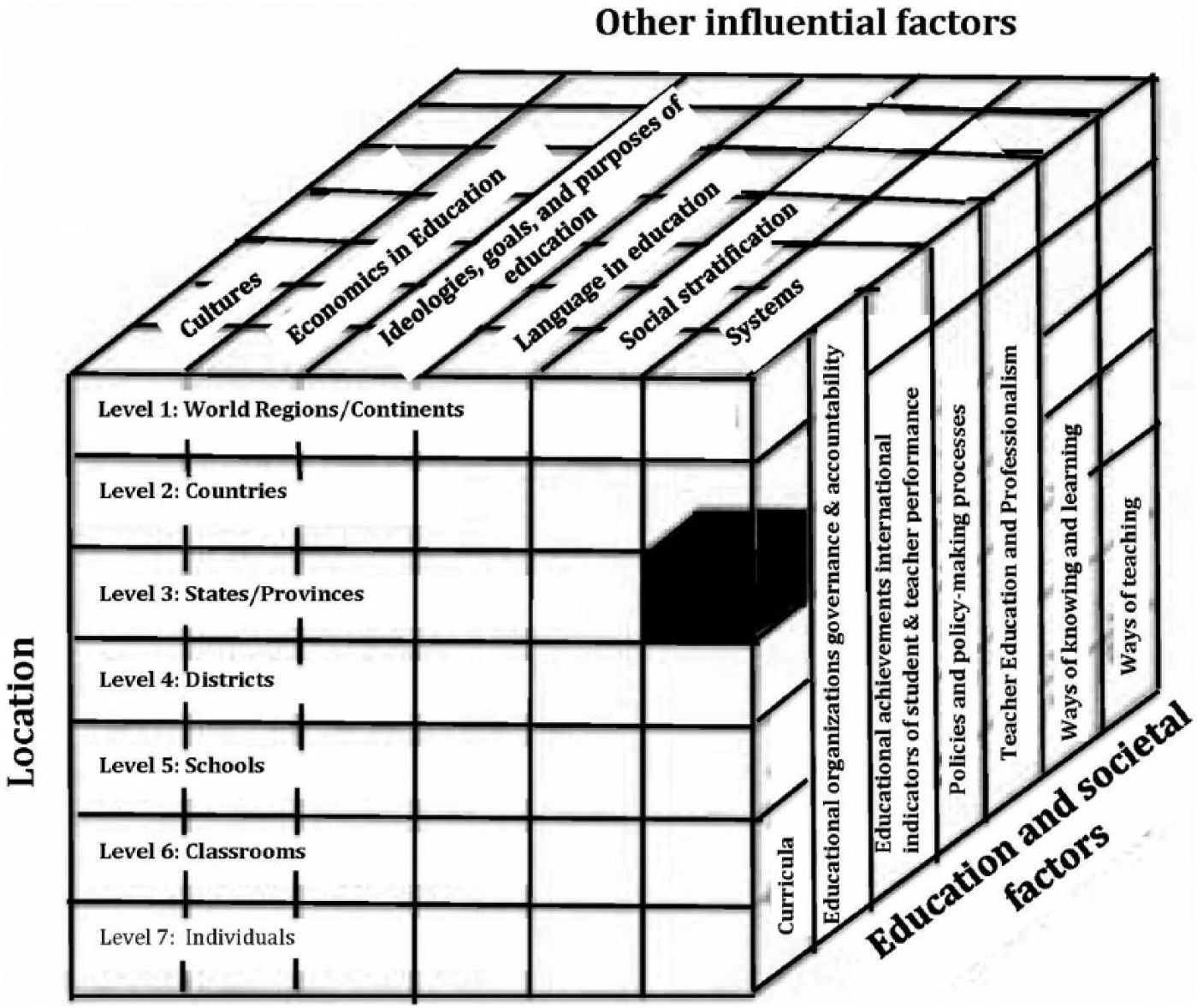
Framework for Comparative Anaylsis: Adapted from Bray and Thomas (1995).
The framework is quite robust. It is both dynamic and synergistic. It serves as a foundation to describe a host of different variables and the various relationships among them. Specifically, this adapted Bray and Thomas framework allows authors to (a) identify a unit of analysis (front, side, and/or top face of cube; choosing a minimum of two allows for a consideration of the “intersectionality” of factors that influence special education teacher education, see black section within the cube), (b) describe the work, (c) delineate the rationale for comparison, and (d) describe implications for both research and practice based on the comparison.
In an attempt to explore and understand globalization in special education teacher education, this special issue of Teacher Education and Special Education (TESE) contains articles that use the approaches and methods of comparative education to bring attention to scholarly work in special education teacher education from different regions of the world. In this issue, there are four articles. The first article, Xin, Accardo, Shuff, Cormier, and Doorman (this issue) discuss globalization within special education teacher education. This work reports the results of a study deigned to promote and increase global competency in pre-service special education teachers. The next two articles are from southeastern Asia and what is known as Western Asia, respectively. Walker (this issue) uses comparative methods as a foundation to critically analyze and describe special education teacher education in Singapore in southeastern Asia. Keller, Al-Hendawi, and Abuelhassan (this issue) use comparative methods as a foundation to critically analyze and describe the design and delivery of special education teacher education in a group of countries constituting the “Gulf Region” in Western Asia. Both articles are intended to provide an overview of the factors that shape teacher education in these two regions. In addition, both articles are preceded by special education teacher preparation landscapes, providing a brief description of the region and an overview of the state of special education teacher education in their region. In the final article, Darling, Dukes, and Hall (this issue) describe a systematic review of literature in search of special education teacher education universals or commonalities across the field of special education teacher education. This work reflects findings from more than 815 articles from 24 journals, published in four continents, aimed at identifying possible special education teacher education universals or common policies, practices, pedagogies, and teacher preparation/co-curricular activities. This article aimed to provide considerations for establishing universals in the field of special education teacher education.
Increase in globalization as we know it begets the need to increase global competence in all fields of study, inclusive of special education teacher preparation. However, to increase global competence, we must first understand more about the global landscape of special education teacher education, including similarities, difference, or universals. Comparative methods provide one tool for conducting these analyses because they tend to reveal relationships among multiple variables.
The intent of this issue was to ignite a conversation about international or global special education teacher education or preparation. The introduction of comparative methods served to introduce a generative approach for identifying and analyzing information, contributing to growth in both special education teacher educators and the pre-service teachers they prepare. Our increasingly globalized world has created new demands for special education teacher educators. These new demands perhaps require new ways of thinking. This kind of information can help to define and encourage the adoption of a comparative stance, perhaps reshaping our habit of mind about the teaching and learning process for pre-service teachers.
In short, the field can benefit from special education teacher educators who understand ways of knowing and learning for children with disabilities from all backgrounds across the globe. Preparation programs have included courses on child development and theories of learning. Thus, the call here is not for new or additional courses in these areas, but rather a consideration of the nature of knowledge, as well as indicators of learning, that reflect global competence. Specifically, special education teacher educators should create additional educational expectations that help pre-service teachers know, learn, and understand how children learn, with an appreciation for the influences of language, culture, economics, race, and ethnicity. Special education teacher educators should also understand ways of teaching that will allow pre-service teachers to effectively instruct children. Effective instruction is the hallmark of special education, but of course, instructional design is not always a straightforward enterprise. A global society calls for “ways of teaching” that instill content, but social consciousness as well. Our hope is that this issue spurs you, the reader, to initiate/continue research on preparing teachers for a global society, ultimately allowing our students with disabilities in pre-K through Grade 12 and beyond and their families to reach new heights in our globalized world.
Footnotes
Declaration of Conflicting Interests
The author(s) declared no potential conflicts of interest with respect to the research, authorship, and/or publication of this article.
Funding
The author(s) received no financial support for the research, authorship, and/or publication of this article.