



Abstract
Initial licensure polices in special education were examined to determine how these policies support or hinder reform efforts to develop teacher education programs that prepare graduates for the increasingly complex needs of diverse students. Initial special education licensure policies are described with an emphasis on the differences across states on two key options: whether licensure for special education teachers is a stand-alone initial license or whether the state requires a general education license prior to obtaining a second license in special education. As the field grapples with how best to prepare both general and special education teachers who can teach to high standards for students with disabilities, the influence of these options is examined in relation to four contemporary issues facing special education and the trade-offs that accrue when a particular licensure option is adopted.
Keywords
There seems little doubt that state teacher licensure policies are influential and serve as strong drivers for teacher education programs. The specific ways that policies influence teacher education practices, however, remain largely unexamined in the research literature. In the current national education reform context to implement higher standards, it is critical to scrutinize the extent to which specific state teacher education licensure policies and practices for special education may contribute to and influence teacher education and teaching and, in turn, the achievement of students with disabilities in the schools.
Historically, teacher licensure in special education has been dominated by what is often referred to as a stand-alone certificate—an initial license that teachers earn after completion of a special education teacher education program or sequence of special education courses and that does not require the awarding of a general education license first (Geiger, Crutchfield, & Mainzer, 2003; Geiger et al., 2014). In addition, such stand-alone licenses typically certify graduates to teach a wide K-12 grade band. In today’s schools, however, where students with disabilities are included and educated in general education classrooms in an increasingly routine fashion, such a policy raises questions about whether an initial, stand-alone license is sufficient for special education teachers in inclusive contexts and, further, whether teachers receiving these licenses are prepared to teach effectively across the broad developmental stages of K-12 education. The growing expectation for students with disabilities to succeed alongside their peers has begun to result in changing roles for both general and special education teachers (Brownell, Sindelar, Kiely, & Danielson, 2010; Youngs, Jones, & Low, 2011). Such changes have led to a trend, for example, for teacher education programs to prepare teachers for dual licensure in both special and general education (Blanton & Pugach, 2011).
Three recent efforts, all supported with federal funds, have created an active climate for greater scrutiny of teacher licensure for special educators. One such early effort, the Center for Improving Teaching Quality (CTQ), was funded from 2002 to 2007 by the Office of Special Education Programs (OSEP) and awarded to the Council of Chief State School Officers (CCSSO) in partnership with the American Association of Colleges for Teacher Education, the Council for Exceptional Children, and the National Association of State Directors of Special Education. Its purpose was to organize state teams representing special and general education (comprised of state licensure, program approval, and special education personnel, higher education faculty and administrators, as well as school district personnel) to work collaboratively to examine and make potential changes in teacher education, state licensure, and other policies relating to and influencing the teaching of students with disabilities. Ensuring that special education teachers gain sufficient depth of knowledge about both the subject matter they teach and about the broad developmental needs of students with disabilities, and how stand-alone K-12 licensure might influence teacher education in this regard, was highlighted in a 2007 policy guide published as part of this CTQ project (Blanton & Pugach, 2007).
A second OSEP funded effort, known commonly as the 325T Project, provided grant awards to 72 institutions of higher education (IHE) over 5 years (2006-2011). This initiative was focused on supporting the restructuring of special education pre-service programs in response to highly qualified teacher mandates, with priority given in later years to IHEs that collaborated with general education and to develop programs producing graduates exiting with dual licensure.
Currently underway, and funded by OSEP for 5 years (2013-2017), the Collaboration for Effective Educator Development, Accountability, and Reform Center (CEEDAR) is working with states to improve outcomes for students with disabilities via educator and system reform (i.e., teacher/leader preparation, state licensure and program approval, and educator evaluation). In addition to CEEDAR’s focus on licensure for special and general education as a key policy lever that states might use to influence outcomes for diverse students, it issued a report in collaboration with CCSSO, which recommends tiered licensure systems and state reciprocity as potential ways to change licensure in states (CCSSO & CEEDAR, 2015).
In addition to these three efforts, a recent report on state policies, including licensure, set forth several recommendations, one of which was to eliminate the wide grade band (i.e., K-12) for special education licensure (National Council on Teacher Quality, 2013). Taken together, this emphasis on licensure demonstrates its prominence as a concern in relationship to how to improve the preparation of educators who have the capacity to meet the needs of students with disabilities. And although some states have changed, or are in the midst of changing special education licensure—sometimes as a result of the efforts described above—the landscape of special education licensure and the issues requiring consideration relative to current educational reform have not been sufficiently interrogated. What does it really take, for example, for special education teachers to be adequately prepared to teach all subjects across the broad developmental span of Grades K-12, or for dually licensed special education teachers to learn the general education curriculum? Issues like these point squarely to the need to probe the outcomes—and subsequent trade-offs—of different approaches to licensure issues in special education.
The purpose of this analysis, then, is to examine how two policy approaches to initial licensure in special education, namely—stand-alone versus obtaining a general education license first—support or hinder current reform efforts to prepare teachers to meet the needs of students with disabilities. To address this, we first describe the current national status of special education initial licensure, documenting whether state certification is earned as a stand-alone initial license or whether a general education license is required before obtaining a second license in special education. In addition, for stand-alone licensure, we examine whether grade bands of the license span K-12 or are divided by developmental levels (i.e., elementary, middle, and secondary). Next we consider the impact of these licensure policies on pressing contemporary issues confronting teacher preparation for students with disabilities and the trade-offs these policy decisions represent. We conclude with a challenge to teacher educators to take a more active role in the policies that influence their programs and, subsequently, the quality of the teachers they produce.
The Landscape of Licensure Approaches in Special Education
Reporting on special education licensure options, Geiger et al. (2003) and Geiger and colleagues (2014) referenced data that were collected in 2002 describing whether state special education licensure was offered as a stand-alone option or required general education first, and whether stand-alone licenses spanned K-12 grade bands or were divided by developmental levels. For our analysis, we collected, examined, and cross-referenced data from multiple sources to obtain the most current information on these two licensure approaches, including (a) the most recent issue of Requirements for Certification of Teachers (Kaye, 2012); (b) a report issued by the National Council on Teacher Quality (2013) that included grade bands associated with special education certification; and (c) current websites on teacher licensure of each of the 50 states. This compilation, reported in Table 1, illustrates the complexity and differences across states.
Initial Licensure for Special Education Teachers—High-Incidence Disabilities.
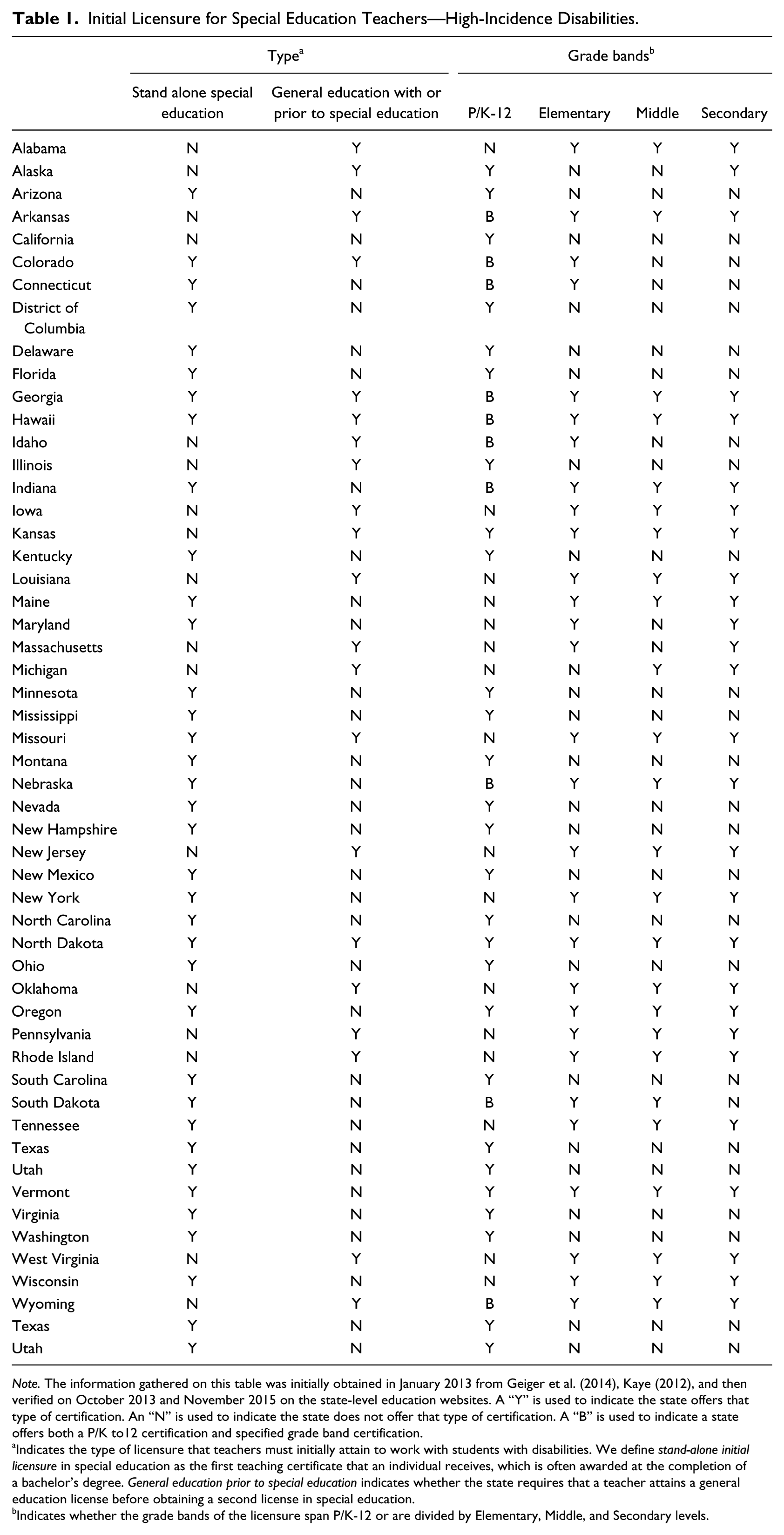
Note. The information gathered on this table was initially obtained in January 2013 from Geiger et al. (2014), Kaye (2012), and then verified on October 2013 and November 2015 on the state-level education websites. A “Y” is used to indicate the state offers that type of certification. An “N” is used to indicate the state does not offer that type of certification. A “B” is used to indicate a state offers both a P/K to12 certification and specified grade band certification.
Indicates the type of licensure that teachers must initially attain to work with students with disabilities. We define stand-alone initial licensure in special education as the first teaching certificate that an individual receives, which is often awarded at the completion of a bachelor’s degree. General education prior to special education indicates whether the state requires that a teacher attains a general education license before obtaining a second license in special education.
Indicates whether the grade bands of the licensure span P/K-12 or are divided by Elementary, Middle, and Secondary levels.
As illustrated in Table 1, 28 states currently maintain stand-alone special education licensure with a K-12 grade band for special education students with high-incidence disabilities, (the largest group of students with disabilities), findings that have changed very little from those reported by Geiger and colleagues (2014). Table 1 also indicates that 16 states currently require general education licensure prior to obtaining a special education teaching license and offer no stand-alone option. These data reflect an increase from four states, as reported by Geiger and colleagues (2014), to 16 at the time the data for this analysis were collected. Such a trend would seem to represent policy responses to the changes in service delivery for students with disabilities and the increasingly collaborative roles of general and special education teachers on their behalf. Given that special education licensure appears to be undergoing a transition, it is perhaps more critical than ever to interrogate the dominant licensure approaches in relation to key issues that affect the next generation of work needed to prepare special education teachers to implement high standards alongside colleagues in general education.
The Impact of Licensure Policy on Prominent Issues in Teacher Preparation for Students With Disabilities
To better understand the impact of these two dominant licensure approaches, we considered them in relationship to four major issues that confront special education teacher education today, especially the dominant philosophical issues associated with special education and its interface with general education for whom there is a shared responsibility for teaching students with disabilities in the schools. These four issues have been emphasized in the special education policy and teacher education literature, and each has been the focus of federal teacher education and system reform initiatives, such as the CTQ and CEEDAR projects. They include (a) student outcomes for students with disabilities, (b) relationships among multiple dimensions of diversity, (c) changing teacher roles for collaborative school practices, and (d) collaborative teacher education.
We acknowledge that other teacher education issues (e.g., alternate pathways to teaching, self-efficacy for teaching) might be considered in such an analysis, but we chose to deliberate on issues that specifically confront special education teacher educators as they prepare graduates for a workplace where they share responsibility with general educators for the achievement of students with disabilities. We anchor the discussion of each issue with a table that identifies affordances and constraints of each licensure option in relationship to that issue.
Each table illustrates the trade-offs that must be taken into account as states make decisions regarding licensure policies for special education teachers. Using these tables, fundamental questions can be raised—examples of which we have posed in the sections below—to guide teacher educators and policy makers as they deliberate the purposes and commitments that might define the preparation of special education teachers in the future. Furthermore, each table includes references to research to document whether the affordances and constraints are supported by evidence.
Student Outcomes for Students With Disabilities
Promising data are available from the National Center on Educational Outcomes (e.g., Thurlow, Quenemoen, Altman, & Cuthbert, 2008) indicating that a growing number of students with disabilities score at the proficient or above levels on state assessments in elementary, middle, and secondary reading. These state data, however, still show persistent achievement gaps between students with disabilities and their school peers (M. J. McLaughlin, 2010). State data also reveal that students with disabilities have higher school dropout rates (Johnson, Thurlow, & Schuelka, 2012), lower graduation rates (M. J. McLaughlin, 2010), and lower employment rates than persons of similar age without a disability (Newman et al., 2011)—all likely the result of students struggling academically in schools. In addition, students with disabilities themselves report that they have little confidence in their future goals (MetLife, 2011).
Although student outcomes have been shown to be influenced by a multitude of factors, the role that teacher licensure may play has been largely unexplored. Our scan of the literature shows that the research conducted on teacher certification and student outcomes is almost exclusively in general education (e.g., Darling-Hammond, Holtzman, Gaitlin, & Heilig, 2005; Wilson & Youngs, 2005), with only a handful of studies in special education. Of these special education studies, some have looked specifically at traditional versus alternative certification (e.g., Bell et al., 2010), but we identified only one study (i.e., Feng & Sass, 2010) that analyzed statewide data to explore teachers’ preparation in special education in relation to the achievement of students with disabilities. Although that study examined the value added of special education certification on students with disabilities’ reading and math achievement, it was not clear whether that licensure was stand-alone or was obtained after a general education license. Thus, we found no research to illustrate whether students with disabilities show improved school performance when taught by a teacher with stand-alone special education licensure in comparison with obtaining a general education license first.
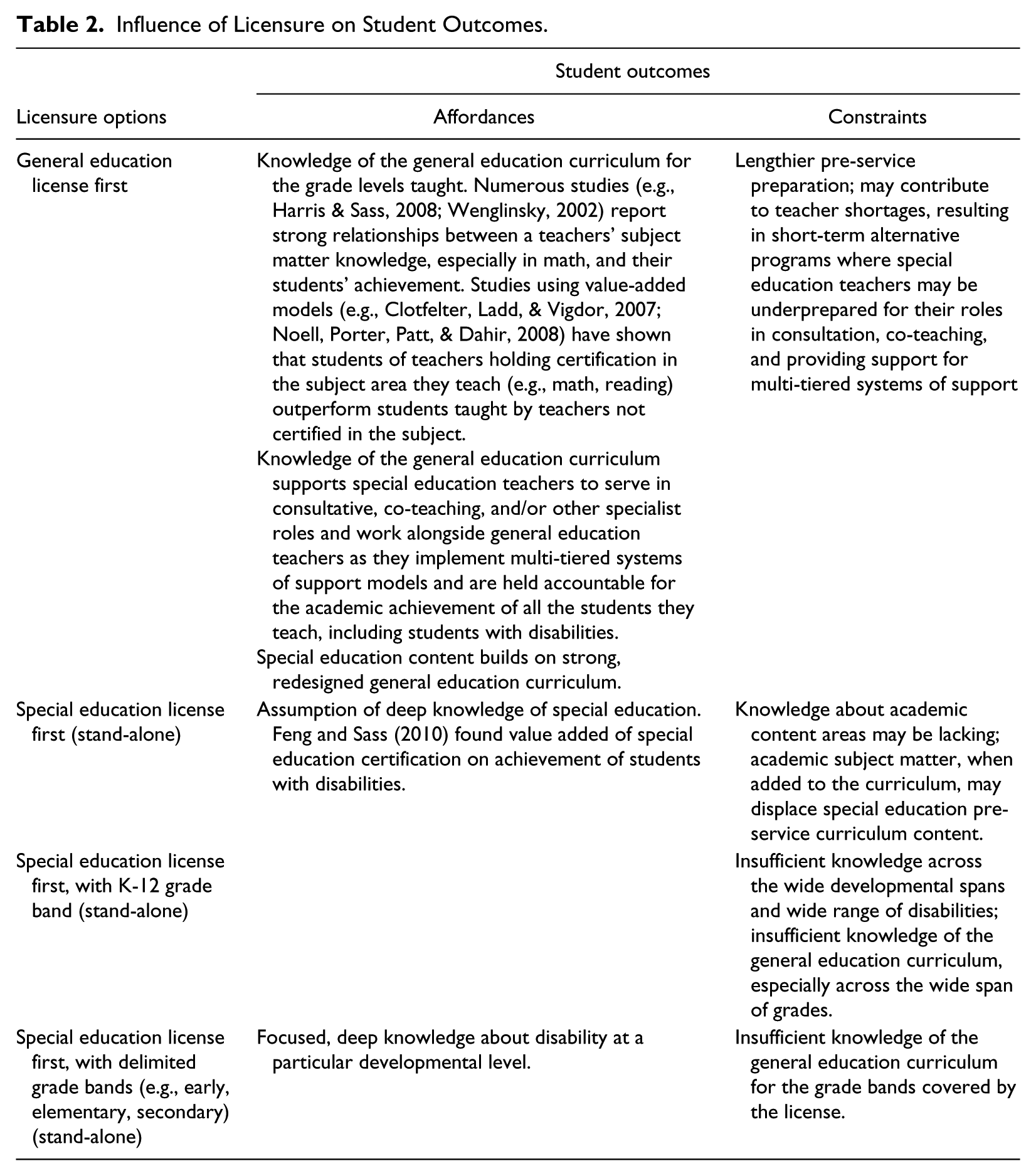
As shown in Table 2, the affordances and constraints of the two special education teacher licensure options on achievement outcomes for students with disabilities suggest several important questions for policy makers and teacher educators—questions that may lead to a clearer focus on which student outcomes are valued most in the preparation and credentialing of teachers and how policy supports or interferes with those values. For example, when considering how the range of knowledge and skills that a contemporary special education teacher needs is defined, Table 2 provides insight on how licensure options relate to student outcomes in regard to the following two questions: What will it take to assure that prospective special education teachers gain the knowledge and skills needed to work in inclusive educational environments—both in terms of teaching directly and supporting teaching academic content to assure positive student outcomes, as well as the specialized knowledge for working with the full range of students who have disabilities, inclusive of those with low-incidence disabilities? What considerations regarding length of preparation need to be taken into account, and how do issues of program length and space affect the pre-service enterprise? As policy makers and teacher educators reconsider the roles of special education teachers with regard to student outcomes, the relationship between solid, robust knowledge in both the academic curriculum and specific special education practices needs to be purposefully negotiated to assure that the content of pre-service preparation develops to reflect real shifts in teacher responsibility.
Influence of Licensure on Student Outcomes.
Relationships Among Multiple Dimensions of Diversity
One assumption that continues to be pervasive in education is the notion that different groups of students require different types of teachers (e.g., special education, bilingual education). In special education, students with disabilities who are culturally or linguistically diverse, or come from low socioeconomic levels, may be separated and viewed chiefly by their disabilities rather than by taking into consideration both their abilities and their full range of sociocultural identity markers (Pugach, Blanton, & Boveda, 2014; Waitoller & Artiles, 2013). Such a simplified, one-dimensional view of diversity can result in teachers, special and general education alike, being ill prepared to meet all of the needs of all of the students they are expected to teach, as well as failing to fully understand the complex and intersecting diversities inherent in every student.
Despite progress that has been made regarding issues such as reducing the disproportionate identification of students of color in special education, what is required now is a deeper exploration of the special educator’s role in understanding the different ways that ethnic, linguistic, and socioeconomic class-based diversity impact ways of being and knowing in children (Seidl & Pugach, 2009). In addition, for teacher education to move forward, teacher educators from within various diversity communities, such as bilingual education, urban education, or special education, can benefit and improve teacher preparation by fostering sustained dialogue across these communities (Pugach, Blanton, & Florian, 2012).
Table 3 displays affordances and constraints of licensure options in relationship to multiple dimensions of diversity. Fundamental questions that require deliberation with regard to this issue include: How do these licensure policies either perpetuate or destabilize the assumption that certain types of teachers should only work with certain types of students? How do special educators learn to situate their students’ diversities other than disability into their identity as persons with disabilities? For example, the table displays how licensure options may influence the understanding of the relationship between serving students with disabilities well and situating those students within their full social identity communities and contexts. Deliberating on questions such as these might more clearly illustrate the outcomes teacher educators value in the preparation of teachers with regard to student diversity, and begin to deal with the complex challenge of what it means both to prepare a specialist well, and to do so in a way that honors the general education learning contexts in which so many students with disabilities—whose identities are complex—are educated.
Influence of Licensure on Relationship Among Diversities.

Changing Teacher Roles for Collaborative School Practice
According to the National Center for Education Statistics (Hemphill & Vanneman, 2012), during the fall of 2009, 95% of students with disabilities received their education in regular schools. In addition, 63% of students labeled as having a learning disability, and 86% of students with speech or language impairments spent more than 80% of their time in general education classes. Such figures demonstrate the impact of the 1997 reauthorization of the Individuals with Disabilities Education Act (IDEA), and again in 2004, actions which included specific mandates for students with disabilities to have access to the general education curriculum. This access mandate resulted not only in changes to the settings where students with disabilities were being served but also in the roles that special education teachers would perform in relationship to the academic curriculum and the challenge for teacher education programs to prepare them for these new roles.
As more students with disabilities are educated in general education classrooms, and the teacher of record for these students is often the general education classroom teacher, the expectation for special educators to engage collaboratively with their colleagues has increased. This expectation, then, means that the special education teacher must have sufficient knowledge of the general education curriculum for the grade levels they are teaching. In turn, the general education teacher must possess knowledge of the diverse students she or he is teaching. This latter point is an important consideration in that 78% of general education teachers report that it is challenging to very challenging to teach the diversity of students making up their classrooms (MetLife, 2013). In addition, 80% of these teachers agree on the importance of shared responsibility among teachers for student achievement (MetLife, 2010).
Historically, role ambiguity has been a pervasive issue for special education teachers (Rock et al., 2016), resulting not only from the growing expectation for special educators to serve in collaborative roles with their school colleagues but also for the variety of other roles (e.g., resource room and self-contained settings) that might be expected of them. Furthermore, special education teacher identity can come into question when teachers are assigned a wide variety of different roles in schools (Naraian, 2010). These role contradictions pose challenges for teacher educators and policy makers and need consideration in discussions of how licensure is structured.
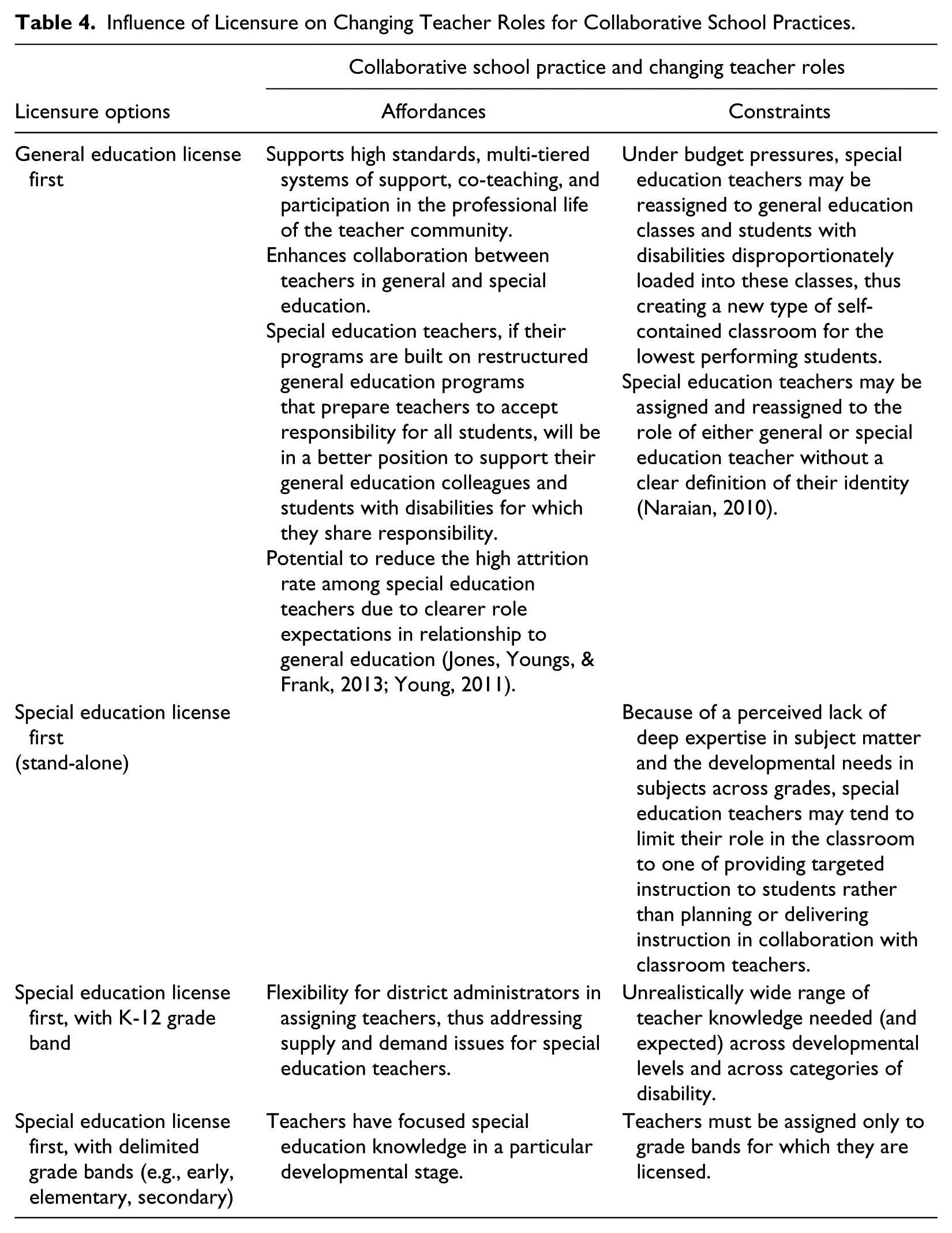
That special education teachers need to be prepared for increasingly collaborative roles does not seem to be in question. What is in question is how best to do so. Considering the current school context that demands practices in which special education teachers must engage with higher standards, and their changing roles in doing so, how do different licensure approaches contribute to supporting teachers’ collaborative practices? Significant questions requiring consideration when examining affordances and constraints of each licensure option (see Table 4) include the following: Which licensure approach might best support teacher educators to prepare special educators for the collaborative roles they will increasingly play in schools? What is the relationship between administrative expediency in schools, which favors maximum flexibility to place special education teachers across a wide grade span, and deep knowledge of a developmental level and grade level curriculum? Questions such as these highlight the need to place teachers’ collaborative roles within both a policy and practice context.
Influence of Licensure on Changing Teacher Roles for Collaborative School Practices.
Collaborative Teacher Education
As a growing trend in teacher education since the 1980s, collaborative teacher education is a broad umbrella term that describes preservice program redesign based on a common, shared goal of bringing together teacher preparation for general and special education for the purpose of improving the quality of instruction for all students generally, and particularly for students who have disabilities. (Blanton & Pugach, 2011, p. 220)
Supporting this trend was the competitive preference given to grants submitted under the U.S. Department of Education, OSEP 325T program, for dual certification in general and special education. Although several models for collaboration that can result in dual licensure have been described and critiqued in the literature (Blanton & Pugach, 2007, 2011), it appears that many special education programs remain separate but offer service courses to other programs, such as a one-course special education requirement (U.S. Government Accountability Office, 2009).
Most states have adopted higher standards for K-12 education requiring that special education teachers be prepared to align the curriculum, integrate high-quality explicit instruction, and implement instruction based on student needs, while helping students gain sufficient knowledge to master rigorous grade level standards. To achieve these outcomes, special education teachers need a solid understanding of K-12 standards as they work with general education teachers and determine instructional options for students with disabilities (Haager & Vaughn, 2013; M. McLaughlin & Overturf, 2012). Understanding the influence of licensure approaches on collaborative teacher education programs is important to this discussion because the goal in redesigning programs—including both the content of the program and the organization of the content and clinical experiences throughout a program—should be to achieve the long-standing value held for inclusive practices.
For example, the simple addition of few courses in special education at the end of a general education program that has not been sufficiently redesigned could fail to provide novice teachers with the realities of collaborative practices in schools. In contrast, if fully merged programs are put into place where both a general and special education license can be earned after a single 4-year program, the depth of knowledge for both subject matter and for special education content may not be sufficient—especially with a K-12 special education license. Furthermore, it is possible that in attempts to put all the content in a single, merged undergraduate program special education content may be privileged over content related to other student identity markers (Pugach & Blanton, 2012).
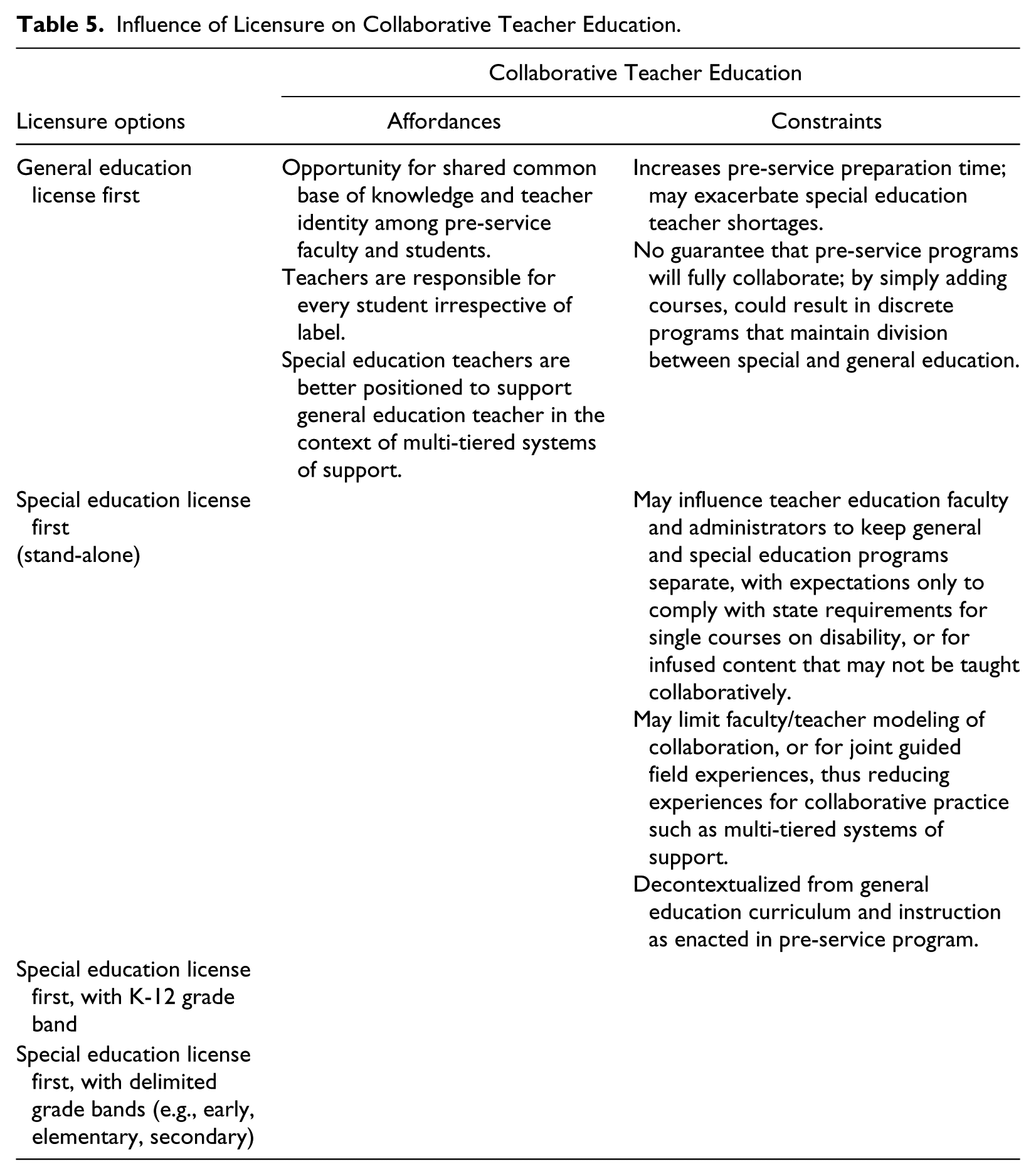
As the affordances and constraints of licensure structures are reconsidered in relation to this issue (see Table 5), questions that teacher educators might ask themselves when considering how the licensure structures support real collaborative work on the part of teacher education providers are: How well does the licensure structure support policy initiatives such as multi-tiered systems of support, which are intended to assist students with disabilities to succeed in schools? How do different licensure structures foster cross-disciplinary program redesign? Examining the answers to these questions might yield a better understanding of what it takes to implement programs that go beyond simple solutions and begin to take on the complexity of real, deep collaboration in teacher education. Furthermore, answering such questions helps teacher educators frame their communications and engagement with policy makers.
Influence of Licensure on Collaborative Teacher Education.
The Trade-Offs of Different Licensure Approaches for Preparing Teachers to Meet the Needs of Students With Disabilities
As teacher preparation providers have expanded from being almost exclusively higher education based to also including non-higher education based providers (e.g., non-profits, for-profits, school districts; U.S. Department of Education, 2013), it is critical to underscore the importance of policies such as state licensure and how this lever can serve to ensure that all educator providers meet desired standards for addressing the needs of students with disabilities. All too often, however, teacher educators may simply react to policy levers such as the state’s licensure system and program approval guidelines, by aligning their programs to ensure compliance with these policies, rather than reflecting on how these policies support national values for inclusive practice in schools. Although teacher educators may assume that a state’s policies reflect these values in school practices as well as the research findings about inclusion, the very opposite could be true, especially if policy is driven by other factors (e.g., teacher shortages) that may promote expediency—even if in good faith. Such practices may have the unintended consequence of trumping the quality needed in today’s special education teachers.
Because the practice in today’s schools is that special education teachers work alongside general education teachers who are the teachers of record for the vast majority of students with high-incidence disabilities, it seems reasonable to expect a state’s policies to reflect this practice. But do they? By examining the affordances and constraints of licensure options, we hope to expose the trade-offs needing consideration as decisions about policy changes in licensure are made in each state. In this way, teacher educators and policy makers may better understand when a trade-off conflicts with the values that have been held historically for the inclusion of students with disabilities. If teacher educators do not want to see these values undermined, we urge them to raise questions such as those posed for the issues discussed in this analysis. Raising questions that seek answers to contradictory positions might lead to a deeper understanding of how licensure impacts their programs and the subsequent knowledge and skills their graduates possess to support the achievement of students with disabilities. The challenge, then, is for teacher educators to become proactive about the influence of policy and to engage actively in their states to gain the attention of policy makers and garner more support for an emphasis on the quality of the special education teacher workforce. The trade-off of failing to use these polices to support the highest standards for all the teachers prepared to teach students with disabilities may result in continuing the unacceptable achievement gaps between students with disabilities and their peers.
Footnotes
Declaration of Conflicting Interests
The author(s) declared no potential conflicts of interest with respect to the research, authorship, and/or publication of this article.
Funding
The author(s) received no financial support for the research, authorship, and/or publication of this article.