



Abstract
The goal of Special Education is to help individuals with disabilities transition to meaningful adult roles. When students with disabilities pursue education majors, Special Education Faculty must balance their desire to support college students with disabilities, while maintaining the rigor of their academic programs. To gain a better understanding of how to support students with disabilities in teacher preparation programs, faculty must have a clear understanding of federal legislation and recent case law related to students with disabilities in professional programs in higher education. The purpose of this article is to provide an overview of the legal precedent for working with students with disabilities in teacher preparation programs. In this study, the authors review federal legislation for students with disabilities in higher education, present recent case law related to accommodating students with disabilities in college training programs with field components, and provide suggestions for faculty working with students with disabilities.
Keywords
Since the promulgation of P. L. 94-142 in 1975, the fundamental function of Special Education has been to provide students with disabilities a free and appropriate public education and related services that meet their unique needs (Education for All Handicapped Children Act, 1975). For secondary-aged students, the focus of their education and services is “to facilitate the [student’s] movement from school to post-school activities” (Individuals with Disabilities Education Act, 34 CFR 300.43 (a), 2004). For a growing number of students with disabilities, this includes attending an institution of higher education (Newman, Wagner, Cameto, Knokey, & Buckley, 2009). In 2013, the National Center for Educational Statistics reported 11% of undergraduate students attending college have a documented disability and many of these individuals pursue majors in education (Snyder & Dillow, 2015). Researchers with the National Longitudinal Transition Study–2 interviewed students with disabilities and reported that 19% of students attending 4-year colleges selected education majors. After social sciences majors, education represented the second most popular major among survey respondents (Newman et al., 2009).
Students with disabilities present an interesting quandary for teacher preparation programs. Although a goal of Special Education is to ensure that students with disabilities are able to transition into adult activities, such as college or vocational training, the complexities of their disabilities can make the transition difficult. Candidates entering teacher education programs must understand there is an important shift between the accommodations provided at the secondary level and those provided in higher education. During P-12 education, parents and educators play a critical role during the identification and planning of an appropriate Individualized Education Program. At the university level, the student becomes responsible for disclosing their disability and ensuring they receive accommodations. This may require the student to engage in a variety of new behaviors, including gathering documentation of the disability, scheduling meetings with the Office for Disability Services, and advocating for accommodations with professors (Newman, Madaus, & Javitz, 2016). Further complicating the issue, students are unable to receive their accommodations until they formally disclose their disability to the appropriate office at the higher education institution. This process can be challenging because students bear the burden to disclose their disability. Disclosure can be complicated, as students are taking on more responsibility and navigating new systems. Due to this challenge, it is not surprising that only 37% of students disclose their disability to their university (Newman et al., 2009).
Despite the challenges with disclosure, the growing number of students with disabilities has led to a need for providing appropriate accommodations in university settings (Eckes & Ochoa, 2005; Newman et al., 2016; Newman et al., 2009). As students begin career preparation, some students may experience the impact of their disability in different ways. For example, college coursework offers more independence than many high school courses; students may need to learn to manage their time, utilize new services (e.g., the writing center), and navigate an electronic system like Blackboard™. In addition, within certain majors such as education, additional field components are often required to complete a degree program or receive a license (Council for the Accreditation of Educator Preparation [CAEP], 2015a). This requires teacher preparation programs to consider a number of questions. For example, what supports are in place for students with disabilities to successfully transition from a secondary education to a postsecondary teacher education program? Do accommodations for college coursework differ from accommodations needed during field placements? Does a student remain qualified if they require unique accommodations in fieldwork that substantively change the teacher preparation program requirements?
Addressing these considerations can be challenging for university faculty. Special Education faculty may be uniquely positioned to provide guidance about how to support individuals with disabilities due to our content expertise. There must be careful consideration for how special education faculty advocate for these individuals. Although special educators may desire to support students with disabilities in higher education, faculty cannot abdicate standards of the profession—even for students with disabilities.
As students with disabilities enter teacher preparation programs, many faculty members find themselves in unknown territory. Faculty must support students while maintaining program standards set forth by accrediting bodies, such as the Council for Exceptional Children (CEC) and the CAEP. Furthermore, faculty must ensure student performance meets individual state licensure standards, while complying with legal mandates designed to protect and support students with disabilities. The task is further complicated when considering how to accommodate educational needs as students transition into field placements, as the dynamic, fast paced environment of a P-12 classroom may offer new challenges for individuals with disabilities.
Despite the growing number of students with disabilities in higher education, there is a limited body of literature focusing on accommodating students with disabilities in teacher preparation programs. Therefore, the purpose of this article is to provide a legal review to support faculty working with students with disabilities in teacher preparation programs. First, we will review federal legislation for students with disabilities. Then, we will provide a review of recent case law related to accommodating students with disabilities in professional programs in higher education. Finally, we use findings from case law and provide suggestions about how to support students with disabilities in teacher preparation programs.
Federal Legislation
When students with disabilities exit secondary education, they no longer receive services under the Individuals with Disabilities Education Act (IDEA, 2004). They can access accommodations in postsecondary education through Section 504 of the Rehabilitation Act of 1973 and the Americans with Disabilities Act (ADA) of 1990 and the 2008 amendment. Both Section 504 and ADA provide support and accommodations for individuals with disabilities. Section 504 requires that accommodations are provided to individuals in establishments receiving federal funds, such as state colleges, whereas the ADA applies to the private sector—such as private colleges—or to state and local government agencies that do not receive federal funding. Thus, students with disabilities attending both public and private universities may be eligible to receive accommodations (Garcia v. S.U.N.Y. Health Sciences Center, 2001).
To qualify for accommodations under these statutes, students must meet at least one of the following three criteria: (a) have a physical or mental impairment that substantially limits one or more major life activities, (b) have a record of such an impairment, and (c) or be regarded as having such an impairment that substantially limits one or more major life activities. For example, major life activities may include seeing, hearing, or reading (U.S. Department of Labor, 2015). In addition, individuals must be otherwise qualified to meet all of a program’s requirements in spite of their disability (Southeastern Community College v. Davis, 1979). In many instances, the individual may be provided reasonable accommodations to allow them to complete the program requirements (U.S. Department of Education, 2011) yet these accommodations cannot present an undue hardship to the institution.
Accommodations are provided based on the individual needs of the student, and are related to the documented disability. Examples of accommodations may include extended time on exams for students with learning disabilities, or interpreters for students with hearing impairments. To better understand the scope of these accommodations, it is necessary to review recent legislation to determine how courts have interpreted ADA and Section 504. For the purpose of this study, we reviewed cases litigated within the last 10 years to account for increased standards and focus on teacher accountability since the passage of No Child Left Behind. (No Child Left Behind Act of 2001: Qualifications for Teachers and Professionals, 2002). Cases were included if they occurred within professional programs (e.g., medicine, speech therapy, education) in higher education settings, and focus on professional programs with a clinical or field component.
Otherwise Qualified
To determine whether a student is otherwise qualified, teacher preparation programs must consider whether the student can perform expected tasks with the requested accommodation. Although a number of cases have tested this provision of Section 504 and ADA, Southeastern Community College v. Davis (1979) was the U.S. Supreme Court ruling that advanced the standard of otherwise qualified under Section 504. Davis was a student with a serious hearing impairment who was denied admission to a nursing program because of her disability. The program argued that even with her ability to read lips and the use of a hearing aid, she would be unable to safely complete the program requirements or safely be employed as a nurse in the future. The court ruled in favor of the school, finding that even with these supports, Davis was not otherwise qualified to complete the requirements of the job. Because her hearing loss prevented her from meeting the physical qualifications for admission to a clinical training program, the court ruled that the program was not required to make substantive changes to a program to accommodate a student with a disability (Southeastern Community College v. Davis, 1979).
Over the years, additional cases have tested the legal requirement that students must be otherwise qualified. Recent cases addressing the standard for otherwise qualified are found in Table 1. One consistent finding is that an institution is not required to substantially modify a program or compromise the integrity of a training program. For example, a court ruled that adding an additional year to the program could compromise the integrity of the program (Shaikh v. Lincoln Memorial University, 2015). Furthermore, a court held that the student must be able to meet the physical requirements of licensure, certification, or professional standards (McCulley v. University of Kansas School of Medicine, 2014) to maintain their status as otherwise qualified.
Cases in Clinical/Field Programs Testing Otherwise Qualified.

Note. Cases are listed in chronological order. ADHD = attention deficit hyperactivity disorder; GPA = grade point average.
Shaikh v. Lincoln Memorial University also represents as a case testing a reasonable accommodation.
In addition, the ruling in Singh v. George Washington University (2011) suggested students must also remain otherwise qualified throughout the program. When students struggle within a program, there must be a clear demonstration of how an academic impairment is a result of the disability to remain in the program. In addition, the court ruled that when a student drops below program requirements with accommodations (Carlson v. Carroll University, 2011), they can be found not otherwise qualified and dismissed from the program.
Student dispositions may also be considered when considering when determining whether a student is otherwise qualified (Halpern v. Wake Forest University Health Sciences, 2012; Shah v. University of Texas Southwestern Medical School, 2016). For example, in Halpern v. Wake Forest University Health Sciences (2012), Mr. Halpern received disciplinary actions as a result of unprofessional behavior (e.g., he was resistant to feedback, lacked interpersonal skills, absent without permission for more than one week). His continued lack of professionalism resulted in his dismissal from medical school. The court stated that when a school has reasonably determined based on an identifiable pattern of prior conduct that a student is unfit to join his chosen profession, federal law does not obligate the school to allow that student to remain in and graduate from its educational program. (Halpern v. Wake Forest University Health Sciences, 2012, pp. 466, 467)
Reasonable Accommodations
As noted earlier, for a student with a documented disability who is otherwise qualified for an academic program, they can expect reasonable accommodations from the higher education institution to accommodate the disability; yet the accommodation cannot cause an undue hardship to the university. Wynne v. Tufts University School of Medicine (1991) was a case that tested the scope of a reasonable accommodation and set precedent that has impacted future cases. Wynne was a medical student with a learning disability who was dismissed from Tuft University Medical School due to poor academic performance. He requested an alternative assessment to multiple-choice exams. When the University denied his request, Wynne filed suit claiming discrimination under ADA, stating the University failed to offer a “reasonable accommodation.” The court found universities must consider a student’s request accommodations. If the accommodation is denied, the University is responsible for demonstrating that the accommodation would substantially alter the integrity of the program. Wynne has set precedent as the first major test of the reasonable accommodations provision (Rothstein, 2015). Wynne established that in cases involving modifications and accommodations, the burden is [on] the institution to demonstrate that relevant officials within the institution considered alternative means, their feasibility, cost and effect on the program, and came to a rationally justifiable conclusion that the alternatives would either lower academic standards or require substantial program alteration. (Rothstein, 2015, p. 553)
Additional cases have tested the scope of reasonable accommodations since the Wynne ruling. A review of details for each case addressing the nature of reasonable accommodations is found in Table 2. Based on the findings of these cases, it is clear that the court does not expect the university to provide accommodations that substantially modify a program (Shaikh v. Lincoln, 2015), but does expect the university to allocate resources to provide reasonable accommodations when the accommodation does not place an undue hardship to the institution (Argenyi v. Creighton University, 2013).
Cases in Clinical/Field Programs Testing Reasonable Accommodation.
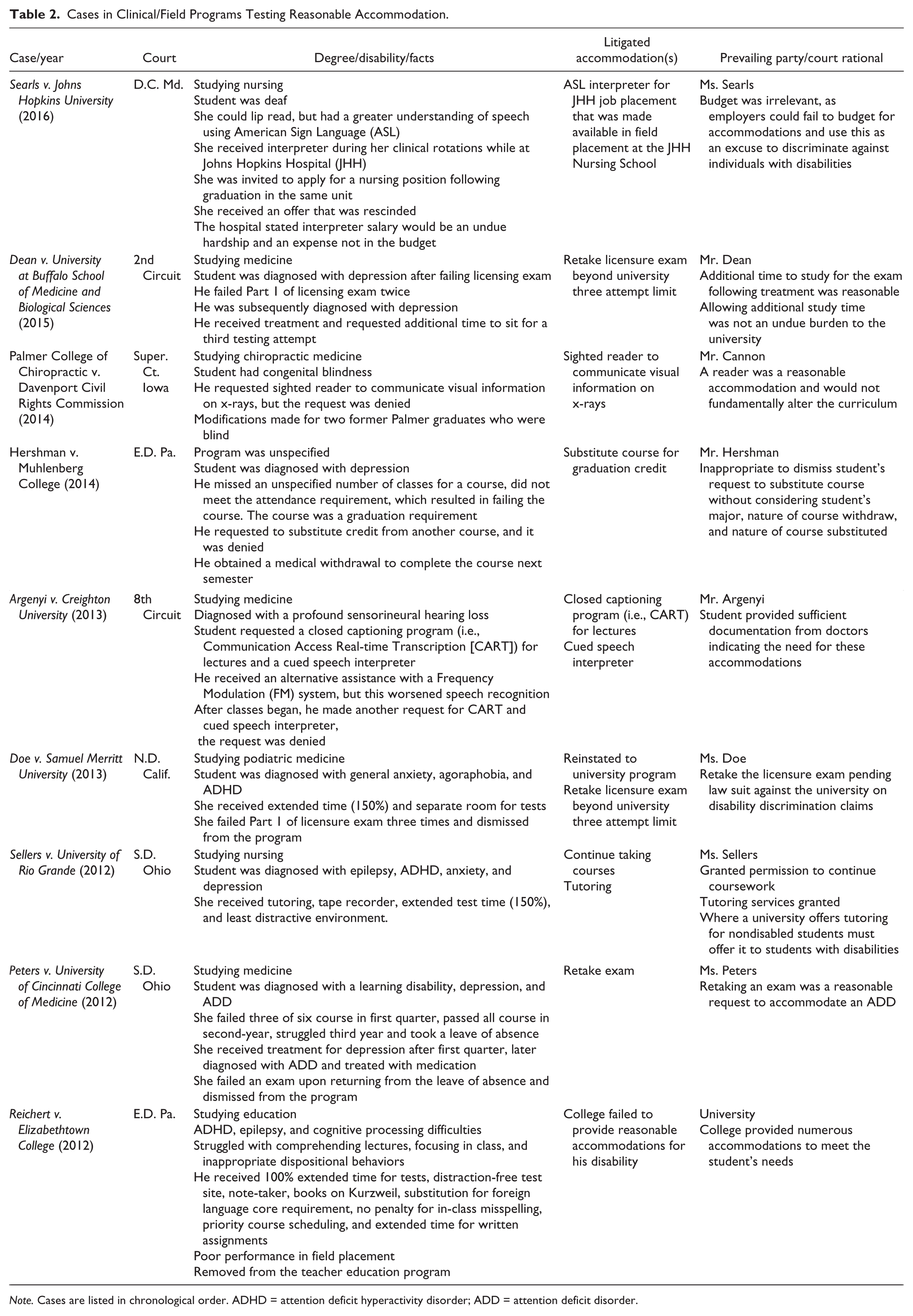
Note. Cases are listed in chronological order. ADHD = attention deficit hyperactivity disorder; ADD = attention deficit disorder.
Other cases have looked at how a university’s prior practices can impact a court’s decision about whether or not an accommodation is considered reasonable. An institution would be required to make a particularly strong case to establish that an accommodation is unreasonable when the university, in the past, provided a similar accommodation to another student with the same disability (Palmer College of Chiropractic v. Davenport Civil Rights Commission, 2014). Furthermore, if a university made a reasonable accommodation within a university training program, there may be implications for the same accommodation to be made in future employment (Searls v. Johns Hopkins University, 2016). Providing an accommodation in the past does not necessarily mean that the accommodation is always required in the future (Sellers v. University of Rio Grande, 2012). Finally, courts have found universities must consider the specific course of study when determining reasonable accommodations (Hershman v. Muhlenberg College, 2014). They must also consider whether retaking exams in coursework (Peters v. University of Cincinnati College of Medicine, 2012), and retaking licensure exams (Dean v. University at Buffalo School of Medicine and Biological Sciences, 2015; Doe v. Samuel Merritt University, 2013) are permissible.
These cases suggest whether an accommodation substantially alters academic standards, the institution has the right to protect the integrity of the program. As these cases originate in medicine and nursing programs, it is unclear how accommodations may transfer to field placements in teacher education.
Applications in Teacher Education Field Placements
As candidates progress through their training programs, they are required to meet both academic and dispositional standards during their clinical experiences to remain otherwise qualified. Field placements often require fluency to rapidly interpret student performance throughout the school day, taking formative feedback from their instruction, and using feedback to modify their instruction to meet the needs of their learners. In addition, CAEP requires programs monitor and demonstrate the quality of their teacher candidates as they progress through the program. As part of this process, CAEP (2015b) standard 3.3 requires that teacher preparation programs “establish and monitor attributes and distributions beyond academic ability that candidates must demonstrate at admissions, or during the program” (para.1). This is particularly important because a student’s ability to obtain high marks in academic coursework areas does not necessarily qualify the student as a viable teacher candidate. Two court cases have tested the scope of reasonable accommodations within field components in teacher preparation.
In Marino v. City University of New York Hunter College (2014), the student challenged her final grade in student teaching, claiming discrimination on the basis of disability. Ms. Marino was a student with partial paralysis and processing difficulty, who performed well in her college coursework. During her field placement, Ms. Marino alleged that her university supervisor questioned the mentor about whether Ms. Marino’s disability affected her work or caused her to be violent with students. She also asked whether the mentor thought Ms. Marino should be a teacher considering the nature of her disability. At the end of her field placement, her mentor teacher provided favorable evaluations; however, her university supervisor gave her a “C.” Ms. Marino sued Hunter College, claiming discrimination based on her disability. The court ruled that she failed to provide a connection between her grade and comments that were allegedly made by the university supervisor. Her case was dismissed since she did not provide substantive evidence of discrimination. Thus, in spite a high academic grade point average (GPA), she was no longer qualified based on the supervisor’s evaluation of her performance during student teaching.
In Reichert v. Elizabethtown College (2012), the court evaluated the scope of accommodations and also addressed professional dispositions. Mr. Reichert had attention deficit hyperactive disorder, epilepsy, and other challenges in learning (e.g., slow language processing, poor listening comprehension, and frequent interruptions during conversations). He received extensive accommodations for his college coursework (see Table 1). Despite the accommodations in his coursework, Mr. Reichert demonstrated a number of inappropriate dispositional behaviors, including cheating on a final exam, plagiarizing work, making offensive comments, making threatening statements to professors and students, being defensive, using rigid thinking, blaming others for his mistakes, and inappropriate racial and sexist comments. These dispositional challenges were evident both in college coursework and in his clinical field placements, and ultimately resulted in removal from his student teaching placement, along with a formal review of his qualifications to remain in the teacher certification track.
Reichert’s neurologist wrote a letter suggesting the disciplinary action exacerbated his disability, and requested the review be delayed until his condition stabilized. The request was granted, but Reichert decided to leave the university and pursue his education elsewhere. After leaving the university, Reichert sued Elizabethtown College under the ADA and Section 504, contending that the college failed to provide reasonable accommodations for his disabilities. The court ruled in favor of the college, suggesting Reichert failed to demonstrate discrimination on the basis of the disability. Furthermore, Judge Schiller stated that the Elizabethtown College provided numerous accommodations to meet Mr. Reichert’s needs and the additional request for extended time to complete lesson plans would alter the integrity of the program and therefore is not required under ADA. Finally, his request for a peer tutor with a certain background in method courses the court found, as in Carlson v. Carroll University (2011) that a personal tutor falls under the “services of a personal nature” which are excluded under Section 504.
Implications for Practice
Higher education personnel are often unprepared to meet the needs of students with disabilities (Humphrey, Woods, & Huglin, 2011). Therefore, it is necessary to consider the legal precedent for addressing the needs of students with disabilities in teacher preparation. These cases provide preliminary guidance for accommodating students with disabilities in higher education, with a focus on the provision of accommodations in field placements. Within teacher education, this may have significant implications. In many ways, teachers with disabilities may be better positioned to build rapport with parents and struggling students, as they have experienced many of the challenges that these students face (CEC, 2016). Individuals with disabilities are still required to meet the general expectations of the program.
To prepare students with disabilities in field placements, faculty must consider a number of variables. First, many college students who formerly received services in Special Education do not disclose their disability in higher education (Newman et al., 2009). When a student fails to disclose their disability, they are not afforded the same protections they would be under Section 504 and ADA. As they progress through their field placements, the challenges of their disability may become evident, and faculty must work with them to determine whether they will progress through the program successfully. Other students may disclose their disability and request accommodations, and still struggle in field placements. In these cases, faculty must clarify the provision of reasonable accommodations in field, and determine whether the student remains otherwise qualified. Finally, when students—with and without disabilities—struggle in their field placements, there must be a clearly defined process for determining whether the student remains otherwise qualified to continue in the program. Thus, to fully accommodate the diversity of students, it is beneficial to consider a multitiered system of support for students in field placements.
Tier 1: Universal Design for All Students
Because students without disabilities may also struggle in field, it is important to explicitly outline expectations, universally designing interventions for all students. The purpose of universal design is to promote the inclusion of all learners (Friend & Bursuck, 2012). This begins with clearly defining expectations. First, the university expectations should be clearly communicated to the students. This may include the expectations for student behavior in the code of conduct, as well as any relevant program expectations. These standards outline a minimum threshold that students must meet to demonstrate their success. Faculty in teacher education may also consider developing additional resources that are sensitive to the demands of field placements.
In P-12 classrooms, students must demonstrate certain competencies in communication, behavior, social skills, cognitive reasoning, and physical abilities. Faculty should define expectations for each of these areas. For example, expectations for communication may include regularly communicating with the mentor teacher and university supervisor about professional development, identifying areas for growth and seeking support, and clearly communicating student performance with parents or other stakeholders. Similarly, with cognitive reasoning, faculty may communicate that students must have a mastery of the content they are teaching, demonstrate fluency with the material by presenting different examples to thoroughly explain the concepts, and evaluate student performance and make instructional decisions. Although many of these expectations are often implicit, explicitly defining expectations allow faculty to be better positioned to communicate the expectations for field placements.
Tier 2: Determining Whether Requested Accommodations Are Reasonable
In addition to solid, universal design, faculty must be prepared for students with disabilities who request accommodations. To fully comply with the guidelines in ADA, the university and student participate in an interactive process to determine the accommodations based on individual needs of the student (Rothstein, 2015). Faculty must consider the requested accommodations, determine the implications for the requested accommodation in the field, and define the scope of the provision of accommodations. The form in Figure 1 can be used to facilitate this process.
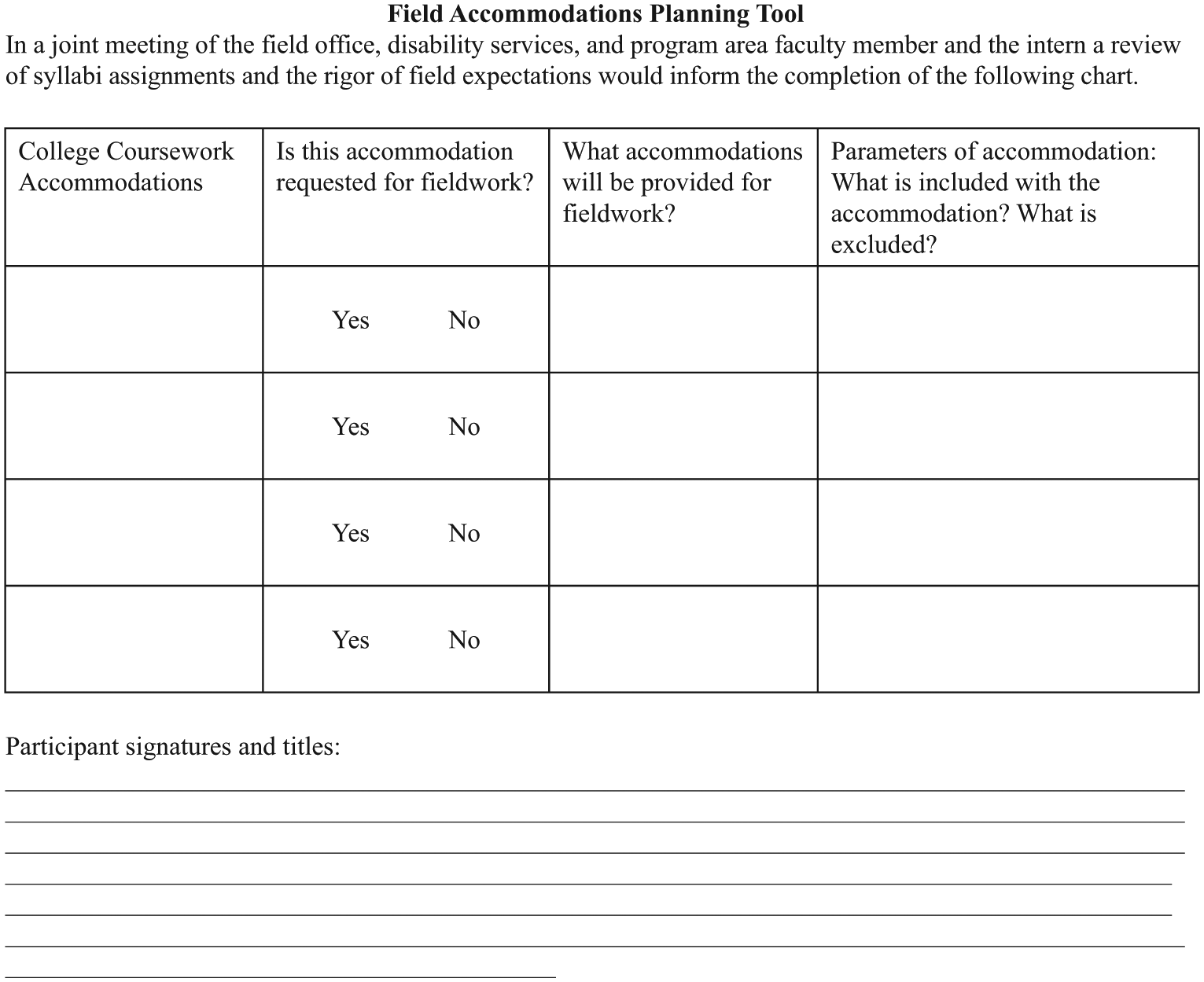
Field accommodation planning tool.
First, faculty should review the expectations of the field requirement. This may involve discussing the syllabus and clearly describing what each assignment requires. Once the student has a clear understanding of the field component expectations, students can better anticipate how their disability may impact their performance. Next, faculty must consider the accommodation, and whether or not the accommodation will be provided during fieldwork. During this stage, faculty must determine whether the request is an accommodation to support their completion of the task, or whether the student is asking for the task to be modified because of their disability. Accommodations offer students an opportunity to complete the job responsibilities despite their disability; a modification changes the nature of the task or job at hand (Heward, Alber-Morgan, & Konrad, 2017). When working with students with disabilities, an accommodation that may be appropriate in the college classroom may serve as a modification in the field, due to the nature of the task.
Accommodations versus modifications in field placements
In some instances, providing a distraction-free environment may be considered a reasonable accommodation for completing exams in college courses (Rothstein, 2015). Many colleges provide testing supports where students can take courses in silent rooms, which provide students an equal opportunity to successfully take the exam. It is unlikely that this accommodation could be provided in a field experience without modifying the nature of the job. Teaching requires the ability to simultaneously attend to the many demands in and outside of the classroom (Kealy, 2010). Thus, to ask for a distraction free, or reduced distraction, classroom would likely modify the core responsibilities of the job.
In addition, universities must determine whether an accommodation is considered reasonable (Lee, 2014). What qualifies as reasonable may differ in the college classroom and the field placements. If the requested accommodation interferes with the student’s ability to complete the licensure requirements, it would not be considered a reasonable accommodation. For example, each State prescribes a minimum number of hours that the candidate must complete to meet licensure requirements. Some students may request extended periods of excused absences due to health issues associated with their disability. In a college classroom, this request may be supported by providing extensions for completing assignments or allowing work to be completed outside of the college classroom. The application of this accommodation may be substantially different in field placements. A university may review this requested accommodation and find it is reasonable, so long as the student is able to meet the minimum number of hours required for licensure. Once students are no longer able to meet the licensure requirements due to absences, the provision of excused absences stops being an accommodation and becomes a modification—thus, is no longer considered reasonable.
Furthermore, extended time for assignments may be another area that does not translate to the field placement. This idea was supported in the Reichert case, where the judge specifically ruled that providing extended time to develop lesson plans was not a reasonable accommodation, because double time for a lesson plan would result in the P-12 students receiving half the instruction. Furthermore, when University partners—such as Pearson—set guidelines for accommodations within the assessment, Universities must comply with those guidelines. For example, many states have adopted Educator Teacher Performance Assessment through Pearson. Pearson encourages individuals with disabilities to request accommodations, and suggests that supports such as scribes or screen reading software may be appropriate for the assessments. They caution that accommodations such as extended time, which may be acceptable for licensure exams, would not be acceptable for this assessment (Pearson Education, 2017).
Another area that warrants further discussion is that of professional dispositions. Professional dispositions refer to the student’s beliefs, values, and commitments that may impact their interactions with students, teachers, parents, and university personnel (Almerico, Johnston, Henriott, & Shapiro, 2011). Although professional dispositions must be maintained both in college coursework and field placements, in some instances, the fast pace nature of field experiences may exacerbate a student’s difficulties. Professional dispositions are particularly important because they indicate pattern of behavior that are predictive of patterns of action (Borko, Liston, & Whitcomb, 2007). Many individuals with disabilities struggle with social skills (Heward et al., 2017), which may impact their professional dispositions in field placements. In the Halpern case, the judge specifically stated that inappropriate patterns of behavior may suggest that the student is unfit to join the chosen profession (Halpern v. Wake Forest University Health Sciences, 2012, pp. 466, 467). Therefore, professional dispositions may be an area that warrants closer attention in field placements, they are predictive of future teaching behaviors.
Once students and faculty have identified reasonable accommodations for fieldwork, it is important to clearly define the parameters of those accommodations. For example, if a student receives an accommodation that allows them to take breaks throughout the day, it would be valuable to indicate that in some instances, such as Individualized Education Program meetings, breaks would not be able to be accommodated.
Tier 3: Does the Student Remains Otherwise Qualified?
Accommodations are intended to provide students with equal access to the course content (Heward et al., 2017). Once reasonable accommodations have been provided, it is the student’s responsibility to demonstrate their ongoing success to prove they are otherwise qualified to complete the program (Lee, 2014; Rothstein, 2015). Faculty should conduct ongoing assessments to determine whether all students—not only students with disabilities—are meeting all the established program expectations. To do this, faculty should consider university and program standards for measuring student success (Gotwals & Birmingham, 2016; Papanastasiou, Tatto, & Neophytou, 2012; Tindle, Freund, Belknap, Green, & Shotel, 2011).
Once expectations are communicated, faculty must track student progress to demonstrate their learning throughout the program. As part of their CAEP accreditation process, programs should outline how each student demonstrates mastery of program content. Specifically, CAEP standard 3 looks to determine how programs demonstrate the quality of candidates as they progress through the program courses and clinical experiences. For example, CAEP (2015b) standard 3.4 requires programs “create criteria for program progression and monitor candidates’ advancement through completion . . . [Universities must] present multiple forms of evidence to indicate the candidates’ developing content knowledge, pedagogical content knowledge, [and] pedagogical skill” (para.1).
Furthermore, faculty are not only expected to monitor academic progress, but of equal importance is to “establish and monitor attributes and dispositions that are required for standard 3.3 CAEP (2015b). Thus, accredited programs already have policies and procedures in place to determine whether students are meeting academic and dispositional expectations of the program. Tracking student’s progress in these areas may be particularly important, because of the predictive nature of these skills (Borko et al., 2007). Therefore, to determine whether students continue to be otherwise qualified, their performance can be measured against these standards and rubrics. If students fail to demonstrate adequate progression, they may be found to be no longer otherwise qualified.
Are field placement requirements being met?
One challenge for teacher preparation programs is determining whether a student remains otherwise qualified as they transition to their clinical experiences. This can be particularly difficult because field placements are less structured than the college classroom, and teaching requirements differ based on the licensure area and setting. When programs use universal design and explicitly outline expectations as described above, faculty are better positioned to hold students accountable. If a faculty member sees evidence that a student may be performing below requirements, it is critical—both for legal compliance and for supporting the candidate—that the student is given an opportunity to demonstrate success.
First, faculty or supervisors must explicitly define specific tasks or objectives students must meet. Once these tasks have been met, faculty must monitor a candidate’s progress toward these goals, specifically taking data on the candidate’s performance. If the candidate meets the goals, new tasks or objectives should be defined to ensure adequate progression toward the successful completion of the program. If a candidate fails to meet the goals, he or she then fails to demonstrate to be an otherwise qualified person eligible to continue in the program.
Conclusion
The purpose of this article was to review federal legislation and case law in effort to identify recommendations for faculty in higher education. These cases provide preliminary guidance, but as case law continues to evolve, it is critical that teacher education faculty work closely with their university resources to ensure best practice with supporting students with disabilities in teacher preparation programs. Additional research and dialog are needed to better understand issues of compliance under the ADA and Section 504 in field placements. Further research is also needed to identify evidence-based practices for working with individuals with disabilities in teacher preparation programs.
Despite a growing number of students with disabilities entering college, there have been limited recommendations on the legal mandates of reasonable accommodations and otherwise qualified across academic disciplines let alone for preservice teacher training individuals with disabilities (Newman & Madaus, 2015). The Board of Directors for the Association for People Supporting Employment First (APSE) has made suggestions about employment for individuals with disabilities that may be applied to individuals with disabilities in teacher preparation programs. Namely, APSE has stated, “Employment First initiatives center on holding individuals with disabilities to the same employment standards, responsibilities, and sets of expectations as any working-age adult” (Niemiec, Lavin, & Owens, 2014, p. 2). Therefore, as faculty seek to support individuals with disabilities in higher education, it is important to consider that inclusion in higher education and employment requires students with disabilities to perform at the same level as their nondisabled peers.
In an effort to ensure equity in preservice preparation for teaching candidates with disabilities, college educators must balance supporting students with disabilities and maintaining the rigor of the program. Student with disabilities should be included in teacher preparation programs, not for the sole purpose of inclusion, but because they are qualified teacher candidates who can provide quality education to P-12 students and serve as role models for all students with and without disabilities. When students are unqualified and passed through teacher preparation programs, there can be two potential results: (a) an individual with a disability can be hired into a position where it either places an undue burden on their coworkers, or (b) can be hired into a position where they are setup to fail due to lack of qualifications.
These potential outcomes must be carefully considered while working with individuals with disabilities in teacher pre-paration programs. Education faculty may be more inclined to provide accommodations and support to students with disabilities—because of their focus on meaningful postschool outcomes for individuals with disabilities—compared to faculty in other professions (Leyser, Greenberger, Sharoni, & Vogel, 2011). A student’s desire to be successful in their teacher preparation program should not negate the requirements to be otherwise qualified. Teacher education faculty must think of not only their college students with disabilities but also their preservice teacher’s future students. Faculty must carefully consider whether reasonable accommodations can allow each candidate to be a competitive member of the next generation of teachers, equipped with skills and strategies to improve outcomes for the next generation of P-12 students.
Footnotes
Acknowledgements
The authors thank Laura Rothstein and Kevin P. Brady for their contribution to an earlier version of this manuscript.
Declaration of Conflicting Interests
The author(s) declared no potential conflicts of interest with respect to the research, authorship, and/or publication of this article.
Funding
The author(s) received no financial support for the research, authorship, and/or publication of this article.