



Abstract
Research about Individualized Education Program (IEP) meeting outcomes indicates special educators are unprepared and uncertain about practices designed to encourage meaningful IEP team participation. In response to these challenges, we crafted a simulated IEP (SIEP) project for preservice special education teachers as part of their licensure program. Using research-based simulation guidelines, preservice special education teachers were required to prepare, participate, and debrief with IEP team member volunteers and professors about the process. To evaluate the social validity of the SIEP project, we conducted qualitative interviews with 60 graduates of the program. Findings revealed five major themes that highlight value in the experience, including (a) valuable preparation for the future, (b) practical application of educational theory, (c) a safe space to learn and make mistakes, (d) real-world practice collaborating as a team, and (e) an opportunity to gain meaningful feedback. Following the presentation of themes, we discuss implications for practice and future research.
Keywords
One major hallmark within the Individuals With Disabilities Education Act (IDEA; 2004) includes regulations specific to the development of a child’s Individualized Education Program (IEP) designed to provide the student a free and appropriate public education (FAPE). Within these guidelines lies a specific focus on the creation of an IEP that is designed to meet the student’s unique needs, in collaboration with designated IEP team members, especially the parent (IDEA 2004, Section 1414(d)(1)(B)). Despite multiple IDEA reauthorizations that aimed to strengthen the parent role (1990, 1997, 2004), multiple barriers to parent involvement during the IEP meeting continue to exist.
Notably, one of the most common barriers to parent participation at IEP meetings includes the behaviors of special education professionals, namely the special education teacher (Bezdek, Summers, & Turnbull, 2010; Hilton & Henderson, 1993). Numerous researchers note that special educators use excessive jargon/acronyms, exhibit “power over parent” behaviors at IEP meetings, demonstrate disproportionate and heightened focus on paperwork rather than parent involvement, and exclude parents during IEP meeting discussions (see Blackwell & Rossetti, 2014; Elbaum, Blatz, & Rodriguez, 2016; Fish, 2008; Martin, Huber-Marshall, & Sale, 2004; Salas, 2004; Stoner et al., 2005). Unfortunately, researchers have gathered enough data to support the notion that educator practice and IDEA regulations focus more on the parents physically attending the IEP meeting, rather than actually participating in a meaningful way (Wolfe & Durán, 2013; Zeitlin & Curcic, 2014). Consequently, further studies highlight parent distrust, poor communication, strained relationships, and conflict between the educators and parents, including overwhelming numbers of potentially preventable due process hearings (Feinberg, Beyer, & Moses, 2002; Lake & Billingsley, 2000).
This exclusion and lack of parent participation in IEP meetings is not due to a lack of research-based guidance (Henderson & Mapp, 2002). On the contrary, many of these challenges are attributed to a lack of preservice special education teacher (hereafter referred to as candidate) preparation regarding collaborative IEP meeting practices (Elbaum et al., 2016; Simon, 2006), including the skills, ethics, and facilitative behaviors that are required to build partnerships with families (Epstein & Sanders, 2006; Ferrara & Ferrara, 2005; Lazar, Broderick, Mastrilli, & Slostad, 1999; Lord-Nelson, Summers, & Turnbull, 2004). In fact, researchers highlight a gap in candidate instruction and practice specific to building collaborative family–professional partnerships (Lawrence-Lightfoot, 2003; MacLure & Walker, 2000). Likewise, parents are provided little guidance, support, and often confusing information about their rights to participate in a meaningful IEP team discussion about their child (Fitzgerald & Watkins, 2006). The lack of educator and family preparation is a concern given the importance of family–professional partnerships, and the implications poor partnerships can have on the IEP team, educator practice, parent satisfaction, and most importantly, student outcomes (Feinberg et al., 2002).
Failure to prepare future educators to engage with families throughout the IEP meeting process poses challenges for special education practice in schools. Of note, not only is parent participation at IEP meetings an important component of IDEA but it is also identified as a predictor of student post-school employment success (Test et al., 2009). Given the already identified barriers to meaningful IEP meetings, it seems almost necessary for preservice programs to provide opportunities to learn and practice implementing effective IEP meeting strategies before entering the field. Furthermore, despite parent trainings directed toward increasing parent involvement at IEP meetings, researchers point out that parent advocacy and involvement are likely to increase as a result of facilitative educator practice (Goldman & Burke, 2017). Thus, it behooves candidates to generate meaningful IEP meeting practice opportunities. Because IEP meetings are dependent on an actual student and IEP team composition, one promising practice designed to potentially address this challenge includes the use of simulated IEP (SIEP) meetings.
The Promise of Using Educational Simulations in Preservice Programs
Using methodical planning and implementation guidelines for practice, medical simulations have proven to be an essential experience used for the preparation of a variety of medical professionals (Barrows, 2000). After conducting repeated simulation research, Barrows (1987, 1993, 2000) identified four simulation design principles found to contribute to the knowledge, skill, and practical application of the experience. These principles include (a) prevalence (i.e., simulations should reflect common challenges likely to occur in practice), (b) instructional importance (i.e., simulations should be varied and require specific skill sets), (c) clinical impact (i.e., simulations should represent rare situations in practice), and (d) social impact (i.e., simulations should be designed with the potential to have an impact on the individual or group).
Using these simulation techniques from the medical field, educational researchers have adopted and applied simulation technology, including providing candidates with simulations focused on student–teacher conferences (Dotger, 2011, 2015), parent–teacher conferences (Dotger, 2010; Dotger, Dotger, & Tillotson, 2010), and collaborative sessions with educational colleagues (Dotger & Ashby, 2010; Lee & Powell, 2006). These simulations included learning objectives focused on (a) building rapport with colleagues and parents (Dotger & Ashby, 2010; Dotger, Harris, & Hansel, 2008), (b) addressing academic and behavioral concerns with parents (Dotger, 2015; Dotger et al., 2008; Dotger et al., 2010), (c) collaborating with colleagues for the purposes of advocating for students (Dotger & Ashby, 2010), and (d) engaging in team-based instructional decision making (Lee & Powell, 2006). For example, Dotger and colleagues (2008) created and enacted six different semester-long (15-week) role play scenarios, referred to as the parent–caregiver conferencing model, used with the intent to create authentic problem-based learning opportunities for candidates using trained actors to act as parents. The process included participating in the simulation, reflecting on their performance, and constructing a communication plan to address skills in need of improvement for the next simulation. Examples of these simulations included listening to and addressing parent concerns, and collaborating with parents to address student academic and behavioral needs. At the end of the course, a focus group with the participants revealed the simulations were described as valuable, authentic, and meaningful. Dotger and colleagues (2010) have continued to implement simulated parent–teacher conferences using qualitative and quantitative research designs that demonstrate measurable candidate growth in ethical sensitivity, multicultural awareness, and collaboration with families. Of note, Dotger’s simulation research uses actors, rather than real parents or educators, thereby raising questions about the authenticity of the simulations. Nevertheless, results are positive enough for researchers to suggest simulations should become core pedagogy within teacher education programs (Dotger, 2013, 2015; Dotger & Smith, 2009; Shulman, 2005).
Furthermore, recent technological advancements have facilitated access to an even more diverse spectrum of simulated opportunities as part of educator preparation. Programs such as TeachLive and Second Life provide candidates with opportunities to practice content delivery, implement instructional and behavioral strategies, and perform other daily special educator tasks, while simultaneously working with student avatars within virtual learning environments (Dieker, Rodriguez, Lignugaris-Kraft, Hynes, & Hughes, 2014; Hartley, Ludlow, & Duff, 2015). Simulations through these virtual learning environments allow candidates to develop proficiency in educational pedagogy through repeated practice without the risk of losing valuable instructional time or negatively impacting student learning (Dieker et al., 2014; McPherson, Tyler-Wood, McEnturff, Ellison, & Peak, 2011). These opportunities also address the research to practice gap by encouraging candidates to consider solutions to challenges experienced when implementing evidence-based strategies during simulations (McPherson et al., 2011). Despite these benefits, there are three potential challenges of using virtual simulations worth noting. First, considerable time, effort, and expertise are required to create and enact virtual simulations for candidates. Second, it is possible the virtual world and avatar’s appearance may seem less convincing than a real person, thereby challenging candidates to immerse themselves in simulations. Finally, high costs are typically associated with purchasing such programs (Graetz, 2006).
Despite the benefits and challenges found with using educational simulations for candidates, little research exists specific to the unique characteristics of IEP meetings. When conducting a search using educational research databases (e.g., Academic Search Premier, EBSCO, ERIC, and PsycINFO), only one study about SIEP meetings surfaced. Werts, Mamlin, and Pogoloff (2002) conducted a workshop training followed by SIEP meetings that utilized volunteer faculty members to act as IEP team members. Using qualitative methodology, 21 candidates provided insight into their perceptions and experiences with the process. The areas identified as the most effective in preparing the candidates included IEP meeting preparation, attendance, and talking with parents during the IEP meeting. Although informative, the authors noted the study could benefit from more data collection, including researching participants after they entered the teaching profession. To date, there are no other published SIEP studies reported in preservice programs.
Because simulations show such promise as core pedagogy for preservice programs, there is an identified need to conduct similar research that investigates IEP meeting simulations. The current study was designed to examine the experiences and perceptions of graduates from a large preservice special education program that uses SIEP meetings with actual family members and educational professionals within a realistic in-person IEP meeting as content pedagogy. We explored one major research question:
Method
SIEP Project Procedures
Candidates enrolled in their final semester of coursework (before student teaching placements) were required to participate in a SIEP project that used an IEP case vignette, based on real student information and data. Within this semester, candidates were enrolled in a practicum block (i.e., courses 2 days a week and field placements 3 days a week) that consisted of advanced behavior assessments and interventions, advanced assessment, and strategies designed for working with students who are identified as having significant needs. Each cohort ranged between 20 and 25 candidates.
The SIEP project required candidates to participate in two key IEP meeting processes. First, the IEP meeting planning included becoming familiar with the case student’s academic, behavioral, and social needs, as well as the family background. Second, the candidates were required to play the role of the student’s special educator and conduct the IEP meeting with the parents and other IEP team members. Faculty deliberately chose to include this simulation across the three courses with the intent to provide candidates practice learning to apply course knowledge, skills, and behaviors that translate to generating FAPE for a case student. A description of SIEP project requirements per course is available by request.
Planning procedure
Candidates were placed into groups of four to five, provided a case vignette (student), and assigned one of three core course faculty members to serve as IEP case manager. The project occurred over a 6-week period within a semester-long (15-week) course. The applied content addressed in the SIEP project was taught in each of the three cohort courses. Each candidate was required to create and complete all necessary components of the student’s IEP using the state generated IEP form, in addition to developing a behavior intervention plan designed to address the case student’s academic, behavioral, and social needs. Indeed, we acknowledge that the introduction of student problem behavior and a behavior intervention plan was an added layer that is not typical for the majority of IEP meetings; however, we remained ambitious in addressing the need for candidates to know and understand how to collaborate with families regarding student problem behavior as well. As the candidates completed their IEP and behavior intervention plan, the faculty case managers were available for support when requested, including answering questions and meeting with the case study group as needed. After the candidates received their case study files and subsequent data, a core faculty member whose research focuses on family–professional partnerships, including the use of Facilitated IEPs for conflict prevention and resolution (Mueller, 2015, 2017; Mueller, Singer, & Draper, 2008; Mueller & Vick, 2017), provided the candidates with a workshop of research-based IEP meeting strategies and required readings that present best practices for IEP meetings (see Dabkowski, 2004; Diliberto & Brewer, 2012; Mueller, 2009), including strategies used to encourage active family participation and problem solving during issues of conflict (Mueller, 2017).
Meeting procedure
When it was time to conduct the SIEP meeting, the candidates acted as the special education team. Throughout this process, they were required to comply with all IEP meeting regulations, including sending a meeting notice to families and providing families a copy of the procedural safeguards. Due to the low readability of procedural safeguards (Fitzgerald & Watkins, 2006), candidates were also encouraged, but not required, to send an accompanying parent friendly version of the procedural safeguards to the parents (e.g., limited educational jargon). In addition, candidates were encouraged to follow the intent of the law by encouraging family participation through contact prior to the IEP meeting (i.e., pre-meeting). Due to the nature of the simulation schedule, this activity was completed by emailing a letter prior to the SIEP that requested family input about the case student. Case managers acted as the family members and responded to the questions.
After completing the IEP and behavior intervention plan paperwork, the candidates conducted a SIEP meeting with volunteer community members who work in the field of special education (i.e., special education directors, teachers, related service professionals), real parents of a child with a disability, and educational faculty who acted as the other IEP team members. Contrary to other simulation research (Dotger et al., 2008), actors were not used in this study. Instead, we specifically recruited individuals who regularly attend IEP meetings either as a professional in the field, family member, or an undergraduate education student to play the student role (if needed). These volunteer SIEP team members played the following roles: family member (e.g., parent, grandparent); special education director; general education teacher; related service professionals, as needed (e.g., speech–language pathologist); case student (if aged 15 years or older); and advocate/attorney, as needed. The team member roles were determined based on the case vignette provided (described later).
Immediately before the SIEP meetings began, the candidates randomly selected, by choosing a piece of paper out of a basket, one of the following four areas of the IEP/behavior intervention plan to address at the meeting: (a) present levels of performance, (b) IEP goals, (c) behavior plan, and (d) accommodations, modifications, and services. These roles were randomly selected before the meeting so that each candidate was prepared to address all areas of the IEP. Next, the SIEP meeting was conducted with all IEP team members acting within their respective roles. Each candidate was provided the opportunity to present data, discuss, encourage shared decision making, and answer any questions throughout the process. SIEP meetings averaged 1 hour and 15 minutes. At the end of the meeting, volunteer SIEP team members, university faculty case managers, and candidates debriefed and discussed the process. A description of the SIEP project procedures is available by request.
Case Vignettes
Case vignettes used in this project depicted a variety of age, gender, skill, and behavioral needs. All case vignettes were created using actual student data. However, to meet the objectives for each of the three courses, faculty made minor adjustments to the case, specifically adding more data. All SIEP meetings were planned as triennial reviews to provide candidates the opportunity to document comprehensive evaluation results and determine eligibility for services. In addition, simulated case vignettes presented academic or developmental concerns, and emotional or behavioral concerns. While most students who have IEPs would not have such comprehensive concerns, these components were necessary to support the course objectives in the methodology courses.
Candidates received case study data in several phases. First, they were provided a general description of the student demographics and needs. Next, as a team, they were required to fill out and submit a form that asked them to identify what they knew about the case (after reading through the material provided) and what they still needed to know for each of the following domains: educational, cognitive, social/emotional/behavioral, communicative, physical, and transition. The candidates were provided one week to complete their questions and submit them to their case manager. The objective of this phase was for the candidates to read through the student information and determine what data they need to continue with the IEP process. This practice intended to reflect real-world experiences that require educators to gather data based on identified student need. For the second phase, case managers provided the SIEP teams with data the team requested. The teams worked through the process of analyzing data and identifying other data they needed. Following this second review, case managers provided the third phase of data based on the remaining data that was requested. Next, the candidates were required to create an IEP and plan for the meeting. Prior to the SIEP meeting, they held a group meeting with the case manager to review information and ask clarifying questions, as needed.
Volunteer IEP team members were provided student and family demographics and IEP meeting scenarios that ranged in level of difficulty (e.g., mild, moderate, extreme). Using Barrows’s (2000) simulation principles, we designed IEP case vignettes that represented prevalence, instructional importance, clinical impact, and social impact. The level of IEP meeting difficulty determined for the case was based on the course professors’ professional judgment, volunteer IEP team member’s expertise, and peer reviewed literature about IEP meeting practice (Feinberg et al., 2002; Lake & Billingsley, 2000). Using these guidelines, the estimated effort involved in resolving the scenario (potential disagreement) and the frequency that the scenario would likely occur in a real IEP meeting were further analyzed to assure the candidates were provided cases of instructional importance and clinical/social impact. Thus, the more effort required to resolve the scenario and/or the higher the frequency of likely occurrence translated to a more difficult scenario label. Diverse family characteristics were also used for the vignettes with the intent to provide candidates an opportunity to work with diverse family demographics (e.g., single parent, same-sex couple, Spanish speaking parent). In addition, each IEP meeting included a meeting catalyst that created a problem-solving situation for the IEP team. Table 1 provides five example case vignettes used in the SIEP meetings. It is important to note that we provided each group with a different vignette, so that the entire cohort would have the experience to either participate in, or observe, a range of vignettes that represented various levels of prevalence, instructional importance, clinical impact, and social impact (Barrows, 2000).
Sample Simulated IEP Scenarios.
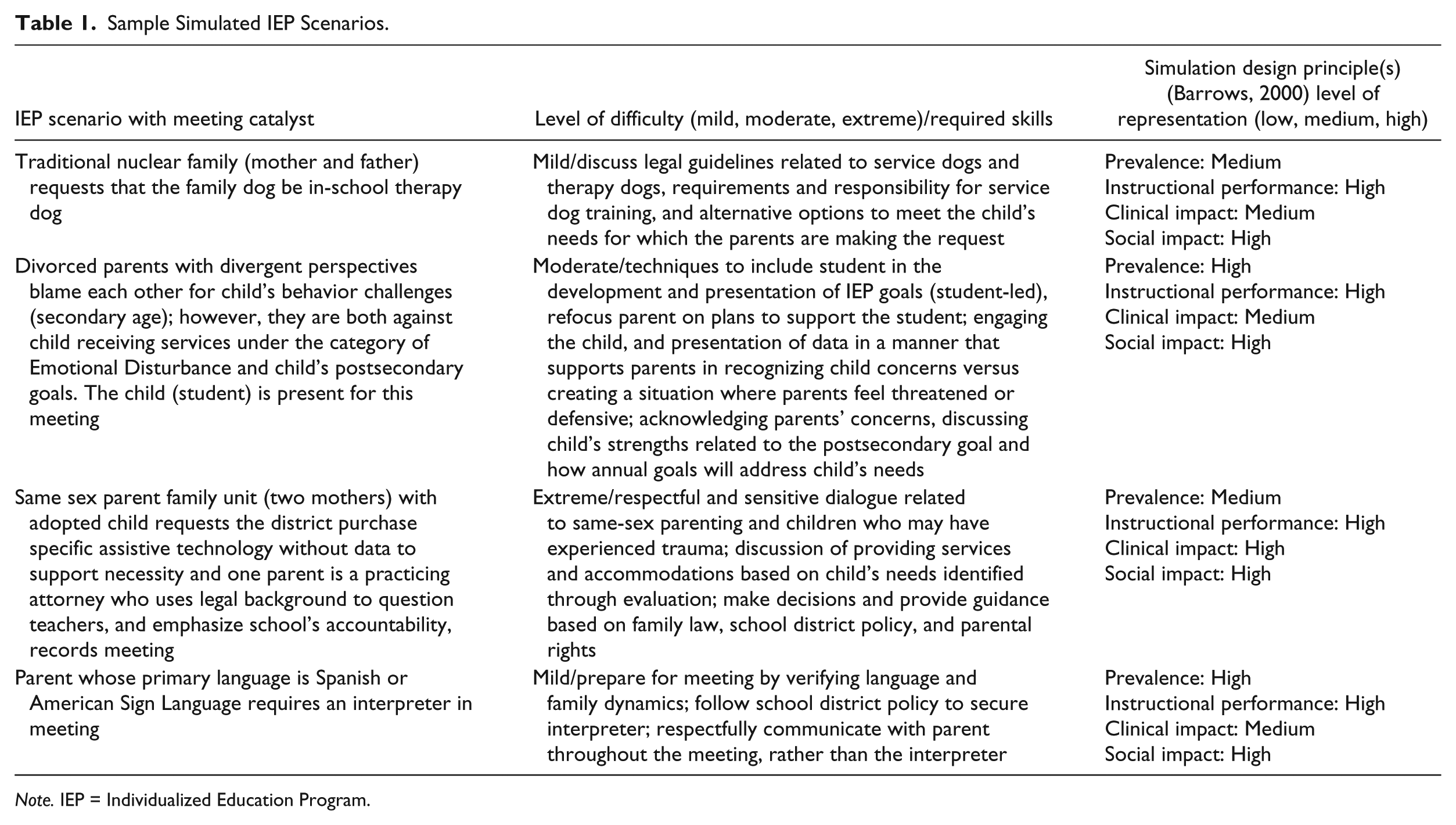
Note. IEP = Individualized Education Program.
SIEP meeting observations
Recalling the work of Bandura (1965) that supports the value of observational learning, and the need for candidates to experience multiple IEP meeting scenarios, all other class members were present to observe the other SIEPs. Thus, by the end of the SIEP meetings, candidates participated in—and observed—at least four other varied meetings. In addition to these repeated observations, all cohort members had the opportunity to hear feedback provided by the volunteer IEP team members and faculty.
Authenticity and Relevancy Measures
In an effort to assess the authenticity and relevancy of the simulations, three measures were utilized with the candidates and the volunteer SIEP team members. These measures were linked to simulation research that emphasizes the importance of establishing and developing teacher identity (Dotger, 2011) and assessing perceptions of authenticity and relevancy among candidates (Dotger et al., 2008).
Candidates
Candidate measures included two procedures: (a) survey completed prior to the start of the simulation project (premeasurement) and after the entire project was completed (postmeasurement) and (b) candidate video analysis reflection. Each is described in detail below.
Candidate pre-/post-survey
Before and after participating in the SIEP meeting, candidates were asked to anonymously complete a survey that involved self-assessing their confidence and preparedness related to special education teacher responsibilities during IEP meetings. Topics addressed in these surveys included writing IEP goals, leading and answering questions during IEP meetings, resolving conflict with parents, and engaging in team-based problem solving with students, parents, and colleagues. Candidates who completed the postsurvey also answered questions pertaining to how authentic the SIEP meeting experience felt and whether it was helpful to their professional development. Postsurvey results showed candidates consistently described the SIEP project as authentic, valuable, and integral to their professional development.
Candidate SIEP meeting reflections
Following the SIEP meeting, candidates were also provided the opportunity to observe and evaluate their performance through the SIEP meeting video of their team, using the SIEP Student Video Analysis Form (form is available by request). During this reflective process, the candidates were asked to critically analyze their meeting performance using quality indicators of effective IEP meeting practice (see Dabkowski, 2004; Diliberto & Brewer, 2012; Mueller, 2009).
Volunteer SIEP meeting feedback
Volunteer SIEP team members provided feedback through a form (available by request) that required the participants to rate their experiences with the SIEP meeting process using a Likert-type scale. The feedback form also included an open response section that allowed the SIEP volunteer team members to provide positive feedback and any noted areas in need of improvement for the candidates. This information was provided to help the candidates understand the differences between the actual simulation and what occurs in the real world.
Data Collection
Data were collected using qualitative interviews with special education program graduates who participated in the SIEP project during their preservice program. In an effort to safeguard against potential research bias, interviews were conducted by a trained doctoral student who did not have any personal or professional history with the participants who completed the SIEP project. The interview protocol consisted of open-ended questions that focused on the graduates’ experiences with the SIEP process and their perception of how the SIEP experience may or may not have impacted their current work as a special educator. Although a question protocol was used during the interviews, the interviewer encouraged participants to share their thoughts and experiences beyond protocol questions (Marshall & Rossman, 2010). The interviews were conducted over the phone, averaged one hour in length, and were recorded using a digital audio recorder.
Participants
Participants were recruited using purposeful sampling (Patton, 2002). After obtaining institutional review board (IRB) approval, we recruited graduates from our special education preservice program through three emails using alumni connections. Due to the exploratory nature of the study, criteria for inclusion required that the participants successfully graduated from the preservice program, and that they were able to recall personal experiences with the SIEP project. First, a description of the study was provided with a request that interested individuals contact the first author. One week later, a follow-up email was sent to those individuals who had not yet responded. Finally, one week later, we made one final attempt to contact any individuals who had expressed an interest, but had not yet scheduled an interview. Because the SIEP meeting project had been used with candidates for a number of years, we deliberately reached out to graduates who could represent cohorts that had completed the SIEP activity over the last seven years since it had been implemented. After obtaining the names and contact information for graduates, we could still locate; approximately, 88 graduates were contacted and invited to participate. Of this number, 16 indicated an interest but did not follow through with scheduling an interview, one person denied participation, and 11 individuals did not respond at all. Thus, after talking with the interested participants, 60 met the criteria and agreed to participate in the study.
Participants included graduates who completed their preservice program in the following years: 2007 (n = 7), 2008 (n = 3), 2009 (n = 2), 2010 (n = 7), 2011 (n = 10), 2012 (n = 6), 2013 (n = 8), and 2014 (n = 17). The level of education among participants ranged from a BA to an MA degree. Meanwhile, experience in education ranged from 0 to 9 years, with participants reporting that since the SIEP meeting they have held between 0 and 230 IEP meetings. Current job descriptions included working as a special educator with students who represented a range of student needs (e.g., mild to severe disabilities) and all school levels, elementary through transition programs. Two participants were not teaching during the time of the interview and two participants worked in other related areas (health care and community service development). Meanwhile, one participant was not employed at the time of the study.
Data Analysis
Interviews were transcribed verbatim through the use of a digital transcription service. Due to the large amount of interview data, two special education program doctoral students, who worked as special education teachers and were trained in qualitative inquiry, independently coded all of the transcripts using the NVivo qualitative software program (Richards, 2002), specifically, open, axial, and selective coding procedures (Corbin & Strauss, 2007). The two doctoral students generated and used a dictionary code list to follow as a guide for data analysis. Using the dictionary code list, the first author, acting as an independent rater, coded a little over 25% (n = 15) of the interviews. After independent coding, the three raters met to discuss and compare codes. When disagreements occurred, the three raters discussed the issue until mutual agreement about the code was established. Finally, after all coding was completed, using peer debriefing procedures (Brantlinger, Jimenez, Klinger, Pugach, & Richardson, 2005), the three reviewers compiled the selective codes, categorized them according to related topics, and identified the qualitative themes.
Trustworthiness
To establish credibility (Brantlinger et al., 2005), we used three recommended credibility practices to encourage qualitative research rigor: (a) investigative triangulation (i.e., use of three raters for data analysis), (b) peer debriefing (i.e., use of multiple raters for data analysis who are familiar with the phenomena—IEP meetings), and (c) member checking (i.e., 30 participants were asked to review and confirm the accuracy of the findings).
Findings
Five outcomes of the SIEP project were identified and described as valuable preservice pedagogy that contributed to the participant’s growth as a special education teacher: (a) valuable preparation for the future, (b) practical application of educational theory, (c) a safe space to learn and make mistakes, (d) real-world practice collaborating as a team, and (e) an opportunity to gain meaningful feedback.
Valuable Preservice Pedagogy
Participants repeatedly referred to the SIEP project as “a valuable experience,” with one participant sharing, “I think it’s one of those things that’s had the biggest impact on me.” Most participants also indicated that the experience assisted them with transitioning into their current role as a special educator. One participant reported, “I just couldn’t imagine going into teaching and not having had that experience before.” In addition, participants discussed value in two key components, the written IEP and conducting the actual IEP meeting. For example, one participant shared, “[It] really felt like you’re doing all the prep work for the IEP, you know, taking all the data, writing the IEP, sharing it, and having a meeting with parents.” Many other participants also highlighted the value of learning to conduct an IEP meeting before entering the field.
Participants described the SIEP project as “beneficial” and “helpful” to the development of their IEP preparation, knowledge, and skill set. For example, one participant shared, “I think that the different role-playing, whether it was different staff, or parents, or students, was . . . beneficial in just seeing all the different variables that could come up at an IEP.”
Another participant stated that it was helpful to have an opportunity to “practice doing as much of the process as I could prior to having to do it as a teacher.” One participant also reported that the project provided a different perspective to the IEP process: “It was kind of the first time that you were responsible for evaluating test results and making a decision . . . that really helped me.” When describing how the SIEP project helped prepare for the future, one participant said, “The procedures and the process of the IEP was the biggest part that the mock IEP helped me prepare.” Other participants also echoed this sentiment.
Valuable Preparation for the Future
Participants described the SIEP project as valuable preparation for the future in three key areas: (a) working as a special educator, (b) preparation to conduct a variety of IEP meetings, and (c) partnering with parents of children with disabilities.
Working as a special educator
Participants indicated the SIEP project helped them prepare for the “real world” including how to conduct their first “real IEP meeting.” For example, one participant shared, “It was a great experience . . . because it prepared me for what I have to do now.” Meanwhile, one participant aptly shared, “I think [the SIEP] was very helpful because it prepared me for my first year of teaching. When I was with all these other colleagues that have been teaching for ten years, I didn’t feel as behind.” Another participant stated, “I think that it really did prepare me to become a special educator. It really addressed some of the issues that might be occurring in the education field right now.” All of these educators talked about how the knowledge and skills they gained as a result of their participation in the SIEP project were directly applied to their teaching responsibilities and expectations.
Preparation to conduct a variety of IEP meetings
Participants also addressed how the SIEP project prepared them to lead a variety of IEP meetings. One participant shared, “The [SIEP] . . . helped me prepare for a real IEP and how to lead an IEP, if you’re the case manager.” Participants reported that in addition to participating in their own SIEP meeting, observing other SIEP meetings was equally beneficial. One participant discussed this finding by saying it “helped anticipate things that could come up in a meeting because . . . there were all these different situations that could come up.” Another participant shared, “The best part of the mock IEP is that it’s not just one situation. You got to observe all these different situations, different cases, different types of parents. That really helps . . . to prepare for what real IEPs will look like.”
Partnering with parents of children with disabilities
Another important facet of the SIEP project included participants sharing that it prepared them to communicate and collaborate with parents. Participant responses indicated this learning component was a meaningful aspect of the project. For example, one participant simply stated, “It’s enhanced my parent communication.” Participants also indicated that the experience helped them to “understand the parents’ perspective.” One participant shared, “I think it [SIEP meeting] gives you an understanding from a parent perspective of what they’re going through and what they’re looking for and how you can best partner with families before you’re put in that situation for real.”
Practical Application of Educational Theory
Participants shared that the SIEP project afforded them with the opportunity to take everything they learned throughout their teacher preparation program and put it into practice. One participant described this opportunity by saying, “[It’s] getting an idea of what a real IEP meeting would be like more than just reading about it or hearing about it in classes and things like that.” Another participant stated, “I thought it was really helpful because instead of just in theory, it was, you know, in practice. The student’s life and putting together a plan, instead of just reading about how it’s done.” In addition, one participant shared, “[It] was a practical application of what we were learning and it gave a chance to flush out and understand better what we were learning in class and how it would apply once we were teaching full-time.” Specifically, participants indicated that the SIEP project gave them the opportunity to apply what they had learned by practicing the skills they had acquired before stepping into the classroom. For example, one participant shared, “I think the greatest thing is that it [SIEP] gives you practice.” The participant then added, “Until you’re in that situation where you actually you have to present those findings and actually talk to them [parent], I don’t think you truly understand and comprehend how they should be presented, or how you should talk to parents.” Of note, participants shared the sentiment that by providing special education preservice teachers with the opportunity to practice the skills they learned throughout their preparation program, they felt more prepared to conduct IEP meetings as a special education teacher.
A Safe Space to Learn and Make Mistakes
The SIEP project was described as a learning opportunity that afforded participants the ability to conduct IEP meetings in a safe space. Specifically, participants shared that the project allowed them to make mistakes to learn from, without the pressure of a “real student at stake.” One participant shared, “It kind of gave me an opportunity to get all the mistakes out of the way.” Participants also indicated it was beneficial to have the SIEP experience before having to conduct a real meeting on their own. One participant shared, “[It] was great that the professors gave a safe environment to hold an IEP meeting, so that when I did have to hold one on my own, it wasn’t the very first one.” Another participant described this process as being able to “test the waters” for the first time “in a safe environment.” one participant also shared, “If you failed . . . you were in a safe environment.” Meanwhile, another participant shared, “It made me feel at least comfortable to step in . . . to treat it as a learning experience, especially as a new teacher.” Overall, these participants described the SIEP as “a chance to make mistakes before you have to go out in the real world.”
Real-World Practice Collaborating as a Team
Participants highlighted the value of collaborating with their peers throughout the SIEP project. Specifically, they shared that it helped them better understand the perspectives of other special education teachers, as well as strategies required to work together and problem solve with families. For example, one participant said, “It was nice having so much collaboration and different viewpoints on things.” Other participants indicated that working with a group to develop and present the SIEP was an important collaborative experience. One participant shared, “My experience was really how to collaborate as a team because my colleagues were a part of this mock IEP and we had to make sure everyone had their part of the IEP.” Meanwhile, participants also emphasized the real-world application of the collaborative process. Relatedly, one participant shared, “The reality is, you have to be a pro at coordinating all these people [colleagues] and communicating with them on the job, so you might as well figure that piece out in college.” Some participants even addressed the value of learning with various IEP members who were not in agreement: “You may not always be on the same page and [the SIEP] just gave you that experience as well.” Meanwhile, all of the participants echoed the “real-world application” of how and why special educators need to be able to collaborate with other people.
An Opportunity to Gain Meaningful Feedback
Participants described positive experiences with receiving feedback from professors and IEP volunteer team members. Feedback was described as “balanced” and “meaningful.” Balanced feedback included identifying what participants did well and what they needed to work on for the future. For example, one participant shared, “There was a lot of positive feedback and there was some negative feedback, I feel like it was appropriately balanced. They did a good job sandwiching it.” Meanwhile, another participant described the balance in feedback by saying, “They do a really good job of letting you know where you did well and what you could work on for future IEPs.” Participants also reported that the feedback provided by their professors gave them the opportunity to reflect on their individual performance and to identify what to do and what not to do during an IEP meeting in the future. One participant summarized this concept by saying, “[The feedback] was helpful . . . it made us reflect and think back to what we said and our demeanor.” The opportunity to receive performance feedback and use that feedback to improve future performance was repeatedly described as valuable to participants.
Discussion
Much has been written about the IEP meeting experience for educators and families, describing it as overwhelming, daunting, and in some cases, rife with conflict (Feinberg et al., 2002; Lake & Billingsley, 2000; Mueller, 2017). Yet, little research has attempted to proactively address this dilemma in preservice special education preparation programs. One promising practice that can address this dilemma is the use of SIEP meetings. Indeed, literature supports the use of simulated learning experiences in a variety of professional preparation programs (Dieker et al., 2014; Shulman, 2005); however, very little exists related to IEP simulation. Thus, findings from this study ought to be considered and added to the growing body of teacher preparation pedagogy literature.
The intent of this study was to measure the social validity of the SIEP project. Simply put, we wanted to know whether the project was a valuable experience for these special education teachers. Due to the large amount of data, follow-up manuscripts also address the effectiveness of the SIEP project, including teacher skills learned and challenges related to the SIEP process. Participants were asked about the knowledge and skills they learned as a result of the SIEP project, and the challenges they still faced during the first few years as a novice educator. Data were analyzed to determine five key skills were acquired from the SIEP project: (a) building relationships with parents, (b) using facilitation strategies to maximize meeting effectiveness, (c) writing the IEP document as a collaborative team, (d) applying conflict resolution strategies, and (e) utilizing skills for legal compliance. Meanwhile, Massafra, Mueller, and Robinson (2018) also identified five major challenges experienced by the graduates during their first few years of teaching despite SIEP project participation, including (a) building and maintaining positive relationships with parents, (b) scheduling IEP meetings, (c) obtaining support from colleagues and administrators, (d) navigating IEP software, and (e) experiencing low confidence leading IEP meetings. When asked how the SIEP experience could have better prepared them to meet these challenges, participants suggested four additional activities: (a) more preservice opportunities to learn and practice strategies to foster meaningful family–professional partnerships, (b) preparing administrators to support novice special educators in cultivating meaningful family–professional partnerships and navigating the IEP process, (c) exposure to IEP software, and (d) providing more opportunities to practice IEP meeting skills throughout their preparation program.
Meanwhile, findings from this study indicated the candidates described value in the simulation project and recommended that the project continue to exist in the undergraduate program, including the need for even more simulated opportunities. Participants overwhelmingly described the SIEP project as a valuable component of their preservice program. The SIEP project was described as contributing to the preparation of the participants’ ability to better understand the IEP meeting process, including techniques that can be used to collaborate with colleagues and parents. Relatedly, participants shared the value of learning in a safe environment that allowed them to apply theory to practice, collaborate with peers, and gain feedback from experts in the field. These findings are promising considering the myriad studies that highlight how educators act as barriers to meaningful IEP outcomes (Elbaum et al., 2016; Stoner et al., 2005). When a real IEP takes place, it is challenging and possibly too late, to provide feedback to educators regarding the improvement of IEP meeting skills. Although such feedback might improve future meetings and change educator practice, the damage may already be done with parents having formed opinions about the process, teachers, and school. After all, research indicates that the majority of parent experiences with the IEP meeting dictates their perception of being included as a member of the team, and ultimately parent satisfaction (Wolfe & Durán, 2013; Zeitlin & Curcic, 2014), a critical perspective to promote parent participation.
Perhaps one of the most exciting findings within this study was the participants’ description of the SIEP project as “real-world” application. In fact, the term or reference to “real-world” application came up repeatedly throughout all of the themes. Numerous participants described the project as one of the most valuable experiences within their preparation program, which, ultimately, helped them prepare for what their job would likely look like today. These individuals further illustrated the authenticity and relevance of the case vignettes and several opportunities the project provided, particularly the availability of feedback, highlighting the value, and promise of using IEP simulations in preservice special education programs. Consequently, implications for both practice and future research are discussed in the next section.
Implications for Preservice Education Practice
Researchers Korthagen and Kessels (1999) found that most novice special educators experience a gap between what they learned in their preservice program and what they can actually implement in practice. Additional research in the field of special education preparation also indicates most preservice programs lack application-based opportunities beyond field experience (Lazar et al., 1999). Consequently, the inclination that candidates could apply recently gained IEP knowledge acquired from university lectures and practitioner articles to a simulated experience is very promising.
Several implications for preservice programs are worthy of consideration. First, preservice programs might benefit from the identification of key components of the SIEP project so that a curriculum, or guide, could be made available to teacher preparation programs. The availability of this resource could provide explicit strategies designed to improve candidate knowledge and skills. Second, preservice programs might consider extending this practice into other educator preparation fields; thereby, encouraging the development of collaborative skills across disciplines throughout the IEP meeting process. Given the new requirements that personnel preparation grants be interdisciplinary, this study provides a great opportunity for the SIEP model to be replicated in interdisciplinary programs. A good place to start would include preservice general educators. Of note, researchers report that next to the student and parents, general education teachers speak the least in IEP meetings (Martin et al., 2006). Thus, given the large amount of students with disabilities who are included in general education classrooms, it would likely benefit all preservice educators to partner for simulations (e.g., general educator, speech–language pathologist, school psychologist, administrator). Finally, findings from this study and other simulation research (Dotger et al., 2008) suggest that more than one SIEP meeting might be even more beneficial. For example, Dotger and colleagues (2008) implemented six different semester-long role-play parent–caregiver conferencing scenarios. The qualitative and quantitative measures used in their study demonstrated change in educator practice when using a variety of simulations. Consequently, these researchers and our study suggest multiple simulations could be a beneficial component used as core pedagogy within teacher education programs (Dotger, 2015; Shulman, 2005). Dotger et al. (2008) fittingly summarized the value of educational simulations by saying, “It holds solid potential for helping educators prepare for the social complexities of the profession” (p. 346).
Limitations and Implications for Future Research
This research study sought to explore the perceptions and experiences of graduates from a preservice program at one university; therefore, three limitations are worth noting. First, this study only reports the perceptions of the participants’ experiences. There were no controlled study designs utilized to actually measure changed candidate behavior. Second, this was a study of graduates who participated in SIEP meetings at one institution. Finally, researchers did not have access to additional sources to confirm participants’ reported preparedness for their role as special educators. Thus, the study should not be generalized to the larger population. Instead, this study ought to be considered as the first of many suggested research studies designed to measure the value of using SIEP meetings in teacher preparation programs.
Future research that looks to expand this line of inquiry could be valuable to the preparation of special educators. In addition to investigating the aforementioned preservice practice ideas, researchers could also expand this line of work by observing candidates as they conduct real IEP meetings with families and colleagues during their student teaching, and potentially postgraduation, to measure quantitative growth. This research could investigate whether the SIEP meeting generalizes to practice, and if not, it could potentially identify challenging areas that may need further attention in preservice programs. Other promising research might include interviewing volunteer SIEP meeting participants to further evaluate the authenticity and relevance of the simulations. Such investigation could contribute to the validation of applying Barrows’s (2000) four simulation design principles (i.e., prevalence, instructional importance, clinical impact, and social impact). Furthermore, as simulations through virtual learning environments (e.g., TeachLive and Second Life) do not require face to face interaction, investigating the benefits of these simulations for distance learners or other learners for whom in-person simulations are unavailable or difficult to access represents another promising direction for future research. In addition, given the amount of time and effort involved in designing the SIEP project, it might be worth conducting a comparative study with two groups: (a) SIEP meetings among peers playing IEP team member roles and (b) SIEP meetings with community volunteers (the design used in this study). The comparison of the perceptions, outcomes, and experiences of the two groups of participants could indicate whether the simulation produces the same outcomes regardless of who plays the role of the IEP team members (i.e., volunteers vs. candidates’ peers). Finally, it might be telling to also interview administrators who could provide insight into program graduates’ preparedness for the IEP process.
Conclusion
The process of developing an IEP, ranging from gathering student data to the meeting, requires the integration of legal mandates, instructional pedagogy, collaboration techniques, and communication skills. This depth of knowledge and skills often leaves teacher educator programs in a quandary about the most effective way to prepare candidates to lead effective and meaningful IEP meetings. The SIEP process was implemented as a culminating assignment that attempted to address this challenge by actively engaging candidates in applying information obtained throughout their program. The experiences described by the program graduates provided promising support for the value of using the SIEP process in preservice special education programs. Graduates identified experiences that represented an integration of a variety of knowledge, behaviors, and skills, including feeling better prepared for the IEP process. Ultimately, as university programs continue to address the challenges of preparing candidates to meet the growing demands of the special educator role, we hope this study provides a glimpse into a promising exercise worthy of consideration for preservice pedagogy.
Footnotes
Declaration of Conflicting Interests
The author(s) declared no potential conflicts of interest with respect to the research, authorship, and/or publication of this article.
Funding
The author(s) received no financial support for the research, authorship, and/or publication of this article.
