



Abstract
In this article, we present findings that examined special education teachers’ perception of students’ with disabilities ability, instructional needs, and difficulties for using visual representations (VRs) as a strategy to solve mathematics problems. In addition, whether these perceptions differed by instructional grade or setting currently teaching was examined. Survey data from 97 in-service teachers revealed, regardless of instructional setting or grade level taught, that they believe students with disabilities have the ability to learn about and use VRs and need to be taught to use VRs. Furthermore, the special education teachers perceived students with disabilities to have difficulty with all aspects related to using VRs in mathematical problem-solving. Implications for teacher training and development are provided.
Keywords
The use of visual representations (VRs), in particular, diagrams and manipulatives, is an evidence-based strategy that all special education teachers should use in their mathematics instruction for students with disabilities (SWDs). Several instructional guides for teachers distributed by the Institute of Education Sciences (IES) and the Instructional Research Group include the specific recommendation that students be taught how to use VRs as a problem-solving strategy (Gersten et al., 2009; Jayanthi, Gersten, & Baker, 2008; Woodward et al., 2012). Furthermore, corresponding levels of evidence for this recommendation range from moderate to strong for all students including SWDs (Gersten et al., 2009; Woodward et al., 2012).
Several key instructional recommendations for how to teach SWDs to use VRs for problem-solving in mathematics have been identified. Specifically, instruction should be explicit to help students (a) understand VRs and the different forms and purposes of VRs (e.g., number lines, diagrams, strip diagrams), (b) appropriately identify and connect a VR to a problem structure, (c) use a VR throughout the problem-solving process (e.g., to identify critical information, solve a problem, check work), and (d) connect the VR to appropriate forms of mathematical notations and the ability to abstract critical ideas. Furthermore, teachers should teach students to be able to use a variety of VRs but carefully select VRs that are both appropriate to meet the needs of their students and then use those VRs consistently for similar problems. In some cases, it may be appropriate for the teacher to provide the VR to guide the problem-solving process. The use of teacher demonstration (e.g., think-aloud procedures) and modeling along with multiple opportunities to practice representing problems using VRs is important (van Garderen, 2006, 2007; Gersten et al., 2009; Gonsalves & Krawec, 2014; Jayanthi et al., 2008; Woodward et al., 2012; Xin, Jitendra, & Deatline-Buchman, 2005). Despite the fact that VRs are a recommended evidence-based practice and guidance is available for instructing SWDs to use VRs, less clear is how special education teachers are using VRs in their mathematics instruction.
To our best knowledge, to date, only one study (the larger study from which the current study comes from) has been conducted (van Garderen, Scheuermann, Poch, & Murray, 2018) that examined special education teachers’ instructional emphasis of VRs in mathematics for SWDs. Overall, it was found that while many teachers had clear ideas about the various roles VRs could serve for solving word problems, their explanations and knowledge of VRs were somewhat narrow in conception in that they primarily viewed VRs as a “product” (e.g., way to show or explain an answer), suggesting that VRs in their instruction may be limited to a peripheral role. Not reported in that article were other data that may provide additional insights about special educators’ instructional practices to use VRs in problem-solving, namely, teachers’ perceptions of their learners’ ability, instructional needs, and difficulties.
Most models of “teacher knowledge” for teaching mathematics incorporate two main categories: subject matter knowledge and pedagogical content knowledge (PCK; Ball, Thames, & Phelps, 2008; Campbell et al., 2014; Hill, 2010; Hill, Ball, & Schilling, 2008). Although topic-specific knowledge of students, including knowledge of students’ misconceptions and difficulties, are often included as a part of PCK within these models (Hill et al., 2008), teachers’ perceptions, such as the beliefs they hold regarding teaching and learning, are not typically a part of such models and, as a result, have only more recently been recommended for addition (Campbell et al., 2014). Research findings clearly indicate that the perceptions teachers hold about learning, such as a learner’s capacity to learn and his or her instructional needs, can affect teachers’ instructional practices and, subsequently, a learner’s performance (Beswick, 2008; Campbell et al., 2014; Fang, 1996; Goddard, Hoy, & Hoy, 2000; Pajares, 1992; Philipp, 2007).
Teacher Beliefs About SWDs Ability and Instructional Needs in Mathematics
A commonly held view is that beliefs can be distinguished from knowledge (Pajares, 1992; Philipp, 2007). Beliefs are typically viewed as “psychologically held understanding, premises, or propositions about the world that are felt to be true” (Richardson, 1996, p. 102). As Campbell et al. (2014) write, “. . . unlike knowledge, beliefs are evaluative and not verifiable or fact-based” (p. 422). Importantly, it is recognized that beliefs are shaped by many factors and can take various forms including teachers’ expectations about their students’ capabilities and instructional needs (Fang, 1996).
Very little research has focused on teachers’ beliefs about the capabilities or instructional needs of SWDs in mathematics in general and, more specifically, in connection to VRs for problem-solving. However, from the available research, it appears that general education teachers seem to differ from special education teachers’ perceptions in terms of their learners’ potential ability to use VRs and their corresponding instructional needs. For example, when examining general mathematical ability, Beswick (2005, 2008), in a survey of 22 general education elementary school teachers given prior to receiving professional development, found that these teachers held lower expectations in mathematics for students who were considered to have mathematics learning difficulties (MLD). Specifically, the focus of instruction should be less varied and challenging, targeted toward “survival skills” (basic skills; Beswick, 2005, p. 142) rather than conceptual understanding. Stylianou (2010) as a part of a larger study examining teacher representational knowledge and instructional use noted that for at least a third of the general education teachers who participated in the study, they primarily viewed representations to be an appropriate practice reserved for high-performing students. In addition, the use of multiple representation forms was perceived as being too confusing for low-performing students to use.
In contrast, Peltenburg and van den Heuvel-Panhuizen (2012) found that special education teachers had a much more positive view of the capabilities of the SWDs in mathematics. A higher percentage (60%) of teachers indicated that there was unused mathematical potential in the students but only 56% of these teachers were able to identify a way to reveal the potential (e.g., shorter and clearly formulated word problems to be read aloud by the teacher). However, these researchers did not focus on SWDs’ capabilities to use VRs in mathematics problem-solving.
Teacher Perceptions of the Difficulties SWDs Have Using VRs
A significant finding in the research is that SWDs experience difficulty using VRs as a strategy to solve mathematical word problems or problems that involve multiple steps (e.g., van Garderen & Montague 2003; van Garderen, Scheuermann & Poch, 2014; Boonen, van Wesel, Jolles, & van der Schoot, 2014; Krawec, 2014). Specific difficulties SWDs experience identified via research include (a) a lack of or limited knowledge about VRs and the purpose for using VRs as a strategy to solve problems; (b) difficulty using VRs to either understand or solve problems such as accuracy of VRs, ability to create VRs, as a way to keep track of their work, to justify an answer, and to check work; and (c) not perceiving VRs to be worthy or beneficial to the problem-solving process (van Garderen et al., 2014; Poch, van Garderen, & Scheuermann, 2015; Krawec, 2014). Interestingly, although there is documented evidence for specific difficulties SWDs may have when using VRs, what difficulties special education teachers perceive SWDs to have is not clear.
From the limited research available that has focused on general and special education teachers’ knowledge of SWDs’ difficulties (or characteristics) in mathematics and, more specifically, for use of VRs in problem-solving, a few conclusions can be drawn. First, both general and special education teachers have identified problem-solving as a significant difficulty SWDs may experience. In a study by DeSimone and Parmar (2006) examining seven general education mathematics teachers’ perceptions about including SWDs in their classroom, teachers were asked to create a profile of a student with learning disabilities and the types of specialized instruction they thought the learner would need. The main difficulties noted were slower processing speed, problems with reading comprehension as evidenced when solving word problems, and concentration and focus. Similarly, Bryant, Bryant, and Hammill (2000) asked special education teachers to rate the difficulties identified from the research that SWDs experience in mathematics. The top-ranked area of weakness, by 391 predominantly special education teachers, was with word problems.
Second, when teachers are asked specifically about student strategy use of VRs to solve problems, it is generally recognized that this is an area of difficulty for SWDs. Meltzer, Roditi, Houser, and Perlman (1998) surveyed 57 fourth to ninth grade general education teachers who had students with learning disabilities in their classrooms to gauge their perceptions of how students used strategies in a number of academic domains including mathematics. The teachers completed the Teacher Observation System (TOS) to report student use of strategies in several domains. For mathematics, four items were used including “remembers math facts readily” and “uses strategies (e.g., pictures) to solve word problems.” Overall, for the domain of mathematics, the teachers rated their SWDs as being “weak” in their strategy use. Unfortunately, the data were not reported for the single items. Chideridou-Mandari, Padeliadu, Karamatsouki, Sandravelis, and Karagiannidis (2016) in a study that examined 114 secondary mathematics teachers’ (with and without special education training) knowledge about dyscalculia, asked teachers to identify (true or false) whether the difficulties listed were characteristic of what students with dyscalculia might experience in mathematics. Included in the set of difficulties were two items specifically related to solving word problems and VRs: (1: “They can’t translate the word information of a problem into a visual representation [schema, picture, table, and diagram] to solve it”; 2: “They have difficulty in designing and interpreting of diagrams”). It was found that 55% of teachers “correctly” identified translation into a VR as a problem and 67% of teachers “correctly” identified difficulty to design and interpret diagrams as problematic.
Purpose of the Study
Overall, it appears that very little is known about special education teachers’ perceptions regarding SWDs’ ability, instructional needs, and difficulties for using VRs to solve mathematics problems. Yet, there is an expectation that special education teachers incorporate the use of VRs in their mathematics instruction (e.g., Gersten et al., 2009; Woodward et al., 2012). Although a teacher’s use of an instructional practice, such as a VR, is somewhat dependent on his or her content and pedagogical knowledge of the practice, a teacher’s perception about his or her learners can have a significant influence as well (e.g., Beswick, 2008; Campbell et al., 2014; Fang, 1996; Goddard et al., 2000; Pajares, 1992; Philipp, 2007). As Fang (1996) notes, “. . . teachers’ thoughts, judgements and decisions guide their classroom behaviour” (p. 49). Therefore, a clearer understanding of teachers’ perceptions is important as it has been consistently demonstrated that a teacher’s perception about his or her learners can be a critical factor in determining how students will develop and their level of academic achievement (Beswick, 2005, 2008; Good, 1987; Peltenburg & van de Heuvel-Panhuizen, 2012; Zohar, Degani, & Vaaknin, 2000). This information may then be used to develop more informed resources and materials for teacher development and training to use VRs with their SWDs in mathematics.
The larger goal of the study was to examine special education teacher knowledge, instructional practices, and perceptions about VRs in mathematics for SWDs. As previously noted, findings from the larger study related to teacher knowledge and instructional practices have already been reported (see van Garderen et al., 2018). Teacher perceptions about SWDs and VRs have yet to be reported. Therefore, we report findings that focused on the following questions:
What beliefs do special education teachers have about SWDs’ ability and instructional needs for using VRs to solve mathematical problems?
What key difficulties do special education teachers identify that SWDs have when using VRs to solve mathematical problems?
Do these perceptions differ for SWDs by instructional setting or grade level?
Method
Participants
For the original survey, respondents included both preservice and in-service special education teachers (N = 146). Given that this article is focused on teacher perceptions about SWDs, it was important that these teachers had actual teaching experiences with SWDs. As a result, although we asked pre-service teachers the same questions, only the in-service teachers’ responses were included in the analysis. The respondents included 97 in-service teachers from four mid-Western states. Of these respondents, 81% were female, 86% identified themselves as White/European American, and 59% taught in other settings (not inclusion, e.g., resource room, self-contained classroom, consultant teacher, center-based program). Their average teaching experience was 11 years within special education and the grade bands taught were fairly evenly distributed (PK-5: 36%, 6-8: 22%, 9-12: 21%, multiple bands: 14%). Table 1 presents additional demographics on the respondents. On the whole, the respondents align with the National Center for Education Statistics on special education teachers (86.1% are female and 86.4% are White/European American; U.S. Department of Education, National Center for Education Statistics, 2011-2012).
Demographic Data of Respondents.

Survey Development
The survey was initially developed through a multistep revision process. The initial survey items were created based on literature about teacher belief/implementation (e.g., Gagnon & Maccini, 2007), teacher knowledge (Stylianou, 2010), and teacher perception for teaching content (Enochs & Riggs, 1990). Content for all survey items was drawn from the current literature base regarding characteristics of and validated instructional practices for SWDs and VRs (e.g., van Garderen & Montague, 2003; van Garderen, Scheuermann, & Jackson, 2013; van Garderen et al., 2014; Krawec, 2014). The survey was then reviewed by three mathematics and/or special education experts. Revisions such as reducing the number of items—specifically those addressing general mathematical knowledge and mathematical attitude—as well as changing format of some items (e.g., open-ended to Likert-type scale) were then made. A pilot of the survey was then administered to a group of special education doctoral students (N = 5) and general education preservice teachers (N = 67). Based on the results of the pilot, items were removed that did not target VRs or did not discriminate (e.g., statement was marked as very important by all participants).
The final survey consisted of five sections of open-ended questions, rank order, and Likert-type scale responses addressing (a) teachers’ knowledge of a VR and its role in their problem-solving; (b) teachers’ explanations of VRs to their students and reasoning for using VRs; (c) the importance participants placed on given instructional practices; (d) participants’ beliefs about SWDs’ ability to use VRs and their instructional needs in using VRs as well as the difficulties they perceive SWDs have using VRs; and (e) demographic information. (Additional details about the survey sections can be found in van Garderen et al., 2018.)
This article focused on the fourth section of the survey, which involved two parts. The first part contained 14 Likert-type scale items (positively and negatively worded; Cronbach’s α = .71). Eight of the items focused on teachers’ beliefs as to whether SWDs could use VRs or be taught to use VRs to solve problems, and six of the items focused on beliefs related to instructional needs about VRs. The respondents indicated the extent to which they agreed with the statement on a 5-point scale. The second part contained eight Likert-type scale items focused on SWDs’ difficulties using VRs to solve mathematics problems (Cronbach’s α = .85). The items were preselected similar to a survey of teachers in a study by Bryant, Bryant and Hammill (2000) as there was concern an open-ended response would result in limited data. The respondents indicated the extent of difficulty for each statement on a 5-point scale. See Tables 2 and 3 for all Likert-type scale items from both parts.
Means, Standard Deviations, and Kruskal–Wallis Analyses for SWDs’ Ability and Instructional Needs Overall and by Instructional Setting and Grade Level.
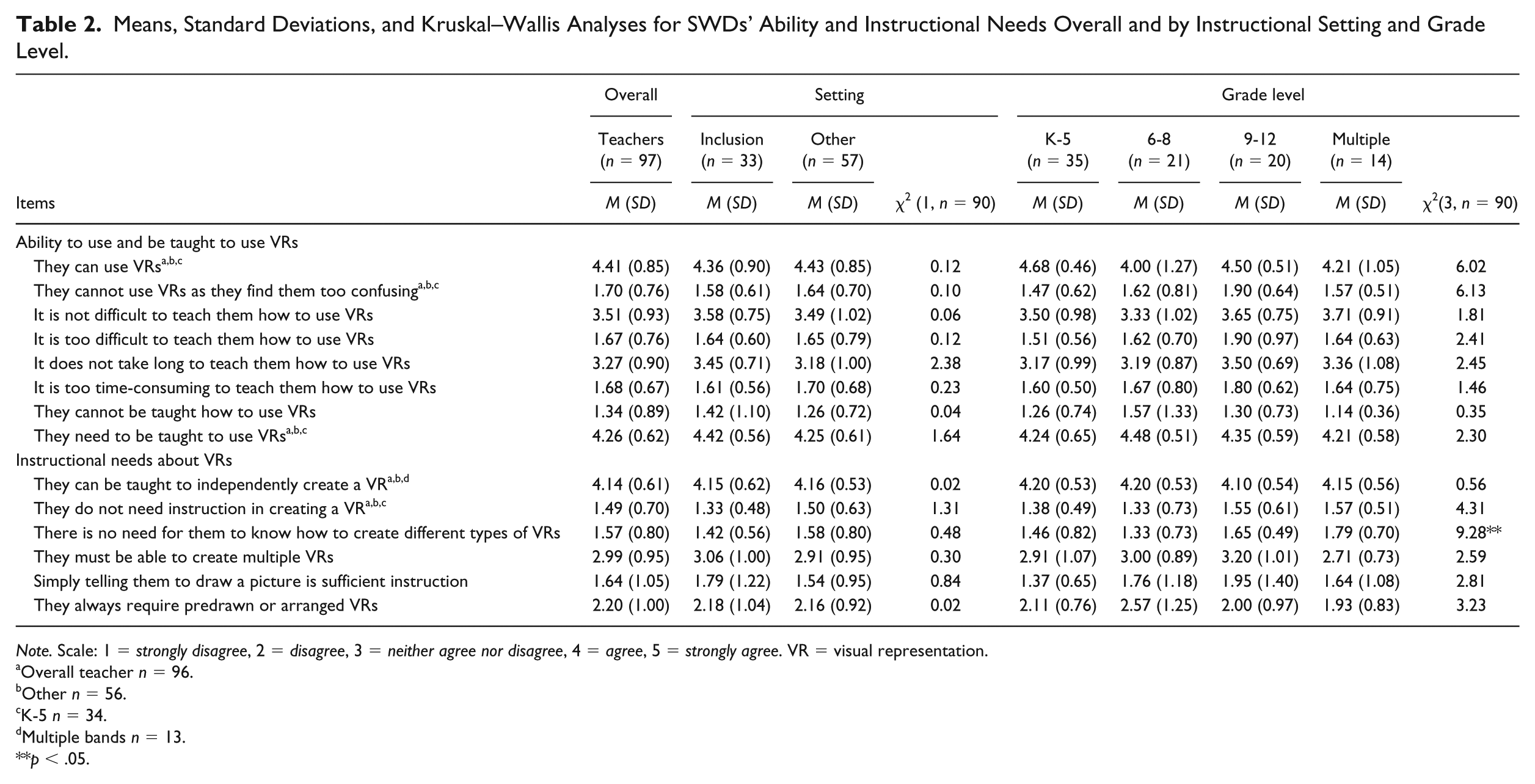
Note. Scale: 1 = strongly disagree, 2 = disagree, 3 = neither agree nor disagree, 4 = agree, 5 = strongly agree. VR = visual representation.
Overall teacher n = 96.
Other n = 56.
K-5 n = 34.
Multiple bands n = 13.
p < .05.
Means, Standard Deviations, and Kruskal–Wallis Analyses for Difficulties SWDs Experience When Using VRs Overall and by Instructional Setting and Grade Level.
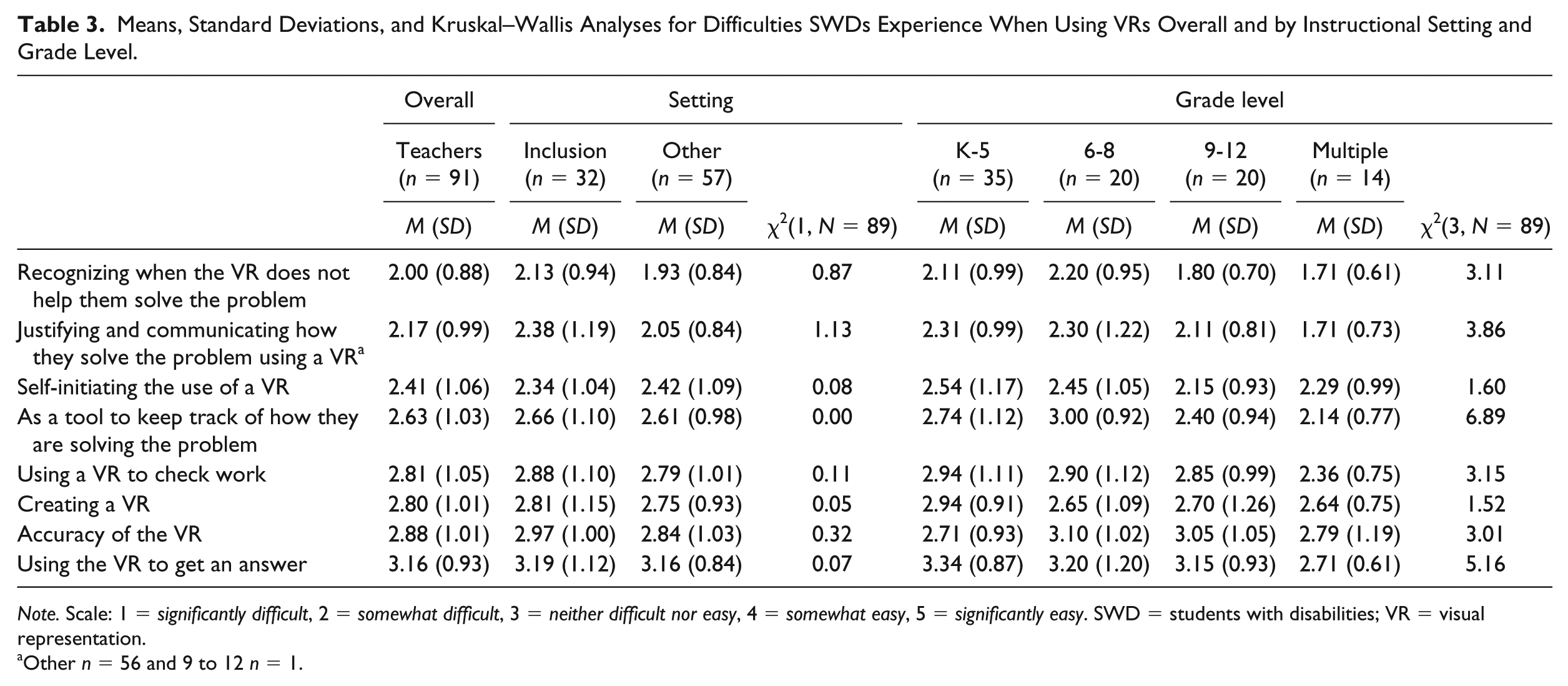
Note. Scale: 1 = significantly difficult, 2 = somewhat difficult, 3 = neither difficult nor easy, 4 = somewhat easy, 5 = significantly easy. SWD = students with disabilities; VR = visual representation.
Other n = 56 and 9 to 12 n = 1.
Implementation Procedures
A total of 34 district representatives from three states were contacted by the authors (via phone and/or email) for permission to distribute the survey to their staff; 10 representatives were willing to (a) pass on the information during a 7-month window (May-November), (b) distribute the survey to their teachers, and (c) send a reminder email with the survey link midway through the window. Calculating an accurate response rate was difficult because although all of the representatives indicated that they had shared the survey link with their special education teachers, only a few shared the number of educators who received the link. For the survey as a whole, an approximate return rate of 7.1% was calculated.
Data Analysis
For each of the items in this analysis, descriptive statistics (i.e., mean, standard deviation, and percent) were examined. Kruskal–Wallis analyses were run on SWD’s grade level (PK-5, 6-8, 9-12, multiple bands) and instructional setting (inclusion vs. other) with necessary post hoc Mann–Whitney U tests to determine whether any differences existed on the items across the various groups. Nonparametric statistics were used as normality assumptions (i.e., distribution of data) were not met and the data collected were ordinal (Jamieson, 2004).
Results
Teacher Beliefs about SWDs’ Ability and Instructional Needs in Mathematics
Table 2 summarizes the means and standard deviations for all teacher responses to items on the survey regarding their perception of SWDs’ ability and instructional needs for using VRs to solve mathematical problems. As evident from the data, there was, on average, strong support that SWDs can use and be taught to use VRs and that they have a need to be taught how to create VRs. On average, there was strong disagreement that it is too difficult and time-consuming to teach SWDs to use VRs and that instruction should be restricted to just telling students to draw a picture or one diagram form. The parallel forms of these statements, however, seemed to suggest, on average, less of an agreement (e.g., on average, participants did not agree nor did they disagree that it does not take too long to teach SWDs how to use VRs).
The results of the Kruskal–Wallis analyses for instructional setting and grade level are summarized in Table 2. For instructional setting, no significant differences were found. For grade level, one item was found to be significant (“There is no need for them to know how to create different types of VRs”), χ2(3, N = 90) = 9.28, p < .05). Post hoc analyses suggested that the significant difference was between teachers in Grades 6 to 8 and Grades 9 to 12, and Grades 6 to 8 and multiple bands. Although significant, all teacher groups still “strongly disagreed” with the statement suggesting that students do need to know how to create different types of VRs.
Teacher Perceptions of Difficulties SWDs Have Using VRs
Table 3 summarizes the means and standard deviations for all teacher responses to items related to difficulties SWDs might experience using VRs. On average, all items were considered to be somewhat difficult for SWDs with the exception of one item (“Using the VR to get an answer”), which was considered, on average, to be neither difficult nor easy for SWDs.
The results of the Kruskal–Wallis analyses for instructional setting and grade level are summarized in Table 3. For instructional setting and grade level, no significant differences were found.
Discussion
In their mathematics instruction, teachers appear to draw not only upon their content and pedagogical knowledge, including their perspectives about the learner, but also on their beliefs (Beswick, 2007; Campbell et al., 2014). In combination, knowledge and beliefs can influence instructional practice (Philipp, 2007). Gaining insight into a teacher’s perspective can provide invaluable information for developing teacher training approaches to improve outcomes for SWDs. We report findings that explored special education teachers’ perceptions of SWDs’ ability and instructional needs for using VRs to solve mathematical problems and the difficulties SWDs might have using VRs to solve mathematical problems. In addition, we examined whether these special education teachers’ perceptions differed for SWDs by grade level and instructional setting. Two main findings emerged.
First, there was an overall general belief across all grades and settings that SWDs have the ability to learn about and use VRs and need to be taught to use VRs. This finding is encouraging for two reasons. On one hand, there is a plethora of literature suggesting that the expectations teachers hold about their learners will determine how they treat them, including in mathematics (Beswick, 2005, 2008; Peltenburg & van den Heuvel-Panhuizen, 2012). Hopefully, too, this may mean that, unlike the general education teachers in Stylianou’s (2010) study, special education teachers are not perceiving that VRs be reserved for high-performing students only. On the other hand, several studies have demonstrated the need for SWDs to be explicitly taught how to use VRs (e.g., van Garderen, 2006, 2007; Xin et al., 2005) that move beyond simply telling a student to use a VR (e.g., “draw a picture”). The findings in this study suggest special education teachers recognize the need for students to receive explicit instruction in VRs. Whether or not they are actively using explicit instruction to teach VRs requires additional investigation.
Second, overall, there was a perception that SWDs have difficulty with all aspects related to using VRs in mathematical problem-solving that, for the most part, did not appear to differ by instructional setting or grade level taught. That the teachers found all aspects to be somewhat difficult for SWDs does corroborate with findings from other studies that identified specific difficulties SWDs may experience with VRs when solving mathematics problems (van Garderen & Montague, 2003; van et al., 2013; van Garderen et al., 2014; Boonen et al., 2014; Krawec, 2014). Further, it is possible that regardless of where SWDs receive their instruction and despite their grade level, using VRs remains a constantly challenging strategy for them to use throughout their schooling. Several researchers have found that even middle and high school students benefit from strategy instruction that incorporates VRs (Hutchinson, 1993; Montague, Enders, & Dietz, 2011; Montague, Krawec, Enders, & Dietz, 2014). Clearly, the findings from this study highlight the continued need for instruction for SWDs that supports their development to use VRs in mathematical problem-solving at all grade levels and in any setting.
Limitations and Future Research Directions
Although the findings of this study are interesting, they should be considered exploratory; indeed, our findings are in need of further investigation. We raise two main issues. First, while the special education teachers in this study, on average, have a more positive view of their SWDs’ ability to use and be taught how to use VRs, it has also been previously acknowledged that VRs may serve more of a peripheral and limited role in their instruction (van Garderen et al., 2018). Thus, based on our earlier findings, it may appear that teachers’ beliefs are inconsistent with their teaching practice and this may be the case. Other researchers have identified inconsistencies between teachers’ beliefs and practices (e.g., Hoyles, 1992; Raymond, 1997; Sztajn, 2003). However, it has been found that these inconsistencies often “disappeared” with a better understanding of the teacher’s thinking about some aspect of his or her classroom environment (see Philipp, 2007, for a review). Simon and Tzur (1999) strongly recommend that when examining teacher beliefs, it is important to understand that “every teacher’s approach is rational and coherent from his or her perspective” (p. 261). To better understand the connections between beliefs and practices, it is recommended that the circumstances or context surrounding the teacher’s practice is also examined (Philipp, 2007). Therefore, in this study, the use of Likert-type scales did not provide a way to further understand whether teachers’ perspectives are indeed inconsistent with their practice. This is not to say the use of Likert-type scales in this study necessarily provided inaccurate data but they may have limited the extent of the findings. Furthermore, there is research supporting the accuracy of teachers’ judgments about their learners’ achievement and actual test performance (Südkamp, Kaiser, & Möller, 2012) suggesting that what may be needed are additional studies that utilize different methodologies (e.g., observations, interviews, context-based survey) to further examine the connections between teachers’ beliefs and practice.
Second, it was interesting to find that, on average, all teachers, regardless of grade or instructional setting, found all aspects of using VRs to be difficult for SWDs. While this might indeed be the case, we wondered if differences should have been found. For example, if SWDs received good explicit instruction related to using VRs to solve mathematics problems in a lower grade, could they then have fewer or no difficulties using VRs in a higher grade? It is possible that listing the difficulties rather than having the teachers identify difficulties may have contributed to the current finding. Additional research using alternative methods (e.g., open-ended questions) may help address this concern. However, it is also possible that the teachers themselves had difficulty differentiating between the statements (e.g., creating vs. using a VR to solve a problem) to really help understand what difficulties SWDs experience. Thus, it may have been that the survey statements were not clear enough or the teachers themselves did not necessarily understand the various ways in which a VR may be used throughout the problem-solving process. In a study by van Garderen et al., (2018), special education teacher knowledge about VRs was considered to be narrowly conceived. Again, however, additional research to address either the limitations of the survey itself or research that utilizes different methodologies (e.g., open-ended questioning, rank order items) to further examine the difficulties special education teachers perceive SWDs to have when solving mathematics problems is warranted. Regardless, this study provides initial steps in moving our understanding forward beyond the general finding that students have difficulties solving word problems to better understand what specific problem-solving difficulties students might experience.
Implications for Teacher Education
The special education teachers in this study acknowledged the many difficulties SWDs may experience when using VRs to solve mathematics problems. Although there is a recognition of students’ difficulties, it should not be assumed that all teachers will recognize that students have difficulties with VRs or be able to identify specific difficulties they may experience. For example, in the study by Chideridou-Mandari et al. (2016), while just over half the teachers were able to identify that students with dyscalculia might experience difficulty with VRs, at least 40% of the teachers were not able to. It may be possible that these teachers, and potentially others, have not been made aware of this important information. Ideally, all teachers should be able to systematically assess for specific difficulties with VRs to determine whether additional explicit instruction in using VRs to solve mathematics problems for SWDs is necessary. Therefore, it is important that opportunities are presented within teacher preparation programs that help teacher candidates understand what difficulties SWDs may experience related to VRs. Several studies have been conducted that provide good insights as to what those difficulties may be (e.g., Krawec, 2014; van Garderen & Montague, 2003, van Garderen et al., 2013; van Garderen et al., 2014).
Finally, an important message from this study is that special education teachers do have positive perspectives about their SWDs’ ability to both use and learn about VRs as a way to solve mathematics problems. Therefore, when training teachers, it seems important to draw out these positive perceptions and utilize them in discussions as a way to encourage or demonstrate the need for high expectations for their learners, particularly given the strong connections between teacher expectations and student outcomes (Beswick, 2005, 2008; Peltenburg & van den Heuvel-Panhuizen, 2012). However, drawing out and connecting to teacher perceptions about SWDs’ ability to use VRs should be considered a starting point. Given that many SWDs experience difficulties using VRs (e.g., van Garderen et al., 2014), teachers will need to know how to provide targeted or explicit instruction for using VRs to solve mathematics problems. This will require provision of instruction within teacher preparation programs that help teacher candidates develop both strong content knowledge about VRs (e.g., what is a VR, purpose and roles of VRs, VR forms and structures, and how VRs can be used throughout the problem-solving process) and pedagogical knowledge about VRs (e.g., how a VR can serve both as a process [i.e., tool or strategy to solve a problem] and product [i.e., way to demonstrate concepts], and how to use VRs with students to promote discussion, explanation, justification of thinking and learning) to use VRs as an evidence-based practice in their mathematics instruction (van Garderen, et al., 2018; National Council of Teachers of Mathematics, 2000; Pape & Tchoshanov, 2001). In addition, teacher candidates will need sound understanding for using explicit instruction as a method of delivery with SWDs (Krawec & Montague, 2014).
Footnotes
Acknowledgements
The authors thank Mary Murray and Angela Black for their support and assistance in generating this manuscript.
Declaration of Conflicting Interests
The author(s) declared no potential conflicts of interest with respect to the research, authorship, and/or publication of this article.
Funding
The author(s) received no financial support for the research, authorship, and/or publication of this article.
