



Abstract
In this study, researchers examine the impact of e-coaching (including a web-based professional development [PD] portal consisting of a learning module, self-monitoring, and video feedback) on preschool teachers’ use of a simultaneous prompting (SP) procedure and the effects of SP on teaching discrete skills to their students with autism spectrum disorder (ASD). The researchers also examine maintenance and generalization effects on teachers’ and students’ behaviors. Moreover, researchers investigate the social validity of the study. They use nested multiple probe designs across four preschool teacher and student dyads to evaluate the effects of the e-coaching intervention and the SP procedure, respectively, on teachers’ and students’ behaviors. E-coaching was effective in the acquisition, maintenance, and generalization of preschool teachers’ use of the SP procedure, and the SP procedure was effective in teaching discrete skills to students with ASD. Teachers had positive opinions about e-coaching and the SP procedure. Limitations and implications for future research are discussed.
Keywords
The sharp increase in the prevalence rates for autism spectrum disorder (ASD) in recent decades (Baio et al., 2018; Christensen et al., 2016) has resulted in a larger number of students with ASD in education systems and higher demands on teachers to provide quality instruction to all children, including children with ASD. General education (GE) teachers, however, have reported concerns about their ability to meet the needs of their students with disabilities in their classrooms (Attwood et al., 2019; Dybdahl & Ryan, 2009; Horne & Timmons, 2009), inadequate coursework in special education (SE) programs, and lack of experience in providing inclusive settings (Barned et al., 2011). They also have reported that they do not have sufficient preservice training with regard to the selection and implementation of evidence-based practices (EBPs) for teaching students with ASD (Morrier et al., 2011). As in many countries, including Turkey, GE teacher training programs, including preschool teacher (PT) training programs (PTs have a bachelor’s degree in preschool education covering a wide range of topics from child development to teaching methods in Turkey; they serve children between 3 and 6 years of age), have generally included a single introductory SE course that covers definitions of special needs and SE, SE categories, and legal requirements. As a result, instead of using EBPs, some teachers may choose to use unproven, disproven, and pseudoscientific interventions in their classrooms (Travers, 2017). Although the use of these interventions should be discontinued, they are still used widely in schools (Miller & Sawka-Miller, 2010). The key to providing quality instruction for students with disabilities, however, is closely related and linked with the use of effective teaching practices (Odom et al., 2011). Although there are no statistics regarding the prevalence rate of children with ASD in Turkey, the number of students with ASD in preschool GE settings has increased recently in many countries. Therefore, providing professional development (PD) opportunities could be an option for supporting teachers to use these practices with fidelity. The need for PD for GE teachers, including PTs, to ensure success for all students in inclusive settings (Mitchell & Hegde, 2007) and address research-to-practice gaps (Cook & Schirmer, 2006; Jones, 2009) is well-documented and affects not only teacher success but also student success (Smith et al., 2010).
Although the most common form of PD is a 1-day in-service training with limited or no follow-up sessions, research has shown that teachers fail to translate the content of this type of training to classroom settings (Kretlow & Bartholomew, 2010; Wood et al., 2016; Yoon et al., 2007). The possible reasons for this failure were explained by Klingner et al. (1999) as follows: (a) teachers may not have an in-depth understanding of a particular practice, (b) they may forget how to use it in the classroom, and (c) they may need a reminder of the practice when starting to use it in the classroom. Wood et al. (2016) indicated that teachers who receive in-service training without having follow-up and/or feedback for their practices in the classroom do not have the chance to develop their teaching skills. Therefore, PD that provides coaching and feedback has started to attract the attention of researchers and practitioners, especially during the past two decades. Kretlow and Bartholomew (2010) described coaching as an expert providing individualized support to teachers after initial training is completed. A coach provides specific feedback on the accuracy of teachers’ implementation of new interventions. Research on coaching shows that the rate of acquisition and accuracy of using new interventions can increase (e.g., Kretlow et al., 2012; McLeod et al., 2019; Ploessl & Rock, 2014; Shepley et al., 2018; Tekin-Iftar et al., 2017). Although PD is an effective strategy for supporting teachers’ implementation of new interventions, the mode of delivering PD is especially important for countries that are larger and have limited financial and human resources (i.e., SE teachers). Given these drawbacks, providing online PD and e-coaching (electronic coaching) could be a valuable option because once it is developed, it does not require intense financial and human resources, and many teachers can access it in their own time and pace. Research on e-coaching shows that it is effective in teaching the use of new interventions to teachers (e.g., Coogle et al., 2017; Fettig et al., 2016). E-coaching consists of using technology to deliver feedback. It can be a one-way or two-way process and can involve audio, video, or both either synchronously or asynchronously. Differences in the components (e.g., length of training, using video examples, and manuals) and delivery modes (e.g., Skype, FaceTime, and TeachLivE) of e-coaching, as well as the type, frequency, duration, and intensity of the feedback are important lines of research. The maintenance and generalization effects of online PD and e-coaching on students’ outcomes are highly valued when designing PD interventions and merit further research (Coogle et al., 2017; Elford, 2013; Owiny, 2014). To date, teachers’ behaviors—not students’ behaviors—have been predominantly examined in research literature. Finally, the social validity of online PD and e-coaching interventions has been investigated in a limited number of studies (e.g., Artman-Meeker, 2010; Coogle et al., 2017). In those studies, interview techniques have rarely been used (e.g., Fettig et al., 2016). As social validity data collected through questionnaires have elicited limited information about the processes and procedures used during face-to-face coaching (Kretlow & Bartholomew, 2010), in-depth interviews with teachers could help determine teacher preferences and garner useful information for designing effective and acceptable coaching models.
Simultaneous Prompting (SP) as an EBP
The SP procedure, one of several response-prompting strategies, is an EBP for teaching discrete and chained skills to individuals with various types of disability from early childhood to adulthood (Tekin-Iftar et al., 2019). It consists of two types of trials: (a) daily probe trials, followed by (b) training trials (Collins, 2012; Tekin-Iftar, 2008). Training trials involve the presentation of an individualized controlling prompt (i.e., one that is likely to result in a correct response) immediately following the presentation of a stimulus (e.g., a task direction). The student is then expected to provide a correct response. Because controlling prompts are delivered in each training trial, the student does not have the opportunity to make an independent response; hence, daily probe trials are needed to assess acquisition. These trials occur prior to training trials so maintenance from the previous training session can be assessed. The instructor continues to deliver SP training trials using the same controlling prompt until criterion is met during probe trials. As training trials are discontinued once criterion is reached in probe trials, the instructor does not have to fade the prompt by changing its type or intensity (Tekin-Iftar et al., 2019).
Tekin-Iftar et al.’s (2019) meta-analysis of the SP procedure research literature documented that its effectiveness has been predominantly investigated in SE settings. At the same time, this meta-analysis also documented that persons other than SE teachers (i.e., peers, paraprofessional) can use it reliably. To the authors’ knowledge, based on the international literature base, there has been only one study investigating the effectiveness of the SP procedure in GE settings among adolescents with ASD (Tekin-Iftar et al., 2017). In this study, health education teachers were provided face-to-face PD with face-to-face coaching. The findings revealed that face-to-face PD with face-to-face coaching was effective in teaching the SP procedure to GE teachers and, subsequently, academic skills to students with ASD. The maintenance and generalization effects of both PD and the SP procedure for both teachers and students are highly promising. The findings of Tekin-Iftar et al. (2019) and Tekin-Iftar et al. (2017), and the aforementioned need for more research on PD, provided impetus for this study, thus extending the research on the implementation of PD and e-coaching in teaching PTs who serve students with ASD to use the SP procedure in inclusive settings. The purpose of this study was twofold: (a) to determine whether e-coaching is effective in teaching the SP procedure to PTs who have students with ASD included in their classrooms, and (b) to determine the effects of the SP procedure in teaching academic skills to preschool students with ASD in GE classrooms. Maintenance and generalization of the acquired skills in teachers and students also were examined. Moreover, opinions of PTs regarding the social validity of e-coaching and the SP procedure were investigated in the study.
Method
Participants
Four PTs and four students with ASD from a local public preschool in Central Turkey participated in this study. Prior to the study, the researchers obtained approval from the university review board. Researchers, school principals, and potential PTs suggested by the principals and working with students with special needs had a meeting to share the research plan to identify the volunteer teachers. The researchers obtained signed informed consent forms from the volunteer PTs, and the PTs obtained signed parental consent forms for the children’s participation in the study. The researchers paired the teachers and students in dyads. All students had received diagnoses of ASD from child and adolescent psychiatrists working at local hospitals. Their diagnoses were not confirmed by the researchers because test scores of children with special needs are not made available to researchers in Turkey. The psychiatrists diagnosed the children based on their observations and parent interviews.
Teachers
Four PTs with a bachelor’s degree from a PT training program participated in the study. Ms. Ezgi and Ms. Asli were 29-year-old female teachers with 4 and 6 years of teaching experience, respectively. Mr. Mete was a 35-year-old male teacher with 12 years of teaching experience. Ms. Duygu was a 33-year-old female teacher with 10 years of teaching experience. The only prerequisite for participation in the study was having a student with ASD in their classroom and not having any prior training in SE (Tekin-Iftar et al., 2017).
Students
Ali was a 6-year-old male student with ASD. The Gazi Early Childhood Development Assessment Scale (GECDAS; Temel et al., 2005) indicated that Ali could run on his tiptoes, name four primary colors, complete an eight-piece puzzle, divide two sets of colored buttons into groups, name opposites, wash his face without assistance, and get dressed and undressed. According to Ms. Ezgi, Ali had difficulty initiating verbal communication, introducing himself, joining social play, and acquiring certain concepts (e.g., fruits, animals, and occupations). Gizem was a 4-year-old female student with Pervasive Developmental Disorder–Not Otherwise Specified (PDD-NOS). Her GECDAS evaluation indicated she could walk on her tiptoes, jump a certain distance, cut paper with assistance, fold paper in half, kick a ball, match three colors, complete a four-piece puzzle, repeat four numbers, indicate six body parts on a doll, sing by herself, and show five body parts. According to Ms. Asli, Gizem could not initiate/maintain conversations, join in group work, or demonstrate some concepts (e.g., colors, animals, and occupations). Can was a 6-year-old male student diagnosed with autism and language and speech impairment. His GECDAS results showed that he could run on his tiptoes, walk backwards with heel contact, catch a bouncing ball, count four objects, complete an eight-piece puzzle, separate buttons of two colors into groups with assistance, count up to 10, and combine two triangles to make a square. Mr. Mete noted that Can had difficulty acquiring facial expressions; naming vegetables, fruits, vehicles, and occupations; initiating communication; and playing independently. Deniz was a 6-year-old male student with autism. GECDAS indicated that he could run on his tiptoes, indicate what two out of three objects are made of, answer “Why” questions, add arms and legs to an incomplete drawing of a person, talk in complete sentences, draw a person indicating six body parts, name opposites, combine two triangles to make a square, and name objects by their functions. Ms. Duygu reported that Deniz had difficulty identifying geometric shapes, naming adverbs of places, naming occupations in English, joining group work, and initiating a conversation by himself. The prerequisite criteria for the students to participate in this study were (a) the ability to pay attention to visual and/or audio stimuli for 5 minutes, (b) the ability to follow directions (4–5 word sentences), and (c) attendance in a part-time or full-time preschool class at least 3 days a week. The first researcher interviewed the PTs regarding these criteria and observed the students in the classroom. All students met the prerequisite criteria. Learning the names of occupations (learning them in English for Deniz) was one of the objectives in the preschool education curriculum (PEC).
Research staff
The first researcher, a doctoral student in SE, conducted all sessions, collected and analyzed data, and provided e-coaching to the PTs. (We sometimes refer to her as “coach” throughout the article depending on the context.) The second researcher, the doctoral student’s advisor, had a PhD in SE, held the rank of full professor at a local university in Central Turkey, and had more than 25 years of experience as a researcher. Another doctoral student in SE collected the reliability data. The first researcher explained and modeled how to collect reliability data while showing a randomly selected training session video. The two doctoral students continued practicing until they reached at least 90% agreement.
Settings and Materials
Settings for teachers
All experimental sessions took place in classrooms in one-on-one instructional arrangements. The classrooms had different learning centers, tables and chairs for students, and television sets, as well as other classroom materials. During the sessions, teacher and student dyads sat face-to-face in a corner of the classroom while all other students in the classroom participated in craftwork or other group activities. Both probe and training sessions took place two or three times a week depending on classroom routines.
Settings for students
The students were assessed in two different settings. The first researcher conducted baseline and generalization sessions individually with the students in an education room containing a photocopy machine, bookshelves, and a table with two chairs. They sat face-to-face during these sessions. The remaining sessions were conducted by the PTs in their classrooms as described above.
Materials for teachers
During baseline and generalization sessions, the PTs used various materials (i.e., picture book of fruits and plastic fruits to teach names of fruits; play dough, watercolors, coloring books, and finger paints to teach colors; masks and cards to teach facial expressions; and colorful cubes and a chalkboard with chalk) to teach adverbs of places such as in, on, and under. They also used tablet computers, tripods, and data collection forms to record data from their sessions and uploaded them onto a website to self-monitor their teaching and obtain feedback through e-coaching.
Materials for students
The researcher used 30 unique clip art picture cards showing different occupations in the screening session. Each occupation card showed a person wearing a special uniform for their occupation and a special tool used by the person performing the occupation (e.g., picture card for firefighter showed man wearing uniform, helmet, gloves, and boots, and handling fire hose). All picture cards (printed out on 10 cm × 10 cm cards and laminated) had the same line width. The pictures on the training cards were in color, whereas the cards used for generalization were black and white. Nine occupation cards were used in the baseline, instruction, generalization, and maintenance sessions. A camera, a tripod, and data collection forms were used to record all sessions. (A list of additional materials used during the development and publishing of the web-based PD program is available upon request.)
Experimental Design
A multiple baseline design across the teacher–student dyads documented the effectiveness of the web-based PD with e-coaching to train the PTs to implement the SP procedure in teaching discrete skills to students with ASD, as well as the effects of the SP procedure on student outcomes. When the dependent variable increased only after the independent variable was implemented in a time-lagged manner, experimental control was established (Tekin-Iftar et al., 2017).
Dependent and Independent Variables
There were two dependent variables in the study: (a) the ability of the PTs to use the SP procedure accurately to teach discrete skills to their students with ASD, and (b) student acquisition of the discrete target behaviors (i.e., naming occupations for Deniz and pointing to the occupation card for Ali, Gizem, and Can) from their PEC. The researchers modified the task analysis developed by Tekin-Iftar et al. (2017) to record the PTs’ instructional behaviors during sessions. The first researcher collected data on the following teacher behaviors during baseline sessions, daily probe sessions, maintenance sessions, and generalization sessions: (a) use correct teaching materials, (b) deliver attentional cue, (c) deliver task direction, (d) wait 4-second response interval, (e) deliver appropriate consequences, (f) collect data on student responses, and (g) wait 4-second intertrial interval. The first researcher collected data on the following teacher behaviors during training sessions: (a) use teaching materials, (b) deliver attentional cue, (c) deliver task direction, (d) present prompt, (e) wait 4-second response interval, (f) deliver appropriate consequences, (g) collect data on students’ responses, and (h) wait 4-second intertrial interval. The criterion for teachers was 100% accuracy in using the SP procedure across three consecutive sessions. To evaluate the PTs’ acquisition of their target behaviors, the first researcher plotted the percentages of correct responses in instructional sessions during the SP.
The first researcher met with each PT at school to identify target behaviors for each student. Because there were no up-to-date individualized education plans for the students, the researchers made a list of all objectives from the PEC and requested that teachers select possible targets for each student. The researchers chose to target receptive identification of occupations by pointing to the correct card from a selection of three cards as the dependent variable for Ali, Gizem, and Can although Can was the only student with speech impairment. The dependent variable for Deniz was stating the name of the occupations shown on the cards in English. Deniz knew the names of the occupations in Turkish; therefore, we chose to state the names of the occupations in English as this would be part of her first-grade curriculum. Target behaviors were as follows: (a) Ali—nurse, vet, and pilot; (b) Gizem—firefighter, nurse, and cook; (c) Can—nurse, painter, and conductor; and (d) Deniz—firefighter, nurse, and cook. The criterion for each was 100% correct responses during daily probe sessions. The first researcher plotted the percentages of correct responses in daily probe sessions on individual graphs for visual analysis. There were also two independent variables in the study: (a) e-coaching to train PTs to use the SP procedure, and (b) the SP procedure to teach occupations to students with ASD.
General Procedure
Pilot study
Prior to this study, a pilot study was conducted with a PT working in a local public school and a preschool child to (a) assess the clarity of the module on the SP procedure for the teacher, (b) assess the teacher use of the SP procedure after completing the module, (c) identify and solve any problems related to website use by the teacher and researchers, and (d) test data collection forms. The teacher was asked to define a target behavior for the child, log in to the website, and complete the module. Afterward, the coach interviewed the teacher about the design of the module, tutorial video, video explaining the SP procedure, and recommendations (if any) regarding any aspect of the web-based PD. She reported that the system was easy to follow and that the content was clear enough for her to understand the SP procedure. No changes were made in the content of the module after the pilot study; however, some technical modifications and changes (e.g., speeding up the internet connection, changing video formats) were made.
Screening procedures
The first researcher, coach, conducted screening sessions to identify the target stimuli for each student. Thirty picture cards, each representing a different occupation, were used to screen for unknown occupations by having Ali, Gizem, and Can receptively identify known occupations across picture cards and by having Deniz state known occupations in English. From the pool of unknown occupations, three were selected as the target stimuli for each student. In making the selections of target stimuli, we took into consideration which occupations were most common in Turkey. We identified the other unknown occupations as distracters to be used in baseline and intervention sessions. There were 10 trials in each screening session (five different occupations randomly asked twice). Three screening sessions were conducted in a day with each student with all screening sessions completed in 2 days. A screening trial in a one-on-one format took place as follows: She delivered an attentional cue (e.g., “Ali, are you ready to start?”). After receiving an affirmative response, she put three occupation cards on the table for Ali, Gizem, and Can: one showing the target stimulus and two serving as distracters. She changed the distracters and placed them in different positions during each trial. She showed a single occupation card to Deniz. She delivered the task direction to Ali, Gizem, and Can (e.g., “Show me the pilot.”) and to Deniz (e.g., “Tell me . . . in English.”) and then waited 4 seconds for the student’s response. No responses (correct, incorrect, or no responses) received feedback from the researcher. The intertrial interval was 4 seconds. The researcher thanked the students for their participation.
Baseline Sessions
Baseline sessions for teachers
The researchers assessed the teachers’ ability to use the steps of the SP procedure (i.e., daily probe trials followed by training trials) while teaching different discrete behaviors (fruits to Ali, colors to Gizem, facial expressions to Can, and adverbs of place to Deniz) to their students with ASD. The researchers asked the PTs to teach behaviors other than the target behaviors to avoid the learning of target behaviors by the students. Baseline sessions for teachers were conducted individually for all PTs. An example of a task direction to the PTs was “Ms. Ezgi, please teach Ali the fruits.” PTs then carried out instruction and simultaneously recorded the process with their tablets. Afterward, PTs uploaded the video file to a website. The researchers assessed the teachers’ behaviors in accordance with the steps of the SP procedure presented in the dependent variable section. The number of possible responses per session was nine trials per step (e.g., deliver attentional cue, present task direction). The three types of responses possible in the baseline sessions were (a) correct response, (b) incorrect response, and (c) no response. The first researcher watched the uploaded video files and collected data on teachers’ behaviors using a plus (+) to indicate that the teacher had delivered a step correctly and a minus (–) to indicate that the teacher had delivered a step incorrectly or failed to perform a step. Thereafter, she calculated the percentage of correct responses out of the number of possible responses to plot the data on a graph.
Baseline sessions for students
The coach conducted baseline sessions with the students. There were nine trials in each baseline session. She delivered an attentional cue (e.g., “Ali, are you ready to start?”); after receiving an affirmative response from the student, she delivered the task direction (e.g., “Show me the pilot.”). She then waited 4 seconds for the student’s response and ignoring correct, incorrect, or no responses she recorded the performance data of the student. She then waited the intertrial interval of 4 seconds before proceeding to the next trial. She thanked the students for their participation and appropriate behavior after the session. The first researcher collected data using a plus (+) to indicate that the student responded correctly within 4 seconds and a minus (–) to indicate that the student responded incorrectly or failed to respond within 4 seconds. Then, she calculated the percentage of correct responses and plotted them on a graph.
Instructional Sessions
Web-based PD portal
The researchers developed a website consisting of the SP module and a system allowing teachers to upload their videos and receive feedback. The researchers adopted a sequence of behavioral skill training (Miltenberger, 2003), including explanations, modeling, self-monitoring, and feedback sequences while developing it. After the researchers collected baseline data from the teachers, they allowed them to log in with their own user names and passwords. The website was accessible to them at www.omegep.com (it is not currently accessible to the public). Teachers followed the steps shown in Figure 1.
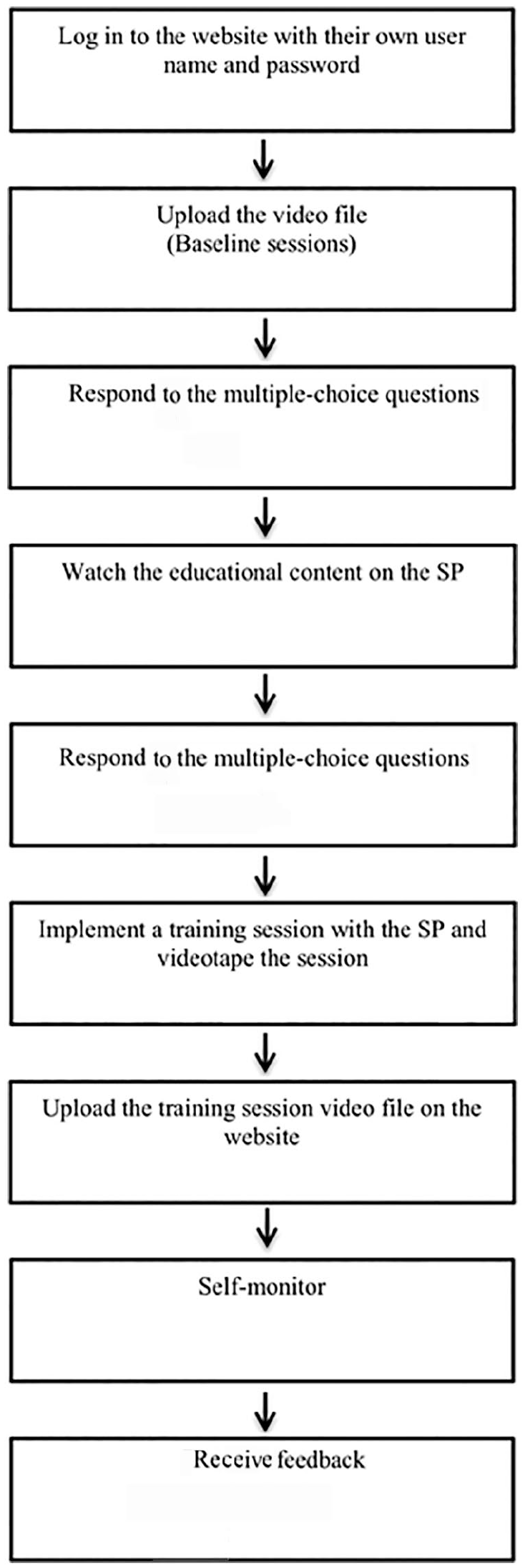
Flow of the expected teacher’s behaviors on website.
Learning module
The following content was shared with the teachers in the form of audio-visual content created using Prezi and presented on the website: (a) explanation of the SP procedure, (b) examples of behaviors taught using the procedure, (c) definitions of concepts (e.g., prompt, session, and trial), (d) the components and examples within the SP, (e) definitions of response and intertrial intervals, (f) an overview of how trials were delivered, (g) how to determine the number of trials per session, (h) probe trial and training trial videos, (i) delivery of task direction and prompts, and (j) how to assess, record, and manage student behaviors. The coach recorded the module content in an 18- to 21-minute video. PTs were asked to respond to five different multiple-choice questions before and after watching the educational content in the video. Access to the educational content by the participants was not restricted.
Self-monitoring
After the PTs completed the learning module, the coach asked each PT to deliver their first training session with their target student to teach target skills (i.e., occupations). The PTs recorded all sessions using a tablet computer and then uploaded them to the self-monitoring section of the website.
Upon completion, the uploaded video was presented on the right side of the webpage, whereas a checklist of teacher behaviors for that session was presented on the left side of the webpage. The PTs were asked to watch their own videos and evaluate their performance by checking the relevant boxes in the checklist. The PTs conducted this self-monitoring procedure across all training sessions and daily probe sessions.
Feedback
The coach provided video feedback regarding the training and probe sessions conducted by the PTs. The coach provided feedback to the PTs within 3 hours on the day they uploaded their videos to the system. On the feedback page of the website, the right side of the page presented the video uploaded by the teacher, whereas the left side displayed the feedback video provided by the coach. The page was designed so that, if needed, the PT could also access the video they uploaded instead of the feedback video of the coach. All feedback videos had an introduction with a positive opening statement. The PTs were thanked for their participation, and positive feedback was provided for all the steps they correctly and fully completed during the trials (i.e., “You were very good at delivering the task directions and immediately following it by presenting the prompt. Thank you, Ms. Ezgi. You were excellent!”). The video recording of the relevant steps of the SP was edited into the feedback video, and corrective feedback was provided (i.e., “Ms. Ezgi, in the next session, please wait for the 4-second response interval. You do not need to redeliver the task direction to the student during this interval.”). Following the presentation of corrective feedback, a positive and motivating closing statement was provided (i.e., “Ms. Ezgi, you completed your training session perfectly and very quickly. Thank you for your effort and attention to detail. I look forward to your next session. Take care.”), and the feedback video ended.
In addition, the coach provided graphical feedback (i.e., a line graph resembling their performance) to the teachers once a week during the training sessions. This was also initiated with a positive opening statement. The first instance of graphical feedback provided information regarding the use and meaning of the information displayed in the images of the feedback. Progress in teacher performance was marked on the graphics, and motivational statements (i.e., “Ms. Ezgi, look how your performance on the SP is developing.”) were used to express appreciation. The graphical feedback was also finalized with a positive closing statement.
In accordance with e-coaching website components, the PTs initially logged in to the website using their user names and passwords. They then uploaded a preprogram video (assessed as baseline sessions for teachers), answered preevaluation questions, followed the educational content of the SP, answered evaluation questions, conducted training sessions based on the SP program, and recorded a video of their daily probe and training sessions. Finally, they uploaded their videos to the website, conducted self-monitoring evaluations, and received feedback.
SP Sessions
PTs conducted a training session first, and then they conducted training sessions immediately after daily probe sessions 2 or 3 days per week. Each session consisted of a total of nine trials, three trials for each target behavior. Daily probe sessions and training sessions were conducted in the same format provided in Tekin-Iftar et al.’s (2017) study. The teacher first secured the student’s attention (e.g., “Ali, today I will ask some questions. If you know the answer, please show me. Are you ready?”) and verbally reinforced his affirmative response (e.g., “Great, let’s start.”). The PT then delivered the task direction (e.g., “Which one is a pilot? Show me.”) and waited 4 seconds for a response; correct responses resulted in verbal reinforcement (e.g., “Great, you did it.”) and edibles for all the students, with the PT ignoring incorrect responses/no responses. The PT collected data on the student’s responses, which are plotted in Figure 3 as students’ performance of target behaviors. The criterion was 100% correct responses for all students for at least three consecutive probe sessions.
During the SP training sessions, the PT secured the student’s attention (e.g., “Ali, today I will ask some questions. This time, I will show/tell you the answer. I want you to repeat my answer. Are you ready?”) and verbally reinforced an affirmative response (e.g., “Great, let’s start.”) before delivering the task direction (e.g., “Which one is a pilot? Show me.”) and immediately presenting the controlling prompt and waiting 4 seconds for a response. The controlling prompt for Ali, Gizem, and Can was a model, whereas it was verbal for Deniz. The PTs provided the same behavioral consequences during training sessions. The researchers collected data on the PTs’ responses; the data are plotted in Figure 2 as teachers’ performance on the SP procedure. The criterion for PTs was 100% accuracy in using the SP across three consecutive training sessions. PTs self-monitored and received feedback for all the sessions.

The percentage of correct responses of teachers during baseline, intervention, generalization, and maintenance sessions.

The percentage of correct responses of students during baseline, intervention, generalization, and maintenance sessions.
Maintenance Sessions
Maintenance sessions for the PTs
The researchers conducted maintenance sessions 1, 2, and 4 weeks after intervention. Only one maintenance session was conducted in these specified weeks. As it was the end of the school year, we could not conduct maintenance sessions with Ms. Duygu. The coach asked the PT to conduct an SP session including both daily probe and training sessions. PTs presented one daily probe and training session of the SP procedure in each maintenance session, recorded the session, and uploaded it to the website. The coach thanked the teachers for their participation and did not present any feedback.
Maintenance sessions for the students
The coach watched daily probe sessions uploaded by the teachers and collected maintenance data on the target behaviors for the students. There were no maintenance data on Deniz’s performance.
Generalization Sessions
Generalization sessions for the teachers
The researchers assessed generalization for the PTs on the delivery of the SP procedure in a pretest–posttest manner. The coach asked the teacher to conduct an SP session including both daily probe and training sessions to teach different target behaviors (i.e., animals to Ali, fruits to Gizem, vegetables to Can, and geometric shapes to Deniz) for their students. There were nine trials each in these sessions; the PTs recorded their sessions with their tablets and uploaded them to the website. The coach thanked the PTs for their participation.
Generalization sessions for the students
The coach conducted one generalization session with each student in a pretest–posttest manner. There were nine trials each in these sessions. She conducted these sessions just like baseline sessions for the students. However, she used black and white cards that displayed the occupation to assess the students’ generalization of target behaviors.
Interobserver Agreement (IOA) and Treatment Integrity
An independent observer collected reliability data for at least 33% of each experimental condition with the teachers and students. The researcher calculated IOA data using a point-by-point method. Table 1 displays the IOA analyses.
Reliability Data for Teachers and Students.

Note. Each cell includes mean IOA (first row), range of IOA (second row), and percentage of sessions data were collected (shown in parentheses in the third row) across teachers and students.
BL = baseline; DP = daily probe; IOA = interobserver agreement.
Treatment integrity for the SP procedure was the dependent variable for the teachers in this study. An independent observer collected reliability data for at least 33% of the e-coaching sessions, and treatment integrity for conducting e-coaching was 100% across the teachers based on the following formula: observed teacher behaviors/planned teacher behaviors × 100 (Billingsley et al., 1980). The first researcher conducted baseline and generalization sessions with 100% treatment integrity across the students.
Social Validity
The researchers developed a social validity question form including 17 open-ended questions. The first researcher conducted semi-structured interviews with the teachers to collect social validity data. Social validity data were collected on the following topics: (a) purpose of e-coaching, (b) importance of target behaviors for teachers and students, (c) appropriateness of e-coaching for teachers and the SP procedure for student acquisition of target behaviors, and (d) importance of findings for teachers as well as students. Open-ended questions were asked about (a) whether teachers found e-coaching effective and useful, (b) whether teachers found target behaviors important for children, (c) whether they found traditional PD (1-day meeting) that they attended in the past or online PD with e-coaching to be more useful, (d) whether they had participated in any web-based program similar to the one in this study, (e) what they found to be most complicated and most liked about e-coaching, (f) what the most liked and least liked parts of the feedback were, (g) whether they thought the SP procedure was easy to implement and appropriate for teaching target behaviors to students, (h) whether they would use the SP procedure in the future, (i) whether they would suggest their colleagues use the SP procedure in their classes, (j) what they observed about their students following instruction with the SP procedure, (k) how the SP procedure affected their teaching behaviors, and (l) whether they thought the SP procedure was easy to use for teaching other target behaviors to students. Interviews were audio-recorded, transcribed, and then analyzed descriptively.
Results
Effectiveness Findings
Effectiveness of e-coaching on PTs’ use of the SP procedure
Figure 2 displays the accurate use of the SP procedure during baseline, intervention, maintenance, and generalization sessions across the PTs. Ms. Ezgi used the steps of the SP procedure during baseline condition with 0% accuracy. Following the intervention of e-coaching, she reached criterion on using the SP procedure in six sessions and maintained with 100% accuracy. Ms. Asli used the steps of the SP procedure during baseline condition with a mean of .27% accuracy (range = 0%–1.5%), reached criterion in five sessions, and maintained with 100% accuracy. Mr. Mete used the steps of the SP procedure during baseline condition with a mean of .1% accuracy (range = 0%–1.5%), reached criterion in two sessions, and maintained with 100% accuracy. Ms. Duygu used the steps of the SP procedure during the baseline condition with a mean of .1% accuracy (range = 0%–1.5%) and reached criterion in three sessions. Regarding generalization, none of the teachers provided any correct responses during the pretest sessions, but all demonstrated 100% accuracy during the posttest.
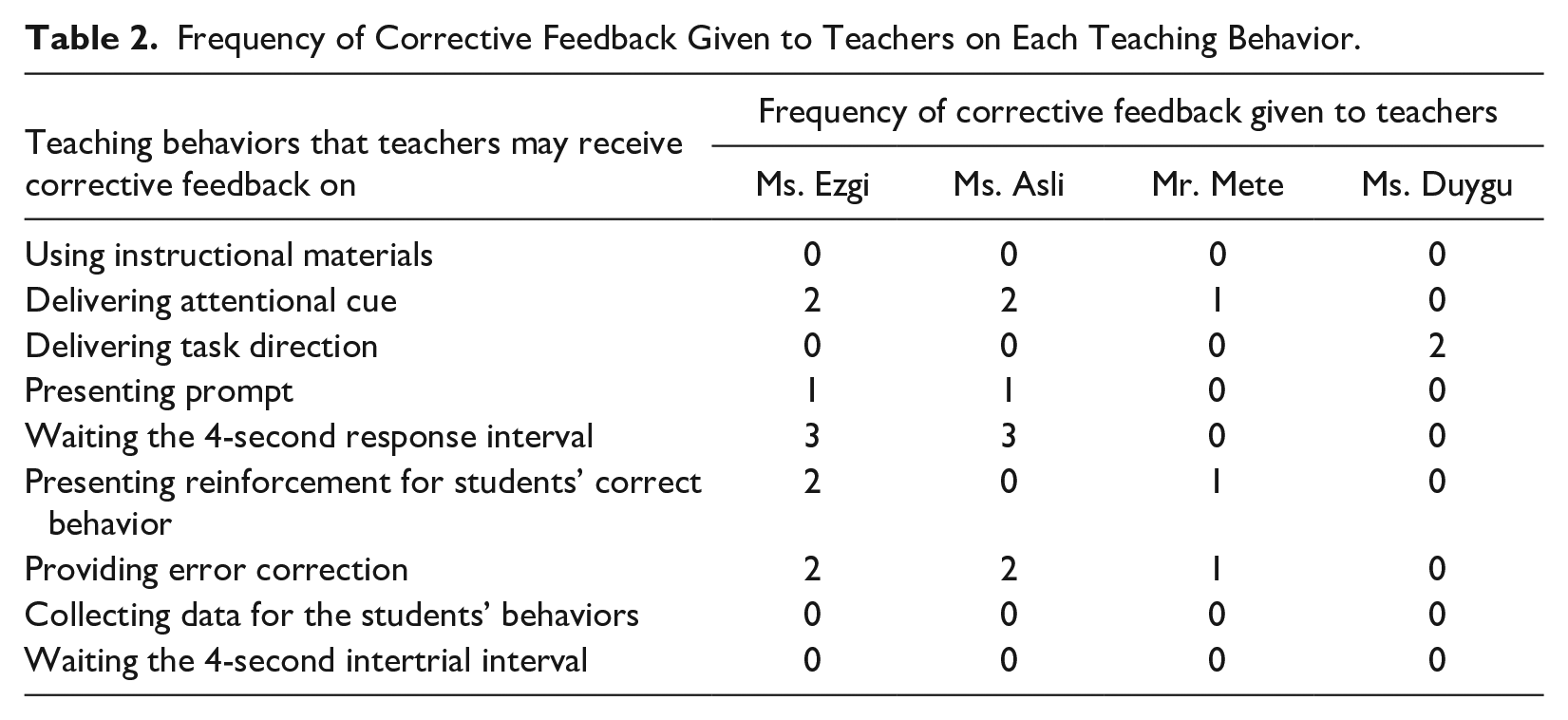
The data regarding feedback given to the PTs can be seen in Table 2. As shown, the researchers provided corrective feedback on the steps of the SP procedure most to least frequently as follows: (a) waiting response interval = six, (b) delivering attentional cue = five, (c) providing error correction = five, (d) presenting reinforcement for student’s correct behavior = three, (e) delivering task direction = two, and (f) presenting prompt = two. The frequency of graphical feedback was given to the teachers as follows: Ms. Ezgi in five sessions, Ms. Asli in four sessions, Mr. Mete in three sessions and Ms. Duygu in two sessions.
Frequency of Corrective Feedback Given to Teachers on Each Teaching Behavior.
The frequency of teachers logging in to the PD website and their correct responses on preevaluation and evaluation questions showed that Ms. Ezgi logged in 67 times, Ms. Asli logged in 56 times, Mr. Mete logged in 80 times, and Ms. Duygu logged in 54 times. Ms. Ezgi achieved correct responses on 60% of the preevaluation questions and 80% of the evaluation questions following SP training. Mr. Mete had correct responses on 40% of the preevaluation questions and 100% of the evaluation questions following SP training. Ms. Asli and Ms. Duygu had correct responses on 60% of the preevaluation questions and 100% of the evaluation questions following the SP training.
Effectiveness of the SP procedure for students’ target behaviors
Figure 3 displays the students’ acquisition of their target behaviors. As shown in Figure 3, the combined effects of the SP procedure and reinforcement showed that Ali demonstrated his target responses during baseline condition with a mean accuracy of 2.2% (range = 0%–11%) and demonstrated 100% accuracy following the intervention. He reached criterion in 14 sessions. Gizem and Deniz did not make any correct responses during baseline sessions and demonstrated 100% accuracy following intervention. Gizem and Deniz reached the criterion in nine sessions and in one session, respectively. Can demonstrated his target responses during baseline sessions with a mean of 5.5% accuracy (range = 0%–22%) and demonstrated 100% accuracy following intervention. He reached criterion in 16 sessions. Ali, Gizem, and Can maintained their target behaviors with 100% accuracy as well. Regarding generalization, the students did not achieve any correct responses during the pretest but had 100% accuracy during the posttest. Deniz did not have any correct responses during the generalization pretest; however, no maintenance and generalization posttest data were collected for Deniz as it was the end of the school year.
Instructional data were collected for the number of total sessions and trials, length of training sessions, and number and percentage of errors until the students reached criterion in the study. Ali reached 100% correct responses for the target behavior in the 14th training session after 126 trials. The total duration of the training sessions conducted with Ali until he acquired the target behavior was 1 hour 9 minutes 6 seconds. Ali made 64 errors (54%) before he reached criterion. The shortest training session with Ali was 3 minutes 31 seconds and the longest training session was 6 minutes 20 seconds. Gizem reached 100% correct responses for the target behavior in the ninth training session after 81 trials. The total duration of the training sessions conducted with Gizem until she acquired the target behavior was 1 hour 12 minutes 20 seconds. She made 53 errors (72.8%) before she reached criterion. The shortest and the longest training sessions with Gizem were 6 minutes 5 seconds and 13 minutes 2 seconds, respectively. Can reached 100% correct responses for the target behavior in the 16th training session after 144 trials. The total duration of the training sessions conducted with Can was 44 minutes. Can made 60 errors (44.7%) before he reached criterion. The shortest and the longest training sessions with Can were 2 minutes and 3 minutes 12 seconds, respectively. Deniz reached 100% correct responses for the target behavior in the first training session after nine trials. The total duration of the training sessions conducted with Deniz until he acquired the target behavior was 12 minutes 3 seconds. The shortest and the longest training sessions with Deniz were 2 minutes 11 seconds and 2 minutes 40 seconds, respectively.
Social Validity Findings
All teachers said they found e-coaching effective on improving their instruction and the target behaviors important for student participants, and they all stated that e-coaching, when compared with 1-day meeting/seminars, was helpful. The teachers also expressed that they would prefer to participate in online PD in the future. They stated that they did not have any difficulty attending online PD, and that they all liked the feedback the most. They also stated that the SP procedure was easy to implement and was an appropriate procedure for teaching target skills to students, and that they would use the SP procedure in the future with their students. They also reported that, in teachers’ meeting at their schools, they suggested to their colleagues that they use the SP procedure in their classes. Teachers said that they observed positive developments in their students after teaching them with the SP procedure. For example, Mr. Mete stated, “My student participated in classroom activities longer.” Teachers also stated that the SP procedure affected their teaching behaviors positively. Ms. Duygu reported, “I realized that I waited too long for my student to answer, and, at the same time, I was manipulating my student to get an answer.” Teachers said they found the SP procedure to be easy to use for teaching other target skills to their students.
Discussion
The researchers designed this study to investigate the effectiveness of (a) e-coaching to prepare PTs to implement the SP procedure in teaching discrete skills from the PEC to preschool students with ASD, and (b) the SP procedure in teaching discrete skills to students with ASD. Maintenance and generalization of both e-coaching and the SP procedure also were examined. Finally, the researchers assessed the social validity of both interventions in the study. E-coaching was effective in preparing PTs to use the SP procedure accurately, and the students acquired targeted discrete skills from their curriculum. Also, both the PTs and the students maintained their acquired skills over time. Furthermore, almost 6 months later, the first researcher visited the school again to determine whether teachers maintained the steps of the SP procedure. Ms. Ezgi, Ms. Duygu, and Mr. Mete performed the SP procedure 100% correctly. There were no long-term maintenance data for Ms. Asli due to her assignment to another school. Moreover, the teachers also generalized the use of the SP procedure in teaching new and different discrete skills to their students, and the students generalized the acquired discrete skills across new materials. Last but not least, the social validity findings of the study were encouraging because the PTs found e-coaching helpful and effective, planned to use the SP procedure in the future with their students, and explained that they would attend online PD training to learn new strategies during their career. The findings of this study showed that exposure to the SP procedure during e-coaching was effective during acquisition and maintenance of the steps of the SP procedure, generalization of the acquired steps, and that SP was effective in teaching discrete skills to students with ASD. These findings provide the groundwork for preparing PTs who currently serve students with ASD to use other EBPs as well as the SP procedure.
There are several points worth discussing regarding the e-coaching process used in this study. First, the PTs needed limited e-coaching during acquisition of the steps of the SP procedure. The most frequently provided corrective feedback was “waiting the response interval,” and the least frequently provided corrective feedback was “presenting task direction” and “presenting a prompt.” The coach did not need to provide corrective feedback for the steps of “making the materials ready,” “monitoring students’ behaviors,” and “waiting the intertrial interval.” In addition to this feedback, the researchers always provided positive feedback about the steps the participants performed correctly in each session. These findings encourage us in providing web-based PD, including e-coaching to PTs on an ongoing basis as this would be a valuable and efficient option for supporting teachers in providing quality teaching in inclusive classrooms because the teachers were able to use the SP procedure with a high degree of accuracy in their classrooms after having online training at their own pace. These findings are particularly valuable for countries and geographic regions where there is a shortage of SE teachers, where the areas are large, and where the financial resources are limited. Countries and regions with these kinds of shortages and limitations should develop well-designed web-based PD opportunities on an ongoing basis to support teachers as well as students with ASD and other disabilities. These findings also were validated in the social validity component of the study as all the PTs found the PD process to be informative, useful, and user-friendly, and shared their intent to participate in similar web-based PD opportunities in the future to learn new strategies and to use the SP procedure with their students in the future.
Another discussion point about the web-based PD is that the PTs performed the steps of the SP procedure fairly accurately (range = 71%–98%; see Figure 2 for the PTs’ performance on the SP procedure) by only watching the learning module and before any feedback on their performance. This indicates that well-designed, web-based PD opportunities can produce the desired outcomes in teachers who are in need of learning new strategies for their classroom instruction.
The SP procedure delivered by PTs was effective in teaching discrete skills to preschool students with ASD. The students not only acquired their target skills but also maintained them over time and generalized them across materials. These results are consistent with previous studies (e.g., Tekin-Iftar et al., 2017; Tekin-Iftar & Olcay-Gul, 2016); therefore, it could be that this study adds to the current literature in terms of the effects of the SP procedure on acquisition, maintenance, and generalization. Compared with other response-prompting procedures, the SP procedure has some advantages that make it preferential: (a) It is an EBP for teaching various skills; (b) it is relatively easy to use as it requires the same prompt throughout training trials; (c) it has only one type of correct response that the student can respond to, so the instructor does not need to differentiate the student’s response, such as with time delay procedures; (d) it requires only one type of instructor behavior—immediately delivering a prompt (instructor does not need to change delay interval or prompt type); (e) it does not require the student to wait for the prompt during training trials; and (f) it has user-friendly characteristics as evidenced by GE teachers, paraprofessionals, peers, and families using it with integrity (Tekin-Iftar et al., 2019). We did not identify any studies focusing on training PTs to learn the SP procedure through either face-to-face PD or online PD with or without coaching. Therefore, through this study, the authors add to the current literature by showing that GE teachers, such as PTs, can acquire an effective teaching practice and use it in their inclusive classrooms. These findings, however, need future research to be verified.
The findings of this study also show that as soon as the teachers started to deliver instruction with the SP procedure, there were immediate improvements in the target behaviors in two students (i.e., Can and Deniz) and moderate improvement in two students (i.e., Ali and Gizem). Finally, they learned their target skills with 100% accuracy. These findings are encouraging and confirm the importance of PD in schools in providing instruction on the SP procedure. Thus, the researchers recommend that future studies be conducted to use e-coaching to teach other response-prompting procedures to PTs who have students with ASD or other types of disabilities in their classrooms. In addition, the researchers also recommend that future studies investigate the parameters of e-coaching to offer the most effective and efficient PD intervention. Also, the students’ outcomes come from the combined effects of reinforcement and the SP procedure. Future research should be designed to examine their differential effects when teaching discrete skills to children with ASD. Last but not least, the researchers analyzed the social validity data descriptively, and we recommend that future researchers analyze the data inductively by deriving concepts and themes from the raw data.
Although the findings of the present study are encouraging, there are some limitations in the study as well. First, only four teacher–student dyads participated in the study, and the findings were limited by characteristics. Second, although the teachers were advised to use distributed teaching trials during intervention sessions for teaching occupations, they were unable to deliver distributed teaching trials and preferred to use massed teaching trials. Therefore, future researchers can examine ways of teaching GE teachers how to chunk teaching trials in their classrooms as they circulate around the room working with other students. Third, the social validity data collection was not anonymous because the coach collected the social validity data in the study. This may have influenced their sincerity in responding to the questions. As anecdotal data, the school principal shared with the researchers that she asked the participating teachers whether they would advise the same PD for the other teachers at the school in a school-wide teacher meeting conducted at the beginning of the school year. The principal reported that they highly recommended the same PD to the other teachers in the school. Therefore, their answers were consistent in supporting their responses during social validity assessment.
Footnotes
Acknowledgements
The authors would like to thank Dr. Belva C. Collins for her insightful review and proofreading.
Declaration of Conflicting Interests
The author(s) declared no potential conflicts of interest with respect to the research, authorship, and/or publication of this article.
Funding
The author(s) disclosed receipt of the following financial support for the research, authorship, and/or publication of this article: This study was supported by a grant from Anadolu University Research Fund (Project No. 1506E475). The first author completed this study in partial fulfillment of the requirements of a doctorate in special education at Anadolu University, Eskisehir, Turkey.
