



Abstract
Bullying in schools is a national problem receiving much needed attention. Teacher workplace bullying is a lesser known but equally debilitating problem. Our purpose in doing this study is to examine the problem of teacher workplace bullying and its effect on teachers, students, and schools. We surveyed 173 general and special education teachers to determine the extent that teachers report workplace bullying by other teachers and administrators. We used the Negative Acts Questionnaire–Revised to examine three constructs of workplace bullying—personal, work-related, and physical intimidation. We also examined differences in self-reported workplace bullying between general and special education teachers. Results suggest special education teachers reported a significantly high level of workplace bullying compared with general education teachers. Unsatisfactory administrative support was the most significant factor contributing to workplace dissatisfaction overall. We offer possible starting points to deal with the problem and discuss implications for teachers, students, and the field.
Keywords
Bullying has been described as a dangerous toxic gas that silently expands throughout entire organization and once detected, it may be too late to reverse the effects on the health of the organization (Ariza-Montes et al., 2016). Bullying behavior is ubiquitous. It can be found almost everywhere including school systems. Although the primary focus of research and prevention of bullying in schools thus far has been on students as victims of bullying, what is not as well-known is that teachers are also victims of bullying, often by other teachers and/or administrators. In fact, teacher workplace bullying (WPB) has been identified by the National Education Association (NEA) as a serious and growing concern. In 2010, the NEA conducted a survey on teacher WPB and found that approximately 18% of teachers reported that they experienced WPB by someone at the school where they currently worked (Bradshaw & Figiel, 2012). The percentage (36%) was higher in urban environments with urban public-school teachers reporting high levels of bullying by teachers and/or principals (Bradshaw & Figiel, 2012; Fox & Stallworth, 2010). Incidents of WPB may actually be underreported because some teachers may not feel comfortable disclosing incidents of bullying by peers or administrators (Bradshaw & Figiel, 2012). Key findings in the NEA report suggest there are few U.S. policies addressing issues of WPB among teachers and limited research on the issue. Furthermore, few programs have been developed to address WPB among teachers to reduce risks.
Among the risks of WPB on teachers is teacher turnover. Pyhältö et al. (2015) studied WPB among teachers in Finland and found that exposure to bullying, exhaustion in terms of excessive heavy workloads, and stress increased the risk for teacher turnover. Fahie and Devine (2014) found that bullying behaviors among adults in school settings contributed to the loss of experienced staff resulting in the need to use limited resources on recruiting and training new teachers. The teacher workforce in the United States is rapidly decreasing due to factors such as diminishing supply (fewer enrollments in teacher preparation programs) coupled with issues of attrition and retention (Billingsley & Bettini, 2019; Carver-Thomas & Darling-Hammond, 2017). These factors are particularly problematic in the field of special education where there has been a chronic and pervasive shortage going back to the inception of IDEA (PL 94-142) with the demand for special education teachers consistently exceeding the supply (Billingsley & Bettini, 2019; McLeskey & Billingsley, 2008). Although there are numerous factors contributing to teacher turnover in America’s schools, one that has yet to be considered is the impact of WPB.
Workplace Bullying
Definition
There are several different definitions for WPB, but according to Lutgen-Sandvik et al. (2007), there are four conditions they have in common: Intensity (the perpetrator’s actions are seen as harmful by the victim), repetition (occurring at least twice per week), duration (lasting 6 months or more), and existence of a power disparity (the victim feels that it is difficult to defend themself against the bully). Einarsen and Hoel (2001) define bullying at work as harassing, offending, socially excluding someone or negatively affecting their work tasks. They further define WPB as occurring repeatedly (weekly or more) and persistently (about 6 months) and the bullying is not an isolated event but rather an escalating process. Mistreatment can come from colleagues, superiors, or subordinates (Einarsen et al., 2009) and although the acts of aggression are perceived by the victim as being harmful in nature, the perpetrator’s intent is irrelevant (Cemaloglu, 2011). WPB can consist of several different behaviors. Riley et al. (2009) identified the five most common WPB behaviors: (a) Withholding information that affects one’s job performance, (b) questioning one’s judgment and/or decisions, (c) setting up tasks with unreasonable or impossible deadlines, (d) belittling one’s performance and work, and (e) withholding positive comments, praise, and recognition. Behaviors may also include harassment (harmed for being a member of a protected class) and sexual harassment (based on gender). It should be noted that these behaviors are unwanted, negative and harmful, and persistent (Einarsen et al., 2003). Despite operationally defining WPB, it remains difficult to identify, which may contribute to incidents being underreported (Jacobs & De Wet, 2013).
WPB in School Settings
Characteristics of WPB
The most common type of WPB facing teachers is psychological in nature and consists of acts of aggression that target their mental wellbeing and character. Ariza-Montes et al. (2016) found that bullying in educational settings is most likely more indirect than direct, and subtle and less obvious to others. Ferfolja (2010) identified two types of teacher WPB, overt and covert. In the former (overt bullying), the victim is directly targeted by acts of aggression that may include name-calling, taunts, abusive language, rumors, yelling and screaming, and threats of premeditated acts of aggression. Covert bullying consists of anonymous name-calling, offensive graffiti, and other indirect acts of aggression. Ben Sasson and Somech (2015) identified WPB that was characterized by hostility and obstructionism. Blasé and Blasé (2002) found similar acts of WPB in which resources and information were intentionally withheld from victims in acts that were often passive aggressive in nature. Examples included perpetrators not returning victims’ phone calls, refusing to provide necessary equipment for school activities and events, and failing to warn victims of imminent danger in the school building (Ben Sasson & Somech, 2015; Blasé & Blasé, 2002). Several researchers identified stalking, such as being followed while driving away from school, as an act of WPB (De Vos & Kirsten, 2015; Fahie & Devine, 2014; Ferfolja, 2010). Victims of WPB in schools also reported cyberbullying, commonly carried out through the use of school email accounts (De Vos & Kirsten, 2015). In isolated instances, teachers also described being subjected to physical acts of bullying by their principals.
WPB perpetrators
Teacher bullying in the workplace takes on many forms although the perpetrators generally fall into one of three categories. The first category includes supervisors and administrators as perpetrators. Known as downward bullying, the perpetrator holds a position of greater power than the victim and uses this power differential to mistreat the victim (Casimir et al., 2012; Fox & Stallworth, 2010). In some cases, perpetrators of downward bullying target victims’ relationships with other individuals, such as the mistreatment of special needs students by principals in the bullying of special education teachers (Blasé & Blasé, 2002). Although bullying by principals is a common finding in the literature, it remains under-researched, largely because of its highly charged nature (Blasé & Blasé, 2002). Bullying that is committed by colleagues is termed horizontal bullying (Casimir et al., 2012). In upward bullying, students target teachers (Casimir et al., 2012). Some research indicates that males are more likely to be the perpetrators of teacher bullying in both downward and horizontal bullying (De Vos & Kirsten, 2015; Orange, 2018).
There are numerous contributing factors for teacher WPB by other teachers and administrators. The first of these is personality traits among the perpetrators and victims that predispose them to WPB. Among those who bully, researchers found envy, hunger for power, narcissism, and discomfort with gender and sexuality issues as common personality traits (De Wet, 2010; Ferfolja, 2010; Sinha & Yadav, 2017). Being perceived as more competent and knowledgeable than peers can make teachers targets of bullying (Sinha & Yadav, 2017). Other factors such as economic, social, and political issues also contribute to teacher WPB (Landsbergis et al., 2018). If a teacher identifies with a nondominant racial, ethnic, and linguistic background or sexual orientation, they are at even higher risk for WPB (Ariza-Montes et al., 2016). Because of the dehumanizing tactics employed by perpetrators of WPB, The World Health Organization (WHO) classifies it as psychological violence (Charilaos et al., 2015).
Effects of WPB on victims
Victims of teacher WPB report experiencing negative physical effects such as nausea, weight loss and/or gain, fatigue, and sleep disruptions (De Vos & Kirsten, 2015). There may also be psychological effects categorized as inward-turning and outward-turning. Inward-turning effects range from exhaustion, impaired decision-making, and increased self-surveillance at work to feelings of fear, shock, disorientation, and guilt (Blasé & Blasé, 2002; De Vos & Kirsten, 2015; Fahie & Devine, 2014). The more extreme inward-turning psychological effects may include depression, anxiety, panic attacks, post-traumatic stress disorder, and suicidal feelings. Outward-turning psychological effects are marked by changes in attitudes and while most of these are negative, occasionally some are positive in nature such as increased self-advocacy to learn about victims’ rights and reporting options (Orange, 2018) as well as anti-discrimination laws (Ferfolja, 2010). Nevertheless, emotional exhaustion, depersonalization, and reduced professional efficacy experienced by victims of teacher WPB are substantial negative components of teacher burnout (Bernotaite & Malinauskeine, 2017).
Differences in WPB Among Teacher Groups
As previously noted, there is limited research on WPB among teachers. Extant research suggests that teachers in urban school settings are more at risk for WPB than teachers in rural or suburban schools (Bradshaw & Figiel, 2012). Teachers working in schools with inadequate resources and/or schools that are less safe are also deemed to be at higher risk for WPB (Ariza-Montes et al., 2016). Some categories of teachers may face higher rates of mistreatment than others. For example, Gray and Gardiner (2013) found that elementary school teachers experienced more negative work experiences than their colleagues teaching in higher grades. Although differences in prevalence of WPB have been reported across settings (urban versus rural, elementary versus secondary), we found no studies to date comparing incidents of WPB across general education and special education where teachers and/or administrators were the perpetrators. We posit however that differences may exist because the roles of special education teachers differ widely from those of general education teachers.
Special educator roles
Special education teachers have many roles, ranging from teacher to case manager, co-teacher, inclusion specialist, and in some cases, paraprofessionals (McLeskey & Billingsley, 2008). Billingsley et al. (2020) describe the role of special education teachers as fragmented due to the wide range of tasks they are responsible for in their work. A separate study found that secondary special education teachers taught 3.5 different content area classes on average on a daily basis and sometimes taught multiple content areas in the same class period (Wasburn-Moses, 2005); something that the author concluded would not likely occur in general education classrooms at the secondary level. Assigned caseloads are increasing requiring special education teachers to in turn, increase amount of collaboration across grades and subject areas (Billingsley & Bettini, 2019). To further complicate the special education workforce, preservice special education teachers are receiving mixed messages across university teacher preparation programs on how to view and understand their roles as future educators with some believing their core role to be direct instruction of students with disabilities while others conceptualize their primary role to be a collaborator with general education teachers to differentiate instruction (Billingsley et al., 2020). Thus, special education teachers find their responsibilities to be ambiguous, they receive less guidance than general education teachers about their roles (Youngs et al., 2011), and are less likely to advocate for supportive working conditions once in the workforce (Billingsley et al., 2020).
Workplace Dissatisfaction and WPB
Teacher bullies and negative teacher-peer relationships have a profound impact on school climate and culture (Gray & Gardiner, 2013). Teacher WPB has been associated with debilitating stress and decreased job satisfaction (Ariza-Montes et al., 2016; Lutgen-Sandvik et al., 2007). Not only do victims of WPB experience workplace dissatisfaction but this could also impact bystanders of WPB who also have negative perceptions of their workplace and are less productive as a result (Lutgen-Sandvik et al., 2007).
Factors
Factors associated with workplace dissatisfaction include lack of administrative support and/or poor leadership styles, including unfair policies and unequal treatment (Billingsley & Bettini, 2019; Gray & Gardiner, 2013). School leaders who are ineffective often bully subordinates (Blasé & Blasé, 2002; De Wet, 2010; Einarsen, 1999) and are the most frequent perpetrators of WPB (Hauge et al., 2007; Salin, 2003). In a study on WPB experienced by teachers in South African schools, De Vos and Kirsten (2015) found similar results in that bullying was most often perpetrated by principals who used colleagues as accomplices in carrying out psychological bullying of teachers.
Work overload and workload manageability
Ben Sasson and Somech (2015) expanded the definition of WPB to include workplace aggression by teachers, defined as any behavior initiated by teachers, intended to harm a teacher or peer in the school setting. They examined the nature, targets, and factors of teacher aggression and found that perceptions of both injustice and work overload were the major factors contributing to teacher aggression with work overload as the most dominant factor. Principals, who by the nature of their role, are in positions of power, control teacher workload tasks along with allocations of resources and tenure and promotion decisions (Ben Sasson & Somech, 2015). Work overload may be perceived as unjust and unfair when it is unequally distributed and may be considered a form of bullying (Jennifer et al., 2003). Riley et al. (2011) operationalized behaviors in workload bullying to include tasks set with unreasonable or impossible targets or deadlines, having to carry out tasks that fall outside the teacher’s job description, impossible deadlines, and being exposed to an unmanageable workload. Bettini, Gilmour, et al. (2020) applied conservation of resources theory to define workload manageability as the degree to which one feels that one’s work can be completed in the time allotted.
Attrition
Conservation of resources theory which describes how individuals manage workloads by balancing job demands and resources, has recently been shown to predict special educators’ attrition and intent to stay in their schools (Bettini, Cumming, et al., 2020). Working conditions, job satisfaction, and school climate are all predictors of teacher attrition and very often teachers decide to leave not just their schools but the profession when working conditions are difficult (Billingsley & Bettini, 2019; Gray & Gardiner, 2013; Hagaman & Casey, 2018). In one study, first year special education teachers who indicated they were leaving their job after the first year of teaching cited dissatisfaction with school climate and an overall lack of respect as reasons for leaving the position (Hagaman & Casey, 2018). Teacher attrition is detrimental and costly to student learning but particularly when teachers leave during the school year. Redding and Henry (2018) report that students who lose a teacher during the school year score an average of 7.5% of a deviation lower on standardized tests.
Purpose of the Study
Previous research has descriptively identified WPB as a problem in school settings. The purpose of this study was to further assess the extent of WPB of teachers in schools while also determining if there is a difference in WPB between general education and special education teachers. In addition, we sought to identify contributing factors to teacher dissatisfaction in school settings. Specifically, we asked the following research questions: (a) To what extent do general education and special education teachers report negative acts (i.e., WPB) among colleagues and administrators in the school setting? (b) Is there a difference in self-reporting WPB between general education and special education teachers? and (c) What factors do special and general education teachers report as contributing to workplace dissatisfaction?
Method
Participant Recruitment
Participants in the survey were recruited through two methods that were both voluntary and anonymous. The first method used convenience sampling of a large northeastern university’s email list of special education graduates. The email list contained 3 years of recent graduates (n = 53). One email was sent out with a link to the survey.
The second method of recruitment used targeted advertisement sampling through a large social media site with over 500 million users (Kosinski et al., 2015). A link to the survey was advertised via the large social media site to users that self-identified as “teacher” as their current occupation. Based on the social media site’s impression statistics, targeted advertisement was programed to reach an estimate of 500 to 1,000 teachers through advertisement for study participation over a 2-month period. Participants who fully completed the survey were automatically entered into a lottery for one of ten $20 Visa gift cards as incentive for full participation. Our recruitment with targeted advertisement did experience some snowball sampling (Goodman, 1961), in that use of the social media site resulted in participants inviting friends and colleagues to participate in the survey. Albeit a new method of sampling, using social media sites have produced self-reported data of high quality (Kosinski et al., 2015). Following recruitment, we examined the responses from general education (n = 145) and special education teachers (n = 28) regarding their experiences with WPB as measured by the Negative Acts Questionnaire–Revised (NAQ-R) survey.
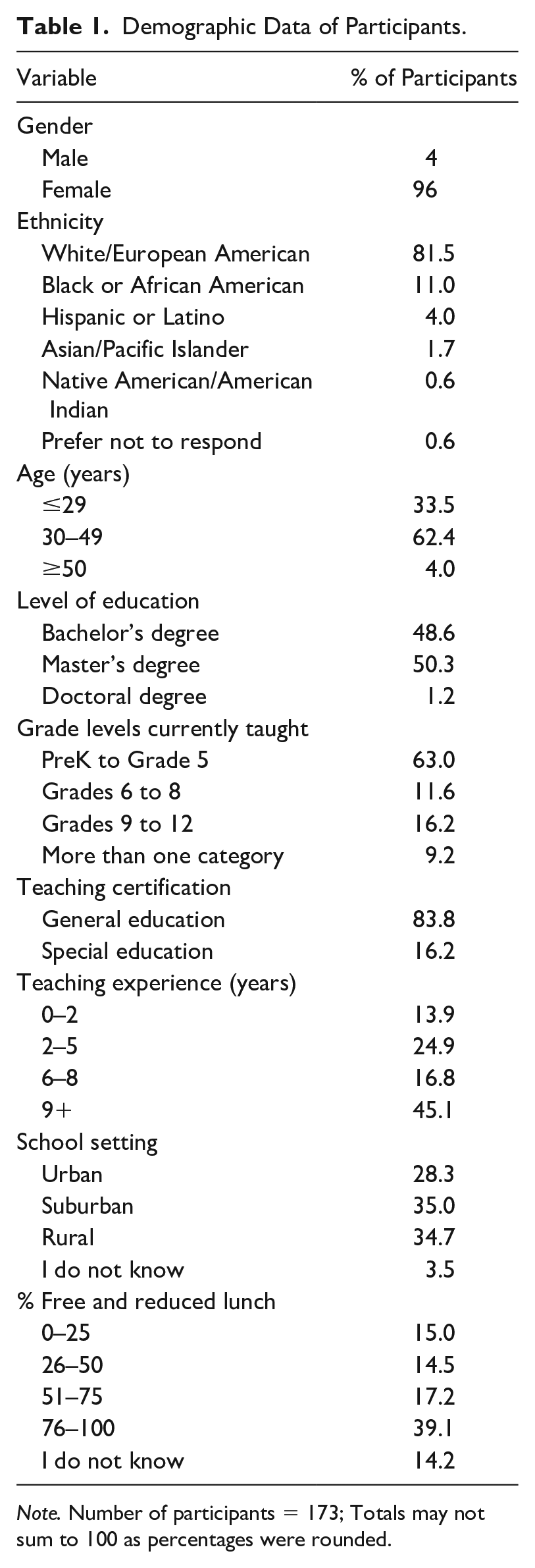
Response numbers were disparate between general and special educators; however, the percentages of responses per group were comparable to the national percentage of general education teachers (85.8%) and special education teachers (14.2%; National Center for Education Statistics, 2020; U.S. Bureau of Labor Statistics, 2020). Furthermore, demographics of respondents were comparable to national averages (see Table 1). For example, in 2017–2018, about 79% of public-school teachers were White, 9% were Hispanic, and 7% were Black (National Center for Education Statistics, 2020). Although response demographics were comparable to national demographics, we caution generalization of findings given the small sample size and other participant selection limitations as discussed later in the article in the “Limitations” section.
Demographic Data of Participants.
Note. Number of participants = 173; Totals may not sum to 100 as percentages were rounded.
Survey Instrument
Participants completed a survey involving the 22-item NAQ-R (Einarsen et al., 2009) and nine demographic items. The NAQ-R is designed to measure exposure to bullying in the workplace. Participants can choose from a 5-item Likert-type scale rating for each item based on personal experience (never, occasionally, monthly, weekly, and daily). Previous research suggests the NAQ-R is a comprehensive, reliable and valid measure (Cronbach’s alpha = .90) of exposure to WPB (Einarsen et al., 2009).
The 22 survey items from the NAQ-R load to three latent constructs: personal bullying, (defined as hostile acts against the person/personality of the target, for example, spreading gossip and rumors), work-related bullying, (defined as hostile behaviors against the working output of the target, for example, withholding information), and physical intimidating forms of bullying, which refers directly to physical abuse (Einarsen et al., 2009). For example, item 20 from the NAQ-R (being the subject of excessive teasing or sarcasm) loads to personal bullying. Item 16 (being given tasks with unreasonable deadlines) loads to work-related bullying. Item 22 (threats of violence or physical abuse or actual abuse) loads to physical intimidating forms of bullying.
Data Analysis
Following the completion of our 2-month window for participant responses, all responses (N = 220) were downloaded to a spreadsheet. Incomplete responses (n = 47) were removed from the data set. The remaining responses (n = 173) were entered into the Statistical Package for the Social Sciences (SPSS) for data analysis. The analyses used in the current study include descriptive statistics and group comparisons using an analysis of variance (ANOVA) of teacher roles (i.e., general or special education).
We used descriptive statistics to analyze the first research question (i.e., the extent of WPB reporting). Participants’ responses were totaled as percentages across the 22-item questionnaire for each rating. We considered items with skewed data toward monthly, weekly, and daily percentages as a higher extent of WPB reporting.
To answer our second research question, an ANOVA was used to analyze the difference in the overall NAQ-R, latent constructs (e.g., work-related, physical, and personal bully), and individual items between groups based on teaching roles (general education or special education). Significance was set at p = .05.
Descriptive statistics and qualitative coding were used to answer our third research question. Following NAQ-R survey questions and demographic information, participants were asked, do you desire to leave your current teaching position? If participants responded “yes,” they were asked to provide a reason why in an open-ended response. Next, participants were asked, do you desire to leave the teaching profession? If participants responded “yes,” they again were asked to provide a reason in an open-ended response. Yes and no responses to these questions were reported as percentages out of overall participants. Reasons for wanting to leave a current teaching position, and teaching profession, were qualitatively coded. During data analysis, it became apparent that teachers who indicated a desire to leave their current position and the profession listed similar factors for both responses. We therefore only reported qualitative codes from teachers desiring to leave their current position so that factors contributing to workplace dissatisfaction were not duplicated in the results. Codes are presented as percentages.
The methodological rigor of qualitative procedures is discussed in terms of trustworthiness pertaining to the confirmability, credibility, dependability, and transferability of findings (Lincoln & Guba, 1985; Shenton, 2004). The goal of coding participant responses was to identify credible themes through both a multi-leveled coding process and inductive reflexive analysis using key-words-in-context (Ryan & Bernard, 2003). Open-ended response data were coded using multiple iterations of reading and analyzing responses, assigning codes, refining codes, recoding, and clustering codes into thematic categories (Corbin & Strauss, 2008). For example, when asked “Why do you desire to leave your current teaching position?” some respondents wrote, “lack of pay” or “better pay in other districts” as reasons. These responses were ultimately coded as money, given their thematic similarities. The second author and a graduate student (naïve to the study) evaluated data separately and met several times during the data analysis iterations to discuss codes, themes, and establish rater-agreement of codes. The coders came to agreement regarding the language and terminology that best communicated the messages shared in the open responses.
Six codes were ultimately identified and applied across participant responses. Responses were coded with Money if lack of monetary compensation was mentioned. Student/Parent Behavior was coded if the response stated difficulties working or dealing with students and/or parents. Personal Reasons was a code to capture a desire to leave one’s current position or the teaching profession for career advancement (e.g., pursuing a doctoral degree) or family matters (e.g., living closer to home). Responses that specified standardized testing were coded as Testing Pressure. The last two codes were applied to responses that indicated a lack of administrative support. Administrative Support: Leadership captured dissatisfaction with a school’s environment, policies, unequal treatment of students and staff, and other factors relating to administrative leadership qualities. Administrative Support: Workload was coded for responses that mentioned having unreasonable workloads, expectations, and not enough resources to do one’s job effectively. The six codes were applied to all participant responses. Many responses contained multiple codes.
Results
The NAQ-R self-report survey examines negative actions that individuals experience within the constructs of personal bullying, work-related bullying, and physical intimidation. Cronbach’s alpha based on participant responses of the current study was .93, which is consistent with previous reliability assessments of the NAQ-R (Einarsen et al., 2009). Analysis was conducted at the item latent variable, and survey levels. Results are presented below in order of research question.
Extent of Reported WPB
In total, 173 participants responded to the NAQ-R survey. Table 1 presents demographic data of participants. The vast majority of participants self-identified as white/European American, female educators between 30 and 49 years of age. Nearly 84% of participants were general education teachers, and 16.2% reported being special education teachers. Most teachers (63%) reported teaching at a PreK-to-Grade 5 level, with a relatively even distribution of participants across school settings (i.e., urban = 28.3%, suburban = 35%, rural = 34.7%).
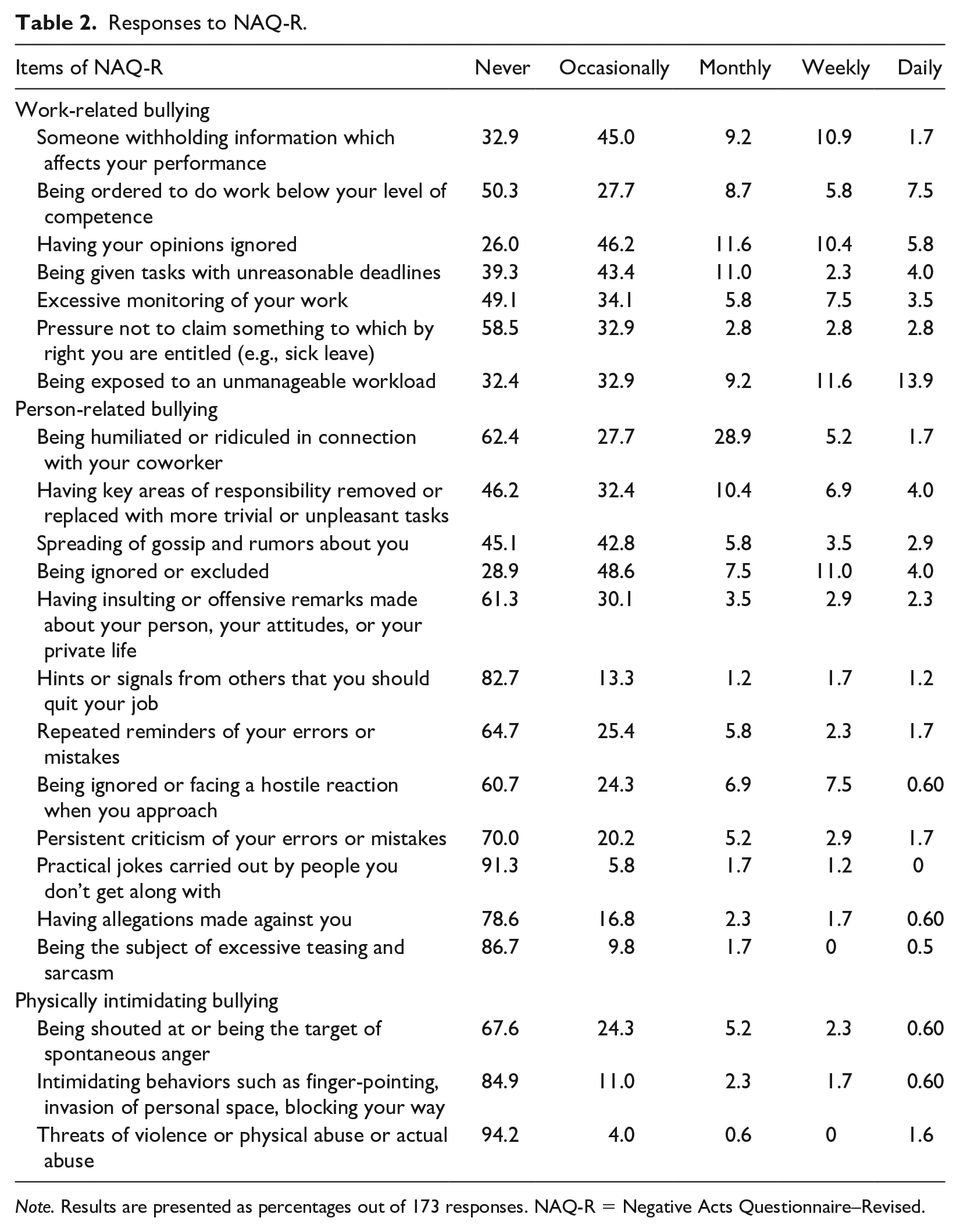
The extent to which both general education and special education teachers report negative acts among colleagues and administrators (i.e., WPB) in the school setting can be found in Table 2. Results are presented in percentages with higher numbers further right in the table indicating higher instances of self-reported WPB. The item with the highest reporting of frequency was being exposed to an unmanageable workload (never = 32.4%; occasionally = 32.9%; monthly = 9.2%; weekly = 11.6%; daily = 13.9%). The item with the lowest reporting of frequency was threats of violence or physical abuse or actual abuse (never = 94.2%; occasionally = 4.0%; monthly = 0.6%; weekly = 0.0%; daily = 1.6%).
Responses to NAQ-R.
Note. Results are presented as percentages out of 173 responses. NAQ-R = Negative Acts Questionnaire–Revised.
Differences Between Special Education and General Education Teachers
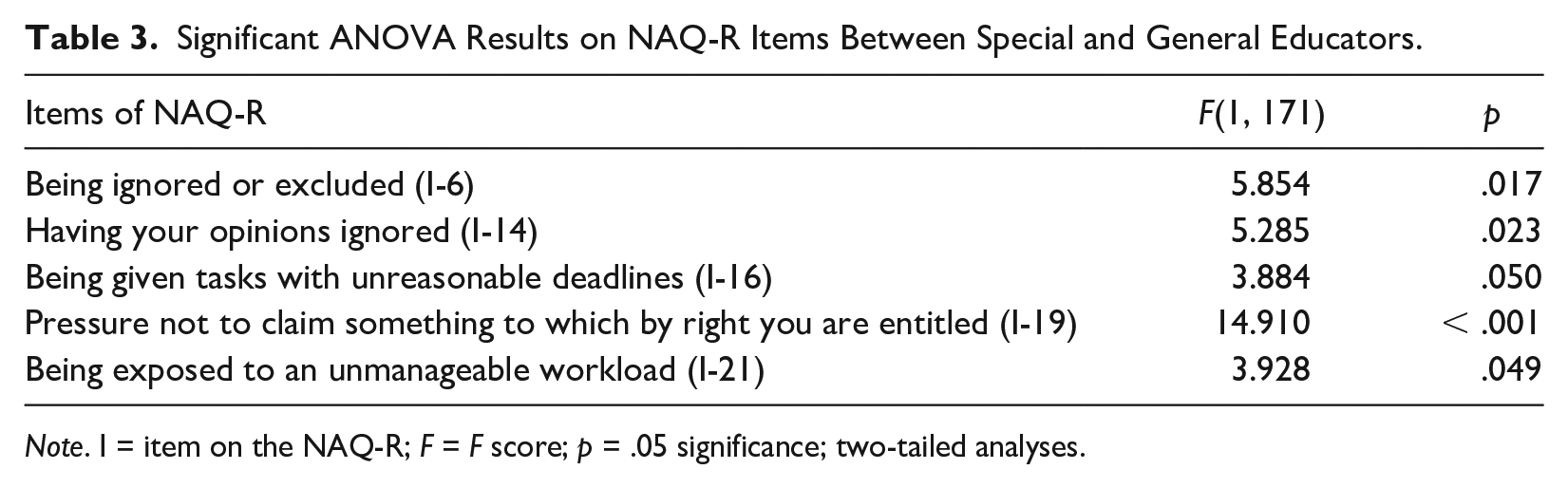
ANOVA results from the overall NAQ-R was F(1, 171) = 5.304, p = .022, indicating significance at the .05 level in responses between special educators and general educators. Results from general and special educator responses on latent variables also indicate a significant difference on the work-related bullying construct, F(1, 171) = 7.477, p = .007, at the .05 level. In both cases, special educators (N = 28; MNAQ total = 19.107, SDNAQ total = 5.842; Mwork-related = 9.535, SDwork-related = 6.708) reported higher work-related bullying incidents than their general education peers (N = 145; MNAQ total = 13.082, SDNAQ total = 11.985; Mwork-related = 6.406, SDwork-related = 5.296). There was no significant difference in experiences of physical intimidation and personal-related bullying as reported by special education and general education teachers. Examining individual survey items resulted in five items that were significant at the .05 level (see Table 3).
Significant ANOVA Results on NAQ-R Items Between Special and General Educators.
Note. I = item on the NAQ-R; F = F score; p = .05 significance; two-tailed analyses.
Factors Contributing to Workplace Dissatisfaction
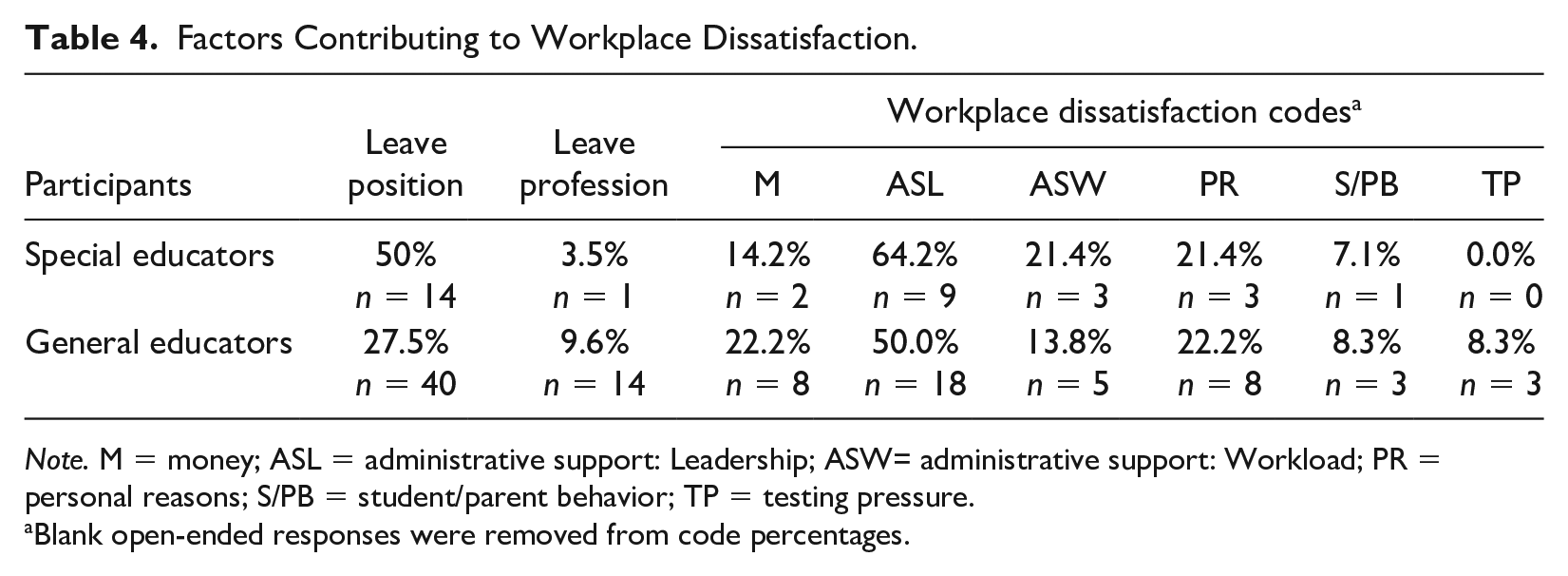
Descriptive and qualitative coding results are presented in Table 4. Readers should note the smaller sample of respondents who completed the open-ended portion of the survey. Results demonstrate that 50% of special educators who provided open-ended responses indicated a desire to leave their current teaching position. Fewer general education teachers stated a desire to leave their current teaching position (27.5%). In regard to leaving the teaching profession entirely, 9.6% of general educators stated “yes,” while only one special educator (3.5% of responses) indicated a desire to leave.
Factors Contributing to Workplace Dissatisfaction.
Note. M = money; ASL = administrative support: Leadership; ASW= administrative support: Workload; PR = personal reasons; S/PB = student/parent behavior; TP = testing pressure.
Blank open-ended responses were removed from code percentages.
The most cited factor contributing to workplace dissatisfaction was a lack of administrative leadership support. Half of general educators reported poor leadership as a reason for wanting to leave their current position, while 64.2% of special education teachers mentioned this factor. Participants wrote responses such as, “the superintendent is pushing the school in the wrong direction,” “too stressful and not enough support,” “bad administrative support,” and “unequal treatment.” A greater percentage of general educators (22.2%) than special educators (14.2%) stated lack of pay as a factor contributing to workplace dissatisfaction. Special educators who completed the survey indicated a lack of administrative support concerning workload requirements and expectations as the second most influential factor (21.4%) in workplace dissatisfaction. An equal percentage of respondents between general and special educators (approximately 22%) listed personal reasons for wanting to leave their current position. Examples of personal reasons given included obtaining a higher degree, moving out of the classroom and into a leadership role, spending more time with family, and living closer to home.
Discussion
We sought to answer the following research questions in this study: (a) To what extent do general education and special education teachers report negative acts (i.e., WPB) among colleagues and administrators in the school setting? (b) Is there a difference in self-reporting WPB between general education and special education teachers? and (c) What factors do special and general education teachers report as contributing to workplace dissatisfaction? To determine to what extent bullying behaviors are occurring to teachers in the workplace, we looked at the highest frequency of incidents reported on items on the questionnaire on a daily, weekly and monthly basis because WPB is further defined not as an isolated incident but rather occurring regularly (weekly or more) and persistently (about 6 months). Criteria for acceptable levels of NAQ-R item percentages has not been established but given the rating scale of Never, Occasionally, Monthly, Weekly, and Daily, ideally, 100% of participants would report Never under all 22-items. However, given the nascency of WPB research among educators, for the purpose of this research, we made the decision to highlight reporting of items on the NAQ-R with double digit percentages of daily, weekly, or monthly occurrences.
Extent of Reported WPB
Of the 173 respondents, 28 (16%) were special education teachers, which is a representative sample of the number of special education teachers in our nation’s schools (National Center for Education Statistics, 2020; U.S. Bureau of Labor Statistics, 2020). The remainder of respondents, 145, identified themselves as general educators. There was no item on the questionnaire to which teachers responded Never (i.e., zero instances of WPB behavior) therefore we can conclude that general and special educators experienced bullying behaviors, albeit to varying degrees, on all 22 items on the NAQ-R. This includes instances of threats of physical violence or actual abuse. Overall, the highest frequency of reporting was work related bullying, that is, Being exposed to an unmanageable workload. This item was also reported as highest weekly occurrence and the only item with a double-digit percentage of responses in the daily frequency category. The other items with double-digit percentages occurring on a weekly basis were Having your opinions ignored, someone withholding information which affects your performance, (both work-related), and Being ignored or excluded (personal related). On a monthly basis, the items that resulted in double-digit percentages of responses included, Being given tasks with unreasonable deadlines, Having your opinions ignored (both work-related), Being humiliated or ridiculed in connection with your coworker, and Having key areas of responsibility removed or replaced with more trivial or unpleasant tasks (both of the latter are personal-related). Furthermore, based on the double-digit percentages in the daily, weekly, and monthly categories, there appears to be escalation and increased personal-related bullying. The workload issues occurring on a weekly basis continue on a monthly basis, but personal-related bullying escalates from being ignored (weekly) to more extreme behaviors of having key areas of responsibility removed and being humiliated. In fact, almost 30% of teachers responded that they were humiliated and ridiculed on a monthly basis.
Results of the data suggest that sampled teachers are regularly (on a daily and weekly basis) and persistently (on a monthly basis) facing negative and unwanted experiences that match the five most common WPB behaviors identified by Riley et al. (2009), that is, withholding information that affects one’s job performance, setting up tasks with unreasonable or impossible deadlines, withholding positive comments, praise, and recognition, and belittling one’s performance and work, and questioning one’s judgment and/or decisions.
Differences Between General and Special Education Teachers
Earlier we hypothesized that differences in rates of WPB may exist between special education and general education teachers due to the unique, wide ranging, and often ambiguous role of the special educator. Our findings support this in that we found a statistical difference between sampled special educators and sampled general educators on the overall NAQ-R. Special education teachers who completed the survey reported higher levels overall due to the work-related bullying variable. There was no difference between special and general educators on the other two variables, personal bullying and physical intimidation. Significant results indicate that sampled special education teachers differ from their general education peers regarding higher instances of WPB in workload (unmanageable tasks and deadlines) and not having a voice (being ignored, opinions ignored, and pressure to not claim what is theirs). Special education teachers have unique roles and are often asked to teach across content areas, grades, and settings. They must collaborate with multiple teachers and specialists in any given day, maintain frequent communication with parents/caregivers, and ensure that legal requirements under the Individuals with Disabilities Education Act are met, along with paperwork inherent to their job. Unfortunately, there is very little information on how special education teachers are prepared to manage their roles, conceptualize them, and advocate for manageable workloads and positive working conditions (Billingsley et al., 2020; Hagaman & Casey, 2018). It is therefore quite possible that special education teachers are entering their classrooms without knowledge of their roles and without skills to advocate for themselves (e.g., voice opinions; be acknowledged), therefore increasing their vulnerability to WPB.
Improving and maintaining positive working conditions is not only the teacher’s role, however, it is a shared responsibility that also includes teacher educators and school leaders (Billingsley et al., 2020). Although varying widely across university programs, a common thread among teacher educators is that they influence and shape preservice teachers’ concepts of their future workplace and role within it. In addition to socializing candidates into their future profession, teacher educators could also provide practical tools to help preservice teachers to navigate challenges they will face in their roles as in-service teachers, including advocating for working conditions that support their complex roles (Billingsley et al., 2020).
Improved preparation of principals and school leaders is also important to improving working conditions for special education teachers (Billingsley et al., 2019; DeMatthews et al., 2020). Unfortunately, special education coursework is lacking in school leadership preparation programs and if there is coursework, the primary focus is on legal issues (Billingsley et al., 2019). In a recent survey of school principals, participants reported that most of what they learned about special education was learned on the job while also stating that they learned very little about special education in their leadership preparation programs (DeMatthews et al., 2020). Improved preparation of principals and other school leaders may contribute to a better understanding of the role of special education teachers, their workloads, and their challenges in managing them (Hagaman & Casey, 2018).
Factors Contributing to Workplace Dissatisfaction
As with research question one, we looked at responses with double-digit percentages for greatest factors contributing to workplace dissatisfaction. Although there were differences percentage-wise in responses between special education teachers and their general education peers, both groups responded with double digits to the same four factors. Lack of administrative leadership support was the highest reported reason for both groups. Fifty percent of general education teachers and 64% of special education teachers who provided open-ended responses to the survey mentioned poor leadership as problematic. This category of response included dissatisfaction with a school’s environment, policies, unequal treatment of students and staff, and other factors relating to administrative leadership qualities. Leadership styles, particularly autocratic leadership, are often associated with WPB. In fact, autocratic administrators may themselves be perpetrators of bullying, and/or, set an example for others to condone it (Bradshaw & Figiel, 2012). Many employers also do not acknowledge that WPB is occurring in their setting which may exacerbate the damage and further signal that bullying behavior is acceptable in the workplace (Bradshaw & Figiel, 2012).
Both special education and general education teachers (approximately 22%) indicated personal reasons for workplace dissatisfaction and 22.2% of general education teachers stated money was a factor, compared to 14.2% of special educators’ responses. Special education teachers also reported a lack of administrative support with workload requirements and expectations as the second most influential factor (21.4%) in workplace dissatisfaction (tied with personal reasons). General education teachers reported double-digit (13.4%) dissatisfaction with workload, as well. Without support structures in place, coupled with unmanageable workloads, special educators in particular are more likely to leave or intend to leave teaching positions (Billingsley & Bettini, 2019). Fifty percent of the special education teachers in our survey indicated a desire to leave their current teaching position and 27.5% of general education teachers indicated the same. In a related study of new special education teachers, 22% indicated that they were planning on leaving their current job and all indicated that school climate issues and lack of respect were the reasons why (Hagaman & Casey, 2018). Also noteworthy is the problem of attrition with almost 10% of general education teacher respondents reporting a desire to leave the teaching profession entirely. Only one special education teacher indicated that they desired to leave the profession.
The costs of WPB are extensive for teachers who experience it, the students they teach, and the schools in which they work. There are physical, economic, and emotional costs to teachers with many experiencing symptoms of posttraumatic stress disorder (Bond et al., 2010). The cost of losing teachers is staggering to school districts. Using extant data, Barnes et al. (2007) estimated annual replacement costs for special education teachers, alone, in a large urban school district to be as high as $14.1 million. Costs to students’ well-being and learning outcomes are immeasurable but long-lasting. Overall, teacher turnover, which results in an unstable teaching force, has a negative impact on educational outcomes for all students, both general and special education (Billingsley et al., 2014; Darling-Hammond & Sykes, 2003). This is particularly problematic for almost one million students with special needs who receive services from unprepared or underprepared teachers or who receive no services whatsoever (Tyler & Brunner, 2014). Whether or not teachers do in fact leave their teaching position, or leave the field of education, teachers who are bullied are stressed and burnout and stress in teachers affects students at the individual level (Wong et al., 2017).
Implications
We can draw several implications from the results of our study. Administrative support in leadership and workload categories were rated as factors contributing to WPB by both general and special education teachers. Educational leaders need to recognize the existence of teacher WPB and address it. Principals should respond to reports of bullying by taking them seriously and promptly investigating them; follow up for perpetrators should be systematic in nature and records should be kept by principals (McCormack et al., 2009). Ensuring awareness of existing policies and resources and providing professional development on prevention and intervention is necessary. More broadly, Cemaloglu (2011) calls for principals to lead with transformational leadership characteristics. These characteristics enable principals to work with teachers and administrators to create a shared vision and mission, create powerful common feelings of purpose with their staff, respond with reason and caution when addressing problems, and provide individual support for teachers. Similarly, Blasé and Blasé (2002) recommend that principals build trust with teachers and recommend such practices as effective listening and expressing empathy and respect overall.
Teacher educators, particularly in special education, must also be involved in the WPB problem by reexamining how preservice special education teachers are being prepared to conceptualize and manage the complexity of their roles in the overall school environment. Little is actually known about how and if preservice special education teachers are prepared to balance their diverse roles and responsibilities, voice their concerns, and advocate for better working conditions if their roles are unmanageable (Billingsley et al., 2020; Hagaman & Casey, 2018). Teacher educators should also equip teacher candidates with effective techniques to cope with aggression by other teachers and administrators and also ways to manage conflict in the workplace (Blasé & Blasé, 2002; Somech, 2008). Without this knowledge and skill set, preservice teachers increase their vulnerability to WPB when they become in-service teachers.
School leadership program faculty also share responsibility for improving preparation of principals and other administrators to improve working conditions for teachers. This is particularly important for understanding the roles that special education teachers play in schools. For example, special education coursework, with the exception of special education law, is often lacking in leadership training (Billingsley et al., 2019). Improved preparation of principals and other school leaders will contribute to a better understanding of the role of special education teachers, their workloads, and their challenges in managing them (Hagaman & Casey, 2018).
In addition to improving preparation of teachers and school administrators, policy changes are needed to address the issues of WPB. Professional development should be provided to both general education and special teachers on policy, resources, and how to respond to incidents when they occur.
Our findings suggest teacher WPB is a problem. However, despite teachers being vulnerable and susceptible to bullying by peers and administrators, research on WPB of teachers is not yet sufficiently developed particularly when it comes to intervention research (Bradshaw & Figiel, 2012). Research is needed to learn more about who does the bullying, which teachers are at higher risk for WPB, and why, to identify appropriate interventions or prevent it from happening in the first place. Particular attention should be given to teachers coming from underrepresented groups who are at higher risk for being bullied in the workplace. Knowledge gleaned from this research could also inform teacher educators to better prepare teacher candidates to recognize WPB and manage it if it becomes an issue. Because of the pervasive nature of teacher WPB, which has either gone largely undetected or ignored, many teachers have experienced lasting negative effects on their mental and/or physical health and well-being. Therefore, research should also consider how to help victims of WPB recover.
Limitations
There are several limitations to this research study. The first is participant recruitment and sampling procedures. Convenience sampling, targeted Facebook advertisement, and snowball sampling methods do not meet the gold standard of randomized sampling because the methods can introduce biases (Kurant et al., 2011). With regards to snowball sampling, the first participants (seeds) are likely to disproportionately affect the composition of the sample, because people tend to interact with others similar to themselves (McPherson et al., 2001). Furthermore, people with many friends are more likely to be recruited into the sample (Kurant et al., 2011). Given that we were not able to track which participants completed the survey based on which recruitment method suggests our results should not be generalized to a greater population. Unequal sample sizes and variances reduces statistical power and increases instances of Type I error (Rusticus & Lovato, 2014).
The second limitation is that the results rely solely on self-reported data. Although not an inherent flaw, just like any measurement system, self-reported data have both advantages and disadvantages (Chan, 2009). Anonymous self-reporting was the most favorable method of data collecting personal and sensitive information. Utilizing multiple measurement systems (e.g., self-reported and non-self-reported), however, may increase construct validity and strengthen subsequent inferences.
As mentioned in the method section, the sample of this study was representative of national demographics, however, the comparisons and generalizability of findings should be taken with caution as analysis may be susceptible to Type I or Type II errors due to our limited sample size. As it relates to the sample groups represented in the current study, we also recognize selection error as a limitation. The means of recruitment of participants and the population recruited should be considered in reviewing the findings. The use of social media to recruit potential participants may have resulted in the inclusion of individuals who are more affable to completing online surveys as well as limit to only those with a social media presences and connections. Finally, the nature of the survey, examining school WPB, may influence participation as only those with strong opinions or experiences related to the topic may have responded to the survey.
Conclusion
Based on a growing body of research, it is apparent that many teachers are experiencing WPB from other teachers and administrators. This has profound ramifications on the teaching profession as well as student outcomes. Once a workplace has a culture of negative interactions, it becomes entrenched and difficult, if not impossible, to disrupt and reverse (Giorgi, 2010). Awareness that WPB exists in educational settings and understanding the underlying factors that contribute to teacher WPB is necessary to intervene and/or prevent it. Chronic teacher shortages may be exacerbated when teachers experience WPB. This is especially problematic for the special education teacher shortage because teachers who leave may be difficult to replace (Billingsley & Bettini, 2019). We implore future researchers to build upon the growing body of WPB literature to further the field’s understanding of causes, effects, and evidence-based intervention strategies.
Footnotes
Author’s Note
Divya S. Deshpande is now a teacher in the CIty School District of New Rochelle, NY, USA.
Declaration of Conflicting Interests
The author(s) declared no potential conflicts of interest with respect to the research, authorship, and/or publication of this article.
Funding
The author(s) received no financial support for the research, authorship, and/or publication of this article.
