




Abstract
The purpose of this study was to investigate the potential of simulated video analysis where candidates with differing educational backgrounds taught their peers prior to engaging in an authentic field experience. Teacher candidates’ special education professional knowledge, reflective ability, and instructional skills were tracked to understand if outcomes differed based on teacher candidates’ previous teaching experience or progress toward licensure. All 37 candidates participated in three simulated video analysis sessions by recording their instruction during role-play with peers, reviewing their video independently in class, and completing a reflection matrix. Finally, candidates completed a culminating field experience project with a P-12 focus student. Results indicated significant improvements in both special education professional knowledge and reflective ability regardless of previous teaching experience or progress toward licensure. Candidates with previous teaching experience demonstrated significantly greater instructional skills than candidates with no previous teaching experience. Implications and limitations discussed.
Keywords
A profession-ready teacher has subject matter and pedagogical content knowledge and has demonstrated the ability to apply their knowledge through both coursework and field-based practice opportunities (Council for Exceptional Children [CEC], 2020; National Education Association, 2020). Although a novice teacher may not have skills equivalent to a distinguished educator, a profession-ready teacher “has had enough opportunities to witness, implement, and reflect on quality teaching and learning and has demonstrated classroom readiness by completing a pre-service, classroom-based performance assessment prior to receiving full state licensure” (National Education Association, 2020, p. 1). Ensuring that each teacher candidate is profession-ready upon program completion is the ultimate goal of teacher preparation programs. Novice special education teachers are faced with dynamic challenges and working conditions, which may be unforeseen without proper preparation (Fowler et al., 2019). A lack of preparedness to manage facets of the profession, such as behavior management, administrative duties, legal compliance, and dynamic working conditions result in higher attrition rates for novice special educators (Billingsley & Bettini, 2019; Gilmour & Wehby, 2020; Miesner, 2020; Nance & Calabrese, 2009). This attrition results in substantial negative effects for schools and students (Carver-Thomas & Darling-Hammond, 2019; Feng & Sass, 2017) and further exacerbates the already critical special education teacher shortage (U.S. Department of Education, 2021). While there are various skills teacher candidates need to learn during their preparation, two critical components of profession-readiness are special education professional knowledge and reflective ability.
Special education professional knowledge, foundational to teacher success, includes an understanding of each student’s developmental and learning needs, subject matter content, specialized curricular knowledge, assessments for data-driven decision-making, effective instruction, collaboration, and social, emotional, and behavioral student needs (CEC, 2020). This professional knowledge can be organized as declarative, procedural, and conditional knowledge. Declarative knowledge is recognizing, expressing, and drawing meaning from explicit concepts (Yan Li, 2019). Through declarative knowledge, teachers understand observable indicators of effective teaching (Stuermer et al., 2013). Procedural knowledge, in comparison, is the understanding necessary to perform teaching tasks (Schunk, 2012). Finally, conditional knowledge is best operationalized through if-then or condition-action statements, which allow learners to foresee consequences if any condition is changed (Smith & Ragan, 1993). To have this insight and demonstrate conditional knowledge, learners must use their declarative knowledge to first identify the concepts related to the situation, and then employ their procedural knowledge to choose specific rules that apply to the situation (Yan Li, 2019). When declarative, procedural, and conditional knowledge operate in tandem, they inform professional knowledge (Peeples et al., 2019). For example, during a field experience, a teacher candidate might recognize a student is exhibiting off-task behaviors. They may recall this particular student exhibits specific avoidance behaviors when the work is beyond their instructional level. The candidate understands if the student continues with off-task behaviors, they will disengage from learning and likely miss important content. Therefore, the candidate recognizes the need to use an appropriate teacher action to re-engage the student in learning. The candidate recalls strategies from coursework that would fit the situation given the needs of the student and context of the lesson. Professional knowledge, when used in this way, is a critical aspect of profession-readiness. Teachers with a stronger knowledge base tend to achieve greater instructional ability and more positive student outcomes (Kunter et al., 2013; Podhajski et al., 2009).
A second important aspect of profession-readiness is reflective ability. Reflective ability in education refers to the investigative process in which a teacher or teacher candidate recognizes a teaching decision, analyzes why the decision was made, judges the success of the teaching decision, and applies these insights to future teaching decisions (Coogle et al., 2019; deBettencourt & Nagro, 2019; Nagro et al., 2017). Taken together, reflective ability promotes application of situational awareness, flexibility, and responsivity (Nagro, 2020; Nagro et al., 2021), which Danielson (2013) defines as characteristics of a distinguished teacher. Upon entering the profession, novice teachers lack the same depth of situational awareness as distinguished teachers (Wolff et al., 2021) who can assess events, determine the appropriate course of action, and revise the course of action as needed (Eraut, 2007). Through reflective practice, teacher candidates can use practice-based experiences as opportunities to recognize classroom context, interpret events accurately, and consider appropriate responses for future teaching decisions. Specifically, reflective practice allows teacher candidates to acknowledge their instructional strengths and deficits, explore the implications of instructional decision-making, and connect the theory of teaching with the practice of delivering effective instruction (Calandra et al., 2008; Crawford et al., 2012; Nagro et al., 2017). Even with professional knowledge, reflective ability can be challenging to develop. Candidates likely need multiple, structured opportunities to engage in reflective practice before such skills become part of professional routines.
Opportunities for reflective practice and application of professional knowledge commonly occur during field-based practice opportunities, such as practicums and student teaching internships (Nagro & deBettencourt, 2017). Field-based experiences are essential to teacher preparation, and some would go as far as to say field-based learning is the most important aspect of teacher preparation (Benedict et al., 2016; Nagro & deBettencourt, 2017; Recchia & Puig, 2011). This notion has face validity given that years of teaching experience at a particular grade level positively correlate with student achievement (Huang & Moon, 2009). Moreover, teachers with previous teaching experience demonstrate greater levels of instructional quality in new teaching roles when compared to teachers with no previous teaching experience (Scribner & Akiba, 2010). As such, leaders in teacher education emphasize the importance of structured and sustained field-based practices opportunities early and often during preparation that include reflective practice and feedback to build professional knowledge and instructional skills (e.g., Brownell et al., 2018). Commonly, teacher preparation coursework that includes field-based learning leverages instructional technology to organize flexible yet robust activities (Nagro & deBettencourt, 2017; O’Brien et al., 2020).
“Technology opens the door to learning . . . in ways impossible in the traditional classroom” (Hicks et al., 2014, p. 436). In today’s technology-rich world, teacher education has moved toward pairing field experiences with innovations in instructional technology (Benedict et al., 2016; Brownell et al., 2020). For example, providing real-time performance feedback through bug-in-ear technology (e.g., Coogle et al., 2019), enhancing presentation of professional knowledge through content acquisition podcasts ([CAPs], e.g., Kennedy et al., 2016), or promoting reflective practice and self-evaluation through video analysis (Nagro et al., 2017) has a growing body of research support regarding the benefits to teacher candidates’ knowledge and practice (Brownell et al., 2020). Video analysis, in particular, has been studied across teacher preparation contexts including, but not limited to preparing candidates to use best practices in student engagement (e.g., O’Brien et al., 2020), communication and questioning techniques (e.g., Nagro et al., 2017), and math instruction (e.g., Borko et al., 2008). Video analysis, when embedded within teacher preparation activities, has been shown to promote improved teacher knowledge, reflective ability, teacher performance, and student outcomes (Morin et al., 2019).
Video analysis refers to teacher candidates analyzing video evidence of their teaching practice in authentic settings. Various video analysis models typically adopt a cyclical approach, such as experiencing, publishing, processing, generalizing, and applying (Pfeiffer & Ballew, 1988), describe, compare, and critique (Jay & Johnson, 2002), or record, review, reflect, and revise (Nagro, 2020; Nagro et al., 2017). Specifically, in the record, review, reflect, revise video analysis cycle, teacher candidates record their instruction in authentic settings, review video evidence of targeted elements of their instruction, reflect on their instructional decision-making, and then plan for revising future instruction to improve learning experiences for students (Coogle et al., 2019). This cyclical reflective approach promotes ongoing review and revision of teaching practice to in turn encourage ongoing learning and professional growth (Rodgers, 2002). Despite the many benefits of video analysis, this approach requires access to authentic classroom settings which can be a challenge in teacher preparation (Nagro & Cornelius, 2013). Barriers, such as the distance between teacher preparation programs and cooperating schools, too few mentor or cooperating teachers available to place teacher candidates with, and placement options that do not span across the continuum of special education services make frequent field-based learning opportunities less feasible (Billingsley & Scheuermann, 2014). Some teacher candidates, including those working through alternative certification programs or those completing their preparation while P-12 education is offered virtually, have few if any field-based experiences, leading many novice teachers to feeling unprepared for the authentic classroom challenges (Kee, 2012).
One alternative to video analysis, which does not require an authentic setting, is simulation. Simulation allows for the repetition of targeted practices in a controlled environment without the added complexities of dynamic and unpredictable classroom settings (Benedict et al., 2016; McPherson et al., 2011). Simulations can vary in their structure and appearance ranging from (a) fully immersive virtual or augmented reality where candidates are placed in a simulated environment that is scripted and controlled (e.g., Yakubova et al., 2021), (b) microteaching where candidates practice teaching in controlled settings for short periods of time, with small groups of students to limit variables of genuine classrooms (e.g., Maheady et al., 2007), and (c) role-play activities where candidates practice teaching in settings other than authentic classroom environments, such as preparation coursework or at home with peers or others playing the role of students (e.g., Robinson & Kelley, 2007). Each of these approaches can be used to target different teaching skills and serve as meaningful practice opportunities, but no simulation is a proxy for authentic field-based practice. Simulation can supplement authentic field-based practice opportunities or serve as a pre-teaching opportunity for candidates prior to beginning a formal field placement. For example, role-play when paired with the video analysis activities (henceforth referred to as “simulated video analysis”) allows candidates to practice new instructional skills or improve existing skills in low pressure, low-stakes scenarios. Simulated video analysis still provides candidates with an opportunity to record, review, reflect, and revise their practice without exposing P-12 students to less than high-quality instruction from an underprepared teacher candidate. Simulated video analysis can allow for customization of learning experiences for teacher candidates with differing backgrounds and areas of strength and weakness. Theoretically, this type of teacher preparation approach is relevant for teacher candidates with little to no previous experience with teaching, reflecting, or coursework in general just as much as simulated video analysis stands to be relevant for advanced candidates working to perfect their instructional decision-making while attempting distinguished teacher practices, such as flexibility and reflexivity in real-time.
Therefore, the purpose of this study is to investigate the potential of simulated video analysis where candidates with differing educational backgrounds taught their peers prior to engaging in an authentic field experience. Specifically, professional growth in special education professional knowledge, reflective ability, and instructional skills were tracked to understand if outcomes differed based on teacher candidates’ previous teaching experience or progress toward licensure. Three research questions were explored in this investigation:
Do teacher candidates, who participated in a curriculum methods course that included simulated video analysis, demonstrate greater special education professional knowledge based on previous teaching experience or progress in their licensure program?
Do teacher candidates, who participated in a curriculum methods course that included simulated video analysis, demonstrate greater reflective ability over time based on previous teaching experience or progress in their licensure program?
Do teacher candidates, who participated in a curriculum methods course that included simulated video analysis, demonstrate greater instructional skills in their field experience based on previous teaching experience or progress in their licensure program?
Method
Sample and Setting
Thirty-seven teacher candidates from a public university in a Mid-Atlantic state, who were completing a special education curriculum methods course as part of a teacher licensure program across two semesters, participated in this investigation. Of the 37 participants, 11 candidates had no teaching experience of any kind, 11 had some experience as either a substitute teacher or an instructional assistant, and 15 had previous formal teaching experience through a license other than special education. In addition, of the 37 participants, 21 were new candidates with one or fewer semesters completed at the start of the investigation, and 16 candidates were more advanced candidates with two or more semesters completed at the start of the investigation. The course sequence in this 39-credit preparation program was recommended but not prescribed. Therefore, some students entered the course at the end of their preparation while others enrolled in this methods course as one of their first courses in their program of study. The variability of candidates’ progress in the program was one of the motivations for testing preparation activities that would be useful to candidates with differing backgrounds. Table 1 includes additional descriptive characteristics of this sample.
Teacher Candidates’ Descriptive Characteristic.
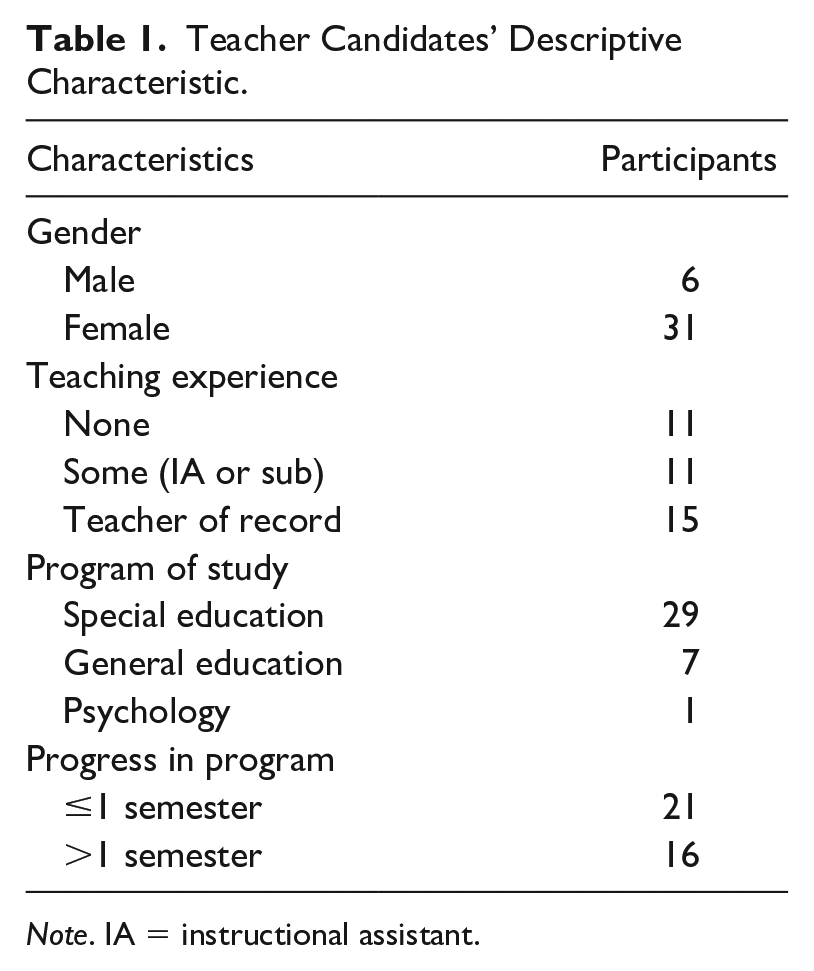
Note. IA = instructional assistant.
Investigation Procedures
Teacher candidates participated in a semester-long curriculum methods course focused on best practices in curriculum instruction of students with disabilities across reading, writing, math, and science content areas. Specifically, the course covered the effects of high incidence disabilities on student learning, high leverage practices, evidence-based practices for teaching reading, writing, vocabulary, math, and science, lesson and unit planning, formative assessments, progress monitoring, classroom management, differentiation, accommodations, modifications, universal design for learning, and collaboration with professionals and families using a combination of lectures, small group problem-solving activities, discussion activities, example teaching videos, CAPs, textbook and practitioner manuscript readings, and simulated video analysis. The course included a field-based experience where candidates worked with a focus student with a disability to collect data, analyze student needs in either math or literacy, develop a plan for targeting areas of need, implement the plan through ongoing individual instruction sessions, log their lessons, monitor student progress, and assess the success of their teaching decisions. The final product was a written report that (a) summarized the field-based experience, (b) documented student work, (c) summarized findings and analysis from data collection, and (d) determined recommendations for future instruction with the student.
During class sessions, teacher candidates engaged in group activities, class discussions, direct instruction, and individual assignments all aimed to prepare candidates to identify and implement appropriate instructional strategies to meet the needs of students with disabilities accessing the general curriculum. The candidates were taught about the importance of the “model it” stage of the self-regulation strategy development (SRSD) approach (Graham et al., 1998; Graham & Harris, 2003; Sanders et al., 2019). During “model it,” the teacher demonstrates how to successfully move through stages of solving a problem or completing a task to show students what learning looks like (Bembenutty et al., 2015). Specifically, the teacher models by thinking aloud to (a) identify a task or problem, (b) think through a plan, (c) choose the correct strategy to use, (d) self-check the process and self-correct as needed, and (e) use positive self-talk to reinforce persevering through the task. Creating opportunities for candidates to practice “model it” fosters teacher-like thinking (Roberts et al., 2014).
After learning about the “model it” phase in class and through assigned readings, the candidates were broken into small groups of three or four peers and asked to plan for and teach the “model it” phase of a math or literacy lesson that they were going to teach during their field experience. During the “model it” phase of SRSD, teachers are leading instruction as opposed to later stages in the gradual release model where students lead learning. Focusing on teacher-led instruction for this project-assured candidates would capture themselves actively teaching on video. This initiated the simulated video analysis cycle where candidates (a) recorded themselves teaching the “model it” portion of a lesson for approximately 5 minutes; (b) reviewed their own video evidence independently immediately after completing their small group session; (c) reflected on their instruction using their video evidence and a graphic organizer referred to as a reflection matrix focused on their communicating with their students (i.e., peers playing the role of students); and (d) revised their approach and planned to repeat the process again.
During the reflection stage of the simulated video analysis cycle, candidates were asked to complete a reflection matrix which was a highly structured approach to reflective practice. The reflection matrix includes four phases of reflection where candidates were asked to first describe their choices in using concrete statements. Then, analyze those choices by providing a rationale, reasoning, or justification for their decisions. Next, they were expected to judge their choices by assessing the effectiveness of their decisions based on student outcomes. Finally, teacher candidates were asked to apply what they learned through critical reflection to plans for improving or maintaining effective instruction in future lessons. These four phases were completed for each focus item within the graphic organizer. This repetition resulted in candidates describing, analyzing, judging, and applying multiple times in one reflection activity.
Teacher candidates had the option to choose from a reflection matrix with four preselected focus items or they could opt to populate their own four focus items centering on their communication techniques during instruction. The preselected focus items, pulled from the instructional domain of the Danielson framework, included: (a) expectations for learning defined as teacher communicates goals for learning clearly to students; (b) directions for activities defined as teacher communicates what students are expected to do during a lesson, particularly during independent or small group work, without direct supervision; (c) explaining content defined as teacher makes no errors when explaining content, anticipates possible student misconceptions, and connects content to students’ interests and lives beyond school; and (d) using oral and written language defined as teacher models both precise language and rich vocabulary in a variety of ways when communicating with students. The initial thought was candidate choice might impact performance, but an analysis of the descriptive statistics between those who used the preselected focus items and those who populated their own focus items for reflection revealed no noteworthy differences between reflective practices (i.e., approaches to individual phases of reflection) or reflective ability (i.e., composite score described in the measures section) resulting in these subgroups being analyzed in the aggregate. In total, teacher candidates spent 1 hour in class each week for 3 weeks to complete the simulated video analysis cycle three times. The simulated video analysis cycle was completed 3 weeks in a row, during class sessions 6, 7, and 8, so that each candidate had three opportunities to teach the same “model it” portion of the lesson of their choice to emphasize planning and teaching refinement prior to beginning their field experiences in the latter portion of the 15-week course.
After several weeks of practicing in class, candidates began their field-based experiences, and the goal was to translate the preparatory teaching activities that occurred in class to genuine teaching experiences with K-8 students. Each candidate identified one focus student with an Individualized Education Program (IEP) to work with during their field experience. The mentor teacher and teacher candidate discussed the student’s needs and decided on either math or literacy as the target subject area. The candidate then designed a curriculum-based assessment to conduct an initial assessment of the focus student’s strengths and weaknesses. After analyzing the findings of these data, the candidate initiated an intervention using the SRSD model with special emphasis on the “model it” stage that was practiced during coursework (Graham et al., 1998; Graham & Harris, 2003; Sanders et al., 2019). Each candidate kept a daily log of their field experience, collected copies of all student work during their sessions, and monitored student progress during each session. At the end of the field experience, which included five or more one-on-one sessions depending on student progress and timing within the semester, candidates again facilitated the curriculum-based measure to assess overall progress toward the intended goal. Mentor teachers were in communication with the university instructor throughout the field experience, but did not provide feedback to the candidate on elements of this project.
Measures
Special education professional knowledge
Special education professional knowledge was measured through proficiency on a practice version of a state standardized licensure exam known as Praxis. The Praxis exam was developed and is administered by the Educational Testing Service, and has been adopted by 39 US states and territories as a requirement for teacher licensure. In addition to the CORE test which measures teacher candidates reading, writing, and mathematics abilities, the Education Testing Service administers 111 individual Praxis assessments, each focusing on a specific subject area. The Praxis exam titled, “Special Education: Core Knowledge and Mild to Moderate Applications (5543)” assesses skills needed to teach students with disabilities. Knowledge components on this assessment are organized as (a) development and characteristics of students with disabilities, (b) planning and organizing the learning environment, instruction, assessment, and (c) foundations and professional responsibilities (Educational Testing Service, n.d.). All questions on this Praxis exam are multiple choice and consist of factual and application questions. The exam questions are developed by advisory committees of teachers, teacher educators, key administrators, and professional organizations through job analysis surveys and national disciplinary standards analyses. According to the Educational Testing Service (2021), all questions are “grounded in current research, including a comprehensive analysis of the most important tasks and skills required of beginning teachers, as well as extensive surveys to confirm test validity.” The Educational Testing Service (2014) uses a validation process in compliance with guidelines set by the American Educational Research Association.
Practice questions, compiled from retired exam questions, are publicly available on the Praxis website. These questions were gathered into an exam question bank used to create the measures for this study. First, the practice questions were categorized into domains. Two independent coders categorized each practice question to assure questions were assigned to the correct category and domain. There was 100% agreement. To control for test–retest threat to internal validity, multiple versions of the measure, each 30 questions, were developed to mirror the exact make-up of the Praxis exam using random selection of exam questions from each category consistent with domains from the actual exam. To ensure that the same questions did not appear in the same order from one test to another, some tests were reordered, but individual test items were never changed. Eight versions of the measure were created. One version was randomly selected for the pre-test and a second randomly selected as the post-test for all participants so that the measure was the same for everyone. Scores were represented in percentages where the total number of correct answers was divided by 30. This test was administered on the first (pre) and last (post) nights of class using paper and pencil format.
Reflective ability
Reflective ability was measured using a composite score calculated from the entries in the reflection matrix. Specifically, each cell within the reflection matrix was scored as a 1 or 0 based on the coding decision rules. Participants earned 20 out of 20 points when they responded to each prompt (i.e., describe, analyze, judge, and apply) for each focus item (i.e., expectations for learning, directions for activities, explaining content, and using oral and written language). Additional decision rules included: (a) scoring only what was in the cell, even if it was a fit for a different cell because the intention is to demonstrate understanding of all four phases of reflection; (b) scoring the row in context so pronouns that referenced early descriptions support meaning across reflective practice phases; (c) not penalizing for incomplete sentences or grammatical errors; (e) looking for reflections of what the candidate did rather than what they should have done or planned to do; (f) looking for reflections of the video-recorded lesson rather than on teaching in general or teaching habits; (g) looking for reflections of teacher behaviors not student behaviors; and (h) scoring explicitly stated thoughts rather than trying to interpret implicit meaning from reflective statement. Each reflective statement that met these conditions was scored a 1, and statements that failed to meet all conditions were scored as 0. The composite score was calculated by summing total points earned on the reflection matrix and then dividing by 20, which was the total possible points. The resulting reflective ability score was presented as a percentage out of 100 for straightforward interpretation. Two independent scorers (Author 1 and a graduate research assistant) practiced scoring with written reflections outside of this sample to finalize coding decision rules and reach 100% inter-rater agreement. Then, the scorers coded each reflection matrix independently before comparing scores, and coming to consensus on any differences. All reflections were doubled coded. Inter-rater reliability was calculated using point-by-point comparison of each cell in each reflection matrix, and averaged 86.5%.
Instructional skills
Candidates’ culminating project was used to assess instructional skill since no direct classroom observations were conducted. Candidates used the data collected, field experience logs, student artifacts, data analysis, and understanding of best practices in instruction to draft a report describing the focus student’s background, strengths and weaknesses, plan for intervention, documentation of instruction, and analysis of progress throughout the field experience. The report concluded with recommendations for next steps for the focus child in regard to the target goal. All data sources were turned in along with the final report and this culminating project was scored against a rubric and assigned a score out of 100 (i.e., 20 points for student background information, 20 points for data collection and analysis procedures, 20 points for implementing SRSD with particular emphasis on “model it” phase, 20 points for synthesis of findings and recommendations, and 20 points for inclusion of all data sources and correct report formatting that followed Academic Improvement Plan [APA] guidelines). This culminating project is not a measure of direct teaching observation, but it does capture several instructional skills, such as collecting, analyzing, and making decisions based on data to instruct a student with a disability in an authentic setting. The culminating report was scored prior to analyzing all other data for this investigation to prevent information about professional knowledge or reflective ability influencing the scoring of the instructional skills measure. Instructional skills scores for this sample were checked against candidates’ culminating reports from previous semesters scored by instructors unrelated to this project to assure reliable application of the grading rubric took place for this investigation. The overall trends in scoring were consistent between participants and non-participants where all candidates scored consistently highest in sections reporting student background information and lowest in sections requiring a synthesis of findings.
Results
Special Education Professional Knowledge
A repeated measures analysis of variance (ANOVA) was conducted in SPSS to determine potential changes in special education professional knowledge over time. Box’s test of equality of covariance matrices was significant indicating assumptions of normality were not assumed. Therefore, a more stringent criterion, Pillai’s trace, was used for the multivariate tests, and a more conservative p-value of .01 rather than .05 was used for conducting significance tests. Mauchly’s test of sphericity indicated sphericity was assumed. On average, candidates with no previous teaching experience scored 53.14% (SD = 22.52), candidates with some previous teaching experience scored 54.00% (SD = 32.38), and candidates with previous formal teaching experience scored 75.50% (SD = 3.15) at the beginning of the semester. In addition, new candidates with one or fewer semesters completed scored 60.83% (SD = 23.29), and more advanced candidates with two or more semesters completed scored 68.81% (SD = 11.21) at the beginning of the semester. When tested again at the end of the semester, candidates with no previous teaching experience scored 69.57% (SD = 12.69), candidates with some scored 70.00% (SD = 6.44), and candidates with previous formal teaching experience scored 83.17% (SD = 3.13). Accordingly, new candidates scored 74.22% (SD = 10.57), and more advanced candidates scored 79.00% (SD =10.27) when tested at the end of the semester. Results of the repeated measures ANOVA indicated a significant difference, F(1, 28) = 9.532, p = .005, in candidates’ special education general knowledge over time. The least significant difference (LSD) post hoc comparisons indicated no significant difference between candidates based on previous teaching experience or progress toward licensure. Therefore, regardless of group, teacher candidates significantly improved their special education professional knowledge scores over time (see Figure 1).

Changes in professional knowledge over time. (a) Based on progress towards licensure and (b) based on previous teaching experience.
Reflective Ability
A repeated measures ANOVA was conducted in SPSS to determine potential changes in reflective ability over time. Box’s test of equality of covariance matrices was not significant indicating assumptions of normality were assumed. Mauchly’s test of sphericity indicated sphericity was assumed. On average, candidates with no previous teaching experience scored 31.16% (SD = 11.13), candidates with some scored 28.00% (SD = 8.76), and candidates with previous formal teaching experience scored 32.67% (SD = 12.08) at the beginning of the semester. In addition, new candidates scored 30.93% (SD = 10.43), and more advanced candidates scored 29.33% (SD = 14.02) at the beginning of the semester. When tested again at the end of the semester, candidates with no previous teaching experience scored 81.18% (SD = 7.63), candidates with some scored 70.00% (SD = 6.44), and candidates with formal teaching experience scored 83.17% (SD = 3.13). Accordingly, new candidates scored 74.38% (SD = 9.82), and more advanced candidates scored 82.92% (SD = 12.29) when tested at the end of the semester. Results of the repeated measures ANOVA indicated a significant difference, F(1, 22) = 213.328, p = .000, in candidates’ reflective ability over time. The LSD post hoc comparisons indicated no significant difference between candidates based on previous teaching experience or progress toward licensure. Therefore, regardless of group, teacher candidates significantly improved their reflective ability scores over time (see Figure 2).
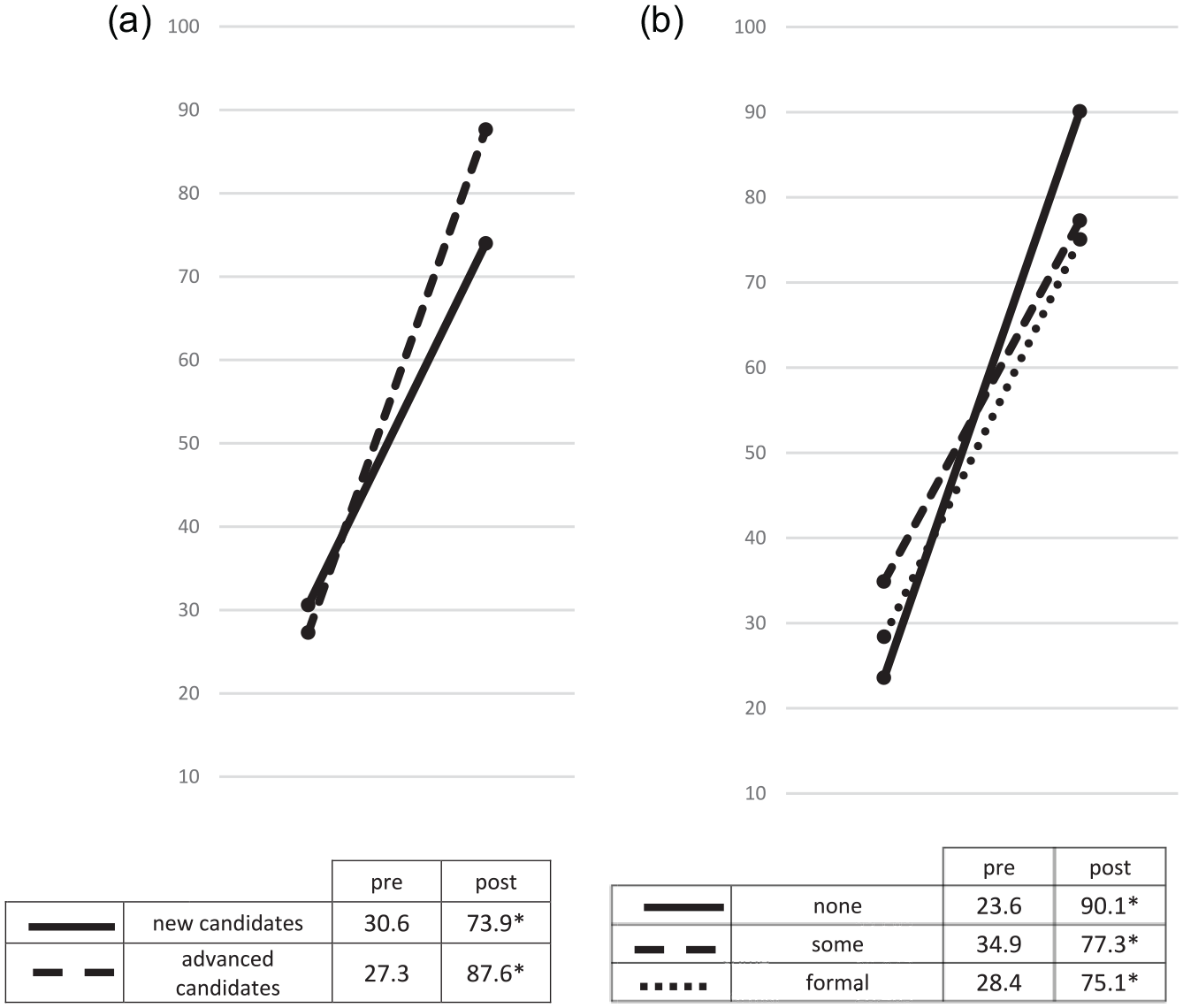
Changes in reflective ability over time. (a) Based on progress towards licensure and (b) based on previous teaching experience.
Instructional Skills
A one-way ANOVA was conducted in SPSS to determine potential differences in instructional skills based on previous teaching experience or progress toward licensure. Box’s test of equality of covariance matrices was significant indicating assumptions of normality were not assumed. Therefore, a more stringent criterion, Pillai’s trace, was used for the multivariate tests, and a more conservative p-value of.01 rather than .05 was used for conducting significance tests. Mauchly’s test of sphericity indicated sphericity was assumed. On average, candidates with no previous teaching experience scored 59.35% (SD = 47.32), candidates with some scored 94.16% (SD = 5.55), and candidates with previous formal teaching experience scored 98.10% (SD = 1.84) on their culminating field experience project. In addition, new candidates scored 77.48% (SD = 38.82), and more advanced candidates scored 95.80% (SD = 4.38). Results of the one-way ANOVA indicated a significant difference, F(2, 34) = 8.016, p = .001, in candidates’ instructional skills based on previous teaching experience. There was no significant difference identified in instructional skills based on progress toward licensure. The LSD post hoc comparisons indicated a significant difference between candidates based on previous teaching experience where candidates with no previous teaching experience performed significantly lower than both candidates with some (p = .003) and candidates with formal (p = .001) previous teaching experience. There was no significant difference between candidates with some or formal previous teaching experience on the culminating project.
Discussion
The purpose of this study was to investigate the potential of simulated video analysis where candidates with differing educational backgrounds taught their peers prior to engaging in an authentic field experience. Specifically, professional growth in special education professional knowledge, reflective ability, and instructional skills were tracked to understand if outcomes differed based on teacher candidates’ previous teaching experience or progress toward licensure. Overall, a special education methods course with simulated video analysis showed promise for promoting growth in special education professional knowledge and reflective ability for all students with diferring educational backgrounds. The following sections discuss these findings in context along with implications for teacher preparation research and practice as well as limitations of the current investigation.
Research questions 1 and 2 included an investigation of the differential effects of a special education methods course that included simulated video analysis on teacher candidates’ special education professional knowledge and reflective ability based on previous teaching experience or progress in a licensure program. Regardless of educational background, all teacher candidates made significant improvements in their special education professional knowledge and reflective ability. Taken in context, candidates who initially failed the professional knowledge assessment were passing, or even excelling in some instances, on the same measure at the end of the semester. Similarly, on average candidates went from being below proficiency to exceeding university proficiency standards by more than doubling their reflective ability scores. Although not significant, candidates with previous formal teaching experience demonstrated greater professional knowledge at the beginning of the semester and still were able to significantly build upon this knowledge over the span of the investigation. These findings highlight that even if teacher candidates have previous teaching experience, they are still capable of improving their professional knowledge in meaningful and significant ways through preparation coursework. Equally, candidates with a range of educational backgrounds engaged in the same preparation activities concurrently, with the same level of guidance, and on average, all benefited in significant ways. All candidates limited their video-recorded lessons to 5 minutes, used the same reflection matrix across time, did not receive feedback on their lesson plans or written reflections, and never turned in their video evidence for outside observation. This suggests that video analysis activities can be structured in a feasible way that allow for sustaining and scaling while maintaining usefulness. Teacher candidates, just like P-12 students, do not come to their coursework at the same point in their development. Identifying preparation activities that can benefit a range of candidates with unique educational backgrounds is ideal.
Research question 3 investigated whether a cumulative rating of instructional skills differed for candidates based on previous teaching experience or progress in a licensure program. Teacher candidates with some or formal previous teaching experience performed significantly better on the culminating field experience project serving as a proxy for instructional skill when compared to candidates with no previous teaching experience. Even teacher candidates with limited previous teaching experiences, such as working as an instructional assistant or substitute teacher performed significantly better than teacher candidates with no teaching experience. These results support existing literature highlighting the critical importance of authentic practice-based learning in teacher preparation (e.g., Benedict et al., 2016; Brownell et al., 2005; Maheady et al., 2014; Nagro et al., 2017). Furthermore, exploring alternate options to providing frequent teaching opportunities in authentic classroom settings that may include teacher candidates taking on the role of substitute or teacher assistant, is warranted. Despite teacher preparation activities, such as simulated video analysis benefiting candidates by strengthening foundational knowledge and skills, the value of practice-based learning in authentic settings cannot be overlooked. It is not clear the extent to which simulated video analysis, as employed in this study, directly influenced candidates’ knowledge and reflective ability, or more distally how their instructional skills during their field experience were impacted, given the lack of a true control group. Embedding research in a preparation course potentially conflates impacts of the intervention with coursework outside the scope of the study that also targeted similar dependent variables. What can be concluded, is these promising findings warrant additional research.
Although these findings highlight the importance of profession-ready skills and useful strategies to obtain them, there are limitations that should be acknowledged. First, it is necessary to acknowledge the challenges with facilitating and assessing the field experience. The measure of instructional skills did not include a direct observation. Understanding and evaluating field experiences is an ongoing challenge when trying to balance feasibility with access. To promote access, candidates had the flexibility to schedule sessions around their own availability and what was feasible for their mentor teacher. This made scheduling formal observations by the university instructor unrealistic. Correspondingly, based on their relationship with the mentor teacher, some candidates spent full days in their field placement teaching small or whole groups that included their focus student while others taught their focus student through one-to-one instruction. All candidates met or exceeded the requirements of the field experience for the course, but implications of this variability in field experiences were not explored.
Methodological limitations must also be recognized. Without a true control group, it is inappropriate to make causal claims regarding the usefulness of simulated video analysis. Identifying this promising practice as one aspect of a meaningful semester for many different types of teacher candidates is noteworthy, but limited nonetheless. Furthermore, issues with missing data and lack of normal distribution resulted in data analysis restrictions. More conservative analyses were selected and a restrictive alpha was employed. This may have led to a Type II error. Data were lost because candidate work samples were in paper form and candidates misplaced items from 1 week to the next. In future iterations, simulated video analysis activities can occur during class, but completing activities electronically would be preferable for archiving purposes. To maintain a robust sample, candidates from differing backgrounds were all included, but not all differences were explored. Differences in aspects of professional identity including previously completed coursework, teaching philosophy, contexts of the field placement, and personal backgrounds may have impacted engagement in—and outcomes of—simulated video analysis. Additional research regarding the influence of professional identity on teacher preparation and profession-readiness is needed.
In theory, the concept of special education professional knowledge combines declarative, procedural, and conditional knowledge. In practice, special education professional knowledge is the culmination of information assessed through state licensure exams, such as the Praxis which is used in 39 US states (Educational Testing Service, n.d.). Through their participation in a course that included simulated video analysis, teacher candidates made significant gains in their special education professional knowledge from pretest to posttest, meaning they improved skills necessary to gain access to the profession through licensure. Identifying preparation activities that help candidates progress toward this goal, regardless of their educational backgrounds is worthwhile. Moreover, just as professional knowledge is an important facet of profession-readiness, so is reflective ability, and identifying preparation activities that also result in improved reflective abilities warrant additional consideration. In this study, candidates moved away from superficial reflective practices toward critical analysis of their instructional decision-making.
Simulated video analysis was feasible given there was no need to have an instructor review video evidence, timely because there was no formal feedback, and meaningful because candidates were working on real-life teaching scenarios that they would face in their field experiences. Candidates had to (a) think and act like a teacher while video recording their instruction, (b) consider the perspective of a P-12 student while playing the role of student for their peers, and (c) review video evidence of their teaching sample using a structured model to promote an objective and accurate assessment of current levels of performance. Repetition of this same activity multiple times promoted familiarity and emphasized the importance of ongoing reflection and continuous improvement in practice. Each of these aspects (i.e., critical thinking, perspective taking, self-assessment, reflective practice, and lifelong learning) are genuine to the profession, and when presented in combination, can offer a cohesive learning experience that supports the notion of preparation impacting practice.
Regardless of previous teaching experience or progress toward licensure, all teacher candidates made significant improvements. At the same time, candidates with previous formal teaching experience outperformed their peers with no or some previous teaching experience on the culminating project that assessed instructional skills. The findings from this investigation suggest simulated video analysis shows potential as one component of a special education teacher preparation methods course, but likely not an effective substitute for authentic field-based experiences. Authentic field experiences serve as a critical source of experiential learning for teacher candidates, and should be prioritized in teacher preparation programs. Simulated video analysis may serve to bolster special education professional knowledge and reflective ability, which are foundational skills for a profession-ready teacher, but does not replace practice in authentic teaching settings.
Footnotes
Declaration of Conflicting Interests
The author(s) declared no potential conflicts of interest with respect to the research, authorship, and/or publication of this article.
Funding
The author(s) received no financial support for the research, authorship, and/or publication of this article.
