



Abstract
Educators often feel ill-equipped to support autistic students in general education contexts, although research shows that inclusion in these settings can contribute to positive outcomes. Professional development (PD) in evidence-based practices (EBPs) for autistic students can address this need; however, it is essential to understand the mechanisms by which PD can improve educators’ EBP use. Through an explanatory sequential mixed-methods design (QUAN→ QUAL), the authors gathered quantitative (Phase 1) and qualitative (Phase 2) data from 86 educators (special educators, general educators, and paraeducators) serving autistic students in general education elementary school classrooms. Using survey data on educators’ reported EBP training and use, the authors evaluated the effects of different training types (conference, in-service workshop, pre-service preparation, webinar, coaching/consultation) on educators’ use of EBPs for autistic students. The authors explored educators’ training experiences that facilitated their EBP use. The authors applied an established professional development framework to qualitative interview data to identify how key PD features (active learning, collective participation, content focus, cohesion, and sustained duration) have been accessed by educators and how they describe these as enabling their EBP use. Results demonstrate that pre-service training, in-service district or school-provided workshops, and coaching or consultation predicted EBP implementation. In addition, educators highlighted key PD features that facilitated EBP use, such as active learning. The authors discuss implications and guidance for incorporating these features within existing PD models to enhance EBP use for autistic students.
The increase in the number of autistic 1 children served in public schools (U.S. Department of Education, 2020) and the prioritization of inclusive education (Individuals with Disabilities Education Act [IDEA], 2004) necessitates that educators are prepared to use evidence-based practices (EBPs) to support autistic students in general education contexts (Simpson et al., 2003). For educators of autistic students, EBP implementation remains inconsistent and challenging in inclusive settings (Barry et al., 2020; Segall & Campbell, 2012; Silveira-Zaldivar & Curtis, 2019). The current general education structure, with large class sizes and a focus on the curriculum, can make it challenging to use EBPs in these settings (Barry et al., 2020; Silveira-Zaldivara & Curtis, 2019; Wilson & Landa, 2019). As a result, educators may struggle to meet the range of autistic students’ academic and developmental needs or rely on general teaching strategies rather than EBPs for autistic students (Corkum et al., 2014; White et al., 2007).
EBPs for Autistic Students
Researchers have demonstrated that EBPs designed and tested specifically for autistic students can improve outcomes across skill domains (e.g., social, adaptive, and academic) and a range of abilities (e.g., those with and without intellectual disability or language impairment; Steinbrenner et al., 2020). Through a systematic literature review and analysis of high-quality intervention studies, the National Professional Development Center on Autism Spectrum Disorder (NPDC) identified 27 focused intervention practices as EBPs (e.g., reinforcement, antecedent-based interventions; Steinbrenner et al., 2020). The EBPs have repeated evidence of effectiveness across several single-case experimental designs or multiple group design studies (Steinbrenner et al., 2020). Furthermore, federal mandates require education teams (e.g., special education teachers, paraeducators, and general educators) to use these research-based practices to help autistic students access the learning content (e.g., antecedent-based interventions), participate with peers (e.g., visual supports), and develop adaptive skills (e.g., task analysis; IDEA, 2004). Although reported use of some EBPs has increased over time, educators need more training, confidence, or use of others (Brock et al., 2020; Dynia et al., 2020; Hess et al., 2008; McNeill, 2019).
Professional Development to Reduce the Implementation Gap
Universal training “should enable practitioners to implement EBPs with fidelity and promote positive outcomes for students with disabilities” (Brock et al., 2014, p. 2). Training opportunities take many forms. For instance, multi-modal training (e.g., active skill rehearsal with feedback) is recommended to empower pre-service teachers with EBP knowledge and skills (Bettini et al., 2022). Common in-service PD opportunities include (a) webinars or web-based modules, (b) professional conferences, (c) workshops offered by schools, districts, or universities, and (d) student or teacher-focused coaching or consultation (Brock et al., 2014; Sam et al., 2020). National centers offer modules that thousands of educators have accessed and have evidence of improving participants’ EBP knowledge (Morin et al., 2021). Despite the variety of training types possible, PD is rarely provided consistently or with sufficient provision to lead to EBP adoption and sustainment (Hsiao et al., 2018; Knight et al., 2019; McNeill, 2019). Furthermore, most PD research relies solely on quantitative measures of broad training types or experiences (Knight et al., 2019; McNeill, 2019). To develop or scale effective PD models, there is a need to identify from the educators what training experiences and features have enabled their EBP use.
Features of Professional Development That Enhance Effectiveness
A critical next step to intervening in the implementation and training gap is to identify what mechanisms (i.e., “the processes by which strategies produce desired effects”; Lewis et al., 2020, p. 1) function to make training at the pre-and in-service level impactful in facilitating EBP use. In implementation science, articulated mechanisms offer causal links between implementation support (e.g., webinar) and the implementation outcome (e.g., the fidelity of EBP use; Lewis et al., 2018). Studying the differential impact of training strategies or elements (direct instruction of practices, performance feedback) that may serve as mechanisms causing the training to be effective has gained traction in recent special education research—Hsiao et al. (2018) evaluated how EBPs were taught in pre-service coursework for teachers of one state (e.g., not mentioned, mentioned and taught incidentally, or mentioned and taught via direct instruction) and found that teachers in one U.S. state received direct instruction through pre-service training in only a few EBPs. For in-service educators, teacher educators and PD researchers have begun to disentangle training strategies and explore which components are efficacious (Desimone, 2009; Desimone & Garet, 2015). Specifically, a meta-analysis by Brock and colleagues (2014) found that one training method, Behavioral Skills Training and its components (e.g., modeling, feedback), was most effective for special educators. Behavioral Skills Training capitalizes on active learning strategies such as modeling, rehearsal, and performance feedback. The authors, however, note that such training may not be feasible within the typical school or pre-service conditions, given the required number of training sessions (e.g., dosage; Brock et al., 2014). Therefore, there is a need to understand how such features have been integrated via practical and existing pre- and in-service PD to support educators’ EBP use.
Desimone (2009) developed a research-based conceptual framework for effective PD features. The framework posits that PD should consist of the following features: (a) alignment to student skill needs and learning of those skills (content focus), (b) opportunities for observation, feedback, analysis, demonstrations, or practice (active learning), (c) consistency with the curriculum, goals, teachers, and schools (coherence), (d) ongoing either throughout the school year or with extended duration (e.g., 20 hours; sustained duration), and (e) engages teachers together as a group to build “interactive learning communities” (collaborative). Research reviews and empirical studies show that these PD features are associated with improved fidelity and act as mechanisms of actual EBP use (Desimone & Garet, 2015; McMaster et al., 2021). For example, Brownell and colleagues (2017) found that teachers’ quality and frequency of EBP use for intensive reading intervention improved along with student outcomes more when PD was sustained. In addition, Desimone and Garet (2015) found that these five PD features were effective for procedural classroom behavior, such as these autism EBPs. Applying this conceptual framework to better understand how teachers have accessed these features in ways they report as effective in enabling their EBP use can highlight effective existing PD.
Study Purpose
Training educators to provide EBPs that promote effective inclusion and reduce autistic students’ educational disparities is essential. Researchers must understand precisely what training mechanisms can be leveraged in PD practice to improve educators’ use of EBPs for autistic students in inclusive settings. Using a mixed-methods approach to integrate the evidence from educators with well-researched theories on PD can have practical implications for future training efforts. In this study, we aimed to identify existing training features and experiences that educators have accessed and reported to facilitate their use of EBPs in general education settings for students with autism. We sought to address the following questions:
Method
As part of a larger, multiphase mixed-methods design (Locke et al., 2021), we used an explanatory sequential mixed-methods design (QUAN→ QUAL) to gather quantitative (Phase 1) and qualitative (Phase 2) data from educators serving autistic elementary students (Palinkas et al., 2011; see supplementary materials procedures for data collection and analysis).
Participants
To capture a broad range of experiences, we recruited a stratified sample of educators (i.e., paraeducator, special educator, and general educator) across elementary schools (Kindergarten–fifth grade) located in different districts in the (Locke et al., 2021, 2022) United States. We used https://thegeneralizer.org to select schools that are representative across the school (size, % free and reduced-price lunch, gender, race, urbanicity) and district characteristics (number of schools, % English Language Learners, % language at home, English only, and urbanicity; Tipton & Miller, 2022). Eighty-six educators from 50 schools within 24 districts in Washington participated. Our final sample had a generalizability index score of .92 (possible range 0–1) for this state (considered very high) and .78 for the United States (high), meaning the sample of schools is very close to representative of the selected population characteristics at the school level. The generalizability index is generated by The Generalizer using an approach described by Tipton (2014) and is based on a statistical comparison of distributions that is similar to propensity score analysis.
Participants included 86 educators: 27 general education teachers (GEN), 31 special education teachers (SPED), and 28 paraeducators (PARA) who served at least one autistic elementary student during the 2019–2020 school year. All participants consented electronically and provided demographic information. The majority of the general education teachers (92.6%), special education teachers (96.8%), and paraeducators (85.7%) were female. Most general educators (81.5%), special educators (96.8%), and paraeducators (81.5%) identified as white. Few educators were Asian (GEN = 7.4%, SPED = 0%, and PARA = 3.7%), Multiracial (GEN = 11.1%, SPED = 0%, and PARA = 14.8%), or Latino/a/x (GEN = 0%, SPED = 0%, PARA = 3.6%). On average, general education teachers had 7.96 years (±5.31), special education teachers had 4.8 years (±4.52), and paraeducators had 6.68 years (± 4.26) of experience working in their current position. Most educators earned at least a Bachelor’s (GEN = 14.8%, SPED = 32.3%, PARA = 50%) or Master’s degree (GEN = 23%, SPED = 67.7%, PARA = 7.1%). In the prior 2 years, educators taught in general education inclusive (66.3%), self-contained (40.7%), co-taught inclusive (15.1%), and special education inclusive (11.6%) classroom models.
Procedures
Recruitment
Following approval from the university and school district Institutional Review Boards, we used district-provided lists of elementary schools. We contacted 358 principals from schools identified in our selection process (see Participants) with study information and a request to forward study screeners to educators at their schools. Interested educators completed a screener and interest form (N = 139 screener responses). They were screened for meeting the inclusion criteria of serving at least one autistic student in an elementary general education setting in the prior 2 school years. Eligible educators who consented (N = 104) were contacted with a unique link to complete the survey via Qualtrics, which included a modified Autism-Treatment Survey measure and a demographic questionnaire. For both phases, participants were instructed to respond to their EBP use with autistic students in a general education classroom. After survey completion, participants (N = 86) were invited to a recorded interview (30–45 minutes) at a convenient time (via Zoom), and 81 (94.2%) completed an interview. Participants received a $40 gift card for the interview, and their schools received a resource kit (e.g., visual supports, books).
Phase 1: Quantitative Measure
Modified Autism Treatment Survey
The Autism Treatment Survey (ATS; Hess et al., 2008) was designed to measure teachers’ frequency of use and training experiences with a comprehensive list of EBPs for autistic children (Hess et al., 2008). We updated the ATS as follows, we (a) included practices identified as EBPs for autistic students according to the NPDC (Steinbrenner et al., 2020), (b) used updated NPDC practice definitions validated via cognitive interviewing with two former educators (Hugh, 2020; Hugh et al., 2021), and (c) separated training type (e.g., conference) and provider. To develop a set of focused EBPs inclusive of both multicomponent practices and strategies that are used to support meaningful inclusion of autistic children in general education settings, we used explicit criteria for exclusion of practices from the NPDC review to focus the set of practice options on EBPs that teachers could access training from a variety of pathways (e.g., schools and online modules) and reduce the potential impact of resource barriers (e.g., cost of certification). The first and final authors and an external autism intervention researcher independently coded practices for inclusion or exclusion with no disagreements. Practices could not: (a) be assessments (e.g., functional behavior assessment), (b) be implemented only outside of schools (e.g., parent-implemented), or (c) require EBP-specific certification (e.g., Sensory Integration Therapy; see supplementary materials for a complete list of practices and definitions). We included 21 EBPs: social narratives, direct instruction, antecedent-based intervention, social skills training, self-management, functional communication training, discrete trial training, peer-mediated instruction and intervention, naturalistic intervention, reinforcement, modeling, task analysis, visual supports, prompting procedures, augmentative/alternative communication, extinction, response interruption/ redirection, time delay, technology-aided instruction and intervention, video modeling, and behavioral momentum intervention. For each of these, participants were asked to indicate if they (a) used the practice and (b) received training in the practice. If they indicated “yes,” they were given a set of training types and instructions to select all training types they had received in each practice, including teacher or educator preparation or certification program, school-based in-service or workshop, District/ESD in-service or workshop, coaching, consultation, webinar, conference, and self-taught with descriptions.
Data Integration for Data Collection
We individualized the qualitative semi-structured interview based on the participant’s quantitative data to enhance breadth and depth. We sought to cover all 21 EBPs included in this study and a variety of training and use. We sampled EBPs by interviewing participants regarding three to four of the EBPs in their survey, for which they responded that they had been trained in and used, used but had not been trained in, and were trained in but not using.
Phase 2. Qualitative Semi-Structured Interview Data Collection
We developed a systematic and semi-structured interview guide (see supplementary materials) to gather educators’ use of, training in, support for, and EBP use for the included autistic elementary student(s) they served. We asked a series of open-ended questions beginning with “In your survey, you indicated you use Practice X for your autistic student included in general education; tell me more about that practice” and followed by a question about their training experiences for up to four practices and probes for what was helpful about those trainings if needed. Interviews were conducted via Zoom by bachelor’s, master, and doctoral-level researchers with training and expertise in ASD EBPs. Most interviews were approximately 25 to 45 min in duration.
Data Analysis
Phase 1. Quantitative Data
RQ1 was analyzed by computing frequencies and proportions of educators who reported receiving training by each training type. Missing data were not possible because of forced choice responding. For RQ1 and RQ2, we combined “coaching” with “consultation,” and we combined “school-based in-service or workshop” with “district workshop.” These were combined to improve model parsimony, and because of conceptual similarity (e.g., qualitative interviews indicated educators discussed these interchangeably “we had a coach who came in and talked about a specific student and watched us practice,” which met our definitions of both coaching and consultation) and strong statistical association of these training types, as each pair had tetrachoric correlations above r > .40 (tetrachoric because each training response was yes/no.)
RQ2 was analyzed using a generalized linear model predicting EBP use, with a logit link for the binomial distribution using a compound symmetry variance structure and robust estimator. To test the effects of training type on EBP use, we predicted each EBP by several dichotomous variables for attended/did not attend for each training type for that specific EBP. Therefore, we used mixed-effects models with all EBPs (N = 21, Level 1) nested within participants (N = 86, Level 2). Dichotomous attendance for each EBP training type was included as a Level 1 variable. Random effects were specified to adjust standard errors and confidence intervals due to the nesting of EBPs within participants. Separate single-variable predictor models were computed for predicting EBP use, including each training type as a predictor. A final model was computed predicting EBP use, with all training types included as predictor variables (excluding “other,” as it was infrequently reported and highly variable). For descriptive purposes, we ran separate combined models stratifying by participant role; however, our sample size did not permit valid statistical testing among roles. For these analyses, webinars were excluded for general education teachers as the model would not converge due to small cell sizes.
Phase 2. Qualitative Data
We developed a stable codebook using six randomly sampled transcripts (two per role) by (a) applying deductive codes from exploratory and explanatory implementation theories (Locke et al., 2021), (b) using inductive coding for concept development or emergent themes, and (c) continuing this process until data saturation (Saunders et al., 2018). We double-coded 20% of randomly selected transcripts and met weekly to discuss disagreements and establish consensus (DeSantis & Ugarriza, 2000; Hill et al., 1997, 2005). We selected every excerpt coded as “training” (defined: “Any description of formal or informal training they or others did/did not receive from any (a) source including colleagues, parents, pre-service program, coaches, consultants, other (b) description of being self-taught and accessing resources (e.g., websites) to learn about practices, (c) what was or was not helpful in their training, and (d) how they heard about a practice.”) for further subcode analysis. In alignment with effective PD features (Desimone, 2009), we developed and reviewed a sub-codebook with examples and non-examples. The first author sorted all excerpts for features and helpfulness of training (Desimone, 2009), and another author independently sorted a random subset of 20% (agreement = 86.7%). All disagreements were consensus coded. We calculated percentages of features in each excerpt (sum of PD features divided by all training excerpts multiplied by 100).
Data Integration for Mixed Methods
To address RQ4, we merged qualitative and quantitative data that suggested mechanistic training pathways for EBP use. For mixed-methods analysis, we conceptualized mechanisms as training features (Desimone, 2009) that participants described were helpful within training experience types that the quantitative data suggested predicted EBP use. We first selected excerpts in which participants described training types that significantly predicted EBP use (teacher prep, school/district workshop, coaching/consultation). From that set, we selected one excerpt from each of those training types with the most PD features and where the educator mentioned that training was helpful. To identify patterns and prime examples of these mechanisms, we merged these via a joint display (Fetters et al., 2013).
Results
Educators’ Training Experiences
Table 1 displays the proportion of participants reporting receipt of each training type for any EBP across all EBPs (i.e., if a participant indicated receiving any training type for any EBP, they were counted toward the frequency count for that training type). Participants most reported receipt of training via school/district workshops (total = 73%, GED = 74%, SPED = 71%, PARA = 75%) and least often reported attending webinars (total = 22%, GED = 15%, SPED = 26%, PARA = 25%). Other common training types included educator preparation/certification programs (63%) and coaching or consultation (62%). Conferences (24%) were less common. Table 2 displays the proportion of participants who reported training per EBP.
Count and Percentage of Participants Receiving a Training Type on Any EBP.
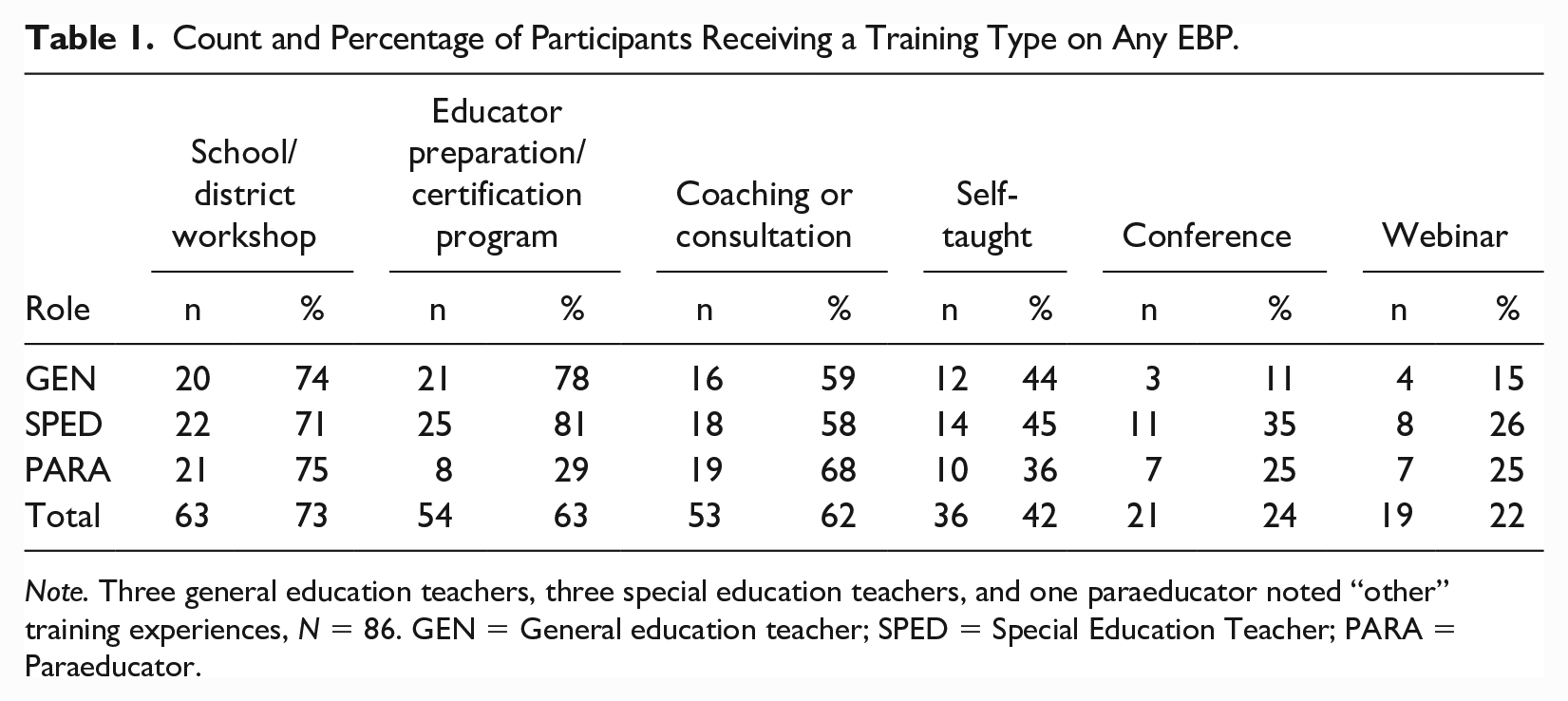
Note. Three general education teachers, three special education teachers, and one paraeducator noted “other” training experiences, N = 86. GEN = General education teacher; SPED = Special Education Teacher; PARA = Paraeducator.
Percentage of Participants Receiving Training Types and Training by Use per Evidence-Based Practice.
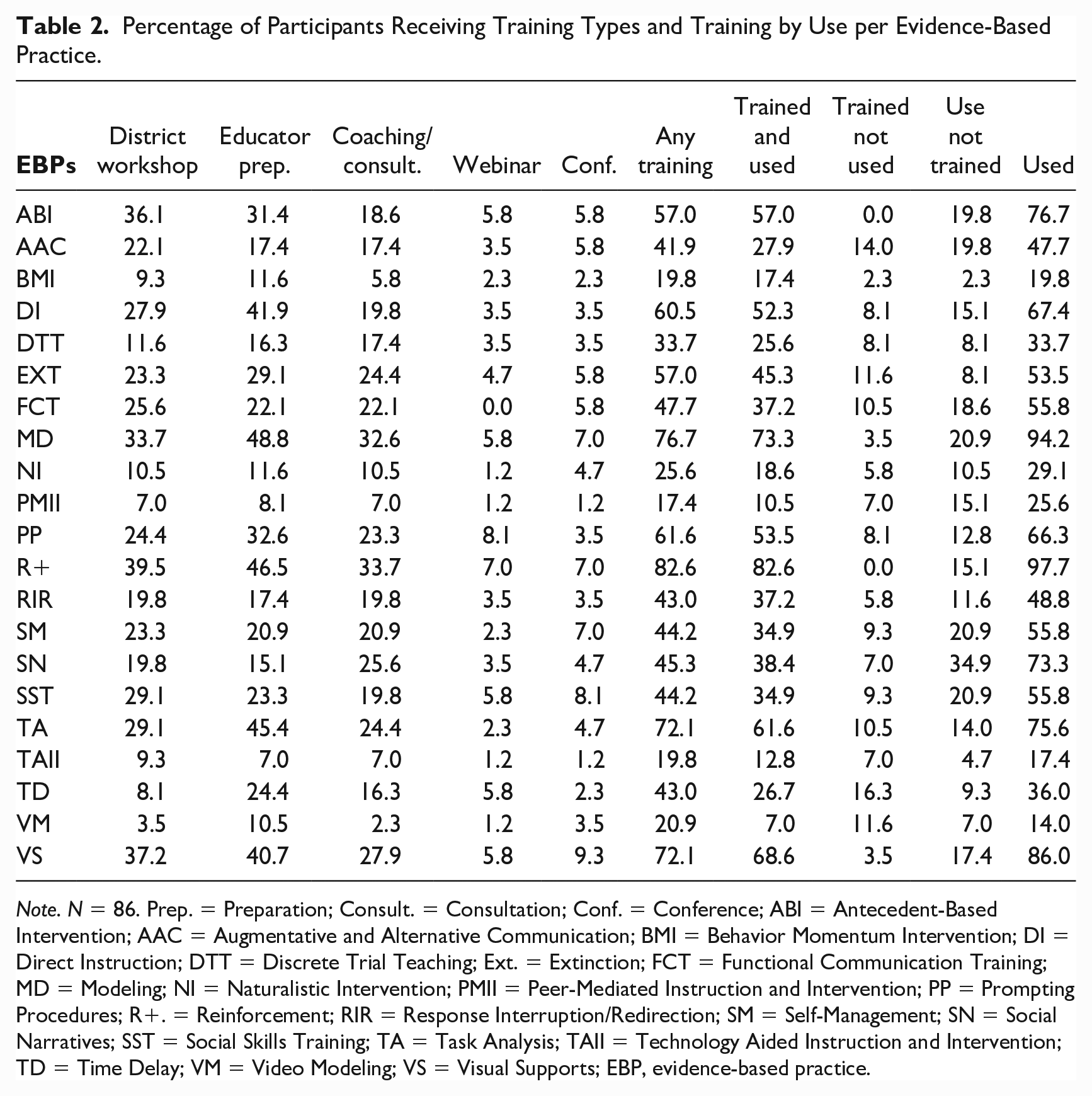
Note. N = 86. Prep. = Preparation; Consult. = Consultation; Conf. = Conference; ABI = Antecedent-Based Intervention; AAC = Augmentative and Alternative Communication; BMI = Behavior Momentum Intervention; DI = Direct Instruction; DTT = Discrete Trial Teaching; Ext. = Extinction; FCT = Functional Communication Training; MD = Modeling; NI = Naturalistic Intervention; PMII = Peer-Mediated Instruction and Intervention; PP = Prompting Procedures; R+. = Reinforcement; RIR = Response Interruption/Redirection; SM = Self-Management; SN = Social Narratives; SST = Social Skills Training; TA = Task Analysis; TAII = Technology Aided Instruction and Intervention; TD = Time Delay; VM = Video Modeling; VS = Visual Supports; EBP, evidence-based practice.
Training Types Predicting EBP Use
Of the 1,806 EBP observations (86 participants x 21 practices and strategies), there were 133 observations (16.2%) of a participant who reported receiving training on an EBP but not using the EBP in the past two years, and 274 (27.8%) observations of EBP use without training (aside from being self-taught). The mixed effects models displayed in Table 3 predict reported usage (yes/no) with training type as predictor variables. Of those who were trained, the percentage who reported use of the practice was relatively high (82.2% for teacher prep 87.1% for school/district workshop, 93.3% for other). Participants could report using the EBP without reporting any training, and all observations were included regardless of whether the participants were trained or used the EBP. All single-variable models were significant and had strong effects (all odds ratios [OR] > 5.3), indicating that reported training was a strong predictor of reported use. The strongest predictors were school/district workshops (OR = 9.1), self-taught (OR = 9.2), and conferences (OR = 9.1). Some caution must be used in comparing between-training effect sizes due to large confidence intervals (see Table 3). When including all training types in a single model, nearly all ORs showed some attenuation, and webinars and conferences were no longer statistically significant. The exception was pre-service, which had a slightly increased OR of 6.6.
Results of Mixed Effects Logistic Regression N = 86.

Table 4 displays the multiple regressions predicting EBP reported use stratified by role. We emphasize, however, that analyses by role are underpowered due to the small sample size, so results must be interpreted cautiously. As in the unstratified analyses, teacher preparation remained a strong predictor of reported EBP use across roles. Webinars and conferences were insignificant predictors for any role. Self-teaching was a strong predictor for GEN and SPED but not for PARA. School or district workshop was not a significant predictor of GEN-reported use but was for SPED and PARA. Coaching and consultation were not significant for GEN, had a borderline bottom confidence interval of 1.0 for SPED and were significant for PARA.
Results of Mixed Effects Logistic Regression by Role.
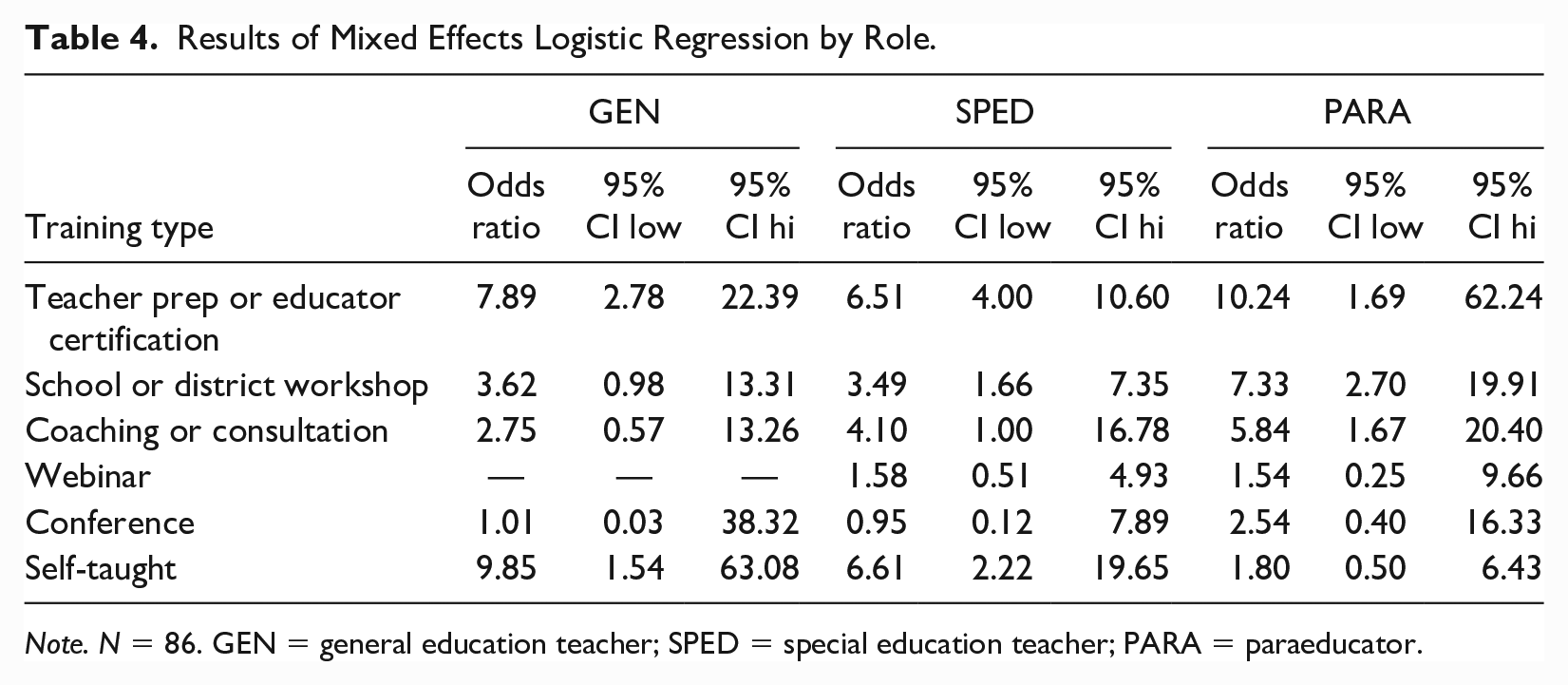
Note. N = 86. GEN = general education teacher; SPED = special education teacher; PARA = paraeducator.
Qualitative Results
Active Learning
Active learning was the most frequently mentioned feature (49.2%); in more than half of those excerpts, it was described as helpful (57%). Participants experienced active learning both within contrived situations in traditional PD workshops and “on the job” through formal and informal mechanisms. Within PD workshops, trainers set up conditions in which participants observed videos and engaged in discussion, with one noting, “see[ing] teachers in action and then hav[ing] that time to notice and wonder what is happening and being reflective of your own practice is a great strategy.” Other workshops used to role-play and case studies, which most educators experienced as beneficial if applied to real-world contexts. For example, one participant described that being given a “fake student. . .doesn’t make a lot of sense until you have to put it in place.” Educators also valued making intervention materials (e.g., social stories) within workshops because it helped them “break apart” and modify the strategy. Those who observed live demonstrations from autistic children within workshops noted that it was helpful to observe trainers use practices with students. They appreciated practicing with the student before having to “juggle it all” in their classroom with many students at once.
Active learning components most often described as helpful were frequently in the context of direct coaching experiences in the educators’ classroom. Educators described that though they may have heard about or learned about practices in training or teacher preparation, observing and using practices with autistic students outside of coaching contexts and within natural interactions “on the job” was their formative learning experience. As described by one participant, “For me, I don’t learn it until I have to do it and put it into practice.” Participants shared that coaching as an active learning method was specifically beneficial because the coaches individualized to the context and student, saying, “This is the practice I’ve heard of in the book. Now let’s put it in person. Let’s apply it to your kids.” For example, one educator said, “In my higher ed program, it was more generalized, that if you used this with a student, this may be an outcome. But when I worked with the therapist in my classroom, we actually saw the gains.” Learning within their classrooms helped educators see what was “doable within [the] confines of the classroom, within the parameters that there is 22 other students and there’s all the other things.” One educator emphasized that knowing each autistic student was fundamental and only possible through experience, so the “specific training with real students” was essential.
Relatedly, the importance of repeated practice in the EBP and seeing the student response in context was emphasized in a few ways. First, several educators noted “trial and error,” with or without support from other educators or PD providers, as their primary learning mechanism in figuring out whether a practice “works” or does not for a specific student. Second, participants benefited from observing and working with their students and the coach via practice and feedback: “Not only has [the coach] said what it’s supposed to look like, now I’m going to get to watch her do it. Then the following week, she’s going to watch me teach one of my groups. Then. . . we’re going to debrief.” Finally, many participants shared that repeated observations, feedback, dialogue, and reflection were “invaluable” in helping them learn to use EBPs.
Educators described observing paraeducators, mentor teachers, special education teachers, speech-language pathologists, behavior specialists (e.g., Board Certified Behavior Analysts, BCBAs), and even principals use the EBP with their students as pivotal learning experiences. These professionals were lauded for having “led by example.” One teacher described observing a BCBA with their student saying, “But when you see it in action in real life with your students, that’s when you really go, ‘Aha, I get it. I want to use this.’” Following the observation, participants would reverse roles and receive formative feedback on how the educator and student did. Many teachers shared that they “felt like [they] learned more just being in [the] classroom every day” than from formalized PD efforts.
Collective Participation
Aspects of collective participation (i.e., participating in all or part of the training with class, team, or school members) also often arose (34.2% of excerpts, and helpful in nearly half of the excerpts, 44.9%). This feature was part of formal workshops and learning EBPs “on the job” through systematically designed training opportunities at the regional, district, school, classroom, and child levels. District and school-level policies that allowed for collective participation included: (a) regular early release to attend training, (b) competency-based programming for paraeducators, (c) required mentorship for new teachers, (d) “lesson study” with reciprocal observation and feedback for a classroom team, and (e) “book studies” in which teachers reviewed the manual, tried the EBP in their class, and held review, reflection, and problem-solving meetings. One educator noted that collective participation enabled all educators to be on board and as a group of “like-minded people . . . I could learn from them, and I could teach them my tricks, and maybe we could figure this all out together.”
Participants engaged in collective participation also at the classroom and child levels through consultation and coaching. Many educators described the benefits of these partnerships with colleagues in other disciplines, such as speech-language pathologists, behavior specialists, school psychologists, and principals. Many were described as “resources,” having very specialized training as BCBAs or in autism-specific classroom models that they brought to their school and informally taught to their classroom team. The different perspectives on their classroom team contributed significantly to participants’ learning, with one teacher explaining that the SLP worked with a “variety of kids and has great ideas, and you can kind of bounce off of each other with ideas when you’re brainstorming about a kid, I think that’s so valuable.” In the context of classroom-specific collective participation, paraeducators often described learning directly from their mentor teacher “through practice,” noting that, “You got to live it and have someone train [you].” Likewise, one teacher described a co-teaching model, in which they and the general educator would switch roles partway through the day to learn the strategies, as extremely beneficial. Collective participation within roles also was critical. A few paraeducators described learning directly from other paraeducators, saying, “that’s probably the strongest bond you get is with your other paras because you’re with them and they get it. They understand it.” Through “shadowing” one another, they would “pass down the knowledge.” One teacher reflected that collaborating with other teachers helped them learn how to use a curriculum; “we started getting things out, and then I started seeing how effective they were and that I didn’t have to ask anybody else to do it or wait for anybody else to do it for me. I could do it myself.”
Coherence
Educators brought up a training’s coherence, or alignment of the EBP and training content with the district, school, or program’s practices and policies, teacher beliefs, and needs of students across a range of connectedness from simple district payment for training to focused training related explicitly to curriculum and student needs (18.9%). For example, one educator said, “if there’s a need, [the district tries] to put together professional development for it.” Coherence was helpful in about half of the mentioned instances, primarily when the connections were stronger to roles, responsibilities, and students (53.0%). Participants emphasized that districts sent educators in groups to training and then created space for these educators to return to school to instruct each other on the EBPs learned. Experiences differed for “brand new special education teachers” or paraeducators, with one paraeducator describing, “Well, I had one training which was absolutely wonderful and it was at the [school district] . . . and paid for by [district]. It was specifically for sped paras.” In contrast, one educator described the district giving them “a spiral-bound book and said, ‘here, do this’” without follow-up or training.
More specific coherence was part of a school-wide initiative (e.g., Positive Behavior Intervention Supports [PBIS], Conscious Discipline, explicit reading interventions, and particular autism or inclusion curriculum or classroom models) or student-specific needs. For example, one educator explained that “a school-wide support system and having it be PBIS” was helpful for their EBP learning and use because it focused on positive reinforcement. Educators mentioned revisiting content from some training and initiatives at regular team or school meetings as “refreshers,” which benefited the whole school team. Educators also underscored the importance of all school personnel being on the “same page” at each school because of training to support an EBP being “absorbed school-wide,” which makes the “biggest difference for the students.”
District-provided training that matched student needs were applauded as incredibly valuable; “I think just the idea that the district is recognizing [that] we are put in these situations, and we need to be educated and that it’s important for everyone and every student and every adult to just be aware of these things.” Other responsive approaches coherent with school policies included having autism and behavior consultants who would come in as needed, or when educators “hit a wall.” Some participants, however, noted that those resources seemed more often used in self-contained than in general education settings. While educators wanted training coherent with their needs, some said they may have only accessed this specific training because they had a “rough classroom” or “autistic student [with] pretty severe behavior.”
Content Focus
Although mentioned minimally (17.7%), focusing on the content of learning the skill or how autistic students specifically learn skills often was described as helpful (65.2% of excerpts). Participants emphasized the importance of knowing why a practice may work for an autistic student/s or skill area—specifically, understanding autism and how autistic students’ brains work was a recurring theme. One educator described the most beneficial aspect of training as learning, “The reason behind it. Like, why is it important?” They connected the understanding of autistic students’ learning and brains often with one participant stating, “From the outside looking in, we might look at them and say, ‘They look totally typical.’ But really, their brain, there’s so much happening in there.” Participants described content focus on individualizing interventions for their specific students and considering the “whole child.”
Educators also described two primary skill areas for which content focus was beneficial and included in their training: social communication skills and behavior. Participants described the helpfulness of understanding students’ behavior, the “function of their behavior” as communication, and “how to communicate to autistic students” precisely. One described, “So I liked how they taught that a student just not being naughty . . . I liked that it was put in that context of: children aren’t just screaming to scream, they’re actually trying to tell you something.” Those who reflected on learning about behavioral function stated the impact on their thinking and perception of the students helping them better address the students’ needs.
Sustained Duration
The sustained duration was the least often described PD feature (13.9%), although often associated with helpfulness (44.0%). Many educators noted having multiple courses within a pre-service program that touched on EBP use (e.g., modeling) or specific practices being embedded in many PD workshops to the point that they could not recall when they began learning about it (e.g., reinforcement). In contrast, instances of repeated learning experiences or extended duration within a particular training type or experience (e.g., workshop) were rare. Structured learning opportunities that participants experienced as helpful often were in the context of collective training and groups throughout the school (e.g., book studies) during the school year for cyclical practice that incorporated new EBP components.
Mixed-Methods Analysis of Training Mechanisms
Quantitative data from educators provided information about what training formats may be the most likely mechanisms of EBP use. In addition, the qualitative data helped describe what effective features were integrated within those learning opportunities and whether teachers described these experiences as helpful in using EBPs. To describe the training mechanisms in educators’ experiences and words, we integrated qualitative and quantitative data for matching and expansion via a joint display (Fetters et al., 2013). We used quantitative criteria for selecting training types that individually predicted participants’ likelihood to use an EBP from the analysis combining role types (p = <.05; pre-service training, school/district-based in-service or workshop, coaching/consultation). Self-taught, though predictive of use, was omitted because there was no excerpt describing any PD features. We then matched qualitative data to excerpts representing each training type’s most effective PD features.
Two of the three training types individually predictive of EBP implementation included all PD features. The excerpts selected for coaching or consultation and school or district in-service described ongoing, district-organized training supplemented with individualized coaching/consultation. These experiences included one-on-one active learning by observing a trainer or others, reflection, problem-solving, and specifically individualizing EBPs to specific autistic students. Pre-service PD only had one excerpt with more than one PD feature (Figure 1, row 3) in which the educator describes the active learning aspect of their sustained practicum and student teaching experiences with their mentor teacher and paraeducators. They explained the impact of observing the demonstration as helping their use with other students.

Joint Display of Mixed-Methods Analysis.
Discussion
In this study, we sought to improve the understanding of PD mechanisms successfully used to facilitate educators’ EBP use for autistic elementary students. We used mixed methods to evaluate the effects of training types and analyze teachers’ descriptions of the helpful training features and experiences. Together, these results suggest that (a) both pre- and in-service training may be critical for educators and may need to include all PD features (collective participation, active learning, cohesiveness, sustained duration, and content focus), and (b) school or district-delivered in-service training that incorporated all PD features as part of combined workshops and coaching were the most helpful in facilitating EBP use. In addition, educators described beneficial aspects of these trainings across effective PD features, with active learning being the most salient. We describe features that act as mechanisms for EBP use and can be practically incorporated into pre- and in-service training.
Participants who reported pre-service training in an EBP were more likely to report use of that practice. Qualitatively, although pre-service experiences were minimally mentioned, participants explained that the sustained duration of their learning opportunities for an EBP via multiple courses and practicum experiences and active learning opportunities through mentor teachers helped them see what they learned in classes in action to be able to know how to apply the EBP in practice. Consistent with other research, participants reported learning by observing, practicing, and receiving feedback in the context of “real” classrooms and students (Brock et al., 2014). These approaches rely on educators and practicum mentor teachers having knowledge and quality EBP implementation, which is a continued need. Pre-service programs may need to train mentor teachers in EBPs to ensure that students’ learning opportunities are consistent with course content on EBPs for autistic students in general education settings. Although pre-service programs typically provide some EBP content, educators rarely mention content focus in their pre-service experiences. Although educators may have had a recency bias and did not think back to the early years of their PD as easily as more recent training experiences, the lack of pre-service experiences described may be a result of the lack of training for general educators and paraeducators, specifically, and suggests a need for continued in-service development via endorsements or competency-based certification.
Participants emphasized the value of the most frequently accessed training type, “on-the-job” workshops, and coaching experiences as they were directly relevant to their students, teachers, schools, and districts. In the future, PD providers can gather input from educators, families, and schools to select EBPs for training and ensure they are relevant and cohesive with school and district curricula and initiatives. Helpful PD features converged with the training types (workshops, coaching/consultation) that significantly affected reported EBP use. For example, schools and districts could leverage formal in-service opportunities that include all effective PD features; district autism, behavior, or specialist (e.g., SLP) experts can provide workshops cohesive with district policy and initiatives and introduce content focused on that EBP and how it works for autistic students. Following such workshops with sustained and collaborative intra- and inter-role groups and coaching with repeated active learning such as modeling, rehearsal, and performance feedback will likely support EBP use.
Our study also calls attention to areas of improvement in pre- and in-service PD. First, pre-service preparation incorporating EBPs that embeds effective PD features (active learning, collective participation) continues to be needed. Second, shifting from a reactive approach to accessing coaching (i.e., only accessing coaching when significant problems occurred) to a preventive PD model, such as matching PD to individual educators’ needs through tiered coaching (Artman-Meeker et al., 2022; Brock et al., 2021) is essential. This may be particularly important for general educators and paraprofessionals who access less disability and autism-specific training during pre-service preparation and all educators who described a “trial and error” approach. Third, while important, collective participation may need an autism expert, such as school district autism or behavior consultants to bring in new expertise on EBPs to teams who lack a toolkit of practices with evidentiary support. Likewise, and fourth, such collective participation and time or technology uses (e.g., cloud-based data collection and planning) for team planning among educators of the various roles may be crucial for learning different EBPs for autistic students while teachers are on the job (Johnson et al., 2018).
Limitations and Future Directions
Although this study demonstrates that different training types and their features consistently lead to educator-reported EBP use, it disregards that different EBPs vary in their purpose, needs to be implemented, complexity, and implementation steps (Steinbrenner et al., 2020). We grouped EBPs to show general trends across reported training types, features, and use of EBPs. Like all data based on self-report, biased responding, and faulty memories may over- or under-endorse training and use. While our data uncovered a sizable percentage of situations in which people reported EBP use but no training and training but no use, we cannot know to what extent any bias may have occurred. Although participants were asked to describe their use of practices, and we only qualitatively coded the “training” code when they were explicitly describing training in an EBP (i.e., if a participant started describing training in a non-EBP, this was excluded), there is potential for varied construct definitions of EBPs between researchers and educators (Locke et al., 2022). We also do not identify which training type is explicitly associated with different EBPs given the mixed-method sampling design and approach. Due to the COVID-19 pandemic, we could not observe EBP use to confirm reported EBP use.
Future research can leverage these findings to explore critical features from educators’ perspectives specific to different EBPs or specific to their roles with important observational data. Although the representativeness of our sample was very high for Washington state, the generalizability of these findings for different trainings that educators may access across the U.S. may be limited and unique to each school district and our demographic data. It may not be representative of specific populations. Specifically, although we recruited educators based on school student demographics based on the Generalizer, no Black educators participated. Although we did not have an adequate sample to analyze by role, future research could build off our findings by studying specific subsets of participants by role through observational EBP use. Future research should purposely sample educators on important demographic factors that may relate to their training opportunities, experiences, and practice use (e.g., race, role Mason-Williams et al., 2023). Finally, while we focused on helpful aspects of training, future research should evaluate unhelpful training features and types that may need to be de-implemented.
Conclusion
Pre- and in-service training incorporating effective PD mechanisms can facilitate educators’ EBP use. Crucially, these mechanisms are practical and actionable PD features (Desimone, 2009) that educators describe were helpful in their EBP use to support autistic students in general education contexts. To enable EBP use and improve autistic students’ outcomes, effective PD features such as active learning aligned with behavioral skills training may need to be integrated into effective training types (e.g., workshops followed by coaching or consultation). Pre- and in-service PD providers can leverage this information to partner with schools to provide the content of EBPs specifically for autistic students through active learning opportunities across multiple or sustained experiences in a cohort or school teams. Such intentional and systematic PD efforts may be a pathway to reducing the implementation gap and improving autistic students’ outcomes.
Supplemental Material
sj-docx-1-tes-10.1177_08884064231178768 – Supplemental material for Educators’ Perspectives on Training Mechanisms That Facilitate Evidence-Based Practice Use for Autistic Students in General Education Settings: A Mixed-Methods Analysis
Supplemental material, sj-docx-1-tes-10.1177_08884064231178768 for Educators’ Perspectives on Training Mechanisms That Facilitate Evidence-Based Practice Use for Autistic Students in General Education Settings: A Mixed-Methods Analysis by Maria L. Hugh, Michael D. Pullmann, Mahima Joshi, Daina M. Tagavi, Kaitlyn Ahlers, Alyssa M. Hernandez and Jill Locke in Teacher Education and Special Education
Supplemental Material
sj-docx-2-tes-10.1177_08884064231178768 – Supplemental material for Educators’ Perspectives on Training Mechanisms That Facilitate Evidence-Based Practice Use for Autistic Students in General Education Settings: A Mixed-Methods Analysis
Supplemental material, sj-docx-2-tes-10.1177_08884064231178768 for Educators’ Perspectives on Training Mechanisms That Facilitate Evidence-Based Practice Use for Autistic Students in General Education Settings: A Mixed-Methods Analysis by Maria L. Hugh, Michael D. Pullmann, Mahima Joshi, Daina M. Tagavi, Kaitlyn Ahlers, Alyssa M. Hernandez and Jill Locke in Teacher Education and Special Education
Footnotes
Declaration of Conflicting Interests
The author(s) declared no potential conflicts of interest with respect to the research, authorship, and/or publication of this article.
Funding
The author(s) disclosed receipt of the following financial support for the research, authorship, and/or publication of this article: This work was financially supported by the Institute for Education Sciences (#R305B170021, #R324A200033).

Supplemental Material
Supplemental material for this article is available online.
Notes
Author Biographies
References
Supplementary Material
Please find the following supplemental material available below.
For Open Access articles published under a Creative Commons License, all supplemental material carries the same license as the article it is associated with.
For non-Open Access articles published, all supplemental material carries a non-exclusive license, and permission requests for re-use of supplemental material or any part of supplemental material shall be sent directly to the copyright owner as specified in the copyright notice associated with the article.
