




Abstract
Although special education legal knowledge is central to educating students with disabilities, how two critical school professionals—special educators and school principals—garner such knowledge is unclear. This study identified gaps in the professional training for special educators and school principals by examining professional standards and common textbooks. After identifying 32 special education legal concepts, we used content analysis to determine the extent to which each concept was mentioned in professional standards and preservice textbooks (five in special education, six in principal preparation, and four in school law). Compared with special education textbooks (in which 68%–84% of special education legal concepts were mentioned), preservice principals received less information on special education law in their general textbooks (3%–13% of concepts mentioned), although gaps narrowed when examining school law textbooks (63%–81%). Special education and school law texts consistently included concepts related to the six pillars of the Individuals with Disabilities Education Improvement Act (IDEA), as well as more specific concepts, such as discipline/behavior and related services. Rarely mentioned concepts were extended school year, resolution meetings, and compensatory services. We discuss training, research, and policy implications.
Students with disabilities in public schools are protected by two federal mandates, Section 504 of the Rehabilitation Act (1973) and Part B of the Individuals with Disabilities Education Improvement Act (hereafter, IDEA, 2004). Under Section 504, students with diagnosed conditions may have access to in-classroom supports and accommodations. IDEA Part B, established in 1975, and reauthorized many times since, delineates the rights of school-age students with disabilities (aged 3–21 years) that must legally be provided by local education agencies (LEAs) and conceptualizes special education in the United States. The main provisions of IDEA are often presented as six interconnected “pillars” (Markelz et al., 2022). These include (a) individualized education programs (IEP), (b) free appropriate public education (FAPE), (c) appropriate evaluation to determine eligibility, (d) least restrictive environment (LRE), (e) parent participation, and (f) procedural safeguards.
Within Part B’s mandate, schools are responsible for providing services and supports that are procedurally and substantively compliant with IDEA. In this vein, special education has been considered the part of education that is most “legalized” (Zirkel, 2015) and litigated (Katsiyannis & Herbst, 2004), making knowledge of IDEA critical for those supporting students with disabilities in schools. In addition to understanding Part B’s legal requirements, school personnel must also appreciate differences between the letter of the law and professional recommendations of best practice (Zirkel, 2020).
In most schools, responsibility for developing and implementing IDEA-compliant services and supports largely falls on two groups of professionals at the building level: special educators and school administrators (i.e., principals and assistant principals). Although others may be involved in supporting students with disabilities (e.g., school psychologists), we focus on these two building-level faculty members who are responsible for most day-to-day oversight. For example, special educators are responsible for daily implementation of the specially designed instruction delineated in an IEP. They must provide special education services using practices that are research-based and ensure students with disabilities receive appropriate supports and accommodations (34 CFR §300.320). They must also measure student progress on IEP goals so updates can be provided through progress reports throughout the school year (34 CFR §300.320). Beyond providing day-to-day education services to students with vastly varying needs, special educators must also know about other parts of special education law, such as the identification-eligibility process (34 CFR §300.301), which they may be responsible for initiating. Without a clear understanding of special education law, special educators may inadvertently contribute to mistakes that, on a practical level, “may mean the significant difference between prophylactic practice and losing litigation” (Zirkel, 2015, p. 264).
Part of IDEA’s legal framework overlaps with school principal responsibilities (Bateman et al., 2017). Although other school district professionals may support compliance with the Act, the oversight and evaluation of staff falls to the building-level principals. In fact, a recent survey of 485 in-service principals ranked teacher observation, inclusive education practices, and understanding IEPs in their top five administrative functions (Pregot, 2021). Thus, the intricacies of understanding “specially designed instruction” (34 CFR §300.39) and IEP implementation require that principals, at minimum, evaluate quality instruction and, when overseeing IEP meetings, adhere to IDEA’s procedural requirements. Other activities must also align with federal guidelines, including disciplining, staffing, supporting collaboration between teachers, providing professional development to build capacity, and scheduling students with disabilities (DeMatthews & Edwards, 2014; Wagner & Katsiyannis, 2010). Such legal obligations have long been recognized by the courts, which have even removed principals for failing to ensure IEP implementation, support parent communication, and provide responsible leadership in the special education process (McElhinny & Pellegrin, 2014).
Given the need for both special educators and school principals to be trained in special education law and the IEP process, calls have arisen for increased preservice training for both groups (e.g., Bateman et al., 2017; National Association of Secondary School Principals [NASSPs], 2021; Zirkel, 2015). Studies have also begun to document this training need. Using a knowledge questionnaire, Horner and colleagues (2019) found that special education preservice teachers were lacking adequate knowledge on IDEA and Section 504 related to such concepts as IEP, child find, assessment, and FAPE. Similarly, Casale and colleagues (2021) found that, across 12 studies, less than a third of principals were able to correctly answer special education legal questions.
To further echo this need and supplement findings based on participant perceptions and knowledge, innovative methodologies have begun to be used to evaluate the degree to which the two professions value such training in their preprofessional programs. Reviewing coursework from 100 principal-training programs (the two highest producing programs in each state), Powell (2010) found that only eight programs offered a course in special education law; most noted that special education content was embedded in their education law course. Similarly, Markelz and colleagues (2022), reviewing coursework from 67 special education teacher preparation programs, found that only 18% had a course on special education law. Whereas some incorporated special education law in required introductory courses, half did not even have a required course that mentioned special education law anywhere in its description.
Taking a broader view, Markelz et al. (2022) also reviewed state licensure requirements across 50 states and the District of Columbia, finding that only one state (Utah) explicitly named a required special education law course for initial special education licensure; six others required special education legal knowledge, but did not mention specific coursework. Although these studies build on our understanding of the current state of training on special education law, few have compared preprofessional training on specific components of special education law (e.g., IEP, assessment, and child find). Furthermore, no research has examined the degree to which such preprofessional training is provided to future special educators compared with school principals.
In this study, we assess the value that each profession attributes to special education law training by employing content analysis of two forms of text. First, we examined professional standards for each field. Typically, professional fields develop standards that guide training and practice for initial certification, indicating competencies that beginner practitioners are expected to meet. For special educators, the Council for Exceptional Children (CEC) promulgates standards to guide programs that prepare special educators to enter the field; these standards, updated in 2020, are also used to review special educator preparation programs seeking national accreditation. For building-level school principals, the National Policy Board for Educational Administration (NPBEA, 2018) publishes the National Educational Leadership Preparation (NELP) program indicators (extended from the Professional Standards for Educational Leaders, 2015); these indicators identify the tasks a building-level principal should, upon program completion, be able to execute.
Second, we examined the content of each field’s common textbooks. In using content analysis to examine the actual text from these books, one can directly assess the legal concepts to which preservice school professionals are exposed. Textbooks are used during course design and inform the topics that are taught in a course (Chang & Silalahi, 2017). In contrast to examining course descriptions or syllabi, one need not infer the content. Using content analysis to review textbooks allows direct measurement of the most common information and practices that are highlighted and recommended for professionals entering the field (Simonsen et al., 2008).
By using content analysis to examine standards and textbooks of two professions central to procedural and substantive compliance with IDEA as well as to day-to-day special education practice, this study answered three research questions:
Method
Data Sources
For both preservice special education teachers and school principals, we used content analysis to examine two purposive samples of data: professional standards and textbooks. For beginner special education teachers, we examined the initial preparation standards from the CEC (2020), as well as five textbooks (see Table 1). For school principals, we examined the NELP Program Recognition Building-Level Standards (NPBEA, 2018), as well as six principal preparation texts. We also included four educational law textbooks for preservice school principals because—in contrast to special education teacher preparation programs (Markelz et al., 2022)—many principal preparation programs embed special education law content in an education law course (Powell, 2010). To determine the need to examine such texts, we first visited the program websites of 31 schools in the United States, News and World Report’s 2022 ranking of the top Education Administration and Leadership programs, and searched through the required and optional courses for the programs within these schools. As over two thirds of programs (22 of 31) offered a course related to school law, we included educational law textbooks for preservice school principals as an additional data source. We did not include special education law textbooks as these courses are rarely offered in special education teacher preparation programs (Markelz et al., 2022) or principal preparation. Based on a review of the program requirements of initial special education licensure special programs in U.S. News and World Report’s top programs of 2022, only one (of 12) required a course in special education law. Similarly, only one (University of Texas at Austin) of 31 reviewed preparation programs in education administration offers a special education legal course in the preparation for the principalship.
Textbook and Standards Descriptive Overview.
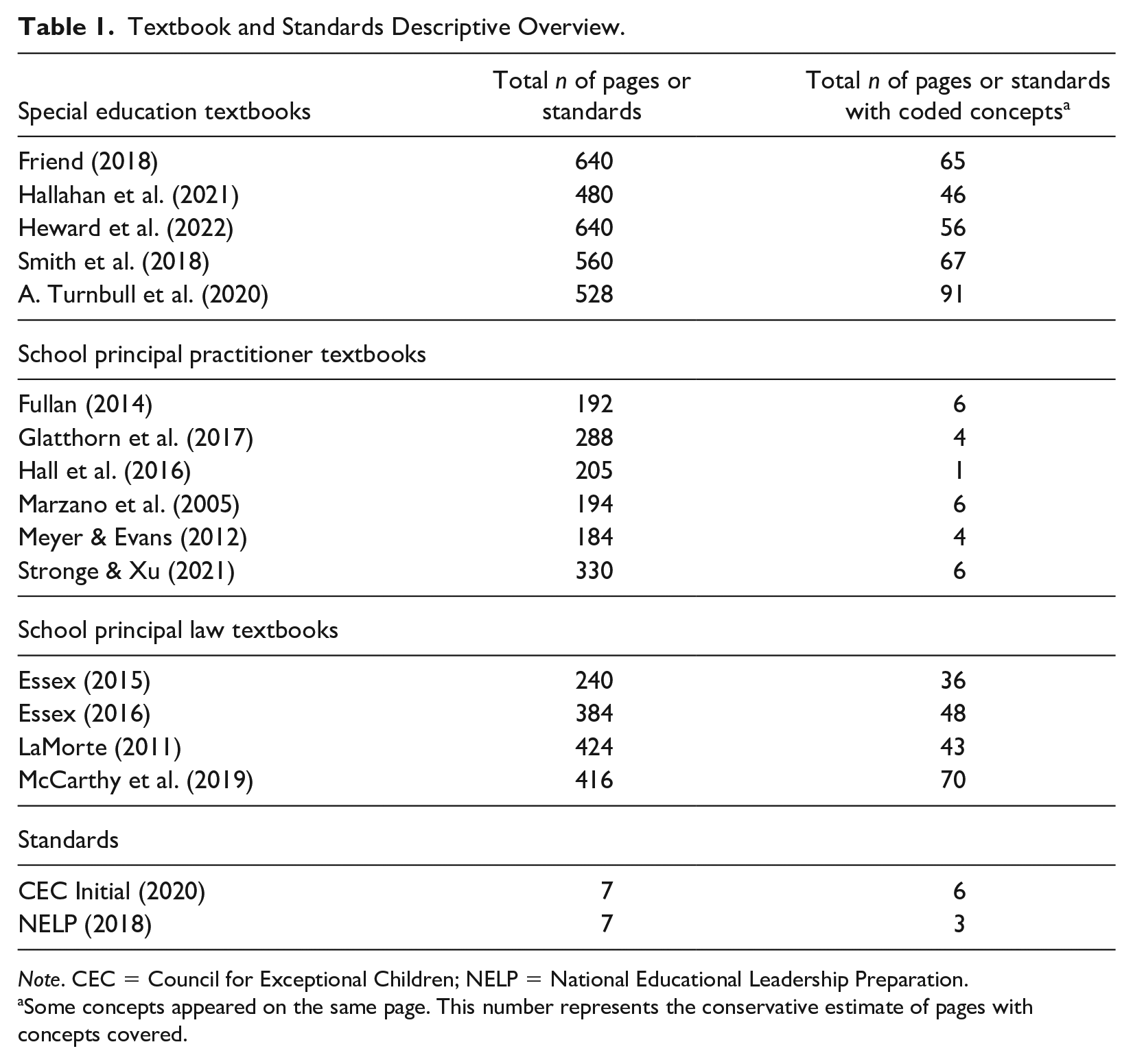
Note. CEC = Council for Exceptional Children; NELP = National Educational Leadership Preparation.
Some concepts appeared on the same page. This number represents the conservative estimate of pages with concepts covered.
Professional Standards
Special Educators
For special education, we included the CEC Initial Practice-Based Professional Standards for Special Educators (CEC, 2020). The Initial Standards consist of seven standards: (a) Professional learning and ethical practice; (b) learner needs; (c) curricular content knowledge; (d) assessment; (e) effective instruction; (f) social, emotional, and behavioral growth; and (g) collaboration (CEC, 2020). Each standard is defined and broken into several “key elements.”
Principals
We used the NELP Program Recognition Building-Level Standards (NPBEA, 2018). The NELP Building Level Standards consist of seven standards broken into multiple components. The standards include (a) mission, vision, and improvement; (b) ethics and professional norms; (c) equity, inclusiveness, and cultural responsiveness; (d) learning and instruction; (e) community and external leadership; (f) operations and management; and (g) building professional capacity (NPBEA, 2018).
Textbook Selection
In the absence of state or agency-agency adopted texts, researchers can identify textbooks for content analysis as those most frequently purchased (Lucy et al., 2020). Given the proprietary nature of textbook publishing, we opted to identify these most frequently purchased texts through third-party websites to reduce inherent bias from independent publisher websites only carrying select texts. We searched each of the three types of textbooks (preservice special educator, preservice principal, and school principal law) in spring 2022. As Amazon sales rankings fluctuate over time, we examined the rankings for each type on two different dates. On the first date, we identified the top-ranked textbooks. On the second date, we confirmed that no other textbooks were ranked above those previously identified. We also verified the highest-ranked textbooks with university librarians at two universities who provided library holding records and third-party rankings (i.e., Amazon sales rankings). As the rankings adjusted daily or hourly, exact reliability was not calculated. Rather, librarians vetted that we had captured the common texts. We also vetted the final list of each type of texts that resulted from the above procedures with five experts in the respective areas. Following these procedures, we identified for review five special educator preparation texts, six principal preparation texts, and four principal law textbooks (see Table 1).
Procedures for Content Analysis of Standards and Textbooks
In this article, we used a quantitative approach to content analysis to identify and code text based on predefined categories and describe results using descriptive statistics (Berelson, 1952). This is considered to be a systematic, rigorous approach for making replicable and valid inferences from text (White & Marsh, 2006) and has been used reliably in review of education texts and standards (Polikoff et al., 2015). We followed established steps for content analysis, including formulating a research question, selecting a sample for analysis, defining categories to be applied, outlining and implementing a coding process including coder training, and analyzing results (Hsieh & Shannon, 2005).
Selection of Concepts
Topics included in a concept analysis may be developed from the experience or knowledge of experts, previous research, and existing theory and practice (White & Marsh, 2006). To determine the extent to which special education law is included in standards and textbooks, we developed a list of 31 significant legal concepts within IDEA (2004) and Section 504, and one unique to principals (“personnel development”). Beginning with a list of common special education legal concepts from IDEA’s (2004) central pillars as well as H. R. Turnbull et al.’s (2009) eight main principles of IDEA’s Part B, we identified concepts associated with specific legal procedures that special educators and principals are likely to implement. We also considered concepts covered in existing special education advocacy programs (e.g., Burke et al., 2016) and peer-reviewed articles highlighting essential concepts and considerations for special education teachers (e.g., Yell et al., 2020; Zirkel, 2020) and principals (e.g., Wagner & Katsiyannis, 2010; Yell et al., 2020). Broad constructs such as procedural safeguards and IEPs were separated into their respective sub-concepts. All authors reviewed and came to agreement on this list of 32 concepts. For external validity purposes, the list of concepts was sent to five experts in the field—all agreed with the list and did not suggest removing any concepts.
We then defined each concept to promote the reliability and validity of our procedures and results (Chu, 2017). Many definitions were pulled directly from the federal regulations—for example, “supplementary aids and services” are defined as “aids, services, and other supports that are provided in regular education classes, other education-related settings, and in extracurricular and nonacademic settings, to enable children with disabilities to be educated with nondisabled children to the maximum extent appropriate” (34 C.F.R. § 300.42). See supplementary materials for a listing of all concepts and definitions.
Coding
We next developed a coding manual with relevant examples, incorporating clarifications and updates before beginning the content analysis—a process to identify results relating to content of written material, such as the pages of textbooks (Chang & Silalahi, 2017). Specifically, we employed a basic manifest content analysis that notes overtly mentioned themes followed by basic statistical analyses (Drisko & Maschi, 2016). Using quantitative content analysis coding procedures (Berelson, 1952), all special educator and school principal textbooks and standards were similarly coded for the presence of the 31 special education law concepts, with one additional code (“personnel development”) only included for school principals (for a total of 32 concepts).
For professional standards, coders read each standard, substandard, and explanation of the standards. If a concept appeared anywhere in the standard, substandard, or explanation of a standard, it was coded as present. When coding textbooks, coders first searched the index for the concepts and then proceeded to search the table of contents to examine individual chapters. Next, the coders independently coded whether the concept was included in the text (present/absent). To be considered present, the term must have been used referring to special education. The concept only had to be mentioned on a page or within a standard for it to be considered present. A code of 0 indicated that a concept was not mentioned in a standard or text. A code of 1 indicated there was at least one in-text mention of the concept.
Coding Reliability
The first author served as the primary coder and trained the second coder, a graduate student in special education. Training procedures for coding were completed in the following manner. First, the primary coder reviewed the concepts and definitions, before modeling the abovementioned coding process. Once training criteria were reached (at or above 90%), both coders coded 100% of textbooks and standards. We calculated reliability for each concept by using point-by-point agreement (agreements / agreements + disagreements) and by calculating kappa coefficients. When disagreements occurred, the coders discussed each case individually, before coming to consensus and assigning a code.
Across all standards and texts for both professions, overall interrater agreement was 97.7%. Coding reliability across special education textbooks and standards was 96.4% and 98.3% across principal textbooks, law texts, and standards. The median kappa coefficient was 1.00 (range from .77 to 1.00). Cicchetti (1994) defined “excellent” reliability coefficients as values ranging from .75 to 1.00.
Data Analysis
To answer our research questions, we first created tables showing the presence of concepts for preservice special educator and principal standards and textbooks. Starting with the six main pillars of IDEA, concepts were then ordered from the most to least present for each discipline. We then calculated the percentage of concepts (total present divided by 31 or 32 × 100) included within each standard and textbook. Next, we descriptively compared the presence of individual concepts and the overall percentage of concepts across these two disciplines.
Results
Presence of Special Education Law Concepts in Professional Standards
Based on professional standards, special education teachers are expected to know more special education law concepts than school principals. The CEC Initial Preparation Standards explicitly mention 26% of concepts (or 8 of 31 concepts present; see Table 2). In contrast, in the NELP standards, only 6% of the concepts (2 of 32) were mentioned. See Table 3. The CEC initial standards explicitly mention five of the main pillars of IDEA, including eligibility and evaluations, IEPs, FAPE, LRE, and parent participation. They also mention supplementary aids and services and discipline/behavior. From the NELP standards, there is explicit mention of only IEPs and personnel development. Thus, IEPs were the only concept mentioned across standards from both disciplines. Given the percentages of special education law concepts absent from the initial CEC standards (74%) and the NELP standards (94%), the standards of both professions do not name the majority of the specific law concepts. Procedural safeguards, one of the main pillars of IDEA, were not included in either profession’s standards either broadly or in relation to its sub-concepts (i.e., independent educational evaluation, prior written notice, parent consent, and access to records).
Presence of Law Concepts in Special Education Standards and Textbooks.
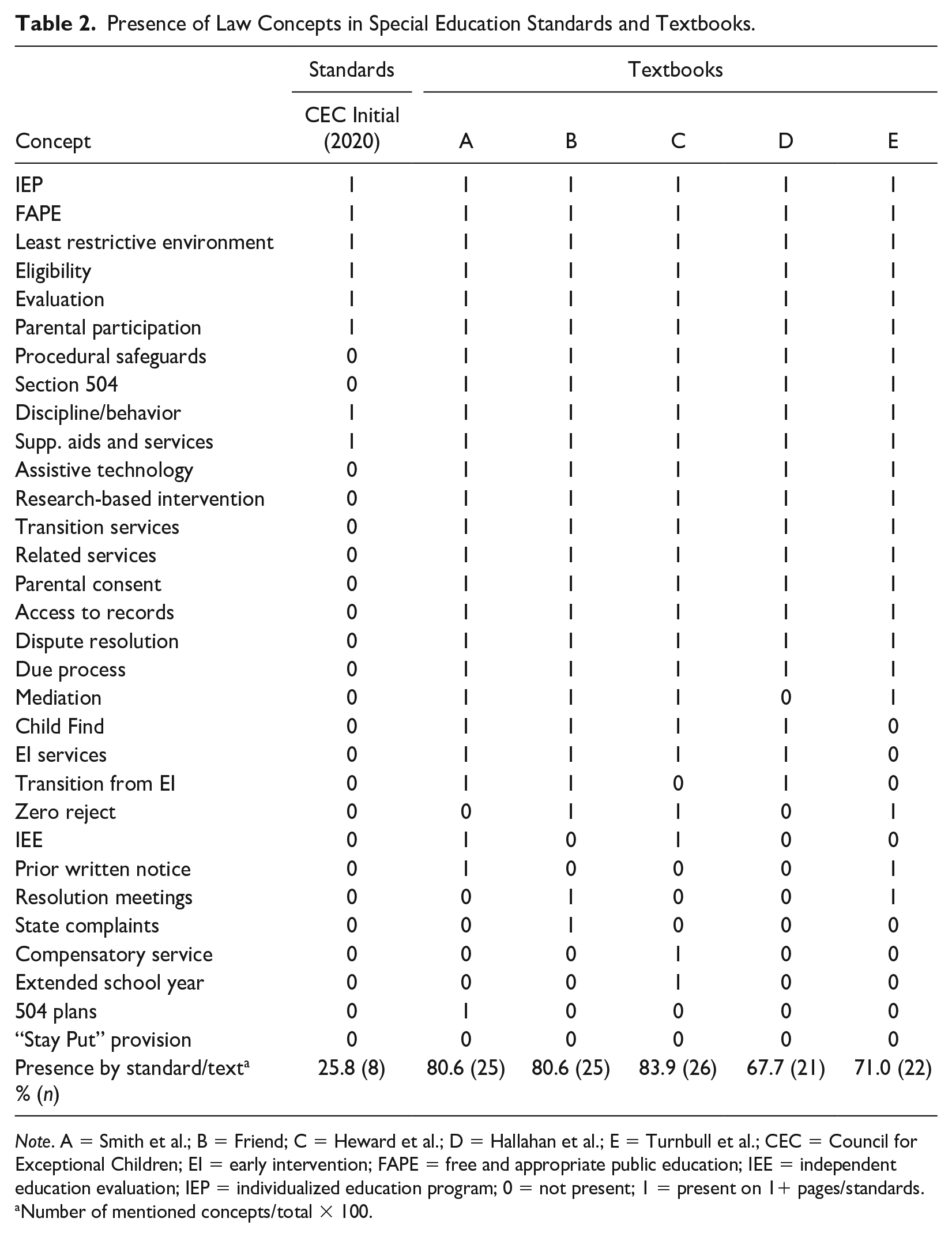
Note. A = Smith et al.; B = Friend; C = Heward et al.; D = Hallahan et al.; E = Turnbull et al.; CEC = Council for Exceptional Children; EI = early intervention; FAPE = free and appropriate public education; IEE = independent education evaluation; IEP = individualized education program; 0 = not present; 1 = present on 1+ pages/standards.
Number of mentioned concepts/total × 100.
Presence of Special Education Law Concepts in School Principal Standards and Textbooks.
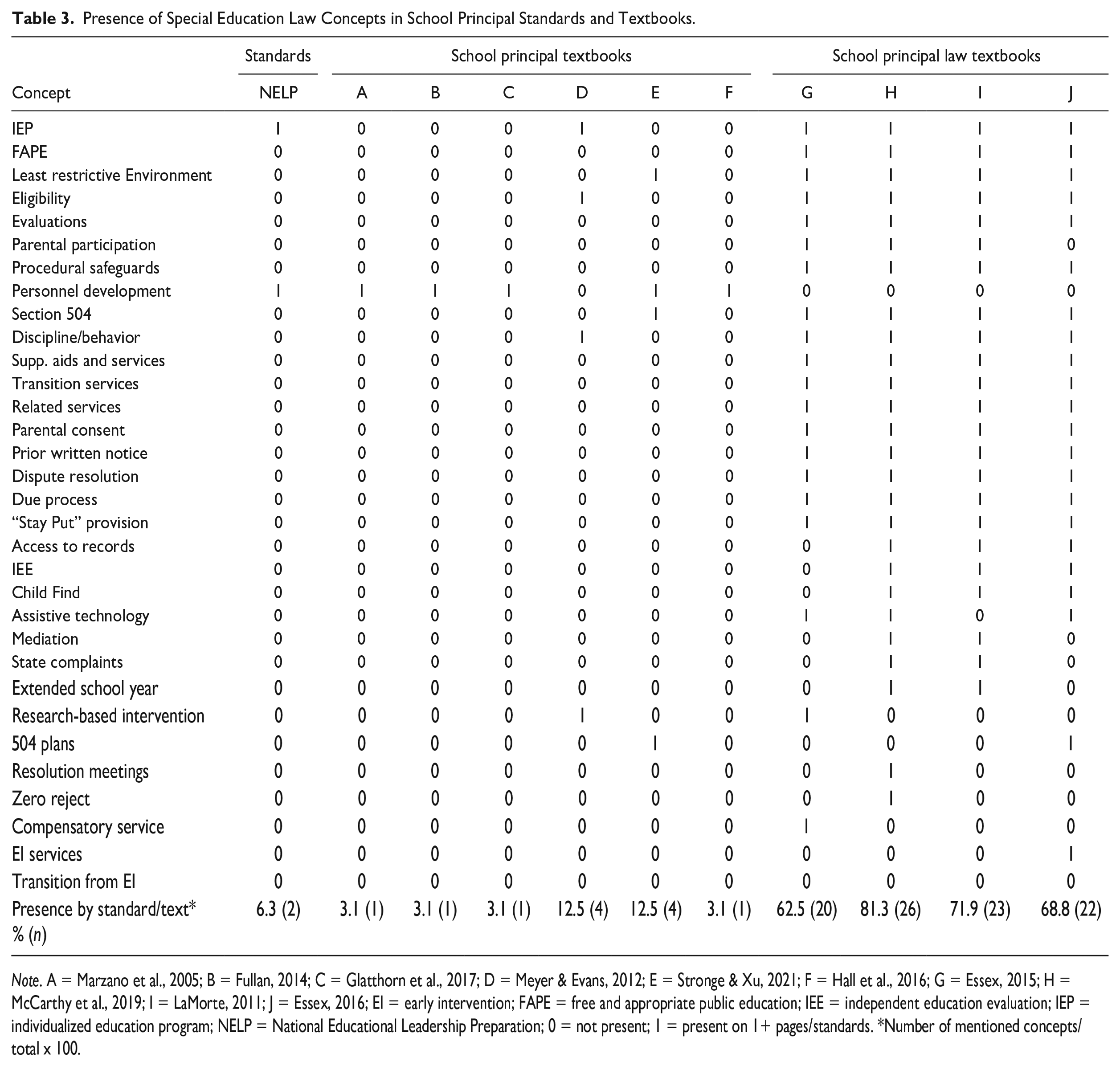
Note. A = Marzano et al., 2005; B = Fullan, 2014; C = Glatthorn et al., 2017; D = Meyer & Evans, 2012; E = Stronge & Xu, 2021; F = Hall et al., 2016; G = Essex, 2015; H = McCarthy et al., 2019; I = LaMorte, 2011; J = Essex, 2016; EI = early intervention; FAPE = free and appropriate public education; IEE = independent education evaluation; IEP = individualized education program; NELP = National Educational Leadership Preparation; 0 = not present; 1 = present on 1+ pages/standards. *Number of mentioned concepts/total x 100.
Presence of Special Education Concepts in Textbooks
The most popular preservice textbooks revealed differences across the two professions. Specifically, texts provided more information regarding special education law to special education preservice teachers than to preservice school principals. Across texts, preservice special education practitioner textbooks referenced from 68% to 81% of the special education law concepts; in contrast, textbooks for school principals referenced 3% to 12% of all concepts. All the special education textbooks included content on the six main pillars of IDEA. Only two of the six principal texts mentioned any special education concepts beyond personnel development. However, educational law texts provided greater amounts of special education law information that was comparable to the percentage of concepts referenced in special education practitioner textbooks. Across the four law textbooks, a range from 63% to 81% of the special education law concepts were present to some degree.
In all five (100%) special education textbooks, authors mentioned the six pillars of IDEA as well as the following specific concepts: related services, transition services, assistive technology, research-based interventions, discipline/behavior, Section 504, and dispute resolution procedures, such as due process hearings. Conversely, the following concepts were only addressed in one of five special education textbooks: extended school year (ESY), written state complaints, 504 plans, and compensatory services. Resolution meetings, prior written notice, and independent education evaluations were each included in only two special education textbooks. No special education textbooks included mention of the “stay put” provision. See Table 2 for full coding breakdown.
Principal texts overall were sparse in coverage of special education concepts. Five of the six school principal textbooks mentioned personnel development for school principals, but no other concepts were mentioned across the majority of the six textbooks. These sparingly mentioned concepts included IEP, eligibility, LRE, research-based intervention, and Section 504 plans. The school principal textbooks with the greatest extent of coverage included four special education concepts. With the least coverage, four school principal textbooks included only one special education law concept (personnel development). See Table 3 for full coding breakdown.
In all four school principal law textbooks, a total of 16 out of 32 common concepts were present. All except one school principal law textbook included the six pillars of IDEA. As in the special education texts, however, most (3 out of 4) principal law textbooks did not mention resolution meetings, 504 plans, and compensatory services. Additional concepts present in a majority of special education textbooks, but absent from three of the four textbooks on educational law, included research-based interventions, early intervention services, and zero reject. None of the school principal law textbooks addressed personnel development or early childhood transition.
Discussion
Given the legalistic nature of special education, it is critical that special education teachers and school principals develop the knowledge, understanding, and skills to implement IDEA in their daily practice (Decker & Brady, 2015). Although other district-employed stakeholders (e.g., school psychologists, related service providers, and district special education supervisors) are involved in special education processes and the compliance thereof, much of the responsibility of direct service provision and oversight and evaluation of that service provision falls to special educators and building-level principals. While repeated calls have arisen for increased teaching of special education law to preprofessional students (Bateman et al., 2017; NASSP, 2021; Zirkel, 2015), this study is among the first to compare professional standards and available textbooks for these two groups of professionals. This study produced three main findings, each with important training and policy implications.
Main Findings
First, we found that textbooks for preservice special educators contain greater amounts of special education law than textbooks for preservice school principals. Within the general textbooks for school principals, few concepts (3%–12%) are covered, compared with exposure to many concepts (67%–84%) in special education textbooks for preservice teachers pursuing initial licensure. For special educator texts, all six of the main pillars of IDEA are addressed. For school principals, the general practitioner textbooks and NELP standards, when combined, covered only 22% (7 of 32) of the special education law concepts, with only two principal texts mentioning any of the pillars of IDEA. Although one does not expect all special education legal concepts mentioned in the general school principal text, it is noteworthy that major concepts such as IEPs are rarely mentioned. Although this low level of special education legal exposure is somewhat ameliorated when one considers principal law textbooks, many important special education concepts remain unmentioned in school principal textbooks.
Second, for both professions, we saw some differences in mentions of concepts in the standards versus the textbooks. For principal preparation, only two special education legal concepts were mentioned in the NELP standards (IEP and professional development). This coverage of 6.3% is slightly higher than some school principal texts (3.1%–12.5%) but significantly lower than what is found in the school law texts (62%–81%). Even within the initial CEC professional standards for special educators, only about one fourth of legal concepts were mentioned, compared with roughly three fourths of such concepts that appeared in the special education texts. This finding is surprising as standards drive the knowledge and value system of preservice education professionals (Darling-Hammond & Podolsky, 2019).
Still, this new 2020 version of the initial CEC professional standards that are currently being incorporated into teacher preparation programs do include reference to five of the six pillars of IDEA—an improvement from the 2015 standards. While this is an improvement, procedural safeguards present a critical piece of IDEA with which special educators and school principals must be familiar to ensure parent and student rights are met. Although others, such as school psychologists, may be relied upon as the “expert” in this area, special educators should be knowledgeable of these safeguards and be able to help families understand and utilize these important legal rights.
Third, certain special education law concepts were covered more than others. Consistent with previous literature using different methodology (Markelz et al., 2022), we found that preservice special education standards and textbooks consistently addressed the six main pillars of IDEA. Extending the literature, we found that the same was true of school principal law textbooks. Beyond these major, interconnected topics, other concepts also overlapped across professions’ textbook content, such as related services, transition services, discipline/behavior, and dispute resolution procedures. These are important topics for beginner educators and school principals.
In practice, school principals likely rely on school law courses for exposure to special education legal content as we did not find mention of these concepts in the sample of general principal texts. School law textbooks do present important special education legal knowledge. But such information is provided separately and, from its missing status among NELP standards, may be considered less central than other concepts in the training of school principals. Furthermore, inclusion of school law courses in programs is variable: our review showed that roughly 70% of the top education administration and leadership programs were providing a (required or optional) school law course (Powell, 2010, noted such courses in closer to 50% of education leadership programs), but only a few states require such courses in their licensure requirements (Scott, 2018).
In effect, programs providing a school law course have separated special education law from day-to-day principal concerns, even as principals-in-training reported not receiving such courses (Angelle & Bilton, 2009; McHatton et al., 2010). Although general texts for principals do commonly mention personnel development, the lack of broad special education content is concerning in that principals seem underprepared to evaluate special educators (Lawson & Cruz, 2017; Lawson & Knollman, 2017; Rodl et al., 2018) as one of their primary administrative roles. Given the long-standing strain on schools to recruit and retain special educators (Billingsley & Bettini, 2019), and the link between administrative support and exiting the field, it is imperative that principals are prepared to support the special educators in their building.
These reports become even more alarming in the context of school principals’ everyday duties. McHatton and colleagues (2010) found between 62% and 97% of principal respondents reported up-to-daily involvement in such activities as IEP meetings, teacher observations, and reviewing special educator lessons. Furthermore, in-service principals report a great need for additional training in special education (Bai & Martin, 2015; Lasky & Karge, 2006; Schaaf et al., 2015), with direct assessments revealing that only 30.9% of in-service principals were able to correctly answer questions related to IDEA (Casale et al., 2021). In Pregot’s (2021) recent survey concerning the self-reported depth of knowledge of different administrative functions, 485 administrators indicated that of the lesser knowledgeable topics the majority (7 of 10) were related to special education. We must rethink how we are preparing and training these school leaders.
Implications for Policy and Practice
Taken together, these findings have important training and policy implications. For both special educators and school principals, initial licensure preparatory programs need to include greater amounts and greater depths of information in special education law. This request is heard from the field as well; in-service principals themselves cite the need for additional training in IDEA and report a lack of preparation for special education law–related matters in their preparatory program (Bai & Martin, 2015; Davidson & Algozzine, 2002). Nationally, the Education Commission of the States (Scott, 2018) reviewed the initial licensure requirements for principals across all 50 states. In their initial licensure requirements, only seven states mentioned courses in education law, and only two (Maine and Montana) explicitly mentioned a course in special educational law (Alabama, Connecticut, Georgia, and Nebraska more generally mentioned a special education course or training component). State licensure boards should consider the integration of more special education legal content to increase legal literacy among our future practitioners.
To provide one example of the importance of such literacy, consider compensatory services that students become eligible for whenever there is a delay or postponement of services as outlined by the student’s IEP or 504 plan (Wright, 2022). One of 31 (or 32) special education legal concepts, compensatory services were rarely mentioned in either discipline’s professional standards or textbooks. But with the onset of COVID-19, and as schools across the country switched to virtual learning from in-person learning, students with disabilities received fewer services (Zirkel & Jones, 2020). In a recent Pennsylvania case (Brennan and James v. Wolf Rivera, Rivera and Pennsylvania Department of Education), a class action suit concerning students with autism found that aspects of students’ IEPs were not followed, including issues related to service provisions, staffing ratios, and instructional methods (Jameson et al., 2020). As a result, the families could request compensatory services. A seemingly esoteric topic—and one that almost never appears in special education or school principal texts or standards—suddenly became increasingly important.
An additional, more policy-related implication concerns professional standards. As promulgated by both disciplines, standards provide the “floor” above which all in-service professionals should be competent; these standards also serve as benchmarks for the content knowledge that training programs must teach (CEC, 2020; NPBEA, 2018). As this study highlights, however, preprofessional textbooks (including the law texts for school principals) provide vastly more special education content than mentioned in these professionals’ standards. Granted, there have been various position statements (NASSPs, 2021), research (Billingsley et al., 2017; Casale et al., 2021; Pazey & Cole, 2012), and crosswalks aligning different standards to other organizations’ standards or recommendations (Council of Chief State School Officers et al., 2017) to align the principal preparation programs and standards with specific preparation in special education. Gilson and Etscheidt (2022) called for principal preparation programs to consider aligning with the Council for Administrators of Special Education (CASE) standards. Although created for special education directors, these standards have utility for building-level administrators as well with specific skills and knowledge items related to special education. To ensure all future school principals and special educators are prepared to meet the needs of students with disabilities, the professional standards must posit that school professionals be well-versed in all aspects of IDEA and Section 504. Training programs must then develop courses accompanied by textbooks that reflect the guidance set by professional standards.
It is also important to increase professional development for in-service professionals. Although such trainings need to cover multiple concepts, priority might be given to those concepts that are least likely to be included in textbooks and standards, and are important in practice, such as compensatory services, ESY, and 504 plans (see Tables 1 and 2). In providing such trainings, it might help to incorporate case-based learning scenarios and readings, which have previously been effective for in-service training (Zirkel, 2015) and for preservice legal training (Decker & Pazey, 2017). Given the perspectives of busy, overworked special educators and school principals, in-service training might also use case studies to guarantee that content is applicable and comprehensive. Given the current growth in schools of emergency licensed educators, these training deficits seem all the more salient.
In addition to these findings and implications, we also acknowledge this study’s limitations. Specifically, we remain uncertain whether we have captured all of both disciplines’ most frequently used texts (including school law texts). Textbook content analysis is a common approach in many fields (Lucy et al., 2020; Pollock et al., 2015; White & Marsh, 2006); however, in the absence of state or organization-endorsed texts, our methodological approach warrants additional research. This study could be repeated with an additional validation of program syllabi for course textbooks and cross-referencing assigned chapters within those textbooks. In addition, we chose to focus this study on two specific professions and laws (IDEA and Section 504). Other disability-related laws, such as the Americans with Disabilities Act, are also important for special educators and principals to understand to fully support the rights of students with disabilities in schools. We also recognize the value of other stakeholders and their roles of compliance in various states. Preservice preparation in other laws and professions should be addressed in future research, and comparisons can be made with our findings.
We acknowledge that presence in a textbook does not guarantee that preservice professionals are exposed to a particular topic; it may also be that other, non-textbook resources often introduce a course’s concepts (Pazey & Cole, 2012). Finally, one might argue that—from common textbooks and professional standards alone—one cannot assess the “value” accorded to special education law in the preprofessional training of special educators or school principals.
Still, despite these limitations, this study highlights the preprofessional training that beginner special educators and school principals receive in special education law based on standards and textbooks. From both the main professional standards and from the most frequently used textbooks, such training seems inadequate, especially within the context of the U.S. system of special education services. Ultimately, if we are going to guarantee that all public school students, regardless of the nature or severity of their disabilities, receive free, appropriate educational services, then we need to ensure that special education teachers and their school principals routinely receive sufficient training in special education law.
Footnotes
Declaration of Conflicting Interests
The author(s) declared no potential conflicts of interest with respect to the research, authorship, and/or publication of this article.
Funding
The author(s) disclosed receipt of the following financial support for the research, authorship, and/or publication of this article: The second author was supported by U.S. Department of Education Training grant: H325K200036.
