




Abstract
Purpose:
Adolescent tobacco use is higher in rural than in urban areas. While e-cigarette use is increasing rapidly among this age group, differences in prevalence between rural versus urban populations for this relatively novel product have not been explored. The purpose is to investigate whether location of school (rural–urban) is associated with e-cigarette use and dual use (defined as the use of both e-cigarettes and conventional cigarettes) among high school students.
Design:
Cross-sectional survey obtained using a stratified, 3-stage cluster sample design.
Setting:
United States.
Participants:
A nationally representative sample of US high school students (N = 11 053) who completed the 2014 National Youth Tobacco Survey (NYTS); slightly more than half were urban (54%).
Measures:
The NYTS measures tobacco-related knowledge, attitudes, and use behavior and demographics of students in the United States.
Analysis:
Weighted logistic regression assessed the relationships of urban–rural location with current e-cigarette use and dual use, adjusting for demographic factors, perceived risk, and social norms.
Results:
There were clear differences in patterns of adolescent e-cigarette and cigarette use in rural versus urban areas. Social norms and perceptions may play a role in understanding these differences.
Conclusion:
Urban youth current cigarette smokers were nearly twice as likely as rural cigarette smokers to also use e-cigarettes. Reasons for urban–rural differences need to be taken into account when designing prevention programs and policy changes.
Keywords
Purpose
Nearly all (88%) regular cigarette smokers report first cigarette use at or before 18 years of age. Addressing tobacco use behavior during adolescence is of critical importance not only to adolescent health but also to chronic disease prevention. 1,2 From 2011 through 2014, there were significant decreases in current cigarette smoking among youth, but this decline has since stalled with no significant change from 2014 to 2015. While youth tobacco use rates generally have declined or plateaued, the rate of e-cigarette use has risen dramatically, increasing from 1.5% to 16% among high school students from 2011 to 2015. 3
Electronic cigarettes, more frequently referred to as e-cigarettes, contain a battery, a heating device, and a cartridge to hold liquid. The liquid is made up of nicotine, flavorings, and other chemicals. The heating device heats the liquid, turning it into an aerosol that is inhaled by the user. 4 With the rise of e-cigarette use among adolescents, safety concerns have come to light. While the long-term safety of e-cigarettes has not yet been determined, e-cigarettes are known to contain carcinogens. 5 There is concern that youth may not understand the risk of e-cigarettes and may start to use them because they believe they are a less harmful alternative to conventional cigarettes. 2 In addition, there is concern that use of e-cigarettes may lead to the initiation of conventional smoking. 6
Although research is limited, there is a positive association between living in a rural area and youth tobacco use. 7 –9 Rural adolescents are more likely to be daily cigarette smokers compared to both their urban (odds ratio [OR] = 0.33, 95% confidence interval [CI]: 0.31-0.35) and suburban counterparts (OR = 0.34, 95% CI: 0.32-0.36). Rural adolescent smokers are more likely to (1) be Caucasian, (2) be female, (3) have used smokeless tobacco, and (4) have smoked their first cigarette by age 12. Lifetime and current adolescent tobacco use rates are higher in rural areas of the United States and Australia compared with those in urban areas. 7 Similarly, Monitoring the Future surveys conducted in 2002 to 2007 found that youth cigarette use was higher in less densely populated areas (ie, non-metropolitan statistical areas [MSAs]). 10 These rural–urban differences in tobacco use are not limited to conventional cigarettes. The 2009 National Survey on Drug Use and Health reported higher rates of both smoking and smokeless tobacco use among those 12 years of age and older in rural areas. 11
E-cigarette use is rapidly increasing among youths and young adults, but few studies have assessed differences in use of this product between rural and urban adolescents. There have been contradictory findings from other countries, suggesting that rural adolescents may use e-cigarettes either more or less than their urban counterparts. 12,13 The purpose of this study is to investigate whether place of residence (rural/urban) is associated with e-cigarette use and dual tobacco use (e-cigarettes and conventional cigarettes) among high school students, using data from the 2014 National Youth Tobacco Survey (NYTS) and controlling for demographic characteristics, perceived harm, and social norms. Our underlying assumption at the outset of the study was that rural students would be more at risk of e-cigarette use, given their higher rates of other tobacco product use, and that likelihood of use would be related to other factors.
Methods
Design
Data from the 2014 NYTS 14 were used for this analysis. The NYTS measures tobacco-related knowledge, attitudes, and behavior of middle and high school students in the United States using a stratified, 3-stage cluster sample design to produce a nationally representative sample. The cluster sample is stratified by racial/ethnic composition and urban versus nonurban status at the first (primary) stage. The primary sampling units (PSUs) are generally counties (or clusters of small counties or portions of very large counties); PSUs are classified as “urban” if they are in one of the 54 largest MSAs in the United States, according to the 2012 American Community Survey data from the US Census Bureau. 15 Otherwise, they are classified as “nonurban.” Secondary sampling units are individual schools (or groups of affiliated schools) within each of the PSUs; the third level of clustering is students within each of the selected schools.
Sample
The 2014 sample included 22 007 students, representing a combined participation rate of 73.3% at the school and student levels. Further details of the methodology are available elsewhere. 16 The data collection protocol for the 2014 NYTS was approved by the Centers for Disease Control and Prevention's (CDC) institutional review board. Participating students completed pencil and paper surveys; these were scanned to create the NYTS database. The analysis for this study was limited to high school students in grades 9 to 12. While 11 399 high school students completed the survey, 346 were omitted since they had skipped 1 or both questions to identify current tobacco use; the sample size used for the analysis was 11 053.
Measures
Nearly all NYTS survey items that mentioned e-cigarettes contained the phrase “electronic cigarettes or e-cigarettes.” For brevity, only the “e-cigarette” portion of each relevant item is listed below. Combustible cigarettes were only referred to as “cigarettes” throughout the NYTS survey, but they are sometimes called “conventional cigarettes” in this article to distinguish them from e-cigarettes.
Tobacco use
Current use of e-cigarettes and conventional cigarettes was defined as those who indicated “Yes” to having used the product 1 or more days in the last 30 days. Dual users were defined as those who used both e-cigarettes and conventional cigarettes in the last 30 days.
School location (urban–rural)
All students attending a school located within one of the 54 largest MSAs were coded as urban; all remaining students were considered rural in this analysis. Given the definition used by the US Office of Budget and Management to identify MSAs, the urban areas included not only the 1 or more core cities within the MSA boundaries but also suburban areas with economic and social ties to the core city or cities in the same MSA.
Demographic variables
Demographic factors included grade in school (ranging from 9th to 12th for this sample) and sex (male, female). We used the combined NYTS race and ethnicity variable including: “white, non-Hispanic,” “black, non-Hispanic,” “Hispanic,” and “other.”
Perceived harm
Single survey items were used to assess perceived harm. The e-cigarette item was: “How much do you think people harm themselves when they use e-cigarettes some days but not every day?” Response options ranged from (1) “no harm” to (4) “a lot of harm.” This same question and response options were asked with “smoke cigarettes” substituted for “use e-cigarettes.” An additional item assessed perceived harm from “breathing smoke from other people’s cigarettes or other tobacco products,” with an identical response set.
Social norms
Social norms for each tobacco product were evaluated using a series of questions about exposure to and thoughts about e-cigarettes and cigarettes. Participants indicated whether anyone living with them used a variety of specific tobacco products. Two separate yes/no indicator variables were created to designate whether the participant lived with someone who used e-cigarettes or smoked cigarettes. Two questions queried opinions about each product individually, “Do you think young people who use e-cigarettes (smoke cigarettes) have more friends?” ranging from (1) “definitely yes” to (4) “definitely not.” For cigarettes only, an additional item and same response options were included: “Do you think smoking cigarettes makes young people look cool or fit in?” These last 3 social norm items were reverse coded prior to analysis; higher responses indicated greater agreement with the statement.
Analysis
Descriptive analyses, including unweighted frequencies and weighted percentages with 95% CIs, were used to summarize participant responses. Multiple logistic regression determined predictors of current e-cigarette use and dual use (i.e., current use of e-cigarettes plus conventional cigarettes). Each of the 2 models included demographic variables, perceived harm, and social norm items for each product. In particular, the e-cigarette logistic model contained items referring to e-cigarettes, while the dual-use model contained items referring to either e-cigarettes or conventional cigarettes.
Each preliminary model included all main effects as well as the interaction between each variable in the model and the urban/rural indicator; significant interactions were retained in the final logistic regressions. The main effects involved in the significant interactions were not interpretable, but contrasts were used to test the significance of group comparisons for any significant interaction retained. The likelihood ratio test assessed the overall model significance. Data analysis was conducted using SAS, version 9.4. 17 SAS SURVEY procedures with relevant weights were employed throughout the descriptive and logistic analyses to adjust for the complex sampling design of the NYTS; an α level of .05 was used.
Results
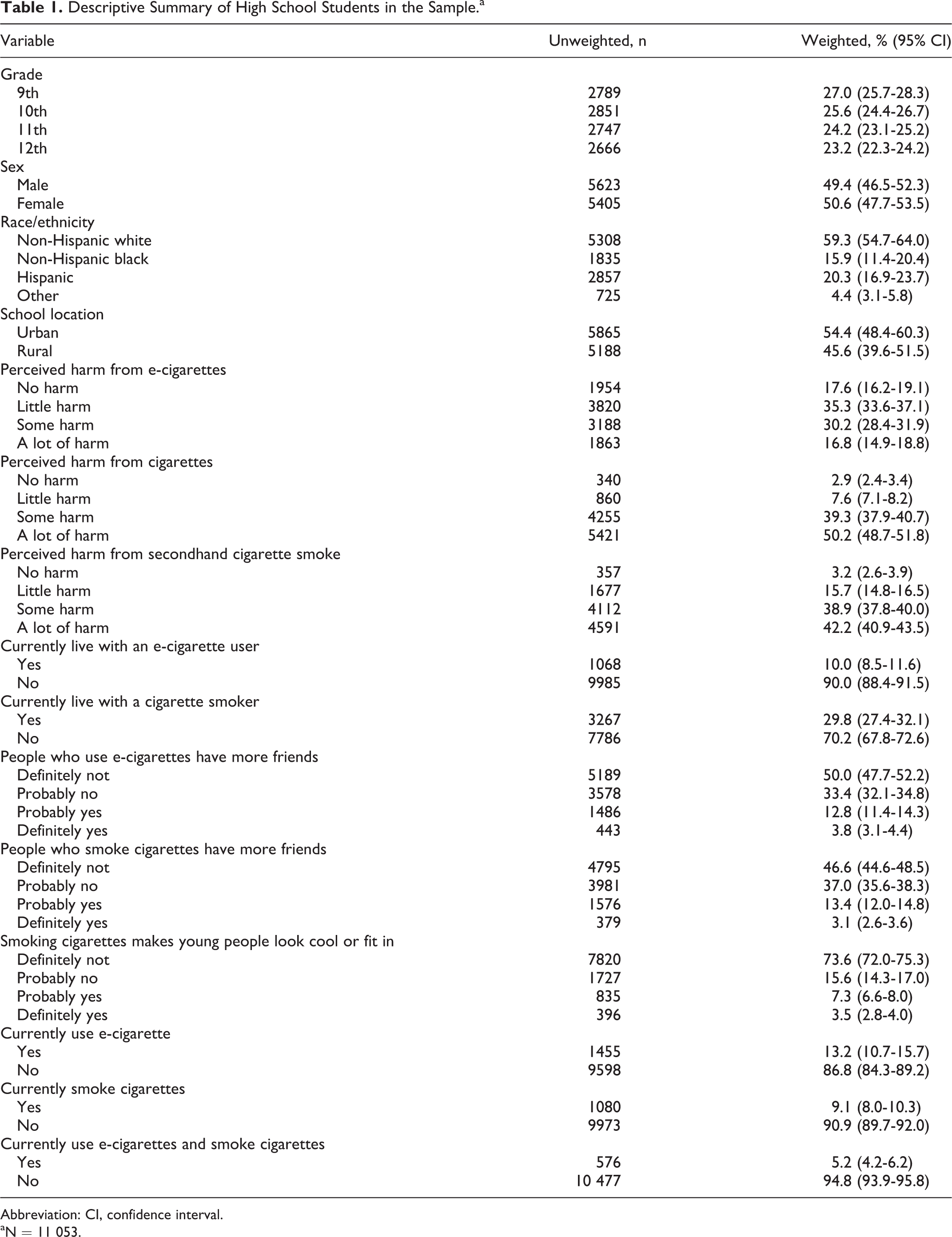
The high school student sample was divided approximately evenly among the 4 grades, ranging from 23% in 12th to 27% in 9th (see Table 1). Slightly more than half were female (51%) and nearly three-fifths were non-Hispanic white (59%), adjusting for sampling weights. Just over half were from urban areas (54%). Thirteen percent currently used e-cigarettes, while 9% currently smoked cigarettes and 5% had used both tobacco products in the last 30 days.
Descriptive Summary of High School Students in the Sample.a
Abbreviation: CI, confidence interval.
aN = 11 053.
While the prevalence of e-cigarette and dual use did not differ significantly by school location, a greater percentage of rural youths used cigarettes only (5.3%, 95% CI: 3.8%-6.8%) compared with those attending urban schools (2.8%, 95% CI: 2.1%-3.6%; see Figure 1).
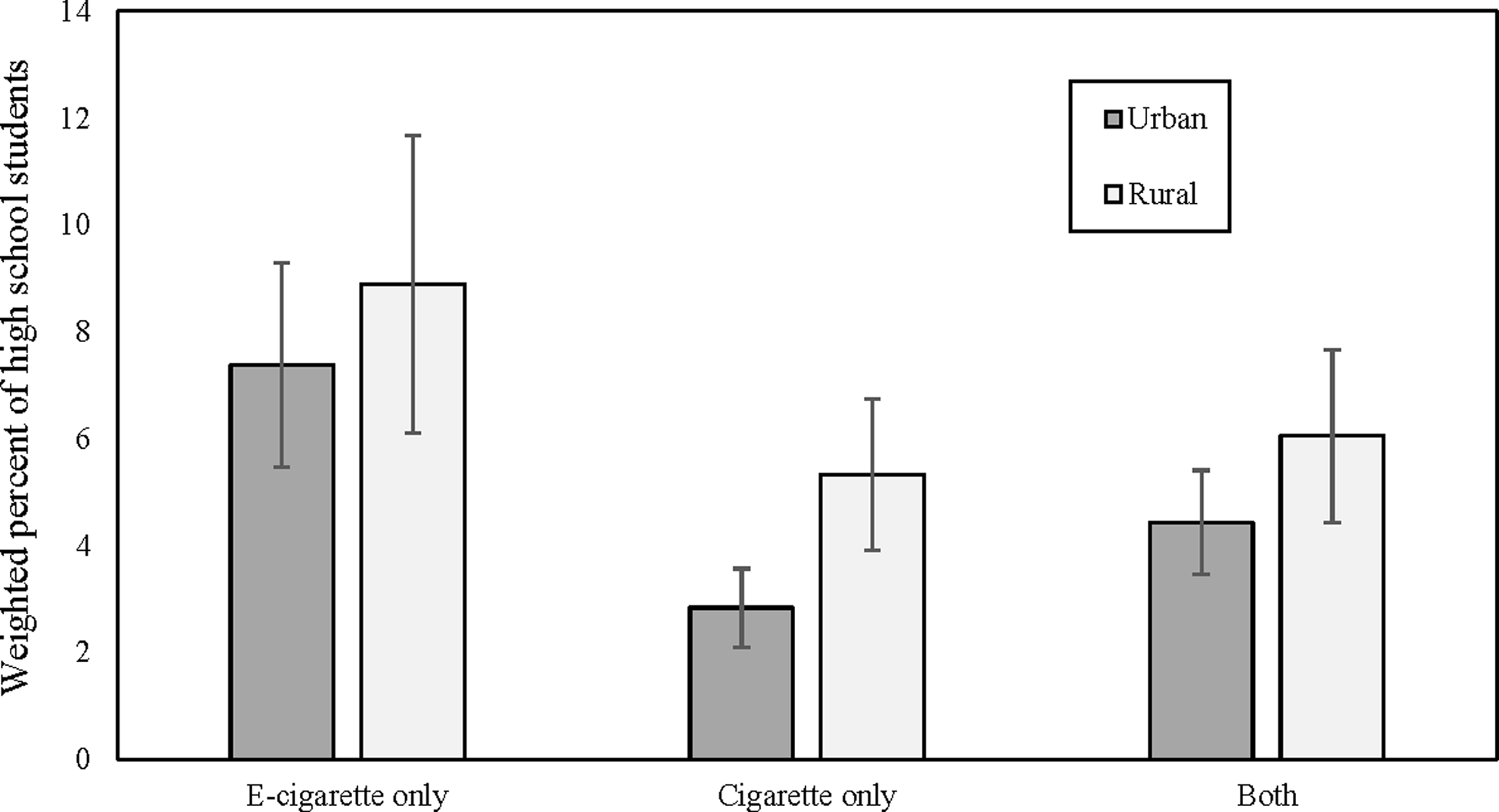
Weighted use prevalence among high school students with corresponding 95% confidence intervals by school location (N = 11 053).
The univariate distributions of perceived harm for e-cigarettes and cigarettes demonstrate lower perceived harm for the former than the latter: 18% perceived “no harm” relative to e-cigarettes versus only 3% for cigarettes. The difference between the perception of “little harm” among users of e-cigarettes versus traditional cigarettes was notable, with 35% choosing this option for e-cigarettes compared with 8% for cigarettes. More than three-quarters (82%) of high school students perceived either “some” or “a lot” of harm due to secondhand smoke from cigarettes or other tobacco products.
Social norms related to e-cigarette and cigarette use varied by product: While 10% indicated they lived with an e-cigarette user, 30% said they lived with someone who smoked cigarettes. However, the products were similar in regard to whether tobacco users thought people who use e-cigarettes or cigarettes have more friends; for both e-cigarettes and cigarettes, 17% of participants thought that those who used these products “probably” or “definitely” had more friends. Eleven percent thought that smoking cigarettes “probably” or “definitely” makes young people look cool or fit in.
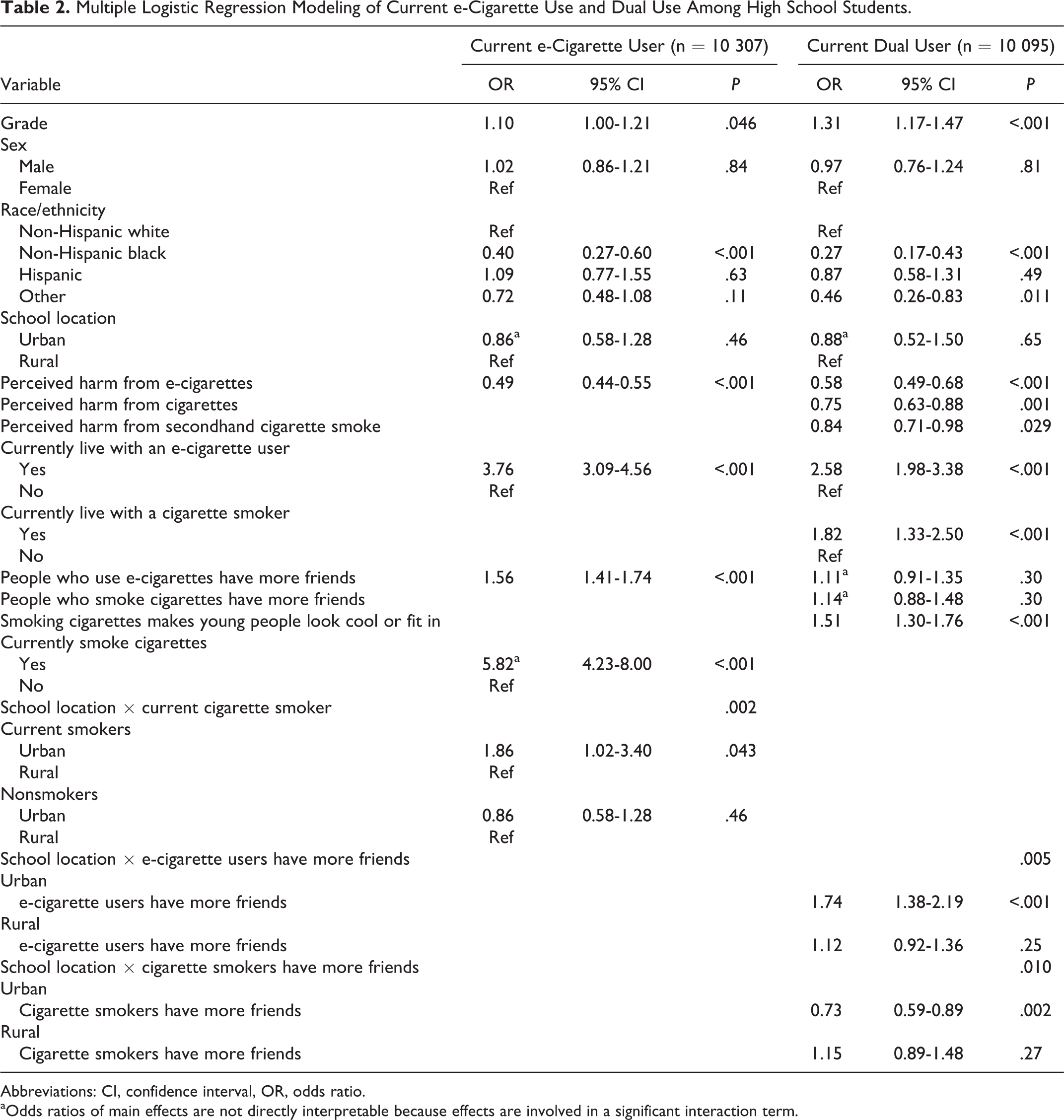
The logistic model with current e-cigarette use as the outcome was significant overall (P < .001 for likelihood ratio test; see Table 2). The interaction between cigarette smoking status and location was significant in the prediction of e-cigarette use (P = .002). Among current cigarette smokers, those attending urban schools were 86% more likely than rural students to also be current e-cigarette users (P = .043). In contrast, among students not currently smoking cigarettes, urban and rural students were equally likely to use e-cigarettes (P = .46). For each additional grade in school, a student was 10% more likely to be a current e-cigarette user (P = .046). Males and females were equally likely to be e-cigarette users. Compared with non-Hispanic whites, non-Hispanic black high school students were 60% less likely to be current e-cigarette users (P < .001); other comparisons to the reference group of non-Hispanic whites were not significant. For each 1-unit increase in perceived harm from e-cigarettes, a student was 51% less likely to use them (P < .001). Participants who lived with an e-cigarette user were 276% more likely to have used the product in the last 30 days (P < .001), and for each 1-point increase in the perception that people who use e-cigarettes have more friends, a student was 56% more likely to use these products (P < .001).
Multiple Logistic Regression Modeling of Current e-Cigarette Use and Dual Use Among High School Students.
Abbreviations: CI, confidence interval, OR, odds ratio.
aOdds ratios of main effects are not directly interpretable because effects are involved in a significant interaction term.
The model to determine predictors of dual use was significant overall (P < .001 for likelihood ratio test). The interaction between urban–rural location of school and the degree of agreement that cigarette smokers have more friends was significant (P = .010). Among urban students, each 1-unit increase with the statement that cigarette smokers have more friends was associated with a 27% decrease in the likelihood of being a dual user (P = .002). Among rural respondents, there was no association between degree of agreement with this social norm variable and likelihood of dual use (P = .27). The interaction between school location and the view that e-cigarette users have more friends was also significant (P = .005). Among urban students, a 1-point increase in agreement that e-cigarette users have more friends was associated with a 74% increase in the likelihood of dual use (P < .001); this relationship was not significant for rural students (P = .25).
For each additional grade level a student had attained, he or she was 31% more likely to be a dual user (P < .001). Males and females were equally likely to be dual users. Compared with the reference of non-Hispanic whites, non-Hispanic blacks were 73% less likely to be dual users (P < .001); students with other racial/ethnic backgrounds were 54% less likely to be dual users compared to the reference (P = .011). The only nonsignificant racial/ethnic OR in this model was for the comparison of non-Hispanic whites to Hispanic students (P = .49). For each of the 3 perceived harm variables, there was an inverse relationship, such that greater perception of harm was associated with a lower likelihood of dual use. For each 1-unit increase in perception of harm from e-cigarettes, a student was 42% less likely to be a dual user (P < .001); for each 1-unit increase in perception of harm from conventional cigarettes, a respondent was 25% less likely to be a dual user (P = .001); and for each 1-point increase in perception of harm from secondhand smoke, a high school student was 16% less likely to be a dual user in the past 30 days (P = .029). For each 1-unit increase in agreement with the statement that smoking cigarettes makes young people look cool or fit, the student was 51% more likely to be a dual user (P < .001).
Discussion
Among current cigarette smokers, those in urban schools were nearly twice as likely as rural students to also use e-cigarettes. Clearly, there are differences between rural and urban areas in patterns of use of these products. Although there has been progress in improving the pro-tobacco impacts in tobacco-growing states, the culture in these largely rural areas contributes to higher rates of smoking. 18 This pro-tobacco culture may foster the use of cigarettes more heavily than e-cigarette use.
With urban youth cigarette smokers at greater risk of e-cigarette use, we need to further explore the nature of tobacco influences in urban areas. Possible influences related to greater likelihood of e-cigarette use among cigarette smokers in urban areas could include advertising, accessibility, or socioeconomic differences. A study using NYTS data reported that high school students’ exposure to advertising for e-cigarettes was highest for retail stores, and these may be more densely clustered in urban areas. 19 It is also possible that urban areas are more likely to be smoke-free and e-cigarettes may be used as a way for smokers to skirt smoke-free regulations. However, the availability of e-cigarettes in areas proximal to schools did not differ by whether the county prohibited e-cigarette use. 20 More research is needed to understand adolescents’ access to e-cigarettes in rural and urban areas.
There were no urban–rural differences in prevalence of either e-cigarette use or dual use. However, high school students in rural areas were more likely to be cigarette-only users, consistent with prior research. 21 More recent studies determined that adolescents in the Southern and Midwestern United States are more likely to be smokers if from nonmetropolitan (rural) areas than from urban areas 22 ; and young adults in rural communities are more likely to use tobacco (particularly smokeless) than their urban counterparts due to a difference in cultural norms. 23
Two studies have found a link between cigarette and e-cigarette use (dual use), although neither examined rural–urban differences in use. In the 2014 Texas Youth Tobacco Survey, 49% of current e-cigarette users reported cigarette use. 24 In a Canadian study, 67% of students who reported smoking cigarettes in the last 30 days reported also using e-cigarettes. 25 In addition, a study of urban adolescents in Hong Kong found that cigarette smokers were at increased risk of using e-cigarettes. 26 While these prior studies have demonstrated a link between cigarette and e-cigarette use, we found no prior studies that investigated differences in e-cigarette or dual use by location. Because of the association between e-cigarettes and conventional cigarettes demonstrated in previous studies, this study was focused on use patterns for these 2 tobacco products only. In particular, we did not assess how use of these products or urban–rural location may be related to use of other tobacco products, including smokeless. These other tobacco products were omitted due to low use prevalence and/or an already established link between use patterns and urban–rural location (as is the case for smokeless tobacco).
In this study, social norms were identified as an important predictor of e-cigarette use. Ten percent of participating students said they lived with an e-cigarette user, and students in this living situation were 276% more likely to have used the product in the last 30 days. In addition, students who perceived that e-cigarettes users had more friends were more likely to use this product. Similar to the impact of social norms on conventional smoking, family and friend influence on e-cigarette use has been described in the literature. 5,27 –29
The interactions between location and 2 social norm variables were significant predictors of likelihood of being a dual user for urban students only. Urban students who agreed that e-cigarette users as well as conventional cigarette smokers have more friends were more likely to be dual users, while agreement with this statement was not associated with dual use in rural areas. Urban–rural differences in the influence of social norms on dual use are not clear. The urban–rural differences in the perception that e-cigarette users have more friends could be affected by the fact that cigarette-only use was more prevalent in rural areas, or differences in advertising or accessibility of e-cigarettes. The associations among social norms, rural–urban differences, and dual use need further examination.
The finding that likelihood of e-cigarette use is positively related to grade (a proxy for age) is consistent with prior research. 28,30 Results from this study, which found increased risk of use for non-Hispanic whites, are in contrast to Lippert, who determined that relative to whites, blacks and Hispanics were more likely to be established e-cigarette users. The inverse relationship between use and perception of harm found in this study is consistent with prior research. 2,5,27,31 The positive association between social norms for cigarettes or e-cigarettes and actual use found in this study is aligned with prior studies, which determined increased likelihood of e-cigarette use given use of cigarettes or e-cigarettes by family or friends or positive opinions about e-cigarettes among friends. 27,32
In addition to the significant agreement found between the current study and prior research, some of the current results are novel and represent important new findings. Few studies have examined whether rural–urban location is associated with high school student e-cigarette and dual tobacco (e-cigarettes and conventional cigarettes) use. We expected that rural students would be more at risk of e-cigarette use, given their higher rates of other tobacco product use. However, among current cigarette smokers, urban youth were 86% more likely than rural youth to be e-cigarette users. This result is an important finding and has implications for programming and prevention.
In addition, there is little in the literature about how social norms (family and friend influence) and perception of harm may be related to e-cigarette use or dual use in rural and urban areas. Prevention efforts to reduce e-cigarette use need to target urban youth who are cigarette smokers and adolescents in both rural and urban areas who live with e-cigarette users. There is a need to emphasize the risks associated with e-cigarette use, promote skill building to avoid use, and discredit the belief that e-cigarette use increases an adolescent’s number of friends. Further, given the explosion of e-cigarette use, students are very likely to be exposed to advertising about e-cigarettes and accurate informational media messages need to be expanded. The Food and Drug Administration (FDA) has recently extended its regulatory authority to cover all tobacco products, including e-cigarettes. This new rule mandates a warning that must be included on all advertisements and packaging that says that the product contains nicotine and that nicotine is addicting. These warnings will help educate adolescents about the effects of e-cigarettes. 33
So What? Implications for Health Promotion Practitioners and Researchers
What is already known on this topic?
Addressing tobacco use behavior during adolescence is of critical importance not only to adolescent health but also to chronic disease prevention. While youth tobacco use rates generally have declined or plateaued, the rate of e-cigarette use has risen dramatically, increasing from 1.5% to 16% among high school students from 2011 to 2015. 3 Although research is limited, there is a positive association between living in a rural area and youth tobacco use. 7 –9 Adolescent cigarette and smokeless tobacco use is higher in rural than urban areas. e-cigarette use is increasing rapidly among adolescents in general, without regard to urban–rural location.
What does this article add?
Prior to this study, it was known that use of cigarettes and smokeless tobacco was higher in rural areas but unknown whether e-cigarette use and dual use (e-cigarettes plus conventional cigarettes) is also higher in rural areas. An analysis of the 2014 National Youth Tobacco Survey revealed that rural students were more likely to use cigarettes only and that there was a significant interaction between location and cigarette smoking when predicting e-cigarette use. Among current cigarette smokers, urban youth were 86% more likely than rural youth to be e-cigarette users. This is a particularly important finding given the rapid rise of e-cigarette use among youth.
What are implications for health promotion practice or research?
Differences in adolescent e-cigarette use between rural and urban locations need to be explored further to determine why these differences exist. Urban–rural differences should be taken into account when designing prevention programs and policy changes.
The size and representativeness of the sample are strengths of the study. In addition, given the rapidly increasing prevalence of e-cigarette use among adolescents, the study reliance on recent data from 2014 is an asset. However, continued research in this area is needed since use is increasing quickly. While urban smokers were more likely to be e-cigarette users than their rural peers, this relationship may change over time. These findings are important due to the dearth of studies comparing urban and rural youth in regard to e-cigarette use and dual use. The primary limitation is the cross-sectional nature of the NYTS database, which allowed us to determine the factors associated with e-cigarette use and dual use, rather than which factors predict these outcomes. An additional limitation is that the e-cigarettes are a relatively novel product and may be known by differing brand names rather than by product type. While most relevant survey questions referred to both “electronic cigarettes” and ”e-cigarettes” and 3 brand names were listed as examples, there may be some adolescents who did not recognize these descriptions as products they have used, so actual use may have been underestimated. Since our focus was on the relatively novel product (e-cigarettes), and how e-cigarette use may be associated with smoking conventional cigarettes, we limited our analysis to these 2 products, omitting those who may have used other tobacco products (including smokeless). Finally, since this survey is school-based, it did not include the population of adolescents in the same age range who were high school dropouts.
Conclusions
This study found clear differences in e-cigarette and cigarette use in rural and urban areas and that social norms and perception of harm may play a role in understanding these differences. Further research is needed to determine how tobacco prevention programs and policies can target these rural–urban differences.
Footnotes
Declaration of Conflicting Interests
The author(s) declared no potential conflicts of interest with respect to the research, authorship, and/or publication of this article.
Funding
The author(s) received no financial support for the research, authorship, and/or publication of this article.